United Arab Emirates University
Scholarworks@UAEU
Theses
Electronic Theses and Dissertations
12-2014
Computer-Assisted Language Learning (Call)
Impact on Students’ Reading Achievement and
Their Attitude towards Its Use.
Ayeda Abdulla Saeed Al Shebli
Follow this and additional works at:
https://scholarworks.uaeu.ac.ae/all_theses
Part of the
Curriculum and Instruction Commons
This Thesis is brought to you for free and open access by the Electronic Theses and Dissertations at Scholarworks@UAEU. It has been accepted for inclusion in Theses by an authorized administrator of Scholarworks@UAEU. For more information, please [email protected].
Recommended Citation
Saeed Al Shebli, Ayeda Abdulla, "Computer-Assisted Language Learning (Call) Impact on Students’ Reading Achievement and Their Attitude towards Its Use." (2014).Theses. 270.
lDlEU
a�1 a...u ... "...-.. I nil CJI LatJl Ci.st.ab J .. . United Arab Emirates UniversityCOMP o
United Arab Emirates University
College of Education
CWTiculum & Instruction Department
TER-ASSISTED LANGUAGE LEARNING (CALL) IMPACT STUDENTS' READING ACHIEVEMENT AND THEIR
A TTITUDE TOWARDS ITS USE
Ayeda Abdulla Saeed Al Shebli
This thesis is submitted in partial fulfillment of the requirements for the degree of 1aster of Education (Curriculum and Instruction)
Under the Supervision of Dr. Abdur Rahman AlMekhlafi
Decla ra tion of Origi n a l Work
I, yeda bdul la aeed 1 hebl i, the undersigned, a graduate tudent at the nited rab Emi rates Uni ersity (U � ), and the author of this thesis entitled" Compllter-As', iSled Language Learning (CAL L) impact on Ilidenls ' reading achievement and Iheir attitude loward it 1I e", hereby, solemn ly dec lare that this thesis is an origi nal re earch work that ha been done and prepared by me under the supervision of Dr. AbdurRahman l Mekhlafi , in the Col lege of Education at UAEU. This work has not been previou ly fomled as the basis for the award of any academic degree, diploma or a simi lar title at this or an other university. The materials borrowed from other source and included in my thesis have been properly cited and acknowledged,
tudent's ignature
�
COP) right© 20 1 4 Ayeda Abdulla Al Shebli
Ap pro a l of the Ma ter The i
This Master The i is appro ed by the follo\ ing Examining Committee Members:
I) Advisor (Committee Chair):
Title .. H
:D.
y, ...4.6.,;L.1
r.;r..a..h7fltL .!l. ime.
kidq,jd.
,
Department of. .. . . ..
. . . .. . .C
.
:
. . . . tt: . .. _ . . . . College OLH mt
t:
r
.b
�
= ... H H... . . m . . . .
.
. . . . .... H Hi
,gnature.;.;;?"" .H ... . ...e;
H.
... Date "H2..."{ ....2
.
,
.
2
.
o.
H.5
2) Member '.
p)" �
CAS\
�Yi
\ S�
"'-'--�
Title
...
A
.s.J.a.C..��A�
. . .p
..�
.
Q
.
�-e
. .w-c;t.t ... . Department of... .. C.l.N\-.. 'C' ..
\.c..\.A.\v...� ..�
...
\..:v:...s.\.
.
t�
.
�\
\�
.. � College of.. . . .CJ.v....c�
.
\
�
.
�
...
.ignature ... . .
��
... Date .... � ..6.
. . . .2,
..-:
...
z-p15
3) MemberTitle ...
./
1
.
)
.
!
.
....Ii.L
..Ka4
.1 ... . Department of. ... . College of.. . .!::
:U.Co...
.
f:l.O
.
Y.I.
...
. Signature... ... ... .. ... Date . . . ..J.;�
...1.::-::
...Z-.c..rJ
4) Member (External Examinep
: .Title ... . . . ...
W/A
...
. Department of. ... .Institution: ... ... ... . . . .. . . .. . . ... ... .. Signature ... Date ... .
Thi Master Thesi is accepted b):
Dean of the College of
ignature .
.
...��
Date..
....
z...
t..
.:
... 2.,..
..2.
.c.
�
tudies
�:et����
.. ....
..
Date ..7.:
.
?
...L�
.
t�..\.
.
S;
... .
b tract (in EngJi b)
Thi tud) ought to inve tigate the effect of computer-as i t d language l earning ( L L ) n stud ent I read ing achi evement, and stud ents' attitudes toward the use of C L L. Two group of grade 7 student participat ed in this tudy. At the beginning of the tud , both groups were given a pretest to val uat e these stud ents' reading ski l ls. In the control group, stud ents were taught through ordinary instruction. On the other hand, in the xperirnental group; tudents used CALL to practice their reading ski l ls.
t the end of the treatment, both gr ups were given a posttest in order to detel111ine \\ hether there was any di fferenc e in their reading ach i evem ent. Then, the
experimental group completed a questionnaire in order to provide data on their attitude toward the u e of C L L. R esult showed a significant di fferenc e between the experimental and the control groups in favor of students who l earned and practiced readi ng ski l l s through CA L L instruction. Furthermore, the results of the questionnaire complet ed by the group that used CALL showed that students had po itive attitudes toward the use of CALL.
Keywords: Atti tudes; CALL; E nglish Education; Grade 7; Readi ng Achievement;
Title a n d A b t ract i n A ra b i c
�I
( \..ll;;..)'I.h..J) .J. . .J. �I ' � � - .- .11 )\S L..uhc.- i ,1: .)l.JI;;"'I.-� <..F : q .l.1;;�I ·�llwl l.-4..., W�\ .r+:! J"" .J� .J -
-o�1 4...,"yr-o -'I wi La)'\ u.b..l\ .J \� .. wl. -, . ..Y"""' 'i!"":"'.J
Acknm ledgment
I \\ uld like to expre my appreciation to Dr. AbdurRahman AIM ekhlafi hair of my Thesis ommittee, who motivated me and as al ays availabl e with
guidance and upport. I also incerel appreciate the committee member Dr. Qasem
A l hannag, who provided me \\ ith useful guidanc e throughout this study. I also I am
grateful to the committee memb r Dr. . G hadah I Murshidi for her advice. I an1 al 0 thankful to M rs. ancy Nagy and Mrs. Nahed Moussa who
supported m through this tud . I offer my sincere thank to my students who
participate in thi study.
ost of alL I \vant to ex pres my appreciation and sincere love to my fami ly. \\ ithout their upport and encouragement, I would not have been be abl e to complete it.
Dedica t i o n
Ta ble of o n t e n t
Title . . . . Declaration o f Original Vv rk . . . .. . . . opyri ght . . . .. pproval o f the Ma ter The i . . . ,. , . . ... . . . . ... . . ... . . , . . . . bstract ( i n Engl ish) . . . .. . . . Title a nd b tract in Arabic . . . ..
11
111
IV
Vll ckno 'W'ledgments . . . .. . . .. . . VlIl
Dedication . . . IX Table o f ntent . . . .. . . X L i t o f Tables . . . . . ... . ... . . .. . . ... . .. .... .. .. . . .. .. .... ... . ... .... ... .. .. ... ... Xll Chapter 1 : I ntroduction . . . .. . .. . . .
Background o f the tud . . . .. . . .
tatement o f the Problem . . . 4
Purpose o f th tudy . . . " . . . 6
Research Que tions and H ypotheses . . . . . . . . . . . . . . . . . . . .. . . . . . . . . . . . . . . . 7
igni ficance o f the tudy . . . 8
Operational Defi nition o f Terms . . . .. . . 8
Organization of the tudy . . . 1 0 L i mi tation o f the Study . . . . . . . . . . . . . . . . . . . . . . . . . 1 1 Chapter 2: Literature Review . . . 1 2 I ntroduction . . . .. . . .. . . 1 2 Tech nology and Education . . . . ... . 1 2 CALL i n L anguage Learning and Teaching . . . . . . 1 5 L anguage S ki l l s and CALL . . . ... . . 1 9 Reading S trategies . . . . . . 20
Readi ng and CALL . . . ... . 22
Merit Software . . . 2 3 Attitude Towards CALL . . . 23
Theoretical Framework . . . 25
Media R ic hness Theory . . . 25
ummaf) [the Literature Review . . . . . . 27
'hapter ..,: 1ethodol gy . . . .. 29
Introduction . . . 29
ampling . . . . . . . . . . . . . . . . . . . . . . . . . . . . . . .. . . . . . . . . . . . . . . .. 29
I nstruments ( alidity and Reliabilit ). . . .. ... 2 9 Re earch Design . . . .. . . .. . . .. . . 3 1 Data ollection Procedure . . . ... . . 3 1 Data naly is . . . .. . . 3 3 UJl1Jllary . ... . . 3 3 Chapter --l: R e ults . . . 34
I n troduction . . . . . . . . . . . . . . . . . . . . . . . . . . . . . . . . . . . . . . . . . . . . . . . . 34
Findings of the tudy . . . . . . . . . . . . 34
ummary of the M ajor Fi ndings . . . . . . . . . . . . . . . . . . . . . . . . . . . . . . . . . . . .. 42
hapter :: Di cussion . . . ... . . 44
I ntrodu ction . . . . . . . . . . . . . . . . . . . . . . . . . . . . . . . . . . . . . . . . . . . . . . 44
Discu ion of the F i ndings . . . . . . . . . . . . . . . . . . . . . . . . . . . . . . . . . . . . . . . .. . 44
I mp lication for Practice . . . . . . . . . . . . . . . . . . . . . . . . . . . . . . . . . . . . . . . . . . . . . . . . . . 49
Recommendations for Future Research . . . . . . . . . . . . . . . . . . . . 49
B i bliography . . . 5 1 ppend ices . . . 60
Appendix A : E M S A Exam (Pretest- Posttest Exam) . . . 60
Li t of Table
Table I: <, peri mental gr up and ontrol group tr atment . . . ... . ... . . ... . . 32
Table 2: naly i of varianc ( OV ) of students' achie ement in reading . . . ... 3 5 Table 3 : Ea e o f use mean and standard deviation results . . . .. . . 36 Table 4: I nterface means and tandard de iation re ults . . . ... . . ... . . 3 7 Table 5: I nteraction mean and standard deviation results . . . ... 3 8 Table 6 : Leaming mean and standard deviation re ults . . . ... . . 39 Table 7: Retention mean and tandard deviati n re ults . . . ... . . ... . ... . . 40 Tabl e 8 : t-Test tudent ' re ults by time C A L L was used at home . . . 4 1 Table 9: t-Te t tudents' results by ex pertise \ i th using computers . . . . . . .. . . . 42
b a pter 1: In t rod u ction
Thi chapter pre e nt the backgrow1d of the study, research problem, research qu tio n , rati nal , h p these , purpose o f the tudy, signi ficance of the study, l i mitatio n of the stud , defi nitio n of terms used i n the study, a nd s wnmary . B ackgro u n d of t h e St u d
i nce 2009, bu Dhabi Education Counc i l (ADEC) ha attempted to i ntegrate tech no log i nto the classroom i n order to create a tech nology-rich e nviro nme nt for leamer and to e nhance teachi ng a nd learni ng. The purpose o f i ntegrati ng technology i nto the las room is to promote stude nt-ce ntered learni ng based on the ADEC's visio n and mis i o n. A DEC has ta I1ed i ntroduci ng teachers to di ffere nt tech nological devices a nd pro ide them with adequate trai ni ng to help them use tech nol ogy
e ffectively i n their classrooms i n order to improve the quality o f teachi ng a nd learni ng. O ne importa nt tool teachers can use i n E nglish c lassrooms is computer-a si ted l computer-a ngucomputer-age lecomputer-arn i ng (CAL L) . This study focused o n usi ng CALL to test its e ffect on stude nts' learni ng achieveme nt and whether it can help stude nts improve their mastery o f a second l a nguage .
Methods o f teachi ng l a nguage skill s have changed as tech nology has bee n i ntroduced i nto the teachi ng a nd learn i ng process. S i nce the l ate 20th ce ntury, many new technologies ha e bee n i ntroduced i nto educat i o n such as computers. Computers have bee n used i n educati o n to e nh a nce teachi ng methods a nd to provide teachers a nd learners with modern tools that support the teachi ng a nd learni ng process. The
i ntroductio n of computers i nto l a nguage classrooms has changed the way teachers teach a nd the way learners learn. I n additio n, the prese nce of computers in the
"Techn log} provide a moti ating learning environment v hereby learner are given the opp rtunit to be con tructi ely engaged with instruction" (Jhurree, 2005,
p.469).As a re ult. computers ha e become an imp rtant element in almo t every nl .
A L L program help tudent to be act ive in tead of passive during in truction. " omputer wi l l allov tudent to take charge of their own learning through direct exploration, e 'pre sion, and e perience" (Muir-Herzig, 2004, p. 1 1 5 ) .
ompuler allow tudents t o interact and practice their language skil ls. CALL has been u ed for over 40 year in the modem countries at that time. It was first implemented during the 1 960s and went through three important i terations: behayiori t CALL communicative CALL, and i ntegrative CALL. In the first
iteration, behaviorist CALL, computers were used as tutors for repetitive dri l l practice programs. I n the second iteration (communicative CALL), computer games were used to improve learners' ski l ls. I n the l ast iteration ( integrative CALL), multimedia
computers were used as assistants for students, helping them to perform tasks. "These technological developments have brought text, graphics, sound, animation and video to be accessed on a single i nexpensive computer. These resources are all l inked and called " hypermedia", enab l i ng learners to navigate through C D- ROMS and the I ntemet at their own pace and path, using a variety of media" (Meiham i & Varmaghani, 20 1 3, p.5 1 )
A n umber of studies have focused on the importance of i ntegrati ng C A L L into l anguage c lassrooms by testing i ts effectiveness (e.g., Chapelle, 2009; Davies, 2002 ; GtindUz, 2005; J ayachandran, 2007; Joshi, 20 1 0; and O libie, 20 1 0) .
Davie ( 2002) did n t find any interaction bet\veen leaners and context in language lab dri l l . With L L programs, however. there is an interaction but no teacher intervention \\ hich lead to indep ndent learning. According to Gunduz ( 2005 ), the use of C A L L v..a li mited for everal years because of a lack of teachers v. ho designed and u ed the pr grams. Most often, pr gram such as Microsoft Word and PowerPoint were u ed fI r teaching and learning. Toda , educators and
te hnology re earchers are \ orking to enhance the quality of CALL programs and tai lor them to all type of learner . Moreover, Jayachandran (2007) found that
"computer ha\'e emerged as fascinating technological tools in the educational arena." In addition, he tated that the use of computers in c lassrooms as a tool for teaching is highly sign i ficant [or language leaming. Likev,;ise, Chapelle (2009) indicated, "The empha i in C L L today is on the pragmatic goal of marshaling professional knowl dge in a manner that is useful for creating learning opportunities and demon trating successful learning." Also, he stated that in ALL classrooms, low achievers can catch up \ ith tasks when they move slowly and high achievers can take on extra tasks. "CAL L provides an i ndividual i nteractive learning program, so both the 'fasf and 'slow' learners can take benefi t from it" (Abu Naba'h, 2012, p.72 ) I n addition, some CAL L programs record t h e achievements o f students, and teachers can use these records to assess students improvement and to identify their weaknesses .
Furthermore, Joshi (20 1 0) stated that CAL L has important learning features
such as bidirectional learn i ng and individualized learning. Also, CAL L uses a variety
of structured l anguage activities and games designed to meet learners' needs at
several levels. CAL L was developed when l anguage teachers moved from teacher
independence for learner to learn in the manner they prefer. Moreover. Olibie (20 1 0 stated, "The ritical role that computers play in English language teaching and
learn ing is best under tood in ternl of computer as i ted language learning ".
LL i an area of appl ied linguistic with a long history. It focuses on everal di tinct language ski l l s including reading, writing, speaking, and l istening. Reading i an important k i l l in any language cbs room. Often, teacher and learners [ocu on peaking and wri ting ski l l but neglect reading ski l ls. This creates
weaknes es in tudent' reading comprehension. I n CALL programs, reading comprehen ion pas ages are presented in various ways to hold learners' attention. These programs otfer tudents di fferent t pes of texts based on their learning preference .
t a t e m e n t of t h e Problem
Reading is one of the ski l l s ADEC i nsists teachers focus on in the English c urricu l um . " Reading in a foreign language i s a very useful and relatively painless way to improve the command over the target language" (Sadeghi & Soltanian, 20 1 0). H owe er, m any second-language learners face chal lenges when learning their target l anguage. "Many learners of English as a foreign l anguage have major difficulties with reading comprehension" ( Marzban, 20 1 0). Nezam i , 20 1 2 studied readi ng problems that second l anguage learners face. He concluded that students are weak i n reading for several reasons. First they avoi d reading because o f the lack o f their vocabulary knowledge. Second, spell i ng and pronunciation could make the meani ng of the context i rrelevant whil e students read. F i nal ly, students do not read with partners, though reading in pairs or groups could help them improve their reading skills. From the researcher experience i n teaching students may perform poorly in
reading becau e they do not paJ attention to reading a a kill: instead they focus on speaking. Furthermore. tudent ma [ace reading problems due to either lack of appropriate reading re ource r lack of knowledge about how to use different reading
trategie .
Ithough ADE oocentrate heavily on reading, students' proficiency in read ing i t i l l ery l i mited. Mo t tudents do not meet DEC goals based on the E 1 A re ult in the pa t four y ar . " Reading provides rich and abundant samples of L2 input. whi h is needed to improve learners' overall language proficiency" ( Pang 200 . p. 1 4). Although read ing hould pia an important role within such a language curriculum, the trai ning of this ski l l is sti l l often neglected within second language c1as room in truction" ( Marzban, 20 1 1 , p. 9)." Reading comprehension is arguably the mo t important k i l l a child l earns. Learning to be a strategic, active and systematic reader i important for success in all content areas" (Nezan1i, 20 1 2, p. 307).
As a solution, CALL may help students enhance their reading ski l l s. "CALL has i mportant potential for E ngl i sh lan guage teaching" ( Barani, 20 1 3 , p.S36). " Using CALL materials i n reading comprehension c l asses the students could make benefi ts of that and i mprove thei r reading comprehension" ( Meiha.rni & Varmaghani, 20 1 3 , p.56). " One of the most i mportant aspects of usi ng CAL L i n the classroom i s that
tudents are free from anxiety and there is no peer pressure which inhibits them from l anguage learning easily" ( Marzban, 20 1 1 p.9). "Educational technology promises to democratize leaming, i ncrease access to m ultiple information resources
decentral ize i nstruction, and remove hierarchies i n communication and interaction i n Engli sh l anguage learning c l assrooms" ( Brennan, 2009). "Unl ike a convent ional foreign language c lassroom with mainly group-based learning, CAL L provides
various acti ities that tudent can u e to improve their language skil ls. " Interventions del i ered via computer allow activitie to be pre ented in a highly structured and
tematic fa hion, including corrective fe dback" ( Macaru 0 & Rodman, 20 1 1 ). Therefore, it is worth e. pI ring and inve tigating the impact of C LL on students' r ading achie ement and their attitudes tov ard it.
Pu rpo e of t h e S t u d
Th purpose f thi stud was to answer four research questions and to test four hypotheses in order to determine the impa t of CALL on students' achievement in reading and their perspecti ves on ALL.
I n order to as ess, ays to enhance students' reading proficiency, this study mea ured whether using CALL affected students' achi evement in reading and
improved students' reading ski l ls. 'The use of techn ology in education can no longer be thought of a a choice to be made on the part of teachers, nor can it be considered an add-on to the curricul um or reserved for special occasions in the classroom" (Dell i Carpini, 20 1 2). I n a study of CALL and reading comprehension, Meihami and Varmaghani (20 1 3 ) found a significant difference in students' results from pretest to posttest. I n addi tion, Blake (2009) stated that when students use CAL L independently, they achieve more than when they study i n groups .
To make learning E nglish as a second l anguage more enjoyable and effective for learners, educators recommend using the modem technology avail able to them. "Classroom teaching becomes more effective with the help of computers"
(AbuSeil eek & Abu Sa' aleek, 20 1 2, p.26). "The use of the computer in and of itse l f does n o t consti tute a teaching method but rather the computer forces pedagogy to think in new ways to exploit the computers benefits and work around its limitations"
(Barani. 20 1 3 . p.532 .To maximize the impact of techno log) . it i important to compare the re ult or outcome of traditional cia sroom learning and C LL cla room learning. uch research can be used to clarify students' attitudes toward both type of l earning.
Re earch Que tion a n d Hypothe e
The re earch questions for thi stud were as fol l ows:
1. To what extent can CALL affect students' achievement in reading?
_. How do tud nts ( i n the e. perimental group) percei e using CALL?
3 . Is there a significant difference between students' results due to the amount of time they u e C A L L at home?
4. Is there a i gn ificant difference between students' results due to their expertise in u ing computers?
I n order to answer the research q uestions, the fol lowing null hypotheses were generated :
1 . There i s no sign ificant difference between using ordinary methods i n teaching and using CALL in terms of students' achievement in reading.
2 . Students' attitudes toward CALL tend to be negative.
3. There i s no sign ificant difference i n terms of students' achievement i n reading due to the amount of time they use CALL at home.
Sign i fica n ce of t h e t udy
In rder to improve students' second-language kills, ALL can be used as an altemati\ e tool for ordinary l aching methods. "Technology provides people in the area f education with lim itle s opportunities" (Kayaoglu, Dag akba�, & OztUrk, 20 1 1 . p. 24). "C L L ha been tak ing advantage of advanced technological facilities to create the highest interacti I aming environments for acti ities that develop
li stening, peaking, read ing, and wri ting ski l l s' (Jafarian, omi, & Kafipour 20 1 2). Researchers uch as Imekh lafi ( 2006), Barani (20 1 3 ), Bhatti ( 20 1 3) and Marzban (20 1 0) recommended that CALL software programs be imposed in language classes b cau e they can play an important role in improving reading ski l l s for some students .
There i s no guarant e that CALL can help all students. However, studies on the effectiven s of CALL conducted by Macaruso and Rodman (20 1 1 ), Meihan1i and Varmaghani (20 1 3 ). and Sadeghi and Soltanian (20 1 0) indicated that CALL can pro ide tudents \ ith opportuni ties to build on their own learning. CALL uses a
ariety of resources, materials, activities, and games to give students the chance to learn i n the way they prefer. This study was designed to deteffi1ine the effects of CALL on students' achievement in reading. There is a need for research l i ke this i n the United Arab E m irates (UAE) i n order t o detem1ine the best ways t o improve learners' reading ski l l s .
Operat i o n a l Defi n ition of Terms
Based on this research study and the l iterature review, there were important operational teffi1inologies used. Therefore, the fol lowing operational definitions were defined to achieve the purpose of the study.
L L r fer to computer-a i ted language leaming, which u e different
ftware program to teach languages. C L L is con idered as a tool for leaming.
"CALL pr gram are automatic guided les ons. They teach the language in different
and more int r ti ng, attractive \ ay and present language through games, animated graphi s and problem sol ing techniques" ( Joshi , 20 1 0). In thi study, CAL L refers spec i fical ly to Merit, an interacti e readi ng program that focuses on different reading
kill . Ba ed on the po itive re iew on the Merit website, the researcher chose Merit a the in (rument f, r detemlining th ffect of using C LL in improving reading
kil ls. Through C L L c i a room tudents use the software in the computer lab and the teacher i th re to guide and SUppOl1 them technical ly whi le they are using the
oftware
M erit oftwa re was created in 1 983. "Merit programs inc lude pre-assessment, comprehension guides, comprehension practice, post-assessment, record keeping of individual tudent respon e , and ti me-on-task indicators" (Jones et aI . , 2004
L2 refers to a second l anguage that a student is learning and is "generall y used to identify a language that is not a speaker' s native language" ( S haw, 20 1 0). I n this study. L 2 refers to the English language, which i s used i n the United Arab Emirates publ ic schools.
Reading skills are processes of "intentional thinking during which mean i ng is
constructed through i nteractions between text and reader" ( Durkin, 1 993). I n this study, reading skil l s refer to skimmi ng; scanning; predicting; identifying general ideas and detai l s; and recognizing sequences, grammar, and texts; critically thinking and reflecting; and drawing concl usions.
Rea d i n g ach ieve m e n t i "the abi l ity to decode \\Titlen l angua� 0 oe to gain i n fomlation" ( Beai rd. 2007). Thi term is used to refer to the students' results on the achievement r ad ing exam that deployed in this tud .
O rd i n a ry m e t h od of teaching refer t teaching that consists of direct and expl icit, teacher-centered in truction. In this stud , ordinar methods of teaching were u ed \\ ith the control group. The teacher reads the t 'ts with tudents, explains, asks question , gi\ c feedback, and e aluates tudents' performance.
E x t e rn a l M easure of tudent Ach ieve men t ( EMSA) is a standardized test designed by ADEC to mea ure students' achievement in English language in publ ic
school . I n thi tud', E M refers to the instrument (exanl ) used in the pretest and po ttest. Thi type of test includes different reading texts about different topic fo llowed with a number of multiple choice questions.
O rga n izat i o n of t h e Study
Thi research is organized and presented in five chapters. The first chapter introduce the problem and presents infomlation and theories about using CALL i n language classrooms and about the role o f C A L L in enllanc ing reading ski l l s. The problem addressed in this study is students' l i mited and poor proficiency in reading. Chapter 1 also states the purpose of the study, significance of the study, research q uestions, l i mi tations, and terms used. Chapter 2 presents a review of the l iterature rel ated to the research topic and problem. Chapter 3 provides an explanation of the methods and procedures used during the research. Chapter 4 states the resul ts and
fi ndings of the pretest and posttest and the q uestionnaire used in this study. Finally,
i m itation of t h e t u dy
The l i m i tation of lhi tudy can be summari zed in n 0 main points:
1 . 1I tud nts in this stud were female, as the study wa
c nducted in a girl ' chool . Thus, th results cannot be generalized to all )ic le 2 female and male tudents
2. Thi tudy focu ed on only one ski l l-reading. Therefore, the result cannot be generalized to all language ski l l s .
h a pter 2: Litera t u re Revie\ In t rod u ction
The purpo e of thi chapter i to introd uce the l iterature related to CALL and the effe ts of LL on students' reading achievement and cognitive style. This chapter pre ent an overview of tudies on C L L and language learning ( peci fical ly reading). The chapter reviews and ummarizes stud ies that co er the period from 2002 to �0 1 3 . The fol l \ ing topics are addressed : (a) t chnology and education, (b) C LL in languag learning and teaching, (c) language ski lls and CALL, (d) reading
trategie , (e) read ing and C L L, (f) attitude towards the u e of CALL, and ( g) theoret ical framework.
Tech n ology a n d E d u ca t i o n
Computer ha e been used i n educat ion for several decades t o enhance teaching methods and provide teachers and learners with modern tools that support the teaching and learning process. Today, the expansion of technology has had a sign i fi cant i mpact on everyday l i fe. "Technology i s a predominant facet of everyday l i fe i n the more developed nations of this world and it is the way of the future for nearly every economicall y developing country" ( S haw, 20 1 0). Technology has been integrated i nto the home, the workplace, the government, education, science, and comm unications .
Researchers have agreed that technology can play an i mportant role i n education (Arniel & Reeves, 2008 ; Christensen, 2002 ; Glindliz, 2005; Halverson & Smith, 2009; J hurree, 200 5 ; M uir-Herzig, 2004 ; N aba' h, H ussain, A I-Omari, &
De Pa quale, and 0 ko. 20 1 2; and Zaho, 2003, 201 2). Christensen (2002) found that using computer in education has had a positive impact on teachers. Teachers'
c n fidence in u ing c mput r may affect thei r implementation of techno log and their method and techniques of teaching in the cla sroom. According to Zaho (2003 ). the r Ie of technology in education could enhance teachers' efficiency in preparing, organizing, and pre enting les on . When planning to use technologies, teachers must keep in mind the organization of time and what they wi ll do in each stage. A lso, they must understand that techno log is an i l l -de fined concept that includes a variety of t ols, art i fact . practice . media, \ eb i tes, video, and conferencing and chat software .
Muir-Herzig (2004) found that computers also give students opportunities to take charge f their own learning. When students start learning with computers on their 0"\0, they make new discoveries and have a variety of experiences that can enhance their performance. The integration of technology in classrooms. however, depends on the teacher ( M uir-Herzi g, 2004). Gunduz (2005 ) stated that computers can be used as the mainstay of any course, revision, or reinforcement. Moreover, the availabil ity of computers in classrooms does not mean that teachers and students use them effectively. I f students and teachers do not know how to use computer programs, computers become useless tools in the classroom. Some teachers do not l i ke to use computers because they think it is a waste of their t i me and that they have l i mi ted time to cover the curriculum. W ithout carefully choosing and preparing materials, planning lessons, m anagi ng the c lassroom, and training learners and teachers, computers are useless. "The amount of confidence a teacher possesses in using computers and related information technologies may greatly influence his or her effective implementation of technology methods i n the classroom" (Christensen,
2002 ). " nother \- aluable role of technology is increa ing teachers' effectivene s in organizing and pre nting Ie on " (ZallO, 2003 ).
J lowe cr, Jhunee ( 2005 ) found that using technology for education has a
signifi ant po itiv impact on the educational proce s in terms of creating a good learning en ironment. I t i al 0 a good tool for teachers to use to improve their teaching. Amiel and Ree e ( _008) found the u e of technology in education tend to be a '01 uti n t the inadequacies of traditional methods of teaching. The most
commonly Ll ed technologie in clas rooms are computers and the I nternet, and many edu ator sti 11 think the power of the I nternet and computers can be used to change the \\ a) educator teach and students learn .
FurthemlOre, Halverson and mith ( 2009) argued that introducing computers into the c lassroom absol utely changes the relationship between teachers and learners. It al 0 can enhance students' level and performance, because when students learn by u ing computers, they develop a passion to learn and achieve their educational goals. Teachers need to be fac i l itators of students to enhance their knowledge and creativity in using computers as a tool for learning .
oreover, Naba ' h, H ussain, A I -Omari, and Shdeifat, (2009) stated that computers, l i ke any other electrical gadget, can provide a means of amplifying individual s ' natural talents and capab i li ties. Moreover, . Ross, Monison, and Lowther (20 1 2) concluded that the growth in technology use in education has i ncreased focus on distance learning the I nternet, and interactive games. The results of i ncorporating technology into education have become more visible. V i rtual l y all educational systems depend on techn ology, especial ly i n terms of administration, regional offices, and classrooms .
Wo d, Zi vcak va, Gentil , Archer De Pa quale, and osko, 20 1 2 ) claimed that offeri ng different kind of technology in the classroom can motivate students to u e t chnol gy more often. When teacher use different technologie . tudents
become more invol ved in learning the subject and their passion for learning increases. In addition, Zaho (20 1 2) argued that a variety of technological devices play an
important role in learning language and that many people believe that new devices will emerge to meet students' language-learning needs, facilitating multimedia computing, Internet use, and speech ynthesis and recognition. As a result of emerging devices, CALL was emerged in ord r to help students improve language ski l l s .
C A L L i n L a n gu age Lea rn i n g a n d Tea c h i n g
nwnber of researchers have confi rmed the importance of using CALL in learni ng languages (e.g., Amenyedzi Lartey, & Dzomeku 20 1 1 ' Chang, 2007; Chapel le, 2009; Del liCarpini, 20 1 2 ; Haider & Chowdhury, 20 1 2; Joshi , 20 1 2; KnO\ les, 2004 ; aba ' h et aI., 2009; and Wang & Heffernan, 20 1 0). "CAL L is a l anguage learn i ng and teaching approach i n which the computer i s used as a tool for presentation, assisting students, and evaluating material, and has an interactional element" Jafarian, Soori , and Kafipour 20 1 2).
To begin with, Knowles (2004) stated that learning a second language demands a signi ficant an10unt of effort and w i l l i ngness on the part of the learner to achieve this goal. According to Chang (2007), in CALL c lassrooms, students are more i ndependent i n terms of learning than i n traditional c lassrooms. Students i n CALL classrooms learn b y controll ing the t i me and place. Therefore, they feel more
independent. moti vated, and confident about their own learning. Ioreover, much of the learning cCLIrs \\ hen tudent are working by themselve (Chang, 2007).
hapell (2009) found that C L L can create more 0PP rtunities for learners to I am a econd l anguage ef£ ctively. Also, CALL emerged when language teacher hi fted from teacher-centered to tudent-centered in truction (Naba'h et a!., 2009), in addition. the, found that student need to be more independent when learning
language . Moreover, ang and I Ieffernan ( _0 1 0) stated that teachers play an impol1ant role in C L L instruction because the are the one who choose the program for tudent to use .
FurthernlOre, Amen edzi. Lart y, and Ozomeku, (20 1 1 ) stated that most teacher u e computers to write lesson plans, prepare materials for teachi ng, and record and calculate student grades. Thus, teachers should be fami l iar with di fferent programs and the uses of these programs. A l so, they should be capable of adapting the programs to meet students' needs. Teachers with pedagogical proficiency in using computers can make a di fference in the l earning process and are more effective than other teachers in transmitting knowledge and support to students. L i kewise,
Oel l iCarpini (20 1 2) showed that using CALL can enhance l anguage and l iteracy. Learning a second l anguage rel ies more on learners' autonomy, i ndependence, and i nv01 ement than on the teacher. Nowadays, computers are widely used in second l anguage c l asses .
Hai der and Chowdhury ( 20 1 2) affirmed that the emergence of CALL has
created noteworthy changes i n the field of l anguage teaching and learning, from the
use of i nnovative learn i ng materials to the spreadi ng of interaction patterns among
fol low in tructi ns b [ore starting an} ta k. This wa tudent use the program correct! . In addition, LL program are automatical l guided and can teach language in an at1racti\ way through animation, graphic , and problem- olving que tions. M reover. LL cIa rooms giv tLident options to choose how they want to \vork-indi idually. in pair , or in a group. Feedback is an important strategy in the learning proce s; without it leamer cannot learn from their mi takes.
Therefore. man) C A L L program provide feedback to users describing their strengths and weakne e in tern1 of language ski lls.
Iany teacher are integrat ing CALL to faci l itate the learning process. Many educator believe that integrating C L L i s not necessary in every class because students become Ie s moti at d when they do the same thing e ery day. According to
bu ei leek and Abu a' aJeek, ( 20 1 2 ) sometime CALL fai l s to meet students' interests and demands, and it cannot deal with all students learning difficulties; therefore, some of them become unmotivated towards the use of it. Also, they
discussed that orne tudents who are not in favor in technology become unmotivated to use it in learning. On the other hand, other educators bel ieve that using CALL every day can motivate students to learn as long as the teacher uses different software programs that teach di fferent l anguage leaming skil ls. I ntegrating CALL into
classroom practice requires a l arge amount of effort from teachers to prepare good teaching materials that meet students' needs and t hat are appropriate for students' level and culture.
In contrast, other researchers l i ke Lai and Kritsonis (2006) c laimed that CALL has a negative impact on students. I n addition, some studies showed that CALL has no effect on students' ach ievement. I n their research paper, Lai and Kritsonis noted
\ a that u ing computer and C L L program c t a lot of mone ' for both
low-inC me I and parent , \\ hich can affect educational quit . econd, not all teacher and learner ha e the arne ba ic computer kill : therefor , the benefit of using omputer and CALL program wi l l be unavai lable for some students. Third.
L L programs are till imperfect and most of them need to be adapted according to tudent ' need . Final l , LL pr gram cannot deal "" ith all students' learning problem and also don ' t match with thei r culture and belief: .
Furthennore, Riasali . A l lahyar, and Tan (20 1 2) discussed the barriers of using technologie l i ke CALL in education. The first barrier \ as that not al l schools and individuals have access to computers and the Internet. Second, a lack of training for teacher and student on ho\ to use the computer and its programs could affect its u efulness as a l earning tool. Third, some teachers do not support the use of CALL as a learning too l ; therefore, student reaction toward the use of this technology could be negatively influenced. Fourth, using technology inside the classroom requires a lot of time and effort for both teachers and students.
Other studies, meanwhile, have shown the opposite of the findings of this study. For example, a study conducted by Kilickaya (2007) aimed to test the effect iveness of CALL on l anguage learn i ng in preparation for the TOFE L exam, indicated that there was no significant difference in the structured part of the exam between the two groups that p articipated ( the control and experimental groups) and l ittle di fference in the reading and l i stening parts. L ikewise, K ayaogl u, Dag akba�, and 6zturk (20 1 1 ) conducted a study to fi nd out whether there was a difference i n learning vocabulary via animation i n CALL compared to the ordi nary method. The researchers found that there was no d i fference among students who used CALL to learn and students who
didn ' t . They tated that both groups learned vocabulary equall \ ell v- ith the two method .
10reo\ er, Ba 02 and ubukcu (20 1 4), in their in estigation of the
effecti \'enes of C L L on tlldents' ocabulary achievement, assigned students into tw groups: a com puler as i ted vocabulary instruction ( CA V I ) and communicati e language in truction ( L I ) group. Th results revealed that there was no significant di tTerence between the two groups.
Final ly , Hartmann, (20 1 4) conducted a quantitati e study in order to inve tigate the effects o f CCALL) in a high school . Two groups of students were im'olved in thi tudy : t udents who u ed CALL to improve their writing and students
\\'h did not . After col l ecting the data, the fi ndings reveled that there was no
tati tical ly ignificant improvement in the writing achievement of students who used CALL.
Despite these negative results, many researchers are sti l l testi ng the impact of CALL on students' achievement i n different l anguage ski l ls using di fferent CALL software.
Language S ki l ls a n d CALL
A variety of computers programs help teach l anguage ski l l s . ' CALL has been taking advantage of advanced technological fac i lities to create the highest interactive learning environments for activit ies that develop l i steni ng, speaki ng, reading, and writing ski l l s' (Jafarian et al., 2 0 1 2). M any learners depend on these software
programs to acquire second-language ski lls. Sadeghi and Soltanian ( 20 1 0) found that i n l anguage c l asses computer programs do a better job of faci l i tati ng learning than
teacher becau e these programs can perform mUltiple tasks at the same time. Joshi articulated that L L material are used in teaching to simplify language learning procedure . He de cribed student-centered accelerated leaming materials as those that pr mote elf-paced learni ng. Thu , computers can make excellent teaching language to I .
ccording to Marzban (20 1 0), C L L programs are beneficial in terms of Impro ing languag learning speed and creating individualized instruction. Listening, writi ng, and speaking are important skills that can be leamed throughout using CALL.
peaking and writing acti ities are emphasized i n c lassroom to help learners be more acc urate and fl uent in the ir target language. Also, he investigated the impact of CALL
n students ' ach ievement in his study and found that there was a significant difference bet, een the experimental and control groups scores, in favor of experimental group.
In addition, Nobar and Ahangari (20 1 2 ) stated that listening is an important feature of l anguage because listeni ng ski l l s c arry with them the understanding of l anguage. Also, to be able to communicate in a second l anguage, students need to be exposed to comprehensible i nput. Therefore, students need to develop listening skil l s t o b e able t o communicate in a second l anguage (Nobar & Ahangari, 20 1 2). C A L L materials offer a l o t o f l i stening practice, from easy t o complex tasks, to suit students' learning styles. H owever, this study focused on the reading ski l ls to proof the impact of using C A L L in order to i mprove reading achievement.
Reading Strategies
I n second-language c l asses, students are less l ikely to use reading strategies while reading. M an y focus on knowing the meaning of ambiguous words by looking them up in dictionaries, i nstead of inferring the meanings of these words, because
they think that if the learn the meaning of the words in this way, they will understand the text. They ignor man imp rtant reading trategies such as skimm ing, scanning, making inference , identi fying main idea and detail , and sequencing ." Proficiency in reading invol e man ariable , for example, automaticity of word recognition, fami l i ari t with te t structure and topic, awareness of arious reading strategies, and con 'CIOU Ll e and control of the e trategie in pro e ing a text" (Pang, 2008, p. l ).
To ta11 with, Ri ngenberg (2005 ) and adeghi and Soltanian (20 1 0) empha iz d the role of reading kills in learning a second language effectively.
ccording to Ringenberg, reading in 01 es t\ 0 important processes: word
recogn ition and comprehension. Word recognition is "the process of perceiving how v\Ti tten symbols con'espond to spoken l anguage." I t is an important step for reading, but not for comprehending, a text because reader construct meaning from the reading text through word recognition .
Readi ng i s considered a language i nput because i t plays an important role in acquiring a second l anguage and requires complex cognitive processes. " Reading in a foreign l anguage i s a very useful and relatively painless way to i mprove the command over the target language" ( Sadeghi & Soltanian, 2 0 1 0). Readi ng involves many strategies that allow L2 learners to understand texts from di fferent reading elements. These strategies i nc lude skimming and scmming, predicting general and main ideas, decoding read i ng deta i l s, guessing the meaning of new words, sequencing,
recognizing grammar types, and criticizing. Learning how to read and use reading ski l ls effectivel y i s critical for students to succeed i n learning a second l anguage . " Reading i s regarded as a major source of comprehensible i nput and as the skil l that many serious learners most need to employ" (Gilakj ani & Ahmadi, 20 1 1 , p. 1 43 ).
Rea d i n g a n d CA L L
A nevv technologie emerge. there is a growing d mand to int grate
tcchn into language clas ro m to promote academic success among students. There are man reading program that can support learning all of the necessary comprchen ion sk i l l . tudie ha b en shown that CALL has a significant effect on improv ing reading achi yement (Macaru 0 & Rodman, 20 1 1 ; Meihami &
armaghani . 20 1 3 ; and adeghi & oltan ian, 20 1 0). To start with Macaruso and Rodman (20 1 1 ) asserted that computer software programs have become an important tool for teaching reading k i l l . Many oftware programs focu on teaching reading
k i l l s that serve di fferent students' needs. oftware designers have focused heavily on read ing k i l l uch a cognition, fluency, and comprehension. Also, CALL programs al low reading activitie to be presented in a highly structured and systemat ic fashion
o as to give corrective feedback and instruction for students .
I n addition, adeghi and oltanian (20 1 0) stated that reading in a second l anguage is a complex process that needs to be fac i l i tated by using different materials and techniques such as sounds pictures, and video. "Computer appl ications to teach reading hold great promise as instructional tools to increase the students' engagement in reading, promote read i ng comprehension, stimulate i nterest, and improve reading ski lls." Lastly, leiham i and Varrnaghani (20 1 3 ) conducted a study of the effect of CALL materials on L2 reading comprehension classrooms and found that "CA L L materials could b e effective in l anguage learning ski l ls and especially reading comprehension ".
� erit oftwa re
c\ eral tudie ha e proven the effectiveness of this software. O' Byrne, ecurro, J ne , and ad le (2006) conducted a quasi-e perimental study to inve tigate the impact of Merit oftware on reading in a middle school in West Virginia. They found a igni ficant impr ement in students' score after using the software. Jones et al. conducted a qua i- xperim ntal tud to eval uate the effects of the Merit reading program in a middle choo! ' The result howed a igni ficant improvement in the reading ski l ls of student \\'ho used thc progran1 a measured by standardized tests. The ftware provided tudents with di fferent texts about different topics and themes. Each text included multiple choice que tions, fil l i ng in blanks, matching activities, and a puzzle. fter finish i ng answering each quest ions, the program provide a direct feedback about each question. At the end of answeri ng the whole text's questions, another feedback is given to define the area of weaknesses and strengths of the reading skil ls.
Attitude Tow a rd CALL
Understanding the attitude of students on the use of CALL could help students cope \vith the problems they face when learning a second language. "The use of computers in the l anguage classes may improve the learners' attitudes and motivation for l anguage learning ' (Nobar & Ahangari, 20 1 2). Many studies have been conducted in this field so as to evaluate students' atti tudes toward the use of CALL. M ost of these studi es showed that students' attitudes were posi tive and students found CALL beneficial in learning a second language (Afshari , Ghavifekr, S iraj , & J ing, 20 1 3 ; B u l ut & Abuseleek, 2007; Meihami & Varmaghani, 20 1 3 ; Rahimia & Yado l l ah i ,
Bulut and Abuseleek (2007) investigated the relationship between students' att itude toward the u e of C LL and their achievement in aU language ski ll ( e.g., read ing, \Hit ing, Ii tening. and peaking). They found that student had positi e atti tude to ard C L L, e peciall in term of its abi lit to impro e their listening and writing k i l l . Furthermore, I Rah imia and Yadollahi ( 2 0 1 1 ) investigated students' attitude to ard the u e of C LL and concluded that student had positive attitudes toward the us of CALL regard les of their age and experience with using a computer.
10 t partici pant considered CALL to be a beneficial tool in learning a second
language.
Moreo er, fshari , Ghavifekr, Siraj , and l i ng (20 1 3 ) conducted a study in Malaysia to i nve tigate students' attitudes toward the use of CALL. They found that their students had moderate attitudes in te1111S of usefu J ness and ease of use. Li kewi se, Meihami and Varmaghani (20 1 3 ) i nvestigated the effect of integrati ng CALL into reading comprehension c lassrooms. They found that most students who used CALL to i mprove their reading ski l l had a positive attitude toward CALL. They recommended using CALL in teaching and learning reading to help students improve their reading ski l l s .
F i nally, Talebinezhad and Abarghoui (20 1 3 ) conducted a study to investi gate students' attitudes toward CALL in receptive ski l l s (e.g., reading and l i stening). The results revealed that most of the part i cipants in this study had positive attitudes toward CALL in learning receptive ski l l s
T h o retical Fra m e" o rk
TV\- theories were u ed in thi study to confiml the impact of using CALL and the attitud related to th u e of it: 1 dia Richness Theory (MRT) and Theory of Reasoned ction (TRA).
\ le(lia Richne s TheOl}'
M RT was developed by two researcher -Daft and Lengel-in 1 984 to study the effe ti ene of media for communication purposes. According to this theory, "media di ffer in their potential capacity for transmitting the meaning of information on four information richnes dimensions" (Heeren & Lewis, 1 997). M RT emphasizes u ing media that can faci l i tate a wide range of cues in order to enhance the positive
ffect on learning performance. One of the assumptions of this theory is that the richer the media used in a task, the more students ' performance of that task wi l l improve. Wright, Sch\ ager, and Donthu ( 2008) studied the application of media richness theory to collecting data to fi nd the difference between using paper-and-penci l tasks and electronic (rich media) tasks. They found that using electronic tasks improved outcomes as they expected.
M RT can explain the relationship between CALL and tradi tional leaming and
students' performance in both. According to Wright, Schwager and Donthu, (2008)
M RT suggests that 'the context of the task or sit uati on is a key determent of the
influence media richness wi l l have toward performance measures"p. 1 3 8 which
i nc ludes two i mportant task characterist ics that help to determine the suitable media
form to use : uncertainty and equivocal i ty . U ncertainty refers to the amount of
R and found that the riclme s of media i n online learning has a positi e effect on tudent learning.
Theory (�f Rea oned Action
The theor) of Reasoned Action was developed by j zen and Fishbein in 1 975 . " The theory of reasoned action (TRA ) offered a theoretical perspective that human beha"ior is tbat behavior intentional and that an individual's stated intention to engage in a behavior is th most immediate predictor of that behavior" (Sugar Crawley, & Fine. _004) . In add ition. Park and Levine ( 1 999) stated that i n the TRA, the two variable f att itude and subj ect norms, which depend on social, cultural, and i ndividual factors. affect predicting behavioral i ntentions, which lead to the actual behm ior. The main as umptions o f this theory are that individuals act according to the circumstance that they face and i ntention is an i mpo11ant factor in detelm ining
behavior.
TRA helps explain the relationship between subject norms, attitudes,
i ntentions. and behavior. Pesl ak Ceccucci, and Sendall (20 1 0) stated that T RA uses
four i mportant factors: attitude, subjective norm, intention, and behavior.
Furthermore, Orr, Thrush, and P laut ( 20 1 3 ) explained the relationship between these
factors as " behaviors are driven directly by intentions towards a behavior. I ntentions
are driven directly by atti tudes and perceived norms rel ated to the behavior. Attitudes
and perceived norms are formed from beEefs." The aim of this study was to exam i ne
students' behaviors with respect to CALL i n order to develop appropriate
i nterventions i n the future. Therefore, it is i mp0l1ant to know students' perspectives i n
u m m a ry of t h e Litera t u re Review
Thi chapter re iewed the literature co ering technology in education, techno log) in cia ro ms, and language and technology. It also covered technology and C LL and second languages and C LL. Fi nal ! , it re iewed the research on attitudes toward CALL. The literature howed that, according to some researchers, techno log. is an effecti e tool for learnino a it can enhance the qual ity of teaching and learning ( miel & Reeves, 2008; lui ten en, 2002 ; G UndUz, 2005 ; Halverson &
mith, 2009; Jhunee. 2005; Muir-Herzig, 2004; Naba'h et aI., 2009· Ross et aI ., 20 1 0; Wood et al.. 20 1 2 ; Zaho, 2003 ). FUlihermore. other studies asselied the importance role of CALL in the classroom and proved its effectiveness (Amenyedzi et a! . , 20 1 1 ; Chang, 2007; Chapel le, 2 009; Dell iCarpini, 20 1 2 ; Haider & Chowdhury, 20 1 2; Joshi, 20 1 2 ; Knowles, 2004 · Naba'h et aI ., 2009; Wang & Heffernan 20 1 0). According to these researchers CALL can help students to become more independent i n their learni ng. provide them with a good learning environment, and provide them with rich learning materials and direct feedback.
In addition, researchers such as Marzban (20 1 0) and Sadeghi and Soltanian (20 1 0) claimed that CALL is an important tool t hat can help students to be more accurate and fl uent i n a second language and to succeed in language classes. Computer programs faci l itate learning better than teachers because these programs can perfonn multiple tasks at the same time. "Computers can faci li tate a variety of learning tasks, and have enonnous potency as teaching tools. They can hel p both the students and the teachers because of their special properties" (AbuSeileek & Abu Sa'al eek, 20 1 2, p. 25). According to Naba ' h et al. (2009), CALL gives attention to a l l i ndividuals a t the same time, guides them, and provides them with the explanations
th } n ed to improve immediatel) . It al 0 al lo\.vs them to choo e the appropriate materials to their le\ el .
r here are everal barrier to integrating technolog in education, a cording to
Lai and Krit oni ' (2006) and Riasati et al. (20 1 2). Technology costs money, it may be percei ed a a wast of tim , ome chool lack the resources to train teachers and learner on the u e of ALL, and many chools have out-of-date software that cannot meet tudent ' ne ds. Moreo\'er, several studies showed no difference between student who u ed C L L and those \ ho learned through ordinary methods (Basoz &
ubuk u, 20 1 4 ; H artmann, 20 1 4 ; K i l ic kaya, 2007; Kayaoglu et aI . , 20 1 1 ). Sti l l , many tud i howed that tudent 0 erall had a posi tive attitude toward the use of CALL ( f hari et aI . , 20 1 3 ; Bulut & Abu eleek, 2007; Meihami & V armaghani , 20 1 3 ;
Rahimi & Yadol l ahi, 20 1 1 ; Talebinezhad & Abarghoui, 20 1 3 ).
This study is similar to other studies (Almekhla fi , 2006; Bhatti, 20 1 3 ; Marzban, 20 1 0) in terms of in estigating the impact of CALL on students' reading achievement . Howe er, some of the differences between the current study and others (Bhatti. 20 1 3 ; M arzban, 20 1 0) are the context and the participants. The current study was simi lar to the study by A lmekh lafi ( 2006), as both were conducted in the UAB i n
b a pter 3 : M ethodology
I n t rod u ction
Thi chapter introduce the re arch meth dol g that was used in this study. It al 0 de ribe the method \ ere u ed to an v er the re earch que tion . Each section in this chapter include a detailed de ription of the re earch questions, hypothesis, participant , instrumentati n, research design, procedure , and data analyses. This experimental tud aimed at detem1 ining the impact of C LL on student achievement in reading and to know th ir per pect ives on the use of ALL.
Sa m pl i n g
The participants in thi study were 50 female tudents in Grade 7 (in two cla se ) i n a middle school in Al Ain. Their ages were between 1 1 - 1 2 years old and their levels i n Engli sh l anguage were between (60% -90%) . The selection of participants was nonrandomized. Participants were divided into two groups : control and experimental . In each group there were 25 students. The experimental study was conducted at the computer l aboratory, which was located at the school after getting an approval from the school principa l .
I nstru m en ts ( V a l i d ity a n d Rel i a b il ity )
For the purposes of this study, Two i nstru ments were used : ( a) ( E M SA), and (b) atti tude questionnaire . First, The E M S A exam was used as a pretest and posttest to measure the difference in reading achievement. It i s one of the ADEC standardized tests which is designed to measure students' reading achievement. For this study, the researcher chose six passages from four E M SA exams that emphasized different reading ski l l s such as skimmi ng, scanni ng, predicting, sequenci ng, analyzing, critical
thinki ng, and inference. The e. am included six reading comprehension passage . For nch pn 'age there � ere (4 to 6) multiple-choice question .
In addition, EM ha been alidated as a tandardized test. Also, the test content \va val idated b two Engli h Coordinator and two English uper isors from AD . The e re\. ievvers were a ked to validate the content and type of questions on the t 't. The t t rel i abi l i ty wa attained through the pi lot study and the Cronbach
l phn reliabi l i ty coefficient was calculated as 0.77 (0.77 > 0 . 7 ) which showed that the test u cd \ as rel iabl e. econd, a questiOlmaire was created to elicit information about
tud nt ' attitudes toward the use of C LL during this study. It was designed to be u d with the experi mental group to determ i ne their attitudes toward CALL.
Furtheml re, the que tiOlmaire was composed of five Likert-scale i tems ( 1 = strongly
agree, 2 = agree, 3 = indifferent, 4 = disagree, 5 = strongly disagree). The
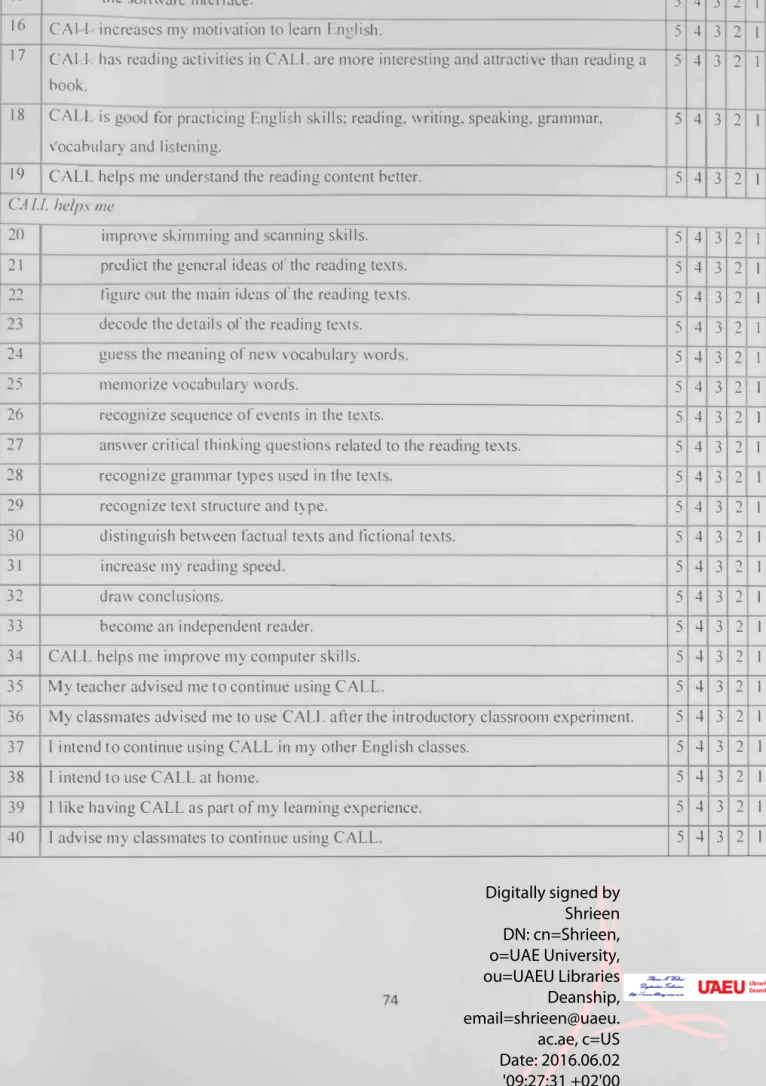
que tiOlmaire included 44 statements and consisted of two sets of questions. The fi rst ection was the background, which included two q uestions on the number of students who u ed computers and CALL at home. The second section included 40 statements on the u e of CALL the d istribution of the i tems on the questionnaire was random. The sections of the q uestionnaire were ease of use, interface, i nteraction, learning, and retention.
The questionnaire was modified several t imes according to the opinions of several university inst ructors and school supervisors. Their feedback was taken i nto consideration. TIlis process provided content val idity. A pi lot study was also
conducted to test the rel iabi l i ty of the questionnaire; therefore, the Cronbach Alpha rel i ab i l ity coefficient was used and calculated as 0 . 7 7 which showed that the questionnaire used was rel iable.
Rc a rch De ign
{,hi stud} u ed a qua i-experimental design. Pre and posttests were used. The indepL:ndent \ ariable in thi stud wa the impact of ALL and the two dependent variables \vere tudents' reading achie ement and their attitudes toward the u e of
ALL. Participant weren 1 as igned random l within each group and class because of technical i ues. T\ 0 la es were in 01 ed in this study (Class A and Class B).
Ja A 'Was the experim ntal group and Class B wa the control group.
Data ol lection P roced u re
Both groups recei ed the same EM A exam as a pretest. For one ful l month, the experimental group practiced reading ski l l s using CALL ( Merit software) at the computer lab. The control group practiced reading comprehension using the regular method. fter 1 month, the ame EMSA exam was administered to the two groups to identi fy the d i fference in the achievement. Finally, the e pell mental group received a que tionnaire about their perspectives on CALL. Before students began answering the quest ionnaire, they received some verbal instruction about how to complete it. A 5-point Likert scale was used to help students d i fferentiate negative and positive
attitudes. Some words in the questionnaire were simpl i fied to ensure the questionnaire was suitable for most o f the students. The researcher translated some statements for low achie ers.
fable 1 bel \\ h \\ the di fference in teaching the c ntrol and experimental group
thr ugh thi tudy:
Ta ble 1 : E x perimen tal g ro u p a n d con t rol aroup t rea t m e n t
O bj ective
o n tc n t
Del ivery M ethod
Place
E n rich m e n t a c t i v i ties
E xpe r i m e n t a l gro up Enhanc stud nt ' reading achievement
1 rit oftware content ( Read ing passages)
LL ( Merit) oftware program ( tudents use Merit software read ing comprehension texts and an wer the interactive questions)
In the Computer lab
Based on the interactive software ( Merit software)
As ignments Completing interactive tasks in reading using Merit software
Time of treatment One moth, 45 m inutes a day
I n structor Same English teacher Prete t -posttest Same
I nstru m entations Pre-test, post-test and Questionnaire
C o n t ro l gro up
Enhance tudents' reading achie ement
Merit software content ( Reading passages)
Traditional method
( Students read the comprehension texts through papers and answer their questions using pencils) I n the normal classroom
Based on the passages that teacher gives (enrichment activities related to the theme)
Answering readi ng comprehension handouts
One moth, 45 minutes a day
Same Engl ish teacher Same
D a t a n a ty i
fter c l Iecting data from the pretest, postte t, and questionnaire, three types of tati tic \\ ere used to anal yze data: (a) anal sis of ariance (b) descriptive
tatistic and (c) an independent ample t-test. To analyze the posttest data, the re carcher used analysis of variance ( OV ) to determine i f there was an
signi ficant di f.(I renee between the achie ements of both groups. Also, to analyze the que tionnaire'. the researcher used both an independent-samples I test to find the di fferences among the e perimental group and descriptive statistics to analyze
tudents' att itudes toward the u of C LL.
u m m a ry
This chapter de cri bes the methodology of study, including the research questions, participants, and setti ng, data collection tools, design, procedures, and data analy s. It de cribes the method by which the researcher i nvesti gated the effects of CALL on students' readi ng achievement and student I attitudes toward the use of
CALL. Three methods were used : pretest, posttest, and a questionnai re. The participants ( = 50) were from one school.
C h a pter 4 : Rc u l t
I n t roduction
The aim of thi tud wa to examine and measure the effect of using CALL on tud nts ' a hie ernent in reading. It also aimed to provide information about students' per pecti ves on the use of ALL in language learning by investigating their attitude to\\ ard the u e of C LL. Thi chapter presents the procedures used to attain the re ult \ jth the fol lo\\ ing in truments : the EM A test and a questionnaire. The re ult of this study are pr sented ba ed on the research questions .
F i n d i n g of t h e S t u d y .
Qlle, lion 1
I n order to answer Question 1 " to what extent can CALL affect students' achievement in reading?", the q uestion tended to measure students' achievement in their pre and post-tests i n reading. Students took the posttest after one month of either regul ar i nstruction or CALL. Analy is of variance ( ANOY A) was perfo rmed to test the significant difference between the control and the experimental groups. The resu l ts obtained from the analysis of ariance indicated that there was a sign i ficant difference i n the ach ievement scores ( p= .000 < 0.05). Therefore, the hypothesis " there i s no sign i ficant difference between using ordinary methods i n teaching and using CALL in terms of students' achievement i n reading " was rejected. The summary of the analysis i s shown on table 2 .
Table 2: n a l Source Corrected Aiodel Intercept Group Pretest Error Tolal Correcled Total of a ri a n c e (ANOVA) of Tvpe III Sum of
Squares 1 1 1 36.9258 6 1 5 . 1 5 8 1 3 04.439 8203 . 1 45 2 763 .095 1 23693 .000 1 3900.020 !If 2 47 50 49 * R Squared = . 80 (Adjll fed R Squared = . 79)
QlIe lion 2 t u d e n t ' a c h ie e m e n t i n rea d i n g Mean F Sig. Square 5 568 .462 94 . 7 1 9 .000 6 1 5 . 1 5 8 1 0.464 .002 1 3 04.439 22. 1 8 8 .000 8203 . 1 45 1 3 9.53 5 .000 5 8 .789
In order to answer Question 2 " How do students (in the experimental group) percel e using CALL? " , the researcher summarized students' overall attitudes of all sections (ease of use, i nterface interaction, learni ng, and retention) i n the
questionnaire.
I n the fi rst section of the questionnai re "ease of use", there were 4 i tems
focused on how students fel t about using CALL. Table 5 i ndicates the means and
standard deviations of each item. The results showed that the majority of students
found CALL an easy, clear, and comfortabl e tool for learning. Furt hermore, many of
them found the l evel of the l anguage in CALL was appropriate to their l anguage level.
I n addition, a lot of students agreed that the time spent using CALL was enough to