ORIGINAL ARTICLE
Strategic maintenance technique selection using combined quality
function deployment, the analytic hierarchy process
and the benefit of doubt approach
Rahul Baidya1&Prasanta Kumar Dey1&Sadhan Kumar Ghosh1&
Konstantinos Petridis2
Received: 14 April 2016 / Accepted: 25 September 2016
#The Author(s) 2016. This article is published with open access at Springerlink.com
Abstract The business performance of manufacturing
orga-nizations depends on the reliability and productivity of equip-ment, machineries and entire manufacturing system. Therefore, the main role of maintenance and production man-agers is to keep manufacturing system always up by adopting most appropriate maintenance methods. There are alternative maintenance techniques for each machine, the selection of which depend on multiple factors. The contemporary ap-proaches to maintenance technique selection emphasize on operational needs and economic factors only. As the reliability of production systems is the strategic intent of manufacturing organizations, maintenance technique selection must consider strategic factors of the concerned organization along with op-erational and economic criteria. The main aim of this research is to develop a method for selecting the most appropriate maintenance technique for manufacturing industry with the consideration of strategic, planning and operational criteria through involvement of relevant stakeholders. The proposed method combines quality function deployment (QFD), the analytic hierarchy process (AHP) and the benefit of doubt (BoD) approach. QFD links strategic intents of the organiza-tions with the planning and operational needs, the AHP helps in prioritizing the criteria for selection and ranking the alter-native maintenance techniques, and the BoD approach facili-tates analysing robustness of the method through sensitivity
analysis through setting the realistic limits for decision mak-ing. The proposed method has been applied to maintenance technique selection problems of three productive systems of a gear manufacturing organization in India to demonstrate its effectiveness.
Keywords Maintenance techniques . Analytic hierarchy
process . Quality function deployment . Benefit of doubt . Stakeholder’s needs . Sustainability
1 Introduction
Appropriate maintenance of plant equipment and machineries significantly reduces overall operating cost of manufacturing. Additionally, it contributes to customer satisfaction through desired quality and on time delivery. The development of new technologies and managerial practices warrants mainte-nance crew to ensure having desired technical and managerial skills [1]. Deterioration and failure of systems result to high costs, due to production losses and delays, unplanned inter-vention on the system and safety hazards. Therefore, appro-priate maintenance strategy is necessary in order to prevent failure [2]. Moreover, maintenance crew must select the most appropriate maintenance technique for each machine and manufacturing system out of a set of possible alternatives. In particular, the development of maintenance strategies (i.e. a suitable combination of corrective, preventive and predictive maintenance) must take into account that resource limitation affects maintenance quality [1]. The current practices of the maintenance technique selection are mainly based on the op-erational criteria in line with machine specification giving ut-most importance to the economic factors rather than framing the maintenance strategy based on the strategic importance in combination of technical requirements and efficiency. * Prasanta Kumar Dey
1
Department of Mechanical Engineering, Jadavpur University, 188 Raja Subodh Chandra Mullick Road, Jadavpur, Kolkata, West Bengal 700032, India
2 Department of Applied Informatics, University of Macedonia, 156
Egnatia str., 54006 Thessaloniki, Greece DOI 10.1007/s00170-016-9540-1
There are number of studies on maintenance technique selec-tion framework development and decision making using opera-tional research techniques [2]. The implementation of advanced manufacturing technologies demands reduction of buffers inven-tory that increases pressure on selection of most appropriate maintenance technique [3]. Therefore, maintenance technique selection has become strategic that needs attention of both voice of customers’(higher management and production people) and voice of technical persons (maintenance crews). Maintenance performance measurement (MPM) is perceived as an important function to achieve sustainable performance of any manufactur-ing organization [4]. While maintenance performance indicators have been studied extensively, little has been done to develop a systematic approach that embraces every level of business activ-ities (i.e. strategic, tactical and operational) for maintenance tech-nique selection [5]. A maintenance plan, which is based on a rational assessment of priorities and up to date knowledge of the condition of the facilities and inventory, will help to ensure the best use of available resources. Based on this, a model is presented, using the analytical hierarchy process in deciding the importance of the criteria [6]. With asset availability and reliabil-ity becoming critical issues in capital-intensive operation, the strategic importance of maintenance in business is needed to be recognized and maintenance management should be based on certain strategic dimension [7]. Maintenance must be viewed in long-term strategic perspective and must integrate technical and commercial issues. A strategic maintenance approach empha-sizes on the quantitative business model that integrate mainte-nance needs with other operational decisions such as production, procurement, marketing and sales [8]. In their work, Luce [9] selects the best maintenance method using Weibull Law by com-paring corrective maintenance, systematic preventive mainte-nance and conditional preventive maintemainte-nance. Parida and Chattopadhyay [10] present a multi-criteria hierarchical mainte-nance performance measurement framework to resolve this issue although their framework does not provide any guidance on the selection of business specific maintenance engineering methods. Arunraj and Maiti [11] propose an approach of maintenance policy selection based on risk of equipment failure and cost of maintenance using the analytic hierarchy process (AHP) and goal programming (GP). Tan et al. [12] propose a risk-based inspec-tion (RBI) methodology to evaluate the maintenance strategy through probability and consequence of accident or failure. They use the AHP to select the most practicable maintenance strategy for specific equipment. Bertolini and Bevilacqua [13] present a combined AHP-GP model. The AHP prioritizes differ-ent maintenance policies with respect to the classical failure mode effect analysis criteria (i.e. occurrence, severity and delec-tability), and the GP formulates a model that led to identification of the best set of maintenance type for the equipment failure modes considered.
Garcia et al. [14] present application of Intelligent System for Predictive Maintenance (SIMAP) to the health condition
monitoring of a wind turbine gearbox. Katchasuwanmanee et al. [15] propose a thermal and energy-management prototype system e-ProMan for application in SME manufacturing envi-ronments. Dey [16] contributes a risk-based inspection and main-tenance approach for cross-country oil pipeline systems that helps selecting varied maintenance methods for different sections of oil pipelines. The quality function deployment (QFD) has been used by Kutucuoglu et al. [5] to develop performance mea-surement system in maintenance. Carnero [17] proposes a model that carries out the decision making in relation to the selection of the diagnostic techniques and instrumentation in the predictive maintenance programs. The model uses a combination of the AHP and factor analysis (FA). It considers a number of criteria that help to select the best alternative maintenance technique. Although this method considers both strategic, technical and managerial criteria, it does not build any relationship between management and technical requirements. Bashiri et al. [14] pres-ent an approach for selecting optimum maintenance strategy using both qualitative and quantitative data through interactions with the maintenance experts based on linear assignment method (LAM) with interactive fuzzy linear assignment method (IFLAM). Chemweno et al. [19] propose a risk assessment tech-nique in maintenance decision-making domain using the analytic network process. Baidya and Ghosh [18] propose a framework for predictive maintenance indicator effectiveness (PMIE) based on the AHP and analyse the model based on multiple case stud-ies. Wang et al. [20] applied fuzzy AHP methodology to evaluate the best maintenance strategy for different equipment.
In summary, three categories of studies have been under-taken in maintenance technique selection—application of multiple criteria decision-making techniques to accommodate strategic, planning and operational criteria; risk-based ap-proaches that consider both multiple criteria and probabilistic analysis; and failure mode effect analysis (FMEA) approach that allows organization to derive condition of specific equip-ment or machine objectively through a few rule-based ap-proach and facilitate deriving maintenance method according-ly. The previous studies have also recognized the need of considering strategic intents in maintenance technique selec-tion and incorporated strategic criteria in selecselec-tion model. However, the methods of identifying those criteria and inte-grating them with selection model objectively are not clearly explained in these researches. Therefore, there is clear knowl-edge gap on the processes of capturing strategic information and connecting them to maintenance method selection. This study bridges that gap. Although maintenance method selec-tion for any equipment, machinery and productive system depends on technical specification, cost of maintenance and operational policy, linking them with organizational strategy in one hand enhances productivity of the system and on the other hand ensures overall organizational sustainability.
QFD has been deployed extensively to capture voice of customers for decision making across the functions of
manufacturing and services operations [21]. QFD has been integrated with multiple criteria decision-making techniques for various decision making. Bhattacharya et al. [22] combine QFD with the AHP for robot selection in manufacturing, Chuang [23] uses for location decision, Hanumaiah et al. [24] apply for rapid hard tooling process selection, Ho et al. [25] adopt for strategic sourcing, and Dey et al. [26] analyse supplier performance. Although the above studies adequately address the consideration of aligning voice of customers with technical requirements in order to make decisions quantita-tively across organizational functions and processes, none of the studies precisely address the realistic upper and lower limit of criteria importance for sensitivity analysis of the outcomes (i.e. decision alternatives). This study proposes a holistic maintenance technique selection method that combines both strategic intents of the organization with technical require-ments of the maintenance crew in an analytical framework along with the robustness analysis. While QFD integrates stra-tegic, planning and operational requirements of stakeholders across the organizational hierarchy, the AHP prioritizes deci-sion alternatives, and benefit of doubt (BoD) approaches en-sure the robustness of the model through introducing confi-dence interval and sensitivity BoD analysis. According to the authors’knowledge, the integrated QFD, the AHP and benefit of doubt approach neither has been used in prior studies nor has this been applied in maintenance technique selection.
The paper is organized as follows. Section2introduces the proposed integrated QFD, AHP and BoD approach. Section3 describes the application of the proposed framework within a manufacturing organization in three different types of systems in order to demonstrate its effectiveness. Section4elucidates the results and findings from the case studies. Section5 dem-onstrates contributions of the study and concludes with infor-mation for further scope of research.
2 Model development
2.1 Notation Indices i= 1 , . . . ,n Customer j= 1 , . . . ,m Technical requirement ParametersRij Relation between customeriand technical
characteristicj
Ci Importance weight for customer requirementi
W0
j;U
Upper bound on normalized weight corresponding to technical characteristicj
W0
j;L
Lower bound on normalized weight corresponding to technical characteristicj
Variables
Wj Degree of importance for the technical requirementj
W0
j
Normalized importance for the technical requirementj
Eij Eigenvector (importance) score of customeri
corre-sponding to technical characteristicj
Sj Overall score of technical requirementj
2.2 House of quality
The concept of house of quality (HoQ) has been first intro-duced by Houser and Clausing [27]. This house-like diagram provides information regarding the relationship between the customer’s needs and how the business/firm will facilitate these needs. HoQ diagram consists of two parts: the relation-ship between strategic requirements of the higher manage-ment and operational needs of maintenance group, and the relationship between maintenance group’s requirements and alternative maintenance techniques/technologies. These two HoQs facilitate derive relative ranking of maintenance methods using QFD [28] framework.
2.3 The proposed QFD-AHP-BoD approach
In order to utilize the information provided by QFD and derive the degree of importance of customer’s requirements towards tangible and intangible technical characteristics, a QFD-AHP approach is adopted in this paper. The AHP is a multiple criteria decision-making (MCDM) technique, developed by Saaty [29], where aiming at capturing the intra-relationships between criteria, both tangible and intangible through pairwise comparison. A graphical outline of the paper is pre-sented in (Fig.1); two HoQs are presented (I and HoQ-II). In HoQ-I, the rows represent strategic requirements while columns the technical requirements. In HoQ-II, the rows rep-resent technical requirements and columns reprep-resent alternate maintenance techniques. BoD [30] approach has been adopted to check the robustness of the proposed method through set-ting upper and lower limits of criteria weight.
The comparisons are made using a scale of absolute judge-ments that represents how much more one element dominates another with respect to a given attribute [29]. Inconsistency is a major problem of the AHP methodology [29]. The index that measures consistency in the AHP is consistency ratio (CR). For the calculation of CR, consistency index (CI) which is calculated in (1) and random index (RI) must be provided; RI is a fixed number based on the dimensions of a pairwise comparison matrixAij.
CI¼λ
max−n
n−1 ð1Þ
In (1),λmaxstands for the largest eigenvalue of a pairwise comparison matrixAijof dimensionsn×n, while fixed values
measure based on whether pairwise comparisons are consis-tent or not, is defined as the quotient of CI to RI.
CI RI¼CR ≤10%consistent >10%inconsistent ð2Þ
Other constraints of the AHP has been demonstrated else-where [16].
QFD was first applied by Japanese manufacturing or-ganizations to meet customers’ requirements throughout the design process and also in the design of production systems. A matrix is used to present data and information [31]. A full QFD application may make use of several HoQ diagrams, forming a sequence that gradually trans-late customer requirements into specific manufacturing steps and detailed manufacturing step requirements. Furthermore, QFD methodology is an overall concept that provides a means of translating customer requirements into the appropriate technical requirements for each stage of product development and production (i.e. marketing strategies; planning, product design and engineering; totype evaluation; production process development; pro-duction; sales) [32].
In this study, two HoQs have been used for the model development, linking the multiple criteria to form an effective decision making model. The generic model development has been explained below in steps.
1. The strategic managerial requirement was identified from the concerned expert group and also verified from the literature. This constructs/criteria are the “WHATs”of the HoQ-I. The importance of this constructs/criteria was derived through pairwise comparison based on the AHP.
2. The technical criteria were identified based on the requirements of the maintenance group and the criti-cal parts considered for the study. These constructs/ criteria are the “HOWs” of the HoQ-I. The relation-ship rating based on predefined scales 9, 3, 1 and 0 indicating strong relationship, medium relationship, weak relationship and no relationship respectively, is obtained. These ratings were obtained from the same expert groups. This analysis yielded the degree of importance (importance-2) of each of the technical criteria by correlating with the managerial require-ments. Assuming that there arej= 1 , . . . ,n technical requirements and customer requirements, the compu-tation of degree of importance is performed as Wj¼
Xm i¼1
Rij⋅Ci;j¼1; :::n ð3Þ
In (2),Wjis an n× 1 vector representing the degree of
importance between technical requirementj and is defined as the product or quantified relationships between customer requirementiand technical requirementj(Rij), as well as
im-portance weighting of customer requirementi(Ci).
3. Degree of importance is further normalized by divid-ing each elementwjof vectorWjby the sum of all the
Table 1 Values for random index (RI) based on the dimensions of pairwise matrixA Number 1 2 3 4 5 6 7 8 9 10 RI 0 0 0.58 0.9 1.12 1.24 1.32 1.41 1.45 1.49 S trategic requirements Technical requirements
HoQ-I
MaintenancerequirementsEigenvectors Importance 2 Normalized value Technical requirements
HoQ-II
No rmali zed valueOverall score for maintenance tecnhology
Fig. 1 Graphical representation of QFD-AHP methodology
elements. The resulting normalized score for each technical requirement j is denoted as Wj′ and yields
a value in the range of [0, 100]% . W0j¼ wj
Xn j¼1
Wj
;j¼1; :::n ð4Þ
4. The technologies available for the considered critical parts were identified from the literature, and a HoQ-II was de-veloped. The WHATs part in HOQ-II relationship matrix are the technical criteria of the HOQ-I, and the HOWs are the technologies considered for the critical parts.
5. Finally, the AHP analysis is applied for the examined technologies based on each and every maintenance group; constructs/criteria are used to obtain the importance/Eigen vector (Eij) for each alternative technology. The overall
score for each requirementjdenoted asSjis calculated by summing over indexj, the product of the normalized score for each technical requirementjwith eigenvector score de-rived for each customer requirementi and technical re-quirementj.
6. Taking all the information regarding the normalized weightsW0j, a linear programming (LP) model is formed in order to investigate the sensitivity of each weight with bound and preference constraints.
Sj¼ Xm
i¼1
W0j⋅Eij;j¼1; :::n ð5Þ
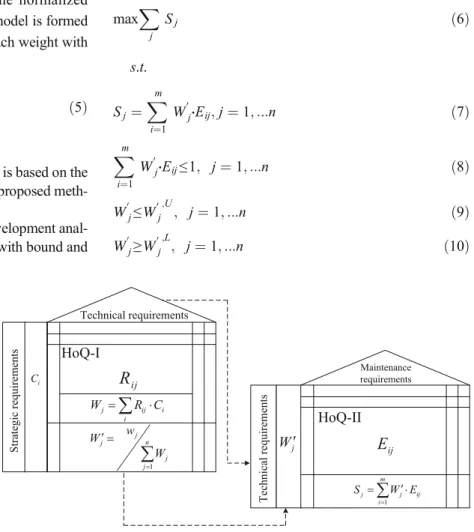
The ranking of the maintenance technology is based on the overall score as derived from step 5 [22]. The proposed meth-odology is graphically summarized in Fig.2.
The analysis employed is based on data envelopment anal-ysis (DEA) technique and especially on BoD with bound and
preference constraints. The optimal weights are calculated based on a LP model. The hierarchy formed in HoQ-II is shown in Fig.3.
Based on that hierarchical structure, the optimal weights are to be calculated in order to provide a ranking for technical requirements. Weights assigned to each“branch”come from HoQ-I, and the target in that analysis is to recalculate the weightsW0j based on the proposed BoD model. The aim of the LP model is to maximizeSj, which in this case is serving used as a CI. Based on (5), the objective function (6) is to maximize the overall score∑
jSj, while this score should yield a maximum value of 1 so constraint (8) is introduced in order to bound each score to 1. Weights that are calculated in HoQ-I are used as initial points and bounds are constructed. Thus, each initial weight value is eventually corrected based on an initial estimation of the weights calculated from HoQ-I. Therefore, constraints (9) and (10) are formulating the bounds placed on each weight. Finally, preference constraints are in-troduced in order to retain the order of weights provided from HoQ-I. Non-negativity constraint (12) is introduced to prevent each weight of taking a negative value.
maxX j Sj ð6Þ s.t. Sj¼ Xm i¼1 W0j⋅Eij;j¼1; :::n ð7Þ Xm i¼1 W0j⋅Eij≤1; j¼1; :::n ð8Þ W0j≤W0j;U; j¼1; :::n ð9Þ W0j≥W0j;L; j¼1; :::n ð10Þ Technical requirements HoQ-I Maintenance requirements i C
R
ij HoQ-II Technical re q uirem ent s ijE
Strategic requirementsFig. 2 Graphical representation of the proposed QFD-AHP methodology
pref W0j¼A;W0j¼B
ð11Þ
W0j≥0;j¼1; :::n ð12Þ
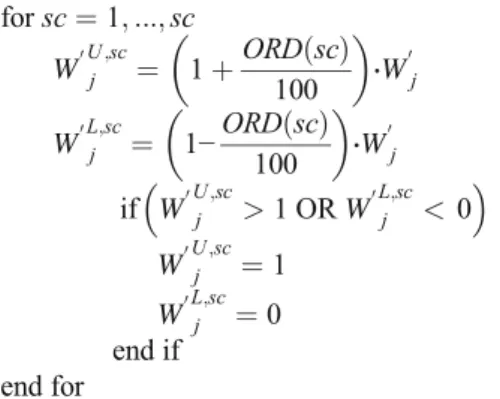
Upper and lower bounds of constraints (9) and (10) that correspond, placed on weightsW0j, are constructed based on the weights derived from HoQ-I. Following that, scenarios on upper and lower bounds are considered with the following procedure presented in pseudo-code in (13). As it can be seen in (13), upper and lower bounds as presented in constraints (9) and (10) are calculated based on the initial value ofW0j. The increment based on which ranges are constructed is based on ORDfunction which corresponds the order of setscwith a number. If upper bound value exceeds 1 or lower bound be-comes a negative number, then a readjustment is made. This procedure implies that the presented LP model is solvedsc times. In this case, 50 scenarios were assumed for bounds starting from ±1 to ±20 %. forsc¼1; :::;sc W0Uj;sc¼ 1þORD scð Þ 100 ⋅W0j W0Lj;sc¼ 1−ORD scð Þ 100 ⋅W0j if W0Uj;sc>1 ORW0Lj;sc<0 W0Uj;sc¼1 W0Lj;sc¼0 end if end for ð13Þ
Preference set of constraint (11) is introduced to retain the ranking of the criteria (technical requirements) based on the weights derived from HoQ-I.
3 Model application on case study
3.1 Step by step approachThe proposed model has been applied to a gear manufacturing organization in India to demonstrate its effectiveness. Gears
are the integrated parts of machines for power transmission. With the advancement of technology, gear manufacturing comes under one of the hi-tech manufacturing industries. It deploys complex machineries and needs sophisticated technologies/techniques for maintenance. Gear manufacturing is in growing trend in India with the recent advancement of automotive industry. However, most appropriate maintenance technique selection for various systems within a complex ma-chine is still challenging. The company under study manufac-tures a wide variety of gears with turnover of 6 million pound. The organization deploys modern machines, and equipment in their production line and maintenance services are provided by a dedicated maintenance department. The modern state of the art machines are maintained by the original equipment manufacturers (OEMs). The manufacturing/production and maintenance groups work closely in order to keep the produc-tion up to the target. The following paragraphs demonstrate the application using step by step approach.
Step 1: The board of directors including the production
di-rector of the concerned organization was engaged for the case study in order to identify their require-ments through the voice of customer (VOC). The requirements of the board members and the con-cerned stakeholders were obtained in a focussed group of five persons—the finance director, market-ing director, production directors, general manager and production manager. The following constructs/ criteria [33,34] were derived from their require-ments return on investment, running cost, reliability, operability, flexibility, machine availability, safety, resource utilization and energy consumption The importance of each criterion is determined using pairwise comparison following the AHP approach with the involvement of the concerned stakeholders. These criteria are the WHATs for the HoQ-I (that is the first QFD relation-ship matrix), and their ratings were obtained from the same focussed group using questionnaires survey. The questioner was prepared for the collection of the qualitative data so as to analyse the decision model. The questionnaire was developed based on the obtained constructs and their relationships. The answers were obtained on a predefined scale of AHP and QFD. The answers were obtained from executives of the par-ticipating organization. The parpar-ticipating executives are all functional experts in manufacturing and maintenance and hav-ing more than 15 years of industry experience. Table2shows the results of pairwise comparison and relative importance of criteria as well as consistency ratio.
Step 2: The strategic maintenance requirement of the
con-cerned organization was identified through brain-storming session with the selected focussed
Goal
C1 C2 C3 C4
. . . . .
C1 C2 C3 C41
j
W Wj n
maintenance group consisting of five of the top main-tenance group board members and other stakeholder members, including R&D department engineers, chief maintenance engineer, chief plant engineer and pro-duction engineer. These requirements are the HOWs for the HOQ-I. The focussed group identified the three critical parts of the machines for the study. They were bearing system, gear system and lubrication system. Vibration analysis, acoustic emission, shock pulse method and oil analysis are considered as alternative maintenance techniques for bearing and gear systems. For lubrication system, the alternative maintenance techniques are process parameter, performance moni-toring and oil analysis. The requirements of mainte-nance department were derived through brainstorming with the involvement of experienced maintenance crew. The technical requirements are as follows: (a) indicating cost of setup, (b) number of probes required, (c) maintenance time required, (d) time for setup, (e) meets maintenance standards, (f) breakdown/ corrective maintenance reduction, (g) life cycle of the setup, (h) frequency of equipment inspection, (i) sup-port equipment required, (j) technical expertise re-quired for maintenance, (k) effectiveness of the setup and (l) reparability of the setup. The following para-graph briefly describes the proposed alternative main-tenance methods.
Vibration analysis still remains the most popular mainte-nance technology for rotating equipment [35]. Its applications have been presented for monitoring the gearbox [36] and the bearings [37, 38]. The measurement and interpretation of acoustic emissions (AE) parameters for fault detection in ra-dially loaded ball bearings have been demonstrated at
different speed ranges [39]. In addition, the application of AE for the detection of bearing failures has been presented by Tan [40]. Little or no vibration may be evident while faults are developing, but analysis of the oil can provide early warn-ings; a case study of a wind turbine gearbox is presented by Leske and Kitaljevich [41]. Shock pulse method (SPM) has been used as a quantitative method for condition monitoring of bearings and works by detecting the mechanical shocks that are generated when a ball or roller in a bearing comes in contact with a damaged area of raceway or with debris [42]. Signals are picked up by transducers, and analysis gives an indication of system condition [43]. Process parameters are the maintenance based on the detection of signals exceeding predefined control limits, control systems becoming increas-ingly sophisticated and diagnostic capabilities even better. Transient and oscillatory stabilities were analysed with differ-ent wind scenarios for electricity generation process [44]. Zaher and McArthur [45] give an explanation of the use of signals and trending for fault detection based on parameter estimation. Performance monitoring analysis the relationship between parameters such as power, wind speed, blade angle and rotor speed for an assessment of wind turbine condition and for the early detection of faults [46].
Step 3: The strategic/managerial criteria and the
mainte-nance group requirements relationship were corre-lated according to QFD scale (strongly, moderately and weekly related and no relationship). The partic-ipants developed consensus on every relationship through brainstorming. Their responses were con-sidered along with the importance of the strategic requirements in order to determine overall impor-tance of the criteria/requirements of the maintenance group using Eqs. (3) and (4) (Fig. 2). The HoQ-I (Table3) depicts the numerical figures for the case Table 2 Pairwise comparison matrix for degree of importance considering the managerial aspects
Major customer (managerial) aspects Return on investment Running cost
Reliability Operability Flexibility Machine availability Safety Resource utilization Energy consumption Eigen vector CR Return on Investment 1 3 0.333 3 3 1 0.333 5 1 0.12028 0.09848 Running cost 0.333 1 1 1 3 3 0.333 3 1 0.1051 Reliability 3 1 1 3 5 3 0.333 5 3 0.17522 Operability 0.333 1 0.333 1 3 0.333 0.142 3 2 0.06666 Flexibility 0.333 0.333 0.2 0.333 1 0.2 0.142 2 3 0.04578 Machine Availability 1 0.333 0.333 3 5 1 0.333 3 2 0.10222 Safety 3 3 3 7 7 3 1 7 5 0.30198 Resource Utilization 0.2 0.333 0.2 0.333 0.5 0.333 0.142 1 0.333 0.02575 Energy Consumption 1 1 0.333 0.5 0.333 0.5 0.2 3 1 0.05700
study organization. The outcome of this step is the importance of the requirements of maintenance group.
Step 4: In this step, the relative priority of alternative
main-tenance techniques against each criteria as derived by the maintenance group was revealed using pairwise comparison in the AHP framework. The participants consensually provide the rating using Saaty’s scale [29]. The outcomes of the pairwise comparisons along with relative priorities of each maintenance technique for the bearing system were derived; one of them has been depicted in Table4.
Step 5: The importance/Eigen vector (Eij) for each
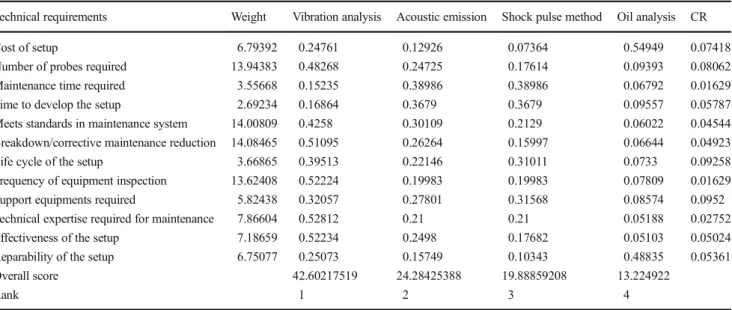
alterna-tive technology/technique obtained from the above step was used as the relationship rating for the HOQ-II. The importance of each criterion of maintenance group’s requirements came from step 3. The overall relative weights and ranking of the maintenance techniques were derived using Eq. (5), as it can be seen in Fig.2. The HoQ-II for bearing system, gear system and lubricating system are shown in Tables5,6and7respectively.
Step 6: In this section, a robustness analysis is performed for
the evaluation of weights assigned to each technical requirementj. The notion behind this meta-analysis is to identify weight’s variability and therefore to exam-ine how robust is the decision made, from the insight of the decision maker. In other words, the analysis provides a level of how certain the decision maker could be when ranking the technical requirements in term of weights. Generally, this technique is applied for composite indicators but is flexible and presents information regarding the weights and value of each criterion based on preselected alternatives [47].
For illustrative purposes, an application is demonstrated in
“Bearing system framework for company” presented in Table5, but the proposed sensitivity analysis can be applied to the other systems (gear system, lubrication system). The technical requirements are denoted with numbers: (1) cost of setup, (2) number of probes required,..., (12) reparability of the setup. Based on Table 5(weight column), it is assumed that 4≺3≺7≺9≺12≺1≺11≺10≺8≺2≺5≺6, whereas ≺ indicates the preference of a technical requirement over anoth-er; for instance,5≺6 is translated as 6 is preferred from 5. To that end, a technical requirementAwhich is preferable from a technical requirementBis modelled with constraint (13). W0j¼A≻W0j¼B→W0j¼A≥W0j¼Bþε ð14Þ
In (14),εstands for a very small positive number and is introduced in order to exclude the fact that two weights will
have the same value; a modified BoD model ((6)–(12)) pro-vides the optimal readjusted weights of the hierarchy form presented in Fig. 3. Preference set of constraints introduced in (13) is analysed with the constraints regarding preferences (15)–(25). W0j¼6≥W 0 j¼5þε ð15Þ W0j¼5≥W 0 j¼2þε ð16Þ W0j¼2≥W 0 j¼8þε ð17Þ W0 j¼8≥W 0 j¼10þε ð18Þ W0j¼10≥W 0 j¼11þε ð19Þ W0j¼11≥W 0 j¼1þε ð20Þ W0j¼1≥W 0 j¼12þε ð21Þ W0j¼12≥W 0 j¼9þε ð22Þ W0j¼9≥W 0 j¼7þε ð23Þ W0j¼7≥W 0 j¼3þε ð24Þ W0j¼3≥W 0 j¼4þε ð25Þ
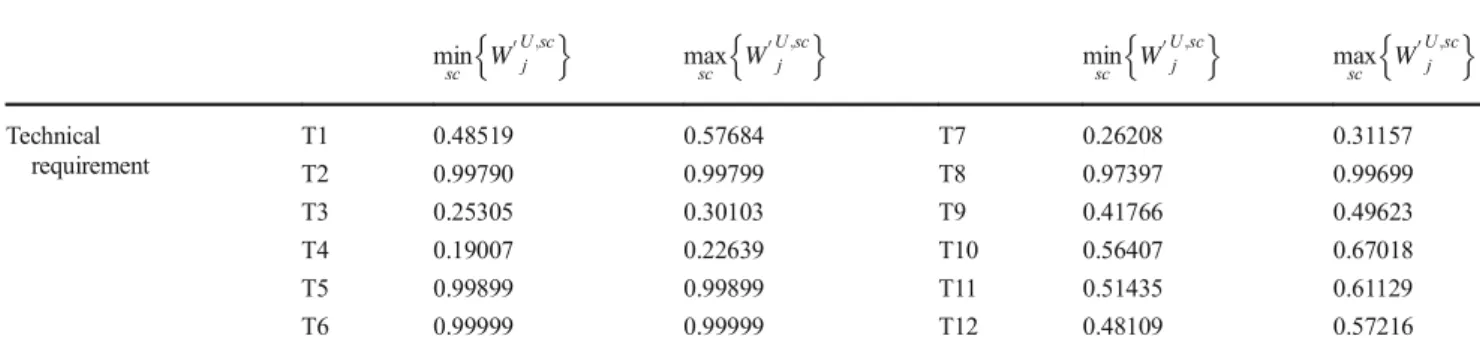
After solving BoD model, the following results regarding weight ranges are presented in Table8.
Based on the approach presented above, let us see an exam-ple of the applicability of the sensitivity analysis. The normal-ized weight assigned to cost of setup (technical requirement 1) is 0.482. In order to measure the sensitivity of each weight that corresponds to technical requirements with respect to the values, the following bounds are considered for each scenario. The bounds, as shown in (26) and (27), correspond to a ±1% deviation in the base value of the weight for scenario 1. W0j¼1≤1:1⋅0:482¼0:4871 ð26Þ
W0j¼1≥0:99⋅0:482¼0:4775 ð27Þ
Solving BoD model with objective function (6) and con-straints (7)–(12), the weightW0j¼1yields an optimal value of 0.4851. The corresponding bounds for scenario 50 are given by [0.3858, 0.5788], while the optimal value for scenario 50 of W0
j¼1 is 0.5768. As ranges do not provide a representative
image of each weight’s variability, standard deviation measure is employed for each range (Fig.4).
In Table8, the range of each technical requirement is cal-culated with respect to minimum and maximum values for each scenario.
According to Fig. 4, the technical requirements with the smallest variability are 5, 6 and 2, while the one with the
Ta b le 3 M ana ger ial cr iter ia vs. m ai nten ance g roup requirement relations hip m atrix Maintenan ce engine ers requirement Customer requirement
(companies managerial perspective) Importance using A HP Cost of set u p Num b er of probes req u ire d Maintenance time required Ti m e to develop the se tup Me ets stan dards in ma inte nanc e syste m Breakdown/ corr ec tive maintenance reduction Li fe cyc le o f the setup F requency o f equipment inspec tion Support equip m ent required T echni cal expertise requ ire d fo r ma inte nance Ef fect ivene ss of the setup Repa ra bili ty of the setup Return on investment 0.12028 9 1 0 9 3 9 9 1 3 1 3 9 Running cost 0.10510 1 3 1 0 9 9 3 9 3 3 0 9 Reliability 0.17522 3 9 1 0 3 9 0 3 3 9 9 0 Op erability 0.06666 1 3 1 0 3 0 0 0 9 9 0 0 Flexibility 0.04578 1 3 3 0 3 0 0 0 3 0 1 0 Machine availability 0.10222 0 0 9 0 0 9 0 9 0 0 0 3 Safety 0.30198 3 9 0 0 9 3 0 9 0 1 3 1 Resource utilization 0.02575 0 1 1 0 9 9 3 3 9 3 0 3 Ener gy cons umption 0.05700 0 9 0 0 9 0 0 3 3 3 0 0 Degree of importance fo r sel ec tion cr ite ri a 2.731 6 5.60645 1.43005 1.08252 5.63229 5.66307 1.4750 5 .47789 2.341 83 3.16273 2.88954 2.7143 No rmalized value 6 .79 13.94 3.56 2.69 14. 01 14.08 3.67 13 .62 5.82 7.87 7.19 6.75 Rank 7 3 1 1 12 2 1 10 4 9 5 6 8
largest is technical requirement 10. From this analysis, it can be concluded that the decisions regarding technical require-ments with smallest variability in the weight ranges are more stable than those with largest variability in the weight ranges.
4 Results and findings
This section demonstrates the specific findings from the ap-plication of the proposed framework in the case study organi-zation. Three most strategic requirements of the management of the case study organization were safety, reliability and re-turn on investment in sequence. In line with strategic intents of maintenance, the maintenance group’s prioritized require-ments were“corrective maintenance reduction”,“meets stan-dard of a maintenance system”,“number of probes required” and“frequency of equipment inspection”. Overall, the com-bined QFD and the AHP analysis reveal that “shock plus method”,“vibration analysis”and“process parameter”were selected for bearing, gear and lubricating system respectively. The analysis for bearing revealed that the shock pulse method with overall score 28.07 was the best followed by acoustic emission with overall score of 24.19 and the worst was oil
analysis with value of 23.57. In a similar way, the analysis of the gear system was done and it revealed that vibration analysis was the most effective technology followed by acous-tic emission, and on analysing the lubrication system, the most effective technology/technique was process parameters followed by the oil analysis. Surprisingly, technologies with the least importance for all the system except for the lubrica-tion analysis was found to be oil analysis, which the case study organization used to deploy prior to this study for every main-tenance need.
Currently, the oil analysis is deployed for maintenance as this option is less expensive compared to other techniques. However, the strategic intents/managerial requirements are not aligned with current approach to selected maintenance technique. The combined QFD and the AHP method provide a robust and holistic approach to select the right maintenance technique for specific system. For the gear system, the vibra-tion analysis was the best followed by the acoustic emission. For the bearing systems, shock pulse method was the best followed by acoustic emission. The analysis of the lubrication system also indicated that the process parameter is the best which is an inbuilt system in any machinery. The company should exclude the oil analysis from the maintenance system Table 5 Bearing system framework for company
Overall importance of the maintenance technologies
Technical requirements Weight Vibration analysis Acoustic emission Shock pulse method Oil analysis CR Cost of setup 6.79392 0.26534 0.15118 0.0752 0.50829 0.07418 Number of probes required 13.94383 0.27624 0.11815 0.11815 0.48745 0.05787 Maintenance time required 3.55668 0.24725 0.48268 0.17614 0.09393 0.08062 Time to develop the setup 2.69234 0.15006 0.37218 0.37218 0.10558 0.02271 Meets standards in maintenance system 14.00809 0.1713 0.35867 0.40113 0.0689 0.01279 Breakdown/corrective maintenance reduction 14.08465 0.14858 0.32485 0.46005 0.06653 0.03901 Life cycle of the setup 3.66865 0.26094 0.16893 0.11896 0.45117 0.0266 Frequency of equipment inspection 13.62408 0.45086 0.19779 0.25742 0.09393 0.08062 Support equipments required 5.82438 0.16362 0.2829 0.44755 0.10592 0.0266 Technical expertise required for maintenance 7.86604 0.26283 0.14088 0.14088 0.45541 0.00388 Effectiveness of the setup 7.18659 0.12218 0.29762 0.52317 0.05703 0.02567 Reparability of the setup 6.75077 0.25742 0.14697 0.11293 0.48268 0.08062 Overall score 24.16633448 24.19439216 28.0661584 23.573146
Rank 3 2 1 4
Table 4 Pairwise comparison matrix at alternatives level based on cost of setup for bearing system Alternative for cost
of setup
Vibration analysis Acoustic emission Shock pulse method Oil analysis Eigen vector CR
Vibration analysis 1 3 3 0.333 0.26534 0.07418 Acoustic emission 0.333 1 3 0.333 0.15118
Shock pulse method 0.333 0.333 1 0.2 0.0752
unless the strategic maintenance requirement is changed as it showed the least importance in most of the analysis. The oil analysis for lubrication system can be used as secondary main-tenance technology/technique as it is the most effective tech-nologies for lubrication system analysis. Hence, this study provided effective way of obtaining the most effective tech-nology based on the strategic needs of the organization. It has also been revealed from the case study that the organization was selecting maintenance technique on economic criteria alone without considering sustainability issues. The research presents an approach for an effective and sustainable
maintenance system selection model. The model also provides an effective designing methodology for any company’s main-tenance needs; the change of managerial criteria and there degree of importance or the maintenance group requirements can alter the result. Thus, this model is versatile for designing an effective maintenance management system according to the need of the industries. The consolidated results (selection of specific maintenance technique) of the case study is given in Table 9. The proposed analysis is linked with BoD ap-proach and is used as a second stage analysis in order to measure the sensitivity of the weights preferences (decisions). Table 6 Gear system framework for company
Overall importance of the maintenance technologies
Technical requirements Weight Vibration analysis Acoustic emission Shock pulse method Oil analysis CR Cost of setup 6.79392 0.24761 0.12926 0.07364 0.54949 0.07418 Number of probes required 13.94383 0.48268 0.24725 0.17614 0.09393 0.08062 Maintenance time required 3.55668 0.15235 0.38986 0.38986 0.06792 0.01629 Time to develop the setup 2.69234 0.16864 0.3679 0.3679 0.09557 0.05787 Meets standards in maintenance system 14.00809 0.4258 0.30109 0.2129 0.06022 0.04544 Breakdown/corrective maintenance reduction 14.08465 0.51095 0.26264 0.15997 0.06644 0.04923 Life cycle of the setup 3.66865 0.39513 0.22146 0.31011 0.0733 0.09258 Frequency of equipment inspection 13.62408 0.52224 0.19983 0.19983 0.07809 0.01629 Support equipments required 5.82438 0.32057 0.27801 0.31568 0.08574 0.0952 Technical expertise required for maintenance 7.86604 0.52812 0.21 0.21 0.05188 0.02752 Effectiveness of the setup 7.18659 0.52234 0.2498 0.17682 0.05103 0.05024 Reparability of the setup 6.75077 0.25073 0.15749 0.10343 0.48835 0.05361 Overall score 42.60217519 24.28425388 19.88859208 13.224922
Rank 1 2 3 4
Table 7 Lubrication system framework for company Overall importance of the maintenance technologies
Technical requirements Weight Process parameters Performance monitoring Oil analysis CR Cost of setup 6.79392 0.52784 0.33252 0.13965 0.05156 Number of probes required 13.94383 0.58155 0.309 0.10945 0.00355 Maintenance time required 3.55668 0.18517 0.15618 0.65864 0.02795 Time to develop the setup 2.69234 0.48064 0.40539 0.11397 0.02795 Meets standards in maintenance system 14.00809 0.15706 0.24931 0.59363 0.05156 Breakdown/corrective maintenance reduction 14.08465 0.24931 0.15706 0.59363 0.05156 Life cycle of the setup 3.66865 0.48064 0.40539 0.11397 0.02795 Frequency of equipment inspection 13.62408 0.52784 0.33252 0.13965 0.05156 Support equipments required 5.82438 0.58155 0.309 0.10945 0.00355 Technical expertise required for maintenance 7.86604 0.40539 0.48064 0.11397 0.02795 Effectiveness of the setup 7.18659 0.17862 0.11252 0.70886 0.05156 Reparability of the setup 6.75077 0.25828 0.10473 0.63699 0.03703
Overall score 37.91 27.033 35.05
The weights that are derived by QFD-AHP approach are recalculated. The weights are not considered to be fixed, and sensitivity of the weights is calculated as a means of robust-ness (Fig.4).
5 Discussion and conclusion
Maintenance technique selection has strategic significance as production system’s availability is directly connected to any manufacturing organization’s economic performance. Currently, maintenance techniques are selected mainly on the basis of specific technical needs of the production system along with economic factors only. In other words, technically feasible least cost option is considered for maintenance tech-nique selection. This causes several issues as quite often least cost option is not the best in long term as well from total cost ownership perspectives. Additionally, consideration of
environmental and social criteria helps achieve image for global reach. Therefore, there is need for analysing the issue from holistic perspectives considering the strategic intents of maintenance of productive unit and identifying criteria for main-tenance technique selection more objectively with the involve-ment of concerned stakeholders. This study considers both strategic/managerial criteria and requirements of the maintenance group for developing a framework for selecting most appropriate maintenance technique. The framework is based on three decision-making techniques—quality function deployment (QFD), the analytic hierarchy process (AHP), and benefit of doubt (BoD). They are combined together to form a decision support system that enables organizations to select the right maintenance technique for specific system/machinery/equip-ment. The framework needs active participation of the concerned stakeholder to identify the constructs for selection, derive the importance, prioritize of the alternative maintenance techniques and analyse sensitivity of the decisions through robustness cal-culation. The proposed framework is dynamic and flexible and can accommodate varied criteria as per the needs of the stakeholders.
The case study reveals that prior to the application of the proposed framework, the organization under study empha-sized on economic factor while selecting maintenance tech-niques for their production system. However, the study de-rives that the strategic emphasize of the organization’s main-tenance needs are reliability, safety and return on investment. As the organization currently emphasizes on efficiency in their maintenance techniques selection, there exist a clear mismatch between their strategic intents and operational decision. The two-stage analysis (as shown in HoQ-Ιand HoQ-II) reflects consideration of varied criteria in strategic and operational levels, their importance as derived with the involvement of the concerned stakeholders and overall priorities of the main-tenance techniques selection using combined QFD and the AHP approach. Additionally, the robustness analysis of the importance of technical requirements is conducted. Based on bounds placed on the weights derived from HoQ-I, bounds are introduced as constraints, while preference constraints Table 8 Ranges of weights for each technical requirement
min sc W 0U;sc j n o max sc W 0U;sc j n o min sc W 0U;sc j n o max sc W 0U;sc j n o Technical requirement T1 0.48519 0.57684 T7 0.26208 0.31157 T2 0.99790 0.99799 T8 0.97397 0.99699 T3 0.25305 0.30103 T9 0.41766 0.49623 T4 0.19007 0.22639 T10 0.56407 0.67018 T5 0.99899 0.99899 T11 0.51435 0.61129 T6 0.99999 0.99999 T12 0.48109 0.57216
guarantee the order to each technical requirement. Based on this analysis, the most sensitive to changes, weight is derived. The outcomes of the analysis reveal that for all the three cases the selection was on the basis of holistic criteria with less emphasize on maintenance cost. Maintenance quality, envi-ronment friendliness and greater sustainability received more importance and techniques that are aligned with these criteria got selected. Therefore, the proposed framework provides a robust approach that can be applied to any situation for main-tenance technique selection within a productive system in line with both strategic and operational needs of the stakeholders. Although maintenance system technique/technology selec-tion using multiple criteria decision making techniques has been researched extensively, very little work has been done to capture stakeholders’perspectives in maintenance decision-making models very systematically. This study bridges this gap by inte-grating stakeholders’ requirements in model building using QFD. Additionally, although the combined QFD and the AHP approach have been used in prior research, there is no study that uses combined QFD and the AHP for selecting maintenance technique. Therefore, this study contributes an integrated deci-sion support system for maintenance technique selection to im-prove overall productivity of manufacturing organizations.
The proposed framework addresses one of the most impor-tant aspects of maintenance procedure; the effectiveness of the technologies used in CBM and simultaneously meets the ob-jective requirements of the strategic needs of the organization and the needs of maintenance engineers. This develops syner-gy between operational needs and the strategic intents of the organization. The proposed framework also enables to elimi-nate least effective and obsolete technologies from company’s maintenance policy so as to make the organization more pro-ductive. The proposed combined QFD, the AHP and BoD model has been also validated through qualitative interviews with nine persons (three each from board, middle-level man-agement and supervisors) in a structured workshop. They have been shown the demonstration of the application of the model through detailed presentation of the model and its ap-plication in three productive systems. The participants have been subsequently asked the on adoptability, usefulness, pros and cons, etc. All the participants conveyed positive remarks on the adoption of the model and presented their positive strategic benefits achieved in long-term organization goal.
The present work can be extended in several ways. The couple of scopes is introduced here. The stakeholders’
requirements could be derived from issues and challenges of each process. This will add an additional house of quality that links processes with issues and challenges just before the pro-posed HoQ-1 as introduced in this study. Instead of the AHP, one can use the analytic network process (ANP) that will allow accommodating the relationship among the criteria. The fuzzy theory will facilitate to consider ranges of outcomes for each alternative. Additionally, combination of these tools and comparison among them might produce interesting per-spectives that can help a few users to select their models more objectively. The analysis of causal relationship of organiza-tional productivity and maintenance technique selection using structure equation modelling (SEM) could be another area one could be interested to reveal. According to authors’ knowl-edge, there is very little work in this direction.
Acknowledgments The authors gratefully acknowledge the support of the UKIERI project at Jadavpur University, India and Aston University, UK (UKIERI) (UKUTP201100145).
Open AccessThis article is distributed under the terms of the Creative C o m m o n s A t t r i b u t i o n 4 . 0 I n t e r n a t i o n a l L i c e n s e ( h t t p : / / creativecommons.org/licenses/by/4.0/), which permits unrestricted use, distribution, and reproduction in any medium, provided you give appro-priate credit to the original author(s) and the source, provide a link to the Creative Commons license, and indicate if changes were made.
References
1. de Smidt-Destombes KS, van der Heijden MC, van Harten A (2004) On the availability of a k-out-of-N system given limited spares and repair capacity under a condition based maintenance strategy. Reliab Eng Syst Saf 83:287–300
2. Van Horenbeek A, Pintelon L (2014) Development of a mainte-nance performance measurement framework—using the analytic network process (ANP) for maintenance performance indicator se-lection. Omega 42:33–46
3. Crespo Marquez A, Gupta JN (2006) Contemporary maintenance management: process, framework and supporting pillars. Omega 34:313–326
4. Muchiri P, Pintelon L, Gelders L, Martin H (2011) Development of maintenance function performance measurement framework and indicators. Int J Prod Econ 131:295–302
5. Kutucuoglu KY, Hamali J, Irani Z, Sharp JM (2001) A framework for managing maintenance using performance measurement sys-tems. Int J Oper Prod Manag 21:173–195
6. Shen Q, Lo K-K, Wang Q (1998) Priority setting in maintenance management: a modified multi-attribute approach using analytic hierarchy process. Constr Manag Econ 16:693–702
Table 9 Rank of the
technologies of the critical parts Rank/effectiveness Lubrication system Bearing system Gear system 1 Process parameter Shock pulse method Vibration analysis 2 Oil analysis Acoustic emission Acoustic emission 3 Performance monitoring Vibration analysis Shock pulse method
7. Tsang AH (2002) Strategic dimensions of maintenance manage-ment. J Qual Maint Eng 8:7–39
8. Murthy DNP, Atrens A, Eccleston JA (2002) Strategic maintenance management. J Qual Maint Eng 8:287–305
9. Luce S (1999) Choice criteria in conditional preventive mainte-nance. Mech Syst Signal Process 13:163–168
10. Parida A, Chattopadhyay G (2007) Development of a multi-criteria hierarchical framework for maintenance performance measurement (MPM). J Qual Maint Eng 13:241–258
11. Arunraj NS, Maiti J (2010) Risk-based maintenance policy selec-tion using AHP and goal programming. Saf Sci 48:238–247 12. Tan Z, Li J, Wu Z et al (2011) An evaluation of maintenance
strat-egy using risk based inspection. Saf Sci 49:852–860
13. Bertolini M, Bevilacqua M (2006) A combined goal program-ming—AHP approach to maintenance selection problem. Reliab Eng Syst Saf 91:839–848
14. Bashiri M, Badri H, Hejazi TH (2011) Selecting optimum mainte-nance strategy by fuzzy interactive linear assignment method. Appl Math Model 35:152–164
15. Katchasuwanmanee K, Bateman R, Cheng K (2016) Development of the Energy-smart Production Management system (e-ProMan): a big data driven approach, analysis and optimisation. Proc Inst Mech Eng Part B J Eng Manuf 230:972–978
16. Dey PK (2004) Decision support system for inspection and main-tenance: a case study of oil pipelines. IEEE Trans Eng Manag 51: 47–56
17. Carnero MC (2005) Selection of diagnostic techniques and instru-mentation in a predictive maintenance program. A case study. Decis Support Syst 38:539–555
18. Baidya R, Ghosh SK (2015) Model for a predictive maintenance system effectiveness using the analytical hierarchy process as ana-lytical tool. IFAC-Pap 48:1463–1468
19. Chemweno P, Pintelon L, Van Horenbeek A, Muchiri P (2015) Development of a risk assessment selection methodology for asset maintenance decision making: An analytic network process (ANP) approach. Int J Prod Econ 170:663–676
20. Wang L, Chu J, Wu J (2007) Selection of optimum maintenance strategies based on a fuzzy analytic hierarchy process. Int J Prod Econ 107:151–163
21. Chan L-K, M-L W (2002) Quality function deployment: a literature review. Eur J Oper Res 143:463–497
22. Bhattacharya A, Sarkar B, Mukherjee SK (2005) Integrating AHP with QFD for robot selection under requirement perspective. Int J Prod Res 43:3671–3685
23. Chuang P-T (2001) Combining the analytic hierarchy process and quality function deployment for a location decision from a require-ment perspective. Int J Adv Manuf Technol 18:842–849 24. Hanumaiah N, Ravi B, Mukherjee NP (2006) Rapid hard tooling
process selection using QFD-AHP methodology. J Manuf Technol Manag 17:332–350
25. Ho W, He T, Lee CKM, Emrouznejad A (2012) Strategic logistics outsourcing: an integrated QFD and fuzzy AHP approach. Expert Syst Appl 39:10841–10850
26. Dey PK, Bhattacharya A, Ho W (2015) Strategic supplier perfor-mance evaluation: A case-based action research of a UK manufacturing organisation. Int J Prod Econ 166:192–214 27. Houser JR, Clausing D (1988) The house of quality. Harv Bus Rev
66:63–73
28. Bicheno J (1994) The quality 50: a guide to gurus, tools, wastes, techniques and systems, PICSIE Books, Buckingham
29. Saaty TL (2008) Decision making with the analytic hierarchy pro-cess. Int J Serv Sci 1:83–98
30. Thanassoulis E (2000) The use of data envelopment analysis in the regulation of UK water utilities: water distribution. Eur J Oper Res 126:436–453
31. Evans JR, Lindsay WM (2002) The management and control of quality. Cincinnati, OH, South-Western, Vol. 5, pp. 115–128 32. Sullivan LP (1986) Quality progress. June, 12–15
33. Zaim S, Turkyilmaz A, Acar MF et al (2012) Maintenance strategy selection using AHP and ANP algorithms: a case study. J Qual Maint Eng 18:16–29
34. Tsang AH (1998) A strategic approach to managing maintenance performance. J Qual Maint Eng 4:87–94
35. Hameed Z, Hong YS, Cho YM et al (2009) Condition monitoring and fault detection of wind turbines and related algorithms: a re-view. Renew Sust Energ Rev 13:1–39
36. Caselitz P, Giebhardt J (June 2003) Fault prediction techniques for offshore wind farm maintenance and repair strategies. In: Proceedings of the EWEC2003; Madrid (Spain)
37. Sun Q, Tang Y (2002) Singularity analysis using continuous wave-let transform for bearing fault diagnosis. Mech Syst Signal Process 16:1025–1041
38. Peter WT, Peng YH, Yam R (2001) Wavelet analysis and envelope detection for rolling element bearing fault diagnosis—their effec-tiveness and flexibilities. J Vib Acoust 123:303–310
39. Tandon N, Nakra BC (1990) Defect detection in rolling element bearings by acoustic emission method. J Acoust Emiss 9:25–28 40. Tan CC (1990) Application of acoustic emission to the detection of
bearing failures. In: Int. Tribol. Conf. 1990 Brisb. 2–5 Dec. 1990 Putt. Tribol. Work Reliab. Maintainab. Lubr. Wear Technol. Prepr. Pap. Institution of Engineers, Australia, p 110
41. Leske S, Kitaljevich D (2006) Managing gearbox failure, Dewek. Dewi Magazine; N, 29
42. Butler DE (1973) The shock-pulse method for the detection of damaged rolling bearings. Non-Destr Test 6:92–95
43. Tandon N, Nakra BC (1992) Comparison of vibration and acoustic measurement techniques for the condition monitoring of rolling element bearings. Tribol Int 25:205–212
44. Muller H, Poller M, Basteck A, et al (2006) Grid compatibility of variable speed wind turbines with directly coupled synchronous generator and hydro-dynamically controlled gearbox. In: Sixth Int. Workshop Large-Scale Integr. Wind Power Transm. Netw. Offshore Wind Farms. pp 307–315
45. Zaher AS, McArthur SDJ (2007) A multi-agent fault detection sys-tem for wind turbine defect recognition and diagnosis. In: Power Tech 2007 I.E. Lausanne. IEEE, pp 22–27
46. Sorensen BF, Lading L, Sendrup P, McGugan M, Debel CP, Kristensen OJD, et al (2002) Fundamentals for remote structural health monitoring of wind turbines blades - A Preproject. Riso-R-1336(EN)
47. Vidoli F, Mazziotta C (2013) Robust weighted composite indicators by means of frontier methods with an application to European in-frastructure endowment. Italian journal of applied statistics 23(2): 259–282
48. Garcia MC, Sanz-Bobi MA, del Pico J (2006) SIMAP: intelligent system for predictive maintenance: application to the health condi-tion monitoring of a windturbine gearbox. Comput Ind 57:552–568