Marshall University
Marshall Digital Scholar
Theses, Dissertations and Capstones2017
Thematic patterning in English and Arabic and its
implications on translation
Saud Abdulrahman Alshehri
Follow this and additional works at:https://mds.marshall.edu/etd Part of theTranslation Studies Commons
This Thesis is brought to you for free and open access by Marshall Digital Scholar. It has been accepted for inclusion in Theses, Dissertations and Capstones by an authorized administrator of Marshall Digital Scholar. For more information, please [email protected],
Recommended Citation
Alshehri, Saud Abdulrahman, "Thematic patterning in English and Arabic and its implications on translation" (2017).Theses, Dissertations and Capstones. 1125.
THEMATIC PATTERNING IN ENGLISH AND ARABIC AND ITS IMPLICATIONS ON TRANSLATION
A thesis submitted to the Graduate College of
Marshall University In partial fulfillment of the requirements for the degree of
Master of Arts In English
by
Saud Abdulrahman Alshehri Approved by
Dr. Hyo-Chang Hong, Committee Chairperson Dr. Ryan Angus
Dr. Kateryna Schray
MARSHALL UNIVERSITY DECEMBER 2017
iii © 2017
Saud Abdulrahman Alshehri ALL RIGHTS RESERVED
iv
ACKNOWLEDGMENTS
First and foremost, praises and thanks are to Allah, the Almighty God, for his blessings and for giving me the opportunity, determination and strength to undertake and complete this thesis.
I would like to express my deep and sincere gratitude to my advisor, Dr. Hyo-Chang Hong, for the invaluable guidance, for being so helpful and supportive, for all the time that he spent steering me in the right direction throughout my research. I am gratefully indebted to him for all his time, efforts, and very valuable comments on this thesis. Without his assistance and dedicated involvement, this paper would not have been accomplished. I also would like to extend my thanks and appreciation to my committee members, Dr. Ryan Angus and Dr. Kateryna
Schray, for the continuous support and encouragement, and to the entire faculty and staff of the Department of English.
Last but not the least, I would like to thank my dear family: my parents, brothers, and sisters for supporting me spiritually throughout writing this thesis and my life in general and endlessly believing in me. Special recognition and appreciation is extended to my sponsor, the Ministry of Education in Saudi Arabia, for the scholarship and giving me the opportunity to study abroad.
v
TABLE OF CONTENTS
List of Tables --- vii
List of Figures --- viii
Abstract ---ix
Chapter 1: Introduction --- 1
Theoretical Framework of the Study --- 5
Theme System and Functions --- 6
The System of Theme in English and Arabic --- 7
Chapter 2: Literature Review --- 10
Definitions of Translation --- 10
Development and Interdisciplinarity of Translation Studies --- 13
Translation Studies and Linguistics --- 15
Systemic Functional Linguistics --- 18
Experiential Metafunction --- 20
Interpersonal Metafunction --- 21
Textual Metafunction --- 21
SFL and Translation --- 23
Application of SFL to Translation --- 26
Chapter 3: Methodology and Data Analysis --- 31
Data --- 31
Methods of Analysis --- 32
Thematic Patterns and Features of Theme Distribution --- 32
vi
Comparative Analysis --- 33
Explanatory Account --- 33
Quantitative Analysis Results --- 34
Comparative Analysis Results --- 40
Theme Marking --- 40
Omission of textual Theme --- 42
Conversion of Theme into Rheme --- 43
Conversion of Rheme into Theme --- 43
Theme Replacement --- 44
Chapter 4: Discussion and Conclusion --- 46
Explanatory Account for Theme Variation --- 47
Application of Theme Analysis in Translation Education --- 48
Concluding Remarks and Recommendations --- 50
References --- 51
vii
LIST OF TABLES
Table 1 Examples of unmarked structures in English and Arabic --- 8
Table 2 Examples of marked structures in English and Arabic --- 8
Table 3 Occurrences of Theme types in each text --- 35
Table 4 Textual Theme types in each text --- 37
Table 5 Occurrences of Theme types in each text after refinement --- 38
Table 6 Example of a textual Theme addition --- 41
Table 7 Example of an interpersonal Theme addition --- 41
Table 8 Example of marking a topical Theme --- 42
Table 9 Example of a textual Theme omission --- 42
Table 10 Example of conversing a Theme into Rheme --- 43
Table 11 Example of conversing a Rheme or part of it into Theme --- 44
Table 12 Example 1 of Theme replacement --- 45
viii
LIST OF FIGURES
Figure 1 Map of disciplines interfacing with translation studies --- 15
Figure 2 SFL language model of text and context --- 19
Figure 3 SFL model of language --- 20
Figure 4 Patterns of topical themes development in a cohesive text --- 23
Figure 5 Description of the study design and investigation steps --- 33
Figure 6 Percentages of Theme types distribution across texts --- 35
Figure 7 Percentages of the distribution of textual Theme types across texts --- 37
ix
ABSTRACT
This thesis examines patterns of thematization between English and Arabic, demonstrating variations in textual meaning and implications of such an examination on the activity and education of translation. Translators frequently encounter the challenge of positioning clausal constituents at the beginning of a sentence when translating from English to Arabic. The study, drawing on Halliday’s SFL theory, applies the system of Theme as a tool to the analysis of an English text and six Arabic translations to investigate such variations. The analysis also aims to demonstrate to what extent thematic patterning is preserved or changed between the original and target text. The results show that there are cases of unjustified deviation, leading to translational shifts and changes in the intended textual meaning. The study argues that thematic patterns are not arbitrary, but imply textual meanings that should be rendered to the target language as they reflect the author’s intentions and method of text development and reader’s orientation. This thesis concludes that changes in thematic patterning between English and Arabic is attributed to the translator’s lack of understanding of the textual meanings underlying such patterns and lack of resources in Arabic to equivalently recreate such meanings. Furthermore, it presents the system of Theme as an objective metalinguistic tool for translation analysis, critique, and education.
1 CHAPTER 1 INTRODUCTION
Translation is a never-ending activity that has been practiced throughout history. It has contributed significantly to human communication, cultural and trade exchanges, intellectual and economical flourishment, and development of nations around the globe through the transference of knowledge, ideas, and cultural values.
At its early stages, translation was concerned mainly with religious and cultural texts. These practices have continued expanding, and reached significance as international
communication and ties have been intensifying among nations especially due to world trade, and the need to build communicational and intellectual bridges between nations has become
fundamental for global interaction (Munday, 2016).
The constant interest in and growing need for translation has turned it into a considerable field of study intriguing scholars and researchers into the investigation of its phenomena. This development has rendered translation a recognized academic discipline and area of research, known as translation studies, which is concerned with and dedicated to the study of theories and practices of translation.
Translation studies began its journey in the second half of the 20th century (Munday 2016; Venuti, 2008). Before the birth and recognition of this discipline, translation was
considered part of language studying disciplines such as contrastive linguistics and comparative literature (Munday, 2016). Despite its current independence as a discipline, translation studies is considered an interdisciplinary area of continuous borrowing of theories from relevant fields, primarily linguistics.
The interaction between linguistics, namely structural or transformational linguistics, and translation was insignificant as its theories are confined to the description of language as a
2
system of lexical items that gain value from their distribution within a sentence. Due to the major focus on structures within sentence boundaries, neglecting the meanings they carry, the gap has widened between translation and linguistics. However, the development of a systemic meaning-based approach to language, namely systemic functional linguistics (SFL) which theorizes language as a meaning making resource, has shifted the focus from structures to meanings underlying those structures, considering their sociocultural framework.
The advent and rapid development of SFL has intrigued several translation scholars to apply its theories to the practice, education, analysis or assessment of translation (Baker, 2011; Hatim & Mason, 2005; Hatim & Mason, 1990; House, 2015; Kim, 2007a; Munday, 2012;
Trosborg, 2000). These studies employed various elements of SFL theories such as the system of modality, transitivity, and Theme1, investigating different phenomena relevant to translation studies.
The system of Theme, in particular, has been adopted by several scholars as a means of translation analysis, exploring and investigating various aspects of textual meanings between English and other languages such as Korean (Kim, 2007b), Chinese (Kim & Huang 2012), Italian (Manfredi, 2011), Norwegian (Rørvik, 2004), German (Ventola, 1995), Portuguese (Vasconcellos, 2008), and Spanish (Munday, 1998). However, despite the multitude of previous cross-linguistic translation research, little has been conducted using the system of Theme (i.e. textual metafunction) as an analytical tool to explore and examine textual meanings of English and Arabic, and implications of such an examination on the practice and education of translation.
When translating from English to Arabic, translators frequently encounter the challenge of positioning clausal constituents at the beginning of a sentence. Such a challenge might result
1 In this study, I follow the systemic functional linguistics tradition and use capitalized terms when they refer to functional categories.
3
in the reordering of clause elements within a sentence in the translation as compared to the original text. This arrangement of clause items in the target language is made either for grammaticality or acceptability purposes (Baker, 2011). The complexity of clause-elements ordering is attributed to the fact that the two languages represent two different systems of Theme.
Moreover, the clause-initial elements (i.e., Theme) have textual significance as they create the method of text development and imply various meanings such as emphasis or topic changes (Baker, 2011). The lack of understanding thematization patterning and its significance in translation make thematic choices more subjective and arbitrary for translators during the process of rendering a text into the target language. Thus, I argue that the SFL system of Theme provides a theoretical insight into such issues and serves as an objective means for a meaning-based analysis of translation.
The current thesis seeks to investigate textual meanings and thematization patterns between English and Arabic by applying the system of Theme, drawing on Halliday’s SFL theory with a special focus on patterns of thematization and changes in textual meanings. The study also aims to examine whether the thematic structures in a source text (ST) are preserved in the target texts (TT) or not, and the applicability of the system of Theme to the area of translation between English and Arabic and to translation education.
This study provides a description of Theme systems in the two languages and an analysis of an English text and six Arabic translations. The study will look at the strategies followed by translators in rendering textual meanings from the source text (ST) to the target texts (TTs). The analysis aims at offering an insight on translators’ various thematic choices at the micro level (the clause or sentence) as compared to the original text.
4
The significance of the study is highlighted by the purpose of handling two languages (English and Arabic), each with a special system of Theme. This study attempts to investigate textual meanings in the two languages as a phenomenon that pertains to the quality, analysis, and education of translation, contributing to the field of translation studies in general and translation education in particular.
The thesis comprises four chapters including the introduction. Chapter Two reviews the literature and studies in the area of translation and linguistics. It delves into the various
definitions of translation, outlines the development of translation studies as an academic interdiscipline, and explores the relationship between linguistics and translation studies. In addition, it embraces an overview of Halliday’s SFL theory of language and traces its integration with translation studies. The chapter concludes with an exploration of translation scholars’ contributions to the field of translation, adopting SFL in their studies.
Chapter Three provides an outline of the data used and the method of analysis adopted in the study. It also offers a quantitative and comparative analysis of Theme patterns in the ST and TTs along with the occurrences of Theme alteration in the TTs as compared to the ST. The last chapter discusses the findings of this study in terms of the impacts of changing thematic structures and how such an issue results in the change of the intended textual meanings expressed in the ST. It offers suggestions of employing the SFL system of Theme as an analytical tool for objective critique of translation and provides recommendations for further studies in the field. In the next section, I present the theoretical framework that details the linguistic theories underpinning the method of data analysis employed in this study.
5 Theoretical Framework of the Study
Translation, as will be further discussed next chapter, is concerned with two central and inseparable issues: equivalence and meaning. Equivalence in translation is hierarchical and occurs at different levels: at the level of words, phrases, and sentences as smaller units, extending to the level of text as a larger unit of equivalence (Baker, 2011, Newmark, 1988). Equivalence between smaller language units enhances an understanding of the targeted meaning merely within sentence boundaries, whereas equivalence at the text level entails an understanding of the distinctions between texts as semantic organizational units of meaning and non-texts that lack such an organization among its units (Baker, 2011).
The organization of any text is realized in the connections within and among its
sentences. These connections are realized at the text level and are of several kinds (Baker, 2011). The first kind is related to the arrangement of information within the clauses and sentences of a text, and how this connection between what comes before a sentence and what comes after it within a text contributes to the topic development in the text (i.e. thematic and information structures). The second connections are ideational ones that create connections between persons or events within a text (i.e. cohesion). The last connections are semantically realized within the clauses and sentences of a text (i.e. coherence).
This study is concerned with a comparative analysis of textual meaning and equivalence at the text level, particularly the investigation of thematic structure, between English and Arabic. In order to investigate such issues, this study draws on SFL theories and adopts Theme system to examine this textual phenomenon and its implications on translation practice and education. In the following, I elaborate on the system of Theme, the various meanings and functions of Theme, and the distinct features of the Arabic Theme system as compared to that of English.
6
Theme System and Functions. The system of Theme (textual metafunction) is a tool of text analysis concerned with textual meaning and flow of information in a text. It examines the way interpersonal and ideational meanings are constructed to form an organized and cohesive message, and the method and pattern of topic development in a text. Theme system divides a clause into two constituents: Theme and Rheme2. Theme functions as a point of orientation that connects and locates a clause within its larger co-text, and as a point of departure whereby a clause topic is identified and foregrounded. Rheme, on the other hand, functions as the message or the new information to be conveyed about the Theme or topic (Halliday & Matthiessen, 2014).
Although the system of Theme is closely linked to clause level phenomena, Themes and their attendant clausal features move beyond grammaticality judgments, contributing to a
semantic connection between text as a whole and clauses as constituent parts. This connection is then manifested in the way that a new subject is manipulated and textual foci are changed to reflect new topics in texts (i.e., patterns or methods of topic development) for various contextual or rhetorical purposes (e.g., aesthetic, stylistic, emphatic, contrastive, or focusing purposes) (Abdul-Raof, 1998). As far as translation is concerned, Theme system can be used as a probe or tool for translation analysis that examines textual meanings and textual equivalence between the source and target text (Baker, 2011).
To examine textual meanings between two languages, an understanding of how such meanings are created and represented in each language is essential. This thesis, therefore, is a comparative study that examines the system of Theme in English and Arabic as applies to translations between the two languages. This study draws on Halliday’s description of Theme
2 In this study, I follow the systemic functional linguistics tradition and use capitalized terms when they refer to functional categories.
7
system. The Arabic language, however has a distinct system of Theme compared with English. I elaborate on the Arabic system of Theme as compared to the English one in the next section.
The System of Theme in English and Arabic. Unlike English, a more or less fixed or rigid word-order language, Arabic is relatively a free word-order language with different system of Theme that allows different constituents of a clause or a sentence (e.g., subject, predicator, complement, and adjunct) to be placed at different positions, (Baker, 2011, Abdul-Raof, 1998). In addition, textual meanings (i.e., flow of information, topic patterns or methods of
development, and cohesion) are conveyed through different lexicogrammatical patterns not found in English. The differences between Arabic and English, as far as thematic structures are concerned, are predominantly realized in the way the two languages mark and identify Theme constituent(s).
In declarative sentences, marking Theme in both English and Arabic entails different ordering of clausal constituents. In terms of unmarkedness, the basic or typical order of clause constituents: predicator-subject-complement-adjunct is featured as unmarked in Arabic, whereas the unmarked sequence of a clause in English is subject-predicator-complement-adjunct (Abdul-Raof, 1998; Baker, 2011; Potter, 2016). In other words, if a Theme in English is the subject and a Theme in Arabic is the verb followed by the subject, both structures are considered unmarked. Table 1 below gives an example of unmarked sentence structures in English and Arabic.
8 Table 1
Examples of unmarked structures in English and Arabic
ST
Unions (subject) are a fundamental component of a free and democratic society.
Unmarked Theme Rheme
TT
رحلا يطارقميدلا عمتجملا يف ةيساسلأا تانوكملا نم )subject - unions(لامعلا تاباقن)verb - are(دعت
Rheme Unmarked Theme
Any permutation of the position of any constituent of an unmarked structure in both languages results in markedness of Theme. Marked Theme is argued to carry more textual prominence (Baker, 2011) and is communicatively motivated to achieve a discursive purpose within a context (Abdul-Raof, 1998). Table 2 below provides examples of marked structures in English and Arabic.
Table 2
Examples of marked structures in English and Arabic
ST
Without the right to organize, people have no way to strive for economic and social justice.
Marked Theme Rheme
TT3
لئاسولا نم ةليسو يأب لاو نيرداق ريغ سانلا حبصي ةيعامتجلاا ةلادعلا ءارو يعسلا ىلع ةيداصتقلااو
. ،اهميظنت يف قحلا حنم نودبف
9
In terms of markedness, marked Themes of Arabic can be classified, following SFL terms, into three main types: fronted Theme (e.g., fronted subject, complement, or adjunct) predicated Theme (i.e., cleft structure), and identifying Theme (i.e., pseudo-cleft structure), functioning similarly to those in English (Baker, 2011; Potter, 2016). Fronted Theme, however, is the most frequent marked Theme compared with predicated and identifying Theme types (Baker, 2011). Next chapter, I elaborate on SFL theories and the system of Theme.
10 CHAPTER 2 LITERATURE REVIEW
This chapter provides a review of literature that focuses on areas relevant to translation and linguistics in terms of theories and application. The first section explores the various perceptions and definitions of translation by different scholars. The second aims to demonstrate the development of translation in academia and its interdisciplinarity with other relevant
disciplines. The third section sheds light on the interconnectedness between translation and linguistics, and on the significance of linguistic theories to the practice and education of translation. The next section gives special focus on systemic functional linguistics by
overviewing its theories and usefulness as an instrument of meaning extraction and text analysis and how these theories contribute to the scientific examination of the phenomenon of translation. This section is then followed by a review of studies applying different theories of systemic functional linguistics to the practice and education of translation in attempts to expound on some problems and quality of translation using scientific methods instead of arbitrary or intuitive ones.
Definitions of Translation
Translation is an intricate phenomenon that has been variously perceived by different translation and linguistics scholars. Michael Halliday (1992) has an inclusive definition of translation as a phenomenon and concept as follows:
In English we use the term “translation” to refer to the total process and relationship of equivalence between two languages; we then distinguish, within translation, between “translating” (written text) and “interpreting” (spoken text). So I will use the term “translation” to cover both written and spoken equivalence; and whether the equivalence is conceived of as process or as relationship (Halliday 1992: 15).
11
Shuttleworth and Cowie’s (1997) definition of translation also provides a general and broad overview of this phenomenon, indicating the various aspects of the concept of translation as follows:
An incredibly broad notion which can be understood in many different ways. For example, one may talk of translation as a process or a product, and identify such sub-types as literary translation, technical translation, subtitling and machine translation; moreover, while more typically it just refers to the transfer of written texts, the term sometimes also includes interpreting. Furthermore, many writers also extend its reference to take in related activities which most would not recognize as translation as such (p. 181).
Translation, according to Kolawole (2013), has always been confused by laypersons in terms of notions and practices. Since the different notions of translation might raise confusion or indicate different concepts and practices, it is appropriate to differentiate translation from
interpretation, and translation as a process from translation as a product. The two terms, translation and interpretation, converge towards one goal which is the transference of meaning between two languages. Practically, however, they diverge from each other as the latter refers to the oral activity of translation whereas the former refers to the written practice (Munday, 2016). Since this study is concerned with texts, the term “translation” as a practice, henceforth, refers to the written activity of translation.
Moreover, the concept of translation, as suggested above, might indicate either the process of translation or translation as a product. Translation as a concept, therefore, refers to either the activity of transforming a text from one language to another (i.e. translating) whereas translation as a product refers to a text (i.e. the translated text) that is a representation of the original in the target language (Hatim & Munday, 2004). The demonstration and differentiation
12
between the various concepts of translation would assist in a better understanding of the various perspectives and definitions of this phenomenon and help to focus on the target of this study: the written form of translation.
Translation, by which we refer to the process of its written modality, has been defined variously by different scholars emphasizing different facets of its activity. One of the early definitions of translation is what Catford (1965) describes as “the replacement of textual material in one language by the equivalent textual material in another language” (p. 20). Another
definition by Bell (1991) refers to it as “the transformation of a text originally in one language into an equivalent text in a different language retaining, as far as is possible, the content of the message and the formal features and functional roles of the original text” (p. xv). Newmark (1988) defines translation from a different perspective as “rendering the meaning of a text into another language in the way that the author intended the text” (p. 5), focusing on the transference of meaning. According to Nida and Taber (2004), “[t]ranslating consists in reproducing in the receptor language the closest natural equivalent of the source-language message, first in terms of meaning and secondly in terms of style” (p. 12).
Despite the various perspectives of scholars on translation, it can be inferred from their definitions that the process of translation revolves around two key elements: meaning and equivalence. These two elements have been central issues and productive fields of research in translation studies. Hence, a good translation, as Kolawole (2013) describes it, is “one that is meaning based and not word-based, one that has the ability of conveying an equivalent message in the most accurate and natural way possible” (p. 7).
Nevertheless, the various interpretations of the phenomenon of translation still reflect the distinct angles of interest and the different theoretical considerations underpinning those
13
viewpoints. These diverse interpretations of translation also indicate its intricate
interconnectedness to other disciplines or fields of study and research contributing to the theory and practice of translation. I turn to this point of discussion in the next section.
Development and Interdisciplinarity of Translation Studies
Translation is one of the oldest intellectual practices that have contributed to the quality of human communication and development of knowledge among nations throughout history. As an academic field of research, however, it is considered “relatively young” (Baker, 1998, p. 277). Translation was regarded as of secondary status in occupation and academia. In academia,
translation, as Baker (1998) states, was studied and treated as a sub-discipline of comparative literature, for literary translation, or contrastive linguistics for non-literary translation. It was merely investigated as a linguistic phenomenon and perceived as part of the foreign language learning/teaching process (Bassnett, 2013; Munday, 2016). In this regard, Munday (2016) says that “translation studies has in some places been colonized by language departments driven by the perceived attractiveness of academic teaching programs centered on the practice of
translation but harboring their own academic prejudices” (p. 26).The rationale behind the treatment of translation as a linguistic phenomenon is in part attributed to the perception that competency in both the source and target languages is sufficient to produce good translation (Manfredi, 2008).
It is not, however, until the second half of the 20th century when translation emerged as an academic field of study, generally known as translation studies, realizing the significance of and contributions to other academic fields that pertain to the theories and practices of translation (Baker, 1998; Munday, 2016). Translation studies, as Baker (1998) defines it, is “the academic
14
discipline which concerns itself with the study of translation” (p. 277), or “the theory and practice of translation” (Hatim, 2014, p. 3). At the outset, translation studies was primarily focused on literary translation, but it “is now understood to refer to the academic discipline concerned with the study of translation at large, including literary and nonliterary translation” (Baker, 1998, p. 277).
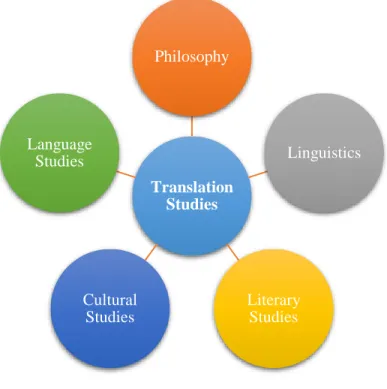
The recognition and development of translation studies in academia, however, have made it “not merely a minor branch of comparative literary study, nor yet a specific area of linguistics, but a vastly complex field with many far-reaching ramifications” (Bassnett, 2013, p. 12). The apparent independence of translation studies does not, however, represent it as a separate or isolated discipline, nor a sub-discipline of other fields, but an interdiscipline that widely covers several academic fields (Munday, 2016), which Hatim (2014) describes as “a house of many rooms” (p. 8). Consequently, translation studies is an interdiscipline of continuous importing of theories and models from other disciplines, especially from linguistics, cultural studies, literary studies, language studies, and philosophy (Munday, 2016). Figure 1 illustrates the
inter-relatedness of translation studies with other academic disciplines. The inter-connectedness of translation studies with other disciplines allows for further research and investigation of translation from different perspectives, which also multiplies and enriches the theories concerning its description and application (Munday, 2016; Venuti, 2012).
15
Figure 1. Map of disciplines interfacing with translation studies.
Although translation studies is characterized by its interdisciplinarity covering a variety of relevant disciplines, it can be divided, as Bassnett (2013) points out, into four areas of interest with different degrees of overlap: history of translation, translation in the target language culture, translation and poetics, and translation and linguistics. Within the framework of these interests, it is believed, however, that linguistics has much to contribute to the study of translation
(Manfredi, 2008). Since this study focuses on non-literary translation, the main concern here is with the interrelation between translation studies and linguistics, and with how linguistic theories have contributed to translation.
Translation Studies and Linguistics
When we speak about linguistics, we are “principally concerned with the description of any language” (Kolawole, 2013, p. 8). Since translation inevitably entails language, the
Translation Studies Philosophy Linguistics Literary Studies Cultural Studies Language Studies
16
interrelation between translation and linguistics is of high significance compared with other relevant disciplines, at least in non-literary translation. Linguistics is an invaluable academic area to translation with its potential to delve into not only grammatical but also semantic aspects of human language in general. The dependence of translation on linguistics has been argued for by different scholars. Jakobson (1959) asserts that “any comparison of two languages implies an examination of their mutual translatability; the widespread practice of interlingua
communication, particularly translating activities, must be kept under constant scrutiny by linguistic science” (pp. 113-114). Catford (1965) states that “any theory of translation must draw upon a theory of language – a general linguistic theory” (p. 1). Fawcett (1997) views linguistics as the toolkit of the translator that sets the theoretical grounding of translation process and aids its practice, and Ulrych and Bosinelli (1999) argue that linguistics “has the advantage of drawing translation away from its intuitive approach and of providing it with a scientific foundation” (p. 9).
Nevertheless, the interaction between translation and earlier linguistic theories, particularly structural and transformational linguistics, seemed relatively insignificant due to their primary focus on the description of language as a system of individual lexical elements that derive their value and roles from their distribution in sentences, neglecting their meanings and sociocultural values (Hatim, 2014: Hatim & Mason, 1990). In structural linguistics, as Hatim and Mason (1990) affirm, “morphology and syntax constituted the main areas of analysis, largely to the exclusion of the intractable problem of meaning, which was either ignored or dealt with purely in terms of the distribution” (p. 25). In addition, the central focus of formal approaches on describing language structures within the sentence boundaries has widened the gap between the linguistic theory and the practice of translation (Hatim & Mason, 1990; Munday, 2016).
17
Hatim and Mason (1990) describe the gap between early linguistics and translation studies as follows:
Since meaning is at the very heart of the translator’s work, it follows that the postponement of semantic investigation in American linguistics was bound to create a gap between linguistics and translation studies. Quite simply, linguists and translators were not talking about the same thing (p. 25).
However, “the practice of translation without a theoretical background tends toward a purely subjective exercise, and a theory of translation without a link to practice is simply an abstraction” (Manfredi, 2008, pp. 27-28). Therefore, as Bell (1991) stresses, translation studies must draw on linguistic theories that realize the “social aspects of language use … that place the source language text and the target language text in their cultural contexts” (p.13). Since
language and culture are interconnected and inseparable, translation process entails
understanding and treatment of meanings in both the source and target languages along with their cultural traditions. Furthermore, due to the acknowledgment of the cultural aspects of texts, translation studies has shifted towards cultural approaches without dismissing the significance of linguistic approaches to translation studies (Manfredi, 2008). Hence the gap between early linguistics and translation kept broadening, and alternative approaches to language, rather than the formal ones, have been sought as well to bridge this divide between the linguistic theories and the practice of translation.
The recent development in linguistics has broadened its scope of study and description of language in terms of its individual items or sentences as units of analysis to embrace the whole text as a unit of analysis, taking into account its sociocultural framework besides the lexcio-grammatical features and the meanings they communicate (Hatim & Mason, 1990; Munday, 2016). The advent of systemic functional linguistics developed by Michael Halliday, which
18
views language as a culturally embedded system of meaning communication rather than isolated items or sets of rules, has drawn the attention and interest of several scholars in the field of translation. The commonalities of interest that translation and systemic functional linguistics share in terms of their concentration on meaning and realization of the sociocultural factors of language have made it compelling for translation scholars to seek application of its theories to the practice and education of translation in attempts to fill the gap between linguistic theories and the activity of translation (El-dali, 2011). Before discussing its contributions to translation
studies, the next section provides an overview of functional linguistics and its approaches to language.
Systemic Functional Linguistics
Systemic functional linguistics, henceforth SFL, developed by Michael Halliday views language as a social semiotic system or resources of making meanings that provide its users with enormous lexico-grammatical options, enabling them to effectively express various social and communicative purposes in a variety of contexts (Fang & Schleppegrell, 2010). It is, as Manfredi (2008) points out, “a socio-linguistically and contextually-oriented framework, where language is viewed as being embedded in culture, and where meanings can be properly understood only with reference to the cultural environment in which they are realized” (p. 37).
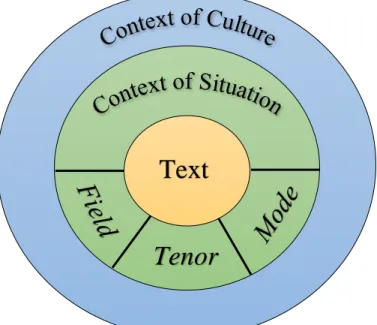
The language model of SFL, as Figure 2 illustrates, shows a meta-redundant relationship between language as a paradigmatic set of lexicogrammatical systems and the influence of situational and cultural contextual variables on the way that lexicogrammatical features are manifested in language (Butt, 2000). The context of culture is the outer stratum that envelopes and influences the context of situation and the text, respectively. The context of situation, which
19
refers to the immediate linguistic enviroment within which the communication occurs, consists of three register variables realized at the text level as follows:
1. Field: the topic of interest or the subject that the text is about or engaged in.
2. Tenor: the interaction and relationship between the participants of the communication. 3. Mode: the medium of communication either written or spoken text.
Figure 2. SFL language model of text and context.
In a nutshell, SFL delves into how different kinds of meanings are constructed and reflected on its users’ language choices (Bloor & Bloor, 2004). Meaning making, according to Oliveira and Schleppegrell (2016), is theorized in SFL as a clustered and intricate process of presenting ideas, enacting relationship (tenor), and creating cohesive messages (mode) in a discourse. These concepts and perceptions of meaning making are represented in SFL as three interrelated and inseparable metafunctions that represent three different yet contextually-motivated meanings: ideational (experiential and logical) meanings activated by Field, interpersonal meanings realized by Tenor, and textual meanings triggered by Mode (Bloor &
Text
20
Bloor, 2004). Figure 3 is a representation of SFL language model and the relationship between its different components.
CO
NT
E
XT
CONTEXT OF CULTURE
Genres as social processes for achieving purposes within the culture CONTEXT OF SITUATION
Registers as particular configurations of the field, tenor and mode. FIELD
(subject matter or topic)
TENOR
(roles and relationships)
MODE
(spoken or written text)
L ANG UAG E IDEATIONAL METAFUNCTION INTERPERSONAL METAFUNCTION TEXTUAL METAFUNCTION Clause level Experiential Metafunction:
The types of processes
involved in the activity, the participants, and
circumstances surrounding the activity.
Beyond the clause Logical metafunction:
The logical relationship between events (e.g. where? when? how? why?
Clause level
Resources for interaction (e.g. MOOD system: questions, statements, commands, offers). Beyond the clause Resources for creating patterns of evaluation and engagement with the audience.
Clause level
Theme and Rheme (the beginning and end of the clause).
Beyond the clause Cohesive devices to form text.
Figure 3. SFL model of language (Adapted from Christie & Derewianka, 2010).
Experiential Metafunction. The experiential metafunction is concerned with the ways in which ideas are presented in a text, what they tell about the world, and how they are
represented in language. This metafunction analyzes clauses in terms of process types (i.e. the verb as the core experiential meaning of the clause), participants (people or things involved in the process), and circumstances that surrounds processes such as time, place, manner, and cause. (Bloor & Bloor, 2004).Process types are material, mental, verbal, behavioral, relational
21
and existential that participant(s) take, and are manifested in a clause as verbs or verb groups.
Participants are nominal groups (one word or a group of words) that represent person(s) or thing(s) participating in the process (Bloor & Bloor, 2004). Roles of participants in a clause vary according to various process types, creating links between processes.
Interpersonal Metafunction. The interpersonal metafunction is concerned with the ways language users make their choices to enact relationships with others through their opinions, attitudes, and embedded judgments (Oliveira & Schleppegrell, 2016). This metafunction manifests the social distance, solidarity, or intimacy the speaker or writer attempts to establish with the audience. In other words, it focuses on the ways speakers or writers interact and practice their social status and relationship with others (e.g. formal or informal) through their language choices (Fang & Schleppegrell, 2010). These manifestations of the language can be explored and examined through the systems of mood and modality. The mood system identifies clauses as declarative (statement), interrogative (question), and imperative (command) showing how the speakers or writers position their audience (i.e. converge to or diverge from the targeted
audience), and the modality system identifies and determines the speakers’ or writers’ stances of confidence and authority or uncertainty and skepticism through their language choices of modal verbs (e.g. might or could) or modal nouns (e.g. possibility or expectation) (Bloor & Bloor, 2004; Fang & Schleppegrell, 2010; Oliveira & Schleppegrell, 2016).
Textual Metafunction. The textual metafunction is involved in the development of a text as a cohesive message unit constructed of several linked clauses with different patterns of textual development (Bloor & Bloor, 2004; Oliveira & Schleppegrell, 2016). At the clause level, the
22
textual meaning system recognizes the development of clauses and the organization of text parts (e.g., Adjuncts) through two main lexicogrammatical resources: Theme, or given/known information and Rheme, or new information (Bloor & Bloor, 2004). The development of Theme and Rheme elements in a text plays a pivotal role in the linkage or interconnection between the text parts and clauses creating textual cohesion and logical sequences (Bloor & Bloor, 2004; Oliveira & Schleppegrell, 2016).
Structurally, Theme is divided into three main types depending on their general meaning connection with co-texts: textual (e.g., conjunctive Adjuncts), interpersonal (e.g., interrogative Mood elements), and topical Theme (e.g. participant, process, or circumstance). In terms of markedness (i.e., infrequency or untypical use), textual and interpersonal Themes are considered marked ones if positioned at the beginning of clauses. However, topical Theme is essential in every clause and can be either marked (e.g., circumstantial Adjuncts) or
unmarked (e.g. pronouns or noun groups). These three types of Theme may combine into constituents of one clause or develop as a single theme (Bloor & Bloor, 2004).
In terms of thematic progression, Themes in a text follow different patterns of development: constant, derived or subordinate, and/or linear patterns (Bloor & Bloor, 2004). That is, to make a cohesive text with well-developed ideas and flow, Themes either represent the general theme or a specific theme in a text (constant pattern), a superordinate item or idea in a text from the general theme (derived pattern), or the Rheme of the previous clause (linear pattern). These patterns of development are significant characteristics of cohesive and coherent texts. Figure 4 shows some of more typical thematic progression patterns found in a cohesive text.
23
Constant Topical Theme Derived Topical Theme Linear Topical Theme A B A C A D A A1 A2 A3 A B B C C D
Figure 4. Patterns of topical themes development in a cohesive text.
All in all, these three metafunctions applied to text analysis have played a significant role in the analysis of language that moves beyond clause level language phenomena to examine paradigmatic meaning choices of both lexical and grammatical items as explored in a variety of texts. Next, we explore how SFL links the practice of translation with the linguistic theory.
SFL and Translation
The previous sections explored the nature of translation studies as an interdiscipline borrowing theories from other relevant disciplines, primarily from linguistics. We also explored the relationship between translation studies and early linguistics, namely structural and transformational linguistics, which resulted in divergence between linguistic theories and practice of translation leading to subjective or intuitive descriptions of translation activity due to their limited concentration on language forms. Furthermore, we reviewed the development of linguistic theories, and SFL in particular, and how they have inspired translation studies, and we provided a general explanation of the SFL modeling of language. In this section, we will elaborate on the commonalities between SFL theories and the activity of translation and on how SFL theories attempt to bridge the gap between linguistics and the practice of
24
From Halliday’s perspective, the process of translation is meaning focused:
“translation (translating/interpreting) is meaning-making activity, and we would not consider any activity to be translation if it did not result in the creation of meaning” (Halliday, 1992, p. 15). Thus, any linguistic theory that pertains to the activity of translation, as Halliday (1992) stresses, must be meaning-oriented and “embody a functional semantics” (p. 15). This concern is shared by the translation community which views languages as carriers whereby various meanings are conveyed and exchanged (Taylor, 1993). With its focus on both form and paradigmatic meaning choices, SFL has been advocated by prominent translation scholars such as Peter Newmark (1991) who praised the meaning-based work of Halliday as follows:
Since the translator is concerned exclusively and continuously with meaning, it is not surprising that Hallidayan linguistics, which sees language primarily as a meaning potential, should offer itself as a
serviceable tool for determining the constituent parts of a source language text and its network of relations with its translation (p. 65).
Unlike some other approaches to translation, the primary focus on the interrelated semantics of both clausal and textual meaning in both SFL and translation studies makes it possible to argue that “the basic unit of semantics is the text – language functioning in context” (Halliday, 1985, p. 43). As Halliday (1985) also emphasizes, “to describe language without accounting for text is sterile; to describe text without relating it to language is vacuous” (p. 10). This perspective towards language description is consistent with the ultimate goal of translation, which is the reproduction of a text or discourse in the source language into a new one that is meaningfully equivalent in the target language. The unit of translation, however, has been a controversial issue among translation communities.
25
The argument about the length of the unit of translation, ‘as short as is possible, as long as is necessary’, is a concrete reflection of the age-old conflict between free and literal translation - the freer the translation, the longer the unit of translation; the more literal the translation, the shorter the unit of translation, the closer to the word, or, in poetry, even to the morpheme. Free translation has always favored the sentence; literal
translation the word. Now, since the rise of text linguistics, free translation has moved from the sentence to the whole text. (Newmark, 1988, p. 54).
Units of translation are categorized into two groups: small units, including words, clauses and sentences, and large units, including paragraphs and texts, and the text as a unit of
translation, hence, is the final stage or “can rather be described as the ultimate court of appeal” in the process of translation (Newmark, 1988, p. 55). This categorization implies that different lengths (i.e., word, phrase, sentence, paragraph, or text) of language can be regarded as a unit of translation; the sentence, however, is regarded as the natural unit of analysis in the process of text translation (Newmark, 1988). This view is consistent with Halliday’s perspective on language that regards clause as the basic unit of discourse analysis to explore the
lexico-grammatical patterns that realize the three strands of contextual meaning (Bloor & Bloor, 2004). Since SFG is concerned with both form and meaning realized within the context of a text, it offers a tool that can usefully be adopted in the process of translation in order to create networks of meaning between the source and target language through discourse. Discourse analysis, according to Munday (2016), has gained its significance in translation since 1990 due to its focus on how meanings and social aspects are communicated in the linguistic choices and through a detailed grammar that connects these choices in a text within the boundaries of its social and cultural framework. Moreover, as Kim and Matthiessen (2015) state:
If we see translation as centrally involving the recreation of meaning through choices made by the translator in the interpretation of the source
26
text and through choices in the generation of the translated text, it follows that all modes of meaning are equally implicated: translation involves recreating ideational meanings of the logical kind, ideational meanings of the experiential kind, interpersonal meanings and textual meanings (pp. 335-336).
The next section explores some of the key works by translation scholars who variously utilized different elements of SFL theories in attempts to provide linguistic foundations relevant to the practice and analysis of translation.
Application of SFL to Translation
The development, growth, and wide acceptance of the SFL model of language has shifted the interest of translation community towards the utilization of the SFL model of language as a means of translation analysis. Kim and Matthiessen (2015) describes the link between translation and SFL as follows:
If we see translation as centrally involving the recreation of meaning through choices made by the translator in the interpretation of the source text and through choices in the generation of the translated text, it follows that all modes of meaning are equally implicated: translation involves recreating ideational meanings of the logical kind, ideational meanings of the experiential kind, interpersonal meanings and textual meanings (pp. 335-336).
The common focus and convergence of both translation and SFL towards meaning in context has inspired several translation scholars who have adopted different elements of its functional theories to the analysis, assessment, or education of translation (Baker, 2011; Hatim & Mason, 2005; Hatim & Mason, 1990; House, 2015; Kim, 2007a, 2007b; Kim & Huang 2012; Manfredi, 2011; Munday, 2012; Trosborg, 2000).
27
House (2015) focuses on methods of translation evaluation and proposes a model of translation assessment, drawing on SFL theories of language, which seeks functional equivalence of meanings between the original and target text. Her model is based on systemic comparative analysis of register (i.e. field, mode, and tenor) of the source text and the target text. The model aims to functionally analyze the lexico-grammatical and textual components of both texts in order to find matches or mismatches of meanings, primarily ideational and interpersonal meanings, between the two texts that are further investigated for assessment purposes to demonstrate whether the two texts are semantically, pragmatically, and textually equivalent.
Baker (2011) concentrates on the concept of equivalence in translation and divides it into a series of levels: at word, above word, grammatical, textual, and pragmatic levels of
equivalence. Her work primarily takes advantage of the SFL system of thematic structure and cohesion. Her adoption of Theme system targets the issues of grammaticality versus
acceptability, text organization and development, and marked versus unmarked Theme
sequences and how they pertain to and reflect on the activity of translation. The work of Baker (2011), using SFL theories, gives considerable attention to how thematic structure might result in either a connected or disjointed translation that lacks orientation and readability in the target language.
Moreover, Hatim and Mason (1990, 2005) are among translation scholars who recognized the influence and the possibilities that SFL can bring to translation studies. They believe that “context exerts a determining influence on the structure and, ultimately, the texture of discourse” (Hatim and Mason, 1990, p. 223). They adopted several SFL theories and notions such as genre, register, cohesion, and coherence to their work that focuses primarily on the textuality of translation. Inspired by Halliday’s model of language, they developed a model of
28
translation analysis that makes use of the analysis of discourse levels with special consideration of the interpersonal and ideational functions of language in context in an attempt to connect translation practice with SFL theories. Using the two systems of transitivity and modality, Hatim and Mason (2005) argue that shifts in ideational and interpersonal meanings are caused due to changes in the transitivity structure and level of modality in translation. In other words, the misunderstanding of ideational meanings in the source text by translators might result in, for example, a distorted rendering of the intended meanings in the target text, and the unawareness of the interpersonal meanings available in the source text might result in, for instance, an alteration of a possibility into a factual statement. Therefore, as Hatim and Mason (1990) emphasize, a translator should not merely be capable of two languages, but also has insight into the cultures of both languages in order to preserve the intended meanings and the rhetorical purposes of a text.
Furthermore, Kim (2007a) utilizes SFL grammar in her study to investigate translation errors in an attempt to avoid subjective and intuitive criticism and evaluation of translation in academic settings and provide objective articulation and reasoning of translation errors. She argues that SFL gives explicit criteria to the evaluation of translation through the identification and classification of translation errors using SFL terms. The findings of her study indicate that the classification of translation errors using SFL terms enables both teachers and students to objectively identify, articulate and understand meaning problems found in the translations regardless of experiential, interpersonal, or textual meaning misrepresentation. The study concludes that SFL meaning-based approach helps to raise an awareness among translation students of their choices and to make informed decisions of their practices as future translators,
29
and this approach also helps educators provide feedback for students based on objective reasoning of translation errors.
In another study of the flow and naturalness of translation, Kim (2007b) applies the textual metafunction to investigate and contrast thematic structuring of two translated texts (from English to Korean) as compared with the original text. The study concludes that the description of Theme systems in both English and Korean, and the employment of the textual metafunction as a tool of analysis have the potential to enhance translation education by providing learners with informed choices in their translations that are based on the results of insightful textual analysis of both the source and target texts away from intuitions and personal opinions.
Manfredi (2011), however, employs multiple SFL theories including ideational
grammatical metaphor, appraisal systems, and the textual and interpersonal metafunction in her analysis of translated texts (from English to Italian) in an attempt to link SFL with the practice of translation. The study argues that since SFL and translation share the same main concern for meaning, SFL could serve as a descriptive and analytical tool for translation training and education. The results of the study, using the system of modality, show that some interpersonal meanings that express modality were incorrectly rendered in the target text. This, as Manfredi (2011) stresses, might imply an ideological stance being inaccurately conveyed in the translation. The study concludes that SFL can provide a metalinguistic toolkit to articulate translation
problems using meta-functional terms to assist the translation teaching efforts from analytical and practical perspectives.
Kim and Huang (2012) apply the textual metafunction in order to analyze Theme types and thematic progression of three English translations (target texts) of a Chinese text (source text). Using the system of Theme, their study investigates textual meanings represented in both
30
languages, the reasons behind the different employment of various Theme types in the source text and the target texts, and the influence of those translation choices on the textual quality of translation. The results demonstrate translation shifts and differences in textual meanings in terms of the number of textual, interpersonal, and marked or unmarked topical Themes used in the original Chinese text compared with the three English translations. The authors conclude the differences in the use of Theme types between Chinese and English reflect the fact that both languages have their own structural characteristics that form textual, interpersonal, and topical Themes.
31
CHAPTER 3
METHODOLOGY AND DATA ANALYSIS
The purpose of this study is to examine textual meanings and their equivalent translations underlying various thematic choices in the TTs in Arabic as compared to the English ST, and implications of such an analysis on the change of textual meanings either lost or added through the process of translation. Following Halliday’s definition and description of textual meaning, and drawing on the description of Arabic structures proposed by Abdul-Raof (1998), the system of Theme is employed in order to conduct a comparative analysis, investigating different thematic choices made by translators and their meanings as compared with the original text. This chapter aims to provide a description of the research methodology, including data, methods of analysis, and research limitations. This chapter also presents the result of the data analysis in two sections: results of quantitative and comparative analysis respectively.
Data
Data were collected from the online forums of the Arabic Translation and Intercultural Dialogue Association (ATIDA)3 where translators, with varied levels of expertise, share or post their work for critical discussion and exchange of ideas that contribute to the quality of their translations. The data used for the comparative analysis comprise a non-literal expository text in English (i.e., source text) and six Arabic translations4 (i.e., target texts) of the original text. Those texts were specifically selected to ensure that all sentences are in the declarative mood in order to clearly and appropriately examine and compare the patterns of markedness/unmarkedness of Theme at the clausal level in each text.
3 More information about the association and its forums available on the official site at www.atida.org
4 The total number of translations posted for the original text were seven. One translation, however, was incomplete and was excluded from this study for that reason.
32
Methods of Analysis
To satisfy the objectives of the comparative analysis adopting the system of Theme, each text was broken down into single clauses as the main unit of analysis. Each clause was broken down into two elements: Theme and Rheme. As a clause might contain multiple Themes as well as the obligatory topical Theme in each clause, topical Themes were first classified as either marked or unmarked; and the other optional marked Themes were classified as either interpersonal or textual.
Thematic Patterns and Features of Theme Distribution. The constituent order of
clausal constituents was examined to achieve the purpose of Theme identification and
categorization. If the clausal constituents followed the basic constituent order in both languages (e.g., subject-predicator-complement in English or predicator-subject-complement in Arabic), the Theme was classified as unmarked topical Theme. When there was any change in the ordinary order or fronting of a clausal constituent (e.g., complement-subject-predicator in English and subject-predicator-complement in Arabic), the Theme was classified as marked topical Theme. Textual Themes were identified in both languages as circumstantial adjuncts (i.e., time or place adjuncts), conjunctive adjuncts, and/or clause-initial conjunctions, whereas interpersonal Themes were identified as modal adjuncts (i.e., mood and comment adjuncts) that are positioned initially in a clause.
Quantitative Analysis. After the process of Theme identification and categorization, a
quantitative analysis was conducted. The quantitative analysis aimed to determine the frequency of thematic choices in each text and to present similarities and differences between the various
33
translations and the original text to show various uses of these textual mechanisms. The quantitative analysis categorized different types of Themes and calculated them accordingly: unmarked topical, marked topical, textual, and interpersonal Theme.
Comparative Analysis. The quantitative analysis was followed by a comparative
analysis of the patterns of thematic development in terms of their markedness features. This analysis aimed to categorize and enumerate the changes of thematic patterns in the Arabic translations as compared to the original English text.
Explanatory Account. The presentation of data analysis findings was followed by an
explanatory account that aimed to explain the variations in thematic choices between the original English text and its Arabic translations. This account aimed to provide interpretations and
insights into the variations of the choices made in the target texts as compared to the source text. This account also discusses how different thematic choices in the target texts might result in changing the textual meaning intended by the original author of the English text. Figure 5 describes the design and steps followed in this investigation.
Figure 5. Description of the study design and investigation steps.
Quantitative Analysis •Determining the
frequencies of thematic choices.
•Presenting the numbers of the various thematic uses according to each type.
Comparative Analysis •Comparing thematic
choices between the source text and the target texts. •Categorizing differences of thematization patterns. Explanatory Account •Explaining variations in thematic patterning and their features.
•Discussing the implications of such variations on translation.
34
The data (i.e., ST and TTs) were analyzed by identifying and categorizing Theme at the clausal level, quantifying instances of Themes according to their types, and providing
explanations of the figures and various patterns of thematic development found and tabulated from the data. The results of the quantitative analysis are presented first and followed by a detailed comparative analysis of Theme structures of the TTs as compared to the original ST.
Quantitative Analysis Results
The aim of conducting a quantitative analysis in this study was to demonstrate the variations in the thematic choices of translators and compare these choices from a broader and comprehensive perspective of textual development in general. This analysis shows varied use of different Theme types in each text. The ST, for instance, shows use of only two Theme types: unmarked topical Theme and textual Theme. Unmarked topical Themes form 71% of the total number as compared to textual Themes that form only 29%.
The TTs, however, showed more frequent use of textual and unmarked topical Themes as compared to the other two types. The use of textual Theme ranges from 47% to 58%, whereas the unmarked topical Theme ranges from 33% to 44% of the total number. Unlike ST, TTs show occurrences of marked topical and interpersonal Themes. Table 3 and Figure 6 outline the result of the frequency of Themes utilized in the texts and their percentages.
35
Table 3
Occurrences of Theme types in each text
Text / Theme Type Unmarked Marked Textual Interpersonal Total
ST 17 0 9 0 26 TT 1 12 3 19 0 34 TT 2 16 1 20 0 37 TT 3 11 5 19 0 35 TT 4 14 2 17 0 33 TT 5 12 4 20 0 36 TT 6 14 1 15 1 32
Figure 6. Percentages of Theme types distribution across texts.
0% 10% 20% 30% 40% 50% 60% 70% ST TT 1 TT 2 TT 3 TT 4 TT 5 TT 6 Fre q u en cy ST TT 1 TT 2 TT 3 TT 4 TT 5 TT 6 Unmarked Topical 65% 35% 43% 31% 42% 33% 44% Marked Topical 0% 9% 3% 14% 6% 11% 3% Textual 35% 56% 54% 54% 52% 56% 47% Interpersonal 0% 0% 0% 0% 0% 0% 3%
36
As shown above, the higher use of textual Themes in the TTs as compared to the ST is attributed to the fact that the Arabic language has inherent cohesive and grammatical features, as represented in the frequent use of initial conjunctions, primarily the sentence-starting conjunction (و, wa) that is equivalent to the cohesive conjunction and in English, but functionally different in Arabic. Unlike the English style of writing, the use of such a marker in Arabic links the clauses and sentences of a text, creating textual cohesion (Ryding, 2005). In other words, most sentences within an Arabic text begin with a cohesive conjunction that connects each sentence with
preceding sentences.
Furthermore, conjunctions in Arabic primarily play a major role in the cohesion of a text rather than adding experiential meanings to a sentence (Ryding, 2005). Therefore, I further analyzed and categorized textual Themes in each text into three formal types: conjunction, adjunct, or relative, in order to examine the ways in which these types are added with different degrees of frequency in the Arabic texts. Table 4 and Figure 7 show the number and percentage of textual Themes according to their types.
37
Table 4
Textual Theme types in each text
Text / Textual Theme Type Conjunction Adjunct Relative
ST 3 4 2 TT 1 13 6 0 TT 2 14 4 2 TT 3 13 4 2 TT 4 10 7 0 TT 5 13 5 2 TT 6 12 2 1
Figure 7. Percentages of the distribution of textual Theme types across texts.
0% 10% 20% 30% 40% 50% 60% 70% 80% ST TT 1 TT 2 TT 3 TT 4 TT 5 TT 6 Fre q u en cy ST TT 1 TT 2 TT 3 TT 4 TT 5 TT 6 Conjunction 33% 68% 70% 68% 59% 65% 80% Adjunct 44% 32% 20% 21% 41% 25% 13% Relative 22% 0% 10% 11% 0% 10% 7%
38
This study follows a meaning-based approach, investigating the patterns of thematic development and their underlying meanings, elements that contribute to cohesion and
grammaticality of texts are regarded as irrelevant. Therefore, such thematically less significant constituents of textual Themes as cohesive conjunctions were excluded from this study. This exclusion, or refinement process, helps the comparative analysis of this study to focus on examining thematically meaningful choices and the variations in patterns of thematization.
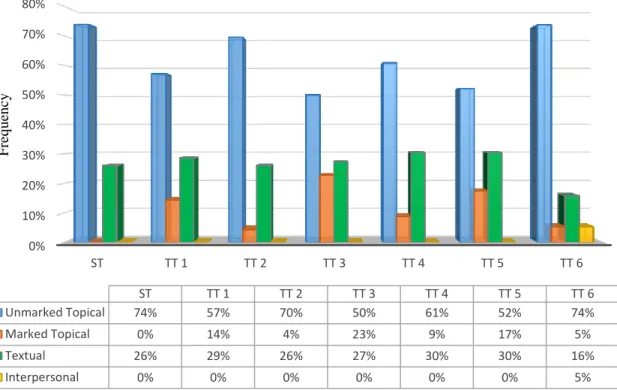
The process of textual Theme refinement rendered unmarked topical Theme the highest type chosen in all texts followed by textual, marked topical, and interpersonal Theme,
respectively. Table 5 and Figure 8 represent the final stage of the analysis of data through the refinement process (i.e., removal of cohesive or grammatical elements from all texts).
Table 5
Occurrences of Theme types in each text after refinement
Text / Theme Type Unmarked Marked Textual Interpersonal Total
ST 17 0 6 0 23 TT 1 12 3 6 0 21 TT 2 16 1 6 0 23 TT 3 11 5 6 0 22 TT 4 14 2 7 0 23 TT 5 12 4 7 0 23 TT 6 14 1 3 1 19