Summary Findings
This note presents and analyzes the main design features of an inventory of non-publicly provided Active Labor Market Programs (ALMPs) in Arab-Mediterranean Countries (AMCs), with a specific focus on programs targeted at youth. Despite considerable international evidence, there is little systematic analysis on the effectiveness of ALMPs in AMCs as most programs and investments remain largely un-assessed. Since most AMCs lack unemployment insurance systems or other safety nets for the unemployed, ALMPs constitute a relevant instrument to address the consequences of labor market frictions, such as high unemployment and slow school-to-work transition. Programs from nine countries are included in the inventory: Morocco, Algeria, Tunisia, Egypt, Lebanon, Syria, Jordan, West Bank and Gaza, and Yemen. Benchmarked against international best practices, assessment of the programs covered in the inventory reveals that the majority lack the necessary mix of design features that make programs effective. These findings call for urgent reforms in program design and delivery, especially given the sizeable financial investments in programs and the urgency to improve labor market outcomes among youth. This policy note constitutes a first step towards understanding and assessing provision of ALMPs in the Middle East and North Africa (MENA) region and intends to provide policy makers and financiers with options for reform to enhance efficiency of existing programs and improve the design of future interventions. In addition to specific aspects of program design and implementation, stakeholder coordination needs to be strengthened and put at the forefront of ALMP reform.
HUMAN DEVELOPMENT NETWORK
About this series...
Social Protection Discussion Papers are published to communicate the results of The World Bank’s work to the development community with the least possible delay. The typescript manuscript of this paper therefore has not been prepared in accordance with the procedures appropriate to formally edited texts. The findings, interpretations, and conclusions expressed herein are those of the author(s), and do not necessarily reflect the views of the International Bank for Reconstruction and Development / The World Bank and its affiliated organizations, or those of the Executive Directors of The World Bank or the governments they represent. The World Bank does not guarantee the accuracy of the data included in this work.
For free copies of this paper, please contact the Social Protection Advisory Service, The World Bank, 1818 H Street, N.W., Room G7-703, Washington, D.C. 20433 USA. Telephone: (202) 458-5267, Fax: (202) 614-0471, E-mail: [email protected] or visit the Social Protection website at www.worldbank.org/sp.
Non-Public Provision of
Active Labor Market
Programs in Arab-
Mediterranean Countries: An
Inventory of Youth Programs
Diego F. Angel-Urdinola
Amina Semlali
Stefanie Brodmann
S P D I S C U S S I O N P A P E R
July 2010
NO. 1005
Public Disclosure Authorized
Public Disclosure Authorized
Public Disclosure Authorized
Public Disclosure Authorized
1
Non-Public Provision of Active Labor Market Programs in Arab-
Mediterranean Countries: An Inventory of Youth Programs
Diego F. Angel-Urdinola, Amina Semlali, and Stefanie Brodmann
1The World Bank
July 2010
This note presents and analyzes the main design features of an inventory of non-publicly provided Active Labor Market Programs (ALMPs) in Arab-Mediterranean Countries (AMCs), with a specific focus on programs targeted at youth. Despite considerable international evidence, there is little systematic analysis on the effectiveness of ALMPs in AMCs as most programs and investments remain largely un-assessed. Since most AMCs lack unemployment insurance systems or other safety nets for the unemployed, ALMPs constitute a relevant instrument to address the consequences of labor market frictions, such as high unemployment and slow school-to-work transition. Programs from nine countries are included in the inventory: Morocco, Algeria, Tunisia, Egypt, Lebanon, Syria, Jordan, West Bank and Gaza, and Yemen. Benchmarked against international best practices, assessment of the programs covered in the inventory reveals that the majority lack the necessary mix of design features that make programs effective. These findings call for urgent reforms in program design and delivery, especially given the sizeable financial investments in programs and the urgency to improve labor market outcomes among youth. This policy note constitutes a first step towards understanding and assessing provision of ALMPs in the Middle East and North Africa (MENA) region and intends to provide policy makers and financiers with options for reform to enhance efficiency of existing programs and improve the design of future interventions. In addition to specific aspects of program design and implementation, stakeholder coordination needs to be strengthened and put at the forefront of ALMP reform.
JEL Classification: J22, J24, J48, J64, L31, O17
Keywords: labor market programs, unemployment, training, impact evaluation, program effectiveness
Authors: Diego F. Angel-Urdino
Amina Sem
Stefanie Brodmann
1This policy note is part of the World Bank’s regional work on Employment in MENA in the context of the Arab World Initiative
(AWI).The authors thank Roberta Gatti, May Wazzan, and Arvo Kuddo for their support, encouragement and helpful insights during the preparation of the work; Polly Jones, Edmundo Murrugarra, Jesko Hentschel for reviewing this work and for their useful comments; Omer M. Karasapan and Najat Yamouri for developing a plan to communicate the main findings of this policy note; and participants of the workshop on “Active Labor Market Policies: International Best Practices, Evidence from MENA, and Knowledge Gaps” at the Marseille Center for Mediterranean Integration on March 12, 2010 for their valuable comments and suggestions.
2
I.
Introduction
1. This note presents and analyzes the main design features of an inventory of non-publicly
provided Active Labor Market Programs (ALMPs) in Arab-Mediterranean Countries (AMCs), with a specific focus on programs targeted at youth. Despite considerable international evidence, there is little systematic analysis on the effectiveness of ALMPs in AMCs as most programs and investments remain largely un-assessed. Since most AMCs lack unemployment insurance systems or other safety nets for the unemployed, ALMPs constitute a relevant instrument to address the consequences of labor market frictions, such as high unemployment and slow school-to-work transition (Angel-Urdinola and Kuddo, 2010). While ALMPs are widely used in AMCs, there are notable differences in their provision and implementation: ALMPs are mostly provided publicly in Tunisia, Morocco and Algeria; while in countries like Egypt, Jordan, and Syria programs are often provided by civil society, international organizations, and line ministries (Martin, 2010). 2 This policy note analyzes the main design features of an inventory of
75 non-publicly provided ALMPs compiled between June 2009 and March 2010. Nine countries are included in the inventory: Morocco, Algeria, Tunisia, Egypt, Lebanon, Syria, Jordan, the Palestinian territories, and Yemen. Programs included in the inventory are private and non- or semi-governmental (mainly implemented by NGOs, donors, bi/multi-laterals – mostly independently but in a few cases implemented in collaboration with the government).3 This policy note constitutes a first step towards
understanding and assessing provision of ALMPs in the Middle East and North Africa (MENA) region and intends to provide policy makers and financiers with options for reform to enhance efficiency of existing programs and improve the design of future interventions. While the focus of the note is on private provision of ALMPs, there is a large scope for public intervention in the realm of government regulation/oversight and donor coordination that could improve program effectiveness, cost efficiency, and accountability of delivery of ALMPs in the region.
2. Active labor market programs (ALMPs) are a widely used policy tool to address skills and
information mismatches. While improving employment outcomes requires a range of substantial
reforms as indicated in the MILES framework (see World Bank 2007), this policy note focuses on the role of ALMPs to enhance labor market (re)integration in AMCs within other existing institutional and macroeconomic constraints (such as labor market regulation, insufficient labor demand, and lagging investment, among others). ALMPs are implemented to improve the employability of labor through productivity and skill enhancement, to create employment and sustain jobs through public work programs and wage subsidies, and to increase the efficiency of the matching process through employment intermediation services. ALMPs are used widely around the world, often substituting for a
2 To date there has not been any systematic data collection on ALMPs provided publicly in AMCs. The World Bank is currently collecting this information and compiling an inventory of publicly-provided ALMPs in the MENA. Public delivery of ALMPs, which is quite relevant in many countries, will be discussed and assessed in a separate note and will be part of a forthcoming report on ALMPs in the Middle East and North Africa region. As part of this programmatic effort, a survey on public provision of ALMPs has been prepared and tested in Tunisia and will be further implemented in Yemen, Lebanon, Syria, Morocco, Algeria, and Egypt to address existing data gaps
3 More details about the representativeness of sample and how programs were chosen to be included in inventory are discussed in depth in Section III of this policy note.
3 comprehensive employment program and extensively used during transition periods and crisis (Heckman et al. 1999; ILO 2009; Kuddo 2009). Indeed, the use of ALMPs in times of economic crisis constitutes a way to stimulate labor demand and provide support to jobseekers and unemployed. Some ALMPs, such as training activities, are actually more appealing during economic downturns when the opportunity cost of training (e.g. expected wages in the labor market) is low. During the recent economic and financial crisis, OECD countries implemented ALMPs widely. In many cases, this was reflected in the expansion of training programs for the unemployed and more investments allocated to job-search assistance (e.g. expansion of public employment service staffing levels, personalized assistance, and/or career counseling for jobseekers) (ILO 2009)
3. Nevertheless, ALMPs are by no means a substitute for a comprehensive employment strategy.
Despite the political appeal to use ALMPs, evidence from industrial and developing countries suggests that such policies do little to remedy structural problems in labor markets and reduce unemployment at the margin only. ALMPs are widely used in AMCs (with varying intensity and success). The programs have evolved from their historical focus on training workers in order to recruit them into public sector jobs to focusing more on developing skills demanded by the growing private sector. With the recent process of privatization of public enterprises and restructuring of the civil service, ALMPs are becoming increasingly relevant to address high rates of youth unemployment in many AMCs where young labor market entrants constitute a significant share of the overall working-age population (youth bulk).
4. The focus of this note is mainly on ALMPs that are privately financed and privately provided.
ALMPs can be financed and provided by public and/or private agencies. Generally, the public sector alone cannot deal with skills mismatches, lack of intermediation, and provision of employment services for the overall population. Private involvement in the provision of ALMPs was boosted by the Private Employment Agency Convention adopted by the ILO in 1997 (Convention 181 supported by Recommendation 188). The convention recognizes that in addition to training, core job matching and career counseling activities are increasingly outsourced and subcontracted to private providers. There is not a standard to quantify the extent to which ALMPs delivery should be public or private. The choice of public vs. private delivery largely depends on each country’s institutional capacity, budget constraints, and private sector development. 4
4 Non-public provision of ALMPs is generally more likely to ensure that programs are not supply-driven, especially when their pay is linked to their performance (as in the case on some private intermediation programs). International best practices indicate that private provision of ALMPs can secure services within smaller and targeted segments of labor market (comparing the costs) and should be, to a larger extent, oriented towards the employers’ requirements than the needs of the unemployed (private agencies will likely address only a few labor market niches but will offer more proactive employment policy by tailoring policy towards labor demand). In general private agencies serve the better skilled and better educated. But private agencies choose large metropolitan areas and tend to ignore or under-serve other parts of the country (Kuddo, 2008b).
In AMCs, the institutional setting for the provision and financing of ALMPs varies from country to country. Public financing of ALMPs could come directly from treasury transfers to the public employment agency, through employment funds (often financed by employers through labor taxes), and through programs financed by the ministries of education, youth, and labor, among others. Private financing could come from NGOs, donors, international organizations, and/or could de directly paid for by the private sector. Similarly, provision of ALMPs could be made publicly (through public training centers and/or community colleges) and privately (through private training
4 centers and factories). The focus of this note is mainly on ALMPs that are privately financed and privately provided.
5. The need for coordination and partnership among relevant stakeholders is even more
important than the public-private ALMP provision/financing mix. Generally, the amount of private vs.
public ALMP provision is not the main issue for policy discussion, but the coordination among stakeholders. For instance, private agencies could be accredited or not accredited by the government, funded by own resources (through the charge of commissions and fees) or by external contributors (like foundations, donors), and could vary widely in capacity and quality of service delivery. In such cases, the role of the public sector is to regulate provision and set quality standards (for instance, by introducing accreditation practices and/or by providing information about providers’ quality). International best practices suggest that good performing ALMP systems require public-private partnerships. In Turkey, for example, ALMPs are largely financed by the public sector but predominantly implemented by private providers (Betcherman et al. 2010). Lack of coordination between public and private stakeholders may create parallel systems with shortcomings in quality and accountability.
6. Benchmarked against international best practices, assessment of the programs covered in the
inventory reveals that the majority lack the necessary mix of design features that make programs effective. These findings call for urgent reforms in program design and delivery, especially given the sizeable financial investments in programs and the urgency to improve labor market outcomes among youth, in the following areas:
• Stakeholder coordination: Most programs in the inventory are characterized by a weak coordination among relevant stakeholders. Although most programs are financed by international organizations and donors, less than 5 percent of all training providers coordinate their efforts with the Public Employment Offices (PES) and with the Ministry of Labor. One of the main reasons for this absence of coordination is the lack of a platform for interaction - to meet and exchange information pertaining to project development. Oftentimes training providers do not attempt to reach PES officials out of fear of getting caught up in bureaucratic red tape instead of receiving constructive input. Moreover, training providers face great difficulties coordinating with the private sector as there is little coordination in identifying training programs the employers would deem relevant and it is difficult to convince private employers (particularly SMEs) to financially invest in training programs and/or or provide on-the-job training opportunities.
• Program Type and Objective: Labor market training is the most common type of intervention, accounting for 93 percent of all interventions included in the inventory.5
5Non-public ALMP providers tend to focus on training, rather than offering other services, such as wage subsidies and public work programs, which explains the high rate of training programs included in the inventory of non-publicly provided ALMPs.
International experience indicates that the impact of training programs on youth labor market outcomes is ambiguous (and often negative) if programs are supply-driven (i.e. if programs are not aligned
5 with the needs of the private sector), traditional (i.e. they focus only on providing hard-skills and take place in a classroom setting), and are not combined with employment services and intermediation. Unfortunately, this is exactly the case of most training programs in the inventory: about 70 percent focus solely on hard skills and are provided in-class, less than 20 percent provide some type of practical experience and/or apprenticeships, less than 35 percent focus on soft-skills, and only 14 percent provide some type of employment services and/or labor market intermediation.
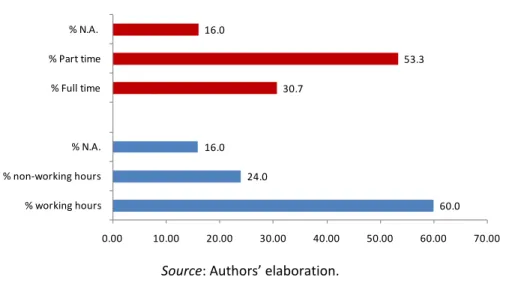
• Targeting: Although most programs in the inventory (about 81 percent) are not targeted by design, in reality beneficiaries are mainly educated males (often university graduates) from mid-or high-income groups. There are several reasons why low-income groups and females do not benefit from these programs, including: the lack of flexible schedules (which would allow beneficiaries to combine program attendance with work and/or family responsibilities), the lack of basic education requirements to participate in the programs, the urban focus of programs, and the lack of information about training options.6
• Signaling: Many beneficiaries face difficulties “signaling” the value added of ALMPs to employers, especially in terms of hard and soft skills acquired. Programs largely lack any type of accreditation and certification (only 10 percent of all programs in the inventory provide beneficiaries with some type of “recognized” credential after program completion). In the words of a training provider from Lebanon: “Private sector employers increasingly ask that we strengthen youth soft skills yet employers still only seem to look at diplomas without even trying to figure out what other skills the youth have acquired.”
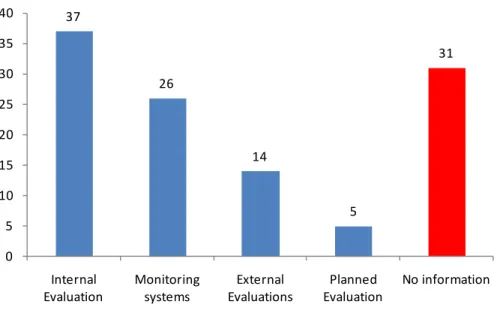
• Monitoring and Evaluation: In the absence of monitoring and evaluation, the benefits of interventions remain largely unknown. Given that the programs included in the inventory are privately funded and small, a rigorous impact evaluation may be out of scope, but a monitoring of program outcomes, such as labor market insertion, should be feasible and is crucial. Yet, documentation regarding program outcomes (such as placement rates and wages after program completion) was not available for most programs and none of the interventions assessed program cost-effectiveness. Programs included in the inventory largely lack rigorous program evaluations. Among the few programs that conducted some type of external evaluation (less than 10 percent), a large majority did not use a rigorous method based on a control group to estimate net impact. Lack of proper evaluations is largely explained by the fact that providers and implementers lack the capacity (and the funding) to conduct proper evaluations. In the words of a training provider from Yemen: “…you (the World Bank) and similar institutions always talk about monitoring and evaluation and impact evaluations,
6 ALMPs and training programs in particular, are not necessarily a redistributive tool. This may explain why many beneficiaries are educated and from higher-income families rather than from disadvantaged groups. Indeed, many training programs are not targeted to low-income groups because individuals in these groups oftentimes lack the minimum skills/education requirements to make participation in the program successful (especially those in more sophisticated areas such as IT, languages, and/or automation).
6
without understanding that we (small scale training providers) do not have the money nor experience to do this…”
7. The policy note is structured as follows. Section 2 provides an overview of labor markets
outcomes in MENA,; section 3 presents the characteristics and design features of successful ALMPs based on international best practices; section 4 describes the inventory and the data collection process; section 5 analyzes the main design features of the ALMPs included in the inventory (i.e. rationale, targeting, signaling, and monitoring and evaluation); section 6 provides conclusions and policy options.
II.
A Brief Overview of Labor Market Outcomes in AMCs
8. Arab-Mediterranean Countries (AMCs) face important employment challenges. Employment
rates in AMCs are low by international standards (at 46 percent versus a world average of 60 percent in 2008) and are driven mainly by low employment and participation rates among women. At the same time, unemployment rates in AMCs remain high (at 10 percent versus a world average of 6 percent in 2008), mainly driven by high rates of unemployment among youth (new – and often educated – entrants to the labor market) and women (see Figure II.1). An additional challenge for AMCs –countries with a very large youth bulk – is the need to create more than 1,500,000 additional jobs per year over the next 10 years in order to provide employment opportunities for new labor market entrants while keeping the proportion of unemployed unchanged. Meeting this challenge would require rates of economic growth surpassing those achieved in recent years, which in itself poses a challenge given the current world and regional economic outlook.7
Figure II.1: Employment Outcomes in AMCs [vs. the International Context]
Source: ILO KILMnet Datbank 2008
Note: (*) Egypt, Algeria, Morocco, Tunisia, Libya, and Sudan
7 In the context of this policy note, AMCs will be loosely defined as the following groups of countries: Algeria, Tunisia, Morocco, Syria, Jordan, Lebanon, Egypt, West Bank Gaza, and Yemen.
4.3 4.9 5.5 5.9 6.1 7.2 7.6 9.0 9.0 10.0 0 2 4 6 8 10 12 East Asia South Asia S.E. Asia & Pacific World OECD & EU LAC Sub-Saharan Africa Central/SE Europe & CIS Middle East AMCs* Unemployment Rates % 45.6 46.8 53.0 54.2 56.5 60.3 60.5 65.4 65.5 70.0 0 10 20 30 40 50 60 70 80 AMCs* Middle East Central/SE Europe & CIS OECD & EU South Asia World LAC Sub-Saharan Africa S.E. Asia & Pacific East Asia
7
9. Recent economic growth in AMCs has not translated into employment growth. Labor market
outcomes are influenced by a series of demand and supply side factors such as macroeconomic performance, investment climate, labor market policies and institutions, education and skills, and safety nets for workers (see World Bank, 2007 for a discussion on the MILES framework). In AMCs, average real GDP growth rose from 0.5 percent a year between 2000 and 2003 to 3.1 percent per year between 2004 and 2008. Despite positive GDP growth, employment growth has been lagging (at 0.5 percent per year) between the years 1998 and 2008. Several factors contribute to explaining this phenomenon: (i) the labor force has been growing faster than the economy (at 3.5 percent per year between the years 2000 and 2010); (ii) employment creation in the public sector (which still accounts for more than one third of overall employment in countries like Iraq, Tunisia, Yemen, and Egypt) has stagnated in many AMCs as part of a regional strategy to reform inefficiencies in the civil service (World Bank, 2008); (iii) private investment rates in the region have, on average, remained low at around 10 to 15 percent since 1985— compared with current rates of close to 30 percent in East Asia (World Bank, 2009); and, (iv) labor regulation in the region introduces important restrictions to employability and is perceived by firms as a major constraint to employment creation in many AMCs (mainly Lebanon, Syria, and Egypt) (Angel-Urdinola and Kuddo 2010).
10. Highly educated new labor market entrants have been particularly affected by the
aforementioned developments. Most employment creation in AMCs in recent years has occurred in
low-productivity/informal sector activities in the service sector. Given that the labor market is not providing enough good quality jobs, young labor market entrants in AMCs are increasingly unable to capitalize on the time and resources invested in their education. As a consequence, unemployment rates are particularly high among highly educated individuals (in Egypt and Tunisia, for example, unemployment rates among individuals with primary education or below oscillate between 2 to 6 percent compared with 16 to 19 percent among individuals with university education). Since public sector jobs are still associated with relatively generous compensation packages (including medical, transportation, and pension benefits) and relatively short work hours, educated individuals (mainly women) still queue for private sector jobs (Angel-Urdinola et al. 2010b). This phenomenon undermines entrepreneurship among young educated workers and contributes to long unemployment spells.
11. On the supply side, skills mismatches constitute an important constraint to business
development, thereby contributing to sluggish employment growth in AMCs. About 36 percent of
private companies in AMCs participating in the World Bank Enterprise Survey 2008 report the lack of skills among workers as a major constraint in business development, followed by 27 percent in the Middle East and North Africa (MENA) region (see Figure II.2). This rate is not only higher than in other regions in the world, but it also predominantly affects young labor market entrants. Private firms indicate that the main obstacle to hiring youth is that the formal schooling system does not provide them with the skills needed for the labor market. Skills mismatches are particularly identified as a constraint to business development in Egypt (50 percent of all firms interviewed), Lebanon (38 percent), Algeria (37 percent), Jordan (33 percent), and Morocco (31 percent). In Syria, over 90 percent of all youth interviewed in ILO’s School to Work Transition Surveys indicated that they did not receive any training that would relate to their employment needs. Nearly half of the youth interviewed (43 percent)
8 claimed that lack of educational qualifications and unsuitable education was the most significant obstacle to finding a job. In Egypt, about 600,000 new entrants each year leave school competing for 200,000 available jobs. Despite this excess supply, skill mismatches prevent employers from hiring adequately trained youth.
Figure II.2: Share of Firms Indicating Labor Skill Level as a Major Constraint to Business Creation
Source:
Note: (*) Average of available results from Egypt, Lebanon, Algeria, Syria, Jordan, Morocco, and WBG
12. In addition to crucial and increasing deficiencies in relevant technical skills and experience,
workers lack important soft skills in terms ofpersonality traits, social graces, interpersonal skills, and
language and personal habits. The global market economy is placing new demands on citizens and
workers in AMCs, who need relevant and updated skills to compete in the world’s knowledge-based economy (World Bank 2008a). Workers’ productivity depends not only on years of education acquired but also on actual learning outcomes. Research on cognitive learning also suggests that how people learn is equally important for successful learning and skills acquisition (OECD 2010). Employers in AMCs not only express their dissatisfaction concerning deficiencies in relevant experience and technical skills of new graduates, but also concerning soft skills such as personality traits, social graces, interpersonal skills, and language and personal habits. Results of a School Transition Survey conducted in Egypt in year 2007 indicate that 60 to 70 percent of all employers interviewed found that first time job seekers did not properly apply knowledge at the work place and were not equipped with the right communication and writing skills (Angel-Urdinola et al. 2010b).
6 13 14 24 25.5 27 35.7 25 31 33 36 37 38 50 0 10 20 30 40 50 60 East Asia and Pacific
South Asia Europe and Central Asia Latin America and the Caribean Africa Middle East and North Africa AMCs* West Bank Gaza 2006 Morocco 2007 Jordan 2006 Syria 2003 Algeria 2007 Lebanon 2006 Egypt 2008
9
III.
Characteristics of Successful ALMPs
13. Despite their widespread use, the effectiveness of ALMPs has been a matter of vigorous
debate and subject to intense scrutiny. ALMPs are a policy instrument to promote employability and
enhance job creation to the advantage of the unemployed. A growing commitment to program evaluation and an associated rapid improvement in data quality and availability, predominantly in OECD countries with a long-standing tradition in providing ALMPs, allows for a better assessment of the effectiveness of these programs. Yet, there is no recipe for what works under all circumstances. Tailoring the programs to the particular needs of the labor market and the unemployed is essential, as effectiveness of ALMPs depends largely on program design, implementation, as well as on the overall macro and labor market framework within which they operate (Dar and Tzannatos 1999).
14. The choice of ALMP type depends on needs of the labor market and the orientation towards
achieving certain objectives. ALMPs are used to address two main labor market objectives: to enhance
employability and to promote job creation. Most countries provide a mix of programs that should be tailored to overcoming specific employment barriers such as inadequate labor supply, information asymmetries, and insufficient labor demand (Figure III.1). The five main types of ALMPs are (i) employment services, (ii) labor market training, (iii) wage subsidies, (iv) public works, and (v) self-employment promotion. The main objective of self-employment services and labor market training is to enhance employability, whereas the main objective of wage subsidies, public works, and assistance to the self-employed is to promote job creation.8 Enhancing employability and promoting job creation are
complementary objectives to reduce (long-term) unemployment, to increase labor force participation (as discouraged workers tend to leave the labor market), and ideally to prevent unemployment for those individuals at risk (e.g., if current program participation decreases the unemployment spell and therefore also the risk of “unemployability” in the future) (Calmfors 1994; Kluve et al. 2007). The following paragraphs lay out the main characteristics of each type of programs, which are summarized in a ‘good practice table’ at the end of the section (Table III.1).
8 In the case of public works programs, job creation is temporary, as beneficiaries are expected to “graduate” from these programs. Wage subsidies can be a form of temporary employment creation if the worker is not being hired with the ending of the subsidy.
10
Figure III.1: Selection of ALMP Type by Objective and Employment Barrier
Source: Authors’ adaptation of Robalino and Sanchez-Puerta (forthcoming)
Employment Services
15. This type of program encompasses all measures aimed at enhancing job search efficiency,
such as providing information on job vacancies, assisting in matching workers to jobs, career
counseling, and assessment and testing to determine job readiness. Employment services can be
provided by public and/or private agencies. Private agencies are often more efficient and effective in the provision of services of employment mediation than the public sector, bearing in mind that they can secure services within smaller and targeted segments of labor market, and are to a larger extent oriented towards employers’ requirements, whereas public employment services (PES) typically serve individuals with lower skill levels, with limited education, and in poorer localities (Kuddo 2008b). Private agencies generally choose large metropolitan areas, tend to ignore or under-serve other parts of the country, and oftentimes concentrate on those unemployed who are most easily placed (i.e. “creaming off”). Quality concerns with regard to private intermediation is oftentimes the result of a lack of public regulating, given that private employment intermediation is currently prohibited in many AMCs countries (e.g., Tunisia) but nevertheless exists in some of these countries.
16. Job search assistance programs are generally found to have a positive impact in the short-run
and to be cost-effective and are particularly effective in upturns of the business cycle when there are
vacancies to be filled. Although job search assistance and related programs are an effective means to
reduce unemployment, evidence suggests that job search assistance and counseling work mainly for individuals with sufficient skills and better labor market prospects, but less for the more disadvantaged (Kluve 2006). Indeed, job search assistance and counseling have been found to be the most cost-effective active labor market measure for the general population of the unemployed, as they achieve similar results as other interventions at a significantly lower cost. Success is more likely when there is intensive follow-up of the individual cases by front-line job counselors. Several countries have build up CV-data banks of jobseekers which can be assessed by employers electronically. Just as in the case of employers entering their vacancies, jobseekers can enter their CVs with the help of a placement officer or by themselves. They can enter this information from their own work station at home over the
11 Internet or from stand-alone facilities in local labor offices or other public premises (Kuddo 2008b). Also, one cost-effective tool for job search assistance are job clubs that increase the motivation and expertise of the unemployed in looking and applying for jobs. These clubs are recommended for those with low self-confidence, who have been unemployed for extended periods of time, or who are displaced.9
Vocational Training
17. The impact of training programs on labor market outcomes remains largely ambiguous. This
type of programs include measures such as classroom training, on-the-job training, and apprenticeships, providing either general education (e.g., alternative high school certification, language or computer skills) or specific vocational skills (firm- or industry specific skill) for unemployed workers outside the education and training system. Training programs are the most widely used active labor market measure. The main objective of training programs is to increase participants’ employability and productivity. Their value added is to equip the program participant with a marketable skills and credentials, providing relevant work experience if training occurs on-the-job, and to allow employers to pre-test potential workers. Results for the United States find training programs to be largely ineffective (Heckman et al. 1999). For Europe, Kluve (2006) finds a modest positive impact training programs on employability, especially among women. Studies from Europe and other OECD countries overwhelmingly find that training programs targeting youth are relatively unsuccessful as they undermine their capacity to actively search for employment while attending training sessions (i.e. negative lock-in effects) (Betcherman et al. 2004; Calmfors 1994).
18. Training appears associated with a positive impact on labor market outcomes when offered as
part of a comprehensive package (Aedo and Nuñez 2004; Angel-Urdinola et al. 2010b; Attanasio et al.
2009). Evaluations of “comprehensive” youth programs from Latin America (e.g., Chile, Argentina, Colombia, Dominican Republic, Panama, Peru, Paraguay, and Venezuela) indicate that programs organized with flexible schedules, based on public-private partnerships (i.e., demand-driven), combined with internships and practical experience (on top of in-class training), providing a combination of soft and hard skills, and monitor and assess the impact of the training, have a significant positive impact on employment and earnings of program participants, especially for women. A general trend away from in-classroom training to more comprehensive approaches is underway. Based on a review of 345 studies from 90 countries, Fares and Puerto (2009) find that these comprehensive training interventions tend to have better employment outcomes than traditional training only by including:
• Provision of hard and soft skills: The acquisition of both “hard” and “soft” skills is crucial in order to create well-rounded and qualified workers. Hard skills are the technical requirements of a job (they are occupation/trade specific skills such as technical and administrative skills). Soft skills refer to the cluster of personality traits, social graces, interpersonal skills, language and personal
9 Job clubs are generally constituted by a group of job seekers that organize events (and set up mechanisms) to meet with employers in the area. Job club activities include job fairs, informal meetings with employers, provision of access to computers to help members to search for jobs online, interview training, and other networking activities.
12 habits that characterize relationships with other people. Soft skills complement hard skills. In a number of professions, soft skills may be more important over the long term than technical skills. Soft skills are intrinsically transferable skills (i.e. once acquired they can be used in different employment and life settings).
• Provision of on-the-job training: International evidence indicates that the most efficient way of acquiring knowledge and skills is to provide an opportunity to apply the theories learnt in class in real world environments, through on-the-job training. On-the-job training, in addition to in-class training, such as internships and/or apprenticeships, allow young people to develop practical and professional skills (such as time management, professionalism, etc.) necessary to excel in the job market. Internships can also be an opportunity to start a good network within the student’s preferred industry. In addition, international experiences have shown that on-the-job training may lead to higher placement rates (Betcherman et al. 2010).10
Wage subsidies
19. This type of program provides financial incentives for sustaining and creating jobs in the
private sector. Wage subsidies provide financial incentives to employers to hire new workers and/or to maintain the jobs of workers who would have otherwise been dismissed. Financial incentives are either provided directly (through direct wage subsidies) or indirectly (through social security waivers and reduction in labor taxes). Wage subsidy programs can be scaled up relatively rapidly, making them particularly prominent during times of economic crises to temporarily sustain jobs and avoid layoffs. While wage subsidies as a useful anti-crisis measure for solvent but illiquid firms can be a feasible policy choice, the selection of firms is bound to be difficult both technically and from governance perspective. Wage and social security contribution subsidies are generally used as an incentive to hire particular groups of workers (such as first time job seekers and/or women), allowing employers to pre-test workers prior to committing to paying the full wage, and allowing workers to gain valuable work experience. As Betcherman et al. (2008) have shown in Turkey, wage subsidies with very specific design features (including only for marginal hires that add to the stock of employment per firm) can have significant and positive employment effects and be, from a fiscal effectiveness point of view, preferable to generalized reductions in the labor tax wedge.
20. While wage subsidies have the potential to be advantageous for certain groups if treated as a
temporary measure, unintended macroeconomic side-effects question their longer term usefulness.
Available evidence suggests that wage subsidies work to the advantage of women and young individuals, especially for those from disadvantaged backgrounds (Galasso et al. 2002; Betcherman et al.
10 In many countries, volunteer work or community service is an additional way for youth to gain practical experience in a broad range of fields, making them more employable. It also has the added benefit of personal growth and an increased awareness of the problems facing the community. People who have performed community or volunteer work often express an even greater desire to contribute to society and are more likely to volunteer again in the future. The human factor is paramount in volunteering/community service: making and meeting friends, having social links and the feeling of belonging.
13 2007), and that they are particularly effective when combined with other programs, such as on-the-job training, counseling, and job search assistance (Kluve 2006). Wage subsidies seem cost-effective in countries such as Poland and Argentina (Cunningham et al. 2010). However, unintended macroeconomic side-effects of wage (and employment) subsidies include deadweight loss (hiring from the target group that would have occurred also in the absence of the program), substitution effects (the extent to which jobs created for the target groups replaces jobs for other groups), and displacement effects (the possible reduction of jobs elsewhere in the market) (Calmfors 1994).
Public Works
21. Public works programs (also known as workfare programs) have been widely implemented
both as safety net interventions and ALMPs. Countries have introduced public works programs (public
works) with diverse objectives, such as support in times of large covariate shocks (such as natural disasters, macro crisis, or seasonal labor demand shortfalls) to protect households from sudden income loss due to temporary job losses, fight against poverty, or to help poor to gain temporary employment. Public works provides direct and temporary employment opportunities at low-wage rate in public works and other activities that produce public goods or services. These jobs comprise labor intensive infrastructure projects (such as road construction and maintenance, irrigation infrastructure, and soil conservation), as well as community activities, and civic projects. Unlike other ALMPs, such as vocational skills training programs, public works are a short term measure that can more easily be scaled up or down, functioning as an automatic adjustor in crisis situations that should be scaled down in an economic upturn.
22. Public works seems to have positive impact on welfare and employment outcomes only in the
short-run. The success of public works programs depends on careful design and incorporation of key
design features such as: (a) setting the design parameters right (such as the level of the wage rate and labor intensity so that the poor are self-selected into the program), and (b) establishing the implementation structure (paying attention to decentralization aspects as needed, depending upon country circumstances). Recently conducted impact evaluation studies suggest a positive impact of public works on earnings and employment outcomes in the short run (Del Ninno et al. 2009, Chacaltana 2003, Galasso and Ravallion 2004, and Colombia’s Departamento Nacional de Planeacion 2004). In general, the marginal increase of earnings tends to be less than the level of transfer, implying that in the absence of this program the beneficiaries could have received some income from employment in informal jobs. Nevertheless, the majority of public works programs do not provide relevant experience and/or skills that can affect participants’ employability after program completion. As a result, it is often observed that the long-term labor market impact of these programs is insignificant, and, in some countries, there is a stigma attached to public works jobs which may decrease the employability of participants in the long run (Dar and Tzannatos 1999; Betcherman et al. 2004).
14
Self-Employment Promotion
23. Self-employment promotion ranges from measures that entail financial and advisory
assistance for starting up small businesses to microcredit programs that function as a poverty alleviation strategy. These measures are often conditional on a successful review of a business plan and include direct financial assistance for business start-up, support in accessing venture capital, training in entrepreneurial skills, and mentoring. The underlying motivation for providing this type of assistance is that entrepreneurship is prevented due to a lack of access to credit and/or lack of business training. An effective self-employment promotion policy should identify the binding constraints facing the particular group of prospective entrepreneurs. A second example are micro finance programs that mainly serve to improve income generating opportunities by enabling participants to develop the necessary skills and access resources. Evaluations of these programs mainly stress the impact on poverty alleviation and the empowerment of women (Hussein and Hussain 2003; Pitt et al. 2006).
24. Individuals who are more suited to run self-employment activities (due to their unobserved
skills and human capital endowments) are more likely to benefit from entrepreneurship training
(Almeida and Galasso 2007). Rigorous evaluations in this area are still scarce, however, and there is little evidence on the effectiveness of employment training. One recent evaluation of a public self-employment training program in the US suggests a positive impact of training on the sustainability of the business. Similarly, evidence from Peru suggests that entrepreneurship training has a positive impact on sales and profits, but no effect on individuals’ income (Karlan and Valdivia 2008). As with wage subsidies, this type of measure risks placing small businesses that do not receive assistance at a disadvantage (substitution effect). It also carries a potentially high risk for the potential beneficiary, who might rather be looking for a job instead of an entrepreneurial opportunity (Betcherman et al. 2004). For some young people, self-employment provides income, self-reliance and a dynamic path for growth and the development of human capital. Youth entrepreneurship programs that focus on non-cognitive skills, such as critical thinking, decision making, teamwork, and flexibility, can be beneficial in the long run since young people can no longer expect to find “job-for-life” careers but rather “portfolio careers” (contract employment, freelancing, periods of self-employment, etc.) (Schoof and Semlali 2008). However, entrepreneurship is not a panacea: it is not for everyone, and those young people who wish to enter self-employment face many obstacles to starting and running a successful business and far from all succeed.
15
Table III.1: ‘Good Practices’ in ALMP design and provision [a summary]
Employment services Training Wage subsidies Public works Self-employment
promotion Targeting individuals
with skills in demand by employers Coordination with private sector (demand-driven training) Used to sustaining jobs in crisis
Rural areas, builds community assets Wide dissemination Exploit information technologies Post-training employment guarantees (caution!) Temporary measure to encourage demand for disadvantaged workers (youth/women) Temporary measure, think of graduation strategy Careful selection of beneficiaries/business plans
Maintain close links with employers
Financial incentives for employers
Combine with training, counseling, job search assistance
Combine with training, counseling, job search assistance
Provide management skills/counseling Decentralize provision Combination of soft
and hard skills
Set wage level appropriate to allow for self-targeting
Labor market information system to monitor successful programs Encourage private employment agencies (but regulation) Institutional capacity (high quality training institutions, competent teachers) Targeting women (sustainability of program) Ensure institutional capacity of PES Accreditation system Source: Authors’ elaboration.
IV.
The Inventory
1. The Inventory of non-publicly provided ALMPs was compiled between June 2009 and March
2010 to provide policy makers in AMCs with a better overview of programs designed to facilitate
school to work transition. As mentioned before, policy makers in AMCs are hampered by a lack of
information on what types of employment programs specifically targeted on youth exist in the region, existing gaps in the provision of programs, and opportunities for scaling up or replicating successful programs.In response to this knowledge gap, the World Bank has compiled an inventory of non-publicly provided ALMPs across the region designed to integrate young people into the labor market. Nine countries are included in the inventory: Morocco, Algeria, Tunisia, Egypt, Lebanon, Syria, Jordan, the Palestinian territories and Yemen. Information about 17 programs was collected in Egypt (where private provision of ALMPs plays a fundamental role), followed by Morocco (14 programs), West Bank and Gaza (13 programs), Lebanon (10 programs), and Jordan (8 programs) (Figure IV.1). The country distribution of the inventory does not accurately reflect the distribution of operations on-the ground, as data was largely collected based on access to information. Providers in some countries were more willing to share information on programs, and the size of private interventions varied by country. In addition, countries with centralized public provision of ALMPS, such as Tunisia and Algeria, are likely to be under-represented in the inventory, as private provision is limited and/or centralized through the national PES.
16
Figure IV.1: Number of Programs in the Inventory by Country
Source: Authors’ elaboration.
2. The inventory includes 75 interventions implemented by 180 providers. The inventory includes
ongoing interventions as well as interventions that were active in recent years but that are now closed. Programs included in the inventory meet minimum documentation standards (namely sound information on the intervention’s objectives, implementation design, and targeting criteria). Programs in the inventory are private and non- or semi-governmental (mainly implemented by NGO’s, donors, bi-/multi laterals – either on their own but in a few instances in collaboration with the government). This inventory does not include programs that are solely governmental. The World Bank (through an activity directly related to this task) is currently undertaking a survey of ALMPs provided by governments across the region, which will complement this inventory to provide a more comprehensive overview of ALMPs in the region. In addition to providing program descriptions, training providers who participated in the interviews were asked to share their perception of the main challenges of youth integration into the labor market. Within most organizations and institutions, several people were contacted and interviewed to increase the amount and accuracy of feedback received.
3. Most of the interviews were conducted by phone and/or e-mail exchange. Around 85 percent
of the interviews were conducted over the phone and 15 percent by e-mail. A one-page questionnaire template was designed to ensure consistency and uniformity in the data collection (for a detailed description of all programs included in the inventory, see Annex I). The template was sent to training providers across the region – accompanied by a request that it be filled out as detailed as possible (one template per program). This was followed up with phone calls. The information collected includes country, intervention type, time period during which it was implemented, financing and implementing organization(s), objectives and program approach, program description (number of beneficiaries, targeting, budget), questions on Monitoring and Evaluation used if applicable (and impact/outputs), and contact information of main respondents. The interviews were mainly qualitative. Qualitative studies have the ability to provide more in-depth assessment than those provided by the typically used surveying methods. It enables certain issues (questions) to be raised several times, which usually
1 3 4 5 8 10 13 14 17 0 2 4 6 8 10 12 14 16 18
17 “unravels” the initially provided socially desirable responses. Nevertheless, the study has upfront limitations: the analysis presented here reflects only the answers of a sub-set of ALMP providers, and therefore must be used and interpreted with care (qualitative studies are not designed to provide answers that are representative of the population). Providers who participated in the interviews were selected based on availability of information and program size (only relatively large programs were included) – which may create a sample selection bias that is common to this type of studies.
4. The inventory only includes programs with more than a hundred beneficiaries and focuses on
youth interventions. The majority of programs included in the inventory served less than 500
beneficiaries, but quite a few served more than one thousand beneficiaries (Figure IV.2). The five largest programs in the inventory are: The Advancing Learning and Employability for a Better Future (ALEF) program in Morocco (reaching 270,000 beneficiaries per year); the INJAZ program in Jordan (reaching 110,000 beneficiaries per year); the E-equality ICT and Entrepreneurship Program in Morocco (reaching approximately 50,000 beneficiaries per year); The Info Youth Centre IT Training in Tunisia (reaching 50,000 beneficiaries per year); and the Vocational Training Promotion Program in Algeria (reaching 30,000 beneficiaries per year). A common feature across countries and programs is the absence of small and medium-sized enterprises in funding and/or implementing ALMPs. In the words of a trainer provider from Egypt: “It is only larger firms that work with us, small and medium firms are absent from the skills development scene. It must change because they share a large part of employment and production in the country. Perhaps they lack knowledge of the potential private returns of skills training to individual companies due to improved productivity...”
Figure IV.2: Distribution of Programs in the Inventory by Number of Beneficiaries (in %)
Source: Authors’ elaboration.
5. Most programs in the inventory are financed by international donors. Interventions included in
the inventory are financed through a variety of sources: international organizations, donor agencies, private foundations, large international corporations (from their ‘social corporate responsibility’ funds), individual donations to NGOs, and to a much lesser extent public funding from governments. Although programs are financed from a variety of sources, important donors include: the United States Agency for International Development (USAID), the German Development Agency ‘Deutsche Gesellschaft für
39.2 15.7 23.5 21.6 100-499 500-999 1000-4999 5000 and +
18 Technische Zusammenarbeit’ (GTZ), and the United States Department of State’s Office of the Middle East Partnership Initiative (MERIP). In particular, USAID and MERIP were the sole financier (or co-funded) 25 percent of interventions in the inventory while GTZ financed and/or implemented close to 10 percent of the interventions. About half of GTZ’s interventions were co-financed by local government and/or ministries. Large private employers are also important sources of funding, especially for programs aiming at skills development of workers (some of whom would be hired by the contributing firm at the end of the program.) In addition to cash contributions, many of the programs benefited from in-kind contributions such as technical equipment (often provided by larger international corporations); educational material and learning modules (often provided by local and international universities/educational institutions); time (some entrepreneurs allocated time to share experiences and advice); volunteers (acting as mentors); and provision of internship/apprenticeship opportunities by firms. Program beneficiaries were rarely obliged to make a financial contribution to participate in programs included in the inventory. While only 12 percent of programs charged student fees, 5 percent of programs required that program graduates reciprocate service by committing to pay a share (generally 5 to 10 percent) of their first year’s salary, oftentimes in exchange for placement services and intermediation during training programs.
6. Most programs in the inventory were characterized by a weak coordination with relevant
stakeholders. Less than 5 percent of all training providers included in the inventory claimed to have
coordinated their efforts with the Public Employment Offices (PES) and/or with the Ministry of Labor. The majority of interventions in the inventory have not received any feedback from public stakeholders on whether the project design is in line with national economic development goals, etc. One of the main reasons for this is that there is often no common platform for interaction - to meet and exchange information pertaining to project development. In many instances training providers have not attempted to reach PES officials out of fear that they will get caught up in bureaucratic red tape rather than receiving constructive input. However, the government and training providers in some instances coordinate through the Ministry of Education and in a couple of instances through the Ministry of Youth. Indeed, about 23 percent of projects are conducting their training within formal educational facilities. The training programs in the inventory that are implemented within the formal educational framework are also the ones that reach the largest numbers of beneficiaries. Moreover, training providers face great difficulties coordinating with the private sector and/or don’t do it at all: there is little coordination to identify training programs that employers would deem labor market relevant; it is difficult to convince private employers (particularly SMEs) to financially invest in training programs and/or to provide on-the-job training opportunities (even though the trainees are acquiring the skills needed by the specific firms). This interaction deficit must be addressed as the lack of coordination might lead to supply-driven programs that may be irrelevant to the needs of the labor market.
19
V.
Main Design Features of ALMPs in the Inventory
1. As mentioned before, successful ALMPs depend largely on program implementation and
design. As discussed in Section 2, however, the current dialog on ALMP implementation is shifting from merely choosing a program type to focusing on necessary design elements to increase the likelihood of program success (independently of the program type). Despite their widespread use, there is no systematic analysis of the program design features of ALMPs provided in AMCs. This lack of evidence represents an immense knowledge gap that precludes the design of new and effective programs and abolishing (or restructuring) of ineffective ones. The aim of this section is to analyze the main design features of the ALMPs included in the inventory. Four main design features will be analyzed: (1) Program type and objective; (2) Targeting; (3) Signaling; and (4) Monitoring and Evaluation.
Program Type and Objective
2. Most of the employment interventions in the inventory are aimed to enhance youth
employability and labor market training is the most common type of intervention used. As mentioned
in Section 2, the choice of ALMP type depends on needs in the labor market and the orientation towards achieving certain objectives. ALMPs are used to address two main labor market objectives: to enhance employability and to promote job creation. Most programs in the inventory address skills mismatches and thus aim to enhance employability. Traditional training accounts for 91 percent of all the interventions included in the inventory. Entrepreneurship training and self-employment promotion constitute less than 9 percent of programs included in the inventory (Figure V.1). Several kinds of entrepreneurship training, education, or self-employment promotion are implemented, such as: business training and mentoring; provision of micro-credit loans; business start-up support; and entrepreneurial education (both within and outside of the formal education system). With the exception of self-employment promotion in forms of micro-credit for start-ups, which account for close to 3 percent of programs in the inventory, none of the remaining programs promote job creation through wage subsidies or public works. The main reason for the predominance of training programs is that job creation programs are mainly implemented by the public sector.
Figure V.1: Distribution of Programs in the Inventory by Program Type (in %)
Source: Authors’ elaboration. 90.7 4.0 2.7 2.7 Training Entrep. Training Emp. Svs Self-Emp. Prom
20
3. A majority of the training programs in the inventory (64 percent) focus solely on the provision
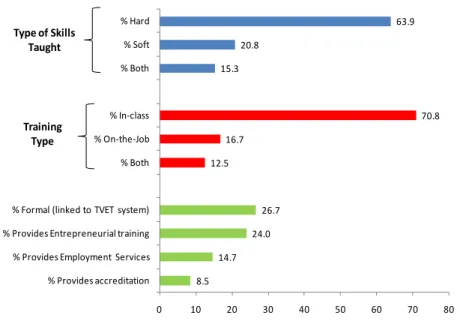
of hard skills and are conducted in-class (71 percent) (Figure V.2).Out of all training programs, only 15 percent provide employment services (to enhance job search efficiency); 27 percent are formal (i.e. taught within the public school system); 24 percent combine training with some type of entrepreneurial training; and 9 percent provide accreditation (Box V.1). As mentioned before, the acquisition of both “hard” and “soft” skills as well as practical on-the-job experience is crucial in order to create well-rounded and qualified workers. However, only a fraction of all training programs analyzed provide soft skills and on-the-job training – which is generally regarded as a good way to acquire experience. Only 15 percent of all programs provide beneficiaries with a combination of hard and soft skills training and only 13 percent of all training programs include both in-class and on-the-job training. This shows that the majority of programs in the inventory use very traditional ways of transmitting knowledge and skills. Youth that are only acquiring hard skills are less likely to be able to transfer these skills, both when it comes to performing various tasks on the job and/or transferring skills between jobs. At the same time, by only providing in-class training, these youth are deprived of a chance to obtain real work experiences – which would make them more employable. In the words of a training provider: “We need to move away from authoritarian teachings. Kids are taught to obey and not question at home and they are taught to take their teachers words for granted without inquiring. We want to help create innovators, explorers, social entrepreneurs. Our youth are intelligent and educated and they will help our societies flourish – if we (the older generation) have the confidence to let them”.
Figure V.2: Some Design Features of Training Programs in the Inventory
Source: Authors’ elaboration.
8.5 14.7 24.0 26.7 12.5 16.7 70.8 15.3 20.8 63.9 0 10 20 30 40 50 60 70 80 % Provides accreditation
% Provides Employment Services % Provides Entrepreneurial training % Formal (linked to TVET system) % Both % On-the-Job % In-class % Both % Soft % Hard Training Type Type of Skills Taught
21
Box V.1. INJAZ al-Arab
Operating in 12 countries across the Middle East and North Africa region, INJAZ al-Arab is an NGO collaborating with corporate volunteers and Ministries of Education to provide experiential education and training to youth in work readiness, financial literacy and entrepreneurship. More than 500,000 middle, high school and university students have been reached since 2004, while 10,000 volunteers have been engaged.
INJAZ al-Arab harnesses the mentorship of business leaders to help inspire a culture of entrepreneurialism and business innovation among youth. Private sector mentors are brought into public school classrooms, for one hour per week over six semesters, to provide students with skills that will prepare them for work in the private sector. Students learn basic business skills such as marketing, how to manage their own budget, how to write a business plan, etc. In addition, they acquire soft skills such as teamwork and leadership skills by setting up their own community projects. While students acquire labor market relevant skills, Arab business leaders are being invoked with a spirit of mentorship and commitment to participate in developing their nation’s youth.
Source: http://www.injazalarab.org/
4. Only a few programs in the inventory consist of on-the-job training, internships, and/or
voluntary services. International evidence indicates that the most efficient way of acquiring knowledge and skills is to provide an opportunity to apply the theories learnt in-class in real world environments, through on-the-job training and internships. Unfortunately, only a few of the programs in the inventory offer internship opportunities.In the words of a training provider from Egypt: “Employers are reluctant to hire inexperienced young people. If more youth at least had work experience through an internship… then the hiring employer would know that the youth had some work experience…” The lack of on-the-job training is unfortunate, as this component has proven successful in increasing the likelihood of job entry after program completion (Box V.2).
5. In AMCs, universities seldom engage with employers in order to encourage the initiation of an
internship program, nor is there a provision of information and linkages of existing internship programs at the university side for students that are interested. This contrasts with practices in Latin America, for example, where many internships programs are offered directly through universities and are considered part of the academic curriculum. In AMCs, in contrast, universities rarely grant students credit towards their graduation if the student participates in an internship program, community service, and/or volunteer work. The general culture within schools and universities is to show appreciation for knowledge of facts and concepts (tested via exams) rather than the ability to actually apply those facts in a real context. Yet, while employers seem concerned that recent graduates lack the desired skills, they also do not seem to appreciate the added value of an applicant with internship, community service, or volunteer experience. Since there are no incentives provided by schools, universities or employers it is hard to motivate youth to apply for an internship or seek volunteer work – particularly in the absence of salary compensation (Dhillon et al. 2009).
22
Box V.2: On-the-job Training Programs by the Education For Employment Foundation (EFE)
The Education for Employment Foundation (EFE) is an NGO that operates in Morocco, Egypt, Jordan, West Bank and Gaza, and Yemen. EFE creates and provides tailored training programs for youth, providing them with the specific skills to acquire and keep a job. The training is developed in direct conjunction with businesses that commit to hiring the graduates. Training includes diverse vocational, technical, and professional fields, as accounting, air conditioning repair, land surveying, construction management, sales, and teaching, and critical soft skills such as leadership, interpersonal communications, and successful business behavior.
Training occurs both in-class and on-the-job and the programs are offered full-time. After program completion, 85 percent of the 255 graduates were successfully placed in jobs in Jordan. Similarly, 86 percent out of 182 graduates were placed in jobs and internships in Morocco. In Yemen, 40 graduates out of 129 succeeded in obtaining employment while the remaining 89 were placed in internships, while participating in an ongoing active placement process. The program cost per participant varies between USD500 to USD2,000 depending on employer requirements and the type of technical training provided. Although students do not pay a student fee, they commit to pay an alumni fee of around 5-10 percent of their salary for one year to EFE.
Source: authors’ elaboration
6. In light of limited public and private resources, targeting becomes essentialand only programs
that are cost-effective and cater to groups that will benefit the most from the intervention should be
put in place and sustained. In general, programs should be carefully and tightly targeted to improve
labor market outcomes of vulnerable groups such as youth, women, and long-term unemployed, among others. Targeting, thus, implies redistributing employment opportunities (Calmfors 1994). Although it is widely recognized that targeting is important and cost effective, tight targeting is difficult to achieve in practice (Box V.3). Due to data restrictions, targeting for ALMPs is generally ad-hoc and categorical (i.e. programs are targeted to specific groups, such as first time job seekers, women, long term unemployed). Many countries practice “creaming” whereby programs are targeted to most qualified applicants. Doing so increases program effectiveness and is generally regarded as cost-effective. However, creaming it not considered equitable as it leaves out more disadvantaged groups (i.e. those who need public intervention the most) and often benefits those individuals who would have found a job without program participation.
Targeting
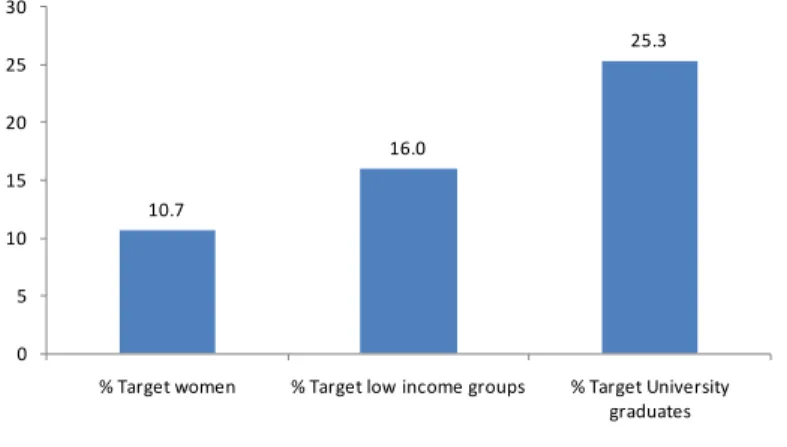
7. The vast majority of programs (81 percent) does not have a specific targeting and are open to
youth from all income, gender, and education groups. The lack of targeting likely entails substitution effects and deadweight losses, and, as a result, inefficient spending.11
11 Substitution effects entail a replacement of non-subsidized jobs by subsidized jobs, and deadweight losses occur if programs finance jobs that would have been created anyway.
The inventory collected data on whether programs were targeted to a particular gender, education, strata (urban/rural), and/or income group. Survey results indicate that 25 percent of all programs are targeted to university graduates, 16 percent to low income individuals, and 11 percent to women (Figure V.3). Yet, 81 percent of programs lacked tight targeting, and, as a result, most beneficiaries are from mid- to high-income groups located
![Figure II.1: Employment Outcomes in AMCs [vs. the International Context]](https://thumb-us.123doks.com/thumbv2/123dok_us/10896610.2978706/7.918.106.799.694.963/figure-ii-employment-outcomes-amcs-the-international-context.webp)