Worcester Polytechnic Institute
Digital WPI
Interactive Qualifying Projects (All Years)
Interactive Qualifying Projects
April 2013
Testing the Effectiveness of Educational Tools and
Games With and Against the ASSISTments System
Ian Patrick Lonergan
Worcester Polytechnic Institute
Shane M. Daley
Worcester Polytechnic Institute
Follow this and additional works at:
https://digitalcommons.wpi.edu/iqp-all
This Unrestricted is brought to you for free and open access by the Interactive Qualifying Projects at Digital WPI. It has been accepted for inclusion in Interactive Qualifying Projects (All Years) by an authorized administrator of Digital WPI. For more information, please [email protected].
Repository Citation
Lonergan, I. P., & Daley, S. M. (2013).Testing the Effectiveness of Educational Tools and Games With and Against the ASSISTments System. Retrieved fromhttps://digitalcommons.wpi.edu/iqp-all/3029
Testing the Effectiveness of Educational Tools and Games With
and Against the ASSISTments System
An Interactive Qualifying Project Report submitted to the Faculty of the WORCESTER POLYTECHNIC INSTITUTE In partial fulfillment of the requirements for the Degree of Bachelor of Science Submitted by
Shane Daley and Ian Lonergan Advised by Cristina Heffernan and Neil Heffernan
Abstract
...
pg. 3Acknowledgements
...
pg. 4Authorship
...
pg. 4List of Figures
...
pg. 5List of Tables
...
pg. 61. Introduction
...
pg. 71.1 Purpose
...
pg. 71.2 Hypothesis
...
pg.81.3 Methodology
...
pg.92. Background
...
pg.122.1 ASSISTments
...
pg.12 2.1.1 What is ASSISTments?...
pg.12 2.1.2 Assistments...
pg.12 2.1.3 Problem Sets...
pg.132.2 Games
...
pg.13 2.2.1 What is a game?...
pg. 13 2.2.2 Educational Games...
pg.15 2.2.2.1 Educational Math Games...
pg.16 2.2.2.2 Effectiveness of Educational Games...
pg.19 2.2.2.3 The Future of Educational Games...
pg.213. The Experiments
...
pg.243.1 Experiment #1
...
pg.243.2 Experiment #2
...
pg. 313.3 Experiment #3
...
pg.373.4 Experiment #4
...
pg. 404. Conclusions and Final Thoughts
...
pg. 43Appendices
...
pg. 45Abstract
This report, prepared for the creators of ASSISTments, addresses the concept of improved learning from educational computer games and describes the methods used to incorporate these games into the ASSISTments learning system. These methods include searching for and selecting the most relevant existing educational computer games, constructing new problem templates for use within the ASSISTments system, and creating custom learning experiences with and without educational games for experimentation.Acknowledgements
We would like to sincerely thank our advisors Neil Heffernan and Cristina Heffernan for their work on the ASSISTments as well as their guidance during the search for quality educational games and the creation of effective experiments using the ASSISTments system. Additionally, we would like to thank everyone that has worked on ASSISTments before us, whether they be programmers, designers, or the creators of templates that adhere to the Common Core Standards. We would also like to thank Eric Corriveau, who selflessly dedicated his free time to develop a program to organize experiment data for facilitated analysis.Authorship
Ian Lonergan was responsible for the creation of the experiment structure within the ASSISTments system as well as the programming of variablized templates. Additionally he contributed to the search for valuable educational games and the teaching strategies for the experiments. Shane Daley was responsible for building the experiments within the established structure. Additionally he was responsible for finding and testing highquality educational games and tools and codesigning the teaching strategies and experience of the experiments. He will be responsible for testing and recording the results of the experiments later this year.List of Figures
Fig 1.1...
pg. 7 Fig 2.1...
pg. 16 Fig 2.2...
pg. 17 Fig 2.3...
pg. 18 Fig 2.4...
pg. 18 Fig 2.5...
pg. 19 Fig 2.6...
pg. 21 Fig 2.7...
pg. 23 Fig 2.8...
pg. 23 Fig 3.1...
pg. 24 Fig 3.2...
pg. 25 Fig 3.3...
pg. 26 Fig 3.4...
pg. 31 Fig 3.5...
pg. 31 Fig 3.6...
pg. 32 Fig 3.7...
pg. 33 Fig 3.8...
pg. 37 Fig 3.9...
pg. 38 Fig 3.10...
pg. 38 Fig 3.11...
pg. 40 Fig 3.12...
pg. 41 Fig 3.13...
pg. 42List of Tables
Table 1.1...
pg.10 Table 1.2...
pg.10 Table 3.1...
pg.28 Table 3.2...
pg.28 Table 3.3...
pg.34 Table 3.4...
pg.34Introduction
Fig 1.1: The ASSISTments logo The ASSISTment System was founded in 2003 for the purpose of educating students in a variety of subjects while providing concise and important feedback to instructors. The software is intended to be intuitive and easy for teachers to use while still providing considerable educational and analytical power. The ASSISTment System has continued to grow since its conception and is easily capable of facilitating and hosting learning experiments. For our Interdisciplinary Qualifying Project we aim to test the effectiveness of the ASSISTment System versus educational games, specifically games related to Algebra, from outside sources as well as the effectiveness of augmenting the ASSISTment system with learning tools and games. 1.1 Purpose The primary purpose of this project was to examine the difference in shortterm and deeplearning between educational thirdparty math games and ASSISTment tutored problem sets. Additionally, the project is intended to highlight the differences between traditional learning and traditional learning augmented with educational math tool software. The project was approached in three phases— finding existing educational math games, content construction and experimental study. The purpose of the searching phase was to find educational games that taught math at a highschool level. The games found would need to fit well with ASSISTments and be able to theoretically teach in a brief period of time.During the content construction phase the intent was to create experiments that tested two approaches to teaching. Since the ASSISTment System offers indepth teacher feedback, the effectiveness of either teaching process can be measured numerically and allow an objective analysis. The experimental study will be conducted later this year on high school students. Their performance will be analyzed so the benefits of the two approaches can be compared. 1.2 Hypothesis It is expected that the students who complete the experiments with games or software will experience greater short and longterm learning than the students exposed to the control. Students who play games are asked to play them for at least five minutes before submitting their high score to ASSISTments, whereas students in the control group are asked to practice doing relevant problems for at least five minutes. The results can be interpreted accurately because ASSISTments allows the instructor to view how long a student spent on one “problem” (in this case a game or series of problems). It is expected that students will be more interested in their work when playing games and using educational software because it is an unusual teaching approach. Additionally, knowing that their high score is recorded may provide extra incentive to become proficient at the subject material. The inverse is also possible. The games may prove to be confusing or overwhelming to students that are not yet proficient with the material. The online learning tool may be harder to use or understand than expected, even with guidance. Furthermore, the visual nature of the games and software may prove useful only to students who are visual learners, and be a
hindrance to those that are not. The rote nature of practicing problems could prove to be efficient, even if it is more “boring”. 1.3 Methodology The first step in building our experiment was to populate a database of existing games and tools. We created and used an exhaustive method for searching for new games and game sites. We took advantage of some advanced qualifiers on google. To find game sites, with appropriate games, we used the following: Methodology A 1. Go to Common Core Standards for Algebra 2. Select a standard from the list 3. Search for games through google using important terms from the common core standard list (e.g. http://www.corestandards.org/Math/Content/HSA/APR/A/1 might search for “polynomial arithmetic game”) 4. Possible to narrow down selection to sites in .org and .edu domains by appending “site:.org” or “site:.edu” to query 5. Search the site itself using Methodology B Methodology B 1. Search for games containing the word algebra (e.g. to search http://www.example.org for algebra games, search “algebra site:www.example.org” or “algebra games site:www.example.org”) 2. If this doesn’t turn up results, attempt searching without the term algebra, but rather with important terms selected from the common core standard list
By following these methodologies we were able to get a list of over thirty games Each of the four experiments has been developed with the same basic structure—the students begin by answering three questions (a pretest) relevant to the subject material (and in some cases specifically tailored to address multiple facets of the same concept) before moving on to one of two possible steps. These steps are variablized through code in the ASSISTment system and a student has a fifty percent chance of encountering either step after they have completed the pretest. The possible steps vary from experiment to experiment: Students are asked to complete problems provided by ASSISTments for at least five minutes and enter how many they completed Students are asked to play a “good” game for at least five minutes before entering the highest score they achieved Students are asked to play a “bad” game for at least five minutes before entering the highest score they achieved Students work through a series of problems intended to help understand the subject material with explanations and an embedded educational online math tool Students work through a series of problems with less prior knowledge building and no tool Table 1.1 The experiments can be explained like this: Experiment 1: Plain ASSISTments versus a “good” game Students are given a pretest followed by either a series of similar questions or a relevant, highquality game, followed by a post test Experiment 2: Plain ASSISTments versus a “bad” game Students are given a pretest followed by either a series of similar questions or a relevant, lowquality game, followed by a post test
posttest Experiment 4: Scaffolded problems augmented with online tool versus scaffolded problems without tool Student are given a pretest, then a scaffolded series of problems designed to build a more complete understanding of the subject material (augmented with educational software tool) or a series of scaffolded problems designed to replicate a textbook’s teaching methods (without tool), followed by a posttest. Table 1.2 After the students work through one of the possible steps they are brought to another three relevant problems, or the “posttest.” The results of the posttest will be compared with the results of the pretest to examine if any shortterm learning occurred. The pretest is important because it gives the us an idea of the student’s proficiency previous to the experiment. If a student spends little time on the pretest and answers all of the questions correctly their results will not be demonstrative, unless the student performed notably worse on the posttest. The analysis will be focused on the students who did not perform well on the pretest. This makes it easy to see if one method results in no notable learning and another method does. Of course, it would not be scientific or accurate to compare students only on their results on the pre and posttests. Fortunately, ASSISTments allows instructors and testers to look at students’ completion times problemtoproblem. Additionally, we can see how many problems students completed and how well they did on those problems and what high score they achieved in the games they played. If a student spends a long time on every problem but answers incorrectly consistently it is clear that the student has a very limited understanding of the material and that likely neither teaching method would be enough to cause notable learning as measured by the posttest. On the other hand, if a student demonstrates incomplete understanding but shows improvement over the course of the experiment and answers more of the posttest questions correctly we can deduce that that student experienced shortterm learning.
2 Background
2.1 ASSISTments
2.1.1 What is ASSISTments?
ASSISTments is a nonprofit research project that blends tutoring “assistance” with “assessment” reporting to teachers. ASSISTments allows teachers and researchers to1 generate and assign problem sets, along with creating content for those problem sets. ASSISTments gives feedback to the students as they answer questions, but also lets instructors and researchers know how students performed.2.1.2 Assistments
An assisstment is a problem (possibly with multiple parts), with all associated answers and feedbacks. Incorrect answers can have feedback messages included, to deal with hints on common errors. Assistments can accept answers in several forms, including simple entry forms (answer must be entered exactly), algebra (answer will be evaluated and compared to correct answer), multiple choice, open response essay, Assistments also have hints, a form of tutoring, which can have one or more messages to help a student answer a question. The final hint is known as the Bottom Out Hint, and generally gives the answer to the question. An assistment set to test mode will disable all tutoring and feedback. This is useful for testing students in a standard fashion to determine current knowledge.Assistments can have multiple main problems, each with their own sets of hints. There is a special type of assistment, known as a variablized template, which allows content creators to generate randomized numbers for usage in the problem. This allows for the generation of many problems of a single type by randomizing the exact numbers that are used.
2.1.3 Problem Sets
Problem sets are groups of assistments and/or sub sections, which are similar to problem sets but can only exist in other sets. Linear order problem sets are completed by performing each assistment in order. When using a random order set, every assistment within must still be completed, but the order at which they are given is randomized for each student. A choose condition problem set randomly picks one child to run, and only that child assistment or sub section gets run. It must be noted that assistments and sub sections of different types can be mixed within a problem set. So, it is possible to have a choose condition problem set with several linear sub sections (in which case a single linear sub section would be run, randomly chosen).2.2 Games
2.2.1 What is a game?
What constitutes a game has undoubtedly been a subject of discussion since soon after their conception. However, Ludwig Wittgenstein (18891951) was possibly the first notable andacademic philosopher to offer considerable wisdom on the subject. Wittgenstein challenged his readers in his book, Philosophical Investigations, to define game and presented the “problems” of competition and amusement that would occur when trying to do so. For example, a competitive chess, go, or Starcraft player feels a completely different sort of amusement, if she does indeed feel amusement, when playing her game of choice than a young boy feels when playing Chutes and Ladders. Furthermore, if two friends cooperate to defeat the artificial intelligence in a computer game the idea of competition is not present. It is by this reasoning that any allencompassing definition of the word “game” could not include either competition or amusement. Wittenstein’s implied conclusion (based on his philosophy of language as a whole) is that games do not need to be defined because people inherently understand the meaning of the word, strict and technical definition or not. However, it is entirely possible to arrive at an inclusive definition if only for the sake of precision. To interact with a game in the traditional sense, one has to play it. The idea of play is the basest way to understand a game. Mark Twain aptly described play as intentional action separate from “work.” This means that reading a book or taking a walk qualify as play, because they are not strictly work, typically. Of course, these things alone could never reasonably be described as games on their own. This leads to the concept of interactivity, something crucial in any game. If one is engaging in play by interacting with something—a ball, for example—that thing can be classified as a plaything or toy. A toy always has rules and restrictions, whether they are imposed by the laws of physics in the case of the ball, or are part of the code in the case of a computer game. However, playing with a ball does not constitute a game in and of itself. What every game shares that has not been included thus far is one or multiple goals. While bouncing a ball is not a game, passing it back and forth, a.k.a. playing catch, is because there is an implied goal (throw the ball from player to player without dropping it). Some games, like chess,
have an overt goal (put the other player into checkmate). With these three components in mind, a game becomes a nonwork related action with rules, restrictions and an objective, or more simply, playing with a toy with rules. In our search for valuable educational games we came across many things that would be considered toys. This in itself is not necessarily a bad thing—but for the purposes of our project we typically wanted to expose students to educational software that encouraged them to perform well. This is why every game that we use keeps track of and displays the player’s score and why we ask students for the highest score they achieved.
2.2.2 Educational Games
The concept of using software as a means of education has been around since computer games became popular. Computing systems were used in the military to train pilots as early as World War II. The Plato IV system, which was released in 1972, featured primitive bitmap graphics and sound and Oregon Trail was developed in 1974 by the Minnesota Educational Computing Consortium (MECC). However, educational games didn’t gain popularity in schools and institutions until the 1980s—notable examples include Oregon Trail, which enjoyed incredible success and popularity from the mid 80s into the 90s, and The Learning Company’s Reader Rabbit (1986), which aided in teaching students to read and spell.Fig 2.1: Oregon Trail tasks students to guide their party of settlers from Missouri to Oregon and features harsh pioneer conditions like dysentery, starvation, and even death. 2.2.2.1 Educational Math Games With the boom of the popularity of educational games in the 1980s, games designed to teach students math began to see use in schools and institutions. Number Munchers, also2 developed by MECC, was extremely successful. The game taught students how to recognize specific categories of numbers. The company later developed Math Munchers in the mid90’s which went on to sell over two million copies—a record that many highbudget noneducational games fail to reach even today.3
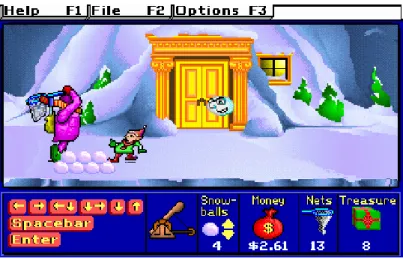
Fig 2.2: Students play as the green character and must “munch” numbers within a category (in this case multiples of 19) if they don’t want to be eaten by the purple monsters in Number Munchers. Treasure Mountain!, which was released in 1990 and was also developed by The Learning Company, was very educational and popular. Treasure Mathstorm!, an iteration that was released in 1996, became an iconic game that countless students looked fondly upon more than ten years later. The game featured better graphics than the previous examples did and taught students about counting numbers and money, balancing weights, and telling time. Additionally, the player had goals to strive for, like buying new nets to catch elves, finding secret items, and progressing up the mountain.4
Fig 2.3: Treasure Mathstorm! was notably more complicated than previous educational math games. Players can capture elves, must avoid or defeat evil snowballs, and must solve various math problems to earn money and progress through the game.
Fig 2.4: The player can spend money in the shop on various items. This gives players a better understanding of how to add and subtract change.
2.2.2.2 Effectiveness of Educational Games Many have questioned the validity of using computer games and simulations to teach students in a classroom environment. As a result, numerous studies have been conducted on the subject, and the findings have been positive: the cumulative results of a research review that examined 68 studies that directly or indirectly tested the difference between simulations/games and conventional teaching methods are pictured and discussed below: Fig 2.55 It is important to note that the majority of these studies (46) examined the effectiveness of games in the area of social sciences. According to the research review, 33 of these studies “showed no difference in student performance between games/simulations and conventional 5 “The effectiveness of games for educational purposes: a review of the research.”
instruction.” Additionally, the social science games did not generally use a computer, while the other areas (math, physics, and language arts) did. Despite using a computer, of the 6 studies dedicated to language arts, 5 demonstrated that games were ineffective. However, of the 8 studies involving math, 7 found that games and simulations were more effective at “improving math achievement” that conventional teaching methods were. According to the research review, “Subject matter areas where very specific content can be targeted and objectives precisely defined are more likely to show beneficial effects for gaming.” Furthermore, the research review found that games and simulations demonstrated greater learning retention than conventional teaching methods. Games and simulations also tended to interest students more. 14 of the studies recorded student feedback. In 12 of these studies the students “reported more interest in simulation and game activities than in more conventional activities.” In an interactive qualifying project also done at Worcester Polytechnic Institute titled, “An Analysis of the Effectiveness of an Interactive, Educational Game”, Michael P. Lundy reported that of the experimental group (asked to learn with an “interactive budget simulation tool” called Massbalance for 10 minutes) and the control group (asked to study a “static source” for 10 minutes), the experimental group spent an additional 2 minutes longer than they were asked to, and the control group spent 1 minute less than they were asked to. Although both groups tended to score similarly on the postquiz, the experimental group was more entertained and engaged than the control group (graph courtesy of Michael P. Lundy):
Fig 2.6 Students answered these questions in a postsurvey after they attempted to learn the material with the game or the static source. The two questions reveal that the majority of experimentees answered above a “3” for both entertainment and engagement after playing the game, while the majority answered below a “2” for the same question after studying text. It seems that students consistently enjoy and are more engaged by educational games, regardless of their effectiveness. Lundy’s report suggests that engagement is directly tied to how likely students are to continue to pursue related learning on their own. Other reports that studied the effectiveness of educational games and software came to similar conclusions. 2.2.2.3 The Future of Educational Games Educational games show considerable promise. Video games as a medium have progressed
astronomically in the last ten years, and as higher quality entertainment video games are developed, higher quality educational games become a distinct possibility. Studies continually reveal that educational games and software can and have been effective teaching tools. As a result, the interest in them has been growing. President Obama has been an advocate of educational computer games from the start, and has tasked his administration to study the benefits of video games. According to Obama, he wants to create “educational software that’s as compelling as the best video game.” Additionally he wants game players “to be stuck on a video game that’s teaching you something other than just blowing stuff up.” While Obama’s goals are lofty, they are possible with enough funding and support.6 On that note, there have been at least two notable educational games that have received or are asking for funding on www.kickstarter.com, a site where entrepreneurs ask for a certain amount of money to fund their projects. Mindblown Labs’ Mindblown Life, a social mobile game that develops money management skills, recently received $77,522 dollars in funding from 695 backers more than $17,000 more than they were asking. Even Bill Nye has worked closely with developers to produce a rough build of an educational physics game call Aero, which is also in the process of receiving funding. 6 “Obama: Games can mae education relevant for young people.”
Fig 2.7: In Aero, players play as a seagull and have to take things like drag, lift, and gravity into account.
3 The Experiments
We aimed to find and test the effectiveness of educational math games that taught subject material at a high school level because there are fewer studies and educational games focused on high school material. After compiling a list of over 30 educational games at or around a high school level we decided on 4 games (2 “good” and 2 “bad”) and 1 piece of educational software.3.1 Experiment #1
Factoring Quadratics: Wrecks Factor vs ASSISTments
Fig 3.1: The main menu of The Wrecks Factor
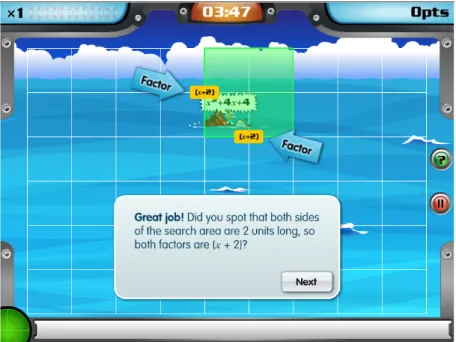
both educational and fun. The Wrecks Factor is a game hosted on managahigh.com about factoring quadratics that is played by rescuing ships in trouble. A player rescues a ship and earns points by dragging a box around it that represents the factored quadratic.
Fig 3.2: The Wrecks Factor provided a concise tutorial to help new players
The game screen is a grid where each unit right and up and left and down represent +1 and 1, respectively. For example, a box dragged two units to the right and two units up represents (x+2)(x+2), which would correctly factor this trinomial.
Fig 3.3: Players drag boxes that represent factored quadratics to help ships in need Ships in need of rescuing appear progressively more quickly and the player is tasked with quickly and efficiently solving numerous quadratics. Points are awarded for doing well at the game and are totaled up after the timer has run out on any given level. Players can choose the amount of assistance they would like, with lower assistance levels awarding more points for completed factorizations. Students participating in the experiment who were tasked to play The Wrecks Factor were asked to spend at least five minutes playing the game and to post their high scores when they were done. Additionally, they were presented the following choices for feedback about the game: ● The game was educational and fun ● The game was boring but educational ● The game was fun but not educational ● The game was not educational or fun ● I had technical difficulties
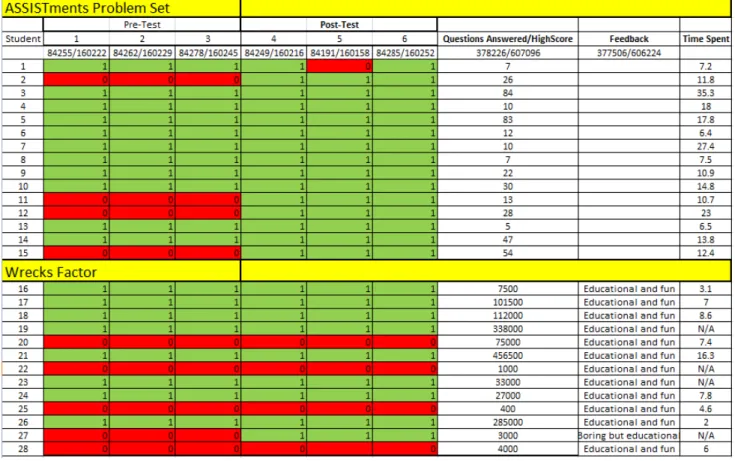
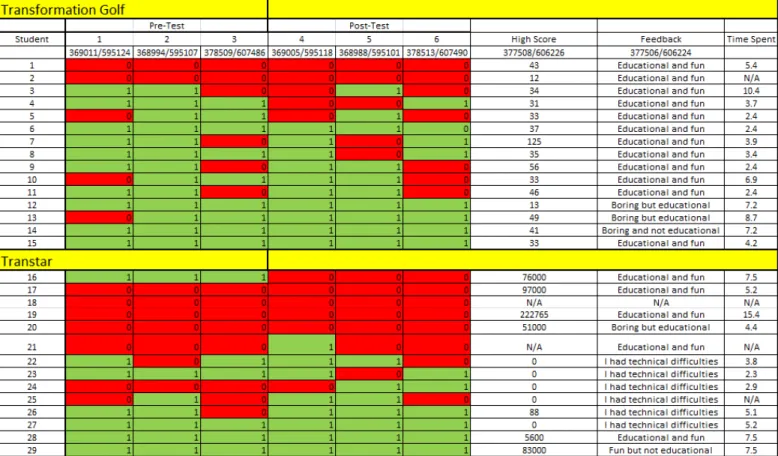
Approximately half of the students were presented with a link to a series of preset problems where they were asked to factor quadratics for at least five minutes. They were asked to record how many problems they had answered in the time that they had spent. The tables of the results of the first experiment are pictured below. Green represents a correct answer, and red represents an incorrect answer. Students were not asked for feedback on the problem set.
Table 3.1: A table of students and their resulting data in each half of the experiment Table 3.2: A table that shows the average pre and posttest differences, the standard deviation of the data, the average time students spent on the task assigned to them, and the statistical significance of the data Students who simply did practice problems seemed to learn more than students who played The Wrecks Factor. 4 out of 15 students who used ASSISTments showed improved performance on their posttests. Only 1 of the 13 students who played The Wrecks Factor showed any improvement on their posttest. Interestingly, every student who showed improvement in either side of the experiment went from getting none of the questions on the pretest correct to
answering every posttest question correctly. Only one student performed more poorly on the posttest, but this is plausibly an anomaly. Of the 15 students asked to practice factoring quadratics, the least time spent was 6.4 minutes. The most time spent was 35.3 minutes. The average time spent was 14.9 minutes. Students answered questions at different rates, but none answered less than 5, and one student answered 84, which was the total number of questions offered. The average amount of questions answered was 29, far more than expected. 3 of the 4 students who showed improvement answered less slightly than the average, but student 15 notably answered 54 questions. Students who showed improvement spent no less than 11 minutes answering questions, double what was asked of them. One of these students spent 22 minutes answering questions. The average improvement from pretest to posttest was .73, which means that students did 24% better on average. Of the students that played The Wrecks Factor, and whose times were recorded, the least time spent playing was just over two minutes. The most time spent playing was 16.3 minutes. The average time spent playing was 7 minutes. 6 scored over 75000, which was considered a good score. One student reported scoring 400 points, even though this is not possible. Several students reported scoring between 1000 and 4000 points, even though 1000 points are rewarded just for completing the tutorial. All but one of the students thought that the game was “Educational and fun.” The one student that did not find the game fun still believed it to be educational. This conflicts with pre and posttest results while no students performed more poorly on the posttest than they did on the pretest, only one of the students improved after playing the game, even though there were more opportunities for students to show improvement in this half of the experiment. It should be added that that student reported obtaining a score of
only 3000 which would suggest that they did not play the game enough or at a high enough skill level to have learned very much. It is possible that they received help or consulted a source to augment their learning. The average improvement from pretest to posttest was .23, which means that students did 7% better on average. The data above suggests that not only did students tend to learn more from practicing relevant problems, they also were compelled to spend more time doing so. Even though students spent less than half the average time students spent practicing problems playing The Wrecks Factor, they still tended to spend two minutes more than was asked of them. It is notable, however, that three of the nine students whose times were record spent less than the time asked playing the game. As can be seen in the second table above, there was a high standard deviation among the results of the students who completed the ASSISTments portion of the experiment, and lower but still notable deviation in the results of the students who played The Wrecks Factor. Unfortunately, the statistical significance of the results was .14, somewhat higher than the desired .05. This was due to a relatively small sample size.
3.2 Experiment #2
Translation, Reflection, and Rotation: Transformation Golf vs Transtar
Fig 3.4: Transformation Golf
Transformation Golf, a game hosted on nationalstemcentre.org, and Transtar, a game hosted on mangahigh.com, were chosen for this experiment because they were believed to represent a “bad” game and “good” game respectively. Transformation Golf demonstrates concepts much in the same way Transtar does, but it is not nearly as polished, visually pleasing, or “fun.” Both of these games teach students how to translate, reflect, and rotate within a coordinate system. Transformation Golf does so with one point, serving as a golf ball, and Transtar does so with a shape that represents a space ship. Unfortunately, Transformation Golf has since become inaccessible, so it will not be pictured below.
Fig 3.6: Like The Wrecks Factor, Transtar offers a brief tutorial
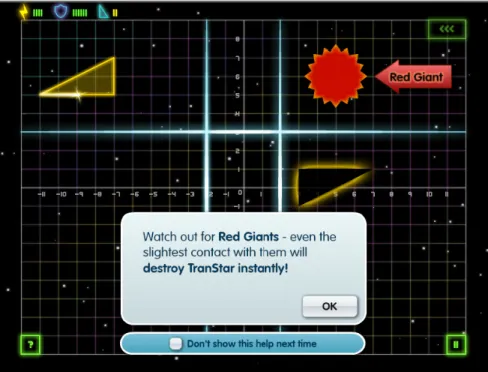
Students click dividing lines to reflect specific shapes into “StarGates.” They have a limited number of moves and tries, and are rewarded for efficiently guiding their shape to its goal.
Fig 3.7: Transtar sets itself apart from other online educational games by introducing a variety of fun and challenging mechanics There are a variety of interesting mechanics in Transtar. For example, players must watch out for Red Giants while reflecting their ship across the coordinate system. It was unknown if this would benefit or hinder the learning process. Students participating in the experiment were asked to spend at least five minutes playing Transformation Golf or Transtar and to post their high scores when they were done. Additionally, they were presented the following choices for feedback about the games: ● The game was educational and fun ● The game was boring but educational ● The game was fun but not educational ● The game was not educational or fun ● I had technical difficulties
The tables of the results of the first experiment are pictured below. Green represents a correct answer, and red represents an incorrect answer.
Table 3.3: The results of experiment #2
Table 3.4: The average difference in pre and posttests, the standard deviation, the average time spent, and the statistical significance of experiment #2’s data
4 of the 15 students who played Transformation Golf did more poorly on their posttest than they did on their posttest. Most demonstrated the same performance from pre to posttest. 2 of the 14 students who played Transtar performed worse on their posttests and most did not demonstrate different performance. Only one student who played Transformation Golf showed improvement from pre to posttest, compared to the four students that improved after playing Transtar. 13 of the students who played Transformation Golf obtained “good” scores at above 30. Most of the students reported the game as “educational and fun” but 3 thought it was “boring” and 1 thought it was “not educational.” Even though multiple students spent only 2.4 minutes playing the game, none spent less. The most time spent was 10.4 and the average time spent was 5 minutes the time they were asked to spend. Many students reported experiencing “technical difficulties” when attempting to play Transtar. Those that played with no problem tended to score “well,” or above 50000, with only one student scoring below. Most of the students who played the game said that it was “educational and fun” with one student believing it be only “fun” and another only believing it be “educational.” No students spent less than 2.3 minutes playing Transtar but none spent more than 7.5. The average time spent playing was 7.1 minutes. Unfortunately, the data on Transtar is less complete than the data on Transformation Golf because most students reported technical difficulties. The reason for this is unknown the link in the experiment is functioning and Transtar has not been taken down like Transformation Golf was soon after the experiment was completed. Possible reasons might include browser or firewall issues. Additionally, Transtar’s initial load time might have been substantial on
lowperformance machines, though it would likely not have exceeded a minute. Some students may have thought that the game was not loading and given up. The average difference between pre and posttests of students who played Transformation Golf is .27, meaning that, on average, students performed worse after playing the game. The average difference of students who played Transtar is .07, meaning students tended to demonstrate some statistically insignificant improvement. However, if students who reported technical difficulties are factored out, the average difference was .25 which is similar to the difference above. Unfortunately, the statistical significance of the results was .42, significantly higher than the desired .05. This was due to a relatively small sample size, which was made smaller due to a small amount of unusable data not analyzed here.
Experiment #3
Multiplying Binomials: ASSISTments vs Rags to Riches
Fig 3.8: Rags to Riches: Multiplying Binomials Rags to Riches: Multiplying Binomials, a game hosted on quia.com, was chosen for this experiment because it was believed to be a “bad” game. It lacks many of the features and visual flair of the other games, and is simply not much different from a series of relevant problems.Fig 3.9: Players earn money as they get more questions correct
Players are given a problem, and choose from four possible answers. As they progress through the game they earn more money until they earn one million dollars or get a single question wrong.
Players are given a total of three hints to use across the course of the entire game. These hints simply tell the player which answers are incorrect, and offer nothing in the way of tutoring like ASSISTments. Rags to Riches did not seem particularly educational. Students participating in the experiment who were tasked to play Rags to Riches were asked to spend at least five minutes playing the game and to post their high scores when they were done. Additionally, they were presented the following choices for feedback about the game: ● The game was educational and fun ● The game was boring but educational ● The game was fun but not educational ● The game was not educational or fun Approximately half of the students were presented with a link to a series of preset problems where they were asked to multiply binomials for at least five minutes. They were asked to record how many problems they had answered in the time that they had spent. At the time of this report, no meaningful data has come from this experiment.
Experiment #4
Parabolas: ASSISTments augmented with the pHet equation grapher vs
ASSISTments
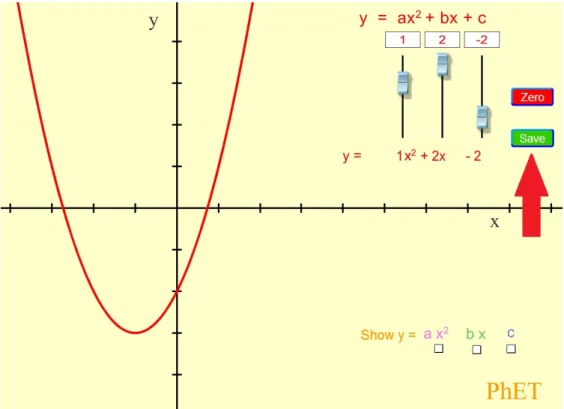
Fig 3.11: The pHet equation grapher is an inbrowser tool where students can graph equations in real time The pHet equation grapher was chosen for this experiment because it offers a visual and exploratory element otherwise not present in ASSISTments. Students using the equation grapher can enter values for a, b, and c and see in real time how the graph of their equation changes.Fig 3.12: An example of a tutorial image used to brief students on how to use the equation grapher Students can enter values manually into the a, b, and c text fields or adjust the sliders below. They can also save a graphed equation to compare it to a new function, both of which are displayed in different colors simultaneously on the screen. All of the functions and features of the equation grapher were made clear to students with access to it through concise visual tutorials.
Fig 3.13: The pHet tool is directly embedded into the ASSISTments system for easy access, as shown by the red box (not normally present in the problem set)
One of the benefits of the pHet equation grapher was that it could be directly embedded into problems within the ASSISTments system. This theoretically greatly facilitates the learning process as students learn about parabolas.
version of the problem set received an extremely similar version with the same problems, albeit without the equation grapher or equation grapher tutorial. Students who have access to the equation grapher have the opportunity to practice a few problems with the assistance of the tool, but both groups are given the same, unassisted pre and posttests.
4 Conclusion and Final Thoughts
From the start, our project team sought to test the viability and effectiveness of educational math games and tools at a roughly high school level. Educational math games have demonstrated their ability to teach and engage younger students, but higher level math students rarely use such software. Furthermore, such software is rare, and relevant software of a high quality is even rarer. ASSISTments is a perfect platform to test the responses to educational games and tools because it offers a variety of features like tutoring, custom hints, and variablized templates, as well as recording detailed data for teachers and experimenters to use and analyze. Of the four experiments that were built, only two yielded meaningful results. The third experiment was used by a single teacher, and many of the students seemingly quit halfway through. The fourth and most complicated experiment has not yet been used by any teachers, but teachers have expressed interest. Of the two experiments that yielded meaningful results, it seems that games may not be aneffective method of learning in this context. While students generally reported that the games were fun and educational, the results disagree. Most students who played the games did not demonstrate improvement, and in some cases did more poorly afterwards. Students seemed more willing to spend a long time practicing problems directly, rather than learning how to play a game and attempting to get a high score. In fact, no students spent less than the requested time attempting to solve problems, while several across both experiments spent as little as two minutes playing games. It is unclear if this is due to student preference, the perceived quality of the games, or a combination of both factors. It is worth noting that many students reported technical difficulties on one game, and that another game has been taken down since the experiment was completed. Avoiding long load times may be prudent, and it the fluidity of the internet is also a factor. In the end, practice problems within the ASSISTments system were shown to be more effective than the games picked for the experiment. More testing is needed, however these experiments are far from offering definitive proof. Games and software may have an important role in high school math education, and more experiments should be conducted to determine the nature of that role.
4/23/13 Assistment - Printing Content
Problem Set "Factoring Quadratics Experiment" id:[77824] 1) Assistment #84255 "84255 - 43056"
Factor the following polynomial: x2 + 12x +27
Once you have the polynomial factored enter one of the two factors Algebra: (x+3) (x+9) (-x-3) (-x-9) Hints:
Factoring means you want to get the polynomial in this form
(___x + ___)(____x + ____) (Note: The signs may change.)
The question is asking for only one of factors: (x + __).
We have: x2 + 12x +27
Since the product of the last terms must be 27, and 27 has three prime factors (3, 3, and 3).
The last terms could be: 27 and 1, because 27*1 = 27 -27 and -1, because -27*-1 = 27 3 and 9, because 3*9 = 27 -3 and -9, because -3*-9 = 27 9 and 3, because 9*3 = 27 -9 and -3, because -9*-3 = 27 3 and 9, because 3*9 = 27 -3 and -9, because -3*-9 = 27
4/23/13 Assistment - Printing Content
Thus we must look at all possible combinations until we find the one that will result in b, 12. (x + 27)(x + 1) : (x * 1) + (x * 27) = 28x (x - 27)(x - 1) : (x * -1) + (x * -27) = -28x (x + 3)(x + 9) : (x * 9) + (x * 3) = 12x (x - 3)(x - 9) : (x * -9) + (x * -3) = -12x (x + 3)(x + 9) : (x * 9) + (x * 3) = 12x (x - 3)(x - 9) : (x * -9) + (x * -3) = -12x (x + 9)(x + 3) : (x * 3) + (x * 9) = 12x (x - 9)(x - 3) : (x * -3) + (x * -9) = -12x
Only (x + 3) (x + 9) results in the correct b value
Type either (x+3) or (x+9).
2) Assistment #84262 "84262 - 43056"
Factor the following polynomial: x2 + 6x +8
Once you have the polynomial factored enter one of the two factors Algebra: (x+2) (x+4) (-x-2) (-x-4) Hints:
Factoring means you want to get the polynomial in this form
(___x + ___)(____x + ____) (Note: The signs may change.)
The question is asking for only one of factors: (x + __).
4/23/13 Assistment - Printing Content
Since the product of the last terms must be 8, and 8 has three prime factors (2, 2, and 2).
The last terms could be: 8 and 1, because 8*1 = 8 -8 and -1, because -8*-1 = 8 2 and 4, because 2*4 = 8 -2 and -4, because -2*-4 = 8 4 and 2, because 4*2 = 8 -4 and -2, because -4*-2 = 8 2 and 4, because 2*4 = 8 -2 and -4, because -2*-4 = 8
To find which set is right, we need to determine which results in b. Because the coefficient of x2 is one, only the sum of the last terms need to add to b.
Thus we must look at all possible combinations until we find the one that will result in b, 6. (x + 8)(x + 1) : (x * 1) + (x * 8) = 9x (x - 8)(x - 1) : (x * -1) + (x * -8) = -9x (x + 2)(x + 4) : (x * 4) + (x * 2) = 6x (x - 2)(x - 4) : (x * -4) + (x * -2) = -6x (x + 2)(x + 4) : (x * 4) + (x * 2) = 6x (x - 2)(x - 4) : (x * -4) + (x * -2) = -6x (x + 4)(x + 2) : (x * 2) + (x * 4) = 6x (x - 4)(x - 2) : (x * -2) + (x * -4) = -6x
Only (x + 2) (x + 4) results in the correct b value
Type either (x+2) or (x+4).
3) Assistment #84278 "84278 - 43056"
Factor the following polynomial: x2 + 18x +45
Once you have the polynomial factored enter one of the two factors
Algebra: (x+3) (x+15) (-x-3)
4/23/13 Assistment - Printing Content
Hints:
Factoring means you want to get the polynomial in this form
(___x + ___)(____x + ____)
(Note: The signs may change.)
The question is asking for only one of factors: (__x + __). We have: x2 + 18x +45
Since the product of the last terms must be 45, and 45 has three prime factors (5, 3, and 3).
The last terms could be: 45 and 1, because 45*1 = 45 -45 and -1, because -45*-1 = 45 5 and 9, because 5*9 = 45 -5 and -9, because -5*-9 = 45 15 and 3, because 15*3 = 45 -15 and -3, because -15*-3 = 45 3 and 15, because 3*15 = 45 -3 and -15, because -3*-15 = 45
To find which set is right, we need to determine which results in b. Because the coefficient of x2 is one, only the sum of the last terms need to add to b.
Thus we must look at all possible combinations until we find the one that will result in b, 18. (x + 45)(x + 1) : (x * 1) + (x * 45) = 46x (x - 45)(x - 1) : (x * -1) + (x * -45) = -46x (x + 5)(x + 9) : (x * 9) + (x * 5) = 14x (x - 5)(x - 9) : (x * -9) + (x * -5) = -14x (x + 3)(x + 15) : (x * 15) + (x * 3) = 18x (x - -3)(x - -15) : (x * -15) + (x * -3) = -18x (x + 15)(x + 3) : (x * 3) + (x * 15) = 18x (x - 15)(x - 3) : (x * -3) + (x * -15) = -18x
Only (x + 3) (x + 15) results in the correct b value
4/23/13 Assistment - Printing Content
4) Assistment #377868 "377868 - Wrecks Instructions"
In the next step you are going to play Wrecks Factor, a game about factoring quadratics, for at least five minutes. Be sure to remember your high score when you are done playing!
The game will guide you through a brief tutorial. If you want further help you can click the Help buttion on the main menu.
Please leave all of the settings on default.
When you are done, return to this window and continue.
What are you going to do? Multiple choice:
Continue and play Wrecks Factor for at least five minutes. Go shopping
No, you are going to continue and play Wrecks Factor for at least five minutes.
Write a poem
No, you are going to continue and play Wrecks Factor for at least five minutes.
Hints:
The answer is .
5) Assistment #377869 "377869 - Wrecks Game"
Click the picture below and play the game for at least five minutes (you can play more if you want to!). Remember to keep track of your score!
4/23/13 Assistment - Printing Content
When you are done, enter your highscore below and continue. Fill in:
17 Hints:
The answer is .
6) Assistment #377506 "377506 - Game Survey"
Did you think the game was: Multiple choice:
Educational and fun? Fun but not educational? Boring but educational? Boring and not educational? I had technical difficulties. Hints:
The answer is .
7) Assistment #378227 "378227 - ASSISTments Instruction"
In the next step you are going to answer a series of questions on ASSISTments.
When you click the ASSISTments image, a new window will open and you will answer questions for at least five minutes, but you may continue as long as you want.
When you are done, you will enter your score and then continue. What are you going to do on the next page?
Multiple choice:
Click the ASSISTments link, use it for at least five minutes, then enter your score Go shopping
No, you are going to continue and play Wrecks Factor Write a poem
4/23/13 Assistment - Printing Content
Hints:
The answer is .
8) Assistment #378226 "378226 - ASSISTments Test Drive"
Please click on the picture below and answer questions for at least five minutes.
When you're done enter how many questions you answered below. Fill in: 17 Hints: The answer is . 9) Assistment #84249 "84249 - 43056"
Factor the following polynomial: x2 + 12x +35
Once you have the polynomial factored enter one of the two factors Algebra: (x+7) (x+5) (-x-7) (-x-5) Hints:
Factoring means you want to get the polynomial in this form
(___x + ___)(____x + ____) (Note: The signs may change.)
The question is asking for only one of factors: (x + __). We have: x2 + 12x +35
4/23/13 Assistment - Printing Content
The last terms could be: 35 and 1, because 35*1 = 35
-35 and -1, because -35*-1 = 35
7 and 5, because 7*5 = 35 OR -7 and -5, because -7*-5 = 35
To find which set is right, we need to determine which results in b. Because the coefficient of x2 is one, only the sum of the last terms need to add to b.
Thus we must look at all possible combinations until we find the one that will result in b. (x + 35)(x + 1) : (x * 1) + (x * 35) = 36x
(x - 35)(x - 1) : (x * -1) + (x * -35) = -36x (x + 7)(x + 5) : (x * 7) + (x * 5) = 12x (x - 7)(x - 5) : (x * -7) + (x * -5) = -12x
Only (x + 7) (x + 5) results in the correct b value
Type either (x+7) or (x+5).
10) Assistment #84191 "84191 - 43056"
Factor the following polynomial: x2 + 6x +9
Once you have factored the polynomial, please enter one of the factors below. Algebra:
(x+3) (-x-3) Hints:
Factoring means you want to get the polynomial in this form
(___x + ___)(____x + ____)
Since x2 + 6x +9 has no coefficient to x2, neither of the x's in the factored form have a coefficient, meaning you only have to find the values of the two blanks.
(x + ___)(x + ____)
4/23/13 Assistment - Printing Content
We have: x2 + 6x +9
Since the product of the last terms must be 9
The last terms could be: 3 and 3 , because 3*3=9
-3 and -3, because -3*-3=9
9 and 1, because 9*1 = 9 OR -9 and -1, because -9*-1 = 9
So you either have: (x + 3)(x + 3) (x - 3)(x - 3) (x + 9)(x + 1) (x - 9)(x - 1)
To determine which of the four is correct, you must re-expand each and find a match to the original problem.
When you multiply you get:
(x + 3)(x + 3) = x2 + 3x+ 3x + 9 = x2 + 6x + 9
(x - 3)(x - 3) = x2 - 3x -3x + 9 = x2 - 6x + 9
(x + 9)(x + 1) = x2 + 9x+ x + 9 = x2 + 10x + 9
(x - 9)(x - 1) = x2 - 9x- x + 9 = x2 - 10x + 9
This one is correct:
(x + 3)(x + 3) = x2 + 3x + 3x + 9 = x2 + 6x + 9
Type (x+3).
This means the original polynomial is a special polynomial. If the polynomial is of the form x2 + (2*c1/2)x + c (b is 2 times the square root of c) then the answer will always be (x+[The square root of c])2.
11) Assistment #84285 "84285 - 43056"
Factor the following polynomial: x2 + 26x +105
Once you have the polynomial factored enter one of the two factors
Algebra: (x+5)
4/23/13 Assistment - Printing Content
(-x-5) (-x-21) Hints:
Factoring means you want to get the polynomial in this form
(___x + ___)(____x + ____)
(Note: The signs may change.)
The question is asking for only one of factors: (__x + __). We have: x2 + 26x +105
Since the product of the last terms must be 105, and 105 has three prime factors (7, 3, and 5).
The last terms could be:
105 and 1, because 105*1 = 105 -105 and -1, because -105*-1 = 105 7 and 15, because 7*15 = 105 -7 and -15, because -7*-15 = 105 21 and 5, because 21*5 = 105 -21 and -5, because -21*-5 = 105 3 and 35, because 3*35 = 105 -3 and -35, because -3*-35 = 105
To find which set is right, we need to determine which results in b. Because the coefficient of x2 is one, only the sum of the last terms need to add to b.
Thus we must look at all possible combinations until we find the one that will result in b, 26. (x + 105)(x + 1) : (x * 1) + (x * 105) = 106x (x - 105)(x - 1) : (x * -1) + (x * -105) = -106x (x + 7)(x + 15) : (x * 15) + (x * 7) = 22x (x - 7)(x - 15) : (x * -15) + (x * -7) = -22x (x + 3)(x + 35) : (x * 35) + (x * 3) = 38x (x - -3)(x - -35) : (x * -35) + (x * -3) = -38x (x + 21)(x + 5) : (x * 5) + (x * 21) = 26x (x - 21)(x - 5) : (x * -5) + (x * -21) = -26x
4/23/13value Assistment - Printing Content
4/23/13 Assistment - Printing Content
Problem Set "Translations and Reflections Experiment" id:[79354] 1) Assistment #369011 "369011 - Triangle Reflection"
Reflect the triangle across the x axis. What are the coordinates of point A after the reflection?
Fill in: (-2,8) (-2 ,8) (-2, 8) (-2 , 8) -2,8 -2, 8 -2 ,8 -2 , 8 Hints:
To reflect, you need to flip the shape over the x axis.
The current coordinates of point A are (-2,-8)
4/23/13 Assistment - Printing Content
is multiplied it by -1 when reflecting across the y-axis. The y-value...
stays the same when relfect across the y-axis
is multiplied it by -1 when reflecting across the x-axis. Type in (-2,8)
2) Assistment #368994 "368994 - Quadrilateral Translation"
Translate the quadrilateral left 4 units and up 5 units. What are the coordinates of point B after the translation? Fill in: (4,4) (4 ,4) (4, 4) (4 , 4) 4,4 4, 4 4 ,4 4 , 4 Hints:
4/23/13 Assistment - Printing Content
The current coordinates of point B are (8,-1)
From (8,-1) you will move to (4,4).
Type in (4,4)
3) Assistment #378509 "378509 - Triangle Rotation"
Rotate the triangle clockwise about the origin 180 degrees. What are the coordinates of point B after the rotation? Fill in: (-7,2) (-7 ,2) (-7, 2) (-7 , 2) -7,2 -7, 2 -7 ,2 -7 , 2 Hints:
4/23/13 Assistment - Printing Content
Rotating about the origin means that (0,0) on the graph will be the center of the rotation. 90 degree rotation is a quarter turn.
180 degree rotation is a half turn.
Clockwise means the direction that a clock moves.
→ → →
↑ ↓
← ← ←
Rotate your drawing 180 degrees.
The current coordinates of the point B are (7,-2)
When you rotate 90 degrees the x and y values reverse. Also the sign will change on one of the two numbers.
When you rotate 180 degrees the sign will change on x and y values. The x-value of point B will change from 7 to -7 when you rotate 180 degrees.
The y-value will change from -2 to 2. Type in (-7,2)
4) Assistment #377820 "377820 - Transtar Instructions"
In the next step you are going to be playing Transtar, a game about translations, reflections, and rotations, for at least five minutes. Be sure to remember your high score when you are done playing!
The game will guide you through a brief tutorial. If you want more help you can click the Help button on the main menu.
When you are done, return to this window and continue.
What are you going to do? Multiple choice:
Go to bed
No you're going to play Transtar for at least five minutes before returning to this window.
Learn to knit
No you're going to play Transtar for at least five minutes before returning to this window.
4/23/13 Assistment - Printing Content
Hints:
5) Assistment #377821 "377821 - transtar2"
Please click the picture below and play the game for at least five minutes. Remember to keep track of your score!
When you are done, enter your highscore below and continue. Fill in:
17 Hints:
The answer is .
6) Assistment #377506 "377506 - Game Survey"
Did you think the game was: Multiple choice:
Educational and fun? Fun but not educational? Boring but educational? Boring and not educational? I had technical difficulties. Hints:
4/23/13 Assistment - Printing Content
7) Assistment #369091 "369091 - Please click the ..."
In the next step you will be playing Transformation Golf, a game about rotations, reflections, and translations, for at least five minutes. Be sure to remember your high score when you are done playing! The goal of the game is to translate, reflect, and rotate the golf ball into the hole.
When you are done, return to this window and continue.
What are you going to do? Multiple choice:
Draw a picture
No, you are going to continue and play Transformation Golf for at least five minutes before returning to this window.
Learn to knit
No, you are going to continue and play Transformation Golf for at least five minutes before returning to this window.
Continue and play Transformation Golf for at least five minutes before returning to this window. Help around the house
No, but that's considerate of you.
8) Assistment #377508 "377508 - transgolf"
Please click the picture below and play the game for at least five minutes (you can play more if you want to!). Remember to keep track of your high score!
4/23/13 Assistment - Printing Content
When you are done, enter your highscore below and continue. Fill in:
17 Hints:
The answer is .
9)Duplicate assistment: Assistment #377506 "377506 - Game Survey" was not displayed.
10) Assistment #369005 "369005 - Triangle Reflection"
4/23/13 Assistment - Printing Content Fill in: (2,7) (2 ,7) (2, 7) (2 , 7) 2,7 2, 7 2 ,7 2 , 7 Hints:
To reflect, you need to flip the shape over the x axis.
The current coordinates of point A are (2,-7)
The x-value...
stays the same when relfect across the x-axis
is multiplied it by -1 when reflecting across the y-axis. The y-value...
stays the same when relfect across the y-axis
4/23/13 Assistment - Printing Content
11) Assistment #368988 "368988 - Quadrilateral Translation"
Translate the quadrilateral left 2 units and up 2 units. What are the coordinates of point D after the translation? Fill in: (0,-4) (0 ,-4) (0, -4) (0 , -4) 0,-4 0, -4 0 ,-4 0 , -4 Hints:
To translate, you need to start at each point and count 2 to the left and then 2 up.
The current coordinates of point D are (2,-6)
From (2,-6) you will move to (0,-4).
4/23/13 Assistment - Printing Content
12) Assistment #378513 "378513 - Triangle Rotation"
Rotate the triangle clockwise about the origin 90 degrees. What are the coordinates of point C after the rotation? Fill in: (-8,-4) (-8 ,-4) (-8, -4) (-8 , -4) -8,-4 -8, -4 -8 ,-4 -8 , -4 Hints:
Redraw the triangle on a seperate sheet of paper.
Rotating about the origin means that (0,0) on the graph will be the center of the rotation. 90 degree rotation is a quarter turn.
4/23/13 Assistment - Printing Content
→ → →
↑ ↓
← ← ←
Rotate your drawing 90 degrees.
The current coordinates of the point C are (4,-8)
When you rotate 90 degrees the x and y values reverse. Also the sign will change on one of the two numbers.
When you rotate 180 degrees the sign will change on x and y values. The x-value of point C will change from 4 to -8 when you rotate 90 degrees.
The y-value will change from -8 to -4. Type in (-8,-4)
4/23/13 Assistment - Printing Content
Problem Set "Multiplying Binomials Experiment" id:[78281]
1) Assistment #112664 "112664 - Multiplying Binomials"
If the directions are to apply the distributive property to multiply these binomials: (8x-7)(5x-2)
Which option correctly multiplies the binomials?
a.(8x-7)(5x-2) = (8x)(5x)-(8x)(2)-(7)(5x)+(7)(2) = 13x2-10x-12x+9 = 13x2-22x+9 b.(8x-7)(5x-2) = (8x)(5x)-(8x)(2)+(7)(5x)-(7)(2) = 40x2-16x+35x-14 = 40x2+19x-14 c.(8x-7)(5x-2) = (8x)(5x)-(8x)(2)-(7)(5x)+(7)(2) = 85x2-82x-75x+72 = 85x2-157x+72 d.(8x-7)(5x-2) = (8x)(5x)-(8x)(2)-(7)(5x)+(7)(2) = 40x2-16x-35x+14 = 40x2-51x+14 Multiple choice: a b c d 2) Assistment #112697 "112697 - 106491 - FOIL"
Simplify the equation: (4x+5)(2x+9)
You need to enter your answer in the right format for the computer to grade it. 1.Use standard form, which means you put the highest power first.
2. Use the ^ to show exponents just like you do with a graphing calculator. 3. Do not put in any spaces.
4/23/13 Assistment - Printing Content
You would type in: -4x^3+x^2-2x+6
Fill in:
8x^2+46x+45 Hints:
Be sure to read the rules in orange carefully. To solve the problem:
Think of each poynomial as one side of a rectangle.
2x + 9
4x + 5
Then calculate the area for each section of the rectangle.
2x + 9
4x (2x)(4x) (9)(4x)
+
5 (2x)(5) (9)(5)
Then add each area together: (2x)(4x)+(9)(4x)+(2x)(5)+(9)(5) and then simplify:
8x2+46x+45
Type in: 8x^2+46x+45
3) Assistment #112782 "112782 - FOIL"
Simplify the equation: (8x+7)(3x-9)