Procedia - Social and Behavioral Sciences 205 ( 2015 ) 128 – 133
1877-0428 © 2015 Published by Elsevier Ltd. This is an open access article under the CC BY-NC-ND license (http://creativecommons.org/licenses/by-nc-nd/4.0/).
Peer-review under responsibility of Academic World Research and Education Center. doi: 10.1016/j.sbspro.2015.09.039
ScienceDirect
6th World conference on Psychology Counseling and Guidance, 14 - 16 May 2015
Critical Issues of Soft Skills Development in Teaching Professional
Training: Educators’ Perspectives
Tang Keow Ngang
a*, Tan Chan Chan
b, Uma Devi a/p Vetriveilmany
caSchool of Educational Studies, Universiti Sains Malaysia, Penang and 11800, Malaysia bMethodist Boy School, Air Itam, Penang and 10460, Malaysia
cSin Min Secondary Chinese Type School, Sungai Petani, Kedah and 08000, Malaysia
Abstract
This study aimed to identify critical issues of soft skills development through teaching professional training. Qualitative data was collected through in-depth interviews with the two 15 years working experiences teacher educators in a Malaysian public university. Data derived from interviews was then analysed according to three main themes namely soft skills that need to be highlighted or neglected and the critical issues. Results of the study revealed that factors on failure of soft skills development were big class size, academic focused and insufficient period of training. In conclusion, embedded model will be a better solution to ensure integration of soft skills in every course design. Future research should focus on the appropriate assessment method to facilitate the soft skills development.
© 2015 The Authors. Published by Elsevier Ltd.
Peer-review under responsibility of Academic World Research and Education Center. Keywords: Soft skills development, teaching professional training, teacher educator, public university;
1.Introduction
The Malaysian Prime Minister in tabling the Ninth Malaysia Plan (2006-2010) on March 31, 2006 emphasized that the development of human capital and the improvement of the mentality and intellectual capacity of a nation must be a priority if Malaysia is to be a developed country. Focusing on these areas will enable the country to raise its capacity for knowledge, creativity, and innovation, which are critical elements in the context of globalization. Consequently, the Minister of Higher Education at that particular year announced that public universities in Malaysia must introduce soft skill components and integrate them in the undergraduate syllabus. There are at least
* Tang Keow Ngang. Tel.: +6-017-539-6315
E-mail address: [email protected]
© 2015 Published by Elsevier Ltd. This is an open access article under the CC BY-NC-ND license (http://creativecommons.org/licenses/by-nc-nd/4.0/).
two critical reasons sustaining the need in strengthening undergraduates’ soft skills especially teacher trainees in Institutes of Higher Learning. First, criticisms from school administrators that novice teachers are generally academically proficient but lack in soft skills such as ethics, moral and professional skills, communication skill, critical thinking and problem solving skills, team work skill and leadership skill (Tang & Tan, forthcoming). Second, the increasing globalization of the work force and job market imposes much more competitive skills on our graduate teachers (Shakir, 2009).
Soft skills can be typically categorized into three major categories namely personal attributes, interpersonal skills, and problem solving and decision making skills (Shakir, 2009). Apart from producing trained teachers with academic excellence, public universities specifically on faculty of education must ensure that their trained teachers possess the relevant personal and ethical development. The Malaysian Institute of Higher Learning has developed a framework suggesting the approach that should be undertaken in implementing soft skills.
2.Soft Skills Development
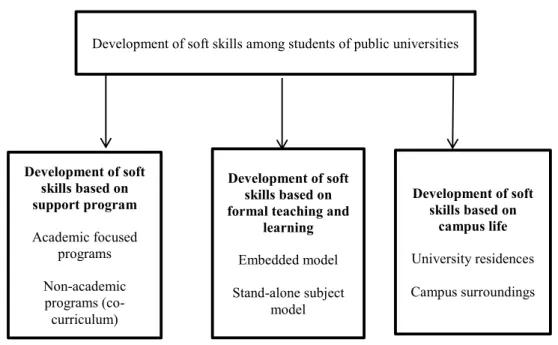
The Malaysian Institute of Higher Learning (2006) recommended that public universities in Malaysia work within the given framework as shown in Figure 1, these public universities are allowed to make variations and additions in the implementation aspect.
Fig. 1. Model for implementation of soft skills in public universities. Source: Ministry of Higher Education Malaysia (2006)
2.1.Development of soft skills through stand-alone subject
Faculties can offer stand-alone subjects which will provide teacher trainees with the opportunities to develop soft skills on a formal basis. These courses which are offered as elective courses such as English (both written and oral), Entrepreneurship, and others can be offered as stand-alone subjects and can be taken up the teacher trainees in any semester. Since the subjects are elective in nature, teacher trainees may decline to register for these subjects, as they may have their own preference. In cases such as this, it is the teacher educators’ role as teacher trainee advisers to advice these teacher trainees accordingly.
Development of soft skills among students of public universities
Development of soft skills based on support program Academic focused programs Non-academic programs (co-curriculum) Development of soft skills based on formal teaching and
learning Embedded model Stand-alone subject model Development of soft skills based on campus life University residences Campus surroundings
2.2.Development of soft skills by embedding it in existing courses
Soft skills can also be introduced at public universities by interweaving them with the current course content. This is probably one of the most practical ways in instilling soft skills to teacher trainees, as minimal or almost no changes need to be made to the current course structure. In this model, teacher trainees develop soft skills throughout the full duration of their course, as some if not all of the skills are integrated in the subject taught. However, the task of the faculty to identify which subjects can be embedded with the most and the least soft skill components. As such, teacher educators should be heavily involved in the implementation aspect while teacher trainees need to be told how and in what aspect they will be assessed.
Since teacher educators play a key role in the implementation and assessment aspect, teacher educators should be creative in designing their teaching modules so as to integrate the relevant skills. Teaching styles should be student centred where teacher trainees are expected to participate actively in the learning process, while the teacher educator undertakes the role as a facilitator. Problem-based learning, case study, and other teaching and learning techniques such as presentations and group work should be widely used in place of the traditional teaching and learning methods. Teacher educators can also emulate how soft skills are integrated in universities abroad.
2.3.Development of soft skills based on support program
Soft skills can also be developed indirectly through support programs such as co-curricular activities. Activities such as these are non-academic in nature, but indirectly assist teacher trainees in developing their personality and character. These programs allow the teacher trainees to explore their interest which can be nurtured by enrolling them in co-curricular and extra-curricular activities that is reflective of their interest.
2.4.Development of soft skills based on campus life
A significant number of teacher trainees reside in the residence colleges. The head of colleges could take this opportunity to plan activities that will involve the participation of all the teacher trainees living in college residences. Activities such as debates, drama competition, sports carnival which includes tally match, charity bazaar, and singing competitions are amongst those activities that could be carried out. Besides increasing social interaction among teacher trainees, leadership qualities, team work, and entrepreneurship can be nurtured through such activities. These informal activities should be carefully planned and carried out continuously throughout the semester and to improve team work capabilities they should encompass all races and gender.
2.5.Development of soft skills based on formal and informal activities at faculty levels
Faculties can also play a significant role in enhancing soft skills amongst teacher trainees on formal activities such as in organizing seminars, workshops, and conferences. Although these activities will most probably benefit those teacher trainees who are already active, the less active ones can be requested to assist. In a more informal approach, the faculty of education could organize activities during weekends for social activities such as visits to shelter homes, games between departments, and the like. While the faculty of education is not taking the role of head of colleges, informal activities at faculty levels can involve all teacher trainees regardless of whether they are college residence or not.
3.Aim of this paper
The crucial challenge faced by faculty of education is how to train teacher trainees of today for the jobs of tomorrow and how to shape teaching and learning so that they can acquire occupational-relevant competencies for teaching career needed in the foreseeable future. The quality of teaching professional training depends on how much value the educational process added to teacher trainees. Therefore, the main aim of this paper is to investigate the critical issues caused from the gaps between the acquired and required soft skills from the views of the two
experienced teacher educators. 4.Methodology
This study employed in-depth interview with two teacher educators to collect data. Exploratory research design has been utilized because it is regarded as the most useful in the preliminary stages of a research project when there are levels of uncertainty and general ignorance of the subject (Webb, 1992). It allows the researchers to explore individuals through complex interventions, relationships, communities or phenomenon in which it occurred (Yin, 2003). The interview began with the teacher educator commenting on the preliminary study findings on the gap between the acquired and required soft skills from 250 novice teachers. Then she was asked to elaborate to what extend the soft skills have been integrated in the teaching professional training. Finally she would discuss on the effectiveness of the implementation soft skill development model which has been introduced by the Ministry of Higher Education since 2006. Data collected from in-depth interview was analysed using constant comparative method. The process of organizing information, synthesising and making sense of the information would enable the researchers to obtain in-depth information and make interpretation of the interviews. (1)
5.Findings and discussion
For this paper, we focused on our analysis mainly on qualitative data collected from interviews of two experienced teacher educators. Teacher educator 1 (R1) currently is a professor who has been an academic staff member in one of the established Malaysian public university since 1993. Besides being a lecturer, she has also held a number of administrative positions such as Coordinator of the Basic Education Research Unit, Program Chairperson, Deputy Dean, Acting Dean and Director of Community Network. She is also the Chairperson of the Preschool Education Committee of The Penang Education Council, Malaysia. Teacher educator 2 (R2) is a professor, a former deputy dean and also a Chairperson of Bachelor of Education (Preschool) program in one of the established Malaysian public university. Her expertise is mathematics education.
5.1.Comments on the failure of soft skills development
R1 has commented on the failure of soft skill development through teaching professional training due to a few factors. One of the major factors is big class size. Most of time, teacher trainees do not have opportunity to develop their soft skills even though in their tutorial session. Tertiary education system is more focused on academic than personality therefore student-centred teaching strategy is not highly emphasized. Some soft skills need to develop since they are young especially ethic, moral and professional skill. The period of teaching professional training for four years is insufficient for teacher educators to develop soft skills of teacher trainees.
R2 has discussed on the failure of integrating soft skills in teaching professional training that caused the gap between the acquired and required soft skills of teachers. This is because soft skills that they acquired from the teaching professional training such as communication skill and team work skill are different from the skills required in their work place. For example, they have to communicate with their students, colleagues, principal, and parents in their work place while they are only communicate with their peers and lecturers during their teaching professional training. In fact communication skill and team work skill are interrelated. Once the teacher trainees are actively involved in team work, they will automatically improve their communication skill.
5.2.Soft skill integration in teaching professional training
According to R1, soft skills are not well planned to integrate into the curriculum as well as practising those soft skills. They are just stated on paper to meet the requirement by the ministry. Although it is stated in the course outline but to what extent those soft skills are practised in teaching and learning process is still questionable.
In addition, R2 gave a different point of view on this issue. According to her, curriculum reviews had been carried out to ensure soft skills are well integrated through lecturing method and co-curricular activities. For example, teacher educators are the role model to teacher trainees. Therefore teacher educators must possess high soft
skills before they are able to train their trainees. Soft skill integration is very much depending on the efforts of teacher educators themselves.
5.3.Effectiveness of the implementation soft skill development model
In order to improve of using the soft skill development model, teacher educators themselves should plan and apply the soft skills in their syllabus as well as conduct their obligations ethically. Soft skills are necessary to be embedded in all program or curriculum and not as a stand-alone subject according to R1. This will enable teacher trainees to see the relationships and relevance of those courses that they studied in their teaching professional program through embedded model rather than stand-alone subject model, added by R1. Soft skills cannot be taught but must be practiced by showing them examples. Teacher trainees’ soft skills should be assessed by teacher educators through classroom observation and tutorial session. An appropriate assessment system must be created to measure teacher trainees’ soft skill development. In addition, R1 suggested that teacher trainees should be given autonomy so that this will enable them to think critically. Teaching practicum can be an important mechanism to develop their soft skills.
R2 is also supporting embedded model rather than stand-alone subject model especially team work skill, communication skill, leadership skill and critical thinking skill. According to R2, these soft skills are not academic components but they are tool for academic, therefore they cannot be alone subject. If they are to be stand-alone subject, teacher trainees will only learn to pass the examination without understand and practise them in their learning process. However, soft skills like ethic, moral and professional skills, and life-long learning and management of information can be stand-alone subject. Finally, R2 suggested that to develop entrepreneurship skill among teacher trainees is through practices so that they will become risk takers while handling challenging activities. Mostly this type of training can be carried out through co-curricular activities.
6.Conclusion
Given the long duration that teacher trainees are exposed to rote learning styles and examination-oriented education system in their formative years of elementary and secondary education upon which their personal characteristics were formed, it is not an easy task to undo these traits during their four years of tertiary education. For instance, the development of soft skills through stand-alone subjects is only taught for duration of three semesters (14 weeks per semester). In addition, as these subjects are perceived as non-core courses, teacher trainees tend to pay the least attention when undertaking these courses. Therefore the two respondents (R1 and R2) prefer embedded model rather than stand-alone subject model. Hence, embedding soft skill components in the curriculum design will probably a better solution. In line with this, all the public universities in Malaysia have been instructed to review their existing curriculum where soft skill components have to be reflected in every course design.
On top of that, teacher trainees often over rate themselves and believe that they are well qualified and do not lack any necessary skills coupled by the belief that soft skills are part of their personal traits that is not possible to be enhanced. Faculty of education must create awareness to teacher trainees on the needs and expectation of the requirement and demand in their workplace, that is school. Acknowledging the fact that these soft skills should be part of the teacher trainees when they graduated, the lack of these soft skills is largely attributed to the education system as they fail to promote soft skills amongst their students. Thus, teacher trainees must be aware of their shortcoming so that they are able to identify their weaknesses and limitations of their soft skills and take the opportunity to acquire as much soft skills as possible while in university to prepare them for the demanding work place. More importantly, teacher trainees must be made to realize the importance of enhancing their soft skills so that they are able to compete in the world without boundaries. At present, there are no clear guidelines on how to assess the level of soft skills amongst teacher trainees as commented by R1 in this paper, future research should focus on the appropriate assessment method to facilitate the effective implementation of soft skill development.
Acknowledgements
The project was made possible with funding from Exploratory Research Grant Scheme (ERGS), Higher Education Department, Ministry of Education and Research Creativity and Management Office, Universiti Sains Malaysia, Malaysia.
References
Ministry of Higher Education Malaysia. (2006). Development of soft skills for Institutions of Higher Learning. Universiti Putra Malaysia.
Ninth Malaysia Plan. (2006-2010). Prime Minister’s Department: Economic Planning Unit.
Shakir, R. (2009). Soft skills at the Malaysian Institutes of higher learning. Asia Pacific Education Review, 2009 (10), 309-315. DOI: 10.1007/s12564-009-9038-8.
Tang, K.N., & Tan C.C. (forthcoming). The importance of ethics, moral and professional skills of novice teachers. Procedia Social and Behavioral Sciences.
Webb, J. (1992). Understanding and designing marketing research. London: The Dryden Press.