The Open University’s repository of research publications
and other research outputs
Integrated and situated academic development for all
categories of staff: lessons for constructive alignment
from an HEA-accredited Continuing Professional
Development scheme
Journal Item
How to cite:
Roberts, Jane and McLachlan, Jill (2018). Integrated and situated academic development for all categories of staff: lessons for constructive alignment from an HEA-accredited Continuing Professional Development scheme. Practice and Evidence of Scholarship of Teaching and Learning in Higher Education, 13(1) pp. 49–73.
For guidance on citations see FAQs.
c
2018 PESTLHE
Version: Version of Record
Link(s) to article on publisher’s website:
http://community.dur.ac.uk/pestlhe.learning/index.php/pestlhe/article/view/187
Copyright and Moral Rights for the articles on this site are retained by the individual authors and/or other copyright owners. For more information on Open Research Online’s data policy on reuse of materials please consult the policies page.
49
Integrated and situated academic development for all categories of
staff: lessons for constructive alignment from an HEA-accredited
Continuing Professional Development scheme
Jane Roberts1,*
Institute of Educational Technology, Open University, UK
[email protected], Jill McLachlan,
Faculty of Education and Languages, Open University, UK,
Abstract
Higher Education Academy (HEA) Fellowship and the UK Professional Standards Frameworks (UKPSF) are increasingly used within British higher education
institutions to support the professional formation of university teachers. This paper evaluates the use of practitioner inquiry within an HEA-accredited scheme
(OpenPAD) to support the professional development of part-time Associate
Lecturers at a large distance-learning institution. OpenPAD was available between 2013 and 2016 to all academic and academic-related staff in the Open University, including the 5000+ part-time teaching-only staff who are the main focus of this evaluation.
OpenPAD used situated learning through practitioner inquiry to generate evidence against the UKPSF. Participant experience is evaluated and lessons drawn, which may have implications for similar schemes in other institutions. The paper
concludes by identifying opportunities for the further integration of academic
1* Corresponding Author
ISSN 1750-8428 (online)www.community.dur.ac.uk/pestlhe.org.uk
50
development for all categories of staff in a successor scheme. It suggests this could be achieved by a proposed alignment between academic development; career-related processes such as induction and appraisal; institutional teaching and learning policies; and scholarship agendas.
Keywords: teaching-only staff; Higher Education Academy recognition; constructive alignment; academic development; practitioner inquiry.
Introduction
Teaching qualifications: the UK context for part-time and fractional staff
The relationship between the professional formation of part-time Higher Education (HE) teachers and the resulting impact on teaching quality has long been the subject of much debate in the UK sector and elsewhere (e.g. Beaton 2017; Brown & Gold, 2007;
Chadha, 2012; Courtney, 2013; Kimber, 2003; Knight et al, 2007). Provision for the initial induction of full-time academic staff new to teaching and their subsequent
continuing professional development is routine now in UK HE (Land & Gordon, 2015), suggesting that most institutions with the sector are convinced, with Gibbs (2010; Gibbs & Coffey, 2004) that there is a positive causal link between teaching qualifications and teaching quality.
In the UK, it is increasingly the case that HE teacher development programmes for new and experienced staff are accredited by the Higher Education Academy (HEA) against the UK Professional Standards Framework (UKPSF) (Land & Gordon, 2015). The UKPSF was developed by the UK HE sector and encompasses five Areas of Activity which teachers and learning support staff engage in; six types of Core Knowledge relevant to these activities; and four Professional Values (Appendix 1). These are the Dimensions of Practice (Higher Education Academy, 2011). Four Descriptors (D1, D2, D3 and D4) benchmark individuals’ practice across career stages in academic or
51
academic-related roles to professional recognition through HEA Fellowship (D1
Associate Fellowship; D2 Fellowship; D3 Senior Fellowship; D4 Principal Fellowship). The UKPSF was launched in 2006 and by early-2018 nearly 100,000 HEA Fellowships had been awarded, most in the UK but some to staff in overseas institutions (Higher Education Academy, 2018). This is 2.8 times the 2012 figure of 36,000 (Staff &
Educational Development Association, 2013), demonstrating the particularly rapid rise in the take-up of Fellowships over recent years. No information is available on the employment status of HEA Fellows, so it is not known if this increase relates to full-time and part-time staff proportionately.
However, it is known that, for staff who teach part-time, arrangements made by UK institutions for developmental support for teaching vary widely, both within and between institutions. Anderson (2007) briefly reviews the access and usage of academic
development activities for these staff, noting the different nomenclature used
internationally to designate teaching staff who work part-time on temporary contracts (e.g. ‘sessional teacher’, ‘adjunct faculty’, ‘part-time teacher’ or ‘contingent academic’). Brown & Gold (2007) use term ‘non-standard academics’ to encompass a range of teachers employed on a part-time, fixed-term, temporary, agency-mediated or hourly-paid basis. Courtney (2013) estimates that between 40% and 50% of HE teachers in the UK can be thus categorised, and identifies links between this casualised
employment pattern and several adverse trends, such as the marginalisation of these staff and the de-skilling of HE teaching. Such trends are caused by ‘insufficient levels of integration into departments and institutions, a lack of institutional support generally and specifically a lack of opportunities for both formal professional development ….. and informal learning’ (Courtney, 2013, p. 42).
Beaton (2017) notes three factors which can inhibit the professional identity and development of part-time staff. These are conflicting responsibilities arising from other responsibilities, for example other employment or study; tangential status in the
institution, associated with marginalisation and disconnection with systems and processes; and limited agency and voice. She suggests that ‘the development of
awards and recognition that are equally open to part- and full-time staff opens the doors for their contribution as teachers, whose practice is grounded in scholarship, to be more visible’ (2017, p.28). This view is endorsed by Southall, who uses a small case study to
52
suggest that ‘with the correct support in place, and with access to funding and
guidance, it is possible for staff employed on a sessional basis to develop a robust and valid academic identity which is on a par with their full time colleagues’ (2017, p. 477).
Professional learning, scholarship and the UKPSF
Southall (2017) goes on to argue that scholarly practice within communities of practice can offer a powerful and developmental route towards the integration of part-time staff into academic departments. Communities of practice (CoP) theory offers significant insights into practice-based learning in organizational contexts (Cox, 2005), in particular the importance of social practice and identity formation for learning. According to
Wenger et al. (2002), all communities of practice share a basic structure which consists of: ‘a domain of knowledge, which defines a set of issues; a community of people who care about this domain; and the shared practice that they are developing to be effective in their domain.’ (2002, p. 27). Within communities of practice practitioners undertake active and authentic learning experiences, such as collaborative learning;
apprenticeship and mentoring; peer and social learning from colleagues; and self-learning through reflection on practice.
Eraut’s research (2011) into the learning of professional workers (although not including HE teachers) found that the majority of learning took place through informal rather than formal learning. This implies that the fragmented and isolated work context of some part-time staff may be even more challenging in terms of professional formation, because their participation in communities of practice is restricted.
The challenge then for universities seeking to enhance the quality of teaching delivered by part-time staff is to facilitate the development and sustenance of informal learning opportunities through communities of practice, as well as appropriate formal training courses for these staff. One way to do this is through the fostering of scholarly approaches to teaching by linking practice-based educational inquiry and academic development (Cleaver et al, 2014; Southall 2017). Such situated approaches lend themselves well to demonstrating alignment with the UKPSF, so that several UK
53
universities have designed professional development schemes using educational inquiry as a route to HEA professional recognition (Floyd & Davies, 2015; Lea, 2015; Shrives, 2012).
Ideally, such schemes will be well integrated into the policy and operational
infrastructure for learning in an institution, so that the UKPSF is a common framing lens for ‘promotion, probation, teaching awards, bids and grants etc.’ (Shrives, 2012, p. 5) by using the UKPSF to underpin learning and teaching policies, scholarship initiatives, academic development and career-related processes such as induction, probation and appraisal. This has the potential to avoid the pitfall identified by Crawford (2010), who noted the challenge to academic development of misaligned institutional initiatives and priorities. However, for part-time staff such alignment can make a difference only if these colleagues are also integrated into mainstream career and academic
development processes within the institution. Given the logistical difficulty that part-time staff can experience attending scheduled events (Cornelius & Macdonald, 2008),
basing academic development on situated learning opportunities, such as practitioner inquiry, supported by asynchronous online resources, may provide a way forward. Setting Eraut’s analysis within the educational context, Sharpe argues that the
professional knowledge of teachers has special characteristics related to ‘the interplay between its construction and use’ (2004, p. 137). Thus, situated academic development activities can be highly effective at promoting the professional learning of teachers. This paper therefore proposes the use of the UKPSF within institutions to align institutional learning and teaching policies, including scholarship agendas, with situated academic development and career-related processes, in much the same way as Biggs (1996) proposes the constructive alignment within teaching of intended learning outcomes, teaching/learning activities, assessment tasks and grading. In our proposed model individual aspirations, identified through annual review and appraisal and shaped by institutional and departmental priorities, determine the desired skills and attributes (learning outcomes). Learning is constructed in situated academic development through scholarly reflection-on-action and reflection-in-action (Schon 1983, p.68) (learning activities). Self-appraisal, feedback within communities of practice, feedback from students, feedback from annual review and appraisal, outcomes of applications for promotion, and the award of HEA Fellowship are all forms of assessment, some wholly formative, some both formative and summative (assessment).
54
We will further argue that approaches to academic development based on situated learning opportunities, such as practitioner inquiry and reflective practice, have the potential to integrate professional development activities for all staff who support student learning, be they full-time academics, academic-related staff, or part-timers on teaching-only contracts, into a common framework.
The Open University
The Open University (OU) has the largest number of students of any European university, with 187,338 registered in 2013/14 (full-time equivalence 73,528). The student body is almost entirely part-time, with a median age of 29 on entry. 75% are working either full- or part-time and, of registered undergraduates, 42% had prior qualifications below the minimum normally required by UK universities. 12% have one or more declared disabilities (Open University, 2014a, 2014b). Each of these student characteristic indicators is markedly larger than the UK HE mainstream and presents considerable challenges for student support.
The OU model of supported open learning depends on a complex structure, with part-time Associate Lecturers (ALs) providing frontline teaching, support and assessment. Much of this is through correspondence tuition and online community-building using forums. This asynchronous support is supplemented by synchronous tutorials, online or face-to-face. Students can access advice and guidance through a network of Student Support Teams (SST), staffed by academic-related staff. Academic teams work based in centres across the UK, including the devolved capital cities, work closely with their SST colleagues, as well as line managing and providing academic development opportunities for Associate Lecturers. These academic teams are also aligned with faculties and departments based at the main Walton Hall campus at Milton Keynes. Within these faculties are central academics based at Walton Hall, who work with SSTs and academic-related staff from professional units such as learning technologists and librarians to develop new modules and associated multi-media materials. Associate Lecturers are by far the most numerous group of staff supporting the learning of OU
55
students (5921 in 2013/4). Central/regional/national academics numbers that year were 1148 and staff on academic-related contracts numbered 1844 (Open University, 2014c). The AL role is summarised in Appendix 2. ALs are employed with a wide range of prior professional experience. Some are academics in other universities and experienced teachers, or come to the OU with teaching experience from other contexts. Others, particularly in vocational subjects, are practitioners (e.g. software engineers, nurses or lawyers), and may have very limited prior experience of teaching. Most appointments are made to a specific module presentation on a fixed-term contract for its remaining life (typically 6-8 years). Some ALs have multiple contracts. The range of contract
workloads is large, varying between 72 to over 400 hours, typically undertaken over module presentation periods of between 3 and 9 months.
The AL contract includes two days staff development per year, within a three-stage professional development framework:
• initial induction (including a period of probation);
• continuing post induction development in teaching and learning;
• extension beyond the core AL role (e.g. into activities such as scholarship, module production and presentation).
There is a biennial appraisal scheme (AL Career Development and Staff Appraisal (ALCDSA). This is used to recognise achievement, review past activities, and plan for future activities and development. Appraisal procedures are not currently aligned with the UKPSF, although there is potential to do this in the future.
The professional development of ALs involves tensions in terms of professional identity, employment and career security, remuneration, and motivation (Cornelius & Macdonald 2008; Knight et al 2007). The challenge therefore is to create development opportunities which are sensitive to differing contractual obligations, catering for large numbers of staff in different roles, with differing expectations and prior experience. They must also be relevant (needs-led) and appealing to participants whilst overcoming barriers of time, distance and isolation. ALs are home-based at a distance from the campus and from colleagues. This means that situated learning opportunities can be very valuable,
56
especially if they engage central and distanced staff across all modes of employment (full- and part-time; academic, academic-related and AL staff) in collaboration.
OpenPAD
The Open University Professional and Academic Development (OpenPAD) scheme was accredited by the HEA in 2013 and ran for three years. Decisions on awarding HEA Fellowship were taken by an internal OU panel with the assistance of an external
adviser.
OpenPAD was developed by the OU Institute of Educational Technology and was operated in cooperation with faculties and units across the university, especially the Associate Lecturer Support and Professional Development unit. Over the three year life of the scheme, 551 OU colleagues registered for OpenPAD, of which 65% (349) were ALs. A total of 225 HEA Fellowships were awarded through the scheme, 123 to ALs (Table 1).
Table 1. Open University OpenPAD completions
AFHEA (D1) FHEA (D2) SFHEA (D3) PFHEA (D4) TOTAL Associate Lecturers 14 101 7 1 123 Central academics 0 12 40 2 54 Regional/national academics 0 2 15 0 17 Academic-related staff 6 6 18 1 31 TOTAL 20 121 80 4 225
OpenPAD allowed participants to generate evidence for professional recognition through practitioner inquiry (PI), an approach based on action research.
57
‘At the heart of all the intellectual traditions of practitioner inquiry is the
assumption that teachers’ intimate knowledge of teaching provides an important “insider” perspective on teaching and learning. Researching teachers are in a sense negotiating the borders between research and practice in ways that raise questions about “what can be known about teaching, who can know it, how it can be known, and how that knowledge can be used” ……... When teachers’
classrooms become inquiry sites for intentional and systematic inquiry of their own teaching and students’ learning, they become knowers and producers of knowledge rather than consumers of knowledge being worked out somewhere else by someone else’ (Robbins, 2014, p. 187).
OpenPAD supported iterative cycles of planning, action, observation and reflection, leading to the transformation of practice and continuing improvement (Carr and
Kemmis, 1986). Participants had access to website guidance on the UKPSF and how to conduct a PI. Additional support was provided by a resource bank of scholarly literature, themed by the UKPSF dimensions of practice, discussion forums, and one-to-one mentoring.
The submitted output was a written account of professional learning through PI. This was cross-mapped to the UKPSF to evidence a claim for a category of HEA Fellowship (AFHEA, FHEA, SFHEA or PFHEA), usually with a short supplementary reflective narrative to cover any elements of the UKPSF which were insufficiently addressed by the PI, which by its very nature took a focussed rather than a broad approach and therefore might not adequately evidence all of the UKPSF dimensions of practice (Appendix 1).
How ALs engaged with OpenPAD
OpenPAD was designed to provide a situated route to HEA Fellowship for all staff who support student learning in the Open University, whatever their employment mode. Quite deliberately, there were many features of the way that OpenPAD was accessed and operated which were common to all staff categories. These commonalities
58 • open registration for a 12-15 month period, with the possibility of re-registering if
the submission was not complete at the end-date
• no fees or charges to the participant nor the employing unit
• allocation of a mentor who had been trained to support claims for professional recognition
• online support through the OU virtual learning environment (VLE), including discussion forums for advice and peer mentoring
• the expected format of the submission
• the process by which submissions were assessed
• the celebration of successful applications through publication of an online
‘OpenPAD Roll of Honour’, which included name, Fellowship category and PI title but omitted job titles and roles.
However, the experience of Associate Lecturers on OpenPAD was not identical to that of their academic and academic-related colleagues, most of whom had employment contracts which were either permanent, full-time, or both. The most significant points of difference were:
Time allocation: the recommended time allocation for OpenPAD participation was 3 days for AFHEA, 5 days for FHEA and 8 days for SFHEA. Academic and academic-related staff had the option of negotiating for some or all of this time to be designated as part of their workload. Academic staff might also be entitled to study leave, which could be allocated for this purpose. The fractional nature of the AL contract meant that in almost all cases, ALs had to complete some or all of their OpenPAD applications in their own time.
Links to career development: the promotion criteria relating to academic staff were revised during OpenPAD’s lifespan to include reference to HEA Fellowships, so that gaining professional recognition could be used as part of a case for promotion in some cases. Although the AL pay scale is linked to the same national pay spine as academic and academic-related staff (UCEA, 2008), pay progression is through experience rather than performance and/or professional recognition. Therefore gaining professional
59
recognition had no impact on AL salary, and more importantly there was little
opportunity for subsequent career progression. This could be de-motivational and led some ALs to question the relevance of academic development in general and
OpenPAD in particular. Academic-related staff sat in the middle of these two extremes. Career development opportunities are more often available, but promotion processes are not formally referenced to HEA Fellowship status.
Mediation of mentor support: mentor support was more likely to be mediated by phone or internet for Associate Lecturers. Staff who were based at the main campus in Milton Keynes had more opportunity to meet face-to-face, although if either mentor or
participant was based elsewhere this was less likely.
Methodology
Regular surveys of OpenPAD participants and graduates were undertaken by email. Each participant received an emailed ‘continuers’ questionnaire between their seventh and twelfth month of registration with the scheme, in order to monitor participants’ experiences of OpenPAD and respond to emerging concerns. The questionnaires were not anonymous for this reason, although data was treated as confidential. In addition, a ‘completers’ questionnaire (with summative questions, some of which repeated those in the continuers survey) was sent in response to submission of an OpenPAD claim for Fellowship. A reminder email was sent after three weeks and the survey closed after six weeks.
Participants who registered and completed within six months received only the
completers’ questionnaire, which is why key questions from the continuer’s survey were included also in the completers. Where data had been received from a participant as both continuer and completer, the earlier continuer questionnaire has been disregarded in this analysis.
The evaluation also drew on other sources of evaluative information, e.g. comments in the OpenPAD forums, emails and other communications from OpenPAD participants and mentors.
60
Findings
OpenPAD participant feedback
The variation in questionnaire response rates between continuers (27%) and
completers (83%) is striking, and likely to be correlated with engagement in the scheme. Completers are, by definition, more engaged than those who have not yet completed, a proportion of whom may have informally withdrawn from the scheme, temporarily or permanently.
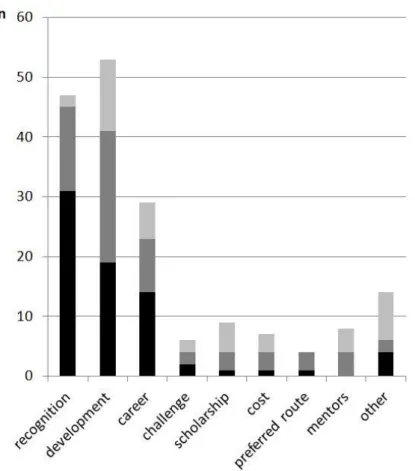
Participants were asked to state up to three reasons for undertaking an HEA Fellowship application through OpenPAD. The open text responses were classified as below (listed in order of main reason popularity) and the results are displayed in Figure 1.
Recognition, development and career were by far the most commonly cited motivations. Motivations were classified according to the following definitions:
• recognition - to gain affirmation of personal practice, knowledge or skills
• development - to enhance personal practice, knowledge or skills
• career – to benefit in employment terms, for example by gaining preference in job applications
• challenge - to enjoy the challenge of making an application
• scholarship - to develop skills in the scholarship of learning and teaching
• cost - to avoid the costs of a direct application to the HEA
• preferred route - OpenPAD was preferred to the direct route for other reasons (not cost)
• mentors - to secure the advice of a mentor
61
Figure 1. Motivations for undertaking OpenPAD (n=75)
OpenPAD completers reported overall satisfaction with the scheme with 94% agreeing that the scheme had met their expectations (‘to some extent’ 28%, ‘largely’ 33%, ‘completely’ 33%, n=39). However, some participants reported difficulties in making progress, despite the support available through mentoring, the website and workshops. A registration cut-off date was subsequently introduced (12 months from first
registration) in the hope of motivating participants towards timely completion. However, as noted below, some respondents perceived practitioner inquiry as more complex and demanding than making a direct application for Fellowship to the HEA. The website was therefore revised to make the stages of the process clearer to participants and this issue was also addressed in the accreditation of the replacement scheme, as described below.
Responses from the continuers survey indicated that a significant proportion of
OpenPAD registrants were not currently making progress on the scheme (‘I have made a start but am stuck’ 42%; ‘I have not yet started’ 22%, n=36). This issue was not
62
unique to ALs. The respective figures for academic and academic-related staff were 33% and 25%, n=12. There is anecdotal evidence that slow rates of progression are a feature of many HEA-accredited CPD schemes and that OpenPAD is not unique in this respect. Open text responses to the question ‘If you are experiencing difficulties in progressing with OpenPAD please summarise the reasons’ showed time or competing work pressures to be the most commonly cited reason for lack of progress for both groups of staff. In early cohorts through the scheme the number of mentors available was small and delays in mentor allocation were mentioned as impediments to progress; however later cohorts mention this factor rarely, reflecting the rapid growth in mentoring capacity as the scheme expanded. Another class of responses from a minority of
participants mentioned intellectual difficulty in engaging with practitioner inquiry and the insecurity that resulted:
I found it extremely difficult to understand what was required in the PI. Those people who made theirs available seemed to have produced pieces of work more suited to researchers in
education, not practitioners. The language was alien to me (and the word evidence seems to be used in several different ways). … There was no way I was going to post questions on forums to reveal my ignorance.(Anonymous survey respondent)
Continuers and completers (n=75) were asked to respond to a series of statements starting with the phrase ‘As a result of participating in OpenPAD …..’. 65% claimed to have made positive changes to their practice as a result of participation, in line with initial expectations of ‘development’ (Figure 1). 59% were more confident in their role as a university teacher. 83% claimed to have a better understanding of the UKPSF, which is reassuring given the importance of this objective within the scheme. The most
surprising result related to confidence in undertaking scholarship, with 62% either agreeing or strongly agreeing that ‘I am more confident that I can undertake scholarly inquiry into learning and teaching’. This contrasts strongly with the small numbers (12% or 9 responses total, all but one as 2nd or 3rd reasons) who gave the development of
63
Overall, this was positive feedback, but the comments associated with the small number of ‘disagree’ and ‘strongly disagree’ responses were scrutinised carefully and in some cases led to amendments being made to the scheme or its supporting materials.
Discussion
Lessons from the OpenPAD evaluation
The re-accreditation offered the opportunity to build on OpenPAD’s strengths whilst addressing the issues identified in the evaluation. It is clear that OpenPAD graduates found the scheme to be developmental, and reviewers noted that some excellent scholarly outputs were produced. Thus, OpenPAD showed practitioner inquiry can add value to the professional recognition process. The opportunities provided to develop scholarship skills are valued by participants as an unanticipated outcome. Rather than just focussing on recent and current practice, as direct applications do, practitioner inquiry is inherently future facing in its focus, and can achieve improvements in individual practice, which can in turn be disseminated if appropriate.
However, a minority of participants at D1 and D2 experienced intellectual difficulty in engaging with practitioner inquiry. For these categories of Fellowship the scholarship expectations inherent in PI may have been too high. There is also evidence that some participants from non-social science disciplines perceived practitioner inquiry as
obscure and inaccessible. This may be one cause of the relatively low progression rates through the scheme, although lack of time is clearly another significant factor. This corresponds with Cleaver et al’s argument that educational inquiry can be very
challenging for some disciplinary experts who are novices in researching their teaching: ‘Such an approach may require venturing into largely unknown territory: a new subject area framed by unfamiliar paradigms, language, research approaches and methods as well as a different understanding of what constitutes “validity”’ (2014, p. 4-5). It was therefore important that the replacement scheme built on and retained OpenPAD’s strengths, whilst incorporating sensitivity to the disciplinary contexts of its participants and realistic expectations in terms of its scholarship requirements.
64 Accrediting and Promoting Professional Learning and Academic Development (Applaud)
The replacement scheme for OpenPAD, Applaud, was launched in autumn 2016. To address the issues identified with its predecessor, it differs in two main respects. First, practitioner inquiry remains available as a route within Applaud, but the scheme offers other formats also, including some linked directly to career processes such as induction and appraisal. Of the 183 fellowship awards made by Applaud in its first 18 months, fewer than 10 have been based on a PI. Most of these were to participants who had been previously registered for OpenPAD, had made some progress with a PI, but did not submit within that scheme’s lifetime.
Second, expectations of what it means to be scholarly at D1, D2 and D3 of the UKPSF have been more carefully defined within Applaud. The organising principle of Applaud is scholarly reflection on professional learning. This links with Baume and Popovic’s
observation (2016, p. 6) that there are three principal ways of being scholarly:
1. being reflective, critical and analytic 2. using ideas from the literature 3. contributing to the literature.
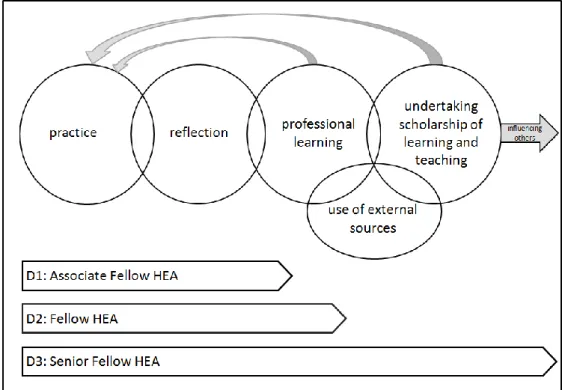
Baume and Popovic suggest these can overlap and that the sequence 1-3 should not be read as necessarily developmental, whilst noting the ‘increase in sophistication’ from (1) through (2) to (3). Applaud uses a similar classification in terms of expectations of scholarship at D1, D2 and D3 to scaffold the development of both teaching and reflective practice to the UKPSF in a way that will be accessible to staff from different disciplines, different prior backgrounds and different employment contexts. Figure 2 shows the Applaud model of the relationship between practice, reflection on practice, professional learning and undertaking original scholarship of learning and teaching. Within Applaud, applications at Descriptor 1 (AFHEA) will be expected to be ‘scholarly’ in the sense of (1) in Baume and Popovic’s characterisation, that is by being reflective, critical and analytic. Rigorous reflection on practice will lead to professional learning
65
which can then be applied to develop practice for the future. At Descriptor 2 (FHEA), applications will demonstrate both (1) and (2). There will be a fuller engagement with learning from the good practice of others, including engagement with the scholarly literature (e.g. core texts such as Biggs and Tang, 2011 or Lea, 2015) to inform practice. At D1 and D2 there will be no requirement to demonstrate skills in formal educational inquiry.
Figure 2. The Applaud model of professional learning through scholarship
At Descriptor 3 all three of Baume and Popovic’s characterisations will be expected to be evident, including extension of the learning and teaching knowledge base, usually through academic writing, although other forms of evidence (e.g. significant and novel evidence-based curriculum enhancements which have been disseminated) may also be acceptable. In this way, applications will be able to demonstrate practice that has had a positive influence on that of colleagues, as required by Descriptor 3 for the award of SFHEA (Higher Education Academy, 2011, p. 6, D3.VII).
Towards a constructive alignment of academic and staff development with university strategies and policies
As suggested earlier, this paper argues that HE institutions should adopt a constructive alignment of academic development and career-related processes in direct support of
66
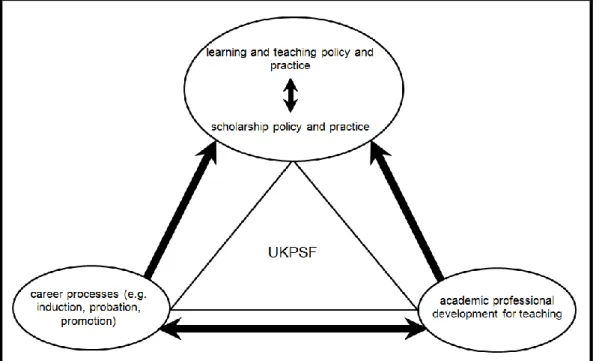
learning and teaching policies and scholarship agendas. Figure 3 suggests how this might be accomplished by using the UKPSF to frame these processes.
The vision is of the UKPSF (or a derivative of this adapted to specific institutional contexts) underpinning the policy and practice of learning and teaching domains and scholarship agendas. Learning and teaching scholarship is inspired by, and in turn enhances, the educational practice of individuals and teams. Academic development, from early formation of novice teachers through to development activities of
experienced staff, draws on the UKPSF to establish a common culture, with externally recognised benchmarks (Fellowship categories) for all staff who support learning, including part-time staff on teaching-only contracts. Career processes such as induction, appraisal, and promotion also use the UKPSF as a reference and developmental framework over the career journey.
Figure 3. Constructive alignment between staff transitions, academic development
and university policies and priorities
Aligning processes in this way has many advantages because an integrating principle such as the UKPSF could enhance the coherence and efficiency of systems (Shrives,
67
2012). However, this paper will focus on those advantages which are most relevant to part-time staff. First, the incorporation of scholarship within the model opens up the possibility of situated learning within the individual practitioner context. As noted above, this is a significant advantage for part-time staff, given the logistical difficulties
associated with attendance on taught courses and face-to-face (Cornelius and Macdonald, 2008). Moreover, because academic development through practitioner inquiry can be made relevant to individual contexts by empowering the participant to identify, research, develop and evaluate responses to teaching issues and conundrums it is also potentially of equal or greater effectiveness as an academic development tool than other methods (Southall, 2017).
Second, the use of a common framework has the potential to encourage parity between different staff groups. For this to be achieved, not only should part-time staff have access to academic development opportunities - they must also be included in career processes, with appropriate induction programmes and regular opportunities for experienced staff to have developmental appraisal conversations with managers or peers (Courtney, 2013). In theory therefore, this model is transferable into a wide range of HE institutions and contexts – but only to the extent that availability of the academic development opportunities and career processes is made broadly equivalent for all categories of teaching staff.
Acknowledgements
Pat Atkins (Academic Services, The Open University) worked with the lead author on an early version of this paper, which was presented as a workshop at the Enhancing
Student Learning Through Innovative Scholarship Conference Durham University, 16-17 July 2015.
68
References
Anderson, V. (2007). Contingent and Marginalised? Academic development and part-time teachers. International Journal for Academic Development, 12(2), 111–121. Retrieved from
http://doi.org/10.1080/13601440701604914
Baume, D., & Popovic, C. (2016). Enhancing Staff and Educational Development. London: RoutledgeFalmer.
Beaton, F. (2017). Just in time and future-proofing? Policy, challenges and opportunities in the
professional development of part-time teachers. International Journal for Academic Development, 22(1), 19–30.
Biggs, J. (1996). Enhancing teaching through constructive alignment. Higher Education, 32, 347–364.
Biggs, J. & Tang, C. (2011). Teaching for Quality Learning at University. Maidenhead: Open University Press.
Brown, D. and Gold, M. (2007). Academics on Non-Standard Contracts in UK Universities: Portfolio Work, Choice and Compulsion. Higher Education Quarterly, 61(4), 439–460.
Carr, W. and Kemmis, S. (1986) Becoming Critical: Education Knowledge and Action Research. London: RoutledgeFalmer
Chadha, D. (2012). Reconceptualising and reframing graduate teaching assistant (GTA) provision for a research-intensive institution. Teaching in Higher Education, 18(2), 1–13. Retrieved from
http://doi.org/10.1080/13562517.2012.696537
Cleaver, Elizabeth; Lintern, Maxine; McLinden, M. (2014). Teaching and Learning in Higher Education: Disciplinary Approaches to Educational Enquiry. London: Sage.
Cornelius, S., & Macdonald, J. (2008). Online informal professional development for distance tutors: experiences from The Open University in Scotland. Open Learning, 23(1), 43–55. Retrieved from
http://doi.org/10.1080/02680510701815319
Courtney, K. (2013). Adapting Higher Education through Changes in Academic Work. Higher Education Quarterly, 67(1), 40–55. Retrieved from http://doi.org/10.1111/hequ.12002
69 Cox, A. (2005). What are communities of practice? A comparative review of four seminal works. Journal
of Information Science, 31(6), 527–540. Retrieved 26 July 2017 from
http://jis.sagepub.com/content/31/6/527.abstract
Crawford, K. (2010). Influences on academics’ approaches to development: voices from below. International Journal for Academic Development, 15(3), 189–202. Retrieved from
http://doi.org/10.1080/1360144X.2010.497669
Eraut, M. (2011). Informal learning in the workplace: evidence on the real value of work-based learning (WBL). Development and Learning in Organizations, 25(5), 8–12. Retrieved from
http://doi.org/10.1108/14777281111159375
Floyd, Sarah; Davies, V. (2015). Professional recognition and scholarship: what’s the evidence? In SEDA Conference. Cardiff, 19-20 November. Retrieved 26 July 2017 from
http://www.seda.ac.uk/resources/files/8_Davies Floyd.pdf
Gherardi, S., Nicolini, D., & Odella, F. (1998). Toward a Social Understanding of How People Learn in Organizations. Management Learning, 29(3), 273–297. Retrieved 26 July 2017 from
http://mlq.sagepub.com/content/29/3/273.abstract
Gibbs, G. (2010). Dimensions of Quality. York: Higher Education Academy.
Gibbs, G., & Coffey, M. (2004). The impact of training of university teachers on their teaching skills, their approach to teaching and their approach to the learning of their students. Active Learning in Higher Education, 5(1), 87–100. Retrieved from http://doi.org/doi:10.1177/1469787404040463
Higher Education Academy (2011). The UK Professional Standards Framework. York: HEA. Retrieved from https://www.heacademy.ac.uk/sites/default/files/downloads/UKPSF_2011_English.pdf
Higher Education Academy (2017). Manchester Metropolitan University lecturer is HEA’s 90,000th Fellow. Retrieved 26 July 2017 from: https://www.heacademy.ac.uk/about/news/manchester-metropolitan-university-lecturer-hea%E2%80%99s-90000th-fellow
Kimber, M. (2003). The Tenured “Core” and the Tenuous “Periphery”: The casualisation of academic work in Australian universities. Journal of Higher Education Policy and Management, 25(1), 41– 50. Retrieved from http://doi.org/10.1080/13600800305738
Knight, P., Baume, D., Tait, J., & Yorke, M. (2007). Enhancing Part-time Teaching in Higher Education: a Challenge for Institutional Policy and Practice. Higher Education Quarterly, 61(4), 420–438. Retrieved from http://doi.org/10.1111/j.1468-2273.2007.00350.x
70 Land, R and Gordon, G. (2015). Teaching excellence initiatives: modalities and operational factors. York:
HEA. Retrieved 26 July 2017 from
https://www.heacademy.ac.uk/sites/default/files/resources/teaching_excellence_initiatives_report _land_gordon.pdf
Lea, J. (ed.) (2015). Enhancing Learning and Teaching in Higher Education. Maidenhead: Open University Press.
Open University. (2014a). Annual Report 2013-14. Milton Keynes. Retrieved 26 July 2017 from
http://www.open.ac.uk/about/main/sites/www.open.ac.uk.about.main/files/files/ecms/web-content/about-annual-report-2013-14.pdf
Open University. (2014b). Equality and Diversity Annual Report 2014. Milton Keynes. Retrieved 26 July 2017 from
http://www.open.ac.uk/equality-diversity/sites/www.open.ac.uk.equality-diversity/files/files/ecms/web-content/ED-Annual-Report-2014-FINAL-V2.pdf
Open University. (2014c). Facts & Figures 2013-14. Milton Keynes. Retrieved 26 July 2017 from
http://www.open.ac.uk/foi/main/sites/www.open.ac.uk.foi.main/files/files/ecms/web-content/fact-figures-13-14.pdf
Robbins, J. (2014). Practitioner Inquiry. In C. M. Conway (Ed.), The Oxford Handbook of Qualitative Research in American Music Education. Oxford University Press. Retrieved from
http://doi.org/10.1093/oxfordhb/9780199844272.013.011
Schon, D.A. (1983). The reflective practitioner. New York: Basic Books.
Sharpe, R. (2004). How do professionals learn and develop? Implications for staff and educational developers. In D. Baume & P. Kahn (Eds.), Enhancing Staff and Educational Development (pp. 132–153). Abingdon: RoutledgeFalmer.
Shrives, L. (2012). From Postgraduate Certificates to embedding UK PSF at all levels. Educational Developments, 13(3), 1–6. Retrieved 26 July 2017 from https://www.seda.ac.uk/past-issues/13.3
Southall, J. (2017). Realising the potential of sessional staff as educational scholars. Practice and
Evidence of Scholarship of Teaching and Learning in Higher Education, 12(3) Enhancing Student Learning through Innovative Scholarship Conference (ESLTIS), 28-29 June 2016, UCL, UK Special Issue July 2017, 465-483. Retrieved 27 July 2017 from
71 Staff & Educational Development Association. (2013). Measuring the impact of the UK Professional
Standards Framework for Teaching and Supporting Learning (UKPSF). York: HEA. Retrieved 26 July 2017 from
https://www.heacademy.ac.uk/sites/default/files/resources/ukpsf_impact_study_report.pdf
Universities & Colleges Employers Association. (2008). A review of the implementation of the Framework Agreement for the modernisation of pay structures in higher education. London. Retrieved 26 July 2017 from
http://www.ucea.ac.uk/download.cfm/docid/9327120E-0EA6-49E7-949BE76D42E32D93
Wenger, E., McDermott, R., & Snyder, W. M. (2002). Cultivating communities of practice. Boston MA: Harvard Business School Press.
72
Appendix 1 UK Professional Standards Framework for teaching and supporting
learning 2011
Dimensions of Practice
Areas of Activity
A1 Design and plan learning activities and/or programmes of study A2 Teach and/or support learning
A3 Assess and give feedback to learners
A4 Develop effective learning environments and approaches to student support and guidance
A5 Engage in continuing professional development in subjects/disciplines and their pedagogy, incorporating research, scholarship and the evaluation of professional practices
Core Knowledge K1 The subject material
K2 Appropriate methods for teaching, learning and assessing in the subject area and at the level of the academic programme
K3 How students learn, both generally and within their subject/ disciplinary area(s) K4 The use and value of appropriate learning technologies
K5 Methods for evaluating the effectiveness of teaching
K6 The implications of quality assurance and quality enhancement for academic and professional practice with a particular focus on teaching
Professional Values
V1 Respect individual learners and diverse learning communities
V2 Promote participation in higher education and equality of opportunity for learners V3 Use evidence-informed approaches and the outcomes from research, scholarship and continuing professional development
V4 Acknowledge the wider context in which higher education operates recognising the implications for professional practice
73 Appendix 2: Aspects of the AL role
Welcome students: Initial introductory contact
Identify students' needs: Identifying and supporting students who are academically
vulnerable
Provide correspondence tuition: Assessing students work and giving feedback Provide academic support: Tuition for a diverse group of students
Provide proactive support: Supporting and encouraging assignment submission and
exam preparation and attendance
Develop students' study skills: Support students to become independent successful
learners within the discipline/module
Monitor student progress: Encourage academic engagement with the module
Provide study related advice: Provide first point of contact, encourage peer support,
refer to SST as appropriate
Provide feedback within OU: Feedback on your experience and that of your students Work online: Using OU and other systems as tutors and as staff
Develop your knowledge and practice: Feedback, reflection, review,
professional/staff development