U N I V E R S I T E I T•S T E L L E N B O S C H•U N I V E R S I T Y j o u k e n n i s v e n n o o t • y o u r k n o w l e d g e p a r t n e r
Monitoring and Diagnosis of Process
Systems Using Kernel-Based
Learning Methods
by
Gorden Takawadiyi Jemwa
Dissertation presented for the Degree of
DOCTOR OF PHILOSOPHY IN ENGINEERING
in the Department of Process Engineering at the University of Stellenbosch
Promotor: Prof. Chris Aldrich
Stellenbosch March 2007
iii
Declaration
I, the undersigned, hereby declare that the work contained in this dissertation is my own original work and has not previously in its entirety or in part been submitted at any university for a degree.
Signature: Date:
Copyright c2007 Stellenbosch University All rights reserved
v
Synopsis
The development of advanced methods of process monitoring, diagnosis, and control has been identied as a major 21st century challenge in control systems research and
appli-cation. This is particularly the case for chemical and metallurgical operations owing to the lack of expressive fundamental models as well as the nonlinear nature of most process systems, which makes established linearization methods unsuitable. As a result, eorts have been directed in the search of alternative approaches that do not require fundamen-tal or analytical models. Data-based methods provide a very promising alternative in this regard, given the huge volumes of data being collected in modern process operations as well as advances in both theoretical and practical aspects of extracting information from observations.
In this thesis, the use of kernel-based learning methods in fault detection and diagnosis of complex processes is considered. Kernel-based machine learning methods are a robust family of algorithms founded on insights from statistical learning theory. Instead of esti-mating a decision function on the basis of minimizing the training error as other learning algorithms, kernel methods use a criterion called large margin maximization to estimate a linear learning rule on data embedded in a suitable feature space. The embedding is implicitly dened by the choice of a kernel function and corresponds to inducing a nonlinear learning rule in the original measurement space. Large margin maximization corresponds to developing an algorithm with theoretical guarantees on how well it will perform on unseen data.
In the rst contribution, the characterization of time series data from process plants is investigated. Whereas complex processes are dicult to model from rst principles, they can be identied using historic process time series data and a suitable model structure. However, prior to tting such a model, it is important to establish whether the time series data justify the selected model structure. Singular spectrum analysis (SSA) has been used for time series identication. A nonlinear extension of SSA is proposed for classication of time series. Using benchmark systems, the proposed extension is shown to perform better than linear SSA. Moreover, the method is shown to be useful for ltering noise in time series data and, therefore, has potential applications in other tasks such as data rectication and gross error detection.
Multivariate statistical process monitoring methods are well-established techniques for ef-cient information extraction from multivariate data. Such information is usually compact and amenable to graphical representation in two or three dimensional plots. For process monitoring purposes control limits are also plotted on these charts. These control limits
are usually based on a hypothesized analytical distribution, typically the Gaussian normal distribution. A robust approach for estimating condence bounds using the reference data is proposed. The method is based on one-class classication methods. The usefulness of using data to dene a condence bound in reducing fault detection errors is illustrated using plant data.
The use of both linear and nonlinear supervised feature extraction is also investigated. The advantages of supervised feature extraction using kernel methods are highlighted via illustrative case studies. A general strategy for fault detection and diagnosis is proposed that integrates feature extraction methods, fault identication, and dierent methods to estimate condence bounds. For kernel-based approaches, the general framework allows for interpretation of the results in the input space instead of the feature space.
An important step in process monitoring is identifying a variable responsible for a fault. Although all faults that can occur at any plant cannot be known beforehand, it is possible to use knowledge of previous faults or simulations to anticipate their recurrence. A framework for fault diagnosis using one-class support vector machine (SVM) classication is proposed. Compared to other previously studied techniques, the one-class SVM approach is shown to have generally better robustness and performance characteristics.
Most methods for process monitoring make little use of data collected under normal oper-ating conditions, whereas most quality issues in process plants are known to occur when the process is in-control. In the nal contribution, a methodology for continuous opti-mization of process performance is proposed that combines support vector learning with decision trees. The methodology is based on continuous search for quality improvements by challenging the normal operating condition regions established via statistical control. Simulated and plant data are used to illustrate the approach.
vii
Oorsig
Die ontwikkeling van gevorderde metodes van prosesmonitering, diagnose en -beheer is geïdentiseer as 'n groot 21ste eeuse uitdaging in die navorsing en toepassing van
beheers-telsels. Dit is veral die geval in die chemiese en metallurgiese bedryf, a.g.v. die gebrek aan fundamentele modelle, sowel as die nielineêre aard van meeste prosesstelsels, wat geves-tigde benaderings tot linearisasie ongeskik maak. Die gevolg is dat pogings aangewend word om te soek na alternatiewe benaderings wat nie fundamentele of analitiese modelle benodig nie. Data-gebaseerde metodes voorsien belowende alternatiewe in dié verband, gegewe die enorme volumes data wat in moderne prosesaanlegte geberg word, sowel as die vooruit-gang wat gemaak word in beide die teoretiese en praktiese aspekte van die onttrekking van inligting uit waarnemings.
In die tesis word die gebruik van kern-gebaseerde metodes vir foutopsporing en -diagnose van komplekse prosesse beskou. Kern-gebaseerde masjienleermetodes is 'n robuuste familie van metodes gefundeer op insigte uit statistiese leerteorie. Instede daarvan om 'n besluit-nemingsfunksie te beraam deur passingsfoute op verwysingsdata te minimeer, soos wat gedoen word met ander leermetodes, gebruik kern-metodes 'n kriterium genaamd groot marge maksimering om lineêre reëls te pas op data wat ingebed is in 'n geskikte ken-merkruimte. Die inbedding word implisiet gedenieer deur die keuse van die kern-funksie en stem ooreen met die indusering van 'n nielineêre reël in die oorspronklike meetruimte. Groot marge-maksimering stem ooreen met die ontwikkeling van algoritmes waarvan die prestasie t.o.v. die passing van nuwe data teoreties gewaarborg is.
In die eerste bydrae word die karakterisering van tydreeksdata van prosesaanlegte ondersoek. Alhoewel komplekse prosesse moeilik is om vanaf eerste beginsels te modelleer, kan hulle geïdentiseer word uit historiese tydreeksdata en geskikte modelstrukture. Voor so 'n model gepas word, is dit belangrik om vas te stel of die tydreeksdata wel die geselekteerde modelstruktuur ondersteun. 'n Nielineêre uitbreiding van singuliere spektrale analise (SSA) is voorgestel vir die klassikasie van tydreekse. Deur gebruik te maak van geykte stelsels, is aangetoon dat die voorgestelde uitbreiding beter presteer as lineêre SSA. Tewens, daar word ook aangetoon dat die metode nuttig is vir die verwydering van geraas in tydreeksdata en daarom ook potensiële toepassings het in ander take, soos datarektikasie en die opsporing van sistematiese foute in data.
Meerveranderlike statistiese prosesmonitering is goed gevestig vir die doeltreende ont-trekking van inligting uit meerveranderlike data. Sulke inligting is gewoonlik kompak en geskik vir voorstelling in twee- of drie-dimensionele graeke. Vir die doeleindes van pros-esmonitering word beheerlimiete dikwels op sulke graeke aangestip. Hierdie
beheerlimi-ete word gewoonlik gebaseer op 'n hipotetiese analitiese verspreiding van die data, tipiese gebaseer op 'n Gaussiaanse model. 'n Robuuste benadering vir die beraming van be-troubaarheidslimiete gebaseer op verwysingsdata, word in die tesis voorgestel. Die metode is gebaseer op eenklas-klassikasie en die nut daarvan deur data te gebruik om die be-troubaarheidsgrense te beraam ten einde foutopsporing te optimeer, word geïllustreer aan die hand van aanlegdata.
Die gebruik van beide lineêre en nielineêre oorsiggedrewe kenmerkonttrekking is vervolgens ondersoek. Die voordele van oorsiggedrewe kenmerkonttrekking deur van kern-metodes gebruik te maak is beklemtoon deur middel van illustratiewe gevallestudies. 'n Algemene strategie vir foutopsporing en -diagnose word voorgestel, wat kenmerkonttrekkingsmetodes, foutidentikasie en verskillende metodes om betroubaarheidsgrense te beraam saamsnoer. Vir kern-gebaseerde metodes laat die algemene raamwerk toe dat die resultate in die invo-erruimte vertolk kan word, in plaas van in die kenmerkruimte.
'n Belangrike stap in prosesmonitering is om veranderlikes te identiseer wat verantwoorde-lik is vir foute. Alhoewel alle foute wat by 'n chemiese aanleg kan plaasvind, nie vooraf bekend kan wees nie, is dit moontlik om kennis van vorige foute of simulasies te gebruik om die herhaalde voorkoms van die foute te antisipeer. 'n Raamwerk vir foutdiagnose wat van eenklas-steunvektormasjiene (SVM) gebruik maak is voorgestel. Vergeleke met ander tegnieke wat voorheen bestudeer is, is aangetoon dat die eenklas-SVM benadering oor die algemeen beter robuustheid en prestasiekenmerke het.
Meeste metodes vir prosesmonitering maak min gebruik van data wat opgeneem is onder normale bedryfstoestande, alhoewel meeste kwaliteitsprobleme ondervind word waneer die proses onder beheer is. In die laaste bydrae, is 'n metodologie vir die kontinue optimering van prosesprestasie voorgestel, wat steunvektormasjiene en beslissingsbome kombineer. Die metodologie is gebaseer op die kontinue soeke na kwaliteitsverbeteringe deur die normale bedryfstoestandsgrense, soos bepaal deur statistiese beheer, te toets. Gesimuleerde en werklike aanlegdata is gebruik om die benadering te illustreer.
ix
...To my parents.
A special dedication to the memory of my mother, Demetria Tafireyi (1947− 2004)
xi
Acknowledgments
I am highly indebted to my study leader Chris Aldrich, whose excellent knowledge and insights inspired the development of this dissertation in innumerable ways. Through a number of extended discussions in his oce, Chris has consistently displayed an exemplary research standard and professionalism that I hold in great respectful admiration and will always aspire to in all my future pursuits.
A sincere appreciation to the Department of Process Engineering for providing an environ-ment and support structure that facilitated the progress and successful completion of the work contained herewith. Heartfelt thanks to Juliana Steyl for being there for me since I started studying at the university. Thanks also to Lynette Bresler, Ina van Zyl, and Enid Thom for taking care of all the administrative issues.
I also would like to acknowledge discussions and assistance I have received from the following members of the machine learning research community; Gökhan Bakhir, Arthur Gretton, Alexandros Karatzoglou, Gert Lanckriet, Chih-Jen Lin, Alain Rakotomamonjy, Bernhard Schölkopf, Alex Smola, David M.J. Tax, Jason Weston. I have also beneted much through various machine learning blogs, particularly those of John Langford and Olivier Bousquet. Although studying in a foreign country can be a very dicult enterprise, I have been very fortunate to have met very friendly people who made sailing the rough seas enjoyable and all the more worthwhile. I extend my inexpressible gratitude to my South African family the Van der Merwe family (Willie Snr., Lettie, Willie Jnr., and Maria) who showered me with all the thoughts and love one can only nd within a family. And to Lettie, Herewith is the nal exclamation mark! May all the nagging cease henceforth.
I am very grateful to members of dierent research groups whom I met and shared oce space with during my studies. Their unwavering belief in me when I could not see the end as well as cherished lighter moments gave me strength to proceed. Many of these, in particular Wezi Banda, John Burchell and Paul Botha, became good friends even outside the boundaries of research cooperation.
Thank you to my brothers, sisters, family members and friends for their patience and understanding during the course of my studies.
Finally, a very special thank you to my parents who have been a source of inspiration as well as guiding and supporting me in all my endeavors since I was young. Without your love and encouragement, this would not have been possible.
This work was made possible through funding by the National Research Foundation (NRF), the Department of Process Engineering, and the University of Stellenbosch.
xiii
Contents
Declaration iii Synopsis v Oorsig vii Acknowledgments xi Nomenclature xvii 1 Introduction 11.1 Trends in Process Systems Engineering . . . 2
1.2 Basic Fault Detection and Diagnosis Framework . . . 3
1.3 Process Model Selection in Fault Diagnosis . . . 4
1.4 Learning Theory: Main Insights and Algorithms . . . 6
1.5 Problem Statement and Objectives of the Study . . . 7
1.6 Scope of Thesis . . . 8
1.7 Organization of Thesis . . . 8
2 Theory and Contemporary Practice in Diagnosis of Process Systems 11 2.1 Basic Principles of Model-Based Fault Diagnosis . . . 12
2.1.1 Residual Generation . . . 13
2.1.2 Residual Evaluation . . . 13
2.1.3 Nonlinear Model-Based Fault Diagnosis . . . 14
2.2 Knowledge-Based Redundancy . . . 15
2.3 Data-driven Diagnostic Methods . . . 15
2.3.1 Articial Neural Networks . . . 15
2.3.2 Multivariate Statistical Process Monitoring . . . 19
2.3.3 Process Diagnosis Using Fisher Discriminant Analysis . . . 25
2.4 Integrated Fault Diagnosis Approaches . . . 27
2.5 Concluding Remarks . . . 27
3 Learning from Data: Foundations and Algorithms 29 3.1 Learning Theory . . . 29
3.1.1 Learning from Data: A Statistical Perspective . . . 29
3.1.3 Structural Risk Minimization . . . 34
3.1.4 Philosophical Remarks . . . 34
3.2 Supervised Learning . . . 35
3.2.1 Large Margin Classication . . . 35
3.2.2 Support Vector Machines . . . 37
3.2.3 Kernel Functions . . . 41
3.2.4 Discriminant analysis . . . 47
3.3 Unsupervised Learning . . . 49
3.3.1 Nonlinear Principal Component Analysis . . . 49
3.3.2 One-class Classication . . . 50
3.4 Concluding Remarks . . . 54
4 Classication of Process Dynamics 57 4.1 Introduction . . . 58
4.2 Singular Spectrum Analysis . . . 59
4.2.1 Background . . . 59
4.2.2 Singular Spectrum Analysis Methodology . . . 59
4.2.3 Limitations of Singular Spectrum Analysis . . . 62
4.2.4 Nonlinearity Testing Using Monte Carlo Singular Spectrum Analysis 62 4.2.5 Nonlinear Singular Spectrum Analysis . . . 64
4.2.6 Case Study: Simulated Anharmonic Wave . . . 66
4.3 Monte Carlo SSA Using Kernel PCA . . . 69
4.3.1 Benchmark Systems . . . 69
4.3.2 Simulation Results and Discussion . . . 70
4.3.3 Applications of MC-SSA on Metallurgical Plant Data . . . 77
4.4 Concluding Remarks . . . 80
5 Nonlinear Projective Methods in Process Monitoring and Diagnostics 83 5.1 Multivariate Process Monitoring Charts Based on PCA . . . 84
5.2 Improved Process Monitoring Charts Using SVMs . . . 86
5.2.1 Case Study I: Platinum Group Metals (PGM)Flotation plant . . . . 86
5.2.2 Case Study II: Monitoring of a Calcium Carbide Furnace . . . 89
5.3 Fault Detection Using Kernel PCA: A Residual Analysis Approach . . . 91
5.3.1 Case Study I: Simulated System . . . 94
5.3.2 Case Study II: Monitoring of a Calcium Carbide Furnace . . . 96
5.4 Process Monitoring By Use of Discriminant Analysis . . . 98
5.4.1 Case Study I: Platinum Group Metals Flotation Plant . . . 99
5.4.2 Case Study II: Copper Flotation Plant . . . 100
5.4.3 Case Study III: Monitoring of a Calcium Carbide Furnace . . . 101
5.4.4 Case Study IV: Monitoring of an Industrial Liquid-Liquid Extraction Column . . . 101
5.5 Analysis of the Fault Diagnosis Problem . . . 111
5.5.1 Fault Diagnosis with Neural Networks . . . 112
5.5.2 Fault Diagnosis Using One-class Classication: An Empirical Anal-ysis . . . 113
CONTENTS xv
6 Process Optimization with SVMs and Decision Trees 119
6.1 Background . . . 120
6.2 Process Improvement Strategies Using Classication of Operating Regions 121 6.3 Inductive Learning Using Decision Trees . . . 122
6.4 Identication of Optimization Opportunities with SVMs . . . 124
6.4.1 Description and Illustration of Methodology . . . 124
6.4.2 Problem Formulation . . . 125
6.4.3 Identication of Sparse Informative Patterns . . . 127
6.4.4 Detection and Filtering of Outliers . . . 130
6.4.5 Adaptive Characteristics/Evolution of Memory of Support Vectors . 132 6.5 Control of Manganese in a Solution Preparation Circuit . . . 135
6.6 Concluding Remarks . . . 140
7 Conclusions & Recommendations 141 7.1 Conclusions . . . 141
7.2 Future Investigation . . . 143
7.3 Publications . . . 144
A Fault Detection and Diagnosis Terminology 149 B MATLAB Software Codes 151 B.1 Support Vector Classication . . . 151
B.2 Kernel Fisher Discriminant Analysis . . . 157
B.3 One-class Support Vector Classication . . . 161
xvii
Nomenclature
vector of Lagrange i coecients
generalized mapping function
(x y) inner product between vectors x and y in Euclidean space
hf ; gi inner product function between vector space of functions f and g in Hilbert space
`(a; b) non-negative loss function between actual a and predicted b Remp empirical risk function
H Hilbert space a generalized Euclidean space k(x; y) a kernel function evaluated on vectors x and y
N set of natural numbers
C covariance matrix
E expected value
I identity square matrix
K kernel or Gram matrix where the (i; j)th entry is K
ij = k(xi; xj)
N (; ) Gaussian distribution with mean and standard deviation
T training set
U(a; b) a continuous uniform distribution on the interval [a; b]
X input or observation space
Y output or target space
YX the set of maps from X to Y
LP Lagrangian objective function in primal form
k k `2norm
k kp `pnorm, p 2 N
P() probability distribution function
R; R+ set of real numbers and positive real numbers, respectively
R risk function
w weight vector
d dimensionality of input space hd VC (shattering) dimension
I() indicator function
m size of training set
CUSUM cumulative sum
ERM empirical risk minimization
EWMA exponentially weighted moving average i.i.d. independent and identically distributed KFD kernel Fisher discriminant analysis KPCA kernel principal component analysis LDA linear discriminant analysis
MC-SSA Monte Carlo singular spectrum analysis MLP Multilayer perceptron
MSPC multivariate statistical process control MSPM multivariate statistical process monitoring PCA principal component analysis
RKHS reproducing kernel Hilbert space SPE squared prediction error
SRM structural risk minimization SSA singular spectrum analysis
NOMENCLATURE xix
SVC support vector classication
SVM support vector machine
1
Chapter 1
Introduction
[For three centuries up to the end of the World War II], the model for technology was a mechani-cal one: the events that go on inside a star such as a sun [and] advance in technology meantas it does in mechanical processesmore speed, higher tempera-tures, higher pressures. Since the end of World War II, however, the model of technology has become the biological process, the events inside an organ-ism. And in an organism, processes are not orga-nized around energy in the physicists's meaning of the term. They are organized around information.
Peter F. Drucker,Innovation and Entrepreneurship
O
VER the last few decades, there have been many socio-economic and technical de-velopments that have seen important changes in the management and operation of industrial processes. For example, globalization challenges require companies to sustain and improve productivity while simultaneously meeting tighter quality specications. Global warming and other threats to the earth's ecosystem have shifted attention toward sustain-able economic activity. It is now imperative for industrial operations including chemical and metallurgical processes to comply with stricter safety and environmental regulatory constraints. As a result, companies are making huge investments in automating and inte-grating operator tasks as well as unit processes. However, plant control and supervisory tasks have also become more complex than can be solved by classical regulatory and sta-tistical process control techniques. In light of these developments, achieving operational and business goals requires advanced control methodologies. Fortunately, advances in the information sciences have yielded data processing and analysis techniques that are very promising with respect to targeted applications in process control.In this chapter the major factors impacting on control issues in process operations are highlighted. The basic fault detection and diagnostic framework is presented. Subse-quently, the learning methodology is introduced, with emphasis on the desirable attributes
of handling nite and noisy data of unknown distribution as are observed in real process systems. Finally, the goals and scope of the thesis are outlined.
1.1 Trends in Process Systems Engineering
The changing social, economic and physical environment has witnessed important develop-ments that are continuously placing greater demands on industrial processes. In the case of resource companies, for example, operations have to process ores with complex min-eralogical compositions as reserves of less refractory ores become depleted. The opening up of the competitive space due to globalization is reducing market shares for most com-panies and a concomitant decrease in prot margins. Also, comcom-panies are now compelled to be responsive to varying customer demands yet still ensuring that product and process quality are sustained if not so much as improved. To maintain a competitive advantage, quality control management methodologies, like Six Sigma and ISO 9000, and other man-agement programs have been developed to assist organizations in addressing some of these challenges.
Modern-day process operations have also become more complex owing to plant-wide in-tegration and high-level automation of many process tasks. For example, recycling of process streams is now widely practiced to ensure ecient material and energy usage. Process plants have virtually become intricate information networks, with signicant in-teractions among various subsystems and components. Although such interconnectivity facilitates the integration of operational tasks to achieve broader business strategic goals, it invariably complicates certain tasks like planning and scheduling, supervisory control and diagnosis of process operations.
Another factor that has aected process operations is the stringent regulatory framework aimed at minimizing risks posed by industrial activities to the environment. In addition, safety and health policies and practices are now priority issues in the modern-day plant. To this end, a number of systematic frameworks have been initiated, including process hazard analysis (PHA) and abnormal event management (AEM) and product life cycle management (PLM). PHA and AEM are aimed at ensuring process safety, while PLM places obligatory stewardship responsibilities to an organization throughout the life cycles of its entire product range, that is, from conception, through design and manufacture, service and disposal (Venkatasubramanian, 2005).
In response to these trends, plants are investing heavily in instrumentation to enable real time monitoring of process units and streams. New sensor technologies such as acoustic or vibrational signal monitoring and computer vision systems have been introduced in, among other, milling plants, multiphase processes, food processing, and combustion processes. Huge volumes of data are increasingly being generated, whereas the information content of these data is rarely enhanced. Moreover, some of the data obtained are not well-suited for analysis using classical approaches although containing useful information. This has motivated the need for advanced process control strategies that are knowledge-based and/or data-driven, collectively referred to as intelligent control systems.
Intelligent control systems are a group of methodologies aimed at exploiting information in plant data and experiential knowledge of plant operators (Åström and McAvoy, 1992;
1.2 BASIC FAULT DETECTION AND DIAGNOSIS FRAMEWORK 3
McAvoy, 2002). The term intelligent refers to the automation of an engineering task without any implication to building a system capable of mimicking human intelligence as is sometimes incorrectly misunderstood. Process monitoring and diagnosis has developed from this perspective as an interdisciplinary eld, with both theory and practice building on ideas from diverse elds such as fundamental process modelling, signal processing, statistics, machine learning, and other articial intelligence-related areas. The development of advanced methods for monitoring, diagnosis, and control of abnormal events in complex systems and processes has been identied as an emerging major challenge in control systems research and application in the 21stcentury (Ogunnaike, 1996; Venkatasubramanian, 2005).
The intelligent systems framework should be viewed as a complementary rather than competing control methodology to classical or well-established techniques (Aldrich, 2000; Venkatasubramanian et al., 2003). By considering all perspectives a better understanding of complex systems can be achieved. Stephanopoulos and Han (1996) remarked that it is impossible to develop a generic, all-encompassing methodology for process fault diagnosis, since any model is only capable of explaining dierent facets of a very rich available knowl-edge resource. Therefore, a typical control and diagnostic system for an entire operation is integrative in form. In the control of nuclear-based processes, for example, dierent tech-nologies, such as articial neural networks, independent component analysis and wavelets, among other are combined in an overall control framework (Hines and Seibert, 2006).
1.2 Basic Fault Detection and Diagnosis Framework
A fault(1) is associated with any unacceptable anomalous behavior of components that
causes a system to deviate from its normal operating condition, potentially leading to the overall failure of the system. Process plant faults can be classied according to their source: sensor faults which aect process measurement; actuator faults that cause changes in the actuators; process component faults arising from changes in process parameters and equipment; and faults induced by operator intervention. Further characterization is based on the time evolution of the fault: (i) abrupt or sudden faults; and (ii) incipient or slowly developing faults, for example equipment degradation or sensor drift. The main objectives in fault diagnosis are timely detection of aberrant process behavior, troubleshooting and eventual elimination of the root cause of the fault with little or no disruptions to the process operation.
Conceptually, the fault diagnosis problem involves building a model describing process be-havior against which future evolution of the process is compared against. Potential faults in the system are then detected by monitoring the deviation of actual process behavior from expected behavior as predicted by a well-dened process model. An alarm is raised whenever the deviation, or a statistic derived from the deviations, violates pre-specied detection limits.
For optimal and reliable performance, any diagnostic system must be capable of producing a sucient set of residuals that can capture the impact of faults of interest; this is closely related to a model's ability to capture regularity in the dynamic behavior of a system. In
(1) Note on terminology: In this thesis, the convention of Isermann and Ballé (1997) is adopted for
addition, a diagnostic system must also be capable of unique and robust inferencing of the origin of the fault (Stephanopoulos and Han, 1996). Since an observed variable mea-surement is a manifestation of the combined eects of dierent contributions including underlying physical and chemical phenomena, external disturbances, instrumentation dis-turbances, state and condition of equipment, and operator-induced actions, unique and robust fault identication requires decoupling the faults from the various contributions. This, in turn, requires existence of well-dened (explicit or implicit) relationships between observations (or symptoms) and a set of known failures. Such relationships are typically found by model tting procedures on a set of observers. A model inversion can then be used to trace the likely root cause of a fault detected in a system. When the fault is com-pletely dierent from what has been experienced or simulated, a diagnostic system should be capable of detecting and labeling these novel faults accordingly. Figure 1.1 shows a schematic outline of the fault detection and identication problem.
Plant and Process Parameter Faults Faulti Residuals Actuator Faults MODEL-1 PROCESS MODEL Sensor Faults Process Output Process Input KEY Process Stream Process Disturbances Model Stream Fault Detection Fault Identification
Figure 1.1: A basic outline of the fault diagnosis problem
Similar to other elds in scientic and engineering inquiry, mathematical models play an important role in process control. Successful monitoring and control is largely determined by how well a mathematical model is in capturing knowledge governing a system's behavior. Poor model accuracy degrades the performance of a diagnostic system. For real processes, an accurate model is not possible and, therefore, requirement of a model introduces another degree of freedom in the fault diagnosis framework, namely model uncertainty, in addition to the unknown disturbances. To guarantee reliability of a diagnostic system, the design and/or development of the process model needs careful consideration.
1.3 Process Model Selection in Fault Diagnosis
Classically, models have been derived analytically on the basis of fundamental physical re-lations. These rst-principles or phenomenological models require extensive knowledge of
1.3 PROCESS MODEL SELECTION IN FAULT DIAGNOSIS 5
involved objects as well as the nature of interactions among them. Examples of fundamen-tal models are diusion models such as Fick's law used in describing transport processes in leaching. Unfortunately, complete knowledge of what exactly is taking place in real pro-cesses is often not available or very dicult to obtain. Hence, process models obtained do not account adequately for all observed behavior.
In other cases, particularly where measured data are not directly related to the underlying phenomena, it is not clear how to proceed in explaining the observed phenomena from a fundamental perspective. For example, in the froth otation processes used in the recovery of metals, computer vision systems are increasingly being used for process monitoring (Aldrich et al., 1997; Hyötyniemi and Ylinen, 2000). A fundamental model for predicting the form of the froth surface requires knowledge of the interacting objects (such as the type and addition rates of reagents, ore mineralogy, grind size, as well as process parameters such as stirring rate, and air feed rate). Other examples include monitoring network activity, detecting fraudulent loan applications, use of acoustic signals in monitoring milling circuits, to name but a few. In all these cases, a fundamental model is dicult to dene, at least not within the existing body of theoretical knowledge.
An alternative approach to fundamental modelling inspired by advances in information processing systems in the last half of the 20th century is learning from experience, such
as operator knowledge or process data. Knowledge-based systems use unstructured and fragmented or non-quantiable information to develop a rule-based inferencing decision support system by means of symbolic reasoning. Of relevance to this study is learning from data, where the objective is to nd a functional dependency that best explains the regularity or structure in process measurements with very few assumptions on the statistical nature of the governing mechanism.
Learning from experience can be considered a paradigm shift from classical scientic inquiry in which phenomena were explained in terms of materials within a well-dened metric sys-tem. Instead, problems are cast in terms of data representation, information and knowledge. Within this perspective, problems from diverse elds such as cognitive science, engineering, economics, genetics, medicine, and other elds where automated prediction is necessary converge when interpreted in terms of nding and analyzing relations in data. For example, upgrade of information content in biological data has also been identied as a dominant theme in computational biotechnology in the 21st century (Stephanopolous, 1999), which
is essentially similar to the process control perspective (Aldrich, 2000; Ogunnaike, 1996; Venkatasubramanian, 2005). Such information content upgrade can be achieved by statis-tical inferencing or planned experimental campaigns.
An alternative and suitable approach that uses little or no assumptions is machine learning. Machine learning is concerned with making machines or software programs that discover patterns in data by learning from examples. It brings together insights and tools of math-ematics, theoretical and applied computational sciences, and statistics. In particular, it overlaps with many approaches that were proposed separately within the statistical com-munity, for example decision trees (Breiman et al., 1993; Quinlan, 1986).
Machine learning algorithms for detecting anomalies, trends, or other interesting regular-ities or patterns have been proposed (Schölkopf and Smola, 2002). In the following section the statistical learning theory framework and the support vector machine (SVM) are
intro-duced, highlighting the desirable attributes of data-based function estimation when applied to practical problems such as are encountered in process systems.
1.4 Learning Theory: Main Insights and Algorithms
Generally, the problem of building models from data is not well-dened unless one is con-strained to a specic subset of allowable models and a method exists for selecting the optimal model in the set. Given a set of nite data, statistical learning theory or Vapnik-Chervonenkis (VC) theory (Vapnik, 1998, 2000) prescribes a principled procedure for decid-ing which model to choose among the potentially innite competdecid-ing models with minimal assumptions on the structure of the model. This should be contrasted to the classical statistical approach in which a certain parametric form is specied beforehand, and tting a model then consists of optimizing over the parameters.
Typically, parametric assumptions assume existence of a well-dened source generating distribution from which the observed data set have been sampled. As discussed later, the performance of parametric models is dependent on the size and quality of the available data used in tting the model (Chapter 3). In particular, model quality degrades with increasing dimensionality of an observation vector because the number of samples required to obtain a proper t increases exponentially with data dimensionality a phenomenon commonly referred to as the the curse of dimensionality in statistics and empirical inference (e.g., Hastie et al. (2001)).
VC-theory provides a statistical learning bias that gives probability guarantees on the per-formance of a learning algorithm when presented with data not used in tting the model. Kernel methods and particularly support vector machines are computationally feasible algo-rithms with good generalization bounds that are based on insights from statistical learning theory. The support vector machine (SVM) algorithm was the rst practical machine learn-ing tool to incorporate a VC-theory learnlearn-ing bias and a method for controlllearn-ing the exibility of the algorithm (Boser et al., 1992; Cortes and Vapnik, 1995). Briey, an SVM learns a simple linear decision function after embedding the data into a potentially high-dimensional feature space. As explained in detail in Chapter 3, it is not necessary to explicitly perform the embedding into the feature space as long as the data objects only appear in terms of dot or inner products in the learning algorithm. The transformation is then implicitly determined by replacing the linear dot product with kernel functions in the computation. The use of kernel functions provides a simple yet elegant way to transform any linear al-gorithm into a nonlinear one. This insight has been used to yield nonlinear extensions of well-established statistical techniques such as principal component analysis (Schölkopf et al., 1998), discriminant analysis (Baudat and Anouar, 2000; Mika et al., 1999), canonical correlation analysis and independent component analysis (Bach and Jordan, 2002). This family of learning algorithms is generally referred to as kernel-based algorithms or kernel methods (Schölkopf and Smola, 2002).
Thus, SVMs (and kernel methods in general) possess the desirable properties of simple statistical complexity of linear models and very rich expressive capacity induced by the choice of the kernel function. Numerically, the SVM algorithm has a unique global solution, which contrasts favorably with other approaches such as articial neural networks. Another
1.5 PROBLEM STATEMENT AND OBJECTIVES OF THE STUDY 7
important property is the ability to learn a function for arbitrary distributions as well as outliers in the data. Moreover, SVMs can handle non-vectorial data such as strings, text, and graphs, which is not possible with most learning algorithms that can only work with vectorial data.
Because of these properties, they have found wide applications in elds such as bioinfor-matics, text mining, graphical modelling, and image processing, whereas applications in process systems engineering have been limited. Given the nature of process data (nonlinear and noisy) and prevailing challenges facing process industries, it is reasonable to extend the use of these methods to process systems.
1.5 Problem Statement and Objectives of the Study
Many process systems are generally characterized by complex nonlinear behavior that is dicult to model using fundamental approaches. Owing to lack of expressive rst-principles model, attention is increasingly being focused on alternative approaches. A promising approach is using data-driven methods, especially given the huge volumes of data being generated on modern day process plants. However, data sampled from physical systems such as process plants is invariably corrupted by measurement and random errors, highly correlated and of limited size, which can pose problems when used within a purely statistical framework or other well-established techniques. There is growing emphasis on the use of computational-based technologies in process operations. These have found applications in modelling and automation of engineering tasks as well as providing a basis for developing an intelligent information system for
monitoring and analysis;
detecting abnormal operating conditions; identication of process trends; and
planning and scheduling of plant recovery after a fault has been detected and elimi-nated.
Kernel-based approaches are a recent computational learning innovation that provide a useful methodology that can be used in data-driven process monitoring, analysis, and di-agnosis tasks, particularly in exploiting redundancy in nite high-dimensional sampled data from nonlinear systems. In this thesis the use of kernel-based learning algorithms for de-veloping new diagnostic methodologies for process systems applications is investigated. Specically, the following objectives are addressed;
Improving process identication; more specically, advancing nonlinearity tests in time series signals obtained from dynamic processes;
Detecting anomalous behavior and/or process drifts;
Comparative analysis of latent variable projective methods, and
Process optimization through continuous improvement opportunities aimed at reduc-ing in-control or common-cause variation.
1.6 Scope of Thesis
Figure 1.2 shows a schematic high-level outline of the specic aspects addressed in this the-sis within the broader framework of monitoring and diagnothe-sis of technical processes. Note that while some overlap exists in the modularized functional tasks, the tasks as addressed at any level are generally dierent and context specic. For example, outlier detection in data validation may refer to removal of data points identied as arising from, say, a malfunctioning sensor. Alternatively, a drift in the sensor can be identied by an outlier detection model previously calibrated using data collected under normal operating process conditions. As might be expected, detecting malfunctioning sensor readings depends on the availability of specic knowledge of status of the process equipment at a point in time while sensor reading drift must be identied on the basis of data.
CONTROLLER PROCESS SUPERVISORY CONTROL x Controller Reconfiguration x Operator Specifications x Optimization (6) x Maintenance
FAULT DETECTION AND DIAGNOSIS
x Process Drift Detection (5,6) x Fault/Disturbance Detection (4,5,6) x Novelty Detection (5,6) x Fault Evaluation Features Sensor Trends MONITORING x Feature Extraction (5) x Process/Signal Characterization (4) x Noise Filtering (4,5,6) Process Disturbances Actuator Faults Sensor Faults Controller Settings Manipulated Variables Process Inputs Process Outputs DATA VALIDATION x Noise Filtering (4,5,6) x Outlier Detection (5,6) DATA RECONCILIATION x Disturbance Estimation x Parameter Estimation x Noise Filtering Parameter Estimates Fault Hazard Classification
Process Variables Quality Variables
Figure 1.2: A high-level modular view of various areas of interest and their relationships within intelligent process control systems research and practice. The specic issues investigated in this thesis fall within the shaded blocks, the number(s) next to the tasks indicating the relevant corresponding chapter(s).
1.7 Organization of Thesis
In the next chapter, a literature review of progress and trends in monitoring, analysis, and fault diagnosis of process operations is given. The general formulation of the fault diagnosis is presented. The dierent modelling approaches that have been considered are discussed. Because of their strong connections to the present work, a relatively detailed exposition on the use of multivariate statistical methods and neural networks is given.
A comprehensive discussion of the theoretical and algorithmic aspects of learning from data paradigm is presented in Chapter 3. The concept of large margin optimization necessary
1.7 ORGANIZATION OF THESIS 9
for improved generalization performance, as well as the exibility introduced by kernels are discussed. Basic kernel-based algorithms for both supervised and unsupervised learning are introduced.
Application of the theoretical and algorithmic framework starts in Chapter 4 where an improved method for classication of time series using nonlinear singular spectrum analysis (SSA) is presented. Furthermore, the enhanced noise ltering properties of nonlinear SSA are highlighted. The usefulness of the method in system identication in process engineering is discussed by way of examples.
Projective latent methods are well-established in multivariate statistical process monitoring (MSPM). A comparative analysis of linear and nonlinear latent variable projective methods is presented in Chapter 5. Also, a delineation of normal operating regions in statistical process monitoring (SPM) charts based on estimating the support of a distribution is proposed. Fault diagnosis is analyzed from an unsupervised learning perspective using one-class one-classication methods. A framework for fault diagnosis using one-one-class SVMs in proposed, including a critical analysis of the approach using a representative model. Chapter 6 discusses a method for continuous improvement of process operations using decision trees and support vector classiers.
Finally, the thesis concludes highlighting main contributions of the study as well as recom-mendations for future investigations.
11
Chapter 2
Theory and Contemporary Practice
in Diagnosis of Process Systems
Marquis Wu asked: What measures will ensure the soldiers will be victorious?
Wu Ch'i replied: Control is foremost. . . If the laws and orders are not clear; rewards and punishments not trusted; when sounding the gongs will not cause them to halt or beating the drum to advance, then even if you had one million men, of what use would they be?
Excerpt from Wu-Tzu,translated by Ralph D. Sawyer
Speaking as a control engineer, I. . . welcome this ir-tation between control engineering and statistics. I doubt, however, whether they can yet be said to be `going steady'.
J.H. Westcott (1962)
T
HE main objective of a fault diagnostic system is early detection, isolation and/or identication of process faults to avoid complete failure of a physical system and its subsystems. Failure to detect and correct faulty conditions has an adverse eect on the safety, reliability, eciency and product quality of process operations. Stimulated mainly by progress in modern control theory as well as challenges arising from automation and complexity of modern-day plants, a unied methodology for analysis of the fault diagno-sis problem is now in place. Central in the approach is an information processing module aimed at extracting fault information from available knowledge about the process, ideally summarized in the form of a mathematical model relating system inputs and parameters to measured outputs. Success of any diagnostic procedure is, therefore, interrelated to how well the model explains observed behavior of a given process under normal operating conditions.Although the task of fault diagnosis has its foundations in control systems engineering, where it is also referred to as an FDI (fault detection and isolation) or FDIA (fault de-tection, isolation and analysis) system depending on its application (Frank, 1990; Frank et al., 2000), it has now assumed an inter-disciplinary character because of the need to exploit various kinds of knowledge found in dierent operating environments. More specif-ically, progress in computational learning theory, statistical pattern recognition and system identication has availed many modelling methods that use and capture dierent forms of knowledge. Therefore, for any given situation dierent diagnostic procedures based on dierent model representations can be constructed.
In this chapter the model-based fault diagnosis methodology is briey reviewed. First, the analytic-based redundancy approach that forms the basis of the methodology is pre-sented and its limitations highlighted. An overview of the knowledge-based and data-driven approaches then follows. Given their close relationship to the present study and widespread application in chemical and metallurgical processes, relatively detailed reviews on the use of articial neural networks and multivariate statistical process monitoring in diagnosis of technical processes are given.
2.1 Basic Principles of Model-Based Fault Diagnosis
The goals of fault detection, identication and diagnosis are respectively early warning of occurrence of a fault or abnormal system behavior, identifying/isolating the variables(s) re-sponsible for triggering the alarm, and nding the root cause(s) of the abnormal behavior. These three tasks are centered around a (dynamic) process plant that consists of actu-ators, sensors and plant dynamics (referred to as components), which given (known and unknown) inputs executes a chain of activities to yield certain outputs (see Figure 1.1). While process monitoring focuses on detection and identication, diagnosis provides the necessary interpretation of the fault information to generate guidelines for intervention or supervisory control. Fault diagnosis involves monitoring a system by modelling the following possible eects that may indicate abnormal plant behavior:
faults in the actuators, sensors, or plant dynamics;
errors induced by the mismatch between process and process model; and measurement and plant disturbances.
In earlier times, process systems had relatively simple conguration and many of the tasks were manually operated. Fault detection and diagnosis were restricted to ensuring directly measurable variables did not violate xed limits or trends. With increasing automation more sophisticated diagnosis methods based on signal processing, hardware redundancy and plausibility schemes were introduced (Isermann, 1984). However, as processes have become very complex and highly automated these approaches are now inadequate because of costly implementations, limited operating ranges, and poor eciency. Because of these limitations, model-based fault diagnosis techniques have been proposed and developed over the last few decades based on modern control theory (Frank et al., 2000). In its ba-sic formulation, model-based fault detection and diagnosis involves two steps of residual generation and residual evaluation, Figure 2.1.
2.1 BASIC PRINCIPLES OF MODEL-BASED FAULT DIAGNOSIS 13 PROCESS Input Output PROCESS MODEL DECISION LOGIC RESIDUAL PROCESSING Residual +
-Residual Generation Residual Evaluation
MODEL-BASED FAULT DIAGNOSIS
FAULT INTERPRETATION
AND ANALYSIS
Figure 2.1: Functional view of model-based fault diagnosis.
2.1.1 Residual Generation
In model-based methods, a mathematical model is sought that accurately describes the nominal static and dynamic relationships between system inputs and measured outputs. The model is derived analytically using fundamental knowledge of the process under con-sideration, which can simply be considered as input-output relations of the dynamics of the system. During operation, the model is presented with the same inputs as the process to give an estimate of the observed variables, which are then compared to the actual measured variables to generate symptoms or residuals. The residuals reect the impact of faults on the process.
Because an exact mathematical model is impossible to derive for any real process, and knowledge of all the inputs is rarely available, the residuals are mixed with other signals which do not contain information about faults. Therefore, designing model-based diagnos-tic systems requires a residual generator that is sensitive to faults of interest and simultane-ously robust to the inuence of model uncertainties and disturbances. Residual generators with high sensitivity to faults and robustness to unknown disturbances have been imple-mented using state estimation (i.e., parity check, observer schemes, detection lters) and parameter estimation techniques (Frank et al., 2000; Isermann and Ballé, 1997; Isermann, 2005; Patton, 1997).
2.1.2 Residual Evaluation
Subsequent to residual generation is the evaluation of residuals to decide the likelihood of whether a fault has occurred. If knowledge of all the inputs to the process is available and the process model is exact, then the following fault decision logic is sucient to detect a fault:
if r(t) 6= 0 then, fault has occurred else
no fault, end if
where r(t) is the residual vector at time t. Because of unavoidable modelling uncertainties as well as system/measurement noise, robust evaluation is required to avoid or minimize false alarms and failure to detect process deviations from normal conditions. The residual evaluation procedure involves choice of the evaluation function and corresponding detection thresholds. During process operation, the output from the preceding residual generation step is input into a residual evaluation function. The resulting output is compared with the threshold limits and, depending on whether or not a violation of the threshold has occurred, an appropriate decision is made. Thus the algorithm presented previously is modied to:
if g(r(t)) then fault has occurred else
no fault, end if
where g() is the evaluation functional and a threshold. Dierent evaluation functionals have been considered in literature including simple threshold tests, moving averages of the residuals, norm-based methods and methods based on statistical decision theory, for example generalized likelihood ratio test or sequential probability testing (Basseville and Nikiforov, 1993; Frank et al., 2000; Patton et al., 2000).
Note that two fault modes (time evolution) can be distinguished: (a) abrupt or sudden faults, for example a blocked valve, and (b) incipient or slowly developing faults, for example process drift or sensor bias. Depending on the targeted application, the appropriateness and importance of the dierent modes may vary.
2.1.3 Nonlinear Model-Based Fault Diagnosis
Although real processes are typically nonlinear, there is no general theory yet for handling nonlinearity in fault detection and identication problems using mathematical models (Frank et al., 2000). To generate residuals for nonlinear processes, a widely practiced approach in control engineering is reducing the problem to a linear one using linearization techniques. Subsequently, robust and adaptive state estimation and parameter estimation techniques are then applied. Unfortunately, the extent of linearization of any system is limited. More-over, linearization errors increase model uncertainties, resulting in poor performance and reliability of the fault diagnostic system. It has been pointed out that linearization tends to work for well-dened processes such as those found in aeronautical, mechanical, and electrical systems (Isermann, 1984; Venkatasubramanian, 2005). For highly nonlinear sys-tems, for example chemical and metallurgical processes, the standard model-based scheme is problematic, and other approaches need to be considered.
An alternative is to replace the analytical model with models inspired by advances in infor-mation processing systems. In the next sections knowledge-based and data-driven methods are introduced and a few specic approaches reported in literature are discussed.
2.2 KNOWLEDGE-BASED REDUNDANCY 15
2.2 Knowledge-Based Redundancy
The main limitation of analytical approaches is the requirement of an exact mathematical process model, which is dicult to obtain in practice. Although robust and adaptive design techniques have been suggested, an alternative approach is that of using methods inspired by articial intelligence (AI), particularly for complex processes with inadequate process knowledge. Knowledge-based systems (KBS) or expert systems were among the rst group of AI technologies to be applied to plant control systems.
From a KBS perspective, fault diagnosis is basically a reasoning activity that involves the mapping of symptoms (residuals) to a hypothesis space developed through experience with the system (Prasad and Davis, 1992). Thus, instead of functional reasoning as in model-based approaches, a rule-inferential system is implemented using expert knowledge in the form of heuristic rules and data stored in a knowledge base. Rules take the form of logical event chains describing cause-eect relationships. The performance of knowledge-based diagnostic systems is dependent on the accuracy and completeness of the knowledge base.
A number of methods implementing rule-based diagnostic systems have been developed for chemical process systems (Petti et al., 1990; Stephanopoulos and Han, 1996; Venkatasub-ramanian and Rich, 1988). However, applications have been limited to targeted processes. This can be attributed to a number of reasons including the dicult and costly exercise of knowledge acquisition from operators; lack of generality; inability of an expert system to adapt or dynamically improve its performance; and inability to handle novel situations (Joseph et al., 1992; Venkatasubramanian and Chan, 1989). Since the KBS has the ap-pealing property of interpretable solutions, the current trend is to optimize the design of knowledge-based diagnostic systems by integrating it with other technologies such as ana-lytical modelling, fuzzy logic, machine learning, and pattern recognition techniques (Frank, 1990; Frank et al., 2000; Özyurt and Kandek, 1996; Uraikul et al., 2006). Before discussing the hybrid approaches, data-driven approaches are presented rst.
2.3 Data-driven Diagnostic Methods
2.3.1 Articial Neural Networks A Brief Introduction
Articial neural networks (ANNs) are among the most widely used nonlinear learning algo-rithms inspired by Frank Rosenblatt's linear perceptron algorithm for classication (Rosen-blatt, 1959). Although the linear perceptron was introduced more than 50 years ago, ANNs became popular only after Rumelhart et al. (1986) suggested a computationally feasible algorithm for solving linearly non-separable problems using a network of perceptrons called multilayer perceptron (MLP). It had earlier been argued that no computationally feasible algorithm could be realized for solving these problems (Minsky and Papert, 1969).
Structurally, an articial neural network consists of many exhaustively connected simple processing units called neurons, each possibly having a limited memory capacity. Informa-tion processing is achieved by mapping a measurement space to the output or decision
space via the interconnections in the network. In the case of feed forward networks, the output of the network can be represented as explicit mathematical functions of the in-puts and strengths between various connections, known as weights. Hence, feed forward networks represent generalized nonlinear functional mappings between input and output variables (Bishop, 1995).
The weights between the processing units are determined through a process called training using a nite set of patterns sampled from the generating but unknown source. During training the weight values are recursively adapted to learn(1) a rule that in the ideal
case generates the correct output given an instance of the input data. Thus, the weights contain the knowledge of the underlying joint density function of the input and output data. When presented with a previously unseen input instance, the trained network attempts to generate the associated set of outputs. Because of this pattern recognition capability, it is not uncommon to see comparisons being drawn with biological neural networks.
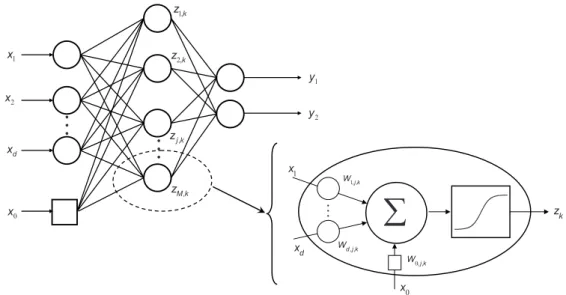
In addition to learning, articial neural networks possess other computational properties at-tributable to intelligent behavior such as association, generalization, detecting novel pat-terns, self-organization, pattern discrimination and self-stabilization (Joseph et al., 1992; Kohonen, 1995; Venkatasubramanian and Chan, 1989). Moreover, because of the dis-tributed parallel information processing structure, ANNs are capable of solving complex problems rapidly. Figure 2.2 shows an example of a feed forward multilayer perceptron network. 1 x 2 x d x 0 x 1,k z 2,k z , j k z , M k z 1 y 2 y
#
#
1 x d x 0 x 1, ,j k W , , d j k W 0, ,j k W k z #¦
Figure 2.2: A typical feed forward multilayer network with one hidden layer and an output layer. The relationship between the input variables x 2 Rd, the bias x
0 and output variables y 2 R2
is determined by minimizing a specied objective function and adaptively modifying the weights Wi;j;k by repeated presentation of a training instance to the network until no changes are made
to the weights. The output from each neuron zk in the hidden layer is a weighted sum of each
input processed processed by a suitable transfer function.
(1) A formal denition of what constitutes learning in a data-based modelling context can be found in
2.3 DATA-DRIVEN DIAGNOSTIC METHODS 17
Applications of Neural Networks in Fault Diagnosis
In principle, given enough representative data, articial neural networks can approximate any mathematical function with very good accuracy. Because of this property, it has been proposed to use ANNs in fault diagnostic systems for nonlinear system identication and pattern recognition, that is residual generation and residual evaluation respectively (Sorsa and Koivo, 1991; Venkatasubramanian and Chan, 1989). A benecial eect is that the requirement of an explicit mathematical model as required in parameter and state estimation methods is circumvented. As indicated before, chemical processes are highly nonlinear systems and deriving an exact mathematical model is very dicult because of incomplete knowledge.
Residual generation using neural models entails using an articial neural network as a proxy for the analytical model. Thus, the model is identied using nominal input-output data for the system under consideration. Similarly, models are tted for each known fault condition. In each case, the data is obtained by direct sampling from the process or, more likely, generated using a realistic simulation model of the process. The identied bank of neural network models are then deployed on the plant for residual generation. Fault diagnosis follows residual generation by solving a pattern classication problem. Figure 2.3 is a schematic illustration of the general fault diagnosis scheme using a bank of models. An important point to consider in nonlinear system identication is incorporation of dy-namics into the network structure. Although the problem of handling dydy-namics is still not yet completely resolved, two approaches are usually implemented in practice. Static ANNs can be endowed with memory by applying a bank of cascading lters to the network inputs. Since the resulting free parameters have xed parameters, the learned model is strictly speaking a quasi-dynamic model. Alternatively, dynamic ANNs can be realized using neu-ron structures whose internal representation are adaptive and not xed (Frank et al., 2000; Haykin, 1994). This is achieved through the use of time delay elements and recurrent connections. A framework for identication of nonlinear processes using dynamic neural networks was proposed in Shaw et al. (1997). Applications of recurrent dynamic networks in developing a fault diagnosis system for a sugar evaporation process have been reported (Patan and Parisini, 2005).
Gomm et al. (2000) evaluated the use of principal component analysis (PCA)(2) in
pre-processing fault signals (or residuals) in an application of neural network-based fault diag-nosis to an industrial nuclear fuel processing plant. The system involved is a complex multi-variable process whose physical states and coecients are mostly unknown and, therefore, an analytic model-based scheme could not be applied. PCA was used to reduce dimen-sionality of the network inputs and, as a result, obtain a parsimonious network topology. PCA lters random noise inuences in data while reduced complexity of the network struc-ture minimizes computational costs of training and storage. A potentially adverse issue not discussed in Gomm et al. (2000) is possible fault masking eect PCA may have on the resulting ltered data during testing. Since PCA discards information contained in the subspace explaining minimal variation in the data, incorrect diagnosis could result from use of ltered fault signals. This is particularly important for slowly developing faults that are
CONTROLLER PLANT DYNAMICS SENSORS ACTUATORS NOMINAL MODEL 1ST-FAULT MODEL x x x NTH-FAULT MODEL PHYSICAL SYSTEM REFERENCE INPUT -+ -+ + r(0) FAULT LOCATION FAULT INTERPRETATION DECISION FUNCTION GENERATOR -FAULT DECISION LOGIC PROCESS OUTPUT r(1) FAULT TIME r(N) RESIDUAL EVALUATION RESIDUAL GENERATION
Figure 2.3: Fault diagnosis scheme using neural networks. A bank of models of the nominal (fault-free) and possible known faults conditions is constructed o-line and deployed for online residual generation and residual evaluation. The fault decision logic can also use a neural network model, the dierence being that instead of nonlinear system identication, a pattern recognition learning problem is solved.
generally dicult to detect.
Venkatasubramanian and Chan (1989) applied supervised neural networks for fault diagnosis in a pattern recognition context. Using knowledge of dierent faults from a catalytic cracking unit used in petrochemical processes, it was shown that a trained network was able to diagnose correctly future faulty conditions. Moreover, multiple fault diagnosis was also possible even if the network had been optimized using knowledge of single fault conditions only. Generalization to multiple faults simplies the training phase of the network, as also demonstrated in Watanabe et al. (1994) where a hierarchical ANN is used to simplify the training. However, the proposed methodology could not handle novel faulty conditions not previously seen during training. In a sequel, Venkatasubramanian et al. (1990) investigated the robustness and fault tolerance capabilities of multilayer perceptrons in the presence of noise and sensor malfunction. In both cases, only steady-state processes were considered, and the direction and magnitude of changes in the measurements were not taken into account.
An investigation of the performance of dierent neural network architectures for fault di-agnosis indicated that the multilayer perceptron provided the most reliable architecture (Sorsa and Koivo, 1991). In further investigations, Sorsa and Koivo (1993) did a compari-son of supervised and unsupervised neural nets, for example Kohonen's self-organizing map
2.3 DATA-DRIVEN DIAGNOSTIC METHODS 19
(SOM) (Kohonen, 1995) and adaptive resonance theory (ART) architectures (Carpenter and Grossberg, 1990). It was shown that supervised networks achieved better classica-tion. Unsupervised neural network models were suggested for use in process classication since all possible faults could not be known a priori. Jämsä-Jounela et al. (2003) devel-oped a fault diagnosis system by combining a knowledge-based scheme with self-organizing maps that was subsequently applied to a copper ash smelting process. Process knowledge obtained from plant operators' experiences was used to categorize neurons in the SOM. Limitations of Neural Networks
The objective function used for determining optimal weights for neural network models is non-convex. Therefore, the training process often results in suboptimal models due to entrapment in local minima (Bishop, 1995; Haykin, 1994). In practice, a number of heuristic techniques such as early stopping or cross-validation, are used to diminish the local minima artefact.
Neural networks are sometimes lumped in the group of so-called black-box modelling techniques as they do not give insight into fundamental understanding and knowledge of a process. In particular, it is not possible to relate network topology or magnitudes of the weights to some physical aspect of the process. The lack of easily interpretable solutions of neural network models limits their adoption by operators, especially for purposes of supervisory control.
Kramer (1992) studied the performance of feed forward neural networks under conditions typically encountered in industrial practice, for example corrupted and limited training data sets. The following structural weaknesses of ANNs relevant to the fault diagnosis problem were identied.
The decision function obtained after training was inuenced by data points located on the boundary resulting in linear decision functions for small training sets even when the true underlying function was nonlinear.
Poor generalization of the networks was observed that was attributed to the tendency of ANNs to arbitrarily place the decision boundary in empty regions of input space, leading to large extrapolation errors. In addition, the decision boundaries for the normal class remained unbounded. In a later investigation, Rengaswamy et al. (2001) showed that the eect of the unbounded normal class problem could be reduced by use of ellipsoidal activation functions, which are based on a distance metric and, therefore, more robust.
By inducing dierent kinds of perturbations in the fault class distributions, the trained model exhibited higher sensitivity when compared to distance-based classiers. 2.3.2 Multivariate Statistical Process Monitoring
Statistical-based models represent another group of data-driven techniques that are widely used in stochastic processes such as parts manufacturing as well as multivariate systems. Statistical process control (SPC) is a well-established methodology used for process im-provement by detecting and eliminating root causes of variability associated with a process