A Thesis
Submitted to the Faculty of
Purdue University by
Junfeng Liu
In Partial Fulfillment of the Requirements for the Degree
of
Master of Science
May 2018 Purdue University Indianapolis, Indiana
THE PURDUE UNIVERSITY GRADUATE SCHOOL
STATEMENT OF COMMITTEE APPROVAL
Dr. Xia Ning, Chair
Department of Computer & Information Science Dr. Mohammad Al Hasan
Department of Computer & Information Science Dr. George Mohler
Department of Computer & Information Science
Approved by:
Dr. Shiaofen Fang
ACKNOWLEDGMENTS
Foremost, I would like to express my sincere gratitudes to my graduate advisor and committee chair, Dr. Xia Ning, for her continuous guidance and support in my graduate study and research. Her advice, comments and engagement have encouraged me greatly in the learning process and in the preparation of this thesis.
I would also like to thank the rest of my graduate committee members: Dr. Mohammad Al Hasan and Dr. George Mohler. I appreciate their insightful comments and remarks in the preparation of this thesis.
My thanks extend to my fellow labmates in Ning Lab: Wen-Hao Chiang, Ziwei Fan, Bo Peng, Yicheng He and Lai Man Tang. Their ideas and encouragements have largely supported my study and research. I feel thankful for our discussions and collaborations.
Last but not least, I must express my very profound gratitude to my parents for giving birth to me and providing me with unfailing support in my life and education. My accomplishments would not have been possible without them. Thank you.
TABLE OF CONTENTS
Page
LIST OF TABLES . . . .viii
LIST OF FIGURES . . . ix
ABSTRACT . . . xi
1 INTRODUCTION . . . 1
1.1 Background . . . 1
1.2 Existing Problems and Solutions. . . 3
1.2.1 Compound Prioritization . . . 3
1.2.2 Compound Prioritization Based on Multiple Properties . . . 5
1.2.3 Precision Drug Selection . . . 7
1.3 Organization . . . 9
1.4 References . . . 9
2 MULTI-ASSAY-BASED COMPOUND PRIORITIZATION VIA ASSISTANCE UTILIZATION . . . 15
2.1 Introduction . . . 15
2.2 Related Work . . . 18
2.2.1 In Silico Methods for Bioassay Data Analysis . . . 18
2.2.2 Learning to Rank . . . 21
2.3 Method Overview . . . 24
2.4 Assistance Bioassay Selection . . . 25
2.4.1 Cross-Ranking based Bioassay Similarities . . . 26
2.4.2 Profiling based Bioassay Similarity . . . 27
2.5 Assistance Compound Selection . . . 28
2.5.1 Aggregated Compound Similarities . . . 29
Page
2.6 Assistance Compound Incorporation . . . 29
2.7 Computational Tools . . . 30
2.7.1 Compound Similarities . . . 31
2.7.2 Concordance Index . . . 31
2.7.3 Ranking List Alignment . . . 32
2.8 Experiments . . . 33 2.8.1 Data Preparation . . . 33 2.8.2 Evaluation Metrics . . . 35 2.8.3 Ranking Algorithm . . . 36 2.8.4 Experimental Protocol . . . 36 2.8.5 Experimental Results . . . 37
2.9 Discussions and Conclusions . . . 55
2.10 References . . . 57
3 DIFFERENTIAL COMPOUND PRIORITIZATION VIA BI-DIRECTIONAL SELECTIVITY PUSH WITH POWER . . . 67
3.1 Introduction . . . 67
3.2 Related Work . . . 70
3.2.1 In Silico Methods for Drug Discovery . . . 70
3.2.2 Structure-Activity-Relationship Modeling. . . 71
3.2.3 Structure-Selectivity-Relationship Modeling . . . 71
3.2.4 Learning to Rank . . . 72
3.3 Definitions and Notations . . . 72
3.4 Methods . . . 74
3.4.1 Compound Scoring . . . 74
3.4.2 Activity Prioritization . . . 74
3.4.3 Bi-directional Selectivity Push with Power . . . 75
3.4.4 Optimization Problem and Solutions . . . 79
Page
3.5 Materials . . . 82
3.5.1 Dataset Generation . . . 82
3.5.2 Compound Feature Generation . . . 86
3.5.3 Experimental Protocol . . . 88
3.5.4 Evaluation Metrics . . . 88
3.6 Conclusions . . . 91
3.7 Experimental Results . . . 93
3.7.1 Overall Performance . . . 93
3.7.2 Selective Compound Prioritization . . . 96
3.7.3 Compound Ranking . . . 103
3.7.4 Top-N Performance . . . 104
3.7.5 Percentile Ranking Change. . . 112
3.7.6 Push Power Change . . . 113
3.8 Discussions . . . 115
3.8.1 Push Relation Among Bioassays . . . 115
3.8.2 Bioassay-Specific Compound Features . . . 116
3.8.3 Differential Promiscuous Compound Prioritization . . . 117
3.9 References . . . 118
4 DRUG SELECTION VIA JOINT PUSH AND LEARNING TO RANK . . 126
4.1 Introduction . . . 126
4.2 Literature Review on Learning to Rank . . . 130
4.3 Methods . . . 131
4.3.1 Drug Scoring . . . 132
4.3.2 Pushing up Sensitive Drugs . . . 133
4.3.3 Ranking among Sensitive Drugs . . . 134
4.3.4 Overall Optimization Problem . . . 135
4.4 Materials . . . 137
Page
4.4.2 Baseline Method . . . 140
4.4.3 Evaluation Metrics . . . 141
4.4.4 Gene Selection and Cell Line Similarities . . . 143
4.5 Experimental Results . . . 144
4.5.1 Ranking New Drugs . . . 144
4.5.2 Ranking New and Known Drugs . . . 152
4.5.3 Ranking Drugs in New Cell Lines . . . 153
4.5.4 Analysis on Latent Vectors . . . 157
4.6 Discussions and Conclusions . . . 162
4.7 References . . . 163
LIST OF TABLES
Table Page
2.1 Notations . . . 23
2.2 Dataset Description. . . 35
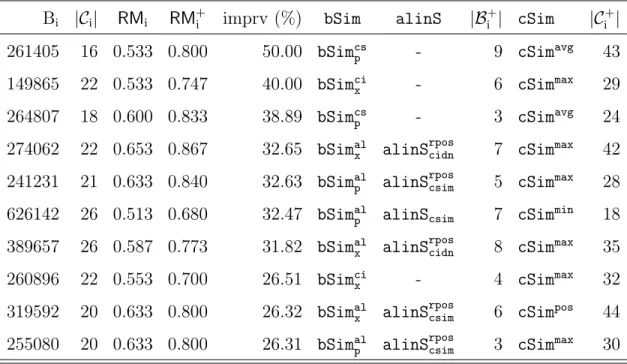
2.3 Overall Performance Comparison . . . 40
2.4 Best Performance Improvement . . . 42
2.5 Comparison of Assistance Bioassay Selection Methods. . . 53
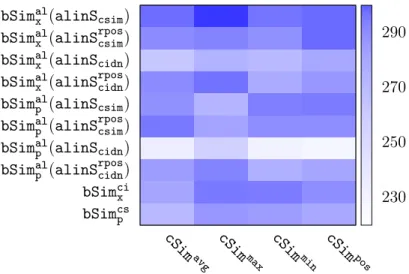
2.6 Comparison of Assistance Compound Selection Methods . . . 54
3.1 Notations . . . 73
3.2 Dataset Description. . . 85
3.3 Overall Performance Comparison . . . 94
3.4 Percentage Improvement of dCPPP(α= 0.6, β = 0.2)vs. dCPPP◦ . . . 102
3.5 Top-N Performance on Compound Ranking (Compound Counts) . . . . 105
3.6 Top-N Performance on Compound Ranking (Bioassay Counts) . . . 106
3.7 Top-N Performance on Selectivity Ranking (Compound Counts) . . . 107
3.8 Top-N Performance on Selectivity Ranking (Bioassay Counts) . . . 109
3.9 Top-N Performance on Selectivity Push (Compound Counts). . . 110
3.10 Top-N Performance on Selectivity Push (Bioassay Counts) . . . 111
4.1 Notations . . . 132
4.2 Dataset Description. . . 137
4.3 Performance on Ranking New Drugs . . . 145
LIST OF FIGURES
Figure Page
2.1 Framework Overview . . . 24
2.2 Linear Interpolation . . . 30
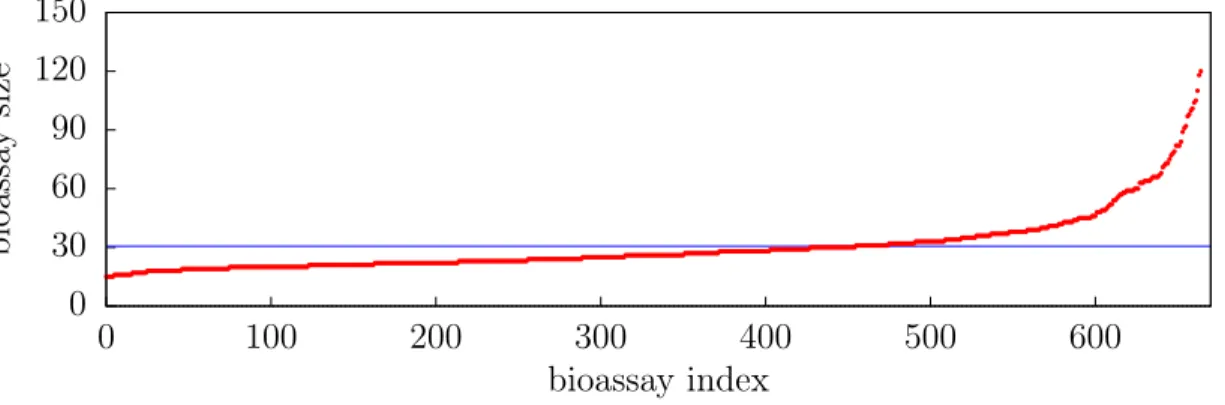
2.3 Bioassay Size . . . 35
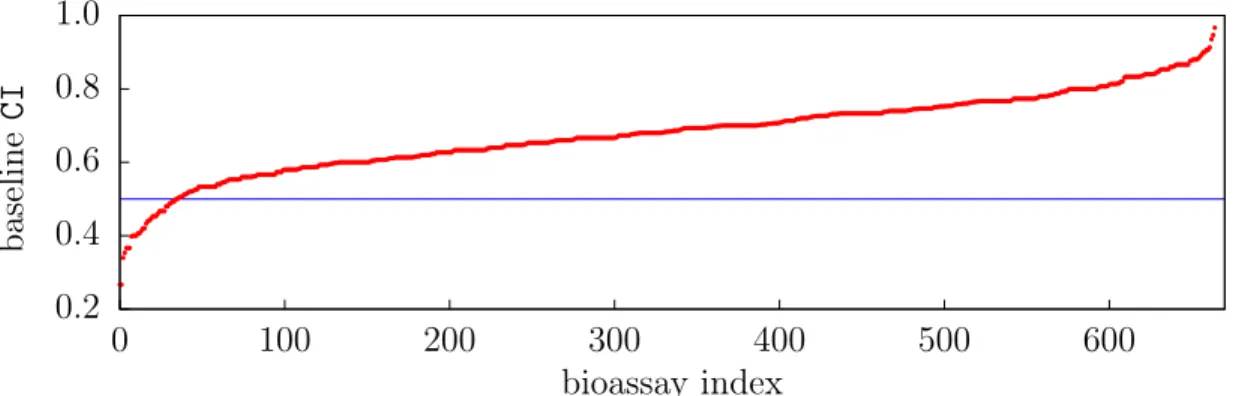
2.4 Baseline Model Performance . . . 38
2.5 Bioassay Compound Similarity vs Baseline Model Performance . . . 38
2.6 Bioassay Size vs Baseline Model Performance . . . 39
2.7 Baseline Model Performance vs Best Improvement . . . 41
2.8 Number of Improved Bioassays by Different Methods . . . 42
2.9 Percentage (%) of Improvement by Different Methods . . . 43
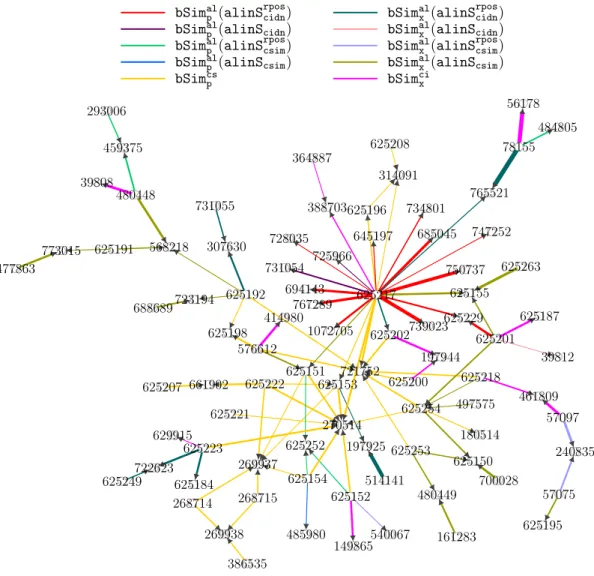
2.10 Assistance Relations among Bioassays . . . 45
2.11 Decision Tree on Method Selection . . . 48
3.1 Overall Scheme of dCPPP . . . 69
3.2 Relations among Bioassay Sets . . . 85
3.3 Bioassay Size in Bc s (Before Split) . . . 86 3.4 Bioassay Size in Bm s (Before Split). . . 86 3.5 Evaluation of dCPPP(1) on Bm s . . . 96 3.6 Evaluation of dCPPP(2) on Bm s . . . 97
3.7 Ranking Difference among Selective Compounds in Iteration 1 . . . 112
3.8 Ranking Difference among Selective Compounds in Iteration 2 . . . 112
3.9 Push-up Weight Change among Selective Compounds . . . 114
3.10 Push-down Weight Change among x-Selective Compounds . . . 114
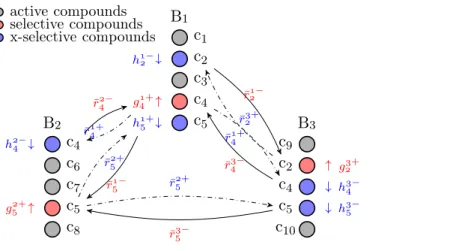
3.11 Push Relation among Bioassays . . . 116
4.1 pLETORg Scheme Overview . . . 128
Figure Page
4.3 Data Split for 5-Fold Cross Validation . . . 138
4.4 Data Split for Testing New Cell Lines . . . 139
4.5 Regression for Gene Selection . . . 143
4.6 Performance of pLETORgw.r.t. the Push Parameter α . . . 148
4.7 Performance of pLETORgw.r.t. the Latent Dimension l . . . 149
4.8 Cell Line Similarity Comparison . . . 154
4.9 Performance on Selecting Drugs for New Cell Lines . . . 155
4.10 ∆r% in Different Drug Pairs . . . 158
4.11 ∆e% in Different Drug Pairs . . . 158
4.12 Drug structures: BRD-K69932463 vs BRD-K67566344 . . . 159
ABSTRACT
Liu, Junfeng M.S., Purdue University, May 2018. Machine Learning Methods for Better Drug Prioritization. Major Professor: Xia Ning.
Effective prioritization is critical in drug discovery and precision medicine. Various computational tools have been developed and utilized in different applications for the development and the use of drugs.
In the early stages of drug discovery, compound prioritization is largely used in high throughput screening to help identify drug candidates for further investigation. For a compound to be a successful drug, it has to exhibit certain promising biological properties (e.g., compound activity, selectivities, toxicity, etc.). Compound prior-itization methods prioritize the drug candidates based on such properties so that the compounds that exhibit more drug-like properties could be prioritized over those compounds that are less likely to become drugs.
After drugs are developed, drug prioritization is also essential to develop better treatment plans in precision medicine. One of the primary goals of precision medicine is to select the right drugs for the right patients. For instance, when selecting drugs for patients of different cancer types, sensitive drugs for patients of certain types of cancers should be prioritized over insensitive drugs, even if these insensitive drugs might be sensitive to patients of other cancer types.
Current development of computational methods for compound prioritization and drug prioritization suffer from three major issues, and we have developed novel ma-chine learning methods to tackle each of them, respectively.
First, existing methods for compound prioritization are largely focused on devis-ing advanced rankdevis-ing algorithms that better learn the orderdevis-ing among compounds. However, such methodologies are fundamentally limited by the scarcity of available
data, particularly when the screenings are conducted at a relatively small scale over known promising compounds. To tackle this problem, we explore the structures of bioassay space and leverage such structures to improve ranking performance of an ex-isting strong ranking algorithm. This is done by identifying assistance bioassays and assistance compounds intelligently and leveraging such assistance within the existing ranking algorithm. By leveraging the assistance bioassays and compounds, the data scarcity can be properly overcome. Along this line, we developed a machine learning framework MACPAU, which consists of a suite of assistance bioassay selection methods and assistance compound selection methods. Our experiments demonstrate an overall 8.34% improvement on the ranking performance over the current state-of-the-art.
Second, current computational methods for compound prioritization usually focus on ranking compounds based on one property, typically activity, with respect to a single target. However, compound selectivity is also a key property which should be deliberated simultaneously so as to minimize the likelihood of undesired side effects of future drugs. To solve this problem, we present a novel machine-learning based differ-ential compound prioritization methoddCPPP. ThisdCPPP method learns compound prioritization models that rank active compounds well, and meanwhile, preferably rank selective compounds higher via a bi-directional selectivity push strategy. The bi-directional push is enhanced by push powers that are determined by ranking differ-ence of selective compounds over multiple bioassays. Our experiments demonstrate that the new methoddCPPPachieves significant improvement on prioritizing selective compounds over baseline models.
Third, conventional methods for drug selection are unable to effectively prioritize sensitive drugs over insensitive drugs, and are unable to differentiate the orderings among sensitive drugs. We have formulated the cancer drug selection problem as to accurately predict 1). the ranking positions of sensitive drugs and 2). the ranking orders among sensitive drugs in cancer cell lines based on their responses to cancer drugs. We have developed a new learning-to-rank method, denoted as pLETORg, that predicts drug ranking structures in each cell line using drug latent vectors and
cell line latent vectors. The pLETORg method learns such latent vectors through explicitly enforcing that, in the drug ranking list of each cell line, the sensitive drugs are pushed above insensitive drugs, and meanwhile the ranking orders among sensitive drugs are correct. Genomics information on cell lines is leveraged in learning the latent vectors. Our experimental results on a benchmark cell line-drug response dataset demonstrate that the newpLETORgsignificantly outperforms the state-of-the-art method in prioritizing new sensitive drugs.
1. INTRODUCTION
1.1 Background
Effective prioritization plays critical roles in drug discovery and precision medicine. Drug discovery is a time-consuming and costly process. For a drug candidate to be-come an approved drug, it has to pass several stages, including initial screening, preclinical research, clinical trials, FDA review and post-market drug safety morn-itoring ∗. Such process could take at least 10 to 15 years and $500 million to $2 billion to introduce a new drug to market [1]. In precision medicine, the drug se-lection process also involves substantial wet-lab experiments on various drugs before a sensitive drug is selected for a specific patient. Compared to traditional in vivo and in vitro methods,in silico prioritization methods are considered as efficient and economical alternatives to perform compound and drug prioritization tasks. These in silico methods could be used in various applications. One research area on these in silico methods is focused on the high throughput screening (HTS) in the early stages of drug discovery. In HTS, the number of compounds to be tested is large and thus it is expensive to conduct wet-lab experiments over all the compounds. The in silico methods could be adopted to identify potential drug candidates effectively and economically. Another area of interest within in silico methods is selecting sen-sitive drugs for patients in precision medicine. In drug selection, various drugs will be tested on a specific cell line for a specific patient. The in silico drug prioritization methods are able to to accelerate drug selection process, so that the right drugs could be selected to the right patients in clinical trials or in real treatments.
In silico compound prioritization, which learns computational models to rank compounds in terms of their drug-like/disease-specific properties (e.g., efficacy,
speci-∗
ficity), has been attracting increasing attention, due to the emerging focus on precision medicine [2]. In silico compound prioritization has been attracting increasing atten-tion, due to the emerging focus on precision medicine [2]. Thein silico compound pri-oritization methods learn computational models to rank compounds in terms of their drug-like/disease-specific properties (e.g., efficacy, specificity), so that the promising drug candidates could be identified via prioritization. In many applications of preci-sion medicine (e.g., cancer drug selection [3]), before precise measurements of disease-specific compound properties need to be considered, a set of promising compounds (typically drugs) should be first selected for future investigation. The foundation of these in silico methods is laid down by the pioneering work of Hansch et al. [4; 5], which revealed the existence of the mathematical relations between the biological activity of a chemical compound and its physicochemical properties.
In silico drug prioritization for precision medicine, which learns computational models to rank drugs for specific patients, is also gaining attention in research in recent years. The primary goal of precision medicine is selecting the right drugs for the right patients, so that the patients could receive customized and effective treatments. When a disease could be treated by different drugs (e.g., many cancer drugs are able to kill various cancer cells), it is necessary to consider which drug is the best for the disease, or even for a specific patient. One emerging application is precision cancer drug selection for a specific patient or a specific cell line. The landscape of cancer genomics and recent pan-cancer evidence from theories and practices (e.g., the Molecular Analysis for Therapy Choice Trial at National Cancer Institute†, The Cancer Genome Atlas‡, etc.) have laid the foundation for joint analysis of multiple cancer cell lines and their drug responses to prioritize and select sensitive cancer drugs.
†https://www.cancer.gov/about-cancer/treatment/clinical-trials/nci-supported/nci-match ‡https://cancergenome.nih.gov/
1.2 Existing Problems and Solutions 1.2.1 Compound Prioritization
A first step in drug discovery is to conduct bioassays [6] that screen a large set of promising compounds. The outcomes from these bioassays inform the following drug discovery steps [1]. Successfully identifying the promising drug candidates in early stages is critical in drug discovery. If the right drug candidates are not successfully selected for further investigation, or those drug candidates that are not promising to be successful drugs are selected, the substantial efforts that are invested in the following investigations will be wasted.
Knowledge discovery from bioassay data is critical to learn the compound physico-chemical properties towards certain targets or diseases. Substantial research effort in this area is dedicated to establishing the relationship between the structures of chemi-cal compounds and their bio-chemichemi-cal properties expressed in the bioassays, for exam-ple, Structure-Activity Relationship (SAR) [4] and Structure-Selectivity Relationship (SSR) [7]. Traditional research in in silico studies for drug discovery is currently facing several problems. Conventional in silico studies for drug discovery have been dominated by classification and regression methods. Classification methods assign each candidate compound a label, typically “active” or “inactive”, to determine which compounds are selected for further investigation. Regression methods approximate certain measurements of drug-like/disease-specific properties for each candidate com-pound (e.g., efficacy, specificity), and further indicate which comcom-pounds should be se-lected for further investigation. Popular classification and regression methods include Support Vector Machines (SVM) [9], Partial Least-Squares [10], random forests [11], Bayesian matrix factorization [12], and Naïve Bayesian classifiers [13], etc. In many regression-basedSARmodels, the objective is typically to minimize the overall errors between the predicted IC50 values (a metric used to measure compound activities in
inhibiting their targets or other biological entities [14]) and true IC50 values.
the minimal-error objective. Compared to regression, classification-based SAR mod-els suffer more from mis-ordering because majority of classification approaches only learn from and predict class labels. Their predicted quantitative measurements are not intended for ranking purposes. Compared to regression and classification, rank-ing models represent a more natural way to prioritize the drug candidates based on certain biological properties.
Another problem that is challenging the in silico studies on compound priori-tization is the availability and quality of the data. Existing research on in silico compound prioritization methods is mainly focused on devising advanced ranking algorithms that better learn the ordering among compounds [15].
However, such methodologies are fundamentally limited by the scarcity of available data, particularly when the screenings are conducted at a relatively small scale over known promising compounds.
To address the aforementioned problems in compound prioritization, we develop the Multi-Assay-Based Compound Prioritization via Assistance Utilization method [8] (denoted as MACPAU). In MACPAU, we focus on improving the compound ranking performance based on a single property (i.e., compound activity to a specific target). Instead of devising more advanced ranking algorithm, we take the complementary aspect, that is, using an existing strong ranking algorithm, we improve its performance by delicately incorporating more useful information in model training. Specific, we address the questions of whether we can leverage the structures of the chemical space and the bioassay space, and collectively build and improve individual ranking models. We develop a unified system in which improved compound prioritization models are achieved through three decoupled steps: 1). select a set of additional bioassays which are very likely to exhibit useful information for a better ranking model for the target of interest; 2). select a set of compounds from these bioassays that are very likely to help improve the ranking model quality; and 3). incorporate such compounds together with the known compounds for the target of interest and build a ranking model. Our
experiments show that the MACPAU method is able to improve the compound ranking performance by 8.34% over the state-of-the-art method.
1.2.2 Compound Prioritization Based on Multiple Properties
Current compound prioritization typically focuses on one single compound prop-erty [16], for example, biological activity. Biological activity of a compound can be initially tested in a target-specific bioassay [6] by measuring whether the compound binds with high affinity to the protein target that it is aimed to effect. Activity is a critical property that a compound needs to exhibit in order to act efficaciously as a successful drug. Compound prioritization in terms of activity needs to rank most active compounds on top of less active compounds.
Compound selectivity is another key property that successful drugs need to ex-hibit [17]. Selectivity measures how a compound can differentially bind to only the target of interest with high affinity (i.e., high activity) while binding to other pro-teins with low affinities. Therefore, the compound selectivity prioritization needs to consider the prioritization difference of a compound in the activity prioritization structures of multiple targets. Specifically, the compound selectivity prioritization needs to follow a combinatorial ranking criterion that 1). it ranks all the compounds well based on their activities; and meanwhile, 2). it ranks strongly selective com-pounds preferably higher, probably even higher than more active comcom-pounds that are not selective. These criteria correspond to that in real applications, active and highly selective compounds are preferred over highly active but also highly promis-cuous compounds [18] to minimize the likelihood of undesirable side effects.
Existing computational methods in bioassays analysis, particularly in findingSAR andSSR, have been dominated by regression and classification as well. In these meth-ods, compounds are typically represented by certain chemical fingerprints, for exam-ple, Extended Connectivity Fingerprints (ECFP)§ and Maccs keys¶. Compound
ac-§Scitegic Inc, http://www.scitegic.com.
tivity and selectivity are used as a label/numerical target of the compounds. Popular classification and regression methods include Support Vector Machines (SVM) [9], Partial Least-Squares [10], random forests [11], Bayesian matrix factorization [12], and Naïve Bayesian classifiers [13], etc. These classification and regression methods also suffer from the similar problems as identified in Section 1.2.1. Ranking methods, compared to classification and regression, are less developed for bioassay analysis. Additionally, to the best of our knowledge, there is no existing method that is able to tackle both compound activity prioritization and selectivity prioritization problems at the same time.
We develop the Differential Compound Prioritization via Bi-Directional Selectiv-ity Push with Power method [19; 20] (denoted as dCPPP) to tackle both compound activity ranking and selectivity prioritization problems within one differential model. In specific, the dCPPP method consists of three components:
1. A compound scoring function, which produces a score for each compound in a bioassay that will be used to rank the compound in the bioassay. The scoring function uses bioassay-specific compound features to calculate the scores. 2. An activity ranking model, which learns the compound scoring function and
approximates the ranking structure among all compounds in a bioassay. The learning is via minimizing the pairwise ordering errors introduced by the scoring function.
3. A bi-directional selectivity push strategy, which preferably pushes up selective compounds in the activity ranking model of a bioassay, and pushes down the com-pounds in the model that are selective in a different bioassay. The bi-directional push strategy leverages the ranking difference of selective compounds across mul-tiple bioassays and alters the activity ranking by pushing selectivity-related com-pounds in two directions with specific powers.
These three components will be learned simultaneously within one optimization for-mulation. To the best of our knowledge, this is the first work in which the activity
and selectivity are both tackled within one differential prioritization model that in-tegrates multiple bioassays simultaneously. Our experiments demonstrate that the dCPPP method is able to improve the compound selectivity ranking by 47.00% over the baseline method while maintaining good ranking structures among both selective and active compounds.
1.2.3 Precision Drug Selection
While in silico methods for bioassay analysis and compound prioritization help identify promising drug candidates, the primary goal of precision medicine is to select the right drugs to the right patients and treat the diseases effectively. Here, we consider the problem of selecting specific cancer drugs for specific patients.
An appealing option for precision cancer drug selection is via the pan-cancer scheme [21] that examines various cancer types together. The landscape of can-cer genomics reveals that various cancan-cer types share driving mutagenesis mechanisms and corresponding molecular signaling pathways in several core cellular processes [22]. This finding has motivated the most recent clinical trials (e.g., the Molecular Analysis for Therapy Choice Trial at National Cancer Institutek) to identify common targets for patients of various cancer types and to prescribe same drug therapy to such pa-tients. The pan-cancer scheme is also well supported by the strong pan-cancer muta-tions [23] and copy number variation [24] patterns observed from The Cancer Genome Atlas∗∗ project. The above pan-cancer evidence from theories and practices lays the foundation for joint analysis of multiple cancer cell lines and their drug responses to prioritize and select sensitive cancer drugs.
Another appealing option for precision cancer drug selection is via the popular off-label drug use [25] (i.e., the use of drugs for unapproved therapeutic indications [26]). This is due to the fact that some aggressive cancer types have very limited existing therapeutic options, while conventional drug development for those cancers, and also
khttps://www.cancer.gov/about-cancer/treatment/clinical-trials/nci-supported/nci-match ∗∗https://cancergenome.nih.gov/
in general, has been extremely time-consuming, costly and risky [27]. However, a key challenge for off-label drug use is the lack of knowledge base of preclinical and clinical evidence, hence, the guidance for drug selection in practice [28].
Current computational efforts for precision cancer drug selection [29] are primarily focused on using regression methods (e.g., random forests [30], kernel based meth-ods [31], ridge regression [32], deep neural networks [33]) to predict numerical drug sensitivity values (e.g., in GI50 ††, IC50‡‡), and selecting drugs with optimal
sensitivi-ties in each cell line [34]. The existing regression methods for drug selection, however, also suffer from the problems as mentioned in Section 1.2.1. That is, the regression models tend to fit insensitive drugs better than sensitive drugs when the majority of the drugs are insensitive in a cell line. This situation is even more likely when the cell line response values for sensitive drugs follow very different distributions than those of insensitive drugs, and thus appear like outliers. The challenge is that this situation occurs very frequently in read datasets.
To address the problems in precision drug selection, we develop the Drug Selection via Joint Push and Learning to Rank method [35] (denoted aspLETORg). In pLETORg, our goal is to improve the ranking performance of cancer drugs in cancer cell lines for drug selection. To induce correct ordering of drugs in each cell line in terms of drug sensitivity, for each involved drug and cell line, we learn a latent vector and score drugs in each cell line using drug latent vectors and the corresponding cell line latent vector. The ranking positions of the drugs in a cell line are determined by the scores generated from drug latent vectors and cell line latent vector. We learn such latent vectors through explicitly enforcing and optimizing that, in the drug ranking list of each cell line, the sensitive drugs are pushed above insensitive drugs, and meanwhile the ranking orders among sensitive drugs are correct.We simultaneously learn from all the cell lines and their drug ranking structures. In this way, the structural information of all the cell lines can be transferred across and leveraged during the learning process. We also use genomics information on cell lines to regularize the latent vectors in
††https://dtp.cancer.gov/databases_tools/docs/compare/compare_methodology.htm ‡‡https://www.ncbi.nlm.nih.gov/books/NBK91994/
learning to rank. Our experimental results show that the pLETORgmethod is able to improve the ranking performance of sensitive drugs by at least 5.81% with statistical significance over the baseline method.
1.3 Organization
In this thesis, three novel machine learning methods are developed to tackle the problems in compound prioritization, compound prioritization based on multiple properties and drug prioritization. Comprehensive experiments and result analysis are also presented respectively. The rest of this thesis is organized as follows. Chap-ter 2 presents the problems in compound prioritization and the corresponding solu-tion, Multi-Assay-Based Compound Prioritization via Assistance Utilization method (MACPAU), along with the experimental results and analysis. Chapter 3 presents the problems in compound prioritization based on multiple properties and the correspond-ing solution, Differential Compound Prioritization via Bi-Directional Selectivity Push with Power method (dCPPP), along with the experimental results and analysis. Chap-ter 4 presents the problems in drug prioritization and the corresponding solution, Drug Selection via Joint Push and Learning to Rank method (pLETORg), along with the experimental results and analysis. Chapter 5 summarizes the three solutions and experimental results.
1.4 References
[1] J. A. DiMasi, R. W. Hansen, and H. G. Grabowski, “The price of innovation: new estimates of drug development costs,” Journal of Health Economics, vol. 22, no. 2, pp. 151 – 185, 2003. [Online]. Available: http://www.sciencedirect.com/science/article/pii/S0167629602001261
[2] E. A. Ashley, “Towards precision medicine,” Nature Reviews Genetics, vol. 17, no. 9, pp. 507–522, Aug. 2016. [Online]. Available: http: //dx.doi.org/10.1038/nrg.2016.86
[3] X. Deng and Y. Nakamura, “Cancer precision medicine: From cancer screening to drug selection and personalized immunotherapy,” Trends in Pharmacological Sciences, 2016.
[4] C. Hansch, P. P. Maolney, T. Fujita, and R. M. Muir, “Correlation of biological activity of phenoxyacetic acids with hammett substituent constants and partition coefficients,” Nature, vol. 194, pp. 178–180, 1962.
[5] C. Hansch, R. M. Muir, T. Fujita, C. F. Maloney, and M. Streich, “The correla-tion of biological activity of plant growth-regulators and chloromycetin deriva-tives with hammett constants and partition coefficients,” Journal of American Chemical Society, vol. 85, pp. 2817–1824, 1963.
[6] [Online]. Available: https://en.wikipedia.org/wiki/Bioassay Accessed: Septem-ber 10, 2015
[7] L. Peltason, Y. Hu, and J. Bajorath, “From activity to structure-selectivity relationships: Quantitative assessment, selectivity cliffs, and key compounds,” ChemMedChem, vol. 4, no. 11, pp. 1864–1873, 2009. [Online]. Available: http://dx.doi.org/10.1002/cmdc.200900300
[8] J. Liu and X. Ning, “Multi-assay-based compound prioritization via assistance utilization: a machine learning framework,” Journal of Chemical Information and Modeling, vol. 57, no. 3, pp. 484–498, 2017.
[9] A. Wassermann, H. Geppert, and J. Bajorath, “Application of support vector machine-based ranking strategies to search for target-selective compounds,” in Chemoinformatics and Computational Chemical Biology, ser. Methods in Molecular Biology, J. Bajorath, Ed. Humana Press, 2011, vol. 672, pp. 517–530. [Online]. Available: http://dx.doi.org/10.1007/978-1-60761-839-3_21 [10] A. Lindström, F. Pettersson, F. Almqvist, A. Berglund, J. Kihlberg, and
A. Linusson, “Hierarchical pls modeling for predicting the binding of a comprehensive set of structurally diverse protein-ligand complexes,” Journal of Chemical Information and Modeling, vol. 46, no. 3, pp. 1154–1167, 2006. [Online]. Available: http://pubs.acs.org/doi/abs/10.1021/ci050323k
[11] N. Weill and D. Rognan, “Development and validation of a novel protein-ligand fingerprint to mine chemogenomic space: Application to g protein-coupled receptors and their ligands,” Journal of Chemical Information and Modeling, vol. 49, no. 4, pp. 1049–1062, 2009. [Online]. Available: http://pubs.acs.org/doi/abs/10.1021/ci800447g
[12] M. Gönen and S. Kaski, “Kernelized bayesian matrix factorization,” IEEE Trans. Pattern Anal. Mach. Intell., vol. 36, no. 10, pp. 2047–2060, 2014. [Online]. Available: http://dx.doi.org/10.1109/TPAMI.2014.2313125
[13] F. Nigsch, A. Bender, J. L. Jenkins, and J. B. O. Mitchell, “Ligand-target prediction using winnow and naive bayesian algorithms and the implications of overall performance statistics,” Journal of Chemical Information and Modeling, vol. 48, no. 12, pp. 2313–2325, 2008. [Online]. Available: http://pubs.acs.org/doi/abs/10.1021/ci800079x
[14] [Online]. Available: https://simple.wikipedia.org/wiki/IC50 Accessed: Septem-ber 10, 2015
[15] S. Agarwal, D. Dugar, and S. Sengupta, “Ranking chemical structures for drug discovery: A new machine learning approach,” Journal of Chemical Information and Modeling, vol. 50, no. 5, pp. 716–731, 2010, pMID: 20387860. [Online]. Available: http://dx.doi.org/10.1021/ci9003865
[16] H. Geppert, M. Vogt, and J. Bajorath, “Current trends in ligand-based virtual screening: Molecular representations, data mining methods, new application areas, and performance evaluation,” Journal of Chemical Information and Modeling, vol. 50, no. 2, pp. 205–216, 2010, pMID: 20088575. [Online]. Available: http://dx.doi.org/10.1021/ci900419k
[17] M. W. Karaman, S. Herrgard, D. K. Treiber, P. Gallant, C. E. Atteridge, B. T. Campbell, K. W. Chan, P. Ciceri, M. I. Davis, P. T. Edeen, R. Faraoni, M. Floyd, J. P. Hunt, D. J. Lockhart, Z. V. Milanov, M. J. Morrison, G. Pallares, H. K. Patel, S. Pritchard, L. M. Wodicka, and P. P. Zarrinkar, “A quantitative analysis of kinase inhibitor selectivity,” Nature biotechnology, vol. 26, no. 1, pp. 127–132, 2008.
[18] Y. Hu, D. Gupta-Ostermann, and J. Bajorath, “Exploring compound promis-cuity patterns and multi-target activity spaces,” Computational and structural biotechnology journal, vol. 9, no. 13, pp. 1–11, 2014.
[19] J. Liu and X. Ning, “Differential compound prioritization via bi-directional selectivity push with power,” in Proceedings of the 8th ACM International Conference on Bioinformatics, Computational Biology,and Health Informatics, ser. ACM-BCB ’17. New York, NY, USA: ACM, 2017, pp. 394–399. [Online]. Available: http://doi.acm.org/10.1145/3107411.3107486
[20] J. Liu and X. Ning, “Differential compound prioritization via bidirectional selectivity push with power,” Journal of chemical information and modeling, vol. 57, no. 12, pp. 2958–2975, 2017.
[21] L. Omberg, K. Ellrott, Y. Yuan, C. Kandoth, C. Wong, M. R. Kellen, S. H. Friend, J. Stuart, H. Liang, and A. A. Margolin, “Enabling transparent and collaborative computational analysis of 12 tumor types within The Cancer Genome Atlas,” Nature genetics, vol. 45, no. 10, pp. 1121–1126, oct 2013. [22] B. Vogelstein, N. Papadopoulos, V. E. Velculescu, S. Zhou, L. A. Diaz, and
K. W. Kinzler, “Cancer genome landscapes,” Science, vol. 339, no. 6127, pp. 1546–1558, 2013.
[23] C. Kandoth, and others, “Mutational landscape and significance across 12 major cancer types,” Nature, vol. 502, no. 7471, pp. 333–339, Oct 2013.
[24] T. I. Zack, and others, “Pan-cancer patterns of somatic copy number alteration,” Nat Genet, vol. 45, no. 10, pp. 1134–1140, Oct 2013.
[25] R. M. Conti, A. C. Bernstein, V. M. Villaflor, R. L. Schilsky, M. B. Rosenthal, and P. B. Bach, “Prevalence of Off-Label Use and Spending in 2010 Among Patent-Protected Chemotherapies in a Population-Based Cohort of Medical Oncologists,” Journal of Clinical Oncology, vol. 31, no. 9, pp. 1134–1139, mar 2013.
[26] R. S. Stafford, “Regulating off-label drug use — rethinking the role of the fda,” New England Journal of Medicine, vol. 358, no. 14, pp. 1427–1429, 2008, pMID: 18385495.
[27] J. A. DiMasi, R. W. Hansen, and H. G. Grabowski, “The price of innovation: new estimates of drug development costs,” Journal of Health Economics, vol. 22, no. 2, pp. 151 – 185, 2003.
[28] S. G. Poole and M. J. Dooley, “Off-label prescribing in oncology,” Supportive Care in Cancer, vol. 12, no. 5, pp. 302–305, May 2004.
[29] C. De Niz, R. Rahman, X. Zhao, and R. Pal, “Algorithms for drug sensitivity prediction,” Algorithms, vol. 9, no. 4, 2016.
[30] S. Haider, R. Rahman, S. Ghosh, and R. Pal, “A copula based approach for design of multivariate random forests for drug sensitivity prediction,” PLOS ONE, vol. 10, no. 12, pp. 1–22, Dec 2015.
[31] M. Gönen, “Predicting drug-target interactions from chemical and genomic kernels using bayesian matrix factorization.” Bioinformatics, vol. 28, no. 18, pp. 2304–2310, Sep 2012.
[32] P. Geeleher, N. J. Cox, and R. S. Huang, “Clinical drug response can be predicted using baseline gene expression levels and in vitro drug sensitivity in cell lines,” Genome Biology, vol. 15, no. 3, pp. R47–R47, Mar 2014.
[33] G. E. Dahl, N. Jaitly, and R. Salakhutdinov, “Multi-task neural networks for qsar predictions,” CoRR, vol. abs/1406.1231, 2014.
[34] J. C. Costello, and others “A community effort to assess and improve drug sensitivity prediction algorithms,” Nat Biotech, vol. 32, no. 12, pp. 1202–1212, Dec 2014.
[35] J. Liu and X. Ning, “Multi-assay-based compound prioritization via assistance utilization: A machine learning framework,” Journal of Chemical Information and Modeling, vol. 57, no. 3, pp. 484–498, 2017.
[36] G. Speyer, D. Mahendra, H. J. Tran, J. Kiefer, S. L. Schreiber, P. A. Clemons, H. Dhruv, M. Berens, and S. Kim, “Differential pathway dependency discovery associated with drug response across cancer cell lines,” in Pacific Symposium on Biocomputing, vol. 22. NIH Public Access, 2017, p. 497.
2. MULTI-ASSAY-BASED COMPOUND PRIORITIZATION
VIA ASSISTANCE UTILIZATION
2.1 Introduction
Drug discovery is a time-consuming and costly process. It is estimated to take at least 10 to 15 years and approximately $500 million to $2 billion to bring a new drug to market [1]. To accelerate this process, in silico methods have been exten-sively developed and adapted as alternatives to in vivo and in vitro methods. These in silico methods are particularly used for identifying potential drug candidates dur-ing the early stages of drug discovery, when the number of compounds to be tested is large and thus it is expensive to conduct wet-lab experiments over all the com-pounds. The foundation of these in silico methods is laid down by the pioneering work of Hanschet al.[2; 3], which revealed the existence of the mathematical relations between the biological activity of a chemical compound and its physicochemical prop-erties. Since then, significant research efforts have been dedicated to the development of quantitative methods for modeling Structure-Activity Relationship (SAR) mathe-matically and predicting compound activities from compound 2D/3D structures and other properties, etc [4; 5]. Such SAR models have demonstrated a great success in assisting and accelerating drug discovery [6]. Recent advancement on SARmodeling is further enabled by more powerful techniques developed from machine learning and data mining communities [7]. In addition, the scalability of SAR modeling has also been substantially improved so that much larger regions of the chemical space can
Reprinted (adapted) with permission from J. Liu and X. Ning, “Multi-assay-based compound prioritization via assistance utilization: a machine learning framework,” Journal of Chemical
In-formation and Modeling, vol. 57, no. 3, pp. 484–498, 2017. Copyright 2017 American Chemical
be effectively explored to identify drug-like compounds, owing to the development in Big Data analytics [8].
On the other hand, compound prioritization, a qualitative counterpart of quantita-tive SARmodeling, was less emphasized historically but has been recently attracting attention increasingly, due to the emergence of precision medicine [9]. In many ap-plications of precision medicine, before the quantitative measurements of compound activities need to be considered, a set of promising compounds (particularly drugs) should be first selected for any future investigation. The problem herein naturally boils down to compound ranking/prioritization, in which only the ordering of com-pounds matters. Conventional SARmethods cannot be directly adapted to solve the compound prioritization problem, largely due to the fact that many SAR modeling approaches have their optimization objectives that do not directly translate to the objectives for prioritization. For example, in many regression-basedSARmodels, the objective is typically to minimize the overall errors between the predicted IC50 values
(a metric used to measure compound activities in inhibiting their targets or other biological entities [10]) and true IC50values. However, since the IC50 values for active
compounds can have a wide spread and orders of magnitude difference (e.g., from 1nM to 1µM), the regression models can be easily biased by the values of majority under the minimal-error objective. Thus, the predicted IC50 values from such
regres-sion models may lose the structural relations in terms of their value ordering. Very complicated regression models can be applied to deal with the order difference among IC50values, but they tend to be overfitted, particularly when the value distribution is
highly screwed. Compared to regression, classification-basedSARmodels suffer from mis-ordering even worse because majority of classification approaches only learns from class labels and predicts class labels. Their predicted quantitative measurements are not intended for ranking purposes.
In this manuscript, we present our systematic studies on compound prioritiza-tion and our new machine learning approaches to conduct and improve compound prioritization. Current development on computational approaches for compound
pri-oritization is mainly focused on devising advanced ranking algorithms that better learn the ordering among compounds [11]. However, such methodologies are funda-mentally limited by the scarcity of available data, particularly when the screenings are conducted at a relatively small scale over known promising compounds. In this work, we take a complementary perspective, that is, using an existing strong rank-ing algorithm, we improve its performance by delicately incorporatrank-ing more useful information in model training. In specific, we address the questions whether we can leverage the structures of the chemical space and the bioassay space, and collectively build and improve individual ranking models. We propose a unified system in which improved compound prioritization models are achieved through three decoupled steps: 1). select a set of additional bioassays which are very likely to exhibit useful informa-tion for a better ranking model for the target of interest; 2). select a set of compounds from these bioassays that are very likely to help improve the ranking model quality; and 3). incorporate such compounds together with the known compounds for the target of interest and build a ranking model.
We have developed different approaches for selecting additional assistance bioas-says and assistance compounds. The bioassay selection methods are developed based on the intuition that if two bioassays have similar compounds and similar orders among the compounds, then they are likely to provide useful information to each other. Therefore, a critical component of the proposed system is to measure bioassay similarities that capture the most pertinent signals for potential model improvement. We have developed a suite of assistance bioassay selection methods that measure bioassay similarities based on their involved compounds and their orders. Similarly, we have developed a set of assistance compound selection methods based on com-pound similarities and their positions in comcom-pound ranking. Our experiments over a large collection of bioassays demonstrate an overall 8.34% improvement on the rank-ing performance over the state of the art. We also provide guided solutions as to which selection methods to use based on bioassay properties. Note that compound ranking does not require that the involved bioassays have to be of same type or follow
a same protocol. Therefore, the proposed framework has a much larger use scenario and is able to connect heterogeneous bioassays (i.e., target-specific and cell-based).
The rest of the article is organized as follows. Section 2.2 presents the literature review on related work. Section 2.3 presents the overview on the new developed meth-ods for better compound prioritization. Section 2.4 presents the assistance bioassay selection methods. Section 2.5 presents the assistance compound selection methods. Section 2.6 presents the assistance compound incorporation approaches. Section 2.7 provides the fundamental computational tools. Section 2.8 presents the experimental results. Section 2.9 presents the conclusions and discussions.
2.2 Related Work
2.2.1 In Silico Methods for Bioassay Data Analysis
A bioassay is a type of scientific experiment used to determine the biological activ-ities of compounds [12]. The results from bioassays inform and direct the entire drug discovery process [1]. Significant amount of research efforts in knowledge discovery from bioassay data is on finding the the relations between the chemical structures of compounds and their bio-chemical properties expressed in the bioassays [13]. For ex-ample, Structure-Activity Relationship (SAR) [2; 3], the relation between compound bioactivity (i.e., the capability of binding to targets with high affinities) and their physicochemical structures, is among the most interested relations from binding bioas-says. Another interested relation is Structure-Selectivity Relationship (SSR) [14] that measures the relation between compound selectivity (i.e., the capability of binding to its target with much higher affinity than to other proteins) and their physicochemical structures.
Classification and Regression Methods
Classification and regression have dominated the computational methods to ana-lyze bioassay data, particularly in findingSARandSSR. These methods typically rep-resent each compound in the bioassays by certain fingerprints that capture compound characteristics and properties, and then build a classification or regression model over the compounds using their fingerprints. Popular features include Extended Connec-tivity Fingerprints (ECFP)∗, Maccs keys†, and Frequent Sub-structures [15]. These computational methods include Support Vector Machines (SVM) [16; 17], Support Vector Regressions (SVR) [18], Neural Networks [19], Partial Least-Squares [20; 21], Kernel Partial Least-Squares [22], random forests [23], Bayesian matrix factoriza-tion [24], and Naïve Bayesian classifiers [25].
These classification and regression approaches typically use both active and inac-tive compounds which together provide differentiable signals. However, in compound prioritization applications, typically only active compounds are available and their correct ranking orders are interested. This results in fewer, and in principle more similar, training data for compound prioritization, and thus the ranking problem becomes more difficult.
Model Improving Schemes
Various computational schemes have also been developed to improve computa-tional methods for bioassay data analysis. Such schemes include semi-supervised learning [26; 27], in which additional useful (un-labeled) compounds from different bioassays are incorporated to improve model performance; multi-task learning [27; 28; 29; 30], in which multiple related models for multiple bioassays are learned together to improve model performance and generalizability; classifier ensembles [27; 31; 32], in which multiple models are combined to produce more robust and accurate results;
∗Scitegic Inc, http://www.scitegic.com.
and active learning [33], in which additional compounds are actively selected and used to train a better model.
In terms of SAR modeling schemes, a special class of methods is based on multi-assay “affinity fingerprint” [34; 35; 36; 37; 38; 39]. In Villar’s pioneering Target-Related Affinity Profiling (TRAP) method [34; 35; 36], the affinity profiles of compounds against a set of diverse bioassays are used as the fingerprints of the compounds. Such affinity fingerprints represent signals of assessible features and shapes of the com-pounds across bioassays, and they can be used to prioritize comcom-pounds for a target of interest. In Bender’s method [37], instead of real affinity values, Bayes scores pro-duced from empirical BayesianSARmodels over a set of targets are used as the Bayes affinity fingerprints for compounds. Such fingerprints are used for database search and thus compound prioritization. Similarly, Lesselet. al.[38] use the docking scores of compounds against a set of reference binding sides as the compound fingerprints. Martin’s profile-QSAR method [39] use empirical BayesianSAR’s to first predict and profile activities of compounds against a set of targets within a same protein family. Such profiles are further used in a regression for direct activity prediction for a new target. All these methods combine activity information from other assays within the assay of interest to improve virtual screening.
The reason why many of these schemes are able to improve computational ap-proaches inSARandSSRis largely due to the well established chemogenomics princi-ples [40; 41; 42], which demonstrate that proteins belonging to a same protein family tend to bind to similar compounds. Therefore, by collectively learning models for proteins from a same protein family and having the signals from those proteins trans-ferred across, the model performance for each involved protein could be improved. However, in the case of compound ranking, the chemogenomics principles may not necessarily be an optimal scheme. Actually, it may hinder the ranking performance improvement. For example, if two proteins of a same family have similar active com-pounds of very different orders, the model from one protein may substantially confuse that of the other one. Thus, new schemes beyond chemogenomics are desired to work
for compound ranking. In this manuscript, we develop such schemes from a purely data-driven perspective. In addition, the existing methods do not easily scale to a large and heterogeneous set of targets (e.g., a large set of protein targets from dif-ferent protein families), but require normalization among the involved targets and theirSAR models (e.g., the predicted affinity scores need to be calibrated in order to be comparable in affinity fingerprints). In this manuscript, the schemes that we will develop will be easily scalable and do not require normalization across targets.
2.2.2 Learning to Rank
Learning to rank (LETOR) [43; 44] is a research area in Computer Science, where the focus is on developing ranking models via learning. It has drawn tremendous in-terest in the past decade particularly in Information Retrieval (IR). ExistingLETOR methods fall into three categories: 1). pointwise methods [45], 2). pairwise meth-ods [46] and 3) listwise methmeth-ods [47]. Listwise methmeth-ods model the full combinatorial structures of ranking lists, while pairwise methods model pairwise ranking relations and pointwise methods model individual scores that are used later for sorting (similar to regression).
The idea of using LETOR approaches to prioritize compounds has also drawn some attention [48]. For example, Agarwal et al.[11] developed the idea of bipartite ranking [49] to rank chemical structures such that active compounds and inactive compounds are well separated in the ranking lists. Thus, inactive compounds are used in the ranking algorithm, which could provide substantial information to push active compounds toward the top of the ranking lists. However, in many applications, inactive compounds are not trustworthy due to, for example, the lack of elaborate evaluation and validation. In addition, the ordering among inactive compounds is less interested. Pointwise methods include those of Jorissen et al. [50] and Geppert et al. [51]. They use SVMs to rank compounds in a bioassay to detect active com-pounds and perform similarity search, respectively. However, these methods do not
optimize compound ranking structures. They utilize the scores produced from SVMs for ranking, which are originally intended for classification. The above methods are all applied on bioassays that are relatively large, which can be distant from real ap-plications. Meanwhile, they all focus on ranking within one bioassay and thus lack the capability of exploring beyond the particular bioassay.
Table 2.1.: Notations
(a) Bioassays and Compounds
notations meanings
c compound
B bioassay
Ci the set of compounds in Bi
RMi ranking model learned fromCi(also denoted as bSim0)
Bji thej-th assistance bioassay for Bi
Cij the set of compounds in Bji
B+i the set of assistance bioassays for Bi(i.e.,Bi+=∪jBji)
Ci+ the set of assistance compounds for Bi (Ci+⊆ ∪jCji) RM+i ranking model learned fromCi∪ Ci+
ri ground-truth ranking list forCi ˜
ri predicted ranking list of Bi usingRMi ˜
ri→j predicted ranking list of Bj using RMi
(b) Bioassay Similarity
notations meanings
bSimx cross-ranking based bioassay
sim-ilarity
bSimcix bSimx using CI
bSimalx bSimx using ranking alignment
bSimp profiling based bioassay similarity
bSimalp bSimp using ranking alignment
bSimcsp bSimp using compound similarity
(c) Aggregated Compound Similarity
notations meanings
cSimmax the maximum compound sim-ilarity
cSimmin the minimum compound simi-larity
cSimavg the average compound simi-larity
cSimpos the ranking position dis-counted compound similarity
(d) Scoring Schemes for Ranking Alignment
notations meanings
alinScidn compound identity based scoring
alinScsim compound similarity based scoring
alinSrpos scoring with ranking position discounted
(e) Other Notations
notations meanings
CI concordance index
Tanimoto Tanimoto compound similarity
cpr cq cp is ranked higher thancq in ranking list
2.3 Method Overview
Inspired by our previous work on multi-assay basedSARmodeling [27], we decom-pose the problem of improving compound ranking for a bioassay Biinto the following
three sub-problems:
• Which bioassays can be used to improveBi’s ranking model RMi;
• Which compounds from such bioassays can be utilized to improve RMi; and • How such compounds can be incorporated to improve RMi.
Here the bioassay Bi, whose ranking model RMi is to be improved, is denoted as
the target bioassay. The other bioassays that are selected to help improve the tar-get bioassay’s ranking model are thus denoted as the assistance bioassays, and the compounds from such assistance bioassays that are incorporated for better RMi are
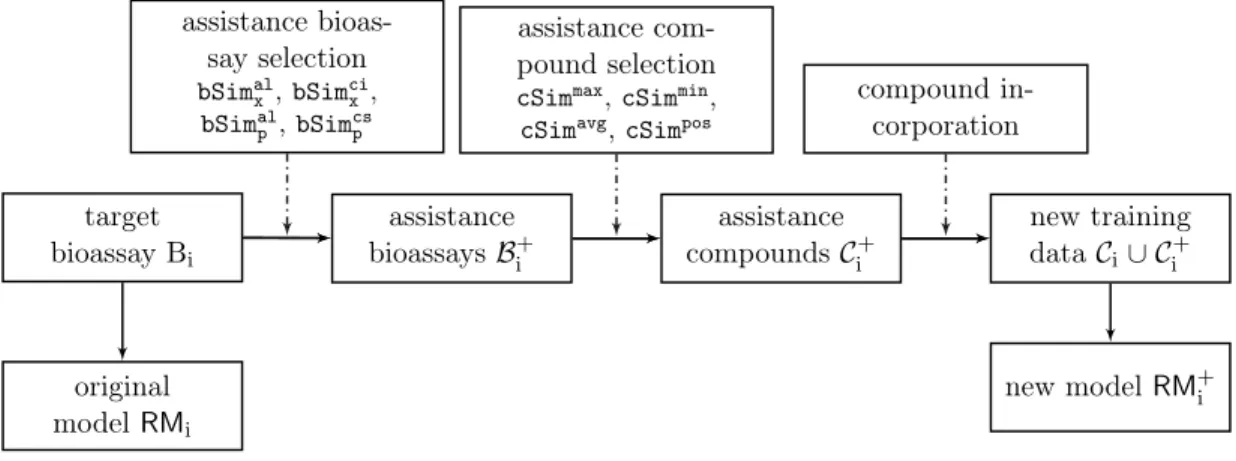
denoted as the assistance compounds. In addition, the improved RMi is denoted as RM+i , Thus, the ranking model improvement procedure is decomposed into three steps in sequence: 1). assistance bioassay selection, 2). assistance compound selection, and 3). assistance compound incorporation. The overview of the framework is presented in Figure 2.1. Such a decomposition is expected to significantly reduce the complexity
target bioassayBi assistance bioassaysB+ i assistance compoundsC+ i new training dataCi∪ Ci+ original modelRMi new modelRM+i assistance bioas-say selection bSimal x ,bSimcix , bSimal p ,bSimcsp assistance com-pound selection
cSimmax,cSimmin, cSimavg,cSimpos
compound in-corporation
Fig. 2.1.: Framework Overview
of the problem, and meanwhile enable necessary interpretability along the course. In the rest of this section, we discuss our approaches for each of the steps. Table 2.1 lists all the notations that are used in this manuscript. In Section 2.4, Section 2.5 and
Section 2.6, we discuss assistance bioassay selection, assistance compound selection and assistance compound incorporation, respectively. In Section 2.7, we discuss the computational tools that are used in the system.
2.4 Assistance Bioassay Selection
The ideal assistance bioassays for the target bioassay Bi are expected to provide
auxiliary information, carried out by consequential assistance compounds, with which Bi’s ranking modelRMican be improved. A key question here is what such auxiliary
information could be in the context of ranking. In active learning for classification, auxiliary information could be additional strong positive/negative signals that help bias the classification boundary toward the right direction. In the context of regres-sion, auxiliary information could be additional data samples that help better reveal the underlying data distribution. Unfortunately, such options from classification and regression do not directly apply for ranking as ranking focuses on the ordinal relations across multiple instances. Thus, we expect that auxiliary information from assistance bioassays could be the information that helps strengthen, remedy or reconstruct the desired reference/ordinal structures among the compounds in the target bioassay. Furthermore, assistance bioassays should be the ones that sufficiently exhibit such information.
In order to identify sensible assistance bioassays, we need quantitative measure-ments to evaluate how much auxiliary information each candidate bioassay carries. However, it is non-trivial to quantify such information content and volume. Instead, we surrogate them by the similarity between the target bioassay and a candidate as-sistance bioassay in terms of their ordinal structures, under the hypothesis that if two bioassays are significantly similar in their ordinal structures, one of them carries aux-iliary information for the other. In specific, we develop the similarities by comparing the ordinal structures from the following two aspects:
• How the target bioassayBi’s modelRMiperforms on the candidate assistance
bioas-say. This method represents an indirect comparison of the ordinal structures; and
• How the target bioassay and the candidate assistance bioassay are similar in their compounds and compound rankings. This is a direct comparison of the ordinal structures.
These two similarities lead to the following two assistance bioassay selection schemes: cross-ranking based assistance bioassay selection, and profiling based assistance bioas-say selection, respectively. From all the candidate bioasbioas-says, we select the assistance bioassays into a set denoted as B+
i , where all the assistance bioassays have the
re-spective bioassay similarities that fall in 98 percentile of all the bioassay similarities.
2.4.1 Cross-Ranking based Bioassay Similarities
The first bioassay similarity measurement is inspired by our previous work that has been applied for target fishing [52]. The idea is, for the target bioassayBi, if its ranking
model RMi performs well on another bioassayBj, thenBiand Bj are similar in terms
of their ranking structures. The underlying assumption is that model RMi captures
and models the signals from Bi’s compound ranking, and the good performance of RMion Bj indicates that such signals align well with those from Bj’s ranking. Under
this assumption, the problem further boils down to measuring the performance of
RMi onBj. Such cross-ranking based assistance bioassay selection scheme is denoted
as bSimx.
To measure the performance of RMi on Bj, we devise the follow two approaches:
1). the first approach, denoted as bSimcix , relies on a standard ranking evaluation metric; and 2). the second approach, denoted as bSimal
x , utilizes sequence-alignment
based ranking comparison. Note that inbSimxwe only useRMionBjin order to select
assistance bioassays to improve RMi. We don’t use RMj onBi for RMi improvement
purposes because in addition to RMi, it requires the availability of Bj’s model RMj,
Concordance Indexing for bSimx (bSimcix )
We first use concordance index (CI; will be discussed later in Section 2.7.2) to evaluate the ranking performance of RMi on Bj. In this case, RMi ranks Bj into a
ranking list r˜i→j, and CI is then calculated on ˜ri→j with respect to Bj’s true ranking
list rj. The higher the CI is, the better the ranking model RMi can predict the
ranking relations in Bj, and thus the more similar Bi and Bj are. Please note that
the similarities calculated from bSimci
x are not necessarily symmetric because the CI
calculated from r˜i→j (i.e., ranking that RMi produces forBj) andri is not necessarily
the same as the CI calculated fromr˜j→i (i.e., ranking that RMj produces for Bi) and
rj.
Ranking Alignment for bSimx (bSimalx )
The concordance index CI measures the entirety of the ranking structures. How-ever, it is possible that only a certain portion of the ranking structures in Bj will
help, while CI cannot indicate such scenarios. Thus, we develop an alignment based ranking performance measurement bSimalx (details on ranking list alignment will be discussed later in Section 2.7.3). The key idea of bSimalx is to identify locally con-served ranking structures among r˜i→j and rj. If the alignment reveals strong block
structures between r˜i→j and rj, it indicates that RMi is able to reproduce a certain
chunk of orderings in rj, which would be considered for auxiliary information.
2.4.2 Profiling based Bioassay Similarity
The second bioassay similarity measurement is based on the comparison of com-pound profiles of two bioassays without modeling any of them. If two bioassays have similar rankings over similar compounds, we consider them as similar and hypothesize that they carry useful information that can be utilized to assist each other. Under this hypothesis, the problem can be casted to that, for bioassay Bi and Bj, we compare
the two ranking lists ri and rj. We develop the following two approaches for ranking
list comparison: 1). the first approach, denoted as bSimalp , compares two ranking lists riand rj using alignment; and 2). the second approach, denoted asbSimcsp ,
com-pares two sets of compoundsCiandCjregardless of ranking structures. The approach bSimcsp is for approach comparison purposes and to make the study complete.
Ranking Alignment for bSimp (bSimalp )
The key idea in profiling-based ranking alignment approach bSimalp is very similar to that of bSimalx , that is, to measure how similar two rankings are. In specific, we look at to what extent similar compounds are ranked in similar orders. However, in bSimalp , instead of aligning r˜i→j and rj as in bSimalx , we align ri and rj and use the
alignment to measure the similarity betweenBi and Bj.
Compound Similarities for bSimp (bSimcsp )
In bSimcsp , we compareBi and Bj by looking at how similar their compounds are,
and thus, the similarity betweenBiandBjis calculated as the average compound
sim-ilarities (Compound similarity will be discussed later in Section 2.7.1). This approach ignores the ranking ordering among the compounds.
2.5 Assistance Compound Selection
From the identified assistance bioassays, we need to select assistance compounds that will best help improve the target bioassayBi’s ranking model. We develop
vari-ous compound similarities to score compounds for selection purposes. We select the assistance compounds into a set denoted as C+
i which have the respective compound
similarities that fall in 90 percentile of all compound similarities. The selected as-sistance compounds will be further incorporated with Bi’s original compounds Ci to
2.5.1 Aggregated Compound Similarities
In order to select assistance compounds from Bi’s assistance bioassays Bi+, we
first union all the compounds from the assistance bioassays into∪jCij. We score each
compound cin∪jCij\ Ci using the maximum/minimum/average of all the similarities
betweencand all the compounds inCi(pairwise compound similarity will be discussed
later in Section 2.7.1). The scoring functions are available in Equation S6, S7 and S8 in the supporting information. These compound scoring functions are denoted as cSimmax,cSimmin and cSimavg, respectively.
2.5.2 Discounted Compound Similarities
The above cSimmax, cSimmin and cSimavg compound scoring measurements do not consider the ranking structures ofBiorB+i . In order to identify assistance compounds
that could be most useful with respect to the ranking structures of Bi, we score
each compound c in ∪jC j
i \ Ci using its weighted sum of compound similarities with
compounds inCi, where the weights are defined as a function of the reciprocal ofCi’s
ranking positions. The scoring function is available in Equation S9 in the supporting information. This compound scoring function is denoted as cSimpos.
2.6 Assistance Compound Incorporation
In order to incorporate the selected assistance compounds in C+
i to improve RMi,
a key question is where to incorporate the new compounds from Ci+ into ri for
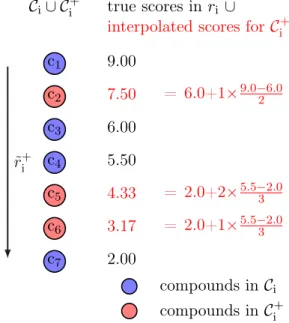
fur-ther training. We develop the following interpolation scheme to do the assistance compound incorporation. We first use RMi (i.e., Bi’s baseline model without new
compounds incorporated) to test Ci∪ Ci+ (i.e., Bi’s own compounds Ci and the new
assistance compounds Ci+). In this way, RMi will generate rankings, denoted as r˜+i ,
for Ci∪ Ci+, and thus distribute C +
i ’s compounds among Ci. For each compound in Ci+, we use its surrounding compounds in r˜i+ that belong to Ci and their true scores
in ri (i.e., not the predicted values in ˜ri+) to interpolate linearly a score for the new
compound. Figure 2.2 demonstrates the linear interpolation.
Ci∪ Ci+ true scores inri ∪
interpolated scores forCi+
c1 9.00 c2 7.50 c3 6.00 c4 5.50 c5 4.33 c6 3.17 c7 2.00 ˜ r+i compounds inCi+ compounds inCi = 6.0+1×9.0−6.0 2 = 2.0+2×5.5−2.0 3 = 2.0+1×5.5−2.0 3
Fig. 2.2.: Linear Interpolation
Note that it is possible that when RMi is not strong enough, a new compound
in Ci+ can be ranked in between a nonconcordant pair of compounds from Ci. Even
though, since the interpolation uses the true scores from ri, not the predicted scores
from r˜i+, the interpolated score will still reflect the most possible ordering among the pair of compounds and the new compound (i.e., the new compound is ranked in between the old compounds).
2.7 Computational Tools
In this section, we discuss the computational building blocks and concepts that will be used in the three sub-problems.
2.7.1 Compound Similarities
In our methods, each compound is represented by their PubChem compound substructure fingerprints‡. The fingerprints are composed of 881 substructure-keys, each corresponding to a predefined substructure. If a substructure is present in a compound, the corresponding dimension in the fingerprint of that compound is set to 1, otherwise 0. The similarity between two compoundsc1 and c2 will be computed as
the Tanimoto coefficient [53] of their fingerprints f1 and f2. The Tanimoto coefficient
is calculated as follows, Tanimoto(c1,c2) = n P k=1 f1kf2k n P k=1 f1kf1k+ n P k=1 f2kf2k− n P k=1 f1kf2k (2.1)
where k goes over all the n (n = 881) dimensions of the fingerprints, and f1k/f2k
is the value at the k-th dimension of f1/f2. Compound similarities calculated as in
Equation 2.1 will be used for compound ranking as in Section 2.8.3, etc.
2.7.2 Concordance Index
Given a true ranking list r and a predicted ranking list r, concordance index˜ (CI) [54] calculates the ratio of correctly ranked pairs (i.e., concordant pairs) in r˜as follows, CI(r,r˜) = 1 |{cp,cq|cp r cq}| X {cp,cq|cprcq} I(cp r˜cq), (2.2)
wherecp r cqrepresents a pair of compoundscp and cq such thatcp is ranked higher
than cq in r, and I is the indicator function,
I(x) = 1, if x is true 0, otherwise (2.3) ‡ftp://ftp.ncbi.nlm.nih.gov/pubchem/specifications/pubchem_fingerprints.pdf