Salvador Climent-Serrano (Spain), Jose M. Pavía (Spain)
An analysis of loan default determinants: the Spanish case
Abstract
The Spanish financial system is experiencing a very turbulent economic period in which loan defaults has lived an unprecedented increasing period, going from being less than 1% in 2004 to levels of above 13% in 2013. The impact of this, along with other circumstances, has led to the greatest financial restructuring ever made to date in Spain, with important macroeconomic and microeconomic consequences. This paper studies the determinants of delinquency (loan default) in Spanish credit institutions for the period of 2004-2011 and introduces new variables that have been dis-closed as relevant in the current financial crisis as well as others non-previously considered internal variables, such as hedging derivatives (which are having an increasingly greater importance in accounts of Spanish credit institutions). Among the most prominent variables that have had a significant impact on the increase of delinquency are, among external variables, house prices, unemployment rates and the number of companies declaring bankruptcy and, among internal variables, property investment, customer credits over active, interest rate, participated companies and solvency rates. The analysis also shows significant differences in delinquency’s behavior between savings banks and banks and between credit institutions that needed recapitalization and those that did not.
Keywords: default, delinquency, risk management, systemic risk, Spanish financial system. JEL Classification:G21, M41.
Introduction¤
The Spanish financial system is facing a very turbu-lent economic period in which delinquency (loan de-faults) in Spanish financial institutions has experi-enced an unprecedented increasing period, going from being less than 1% in 2004 to levels of above 13% in 2013 (Banco de España, 2013). Although Spain fol-lows the pattern demonstrated in other countries (Swedberg, 2013), ensuing the macroeconomic con-sequences of losses in lending banks and reductions in the issuance of new loans, the Spanish financial crisis presents some particular characteristics that make it singular. Among them, the enormous amount of in-vestment made by financial institutions in real estate at the heat of the housing boom, the lag registered in Spain in the bursting of the housing bubble, the high leverage of Spanish institutions with foreign investors and the deep recession in which Spain seems to have fallen, which has considerably damaged its businesses and employment.
The impact of this unprecedented increase of delin-quency in the Spanish financial institutions, along with other circumstances, has led to the greatest financial restructuring ever made to date in Spain. Through an intense process of fusions and absorptions, the sector has experienced a really significant reduction in the number of its institutions, mainly focused on savings banks (Climent, 2012) which have passed from 45 to 10 changing as well their corporate structure to become commercial banks. This process has practi-cally resulted in the disappearance of traditional sav-ings banks, which had previously formed part of the Spanish financial system for almost 200 years and represented a 45% share of the financial market. Fur-ther, in line with other developed countries (Weber and Schmitz, 2011; Rose and Wieladek, 2012), the
¤Salvador Climent-Serrano, Jose M. Pavía, 2014.
Spanish credit institutions have received direct public funding to guarantee their sustainability. Funds that in the case of Spain have exceeded 6% of the Spanish GDP (FROB, 2013).
In light of the events to which have contributed in part delinquency, it is paramount that further analyses of the impact of default on Spanish credit institutions is carried out and also to further study its determinants in order to construct an econometric model from which explain aggregate default levels in the Spanish finan-cial companies. From the perspective of banks, a proper management of risks requires the ability to monitor these numbers and, from a policy perspective, it is an important to quantify these risks in order to know the likelihood of new additional recapitaliza-tions and when the issuance of new loans is going to recover. Indeed, one area that has received relatively little attention is the interrelation between risk, risk management and management accounting and control practices, some issues that likely should be reformu-lated (reconstructed) after the financial crisis (Huber and Scheytt, 2013) and will lead to more risk-related disclosures (Oliveira et al., 2013).
The rest of the document is structured as follows. Sec-tion 1 offers a background of the issue. SecSec-tion 2 pre-sents methodology and details objectives. Section 3 shows results. And, final section states the main con-clusions.
1. Background
The analysis of the impact of loan default on the Span-ish financial system and the study of its determinants is not new and has already been the object of interest in other periods. Fernandez de Lis et al. (2000) ana-lyzed the determinants of delinquency in the period of 1963-1999 and pointed to economic cycle and compe-tency increase as the most significant determinants. Freixas et al. (1994) focused on the period of 1973-1992 using variables such as economic growth,
infla-tion, expectations of economic activity and interest rate. Delgado and Saurina (2004) examined during the period 1982-2001 the relationship between the most relevant macroeconomic variables (such as GDP variation, interest rates, level of debt, financial burden and asset prices) and the risk of credit in banks and savings banks. Furthermore, Saurina (1998) tries to explain delinquency from 1985 to 1995 using both internal and external variables. Salas and Saurina (2002) use a wide range of internal and external vari-ables to obtain the determinants of risky loans between 1985 and 1997, distinguishing between savings banks and banks. And, more recently, Gonzalez and Diez (2010) relate credit growth, delinquency and eco-nomic cycle to deduce that credit grows and delin-quency decreases in expansive cycles whilst the oppo-site occurs during recessions. Foos et al. (2010), in a study involving 16 European countries including Spain, note that credit growth entails an increase in loss provisions during the three years following. De los Rios et al. (2012) study the difference between savings banks and banks with respect to risk manage-ment and social responsibility. And, Jiménez et al. (2013) find a negative relationship between loan market power and bank risk during the period of 1988-2003.
Regarding studies on other countries different from other than Spain, one can cite the papers published by Crook and Banasik (2012), Magri and Pico (2012), Esteban and Estrada (2013), and Ramcharan and Crowe (2013), among the latest researches. Crook and Banasik (2012) relate delinquency rate to debt levels, interest rates and house prices in the USA during the period between 1987 and 2009. Magri and Pico (2012) relate interest and delinquency rates in the Italian fi-nancial institutions in the period of 2000-2007. Esteban and Estrada (2013) found house prices, out-standing mortgage debts and, to a lesser extent, in-come levels to be the principal determinants of delin-quency in the Columbian financial institutions from 1997 to 2004; while Ramcharan and Crowe (2013) show that house price fluctuations have a significant impact on credit markets well beyond the mortgage
segment, being thus a potentially catalyst for macroe-conomic shocks. In this line, Vallascas and Keasey (2012) identify which bank characteristics offer a shelter from systemic shocks and demonstrate some key determinants of a bank’s risk exposure.
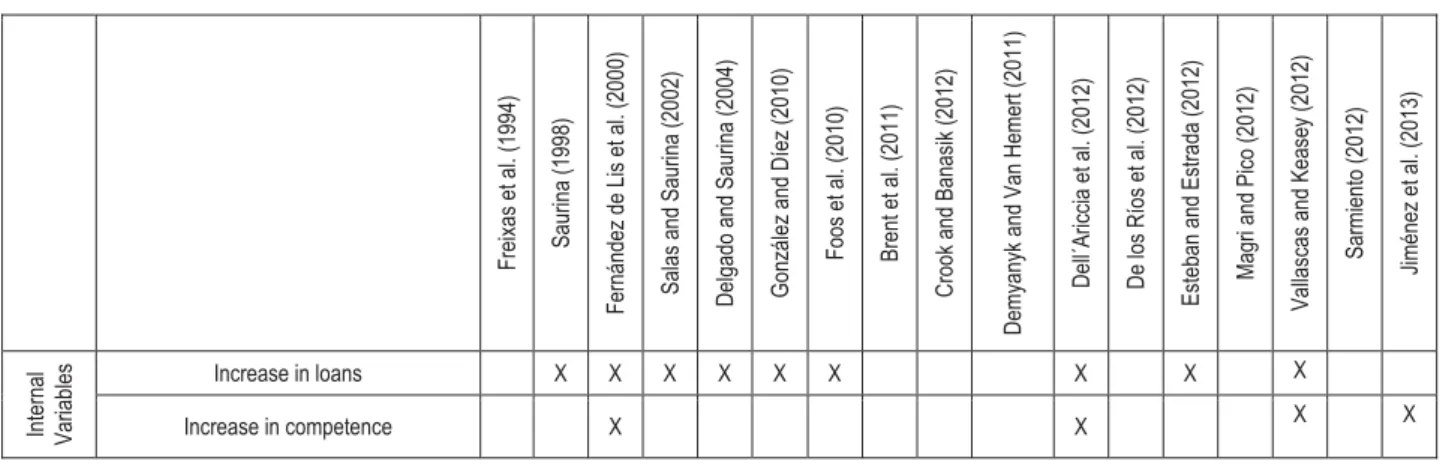
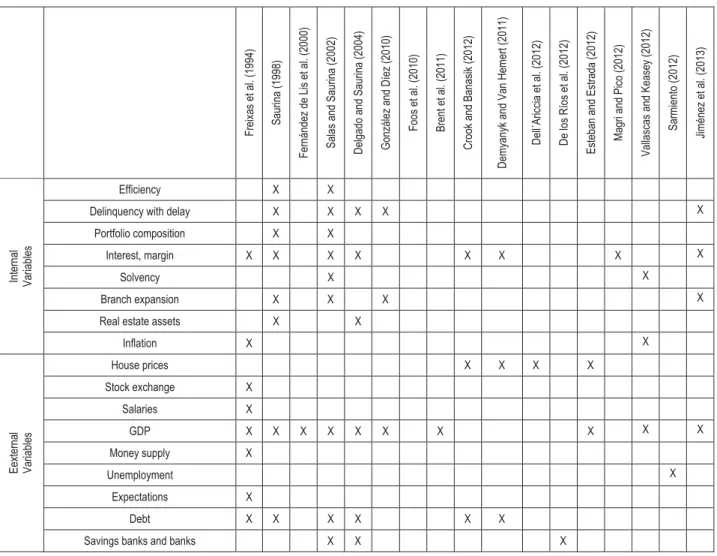
There also exists a literature on the subprime mort-gages in the USA, among which Demyanyk and Van Hemert (2011), Brent et al. (2011), Roll (2001), Sar-miento (2012) and Dell’Ariccia et al. (2012) can be cited. Demyanyk and Van Hemert (2011) maintain that the high rate of growth in house prices masked the delinquency of subprime mortgages between 2003 and 2005. Brent et al. (2011) find that the mortgagee’s income and the economic cycle were determinants of delinquency in the period from 2004 to 2009. Sar-miento (2012) shows unemployment increases playing a very significant role in mortgage defaults rise during the Great Recession. Roll (2011) proposes a com-pletely alternative tale and disagrees about the most popular explanations of the financial crisis, advocating for a different US macroeconomic policy. And Dell’Ariccia et al. (2012) conclude that during the periods of rapid credit growth lending conditions were relaxed, with the relaxation increasing when competi-tion and also house prices rise. A summary of the variables used as determinant of delinquency in all the above mentioned papers is shown in Table 1.
This paper adds to the delinquency literature a couple of new features that we think could be of interest. Firstly, it is centred on a long and homogenous period in Spain that up until now had not been studied; a period in which the delinquency in Spain went from historic minimums to historic maximums with a trend of continuous growth. Secondly, regarding the vari-ables used, the study includes both new internal and external variables. In particular, in addition to the de-terminants highlighted in the overview of the delin-quency literature, this study incorporates new account variables, such as hedging derivatives, the portfolio of participated companies and property investments (within the internal variables) and the increase in the number of companies in bankruptcy (within the exter-nal variables), that apparently have not been consid-ered until now.
Table 1. Variables used as determinants of delinquency in previous researches
Freixas et al.
(1994)
Saurina (1998)
Fernández de Lis et al. (2000) Salas and Saurina (2002) Delgado and Saurin
a (2004)
González and Díez (2010)
Foos et al. (2010) Brent et al.
(2011)
Crook and Banasik (2012)
Demyany
k and Van Hemert (2011)
Dell´Ariccia et al. (20
12)
De los Ríos et al. (20
12)
Esteban and Estrada
(2012)
Magri and Pico (2012)
Vallascas and Kea
se y (2012) Sarmiento (2012) Jiménez et al. (2013) In te rn al Variables Increase in loans X X X X X X X X X Increase in competence X X X X
Table 1. Variables used as determinants of delinquency in previous researches
Freixas et al.
(1994)
Saurina (1998)
Fernández de Lis et al. (2000) Salas and Saurina (2002) Delgado and Saurin
a (2004)
González and Díez (2010)
Foos et al. (2010) Brent et al.
(2011)
Crook and Banasik (2012)
Demyany
k and Van Hemert (2011)
Dell´Ariccia et al. (20
12)
De los Ríos et al. (20
12)
Esteban and Estrada
(2012)
Magri and Pico (2012)
Vallascas and Kea
se y (2012) Sarmiento (2012) Jiménez et al. (2013) In te rn al Variables Efficiency X X
Delinquency with delay X X X X X Portfolio composition X X
Interest, margin X X X X X X X X
Solvency X X
Branch expansion X X X X Real estate assets X X
Inflation X X Eexternal Variables House prices X X X X Stock exchange X Salaries X GDP X X X X X X X X X X Money supply X Unemployment X Expectations X Debt X X X X X X Savings banks and banks X X X Source: own elaboration.
2. Objectives and methodology
2.1. Objectives. The objective of this research is to construct an econometric model from which to explain the level of delinquency, using as indicators all the relevant variables that may have an impact on delin-quency and on its effects. These determinants will include both microeconomic (e.g., house prices) and macroeconomic external factors (e.g., unemployment rates) as well as internal factors of the credit tions (e.g., property assets or leverage of the institu-tion). As such, this will create a tool that can help to manage the effect of certain decisions with respect to the control of delinquency. Likewise, the model will permit the projection of the impact on delinquency of some of the external variables for example, two of them, house prices and the unemployment level, are included in the model with lags of order one and two, respectively.
In addition, and given the different impact the eco-nomic and financial events have had on banks and saving banks (see, Climent-Serrano and Pavía, 2014) a separate analysis has been carried out on each of the groups in order to analyze the possible differences. In this way, we can study whether the type of corporate
governance has a differential impact on the develop-ment of delinquency, since as Park (2012, p. 907) points out “corruption significantly aggravates the problems with bad loans in the banking sector”. The analysis will also be extended to study (through two new regressions) the differences between institutions that have received aid and those that have not. The constructed models therefore could be used to im-prove our information levels and our knowledge about the mechanism that operate in this issue, making it easier to predict future trends in delinquency and con-sequently enabling the necessary preventative meas-ures to be taken for banks, their shareholders, the su-pervisor and stakeholders in general.
2.2. Methodology. To perform the analysis, unbal-anced panel data regression techniques are used com-bining macroeconomic variables with information from the latest financial annual accounts reports of the period of 2004-2011 of all the Spanish savings banks and the 13 largest commercial banks, which together make up 99% of the assets of Spanish banks and sav-ings banks. The total number of institutions in 2004 was 58, while there were 20 in 2011. This difference is the result of the restructuring process (which is still ongoing) of the mergers and absorptions that occurred
in the course of 8 years and especially in 2010 (Cli-ment Serrano, 2013).
Financial institutions annual accounts reports are drawn up and approved by the board of directors of each entity and by their general meetings or share-holders’ meetings, undergo internal audit controls and are audited by independent companies overseen by the Bank of Spain. However, despite all these controls, these measures are not always sufficient to ensure that the accounts reflect fairly the assets of the institutions, as has occurred in those credit institutions that had to be intervened, characterized by pre-crisis weaker cor-porative governances, where the new administrators have reformulated the accounts having come to light significant losses in all cases (see, e.g., Climent-Serrano and Pavía, 2015a). Therefore, the accounts used have been the new reformulated accounts, which show a high level of losses.
Using this information, an econometric model is con-structed based on an unbalanced panel data with 400 observations in which dependent variable is loan de-fault, measured as a ratio between non-performing loans and the total amount of loans. As explicative variables, in addition to the ones already studied in the previous literature, four new features have been also considered: property investments, participated compa-nies, hedging derivatives and, number of companies in (bankruptcy or) administration. Below (in subsection 2.3) the independent variables of the model are listed. The availability of information for a sample of be-tween 58 and 20 institutions (depending on the year) and 8 time periods, allows the use of a double tempor-al and cross-section dimension of the sample through an econometric model of non-balanced panel data. This provides us, compared to just cross-sectional databases, with a more informative database (with more variability, less collinearity and more degrees of freedom) that will permit us to attain more efficient estimates in an econometric linear regression model and mainly to control for endogeneity and/or individ-ual unobserved heterogeneity (Arellano and Bon-home, 2012). Therefore, along with the components that could determine delinquency, it is acknowledged that each institution may have specific characteristics,
Dj = D + vj, albeit measurable and
non-observable, which can affect the relationship. Hence the model ultimately specified has been:
1 1
.
¦
I¦
Eji j i jt i t jt
i= i=
Delinquency =Į + ȕint.var + ȕext.var +Ȧ
Ei being the coefficient of ith the internal variable in the
regression model, Je the coefficient of the eth external
variable, subindex j denotes entity, t represents time, I
is the number of internal variables, E is the number of external variables and Zjt is a disturbance error term.
According to the goals stated in subsection 2.1, five different variants of this model have been considered. The first model, the baseline model, is made up of all the institutions and all the time periods available, in total, 71 entities and 400 observations. The second and third models are made by dividing the complete sam-ple into two sub-samsam-ples, savings banks and banks, with the objective of studying the possible differences between them. In models four and five, the sample is sub-divided into those entities that received help and those that did not.
2.3. Variables. The list of account features handled has been, as internal variables, investment properties
(ratio of investment in properties and assets), leverage
(ratio of customer deposits on loans) increased appro-priations set (loan increasing less nominal GDP in-creasing),hedging derivatives (ratio of hedging deriv-atives over assets), real estate assets (ratio of secured loans to total loans), ratio client credit-active (ratio of customer loans over assets), interest rate (interest rate of the asset), participated companies (ratio of inves-tees on participated companies over assets), solvency
(equity ratio of the group over assets) and, as external variables, bankruptcy (annual variation in the number of companies in bankruptcy), unemployment rate (-2) (unemployment rate of the Spanish economy with a delay of two years) and house prices (-1) (annual change in the average price of housing in Spain, ac-cording to the Ministry of Industry, with a lag of a year). House price lag has been set in one to include information delays and owners’ psychological elastic-ity and unemployment rates are included with a lag of order two to account for the unemployment regulation benefits prevailing in Spain during the study period. 3. Results
The econometric software Eviews in its version 7 has been used to estimate with pooled data, fixed effects and random effects the models specified in the pre-vious section. Homogeneity tests indicate that fixed effects models are preferable to pooled data models while Hausman tests point to the fixed effects specifi-cation as preferable to the random effects one. Hence, the fixed effects model will be the one presented in this research.
Table 2 shows the results obtained in the regressions. There are no problems with co-linearity or correlation problems among the predictors employed and as the Durbin-Watson test shows (see the bottom of Table 2) there are no remarkable concerns of residual autocor-relation. Likewise, the R2 results obtained indicate that the regressions explain a large percentage of delin-quencies in all models used. This latter result may lead to the idea that there is a problem of over-parameterization affecting the model specifications. In order to dispel this doubt and following the philosophy of machine learning (Bishop, 2006), the sample was
randomly divided into two groups, one of modeliza-tion (learning group) with 80% of the observamodeliza-tions and the other of evaluation (test group) with the re-maining 20%. The test results showed an excellent predictive capability of the model, consistent with the observed R2.
Although as a rule a similar core group of variables are identified as significant in the plurality of the modls, with the one with the greatest difference being the unaided entities’ model, large differences between groups could be observed with respect to the impact of
the determinants. Focusing first on the baseline model, we find that the variables that have been revealed as significant with a positive sign, and therefore contrib-uting to the increase in delinquency, are property in-vestment and interest rate, among the internal vari-ables, and unemployment rates and number of compa-nies declaring bankruptcy, among the external vari-ables. On the other hand, with a negative impact, meaning their increase leads to a reduction in delin-quency, we can find participated companies, solvency and the ratio of customer credit over active, as internal variables, and house prices, as external variable. Table 2. Coefficients estimates of delinquency determinants
Variables Baseline
model Savings banks Banks Differences
Aided entities Unaided entities Differences Constant 0.078*** 0.085*** 0.043* 0.041* 0.045*** 0.008 0.037 (0.013) (0.016) (0.024) (0.016) (0.024) Property investment 0.434*** 0.419*** 0.427** -0.008* 0.544*** 0.148 0.396** (0.084) (0.099) (0.197) (0.099) (0.139) Leverage -0.007 -0.008 -0.011 0.003 0.003 -0.017 0.019** (0.007) (0.010) (0.009) (0.008) (0.011) Credit increase 0.001 -0.033** 0.001 -0.034** 0.018 -0.002 0.020* (0.006) (0.015) (0.005) (0.012) (0.005) Hedging derivatives -0.115 -0.230 0.160 -0.390 0.251 -0.072 0.324 (0.186) (0.0227) (0.331) (0.224) (0.261) Real estate assets 0.008 0.007 0.021** -0.014* -0.002 0.012* -0.015* (0.005) (0.006) (0.008) (0.006) (0.006) Customer credit over active -0.054*** -0.075*** -0.011 -0.063** -0.044** 0.044 -0.087** (0.018) (0.024) (0.027) (0.020) (0.037) Interest rates 0.373*** 0.492*** -0.117 0.608*** 0.548*** -0.168 0.716*** (0.10) (0.0147) (0.199) (0.140) (0.198) Participated companies -0.204*** -0.198 -0.072 -0.126 -0.335** 0.041 -0.376** (0.067) (0.142) (0.117) (0.139) (0.104) Solvency -0.603*** -0.658*** -0.128 -0.530*** -0.737*** -0.172 -0.565*** (0.011) (0.078) (0.149) (0.083) (0.106) House prices (-1) -0.204*** -0.172*** -0.195*** 0.023 -0.255*** -0.162*** -0.093*** (0.011) (0.020) (0.016) (0.021) (0.014) Unemployment rate (-2) 0.235*** 0.339*** 0.079* 0.259*** 0.441*** 0.153*** 0.288*** (0.033) (0.044) (0.045) (0.017) (0.040) Bankruptcy 0.017*** 0.015*** 0.012** 0.003 0.018*** 0.018*** 0.000 (0.002) (0.003) (0.005) (0.003) (0.004) R2= 0.936 D-W = 1.74 n = 400 R2= 0.945 D-W = 1.73 n = 313 R2= 0.839 D-W = 1.77 n = 87 R2= 0.957 D-W = 1.81 n = 280 R2 = 0.770 D-W = 2.30 n = 120
Source: Own elaboration. Calculations made using EViews, Release 7. Dependent variable: delinquency, Standard deviations in brackets. *, **, and *** denote significance at level 10%, 5% and 1%, respectively. D-W: Durbin-Watson statistics.
The rest of the variables did not prove to be signifi-cant. Leverage, which had a negative coefficient, and credit increase, with a coefficient practically zero, cannot be considered as important determinants in delinquency. It also highlights that the hedging deriva-tives variable, which aims to reduce the risk, does not appear to be significant, in this case nevertheless the-coefficient is negative, so keeping this sign would reduce delinquency. This meaningfulness of hedging could occur, according to Engel (2013), for the use of
derivatives not only to hedge but also for speculative purposes.
Analyzing the two models that serve to distinguish between savings banks and banks, we see that the variable participated companies lost its significance in savings banks while the variable credit increase be-comes significant with a negative coefficient. This last result tells us that the increase in credit, more so than nominal GDP increase, contributed to the moderation of the increase of delinquency in the savings banks.
Comparing the model of the banks to the baseline model we observe that a large number of internal variables become not significant, in particular the four variables: ratio of credit over active, participated com-panies, solvency and interest rate. The result for this last variable is really interesting given that it is no longer significant and its coefficient changes from positive to negative, telling us that the impact of an increase in the interest rate did not contribute to delin-quency in banks, when in the case of savings banks, this variable is not only significant but it shows a coef-ficient greater than in the baseline model. Also re-markable is the behavior of the variable real estate assets, which after being not significant in the baseline model, becomes significant in the case of banks’ model.
Comparing the estimated coefficients between both models, significant differences could be observed between savings banks’ and banks’ models. In particu-lar, and in addition to the differences in the impact of interest rate already pointed out, it highlights the dif-ference between the coefficients of the unemployment level, 0.339 for savings banks and 0.079 for banks. that in a situation as the one in the current labor mar-ket, with levels of unemployment above 20%, sug-gests that the impact on savings banks is greater than on banks, without doubt a consequence of their differ-ent loan portfolio composition, which indeed is a re-flection of the different risk credit policies they fol-lowed during the housing boom and their different target populations. In general, these differences in the regression coefficients, both internal and external, along with the different structure of the distributions in internal determinants between banks and savings banks explains why the average level of delinquency during the whole period in the banks is 0.66% less than in the savings banks.
Analyzing the model of the institutions that have re-ceived aid, we observe the same significant variables as in the baseline model, whilst the model for non-aided institutions shows hardly any significant internal variables, with only real estate assets being significant. The significance of all the external variables, however, is maintained in both models.
Comparing the coefficients for these two models, one can see that among the internal variables there are significant differences in interest rates, participated companies and solvency and, to a lesser extent, in leverage, credit increase, real estate assets and client credit over active. Indeed, almost all the coefficients of the interval variables are significantly different in the two models. Furthermore, among the external vari-ables, it highlights the significant differences in house prices and unemployment rates that in addition are significant in both models, something that hardly hap-pens with internal variables. The impact of the reduc-tion in house prices and the increase in unemployment
rates is greater in those institutions that received help than in those that did not need help.
As in the models of banks and savings banks, these differences in the regression coefficients, both internal and external, along with the different structure of the distributions of the variables studied, explain why the average rate of delinquency has been 1.17% higher during the whole period in the institutions receiving help than in the unaided institutions.
Conclusions
The current socio-economic environment has contrib-uted significantly to increase delinquency in Spanish credit institutions. In fact, according to the results of the regressions, the evolution of external variables in recent years has significantly impacted on the levels of delinquency. Both decrease in house prices and in-crease in unemployment jointly with the number of companies undergoing bankruptcy have contributed to rising loan defaults. This impact was also seen to be higher in savings banks than in banks and in those institutions that received aid rather than those that did not, without doubt as a consequence of their different target populations and risky policies, more soft-information based (Parnes, 2012), which are reflected in the composition of their loan portfolios.
As far as internal variables concerns, an increase in property investment and an increase in interest rate have been seen to contribute to an increase in delin-quency whilst increases in the ratio of customer loans to assets, participated companies and solvency help to reduce delinquency.
The variables leverage, credit increase, real estate assets and hedging derivatives have proved to be in-significant. It is noticeable that variables such as lev-erage or credit increase have hardly had any repercus-sion on delinquency, being unimportant and with very small coefficients. Equally, it was initially surprising that expected results were not achieved for the hedg-ing derivatives, as its impact is not significant, al-though its coefficient does appear with an expected negative sign. The impact of some of the variables has been very different between savings banks and banks, especially in relation to interest rate and unemploy-ment level which helps to explain the difference of 0.66% on average in delinquency rates throughout the period.
In this sense, the results of this study add to those of other studies that also found differences between banks and savings banks in different periods and in different ways, such as Coello (1994), Pastor (1994), Azofra and Santamaria (2004), Fonseca et al. (2011), Climent (2012) and Climent and Pavía (2015b). Finally, significant differences are also found between institutions that received aid and those that did not, the main differences being in the variables property
in-vestment, interest rate, participated companies, sol-vency, house prices and unemployment rates. This situation has resulted in the average delinquency
level being 1.17% higher in aided institutions, which eventually led them being faced with massive recapi-talization that accounted for 6% of the Spanish GDP. References
1. Arellano, M. and Bonhome, S. (2012). Identifying Distributional Characteristics in Random Coefficients Panel
Data Models, Review of Economic Studies, 79 (3), pp. 987-1020.
2. Azofra Palenzuela, V. and Santamaría Mariscal, M. (2004). El gobierno de las cajas de ahorro españolas,
Universia Business Review, 2, pp. 48-59.
3. Banco de España (2013). Boletín Estadístico. Datos de Créditos Dudosos, accessed at:
http://www.bde.es/webbde/es/estadis/infoest/a0403.pdf on October 18, 2013.
4. Bishop, C.M. (2006). Pattern Recognition and Machine Learning, Springer.
5. Brent, W. Kelly, L. Lindsey-Taliefero D. and Price, R. (2011) ‘Determinants of Mortgage Delinquency’, Journal
of Business and Economics Research, 9 (2), pp. 27-47.
6. Climent Serrano, S. (2013). La reestructuración del sistema bancario español tras la crisis y la solvencia de las
entidades financieras. Consecuencias para las cajas de ahorros, Revista de Contabilidad – Spanish Accounting
Review, 16 (2), pp. 136-146.
7. Climent Serrano, S. and Pavía, J.M. (2014). Determinantes y diferencias en la rentabilidad de cajas y bancos,
Revista de Economía Aplicada, 65 (22), pp. 117-154.
8. Climent Serrano, S. (2012). La caída de las cajas de ahorros españolas. Cuestión de rentabilidad, tamaño y
estructura de propiedad, Estudios de Economía Aplicada, 30 (2), pp. 1-26.
9. Climent-Serrano, S. and Pavía, J.M. (2015a). BANKIA: ¿Para qué sirven los estados contables y los órganos de
control? Estudios de Economía Aplicada, 33 (1), forthcoming.
10. Climent-Serrano, S. and Pavía, J.M. (2015b). Determinants of profitability in Spanish financial institutions. A
comparative study of the entities that needed public funds and those that did not, Journal of Business Economics
and Management, forthcoming.
11. Coello Aranda, J. (1994). Son las cajas y los bancos estratégicamente equivalentes? Investigaciones Económicas, XVIII,
pp. 313-332.
12. Crook, J. and Banasik, J. (2012). Forecasting and explaining aggregate consumer credit delinquency behavior,
International Journal of Forecasting, 28, pp. 145-160.
13. Delgado, J. and Saurina, J. (2004). Riesgo de crédito y dotaciones a insolvencias. Un análisis con variables
ma-croeconómicas, Moneda y Crédito, 219, pp. 11-42.
14. Dell’Ariccia, G., Igan, D. and Leaven, L. (2012). Credit booms and lending standards: evidence from the subprime
mortgage market, Journal of Money, Credit and Banking, 44 (2-3), pp. 367-384.
15. De los Ríos Berjillos, A., Ruiz Lozano, M., Tirado Valencia, P. and Carbonero Ruiz, M. (2012). Una aproximación a la relación entre información sobre la responsabilidad social orientada al cliente y la reputación
corporativa de las entidades financieras españolas, Cuadernos de Economía y Dirección de la Empresa, 15,
pp. 130-130.
16. Demyanyk, Y. and Van Hemert, O. (2011). Understanding the Subprime Mortgage Crisis, The Review of
Finan-cial Studies, 24 (6), pp. 1847-1880.
17. Engel, A. (2013). Futures and risk: The rise and demise of the hedger-speculator dichotomy, Socio-Economic
Review, 11 (3), pp. 553-576.
18. Esteban Carranza, J. and Estrada, D. (2013). Identifying the determinants of mortgage default in Colombia
be-tween 1997 and 2004, Annals of Finance, 9, pp. 501-518.
19. Fernández de Lis, S. Martínez, J. and Saurina, J. (2000). Crédito bancario, morosidad y dotación de provisiones
para insolvencias en España, Boletín Económico Banco de España, Noviembre, pp. 1-10.
20. Fonseca Díaz, A.R., Fernández Rodríguez, E. and Martínez Arias, A. (2011). Factores condicionantes de la presión
fiscal de las entidades de crédito españolas. Existen diferencias entre bancos y cajas de ahorros? Revista Española
de Financiación y Contabilidad, XXXIX, 152, pp. 491-516.
21. Foos, D. Norden, L. and Weber, M. (2010). Loan growth and riskiness of Banks, Journal of Banking & Finance,
34, pp. 2929-2940.
22. Freixas Dargallo, X., De Hevia Payá, J. and Inurrieta Beruete, A. (1994). Determinantes macroeconómicos de la
morosidad bancaria: un modelo empírico para el caso español’, Moneda y Crédito, 199, pp. 125-156.
23. FROB (2013). Notas informativas, last accessed at: http://www.frob.es/notas/notas.html on 12 April, 2013.
24. González Pascual, J. and Díez Cebamanos, N. (2010). El crédito y la morosidad en el sistema financiero español,
Boletín Económico de ICE, 2997, pp. 51-65.
25. Huber, C. and Scheytt, T. (2013). The dispositif of risk management: Reconstructing risk management after the
financial crisis, Management Accounting Research, 24, pp. 88-99.
26. Jimenez, G. Lopez, J.A. and Saurina, J. (2013). How does competition affect bank risk-taking? Journal of
Finan-cial Stability, 9, pp. 185-195.
27. Magri, S. and Pico, R. (2011). The rise of risk-based pricing of mortgage interest rates in Italy, Journal of Banking
28. Oliveira, J., Rodrigues, L.L. and Craig, R. (2013). Public visibility and risk-related disclosures in Portuguese credit
institutions, The Journal of Risk, 15 (4), pp. 57-90.
29. Park, J. (2012). Corruption, soundness of the banking sector, and economic growth: A cross-country study, Journal of
International Money and Finance, 31 (5), pp. 907-929.
30. Parnes, D. (2012). Approximating default probabilities with soft information, The Journal of Credit Risk, 8 (1), pp. 3-28.
31. Pastor, J.M. (1995). Eficiencia, cambio productivo y cambio técnico en los bancos y cajas de ahorros españolas: un
análisis de la frontera no paramétrico, Revista Española de Economía, 12 (1), pp. 35-73.
32. Ramcharan, R. and Crowe, C. (2013). The impact of house prices on consumer credit: evidence from an internet bank,
Journal of Money, Credit and Banking, 45 (6), pp. 1085-1115.
33. Roll, R. (2011). The Possible Misdiagnosis of a Crisis, Financial Analysts Journal, 67 (2), pp. 12-17.
34. Rose, A.K. and Wieladek, T. (2012). Too big to fail: Some empirical evidence on the causes and consequences of public
banking interventions in the UK, Journal of International Money and Finance, 31 (8), pp. 2038-2051.
35. Salas, V. and Saurina, J. (2002). Credit Risk in Two Institutional Regimes: Spanish Commercial and Savings Banks,
Journal of Financial Services Research, 22 (3), pp. 203-224.
36. Sarmiento, C. (2012). The role of the economic environment on mortgage defaults during the Great Recession, Applied
Financial Economics, 22 (3), pp. 243-250.
37. Saurina Salas, J. (1998). Determinantes de la morosidad de las cajas de ahorros españolas, Investigaciones Económicas,
XXII (3), pp. 393-426.
38. Swedberg, R. (2013). The financial crisis in the US 2008-2009: losing and restoring confidence, Socio-Economic
Re-view, 11 (3), pp. 501-523.
39. Vallascas, F. and Keasey, K. (2012). Bank resilience to systemic shocks and the stability of banking systems: Small is
beautiful, Journal of International Money and Finance, 31 (6), pp. 1745-1776.
40. Weber, B. and Schmitz, S.W. (2011). Varieties of helping capitalism: politico-economic determinants of bank rescue