AND ITS APPLICATIONS IN FINANCE AND ENGINEERING
by
Bingduo Yang
A dissertation submitted to the faculty of
The University of North Carolina at Charlotte
in partial fulfillment of the requirements
for the degree of Doctor of Philosophy in
Applied Mathematics
Charlotte
2012
Approved by:
Dr. Zongwu Cai
Dr. Jiancheng Jiang
Dr. Weihua Zhou
Dr. Sheng-Guo Wang
c
⃝
2012
Bingduo Yang
ABSTRACT
BINGDUO YANG. Variable selection for functional index coefficient models and its
applications in finance and engineering. (Under the direction of DR. ZONGWU CAI)
Variable selection with a non-concave penalty function has become popular in
recent years, since it has ability to select significant variables and to estimate unknown
regression coefficients simultaneously. In this dissertation, firstly, I consider variable
selection in a functional index coefficient model under strong mixing context. Due to the
fact that the model is in a semiparametric form so that the convergence rate of parametric
estimator is faster than nonparametric estimator, my selection procedures with smoothly
clipped absolute deviation penalty function consist of two steps. The first is to select
significant covariates with functional coefficients and it is then to do variable selection
for local significant variables with parametric coefficients. The asymptotic properties
such as consistency, sparsity and the oracle property of these two step estimators are
established, whereas easy computational algorithms are suggested to highlight the
implementation of the proposed procedures. Finally, Monte Carlo simulation studies are
conducted to examine the finite sample performance of the proposed estimators and
selection procedures. Two financial examples including functional index coefficient
autoregressive models and functional index coefficient models for the stock return
predictability are extensively studied.
In the second part of this dissertation, I consider the estimation and variable
selection for the local annual average daily traffic (AADT) using different groups of
variables. It is well documented that in transportation networks, AADT estimation is very
important to decision making, planning, air quality analysis, etc and a regression method
may be one of the most popular methods for estimating AADT on non-counters roads.
The existing literatures focus on how to collect different groups of predicting variables,
and to select significant variables by t-test and F-test. However, there is no theory on the
validity of these multiple selecting steps. Furthermore, variables collected for high
functional class roads maybe not suitable for the estimation of local AADT because of
lacking counters. The variable selection by smoothly clipped absolute deviation penalty
(SCAD) procedure is proposed and it can select significant variables and estimate
unknown regression coefficients simultaneously at one step. The estimation algorithm
and the tuning parameters selection are also presented. To demonstrate the usefulness of
the proposed procedure, I use the real data observed from Mecklenburg County of North
Carolina in 2007 for illustration. The analysis result shows that the selection procedure is
indeed valid and it further improves the local AADT estimation by incorporating satellite
information. The proposed method outperforms some other regression methods when it is
applied to local AADT estimation.
The third part of this dissertation is to consider how to calculate seasonal factors
in annual average daily traffic (AADT) and vehicle miles traveled (VMT). It is well
known that seasonal factors are very important to the estimation of AADT and VMT and
they are used to transfer one or two days measured traffic data at portable traffic
monitoring sites to the AADT. Most literatures focus on taking the average of seasonal
factors within groups of roads. Factor grouping including three techniques to calculate
seasonal factors has been recommended by the Federal Highway Administration
(FHWA). However, as recognized, it is difficult to select a representative group sample
of roads. In this part, to calculate seasonal factors, I propose a new nonparametric
approach by introducing the distance kernel and by using the local weights. The
nonparametric seasonal factors estimation and test procedure are presented. Moreover,
the proposed approach can be extended to grouping cases if prior information of grouping
is available. Finally, the real example demonstrates the new approach by using the data
observed in the North Carolina.
ACKNOWLEDGMENTS
I would like to gratefully and sincerely thank my supervisor Dr. Zongwu Cai for
his guidance, understanding, patience, and most importantly, his friendship during my
graduate studies at UNC Charlotte. It is because of him that I came to the USA and
pursued my Ph.D. degree. He encouraged me to not only grow as a statistician and an
econometrician, but also as an instructor and an independent thinker. He asked me to
explore different new topics and let me do what I am interested in. He gave me the
opportunity to develop my own individuality and self-sufficiency with independent
thinking. His wisdom, knowledge and commitment to the highest standards inspired and
motivated me. He always made himself available to clarify my doubts despite his busy
schedules. Meanwhile, he revised the draft of my dissertation so carefully and made it the
way as it is now. Furthermore, he often treated us for lunch or dinner. His wife and he
hosted our Ph.D. students including myself many times throughout years. Many thanks to
Dr. Zongwu Cai for everything he has done for me.
I would like to thank Dr. Jiancheng Jiang for his guidance of study in my graduate
life, suggestions in the dissertation and useful discussions in the seminars. I usually ask
Dr. Jiang for help if I have any questions in the research. He is really sweet and patient to
give me academic and professional commitments. In particular, I should thank him for
being a member of my oral exam and doctoral dissertation defense committee. My
special thanks also go to Dr. Weihua Zhou for being a member of my oral exam and
doctoral defense committee.
I also want to convey my appreciation to Dr. Sheng-Guo Wang for his unending
encouragement and support. I did projects under his supervision and he taught me how to
write and revise our papers more than ten times face to face and step by step. I would like
to thank him for his valuable guidance, scholarly inputs and consistent encouragement I
received throughout the research work.
I would like to thank the Department of Mathematics and Statistics for its
supports of my Ph.D. study. In particular, I would like to thank Dr. Avrin, Dr. Kazemi
and Chairman Dr. Alan Dow for their hard work and patient service. I would like to take
this opportunity to thank the China Scholarship Council for the two-year financial
support during my visit as an exchange Ph.D. student in the USA.
Most importantly, I would like to thank my parents, for their financial support
when needed, their unwavering faith and allowing me to be as ambitious as I wanted and
to do what I thought.
Finally, I am very grateful for the friendship from all the members of our seminar.
In particular, I should thank Dr. Linman Sun for helpful discussion in my graduate life.
My colleagues and friends, Yonggang Wang and Li Wu have all extended their support
in a very special way. I learned a lot from them, through their personal and scholarly
interactions, their suggestions at various points of my research program. Meanwhile, I
would like to express my deep appreciation to those who love me and help me and those
who provided so much support and encouragement throughout this process. In particular,
I should thank Director Marian Beane for her input and accessibility. The University
Hills Baptist Church, through its global coffee program, helps me know more about the
Christ and American culture. Finally, I should thank Dr. Jianping Fan and his wife Hailan
Zhong for their kind friendship.
TABLE OF CONTENTS
LIST OF TABLES
x
LIST OF FIGURES
xi
CHAPTER 1: INTRODUCTION
1
1.1
Variable Selection for Functional Index Coefficient Models
1
1.2
Efficient Local AADT Estimation via SCAD Variable Selection
5
Based on Regression Models
1.3
Nonparametric Approach to Calculate Seasonal Factors for
5
AADT Estimation
CHAPTER 2: VARIABLE SELECTION FOR FUNCTIONAL INDEX
7
COEFFICIENT MODELS
2.1 Introduction
7
2.2 Identification, Estimation and Penalty Function
11
2.3 Variable Selection for Covariates with Functional Coefficients
17
2.4 Variable Selection for Local Significant Variables with
21
Parametric Coefficients
2.5 Practical Implementations
24
2.6 Monte Carlo Simulation Studies
28
2.7 Empirical Studies
32
2.8 Conclusion
43
CHAPTER 3: EFFIFCIENT LOCAL AADT ESTIMATION VIA SCAD
53
VARIABLE SELECTION BASED ON REGRESSION MODELS
3.1 Introduction
53
3.2 Groups of Variables
56
3.4 Comparison
60
3.5 Conclusion
62
CHAPTER 4: NONPARAMETRIC APPROACH TO CALCULATE
63
SEASONAL FACTORS FOR AADT ESTIMATION
4.1 Introduction
63
4.2 Assumptions and Their Validation
65
4.3 Seasonal Factors Estimation
66
4.4 Tests for Location Effect
71
4.5 Example
73
4.6 Conclusions
75
REFERENCES
77
LIST OF TABLES
TABLE 2.1: Simulation results for the covariates with functional coefficients
30
TABLE 2.2: Simulation results for the local variables with parametric coefficients
31
TABLE 2.3: Description of returns for different horizons
35
TABLE 2.4: Coefficients for local variables and covariates
36
TABLE 2.5: Description of monthly returns for different predictors and
42
local variables
TABLE 2.6: Coefficients for local variables and covariates in model 1
45
(One month horizon)
TABLE 2.7: Coefficients for local variables and covariates in model 2
46
(One month horizon)
TABLE 3.1: The contribution of significant variable to AADT
60
TABLE 3.2: Regression result of the linear model
61
TABLE 3.3: Percentile of prediction error for two different methods
62
TABLE 4.1: Analysis of the Variance
73
TABLE 4.2: Average monthly seasonal factors for North Carolina
73
TABLE 4.3: Weekly factors estimation at the location (1477167, 556127)
75
with grouping and nonparametric method.
LIST OF FIGURES
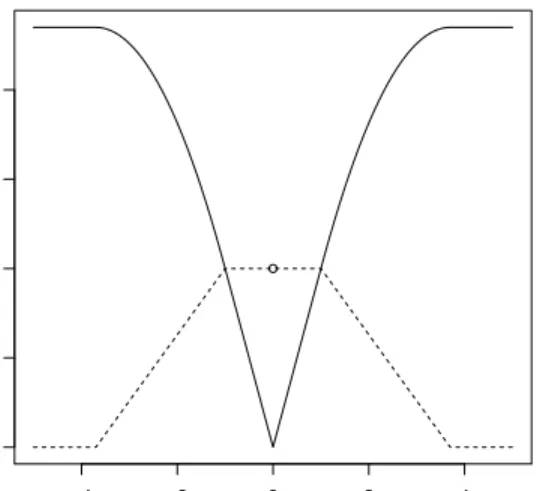
FIGURE 2.1: SCAD penalty function (solid line) and its derivative (dotted line)
15
and
FIGURE 2.2: Non-zero functional coefficients for FIAR with daily DOW data
47
FIGURE 2.3: Non-zero functional coefficients for FIAR with daily NASDAQ data
47
FIGURE 2.4: Non-zero functional coefficients for FIAR with daily SP data
48
FIGURE 2.5: Non-zero functional coefficients for FIAR with weekly DOW data
48
FIGURE 2.6: Non-zero functional coefficients for FIAR with weekly NASDAQ data 49
FIGURE 2.7: Non-zero functional coefficients for FIAR with weekly SP data
49
FIGURE 2.8: Non-zero functional coefficient for FIAR with monthly DOW data
50
FIGURE 2.9: Non-zero functional coefficients for FIAR with monthly NASDAQ data 50
FIGURE 2.10: Non-zero functional coefficients for FIAR with monthly SP data
51
FIGURE 2.11: Non-zero functional coefficients for prediction with monthly
51
DOW data
FIGURE 2.12: Non-zero functional coefficient sfor prediction with monthly
52
NASDAQ data
FIGURE 2.13: Non-zero functional coefficients for prediction with monthly
52
SP data
FIGURE 4.1: Epanechnikov kernel (solid line) and Uniform kernel (dotted line)
76
FIGURE 4.2: Three dimension weekly predicted factors (a) Sunday, (b) Monday.
76
This dissertation covers three topics, including variable selection for functional
index coefficient models and their applications in finance, efficient local annual average
daily traffic (AADT) estimation via smoothly clipped absolute deviation (SCAD)
variable selection based on regression models and nonparametric approach to calculate
seasonal factors for AADT estimation. In this chapter, I will introduce the main
results I have done to these tree topics, respectively.
1.1
Variable Selection for Functional Index Coefficient Models
Varying-coefficient model proposed by Hastie and Tibshirani (1993) has gained
more and more attention in recent years due to desirable properties such as its
flexibil-ity and dimension reduction in nonparametric sense. To incorporate more variables
in the functional coefficients and to overcome the difficulty of the curse of
dimen-sionality, Fan, Yao and Cai (2003) proposed the following functional index coefficient
model (FIM)
y
i=
g
T(
β
TZ
i)
X
i+
ε
i,
1
≤
i
≤
n,
(1.1)
where
y
iis a dependent variable,
X
i= (
X
1i, X
2i, . . . X
pi)
Tis a
p
×
1 vector of covariates,
Z
iis a
d
×
1 vector of covariates,
ε
iare independently identically distributed (i.i.d) with
mean 0 and standard deviation
σ
,
β
∈
R
dis a
d
×
1 vector of unknown parameters and
g
(
·
) = (
g
1(
·
)
. . . g
p(
·
))
Tis a vector of
p
−
dimensional unknown functional coefficients.
Assume that
∥
β
∥
= 1 or the first element of
β
is positive for identification.
Due to the efficiency of estimation and the accuracy of prediction, it is very
important to select significant variables and exclude insignificant variables in equation
(1.1). Meanwhile, almost all existed variable selection procedures are based on the
assumption that the observations are identically independently distributed (i.i.d). In
this chapter, I consider variable selection in functional index coefficient models under
strong mixing conditions.
It is clear that model (1.1) is a semiparametric model. Therefore, to estimate
g
(
·
), the initial estimators of ˆ
β
are needed and they might not have huge effects on
the final estimation of
g
(
·
) if the sample size
n
is large enough, since the convergence
rate of the parametric estimators ˆ
β
is faster than the nonparametric function
esti-mators ˆ
g
(
·
). Thus, to estimate
g
(
·
) and
β
, a two-stage procedure is needed. Here,
I propose variable selection and estimation in two steps as follows. Firstly, I select
the significant covariates with functional coefficients, and then variable selection is
applied for choosing local significant variables with parametric coefficients.
Step One:
Given an initial estimator ˆ
β
such that
∥
β
ˆ
−
β
∥
=
O
p(1
/
√
n
), minimize
the penalized local least squares
Q
(
b
g,
β, h
ˆ
) to obtain
b
g
(
·
), where (or maximize the
penalized local likelihood),
Q
(
b
g,
β, h
ˆ
) =
n∑
j=1 n∑
i=1{
y
i−
b
g
T(
ˆ
β
TZ
j)
X
i}
2K
h(
ˆ
β
TZ
i−
β
ˆ
TZ
j)
+
n
p∑
k=1P
λk(
∥
b
g
·k∥
)
(1.2)
with
K
(
·
) being the kernel function,
K
h(
z
) =
K
(
z/h
)
/h
and
P
λk(
·
) being the penalty
function, specified later.
Step Two:
Given the estimator of function ˆ
g
(
·
), minimize the penalized global least
squares
Q
(
β,
ˆ
g
) (or maximize the penalized global likelihood), where
Q
(
β,
g
ˆ
) =
1
2
n∑
i=1(
y
i−
g
ˆ
T(
β
TZ
i)
X
i)
2+
n
d∑
k=1Ψ
λn(
|
β
k|
)
(1.3)
with Ψ(
·
) being a penalty function, specified later..
In Chapter 2, I study the large sample behavior of these estimators such as
consistency, sparsity and the oracle property, meanwhile, computational algorithms
are outlined. Finally, Monte Carlo simulations are conducted to examine the finite
sample performance and two financial examples including functional index coefficient
autoregressive models and functional index coefficient models for the stock return
predictability are extensively studied.
The first real example I consider is to use functional index coefficient
autore-gressive models (FIAR) to analyze asset return data. The FIAR model for this real
example is defined as
r
t=
p∑
j=1g
j(
β
Tr
t)
r
t−j+
ε
t,
where
r
tis the asset return and
g
j(
·
)’s are unknown functions in
R
dfor
j
≤
p
and
r
t= (
r
t−1,
· · ·
, r
t−d)
Tis a vector of lagged returns. Clearly, it is an extension of
functional coefficient autoregressive (FAR) model, which was proposed by Chen and
Tsay (1993). To explore the performance of functional index coefficient autoregressive
models for asset returns, by taking
p
= 6, I simply assume my working model as
follows.
rt
=
6∑
j=1gj
(z
t)
rt
−j+
εt,
where
z
t=
β
1r
t−1,t+
β
2r
t−2,t+
β
3r
t−3,tand I assume
β
12+
β
22+
β
32= 1 in order to
satisfy the identification assumption.
The data for asset returns consist of daily, weekly and monthly returns on the
Dow Jones Industrial Average, NASDAQ Composite and
S
&
P
500 INDEX. I use
two step variable selection procedures to select significant variables and to estimate
unknown coefficients simultaneously. Firstly, I do variable selection on the regressors
based on penalized local maximum likelihood, then I do variable selection on the local
variables based on penalized global maximum likelihood. When two step estimations
and variable selections are employed in my model, the estimated coefficients of local
variables and the norms of covariates are reported in Table 2.4. An interesting finding
is that, all local variables perform the same for one day return of three index with
similar parameter coefficients. However, we cannot find this phenomenon with the
return of one week horizon and one month horizon.
Another interesting example I consider is the predictability for the stock
re-turn, which is very important in empirical finance since it is the center issue to the
asset allocation for practitioners in finance markets. Many literatures have revealed
that the coefficients of predictors may depend on other financial variables. In this
section, I consider the predictability for the stock return with the functional index
co-efficient models of Fan, Yao and Cai (2003), which can incorporate multiple variables
in the coefficients. I specify two type models as below.
Model 1:
r
t=
g
1(z
t)
z
1,t+
g
2(z
t)
z
2,t+
g
3(z
t)
z
3,t+
g
4(z
t)
z
4,t+
ε
t,
where
z
t=
β
1z
1,t+
β
2z
2,t+
β
3z
3,t+
β
4z
4,tand
z
jtis a financial variable described
below, and
Model 2:
rt
=
6∑
j=1gj
(z
t)
rt
−j+
εt.
In Model 1, the covariates and local variables
{
z
j,t}
include “BamAa”, the spread
between Moody’s Baa corporate bond yield and Moody’s Aaa corporate bond yield,
“Bam3m”, the spread between Moody’s Baa corporate bond yield and a three-month
Treasury bill, “term1year”, the term spread between the one year and three-month
Treasury yields, and “term10year”, the term spread between the ten year and
three-month Treasury yields. In Model 2, I let the lagged returns to be covariates. To match
the predictors, I let the lagged data as covariates and local variables. The dependent
variables include monthly returns on the Dow Jones Industrial Average, NASDAQ
Composite and
S
&
P
500 INDEX in both two models. Finally, the detailed analysis
results are summarized in Table 2.6 and Table 2.7 or Figure 2.11
∼
Figure2.13.
1.2
Efficient Local AADT Estimation via SCAD Variable Selection Based on
Regression Models
In transportation networks, annual average daily traffic estimation is very
important to decision making, planning, air quality analysis, etc. Regression method
may be one of the most popular approaches used for estimating AADT on
non-counters roads. Most literatures focus on how to collect different groups of predicting
variables, and to select significant variables by t-test and F-test. However, there is
no theory on the validity of these multiple selecting steps. This Chapter focuses on
the estimation and variable selection for the local AADT using different groups of
variables.
To illustrate the proposed method is practically useful, I consider a real data
set observed in Mecklenburg County of North Carolina in 2007.
I consider four
groups of 19 variables including general driving behavior, characteristics of the roads,
information from satellite and socioeconomic variables. The incorporated satellite
information has a great improvement in our model, and it makes R-square to go up
from 0.48 to 0.65. According to the R-square and the prediction error, our method
produces a better result to estimate AADT in the local functional class roads.
1.3
Nonparametric Approach to Calculate Seasonal Factors for AADT Estimation
Seasonal factors are very important to the estimation of annual average daily
traffic (AADT) and Vehicle Miles Traveled (VMT) and they are used to transfer one
or two days measured traffic data at portable traffic monitoring sites to the AADT.
Most literatures focus on taking the average of seasonal factors within groups of roads.
In this chapter, to calculate the seasonal factors, I propose a nonlinear
regres-sion model based on the nonparametric method by introducing the distance kernel and
by using the local weights. The factors utilize the similarity of seasonal variability and
traffic characteristics at the count sites in a nearby area. They are decomposed into
monthly factors and weekly factors. Then, I introduce a nonlinear distance weighting
kernel to estimate the weekly factors. It puts more weight on the observation points
which are much closer to the interested point, and puts less weight on the far away
observation points. Thus, it makes the seasonal factor estimation more reasonable
and accurate to be close to the true value.
Firstly, I can calculate seasonal factors as follows
F
mw=
F
m·
F
w,
(1.4)
where
Fmw
is the seasonal factor for the m-th month and the w-th week,
Fm
is the
monthly factor for the m-th month, and
F
wis the weekly factor for the w-th day in
a week.
Secondly, I can obtain the Nadaraya-Watson estimator of
F
w(
x
0, y
0) by
ˆ
g
w(
x
0, y
0) =
n∑
i=1w
iF
w(
x
i, y
i)
,
(1.5)
where
w
iis defined in (4.9), defined later.
To test whether there exists location effect or not, I construct the hypothesis
testing by generalized likelihood ratio test (GLR test). At last, the detail estimation
procedures for the seasonal factors and AADT are clearly presented by an example.
COEFFICIENT MODELS
2.1
Introduction
Varying-coefficient model proposed by Hastie and Tibshirani (1993) has gained
more and more attention during the recent years. Many extensions (Xia and Li, 1999;
Fan and Zhang, 1999; Cai, Fan and Li, 2000; Fan, Zhang, and Zhang, 2001; Huang,
Wu, and Zhou, 2002; Fan, Yao and Cai, 2003; Fan and Huang, 2005; Li and Liang,
2008) have been considered on the estimation of parameters and functionals and
hypotheses testing. Specially, to overcome the difficulty of the curse of dimensionality,
Fan, Yao and Cai (2003) proposed the following functional index coefficient model
(FIM)
y
i=
g
T(
β
TZ
i)
X
i+
ε
i,
1
≤
i
≤
n,
(2.1)
where
y
iis a dependent variable,
X
i= (
X
1i, X
2i, . . . X
pi)
Tis a
p
×
1 vector of
covari-ates,
Z
iis a
d
×
1 vector of covariates,
ε
iare independently, identically distributed
(i.i.d) with mean 0 and standard deviation
σ
,
β
∈
R
dis a
d
×
1 vector of unknown
parameters and
g
(
·
) = (
g
1(
·
)
. . . g
p(
·
))
Tis a vector of
p
−
dimensional unknown
func-tional coefficients. We assume that
∥
β
∥
= 1 or the first element of
β
is positive for
identification.
Xia and Li (1999) studied the asymptotic properties of model (2.1) under
mixing conditions when the index part of the above model is not constraint to linear
combination of
Z
i. However, due to the efficiency of estimation and the accuracy of
prediction, it is very important to select significant variables in
Zi
and exclude
insignif-icant variables in equation (2.1). Fan, Yao and Cai (2003) proposed a combination
of the t-statistic and the Akaike information criterion (AIC) to select significant
vari-ables of
Z
iand they deleted the least significant variables in a given model according
to t-value, and selected the best model according to the AIC. However there is no
theoretical foundation for their work. As mentioned in Fan and Li (2001), a stepwise
deletion procedure may suffer stochastic errors inherited in the multiple stages. Thus,
it is very critical to develop a variable selection procedure which can simultaneously
select significant variables and estimate unknown regression coefficients for the above
model.
In fact, the motivation of this study comes from functional coefficient
autore-gressive (FAR) model proposed by Chen and Tsay (1993). The coefficients in FAR
model are unknown functional form and depend on lagged terms and it satisfies
r
t=
g
1(r
∗t−1)
r
t−1+
· · ·
+
g
p(r
∗t−1)
r
t−p+
ε
t,
(2.2)
where
r
∗t−1= (
r
t−i1, r
t−i2,
· · ·
, r
t−id)
′
for
j
= 1
,
· · ·
, d
. Due to the curse of
dimen-sionality, Chen and Tsay (1993) just considered one single threshold variable case
r
∗t−1=
r
t−kfor some lagged term
r
t−k. To overcome the curse of dimensionality and
incorporate more variables in the functional coefficients
β
’s, we assume that
r
∗t−1is
a linear combination of
r
t−ij’s, e.g.
r
∗t−1=
β
Tr
t, where
r
t= (
r
t−1,
· · ·
, r
t−d)
T. The
FAR model can be reduced as a special case of FIM of Fan, Yao and Cai (2003). We
name it as functional index coefficient autoregressive models (FIAR).
rt
=
g
1(
β
Tr
t)
rt
−1+
· · ·
+
gp
(
β
Tr
t)
rt
−p+
εt.
(2.3)
As mentioned above, there is no theory on the variable selection procedure for model
(2.1) and so, neither is for model (2.3). Also, Fan, Yao and Cai (2003) did not address
how to select the covariates
r
t−jin model in (2.3). This motivates us to do variable
selection with local variables
r
tand covariates
r
t−iin model (2.3).
decades ago. Pioneer criterions include the Akaike information criterion (Akaike,
1973) and the Bayesian information criterion (Schwarz, 1978). Various shrinkage type
methods have been developed recently, including but not limited to the nonnegative
garrotte (Breiman, 1995; Yuan and Lin, 2006), bridge regression (Fu, 1998), least
absolute shrinkage and selection operator (Tibshirani, 1996; Knight and Fu, 2000),
smoothly clipped absolute deviation (Fan and Li, 2001), adaptive LASSO (Zou, 2006),
and so on. The reader is referred to the review paper by Fan and Lv (2010) for details.
Here we prefer the SCAD of Fan and Li (2001) since it merits three properties of
unbiasedness, sparsity and continuity. Furthermore, it has oracle property. Namely,
the resulting procedures perform as well as if the subset of significant variables were
known in advance.
The shrinkage method has been successfully extended to semiparametric
mod-els; for example, variable selection in partially linear models (Liang and Li, 2009),
partially linear models in longitudinal data (Fan and Li, 2004), single-index models
(Kong and Xia, 2007), semiparametric regression models (Brent et al., 2008; Li and
Liang, 2008), varying coefficient partially linear models with errors-in-variables (Zhao
and Xue, 2010), and partially linear single-index models (Liang et al., 2010), and the
references therein.
However, the aforementioned papers focused mainly on the variable selection
of significant variables with parametric coefficients. Also, the shrinkage method was
extended to select significant variables with functional coefficients. Lin and Zhang
(2006) proposed component selection and smoothing operator (COSSO) for model
selection and model fitting in multivariate nonparametric regression models in the
framework of smoothing spline analysis of variance (ANOVA), meanwhile, Zhang
and Lin (2006) extended the COSSO to the exponential families. Wang, Li and
Huang (2008) proposed the variable selection procedures with basis function
approx-imations and SCAD, which is very similar to the COSSO, and they argued that their
procedures can select significant variables with time-varying effects and estimate the
nonzero smooth coefficient functions simultaneously. Huang, Joel and Wei (2010)
proposed to use the adaptive group LASSO for variable selection in nonparametric
additive models based on a spline approximation, in which the number of variables
and additive components may be larger than the sample size. Adopted the idea of
grouping method in Yuan and Lin (2006), Wang and Xia (2009) used kernel LASSO
(KLASSO) to shrinkage functional coefficient in the varying coefficient models. Their
pure nonparametric shrinkage procedure is different from spline and basis functions
(Lin and Zhang, 2006; Wang, Li and Huang, 2008; Huang, Joel and Wei, 2010).
Almost all the variable selection procedures mentioned above are based on the
assumption that the observations are identically independently distributed (i.i.d).
To the best of our knowledge, there are few papers to consider variable selections
under non i.i.d settings. It might not be appropriate if it is applied in to analyze
financial and economic data, since most of the financial/economic data are week
dependent. To address this issue, Wang, Li and Tsai (2007) extended to the regression
model with autoregressive errors via LASSO. In this Chapter, we consider variable
selection in functional index coefficient models under very general dependent structure
– strong mixing conditions. Our variable selection procedures include two steps.
Firstly, we select the significant covariates with functional coefficients, and then do
variable selection for local significant variables with parametric coefficients.
The rest of this paper is organized as follows. In Section 2.2, we present the
conditions for identification in functional index coefficient models, two step
estima-tion procedures and some properties of SCAD penalty funcestima-tions. In Secestima-tion 2.3, we
propose variable selection procedures for covariates with functional coefficients, and
establish consistency, sparsity and the oracle property of the estimators. In Section
2.4, variable selection procedures for local variables with parametric coefficients are
provided together with their asymptotic properties. A simple bandwidth selection
method is introduced, and two computational algorithms for these two procedures
are also developed in Section 2.5. Monte Carlo simulation results for two cases are
reported in Section 2.6. In Section 2.7, two financial examples are extensively studied.
They include functional index coefficient autoregressive models (FIAR) and functional
index coefficient models (FIM) for the stock return predictability. Section 2.8
con-cludes the chapter and all the regularity conditions and technical proofs are gathered
in the appendix.
2.2
Identification, Estimation and Penalty Function
2.2.1
Identification
The identification problem in single index model was first investigated by
Ichimura (1993), and extensively studied by Li (2007) and Horowitz (2009).
Mean-while, partial conditions for identification in functional index coefficient models were
showed in Fan, Yao and Cai (2003). Here we present the conditions for identification
below.
Theorem 1.
(Identification in functional index coefficient models) Assume that
dependent variable
Y
is generated by equation (2.1),
Xi
= (
X
1i, X2i, . . . Xpi)
Tare
p
−
dimensional vector variables and
Z
are
d
−
dimensional vector variables.
β
∈
R
dare
d
−
dimensional unknown parameters and
g
(
·
) = (
g
1(
·
)
. . . g
p(
·
))
Tare
p
−
dimensional
unknown vector functional coefficients. Then
β
and
g
(
·
) are identified if and only if
the following conditions hold:
(I1) The vector functions
g
(
·
) are continuous, bounded, and not constant
every-where.
(I2) The components of
Z
are continuously distributed random variables.
of the components of
Z
is constant.
(I4) There exists no perfect multi-collinearity within each components of
X
.
(I5) The first element of
β
is positive, and
∥
β
∥
= 1, where
∥ · ∥
is the Euclidean
norm (
L
2norm) and
∥
β
∥
=
√
β
21
+
β
22+
· · ·
+
β
d2.
(I6)
E
(
Y
|
X, Z
) can not be the form as below
E
(
Y
|
X, Z
) =
α
TXβ
TX
+
γ
TX
+
c,
where
X
=
Z
, and
α
,
γ
∈
R
d,
c
∈
R
are constant and
α
and
β
are not parallel
to each other.
Remark 1:
Assumption I1 holds true since continuous and bounded functions are
commonly assumed in nonparametric estimation, and it is obvious that
β
can not be
identified if
g
(
·
) is a constant. we can relax Assumption I2 with some components
of
Z
being discrete random variables. But two more conditions should be imposed,
see Ichimura (1993) and Horowitz (2009) for detail. The perfect multi-collinearity
problem in Assumptions I3 and I4 is similar to that for the classic linear models. In
fact, it is also hard to get an exact estimator of
β
if high correlation of components
exists in
Z
and
X
, respectively.
It is not identified if any one component of
Z
is constant. For example, if
Z
1=1,
E
(
Y
|
X, Z
) =
g
T(
β
1+
β
2Z
2+
· · ·
+
βdZd
)
X
=
f
T(
β
2Z
2+
· · ·
+
βdZd
)
X
. An alternative of Assumption I5 is to let the first coefficient
be 1, e.g.
β
1= 1. However, it is infeasible for estimation and variable selection
simultaneously, since we do not have any prior information that whether the coefficient
2.2.2
Estimation Procedures
Model (2.1) can be regarded as a semiparametric model. Therefore, to estimate
both the functionals
g
(
·
) and parameters
β
, it is common to use a two-stage approach.
To estimate
g
(
·
), it needs a initial estimator of ˆ
β
which might have little effects on the
final estimation of
g
(
·
) if the sample size
n
is large enough, since the convergence rate
of the parametric estimators ˆ
β
is faster than the nonparametric function estimators
ˆ
g
(
·
). Here we propose variable selection and estimation in two steps:
Step One:
Given an initial estimator ˆ
β
such that
∥
β
ˆ
−
β
∥
=
O
p(1
/
√
n
), minimize
the penalized local least squares
Q
(
b
g,
β, h
ˆ
) to obtain
b
g
(
·
), where (or maximize the
penalized local likelihood),
Q
(
b
g,
β, h
ˆ
) =
n∑
j=1 n∑
i=1{
y
i−
b
g
T(
ˆ
β
TZ
j)
X
i}
2K
h(
ˆ
β
TZ
i−
β
ˆ
TZ
j)
+
n
p∑
k=1P
λk(
∥
b
g
·k∥
)
,
(2.4)
with
K
(
·
) is the kernel function,
K
h(
z
) =
K
(
z/h
)
/h
and
P
λk(
·
) is the penalty function.
As recommended, an initial estimator ˆ
β
can be obtained by various algorithms such
as the method in Fan, Yao and Cai (2003). As long as the initial estimator satisfies
∥
β
ˆ
−
β
∥
=
O
p
(1
/
√
n
), as expected, the parameter estimator ˆ
β
does not have any
effect on the shrinkage estimation of functional coefficients ˆ
g
(
·
) in the above equation.
We choose penalty term
P
λk(
·
) as SCAD function, which is described in Section 2.2.3,
and the
L
2functional norm
∥
b
g
·k∥
is defined in Section 2.3.1. The purse of using the
penalized locally weighted least squares is to select significant variable
Xi
in model
(2.1).
Note that when the penalty term
P
λk(
z
) =
λ
k|
z
|
, the penalized local likelihood
becomes the Lasso type, so that the above penalized local least squares in (2.4) is
reduced to the case in the paper by Wang and Xia (2009).
squares
Q
(
β,
ˆ
g
) (or maximize the penalized global likelihood), where
Q
(
β,
g
ˆ
) =
1
2
n∑
i=1(
y
i−
g
ˆ
T(
β
TZ
i)
X
i)
2+
n
d∑
k=1Ψ
λn(
|
β
k|
)
(2.5)
with Ψ(
·
) being a penalty function.
Clearly, the above general setting may cover several other existing variable
selection procedures as a special case. For example, when
p
= 1 and the regressor
X
= 1, the above procedure becomes variable selection for the single-index model
in Kong and Xia (2007), which provided an alternative variable selection method
called separated cross validation to do variable selection in the single-index model.
When
p
= 2 and the only one regressor is market return, then the above model
reduces to the case in the paper by Cai and Ren (2011) for an application in finance.
In particular, they considered a nonparametric estimate of time-varying betas and
alpha in the conditional capital asset pricing model (CAPM) with a variable selection.
However, Cai and Ren (2011) did not provide any theory for the variable selection
procedures. Furthermore, the model includes a special case of variable selection in
partially linear single-index models as addressed in Liang et al. (2010), if only the first
functional coefficient
g
(
·
) is nonlinear and all others are constant. Finally, it includes
variable selection in semiparametric regression modeling by Li and Liang (2008), if
the dimension of local variables
d
= 1 and some of the functional coefficients
g
(
·
) are
constant and others are not.
2.2.3
Penalty Functions
As pointed out by Fan and Li (2001), a good penalty function should enjoy
the following three nice properties.
(a) Unbiasedness, the estimator should be unbiased when the true unknown
parameter is large.
−4 −2 0 2 4 0.0 0.5 1.0 1.5 2.0 x y_penalty
Figure 2.1: SCAD penalty function (solid line) and its derivative (dotted line)
a
= 3
.
7
and
λ
= 1
zero automatically.
(c) Continuity, the estimator is continuous to avoid instability in model
pre-diction.
To achieve all the aforementioned three properties, Fan and Li (2001) proposed
the following so called SCAD penalty function,
P
λ(
|
β
|
) =
λ
|
β
|
,
|
β
| ≤
λ,
−
(
|
β
|
2−
2
aλ
|
β
|
+
λ
2)
/
[2(
a
−
1)]
, λ <
|
β
| ≤
aλ,
(
a
+ 1)
λ
2/
2
,
|
β
|
> aλ,
(2.6)
The important property for the SCAD penalty function is that it has the following
first derivative,
P
λ′(
|
β
|
) =
λ,
|
β
| ≤
λ,
(
aλ
− |
β
|
)
/
(
a
−
1)
, λ <
|
β
| ≤
aλ,
0
,
|
β
|
> aλ,
for some
a >
2
.
(2.7)
function and its derivative are displayed in Figure 2.2.3. It can be clearly seen that
P
λ(
|
β
|
) is not differentiable at 0 with respect to
β
. Thus it is not easy to minimize the
penalized least squares functions due to its singularity. Fan and Li (2001) suggested
to approximate the penalty function by a quadratic function as
P
λ(
|
β
j|
)
≈
P
λ(
|
β
(0) j|
) +
1
2
{
P
′ λ(
|
β
(0) j|
)
/
|
β
(0) j|}
(
β
2 j−
β
(0)2 j)
for
β
j≈
β
(0) j.
(2.8)
Alternatively, Zou and Li (2008) proposed local linear approximation (LLA) for
non-concave penalty functions as
[
P
λ(
|
β
j|
)]
′=
P
λ′(
|
β
j|
)sign(
β
j)
≈ {
P
λ′(
|
β
(0)
j
|
)
/
|
β
(0)
j
|}
β
j,
(2.9)
which can reduce the computational cost without losing any statistical efficiency.
Recently, other algorithms such as mimorize-maximize (MM) algorithm are proposed
by Hunter and Li (2005).
Given a good initial value
β
(0)such as maximal likelihood estimator (MLE)
without the penalty term, in view of (2.8), we can find the one-step estimator as
follow
β
(1)= argmin
1
2
(
β
−
β
(0))
T[
−∇
2ℓ
(
β
(0))](
β
−
β
(0)) +
n
d∑
k=1P
λ′(
|
β
k(0)|
)
2
|
β
k(0)|
β
2 k,
(2.10)
where
∇
2ℓ
(
β
(0)) =
∂
2ℓ
(
β
0
)
/∂β∂β
T. As argued in Fan and Li (2001), there is no
need to iterate until it converges as long as the initial estimator is reasonable. Also,
the MLE estimator from the full models without penalty term can be regard as the
reasonable estimator. For using the local linear approximation in Zou and Li (2008)
and (2.9), the sparse one-step estimator given in (2.10) becomes to
β
(1)= argmin
1
2
(
β
−
β
(0))
T[
−∇
2ℓ
(
β
(0))](
β
−
β
(0)) +
n
d∑
k=1P
λ′(
|
β
k(0)|
)
|
β
k(0)|
β
k.
(2.11)
As demonstrated in Zou and Li (2008), this one step estimator is as efficient as the
fully iterative estimator, provided that the initial estimator is good enough. For
example, we let
β
(0)be the maximal likelihood estimator without the penalty term.
2.3
Variable Selection for Covariates with Functional Coefficients
2.3.1
Notations and Technical Conditions
Let
{
(
X
i, Z
i, y
i)
}
be a strictly stationary and strong mixing sequence, and
f
(
z, β
) be the density function of
z
=
β
TZ
, where
β
is an interior point of the compact
set
B
. Define
A
z=
{
Z
|
f
(
Z, β
)
≥
ε,
∀
β
∈
B
and
∃
a, b, β
TZ
∈
[
a, b
]
}
as the domain
of
Z
, such that
β
TZ
is bounded and the density of
f
(
Z, β
) is bounded away from
0. Also, define the domain of bandwidth
h
,
H
n=
{
h
| ∃
C
1and
C
2, C
2n
−1/5< h <
C
1n
−1/5}
. For
Z
∈ A
z, β∈
B
, and
h
∈ H
n, define
n
by
p
matrix penalized estimator
as
b
G
(
b
β
)
=
[
b
g
(
b
β
TZ
1)
,
· · ·
,
b
g
(
b
β
TZ
n)]
T= [
b
g
·1,
· · ·
,
b
g
·p]
,
where
b
g
(
b
β
TZ
)
=
[
b
g
1(
b
β
TZ
)
,
· · ·
,
b
g
p(
b
β
TZ
)]
T∈
R
p,
and
b
g
·k=
[
b
g
k(
ˆ
β
TZ
1)
,
· · ·
,
b
g
k(
b
β
TZ
n)]
T∈
R
n.
Similarly, we can define true value
G
0(
β
)
, g
0(
β
TZ
)
and
g
0·k. Without loss of
gen-erality, we assume that first
p
0functional coefficients are non-zero, and other
p
−
p
0functional coefficients are zero, e.g.
∥
g
·k∦
= 0 and
g
·kare not constant everywhere
for 1
≤
k
≤
p
0,
∥
g
·k∥
= 0 for
p
0< k
≤
p
. Let
α
n= max
{
P
λ′(
∥
g
·k∥
) : 1
≤
k
≤
p
0}
.
Then
α
n= 0 as
n
→ ∞
. For an arbitrary matrix
X
= (
X
ij), we define
L
2norm as
∥
X
∥
=
√∑
i,jX
2i,j
and the kernel function
K
h=
K
(
x/h
)
/h
. Also we define object
function
Q
(
G,
b
β, h
ˆ
) =
n∑
j=1 n∑
i=1{
y
i−
b
g
T(
ˆ
β
TZ
j)
X
i}
2K
h(
ˆ
β
TZ
i−
β
ˆ
TZ
j)
+
n
p∑
k=1P
λk(
∥
b
g
·k∥
)
.
(2.12)
By minimizing the above object function with respect to ˆ
g
(
·
), one can obtain the
penalized local least squares estimator for
g
(
·
).
To study the asymptotic distribution of the penalized local least squares
esti-mator, we impose some technical conditions as follows.
(A1) The vector functions
g
(
·
) are bounded, not constant everywhere and have
con-tinuous second order derivatives with respect to the support of
A
z.
(A2) For any
β
∈
B
and
Z
∈ A
z, the density function
f
(
β
TZ
)
is continuous and
there exists a small positive
ε
such that
f
(
β
TZ
)
> ε
.
(A3) The kernel function
K
(
z
) is twice continuously differentiable on the support
(
−
1
,
1), Let
∫
z
2K
(
z
)
dz
=
µ
2
,
and
∫
K
2(
z
)
dz
=
ν
0
.
(A4) lim
n→∞inf
θ→0+P
λ′n
(
θ
)
/λ
n>
0,
n
−1/10λ
n→
0,
h
∝
n
−1/5and
∥
β
ˆ
−
β
∥
=
Op
(1
/
√
n
).
(A5) Define Ω
(
β
TZ
)
=
E
(
X
iX
iT|
β
TZ
)
, Ω
(
β
TZ
)
is nonsingular and has bounded
second order derivative on
A
z.
(A6)
{
(
Xi, Zi, yi
)
}
is a strictly stationary and strongly mixing sequence with mixing
coefficient
α
(
m
) =
O
(
ρ
m) for some 0
< ρ <
1.
(A7) Let
z
=
β
TZ
, the conditional density
f
(
z
i