This section describes the UCSF functional elements that support UCSF’s research, clinical, and instruction endeavors across all campus sites: housing, child care, transportation, food services, recreation and fitness, public safety, and information technology.
11.1 HOUSING
11.1.1 EXISTING SETTING
Table 8 describes existing and proposed campus housing at Parnassus Heights and Mission Bay, and the number of beds, units, and gsf at each location.
The demand for on-campus rental housing at Parnassus Heights and Mission Bay exceeds the supply. Occupancy is generally 100 percent, with a wait-list of over 700 individuals. There is a correlation between the steep increases in the number of people on the wait-list and rising rents in the city over the past few years. This situation is exacerbated by the lack of available and affordable housing elsewhere in the city, where rental vacancy rates are only 3.4 percent.1 The
median rental price in June 2013 of a one-bedroom unit in San Francisco was $2,795, having risen 27 percent over the previous two years; two-bedroom units rose even more at 33 percent.2 In response to the increasing demand for rental
housing in San Francisco, over 6,000 residential units were under construction in October 2013, and another 32,000 had been granted entitlements.3 However, affordability is
not expected to change substantially even with these new units, because of San Francisco’s ongoing desirability factor, increasing employment, and high cost of construction. Furthermore, most of the housing will be built in the eastern parts of the city and not around Parnassus Heights, where UCSF’s student housing demand remains greatest.
The provision of campus rental housing is a priority for UCSF because it helps to:
• Recruit and retain students, postdoctoral scholars, clinical residents, and faculty, all of whom want reasonably priced housing and the convenience of living within walking distance of where they attend class or go to work; • Provide housing for incoming students, many of whom
are from foreign countries or out of state and do not have the time, resources, or knowledge to search the city for housing;
• Create a vibrant 24-hour on-campus community; • Meet environmental sustainability goals by reducing
commute traffic, parking demand, and greenhouse gas emissions; and
• Support citywide housing goals, lessen traffic impacts, and enhance campus vitality.
1 U.S. Census Bureau. Decennial Census on Housing, December 2010.
2 Ibid.
A small amount of campus housing is offered for rent to new faculty. However, most faculty prefer to own a home rather than rent, although they find it difficult to obtain loans for expensive Bay Area housing; therefore, UCSF addresses the faculty housing need primarily through financial assistance. To assist qualifying faculty and senior managers in purchasing their first homes in the Bay Area, eligible applicants may obtain first deed of trust variable-rate loans through the UC Mortgage Origination Program (MOP). Applicants may also qualify for a Supplemental Home Loan Program (SHLP) in conjunction with a MOP loan. The administration of these two programs will be transferred in 2014 from the UC Office of Loan Programs at the Office of the President to a new nonprofit public benefit corporation, to be known as the UC Home Loan Program Corporation, so that more flexible underwriting criteria and Small Creditor Exemptions may be made available. In addition, UCSF has a Faculty Recruitment Allowance Program (FRAP) that offers grants to eligible participants. The primary purpose of FRAP is to provide support for housing costs, but an individual may also use the allowance for child care expenses, education or tuition assistance, or similar expenses.
11.1.2 PROPOSED PLAN
Goals for providing housing for UCSF students, postdoctoral scholars, clinical residents and faculty have been established by the Chancellor’s Housing Advisory Committee, based on a campus community survey regarding housing demand sponsored by the committee. After reviewing and vetting the survey results, the committee established goals for housing the following UCSF population categories:
• 40 percent of students;
• 25 percent of postdoctoral scholars, including clinical fellows;
• 25 percent of clinical residents; and • 10 percent of faculty.
Table 8 indicates UCSF’s existing and proposed housing inventory, and Tables 9 and 10 identify the population currently housed and additional housing needed to meet campus housing goals for the projected 2035 campus population. UCSF currently houses 1,004 students, postdoctoral scholars, clinical residents, and faculty. Assuming that no additional beds would be provided for spouses, partners, children, or short-term tenants (visitors), this translates to a need for approximately 1,660 additional beds to meet the housing goals in 2035.
The LRDP proposes additional housing at the two campus sites at which overall demand is greatest, Parnassus Heights and Mission Bay. New housing at both sites will enable UCSF
to better match the needs of specific populations with their place of study or employment. With more student housing at the Parnassus Heights campus site, where most of UCSF’s instruction occurs, existing housing at the Mission Bay campus site can be made available to clinical residents who will be working at the Medical Center at Mission Bay, as well as for graduate students, postdoctoral scholars, and faculty who will occupy new research buildings as the Mission Bay campus site grows. Providing additional housing at Parnassus Heights and Mission Bay will strengthen the sense of campus community at these locations, benefiting both UCSF tenants and residents of the surrounding neighborhoods.
UCSF has been studying options for developing housing on UCSF property. Table 8 summarizes the LRDP’s proposal for new housing that can be developed at the Parnassus Heights and Mission Bay campus sites through 2035. While these proposals will increase the total amount of housing considerably, there will still be a shortfall in meeting the campus housing goals, as shown in Table 10. UCSF has financial constraints including restrictions on annual debt, UC requirements that housing be self-supporting, and a limited housing stock across which to spread the costs of new development. In addition, the expectation is that new housing will be provided at below-market rental rates (comparable to existing campus housing), which makes financing of new housing challenging. Nonetheless, proposed housing would help meet some of UCSF’s housing goals while also reducing some of the pressure on the city’s housing demand. UCSF will also continue to seek opportunities at off-campus locations (such as master leases) to develop housing for campus populations.
In addition to increasing UCSF’s housing stock, strategies such as term limits for campus housing are being explored to make housing available to the maximum number of newly arrived students, clinical residents, postdoctoral scholars, and faculty as they join the UCSF community.
UCSF also intends to continue to provide financial assistance for eligible faculty to acquire homes, to participate in the MOP, and to make every effort to seek additional resources to recruit and retain faculty.
Table 8: Existing & Proposed Campus Housing
Table 9: Campus Housing goals – Status as of 2014
Note: Numbers rounded to nearest 10.
a For the purposes of housing category, Postdoctoral Scholars (1,100) includes Clinical Fellows (450). b Current housing population includes all occupants of housing.
EXISTING HOUSING BY POPULATION TYPE APPROX. 2013 UCSF
POPULATION HOUSING GOAL CURRENT % HOUSED CURRENT HOUSING POPULATION b
SHORTFALL IN 2014 Postdoctoral Scholars a 1,550 25% 19% 300 88 Students 3,080 40% 18% 543 689 Clinical Residents 1,680 25% 7% 115 305 Faculty 3,170 10% 1% 46 271 EXISTING TOTAL 9,480 1,004 1,353
Table 10: additional Housing needed to Meet Campus Housing goals by 2035
a For the purposes of housing category, Postdoctoral Scholars (1,100) includes Clinical Fellows (450).
PROPOSED HOUSING BY POPULATION TYPE APPROX. 2035 UCSF
POPULATION HOUSING GOAL POPULATION GOAL2035 HOUSING CURRENT HOUSING POPULATION ADDITIONAL HOUSING NEEDED TO MEET GOALS BY 2035 Postdoctoral Scholars a 1,550 25% 388 300 88 Students 3,375 40% 1,350 543 807 Clinical Residents 2,015 25% 504 115 389 Faculty 4,220 10% 422 46 376 PROPOSED TOTAL 11,160 2,664 1,004 1,660
EXISTING HOUSING BEDS UNITS GSF
PARNASSUS HEIGHTS
Parnassus Heights - Aldea Housing 172 172 132,400
Parnassus Heights - 145 Irving Street 35 18 17,800
Parnassus Heights Avenue Houses - Students 98 18 49,300
Parnassus Heights Avenue Houses - Faculty 20 14 42,500
Existing Parnassus Heights 325 222 242,000
MISSION BAY
Mission Bay - Block 20 596 431 387,400
Existing Mission Bay 596 431 387,400
Existing Total 921 653 630,600
PROPOSED HOUSING BEDS UNITS GSF
PARNASSUS HEIGHTS
UC Hall (Upper 3 floors) 134 105 74,700
UC Hall (Lower 3 floors) 78 64 68,300
Millberry Union Towers Conversion 83 83 47,100
Fifth and Parnassus avenues 61 45 48,400
Proctor Site 32 32 30,400
Proposed Parnassus Heights 388 329 268,900
MISSION BAY
Mission Bay - Block 15 774 523 398,700
Proposed Mission Bay 774 523 398,700
Proposed Total 1,162 852 667,600
FUTURE TOTAL (EXISTING AND PROPOSED) 2,083 1,505 1,297,000
11.2 CHILD CARE
11.2.1 EXISTING SETTING
UCSF has four child care centers: Lucia Child Care Center (formally known as Marilyn Reed Lucia Child Care Study Center) and Kirkham Child Care Center, both at Parnassus Heights; University Child Care Center at Laurel Heights; and University Child Care Center at Mission Bay, which is temporarily in a modular facility. The number of licensed child care slots at each center is shown in Table 11. The total of 297 slots represents slightly more than 1 percent of the total UCSF population, a relatively low proportion for comparable institutions based on research conducted by Campus Life Services.4
The demand for campus child care has been increasing in concert with the steady rise in the numbers of young faculty and students with families at UCSF. The lack of affordable child care, along with the lack of affordable housing, is one of UCSF’s challenges to recruitment and retention. This situation is exacerbated by the lack of available child care in the area of Mission Bay. In 2013, there were over 1,500 families on the waiting list for UCSF child care slots, with the greatest demand at Mission Bay. Based on demographic trends, growing waiting lists at UCSF over the past few decades, and indications of those surveyed who plan to increase the sizes of their families, it is projected that the demand for child care at UCSF will rise in the foreseeable future.
4 Campus Life Services is the UCSF department responsible for overseeing child care, as well as many functions such as housing, transportation, retail services, and recreation and fitness. (Public safety and information technology are separate UCSF services.)
11.2.2 PROPOSED PLAN
UCSF’s goal for child care is to supply child care capacity for 2 percent of the campus employee and student population, excluding unpaid faculty, patients, and visitors. Child care slots are projected to be provided in a combination of on-campus child care facility slots and off-campus child care solutions, which could include sponsorship of slots at a non-UCSF center, a referral/placement program, or some other method. To help meet this goal, a permanent, larger child care center at Mission Bay with 200 slots is proposed on Block 15 as part of a new campus housing complex, unless child care space is acquired or leased off-campus. UCSF may also expand the Kirkham Child Development Center by converting its multi-purpose room to a classroom and increasing its outdoor play area.
As mentioned previously, UCSF is evaluating opportunities to consolidate remote sites to save operating and occupancy costs. As part of this effort, UCSF is reviewing its long-term occupancy of the Laurel Heights campus site. In the event that UCSF vacates its Laurel Heights campus site in the future, the 116 slots (with 11,500 indoor and 4,500 outdoor square feet) in the University Child Care Center at Laurel Heights would need to be accommodated at another location on or off property owned by UCSF.
Table 11: Existing & Proposed Child Care
EXISTING CHILD CARE CHILDREN
Lucia Child Care Center at Parnassus Heights 24
Kirkham Child Care Center at Parnassus Heights 72
Mission Bay Child Care Center 85
Laurel Heights Child Care Center a 116
Existing Total 297
PROPOSED CHILD CARE CHILDREN
Net New Additional Slots Proposed at Parnassus Heights (Kirkham Child Care Center) 20
Net New Additional Slots Proposed at Mission Bay 115
Proposed Total 135
FUTURE TOTAL (EXISTING & PROPOSED) 432
a If UCSF were to vacate the Laurel Heights campus site, child care currently located there would need to be accommodated at another location on or off property owned by UCSF.
11.3 TRANSPORTATION
11.3.1 UCSF TRANSPORTATION DEMAND
MANAGEMENT (TDM) PROGRAM
UCSF is a leader in sustainable transportation services in the UC system and across the country. Based on UCSF’s 2013 employee commute survey, 66 percent of the campus population commutes by means other than driving alone. In 2011, UCSF received the Gold level award from Best Workplaces for Commuters. Key features of UCSF’s existing TDM program include the following:• 60 shuttles serving 17 locations, with over 2.3 million passengers per year
• 33 vanpools that travel as far as Sacramento and operate using the Green Road Safety System, which improves fuel consumption and safety
• 62 reserved carpool stalls at various sites
• Marin Commute Club buses with about 55 daily riders who live in Marin and Sonoma Counties to the north of the city
• 18 City CarShare vehicles with dedicated parking spaces, along with 1,500 UCSF members who can use these vehicles by scheduling their use online
• A fleet of 43 low-emitting alternative-fuel and hybrid vehicles, including cars, shuttles, golf carts, and trucks • 18 electric-vehicle charging stations at Parnassus Heights,
Mount Zion, and Mission Bay, with plans for another 20 at Mission Bay in the Owens Street Garage and 10 at other locations
• Over 1,900 UCSF users of the ZimRide online carpool matching program
• 972 bicycle parking spaces, with another 100 planned at Mission Bay, as well as bike racks on shuttles, a cyclist shower program that allows bicyclists to use UCSF showers at a discount, and other bicycle-related benefits • Bay Area Bike Share station at Mission Bay, where
members will have access to bicycles (and a regional network of stations) provided by the Bay Area Air Quality Management District; construction is dependent on the City’s ability to secure additional funding for the program • More than 400 off-street motorcycle parking stalls in
garages and surface parking lots
• An “emergency ride home” program to encourage use of alternative modes of transportation
• Clipper Card (public transit pass) sales at easily accessible locations, including through UCSF’s website
• Close to 1,800 UCSF employees that participate in a pretax transit program, which saved UCSF employees over $700,000 on public transit commute costs in 2013
In 1973, the City adopted the Transit First policy in the Transportation Element of the San Francisco General Plan, which promotes the use of public transit, ridesharing, walking, and bicycling over the use of private vehicles. UCSF proposes to continue to respond to the City’s Transit First policy by: • Limiting parking at all campus sites, and prioritizing parking
for patients and essential health care employees at sites with clinical facilities;
• Enhancing its TDM program and more aggressively promoting participation;
• Expanding the City CarShare and UCSF carpool programs;
• Increasing the number of bicycle racks and cages, and providing access to showers and lockers for bicyclists; and • Encouraging more ridesharing.
11.3.2 UCSF SHUTTLE SYSTEM
The UCSF shuttle system provides service between all primary campus sites and to select secondary sites and public transit. Ridership is free to UCSF students, faculty, staff, patients, and visitors. The shuttles are not a substitute for City transit, which is used primarily for commuting between home and campus, but as an alternative to traveling by private vehicle between campus sites. On average, nearly 7,500 people ride the shuttle system daily. It is estimated that shuttle services eliminate 2,700 daily vehicle trips city-wide.
UCSF is sensitive to the concerns about noise and vibration impacts of its shuttles on residential routes, and will continue to make operational adjustments to minimize these impacts. However, because UCSF is obligated to provide frequent shuttle runs to meet accreditation requirements, passenger numbers can be low at non-peak times.
Shuttle operations will expand with the opening of Phase 1 of the UCSF Medical Center at Mission Bay and continued campus development. Based on anticipated campus growth, shuttle needs were projected for years 2020 and 2035. By 2020, it is estimated that ridership per shuttle route servicing Mission Bay will increase by between five and 12 percent, which will require an additional shuttle during the morning and afternoon commute periods on the direct route between Mission Bay and Parnassus Heights. In addition, the need for larger shuttles on various routes and additional service during peak periods is projected. In 2035, UCSF may need to utilize five of the larger shuttles throughout the day between Mission Bay and Parnassus Heights, and add larger and/or additional shuttle vehicles on other routes during peak and non-peak periods. UCSF will develop adequate facilities to support
increased shuttle operations. If UCSF increases shuttle operations, the community will be included in the planning process.
In response to UC policy and community interest in greater shuttle efficiency and clean energy, UCSF continues to monitor advances in biodiesel, compressed natural gas, hybrid electric, and fully electric technologies, and anticipates the procurement of new alternative-fuel vehicles as operating efficiency improves and reliability issues are resolved.
11.3.3 BICYCLES
UCSF’s goal is to provide bicycle facilities at all campus sites adequate to meet demand. At Mission Bay, UCSF coordinated with the City, the San Francisco Bicycle Coalition, and others on the design of the public plaza in the Fourth Street right-of-way to accommodate bicycle traffic along the street and through the plaza as a Class 1 and 2 bicycle route. When the hospital construction is completed, this route will become a southward extension of the Class 2 and 3 bicycle route on Fourth Street north of Sixteenth Street. UCSF is also coordinating with the City and the Bicycle Coalition in planning the streetscape improvements for Parnassus Avenue, and is planning to install additional bicycle racks at that campus site.
11.3.4 PARKING
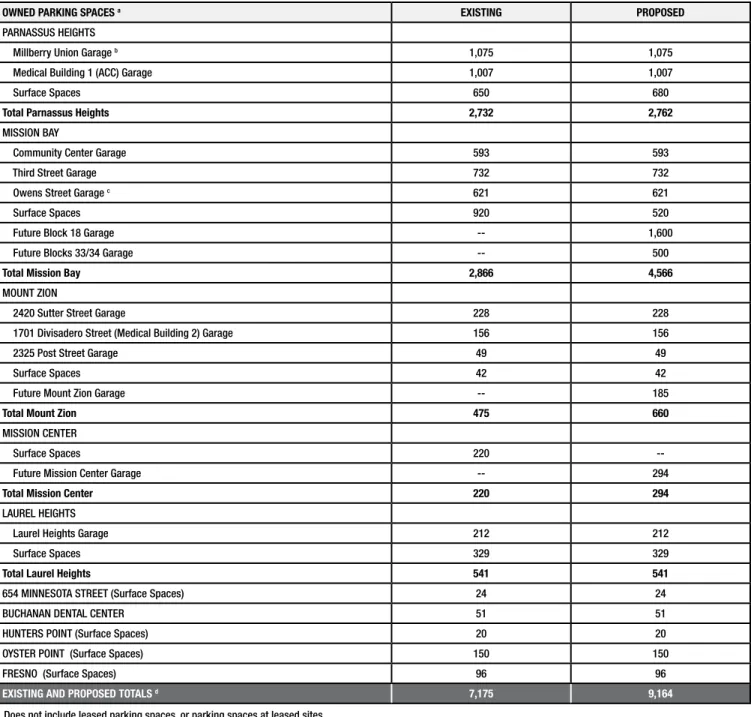
UCSF currently provides over 7,100 parking spaces campus-wide (Table 12), with a 90-percent overall occupancy rate during the peak period in the middle of the day. Parking demand exceeds supply at Parnassus Heights, where there is an ongoing wait-list of over 500 individuals waiting for parking permits. Demand is tempered by the cost of parking, particularly at Mount Zion, where on-street parking is challenging to find because it is less expensive than garage or surface-lot parking, which is generally available. The cost of parking is expected to continue to increase towards prevailing market rates. All UCSF parking must be financially self-supporting.
When warranted, additional off-street parking will be provided on campus sites at Parnassus Heights, Mission Bay, Mount Zion, San Francisco General Hospital, and Mission Center. The quantity of any new parking is to be determined when projects are proposed. Essential healthcare workers, patients, and patient visitors would be given parking priority at
Parnassus Heights, Mission Bay South Campus, Mount Zion, and other sites where there are UCSF medical facilities.
Bike racks at Parnassus Heights campus site.
Over time, UCSF’s overall parking ratio of approximately 1.02 spaces per 1,000 gsf of owned space in 20145 is expected to
decrease to approximately 0.86 spaces per 1,000 gsf in 2035. In addition, UCSF will monitor parking demand over time, to avoid building more parking than is necessary should demand decline further over time.
Table 12: Existing & Proposed Parking Facilities
a Does not include leased parking spaces, or parking spaces at leased sites. b Also includes Kalmanovitz Library Garage.
c Does not include Owens Street Garage expansion, which is projected to occur after the 2035 horizon of the LRDP. d Figures do not include bicycle or motorcycle parking spaces.
OWNED PARKING SPACES a EXISTING PROPOSED
PARNASSUS HEIGHTS
Millberry Union Garage b 1,075 1,075
Medical Building 1 (ACC) Garage 1,007 1,007
Surface Spaces 650 680
Total Parnassus Heights 2,732 2,762
MISSION BAY
Community Center Garage 593 593
Third Street Garage 732 732
Owens Street Garage c 621 621
Surface Spaces 920 520
Future Block 18 Garage -- 1,600
Future Blocks 33/34 Garage -- 500
Total Mission Bay 2,866 4,566
MOUNT ZION
2420 Sutter Street Garage 228 228
1701 Divisadero Street (Medical Building 2) Garage 156 156
2325 Post Street Garage 49 49
Surface Spaces 42 42
Future Mount Zion Garage -- 185
Total Mount Zion 475 660
MISSION CENTER
Surface Spaces 220
Future Mission Center Garage -- 294
Total Mission Center 220 294
LAUREL HEIGHTS
Laurel Heights Garage 212 212
Surface Spaces 329 329
Total Laurel Heights 541 541
654 MINNESOTA STREET (Surface Spaces) 24 24
BUCHANAN DENTAL CENTER 51 51
HUNTERS POINT (Surface Spaces) 20 20
OYSTER POINT (Surface Spaces) 150 150
FRESNO (Surface Spaces) 96 96
11.4 FOOD SERVICE
In recent years, UCSF has endeavored to ensure that food is available at all campus sites to reduce the need to travel off campus for food, thus reducing traffic impacts. At many campus sites, food services are provided by vendors in retail spaces. Campus Life Services also promotes farmers’ markets at Parnassus Heights and Mission Bay, and accommodates a limited number of food trucks. It is proposed that food-service facilities be considered at all sites where future buildings are planned, and be located so as to enhance the public realm and promote social activity. UCSF also proposes to increase food services near proposed housing.
11.3.5 LOADING
UCSF must ensure mission-critical deliveries are received in a timely manner, but will continue to make efforts to reduce truck trips to all campus sites and ensure that no single neighborhood is overly burdened. Ongoing efforts include, among other considerations, delivery consolidation, more cross-docking (in which vendors deliver goods to Oyster Point or another remote location and goods are consolidated onto UCSF vehicles for delivery to campus sites), new vendor contract requirements and restrictions (for example, restricting vendors to specific delivery times, and requiring them to consolidate loads), and increasing off-street loading capacity. At Parnassus Avenue, UCSF proposes to build two new loading areas accessible from Parnassus Avenue. In addition, some of the current loading areas may be redesigned or repurposed to provide additional loading space for the New Hospital Addition accessible from Parnassus Avenue and/or Medical Center Way. At other campus sites, the number of loading docks would be determined as each new building is planned.
11.5 RECREATION AND FITNESS
UCSF has a goal to promote fitness at all but the most remote campus sites. At some locations, this means simply designating a room for fitness equipment or where a group exercise class can take place. At Mission Bay, the goal is to supplement UCSF’s existing indoor recreation and fitness facilities with outdoor facilities. It is anticipated that this will include a regulation-sized soccer field that can also be used for softball, summer youth programs, and other recreational purposes both by the UCSF community and by members of the public. There is also interest in providing a playground on the Mission Bay campus site to serve young children of housing tenants, children in the University Child Care Center, and families in the vicinity.
11.6 PUBLIC SAFETY
The UC Police Department (UCPD) has four separate divisions that handle all patrols, investigations, crime prevention, emergency management, homeland security, and related law-enforcement duties. UCPD is located at multiple campus sites, including Parnassus Heights and 654 Minnesota Street (south of the Mission Bay campus site); the latter also doubles as an Emergency Communications Center. There is also some police administrative space located at the Mission Center building.
UCPD has a mutual-aid agreement with the San Francisco Police Department (SFPD) to provide cooperative assistance within a one-mile radius of each UCSF campus site. A Memorandum of Understanding (MOU) between the UCPD and the SFPD establishes that UCPD has exclusive jurisdiction over police service on UCSF properties. Depending on the nature of the emergency, the UCPD may request assistance from the SFPD.
One of UCSF’s goals is to locate its police facilities in buildings that qualify as “essential services buildings,” which meet higher seismic standards, so that police functions can continue to operate in the event of an earthquake. As the Mission Bay campus site grows, it is anticipated that a minor amount of space will be needed for some police services in a building on the North Campus, in addition to the existing space at 654 Minnesota Street.
11.7 INFORMATION TECHNOLOGY
The provision of sophisticated, connective, and reliable information technology is critical to the function of UCSF research, clinical, and administrative endeavors. UC’s Information Technology unit provides wide-ranging services for voicemail, video conferencing, pagers, email, websites, networks, wireless communication, desktop assistance, and security. Its mission is to support today’s needs and to forecast future needs for telemedicine, centralized services, and cloud-based services.
Not all UCSF buildings have routers, videoconference, and teleconference capability and other updated information technology infrastructure. The Building Network Improvement Project is a long-term project to upgrade equipment in UCSF buildings to improve network connectivity within buildings as well as between each building and the rest of UCSF. Connectivity provides the important secondary benefit of minimizing commute traffic and travel between campus sites. Reliability, another important objective, can be achieved by locating server farms in buildings such as 654 Minnesota, where services would have an increased likelihood of continuing uninterrupted following a seismic event.
New buildings are to be planned to take advantage of existing systems and evolving technology. Videoconferencing and other infrastructure support will continue to be promoted as a means to reduce travel and become more environmentally sustainable.