January 2011
Payment for Forest
Environm
ent
al Services:
A Case Study on Pilot Implementation in
ACKNOWLEDGMENTS
Contributors Funding Implementing Partners Please cite this document as PhotographsNguyen Thi Bich Thuy, Nguyen Chi Thanh, Nguyen Phuong Thao, Pham Thanh Nam, David Bonnardeaux, Dione Cottrill Riedel, Lam Dong Province PES Technical Working Group The Asia Regional Biodiversity Conservation Program is funded by USAID/RDMA. Vietnam Ministry of Agriculture and Rural Development, Lam Dong Province Peoples’ Committee, Lam Dong Province Department of Agriculture and Rural Development, Lam Dong Province Department of Natural Resources and Environment
Payment for Forest Environmental Services: A Case Study on Pilot Implementation in Lam Dong Province Vietnam from 2006 - 2010, Winrock International, 2011.
ARBCP/Winrock International
This study is made possible by the generous support of the American people through the United States Agency for International Development (USAID). The contents are the responsibility of Winrock International and do not necessarily reflect the views of USAID or the United States Government.
Front cover photo: Waterfall in Bi Duop-Nui Ba National Park
For more information:
[email protected] Winrock International
2101 Riverfront Drive | Little Rock, Arkansas 72202 www.winrock.org | www.arbcp.com
TABLE OF CONTENTS
ACKNOWLEDGMENTS ... 2
INTRODUCTION AND SUMMARY ... 7
ACRONYMS ... 8
MAP OF PFES PILOT AREAS IN LAM DONG PROVINCE ... 9
SECTION 1: BACKGROUND AND CONTEXT ...11
1.1 DECISION 380 – PFES PILOT POLICY ...11
1.2 PILOT SITE SELECTION IN LAM DONG PROVINCE ...12
1.3 IMPLEMENTING THE PFES PILOT POLICY IN LAM DONG PROVINCE ...13
1.4 TIMELINE OF PFES PILOT POLICY IMPLEMENTATION ...14
SECTION 2: INITIAL STUDIES AND CONSULTATIONS ...16
2.1 BIOLOGICAL ASSESSMENT AND CONSERVATION ACTION PLAN ...16
2.2 BIODIVERSITY MONITORING ...17
2.3 VALUATION OF FOREST ENVIRONMENTAL SERVICES ...18
SECTION 3: PUBLIC AWARENESS, CAPACITY BUILDING, AND TRAINING ...21
3.1 CAPACITY BUILDING AND TRAINING ...22
SECTION 4: IMPLEMENTING THE PILOT PFES POLICY IN LAM DONG PROVINCE ...25
4.1 IMPLEMENTATION APPROACH ...25
4.2 EXPLORING OTHER PES OPPORTUNITIES IN LAM DONG PROVINCE ...28
SECTION 5: MONITORING AND EVALUATION ...30
5.1 MID-TERM EVALUATION ...30
5.2 ASSESSMENT OF PROGRESS AND LOCAL MONITORING ...31
5.3 SOCIOECONOMIC SURVEY ...31
5.4 GAUGING STATIONS ...32
SECTION 6: ACCOMPLISHMENTS, CHALLENGES AND LESSONS LEARNED ...35
6.1 ACCOMPLISHMENTS ...35
6.2 CHALLENGES AND LESSONS LEARNED ...36
“Without
sufficient economic,
social, and policy incentives,
the Subregion’s globally significant
natural areas — home to scores of
threatened and endangered species —
are likely to become irreparably degraded,
along with the important ecosystem
functions they provide.”
INTRODUCTION AND SUMMARY
With support from USAID/RDMA (Regional Development Mission for Asia), Winrock International’s Asia Regional Biodiversity Conservation Program (ARBCP) has supported the Government of Vietnam since 2006 in implementing a successful pilot program of Payment for Forest Environmental Services (PFES), which has improved livelihoods of over 40,000 rural poor while promoting biodiversity conservation in Lam Dong Province and across Vietnam. The pilot policy also helped to inform the design and subsequent signing of a national PFES Decree, a regionally significant milestone.
Vietnam, like many countries in Southeast Asia, has suffered the loss of critical forestlands and other environmental degra-dation from the expansion of agriculture and unbridled economic development. Conservation of vital habitats is more likely if forest owners and forest-dwelling communities can be compensated for the true economic value of the services intact ecosystems provide, including protection of water quality, prevention of soil runoff that increases siltation of hydroelectric reservoirs, harvest of natural forest products, and the aesthetic appeal of natural landscapes important to tourism.
Vietnam’s national PFES pilot policy, the first of its kind in Southeast Asia, created the legal framework necessary to col-lect and distribute a portion of the economic value of ecological services provided by forests in two pilot areas (Lam Dong province in the south and Son La province in the north). The policy facilitated payments ensuring continuous forest protec-tion and management services, while improving the economic condiprotec-tion of local communities providing those services. The program also created a transparent process, based on scientific research that increased market confidence by requiring PFES payments from public utilities based on a reduction in their operating costs.
This case study examines the establishment of the scientific basis and justification for, and valuation of, forest environmental services in Lam Dong Province; recounts the capacity building and public awareness efforts necessary to implement the pilot policy; details the key activities undertaken during the two-year implementation phase (2009-10); summarizes ongoing monitoring and evaluation efforts; and provides an overview of the policy’s achievements, challenges, and lessons learned. By December 2010, PFES payments totaling 87,067,200,000 Vietnam Dong (VND; US $4.46 million) were made to 22 Forest Management Boards (FMBs) and forestry businesses, as well as to 9,870 households, 6,858 of which are ethnic minorities. PFES activities have resulted in enhanced protection of 209,705 hectares of threatened forest land. In 2010, the average annual payment per household was 10.5-12 million VND (US $540-615), representing an almost 400 percent increase over previous forest protection payments by the Government of Vietnam. Based on information in logbooks main-tained by patrol teams, forest protection patrols supported by PFES payments have resulted in a 50 percent decrease in the number of reported cases of illegal logging and wildlife poaching in the Da Nhim watershed area.
On September 24, 2010, the successful implementation of the pilot PFES policy in Lam Dong Province during its two-year trial culminated in an announcement from the Prime Minister of Vietnam that a National PFES Decree had been approved. The PFES Decree transforms the way forests are viewed and managed in Vietnam, providing a measure of assurance that critical forests, and the ecosystems services they provide, will be protected into the future through the scale up of PFES nationwide. This regionally and globally significant achievement serves as a model for other countries in Southeast Asia struggling to find economically viable approaches to support biodiversity conservation.
ACRONYMS
ADB ARBCP C CO2 CERs CTNP DARD DONRE DPI EVN FMB FPD FPDF GCC GoV GMS GTZ ha HCMC MARD MF MONRE NTFP PA PES PFES PPC PPP RCSP RDMA REDD SAWACO SFE t USAID USFS VCSAsian Development Bank
Asia Regional Biodiversity Conservation Program Carbon
Carbon Dioxide
Certified Emission Reductions Cat Tien National Park
Department of Agriculture and Rural Development Department of Natural Resources and Environment Department of Planning and Investment
Electricity of Vietnam Forest Management Board Forest Protection Department
Forest Protection and Development Fund Global Climate Change
Government of Vietnam Greater Mekong Subregion
Deutsche Gesellschaft für Technische Zusammenarbeit Hectare
Ho Chi Minh City
Ministry of Agriculture and Rural Development Ministry of Finance
Ministry of Natural Resources and the Environment Non-timber Forest Product
Protected Area
Payment for Ecosystem Services
Payment for Forest Environmental Services Provincial Peoples’ Committee
Public Private Partnership
Regional Cooperation Strategy and Program Regional Development Mission for Asia
Reducing Emissions from Deforestation and Forest Degradation Sai Gon Water Company
State Forest Enterprise Ton
United States Agency for International Development United States Forest Service
MAP OF PFES PILOT AREAS IN LAM DONG PROVINCE
PFES pilot implementation areas relative to the Dong Nai River Basin Conservation Landscape.
South China Sea
VIETNAM
Ho Chi
Minh City
Buon Ma
Thuot
Nha Trang
Phan Thiet
Dong Nai River Basin
Conservation Landscape
Lam Dong Province
Dong Nai River
PFES Areas
REDD Pilot
Forest Enrichment
Gauging Stations
Biodiversity Monitoring
Vinh Cuu
Nature
Reserve
Da Teh
District
Bi Doup-Nui
Ba National
Park
Da Nhim
Watershed
Dai Nhin
Watershed
Cat Tien
National
Park
₡
₡
“Few markets exist
where conservation
benefits can be
converted into
tangible economic
values that in turn
influence human
behavior to promote
conservation.”
diversity conservation goals. Costs of managing protected areas are high, particularly those related to biological and enforcement monitoring. Management boards for pro-tected areas rely on funding provided by Vietnam’s central government. Few funding sources are available for con-servation initiatives located outside protected areas, and reforestation programs have not received enough funding to meet and maintain required results.
In 2006-2007, ARBCP supported Lam Dong Province in developing its first Biodiversity Conservation Action Plan (BCAP), establishing clearly defined landscape-level man-agement objectives to be reached, and potential strategic biodiversity corridor targets to be met by 2020. The plan provides the framework for using funds generated by Payments for Ecosystem Services (PES) mechanisms to support and sustain the province’s priority conservation tar-gets. The BCAP was the first in Vietnam to be fully coordi-nated with a province’s socioeconomic development plan. Together with national and provincial partners, ARBCP developed a sustainable PES-based financing mecha-nism (coined Payment for Forest Environmental Services– PFES – in Vietnam) explicitly designed to preserve bio-diversity at the landscape level. The pilot approach sup-ported natural resource management and conservation in ways that provide real economic opportunities to rural communities, using sustainable financing pinpointed at reducing poverty. PFES has provided local stakeholders with a significant role in managing the forest resources that contribute to their livelihoods, helping ensure continuing lo-cal support for conservation.
1.1 DECISION 380 – PFES PILOT POLICY
In 2007, significant efforts by key decision-makers within the Ministry of Agriculture and Rural Development (MARD)S
ECTION
1: B
ACKGROUND
AND
C
ONTEXT
Since October 2005, Winrock International’s Asia Regional Biodiversity Conservation
Program has been supporting initiatives to encourage conservation and sustainable
natural-resources management in Southeast Asia and the Greater Mekong Subregion
1(GMS),
a globally important hotspot of biodiversity. The overarching goal of the
USAID/RDMA-funded ARBCP is to help partner countries develop the capacity to improve
landscape-level ecosystem connectivity and biodiversity habitat function in multiple-use forests.
Threats to biodiversity in the GMS are largely driven by the need for economic development. One of the most pressing issues for conservation involves offsetting the ‘opportunity’ costs to rural communities of protecting natural habitats rather than converting them to agriculture or other uses providing immediate income generation. Biodiversity and watershed conservation services provided by special-use forests, protected forests, and commercial forests are of-ten undervalued. Few markets exist where conservation benefits can be converted into tangible economic values that in turn influence human behavior to promote conser-vation. As a result, in many cases economic returns from the protection of planted and natural forests are not high enough to prevent their conversion to other uses. Without sufficient economic, social, and policy incentives, the Subregion’s globally significant natural areas — home to scores of threatened and endangered species — are likely to become irreparably degraded, along with the important ecosystem functions they provide.
In Vietnam, as elsewhere, insufficient funding for conser-vation serves as another major constraint to achieving
bio-Payment for Ecosystem Services
Payments for ecosystem services (PES) mechanisms compensate individuals or communities for
undertaking actions that increase the provision of
ecosystem services such as water regulation, flood
mitigation, or carbon sequestration. PES programs induce behavioral change by providing an economic incentive, and as such are considered part of the broader class of incentive- or market-based mechanisms for environmental policy.
1. Greater Mekong Subregion (GMS) comprises Cambodia, the People’s Republic of China, Lao People’s Democratic Republic, Myanmar, Thailand, and Vietnam.
led to a request for ARBCP to help develop a pilot policy for Payment for Forest Environmental Services in Vietnam. The result was a globally and regionally significant poli-cy approved under Prime Minister’s Decision No. 380/ QÐ-TTg2, dated April 10, 2008, with activities undertaken
through December 2010. MARD led implementation of the pilot policy in cooperation with Lam Dong Province in the south and Son La Province in the north. ARBCP was se-lected to undertake implementation in Lam Dong Province, while German development agency (GTZ) supports activi-ties in Son La Province.
Upland communities, in search of firewood and increasing production from agricultural land, illegally cut trees in the Da Nhim watershed. In Vietnam, as elsewhere, insufficient funding for conservation serves as another major constraint to achieving biodiversity conservation goals.
The PFES pilot policy, the first of its kind in Southeast Asia, created the legal framework necessary to collect a portion of the true economic value of ecological services provid-ed by forests in the two pilot areas. The policy facilitates disbursement of payments from service buyers like hy-dropower facilities to ensure continuous forest protection and management services, while improving the livelihood of the participating communities safeguarding these ser-2. Decision No. 380/QÐ-TTg is the official title of Vietnam’s Payment for Forest
Environmental Services Pilot Policy.
vices. The pilot policy also increased market confidence by requiring PFES payments as a means to reduce public utility operating costs. Specifically, the policy:
• Established a pilot phase for testing PFES in Lam Dong and Son La Provinces from January 2009 through December 2010;
• Stipulated three types of forest environmental servic-es for piloting: water regulation, soil conservation, and landscape aesthetics;
• Identified the ‘service buyers’, directing publicly-owned electric and water utilities, including Electricity of Vietnam (EVN) and the Sai Gon Water Company (SAWACO), to pay for water regulation and soil conser-vation services, and directing tourism operators in Lam Dong and Son La Provinces to pay for the landscape aesthetics service;
• Based on studies conducted by Winrock, set the pay-ment levels at 20 VND per kilowatt-hour from commer-cial hydropower production businesses, 40 VND per cubic meter from clean-water production businesses, and 0.5-2 percent of annual revenue from tourism busi-nesses; and
• Identified the ‘service providers’, stipulating that local farmers, local farming households, and local farmer communities who had already been allocated forest land would be the primary beneficiaries from the PFES policy.
1.2 PILOT SITE SELECTION IN
LAM DONG PROVINCE
The Dong Nai watershed, including its surrounding ar-eas located in Dong Nai, Binh Phuoc, and Lam Dong Provinces, was selected as ARBCP’s pilot site area. The site possessed the necessary conditions (see Section 2.1) to directly support conservation and development objec-tives set forth by the Government of Vietnam (GoV) in the BCAP. In addition, the high demand for watershed services from Ho Chi Minh City and surrounding urban industrial parks gave PFES mechanisms in the Dong Nai watershed area the best chance for success. Finally, the site area’s proximity to major tourism markets offered opportunities to turn demand for biodiversity conservation services into tangible economic incentives.
ARBCP reviewed the Government of Vietnam’s Program 1353 priority areas in the Dong Nai River basin, and
com-pleted assessments of communities located around the priority conservation areas of Cat Tien National Park
(par-3. Government of Vietnam Program 135, Phase II (2006 – 2010) is a poverty reduction plan targeting poor, rural, ethnic minority communities.
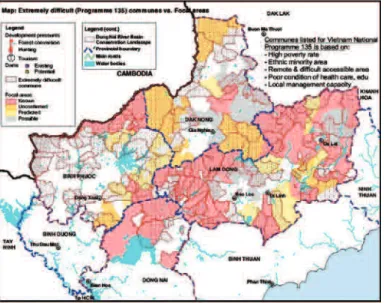
ticularly Da Teh district) and Bi Doup-Nui Ba National Park (particularly the watershed catchment areas of the Da Nhim dam in Lac Duong district). The study identified two initial pilot areas in Lam Dong Province that possessed the range of conditions and incentives (see Section 2.1) need-ed to achieve PFES development, habitat connectivity, and enhanced livelihoods. These districts (see Figure 1.2: Program 135 communes vs. Conservation Focal Areas) have populations comprising significantly poor ethnic mi-nority households that rely primarily on forest products for their livelihoods. The two national parks, in turn, represent important conservation anchors for the Dong Nai River Basin Conservation Landscape.
Figure 1.2 The mapping of poor communes outlined under Program 135 and conservation focal areas delineated under the biodiversity
assessments helped identify the two initial pilot PFES areas.
1.3 IMPLEMENTING THE PFES PILOT
POLICY IN LAM DONG PROVINCE
To implement the pilot policy, ARBCP worked with the Lam Dong Provincial Peoples’ Committee (PPC), Department of Agriculture and Rural Development (DARD), and MARD’s Forest Protection Department (FPD) to design and devel-op a PFES program that (1) promotes financial sustain-ability; (2) minimizes transaction costs; (3) encourages transparent flow of funds and information; (4) targets agro-forestry smallholders as the service providers; (5) provides ethnic minorities, women, and other disadvantaged groups with opportunities to participate as service providers as a means of poverty reduction; (6) fosters locally defined best management practices for PFES implementation and monitoring; and (7) strengthens environmental gover-nance mechanisms and increases institutional capacity of relevant national and provincial implementing agencies. The following case study examines the establishment of the scientific basis and justification for forest environmen-tal services in Lam Dong Province, recounts the capacity building and public awareness efforts necessary to imple-ment the pilot policy; details the key activities undertaken during the two-year implementation phase; summarizes the ongoing monitoring and evaluation efforts; and pro-vides an overview of the pilot’s achievements, challenges and lessons learned.Results
Monitoring, Evaluation
&
Adjustments
Pilot
Implementation
Capacity Building &
Awareness
Raising
Policy Issued
Biological &
Macroeconomic Assessments
1.4 TIMELINE OF PFES PILOT POLICY IMPLEMENTATION
This time line provides a schematic representation of the main activities undertaken to prepare for and ultimately implement the PFES pilot policy effectively in Lam Dong Province. Its successful implementation led to the disbursement of US $4.46 million to, amongst others, 9,870 primarily ethnic minority and relatively poor households. It also led to the signing of a national PFES Decree into law on September 24, 2010.
2006 - 2007 April 2008 2008 - 2009 2009 2010 September 2010 December 2010
Biological Assessment of the Dong Nai River Basin Conservation Landscape undertaken.
Vietnamese government officials go on study tour to PES watershed management projects in the USA.
Spatial threats assessment completed for DNRBCL, together with macroeconomic assessment and cost-benefit analysis for major land use types of Lam Dong Province Biodiversity Conservation Action Plan drafted, providing rationale and basis for piloting sustainable conservation finance mechanism in Lam Dong Province. Valuation study in Da Nhim watershed completed, providing baseline estimates of economic value of ecosystems services in the watershed.
Pilot PFES policy approved under Prime Minister’s Decision No. 380/QÐ-TTg, establishing pilot phase for Lam Dong and Son La Provinces from January 2009 through December 2010.
Awareness raising campaigns on importance of biodiversity conservation and other environmental services values undertaken at commune, district, provincial and national level.
Training and capacity building on various disciplines including forest valuation, environmental monitoring, field surveying, and spatial modeling.
EVN, SAWACO, Bien Hoa Water Company, and 59 tourism concessions sign initial MOUs committing payments totaling US $3.4 million to protect more than 220,000 hectares of forests.
PFES payments set and first payments are received by the newly established Forest Protection and Development Fund (FPDF).
Da Nhim identified as first PFES pilot commune to enter into forest protection contracts under PFES pilot policy and first payments disbursed to households. Assessment of PFES policy implementation undertaken by MARD and payment levels increased.
Gaging Stations to monitor water and sediment flows installed at four sites in Da Nhim watershed. Preliminary data supports the fact more sediment originates from agricultural land use versus forest land.
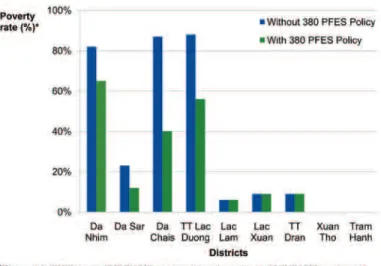
Socioeconomic study carried out to evaluate the impact of payments on households. Showed pilot PFES policy plays an important role in family cash income, reducing poverty and forest degradation.
Prime Minister of Vietnam signs the National PFES Decree into Law.
PFES payments totaling US $4.46 million have been made to 22 Forest Management
Boards and forestry businesses, as well as to 9,870 households, 6,858 of which are
“Downstream users
such as hydroelectric
power plants and water
companies, gain benefits
from water regulation and
soil conservation, and so
arguably should pay
upstream providers of these
environmental services.”
S
ECTION
2: I
NITIAL
S
TUDIES
AND
C
ONSULTATIONS
ARBCP undertook a series of studies and consultations with regional and international
experts, with the aim of informing the policy development process, providing a scientific
and socioeconomic basis for the pilot site selection, and determining the market value for
water, soil, and aesthetic environmental services in the Dong Nai River basin. Major studies
and significant results and findings are detailed below.
2.1 BIOLOGICAL ASSESSMENT AND
CONSERVATION ACTION PLAN
In 2006-2007, ARBCP supported the completion of a study entitled Biological Assessment of the Dong Nai River Basin Conservation Landscape (Pilgrim et al, 2007), which examined the four provinces of Binh Phuoc, Dak Nong, Dong Nai, and Lam Dong in southern Vietnam. The principal result of the assessment was an ambitious bio-logical vision for strategic conservation action. The vision comprised a set of “conservation foci” (global biodiversity elements that were deemed conservation priorities); a map of “focal areas,” which provided a set of priority geo-graphic options for the conservation foci; and a series of “conservation targets” that needed to be met for the biodi-versity elements to be conserved.
The conservation foci included two ecological processes (habitat manipulation by very large herbivores and pre-dation by large carnivores); three focal communities (up-land evergreen forest, non- or slow-flowing wet(up-lands, and fast-flowing rivers and streams); and 36 focal taxa (five mammals, seven birds, one reptile, one amphibian, and 22 plants). The focal areas were mainly distributed within the conservation landscape’s major forested corridors, including the corridor from Vinh Cuu Nature Reserve to Bi Doup-Nui Ba National Park along the Dong Nai River and a cluster of areas around Cat Tien National Park and between Ta Dung Nature Reserve and Bi Doup-Nui Ba National Park.
A spatial assessment (Thai, 2009) was conducted to de-termine the level of economic threats in the priority con-servation focal areas. Two provincial-level macroeconom-ic assessments were conducted in Lam Dong (Thanh, 2009) and Binh Phuoc Provinces to further understand the rate and direction of change that could be expected under future development plans and to help the program and
its partners further prioritize areas for implementing pilot activities. This process considered conservation priorities, as well as imminent conservation threats derived from the socioeconomic status of the local communities. Two focal areas — Da Teh and Da Nhim in Lam Dong Province, ly-ing at the two extremes of the Vinh Cuu Nature Reserve and Bi Doup-Nui Ba National Park corridor, respectively — were identified as appropriate pilot sites.
The biological assessment was considered along with three other studies: Lam Dong Province Macroeconomic Assessment (Thanh, 2009), Lam Dong Spatial Threats Analysis (Thai, 2009) and the Cost-Benefits Analysis
for Selected Crops and Trees—Lam Dong Province (THanh, 2007). The result was the Lam Dong Biodiversity Conservation Action Plan (BCAP) (Lam Dong PPC, 2008), developed by ARBCP, Lam Dong DARD and Forest Protection Department (FPD) with cooperation of other relevant provincial departments.
The BCAP provides a framework to maintain and strengthen landscape connectivity and functions of eco-systems, particularly between Cat Tien National Park and Bi Doup-Nui Ba National Park; maintain and develop focal populations, species, and genetic diversity; and mobilize resources from the government, nongovernment organi-zations, and economic sectors to make contributions to, and share the benefits from, conservation and biodiver-sity in the province. The Lam Dong Province BCAP was completed and approved by the Lam Dong PPC in 2007, providing the rationale and basis for piloting a sustainable conservation finance mechanism in Lam Dong. The plan also presented recommended assessments and conser-vation measures for conserconser-vation foci, particularly focus-ing on endangered and endemic species that have re-ceived less attention in the past.
2.2 BIODIVERSITY MONITORING
A baseline assessment of biodiversity in Da Teh’s forests was undertaken as part of the BCAP for Lam Dong. Da Teh was chosen for its importance as a buffer zone for Cat Tien National Park, as well as its location in the forest corridor connecting Cat Tien to the natural forests of the Langbian Plateau around Da Lat City. Beginning in 2007, communi-ty-led teams monitored the populations of target species in Da Teh district over the course of three years. Existing target species and populations of global and national con-servation significance include the yellow-cheeked crested gibbon (Nomascus gabriellae), black-shanked douc langur (Pygathrix nigripes), orange-necked partridge (Arborophila davidi), green peafowl (Pavo muticus), Germain’s peacock pheasant (Polyplectron germaini), and great Indian hornbill (Buceros bicornis) 4.
The most recent survey in Da Teh district, conducted in December 2009, revealed a viable population of yellow-cheeked crested gibbon, a high encounter rate of great Indian hornbill, and potentially the highest known density of orange-necked partridge in its range, a species en-demic to the Dong Nai Conservation Landscape (includ-ing Cambodia). Because gibbon and hornbill species are considered indicators of good forest quality, Da Teh forests can be judged to still provide suitable wildlife habitat and to serve as a buffer zone for Cat Tien National Park as well as a key habitat corridor in the Dong Nai River Basin Conservation Landscape.
Counterbalancing this good news were findings by the community-based monitoring program emphasizing the potential negative impact of the increasing number of com-mercial tree plantations (including rubber and acacia) on the biodiversity value and ecological function of Da Teh’s forests. Monitoring results showed a substantial reduction in gibbon activity in 2008 related to a sudden increase in forest disturbance by new private forest companies and lo-cal residents. A rebound in the number of gibbon groups in 2009 implies that gibbon populations can adapt to a higher disturbance level as long as large contiguous forest cover with a high density of tall broadleaf trees remains intact. 4. Yellow-cheeked crested gibbon is listed as ”endangered” in the Vietnam Red
Book 2007 and as ”vulnerable” in the IUCN Red List 2006; the black-shanked douc langur and orange-necked partridge are listed as ”endangered” in the
IUCN Red List and Vietnam Red Book; and the green peafowl, Germain’s
peacock pheasant and great Indian hornbill are listed as “vulnerable” in the Vietnam Red Book and “near threatened” in the IUCN Red List (Lam Dong PPC, 2008)
Community-based biodiversity monitoring had a dual ben-efit: Not only did it create the conservation monitoring baseline for Da Teh, it also built the capacity and aware-ness of five communes that received PFES payments while improving their knowledge about the environmental services that their forest provides and the requirements to sustain these services for the future.
Furthermore, ARBCP investments in the Da Teh district pi-lot site serve to provide a continuing laboratory for the as-sessment of biodiversity-friendly development alternatives that can help meet Lam Dong Province BCAP targets for conservation and socioeconomic development.
Pinus krempfii
—An Endemic Species
The conifer species Pinus krempfii ranks as one of the most important endemic tree species in the tropical moun-tainous monsoon area within Lam Dong Province. In rec-ognition of its intrinsic value5, a study was undertaken to
provide a scientific baseline for its conservation in the PFES pilot areas, encompassing its natural distribution and plans for future conservation and monitoring.
Using five standard permanent sampling plots workers studied the forestry characteristics, species ecology, and population ecology of Pinus krempfii. Two hectares of P.
krempfii were planted within the natural range of the spe-cies, with plantations monitored to assess mortality and determine ideal conditions for future conservation plant-ing. The study showed that illegal logging and conversion of forest to agriculture are restricting the species’ range. These factors, coupled with poor natural regeneration of
P. krempfii compared to other species in the ecosystem, could mean eventual extinction for this important endemic tree. P. krempfii is listed as “Vulnerable” in the Vietnam Red Book and as “Endangered” in the Red Book of the International Union for the Conservation of Nature.
The study provided recommendations for mitigating nega-tive impacts on the conifer’s range, demonstrated the envi-ronmental values of PFES pilot areas, and showed the im-portance of conveying this information to the households contracted under the PFES pilot mechanism.
5. Pinus krempfii is not only endemic to Lam Dong Province, but is considered to
be a rare conifer species due to its flat needles. As a result it is classified in its own subsection.: Krempfianae (Wang, et al, 1999)
2.3 VALUATION OF FOREST
ENVIRONMENTAL SERVICES
An integral part of the program involved an initial water-shed valuation model, undertaken to support the main thrust of the PFES pilot policy and to provide baseline estimates for the economic value of the Da Nhim water-shed catchment. The program also worked with Lam Dong Province to develop forest cover baseline assessments, which formed the basis for estimating carbon offset values that will enable Lam Dong Province to generate additional revenues from standing forests or forest restoration activi-ties in the future.
Water Regulation and Soil Conservation
ARBCP’s initial forest valuation study for the Da Nhim watershed provided baseline estimates of the tangible economic value of two vital environmental services pro-vided by intact forests (Thanh, 2008). Downstream users such as hydroelectric power plants and water companies, gain benefits from water regulation and soil conservation, and so arguably should pay upstream providers of these environmental services. The valuation study (see Figure 2.3 below) was also instrumental in raising the confidence level of policymakers regarding setting payment levels.
Figure 2.3 Two divergent land use scenarios were run through a Soil
& Water Assessment Tool (SWAT) model to demonstrate the impact
on hydropower production and generate tangible economic values for water regulation and soil conservation ecosystem services.
The program, in collaboration with local authorities, identi-fied hydropower and water-supply companies as potential payers of forest environment services, and forest-depen-dent rural households as payees.
More sediment is carried into a stream running through ag-riculture land than a similar stream running through intact forest. Storage capacity of a downstream reservoir de-creases as a result of sedimentation, shortening the reser-voir’s useful lifespan and creating a significant and quanti-fiable financial loss. Equally, an intact forest regulates the flow of water ultimately reaching a reservoir, minimizing flash floods.
The study used the Soil and Water Assessment Tool (SWAT) model on two different scenarios: preserving existing forest cover and converting 45,000 hectares of pine forest to agriculture. SWAT was used to predict wa-ter runoff and suspended sediment levels enwa-tering the Da Nhim Reservoir. The varying water inflows generated by the SWAT model were entered into a Power Generation Production model of the Da Nhim Hydropower Plant to estimate the daily power production outputs. The produc-tion value and net benefit under the two scenarios were estimated, as well as the Net Present Value (NPV) of the forest in dollars per hectare per year.
A model was established that took into consideration the sediment deposited in the reservoir for the two scenarios. The total power generation forgone due to the shift between the two scenarios was estimated, followed by the cash-flow from the power generation during the lifetime of the reser-voir. The change in the NPVs between the two scenarios was estimated, as well as the NPV of the losses. Finally, the value of the environmental service that forests provide in reducing sedimentation in the reservoir was estimated. Results indicated that one hectare of forest was valued at US$69 per year to the Da Nhim hydropower project, of which US$14.60 was attributed to the benefits accrued from water regulation and US$54.40 for reduction of sedi-ment into the reservoir. Translated into production cost, water regulation and soil conservation was priced at 64.55 VND per kilowatt-hour of electricity produced—14.9 VND for cost of water regulation and 49.6 VND for reduction of sediment into the reservoir.
These initial estimates formed the basis for policymakers to consider and ultimately decide upon the payment levels stipulated in the pilot PFES policy: 20 VND per kilowatt-hour for power generation and 40 VND per cubic meter for water provision. The study has also therefore been in-strumental in informing the development of the national PFES decree.
Landscape Aesthetics
Sustainable and effective conservation in Lam Dong depends in part on the development of ways for forest residents to reap measurable financial rewards from the province’s inherent beauty and scenic (aesthetic) values. ARBCP completed several studies providing a basis for medium- and long-term sustainable tourism planning, in-cluding a draft plan to fund conservation of Lam Dong’s natural and cultural assets. Studies included Lam Dong Provincial Tourism Master Plan: Options for Tourism and Biodiversity Funding Mechanisms (Rogers, 2008), the as-sociated Cost-Benefit Analysis of Sustainable Tourism in
Lam Dong Province (Rogers, 2008), and Linking Tourism and Payment for Ecosystem Services in Bidoup Nui Ba National Park Lam Dong Province, Vietnam (Patterson and Burns, 2009).
As a first step, potential payers in the pilot areas were identified and awareness raising programs implemented within the tourism sector. Later, ARBCP formulated a plan through which tourism companies in the pilot area could pay for forest environmental services. Deliberations at the provincial level, taking into consideration the ARBCP stud-ies, resulted in the decision to set the payment level of 0.5-2 percent of annual gross revenues for tourism companies.
The Da Nhim reservoir is laden with silt after recent storms. The
conversion of forest to agriculture (as seen in the foreground) is
known to increase runoff rates and soil erosion causing greater
sediment yields in streams, rivers and ultimately the reservoir.
Carbon Sequestration
The growing economic opportunities associated with car-bon credits offer additional ways for communities to gener-ate income while protecting forests. An important part of PFES, carbon credits reward forest stewards for preserv-ing trees that not only sequester CO2 from the atmosphere, but would have been a source of CO2 emissions had they been cut down. These credits are the result of a relative-ly new and evolving global framework called Reducing Emissions from Deforestation and Forest Degradation (REDD). The framework represents a potentially important means by which rural communities can benefit financially from forest protection.
ARBCP helped Lam Dong Province establish a forest cov-er baseline for the pilot PFES project area using Quickbird, one form of high-resolution satellite imagery. This work also provided the opportunity to estimate the carbon stocks in the pilot area. Ultimately, the value of the carbon sequestration service could be added to revenue from wa-ter regulation, soil conservation, and landscape aesthet-ics, providing households with greater compensation for protecting forests rather than, for example, clearing them to plant monoculture crops.
Using GEOMOD, a computer program which simulates land use change using geographic modeling, the defor-estation in a “business-as-usual” scenario was estimated. Carbon dioxide emissions associated with unplanned de-forestation (assuming a dede-forestation rate of 0.59 percent per year) were also predicted. The simulation indicated that between 2007 and 2037, a total of 2.19 million tons of carbon would be at risk of being lost across the whole Da Nhim watershed (representing 14,000 hectares of forest loss), equivalent to 8.02 million tons of CO2 emissions. ARBCP provided continuing support to Lam Dong Province in designing a REDD pilot project that would generate car-bon credits to be sold in the voluntary carcar-bon market. To provide a greater measure of confidence in the outcome, ARBCP helped the province estimate carbon emissions from an existing provincial plan to convert nearly 3,448 hectares of forest to development and agriculture (see Section 4.2 for more details).
“ARBCP estimates that more
than one million residents
(equivalent to about 10% of
the highly populated region
that encompasses Ho Chi
Minh City) in the Dong Nai
River basin have received
information about PFES and
biodiversity conservation
through provincial and
national media
coverage.”
S
ECTION
3: P
UBLIC
A
WARENESS
, C
APACITY
B
UILDING
,
AND
T
RAINING
The concept of Payment for Ecosystem Services is gaining recognition worldwide, but is
still a relatively new concept in the Southeast Asia region, Vietnam notwithstanding. ARBCP
recognized the need for national and local awareness raising activities, as well as
provincial-level capacity building and training to ensure that the ambitious objectives outlined for the
pilot PFES mechanism could be realized within the two-year pilot implementation phase.
AWARENESS RAISING
PES Study Tour to US
During the months leading up to the pilot PFES policy de-velopment phase, in 2007 ARBCP and the U.S. Forest Service (USFS) supported a study tour to the United States for participants from Vietnam, Cambodia, and Thailand. The tour visited successful PES watershed-management projects in which upstream forest and ecosystem service providers receive financial incentives from downstream beneficiaries. Participants also learned how PES programs in Hawaii, Oregon, and New York calculated economic de-mand for watershed services and garnered support for the services through tangible economic incentives.
Through presentations, site visits, and discussions with lo-cal officials, participants learned about interagency coop-eration, innovative public-private partnerships, and legisla-tive and legal support mechanisms designed to encourage private-sector involvement in service delivery. The tour pro-vided excellent real-life concepts and models for applica-tion and replicaapplica-tion in the design and the implementaapplica-tion of the ARBCP pilot PFES policy development activities in Vietnam. ARBCP worked with the Vietnamese participants in considering the best practices presented in the study tour when evaluating private sector demand for environ-mental services in Vietnam and when designing the PFES mechanism with Vietnamese water utilities, hydropower companies, and tourism operators. The tour also exposed the participants to the range of scientific, legal, political, and administrative procedures required to facilitate PES proj-ects in the United States and their relevance for Vietnam.
Community-Level Public
Awareness Campaigns
In 2008, ARBCP began conducting awareness raising campaigns on the importance of biodiversity and other
environmental services values, both at the commune and district level and the Dong Nai River basin and nationally. Campaigns were launched with support from district offi-cials and local communities in Quoc Oai, An Nhon, Da Lay, Da Kho, and Huong Lam communes of Da Teh District, as well as the Da Nhim, Da Sar, and Da Chais communes of Lac Duong District in Lam Dong Province. The campaigns featured contests, performances, and competitive role-playing skits. Village teams were judged on their conser-vation knowledge and ability to link general environmen-tal messages to attitude and behavioral change. Several of the skits were televised across Lam Dong Province. ARBCP estimates that more than one million residents (equivalent to about 10% of the highly populated region that encompasses Ho Chi Minh City) in the Dong Nai River basin have received information about PFES and biodi-versity conservation through provincial and national me-dia coverage. Local news agencies aired these and other PFES stories during their weekend programming to ensure a wide viewership among local farming communities.
“Town hall” meetings on PFES in the Da Nhim commune provided a forum to raise the awareness of local households on forest environmental services, answer questions and elicit ideas
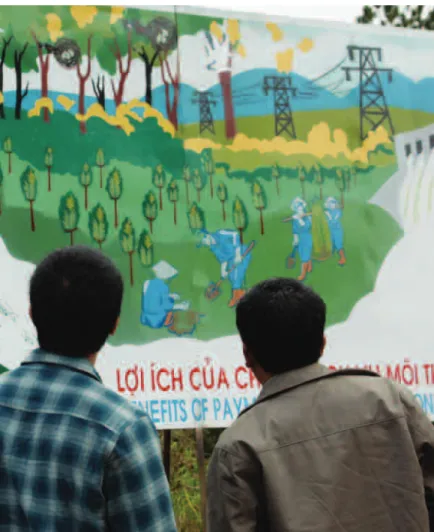
Figure 3.1 Forty-one roadside PFES billboards were installed in districts within the Da Nhim watershed to further raise awareness of the benefits of ecosystem services and the need to keep forests intact.
Once the PFES pilot communities were identified in early 2009 (see Section 1.2), the project translated the PFES Pilot Policy (Decision 380; see Section 1.1) into local lan-guages and held informal commune and hamlet “town hall” meetings to introduce PFES concepts, outline the benefits of providing environmental services, and discuss how forest protection might be conducted at the commune level. ARBCP also coordinated with the Lam Dong Forest Protection and Development Fund (FPDF) – the indepen-dent entity created to manage the disbursement of the PFES payments – and the Forestry Department to work with Lam Dong television to broadcast brief messages about PFES in local languages to better inform minority communities about its benefits to participating households. In 2009, an Al Jazeera Asia news crew visited Lam Dong Province to shoot a two-minute news piece on the prov-ince’s groundbreaking PFES activities. The visit and short video served to demonstrate to local stakeholders the
in-creasing level of interest in the pilot PFES activities—not only in Vietnam but throughout Asia.
PFES Information Campaign by
the Government of Vietnam
Throughout the two-year pilot phase, ARBCP has support-ed provincial authorities and the FPDF in a major PFES public information campaign, which included installing 24 poster panels in Lac Duong, Don Duong, Duc Trong, and Da Lat districts, displaying more than 200 small bill-boards at major tourist sites, installing 41 large roadside billboards (see Figure 3.1), and distributing 14,200 bro-chures, as well as organizing meetings and workshops for local stakeholders.
The FPDF also launched a VND 438 million (US$ 22,000) multimedia publicity program in September 2009, which disseminated information on PFES through television and radio programs aired in Lam Dong Province.
ARBCP helped MARD develop a 30-minute video on PFES implementation that has been aired nationally on television and widely featured at various inter-ministerial and national meetings. The video includes interviews and discussions with national, provincial, and local PFES im-plementers, and closes with remarks on the success of PFES in Lam Dong Province by Deputy Prime Minister Hoang Trung Hai.
3.1 CAPACITY BUILDING AND TRAINING
Provincial-Level Capacity
Building and Training
To prepare Lam Dong Province to undertake the PFES pi-lot, ARBCP worked with provincial officials to appoint a ten-member Lam Dong PFES Technical Working Group made up of forestry and environment experts from the province, as well as key technicians and civil servants from DARD, DONRE, the Department of Culture, Tourism and Sport, and the FPDF.
ARBCP organized a series of workshops and discussion groups with experienced international PES experts, includ-ing experts from the New York City Water Supply-Catskill Watershed Corporation and the Heredia Public Utilities Company of Costa Rica. Provincial technicians were also
supported in attending overseas courses and undertak-ing study tours to build their capacity and improve their knowledge in tourism (Australia), watershed management (United States), and SWAT modeling (Thailand). ARBCP has also facilitated more than 50 technical training ses-sions for officials and technicians from more than 15 pro-vincial agencies.
Key training and capacity building exercises undertaken in collaboration with the PFES Technical Working Group are summarized below. ARBCP:
• Provided training on environmental monitoring and for-est valuation, including watershed management, field surveying, and REDD-related courses (carbon stock measurement, spatial modeling, Voluntary Carbon Standard) (see Figure 3.2 below);
• Provided advice and training on data collection re-quired to develop baselines for conservation of en-demic species;
Figure 3.2 Training on carbon stock measurements in Da Nhim
watershed ensures buy-in from provincial counterparts and
stakeholders and sustainability of the monitoring process.
• Conducted training sessions for the PFES Technical Working Group and the local Environmental Impact Assessment committee on environmental assessments
of roads in partnership with the U.S. Forest Service; • Worked with DONRE to install and collect data from
four gauging stations with training support from the U.S. Geological Survey;
• Trained provincial officials to conduct a socioeconomic survey on PFES and analyze and report results; and • Supported training on land use classification from
re-mote sensing images in partnership with Chiang Mai University, Thailand.
Testing Forest-Friendly
Livelihood-Improvement Models in Da Teh
To further inform the pilot PFES activities in Lam Dong Province, ARBCP tested models for livelihood improve-ment focused on increasing household incomes while aiding biodiversity conservation. The project has worked to bolster enterprise development and production of non-timber forest products, particularly in bamboo handicraft production and planting and processing of cacao and essential oils. Within these sectors, the project linked forest-dependent communities with “downstream” firms and markets in Ho Chi Minh City, leveraging project sup-port to communities and enterprises to develop profitable commercial-based relationships that ensure communities’ long-term access to technology and financing.
The project facilitated the signing of ten commercial con-tracts between private enterprises and farmers who supply raw materials and end products such as handicrafts and essential oils. ARBCP continues to strengthen these pub-lic-private partnerships and build the capacity of new en-terprises by providing market knowledge, production train-ing, and management advice to farmers, community lead-ers, and local authorities through study tours and monthly cooperative meetings. To date, ARBCP has trained more than 1,400 farmers through improved rural livelihood and agroforestry activities.
As a result, low quality forests have been enriched, im-proving the wildlife habitat and maintaining an important buffer zone to the Cat Tien National Park.
“Forest protection services have
resulted in a 50 percent decrease in
the number of reported cases of illegal
logging and wildlife poaching in
the Da Nhim watershed.”
S
ECTION
4: I
MPLEMENTING
THE
P
ILOT
PFES P
OLICY
IN
L
AM
D
ONG
P
ROVINCE
As described in previous sections, the preparations and process for implementing the pilot
PFES policy in Lam Dong Province included scientific studies, national and local awareness
raising efforts, and provincial capacity building and training activities. The Lam Dong pilot
implementation plan was developed in consultation with national, provincial, and local
stakeholders to ensure immediate buy-in and commitment from the province, the payers,
and the services providers.
4.1 IMPLEMENTATION APPROACH
Da Nhim Commune PFES Pilot
• 5 hamlets
• 220 farmers
• 90% K’ho ethnic minority • 4,800 ha contracted to protect
• Average income from forest protection activities under government sponsored 661program in 2008
was $417/household/yr
In 2009, Lam Dong DARD, with assistance from ARBCP and the legal authority from MARD and the Lam Dong PPC, finalized the work plan for a two-year pilot PFES im-plementation phase scheduled to end in December 2010. A national PFES Steering Committee was established with representatives from MARD, DARD, PPC, Office of the Government, Ministry of Planning and Investment, Ministry of Finance, and ARBCP. The committee’s primary function is to review, lead, and monitor the PFES implementation plan. In April 2009, the steering committee, in concert with the Lam Dong PPC, determined that one PFES pilot com-mune (Da Nhim) would be the first to enter into forest-pro-tection contracts.
Identifying the Payers
ARBCP worked with national and provincial stakeholders to identify a range of potential payers for environmental services. In particular, the project worked with the Lam Dong provincial government to identify payment mecha-nisms and beneficiaries from improved watershed
man-agement, including hydropower facilities and large tourism concessions in Lam Dong Province. ARBCP conducted a series of valuation studies (see Section 2) to estimate revenues, potential payments, and the potential impact of focusing on, and putting a value on, forest environmental services as part of improving watershed management. Two hydropower companies, Da Nhim and Dai Ninh, as well as Sai Gon Water Company (SAWACO) were identi-fied by the PFES Steering Committee as the pilot’s first payers. Tourism operators in Lam Dong Province and the Dong Nai Water Company were added later.
Figure 4.1 The Lam Dong FPDF has received 107.81 billion VND (US $5.53 million) from payers – primarily from the Da Nhim and Dai Ninh
hydropower plants – who are benefiting from the forest environmental services the intact forests provide in the form of regular water flow and
reduced sedimentation in rivers and aesthetically-pleasing landscapes.
As dictated by the GoV to Electricity of Vietnam (EVN), under the PFES pilot policy the participating hydropower
companies were instructed to pay 20 VND per kilowatt-hour into the Lam Dong Forest Protection and Development Fund (FPDF). The Dong Nai and Sai Gon water supply companies were instructed to pay 40 VND per cubic meter, while tourism companies operating in and around Da Lat City were to contribute 1 percent of their total annual gross revenue into the fund. Figure 4.1 shows the breakdown of total payments made into the FPDF: 107.81 billion VND (US$5.53 million) from January 2009 to December 2010.
Establishing the Forest Protection
and Development Fund
With ARBCP technical support, Lam Dong Province es-tablished Vietnam’s first provincial Forest Protection and Development Fund. Lam Dong’s FPDF serves as a key financial component of Vietnam’s first decentralized bud-get-transfer mechanism. The fund is overseen by an in-dependent governing board consisting of representatives from DARD, Department of Finance, DONRE, Department of Planning and Investment, Department of Taxation,
Department of Industry and Trade, and the State Treasury, who together appointed the fund’s manager. The fund is monitored by independent auditors to ensure transparent and proper use of the monies received and paid out for the forest protection services.
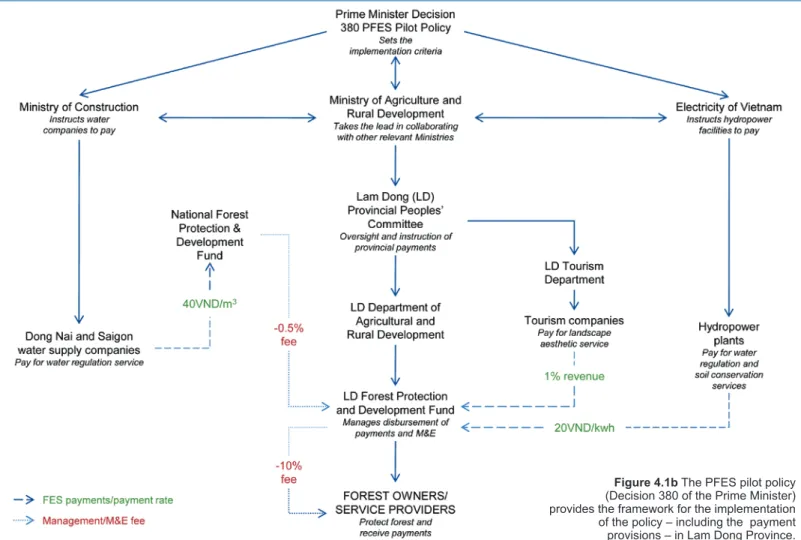
In early 2009, EVN, SAWACO, Bien Hoa Water Company, and 59 tourism concessions signed initial Memorandums of Understanding (MOUs) committing payments totaling US $3.4 million to protect more than 220,000 hectares of forests and the services they provide. The provincial FPDF was set up to receive these payments, transfer them to ser-vice providers (forest owners), and ensure that the serser-vices are properly delivered. Figure 4.1b depicts the payment process and associated management fees currently being employed under the Lam Dong pilot PFES mechanism.
Contracting Forest Protection
and Management Services
As part of the pilot PFES implementation, the FPDF and Lam Dong Province initiated forest protection contracts
Figure 4.1b The PFES pilot policy (Decision 380 of the Prime Minister)
provides the framework for the implementation
of the policy – including the payment provisions – in Lam Dong Province.
in five hamlets, involving 218 contracted households, for patrolling 4,795 hectares of forest in and around the Da Nhim commune for a three-month pilot phase. Farmers and forest management boards (FMBs) were allowed to enter into the pilot program on a voluntary basis. Commune leaders met with the FPDF managers, DARD, and FMBs to discuss contract terms and payment levels. After several meetings, the parties agreed that the ser-vices would include:
• Maintaining and improving the forest and soil by patrol-ling regularly according to a fixed schedule;
• Patrolling and guarding the forest to promptly detect and stop any illegal encroachment activities or any ac-tivity that could harm the forest;
• Installing signage provided by the province for demar-cating the boundaries of the contracted area; and • During the dry season, clearing and treating
combus-tible materials, establishing fire breaks, constructing makeshift fire sentry towers, and supporting firefighting efforts when needed.
In addition, the farmers are not allowed to negatively im-pact the forest, hunt forest animals, raise animals in the forest, import exotic or invasive species to raise in the for-est, change the natural landscape of the forfor-est, or cause environmental pollution to the contracted protection area. Daily patrolling entries in the Forest Environmental Services Protection Contracting Logbook provide the ba-sis for the quarterly payments.
Establishing Payment Levels
Extensive studies were undertaken to assess how to set PFES payments based on forest quality and threat lev-els, ultimately employing the concept of a “K coefficient.”6
However, pilot communities in Lam Dong Province elect-ed to keep the payments consistent for forest environmen-tal services to assure equitable payments and thereby avoid conflicts. In 2009, the province decided on pay-ments of 290,000 VND/ha/yr for the Da Nhim watershed and 270,000 VND/ha/year for the Dai Ninh watershed. In 2010, the province increased payment levels through two legal decisions7 to 400,000 VND/ha/year in the Dai Ninh
6. Article 13 in Decision 380/TTg provided guidance for applying a coefficient (the K-coefficient) to different forest areas to determine their relative value based on
an average of four factors: forest type, KLR (protection/special use/production);
quality of forest, KCLR (rich/moderate/poor/secondary); origin of forest, KNGR
(natural forest/planted forest); and human impact, KTĐ (near road or residential
areas, remote forest area) i.e. K= (KLR+KCLR+KNGR+KTD)/4.
7. Decision 415/QÐ-UBND, dated February 14, and Decision 1363/QÐ-UBND, dated June 25, 2010.
watershed, to 350,000 VND/ha/year in the Da Nhim wa-tershed. This was a corrective administrative step to ac-celerate disbursement of funds that had accrued during the delayed allocation of land and contracting of farmers to provide forest protection services.
Farmers from Da Teh District plant bamboo seedlings under ARBCP-supported public-private partnerships to enrich natural
forests (thereby improving habitat for wildlife) and provide a
sustainable resource for bamboo handicraft production.
Expanding PFES in Lam Dong Province
According to the FPDF’s report from January 2011, PFES payments have been made to 22 Forest Management Boards and forestry businesses, as well as to 9,870 house-holds (6,858 of which are ethnic minorities; and includes over 13,000 women), for the protection of 209,705 hect-ares of threatened forest land. The average household payment in 2009 was 8.1-8.7 million VND (US $438-470) per year, with each household protecting approximately 30 hectares. In 2010, the average payment per household was increased to 10.5-12 million VND (US $540-615) an-nually. These payments represent an almost 400 percent increase over previous forest protection income received from national GOV policies. Based on information in the patrolling logbooks, forest protection services have re-sulted in a 50 percent decrease in the number of reported cases of illegal logging and wildlife poaching in the Da Nhim watershed.
4.2 EXPLORING OTHER PES
OPPORTUNITIES IN LAM
DONG PROVINCE
Avoidance of Carbon Emissions
Carbon sequestration is one of the most important environ-mental services provided by forests, reducing greenhouse gases that contribute to climate change. The Government of Vietnam acknowledges this by including references to car-bon sequestration in the national PFES decree. However, given the extended time for any payments to originate from the sale of Certified Emission Reductions (CERs) or carbon credits and the fact there was still uncertainty surrounding the mechanism within the Province and Vietnam in gen-eral, carbon offsets were not included in the pilot phase of PFES. Nevertheless, payments from future REDD or vol-untary offset projects, when bundled with the payments for water regulation, soil conservation and landscape aesthet-ics, would be better able to offset the cost of coffee planta-tions and other high-income activities farmers would forgo. As such, ARBCP has built the capacity of the Lam Dong Technical Working Group to benefit from future REDD activities including forest carbon inventorying and spatial modeling. An iterative learning-by-doing approach has been employed to guarantee sustainability. With support from Winrock International’s Ecosystem Team, different approaches were considered to generate CERs from the project area, such as avoidance of unplanned deforesta-tion and/or planned deforestadeforesta-tion. The program focused its efforts primarily on the avoidance of deforestation of 3,448 hectares scheduled by the province for conversion to agri-culture and urban development. Taking into consideration the calculated biomass of 60 tons of carbon per hect-are (tC/ha), and the proposed logging of the entire hect-area by 2020, it is estimated that 265,191 tC would be saved, equivalent to 973,252 tCO2 of emissions avoided, amount-ing to US $4.7 million in revenues (assumamount-ing no leakage and a price of US $5 per tCO2 emissions avoided).
Biodiversity Conservation
through Agroforestry
The program’s successful establishment of biodiversity-friendly microenterprise models has supported the devel-opment of incentive-based, biodiversity-friendly natural resource management approaches that can be applied
under PES projects to improve the incomes of poor house-holds while improving habitat connectivity and ecosystem function targets.
Earlier this year, ARBCP facilitated a public-private partner-ship with Ho Chi Minh City-based essential oil company, Saroma, and six farmers in a pilot program to cultivate ten hectares of lemongrass. Planting and processing strictly followed the GLOBALG.A.P (Good Agricultural Practices) guidelines. To this end, ARBCP and Saroma worked close-ly with the farmers to provide necessary technical and fi-nancial support, including training, regular inspections, and on-site advice to ensure that the production process observed the GLOBALG.A.P standards. Saroma and the cooperative were awarded GLOBALG.A.P certification in May 2010. As a result, the company will be able to access niche markets resulting in higher prices for the products, and higher revenues for the farmers in principle.
Private sector investments in the program’s biodiversity-friendly bamboo agroforestry model support conservation targets in two biodiversity corridors: Da Teh in Lam Dong Province and Vinh An in Dong Nai Province. Initial moni-toring results in the Da Teh biodiversity corridor document that populations of six target wildlife species migrated to areas where the program’s bamboo planting and agrofor-estry models avoided clearing of natural forest.
ARBCP supported the sustainable production of bamboo handicrafts by public-private partnerships, providing employment and supplemental income to poor rural households in Da Teh District.
“Vietnam is now developing
as a center of excellence,
from which other countries
in the region could learn
about implementing
PES mechanisms.”
ARBCP engaged in a series of stakeholder consultations to discuss the pilot implementation. It supported a com-prehensive socioeconomic survey to review the impact of the policy and, in particular the PFES payments, on par-ticipating households and communes as well as the im-pact on the payers and related forest owners designated by the Government to manage forests, such as the Forest Management Boards and the National Parks.
ARBCP helped Lam Dong Province establish a watershed monitoring system in sub-catchments of the Da Nhim wa-tershed. This action supports the scientific premise that effectively maintaining and managing forest cover will re-duce soil erosion and enhance water regulation, and in turn reduce future production costs for hydropower and water supply companies.
5.1 MID-TERM EVALUATION
ARBCP supported MARD in completing a mid-term evalu-ation report for the pilot PFES policy. This report was sub-mitted to the Prime Minister and the findings were pre-sented by Mr. Hua Duc Nhi, Vice-Minister of MARD, at a national meeting in Hanoi hosted by MARD and chaired by Mr. Nguyen Sinh Hung, Standing Deputy Prime Minister, on March 9, 2010.
Experiences in piloting the policy were presented by rep-resentatives from the main stakeholders involved in the pi-lot PFES implementation in Lam Dong Province (and Son La Province), including the Lam Dong Province Peoples’ Committee, the Da Nhim Hydropower Plant, the People’s Committee of Da Nhim Commune, Sai Gon Water Supply Company, and Lam Dong Department of Agriculture and Rural Development.
In general, it was noted that the pilot policy was being im-plemented successfully, with payments made by the pay-ers and received by the communities providing the forest protection service. The income of households involved in the implementation of the policy was shown to have
in-creased significantly. PFES payments were becoming an important source of income for poor households, especial-ly those of ethnic minorities. As a result, forests in the pilot areas were acknowledged to be better protected, with the incidence of violations and encroachment reduced signifi-cantly. According to the report, businesses benefitting from forest environmental services understood that PFES was an input investment that fosters sustainability of their own business operations.
Vietnam is now developing as a center of excellence, from which other countries in the region could learn about im-plementing PES mechanisms.
Deputy Prime Minister Nguyen Sinh Hung affirmed that Vietnam was committed to continuing the pilot PFES im-plementation by supporting the development of a national PFES Decree that would effectively expand the pilot activi-ties to 15 provinces.
PFES–contracted farmers patrol forests in Da Chais commune in the
Da Nhim watershed, deterring illegal logging and encroachment of
agricultural plots in return for payments of up to 350,000 VND/ha/year.