ROBOT SKILL LEARNING THROUGH HUMAN DEMONSTRATION AND INTERACTION
By YE GU
Bachelor of Engineering in Electrical Engineering Harbin Institute of Technology
Harbin, Heilongjiang 2007
Master of Science in Engineering Management University of Minnesota Duluth
Duluth, Minnesota 2010
Submitted to the Faculty of the Graduate College of the Oklahoma State University
in partial fulfillment of the requirements for
the Degree of
DOCTOR OF PHILOSOPHY May, 2015
ii
ROBOT SKILL LEARNING THROUGH HUMAN DEONSTRATION AND INTERACTION
Dissertation Approved: Weihua Sheng Dissertation Adviser Qi Cheng Martin Hagan Christopher Crick
iii
Acknowledgementsreflecttheviewsoftheauthorandarenotendorsedbycommittee membersorOklahomaStateUniversity.
ACKNOWLEDGEMENTS
I would never have been able to finish my dissertation without the guidance of my committee members, help from friends, and support from my family.
I would like to express my deepest gratitude to my advisor, Dr. Weihua Sheng, for guiding and supporting me over the years. You have set an example of excellence as a research, mentor and role model. Thanks for taking me on as a new graduate student who knew very little about Robotics. Thanks for your tremendous effort to my dissertation and papers.
I’d like to thank my committee members for all of their guidance through this process; your advices, discussion and feedback have been absolutely invaluable. Special thanks go to Dr. Crick for giving me precious professional advices and access to his lab equipment. It was a pleasure to work with you.
I would also like to thank my parents, my grandmother and all my family members. They were always supporting me and encouraging me with their best wishes.
Finally, I would like to dedicate this thesis to my grandfather. You have been always motivating me especially when I was struggling. Although it has been years since you have passed, I still take your words with me, every day.
iv
Name: Ye Gu
Date of Degree: MAY, 2015
Title of Study: ROBOT SKILL LEARNING THROUGH HUMAN DEMONSTRATION AND INTERACITON
Major Field: ELECTRICAL ENGINEERING
Abstract: Nowadays robots are increasingly involved in more complex and less structured tasks. Therefore, it is highly desirable to develop new approaches to fast robot skill acquisition. This research is aimed to develop an overall framework for robot skill
learning through human demonstration and interaction. Through low-level demonstration and interaction with humans, the robot can learn basic skills. These basic skills are treated as primitive actions. In high-level learning, the complex skills demonstrated by the
human can be automatically translated into skill scripts which are executed by the robot. This dissertation summarizes my major research activities in robot skill learning. First, a framework for Programming by Demonstration (PbD) with reinforcement learning for human-robot collaborative manipulation tasks is described. With this framework, the robot can learn low level skills such as collaborating with a human to lift a table
successfully and efficiently. Second, to develop a high-level skill acquisition system, we explore the use of a 3D sensor to recognize human actions. A Kinect based action recognition system is implemented which considers both object/action dependencies and the sequential constraints. Third, we extend the action recognition framework by fusing information from multimodal sensors which can recognize fine assembly actions. Fourth, a Portable Assembly Demonstration (PAD) system is built which can automatically generate skill scripts from human demonstration. The skill script includes the object type, the tool, the action used, and the assembly state. Finally, the generated skill scripts are implemented by a dual-arm robot. The proposed framework was experimentally evaluated.
Contents
1 Introduction 1
1.1 Motivation . . . 1
1.2 Objectives . . . 2
1.3 Overview of Robot Skill Learning Approaches . . . 3
1.3.1 Programming by Demonstration . . . 4
1.3.2 Reinforcement Learning . . . 5
1.4 Related Works . . . 6
1.4.1 Learning from Demonstration . . . 6
1.4.2 Action Recognition . . . 9
1.4.3 Ways of Skill Demonstration . . . 12
1.5 Organization of the Dissertation . . . 13
2 Human Robot Table Lifting through PbD and Reinforcement Learning 15 2.1 Motivation . . . 15
2.2 Problem Statement . . . 16
2.3 Experimental Setup . . . 16
2.3.1 Motion Capture System . . . 17
2.3.2 Calibration . . . 18
2.3.3 Imitation Learning Phase . . . 19
2.3.4 Reinforcement Learning . . . 22
2.4.1 Imitation Learning Results . . . 24
2.4.2 Reinforcement Learning Results . . . 25
2.5 Summary . . . 28
3 RGB-D Sensor based Manipulative Action Recognition 30 3.1 Motivation . . . 30
3.2 Problem Statement . . . 31
3.2.1 System Setup . . . 31
3.2.2 Formulation of the Problem . . . 32
3.3 Methodology . . . 33
3.3.1 Object Recognition . . . 33
3.3.2 HMMs for Low-level Action Recognition . . . 36
3.3.3 Bayesian Network for Modeling Object/action Dependency . . . 37
3.3.4 HMM Modeling of Sequential Constraints . . . 39
3.4 Experiments and Results . . . 40
3.4.1 Experiment Procedure . . . 40
3.4.2 Results . . . 42
3.5 Summary . . . 48
4 Fine Manipulative Action Recognition through Sensor Fusion 50 4.1 Motivation . . . 50
4.2 Problem Statement . . . 51
4.2.1 System Setup . . . 52
4.2.2 Formulation of the Problem . . . 54
4.3 Methodology . . . 54
4.3.1 Object Recognition . . . 55
4.3.2 Fusion Method . . . 56
4.3.3 Bayesian Network for Modeling Object/action Dependency . . . 58
4.4.1 Experiment Setup . . . 59
4.4.2 System Evaluation . . . 60
4.5 Summary . . . 68
5 Automated Complex Assembly Skill Acquisition through Human Demonstration 69 5.1 Motivation . . . 69
5.2 System Overview . . . 71
5.2.1 PAD System Setup . . . 71
5.2.2 Formulation of the Problem . . . 71
5.3 Methodology . . . 73
5.3.1 Assembly State Estimation . . . 74
5.4 Experiment and Results . . . 76
5.4.1 Object Recognition . . . 76
5.4.2 Action Recognition . . . 78
5.4.3 Assembly State Estimation . . . 80
5.5 Summary . . . 86
6 Implementing Assembly Skills on the Baxter Robot 87 6.1 System Overview . . . 87
6.1.1 Hardware Setup . . . 88
6.1.2 Calibration . . . 88
6.1.3 Object Tracking . . . 91
6.2 Basic Action Learning . . . 93
6.3 Script Implementation . . . 97
6.3.1 Experiment Procedure . . . 97
6.3.2 Results . . . 98
6.4 Summary . . . 100
7 Conclusions and Future works 102 7.1 Conclusions . . . 102
List of Tables
3.1 Object and action dependencies. Darker color represents lower probability. . . 40
3.2 The confusion matrix of object recognition . . . 44
3.3 Recognition accuracy of the low-level HMMs . . . 44
3.4 Recognition accuracy of the Bayesian model . . . 45
3.5 Recognition accuracy of the high-level HMM . . . 47
3.6 The profiles of the subjects . . . 47
3.7 Recognition Accuracy Comparison for MSRDailyActivity 3D dataset . . . 48
4.1 The action, tool and part sets. . . 60
4.2 The object recognition accuracy. . . 61
4.3 The feature selection output . . . 61
4.4 The list of recognition approaches. . . 62
4.5 Recognition accuracy of the decision-level fusion method . . . 66
4.6 Recognition accuracy of the feature-level model . . . 66
4.7 Recognition accuracy of the Bayesian model . . . 67
4.8 The profiles of the subjects . . . 67
5.1 The object recognition accuracy. . . 79
5.2 Recognition accuracy of the HMMs . . . 79
5.3 Recognition accuracy of the Bayesian model . . . 80
5.4 The procedure of the assembly task . . . 83
List of Figures
1.1 The overall learning framework. . . 3
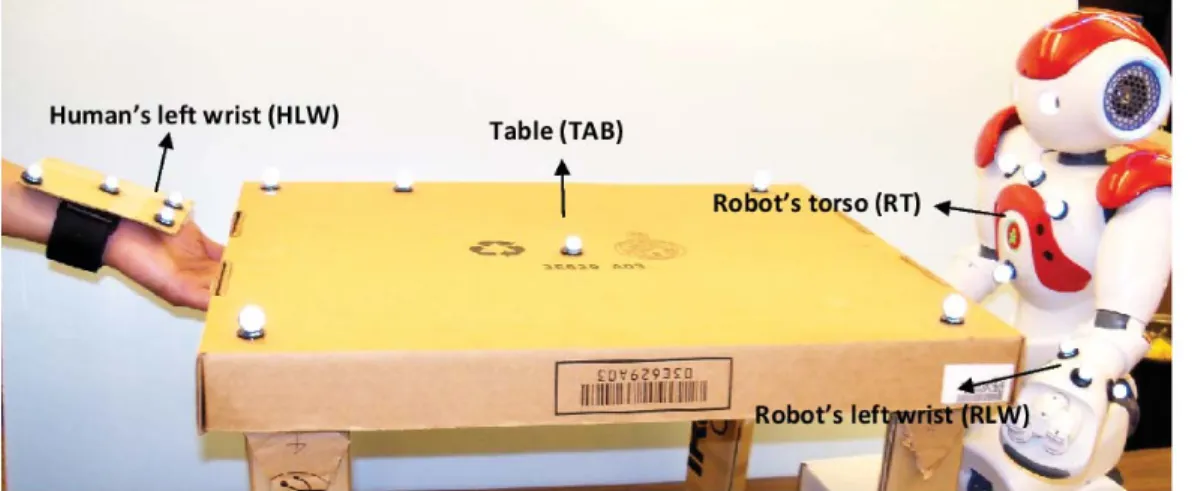
2.1 Experimental setup. . . 17
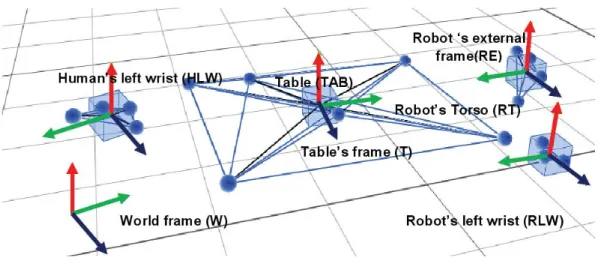
2.2 The frames used in the experimental setup. . . 18
2.3 The block diagram of the imitation learning phase. . . 19
2.4 State definition for the reinforcement learning. . . 23
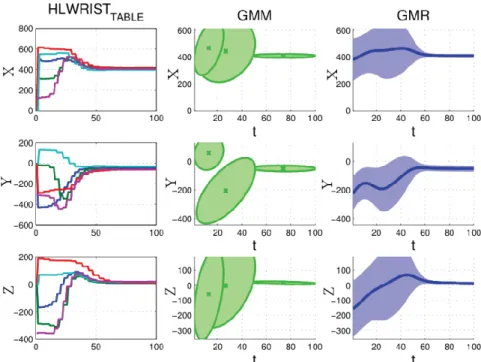
2.5 Trajectory encoding and generalization. . . 25
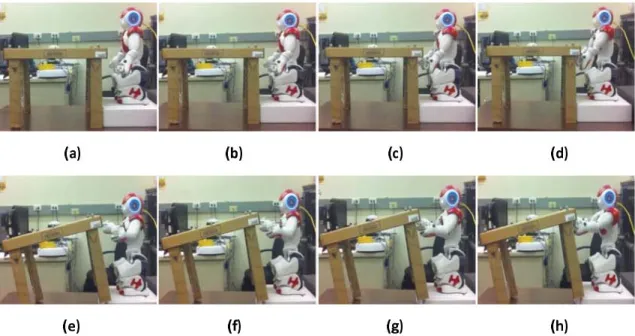
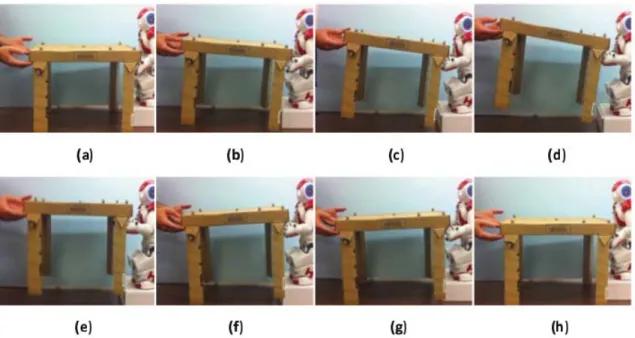
2.6 (a)-(d) Replaying the generalized trajectory. (e)-(h) Reproducing the generalized trajectory in an unknown table pose. . . 26
2.7 (a) Random exploration learning performance. (b) Guided exploration learning performance. . . 27
2.8 Trajectory of the robot’s movement and human’s movement during lifting the table. 27 2.9 Snapshots of human robot performing the table lifting task. (a)-(d) the robot lifting the table up. (e)-(h) the robot putting the table down. . . 28
3.1 Breakfast scenario. The objects in the scene, from left to right are bowl, milk box, coffee can, cup, cereal box. . . 32
3.2 The multi-level action recognition framework. . . 34
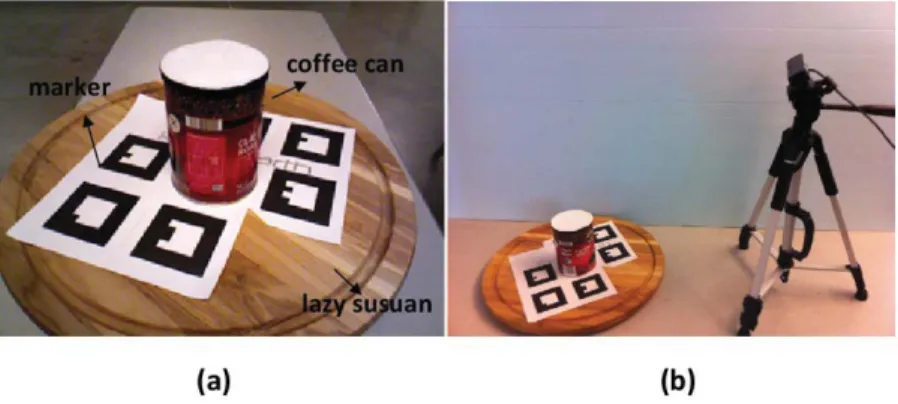
3.3 Setup for 3D object model modeling. (a) the camera view. (b) the object recording setup. . . 35
3.4 Two different views of the 3D model of a coffee can. . . 35
3.6 Data segmentation in recognition phase. . . 37
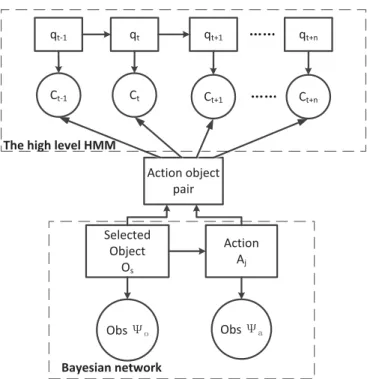
3.7 The hierarchical probabilistic model. . . 38
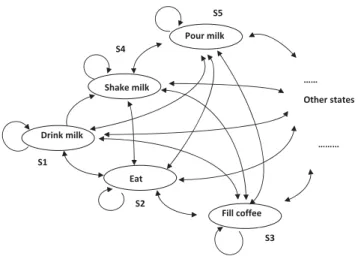
3.8 The constraints in the upper level HMM. . . 39
3.9 Real time recognition procedure. . . 41
3.10 Object recognition results 1. The objects from left to right are bowl, milk box, coffee can, cup, cereal box. (a) bowl, coffee can, cup and cereal box have been recognized. (b) bowl, milk box, cereal box have been recognized. . . 42
3.11 Object recognition results 2. (a) Camera view. The goal is to recognize the coffee can in the middle of the three objects. (b), (c) Recognition result with occlusion and similar object in the scene. (d) Recognition result in cluttered scene. . . 43
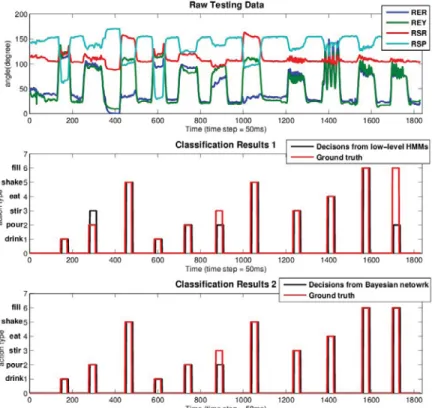
3.12 Action recognition results with object constraints. Results of 11 actions are shown here. The Bayesian network output is action object pair. The object type is not shown in the figure. The legend RER,REY,RSR,RSP represent the angle of right elbow roll, right elbow yaw, right shoulder roll and right shoulder pitch respectively. 45 3.13 Action recognition results with object constraints and sequential constraints. Re-sults of 7 actions are shown here. The high-level output is action object pair. The object is cup. The legend RER,REY,RSR,RSP represent the angle of right elbow roll, right elbow yaw, right shoulder roll and right shoulder pitch respectively. . . . 46
3.14 Recognition performance on different subjects. . . 47
4.1 The setup of the Portable Assembly Demonstration (PAD) system. . . 51
4.2 Finger model created. (a) the placement of the markers. (b) finger model created. . 53
4.3 Force sensor setup. (a) the force sensors on the finger tips. (b) the Xbee module for wireless communication. . . 53
4.4 The flowchart of the action recognition system. . . 53
4.5 The two-level action recognition framework. . . 55
4.6 Fusion approaches. (a) feature-level fusion method. (b) decision-level fusion method. 57 4.7 The Bayesian Model for action recognition. . . 58
4.8 The parts and tools. From left to right, the top row shows saw, G clamp, drill, and wood planner. The middle row shows hammer, screw driver, and wrench. The
bottom row shows screw, red base board, long base board, and bolt. . . 60
4.9 Results of board recognition, where the recognized objects are highlighted in green. (a) recognition of the red base board with occlusion from a bolt. (b) recognition of the red base board in a cluttered scene. . . 61
4.10 Recognition results of the HMMs using left arm motion features. . . 62
4.11 Recognition results of the HMMs using left finger motion features. . . 62
4.12 Recognition results of the HMMs using left finger force features. . . 63
4.13 Recognition results of the decision-level fusion method. . . 63
4.14 Recognition results of the feature-level fusion method. . . 63
4.15 Recognition results of the decision-level fusion method+Bayesian model. . . 65
4.16 Recognition results of the feature-level fusion method+Bayesian model. . . 65
4.17 Recognition performance on different subjects. . . 67
5.1 The hardware setup of the PAD system. . . 71
5.2 Coordinate system defined by the 6 markers in [1]. . . 74
5.3 State estimation for a two-step assembly task. M1andM2are the 3D models of the base board and the bolt. C M1is the 3D model of the assembled part after the first action. C M2is the 3D model of the assembled part after the second action. . . 74
5.4 The parts and tools. From left to right, the top row are saw, G clamp, drill, and wood planner. The bottom row are hammer, screw driver, wrench, bolt, screw, nut and red board. . . 76
5.5 Extraction of the based board’s points from the scene point cloud. (a) and (b) show the scene point cloud with two different rotation angles of the Lazy Susan. (c) and (d) show the extracted points of the base board. . . 77
5.6 Results of tool and part recognition, where the recognized objects are highlighted in red. (a) recognition of the screw driver. (b) recognition of the hammer. (c) recognition of the base board. (d) recognition of the screw. . . 78
5.7 Results of board recognition, where the recognized objects are highlighted in green. (a) recognition of the board with occlusion from a bolt. (b) recognition of the board with occlusion from another board. (c) recognition of the board in cluttered scene 1. (d) recognition of the board in cluttered scene 2. . . 78 5.8 Accuracy of the rotation estimation with respect to the portion of point cloud kept.
Different colors denote registration from the models with different intial angles. The angular difference between the input model and the target model of each reg-istration is 30 degree. . . 81 5.9 Registration results. All the figures show the downsampled 3D models without
color information. (a) the input 3D model. (b) the target model. (c) registration result of ICP. (d) registration result of SAC-IA. (e) registration result of our ap-proach. ((c) - (e): Red ones indicate the registration results. Yellow ones indicate the target model.) . . . 82 5.10 The actions used in the experiment. (a) inserting the bolt. (b) hammering the bolt.
(c) wrenching the bolt. (d) aligning the nut to the hole on the base board. (e) inserting the screw. (f) screwing the screw. . . 82 5.11 The parts and the associated model. (A) red board. (B) bolt (C) nut (D) parts pose
(CP1) after action 1. (E) parts pose (CP2) after action 2. (F) parts pose (CP3) after action 3. (G) parts pose (CP4) after action 4. (H) parts pose (CP5) after action 5. (I) parts pose (CP6) after action 6. (a) - (i) are the models of (A)-(I). . . 83 5.12 Registration results. (a) register M11 and M21 to C M1 after action 1 “inserting”.
(b) registerM12and M22toC M2after action 2 “hammering”. . . 84
5.13 Registration results. Register M15 andM25toC M6 after action 6 “screwing”. . . . 85
6.1 The assembly skill implementation procedure. . . 88 6.2 The robot implementation setup. (a) The Baxter robot [2]. (b) The workspace of
the Baxter robot. . . 89 6.3 Camera views. (a) The Xtion color image view. (b) The left gripper camera view. . 89
6.4 Camera calibration results. (a) Robot and camera positions. (b) Relationship
be-tween the camera frame and selected frames of the Baxter robot. . . 90
6.5 Marker placement. (a) reflective markers on camera and object (hammer). (b) frames created using reflective markers. . . 91
6.6 The frame transform tree. The dash line represents the unknown relationship. . . . 92
6.7 The chessboard frame (CH). (a) the chessboard frame defined in the calibration method. (b) the placement of three markers which are used to create the same frame. 92 6.8 Tracking accuracy evaluation. The peaks are caused by the quick motion of the tracked target. . . 94
6.9 Human scaffolding for the hammering action. . . 94
6.10 Trajectory encoding and generalization 1. The figures on the left column represent the trajectories of x,y, and z positions of each demonstration (hammering). The figures in the middle column show the GMMs to model the trajectories. The figures on the right column show the generalized trajectories of each dimension and the corresponding variances. . . 95
6.11 Trajectory encoding and generalization 2. The figures on the left column represent the roll, pitch, and yaw rotations of each demonstration (hammering). The fig-ures in the middle column show the GMMs to model the trajectories. The figfig-ures on the right column show the generalized trajectories of each dimension and the corresponding variances. . . 96
6.12 Reproducing the hammering action given the bolt pose. . . 97
6.13 The robot implements script 1 (inserting bolt). . . 99
6.14 The robot implements script 2 (hammering bolt). . . 99
6.15 The robot implements script 3 (inserting screw). . . 100
Chapter 1
Introduction
In this chapter, first the motivation and objectives of our research are presented. Then an overview of existing robot skill learning approaches is provided. At the end of this chapter, related work is introduced.
1.1
Motivation
As more and more advanced robots enter our life, the demand for teaching robot complex skills increases [3, 4]. If a robot can replace a human worker doing complex assembly tasks, the labor cost can be reduced. Compared to the heavy-duty industrial robot manipulators employed in au-tomotive industry, light weight arm (LWA) robots and dual-arm robots have appeared recently for small batch manufacturing. For example, Foxconn Technology Group has already deployed their own assembly robot called “Foxbot” in their factories [5]. Dual-arm robots have been developed by several companies that are mainly targeting small part assembly. These robots include Rethink Robotics’ Baxter robot [2], Kawada’s Nextage robot [6], etc. Currently these robots can only per-form simple assembly tasks. Many of the complicated assembly processes still require human labors. Many of the complicated assembly processes still require human labors. Teaching a robot such delicate assembly skills through human demonstration can avoid lengthy robot programming, while no technical expertise is required for the operator.
Programming by demonstration can enable quick skill acquisition [7]. However, this is only true in the situation where the reproduction is sufficiently similar to that of the demonstration. To allow the robot to learn to perform a task again in a different situation, it appears important to combine PbD methods with other learning techniques. Reinforcement learning (RL) [8] is par-ticularly suitable for this type of problem. It enables the robot to learn its own ways of acting, in order to improve its abilities. RL algorithms have already been successfully implemented in robotic applications such as swinging up and controlling an inverse pendulum [9], refining fore-hand and backfore-hand tennis swing [10]. RL algorithms perform well in discrete environments of low dimensionality.
There are mainly two ways of demonstration: robot-based demonstration and human-based demonstration. Compared to robot-based demonstration, human-based demonstration is more con-venient for the human operators since it avoids operating the robot. To extract important clues from the human demonstration, the following functions are required: accurate action and object recog-nition and robust action effect estimation. With the effect of the action available, the learned skills can be used in a robot task planning system.
1.2
Objectives
Our research goal is to build a robot skill learning framework for acquiring complex human skills. The overall learning framework we proposed is shown in Fig. 1.1. It contains both low-level skill learning and high-low-level skill learning. In low-low-level learning, both PbD and reinforcement learning are employed. These learned skills are treated as basic actions. In high-level skill acqui-sition, complex skills that usually involve multiple actions and the use of various objects need to be captured. The manipulated objects are recognized. With the object/action dependencies, the manipulative actions are recognized. 3D object models are created which can be used to esti-mate the spatial relationship between the objects. One example of high-level skill acquisition is assembly skills acquisition. The human will demonstrate the whole process of an assembly task. For example, the sequence of actions may include inserting a screw into a hole, screwing using a screw driver and etc. Finally, the learned skills are implemented on the robot through a planning
User Action recognition Object recognition State estimation Skill scripts Primitive action 1 . . Primitive action N Task 1 . . Task N High-level skill learning
Knowledge base Planning Robot Implementation Implementation phase Human features Object features demonstration Generalization Reproduction Reinforcement learning Primitive actions Interaction
Low-level skill learning
Learning phase demonstration Object 3D modeling scaffolding
Figure 1.1: The overall learning framework.
procedure.
In summary, the proposed framework enables the following robot capabilities:
• Basic skills learning. With human demonstration, scaffolding, and interaction, the robot can learn basic actions like grabbing, approaching, lifting and etc. The learned actions are treated as basic skills for the high-level skill learning.
• Complex skills learning. With a Portable Assembly Demonstration (PAD) system, the skill scripts can be automatically extracted from the demonstration. It includes the action applied, the object involved and the relative position and orientation between objects.
• After learning both the basic actions and the complex skills, the robot can autonomously interpret and implement the generated skill scripts.
1.3
Overview of Robot Skill Learning Approaches
Robots can acquire skills through many different learning approaches, such as programming by demonstration, and reinforcement learning. The idea of these methods is inspired by how human
learns. The most straightforward method humans use to learn is through imitation. Also we can learn by ourselves through trial-and-error since demonstrations are not always available.
1.3.1
Programming by Demonstration
The research on robot programming by demonstration [11] started about thirty years ago, and has been attracting more research interest during the past decade. The rationale for moving from tedious coding for robot programming to flexible demonstration-based skill acquisition is three-fold [12].
First, imitation learning offers an implicit means of training a machine, such that explicit and tedious programming of a task by a human user can be minimized or eliminated. Imitation learning is thus a “natural” means of interacting with a machine that would be accessible to people.
Secondly, it is a powerful mechanism to reduce the complexity of search spaces for learning. When observing either good or bad examples, one can reduce the search space for a possible solution, by either starting the search from the observed good solution (local optima), or conversely, by eliminating bad solutions from the search space. Imitation learning is, thus, a powerful tool for enhancing and accelerating learning.
Third, studying and modeling the coupling of perception and action, which is at the core of imitation learning, helps us understand the mechanisms by which the self organization of percep-tion and acpercep-tion could arise. The reciprocal interacpercep-tion of perceppercep-tion and acpercep-tion could explain how competence in motor control can be grounded in rich structure of perceptual variables, and vice versa, how the processes of perception can develop as a means to create successful actions.
PbD promises are thus multi-fold. On the one hand, it will make learning faster, in contrast to reinforcement learning or other trial-and-error learning approaches. On the other hand, one expects that the methods, being user-friendly, will enhance the application of robots in human environments. Recent progresses in the field, which we review in this chapter, show that the field has made a leap forward during the past decade toward these goals. In addition, we anticipate that these promises may be fulfilled very soon.
skills across various agents and situations. One of the key problems is “What to Imitate” [12]. Current approaches to representing a skill can be broadly divided between two trends: a low-level representation of the skill, taking the form of a non-linear mapping between sensory and motor information, which we will later refer to as “trajectories encoding”, and, a high-level representation of the skill that decomposes the skill in a sequence of action-perception units, which we will refer to as “symbolic encoding”.
Another key problem is “How to reproduce a skill in a completely novel situation” [12]. The robustness of dynamic system control to perturbations occurring in uncontrolled environments has been demonstrated. However, it can happen that the dynamic system alone is not sufficient to handle any perturbation. In those cases, an exploration process is needed, during which the robot will search for new ways of accomplishing the task. Reinforcement learning is particularly suitable for this type of problem.
Learning through interaction is usually combined with PbD. The purpose is to detect and utilize “social cues” given implicitly or explicitly by the teacher during training. It has become the focus of a large body of work in PbD [13, 14]. Such social cues can be viewed as a way to introduce priors in a statistical learning framework which can speed up learning.
1.3.2
Reinforcement Learning
Reinforcement learning is learning how to map situations to actions so as to maximize a nu-merical reward signal. The learner is not told which actions to take, as in most forms of machine learning, but instead must discover which actions yield the most reward by trying them. In the most interesting and challenging cases, actions may affect not only the immediate reward but also the next situation and, through that, all subsequent rewards. These two characteristics: trial-and-error search and delayed reward, are the two most important features of reinforcement learning [15].
Reinforcement learning is different from supervised learning, most current research in ma-chine learning, statistical pattern recognition, and artificial neural networks. Supervised learning is learning from examples provided by a knowledgeable external supervisor [16]. This is an im-portant type of learning, but alone it is not adequate for learning from interaction. In interactive
problems it is often impractical to obtain examples of desired behavior that are both correct and representative of all the situations in which the agent has to act. In uncharted territories where one would expect learning to be most beneficial an agent must be able to learn from its own experience [17].
One of the disadvantages of reinforcement learning is that as the dimension of the learning space grows, the computation cost will grow exponentially. Combined with PbD, which has al-ready offered a solution, the search space can be decreased dramatically.
1.4
Related Works
Related work is divided into three parts. First, PbD approaches are surveyed. Then a review on action recognition is presented. Finally, an overview of the ways of skill demonstration is given.
1.4.1
Learning from Demonstration
Current approaches to representing a skill can be broadly divided into two trends: a low-level representation of the skill, taking the form of a non-linear mapping between sensory and motor information, which we will later refer to as “trajectories encoding”, and, a high-level representation of the skill that decomposes the skill into a sequence of action-perception units, which we will refer to as “symbolic encoding”. Some related works are listed below. Work in low-level PbD encodes human movements in either joint space, task space or torque space. The encoding may be specific to a cyclic motion [18], a discrete motion [19], or to a combination of both. The most promising approaches to encoding human movements are those that encapsulate the dynamics of the movement into the encoding itself. Several of these methods are highlighted below.
Calinon et al. [20] presented a probabilistic architecture for solving generically the prob-lem of extracting the task constraints through a PbD framework and for generalizing the acquired knowledge to various situations. They extend this approach to a more generic procedure handling simultaneously constraints in joint space and in task space by combining directly the probabilistic representation of the task constraints with a simple Jacobian-based inverse kinematics solution.
Two 5-DOFs Katana robots [21] from Neuronics are used for the experiment. Each motor is equipped with encoders which allows the user to move the robot manually while registering joint angle information.
Calinon et al. [22] proposed an approach to teaching incrementally human gestures to a hu-manoid robot. The learning process consists of first projecting the movement data in a latent space and encoding the resulting signals in a Gaussian Mixture Model (GMM). The demonstrations can be provided in various modalities. The robot observes a human user demonstrating the gesture while wearing motion sensors. On the other hand, the coach helps the robot move correctly its limbs by kinesthetic teaching.
Ude et al. [23] used spline smoothing techniques to deal with the uncertainty contained in
several motion demonstrations performed in a joint space and in a task space. In [24], using different demonstrators ensures variability across the demonstrations and quantifies the accuracy required to achieve a Pick & Place task. The different trajectories form a boundary region that is then used to define a range of acceptable trajectories.
In [25], the robot acquires a set of sensory variables while a human demonstrates a manipu-lation task of arranging different objects. At each time step, the robot stores and computes the mean and variance of the collected variables. The sequence of means and associated variances is then used as a simple generalization process, providing respectively a generalized trajectory and associated constraints.
Dynamical systems also offer a particularly interesting solution to an imitation process aimed at being robust to perturbations. It is robust to dynamical changes in the environment. The first work to emphasize this approach was that of Ijspeertet al. [10], who designed a motor representation based on dynamical systems for encoding movements and for replaying them in various conditions. The approach combines two ingredients: nonlinear dynamical systems for robustly encoding the trajectories, and techniques from non-parametric regression for shaping the attractor landscapes according to the demonstrated trajectories.
The main advantages of these trajectory-level approaches are that they offer generic represen-tation of motion which allows encoding of very different types of signals. However it doesn’t allow
to reproduce complicated high-level skills.
On the other hand, a large body of work [14, 26] uses a symbolic representation of both the learning and the encoding of skills and tasks. This symbolic way of encoding skills may take several forms. One common way is to segment and encode the task according to sequences of predefined actions, described symbolically. Encoding and regenerating the sequences of these actions can be done using classical machine learning techniques, such as Hidden Markov Model (HMM).
In [27], an approach for teaching a humanoid robot is presented that will enable the robot to learn typical tasks required in everyday household environments. The first step concentrates on an analysis of human actions and action sequences that can be identified when watching a human demonstrator. Secondly, sensor systems are introduced which augment the robot’s perception ca-pabilities while watching a human’s demonstration and the robot execution of tasks respectively. The main focus is then put on the knowledge representation in order to be able to abstract the strategies and to transfer them onto the robot system.
Ekvall et al. [28] proposed a novel method for learning robot tasks from multiple demon-strations. Each demonstrated task is decomposed into subtasks that allow for segmentation and classification of the input data. The demonstrated tasks are then merged into a flexible task model, describing the task goal and its constraints. The two main contributions of their paper are the state generation and constraints identification methods. They also present a task level planner, which is used to assemble a task plan at run-time, allowing the robot to choose the best strategy depending on the current world state.
Saunders et al. [29] described an approach of robot task learning based on studies of social animals where two teaching strategies are applied to allow a human teacher to train a robot by moulding its actions within a carefully scaffolded environment. Within these environments, sets of competences can be built by building state/action memory maps of the robot interaction within that environment. These memory maps are then polled using a k-nearest neighbor based algorithm to provide a generalized competence.
se-quences of symbolic cues) can be learned efficiently through an interactive process. However, because of the symbolic nature of their encoding, the methods rely on a large amount of prior knowledge to predefine the important cues and to segment those efficiently.
Also, as the PbD techniques develop, traditional ways of guiding/teleoperating the robot were progressively replaced by more user-friendly interfaces, such as vision [27], data gloves [30], laser range finder [31] and kinesthetic teaching which has already been introduced above.
1.4.2
Action Recognition
In recent years, vision-based human action recognition has found many applications, such as human-computer interaction, surveillance, etc. [32]. The use of human action recognition in robotics is a new research frontier. As robots start entering human environments, there is a great need for robots to acquire new skills in an efficient way.
There are generally three steps for vision based action recognition: feature extraction, model training and classification. Local spatial-temporal features such as histogram of gradient (HOG) [33], histogram of optical flows (HOF) [34], 3D scale-invariant feature transform (SIFT) [35], and Cuboids [36] have been widely used for action recognition. In [37, 38, 39, 40], features are first extracted on images from a 2D sensor or point clouds from a 3D sensor. Then probabilistic approaches such as Hidden Markov Models (HMMs) [41] and Supporting Vector Machine (SVM) [42] are used for modeling and classification.
To further improve the accuracy, feature-level fusion has been applied to the features generated from the single sensors. In He’s paper [43], a new feature fusion method for gesture recognition based on a single tri-axis accelerometer has been proposed. Both time-domain and frequency-domain features are extracted. Recognition of the gestures is performed using SVMs. The average accuracy results using the proposed fusion methods is 89.89% which is improved compared with the approach using only one of the features. Tranet al.[44] presented a real-time or online system for continuous recognition of human daily actions. HMMs are applied to model a joint of human posture features. The results show the fusion models outperform the baseline approach.
of features. Therefore, more and more attention has been focused on how to utilize multiple sensor modalities to help improve action recognition. Correspondingly, the information fusion approaches have been applied. Thomaset al. [45] present a novel method for continuous activity recognition based on ultrasonic hand tracking and motion sensors attached to the users arms. Plausibility analysis is designed to fuse the decisions. Lukowiczet al. [46] present a technique to automatically track the progress of maintenance or assembly tasks using body worn sensors. The technique is based on a novel way of combining data from accelerometers with simple frequency matching sound classification. Zhanget al. [47] presented a framework for hand gesture recognition based on the information fusion of a three-axis accelerometer (ACC) and multichannel electromyography (EMG) sensors signals. A decision tree and multistream HMMs are utilized for decision-level fusion to generate a final decision. Chenet al. [48] presented a robust visual system that allows effective recognition of multiple-angle hand gestures in finger guessing games. Three Support Vector Machine (SVM) classifiers were trained for the construction of the hand gesture recognition system. The classified outputs were fused by proposed plans to improve system performance. The system presented can effectively recognize hand gestures, with an accuracy of over 93%, for different angles, sizes, and different skin colors. Wu et al. [49] proposed to take audiovisual characteristics of realistic human action videos into account in human action recognition. Effective features are identified from a large number of audio features with the generalized multiple kernel learning algorithm. The widely used spacetime interest point descriptors are utilized as visual features, and a support vector machine is employed for both audio- and video-based classifications. At the final stage, fuzzy integral is utilized to fuse recognition results of both audio and visual modalities. Bahrepouret al. [50] implemented classification techniques on wireless sensor nodes attached to patients body, online evaluation of the classification results on individual nodes, and fusing results of various nodes to resolve possible conflicts between sensor nodes and reach a consensus. The wireless body sensor network consists of a number of wireless sensor nodes that cooperatively monitor physical and physiological conditions of a person.
The other way is to model contextual information. Kojima et al. [51] proposed a method for recognizing human actions and objects. With the recognition of the human pose, object and
the detection of contact points, human actions can be inferred based on the prior knowledge. The limitation is that each object and pose correspond to only one action which results in a deterministic object and action correlation. Guptaet al. [52] presented an approach which unifies the inference process involved in object recognition and localization, action understanding and perception of object reaction. They use the object properties as prior for action recognition, while taking the advantage of object reaction to verify the object detection. Wilsonet al.[53] presented a parametric Hidden Markov Model (PHMM) for human action recognition. They indirectly modeled the effect of object properties on human actions. Yaoet al. [54] proposed a mutual context model to jointly model objects and human poses in human-object interaction activities. In their approach, activity classes, objects and human poses all contribute to the recognition and detection of each other. The model includes co-occurrence compatibility between activities, object and pose. Instead of considering the dynamics of actions in the 3D image, they mainly focus on pose detection in 2D images. Kjellstromet al. [55] presented a method for categorizing manipulated objects and human manipulative actions in the context of each other. Their method employs conditional random fields (CRFs) and is able to simultaneously segment and classify human hand actions, as well as detect and classify the objects involved in the action. However, to segment hand from the 2D images, the appearance of the hand is compared to a large database (on the order of 105examples) of synthetic hand views tagged with articulated pose and orientation which is computationally intensive.
Kojima et al. [51] proposed a method for recognizing human actions and objects. With the recognition of the human pose, object and the detection of contact points, human actions can be inferred based on the prior knowledge. The limitation is that each object and pose correspond to only one action which results in a deterministic object and action correlation. Gupta et al.
[52] presented an approach which unifies the inference process involved in object recognition and localization, action understanding and perception of object reaction. They use the object properties as prior for action recognition, while taking the advantage of object reaction to verify the object detection. Wilsonet al. [53] presented a parametric Hidden Markov Model (PHMM) for human action recognition. They indirectly modeled the effect of object properties on human actions.
human-object interaction activities. In their approach, activity classes, objects and human poses all contribute to the recognition and detection of each other. The model includes co-occurrence compatibility between activities, object and pose. Instead of considering the dynamics of actions in the 3D image, they mainly focus on pose detection in 2D images. Kjellstromet al.[55] presented a method for categorizing manipulated objects and human manipulative actions in the context of each other. Their method employs conditional random fields (CRFs) and is able to simultaneously segment and classify human hand actions, as well as detect and classify the objects involved in the action. However, to segment hand from the 2D images, the appearance of the hand is compared to a large database (on the order of 105 examples) of synthetic hand views tagged with articulated pose and orientation which is computationally intensive.
1.4.3
Ways of Skill Demonstration
The ways to demonstrate skills to robots fall into two categories: robot-based demonstration and human-based demonstration. Robot-based demonstration uses robots as the demonstrator. This method mainly includes teleoperation [56] and kinesthetic teaching which is also called scaf-folding [57]. On the contrary, human-based demonstration employs humans as the demonstrator. Compared to robot-based demonstration, human-based demonstration is more convenient for the human operators since they can just focus on the task itself and do not need to control the robot. Two kinds of sensors are widely used for collecting human demonstration data: wearable sensors and vision sensors. Wearable sensors include inertial measurement units (IMUs) [58] and data gloves [59, 60]. In robot learning, it is also called the “sensor on teacher” approach. Wearable sensors are usually used along with vision sensors that extract the information of the involved ob-jects. Lee et al. [61] proposed a skill learning and inference framework for a Skilligent robot. Data gloves are used to demonstrate the task. Based on the framework, the robot learns and in-fers situation-adequate and goal-oriented skills to handle uncertainties and human perturbations. Kunzeet al.[62] performed a manipulation task in an interactive physics simulation. By perform-ing novel manipulation tasks in a virtual environment usperform-ing a data glove, task-related information of the demonstrated actions can be directly accessed and extracted from the simulator. By using
simulation, they avoid the practical problem of object and pose estimation.
On the other hand, vision-based human motion tracking systems are regarded as a natural way to capture demonstration since no sensors need to be attached to the demonstrator. Ahmadzadeh
et al. [63] proposed a visuospatial learning approach which uses a simple algorithm and
mini-mum prior knowledge to learn a sequence of operations from a single demonstration. Song et al. [64] developed a testbed for learning by demonstration from natural languages and a Kinect sensor, with the initial domain of kitchen activities. In their work, only a single large-size object is involved, which can be recognized easily. Additionally, there are research works specifically on vision-based assembly skill learning from human demonstration. Hovlandet al. [65] proposed an approach to representing an assembly skill by a hybrid dynamic system where a discrete event controller models the skill. The discrete controller is represented as an Hidden Markov Model (HMM) [41]. The deficiency for this approach is that as the task becomes complex, the HMM will demand a tremendous training data set. Dantamet al. [66] developed a method to transfer human demonstration to robots. The demonstration is interpreted into a sequence of object connection symbols which can be further transformed into the task language. The assembly task they handled is simple and only the location of the part is required. Takamatsuet al. [67] aimed to recognize assembly tasks through human demonstration. Two rigid polyhedral objects are recognized from noisy data obtained by a conventional 6 degree-of-freedom (DOF) object-tracking system. Assem-bly tasks can be basically expressed as chains of two-object relationships. However, they ignored the problem of occlusion between the parts. Aleotti et al. [68] demonstrated the assembly task through simulation, which does not address the action recognition and object recognition task. A task planner is designed to analyze the demonstration and segment it into a sequence of action primitives.
1.5
Organization of the Dissertation
In the following chapters, each part of the learning framework will be introduced. In Chapter 2, human robot collaborative manipulation task learning through PbD and reinforcement learning is described, which is a type of low-level skill learning of basic actions. In Chapter 3, an action
recog-nition system with a Kinect sensor is developed which considers the correlation between objects and actions, as well as the sequential constraints of actions. In Chapter 4, The action recognition framework is extended to handle more challenging tasks, such as assembly skill acquisition, using multiple sensing modalities. Based on the previous work, Chapter 5 presents a Portable Assembly Demonstration (PAD) system which can generate a complete robot skill script for complex part assembly from human demonstration. Chapter 6 describes how to implement the skill scripts gen-erated by the PAD system on a real robot. Chapter 7 presents the conclusions and future work is discussed.
Chapter 2
Human Robot Table Lifting through PbD
and Reinforcement Learning
In this chapter, the robot imitation learning and reinforcement learning framework is presented as a solution to low-level skill learning. Section 2.1 introduces the motivation of the proposed framework. In Section 2.2, the problem to be solved is described. In Section 2.3, the experiment setup is introduced. Section 2.4 gives details of the framework. In Section 2.5, experiment results are given and discussed.
2.1
Motivation
Before demonstrating a complex task, the low-level skills (primitive actions) should be learned first. For co-robots to be useful, one of the fundamental abilities they should possess, is to work collaboratively with humans. A common example where collaboration would be required, is in a cooperative manipulation task, where a human-robot team has to manipulate an object of interest. Human-robot collaboration (HRC) is a research field with a wide range of applications and high economic impact [69]. Technology that enables robots to work collaboratively with humans can be widely applied in the industry as well as in common day-to-day scenarios. This field has seen a renewed interest in recent years because of the possibility of humanoid robots residing along with
us in the near future. In this chapter, we are going to explore how to enable a robot to learn such basic manipulative skills in an interactive way. These basic skill can be learned at the low level and they can be later used in high-level skill learning.
2.2
Problem Statement
The task we consider is how a robot learns to collaborate with a human to lift a dummy table. The reason of using a dummy table is because the robot can not handle heavy objects. Two skills need to be learned: reaching the table and lifting the table up with the human. A two-phase framework which combines PbD and reinforcement learning is developed to enable the robot to learn dynamic tasks in a reasonable amount of time. In the first phase, PbD is used to teach the robot how to reach out to the table. In the second phase, reinforcement learning is used for keeping the table horizontal.
2.3
Experimental Setup
This section presents the experimental platform developed for human-robot table lifting. The hardware includes a motion capture system, a humanoid robot and a dummy table. Fig. 2.1 illustrates the experimental setup.
The goal is to extract the task constraints from the human demonstrations, map the constraints to the robot’s internal frame and let the robot learn to approach the table and keep the table horizon-tal while lifting it with the human. Multiple demonstrations of human’s hand approaching the table are given to the robot. Markers are attached and rigid-bodies are created to collect information of interest. The position vector and the rotation matrix of each rigid-body are defined as follows:
• The position vector of the human’s left wrist (HLWPW).
• The position vector of the robot’s left wrist (RLWPW) and its torso for reference (RTPW). • Four markers on the table’s corners to create the table object. Its position vector is
Figure 2.1: Experimental setup.
the position of the human robot-ends (Z1 andZ2). • T ABR
W andRTRW denote the rotation matrices of the table and the robot’s torso respectively. Each variable has three parts, the upper left superscript denotes the name of the variable, the subscript denotes the which frame the variable is in, where P indicates a position vector and R indicates a rotation matrix.
There are totally four frames used which are shown in Fig. 2.2: the world frameW, the table’s frame T, the robot’s internal frame RI and external frameRE. The world frame is the frame of the Vicon system. All the position vectors and rotation matrices are initially in the world frame. The table’s frame is used to observe the human’s hand motion with respect to the table during the demonstration. The robot’s external frame is used for calibration, and the robot’s internal frame is used for controlling the robot.
2.3.1
Motion Capture System
The motion capture system used for our experiments is the Vicon MX motion capture system [70]. The system consists of 12 Vicon T-40 cameras. Each camera can capture a 10 bit grayscale image at a resolution of 4 megapixels. It can capture data at speeds upto 100 frames per second. However, in our experiments, we only need the speed of 10 frames per second. The system is
Figure 2.2: The frames used in the experimental setup.
equipped with sophisticated dynamic reconstruction algorithms for real time tracking. A Gigabit Ethernet port is provided for connecting the cameras to the system. With the given system, we can track any optical marker within a tolerance of 0.7 mm. We can create rigid bodies which are three markers attached to a solid body in a specific pattern. The Vicon Tracker software is used for capturing the rigid-body data. The algorithms used in Tracker are optimized for tracking rigid bodies.
The Nao humanoid robot [71] is used for the experiment. It is an autonomous, programmable and medium-sized humanoid robot which has 21 degrees of freedom (DOF), developed by Alde-baran Robotics. The robot can be controlled remotely using telnet-like commands on a wireless network. The SDK provided by the company includes an inverse kinematics procedure to control end-effector positions with respect to a frame of reference located in its torso.
2.3.2
Calibration
The robot’s end-effector has to be controlled with respect to its internal frame of reference. But the data obtained from motion capture, is for the markers placed on the robot’s body. Hence, a correspondence between the externally attached markers and the controllable points on the robot has to be found out. The robot’s SDK can provide the position of the robot’s end effector with respect to its internal frame of reference. Hence we can obtain a model of transformation given the
Human demonstration Coordinate translation, rotation GMM/GMR Bias elimination Position controller Mirror to
right arm Multiply by calibration
matrix Demonstrations Transformation Generalization Mapping Reproduction
Left arm trajectory
Object & Robot pose (TAB, RE)
Figure 2.3: The block diagram of the imitation learning phase.
motion capture data and the corresponding robot’s data. We model this relation as a homogeneous transformation which includes scaling, translation and rotation. The homogeneous transformation takes the form of a calibration matrix.
For calibration, the robot waves its hand in random trajectories trying to cover all the possible joint configurations of its arms. While it is doing so, positions are collected simultaneously from the motion capture system (denoted by A) and forward kinematics is applied to robot’s internal joint encoders (denoted byB). The linear least squares formula used to calculate this homogeneous transformation (H) can be expressed as
H =(ATA)−1ATB (2.1)
2.3.3
Imitation Learning Phase
Firstly, the trajectories of interest have to be derived from the human demonstrations. Then we have to extract critical constraints from the trajectories. Gaussian Mixture Model (GMM) is used to encode the set of demonstrated trajectories (representation phase). Gaussian Mixture Regression (GMR) [72] is then applied to retrieve a smooth generalized version of these trajectories and asso-ciated variances (generalization phase). After mapping the constraints to the robot’s perspective, the robot can generate its own trajectories based on the constraints. In the reproduction phase a position controller is derived from the generalized trajectories for the new position and orientation of the robot and the table. The block diagram of the proposed learning algorithm is shown in Fig. 2.3. The details of the block diagram are described next.
Coordinate transformation
This section explains the required coordinate transformations. HLWP
W, RTPW and T ABPW are all in the Vicon’s world frame. The human’s wrist trajectory with respect to the table (denoted by HLWP
T) is of interest for the learning purpose. So we need to transform the trajectory from the world frame to the table’s frame. This transformation includes translation and rotation given by
HLWP
T =T AB RW(HLWPW−T ABPW) (2.2)
• Generalization
For imitation learning we adopt the probabilistic learning framework proposed by Calinon et al. [20]. Letεj
N
j=1 denote theN demonstrations. Each demonstration is normalized to 100 time
steps. Each datapointεj =
tj, εSj
consists of a time steptj and a coordinate of positionεSj which is a point in the trajectory of the human’s left wrist with respect to the table,HLWP
T. The dataset is first modeled by a Gaussian Mixture Model(GMM) ofK components [73]. Each data point is defined by its probability density function
p(j)= K
k=1
πkN(j;μk,Σk) (2.3)
where, πk are prior probabilities and N(j;μk,Σk) are Gaussian distributions defined by cen-ters μk and covariance matrices Σk, whose temporal and spatial components can be represented separately as μk = (μTk, μ S k), Σk = ⎛ ⎜⎜⎜⎜⎜ ⎜⎜⎜⎝ ΣT Tj Σ T S j ΣS T j Σ S S j ⎞ ⎟⎟⎟⎟⎟ ⎟⎟⎟⎠ (2.4)
Based on the GMM, a generalized version of the trajectories is computed by applying Gaussian Mixture Regression (GMR). The procedure is as follows. For each component k, the expected distribution of likelihood ofεS
j given a time step tj and Gaussian mixture component kis defined by p(Sj|tj,k)= N(Sj; ˆ S k,Σˆ S S k ) (2.5)
ˆ S k = μ S k + Σ S T k (Σ T T k )− 1(t j−μTk) (2.6) ˆ ΣS S k = Σ S S k −Σ S T k (Σ T T k )−1Σ T S k (2.7)
By taking the complete GMM into account, the expected distribution is defined by
p(Sj|tj)= K k=1 βk,jN(Sj; ˆ S k,Σˆ S S k ) (2.8)
whereβk,jis the probability of the componentkresponsible fortj. By using the linear transfor-mation property of Gaussian distribution, and estitransfor-mation of the conditional expectation ofS
j given
tjis thus defined by p(Sj |tj) ∝ N(ˆSj,ΣˆS Sj ), where the parameters of the Gaussian distribution are defined by ˆ S j = K k=1 βk,jˆkS, Σˆ S S j = K k=1 β2 k,jΣˆ S S k (2.9)
By evaluating ˆSj,ΣˆS Sj at different time steps tj, a generalized form of the trajectories ˆ =
tj,ˆSj
and associated covariance matrices ˆΣ = ΣˆS S j
representing the constraints along the task can be computed [74].
Correspondence problem
In the next step, the constraints derived fromHLWP
T will be applied to the robot. Since the hu-man’s dimension is different from the robot, the constraints derived forHLWPT have to be mapped to the robot’s end effector with respect to the table RLWP
T. This problem can be simplified if we consider only the position of the human’s wrist with respect to the table. Then, it only needs to compensate for the dimension difference between the human’s wrist and the robot’s end effector. The dimension difference is nothing but a constant bias. A simple method is proposed to calculate this dimension difference. We put markers on a fixed object, then we let the human with markers on the wrist and robot with markers on the end effector touch the same point on the box respec-tively. The coordinates with respect to the fixed object are obtained. The difference of these two coordinates is the dimension difference.
Reproduction
In the reproduction phase, a new trajectory for the robot’s end effectorRLWP
RE has to be pro-duced based on the generalized version of RLWPT. Given theT ABPW during reproduction phase, RLWP
RE can be derived as follows: We haveRLWPT which is RLWP T =T AB RW(RLWPW−T ABPW) (2.10) RLWP W can be obtained as RLWP W =T ABRW− 1RLW PT +T AB PW (2.11)
Finally we can deriveRLWP RE as
RLW
PRE =RT RW(RLWPW −RT PW) (2.12)
RLWP
RE is the trajectory of the robot’s left end effector with respect to its torso, which will be enacted by the robot after converting it into the trajectory with respect to the robot internal torso frame.
Mirroring the trajectory
In the imitation learning phase, only left hand demonstrations are provided to the robot. This trajectory is mirrored to obtain the corresponding trajectory of robot’s right end effector. The mirroring process keeps all the X and Z coordinates in the trajectory of the left arm as they are and reverses all the Y coordinates.
2.3.4
Reinforcement Learning
Once the robot holds the table successfully, it switches to learn the second task, table lifting with human. The robot has to learn a reactive controller which generates a robot behavior based on the human motion in order to keep the table horizontal. We use a reinforcement learning algorithm to fulfill this task. For reinforcement learning, the state, action space and the rewards have to
Figure 2.4: State definition for the reinforcement learning.
be defined. Instead of having a complex contact environment, the environment in our task is simplified. The inclination of the table object determines the state. The action space consists of a predetermined discrete set of commands which move the robot’s hand-tip up or down by specified distances. The objective of the task is to keep the table horizontal during the task. Accordingly, the reward structure has been designed to give a positive reward if the robot decreases the slope of the table or a negative reward if the robot increases the incline of the table. The rewardris calculated as
r=(|Z2−Z1|)t−(|Z2−Z1)|)t+1 (2.13)
whereZ1 and Z2 represent the position of the human-end and the robot-end of the table respec-tively.
The state definition forN states is shown in Fig. 2.4. In our task, we choseN =5. The update for the Q-learning algorithm is given by
ΔQ(st,at)=α[r+γmax
a Q(st+1,a)−Q(st,at)] (2.14) whereαis the learning rate,γis the discount factor.
In order to speed up the reinforcement learning phase, a guided-exploration method is used. The guided learning algorithm is given below.
Visit(si,ai) is a counter which counts the number of visits to the state-action tuple (si,ai). Given
a state, the action selection for exploration is done on the basis of number of visits to the particular state-action pair. The state-action pair explored least is given more priority.
Algorithm 1Guided Q Learning
1: InitializeVisit(si,ai)=0∀i∈N
2: Initialize Q-tableQ(si,ai)=0∀i∈N
3: whileLearning phasedo
4: t =timestep
5: st =getS tate()
6: Selectat ←argmin(Visit(st,a))
7: Take actionat
8: Visit(st,at)←Visit(st,at)+1
9: r =getReward()
10: UpdateQ(st,at) using Eq. (2.14), based on reward r.
11: end while
2.4
Experimental Results
In this section, first the imitation learning results are presented, followed by the reinforcement learning results.
2.4.1
Imitation Learning Results
In the imitation learning phase, multiple demonstrations are given by the human. In each demonstration, the human tried to approach the same position of the table with his or her left hand from an arbitrary initial position. An open source code from http://www.calinon.ch/ has been used to run the GMM/GMR. The GMM/GMR results are shown in Fig. 2.5. Generalized trajectories and constraints are thus obtained. From the results, it can be seen that the constraint on the human-hand’s initial position is very loose. In contrast, the constraint on the human hand’s final position is very strict, which indicates the final position of the robot’s end effector with respect to the table is constant. After compensating for the size difference between human’s hand and robot’s hand, the robot can generate its own trajectory given the constraints extracted. Each time the table is moved to a new position, a new trajectory is reproduced by the position controller so that the
Figure 2.5: Trajectory encoding and generalization.
robot can successfully approach the table. Finally the calibration matrix is used to convert the trajectories from the robot’s external frame to the robot’s internal frame. In the imitation learning phase, only left hand demonstrations are provided to the robot. This trajectory is mirrored to obtain the corresponding trajectory of robot’s right end effector. The results are shown in Fig. 2.6. The images (a)-(d) show the robot replaying the generalized trajectories extracted from the demonstrations and the images (e)-(f) show the robot reproducing the trajectories in a new situation (different pose of the table). It is observed that the trajectories generated are smooth, with which the robot successfully approaches the table.
2.4.2
Reinforcement Learning Results
For state-action space consisting of 5 states and 5 actions, the performance of random explo-ration is compared with that of guided exploexplo-ration. For training, in each experiment, the number of iterations is fixed to 100. To test the speed of convergence, the experiment was performed 100 times. Fig. 2.7 shows the speed of convergence for these two algorithms for a single experiment
Figure 2.6: (a)-(d) Replaying the generalized trajectory. (e)-(h) Reproducing the generalized tra-jectory in an unknown table pose.
respectively. It is observed that the guided exploration policy converges much faster and is more stable than the random exploration policy. On average the random exploration took more than 100 trials to reach an optimal policy whereas the guided learning algorithm could reach the optimal policy within 60 trials.
After learning the optimal policy, we apply it to the robot. Fig. 2.8 shows the positions of the ends of the table for human and robot side. The moving range of the table is within 20 cm. Fig. 2.9 shows the whole process of the table lifting task. From these figures, we can see that the robot can follow the human’s action and perform the table lifting task successfully. However we could also observe some jerks during the task which are due to the imperfections in the position controlled end effector of the robot. Also the movement of the robot’s end effector has some delays, since it takes some time for the robot to realize the human’s action.
Figure 2.7: (a) Random exploration learning performance. (b) Guided exploration learning perfor-mance.
Figure 2.9: Snapshots of human robot performing the table lifting task. (a)-(d) the robot lifting the table up. (e)-(h) the robot putting the table down.
2.5
Summary
This chapter proposed a low-level skill learning strategy for robot skill acquisition. As shown in the overall framework, the low-level skills (primitive actions) learned become part of the knowl-edge base. It is a two-phase learning framework which combines imitation learning and reinforce-ment learning. In the first phase, using imitation learning the robot can reach out and hold the end of the table. A Programming by Demonstration (PbD) algorithm is used to accomplish this. From the demonstration, the human left wrist position with respect to the table is recorded. Through compensating the size difference between the human wrist and robot’s end effector, the trajectory of the robot left end effector with respect to the table is obtained. Then the relationship between the robot’s external frame and internal frame is calibrated. After that, the trajectory which can be implemented by the robot is derived. GMM/GMR is applied to the multiple demonstrations for generalization. The generalized trajectory is reproduced according to the new table position.
In the second phase, through reinforcement learning, the robot can learn to collaborate with a human for the table lifting task. With the guided exploration strategy for Q-learning, the learning
speed is improved. Using the entire framework, the robot can learn to perform the collaborative table-lifting task quickly and successfully. Such low-level skills learned can be treated as primitive actions in high-level skill learning. In our task, the robot only behaves as a follower and simply reacts to the human’s action. For future works, if the robot can predict human’s motion, the per-formance can be improved. Also, in the reinforcement learning phase, the states and actions are discrete. Using continuous state-action representation can make the robot’s action smoother.
Chapter 3
RGB-D Sensor based Manipulative Action
Recognition
To obtain high-level skills, the action used in the demonstration is an important clue because it can tell the robot how to implement a task. In this chapter, by adopting an Xtion sensor [75], we aim to recognize manipulative actions. Section 3.1 introduces the motivation of the proposed framework. In Section 3.2, the problem to be solved is formulated. Section 3.3 presents the pro-posed methodology. Section 3.4 describes the experiment procedures and gives the experimental results.
3.1
Motivation
In recent years, human action recognition has found many applications, such as human-computer interaction, surveillance, video games, etc. [32]. The use of human action recognition in robotics is a new research frontier. As robots start entering human environments, there is a great need for robots to acquire new skills in an efficient way. To fulfill this task, the robot has to understand the actions conducted by the demonstrator.
Traditional action recognition methods merely consider motion related features captured by either motion sensors or cameras. However, the capability to differentiate very similar actions