COMMUNICATION SYSTEMS
by
MEHDI SALEHI HEYDAR ABAD
Submitted to the Graduate School of Engineering and Natural Sciences in partial fulfillment of the requirements
for the degree of Doctor of Philosophy Sabancı University
c
Mehdi Salehi Heydar Abad, 2019 All Rights Reserved
COMMUNICATION SYSTEMS
Mehdi Salehi Heydar Abad
PhD Thesis, 2019
Thesis Advisor: Prof. Dr. ¨Ozg¨ur Erc¸etin
Keywords:Energy Harvesting, Resource Allocation, Machine Learning
Next generation of wireless communication systems envisions a massive number of connected battery powered wireless devices. Replacing the battery of such devices is expensive, costly, or infeasible. To this end, energy harvesting (EH) is a promising technique to prolong the lifetime of such devices. Because of randomness in amount and availability of the harvested energy, existing communication techniques require re-visions to address the issues specific to EH systems. In this thesis, we aim at revisiting fundamental wireless communication problems and addressing the future perspective on service based applications with the specific characteristics of the EH in mind.
In the first part of the thesis, we address three fundamental problems that exist in the wireless communication systems, namely; multiple access strategy, overcoming the wireless channel, and providing reliability. Since the wireless channel is a shared medium, concurrent transmissions of multiple devices cause interference which results in collision and eventual loss of the transmitted data. Multiple access protocols aim at providing a coordination mechanism between multiple transmissions so as to enable a collision free medium. We revisit the random access protocol for its distributed and low
energy characteristics while incorporating the statistical correlation of the EH processes across two transmitters. We design a simple threshold based policy which only allows transmission if the battery state is above a certain threshold. By optimizing the threshold values, we show that by carefully addressing the correlation information, the randomness can be turned into an opportunity in some cases providing optimal coordination between transmitters without any collisions.
Upon accessing the channel, a wireless transmitter is faced with a transmission medium that exhibits random and time varying properties. A transmitter can adapt its transmission strategy to the specific state of the channel for an efficient transmission of information. This requires a process known as channel sensing to acquire the channel state which is costly in terms of time and energy. The contribution of the channel sens-ing operation to the energy consumption in EH wireless transmitters is not negligible and requires proper optimization. We developed an intelligent channel sensing strategy for an EH transmitter communicating over a time-correlated wireless channel. Our re-sults demonstrate that, despite the associated time and energy cost, sensing the channel intelligently to track the channel state improves the achievable long-term throughput sig-nificantly as compared to the performance of those protocols lacking this ability as well as the one that always senses the channel. Next, we study an EH receiver employing Hy-brid Automatic Repeat reQuest (HARQ) to ensure reliable end-to-end communications. In inherently error-prone wireless communications systems, re-transmissions triggered by decoding errors have a major impact on the energy consumption of wireless devices. We take into account the energy consumption induced by HARQ to develop simple-to-implement optimal algorithms that minimizes the number of retransmissions required to successfully decode the packet.
The large number of connected edge devices envisioned in future wireless technolo-gies enable a wide range of resources with significant sensing capabilities. The ability to collect various data from the sensors has enabled many exciting smart applications. Pro-viding data at a certain quality greatly improves the performance of many of such applica-tions. However, providing high quality is demanding for energy limited sensors. Thus, in the second part of the thesis, we optimize the sensing resolution of an EH wireless sensor in order to efficiently utilize the harvested energy to maximize an application dependent utility.
VER˙IML˙I KAYNAK TAHS˙IS˙I
Mehdi Salehi Heydar Abad
Doktora Tezi, 2019
Tez Danıs¸manı: Prof. Dr. ¨OZG ¨UR ERC¸ ET˙IN
Anahtar Kelimeler: Enerji hasadı, kaynak tahsisi, makina ¨o˘grenme
Gelecek nesil kablosuz iletis¸im sistemleri batarya ile c¸alıs¸an c¸ok sayıda kablosuz cihaz olmasını ¨ong¨ormektedir. Bu t¨ur cihazların bataryasını de˘gis¸tirmek pahalı, maliyetli veya olanaksızdır. Enerji hasadı (EH) tekni˘gi bu t¨ur cihazların ¨omr¨un¨u uzatmak ic¸in umut veren bir y¨ontemdir. Hasat edilen enerjinin miktarı ve varolmasındaki rastgelelik, EH sistemlerine ¨ozg¨u sorunları ele almak suretiyle mevcut iletis¸im tekniklerinin guncel-lenmesini gerektirmektedir. Bu tezde EH’in kendine has ¨ozelliklerini ele alarak, temel kablosuz iletis¸im sorunlarını ve gelecekteki hizmete dayalı uygulamalarını incelemeyi hedefliyoruz.
Tezin birinci b¨ol¨um¨unde, kablosuz iletis¸im sistemlerinde var olan ¨uc¸ temel sorunu ele alıyoruz; c¸oklu eris¸im strateji, kablosuz kanalın olumsuz etkilerini azaltmak ve g¨uvenilirlik sa˘glamak. Kablosuz kanal paylas¸ılan bir ortam oldu˘gundan, c¸oklu cihazların es¸zamanlı yayınları giris¸ime neden olur ve c¸arpıs¸ma sonucunda iletilen veri kaybolur. C¸ oklu eris¸im protokolleri c¸oklu veri aktarımı ic¸in kordinasyon sa˘glayarak c¸arpıs¸masız bir ortam sa˘glamayı hedefler. Da˘gıtık ve d¨us¸¨uk enerji ¨ozelliklerine sahip olan rastgele eris¸im protokol¨u, EH s¨urec¸lerinin istatistiksel olarak iliskili olan iki verici ic¸in tekrar g¨ozden gec¸iriyoruz. Sadece
batarya seviyesi belli bir es¸i˘gn ¨ust¨une c¸ıktı˘gında iletime izin veren basit bir es¸ik ta-banlı eris¸im protkolu tasarlanmaktadir. Korelasyon bilgisini dikkatlice ele alarak es¸ik de˘gerleri optimize edildiginde rastgeleli˘gin fırsata d¨onebilece˘gini ve bazı durumlarda vericiler arasında en uygun koordinasyonu sa˘glayan c¸arpıs¸masız bir protokol olabilece˘gi g¨osterilmektedir.
Kanala eris¸ildi˘ginde, bir kablosuz verici rastgele ve zamanla de˘gis¸en ¨ozellikler g¨osteren bir iletim ortam ile kars¸ılas¸maktadır. Bir verici iletim stratejisini kanalın duru-muna uyarlayarak daha etkin bir iletis¸im sa˘glayabilir. Kanal durumunu o˘grenmek, kanal algılama surecinin bas¸latılmasını gerektirir ki bu zaman ve enerji ac¸ısından maliyetlidir. Kanal durumu algılamanın enerjiye olan katkısını EH kablosuz cihazlarında olan etkisi ih-mal edılemez, bu y¨uzden uygun optimizasyon gerekmektedir. Zamanda ilis¸kili bir kablo-suz kanal ¨uzerinden iletis¸im kuran bir EH vericisi ic¸in akıllı bir kanal algılama stratejisi gelis¸tirilmektedir. Elde edilen sonuc¸lara g¨ore zaman ve enerji maliyetine ra˘gmen kanalın akıllı bir s¸ekilde algılanması bu kabiliyetten yoksun ve ya herzaman kanalı algılayan pro-tokollere g¨ore ¨onemli ¨olc¸¨ude veri aktarımını arttırmaktadır. Sonrasında, g¨uvenilir uc¸tan uca iletis¸im sa˘glamak ic¸in hibrit yeniden g¨onderimli sistem (HYGS) kullanan bir EH alıcısı incelenmektedir. Do˘gası gere˘gi hataya ac¸ık kablosuz iletis¸im sistemlerinde, hata-lardan kaynaklanan yeniden gonderimin tetiklenmesi enerji t¨uketiminde b¨uy¨uk bir etkiye sahiptir. HYGS’ın neden oldu˘gu enerji t¨uketimini ele alarak, gereken yeniden g¨onderim sayısını en aza d¨us¸urmek ic¸in basit bir s¸ekile uygulanabilen algoritma gelis¸tirilmektedir.
Gelecek nesil kablosuz teknolojilerde ¨ong¨or¨ulen c¸ok sayıda ba˘glı cihazlar genis¸ bir algılama kabiliyetine sahip kaynak yelpazesi sa˘glar. C¸ es¸itli verileri algıc¸lar tarafından toplayabilmek, pek c¸ok heyecan verici akıllı uygulamayı m¨umk¨un kılmaktadır. Bu t¨ur uygulamaların bas¸arısı ¨onemli bir ¨olc¸¨ude aktarılan verilerin kalitesine ba˘glıdır. Ancak, y¨uksek kaliteli veri sa˘glamak, enerjisi sınırlı olan algıc¸ların yeteneklerinin sınırlarını as¸maktadır. B¨oylece tezin ikinci b¨ol¨um¨unde, algıc¸ın verisine ba˘glı olan uygulamanın bas¸arısını enerji verimili bir s¸ekilde en y¨uksek seviyeye c¸ıkarabilmek ic¸in, algıc¸ın algılama c¸¨oz¨un¨url¨u˘g¨u optimize edilmektedir.
There are many individuals who have played an important role in my success. First and foremost my sincere appreciation and thanks goes to my advisor Dr. ¨Ozg¨ur Erc¸etin. I would not have been successful without his generous support and guidance. His patience, motivation, and immense knowledge had guided me to be an independent researcher to-day. I could not have imagined having a better advisor and mentor for my PhD study.
Additionally, I would also like to thank Dr. Deniz G¨und¨uz whom I learned a lot through numerous collaborations and studies. I would also like to thank the rest of my thesis committee: Dr. ¨Ozg¨ur G¨urb¨uz, Dr. Sinan Yıldırım, and Dr. Alper Erdo˘gan, for their insightful comments and encouragement.
I am also thankful for the support of my family and friends. I would like to express my special gratitude towards my wife, Deniz, who had made this journey possible through significant amount of support and sacrifice. Finally, I am grateful for my good friend Emre who has contributed towards my academic accomplishment with his insights and numerous collaborations.
Contents
1 Introduction 2
1.1 Overview . . . 2
1.2 Focus . . . 4
1.2.1 Multiple Access strategy . . . 4
1.2.2 Wireless Medium . . . 6
1.2.3 Reliability . . . 7
1.2.4 Service Based Optimization . . . 8
1.3 Contributions . . . 8
1.4 Publication Lists . . . 10
1.4.1 Journal Papers . . . 10
1.4.2 Conference Papers . . . 11
2 Literature Review 12 3 Random Access Protocol with Correlated Energy Sources 17 3.1 Overview . . . 17
3.2 System Model . . . 19
3.3 Maximizing the Throughput . . . 21
3.4 Special Cases . . . 24
3.4.1 The Case of High Negative Correlation . . . 24
3.4.2 The Case of High Positive Correlation . . . 25
3.5 Numerical Results . . . 29
3.6 Chapter Summary . . . 30 4 Intelligent Channel Sensing Protocol over a Channel with Memory 33
4.2 System Model . . . 36
4.2.1 Channel and energy harvesting models . . . 36
4.2.2 Transmission protocol . . . 37
4.3 POMDP Formulation . . . 38
4.4 The Structure of The Optimal Policy . . . 43
4.4.1 General Case . . . 43
4.4.2 Special Case: R1 = 0 . . . 49
4.5 Numerical Results . . . 52
4.5.1 Evaluating the optimal policy . . . 52
4.5.2 Throughput performance . . . 54
4.5.3 Optimal policy evaluation with two different transmission rates . 59 4.6 Chapter Summary . . . 60
4.7 Optimality of always transmitting in a GOOD state . . . 61
5 Reliable Communication for a SWIPT enabled Receiver 65 5.1 Overview . . . 66
5.1.1 Background and Motivation . . . 66
5.1.2 Contributions . . . 67
5.1.3 Related Work . . . 68
5.2 System Model and Preliminaries . . . 71
5.2.1 Channel Model and Receiver Architecture . . . 71
5.2.2 Brief Overview of HARQ . . . 72
5.2.3 Energy Harvesting and Consumption Model . . . 73
5.3 The Minimum Expected Number of Re-transmissions For I.I.D. Channels 74 5.3.1 Markov Decision Process (MDP) Formulation . . . 75
5.3.2 Absorbing Markov Chain Formulation . . . 77
5.4 Optimal Class of Policies for i.i.d. Channels . . . 86
5.5 Expected Number of Re-Transmissions for a Correlated Channel . . . 91
5.6 Numerical Results . . . 95
5.6.1 Simple ARQ . . . 96
5.6.2 i.i.d. Channel States . . . 96
5.7 Chapter Summary . . . 99
6 Optimal Sensing Strategy for Wirelessly Powered Devices 104 6.1 Overview . . . 105 6.1.1 Motivation . . . 105 6.1.2 Contributions . . . 108 6.1.3 Related Work . . . 109 6.1.4 Outline . . . 111 6.2 System Model . . . 112 6.3 Problem Formulation . . . 114
6.4 Finite Horizon Throughput Maximization . . . 115
6.4.1 Optimal Offline Policy . . . 116
6.4.2 Optimal Online Policy . . . 120
6.5 Optimal Sensing . . . 130 6.6 Numerical Results . . . 133 6.6.1 Rate-Energy Trade-off . . . 134 6.6.2 Performance Evaluation . . . 134 6.6.3 MAB . . . 136 6.7 Chapter Summary . . . 139
3.1 System Model . . . 18
3.2 Associated DTMC with joint battery states . . . 22
3.3 Transitions of joint battery states for high positive correlation case. . . 25
3.4 %AE and %RE versusγ1 withγ2 = 9andδ0 = 30. . . 29
3.5 Expected total throughput for high negative correlation withδ0 = 5. . . . 30
3.6 Expected total throughput for high positive correlation withδ0 = 0.04. . . 31
3.7 Expected total throughput for high positive correlation withδ0 = 30. . . . 32
4.1 System model. . . 36
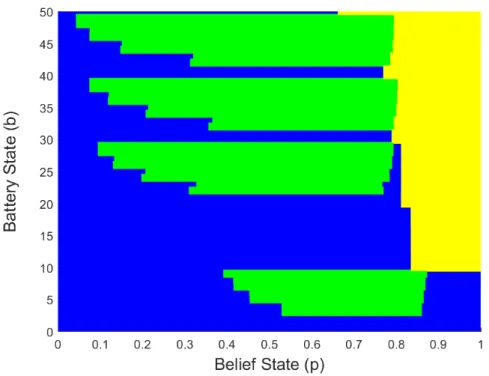
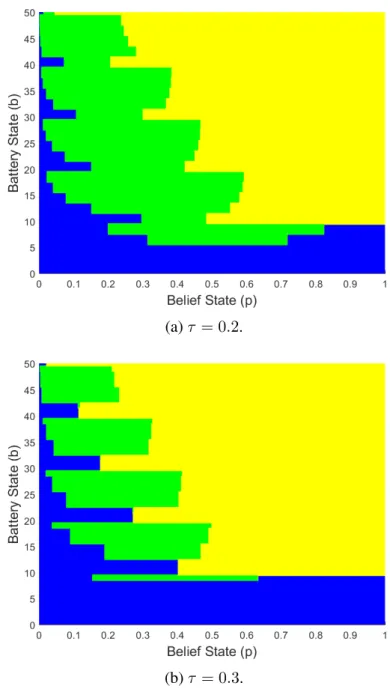
4.2 Optimal thresholds for taking the actions D (blue), O (green), H (yellow) forBmax = 50,ET = 10,τ = 0.2,β = 0.98,λ1 = 0.9,λ0 = 0.6,R = 3 andq = 0.1. . . 53
4.3 Value function associated withBmax = 50,ET = 10, τ = 0.2, β = 0.98, λ1 = 0.9,λ0 = 0.6,R= 3andq = 0.1. . . 54
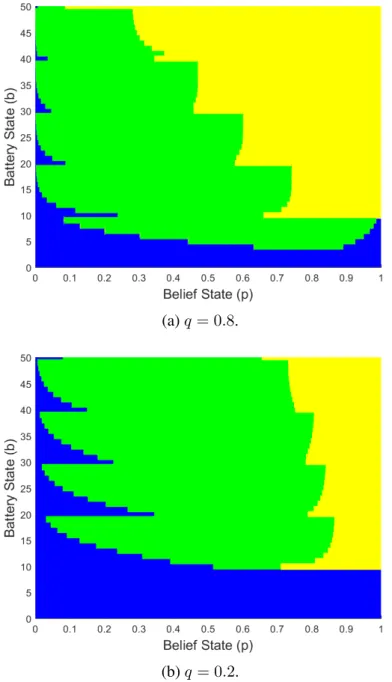
4.4 Optimal thresholds for taking the actions D (blue), O (green), H (yellow) forBmax = 50,ET = 10,τ = 0.1,β = 0.9,λ1 = 0.8,λ0 = 0.4, andR= 3. 55 4.5 Optimal thresholds for taking the actions D (blue), O (green), H (yellow) forBmax = 50,β = 0.9,ET = 10,λ1 = 0.8,λ0 = 0.4,R= 3andq= 0.8. 56 4.6 Throughputs by the optimal, greedy, single-threshold and opportunistic policies as a function of the EH rate,q. . . 58
4.7 Optimal thresholds for taking the actions D (blue), L (red), OD (green), OT (black), H (yellow) forBmax = 800, ET = 200,τ = 0.035,β = 0.7, λ1 = 0.98,λ0 = 0.81,R1 = 2.91,R2 = 3andq = 0.1. . . 60
5.1 A brief overview of the chapter. . . 78
5.3 The effect of the encoding rate on the minimum expected number of re-transmissions forR1 = 10,e= 1,Ed= 5andp= 0.1. . . 100 5.4 The effect of the channel quality and correlation on the minimum
ex-pected number of re-transmissions forR1 = 10, R0 = 3,e = 1,Ed = 5 andp= 0.1. . . 101 5.5 The effect of the EH rate on the minimum expected number of re-transmissions
forR1 = 10,R0 = 5,Ed= 10andp= 0.1. . . 102 6.1 System model. . . 112 6.2 The comparison of monomial and actual transmission rate and required
signal-to-noise (SNR) ratio per symbol form= 3andλ= 0.025as given in [1].drepresents the minimum distance between signal points. . . 114 6.3 An illustrative example of the battery evolution,E(t), whereT = 10. . . 120 6.4 The effect of channel discretization and deadline duration on the expected
throughput. . . 135 6.5 Expected total throughput of the WPD with respect to the number of
chan-nel discretization levels inT = 100time slots. . . 136 6.6 Expected total throughput of the WPD withN = 20channel levels with
respect to the frame length,T. . . 137 6.7 Expected transmission rate of the WPD withN = 20channel levels with
respect to the frame length,T. . . 138 6.8 Per-period regret comparison of TS and -greedy algorithms for =
Introduction
1.1
Overview
Wireless sensors has been utilized for decades to collect information from the environ-ment. Prior use cases for the utilization of sensors were limited to simple applications such as environmental monitoring, animal tracking, monitoring catastrophic events such as volcano and etc. The recent scope envisions the utilization of huge number of wireless sensors in emerging services and applications such as the internet of things (IoT), enter-tainment, haptics, automation and many more. Regardless of the use case scenario of the sensors, an important issue related to employment of such sensors is the limited lifetime of their batteries. Consequently, many early research in this field proposed solutions for prolonging the lifetime of these devices. Some prominent proposed approaches include the energy aware MAC [2] protocols, duty cycle optimization [3], adaptive sensing [4] and etc. Although these solutions prolong the lifetime of sensors, it should be noted that even-tually the lifetime remains finite. Note that many of such sensors are deployed in toxic, hostile or inaccessible environments where the replacement of batteries is often difficult, cost-prohibitive or impossible [5]. Another major difficulty is the sheer number of sensors in futuristic use cases which makes their tracking and hence battery replacement costly.
As a promising solution for the battery replacement problem, harvesting of energy from natural resources has become an important research area as a mean of achieving an ultimate perpetually available networks [6, 7]. Energy harvesting (EH) refers to scav-enging energy from the environmental sources such as solar and wind, or other sources such as body heat and foot striking. The harvested energy is then converted to
electric-ity to be used by electrical devices. The various sources for EH include wind turbines, photovoltaic cells, thermoelectric generators and mechanical vibration devices such as piezoelectric devices, electromagnetic devices [8]. Unlike the sole dependence on the energy of a battery, EH provides periodical charging opportunities for EH devices which can extend their lifetimes significantly.
The fundamental challenge of EH paradigm is that the harvested energy is minus-cule, comes at random amounts and times. This puts a heavy emphasis on communication schemes that specifically account for the randomness of the EH process. Based on the EH characteristic, the communication design can be categorized based on:
• energy storage structure: the sensor can either have a dedicated energy storage unit such as a battery and (super) capacitor, or without a storage unit such as passive RFID tags.
• energy arrival process: the energy arrival process can be either offline or online. The energy storage unit enables storing energy to be used in the future. This cor-relates the resource management decisions over time making the resource management problem a dynamic one. Earlier research in design of energy management policies for EH systems aim at maximizing a given concave utility of consumed energy (e.g., transmitted bits, delay, etc) for the offline scenario in which the amount of harvested energy is known non-causally [9,10]. Such a non-causal assumption on EH process enables an offline opti-mization framework that can be solved using well-known techniques such as Lagrangian optimization frame work. On the contrary, when the EH arrival process is online, only causal information about the EH process is available and future realization of the EH process is unknown. The online EH process itself can be categorized in to two cases re-garding the availability of EH statistics. The statistics governing the random processes can be available at the transmitter while their realizations are known only causally [11–13]. In this case, the EH communication system is usually modeled as a Markov decision process (MDP) [14], and dynamic programming (DP) [15] can be used to solve the MDP. There is also the possibility that in an online case even the statistics about the EH process is unknown. Such cases usually require tools such as machine learning to be able to learn the optimal resource allocation policy through interacting with the specific environment
stochastic nature of the EH process dictates the amount and availability of the harvested energy that is beyond the control of system designers. To this end, radio frequency (RF) EH has been gaining popularity since it has the potential to provide network adminis-trators a leverage for seamless charging opportunities. Radio signals with frequencies ranging from300GHz to3KHz can be used as a medium for transferring energies using electromagnetic propagation. Wireless power transfer (WPT) is a technology providing the network a way to replenish the batteries of the remote devices by utilizing RF trans-missions. In wireless powered communication networks (WPCNs) [17–19], WPT occurs in the down-link (DL) to replenish the battery of WPDs which in turn is used for infor-mation transmission (IT) in the up-link (UL). Recently, the concurrent use of RF signals for both delivering energy and information has gained interest. In simultaneous wireless information and power transfer (SWIPT), the incoming RF signal is used for both en-ergy harvesting and decoding of information bits. We emphasize that although WPT and SWIPT can be employed on demand to provide energy to the EH devices, the medium in which the RF signal is delivered has stochastic properties that may cause random varia-tions in the received RF signal.
1.2
Focus
We divide the focus of this work into two parts. In the first part, we study three important challenging problems existing for communications systems; i) multiple access strategy for shared mediums, ii) channel state acquisition, and, iii) reliability. We develop policies that are tailored carefully for EH systems in addressing these problems by taking into account the challenges associated with EH systems. In the second part, we address the service based perspective of the future generations of the wireless communication technology. To this end, we take a general view of a service quality as an optimization metric and design a cross layer optimization framework specifically for this purpose.
1.2.1
Multiple Access strategy
At the physical layer, a wireless transmitter’s job is to convert the digital bits into electrical signals, modulate them into higher frequencies suitable for propagation and then feed
them into an antenna for propagation. The medium in which the electromagnetic wave is transmitted is shared with other electromagnetic waves giving an additive property to the electromagnetic waves. Hence, when multiple transmitters transmit a signal concurrently, their electromagnetic bearers interfere in the air and result in collision and eventual loss of data. Thus designing efficient multiple access policies for wireless channels is popular. The resources that a transmitter may use is time, frequency and space. The use of these resources can be orthogonalized to allow multiple transmitters to communicate with a common receiver. One way is to use a centralized entity to allow a given transmitter to communicate only on allowed resources, similar to a moderator in a debate. Such approaches require various signalling steps to enable orthogonalization which is costly in terms of energy.
Distributed algorithms do not rely on a centralized entity for mitigating collisions. As an example, carrier sense multiple access (CSMA) algorithm requires each transmit-ter to monitor the wireless channel for a certain time and allows them to transmit only when no other transmitter is transmitting. This technique relies on continuous sensing of the channel activity resulting in high energy consumption for low capability EH de-vices. Random channel access strategy is a frequently used technique preferred for its distributed and stateless implementation, which is particularly suitable for low power and low duty-cycle sensor networks. In random channel access no specific signaling is re-quired to coordinate the transmissions and thus, enabling a low energy access scheme. However, this comes at the cost of occasional packet collisions. Specifically, transmitting with high probability increases the chances of collision events and accessing the channel with low probability decreases the resource utilization.
To this end, we adopt a random channel access strategy with the aim of introducing a form of coordination with the help of the statistics of the EH processes. More specifi-cally, depending on the spatial distribution of EH devices, the amount of energy harvested by different devices is typically correlated. For example, consider EH devices harvesting energy from tidal motion [20]. The locations of two EH devices may be such that one is located at the tidal crest, while the other one is located in a tidal trough. In such a case, there may be a time delay equal to the speed of one wavelength between the generation of energy at each device. Such correlation information can be used to coordinate the trans-missions of these devices without passing messages between them which is usually costly
data to a common base station over a random access channel. We develop and analyze a simple threshold-based transmission policy which grants access to an EH device only when its battery state exceeds a given threshold value. Threshold values are optimized based on the battery capacities and the correlation among EH processes of the devices to maximize the long-term throughput of the system.
1.2.2
Wireless Medium
The transmitted electromagnetic waves undergo various processes that attenuate signal power through absorption, reflection, scattering, and diffraction. When the attenuation is strong, the signal is blocked. Moreover, due to mobility, change of environment, or interference from other signals, the signal power may change randomly over time. Such variations in the wireless channel profile (amplitude and phase) is known as channel state information (CSI). A transmitter can adapt its transmission strategy to the specific state of the channel for an efficient transmission of information. One way to achieve this is to sense the channel1by consuming a fraction of available resources such as energy and time required for transmitting and receiving a pilot signal.
Often times, the wireless channel exhibits correlation in time in which the past his-tory of the wireless channel can be used to predict the future channel state saving time and valuable energy for the EH transmitter. For an EH transmitter, we aim to utilize the mem-ory of the channel to design intelligent channel sensing protocol so that harvested energy can be used efficiently by only expending energy when it is required. The correlation information can be mapped to a belief state which represents the conditional probability of the channel quality given its history. The EH transmitter, if believes that channel is in a good state can transmit without sensing the channel to save energy. Meanwhile if it believes that the channel quality is bad, it can opt to remain silent and save energy. The ultimate goal is to map the belief of the EH transmitter about the channel to the sensing, transmitting and deferring actions of an EH device to maximize the expected throughput over an infinite time horizon.
1If the transmitter receives a known signal, known as pilot, it can calculate the channel state by
1.2.3
Reliability
As discussed, wireless medium behaves randomly over time resulting in eventual loss of data due to unpredictable events such as random interfering RF signals. Thus, providing a mechanism for a reliable end-to-end transmission protocol is another important research topic for communication systems in recovering lost data. Automatic repeat and reQuest (ARQ) was the simplest form of reliable transmission protocols. The data stream is seg-mented into units of data known as packets and transmitted one by one. The receiver upon receiving the packets informs the transmitter whether a packet is corrupted and there is a need for retransmission. An obvious drawback of the ARQ protocol is that upon packet corruption, the whole corrupted packet is retransmitted which is inefficient. Hybrid ARQ (ARQ) protocols [21] provide a mechanism for forward error correcting (FEC) which is enabled by introducing redundancy to the packets. Specific HARQ protocols such as chase combining (CC) and incremental redundancy allow for the corrupted packets to be combined to potentially reducing the number of retransmissions. Nevertheless, this comes at the expense of extra processing time and energy associated with the enhanced error-correction decoders.
Recall that in simultaneous wireless information and power transfer (SWIPT), the incoming RF signal is used for both energy harvesting and decoding of information bits. More specifically, receiver architectures often adopted for a SWIPT receiver is the sepa-rated and co-located architectures. In sepasepa-rated architecture, both receivers have separate antennas, whereas in co-located architecture a single antenna is shared by both. In gen-eral, EH devices have small footprints necessitating a co-located architecture. This arises a resource allocation problem of sharing the RF signal among the two receivers. The incoming RF signal is fed to information decoding (ID) and energy harvesting (EH) cir-cuitry by applying either time-switching (TS) or power splitting (PS) schemes. In TS, the RF signal is split over two different parts of the time slot, one for EH and the other for ID, whereas in PS the incoming RF signal is fed to both, proportional to a given factor. A receiver employing HARQ encounters two major energy consuming operations: (1) sampling or Analog-to-Digital Conversion (ADC), which includes all RF front-end pro-cessing, and (2) decoding. The energy consumption attributed to sampling, quantization and decoding plays a critical role in energy-constrained networks which makes their study
HARQ to deliver a message reliably to an EH receiver. The receiver has no energy source, so it relies on harvesting energy from the information-bearing RF signal. The channel is time-varying where the amount of energy harvested and information collected varies depending on the quality of the channel. We minimize the expected number of re-transmissions needed to successfully deliver a message by optimally splitting the in-coming RF signal between EH and ID receivers.
1.2.4
Service Based Optimization
The future generation of wireless communication technologies envision a service based approach where the wireless network should be tailored to realize the specific service based requirements. With the rapid development of hardware technologies for sensors, we are witnessing an increasing amount of data that can be collected to be used in various data driven machine learning applications. The performance of such applications and services greatly depends on the quality of the sensor generated data as measured by the resolution of the data points. On the other hand, generating high resolution data by wireless sensors induces a higher energy consumption and reduces the chance of successfully delivering the sensed data. We study a utility maximization problem in data driven applications for a wireless powered device (WPD) that is able to generate and transmit data at different resolution settings. We balance a trade-off between the utility gained by providing a high resolution data and the extra energy consumption associated with it.
1.3
Contributions
• In Chapter 3, we investigate the effects of the correlation between the EH processes at different EH devices in a wireless network. To this end, we consider a net-work with two EH nodes transmitting data to a common base station over a random access channel. We develop and analyze a simple threshold-based transmission policy which grants access to an EH node only when its battery state exceeds a given threshold value. Threshold values are selected based on the battery capacities and the correlation among EH processes of the nodes to maximize the long-term throughput of the system. We derive the average throughput of the network by
modeling the system as a discrete time Markov chain (DTMC) and obtaining its steady-state distribution. We then investigate two important special cases to ob-tain further insights into the selection of optimal transmission thresholds. In the first special case, only one node harvests energy at any time, while in the second case the nodes always harvest energy simultaneously. These two cases demonstrate completely different optimal threshold characteristics.
• In chapter 4, we utilize the information conveyed by a time correlated channel to de-sign an intelligent channel sensing protocol to maximize the throughput of the EH transmitter. we take into account the energy cost of acquiring the CSI. We formu-lated the problem as a partially observable MDP (POMDP), which is then converted into an MDP with continuous state space by introducing a belief parameter for the channel state. We prove that the optimal transmission policy has a threshold struc-ture with respect to the belief state, where the optimal threshold values depend on the battery state.
• In Chapter 5, we consider a class of wireless powered devices employing HARQ to ensure reliable end-to-end communications over a two-state time-varying channel. A receiver, with no power source, relies on the energy transferred by a SWIPT enabled transmitter toreceiveanddecodeinformation. We develop low complexity algorithms for the receiver to be able to decode the information with the minimum number of re-transmissions over independent and identically distributed (i.i.d.) as well as time correlated channel.
• We address the service based optimization perspective of next generation of wire-less technologies in Chapter 6. To this end, we consider data driven applications in which the output quality depends on the resolution of the data generated by the sensors. We study a sensing resolution optimization problem for a WPD that is powered by wireless power transfer WPT from an access point (AP). We study a class of harvest-first-transmit-later type of WPT policy, where an AP first employs RF power to recharge the WPD in the down-link, and then, collects the data from the WPD in the up-link. The WPD optimizes the sensing resolution, WPT duration and dynamic power control in the up-link to maximize an application dependant
zon throughput maximization problem by jointly optimizing the WPT duration and power control. We prove that the optimal WPT duration obeys a time-dependent threshold form depending on the energy state of the WPD. In the subsequent data transmission stage, the optimal transmit power allocations for the WPD is shown to posses a channel-dependent fractional structure. Then, we optimize the sensing resolution of the WPD by using a Bayesian inference based multi armed bandit problem with fast convergence property to strike a balance between the quality of the sensed data and the probability of successfully delivering it.
1.4
Publication Lists
1.4.1
Journal Papers
• M. Salehi Heydar Abad and O. Ercetin, “Optimal Finite Horizon Sensing for Wire-lessly Powered Devices,” in IEEE Access, vol. 7, pp. 131473-131487, 2019. • Mehdi Salehi Heydar Abad, Ozgur Ercetin, Eylem Ekici, “Throughput optimal
ran-dom medium access control for relay networks with time-varying channels,”Computer Communications, Volume 133, Pages 129-141, 2019.
• M. Salehi Heydar Abad, O. Ercetin and D. Gunduz, “Channel Sensing and Commu-nication Over a Time-Correlated Channel With an Energy Harvesting Transmitter,” in IEEE Transactions on Green Communications and Networking, vol. 2, no. 1, pp. 114-126, March 2018.
• M. Salehi Heydar Abad, O. Ercetin, T. ElBatt and M. Nafie, “SWIPT Using Hybrid ARQ Over Time Varying Channels,” in IEEE Transactions on Green Communica-tions and Networking, vol. 2, no. 4, pp. 1087-1100, Dec. 2018.
• M. S. Heydar Abad, E. Ozfatura, D. Gunduz and O. Ercetin, “Hierarchical Feder-ated Learning Across Heterogeneous Cellular Networks”, arXiv, 2019.
1.4.2
Conference Papers
• M. S. Heydar Abad, E. Ozfatura, O. Ercetin and D. Gunduz, “Dynamic Content Updates in Heterogeneous Wireless Networks,” 2019 15th Annual Conference on Wireless On-demand Network Systems and Services (WONS), Wengen, Switzer-land, 2019, pp. 107-110.
• M. S. H. Abad and O. Ercetin, “Finite Horizon Throughput Maximization for a Wirelessly Powered Device Over a Time Varying Channel,” 2018 IEEE Globecom Workshops (GC Wkshps), Abu Dhabi, United Arab Emirates, 2018, pp. 1-6. • M. S. H. Abad, O. Ercetin, T. Elbatt and M. Nafie, ”Wireless energy and information
transfer in networks with hybrid ARQ,” 2018 IEEE Wireless Communications and Networking Conference (WCNC), Barcelona, 2018, pp. 1-6.
• M. S. H. Abad, D. Gunduz and O. Ercetin, “Communication over a time correlated channel with an energy harvesting transmitter,” 2017 International Symposium on Wireless Communication Systems (ISWCS), Bologna, 2017, pp. 331-336.
• M. S. H. Abad, D. Gunduz and O. Ercetin, “Energy harvesting wireless networks with correlated energy sources,” 2016 IEEE Wireless Communications and Net-working Conference, Doha, 2016, pp. 1-6.
• M. S. Heydar Abad, E. Ozfatura, D. Gunduz and O. Ercetin, “Hierarchical Fed-erated Learning Across Heterogeneous Cellular Networks” ICASSP 2020, under review.
Literature Review
Due to the tremendous increase in the number of battery-powered wireless communica-tion devices over the past decade, harvesting of energy from natural resources has become an important research area as a mean of prolonging life time of such devices [6, 7]. The various sources for energy harvesting (EH) are wind turbines, photovoltaic cells, thermo-electric generators and mechanical vibration devices such as piezothermo-electric devices, elec-tromagnetic devices [8]. EH technology is considered as a promising solution especially for large scale wireless sensor networks (WSNs), where the replacement of batteries is often difficult or cost-prohibitive [5]. However, due to the random nature of the harvested energy from ambient sources, the design of the system requires a careful analysis.
Early research in the design of optimal energy management policies for EH net-works consider an offline optimization framework [9, 10, 22–24], in which non-causal information on the exact realization of the EH processes are assumed to be available. In the online optimization framework [11–13, 25], the statistics governing the random pro-cesses are assumed to be available at the transmitter, while their realizations are known only causally. In the learning optimization framework, knowledge about the system be-havior is further relaxed and even the statistical knowledge about the random processes governing the system is not assumed, and the optimal policy scheduling is learned over time [16, 26].
The EH sensors communicate with a destination for reporting their data over wire-less channels. Since the wirewire-less channel is a shared medium, concurrent transmissions of sensors create interference. Thus, efficient multiple access protocols are needed to uti-lize the harvested energy which is usually of minuscule amount. In [22], for an offline
setting, the goal is to minimize the time in which all the data from both users are trans-mitted to the destination by optimizing the power allocations and departure rates. In [9], a transmitter with non-causal information schedules packets to be transmitted for two EH receivers and the objective is two minimize the transmission completion time which is the time both users have received their packets. [27] studies a resource allocation problem over a finite horizon to characterize the boundary of the maximum departure region for a multiple access channel in which the users can communicate with each other.
Concurrent transmissions of multiple devices over a shared wireless channel result in collision and eventual loss of data. Orthogonal schemes such as time division multiple access (TDMA) [17,28] and frequency division multiple access (FDMA) [29] allocate non overlapping resources to users to mitigate collision. Ensuring orthogonalization requires message passing to synchronize the transmission which comes at the cost of extra energy consumption for energy limited sensors. Random access protocols such as ALOHA [30] require no coordination at the cost of allowing occasional collisions among transmitters. In chapter 3, we aim at developing a random access policy for two energy harvesting sen-sors that transmit their data to a common destination. Different from literature, we take into account the possibility that the harvested energy by the sensors maybe correlated across them. We incorporate this information in designing a simple threshold based trans-mission policy that coordinate their transtrans-missions for maximizing the sum throughput of the network. We show that the inherent randomness in the EH system can be turned into an opportunity by carefully addressing the correlation information in the random access policy.
Upon accessing the channel, the wireless sensor needs to overcome the challenges imposed by another source of randomness which is the state of the wireless channel that vary randomly over time. For an efficient utilization of energy, the transmission strategy should be properly adapted to the channel state. In [31], the authors develop an optimal transmission policy for maximizing the bit rate of a EH sensor by adapting the transmis-sion parameters, allocated power and modulation type to the channel state. The optimality of a single-threshold policy is proven in [32] when an EH transmitter sends packets with varying importance. The allocation of energy for collecting and transmitting data in an EH communication system is studied in [33] and [34]. The scheduling of EH transmitters with time-correlated energy arrivals to optimize the long term sum throughput is
inves-either the current or future energy and channel states are known by the transmitter. In [37], power allocation to maximize the throughput is studied when the amount of harvested en-ergy and channel states are modeled as Markov and static processes, respectively. In [38], an energy management scheme for sensor nodes with limited energy being replenished at a variable rate is developed to make the probability of complete depletion of the battery arbitrarily small, which at the same time asymptotically maximizes a utility function (e.g., Gaussian channel capacity) that depends on the energy consumption scheme. In [39] a simple online power allocation scheme is proposed for communication over a quasi-static fading channel with an i.i.d. energy arrival process, and it is shown to achieve the optimal long-term average throughput within a constant gap. However, [31–39] assume that the transmitter is aware of the wireless channel prior to transmissions. In practice, channel state is obtained through channel sensing which is realized by utilization of pilot signals. This procedure results in both energy and time overheads when the channel state is sensed at every transmission. We argue that the energy consumption for limited EH devices can-not be neglected and intelligent channel sensing algorithms is required to only sense the channel when it is needed. Thus, in Chapter 4, we show that when the channel state is correlated over time (e.g., when strong line of sight exists) it is possible to provide an in-telligent frame work for the EH sensor to refrain from channel sensing and save its energy for future.
In inherently error-prone wireless communications systems, re-transmissions trig-gered by decoding errors have a major impact on the energy consumption of wireless devices. Hybrid automatic repeat request (HARQ) schemes are frequently used in or-der to reduce the number of re-transmissions by employing various channel coding tech-niques [21]. Nevertheless, this comes at the expense of extra processing time and energy associated with the enhanced error-correction decoders.
Note that EH devices harvest energy only in minuscule amounts (orders ofµWs), so the energy consumption of the receiver circuitry to perform simple sampling and decod-ing can no longer be neglected. The authors in [40] addressed the energy consumption of sampling and decoding operations over a point-to-point link where the receiver harvests energy at a constant rate. In [41], a decision-theoretic approach is developed to optimally manage the transmit energy of an EH transmitter transmitting to an EH receiver, where
both the transmitter and the receiver harvests energy independently from a Bernoulli en-ergy source. The receiver uses selective sampling (SS) and informs the transmitter about the SS information and its delayed battery state by feedback. Based on this feedback, the transmitter adjusts its transmission policy to minimize the packet error probability.
Meanwhile, in [42], the performance of different HARQ schemes for an EH re-ceiver harvesting energy from a deterministic energy source with a constant energy rate was studied. In [43], the impact of the battery’s internal resistance at the receiver was an-alyzed for an EH receiver with imperfect battery, with the aim of maximizing the amount of information decoded by the EH receiver. While ignoring the sampling energy cost at the receiver, [44] investigates the performance of TS policies to maximize the amount of information decoded at the receiver operating over a binary symmetric channel (BSC), by optimizing the fraction of time used for harvesting energy and for extracting information. For an EH transmitter and an EH receiver pair both harvesting ambient environmental en-ergy with possible spatial correlation, [45] addresses the problem of outage minimization over a fading wireless channel with ACK-based re-transmission scheme by optimizing the power allocation at the transmitter. In [46], for a pair of EH transmitter-receiver employ-ing ARQ and HARQ with binary EH process, packet drop probability over fademploy-ing chan-nels is minimized by optimally allocating power over different rounds of re-transmissions. In [47], an adaptive feedback mechanism for an EH receiver is proposed by taking into account the energy cost of sampling and decoding. The receiver is allowed to transmit a delayed feedback with the aim of efficiently utilizing the harvested energy in order to minimize the packet drop probability in the long run. In [48], the outage probability for an EH receiver powered by RF transmissions is minimized by implementing HARQ.
In Chapter 5, we consider a point-to-point link where an energy-abundant trans-mitter employs HARQ to deliver a message reliably to an EH receiver. The receiver has no energy source, so it relies on harvesting energy from the information-bearing RF sig-nal. We develop optimal low complexity algorithms that can minimize the number of retransmissions required for successfully decoding information by an EH receiver, thus, addressing reliability issue in communication systems for EH receivers.
We revisited some the most fundamental problems of communication system is Chapter 3, 4 and 5 by specifically accounting for the characteristics of EH systems. Nowa-days, the application scope of the sensors have evolved from simply reporting fixed size
teraction with the physical world, detection of unsafe behaviors, leveraging visual context for advertising, life logging and etc. For example, in [49], a camera sensor is trained to estimate the gaze location of person. Such an application heavily depends on the quality of the reported data by the sensors as measured by its resolution. In the example of [49], a high resolution image results in a lower gaze error while consuming more energy with the risk of not being able to deliver the message. Such a service based vision of sensors for future technologies motivated us to consider a general service based optimization in Chapter 6 where we optimize sensing resolution of a sensor to maximize the application dependant utility.
Chapter 3
Random Access Protocol with
Correlated Energy Sources
This chapter considers a system with two energy harvesting (EH) nodes transmitting to a common destination over a random access channel. The amount of harvested energy is as-sumed to be random and independent over time, but correlated among the nodes possibly with respect to their relative position. A threshold-based transmission policy is developed for the maximization of the expected aggregate network throughput. Assuming that there is no a priori channel state or EH information available to the nodes, the aggregate net-work throughput is obtained. The optimal thresholds are determined for two practically important special cases: i) at any time only one of the sensors harvests energy due to, for example, physical separation of the nodes; ii) the nodes are spatially close, and at any time, either both nodes or none of them harvests energy.
3.1
Overview
Depending on the spatial distribution of EH devices, the amount of energy harvested by different devices is typically correlated. For example, consider EH devices harvesting energy from tidal motion [20]. The locations of two EH devices may be such that one is located at the tidal crest, while the other one is located in a tidal trough. In such a case, there may be a time delay equal to the speed of one wavelength between the generation of energy at each device.
1 n 2 n 2 B E2
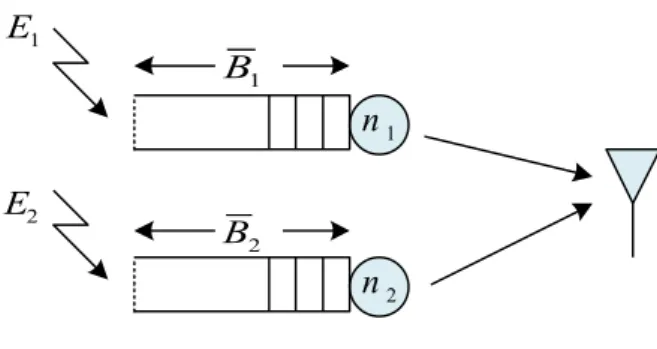
Figure 3.1: System Model
processes at different EH devices in a wireless network. To this end, we consider a net-work with two EH nodes transmitting data to a common base station over a random access channel as shown in Fig. 3.1. Random channel access is a frequently used technique pre-ferred for its distributed and stateless implementation, which is particularly suitable for low power and low duty-cycle sensor networks. In random channel access, the nodes transmit probabilistically over time resulting in occasional packet collisions. However, packet collisions are especially harmful in EH networks due to scarce resources, and should be avoided as much as possible. In this chapter, we develop and analyze a simple threshold-based transmission policy which grants access to an EH node only when its battery state exceeds a given threshold value. Threshold values are selected based on the battery capacities and the correlation among EH processes of the nodes to maximize the long-term throughput of the system.
To illustrate the importance of choosing these threshold values intelligently, con-sider the following example. Let both EH nodes have a battery capacity of two energy units. Suppose that the EH nodes are spatially close, so they harvest energy simultane-ously when energy is available. If the transmission thresholds are such that both nodes transmit a packet whenever they have one unit of energy, transmissions always result in a collision, and thus, the total network throughput is essentially zero. Meanwhile, if the thresholds are selected such that one EH node transmits a packet whenever it has one unit of energy, and the other node transmits a packet whenever it has two units of energy, there will be a collision once every two transmissions. Hence, with the latter choice of thresholds throughput increases to0.5packets.
We first derive the average throughput of the network by modeling the system as a discrete time Markov chain (DTMC) and obtaining its steady-state distribution. We then investigate two important special cases to obtain further insights into the selection of
optimal transmission thresholds. In the first special case, only one node harvests energy at any time, while in the second case the nodes always harvest energy simultaneously. These two cases demonstrate completely different optimal threshold characteristics.
We assume that EH nodes have no knowledge about the EH processes, and can only observe the amount of harvested energy in their own battery. Optimal threshold policies for an EH network is considered in [50] based on a game theoretic approach. In [51], authors optimize the throughput of a heterogeneousad hoc EH network by formulating it as an optimal stopping problem. In [52] multiple energy harvesting sensor nodes are scheduled by an access point which does not know the energy harvesting process and battery states of the nodes. However, in these works the EH processes at different devices are assumed to be independent.
3.2
System Model
We adopt an interference model, where the simultaneous transmissions of two EH nodes result in a collision, and eventual loss of transmitted packets at the base station. Each node is capable of harvesting energy from an ambient resource (solar, wind, vibration, RF, etc.), and storing it in a finite capacity rechargeable battery. EH nodes have no additional power supplies. The nodes are data backlogged, and once they access the channel, they transmit until their battery is completely depleted. Note that assuming that the nodes are always backlogged allows us to obtain the saturated system throughput. In the following, we neglect the energy consumption due to generation of data to better illustrate the effects of correlated EH processes1.
Time is slotted into intervals of unit length. In each time slot, the energy is harvested in units ofδjoules. LetEn(t)be the energy harvested in time slottby noden= 1,2. We assume thatEn(t)is an independent and identically distributed (i.i.d.) Bernoulli process with respect to time t. However, at a given time slot t, E1(t) and E2(t) may not be
1For example, data may be generated by a sensor continuously monitoring the environment. Then, the
energy consumption of a sensor may be included as a continuous drain in the energy process, but due to possible energy outages, the data queues may no longer be backlogged. We leave the analysis of this case as a future work.
Pr(E1(t) =δ, E2(t) =δ) =p11,
Pr(E1(t) =δ, E2(t) = 0) =p10,
Pr(E1(t) = 0, E2(t) =δ) =p01,
Pr(E1(t) = 0, E2(t) = 0) =p00, (3.1)
wherep00+p10+p01+p11= 12.
We assume that the transmission time ε is much shorter than the time needed to harvest a unit of energy, i.e.,ε 1, and the nodes cannot simultaneously transmit and harvest energy. Transmissions take place at the beginning of time slots, and the energy harvested during time slottcan be used for transmission in time slott+ 1. The channel is non-fading, and has unit gain. Given transmission powerP, the transmission rate,rn(t),
n = 1,2is given by the Shannon rate, i.e.,rn(t) = log (1 +P/N)(nats/sec/Hz), where
N is the noise power.
We consider a deterministic transmission policy which only depends on the state of the battery of an EH node. Each EH node independently monitors its own battery level, and when it exceeds a pre-defined threshold, the node accesses the channel. If more than one node accesses the channel, a collision occurs and both packets are lost. Note that, by considering such an easy-to-implement and stateless policy, we aim to achieve low-computational power at EH devices.
The battery of each EH node has a finite capacity ofB¯n,n = 1,2. LetBn(t)be the state of the battery of EH noden = 1,2at timet. Nodentransmits whenever its battery state reachesγn ≤ B¯n joules,n = 1,2. When node naccesses the channel, it transmits at power Bn(t)
ε , i.e., the battery is completely depleted at every transmission. Hence, the time evolution of the battery states is governed by the following equation.
Bn(t+ 1) = min
¯
Bn,
Bn(t) +En(t)1{Bn(t)<γi}−1{Bn(t)≥γi}Bn(t) , (3.2)
2Note that ifp
00 =p10=p01 =p11= 1/4, then EH nodes generate energy independently from each
where1a<b = 1 ifa < b 0 ifa ≥b
is the indicator function. LetRn(t)be the rate ofsuccessfultransmissions, i.e.,
R1(t) = log 1 + B1(t)/ε N 1{B1(t)≥γ1,B2(t)<γ2}, (3.3) R2(t) = log 1 + B2(t)/ε N 1{B1(t)<γ1,B2(t)≥γ2}. (3.4)
3.3
Maximizing the Throughput
We aim at maximizing the long-term average total throughput by choosing the transmis-sion thresholds intelligently, taking into account the possible correlation between the EH processes. Let R¯n(γ1, γ2) be the long-term average throughput of EH noden when the thresholds are selected asγ1, γ2, i.e.,
¯ Rn(γ1, γ2) = lim T→∞ 1 T T X t=1 Rn(t), n= 1,2. (3.5)
Then, the optimization problem of interest can be stated as
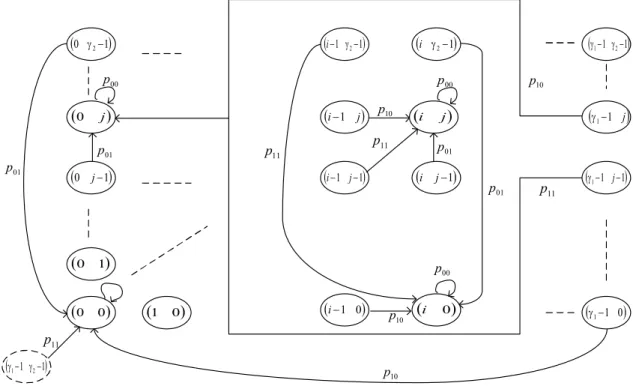
max γ1,γ2 X n ¯ Rn(γ1, γ2), (3.6) s.t. 1≤γn≤B¯n n= 1,2. (3.7) In order to solve the optimization problem (3.6)-(3.7), we first need to determine the long term average total throughput in terms of the thresholds. Note that for givenγ1, γ2, the battery states of EH nodes, i.e.,(B1(t), B2(t)) ∈ {0, . . . , γ1−1} × {0, . . . , γ2−1} constitute a finite two dimensional discrete-time Markov chain (DTMC), depicted in Fig. 3.2. Let π(i, j) = Pr(B1(t) = i, B2(t) = j) be the steady-state distribution of the Markov chain fori= 0, . . . , γ1−1andj = 0, . . . , γ2−1.
Theorem 3.1. The steady state distribution of DTMC associated with the joint battery state of EH nodes isπ(i, j) = γ1
11 j 11 j1 11 0 0 j 0 j1 0 0 i 1 j i1 j1 i j1 i j 1 0 0 1 i1 0 i 0 1 1 21 11 p 11 p 11 p 11 p 01 p 01 p 01 p 10 p 01 p 10 p 10 p 00 p 00 p 00 p 10 p
Figure 3.2: Associated DTMC with joint battery states
Proof. The detailed balance equations fori= 1, . . . , γ1 −1andj = 1,· · · , γ2−1are:
π(i, j) (1−p00) =π(i−1, j−1)p11
+π(i−1, j)p10+π(i, j−1)p01. (3.8) Whenever the battery state of nodenreachesγn−1, in the next state transition, given that it harvests energy, there is a transmission. Since the transmission time is much shorter than a time slot, i.e., ε 1, after reaching state γn, node n immediately transmits and transitions back to state0. Thus, the detailed balance equations for state0are given as:
π(i, 0) (1−p00) =π(i−1, 0)p10+π(i, γ2−1)p01 +π(i−1, γ2−1)p11, 1≤i≤γ1−1, (3.9) π(0, j) (1−p00) =π(0, j−1)p01+π(γ1−1, j)p10 +π(γ1−1, j−1)p11, 1≤j ≤γ2−1, (3.10) π(0, 0) (1−p00) = π(γ1−1, γ2 −1)p11 +π(γ1−1, 0)p10+π(0, γ2−1)p01. (3.11)
From (3.8), it is clear that ifp01, p10 6= 0thenπ(i, j) 6= 0for alli = 1, . . . , γ1−1and
j = 1, . . . , γ2 −1. Then, it can be verified that π(i, j) = π(l, k)satisfies (3.8)-(3.11) for alli, j, k, andl. Hence, the theorem is proven sincePγ2−1
j=0
Pγ1−1
i=0 π(i, j) = 1. Once the steady state distribution of DTMC is available, we can obtain the average throughput values. Letδ0 = δ/εN .
Lemma 3.1. The average throughput of EH nodes 1 and 2 forp01, p106= 0are given as
¯ R1(γ1, γ2) = log(1 +γ1δ0) × (p10+p11) γ2−2 X j=0 π(γ1−1, j) +p10π(γ1−1, γ2−1) =log(1 +γ1δ 0) [(γ 2−1) (p10+p11) +p10] γ1γ2 , (3.12) ¯ R2(γ1, γ2) = log(1 +γ2δ0) × (p01+p11) γ1−2 X i=0 π(i, γ2−1) +p01π(γ1−1, γ2−1) ! =log(1 +γ2δ 0) [(γ 1−1) (p01+p11) +p01] γ1γ2 . (3.13)
Proof. Consider node 1. Note that whenever the batteries are in one of the states(γ1 −1, j) forj = 0, . . . , γ2 −2, a unit of energy (ofδ joules) is harvested at node 1with proba-bility ofp10 +p11, and it transmits in the subsequent transition. Meanwhile, whenever the batteries are in state (γ1 −1, γ2−1), both nodes harvest a unit energy with prob-ability p11, and transmit in the subsequent transition resulting in a collision. Thus, in state (γ1−1, γ2−1), EH node 1 successfully transmits with probability p10. Similar arguments apply for node 2.
The following optimization problem is equivalent to (3.6)-(3.7).
max γ1,γ2 z(γ1, γ2), log(1 +γ1δ0) [(γ2−1) (p10+p11) +p10] γ1γ2 +log(1 +γ2δ 0) [(γ 1−1) (p01+p11) +p01] γ1γ2 , (3.14) s.t. 1≤γn≤B¯n, n= 1,2. (3.15) Note that (3.14)-(3.15) is an integer program. Since our main motivation is to
in-by omitting the integrality constraints. Nevertheless, the resulting relaxed optimization problem is still difficult to solve since the objective function is non-convex. Hence, in the following, we obtain the optimal solution for two important special cases.
3.4
Special Cases
Depending on the energy source and relative locations of the nodes, correlation among their EH processes may significantly vary. For example, if mechanical vibration is har-vested, and the nodes are located far from each other, e.g., one EH device on one side of the road whereas the other one on the other side of a two-lane road, only the EH device on the side of the road where a car passes may generate energy from its vibration. This is a case ofhigh negative correlation. Meanwhile, if solar cells are used as an energy source, EH processes at nearby nodes will havehigh positive correlation.
3.4.1
The Case of High Negative Correlation
We first analyze the case of high negative correlation. In particular, we havep00 =p11 =
0, p10 = p andp01 = 1−p with0 < p < 1. Note that only one EH device generates energy at a given time. Letz(−)(γ
1, γ2)be the total throughput of EH network when the thresholds are γ1, γ2, obtained by inserting the values of p00, p11, p10, p01 in (3.14). We have z(−)(γ1, γ2) = log(1 +γ1δ0)p γ1 +log(1 +γ2δ 0)(1−p) γ2 . (3.16)
The following lemma establishes that an EH device transmits whenever it harvests a single unit of energy. Interestingly, the optimal thresholds prevent any collisions be-tween transmissions of EH devices, since at a particular time slot only one EH device has sufficient energy to transmit.
Lemma 3.2. The optimal solution of (3.14)-(3.15) when p00 = p11 = 0, p10 = p and
p01= 1−pwith0< p <1, isγ1∗ = 0,γ
∗
2 = 0.
1 2 3 1 2 3 4 5
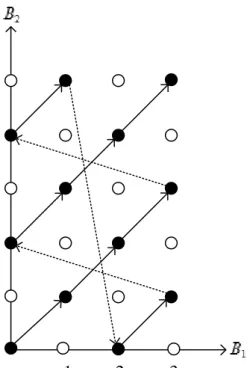
Figure 3.3: Transitions of joint battery states for high positive correlation case. ofz(−)(γ1, γ2)is: ∇z(−)(γ1, γ2) = p(δ0γ1−(1 +δ0γ1) log (1 +γ1δ0)) γ12(1 +δ0γ1) , (1−p) (δ0γ2 −(1 +δ0γ2) log (1 +γ2δ0)) γ22(1 +δ0γ2) . (3.17) Note that ∇z(−)(γ
1, γ2) < 0for all γ1 ≥ 0, γ2 ≥ 0 andp. Since ∇z(−) < 0, we have
z(−)(γ1, γ2)> z(−)(ˆγ1,γˆ2)for everyγ1 <γˆ1andγ2 <ˆγ2. Then, the lemma follows.
3.4.2
The Case of High Positive Correlation
Now, we consider the case of high positive correlation. In particular, we investigate the optimal solution when EH process parameters arep01=p10 = 0,p11=pandp00 = 1−p with0< p <1; that is, either both EH devices generate energy or neither of them does. Note that in Theorem 3.1 the steady state distribution of DTMC is derived assuming that all of the states are visited. However, in the case of high positive correlation, only a part of the state space is visited.
In order to better illustrate this case, consider an EH network with thresholdsγ1 = 4 andγ2 = 6. The state space of the corresponding DTMC is given in Fig. 3.3. Large solid
the dotted lines represent transitions when at least one of the nodes transmits. Also, arrows show the direction of transitions between the states. Since only a subset of the state space is visited infinitely often, the average throughputs given in Lemma 3.1 are no longer valid. We establish the average throughput of EH network with high positive correlation by the following lemma.
Lemma 3.3. The average throughput R¯(+)n (γ1, γ2)of noden = 1,2for p01 = p10 = 0,
p11=pandp00 = 1−pis given as ¯ R(+)n (γ1, γ2) =p· h LCM(γ1, γ2) γn −1 i LCM(γ1, γ2) ·log(1 +γnδ0), n= 1,2 (3.18)
whereLCM(γ1, γ2)is theleast common multipleofγ1andγ2.
Proof. Due to our transmission policy, EH node n transmits whenever its battery level reachesγn, n = 1,2. Note that both nodes reach their respective thresholds simultane-ously everyLCM(γ1, γ2)instances of EH events. Since they transmit simultaneously, a collision occurs, and they both exhaust their batteries, i.e., the joint battery state tran-sitions into state (0,0). The process repeats afterwards. Hence, the renewal period of this random process isLCM(γ1, γ2). In every renewal period, EH noden = 1,2makes
LCM(γ1, γ2)
γn −1number of successful transmissions. Hence, by using renewal reward
the-ory, and noting that on the average a unit of energy is harvested inp < 1proportion of time slots, we obtain (3.18).
Letz(+)(γ
1, γ2) = ¯R (+)
1 (γ1, γ2) + ¯R (+)
2 (γ1, γ2)be the total throughput of a system with high positive correlation. Note thatz(+)(γ
1, γ2) is a non-convex function with re-spect toγ1, andγ2. Hence, in the following, we analyze the system in two limiting cases, i.e., when unit of energy harvested per slot, i.e.,δ0, is either very small or very large. Small Values ofδ0
For small values ofδ0,log(1 +γnδ0)can be approximated byγnδ0. LetGCD(γ1, γ2)be thegreatest common divisorofγ1 andγ2. By substitutingLCM(γ1, γ2) = GCD(γγ1γ12, γ2)
we obtain z(+)(γ1, γ2) = 2δ0p−GCD(γ1, γ2) 1 γ1 + 1 γ2 δ0p. (3.19)
Note that maximizing (3.19) is equivalent to minimizingGCD(γ1, γ2)
1 γ1 + 1 γ2 . Lemma 3.4 establishes that it is optimal to choose the thresholds as large as possible as long as the greatest common divisor of the two thresholds is equal to1. This is due to the fact that the objective function in (3.19) is linear, and the optimum thresholds minimize the number of collisions.
Lemma 3.4. The optimal thresholds for the case of high positive correlation for small values ofδ0, and forB¯2 >B¯1areγ1∗ = ¯B1,γ2∗ = arg maxjB¯2−j forj = 1, . . . ,B¯2, s.t.,
GCD( ¯B1, j) = 1. Proof. Note that 0 < 1
γ1 +
1
γ2 ≤ 2, for1 ≤ γn ≤ ¯
Bn, n = 1,2. Let Γ = {(γ1, γ2) :
GCD(γ1, γ2) = 1}. Note that if (γ1, γ2) ∈/ Γ, thenGCD(γ1, γ2) ≥ 2. Hence, it can be shown thatz(+)(γ
1, γ2) ≥ z(+)(γ10, γ
0
2), for all (γ1, γ2) ∈ Γ, and (γ10, γ
0
2) ∈/ Γ. Among
(γ1, γ2)∈Γ, we choose the one that minimizesγ11+γ12, and thus, proving the lemma. Large Values ofδ0
For large values ofδ0,log(1+γnδ0)can be approximated bylog(γnδ0). Also by substituting
LCM(γ1, γ2) = GCD(γγ1γ12, γ2) inz(+)(γ1, γ2)we have: z(+)(γ1, γ2) = (γ2−GCD(γ1, γ2)) log(γ1δ0)p γ1γ2 + (γ1−GCD(γ1, γ2)) log(γ2δ 0)p γ1γ2 . (3.20)
The optimal thresholds for this case is established in Lemma 3.5. Since the objective function in (3.20) has the property ofdiminishing returns, i.e., the rate of increase in the function decreases for higher values of its parameters, each device will choose transmit-ting more often, equivalently short messages, using less energy. However, transmissions are scheduled every time each node exceeds a threshold, which dictates small thresholds. When both EH devices transmit with small thresholds, there will be a large number of collisions, so the following lemma suggests that the aggregate throughput is maximized
values of δ are γ1 = B1, γ2 = 1 for B¯1 > B¯2, and they are γ1 = 1, γ2 = B2 for
¯
B2 >B¯1.
Proof. Letzˆbe an upper envelope function forz(+), obtained by substitutingGCD(γ
1, γ2) = 1in (3.20): ˆ z(γ1, γ2) = (γ2−1) log(γ1δ0)p γ1γ2 + (γ1−1) log(γ2δ 0)p γ1γ2 . (3.21)
Note that sinceGCD(γ1, γ2)≥1, for every value ofγ1andγ2, we havezˆ(γ1, γ2)≥
z(+)(γ
1, γ2). First, we maximizezˆfor a givenγ2 by obtaining the corresponding optimal
γ1. Taking the partial derivative ofzˆwith respect toγ1, we obtain:
∂zˆ
∂γ1
= p
γ2 1γ2
[log (γ1δ) + log (γ2δ)−γ2(log (γ1δ)−1)−1]. (3.22) Note thatγ2 ∈ {1, . . . ,B¯2}. Ifγ2 = 1, (3.22) reduces to
∂zˆ(γ1,1) ∂γ1 = p γ2 1γ2 logδ >0. (3.23) Since ∂ˆz(γ1,1)
∂γ1 >0, the maximum value ofzˆis attained whenγ1 =B1. For γ2 = 2,
(3.22) reduces to ∂zˆ(γ1,2) ∂γ1 = p γ2 1γ2 (−log (γ1δ) + log(2δ) + 1) = <0 ifγ1 >2e, ≥0 ifγ1 ≤2e, (3.24)
whereeis the Euler’s constant. Since ∂2∂γˆz(2e,2)
12 =−
1
16e3 < 0, the maximum value of zˆis
attained whenγ1 = 2e. Finally, ifγ2 ≥ 3, it can be shown that (3.22) is always negative as long asδ > 3e2. Hence, the maximum value ofzˆis attained forγ
1 = 1, if γ2 ≥ 3. By comparing the optimal values of zˆfor all γ2 ∈ {1, . . . ,B¯2}, one can show thatzˆis maximized for(γ1, γ2) = (B1, 1)whenB1 > B2and(γ1, γ2) = (1, B2)whenB2 > B1. Since GCD(1, B2) = GCD(B1, 1) = 1, and zˆ = z(+) when GCD(γ1, γ2) = 1, it follows that optimal points forzˆare also the optimal forz(+).
3.5
Numerical Results
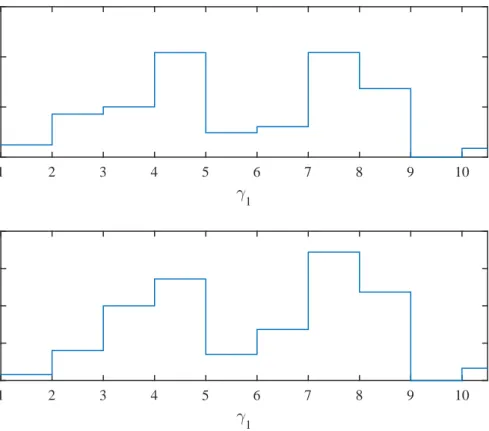
We first verify (3.14) and (3.18) by Monte Carlo simulations. In the simulation, we model the battery states using equation (3.2). At each time slot t, we generate the joint EH process(E1(t), E2(t))randomly. We run the simulation for104 time slots and calculate the expected throughput by evaluating time average of the instantaneous rates as in (3.5). Fig. 3.4 depicts the reliability of our analytical derivations. In particular, we
mea-sure both the percent relative error (%RE), which is defined as%RE= Analytical valueAnalytical value−Simulation value×
100, and the absolute error (%AE), which is defined as %AE = (Analytical value − Simulation value)×100, forγ2 = 9versusγ1. The results show a good match between the analytical and simulation results.
γ 1 1 2 3 4 5 6 7 8 9 10 %AE 0 0.5 1 1.5 γ 1 1 2 3 4 5 6 7 8 9 10 %RE 0 0.5 1 1.5 2
Figure 3.4: %AE and %RE versusγ1withγ2 = 9andδ0 = 30.
Next, we verify the optimal thresholds by numerically evaluating (3.14) and (3.18) for the cases of high negative and high positive correlation. We assume thatB¯1 = ¯B1 =
10andp = 0.5. The aggregate throughput of the network with respect to the thresholds
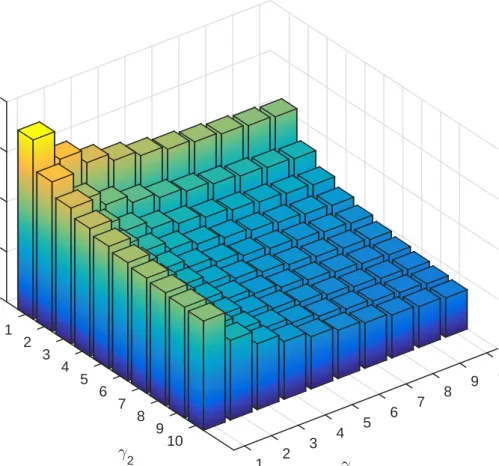
γ1 andγ2 for the case of high negative correlation is depicted in Fig. 3.5. It can be seen that the optimal thresholds areγ1∗ = 1,γ2∗ = 1, which is in accordance with Lemma 3.2.
10 9 8 7 6 5 γ1 4 3 2 1 10 9 8 γ 2 7 6 5 4 3 2 1 1 0 0.5 1.5 Expected Throughput
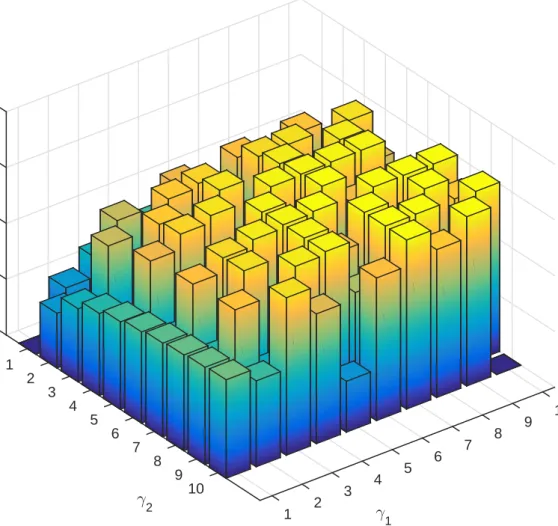
Figure 3.5: Expected total throughput for high negative correlation withδ0 = 5. positive correlation with respect toγ1andγ2forδ0 = 0.04. The abrupt drops in the value of the aggregate throughput are due to the fact thatGCD(γ1, γ2)varies at least by a factor of two, which shows consistency with Lemma 3.4.
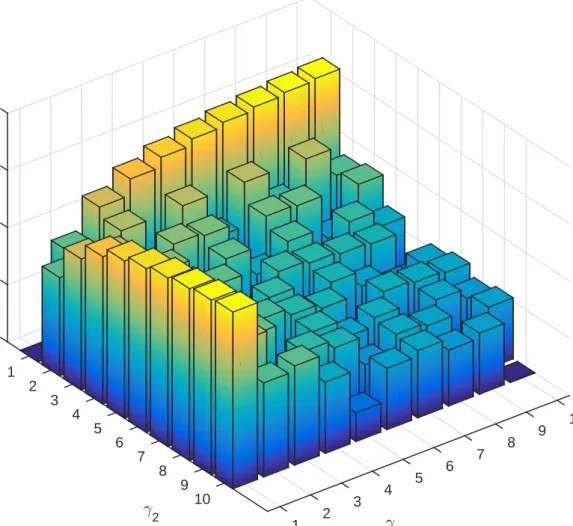
In Fig. 3.7, the aggregate throughput is depicted for the case of high positive corre-lation with respect toγ1 andγ2 forδ0 = 30. As expected from the results established in Lemma 3.5, the optimal thresholds are either(γ1∗, γ∗2) = (1, 10)or(γ1∗, γ2∗) = (10, 1).
3.6
Chapter Summary
We have investigated the effects of correlation among the EH processes of different EH nodes as encountered in many practical scenarios. We have developed a simple thresh-old based transmission policy to coordinate EH nodes’ transmissions in such a way to maximize the long-term aggregate throughput of the network. In the threshold policy, nodes have no knowledge about each other, and at any given time they can only monitor their own battery levels. Considering various assumptions regarding the EH statistics and
10 9 8 7 6 5 γ1 4 3 2 1 10 9 8 γ 2 7 6 5 4 3 2 1 0.04 0.03 0.02 0.01 0 Expected Throughput
Figure 3.6: Expected total throughput for high positive correlation withδ0 = 0.04. the amount of the harvested energy, the performance of the proposed threshold policy is studied. The established lemmas in Section 3.3 show that different assumptions about the underlying EH processes and the amount of the harvested energy demonstrate com-pletely different optimal threshold characteristics. As our future work, we will investigate the cases when data queues are not infinitely backlogged and when the channels exhibit fading properties.
10 9 8 7 6 5 γ 1 4 3 2 1 10 9 8 γ2 7 6 5 4 3 2 1 1.5 1 0.5 0 Expected Throughput