University of Connecticut
OpenCommons@UConn
Doctoral Dissertations University of Connecticut Graduate School
5-5-2015
Engineering Creativity: Differences in Creative
Problem Solving Stages Across Domains
Lamies J. Nazzal
University of Connecticut - Storrs, [email protected]
Follow this and additional works at:https://opencommons.uconn.edu/dissertations Recommended Citation
Nazzal, Lamies J., "Engineering Creativity: Differences in Creative Problem Solving Stages Across Domains" (2015).Doctoral Dissertations. 753.
Engineering Creativity: Differences in Creative Problem Solving Stages Across Domains
Lamies Jouries Nazzal, Ph.D. University of Connecticut, 2015
There is a growing call for enhancing creativity in engineering education. However, research indicates that most higher education institutions still lack the needed criteria for providing students with real-world experience that will hone their creative problem solving skills. Creating such environments requires a deeper understanding of different facets of engineering creativity. One key question is how engineering students across related disciplines demonstrate different strengths across the stages of the creative problem solving process. To study this issue, a sample of 505 engineering students was recruited from one northeastern university. Using the analysis of covariance statistical technique, this study compared engineering students on creative problem solving skills (specifically, problem recognition, idea generation, idea evaluation, and solution validation) and overall creativity. Multiple linear regressions were conducted to investigate the relationship between individual difference measures (such as gender, personality, and creative self-efficacy) and problem solving stages, as well as the possible association between these problem solving processes and specific desired educational outcomes (specifically, self-reported GPA, learning goals, performance goals, perceived ability, and academic interest in engineering). Additionally, two path analysis models were conducted to further investigate the association between the creative problem solving stages and overall creativity, and to explore how the three divergent thinking measures predicted the overall creativity. The findings of this research
varied based on engineering major and year in the engineering program. However, scores on the other creative problem solving stages (idea generation, idea evaluation, and solution validation) did not vary by major nor by year. Overall creativity was significantly associated with learning goals, perceived ability, and interest, but not with engineering students’ performance goals. Path analysis models revealed that the quality of problem recognition and solution validation
positively predicted creativity, whereas that the quality of idea generation and idea evaluation negatively predicted creativity. Divergent thinking measures positively predicted creativity. The core results emphasize the importance of problem recognition, domain knowledge, and
experience in the creative process. These findings, along with past research, can be used to help advise engineering education to best nurture student creativity.
Engineering Creativity: Differences in Creative Problem Solving Stages Across Domains
Lamies Jouries Nazzal
B.S., Civil Engineering, Damascus University, 1998
M.A., Mathematics, California State University San Bernardino, 2004
A Dissertation
Submitted in Partial Fulfillment of the Requirement for the Degree of
Doctor of Philosophy at the
University of Connecticut 2015
Copyright by Lamies J. Nazzal
APPROVAL PAGE Doctor of Philosophy Dissertation
Engineering Creativity: Differences in Creative Problem Solving Stages Across Domains
Presented by
Lamies J. Nazzal, B.S., M.A.
Major advisor: _________________________________________________________________ Dr. James Kaufman Associate advisor: ______________________________________________________________ Dr. Ronald Beghetto Associate advisor: ______________________________________________________________ Dr. Jonathan Plucker Associate advisor: ______________________________________________________________ Dr. Catherine Little University of Connecticut
DEDICATIONS
This dissertation is dedicated to my mother, Mariam Nazzal. Your endless love and constant prayers were foundational throughout my personal as well as my academic and professional life! I am forever grateful and honored to have you as my precious mom and lovely friend!
It is also dedicated in loving memory to my father, Jouries Nazzal, who has always been my steadfast pillar of support. Remembering his continuous doubtless confidence in my abilities helped me through this challenging process and made me a better scholar.
ACKNOWLEDGEMENTS
The pursuit of this dissertation study has been the most significant academic challenge I have ever had to face. However, the guidance of my professors, the support of my colleagues and friends, and the encouragement of my family have made it the most fruitful and rewarding experience. I owe them all my deepest gratitude.
First I want to thank my advisor, Dr. James Kaufman, the sole reason I was able to come to this program. The blend of your scholarly input and encouraging advice inspired me to learn and excel. I am especially thankful to you and your wife, Dr. Allison Kaufman, for providing a networking of resources and a feeling of family when I was so far from my own!
I also want to thank my committee members Dr. Ronald Beghetto, Dr. Jonathan Plucker, and Dr. Catherine Little. Thank you for the valuable guidance, informative input, and thoughtful
comments each one of you uniquely provided to improve this research.
A special thank you to Dr. Joseph Renzulli and Dr. Sally Reis. Your encouraging support and professional impact helped me enjoy working in the warm environment that you have created. I am also grateful to Dr. E. Jean Gubbins for her continuously inspiring comments and detailed thoughts. Thank you!
I want to extend many thanks to Associate Dean Daniel Burkey for the supportive help and thoughtful discussions he provided throughout this process.
A special thank you as well to Dr. Arash Zaghi, Dr. Ali Bazzi, Dr. Loulia Valla, Dr. Kevin McLaughlin, Dr. Jason Lee, and Dr. Alexander Agrios from the School of Engineering at UConn for their invaluable help collecting data and recruiting raters.
Many thanks to Dr. David Cropley, from the University of South Australia! Your valuable input as a reader of my dissertation proposal and as an engineering creativity expert was priceless.
I also want to acknowledge the work of the people who served as raters for my dissertation data. I truly appreciate the time and effort you have put despite your busy schedules. Thank you! I would also like to express my gratitude to my extended family at the Center of Creativity, Gifted Education, and Talent Development. I am proud to be part of such great community. I want to thank each and all of you for your continual encouragement, care, and love.
Finally, I want to express my intimate appreciation to my family, my mom, and my siblings. Your genuine love and meaningful support helped me tremendously throughout this challenging journey. I am deeply grateful!
TABLE OF CONTENTS
CHAPTER 1: INTRODUCTION TO THE STUDY 1
Background of the Problem 1
Statement of the Problem 3
Purpose of the Study 3
Research Questions 4
Hypotheses 4
Theoretical Framework 5
Summary of Methods 6
Significance of the Study 7
CHAPTER 2: REVIEW OF LITERATURE 9
Engineering 9
Creativity 11
Creative Problem Solving Models 14
Four-Stage Problem Solving Model 16
Problem Recognition 16
Idea Generation 18
Idea Evaluation 19
Solution Validation 20
Individual Differences Variables 21
Engineering Major 21
Year in the Engineering Program 22
Personality 25
Creative Self-Efficacy 26
Academic Outcomes 26
Grade Point Average (GPA) 27
Academic Engagement 27
Perceived Ability 28
Academic Interest 29
Sampling 31
Instrumentation 33
Measures of Stages of Creative Problem Solving Process 34
Scoring Protocol 35 Data Analyses 42 CHAPTER 4: FINDINGS 44 Descriptive Statistics 44 Research Question 1 48 Research Question 2 55 Research Question 3 60
CHAPTER 5: DISCUSSION AND IMPLICATIONS 70
Summary of Findings 71 Discussion 73 Implications 80 Limitations 81 Future Directions 82 Conclusion 83 References 85 Appendices 103
Appendix A: Demographic Information Form 103
Appendix B: Engineering-Related Problem 104
Appendix C: Knowledge Measure 105
Appendix D: Personality Measure 106
Appendix E: Creative Self-Efficacy in Engineering Measure 107
Appendix F: Learning Goals, Performance Goals, and Perceived Ability In Engineering 108
Appendix G: Academic Interest In Engineering 109
Appendix H: Drawing Info Sheet 110
Appendix I: Raters Instructions 111
LIST OF TABLES
Table 2.1. Different Models of Creative Process 15
Table 2.2. Four-Stage Model of Creative Problem Solving and How it Corresponds to Stages of
Engineering Design 16
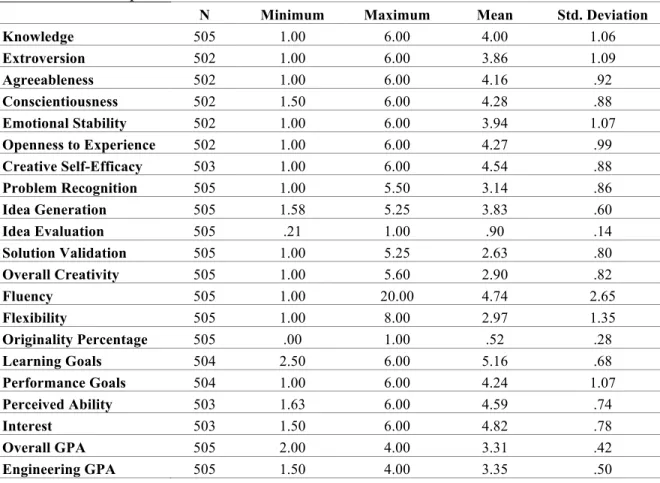
Table 4.1. Descriptive Statistics 46
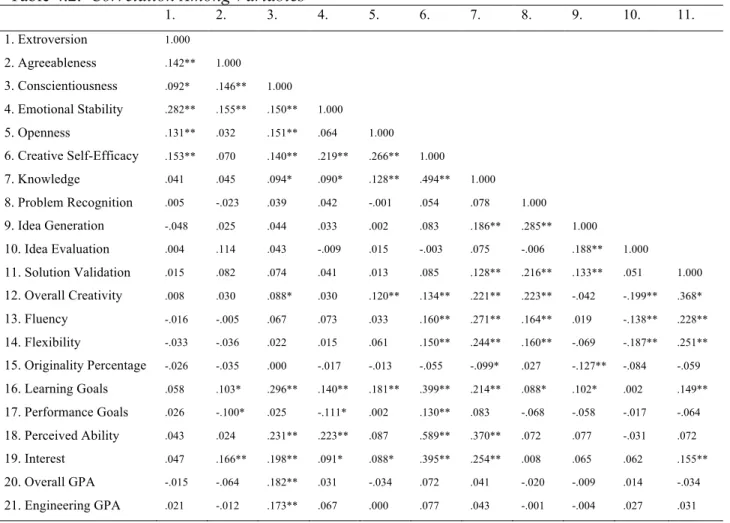
Table 4.2. Correlation Among Variables 47
Table 4.3. Major*Year Post-Hoc Comparisons (Dependent Variable: Overall Creativity) 52
Table 4.4. ANOVA Results 54
Table 4.5. Regression Results of Creative Measures 58
Table 4.6. Creativity and Creative Problem Solving Stages 60
Table 4.7. Regression Results of Academic Outcomes 64
Table 4.8. Path Coefficients for a Path Model of Creative Problem Solving Stages and Overall
Creativity 66
Table 4.9. Effects Decomposition for a Path Model of Creative Problem Solving Stages and
Overall Creativity 67
Table 4.10. Path Coefficients for a Path Model of Divergent Thinking Measures and Overall
LIST OF FIGURES
Figure 1. Sample Demographics by Gender 32
Figure 2. Sample Demographics by Major 32
Figure 3. Sample Demographics by Year 33
Figure 4. A Path Model of Creative Problem Solving Stages and Overall Creativity 65
CHAPTER 1: INTRODUCTION TO THE STUDY Background of the Problem
For more than five decades, the United States has led the Science, Technology,
Engineering, and Mathematics (STEM) disciplines; however, there is a new growing need for an educated and skilled STEM workforce to ensure America’s continued competitiveness in a challenging global economy (Burke & Mattis, 2007; National Academy of Sciences, 2005). According to the National Conference of State Legislators (2010), there is a need to focus on the policies related to STEM education to improve the quality of education and to prepare students for jobs in the 21st Century workforce. Educational reform is especially essential in the
engineering arena, because it is the field in which society’s needs are met and its innovations are derived (National Academy of Engineering, 2008). The engineering profession primarily focuses on designing solutions to identified problems, and creativity is a vital tool for engineers who are responsible for developing these creative solutions (Charyton & Merrill, 2009; D. H. Cropley & Cropley, 2005).
Creativity has recently received much attention as an essential characteristic in the engineering problem solving process (Charyton & Merrill, 2009; D. H. Cropley, 2015); yet, it is still absent in contemporary engineering education (Kazerounian & Foley, 2007). The National Academy of Engineering (2013) highlighted engineering as an “inherently creative” profession (p. 1). Nonetheless, the term “creativity” or “creative” is absent in the US Accreditation Board for Engineering and Technology (ABET) definition of the engineering profession1, and the only
use of the term appears when they talk about “carry[ing] knowledge further toward creative
application” as one of the ABET accreditation criteria for academic programs curricula (Engineering Accreditation Commission, 2011, p. 4).
The need for developing learning environments that foster engineering creativity is evident in postsecondary education (Felder, 1987; Liu & Schonwetter, 2004). Engineers deal with real world problems, which are rarely neatly presented (Mumford, Baughman, & Sager, 2003), and thus engineering students should be trained to creatively solve open-ended ill-defined problems. Therefore, incorporating creativity into engineering curricula and learning
environments in which students can grasp content knowledge while working on real-world problems (Heylen, Smet, Buelens, & Vander Sloten, 2007) is a necessity. However, creating environments better tailored to specific engineering domains requires a deep understanding of how different facets of engineering creativity are used within these disciplines.One key issue is the need to study the creative process to understand how students across different engineering domains may demonstrate different strengths across the stages of the problem solving process.
This study contributes to the current body of research by examining the nature of creative process across multiple engineering disciplines. Specifically, based on a four-stage model of creative problem solving, this research compares students from several engineering domains at one institution on the following skills: problem recognition, idea generation, idea evaluation, and solution validation. Additionally, this study investigates the relationship between individual differences and stages of the creative problem solving process. It also examines the possible association between these creative problem solving stages and specific desired educational outcomes.
Statement of the Problem
Despite the growing call for enhancing creativity in engineering education, creativity is still absent in most higher education institutions (Kazerounian & Foley, 2007), and new
graduates are emerging from various universities lacking skills in creativity and problem solving (D. H. Cropley, 2015). Prior research on engineering creativity has mostly focused on the need to foster creativity. Curriculum reforms were suggested to foster creativity in engineering education (e.g., Chen, Jiang, & Hsu, 2005), and some courses were developed (e.g., “Problem Solving and Engineering Design”) to introduce engineering students into real engineering practice (Heylen et al., 2007). Nevertheless, review of practice throughout higher education in the United States indicated the lack of deliberate training in creativity (D. H. Cropley, 2015). Addressing this problem requires a deeper understanding of different facets of engineering creativity. One fundamental issue is the need to understand how students in different engineering disciplines demonstrate different strengths and weaknesses across the creative problem solving process. The proposed study aims at exploring this issue.
Purpose of the Study
The purpose of this study is to investigate the creative problem solving process within engineering education. In particular, this study compares students across multiple engineering domains on different creative problem solving skills (specifically, problem recognition, idea generation, idea evaluation, and solution validation) and examines the ways these stages
differentially predict both each other and overall creativity. In addition, this research explores the way that the quality and creativity of the creative process relate to some desired academic
as personality traits and creative self-efficacy). These findings can be used to better inform engineering curricula and pedagogical techniques that can enhance creativity development.
Research Questions
The purpose of this study is to address the following questions:
1. Do students across different engineering domains and at different stages of their education demonstrate different patterns of strengths in creative problem solving skills (specifically, problem recognition, idea generation, idea evaluation, and solution validation)?
2. Do individual difference variables (such as gender, personality, and creative self-efficacy in engineering) differentially predict engineering creativity and problem solving quality? 3. Are different parts of the creative problem solving process associated with specific desired
academic outcomes (such as self-reported GPA, engagement with engineering (measured as with both learning and performance goals), perceived ability in engineering, and academic engineering interest)?
Hypotheses
There is a relative lack of research on creative problem solving stages in engineering. Therefore, hypotheses proposed for the research questions are more exploratory and rooted in the general creativity literature. The hypotheses are:
Hypothesis 1: Differences will be observed among students in different engineering majors with regard to their problem solving skills.
Hypothesis 2: Differences will also be observed among engineering students in different levels (year in the engineering program) with regard to their problem solving skills.
Hypothesis 3: Individual differences variables will predict some percentage of the quality and creativity of engineering students’ creative problem solving.
Hypothesis 4: Creative problem solving skills will be associated with academic outcomes, such as engagement, perceived ability, and academic interest in engineering.
Theoretical Framework
Over the course of nearly the past century, scholars and researchers have been studying the creative process and have found that creativity tends to occur in a sequence of stages. Creativity theorists have proposed different models of the creative process cognitive skills (e.g., Mumford, Mobley, Uhlman, Reiter-Palmon, & Doares, 1991; Sawyer, 2012; Sternberg, 2006; Wallas, 1926). Drawing from the key stages of creative problem solving, a four-stage model of creative problem solving (problem recognition, idea generation, idea evaluation, and solution validation) was selected to provide the theoretical framework of the proposed research.
Grounded in more than 60 years of research, these four stages were articulated by Cropley (2015), drawing heavily from Guilford (1959), to be the foundation for understanding the main stages needed for creative problem solving in engineering. Likewise, these four stages strikingly correspond to the four criteria emphasized in the Next Generation Science Standards (NGSS) to define engineering design: identifying the problem in terms of criteria for success and constraints, generating potential solutions, evaluating the solutions in light of the criteria and constraints, and choosing the best solution to implement (NGSS, 2013). Further, this stage-based approach ties to the phases of design thinking concept proposed by several scholars as a way for investigating ill-defined problems, focusing on the process of the problem solving rather than the product per se (e.g., Brown, 2008). These four stages of creative problem solving are explained in detail in Chapter 2.
Summary of Methods
The sample for this study consisted of 505 engineering students attending a northeastern public university. The students were recruited from different engineering disciplines and at different levels in their programs. A convenience sampling method was used to recruit undergraduate engineering students from all different engineering domains.Overall, sample members were of age 18 or older enrolled in an engineering program.
Participants completed several sets of measures: (a) demographic information form (gender, age, specific engineering major, and year in the engineering major); (b) a general engineering-related, ill-defined, problem-solving task with a series of questions; (c) individual differences measures (personality and creative self-efficacy in engineering); (d) specific academic outcomes (learning goals, performance goals, perceived ability in engineering, and academic interest in engineering); and (e) a domain-specific knowledge measure. More details about these measures are presented in Chapter 3; they are included in their entirety in
Appendices A through G.
Participants’ responses were scored using the Consensual Assessment Technique (CAT, Amabile, 1996). According to this method, experts from the relevant field are the best and the most appropriate judges of creativity in the domain (J. C. Kaufman, Baer, & Cole, 2009).
However, given the difficulty in obtaining high-level experts to serve as raters for a large sample, and as proposed by J. C. Kaufman and Baer (2012), quasi-experts were used for this study. Studies have shown that advanced students in a field (J. C. Kaufman, Baer, Cropley, Reiter-Palmon, & Sinnett, 2013; J. C. Kaufman, Gentile, & Baer, 2005), and both experts and quasi-experts in the domains of teaching and creativity research (Baer, Kaufman, & Riggs, 2009; J. C. Kaufman et al., 2013) tend to agree at a reasonable level with actual experts.
Using this methodology, I recruited several quasi-experts from within the fields of education, creativity research, and the domain in question (engineering). Consistent with past Consensual Assessment Technique work (Amabile, 1996), working alone and primarily relying on their personal definitions of the concepts of creativity and quality, the raters assigned scores to each of the responses. Inter-rater reliability were evaluated with Cronbach’s (1951) coefficient alpha. Procedures of scoring the four stages slightly differed. Further details of the scoring protocol are explained in the methods section in Chapter 3. Overall, each student was assigned several scores: problem recognition, idea generation, idea evaluation, solution validation, and overall creativity score; in addition, there were three divergent thinking scores: fluency, flexibility, and originality.
Descriptive statistics and a correlation matrix were computed. Two-way between-groups ANOVAs were used to answer the first research question. A series of multiple linear regression was conducted to answer research questions 2 and 3. In addition, two path analysis models were run to thoroughly capture the relationship between the quality of creative problem solving stages and overall creativity, as well as the association between the divergent thinking measures and overall creativity. Details of data analyses are presented in Chapter 3.
Significance of the Study
The differences in strengths and weaknesses that I anticipate to find in my study are noteworthy for educational policy development because of at least two reasons:
- Students who are skilled in the application of a specific stage of the creative process will likely be attracted to domains in which these processes are emphasized (Schneider, 1987).
- Selection into the domain will tend to focus on those processing skills that are critical to creative performance within the relevant domain (Csikszentmihalyi, 1999).
CHAPTER 2:REVIEW OF LITERATURE Engineering
Engineering is an applied science whereby engineers solve problems and derive
innovations (National Academy of Engineering, 2008). Engineers integrate different types of skills and knowledge in an effort to discover ways to improve the public’s lives by “creating bold new solutions that connect science to life in unexpected, forward-thinking ways” (National Academy of Engineering, 2008, p. 5). Buhl (1960) stated that engineers must be creative at every stage of problem solving in order to create new products and processes to fulfill the needs. Engineers that are “equipped with the blend of technical knowledge and creativity” are needed to design solutions to satisfy humankind’s needs and desires (D. H. Cropley, 2015, p. 49). A recent report of the National Academy of Engineering highlighted the importance of improving public understanding of this profession in order to attract young students to engineering careers by “cast[ing] engineering as inherently creative” field and engineers as “creative problem-solvers” (National Academy of Engineering, 2013, p. 1).
Engineering Design is considered the central activity of the field of engineering (Simon, 1996). Engineering educators Katehi, Pearson, and Feder (2009) have defined engineering design as “the engineering approach to identifying and solving problems” (p. 4). They further argued that engineering design as a problem-solving process is a “potentially useful pedagogical
strategy” that provides students with opportunities to apply mathematical and scientific concepts to create different solutions to identified problems (p. 4). The NGSS (2013) propose that
engineering design should include identifying the problem in terms of criteria for success and constraints, generating potential solutions, evaluating the solutions in light of the criteria and constraints, and choosing the best solution to the problem.
Katehi et al. (2009) emphasized that teaching engineering at the K-12 level has a
conceptual connection to post-secondary education and to the practice of engineering in the real world. This approach stresses three principles: (a) emphasizing the design process as an
engineering approach of problem-solving; (b) incorporating important and developmentally appropriate knowledge and skills; and (c) promoting engineering “habits of mind” such as systems thinking, creativity, optimism, collaboration, communication, and attention to ethical considerations (p. 5). One could argue, thus, that engineering education at the college level should mirror these principles.
However, engineering researchers Kazerounian and Foley (2007) argued that these
conceptions are not reflected in the way that universities currently prepare future engineers. They posited that “creativity is not valued in the contemporary engineering education” (p. 762). They have proposed the Ten Maxims of Creativity necessary for a creative environment, and the results of their research showed that current engineering education lacks almost all of these criteria. They found that engineering students lack a creative work process; specifically, the concept of search for multiple answers was perceived as conceptually foreign. However, their findings also indicated that engineering students have the most room for creative improvement (in comparison to their counterparts in the sciences and humanities). Engineering curriculum and pedagogical practices need to be improved, which can thus lead to learning environments that require and reward creativity (Kazerounian & Foley, 2007).
Incorporating creativity in postsecondary engineering education is a necessity. The ultimate educational goal is to create learning environments in which students can be grasping the content while working on real-world problems that will better prepare them to be
facets of engineering are related to creativity. One key issue is the need to understand how engineering students across different disciplines demonstrate different strengths in the creative problem solving process. To explore these questions, I will provide a brief review of the related literature on creativity and creative problem solving.
Creativity
Creativity has received continued attention within the fields of psychology and education since Guilford’s (1950) presidential address at the American Psychological Association. Existing definitions of creativity highlight two key components describing this construct—originality (novelty) and task appropriateness (usefulness) (e.g., Amabile, 1983; Reis & Renzulli, 1991; Simonton, 2012; Sternberg, 1999; Sternberg, Kaufman, & Pretz, 2002). Other scholars have added a context-relevance factor and introduced the definition in a form of mathematical equation (i.e., ! =[! × !]!"#$%&$); that is, creativity produces an original product that is task-appropriate in a particular context (Beghetto & Kaufman, 2014; Simonton, 2012). Based on a synthesis of reoccurring themes across the creativity literature, Plucker, Beghetto, and Dow (2004) offered the following definition of creativity: “Creativity is the interaction among aptitude, process, and environment by which an individual or group produces a perceptible product that is both novel and useful as defined within a social context” (p. 90). This definition underlines the four Ps introduced by theorists to classify creativity: Person, Product, Process, and Press. The four-Ps framework, first introduced by Rhodes (1961), helps differentiate among talking about the creative person (who is involved in the creative act), the creative product (output produced by the creative act), the creative press (where and when the creative act is taking place), and the creative process (the cognitive strategies used during the creative act).
emphasized (J. C. Kaufman, 2009; Kozbelt, Beghetto, & Runco, 2010). Although some scholars have argued that the most important aspect of engineering creativity is the product that performs tasks or solves problems (D. H. Cropley & Cropley, 2005), the creative process that is used by the creative person is also a vital component to understand engineering creativity (J. C.
Kaufman, 2009). Further, the creative process is tied to the domain in which it is happening. According to Csikszentmihalyi (1999), the domain is a necessary component of creativity because a specific domain dictates how the information is recorded and determines how well the information is integrated; further, creativity is related to how the domain is central to, accessible by, and autonomous from the rest of the culture.
The creativity literature, as with most other research arenas, is filled with different debates; one of these is the question of whether creativity is more domain-general or domain-specific (see for example, Plucker, 2004; Plucker & Beghetto, 2004; Sternberg, 2005). Although this is an ongoing discussion, a large body of research disputes both extreme approaches and suggests a “hybrid position” of this debate (e.g., Plucker & Beghetto, 2004; Sternberg, 2005). In other words, the nature of creativity is partly general, partly domain-specific, and partly task-specific (Lubart & Guignard, 2004). Creativity scholars have proposed theoretical models to interweave the domain-specific and domain-general approaches of creativity.
One such model is the Amusement Park Theoretical model (APT; Baer & Kaufman, 2005; J. C. Kaufman & Baer, 2004, 2005), which argues that creativity has domain-specific aspects as well as general features. According to this theory, the nature of creativity has domain-general skills that Kaufman and Baer call “initial requirements,” which influence creative performance in all domains (e.g., intelligence, motivation, and an appropriate environment), whereas the next level, called “general thematic areas,” is domain-specific (such as visual art,
writing, math, and science). They then extend the model to include domains (i.e., poetry) and microdomains (i.e., Haikus).
Considering engineering as a broad thematic area, one can argue that specific domains of engineering would differ in the nature of the creative processes. Whereas some of the cognitive processes needed for problem solving may be common across domains of engineering (D. H. Cropley, 2015) and qualify as initial requirements, the specific strengths and weaknesses throughout the creative problem solving procedure should vary by domains (J. C. Kaufman, 2009). Differences might exist in the stages engineers undertake to tackle the same problem. Mumford, Mobley, Uhlman, Reiter-Palmon, and Doares (1991) argued that some types of creative problems presented in different domains would require greater skill in performing certain processes, and others would emphasize different processes.
Csikszentmihalyi (1999) called for empirical research examining cross-field differences in the creative process. Mumford, Antes, Caughron, Connelly, and Beeler (2010) investigated the differences in eight creative problem-solving skills across three fields (or what Kaufman and Baer might call three thematic areas): Health, Biological, and Social Sciences. Their findings suggest that these fields differ in the type of creative thinking skills they emphasize. In particular, they found that health science doctoral students performed better on problem definition, information gathering, information organization, implementation planning, and solution appraisal processes. The biological science doctoral students had stronger skills in information gathering, information organization, idea generation, and idea evaluation. The social science doctoral students had stronger conceptual combination, idea generation, and solution appraisal skills.
skills will be observed within one thematic area such as engineering, but across multiple domains (such as civil, electrical, mechanical, biochemical, and biomedical). To investigate that question I will first review the stages that are essential in the creative problem solving process.
Creative Problem Solving Models
As stated by Sawyer (2012), philosophers have developed two competing theories of the creative process: Idealist Theory (stating that the creative process is all about the creative idea) and Action Theory (arguing that the execution of the creative work is essential to the creative process). Sawyer argued that the Idealist Theory is false and that creativity takes place over time and most of it occurs while doing the work. Over the course of nearly the past century, scholars and researchers have been studying the creative process and have found that creativity tends to occur in a sequence of stages. Creativity theorists have proposed different models of the creative process cognitive skills starting from a simple two-stage model (a divergent thinking stage in which ideas are generated followed by a convergent thinking stage in which the best idea is chosen, comparable to Finke, Ward, and Smith’s (1992) Geneplore Model); and then expanding upon it to three stages or more. Some examples of these models include Wallas’s (1926) four-stage model; Sternberg’s (2006) seven-four-stage model; and Mumford et al.’s (1991) eight-four-stage model. Sawyer (2012) described an integrated eight-stage framework capturing the key stages of all of the various proposed models (find and formulate the problem, acquire knowledge relevant to the problem, gather a broad range of potentially related information, take time off for
incubation, generate a large variety of ideas, combine ideas in unexpected ways, select the best ideas by applying relevant criteria, and externalize the idea using materials and representations). Table 2.1 summaries these proposed models and the key stages of the creative process.
Table 2.1. Different Models of Creative Process Wallas (1926) Osborn-Parnes (1953; 1967) Guilford (1959) Mumford et al. (1991) Higgins (1994) Sternberg (2006) Sawyer (2012) Objective finding Problem
recognition Problem definition
Problem identification,
making assumptions about the future
Redefine problems
Find the problem
Preparation finding Fact Information gathering Know the domain Acquire the knowledge Problem
finding organization Information Gather related information Incubation combination Conceptual Take time off Incubation
Idea finding
Idea
generation Idea generation
Generation of alternatives
Generate
ideas Generate ideas Cross-fertilize ideas Combine ideas Solution finding Idea
evaluation Idea evaluation
Choice of alternatives
Judging ideas
Select the best ideas Illumination Implementation planning
Verification Acceptance finding validation Solution Solution appraisal Sell the idea, persevere
Externalize ideas
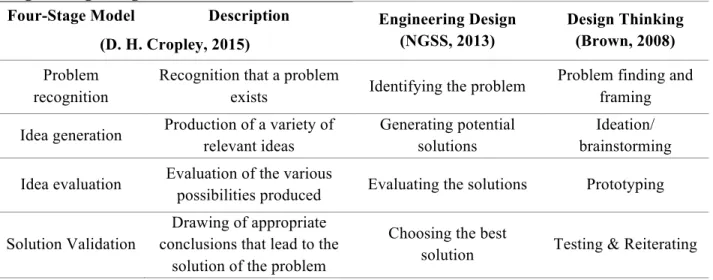
Drawing from these key stages, I have selected a four-stage model of creative problem solving (problem recognition, idea generation, idea evaluation, and solution validation) to provide the theoretical framework of the proposed research. These four stages were articulated by Cropley (2015), drawing heavily from Guilford (1959), to be the foundation for understanding the main stages needed for creative problem solving in engineering. Likewise, as presented in Table 2.2, these four stages correspond nicely to the four criteria emphasized in the NGSS to define engineering design: identifying the problem in terms of criteria for success and constraints, generating potential solutions, evaluating the solutions in light of the criteria and constraints, and choosing the best solution to implement (NGSS, 2013). Further, they tie to the phases of design thinking concept (e.g., Brown, 2008) that have been adopted by several businesses and
institutions as an approach for investigating ill-defined problems, focusing on the process of the problem solving rather than the product per se.
Table 2.2. Four-Stage Model of Creative Problem Solving and How it Corresponds to Stages of Engineering Design
Four-Stage Model Description Engineering Design
(NGSS, 2013) Design Thinking (Brown, 2008) (D. H. Cropley, 2015) Problem recognition
Recognition that a problem
exists Identifying the problem
Problem finding and framing Idea generation Production of a variety of
relevant ideas
Generating potential solutions
Ideation/ brainstorming Idea evaluation Evaluation of the various
possibilities produced Evaluating the solutions Prototyping Solution Validation
Drawing of appropriate conclusions that lead to the
solution of the problem
Choosing the best
solution Testing & Reiterating
The following sections of this literature review provide a brief explanation of each of the four stages.
Four-Stage Problem Solving Model
Engineering profession involves dealing with real world problems. However, real world problems are rarely neatly presented (Mumford et al., 2003), and thus engineering students should be trained to creatively solve open-ended ill-defined problems. Thus, this model of problem solving process assumes such a problem on hand.
Problem Recognition
Researchers have discovered that creativity often results when individuals work on unspecified problems (Csikszentmihalyi, 1965). These results made many creativity theorists believe that problem finding is as important as problem solving for the creative process (Reiter-Palmon, Mumford, O’Connor Boes, & Runco, 1997). Thus the first stage in the creative process
requires precisely recognizing and defining the one problem that needs to be solved (D. H. Cropley, 2015). Problem recognition entails finding the good problems (Getzels &
Csikszentmihalyi, 1976; Tardif & Sternberg, 1988). A “good” problem is one that will be helpful to the situation at hand, as well as will yield to generalizable solutions beyond the present need (D. H. Cropley, 2015).
Although different scholars have suggested slightly different theoretical models to explain the creative process (see Table 1), almost all of them included problem recognition (they also used various terms such as problem definition, problem identification, and problem construction) as the first step. These theorists highlighted the significance of this first stage of the creative process; however, empirical studies did not begin until Getzels and Csikszentmihalyi's (1976) study that indicated the impact of problem identification and construction on long-term success of art students.
Since the 1990s, much more work has been done on problem recognition (e.g., Runco, 1994) and additional theoretical frameworks have been developed (e.g., Mumford, Reiter-Palmon, & Redmond, 1994) to better explain factors influencing and shaping this stage of the creative process. Reiter-Palmon et al. (1997) tested the hypotheses in Mumford et al.’s (1994) model and found that undergraduates with high problem construction ability produced solutions of higher quality and originality for leadership, social, and school problems (the results showed only marginally significant effects of originality for the social and school problems). As part of a series of studies on process-based measures of creative problem-solving skills, Mumford,
Baughman, Threlfall, Supinski, and Costanza (1996) developed a test to assess problem construction based on the model proposed by Mumford et al. (1994). Their results suggest that “the use of high-quality procedures in problem construction can influence creative problem
solving on tasks drawn from different domains” (Mumford et al., 1996, p. 75). That suggests that viable framing of an ill-defined problem would positively affect the next stages of the creative process, starting with generating potential ideas.
Idea Generation
After identifying a good problem to solve, the second stage is to generate multiple solutions to the ill-defined problem. This stage involves divergent thinking given that the problem-solver is dealing with an open-ended, ill-defined problem; consequently, the solution will not be clear at first. The task for this stage is to generate many different ideas that might be potential solutions to the problem that was identified in the first stage. Generating ideas is more than brainstorming; it is exploring ideas that are possible solutions of the problem at hand (Creative Education Foundation, 2014). It involves, as stated by Treffinger (1995), “fluent thinking” (producing many options), “flexible thinking” (creating a variety of possible options), “original thinking” (making novel options), and “elaborative thinking” (forming detailed
options). According to Cropley (2015), this stage is where the creator moves from having one identified problem (convergence) to a variety of ideas (divergence).
Although this stage is primarily listing ideas, it nonetheless requires knowledge and expertise in the specific domain (Vincent, Decker, & Mumford, 2002). The goal at this stage is not only to generate ideas, but also to come up with as many good potential solutions to the problem as possible. Information about the problem structure (from the first stage) along with concepts of the given domain provide the basis for generating alternative ideas (Runco & Chand, 1994)
Prior research has revealed that creativity is enriched by a close linkage between divergent and convergent thinking; real-world creativity requires both idea generation and idea evaluation
abilities (Runco, 2003). Silvia (2008) found a correlation between idea generation and evaluation abilities; people who generated more ideas were better at evaluating them. Hence, performing well at this stage enables strong performance on the next.
Idea Evaluation
After generating many potential solutions to the problem, the problem-solver needs to find the best solution. The task of the third stage is to evaluate these solutions in terms of criteria for success and test them against the constraints to choose the optimal one. Cropley (2015) asserted that this phase is when the problem-solver needs to eliminate nearly all of ideas generated in the second phase to arrive at only one solution; that is, this stage is convergent in nature. He argued that whereas the potential for success drives the stage of “idea generation,” the constraints are typically what play a vital role in the “idea evaluation” stage—the constraints give the criteria against which the alternatives would be judged.
In this phase, the creator needs to draw on his or her knowledge about the domain in order to evaluate the ideas (Runco & Chand, 1994, 1995), in addition to other evaluative criteria such as novelty and appropriateness (R. K. Sawyer, 2012). Accordingly, the novel solution that both addresses the need and meets the constraints will be chosen.
Scholars have discussed the importance of the idea evaluation phase under different terms such as verification (Wallas, 1926), convergent thinking (Isaksen & Treffinger, 1985), and evaluative skill (Runco & Chand, 1995; Runco & Smith, 1992). Other scholars proposed models of the idea evaluation process (e.g., Mumford, Lonergan, & Scott, 2002; Wilson, Guilford, Christensen, & Lewis, 1954). Blair and Mumford (2007) identified different attributes that people use when evaluating ideas. They found that people are likely to choose ideas that fit social norms, produced the desired outcome quickly, were complex to implement yet easy to
understand, and benefited many people. A related study revealed that people consider two issues when they evaluate ideas: the resources needed to implement the idea, and the consequences of implementing the idea (Dailey & Mumford, 2006). This finding leads us to the last stage of the creative process.
Solution Validation
Given that the primary purpose is to successfully solve the problem, the last stage is validating the best solution and then implementing it. This stage is convergent in nature and requires connecting the chosen solution back to the initial problem; it simply brings all the stages together to confirm that all stages were executed correctly and were integrated into an actual solution of the problem at hand (D. H. Cropley, 2015). Although creativity research tends to focus on earlier stages of the creative process, a great deal of creativity occurs at this stage (R. K. Sawyer, 2012). A creative and applicable idea is not validated as a useful solution if it is not implemented.
The creator, especially in practical domains (such as technological invention, engineering, and entrepreneurship), needs to be skilled at executing ideas, identifying the necessary resources to make them successful, forming plans for implementation, and anticipating to adjust the plans in the future (Mumford, 2003; Policastro & Gardner, 1999). Sawyer (2012) claimed that this phase requires more than a straightforward execution of the idea; it entails creatively making the idea a reality as well as generating potential follow-up ideas. He further argued that creative people do not wait until their idea is fully formed before they start externalizing it; rather, they start putting together at the early stages. He further argued that for successful creators, this stage is essential to the problem-finding phase. This view ties all of the four stages together.
would help to investigate their different strengths within the creative process. Potential findings can provide insights that will inform engineering education and improve current learning environments to better prepare professional engineers. My research aimed to examine how individual difference variables impact these creative problem solving processes. As well, this study aimed to investigate the possible association between these stages and some desired academic outcomes.
Individual Differences Variables
Scholars have long been interested in individual and environmental characteristics that may influence creative thought and achievement (Csikszentmihalyi, 1999; Mumford et al., 2010). Research has showed that many variables (including personality and creative self-efficacy) might contribute to cross-field differences in creativity and creative performance (e.g., Choi, 2004; Feist, 1999). However, limited research has been produced which investigates differences in creativity and creative performance across engineering domains (D. H. Cropley, 2015). Although creative problem solving has not been studied thoroughly in engineering, one can argue that it may be affected by the same variables that are important in the rest of the creativity literature. I will examine the following variables as potential predictors of engineering undergraduates’ creative problem solving skills: engineering major, year in engineering program, gender, personality, and creative self-efficacy.
Engineering Major
Prior research has indicated that there are cross-field differences in the creative processing skills (Mumford et al., 2010). These scholars argue that the creative problems presented in different fields would differ in the type of skills needed in the execution of the relevant creative thinking processes. In this study, I further argue (based on the Amusement Park
Theory explained above) that potential differences will be observed across multiple domains within one thematic area. That is, for example, different engineering domains might differ in the type of problems they solve, or even in the way they would solve the same problem (Bruch & Krieshok, 1981; Veurink & Sorby, 2013). Differences in the type of problem found across engineering domains might characterize the creative work conducted within these domains. In my study I aim at investigating such potential differences in the stages of creative problem solving across multiple engineering domains (specifically as biomedical, chemical, civil, computer science, electrical, environmental, materials, and mechanical).
Year in the Engineering Program
One could expect that practice in a domain might lead to improvement in student’s application of domain-relevant creative skills as a result of knowledge and experience
(Weisberg, 2006). However, as Mumford et al. (2010) argued, the patterns of growth and change observed in creative thinking processes may be quite complex with at least three different
patterns of change potentially being observed with experience: (a) gains in field-relevant processing skills, (b) no change, and (c) decrements in field irrelevant processing skills.
Therefore, it is possible that either growth or decline of creative processing skills might occur as people advance in a given field (Mumford et al., 2010).
It simply seems that more experience in a field would result in the acquisition of stronger declarative and procedural knowledge (Chi, Bassok, Lewis, Reimann, & Glaser, 1989), which should, in turn, result in gains in field-relevant processing skills. Presumably, such experiences would result in the growth of field-relevant skills in the application of creative problem-solving processes. Nevertheless, it is also plausible that little, or no, change in requisite processing skills would be observed as people enter a field. Upon people’s entry into a field, there is an
acquisition of declarative knowledge. During this initial time, there is often a focus on basic concepts. It takes more time to acquire the procedural knowledge or strategies that lead to more effective application of creative thinking processes (Ericsson & Charness, 1994). Consequently, growth in field-relevant creative thinking processes might not occur. Finally, a third possibility might be observed. Declines in some creative processing skills may be observed as people enter a field for different reasons: (a) people will be more invested in pursuing work within the domains of interest, and consequently, the growth of these creative processing skills may be slowed; (b) a person might be provided with negative feedback regarding the application of inappropriate problem-solving strategies (Zuckerman, 1977), which may lead to declines in the application of any creative thinking processes; or (c) people with too much knowledge might become inflexible (Frensch & Sternberg, 1989; Schooler & Melcher, 1995), or have the tendency
to rely on standard examples to generate new ideas (Ward, 1995; Ward, Dodds, Saunders, &
Sifonis, 2000; Ward & Kolomyts, 2010).
In my study I will investigate which of these patterns might be affecting the engineering undergraduates, across multiple domains, at different levels of their college experiences.
Gender
Research shows that females are significantly less likely to declare a STEM major (e.g., Goyette & Mullen, 2006; Nicholls, Wolfe, Besterfield-Sacre, Shuman, & Larpkiattaworn, 2007), or to graduate with a STEM major compared to their male non-minority counterparts (Griffith, 2010; National Science Foundation, 2008, 2011; Seymour & Hewitt, 1997). Specifically, there is a disparity between the number of male and female engineering graduates. In 2005, women received 58 percent of the bachelor’s degrees awarded in all fields, but only 43 percent in physical sciences, 22 percent of computer sciences degrees, and 20 percent in engineering (Hill,
Corbett, & Rose, 2010; National Science Foundation, 2008). However, this discrepancy is less evident in creativity literature.
Reviewing extensive literature that reports gender differences on creativity tests, Baer and Kaufman (2008) found that no simple result could be taken. That is, where some studies showed that men do better than women, others that women do better, and other studies found no
difference. Nonetheless, they further argue, the general trend in these studies mirrors the larger cognitive findings in achievement tests (i.e., women score higher on verbal measures and men score higher on figural/mathematical measures). In a recent study on divergent thinking, Hong, Peng, O’Neil, and Wu (2013) found where is no differences in domain-general divergent thinking, differences appear on domain-specific divergent thinking—women scored higher on fluency, flexibility, and elaboration.
However, a large body of research on gender differences in creativity revealed
inconsistency between gender differences on creativity tests and actual creative accomplishment (J. C. Kaufman, 2009). Despite the fact that creativity tests reveals minor and inconsistent gender differences, differences in real-world creative accomplishment are large and significant (Murray, 2003; Simonton, 1994). In a review of human accomplishment, Murray (2003), notes that out of 4,002 eminent people he categorized as "significant," only 88 (two percent) were female. Furthermore, he found that only four percent of all Nobel Prize winners from 1901-1950, and only three percent of all winners from 1951-2000 were women. A similar male-dominance trend found by Piirto (1991). It was found that girls’ comparative lack of creative achievement does not appear until after high school and college, which indicates that the issue might be a conflict between personal vs. professional demands (Piirto, 1991).
The study of gender as a variable affecting creative problem solving in engineering is necessary due to: (a) the disparity between male and female graduates in engineering, and (b) the inconsistency between gender differences in creativity and actual creative accomplishment. In this study I examine gender difference in the creative problem solving stages across different engineering domains.
Personality
Personality is one of the most commonly studied attributes associated with creativity. The most widely used theory is the Five Factor theory of personality (Goldberg, 1992). This theory summarizes the different possible personality components under five factors (sometimes called the “Big Five”): neuroticism, extroversion, openness, conscientiousness, and agreeableness (J. C. Kaufman, 2009). Each of these factors measures a specific trait of the human nature.
Neuroticism measures a person’s emotional stability, extroversion measures how sociable a person is, openness to experience expresses an individual’s intellectual and experiential curiosity, conscientiousness taps into one’s discipline and integrity, and agreeableness means being friendliness and good-natured (J. C. Kaufman, 2009; Kyllonen, Walters, & Kaufman, 2005; McCrae & Costa, 1997). Openness to experience is consistently the factor that is most associated with a wide variety of creativity measures; one common way that researchers study creativity is by giving openness-to-experience-type of questions (J. C. Kaufman, 2009). This connection has been shown across multiple domains. In his extensive meta-analysis, Feist (1998) found that creative scientists were more open to experience than less-creative scientists, and artists were more open to experience than non-artists.
As reviewed by Kaufman (2009), many of the other personality factors show strong domain effects. For example, scientists are more apt to be disagreeable and conscientious,
performers are more likely to be extroverted, and fine artists are more likely to be introverted and not conscientious. Very few studies have examined the relationship between creativity and personality within engineers, particularly across stages of the creative problem solving process. Personality has been included as a potential predictor variable for this reason.
Creative Self-Efficacy
Self-efficacy, as a broad construct introduced by Bandura (1997), is how someone judges his or her specific abilities to succeed in a given task. This judgment might influence effort, persistence, and, ultimately, the achievement of a given outcome. Bandura further recognized a likely relation between self-efficacy and creative performance; he states, “innovativeness requires an unshakeable sense of efficacy to persist in creative endeavors” (1997, p. 239).
Research indicates that creative performance is influenced by someone’s self-efficacy for his or her creative abilities (Tierney & Farmer, 2002). Creative self-efficacy has been defined as “the belief one has the ability to produce creative outcomes” (Tierney & Farmer, 2002, p. 1138).
Examining students’ creative self-efficacy may be useful in supporting the growing creativity enhancement efforts of educators and creativity scholars (e.g., Feldhusen & Treffinger, 1985; Renzulli & Reis, 2014; Torrance, 1987). Specifically, as stated by Beghetto (2006), it will be useful to know how students’ experiences are related to their creative self-efficacy, and how academic beliefs and behaviors are associated with varying levels of creative self-efficacy. In this study I intend to investigate the potential relationship between engineering students’ creative self-efficacy and their creative problem solving skills.
Academic Outcomes
Research on higher education has primarily focused on student success and desired academic outcomes (Astin, 1993; Pascarella & Terenzini, 2005; Tinto, Russo, & Kadel, 1994).
In particular, a large body of engineering education research focuses on student persistence and tries to find ways to retain undergraduates in the engineering majors (Felder, Woods, Stice, & Rugarcia, 2000; Knight, Carlson, & Sullivan, 2007). There is a consensus in the literature that college students are more likely to be successful in their college studies if they have strong perceived ability, are engaged in their courses, and demonstrate interest in their programs (e.g., Greven, Harlaar, Kovas, Chamorro-Premuzic, & Plomin, 2009; Kuh, 2003a; Renninger, Hidi, & Krapp, 2014). The engineering domain is a not an exception, and thus, these variable are
expected to be also useful in engineering education.
In my study I seek to examine if specific creative problem solving skills positively relate to desired academic outcomes in engineering students, such as student Grade Point Average (GPA), academic engagement, perceived ability, and interest in engineering.
Grade Point Average (GPA)
Student Grade Point Average (GPA) has been historically considered one of the most important predictors and outcomes of student success (R. Sawyer, 2013; Zwick, 2013). The relationship between GPA and creativity is mild at best (Grigorenko et al., 2009), but specific strengths in creative problem solving have not been studied in relation to GPA. Given GPA’s prevalence in the academic realm, its inclusion as an outcome variable seemed appropriate.
Academic Engagement
Engagement inside the classroom is of particular importance to student development (Astin, 1993; Tinto et al., 1994). Research on college student learning indicates that students who are actively engaged in their academic activities gain more from their college experience
compared to students who are not actively engaged (Pascarella & Terenzini, 2005). Prior research on engineering persistence indicated that there is an association between academic
engagement and persistence (Ohland et al., 2008). Thus, there is a pressing need for efforts to improve academic engagement of college students in general, and engineering students in particular. These efforts are widely perceived to be one key to improving the educational experience of undergraduate students (e.g., Kuh, 2003a, 2003b).
Research on academic engagement further investigated the culture of engagement in different disciplines. Brint, Cantwell, and Hanneman (2008) found that there are two different cultures of academic engagement: the “humanities/social sciences culture of engagement”, and the “natural sciences/engineering culture of engagement” (p. 390). They point out that the culture of engagement in the natural sciences and engineering focuses on improvement of quantitative skills and it can generate hard work, collaborative study, and technically competent
performances.
Thus, understanding the nature of engagement in engineering higher education is needed to improve students’ persistence in engineering domains. One key investigation is to study the potential relationship between students’ creative skills and their academic engagement in engineering disciplines. Reasons for student academic engagement could be related to learning goals (where the purpose of their engagement is gaining knowledge) or performance goals (where students engage in an activity to prove their competence; Elliot & McGregor, 2001). Whereas learning goals are associated with intrinsic motivation, performance goals are related to extrinsic motivation (J. C. Kaufman, 2009). Therefore, understanding the role that learning goals as well as performance goals may play in the creative process is of significant importance.
Perceived Ability
Researches have found that several constructs other than IQ tests are also important predictors of academic achievement, one of which is self-perceived ability (Greven et al., 2009).
Greven et al. (2009) state that self-perceived abilities (or how good people think they are) proved useful in predicting academic achievement after controlling for IQ measures. In the past few decades, scholars paid a special attention to this construct as a vital predictor of students’ performance. Some studies have indicated that students’ self-perceived abilities predict their school performance independent of their IQ scores (Schicke & Fagan, 1994; Spinath, Spinath, Harlaar, & Plomin, 2006). In addition, in a longitudinal study, Valentine, DuBois, and Cooper (2004) found that students’ self-perceived abilities had a small but consistent impact on academic achievement after controlling for previous achievement.
College students’ perceived ability is an important factor that affects academic
achievement. Therefore, there is a need to investigate potential associations between students’ perceived abilities and other academic constructs, such as creativity.
Academic Interest
Research on academic interest started over a hundred years ago. Dewey (1913) was the first to highlight the vital role of academic interest in learning. He believed that it is interest, rather than effort, that leads to deeper learning. According to him, interest as a construct (a) should be present in the classroom, and (b) could be fostered by providing students with opportunities that promote challenge and autonomy. In addition, later studies explicitly
addressed the relationship between interest and learning and indicated that a positive relationship between interest and learning exists (Kintsch, 1980; Renninger et al., 2014). Scholars have found that interest in activities may increase the likelihood that individuals consider goals related to these activities and invest time and effort to achieve them (Bandura, 1986; Renninger et al., 2014). Other researchers have related high levels of interest to engagement and persistence at a given task (Csikszentmihalyi & Nakamura, 1989; Deci, 1992).
Investigating academic interest is central to understanding the underlying reasons for why students perform well the way they do, and thus, to promote opportunities that foster interest in the classroom (Schraw, Flowerday, & Lehman, 2001). My study will examine the potential relationship between engineering students' creative skills and their developed interest in the engineering courses.
CHAPTER 3: RESEARCH METHODS Research Design
In this study, quantitative procedures were used to investigate the hypothesized differences in creative problem solving processes among students across several engineering domains at one northeastern university.
Sampling
The sample consisted of 505 engineering students attending one northeastern university. The students were recruited across different engineering disciplines and at different levels in their programs. The office of the Associate Dean of Undergraduate Education and Diversity provided names, majors, and email addresses of the students in the School of Engineering at that specific university. A multi-stage process was used to recruit students in the different
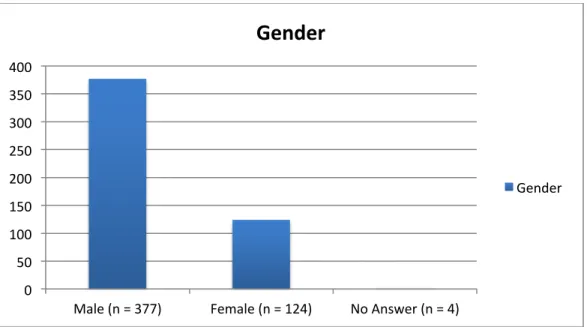
engineering programs. First, engineering faculty announced the study in their classes. Second, the Office of the Associate Dean of Undergraduate Education and Diversity sent emails directly to all engineering undergraduates requesting participation in the study. A convenience sampling method was used to recruit undergraduate engineering students from all different engineering domains.Overall, sample members are of age 18 or older, males and females, at different levels of engineering programs. See Figures J.1 through J.3 for gender, major, and year statistics for the sample.
Figure 1. Sample Demographics by Gender
Figure 2. Sample Demographics by Major 0 50 100 150 200 250 300 350 400
Male (n = 377) Female (n = 124) No Answer (n = 4)
Gender
Gender 0 20 40 60 80 100 120Major
Major
Figure 3. Sample Demographics by Year
Instrumentation
Participants were asked to complete several sets of measures via on-line survey. First, the students were asked to complete a demographic information form. This form includes gender, age, specific engineering major, and level of experience (freshman, sophomore, junior, senior). Second, participants were asked to complete a problem to provide solutions to a general real-world, engineering-related, ill-defined task. Third, participants were asked to complete a set of individual differences measures to be used as potential predictor variables (personality and creative self-efficacy in engineering). Fourth, participants were asked to complete a set of measures of specific academic outcomes (such as learning goals, performance goals, perceived ability in engineering, and academic interest in engineering). Finally, participants were asked to complete a four-item measure to check their knowledge on the questions in the engineering problem. This measure was used as a control variable. In addition, participants had the option to provide their contact information if they want to be entered in a drawing to win one out of four
0 50 100 150 200 250 300 350 400
First (n = 371) Second (n = 58) Third (n = 32) Fourth (n = 44)
Year
$25 Amazon gift card (at no point was this personal information associated with any of their responses). For the exact measures, see Appendices A through H.
Measures of Stages of Creative Problem Solving Process
The measures of creative thinking skills were derived from the engineering-relevant multi-stage problem. This problem was created through a multi-step process. First, a panel of several engineering professors created different scenarios involving general engineering problems. Next, the panel reviewed all scenarios with regard to three criteria: (a) real-world applications, (b) relevance to multiple engineering disciplines, and (c) potentially open-ended with room for creativity. Additionally, the problems were checked for clarity and realism. This process led to the selection of one prompt that was used in the study:
“I recently moved into an old farm house and I was horrified when I received the bills for the first quarter. The electricity bill was twice what I am used to; I had to pay triple what I was paying in my last place for oil. What can I do?”
This problem included four stages in which students were asked to write their responses to each stage. Each response for each stage was later rated as part of the measurement of the creative process. Participants were asked to read through the scenario and then assume the role of the responsible engineer for their response. After reading the scenario, students were presented with four questions that led them through the four stages of the creative problem solving process. The questions are:
1. Identify an engineering-related problem that you find in this scenario and explain it in detail in one or two sentences.
2. Think of potential solutions to this problem. List as many different ideas as you can that might solve it.