INTERACTIVE
FUNCTIONAL
PROGRAMMING
Roland Perera
A thesis submitted to University of Birmingham
for the degree of doctor of philosophy
School of Computer Science
Edgbaston
Birmingham
B15 2TT
University of Birmingham Research Archive
e-theses repository
This unpublished thesis/dissertation is copyright of the author and/or third
parties. The intellectual property rights of the author or third parties in respect
of this work are as defined by The Copyright Designs and Patents Act 1988 or
as modified by any successor legislation.
Any use made of information contained in this thesis/dissertation must be in
accordance with that legislation and must be properly acknowledged. Further
distribution or reproduction in any format is prohibited without the permission
of the copyright holder.
Submitted 31 October, 2012 Examined 18 January, 2013 Corrected 24 April, 2013 Finalised 21 May, 2013
For Luca
Abstract
We outline a vision for a new kind of execution environment where applications can be debugged and re-programmed while they are being used. The overall concept we callinteractive programming. In contrast to most other systems for live programming, interactive programming presents execution to the user as a live, explorable document. In contrast to the edit-and-continue features found in many debuggers, and to systems for patching software dynamically, we utilise a notion ofretroactive update, where the computation transitions to a new consistent state when the program changes, rather than a hybrid of old and new. What changed in the execution is always explicit and visible to the user. Retroactive update relates our work to incremental computation.
We develop some key components of interactive programming in the setting of a pure, call-by-value functional language. We illustrate our ideas via a proof-of-concept implementation called LambdaCalc. Several important components of the overall vision, including efficient incremental update, scaling to realistic programs, supporting effectful programs, and dealing with non-termination, are left for future work. We implemented a comprehensive visualisation subsystem inLambdaCalcitself, but further performance work is required for this to be the basis of a working user interface.
Our specific achievements are as follows. First, we show how toreifythe execution of a program into a live document which can be interactively decomposed into both sequential steps and parallel slices. We give a novel characterisation of forward and backward dynamic slicing and show that for afixed computation, the two problems are described by a Galois connection. We extend the notion of slicing to reified computations, and formalise what it is for a slice of a computation to “explain” some part of a value. We show how being able to slice a computation interactively can help debugging.
Second, we introduce a novel execution indexing scheme which derives execution differences from pro-gram differences. Our scheme supports the wholesale reorganisation of a computation via operations such as moves and splices. The programmer is able to see the consequences of edits on the intensional structure of the execution. Where possible, node identity is preserved, allowing an edit to be made whilst an execution is being explored and the changes to be reflected in the user’s current view of the execution. This allows the user to see theimpact of code changeswhile debugging. We illustrate this usingfigures generated by our implementation. Our self-hosted visualisation code is able to compute differences in visualisations, which we use to visualise differences in computations.
We conclude with a discussion of some of the challenges facing the proposed paradigm: space require-ments, visualising large computations and data structures, computational effects, and integrating with envi-ronments that lack support for retroactive update.
Acknowledgements
Many years of fascinating conversation with my friend Russ Freeman started me offin this direction in the first place. James Cheney and Deepak Garg have been great mentors and collaborators, and I thank them both for giving me nice things (jobs). James came up with the phrase “self-explaining computation”. My examiners Dan Ghica and Henrik Nilsson provided high-quality feedback that made the slog of actually writing a thesis worthwhile.
Three people require a special mention. First, I’m indebted to Umut Acar for hosting me as an intern and later as a research visitor at MPI-SWS, Kaiserslautern. Without those eighteen months of focus I don’t think I would have made it. Second, I thank myDoktorvater, Paul Levy, whose focus and clarity are truly impressive and who has always been willing to have lengthy Skype chats at unreasonable times. (My only regret is that I still don’t understand call-by-push-value.) I also owe Paul for hooking me up with Neel who hooked me up with Umut. But the biggest debt I owe to my dad Siri, for lots of love and support,financial and otherwise.
Saarbrücken, Germany April 2013
Contents
1 Overview. . . 1 1.1 Plan of thesis . . . 1 1.2 Scope . . . 3 1.3 Contributions . . . 4 2 Programming as Interaction . . . 7 2.1 Self-explaining computation . . . 8 2.2 Differential execution . . . 122.3 Visualising structured values . . . 20
2.4 Editing structured values . . . 23
2.5 Interactive slicing . . . 29
2.6 Interweaving testing, diagnosis and bug-fixing . . . 34
2.7 Summary . . . 37
3 Related Work . . . 39
3.1 Recording and replaying execution . . . 40
3.2 Algorithmic debugging . . . 42
3.3 Debugging lazy programs . . . 44
3.4 Program slicing . . . 45
3.5 Provenance . . . 46
3.6 Dynamic program visualisation & visual programming . . . 47
3.7 Live programming & live coding . . . 52
3.8 Spreadsheet languages. . . 54
3.9 Functional reactive programming. . . 55
3.10 Self-adjusting computation . . . 56
3.11 Dynamic software updating . . . 59
3.12 Execution indexing . . . 61
3.13 End-user programming . . . 62
4 Reifying Computation. . . 65
4.1 Reference language . . . 66
4.2 Syntax all the way down . . . 66
4.3 Tracing semantics . . . 69
5 Slicing Computation. . . 73
5.2 Characterising dynamic slicing . . . 76
5.2.1 Forward dynamic slicing. . . 76
5.2.2 Backward dynamic slicing . . . 78
5.2.3 Differential slices . . . 80
5.3 Program slicing as backwards execution . . . 81
5.3.1 Unevaluation . . . 82
5.3.2 Correctness of tracing evaluation . . . 84
5.3.3 Unevaluation computes least program slices . . . 85
5.4 Trace slicing . . . 87
5.4.1 Computation of least explanations . . . 90
6 Differencing Computation . . . 91 6.1 Indexed syntax . . . 93 6.2 Indexing evaluation . . . 96 6.3 Delta computations . . . 101 7 Conclusion . . . 105 7.1 Appraisal . . . 105 7.2 Future work . . . 106
7.2.1 Scaling to realistic programs. . . 106
7.2.2 Efficient incremental update . . . 107
7.2.3 Distributed systems . . . 108
7.2.4 State and I/O . . . 109
7.2.5 Demand-indexed computation . . . 110
7.2.6 Primitive operations . . . 111
Appendices . . . 123
A Additional Proofs . . . 123
A.1 Proof of Theorem 3 . . . 123
A.2 Proof of Theorem 4 . . . 124
A.3 Proof of Lemma 6 . . . 125
A.4 Proof of Theorem 5 . . . 125
A.5 Proof of Theorem 8 . . . 127
A.6 Proof of Theorem 9 . . . 129
B Delta Visualisation in LambdaCalc . . . 131
B.1 Visualising differences by differencing visualisations . . . 131
1
Overview
To understand a program you must become both the machine and the program.
Alan Perlis,Epigrams on Programming[Per82]
Programming is an ongoing dialogue between programmer and programming environment. Development activities, such as tweaking code, writing new test cases, stepping through a computation in a debugger, and so on, arequestions that we ask of our programming environment. The programming environment answersby providing feedback or transitioning into a new state. The questions and answers are woven into a complex web of interaction, as we switch between testing and understanding, changing andfixing.
In this thesis, we propose a model of programming that supports these interwoven, interactive Q&A sessions directly. The key idea is to treat the execution of a program as a persistent, explorable, spreadsheet-like document. Because the user can interact with and modify a running program, our proposal is a form oflive programming(Related Work, §3.7). We call our approachinteractive programming. Compared with other approaches to live programming, the unique feature of interactive programming is that an edit results in adeltato the program execution and its visualisation, allowing our working context toupdateinto a new consistent state, rather than forcing us to reconstruct it from scratch each time, or risk continuing in an inconsistent state.
Interactive programming, as sketched here, is an ambitious goal. As we clarify in §1.2below, our achieve-ments in this thesis are modest compared to this ambitious vision. In §1.3we list our specific achievements.
Supplementary material.The following additional material is available online:
http://dynamicaspects.org/papers/thesis/LambdaCalc.tar.gz Haskell source code, plus examples https://vimeo.com/45867320 Slide presentation (part 1)
https://vimeo.com/43760460 Slide presentation (part 2)
1.1
Plan of thesis
Chapter1. Overview.We introduce the key idea of interactive programming, outline the plan of the thesis, discuss the scope and limitations of the work, and then summarise our contributions, including the relation-ship to previous publications of the author.
Chapter2. Programming as Interaction. We outline our vision of interactive programming, which moti-vates the technical development in the rest of thesis. Although our prototypeLambdaCalconly implements some components of the vision, we are able to use it to illustrate the central ideas. To set the scene, we de-scribe programming is an ongoing Q&A session between programmer and programming environment. We divide the questions into two kinds. “How” questions concern a single computation, in particular the rela-tionship between program and output. Normally “how” questions are difficult to answer because programs are black boxes. InLambdaCalcsuch questions are enabled via two forms of interactive decomposition of a running program: into sequential steps and into parallel slices.
“What if” questions concern the relationship between one computation and another. They subsume the familiar notion of an edit, which we construe as a question of the form, “How would my program’s be-haviour change if it were modified in the following way?” We allow “what if” questions to be asked while the programmer is pursuing the answer to a “how” question. Usingfigures obtained fromLambdaCalc, we argue that the programmer should not have to restart a computation in order to understand it or change it but should be able to move seamlessly between using, understanding and editing to suit the task at hand.
Chapter 3. Related Work. We relate our work to previous work on tracing, debuggers, program visu-alisation, live programming, spreadsheets, functional reactive programming, provenance, program slicing, incremental computation, execution indexing and end-user programming.
Chapter4. Reifying Computation. We allow the user to look inside a computation. We enable this by reifying execution: turning the process of execution into a description of the process. Our techniques are standard here, but this is needed for what follows. Wefirst introduce the baseline language used for the rest of the thesis, and then show how reified computations take the form of an “unrolling” of the program that grows as the program runs. We call these reified computations traces. Traces are built by a tracing interpreter that transcribes the big-step evaluation of a term into a data structure.
Chapter5. Slicing Computation. We allow the user to query the relationship betweenpartsof the output and partsof the program, for given computation. In the literature this is called dynamic slicing. Slicing queries can be asked in two directions, depending on whether they seek to relate partial programs to partial outputs, or partial outputs to partial programs. We formalise the notion of aslice(prefix) of a program and extend the notion of execution to program slices. This analysis gives rise to aGalois connection, implying that for any slice of the output of the program, there is a least slice of the program able to compute it.Differential program slices, differences between one slice of a program and another, enable morefine-grained Q&A about the relationship between input and output.
program backwards for that portion of the output. The traces we built in Chapter4guide the backward ex-ecution. The notions of slicing and differential slicing are extended to traces as well as programs, revealing information that a program slice cannot. We give a trace-slicing algorithm and show that it calculates the least trace slice that “explains”, in a technical sense, a given portion of the output.
Chapter 6. Differencing Computation. We allow the user to edit a program and observe the resulting delta in its execution. This is possible viaindexed traceswhere nodes are identified by injectively assigned indices. Indexed traces are built by a deterministic indexing interpreter which derives an index for each node in the computation from indices provided on the input program. We show how two indexed traces can be subtracted to obtain a trace delta. Trace deltas are more general than the differential slices introduced in Chapter 5, which can describe only increasing or decreasing changes. Differences between indexes traces can describe complex reorganisations of a computation such as moves and splices.
Chapter7. Conclusion.We assess the strengths and weaknesses of our work, and discuss future directions: scaling to realistic programs, efficient differential execution, distributed systems, computational effects, and demand-indexed computation. We also sketch a more realistic treatment of primitive operations.
AppendixA. Additional Proofs.We give longer proofs omitted from the main body of the thesis.
Appendix B. Delta Visualisation in LambdaCalc. By adding a reflection facility to LambdaCalc, we were able to use differential execution to implement much of the GUI code which visualises the deltas that differential execution itself produces. We use this as a case study to discuss the viability of interactive programming as a form of incremental computation, with several examples from our code base.
1.2
Scope
To make our problem more tractable, we adopt several simplifying (and unrealistic) assumptions, which we now set out. We also describe a significant limitation of our implementation, and give a sense of how the gap between our current implementation and the long-term vision might be narrowed. We say more about this in Future Work, §7.2.
Linguistic simplifications.We restrict ourselves to a pure, call-by-value functional language with recursion
and data types. Despite this simplified setting, we are able to put our language to practical use, using it to generate all the visualisations of executions that appear in the thesis. In Future Work, §7.2, we discuss more realistic features, in particular concurrency, distribution, and side-effects. We also ignore non-terminating programs; our implementation hangs in the presence of divergence and our main theorems only consider programs which terminate. Ideally the user would be able to interrupt a divergent or long-running compu-tation, interact with it, and resume it. While this is a plausible extension of the ideas presented here, it is beyond the scope of the thesis.
Toy examples.To avoid having to address non-trivial visualisation and performance issues, we restrict our examples to toy programs. These suffice to illustrate the philosophy of interactive programming in Chap-ter2, but fall well short of demonstrating that the approach can scale even to medium-sized programs. The space overheadassociated with treating computations as explorable data structures is one concern; thank-fully existing work on functional debuggers has explored various techniques that could be applicable here. We discuss these in Future Work, §7.2.1. Thevisualisationchallenges for more realistic programs are another concern; “zoomable” user interfaces and custom visualisations for particular data types may help here. We discuss these in §7.2.1too and also explain why it makes sense to build such visualisations inLambdaCalc itself.
Implementation limitations.We validated several of our key ideas via a proof-of-concept implementation. We call this systemLambdaCalc, after the early spreadsheet systems VisiCalc and SuperCalc, since it has much of theflavour of a “spreadsheet for functional programming”. The visualisation subsystem of Lamb-daCalcis mostly self-hosted. This allows us tovisualise differences by differencing visualisations, something explained in more detail in AppendixB. This was a powerful validation of our system’s ability to generate useful execution deltas, but unfortunately our self-hosted visualisation layer is too slow to form the basis of a point-and-click GUI, even for the toy programs considered here. (The irony of presenting “interactive programming: the non-interactive version” has not escaped us.)
Instead, we provide a set of browsing and editing combinators which allow an interaction with a pro-gram and its execution to be scripted in Haskell. A script can askLambdaCalcto render the UI state as-sociated with any configuration in a window, or as a PDF or Postscript file. Having experimented with a much faster implementation technique which still supports self-hosting, we believe that LambdaCalc’s performance shortcomings are related to naïve implementation decisions, rather than inherent to our goals. Nevertheless, a live demo is unfortunately beyond the scope of this thesis. In Future Work, §7.2.2, we discuss efficiency issues thatarerelated to our longer-term goals, in particularincremental update, which means updating a computation in time proportional to the size of the execution delta.
1.3
Contributions
The specific contributions of the thesis are as follows. We summarise the relationship to previously published work at the end of this section.
Technical. In Chapters5and6, we make several technical contributions in the area of dynamic program slicing (Related Work, §3.4) and execution indexing (Related Work, §3.12):
• Slicing problem definition.We give a novel characterisation of the problem of backward dynamic slic-ing with respect to criteria on the output specified in terms of partial values. We show that extending evaluation to partial programs (which characterises forward slicing) gives rise to a family of Galois connections, thereby uniquely determining the backward-slicing problem.
• Program slicing algorithm.We give an algorithm for efficiently computing backward dynamic slices of programs by “unevaluating” a trace back into a program slice. Our algorithm improves on earlier work on slicing for functional programs by computing slices which areminimalwith respect tofine-grained criteria on the output.
• Trace slicing.We extend slices to traces (explanations), formalise the notion of a slice of a trace being sufficient to explain the selected part of the output, and show that our algorithm computes the least such slice for the selected output.
• Execution indexing scheme. We introduce a novel indexing scheme which deterministically assigns indices to trace nodes based on indices provided on program nodes. Our scheme can be used to derive execution differences that preserve program differences. In particular, our scheme supports wholesale structural reorganisation of a computation.
Implementation. We implemented our system predominantly in Haskell but much of our visualisation code in LambdaCalc itself. The key contribution here is a demonstration of the potential of interactive programming as a form of differential computation:
• Visualising differences by differencing visualisations.Our self-hosted visualisation code demonstrates the practical utility of our execution indexing scheme. We were able to visualise execution differences by reflectingLambdaCalctraces back intoLambdaCalcand then computing visualisation differences by comparing the output of a visualisation function applied to different input traces.
Conceptual. Many of the ideas that distinguish our view of programming from traditional batch-mode IDEs and compilers have been explored in other settings dating back as far as the 1960s. The ideas and concepts that appear to be unique to our work are:
• Change is always explicit.In our approach, change detection is automatic and pervasive. Just as there is no hidden computation, there are no “hidden changes”. We argue that tracking structural deltas is not just about making a programming mediumresponsive, but also about letting the user see what is happening.
• Interweaving of computations and values. We introduce a UI design principle that allows the user to move smoothly from an extensional view, where the computation maps a monolithic value to a monolithic value, to increasingly intensional views which expose more of the value assembly and disassembly.
Relationship to previously published work. The technical parts of Chapters4and 5were presented at ICFP 2012 [PACL12]; the majority of the work was mine. Some of my earlier work [Per04,Per08] informed the discussion in Chapters 2and3. A workshop paper [Per10] presents a substantially less mature version of the ideas in Chapter6. The rest of the thesis was not published previously; in particular the other jointly-authored work mentioned in Chapter3[AACP12] does not form part of this thesis.
2
Programming as Interaction
At the beginning of Chapter1we described programming as aninteractive dialoguebetween programmer and tool. Here we divide the questions “asked” by the programmer into two mainflavours. How(or prove-nance) questions, which we consider in Chapters4and5, concern a particular program and what it computes. These are the questions that commonly arise during debugging. How did this result get to be zero? Why was that true rather than false? What ifquestions, on the other hand, which are the focus of Chapter6, concern variants of a program and how they relate to each other. “What if” questions are framed by making changes to either code or data, and typically arise during coding, testing and bug-fixing. What value would the program produce for a different input? What value would a different program produce for the same input? The emphasis of the ongoing dialogue often shifts between constructive, diagnostic and remedial.
This interactive construal of programming may have some intuitive appeal, but is poorly supported by traditional programming environments. For example, we often want to see the impact of afix in the middle of a complex debugging activity. In particular, we want to see theimpact of thefixon ourcurrent view of the execution of the program. That carefully constructed view isolates a problem, and we want to know if thefix makes the problem go away. To use the terminology just introduced, we would like the answer to the “what if” question to take the form of achangeto the answer to the “how” question which forms our current debugging context. But to ask a “what if” question usually jeopardises any active “how” question in one of two ways. Either we must exit the program, apply the change, and restart, discarding the original context entirely. Or, if our development environment supports some kind of edit-and-continue feature, we can avoid restarting, but with only subsequent execution incorporating thefix. This second scenario is more convenient but now the integrity of our all-important debugging context is compromised.
The importance of the debugging context should be apparent if we consider that we rarely ask a single provenance question in isolation. Instead, the system’s answer to ourfirst question is only a partial answer, which invites another question, and so on. This is roughly what is going on when we step through a complex execution in a debugger or obtain a very specific view in a tracing tool. The outcome of our interactive Q&A session is a complex tree of provenance-related questions and answers that “explains” the result of interest. Once we have obtained this intensional view of a computation tailored to a specific comprehension task, what we are typically most interested in iswhat would happen to that chain of explanationsif something were different. Would this function still behave correctlyfor the right reasonsif I were to remove an element from the list? Would this change to a base case of a recursive functionfix itin the way I expect? Our carefully constructed view is not an ephemeral concern, but remains important for as long as we are interested not only in what our program does, but in how it does it.
whilst in the middle of a complex debugging or comprehension activity and have the consequences of those edits reflected immediately in the view of the execution, without having to lose more of their working context than necessary. There is no separate debugging mode: the user programs in a debugger, or alternatively, debugs from within an editor. But unlike edit-and-continue debuggers, the view of the computation is updated, after each change, so that things are as though the program had been written differently in thefirst place. We build this approach on a foundation which treats execution as something concrete and persistent, instead of hidden and ephemeral. Computations are “self-explaining”: not black-box processes that compute values, but interactive, spreadsheet-like documents describing how values are computed.
In our long-term picture of interactive programming, “online debuggability” becomes an intrinsic feature of the execution environments in which applications live, allowing usage to blend seamlessly into under-standing or fixing and then back to using. Although we are still some way from a practical realisation of the approach, we have implemented several important components of the approach in a system called LambdaCalc, a spreadsheet-like execution environment for functional programs. Unlike normal spread-sheet languages,LambdaCalcsupports familiar functional programming features like recursion, higher-order functions and data types. Cells contain nested spreadsheets, so that all intermediate computations can be explored. A LambdaCalccomputation is “spreadsheets all the way down”. Jonathan Edwards explored a similar nested-spreadsheet concept in the programming language Subtext [Edw05], but without considering many of the features we present here. In its current form, LambdaCalclacks an interactive UI, and can only be controlled programmatically via an editing and browsing API. For the purposes of explaining the overall vision of interactive programming, it is convenient to gloss this shortcoming for the remainder of this chapter, and talk as though the UI were able to accept and respond to user input efficiently.
2.1
Self-explaining computation
To debug or understand a program, we often need to know how a certain part of the output was computed. Yet by the time the need arises, the information in question has usually been discarded. Our only hope is to reconstruct it, perhaps by manually instrumenting the code with print statements and restarting, re-launching in a debugger, or running the program in “tracing” mode and browsing the resulting execution log in an offline tool.
This is unfortunate considering that what we want to access has just taken place in the interpreter. More-over, in a modern distributed environment, it is not always feasible to rely on re-execution as a way of recovering computational history. The sub-computation of interest may be external to our system, such as a calculation associated with an online transaction. We may lack the authority or the means to instrument it or to re-execute it in a debugger. If the computation was effectful, is not clear that “re-running” it even makes sense. For these scenarios, a more realistic goal is an execution environment which makes it possible to discover what happened after the fact.
In this thesis, we propose a kind of runtime environment in which computational history is always avail-able. We explore this paradigm, which we call interactive programming, for pure, sequential languages, deferring distribution and effectful computations to future work (§7.2.3and §7.2.4). In our approach, a
pro-gram run is not a black-box activity that yields a value, but rather anexplorable documentdescribing how a value was calculated. The user is able to peek inside a computation, and understand the steps taken to obtain a result, without having to restart the program in a separate debugger. We illustrate this by showing how a user would run and interact with a program in an interactive UI based on ourLambdaCalcprototype, with figures obtained directly from our implementation.
fun foldr op z xs → case xs of Nil → z Cons(x,xs') → op x foldr op z xs'
Figure 2.1 Definition offoldr
Figure2.1defines the familiar functional programming operationfoldr which right-folds a binary op-eration over a list. The thin borders make it easier to visually parse the expression into sub-expressions. Figure2.2then shows an application offoldr to three arguments. The three arguments are the function
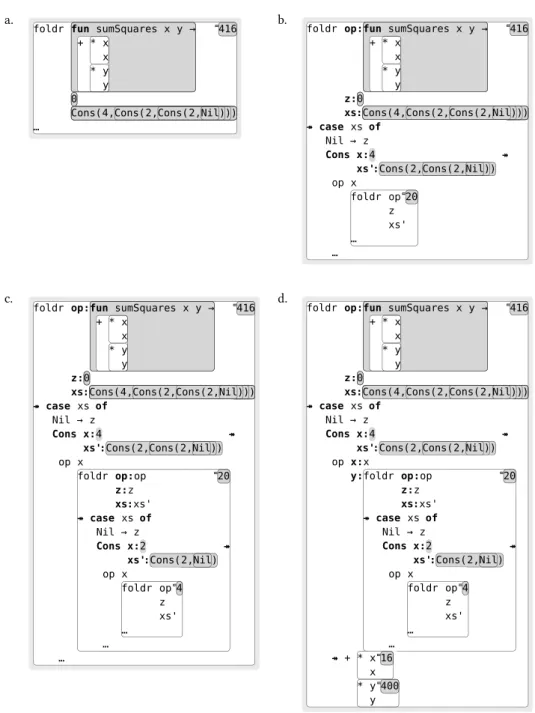
sumSquares, the seed value0, and a list of three integers. When the userfirst loads the program into Lamb-daCalc, it executes and produces the visualisation shown in (a). The input expression has been visually paired with its result in a spreadsheet-like cell with two components. The grey panel in the top right-hand corner is avalue pane, and displays the integer416, which is the value of thecomputationin the white panel that encloses it. The small rectangular tab on the left-hand side of the value pane tells the user that this value isexplained bythe attached computation. The reader will notice that the bindings for the arguments tofoldr are also shown in grey, because they too are values. But these values have no rectangular tab indicating an associated explanation: this is because they were not computed, but were instead provided as they are.
Thus far, the interaction is like a graphical version of aread-eval-printloop (REPL), the interactive top-level prompt found in most functional language implementations, where the user can type in expressions and have them evaluated. But inLambdaCalcthe user can do much more than just ask for an expression to be evaluated. Note the ellipsis in the bottom left-hand corner of (a). This conveys to the user that the explanation of how 416was computed isincomplete, and that they can see more of that explanation by clicking on the ellipsis. Doing so causes two things to happen, as shown in Figure2.2(b). First, the ellipsis has disappeared and been replaced by a small double-headed arrow ։, followed by a view of some more of the steps taken by the interpreter to calculate the result. The arrow indicates that there was some control flow, in this case entering the body of the functionfoldr; to the right of the arrow we see the execution of the body offoldr. The second thing is that thebindingsof the arguments to the formal parameters offoldr
are made explicit via a visual convention reminiscent of call-by-keyword (named argument) syntax [FB09]. Thefirst argument has been prefixed byop:, indicating that the parameteropoffoldrhas been bound to
sumSquares. Bindings for the other two parameterszandxsare also indicated.
a.
foldr fun sumSquares x y →
+ * x x * y y 0 Cons(4,Cons(2,Cons(2,Nil))) …
416 b. foldr op:fun sumSquares x y →
+ * x x * y y z:0 xs:Cons(4,Cons(2,Cons(2,Nil))) ↠ case xs of Nil → Cons x:4 xs':Cons(2,Cons(2,Nil)) ↠ x foldr xs' … 20 … 416 c.
foldr op:fun sumSquares x y → + * x x * y y z:0 xs:Cons(4,Cons(2,Cons(2,Nil))) ↠ case xs of Nil → z Cons x:4 xs':Cons(2,Cons(2,Nil)) ↠ op x foldr op:op z:z xs:xs' ↠ case xs of Nil → z Cons x:2 xs':Cons(2,Nil) ↠ op x foldr op z xs' … 4 … 20 …
416 d. foldr op:fun sumSquares x y → + * x x * y y z:0 xs:Cons(4,Cons(2,Cons(2,Nil))) ↠ case xs of Nil → z Cons x:4 xs':Cons(2,Cons(2,Nil)) ↠ op x:x y:foldr op:op z:z xs:xs' ↠ case xs of Nil → z Cons x:2 xs':Cons(2,Nil) ↠ op x foldr op z xs' … 4 … 20 ↠ + * x x 16 * y y 400 416
Figure 2.2 Interactive drill-down into computation
to stepping into a function call in a debugger, but rather than having to restart in a different “mode”, the user instead inspects the computation directly from the editor, by simply unfolding the source codein situ. Modulo a few minor syntactic extensions to aid comprehension, such as the argument-binding convention just described, the “language of computation” is the language of programs. The programmer need only learn one notation and can understand the execution of a program in terms that are already familiar.
Thefirst thing we see inside the executed body offoldris a case analysis of the list argumentxs. The patternCons(x,xs’)was matched, indicated by the bold highlighting of the constructor name and pattern variables, and the fact thatxandxs’are bound to the components ofxs, which is shown using the same ‘:’ notation used for function arguments.1 (Binding occurrences of variables are always in this format.) Inside theConsbranch is an application ofopto two arguments, namelyxand a recursive call to foldr. The recursive call appears as anested cell, with its own value pane. The ellipsis underneath the recursive call indicates that there is another executed function body here to explore, which is currently collapsed. The body of the call toopis also collapsed.
A simple rule determines whether a sub-computation is visualised in its own cell, or rendered as part of the parent cell. The rule is really just the visual analogue of the so-called “tail-call” compiler optimisation [Ste77]. When the parent computation returns the value computed by the child directly, the value pane of the child is “reused” by the parent and the child cell coalesced into the parent. This happens with function applications andletexpressions, which return the result of evaluating the body, and also withcaseexpressions, which return the result of evaluating the selected branch. On the other hand, when the child computation yields a value which is not just passed upward, its value pane cannot be reused by the parent computation, and the child is then visualised in its own cell so that the intermediate result is still available for inspection. Thus the (white-backgrounded) “computation” component of any cell can always be read as a linear chain of steps that locally terminates in the result shown in the value pane.
The tail-call convention explains why the recursive call in Figure2.2(b) appears as a nested call: the integer
20returned by the recursive call is “intercepted” by the application ofop, rather than just passed upward. Visual conventions such as these, while an important part of any practical implementation, are not essential to the idea of interactive programming. Later we will see other conventions, such as hiding the explanation associated with a computed value completely, or hiding the dead branches of a conditional. One advantage of working with reified computation is that decisions regarding presentation can be taken after the program has run and applied to the computation afterwards, as discussed in Related Work, §3.6.
In Figure2.2(c) the user continues to explore the behaviour offoldrby expanding the recursive invoca-tion. A second recursive call is nested inside, producing the intermediate result4which is again passed to
op, resulting in20. In (d) the user takes a different path, choosing to expand the application ofopinstead, and thereby browse into the body ofsumSquares. Because the user chooses interactively whether to expand a particular sub-computation into an intensional view, or to keep it collapsed and see only the computed re-sult, the specific view of the execution they have at any point in time reflects the information they currently need to understand it. These needs vary depending on what they are trying to do and how well they already understand different parts of the program. The partial views of the running program thereby obtained are
partial explanationsof how some aspect of the program works. It is these potentially complex views which comprise the user’s “comprehension context” and whose structure we are concerned with preserving, where possible, as the program changes.
To summarise the story so far, aLambdaCalcexecution is a structured document which the user is able
1The attentive reader will notice that, unlike the0bound toz, the4bound toxhas no border. The convention is that a primitive value which is merely a sub-component of another value has no border. Here,4is part of the list bound toxs, whereas0is the value of a computation. The particular details of theUI are not essential to our message, however.
to explore interactively in order to understand. We treat execution not as a process that unfolds in time and computes a value, but as a structure which unfolds in space and describes how a value can be computed. We call thisreification: the explicit representation of something formerly implicit or tacit.2The precise form that the reification takes is informed by the observation that big-step evaluation proceeds by a top-down decomposition of the program. This allows us to treat execution as an “unrolling” or in situinflation of the program, with variables taking on actual values, sub-expressions being associated with the values they compute, and nested structure arising from the execution of function bodies. Executed function bodies are the only source of additional structure beyond what was present in the original program.
Sometimes computations take a very long time to produce a result, possibly forever. In a more realistic implementation, a user would be able to interrupt a long-running computation and observe apartialtrace reifying the computation which has taken place so far. For the purposes of this thesis, we consider only terminating computations which cannot be interrupted.
2.2
Di
ff
erential execution
We often run the same program or program fragment with modified inputs, when testing, debugging, or sim-ply exploring our intuitions about how a program works. In a traditional compiled or interpreted language this involves running the program again from scratch with the new input. Equally, we often run amodified
program on thesame input, when testing new code or trying tofix a bug. So-called “live coding” or live programming systems (Related Work, §3.7) allow code to be edited on thefly while the program is running, but the execution itself usually remains a black box, and the semantics of update are typically ill-defined.
In LambdaCalc, when the user makes a change to the program their view of its execution is updated automatically. The result is a new computation with some highlighting indicating the parts that changed. The system uses a memoisation-like scheme to determine when a particular part of the new computation notionally has the same “identity” as, although possibly distinct contents from, some part of the old compu-tation. The difference between (syntactic) equality and “identity” in this sense is similar to theequalvs.eq
distinction in Lisp: “identity” corresponds to eq-style pointer equality.3 When a node of the computation persists into the new state, the information about how the user was browsing it can also be preserved, even though the contents of that node may have changed. This allows the user to see the impact of the change expressedin terms ofthe aspect of the program they were viewing previously.
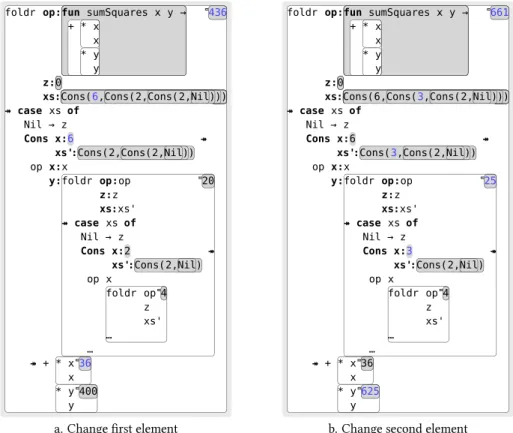
A simple edit is shown in Figure2.3, which continues with thefoldrexample. In (a), the user moves the edit focus to thefirst element of the list argument and changes4to6. Changed values are highlighted in blue; this brings the user’s attention to the fact that the value of the overall computation has updated to436, but also that the intermediate value representing the square ofxupdated, to36. This seems like a reasonable outcome, so in (b), the user now changes the second element of the input list to see what happens in that case. This time the square ofychanges, but the user can see by the binding information indicated byy:that
yis actually computed by a recursive fold over the tail of the list. Changes to different parts of the input
2The Oxford English Dictionary definesreifyto mean “to make (something abstract) more concrete or real; to regard or treat as if having material existence” [OED09].
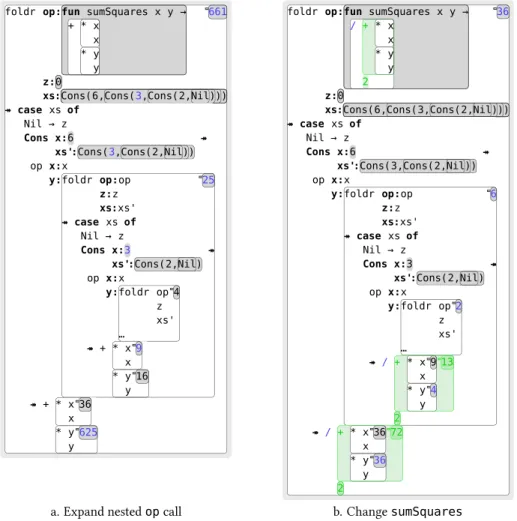
affect different parts of the explanation, revealing different aspects of the execution’s structure. The user is able to see at once how changes “slice” through the dependency structure of the computation, since it is presented spatially, rather than temporally like in a stepping debugger. The delta remains visible until the user requests otherwise, either explicitly, or implicitly by starting a new edit. In Figure2.4, the user decides in (a) to expand the nested call tosumSquares; the delta remains active, because this is only a change to the visualisation, not to the state of the computation itself. Perhaps they want to confirm that the change to the second element is treated in the recursive call analogously to how the change to thefirst element was treated in the outermost call. And this is indeed what the nested delta confirms via the blue highlighting of 9in Figure2.4(a).
foldr op:fun sumSquares x y → + * x x * y y z:0 xs:Cons(6,Cons(2,Cons(2,Nil))) ↠ case xs of Nil → z Cons x:6 xs':Cons(2,Cons(2,Nil)) ↠ op x:x y:foldr op:op z:z xs:xs' ↠ case xs of Nil → z Cons x:2 xs':Cons(2,Nil) ↠ op x foldr op z xs' … 4 … 20 ↠ + * x x 36 * y y 400
436 foldr op:fun sumSquares x y → + * x x * y y z:0 xs:Cons(6,Cons(3,Cons(2,Nil))) ↠ case xs of Nil → z Cons x:6 xs':Cons(3,Cons(2,Nil)) ↠ op x:x y:foldr op:op z:z xs:xs' ↠ case xs of Nil → z Cons x:3 xs':Cons(2,Nil) ↠ op x foldr op z xs' … 4 … 25 ↠ + * x x 36 * y y 625 661
a. Change first element b. Change second element Figure 2.3 Simple structure-preserving edits
Interactions such as these arequeriesthat the user formulates and obtains answers to by browsing, making changes and observing the consequences. If the user does not like the answer to their question they can undo to return to their previous state, or continue with further diagnostic or editing questions. This ability to frame questions by editing data values or programs (“formulae”) is what makesLambdaCalcresemble aspreadsheet
for general-purpose functional programming. Following spreadsheet nomenclature, we call these queries “what if” questions; semantically they have the form “what would happen to its execution if my program were changed in the following way?” As with a spreadsheet, each such edit is like steppingsidewaysin time,
into a “counterfactual” execution where it is “as though” the program had been written differently from the outset. However unlike a normal spreadsheet, both edits and their consequences are always made visible via explicit delta-highlighting, until the user accepts the changes and moves on. Inspired by Demaine et al.’s
retroactive data structures, which are persistent data structures that admit modifications to the historical sequence of operations performed on them [DIL04], we refer to this ability to step sidewise into an alternate execution asretroactive update. Retroactive update allows the “computational past” to be changed.
foldr op:fun sumSquares x y → + * x x * y y z:0 xs:Cons(6,Cons(3,Cons(2,Nil))) ↠ case xs of Nil → z Cons x:6 xs':Cons(3,Cons(2,Nil)) ↠ op x:x y:foldr op:op z:z xs:xs' ↠ case xs of Nil → z Cons x:3 xs':Cons(2,Nil) ↠ op x:x y:foldr op z xs' … 4 ↠ + * x x ! * y y " ↠ + * x x 36 * y y
661 foldr op:fun sumSquares x y →
/ + * x x * y y 2 z:0 xs:Cons(6,Cons(3,Cons(2,Nil))) ↠ case xs of Nil → z Cons x:6 xs':Cons(3,Cons(2,Nil)) ↠ op x:x y:foldr op:op z:z xs:xs' ↠ case xs of Nil → z Cons x:3 xs':Cons(2,Nil) ↠ op x:x y:foldr op z xs' … 2 ↠ / + * x x 9 * y y 4 13 2 6 ↠ / + * x x 36 * y y 36 72 2 36
a. Expand nestedopcall b. ChangesumSquares Figure 2.4 Structural editing with delta-highlighting
As we have seen, a (terminating) LambdaCalcprogram executes by unfolding into a spatially extended structure roughly corresponding to its big-step derivation tree. To understand retroactive update, we must think of both the program and its reified execution not astrees, but asterm graphs. A term graph is a way of representing a pure tree-structured value as a labelled, directed acyclic graph (DAG), normally to permit the sharing of common substructure. A useful intuition is to think of a node of a term graph as alocationstoring a constructor cand a sequence ofchild pointersα1, . . . , αn. We refer toc(α1, . . . , αn)as thecontentsof
information and recovers the original tree.
The significance of the sharing of common substructure will become apparent in §2.3. Here what matters is that we can also use term graphs to support retroactive update. If we allow the term-graph representation of two programs to have nodes in common, we canidentifyparts of the two programs whenever they are represented by the same node (or if you prefer, stored at the same location). It then becomes meaningful to talk of the “same” program part existing in two programs with very different shapes. To the programmer, the program is mutable: they obtain an updated program by modifying an existing one. In particular they are able to express structural reorganisations of the program that arise commonly during programming, such as moves and splices, which are not so straightforward to capture as deltas of pure tree-structured syntax.
Retroactive update is then enabled by taking a similar term-graph approach to the representation of reified computations. But whereas the user obtains a modified program directly, by editing an existing one, they obtain a modified computation only indirectly, by executing a modified program. The new computation will usually overlap with the previous computation at certain locations, allowing it to be expressed as adelta
to the previous one. In theLambdaCalcGUI, we present the updated computation graph in an unravelled, tree-like view, and use colouring to highlight the (asymmetric) difference between the new computation and the previous one. Green indicates that a node is new, i.e. did not exist in the previous computation. Otherwise, the node existed in the previous computation, although possibly with different contents, which are then shown in blue.
An example of how a structural modification of the program can translate into a structural modification of its execution is given in Figure2.4(b). Here, the user has edited the definition ofsumSquaresso that it calculates the average of two squares. The edit happened as follows. First, they turned the+into/, which is now highlighted in blue. Second, they spliced in a new application of +(shown in green) around the expressions* x xand* y y, leaving/missing a second argument. For the missing argument they supplied
the new value2, which is also shown in green. The effect of the program change on the computation to apply a similar transformation to each application ofsumSquares. The additional intermediate values produced by the new+node are visible as new value panes shown in green, and the implied changes in the values computed by the various calls tosumSquaresand recursive calls tofoldrare shown in blue. A more mature GUI than the one we have implemented inLambdaCalcwould smoothly animate the transition between (a) and (b) to provide a more robust visual realisation of node identity.
Allowing a live computation to be re-programmed on thefly poses non-trivial user-interface and usability challenges. For example, the editing scenario just described involved an intermediate state in which the operation/was missing one of its arguments. In such situations, there are choices to make about whether to update the computation and how to handle the potentially ill-formed state. Our prototype implementation only permits programmatic editing, so these concerns are mostly out of scope. For a real-world implementa-tion, we envisage some kind ofstructure-aware editor[DGHL+80], cognisant of the document’s underlying syntax. The editor would be responsible for error recovery, timing and frequency of updates, and the inter-play between textual and structural editing. Although structure editors remain unpopular, a recent study of Java programmers showed that, in practice, code changes rarely utilise the fullflexibility of free text editing [KAM05]. That structural changes are the norm gives us some confidence that structure-aware editors do
indeed have a plausible role to play in making our approach practical.
The delta shown in Figure 2.4(b) will make more sense if we say something about how nodes in the computation graph are built from nodes in the program graph. The key principle is that the evaluation function, which builds the reified computation from the program, ishomomorphicwith respect to the labelled DAG structure. In other words, if two program nodese1ande2are related in the program graph by an edge
labelled withn, indicating thate2is thenth child ofe1in the program syntax, then in any context wheree1
ande2are evaluated to produce reified computation nodesT1andT2, the nodesT1andT2will be related
by an edge labelled withnin the computation graph, so thatT2is thenth child ofT1. If evaluation relates
program graphs and computation graphs in this way then structural reorganisations of the program will be preserved into the structure of its execution. This enables the computation delta to reflect the edit that the user made, at any rate in those parts of the new computation that reuse nodes from the old computation.
The homomorphism principle means that each distinctedit pathbetween the same two programs results in a distinct computation delta. Suppose for example the user had spliced in/around the existing+, rather than changing+to/and then splicing in+. Then the corresponding nodes in the computation would be mod-ified in an analogous way, with a new application of/being spliced into every invocation ofsumSquares. This preservation of edits is precisely what we want, because then the computation delta isexplained by, or attributable to, the program delta, even though thefinal program (and therefore by determinism the compu-tation) is the same as with thefirst edit. We discuss this important topic in more detail in §2.4, in relation to Figure2.9, where we consider an example based onmap.
Our working hypothesis is that directly observing the impact of edits on execution in this way can be helpful even when the programmer already has good intuitions about how the program works. Those intu-itions can be reaffirmed (or perhaps disconfirmed) interactively as they work, allowing them to proceed more confidently. When the programmer lacks such intuitions, directly observing the impact of changes has the potential to be even more useful. Novice programmers, for example, can see directly what is going on and can interactively explore the consequences of simple algorithmic changes. Indeed, given the likely effort in-volved in scaling our approach to real-world systems, a more realistic initial target might be a programming environment for teaching and learning-by-exploration.
What is more, modern software engineering practices such as test-driven development [Bec02] and refac-toring [Fow99] eschew building complex behaviours all at once. Instead complex behaviours are built by modifying existing, simpler ones. In test-driven development, one introduces a new function by starting with a simpler function of the right type and gradually editing it until it has the desired behaviour, as con-firmed by a unit test. Some practitioners have argued for abottom-upprogramming style where functions are developed independently of their intended calling context [Gra94]. When the desired function has a complex type, this permits starting with a function of a simpler type and gradually transforming not only its behaviour but also its type through a series of edits. With refactoring, the idea is to preserve the extensional behaviour but reorganise the code to make subsequent edits and maintenance easier. Implicit in all these practices is a view of programming as the systematic application of code changes that transformintensional structures, and sometimes extensional behaviours, in well-defined ways. We argued explicitly for such a per-spective ourselves in earlier work on “micro-refactoring” [Per04]. Interactive programming is a step towards
supporting these incremental programming methodologies more directly.
The significance of execution deltas to this view of programming is that they are more focused than entire executions. The deltas isolate and reveal individual features of an algorithm, saving the programmer from having to tease these separate strands apart mentally. Instead, they can formulate simple hypotheses, test them interactively, and receive informative visual feedback. The interactions leading to Figure2.4(a) for example might have been an empirical exploration of the hypothesis that changing a numerical quantity in the input list has no bearing on the structure of the fold, but only on the value it computes.
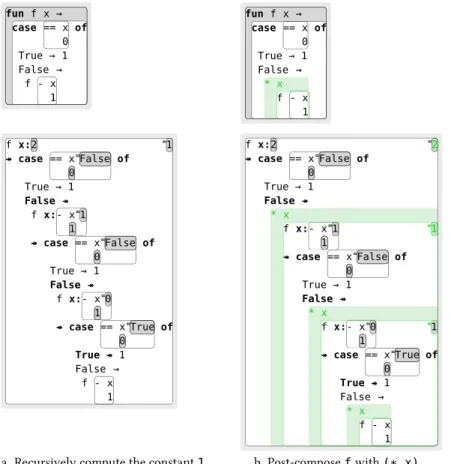
fun f x → case == x 0 of True → 1 False → f - x 1 fun f x → case == x 0 of True → 1 False → * x f - x 1 f x:2 ↠ case == x 0 False of True → 1 False ↠ f x:- x 1 1 ↠ case == x 0 False of True → 1 False ↠ f x:- x 1 0 ↠ case == x 0 True of True ↠ 1 False → f - x 1 1 f x:2 ↠ case == x 0 False of True → 1 False ↠ * x f x:- x 1 1 ↠ case == x 0 False of True → 1 False ↠ * x f x:- x 1 0 ↠ case == x 0 True of True ↠ 1 False → * x f - x 1 1 1 2
a. Recursively compute the constant1 b. Post-composefwith(* x) Figure 2.5 Creating the factorial function
Here is another example which shows how execution deltas complement our view of programming as the transformation of intensional structure. Figure2.5(a) shows a simple function which takes an integer argumentx, counts down fromxto0, and then just returns the constant1. This is a plausible intermediate definition en route to the definition of a more complex function such as factorial. Underneath we see its fully-expanded execution when applied to2. In (b), the user edits the definition offto multiply byxthe value returned by the recursive call, so that the function now indeed computes the factorial of its argument. The overall result of the computation is now 2 instead of1 but more importantly the way the result is computed has a quite different structure and this is reflected visually to the user. Previously,f was
tail-recursive; a1was computed and passed all the way to the top, as was visually apparent in (a) by the entire computation having a single value pane. In (b), we see thatvery same1being “intercepted” part of the way up and multiplied by the current value ofxat the point, producing a “different” value node (shown in green) which happens to also have the value1. This result is in turn intercepted at the enclosing recursive call and again multiplied by the local value ofx, producing thefinal result2. The visual tail-call “optimisation” that we described in §2.1above has beenunapplied, and the change in the visualisation made explicit to the user via delta highlighting. The result is a concrete presentation of how the edit they just made transformed the intensional behaviour of the function.
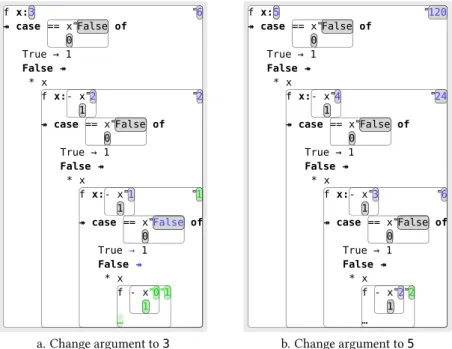
f x:3 ↠ case == x 0 False of True → 1 False ↠ * x f x:- x 1 2 ↠ case == x 0 False of True → 1 False ↠ * x f x:- x 1 1 ↠ case == x 0 False of True → 1 False ↠ * x f - x 1 0 … 1 1 2 6 f x:5 ↠ case == x 0 False of True → 1 False ↠ * x f x:- x 1 4 ↠ case == x 0 False of True → 1 False ↠ * x f x:- x 1 3 ↠ case == x 0 False of True → 1 False ↠ * x f - x 1 2 … 2 6 24 120
a. Change argument to3 b. Change argument to5 Figure 2.6 Testing the factorial function
In Figure 2.6(a), the user goes on to test their new definition at other arguments. First they edit the argument from the value2that it had in Figure2.5(b) to3. This causes the scrutinee in thefinal conditional test of the execution to change fromTruetoFalseand therefore control to switch branches. This is indicated by the ։arrow following the pattern Truebecoming→, and the→arrow following the pattern False
becoming։, both changes being highlighted in blue. This confirms the user’s expectation that when the argument is incremented the recursion will go one level deeper. Indeed, the recursive call in the False
branch, which was inactive in the previous state, is now live, as is its argument, which can be seen to evaluate to 0. And there is a new executed function body (a green ellipsis), indicating that there is now more structure to explore. The overall effect of the edit has been to “relocate” the user’s view to a different execution of factorial, whilst preserving the fact that they are viewing the computation only to a certain depth. Then in (b), the user increases the argument from 3to5. This time there aretwo new calls tof
to the same depth, both the new calls are hidden away under the ellipsis. Nevertheless, the user can see that the last four values of factorial which were calculated are now2,6,24and120.
So again, the potential benefit to the user in this case is that they can see – rather than merely imagine – exactly howchanging the value of an argument controls the depth of the recursion. Sincefdoes more work for larger arguments, incrementing the argument adds new computation at the end of the execution, by deferring the termination of the recursion.
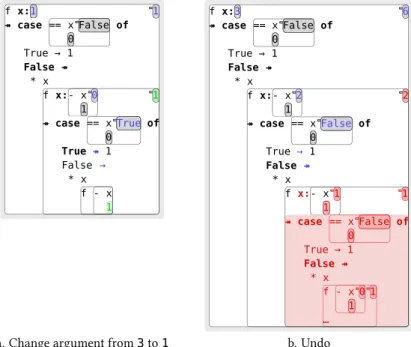
f x:1 ↠ case == x 0 False of True → 1 False ↠ * x f x:- x 1 0 ↠ case == x 0 Trueof True ↠ 1 False → * x f - x 1 1 1 f x:3 ↠ case == x 0 False of True → 1 False ↠ * x f x:- x 1 2 ↠ case == x 0 False of True → 1 False ↠ * x f x:- x 1 1 ↠ case == x 0 False of True → 1 False ↠ * x f - x 1 0 … 1 1 2 6
a. Change argument from3to1 b.Undo
Figure 2.7 Using undo to obtain a deletion delta
Symmetrically, making the argument smaller would delete computation from the end, by making the recursion terminate earlier. In Figure 2.7(a), the user has undone the edit of3into5 and changed it to1
instead. The computation has indeed become smaller. However, the deltas that we visualise inLambdaCalc are asymmetric and cannot simultaneously show creation and deletion. This is so that the content of the UI at a given state can be read as a bonafide execution by simply disregarding the delta highlighting. The deltas we have seen up till now, which are the result of edits, we callcreationdeltas. A creation delta shows the present state relative to a prior one. A node unique to the present has therefore just been created; such nodes, as we have seen, are shown in green. But if the edit also causes nodes to be deleted, they will not be visible in the resulting delta since they are no longer part of the present state.
The user can however obtain a delta showing any deleted nodes by simplyundoingthe edit, as shown in Figure2.7(b). Now the UI shows what we call adeletiondelta. A deletion delta shows the present state relative to a hypothetical future state, in this case the state in whichfwas applied to1, from which the user just returned via undo. A node unique to the present is now one which is scheduled for deletion in that future state; such nodes are shown in red. Here the user can see the part of the execution which will no
longer take place. Deltas therefore come in twoflavours which differ only in the colour they use to highlight “fresh” nodes, i.e. nodes which occur in the present state but not in the state with which the present state is being compared. Changed nodes appear in blue in both kinds of delta. Deletion deltas have a subjunctive flavour; whereas creation deltas compare things to how theywere, deletion deltas compare things to how theywould be. The point is that there are no hidden changes: the user can always access the full content of the symmetric delta by undoing and redoing the edit.
The idea of making execution live and tangible is similar to the philosophy of programming environments like VisiProg [HW85] and Flogo II [Han03]. The key novelty that we introduced in this section is to extend this idea with explicit execution deltas, which have two important benefits. First, the user can directly ob-serve the effects of program edits on the behaviour of their program, as the transformation of intensional structure. Second, their view of the computation can often be retained in the new state, preserving their working context, and allowing editing and comprehension to be interwoven. We illustrated this interactive approach to programming with some simple examples intended not only to convey the potential benefits, but also to bring home the absurdity of having to “play computer” in order to understand what is happening inside a computer carrying out that very task. We neglected an important question, one which is unfortu-nately mostly out of scope for this thesis, namely how to scale this approach effectively to large programs. We consider this topic in Future Work, §7.2.1.
2.3
Visualising structured values
In the previous section, the notion of term graph helped us make sense of the idea of the “same” sub-computation or value existing in different computations. To “change” a node is to retain it in the new state, but label it with a different constructor, or change the outgoing edges in which it participates. We now show that reuse of nodes also arises naturally withina state if computations and values are represented as term graphs.
Consider functional computations that operate on structured values such as lists and trees. These programs take values apart, via pattern-matching and projection, and assemble new ones, via construction. When these assembly and disassembly actions take place, the sub-graphs representing values are automatically reused. For example when projecting a component out of a structured value, we return it “by reference”, and similarly when we construct such a value, we include its components “by reference”. Sharing also takes place when a computation simply returns a value constructed elsewhere: when evaluating a variable, we return “by reference” the value to which it is bound, and for a conditional expression, we return “by reference” the value computed by the selected branch. This kind of natural sharing is a consequence ofdataflow, the paths that values take through the computation.
Implementations of mature functional languages often use term graphs, because they tend to be based on imperative languages with pointers in which graphs are easy to implement. The kind of reuse described above is then the default behaviour, in that when mentioning a node, one must explicitly copy its sub-graph to avoid sharing its representation. With lazy languages, sharing has an additional role to play in avoiding the duplication of delayed computations [Wad71]. In these cases sharing is technically an optimisation
because it is unobservable at the level of the computation – one cannot write a program whose abstract behaviour differs depending on whether or not values are shared.
InLambdaCalc, the situation is slightly different, because the paths taken by values through the compu-tation are made explicit to the user. (We will see this more comprehensively in §2.5below.) These paths are determined by the semantics of the language, and establish a relation ofsynonymybetween values. This synonymy in turn serves as the basis of a visualisation technique with a dual role: enabling more compact views, and helping the user understand a computation by revealing how it decomposes and composes values. This is not an “optimisation” particular to the implementation but rather an aspect of the semantics exposed by the tool.
Let us consider an example. In Figure2.8(a), the user initially sees the valueSome("claire"). As before, the rectangular tab to the left of the value pane indicates that the value has an explanation, but in this example the explanation is completely hidden. (It would be more consistent to display a single ellipsis for the empty partial explanation, but for compactness we omit it.) This illustrates a presentation option which might for example be enabled by default in a distributed setting whenever a value is computed remotely.
Now suppose the user wants to understand the provenance of that value, for example why the string
"claire" appears here. They would start by revealing the partial explanation shown in (b). This partial explanation indicates that the result was computed by applying a function calledlookupto two arguments: an integer7, and a binary tree containing some data. Suppose that here the user knows that the nodes of the tree store(k, s)pairs and are sorted by integer keysk, and thatlookup returns eitherSome(s), wheresis the string associated withkin the tree, orNoneifkis not found. What the partial explanation tells them is that the key7was found in the tree, but also that the value"claire"is not just equal to, but isidentical to
(synonymous with) the occurrence of the same string in the input tree. This is indicated by the dotted line pointing back from the output to the occurrence of that string in the input. Since this notion of synonymy coincides with the sharing that arises naturally as a consequence of dataflow, we call thesesharing links.
However, although these links do represent a kind of sharing, an implementation of our approach may internally choose to store data quite differently from the arrangement implied by the sharing links. In a distributed setup, values might be “shared” in this abstract sense but duplicated in the implementation; and conversely, values might be “distinct” in this abstract sense but equal and therefore able to share a representation. Such implementation choices arenotpart of the abstract operational model, and therefore would be invisible to a user of the system. (It may occasionally be useful to see details of the underlying language implementation too, but that is not our goal here; throughout this thesis we will only be concerned with executionwith respect to a reference semantics.)
The sharing links become more informative as the user exposes more of the computation. In (c), they expand the ellipsis to reveal the body oflookup. We see that the tree passed tolookupis bound to the pa-rametertand then immediately pattern-matched as aBranchnode. (For this example, we have suppressed the presentation of dead branches.) Pattern-matching binds the variablest1,kvandt2to the components oft, establishing further sharing links. But note how the visualisation shows the components oftpointing to the values of the three variables bound to them, rather than the other way around. The rule is that the firstoccurrence of a value in the visualisation, with respect to a postorder traversal of the view structure, is
Some("claire")
(a) Explanation completely hidden
lookup 7
Branch Branch Empty
Pair(3,"simon") Empty
Pair(4,"john") Branch Branch Empty
Pair(6,"sarah") Empty Pair(7,"claire") Empty … Some( ) lookup k:7 t:Branch ↠ case t of
Branch t1:Branch Empty
Pair(3,"simon") Empty
kv:Pair(4,"john") t2:Branch Branch Empty
Pair(6,"sarah") Empty Pair(7,"claire") Empty ↠ case GT of GT ↠ lookup k t2 … Some( )
(b) Partly expanded (c) Browsing into body oflookup
lookup k:7 t:Branch
↠ case t of
Branch t1:Branch Empty
Pair(3,"simon") Empty
kv:Pair( ,"john")
t2:Branch Branch Empty
Pair(6,"sarah") Empty Pair(7,"claire") Empty ↠ case compare k fst kv 4 … GT of GT ↠ lookup k t2 … Some( ) lookup k:7 t:Branch ↠ case t of
Branch t1:Branch Empty
Pair(3,"simon") Empty kv:Pair(4,"john") t2:Branch ↠ case of GT ↠ lookup k:k t: ↠ case t of
Branch t1:Branch Empty
Pair(,"sarah") Empty kv:Pair(7, ) t2:Empty ↠ case EQ of EQ ↠ Some snd kv "claire" Some( )
(d) Partial explanation ofGT (e) Browsing into recursive call
Figure 2.8 Exploring a computation to reveal value assembly and disassembly
the one that is actually rendered, with any other occurrences then being rendered as sharing links. This (ad-mittedly simplistic) convention means that the user can observe sub-values propagate into the computation