UC Irvine
UC Irvine Electronic Theses and Dissertations
Title
Towards Methods to Exploit Concurrent Data Structures on Heterogeneous CPU/iGPU Processors Permalink https://escholarship.org/uc/item/7r21z1s7 Author Fuentes, Joel Publication Date 2019 License CC BY 4.0 Peer reviewed|Thesis/dissertation
UNIVERSITY OF CALIFORNIA, IRVINE
Towards Methods to Exploit Concurrent Data Structures on Heterogeneous CPU/iGPU Processors
DISSERTATION
submitted in partial satisfaction of the requirements for the degree of
DOCTOR OF PHILOSOPHY in Computer Science
by
Joel Fuentes
Dissertation Committee: Professor Isaac D. Scherson, Chair Professor Alex Nicolau Professor Raymond Klefstad
c
DEDICATION
TABLE OF CONTENTS
Page
LIST OF FIGURES v
LIST OF TABLES vi
LIST OF ALGORITHMS vii
ACKNOWLEDGMENTS viii
CURRICULUM VITAE ix
ABSTRACT OF THE DISSERTATION xi
1 Introduction 1
1.1 Multi-thread and Data Parallelism . . . 3
1.2 Challenges in Heterogeneous Concurrent Programming . . . 3
1.3 Contributions of the Thesis . . . 5
2 Preliminaries 7 2.1 Common Terms . . . 7
2.2 Formal definitions . . . 9
2.3 Heterogeneous CPU/iGPU Architecture and Programming Framework . . . 10
2.3.1 Intel’s Multi-Core CPU/iGPU Processor . . . 10
2.3.2 C for Media . . . 13
3 Related Work 18 3.1 Synchronization Mechanisms for Multi-Core CPUs . . . 18
3.2 Concurrent Data Structures for Multi-Core CPUs . . . 19
3.2.1 Stacks . . . 20 3.2.2 Queues . . . 21 3.2.3 Lists . . . 22 3.2.4 Maps . . . 23 3.2.5 Trees . . . 24 3.2.6 Skiplists . . . 25
4 Exploiting Concurrent Data Structures 26
4.1 Synchronization techniques . . . 28
4.2 Concurrent Data Structures with SIMD Processing . . . 31
4.2.1 SIMD-node transformations . . . 33
4.2.2 SIMD-node Traversals . . . 36
4.2.3 Restrictions and Considerations . . . 37
5 Contributed Multi-threaded Synchronization Mechanisms 38 5.1 Spatial Locks: A Specilized Synchronization mechanism for Geometric Algo-rithms . . . 38
5.1.1 Paradigm and Interface . . . 40
5.1.2 Implementation . . . 42
5.1.3 Settings and restrictions . . . 46
5.1.4 Parallel Mesh Simplification using Spatial Locks . . . 47
6 Contributed Concurrent Data Structures with SIMD Processing 57 6.1 k-ary Tree based on SIMD-node transformations . . . 57
6.2 Lock-free Skiplist based on SIMD-node transformations . . . 60
6.2.1 Structure details . . . 61
6.2.2 Implementation considerations . . . 63
6.2.3 Data structure operations . . . 64
6.2.4 Correctness . . . 73
6.2.5 Experimental Results . . . 78
6.3 SIMT-friendly Data Structures . . . 83
6.3.1 SIMT Tree Search . . . 85
7 Conclusions and Future Work 87 7.1 Conclusions . . . 87
7.2 Future Work . . . 88
LIST OF FIGURES
Page 2.1 Architecture components layout for an Intel processor with Gen9 Integrated
Graphics Processor [40]. . . 11
2.2 Intel’s Gen9 Execution Unit (EU) [40]. . . 12
2.3 Layout of the Intel’s Gen9 iGPU[40]. . . 13
4.1 Classification of data structures . . . 26
4.2 Multi-thread parallelism . . . 27
4.3 Lock-based synchronization . . . 28
4.4 Non-blocking synchronization . . . 30
4.5 Multi-thread + SIMD parallelism . . . 31
4.6 Θ-node transformation from a one-dimensional (a) and multi-dimensional (b and c) structures . . . 34
5.1 Spatial hashing where objects are mapped into uniformly-sized cells . . . 40
5.2 Surface mesh simplification algorithm applied to a mesh with different sim-plification levels [5]. . . 48
5.3 Contraction of the edge (v, vu) into a single vertex. The shaded triangles become degenerate and are removed during the contraction. . . 49
5.4 Total time spent by the parallel mesh simplification algorithm in simplifying surface meshes with up to 3,136,234 triangles. . . 52
5.5 Total time spent by the mesh simplification algorithm using internal locks and Spatial Locks. . . 55
5.6 Total time spent by both algorithms in simplifying a surface mesh with 2,436,234 triangles. . . 56
6.1 Skiplists before and after Θ-node transformation . . . 61
6.2 Skiplist structure . . . 61
6.3 Insertion of key 67 . . . 70
6.4 Insertion of key 21 . . . 71
6.5 Throughput of different Skiplists on GenX and CPU . . . 79
6.6 Speedup of CMSL on GenX over Fraser’s skiplist for CPU . . . 80
6.7 Scalability of CMSL by the number of threads. Operations are 90% search, 5% insert and 5% delete. . . 83
LIST OF TABLES
Page 4.1 Classification of concurrent data structures based on their implementation . 32 5.1 Performance of the PMS algorithm implemented with Spatial Locks . . . 52 5.2 Performance of mesh simplification algorithms using internal locks and Spatial
Locks . . . 54 6.1 Performance comparison between CMSL and M&C skiplists. Relative
effi-ciency of CMSL is calculated by eCM SL
LIST OF ALGORITHMS
Page
1 Traversal of a ΘX transformed tree . . . 37
2 Lock object in Spatial Hash Table . . . 44
3 Unlock object in Spatial Hash Table . . . 45
4 Parallel Mesh Simplification using Spatial Lock . . . 50
5 Find list . . . 65
6 Search key . . . 66
7 Insert key . . . 67
8 Insert in Chunk . . . 68
9 Delete key . . . 72
ACKNOWLEDGMENTS
I would like to thank many people without whom this thesis would not have been possible. First, I thank my advisor Isaac D. Scherson for the guidance and inspiration he gave me during this journey towards a Ph.D. He not only taught me fundamental knowledge necessary for writing this thesis, but also gave me a lot of useful career advice. His broad knowledge and experience have given me a better perspective on the “big picture” of this thesis. I thank the Department of Computer Science and Information Technologies (DCCTI) from the Universidad del B´ıo-B´ıo for providing me an opportunity to develop a research career. I am very grateful to all the DCCTI members for their motivation and encouragement to pursue a Ph.D. in the U.S.
Also, I would like to acknowledge the funding sources that made my dissertation research possible. Fellowship support was provided by the Universidad del B´ıo-B´ıo and Becas Chile CONICYT. Additional support was provided by the UCI AGS Division through travel grants. I am also thankful to Intel Corporation and the CM Compiler team for providing internship appointments during my graduate studies. They also provided me the computing resources needed for the experimental part of this thesis. I am grateful to Wei-yu Chen and Guei-yuan Lueh for many interesting discussions on iGPUs and compilers, which inspired me to do research on concurrent data structure with SIMD/SIMT processing.
I am especially thankful to my wife, Lidia. She stood by my side during all of my ups and downs, and her constant support and encouragement enabled me to finish this journey. Finally, I thank my parents, Sebastian and Carmen, for always motivating me to pursue my dreams and being there whenever I needed them. Without them, I would not have come this far.
CURRICULUM VITAE
Joel Fuentes
EDUCATION
Doctor of Philosophy in Computer Science 2019
University of California, Irvine Irvine, CA, USA
Master in Computer Science 2016
University of California, Irvine Irvine, CA, USA
Bachelor in Science, Computer Engineering 2011
Universidad del B´ıo-B´ıo Chill´an, Chile
RESEARCH EXPERIENCE
Graduate Research Assistant 2014–2019
University of California, Irvine Irvine, CA, USA
Research Intern 2017–2018
Intel Corporation Santa Clara, CA, USA
TEACHING EXPERIENCE
Teaching Assistant 2014–2019
REFEREED JOURNAL PUBLICATIONS
Synchronizing Parallel Geometric Algorithms on Multi-Core Machines
2018
Joel Fuentes, Fei Luo, Isaac D. Scherson. International Journal of Networking and Computing 8 (2), 240-253
A Method to Find Functional Depen- dencies Through Refutations and Duality of Hypergraphs
2015
Joel Fuentes, Pablo Sez, Gilberto Gutirrez, Isaac D. Scherson. The Computer Journal 58 (5), 1186-1198
REFEREED CONFERENCE PUBLICATIONS
A Lock-Free Skiplist for Integrated Graphics Processing Units
2019
Joel Fuentes, Wei-yu Chen, Guei-Yuan Lueh, Isaac D. Scherson. International Parallel and Distributed Processing Symposium
Synchronizing Parallel Geometric Algorithms on Multi-Core Machines
2017
Joel Fuentes, Fei Luo, Isaac D. Scherson. 2017 Fifth International Symposium on Com-puting and Networking (CANDAR), 401-407
Dynamic Creation of Virtual Machines in Cloud Com-puting Systems
2017
Fei Luo, Isaac D. Scherson, Joel Fuentes. 25th International Conference on Systems Engineering (ICSEng), 316-323
A Novel Genetic Algorithm For Bin Packing Problem In jMetal
2017
Fei Luo, Isaac D. Scherson, Joel Fuentes. IEEE International Conference on Cognitive Computing (ICCC), 17-23
Mining for Functional Dependencies Using Shared Radix Trees in Many-Core Multi-Threaded Systems
2017
Joel Fuentes, Claudio Parra, David Carrillo and Isaac D. Scherson. Emergent Compu-tation, 303-319
ABSTRACT OF THE DISSERTATION
Towards Methods to Exploit Concurrent Data Structures on Heterogeneous CPU/iGPU Processors
By Joel Fuentes
Doctor of Philosophy in Computer Science University of California, Irvine, 2019
Professor Isaac D. Scherson, Chair
Heterogeneous processors, consisting of CPU cores and an integrated GPU on the same die, are currently the standard in desktop and mobile platforms. The number of CPU cores is increased with every new generation, and integrated GPUs are constantly being improved in performance and energy efficiency. This raises the importance of developing programming methods and techniques to benefit general purpose applications on heterogeneous processors as more parallelism can be achieved. This dissertation addresses this challenge by studying new ways of exploiting parallelism on CPU cores as well as the integrated GPU, focusing on blocking and non-blocking data structures.
A new thread synchronization mechanism for parallel geometric algorithms dubbed Spatial Locks is first introduced. This synchronization mechanism ensures thread synchronization on geometric algorithms that perform concurrent operations on geometric surfaces in two- or three-dimensional spaces. A parallel algorithm for mesh simplification is chosen to illustrate the Spatial Locks usefulness when parallelizing geometric algorithms with ease on multi-core machines. Experimental results show the advantage of using this synchronization mecha-nism where significant computational improvement can be achieved compared to alternative approaches.
Non-blocking data structures are commonly used by many multi-threaded applications, and their implementation is based on the use of atomic operations. New computing architectures, such as Intel CPU/iGPU processors, have incorporated data-parallel processing through SIMD instructions, including in some cases support for atomic SIMD instructions and SIMT processing on the integrated GPU. A new framework called SIMD-node Transformations
to implement non-blocking data structures using multi-threaded and SIMD processing is proposed. As a result, it is shown that one- and multi-dimensional data structures, such as skiplists, k-ary trees and multi-level lists, can embrace SIMD processing through these transformations. Finally, important performance gains obtained when applying these trans-formations to concrete data structures are reported.
Chapter 1
Introduction
With the advent of heterogeneous computing systems that use silicon devices with many CPU cores and an integrated GPU (iGPU) per chip, also known as Multi-Core CPU/iGPU processors, new challenges are posed to programming applications that attempt to use paral-lelism to achieve a significant computational improvement. Typical Multi-core CPU/iGPU computers use chips that contain two, four or more cores each, and an iGPU with a few dozens of GPU cores (Execution Units - EU). These heterogeneous processors also include an on-chip hierarchical shared cache system that provides local and shared caches for the CPU cores and iGPU’s EUs. An interface to a large common main DRAM storage completes the solid state memory hierarchy. These systems are normally programmed using threads that are managed by the operating system to execute in the available cores attempting to use as much parallelism as possible. The main problem that arises is the management of shared data structures in the shared hierarchical memory to guarantee synchronized access to the data structures, avoiding deadlock and providing a correct access sequence as re-quired by the program. Additionally, the inclusion of Data-Parallelism on these architecture through SIMD (single instruction multiple data) instructions has brought a new dimension of parallelism that has to be explored to exploit shared data structures.
SIMD processing is a term introduced by Michael J. Flynn in 1966 [13]. It refers to a processor architecture that executes a single instruction over multiple data items at the same time. However, it is not straightforward to take advantage of this architecture. The programmer requires to manually manage the data in arrays or vectors (SIMD-friendly format), so the SIMD execution unit can act over them. New CPU/iGPU computing architectures, such as Intel’s heterogeneous processors, have brought new processing capabilities such as SIMD and SIMT processing on the iGPU. Along with the inclusion of GPU cores within the same CPU die, the performance and programmability of the Intel’s integrated graphics processing unit (GenX iGPU) has been significantly improved over earlier generation of integrated graphics [40]. Besides providing specialized graphics hardware, GPU cores are also getting more programmable as new generations are released, making them amenable to general-purpose computing. In terms of use and presence, the GenX iGPU is massively used since it is present in almost every processor Intel releases for desktop and mobile.
Maurice Erlihy and Nir Shavit wrote a book [35] that discusses the methodologies used to properly program Multi-Core systems. Exploiting parallelism depends very much on the syn-chronization mechanisms available to avoid shared data conflicts. Their book has become a classic and has been adopted to teach Multi-core programming courses. Mutual exclu-sion concepts and blocking properties discussed in their book, such as deadlock-freedom and starvation-freedom, are fundamental when implementing new synchronization primi-tives. On the other hand, non-blocking techniques and properties such as lock-freedom, wait-freedom and obstruction-freedom, are essential for achieving correct non-blocking ex-ecutions in concurrent programs. The authors also pioneered the linearization correctness condition for non-blocking data structures, which became widely used for different authors and researchers of new non-blocking designs.
1.1
Multi-thread and Data Parallelism
The spread of multi-core CPU architectures along with the deceleration of Moore’s law have shown a change on how we develop software. Until recently, advances in technology meant advances in clock speed, so software would effectively “speed up” by itself over time. Now, however, this free ride is over. Advances in technology will mean increased parallelism and not increased clock speed, and exploiting such multi-thread parallelism is one of the out-standing challenges of modern Computer Science. Therefore, with the advent of computing systems with many CPUs per chip, well-known as multi-core and many-core machines, paral-lelizing algorithms is an objective in order to achieve significant computational improvement.
Data parallelism refers to scenarios in which the same operation is performed in parallel on elements in a source collection or vector. Accelerators targeting data-parallelism, such as GPU, have become very popular for graphics applications, media, video game, and machine learning. Notice that modern CPU architecture also support data-parallelism through vec-tor operations; e.g. Advanced Vecvec-tor Extensions (AVX, also known as Sandy Bridge New Extensions) are extensions to the x86 instruction set architecture for microprocessors from Intel and AMD.
1.2
Challenges in Heterogeneous Concurrent
Program-ming
In recent years, GPUs have become essential for many computer tasks and they are used to accelerate applications in a wide variety of fields. They are well-known for having the potential to accelerate many kinds of computations, especially if these computations involve large number of data elements that can be executed in parallel. GPUs were initially created
as a discrete component for computer machines, but today they are also widely available as System on a Chip (SoC) component in the same CPU die; as is the case of Intel processors.
Even when the use of these heterogeneous processors has become very common, especially on data parallel algorithms such as graphics/media applications, machine learning, etc., applications with concurrent data structures have not been explored yet. There exists a big group of data structures whose traversal algorithms can be improved by using data-parallel processing.
In a system where a discrete GPU is present, the work flow involves transferring data from main memory to GPU device memory, performing the computations on the GPU, and mov-ing the results back to main memory. This data movement is done through the PCI express bus, which is orders of magnitude slower than making copies within the main memory. Het-erogenous platforms with an iGPU, on the other hand, offer an environment where memory is shared between the CPU and the accelerator (in this case, iGPU). Thus, all the data move-ment can be avoided. The use of this shared memory presents demanding challenges in terms of thread synchronization when shared memory blocks from a concurrent data structures are accessed/updated from both devices; i.e. how mutual exclusion and/or linearizability are guaranteed.
In terms of programming languages, they need to provide an intuitive interface to express data-parallelism at a high level of abstraction. Compilers for these heterogeneous archi-tectures need to efficiently exploit the SIMD capability of the iGPU. Optimizations and validations on data-parallel operations should be considered as well, especially when the used is in charge of defining vector operations and SIMD sizes.
Most research in frameworks aimed at scheduling tasks on heterogeneous architectures, com-posed of CPU’s and GPUs, has focussed on optimizing execution time without considering en-ergy consumption. However, a CPU core and an iGPU exhibit different performance/enen-ergy
trade-offs, this is, a workload can run faster on one device but consume less energy on the other one. Thus, in order to benefit from the potential energy efficiency that the accelerators can provide in these heterogeneous chips, the runtime scheduler also needs to consider the performance/energy asymmetry when making a scheduling decision.
1.3
Contributions of the Thesis
The main contributions of this thesis are:
1. A thread synchronization mechanism dubbed Spatial Locks for parallel geometric al-gorithms is presented. We show that Spatial Locks ensure thread synchronization on geometric algorithms that perform concurrent operations on geometric surfaces in two-dimensional or three- dimensional space. The proposed technique respects the fact that these operations follow a certain order of processing, i.e. priorities. Parallelizing these kinds of geometric algorithms using Spatial Locks requires only a simple pa-rameter initialization, rather than modifying the algorithms themselves together with their internal data structures. A parallel algorithm for mesh simplification is chosen to show the Spatial Locks usefulness when parallelizing geometric algorithms with ease on multi-core machines. Experimental results illustrate the advantage of using this syn-chronization mechanism where significant computational improvement can be achieved compared to alternative approaches.
2. We present a new framework called Θ-node Transformationsto implement non-blocking data structures using multi-threaded and SIMD processing. As a result, it is shown that one- and multi-dimensional data structures, such as skiplists, k-ary trees and multi-level lists, can embrace SIMD processing through these transformations and re-main linearizable. Some guidelines to implement new Θ-node-based data structures
from scratch are also provided.
3. A lock-free skiplist based on Θ-node transformations is presented. It capitalizes on the GenX iGPU computational model to accelerate its search and update operations. It uses non-blocking techniques and all its operations are lock-free. To the best of our knowledge, this is the first implementation of a lock- free data structure for iGPU. Experimental results show that our proposal is more compute-efficient than an existing discrete GPU implementation and outperforms state-of-the-art lock-free and lock-based skiplists for multi-core CPU, achieving up to 3.5x speedup. Additionally, energy savings of up to 300% are obtained when running different skiplist workloads on iGPU instead of CPU cores, hence further improving energy efficiency.
4. A SIMT-based tree search algorithm is presented. It capitalizes on the fact that binary search trees algorithms have low divergence and are simple. Experimental results show that SIMT-based search achieve higher throughput for some tree structures than multi-threaded algorithms for CPU.
Chapter 2
Preliminaries
2.1
Common Terms
• Mutual exclusion: It is the problem of making sure that only one thread at a time can execute a particular block of code, and is one of the classic coordination problems in multiprocessor programming.
• Atomic operation: Modern multiprocessor hardware provides special read-modify-write instructions that allow threads to read, modify, and write a value to memory in one atomic (i.e., indivisible) hardware step. In this thesis, we refer to the specific atomiccompare-and-exchangeoperation (CMPXCHG) ascompare-and-swapoperation (CAS).
• ISA: Instruction set architecture.
• Kernel: A compute kernel is a routine compiled for high throughput accelerators (such as graphics processing units (GPUs), digital signal processors (DSPs) or field-programmable gate arrays (FPGAs)), separate from but used by a main program (typically running on a central processing unit). They are sometimes called compute
shaders, sharing execution units with vertex shaders and pixel shaders on GPUs, but are not limited to execution on one class of device, or graphics APIs.
• GenX: Intel architects colloquially refer to Intel processor graphics architecture as simply Gen, shorthand for Generation. A specific generation of the Intel processor graphics architecture may be referred to as Gen9 for generation 9 [40].
• SISD: Single instruction, single data
• SIMD: Single instruction, multiple data
• SIMD Width: Size of the vector operation to be processed by a SIMD instruction.
• SIMT: Single instruction, multiple threads.
• Cache Coherency: In most modern multiprocessors, each processor has an attached cache, a small, high-speed memory used to avoid communicating with large and slow main memory. Each cache entry holds a group of neighboring words called a line, and has some way of mapping addresses to lines. Each cache line has a tag, which encodes state information. The cache coherence protocol detects synchronization con-flicts among individual loads and stores, and ensures that different processors agree on the state of the shared memory. When a processor loads or stores a memory address a, it broadcasts the request on the bus, and the other processors and memory listen in (sometimes called snooping).
• Exponential Backoff: It is an algorithm that uses feedback to multiplicatively de-crease the rate of some process, in order to gradually find an acceptable rate.
2.2
Formal definitions
Definition 2.1. Mutual exclusion is when critical sections of different threads do not overlap. For threads A and B, and integers j and k, either CSk
A →CS
j
B or CS j
B →CSAk.
Definition 2.2. Deadlock-freedom guarantees that if some thread attempts to acquire the lock,then some thread will succeed in acquiring the lock. If thread A calls lock() but never acquires the lock, then other threads must be completing an infinite number of critical sections.
Definition 2.3. Starvation-freedomguarantees that every thread that attempts to acquire the lock eventually succeeds. Every call to lock() eventually returns. This property is some-times called lockout freedom.
Definition 2.4. A method is lock-free if it guarantees that infinitely often some method call finishes in a finite number of steps.
Definition 2.5. A method is wait-free if it guarantees that every call finishes its execution in a finite number of steps.
Definition 2.6. A method is obstruction-free if, from any point after which it executes in isolation, it finishes in a finite number of steps.
Definition 2.7. An execution of a concurrent system is modeled by a history H, a fi-nite sequence of method invocation and response events. A subhistory of a history H is a subsequence of the events of H.
Definition 2.8. A history H is linearizable if it has an extension H0 and there is a legal sequential history S such that
• L1. complete(H0) is equivalent to S, and
We refer to S as a linearization of H (H may have multiple linearizations).
Definition 2.9. For implementations that do not use locks, the linearization point is typically a single step where the effects of the method call become visible to other method calls.
Definition 2.10. TheABA problem ocurrs especially in dynamic memory algorithms that use conditional synchronization operations such as CAS operations. Typically, a reference about to be modified by a CAS operation changes from a, to b, and back to a again. As a result, the CAS operation call succeeds even though its effect on the data structure has changed, and no longer has the desired effect.
2.3
Heterogeneous CPU/iGPU Architecture and
Pro-gramming Framework
2.3.1
Intel’s Multi-Core CPU/iGPU Processor
Intel introduced a few years ago the first heterogeneous processor that integrates GPU cores along with the CPU cores on the same die. The integrated graphics processor that used to be part of MCH (Memory Controller Hub) or North-Bridge is now placed inside the proces-sor. This move further improved the performance of Intel iGPU by a significant amount. Besides providing specialized graphics hardware, GPU cores are also getting more and more programmable making them amenable to general-purpose computing. GPU architecture, however, evolved out of its need to support real-time computer graphics and video/image processing with tremendous inherent parallelism. As a result their emphasis on through-put optimization and expectation of explicit parallelism is much more aggressive than the CPU cores. In other words, while the CPU cores are better suited for applications that
are latency-sensitive and have implicit instruction-level parallelism, the GPU cores target throughput-oriented workloads with abundant parallelism. iGPU architectures are named GenX, where X is the number of a specific generation. In this thesis, all the computational experiments were carried out using a Gen9 iGPU.
Figure 2.1: Architecture components layout for an Intel processor with Gen9 Integrated Graphics Processor [40].
The Intel’s iGPU delivers a full complement of high-throughput floating-point and integer compute capabilities, a layered high bandwidth memory hierarchy, and deep integration with on-die CPUs. The communication between CPU cores, caches and the iGPU is done through a bi-directional ring interconnect that has a 32-byte wide bus. Figure 2.1 illustrates the architecture components of an Intel processor with Gen9 iGPU. Some configurations include an embedded EDRAM exclusively for iGPU, along with coherence within its memory hierarchy and the CPU cores through a shared Last Level Cache (LLC) [40]. When we have both throughput-oriented and latency-oriented cores on the same die, it is but natural to think of exploiting such cores operating in tandem to address heterogeneous workloads. From a performance perspective, GPU cores placed inside the processor die get a boost from cutting-edge CPU manufacturing process and access to large on-chip cache. Furthermore, overhead of transferring data between CPU and GPU memory can virtually be eliminated
as they share the same main memory.
Figure 2.2: Intel’s Gen9 Execution Unit (EU) [40].
The foundational building block of GenX iGPUs is the Execution Unit (EU). Figure 2.2 shows the diagram of a Gen9’s EU. The architecture of an EU is a combination of simultaneous multi-threading (SMT) and fine-grained interleaved multi-threading (IMT). Each EU has 7 threads, a total of 128 32-byte general purpose registers (GRF), and a pair of SIMD floating point units (SIMD FPUs). Depending on the software workload, the hardware threads within an EU may all be executing the same compute kernel code, or each EU thread could be executing code from a completely different compute kernel. The execution state of each thread, including its own instruction pointers, are held in thread-specific ARF registers. On every cycle, an EU can co-issue up to four different instructions, which must be sourced from four different threads. The EUs thread arbiter dispatches these instructions to one of four functional units for execution.
The EU Instruction Set Architecture (ISA) and associated general purpose register file are all designed to support a flexible SIMD width. Thus for 32-bit data types, the Gen9 FPUs can be viewed as physically 4-wide. But the FPUs may be targeted with SIMD instructions and registers that are logically 1-wide, 2-wide, 4-wide, 8-wide, 16-wide, or 32-wide.
Subsequently, a subslice is an array of EUs that has its own local thread dispatcher and its own supporting instruction caches. Finally, subslices are clustered into slices, that manage thread dispatch routing, level-3 cache and atomic and barrier operations. Figure 2.3 illustrate the organization of slices, subslices and EUs in Gen9. Notice that, similar to CPU cores, the Gen9 iGPU includes a hierarchy of cache memory L3, L2 and L1.
Figure 2.3: Layout of the Intel’s Gen9 iGPU[40].
2.3.2
C for Media
C for Media (CM) is a high-level programming environment based on C/C++ that pro-vides an efficient interface to utilize GenX iGPU. The CM toolset consists of two primary components: 1) the compiler for the CM language, which is a subset of C++, for the GPU-targeted code; and 2) the CM runtime, which provides an API to C++ programs, for setting up the GPU to transfer data and execute GPU-targeted code. The CM project was recently open-sourced [39].
CM supports two basic component data types, matrix and vector, and two reference compo-nent data types,matrix ref andvector ref, are defined as C++ template classes. Parameters are the element type and size of matrix/vector, which must be compile-time constants. The element type must be one of the basic types supported by CM. Following are examples of matrix/vector declaration:
matrix<int, 4, 8> m; // a 4x8 integer matrix
vector<short, 8> v; // a vector with 8 short integers
Matrix ref andvector ref define references to basic matrix/vector objects. No memory space is allocated to reference variables. For example,
vector_ref<int, 8> v_ref(m.row(2))
defines a vector referring to the second row of matrix m.
The primary goal of the CM platform is to allow programmers to keep their existing appli-cations and delegate the data-parallel or massively-parallel segments of the application to the on-die iGPU cores. The language was designed to efficiently leverage SIMD capability of the iGPU, providing a syntax that facilitates implementing data-parallel applications. As an example, 16-int vector operations can be easily expressed in CM as:
vector<int, 16> v1, v2, result; ...
result = v1 + v2;
Then, these 16-int vector operations are converted into SIMD operations by the CM com-piler. Thus, the CM compiler generates optimized GenX instructions extracting as much parallelism as possible from the underlying iGPU hardware.
C structures are also supported. They can contain all the supported scalar data types and vector/matrix object types, with the restriction that the structure data members must be properly aligned. The reference object cannot be declared as a structure field. Mask for SIMD comparison and merge operations has three kinds of representations in CM. It can be an integer, or a vector/matrix of short integers
The iGPU functions, also termed as kernels, are instantiated into user-specified number of threads. Each thread is then scheduled to run on an in-order EU. It is worth noting here that, unlike OpenCL or CUDA, a CM thread is equivalent to a CUDA warp and it executes SIMD instructions. SIMD computations over data blocks are expressed in CM via vector and matrix operations and efficiently translated to GenX-EU ISA (Instruction Set Architecture) by the CM compiler.
CM supports standard C++ operations for the allowed basic data types, with some deviation for float type. For component data types, CM supports some overloaded operators, including assignment, matrix/vector constructor, and component-wise arithmetic/shift/logic/comparison operators following C++ standard. In addition, some new operators are supported for ma-trix/vector manipulation.
• Read and write: reads data blocks from memory to registers and writes the computed output from registers to memory respectively. A vector of indices (offsets) can be used for scattered reads/writes. In order to reduce the load on the message gateway as well as maximize bandwidth utilization of read operation bandwidth we attempt to utilize the full capacity of the read operations (i.e. 32 dwords for linear block reads and 16 dwords for scattered reads) whenever possible.
• Select: CM provides a set of select functions for referencing a subset of the elements of vector/matrix objects. Some of these operations return a reference to the elements of matrix/vector objects, so they can be used as L-values in the statements.
• Atomic read-modify-write: GenX supports up to SIMD16 atomic read-modify-write operations on data block (contiguous data elements), i.e. it is guaranteed by GenX to perform the read-modify-write operation atomically on the data block. Similar to C++, it sup- ports the commonly used operations ADD, SUB, INC, COMPXCHG (compare-and-swap, CAS), and so on.
• Format: CM supports reinterpreting the element type of a matrix/vector and change the shape to another matrix/vector. As an example, format¡int, 4, 8¿(v) changes the type of elements in vector v to int and returns a 4x8 integer matrix.
• Merge: It is used to model masked copy operation. There are two forms of merge, v.merge(x, mask) and v.merge(x, y, mask). The elements in the file result are deter-mined by the mask. The first one copies one element from x to v if the corresponding bit in mask is true. The second one copies an element in x if the corresponding mask bit is true; otherwise, it copies an element from y.
• Boolean reduction: it is applied to mask objects. Two operations are suppoted, any and or. v.any() returns 1 if any of the elements of v is 1; otherwise it returns 0. V.all() returns 1 if all of the elements of v is 1; otherwise it returns 0. rescheduling.
The CM toolset consist of a compiler, runtime and a few other components. The execution model as follows: first, the GenX kernels are compiled by the CM compiler to an interme-diate language (called Common-ISA) file. Common-ISA is a high-level, generic assembly language that can be translated to run on any current or future GenX GPUs. At runtime, CM JIT compiler translates the Common-ISA into GenX executable code. Next, the ap-plication is compiled into an x86 binary with any C++ compiler of developers choice. At runtime, the application calls the CM-runtime APIs to setup and execute on the GPUs. The CM runtime provides the desired hardware abstraction layer to the application - it manages device-creation, setting-up input and output buffers, kernel-creation, setting-up thread
argu-ments, and dispatching kernels to the GPU. During kernel-creation, CM runtime invokes the JIT compiler to generate GenX binary from Common-ISA. Subsequently, thread creation and scheduling is performed entirely in hardware by the GPUs thread dispatcher.
Chapter 3
Related Work
3.1
Synchronization Mechanisms for Multi-Core CPUs
Many synchronization mechanisms for shared-memory systems have been proposed over the years. Locks, Semaphores, Monitors and many other variants are used by most of the multi-threaded applications that require synchronization. Even though they were proposed several years ago, the design of efficient multi-core locks is still a hot research topic [22, 47, 9], considering also that the current trend is to include more CPU cores per chip.
Attempts to parallelize Geometric Algorithms have been focusing on partitioning the space into sub-regions, computing a sub-solution for each sub-region, and finally merging all of them into a final result. Some examples are the algorithms proposed in [7, 6] to solve the 3D Delaunay Triangulation. Another well-known approach is acquiring exclusive access to the containing sub-region and cells around it, as presented in [43] for the parallelization of ran-domized incremental construction algorithms. Batista et al. presented in [3] a few strategies to parallelize some geometric algorithms such as vertex-locking strategy, cell-locking strat-egy and other variants. These strategies use additional variables within vertices and through
atomic operations they guarantee synchronization. Additionally, priority locks are used to avoid deadlock that occurs when a thread, that might already own other locks, waits for a lock owned by another thread. Our proposal differs from related works by offering a sim-pler approach that does not require modifications on geometric algorithms’ data structures or surface information, in fact it only requires a simple initialization and the set of points –minimum and maximum points to be precise– representing the surface being updated in 2D or 3D space to guarantee mutual exclusion. Moreover, it provides better performance comparing with vertex-locking strategies, especially when the vertex degree of objects is high.
3.2
Concurrent Data Structures for Multi-Core CPUs
Most of the concurrent data structures for CPU available in the literature focus on multi-threaded programming only. The following subsections describe the main proposals with at least lock-free and wait-free properties.
In terms of data-parallel processing, there have been some proposals for using SIMD instruc-tions to accelerate data structures and indices on CPU and GPU (discrete and integrated). The main focus is the use of SIMD instructions for traversals and search operations in dif-ferent data structures and indices [58, 57, 42, 67]. However, non-blocking and linearizable data structures with SIMD processing have not been explored yet. The main restriction for implementing non-blocking data structures with SIMD processsing is the hardware support. Currently, most of the modern CPUs and GPUs support SIMD instructions, however not all of them support atomic SIMD instructions. There have been some proposals for adding multi-word CAS (CASN) support to CPUs [24, 63, 12], but their performance decreases considerably with high values of N.
3.2.1
Stacks
A concurrent stack provides concurrent push and pop operations with LIFO semantics. Sev-eral concurrent stacks have been proposed for shared memory systems. Lock-free implemen-tations commonly support any number of concurrent operations, and some of them internally implement exponential backoff to help deal with high load and so improve scalability. This technique tackles the typical performance problem when implementing a concurrent stack, which is high contention on the head pointer.
R. Treiber proposed the first lock-free concurrent stack implementation in 1986 [64]. Treiber’s stack consists of a singly-linked list with a top pointer that is modified atomically by CAS operations. Later proposals, such as [49], optimized Traiber’s stack by using non-blocking techniques based on Herlihy’s work [30].
Hendler et al. introduced a more scalable lock-free stack in [29]. It is based on the elimi-nation technique proposed in [61]. This techniques allows pairs of operations with reverse semanticslike pushes and pops on a stackto complete without any central coordination, and therefore substantially aids scalability. The idea is that if a pop operation can find a concur-rent push operation to “partner” with, then the pop operation can take the push operation’s value, and both operations can return immediately. The net effect of each pair is the same as if the push operation was followed immediately by the pop operation, in other words, they eliminate each other’s effect without the top of the stack involved. Elimination can be achieved by adding a collision array from which each operation chooses a location at random, and then attempts to coordinate with another operation that concurrently chose the same location. The number of eliminations grows with concurrency, resulting in a high degree of parallelism [51, 61].
Another technique to achieve scalable concurrent stack implementation is flat combining, introduced by Hendler et al. in [27]. It is a very general approach that has been successfully
extended to complex lock-free data structures and allows to combine different algorithms; e.g. the elimination back-off. With this technique, if N threads access the stack at the same time, just one of them will acquire a lock, and the rest will wait for its release. But instead of passively waiting, the waiting threads could announce their operations. Thus, the winner-thread (lock owner) could perform tasks from the other threads, in addition to its own job.
3.2.2
Queues
A concurrent stack provides concurrent queue and dequeue operations with FIFO semantics. Several concurrent queues have been proposed for shared memory systems. Lock-free im-plementations commonly support any number of concurrent operations, and some of them internally implement exponential backoff, helping techniques and flat combining.
Herlihy et al. introduced in [36] an array-based lock-free queue that considers unbounded array sizes. A linked-list-based proposal was introduced in [28]. Michael and Scott present in [49] a linearizable CAS-based lock-free queue with parallel access to both the head and tail. The algorithm uses helping technique to ensure that the tail pointer (enqueue operations) is always behind the end of the list by at most one element. In [44], the authors presented an optimistic approach to lock-free queues, the key idea behind their algorithm is a way of replacing the singly-linked list of Michael and Scott’s queue, whose pointers are inserted using a costly compare-and-swap (CAS) operation, by an “optimistic” doubly-linked list whose pointers are updated using a simple store, yet can be “fixed” if a bad ordering of events causes them to be inconsistent.
Hoffman et al. [37] introduced a new approach called Basket, where instead of the traditional ordered list of nodes, the queue consists of an ordered list of groups of nodes (logical baskets). This produces a new form of parallelism among enqueue operations that creates baskets of
mixed-order items instead of the standard totally ordered list. The operations in different baskets can be executed in parallel, and this implementation results in a linearizable FIFO queue.
An interesting new approach was introduced by Afek et al. in [1] for segment queues. The general idea is that the queue maintains a linked list of segments, each segment is an array of nodes in the size of the quasi factor, and each node has a deleted boolean marker, which states if it has been dequeued. Based on the fact that most of the time threads do not add or remove segments, most of the work is done in parallel on different cells in the segments. This ensures a controlled contention depending on the segment size, which is quasi factor. However, the segmented queue is an unfair queue since it violates the strong FIFO order but no more than quasi factor. It means that the consumer dequeues any item from the current first segment.
Similar to flat combining on lock-free stacks, the authors in [27] also presented a flat-combining-based lock-free queue.
3.2.3
Lists
Linked list is a linear collection of data elements, whose order is not given by their physical placement in memory. Instead, each element points supports insert, delete, and search operations. The most popular lock-based approach is hand-over-hand locking [45]. In this approach, each node has an associated lock. A thread traversing the linked list acquires and releases a nodes lock to obtain exclusive access to the current node.
In terms of lock-free proposals, Valois introduced a lock-free linked list in [65]. Valoiss algorithm is correct but this solution is not practical. Harris presented in [23] a lock-free list that uses a special “deleted” bit that is accessed atomically with node pointers in order to
signify that a node has been deleted. Michael [48] overcomed this disadvantage by modifying Harriss algorithm to make it compatible with memory reclamation methods [51].
Heller et al. introduced in [26] a “lazy” list-based implementation of a concurrent set object. It is based on an optimistic locking scheme for inserts and removes, eliminating the need to use the equivalent of an atomically markable reference. It also has a novel wait-free membership test operation that does not need to perform cleanup operations and is more efficient than that of all previous algorithms.
3.2.4
Maps
A hash table is a resizable array of buckets, each holding an expected constant number of elements, and thus requiring on average a constant time for insert, delete and search operations [51].
Michael in [48] proposed a lock-free hash structure that performs well in multiprogrammed environments: a fixed-sized array of hash buckets, each implemented as a lock-free list. However, there it is not lock-free extensible on the array of lists. Greenwald showed how to implement an extensible hash table using his two-handed emulation technique in [19]. However, this technique employs a DCAS (double CAS) synchronization operation, which is not available on current architectures.
Shalev and Shavit [60] introduced a lock-free extensible hash table which works on current architectures. Their key idea is to keep the items in a single lock-free linked list instead of a list per bucket. To allow operations fast access to the appropriate part of the list, the Shalev- Shavit algorithm maintains a resizable array of pointers into the list.
Feldman et al. introduced in [11] a wait-free hash map dbased on perfect hashing. Their implementation makes use of a tree-like array-of-arrays structure, with data stored in
single-element leaf arrays. Their design also includes dynamic hashing, the use of sub-arrays within the hash map data structure; which, in combination with perfect hashing, means that each element has a unique final, as well as current, position.
3.2.5
Trees
Some non-blocking implementations of balanced search trees have been achieved using Dy-namic Software Transactional Memory mechanisms [14, 34]. These implementations use transactions translated from sequential code that performs rebalancing work as part of reg-ular operations.
Ellen et al. proposed the first practical lock-free algorithm for a concurrent binary search tree in [10]. Their algorithm uses an external (or leaf-oriented) search tree in which only the leaf nodes store the actual keys. Howley and Jones proposed another lock-free algorithm for a concurrent binary search tree in [38]. Their algorithm uses an internal search tree in which both the leaf nodes as well as the internal nodes store the actual keys.
Natarajan and Mittal proposed a lock-free algorithm for an external binary search tree [53], which uses several ideas to reduce the contention among modify (insert and delete) operations. As a result, modify operations in their algorithm have a smaller contention window, allocate fewer objects and execute fewer atomic instructions than their counterparts in other lock-free algorithms.
Ramachandran et al. introduced in [56] a new lock-free binary search tree. Their design is based on the use internal representation of a search tree and is based on marking edges instead of nodes. It also combines ideas from two existing lock-free algorithms, namely those by Howley and Jones [38] and Natarajan and Mittal [53], and is especially optimized for the conflict-free scenario.
3.2.6
Skiplists
Skiplists, and concurrent data structures in general, have been mainly studied for CPU architectures. Pugh introduced the skiplist data structure in [54], and then in [55] he de-scribed highly concurrent implementation of skiplists using locks. Fraser in [14] discussed various practical non-blocking programming abstractions, including the skiplist. Herlihy et al. [32, 31] presented blocking skiplist implementations that are based on optimistic syn-chronization. Herlihy et al. [33] also provided a simple and effective approach to design non-blocking implementation of skiplists. Crain et al. proposed in [8] a non-blocking skiplist that alleviates contention by localizing synchronization at the least contended part of the structure. Guerraoui and Trigonakis introduced OPTIK in [21], a practical design pattern for designing and implementing fast and scalable concurrent data structures. They implemented a concurrent skiplist and modified Herlihy’s using OPTIK patterns.
3.3
Concurrent Data Structures for GPUs
Even though concurrent data structures have been relatively new on discrete GPUs, there ex-ist proposals of concurrent queues, linked lex-ists, hash tables and trees [66, 59, 42, 41, 2] . With respect to skiplists, there exist two concurrent skiplist proposals for discrete GPU. Misra and Chaudhuri [50] implemented several well-known lock-free data structure algorithms in CUDA, including a lock-free skiplist. Their experimental results show important speedup when comparing to CPU lock-free implementations. Moscovici et al. proposed in [52] a fine-grained lock-based skiplist optimized for GPU that outperforms Misra and Chaudhuri’s skiplist. Their implementation is based on chunked nodes and warp-cooperative functions that take advantage of the CUDA programming model.
Chapter 4
Exploiting Concurrent Data
Structures
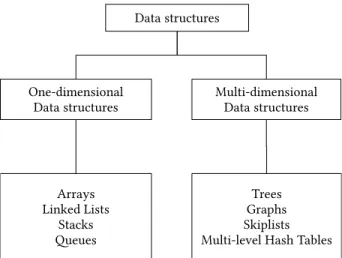
Data structures can be classified according to their organization in memory and how traversal operations can be performed. Figure 4.1 shows a classification of data structures according their orgnization in memory.
Figure 4.1: Classification of data structures
there is only two ways of traversal: forward and backward. On the other side, elements of multi-dimensional data structures are stored in a multi-dimensional organization, which allows traversals in any manner based on the links between elements.
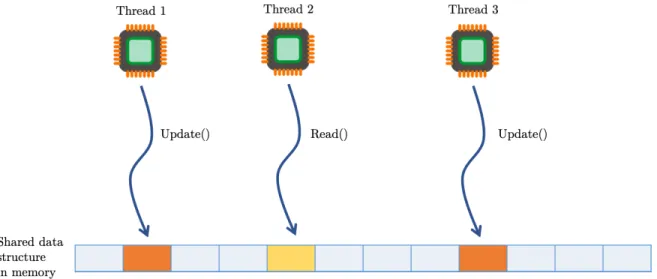
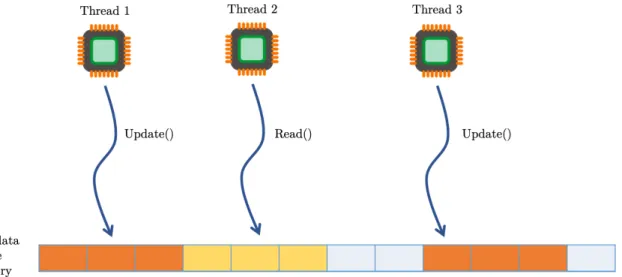
A common way to exploit concurrent data structures is by having several threads accessing a shared data structure concurrently. Figure 4.2 illustrates how multi-thread parallelism works on shared concurrent data structures. Notice that different kinds of operations are performed on different memory addresses in parallel. The goal becomes challenging when having operations from different threads being performed on the same memory address, which can produce data race conditions and unexpected results.
Figure 4.2: Multi-thread parallelism
There exist two ways of implementing data structures: static implementation using arrays and dynamic implementation using pointers. Parallelism on one-dimensional and multi-dimensional data structures can be achieved by using blocking and non-blocking synchro-nization techniques to make them thread-safe (without data race) in multi-threaded pro-grams.
Even when non-blocking implementations can be designed for one-dimensional data struc-tures, their performance suffers from high data contention when a large number of threads
perform operations on similar memory locations. This is due to the fact that there is only one dimension of elements and the parallelism is restricted to the linear organization of elements.
4.1
Synchronization techniques
Parallelism can be exploited on both one-dimensional and multi-dimensional structures. There are five well-known techniques that allow multiple threads to access/update a sin-gle object at the same time [35].
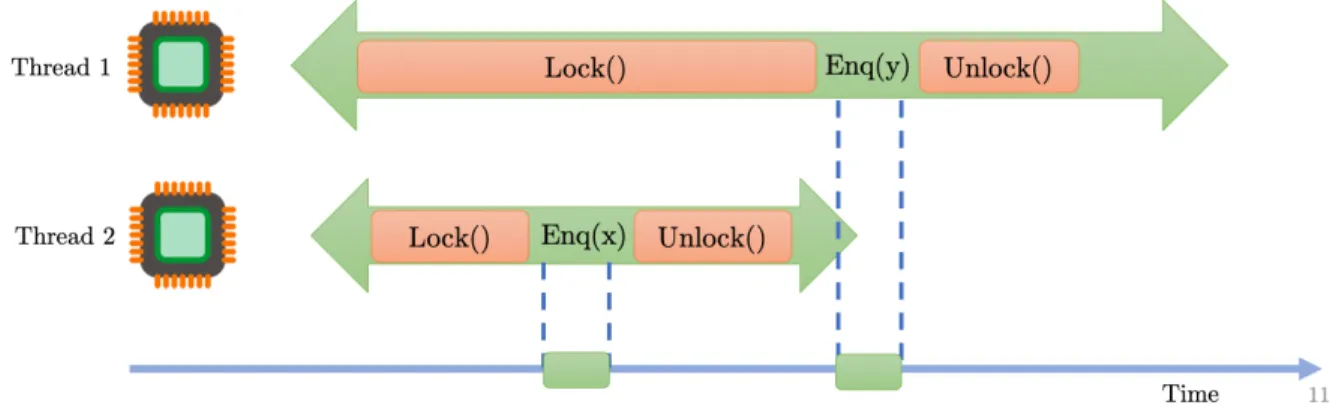
• Coarse-grain synchronization: A spin lock is used to provide mutual exclusion in every access and update procedure. Each method call acquires and releases the lock. Figure 4.3 shows an example of a locked-based execution on a shared data structure over time. There are two threads performing concurrent operations on a shared queue. As both threads can eventually update the same memory address – inserting a new element at the end of the queue – there may be data race condition during their execution. For this reason, both threads require a lock first, and then once it is acquired their insertion can be safely performed. At the end, all the operations performed within critical sections are serialized.
• Fine-grained synchronization: Instead of using single lock to synchronize every access to an object, the object is split into independently synchronized components, ensuring that method calls interfere only when trying to access the same component at the same time.
• Optimistic synchronization: A search without acquiring any locks is performed first. Then, if the method finds the sought-after component, it locks it and checks that the component has not changed in the interval between when it was inspected and when it was locked. This technique is worthwhile only if it succeeds more often than not.
• Lazy synchronization: Consist of postponing the hard work. For example, a re-move operation will first rere-move logically a component by setting a tag bit, and later, the component can be physically removed by unlinking it from the rest of the data structure.
• Non-blocking synchronization: Instead of using locks, built-in atomic operations such as compareAndSwap() are used directly in the update functions. By avoiding locks, non-blocking synchronization does not exhibit problems from lock-based syn-chronization such as deadlocks, blocking and priority inversion. Non-blocking shared data objects also have a higher degree of fault-tolerance than lock-based ones since they can tolerate any number of processes experiencing stop-failures [18].
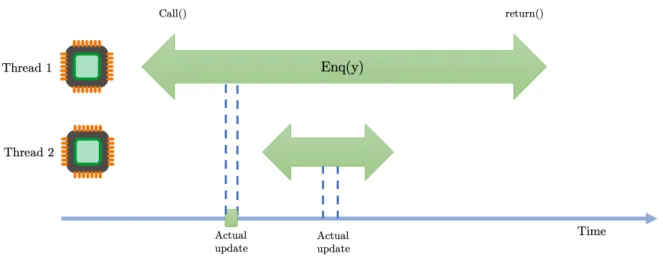
Figure 4.4 depicts a non-blocking execution of the same example from Figure 4.3. In this scenario, two threads perform the insertion of new elements in the queue without the use of locks. The insertions are perform in atomic steps during the method calls
enq(x) and enq(y).
To verify the correctness of non-blocking executions, the linearizability property is used [35]. In a linearizable execution each method call should appear to “take effect” instantaneously at some moment between its invocation and response. So the approach
Figure 4.4: Non-blocking synchronization
to verify linearizable executions of concurrent threads on concurrent data structures is to identify the atomic step where an operation takes effect (linearization points) to show that an implementation is linearizable.
– Lock-free: A lock-free algorithm guarantees that regardless of the contention caused by concurrent operations and the interleaving of their steps, at each point in time there is at least one operation which is able to make progress. How-ever, as there is no fairness guarantee, some operation could be starved and take unbounded time to finish.
– Wait-free: A wait-free algorithm is both lock-free and fair, it guarantees that every operation finishes in a bounded number of its own steps, regardless of the actions of other operations. This is a very strong property, as it decouples the processes using the same shared data object from each other.
4.2
Concurrent Data Structures with SIMD
Process-ing
To correctly implement concurrent data structures on SIMD architectures, support of atomic operations is required. The goal of implementing concurrent or non-blocking data structures is two-fold: to achieve higher thread concurrency by using non-blocking techniques and to achieve data parallelism at instruction level through SIMD processing.
Figure 4.5 shows the execution of concurrent operations from different threads on a shared data structures. Recall that in Figure 4.2 parallelism is achieved by having parallel threads performing operations on single data items of the shared data structures. For this new scenario, parallel threads are now able to perform concurrent operations on several data items at a time (in one instruction). Thus, a new dimension of parallelism is achieved: data-parallel processing.
Figure 4.5: Multi-thread + SIMD parallelism
Similarly to CPU programming, concurrent data structures on SIMD architectures can be classified as blocking and non-blocking data structures. Additionaly, it is shown in this paper that non-blocking data structures such as lock-free and wait-free can be implemented
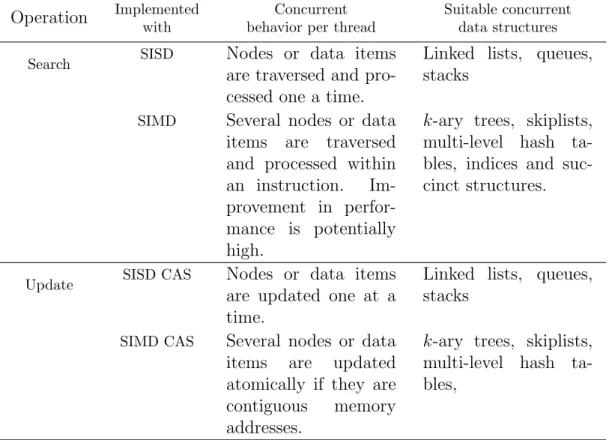
Table 4.1: Classification of concurrent data structures based on their implementation
Operation Implemented with
Concurrent behavior per thread
Suitable concurrent data structures Search SISD Nodes or data items
are traversed and pro-cessed one a time.
Linked lists, queues, stacks
SIMD Several nodes or data items are traversed and processed within an instruction. Im-provement in perfor-mance is potentially high.
k-ary trees, skiplists, multi-level hash ta-bles, indices and suc-cinct structures.
Update SISD CAS Nodes or data items are updated one at a time.
Linked lists, queues, stacks
SIMD CAS Several nodes or data items are updated atomically if they are contiguous memory addresses.
k-ary trees, skiplists, multi-level hash ta-bles,
on SIMD architectures.
To efficiently exploit the SIMD capabilities within concurrent operations the organization of internal data items and nodes is the most important design aspect. Achieving correctness, non-blocking properties, and data parallelism requires a new abstraction when implementing SIMD-friendly concurrent data structures from scratch or transforming existing ones.
Table 4.1 shows a classification of concurrent data structures based on their operation im-plementations using SISD (Single Instruction Single Data – classical CPU instructions) and SIMD. Atomic operations and specifically the compare-and-swap operation (CAS) are fun-damental for implementing update operations in non-blocking data structures. SISD CAS is supported in most multi-core CPU and GPU architectures. Differently, SIMD CAS is not commonly supported on CPU architectures, nonetheless, modern iGPU on heterogeneous CPU/iGPU architectures do support it [40].
A search operation, that traverse data structures, is typically the most common operation in applications such as databases, search engines, file systems, etc. So it is important to implement them efficiently. SIMD traversals are search operations where comparisons are performed on several data items within a single instruction [42]. For example, chunk-based nodes of a k-ary tree can contain several keys that serve as decision to continue the search to their children nodes and whose search is performed using data-parallel comparisons with SIMD instructions. Besides chunk-based trees, multi-dimensional data structures such as skiplists, multi-level hash tables, and index structures are good candidates to be implemented in such way and thus, take advantage of the SIMD processing. On the other hand, one-dimensional data structures such as linked lists, queues, and stacks are not well-suited for SIMD processing due to their nature of operations, i.e. in some cases data items are obtained directly without search, or traversals are sequential.
4.2.1
SIMD-node transformations
In order to implement non-blocking data structures based on SIMD processing, a new ab-straction is defined. This abab-straction will serve as guideline for designing new SIMD-friendly non-blocking data structures or transforming existing SISD non-blocking data structures to SIMD-friendly ones.
Definition 4.1. Let ΘX denote a super node encapsulating single nodes or data items of a
data structure that can be processed by a SIMD instruction of size X (SIMD width). ΘX can
be updated atomically by SIMD CAS operations in concurrent executions and it is restricted to have the X data items contiguously in memory.
Definition 4.2. Let S be a one- or multi-dimensional data structure, then a Θ-node trans-formation SΘ can be attained such that
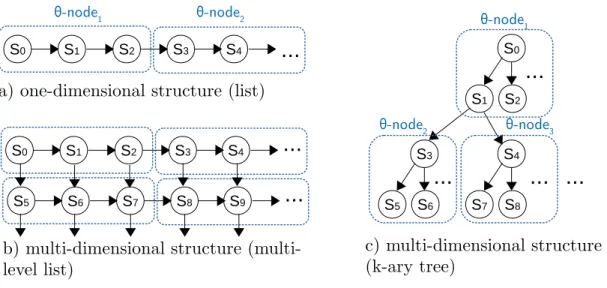
Figure 4.6: Θ-node transformation from a one-dimensional (a) and multi-dimensional (b and c) structures
• Every node in S is in some ΘX of SΘ.
∀r∈S, r∈SΘ∧ |S|= n X
i=0
|ΘiX|
where |S| is the number of single nodes or data items in S.
• SΘ preserves the same S’s traversal structure and thus the complexity of all its
opera-tions.
• SΘ can be traversed using the orginal traversal algorithms of S (single node-based
traversal), and new traversal algorithms using SIMD instructions (ΘX-based
traver-sal).
Figure 4.6 depicts Θ-node transformations from three different data structures. Sub-figure 4.6a shows the layout of a simple linked list (one-dimensional structure) whose nodes have been encapsulated by two ΘX. Sub-figures 4.6b and 4.6c illustrate the Θ-node transforma-tions of two multi-dimensional structures, a multi-level list and a k-ary tree. Notice that these examples illustrate pointer-based data structures, but Θ-node transformations can also
be applied on to other kinds of data structure, e.g. array structures, where several data items can be contained in X.
The manner that Θ-node transformation is applied depends mainly on the organization of the data structure. In hierarchical data structures such as k-ary trees, Θ-node transformations are to be performed inparent-childrenform, i.e. ΘX encapsulates a parent and all its children. Therefore, the maximum size of X, which is defined by hardware, is the most important factor when performing Θ-node transformations; it defines whether the transformation in a hierarchical data structure is possible or not. In one-dimensional structures such as lists, queues, etc., the only restriction is to encapsulate more than one node or data item in ΘX.
Theorem 4.1. AΘ-node transformation, applied on a one- or multi-dimensional data struc-ture S, produces SΘ with the same traversal structure and complexity.
Proof. Assume that the produced SΘ has different traversal structure and complexity than the original S. However, for this to happen, new pointers must have been added/removed between nodes or data items during the Θ-node transformation. Then, by Definition 4.2, a Θ-node transformation on one- or multi-dimensional structures only encapsulates contiguous nodes or data items and no new pointers are added and no existing pointers are modified outside each ΘX.
The concept linearizability, introduced in [36], is used to prove the correctness of a Θ-node transformation from a concurrent data structure. Linearizability is a global property that ensures that when two processes each execute a series of method calls on a shared object there is a sequential ordering of these method calls that do not necessarily preserve the program order (the order in which the programmer wrote them down), but each method call does seem to happen instantly (i.e., invocation and response follow each other directly), whilst maintaining the result of each method call individually and consequently the object its state [35]. This definition of linearizability is equivalent to the following:
• All function calls have a linearization point at some instant between their invocation and their response.
• All functions appear to occur instantly at their linearization point, behaving as specified by the sequential definition.
Conjecture 4.1. A Θ-node data structure SΘ can be linearizable.
Observation. As any ΘX can be updated atomically by Definition 4.1, SΘ can be proved linearizable when all its functions hold the linearization properties in any ΘX of SΘ.
If we consider a data structure traversal as a graph traversal, after applying Θ-node trans-formations we obtain a transformed graph with the same traversal by definition. In this sense, the data structure traversal has not changed. However, the transformations refer to the change of internal processing within nodes. So this change is reflected in the algorithm to traverse the data structure by ΘX nodes instead of single nodes.
4.2.2
SIMD-node Traversals
Traversing a Θ-node-based concurrent data structure involves performing comparison oper-ations on ΘX with single SIMD operations. Algorithm 1 illustrate a simple traversal for a general Θ-node transformed tree where there are only two ways to finish: the key is found or not (we reached the end of the structure).
Notice that all the operations on ΘX are performed using SIMD instructions. So not only assignments and comparisons are SIMD (lines 2, 4, 7 and 10), but also the read operation (line 11) is performed by reading the entire SIMD block from memory. This tree traversal and its operations can be easily generalized to any Θ-node transformed structure.
Algorithm 1 Traversal of a ΘX transformed tree
1: procedure treeTraversal(root, key)
2: ΘX ←root
3: while true do
4: if ΘX ==null then
5: break . Key not found
6: end if
7: if ΘX ==key then
8: break . Key found
9: end if
10: next←ΘX.children within key range
11: ΘX ←read(next) . Visit next Θ-node
12: end while 13: end procedure
4.2.3
Restrictions and Considerations
The main restriction for implementing non-blocking data structures with SIMD processsing is the hardware support. Currently most of the modern CPUs and GPUs support SIMD instructions, however not all of them support atomic SIMD instructions. There have been some proposals for adding multi-word CAS (CASN) support to CPUs [24, 63, 12], but their performance decreases considerably with high values of N.
The proposed framework also considers the availability of a memory allocator that is capable of allocating contiguous memory addresses for each SIMD node. Recall that SIMD-node transformations are based on data item encapsulation within contiguous memory addresses.
In terms of performance, defining a proper width of each SIMD node could impact the performance significantly. SIMD instructions might have many performance implications due to their width and interpretations from the compilers: under-utilization of the SIMD block, incorrect SIMD width defined by user, unmatched cache line size, and so on.
Chapter 5
Contributed Multi-threaded
Synchronization Mechanisms
5.1
Spatial Locks: A Specilized Synchronization
mech-anism for Geometric Algorithms
The parallelization of algorithms that update models in 2D or 3D space has been commonly solved by dividing the model into sub-models, processing each sub-model with different threads in parallel to finally merge the individual results, taking special care of the stitches. Even though these algorithms are known to be embarrassingly parallel and show good per-formance, they bogdown when the update operations must be performed in certain order or with priorities. For example, in the simplification algorithm for triangulated meshes, paral-lelizing the simplification by decomposing the mesh into submeshes and run the algorithm sequentially on each part can lead to bad quality results [20].
appealing. A well-known example is the 3D Delaunay triangulation, which is typically im-plemented using shared containers for vertices and cells. Building a Delaunay triangulation requires threads to perform efficient alternating addition and removal of new and old cells, and addition of new vertices, updating the shared containers. These operations come out as the algorithm runs based on the current properties of the mesh.
We introduce a new synchronization mechanism called Spatial Locks that allows thread synchronization on shared-memory and multi-core architectures [16]. This synchronization becomes very useful when the algorithm to be parallelized performs updates over objects in 2D or 3D space by following a certain order of processing. Even though the example problem in this paper is the synchronization of concurrent updates done by geometric algorithms on shared objects in 2D and 3D spaces, it can also be applied to other kinds of algorithms that might need this type of synchronization.
The basic idea behind the proposed Spatial Locks mechanism is to protect 2D or 3D regions by dividing them into space cells and using lock-protection for each acquired cell.
The novelty in Spatial Locks stems from the merging of two well-known concepts, namely Spatial Hashing and Axis-aligned Bounding Box (AABB). Spatial hashing is the process by which a 3D or 2D domain space is projected into a 1D hash table [25]. The hash function takes any given 2D or 3D positional data and returns a unique grid cell that corresponds to a 1D bucket in the hash table. The hash function for hashing 2D to 1D can be as simple as hash=x∗conversion f actor+y∗conversion f actor∗width, whereconversion f actor is computed by 1/cell size andwidth is the number of uniformly-sized cells per axis. The cell size is defined by the user and will depend on the algorithm domain. It is called spatial hash because the cell index of a data element can be obtained in constant time by its coordinates (e.g., x, y and z) with the hash function. Evidently, a 2D or 3D matrix can be used instead of the hash table and using a simplified hash function will be enough to get the corresponding cell: grid[x∗conversion f actor, y∗conversion f actor]. The programmer has the option to
![Figure 2.1: Architecture components layout for an Intel processor with Gen9 Integrated Graphics Processor [40].](https://thumb-us.123doks.com/thumbv2/123dok_us/10225309.2926380/25.918.246.675.257.551/figure-architecture-components-layout-processor-integrated-graphics-processor.webp)
![Figure 2.2: Intel’s Gen9 Execution Unit (EU) [40].](https://thumb-us.123doks.com/thumbv2/123dok_us/10225309.2926380/26.918.232.692.151.431/figure-intel-s-gen-execution-unit-eu.webp)
![Figure 2.3: Layout of the Intel’s Gen9 iGPU[40].](https://thumb-us.123doks.com/thumbv2/123dok_us/10225309.2926380/27.918.174.710.296.682/figure-layout-of-the-intel-s-gen-igpu.webp)