EFFECT OF FOREIGN TELEVISION PROGRAMMES ON IGBO CULTURE: A STUDY OF ENUGU METROPOLIS
Onwuama Emeka Micheal Ph.D. (Rv. Fr.) Humanities Unit,
School of General Studies University of Nigeria, Nsukka
Emmanuel J. Ibuot Humanities Unit, School of General Studies University of Nigeria, Nsukka
___________________________________________________________________________
Abstract
The study examined the influence of foreign television programmes on Igbo culture with particular reference to Enugu metropolis. The study examined Enugu residents perception of the influence of foreign television programmes on Igbo culture, examined the effect of foreign television programmes on the development of Igbo culture, examined the effect of foreign television programmes on the use of Igbo language among Igbos. The study equally ascertained the effect of foreign television programme on the dressing pattern of the Igbo people. The population consisted of 952,410 residents of Enugu metropolis. The study used the survey approach. The primary sources used were the administration of questionnaire to the respondents. The sample size of 384 was determined using Wimmer and Dominick sample size calculator. 364 copies of the questionnaire were accurately filled and returned. The validity of the instrument was tested using content analysis. The hypotheses were analyzed using f-statistics (Pearson correlation coefficient (r)) tool. The result of the analysis shows that Enugu residents have positive perception about the influence of foreign television programmes on Igbo culture. It was also observed that foreign television programmes have significant effect on the development of Igbo culture. It also shows that foreign television programmes have significant effect on the use of Igbo language among Igbos. It was also discovered that foreign television programmes have significant effect on the dressing pattern of the Igbo people. Based on the findings, the study recommends among others that regulatory bodies, such as the National Broadcasting Commission (NBC) and Nigerian Film Censors Board should ensure that broadcasting standards are not compromised. Government through concerned bodies should utilize the instrument of legislations and checks and balances in ensuring that the undue influence exercised over our cultural values is checkmated and constantly monitored.
Keywords: Television programmes, Igbo culture
Introduction
1.1 Background of the Study
When people with varied characteristic ways of life come into contact with others, cultural
contact has taken place because two different cultures have met. Contacts like this often
result in either party adjusting their ways of life to suit the ways of life of the other party or
one side of the party does that. Cultural transfer can also be called acculturation. It is a
normal thing because most of the great nations of the world learnt one thing or the other from
other nations. Achebe, (2015) states that identities shift depending on how an agent is socially
positioned in a specific context.
Foreign televisions programmes have succeeded in bringing alien behavior that is uncultured
to Africans into Africa and we are rapidly accepting to change ourselves to be imitation
Americans just to suit what we watched on the television. Things that used to be
abominations in Africa are now celebrated in Africa (Afigbo, 2012). In the olden days,
having a child out of wedlock was an abomination that the victim and her parents hide their
faces in shame especially in public but today, it is no more, as long as you do it with a
celebrity or that you are a celebrity; it is called “baby mama.” That time, parents hide their
faces in shame when their daughter’s husband finds out that their daughter is not a virgin.
The notions of chastity and virginity have been rendered absurd. Our values as a people are
rushing down the drain, and we feel that it does not matter as you can commonly hear people
say (Allen, 2016).
The delicacies we are known for are in a long walk to extinction because of the emergence of
foreign designed foods like noodles, spaghetti, marcoroni etc. Our local foods which are
widely known to be rich in nutrient like ukwa, fio-fio, okpa, abacha are seen as food for the
poor and therefore avoided (Aniakor,2018).
Our debased mode of worship is also worthy of attention. Originally, the Igbos believe that
Chukwu is a supreme God. In the Igbo pantheon, chukwu is the source of all other deities and
is responsible for assigning them their different tasks. They believe that all things came from
Chukwu who is an infinitely powerful, indefinable supreme deity encompassing everything in
the space and the space itself (Anyanwu,2018).
Today all the sacred things about our religion have been destroyed. Before now, our land was
so proactive that it arrests you if you remove your footwear and say any lie. There were
places where you do not go if you know that you are not clean, there are other places where
you do not purposely accuse a person wrongly or give false testimony against a person
society and regulate human excesses. In the past, the traditional belief in the existence of
gods, created an aura of fear and trepidation in most societies in Nigeria and elsewhere.
People feared the dire consequences of their actions when those actions conflict with the
norms. A simple act of placing a handful of sand on money by the road side would keep
people away from touching it. Tying a piece of red cloth around an object was enough to
scare deviant people away from the object. All these are part of the checks on society to
ensure that the society conforms to certain standards (Belson, 2018).
The Nigerian society from obvious indications has lost some of the elements which Brown,&
Duke, (2014) calls “The finesse of natural mould” The advent of Christianity and its
proliferation has tended to whittle down the influence and fright associated with awfulness of
the gods.
Our cultural heritage has been watered down by the western civilization. Gone are the days
when life is treasured and values were upheld with great tenacity. The moral excellence that
was an attribute of the Igbos was overnight transformed into moral decay. Elders are no
longer respected; our rich cultural festivals, ceremonies and arts are now considered obsolete
(Chukwu,(2008).
Imperialism has both economic and social implications. Economically, it has hindered our
development. We pride ourselves in buying foreign goods at exorbitant prices while our
locally produced goods suffer in our hands. We call them difference names like Aba made,
awarawa which depicts that they are inferior but funny enough, some of our indigenous
producers export their products and we buy them very expensive in foreign land as a foreign
product (Dike, 2016).
Socially, we respect foreigners more than ourselves; we are more diligent whenever we work
with them. The west have arrested our brains, colonized it and consistently washed it to
accept that they are demigods, the lord and the master (Ejizu, 2017). This mental colonization
is the reason we believe that our local motion pictures are always fake but will believe it is
real when Jack Chan jumps from one moving car to another without any delay; he runs till he
gets to his targeted car but refused to watch our indigenous movies because they are fake.
According to Ezeanya, (2016), Culture is the way of life of a people or the way people do
their things that differentiate them from other people and that is transmitted from one
generation to another. As a people there are things that characterized us and they are those
things that once you do, a person will know that you are an Igbo. They are what Igbomanis
identified with. They are the Igbo culture. Horton, (2015) cited in Isizoh,(2017) sees culture
common or culture is that complex whole which includes knowledge, custom, belief, arts,
moral, law and any other capabilities and habit acquired by man as a member of a society.
One can look at culture as a way of life of the people. It comprises the totality of a people’s
cherished norms, values and attitude towards issues of common interest. James, (2014) avers
that culture encompasses all the characteristics and interests of the people as a holistic
component of their being. Culture which looks like a social creation or social heritage can be
transferred from one generation to another through the use of language. This is the reason
why human society has a culture; we do not have a cultureless society anywhere in the world.
It is culture that shapes the identity of any society. People are known on the basis of culture
(Jean, 2012). Let it be known therefore that culture in spite of being a major symbol of a
given society, could equally be the symbol of people’s identity.
1.2 Statement of the Research Problem
The problem of African response to the challenges of globalization and technological
advancement is a daunting task. It is clear that technological advancement is really affecting
the African mindset; it poses a grave problem to the Igbo mind on how to take the good
things of globalization and still maintain the uniqueness of his cultural identity. Another
problem faced by the Igbo is the effects globalization has on the cultural, religious and moral
values of the Igbo person. The Igbo mind wonders to what extent he can still maintain his
cultural identity today in the face of technological advancement (Kalu, 2012).
The Igbo minds also try to explore what they can contribute to the global community by way
of their cultural values and religion. It wonders what cultural values have the Igbo people lost
in this globalization onslaught. It is in this vein that this research work seeks to evaluate
influence of foreign television programmes on Igbo culture with particular reference to
Enugu metropolis. When one looks at the society generally in Igbo land, he will realize that
the issue of moral decadence is approaching an alarming proportion. The adaptation of alien
behaviours by mostly our youths call to question, the influence of what they watch on
television in their knowledge of who they are (Kraft, 2013).
The youths no longer remember the Igbo proverbial adage that enjoins them to respect elders
and the elderly ones themselves have lost the attributes of virtue associated with the aged.
There is more youth restiveness, corruption, immorality amongst youths and lack of respect
for our values and morals. All these are alleged to be as a result of foreign culture imposed on
us indirectly by foreign television programmes both by our local television stations such as
NTA Enugu, ESBS TV, foreign movies and programs from foreign television station
is in this vein that this research seeks to evaluate the influenceof foreign television
programmes on Igbo culture. This work is therefore meant to empirically unveil the influence
of foreign television programmes on Igbo culture (Manus, 2013).
1.3 Objectives of the Study
The broad objective of this research work is to examine the influence of foreign television
programmes on Igbo culture with particular reference to Enugu metropolis. The specific
objectives of the study include the following:
1. To ascertain Enugu residents perception of the influence of foreign television
programmes on Igbo culture.
2. To examine the effect of foreign television programmes on the development of Igbo
culture.
3. To examine the effect of foreign television programmes on the use of Igbo language
among Igbos.
Research Questions
Based on the objectives above, the researcher asked the following questions to guide the
study;
1. What are the perceptions of Enugu residents on the influence of foreign television
programmes on Igbo culture?
2. What are the effects of foreign television programmes on the development of Igbo
culture?
3. What are the effects of foreign television programmes on the use of Igbo language
among Igbos?
Hypotheses
In line with the objectives and the research questions, the researcher formulated the following
hypotheses to guide the work.
1. Ho: Enugu residents have negative perception about the influence of foreign television
programmes on Igbo culture.
2. Ho: Foreign television does not have significant effect on the development of Igbo
culture.
3. Ho: Foreign television programmes has adverse effect on the use of Igbo language
Review Of Related Literature 2.0 Conceptual Framework
2.1.1 Culture
The word culture stems etymologically from the Latin word "cultura" which literally means
to "cultivate" (Myerhoff, 2016). Humans are social animals who grow and develop a sense of
life style in the traditional behavioural patterns of their varying societies. This is cultivated
over time in the existence of a being and is initially and continuously passed on to the
individual following the fact of socialization and its agents which include: family, school,
church, work place, peer groups, and the media.
It is in the light of this that the Cultural Policy of Nigeria as stated in Nwabueze, (2013)
defines culture to be “the totality of the way of life evolved by the people in an attempt to
meet the challenge of living in their environment, giving order and meaning to their political,
social, economic, aesthetic and religious norms and modes of organization, thus
distinguishing a people from their neighbours.”
From the foregoing, culture and its features symbolize a mode of identity and create the
consciousness of a feeling of dichotomy. It is also an instrument to which social order can be
ensured and maintained. The consciousness of this feeling and its attendant consequences
generate varying views and perceptions of the world which further culminate into forming a
value system for our existence as humans (Nwoye, 2015). It is to this end that the attributes
of culture will be examined to lend more credence to the overview of this concept.
2.1.2 Igbo culture
Igbo culture (Igbo: Omenala-Ndịgbo) are the customs, practices and traditions of the Igbo
people of southeastern Nigeria. It comprises archaic practices as well as new concepts added
into the Igbo culture either by cultural evolution or by outside influence. These customs and
traditions include the Igbo people's visual art, music and dance forms, as well as their attire,
cuisine and language dialects. Because of their various subgroups, the variety of their culture
is heightened further (Achebe, 2015).
The Igbo people have a melodic and symphonic musical style, which they designed from
forged iron. Other instruments include Opi, (a wind instrument similar to the flute),Igba, and
Ichaka. Another popular musical form among Igbo people is highlife, which is a fusion of
jazz and traditional music and widely popular in West Africa (Afigbo, 2012). The modern
Igbo highlife is seen in the works of Prince NicoMbarga, Dr Sir Warrior, Oliver De Coque,
musicians of the twentieth century. There are also other notable Igbo highlife artists, like
Mike Ejeagha, Paulson Kalu, Ali Chukwuma, OzoemenaNwaNsugbe etc.
Igbo Art is known for various types of masquerade, masks and outfits symbolizing people or
abstract conceptions. Igbo art is also known for its bronze castings found in the town of Igbo
Ukwu from the 9th century. Igbo art is any kind of visual art originating from the people of
the Igbo. Igbo culture is a visual art and culture (Afigbo, 2012).
2.1.3 Effect of civilization on Igbo Culture
The so-called civilization brought by the Europeans was just another concept of domination,
imposition of a foreign culture over African traditional cultural values. It is important to
emphasize fundamentally that urgent and more decisive steps need to be taken to reverse the
fading trend of cultural emptiness, without which Africa may experience seasons of cultural
extinction and drought of African values (Allen, 2016). Colonization of the continent was
destructive in terms of cultural heritage and values for which Africa was famous.
Colonialism was precariously retrogressive as the continent was robbed of decades of
opportunities- opportunities of self-development, opportunities of self- government, and
indeed, opportunities of self-styled technological development. The television is thus a
powerful socializing agent because of its attributes to impose and stamp images permanently
on the minds of its viewers, especially the youths. (Aniakor,2018).
The cultural values of any society is the commonly held standards of what is acceptable or
unacceptable, important or unimportant, right or wrong, workable or unworkable in a
community or society. The culture of every nation is an important aspect of that nation and
should be preserved (Anyanwu,2018).Culture is the lifestyle of the people in a society and
denotes their values, beliefs, artifacts and behaviour. It is the totality of the way of life of a
people which is passed down from one generation to another. A culture exists when a distinct
way of life shapes what a group of people believe, value and do (Arazu, 2015). The African
cultural values are distinct and vary from one region to the other and Nigeria being the largest
African country, with over 200 tribes has the largest concentration of African cultures and
civilizations. In fact, every Nigerian tribe has distinct cultural values which are evident in
their language, music, songs, dance, marriage rites, greetings, mode of dressing and many
more. However, according to Belson, (2018), the Nigerian culture is a complex subject that
involves more than music and dancing or arts in general. It encompasses the material and
nonmaterial aspects of culture. The material includes the food, clothing building architecture,
fine arts and any other physical items, while the non-material includes African philosophy,
many other creative aspects. An American Sociologist, Charles Ellenwood describes Culture
as the collective name for all behavioural patterns socially acquired and socially transmitted
by means of symbols; hence a name for distinctive achievements of human groups, including
not only such items as language, tool making, industry, art, science, law, government, morals
and religion, but also the material instruments or artifacts in which cultural achievements are
embodied and by which intellectual cultural features are given practical effect, such as
buildings, tools, machines, communication devices, art objects. In addition, Brown,& Duke,
(2014) submits that: We must pay adequate attention to promoting our rich and diverse
cultural experiences for the sake of our future. And this is a task that requires more than a
negligible number of "patriotic" minds and hands in certain brackets of the media and
entertainment segment of the society. Furthermore, Chukwu,(2008) describes culture as not
only about dancing and music or costumes alone. It is beyond the pattern of social
celebrations such as rituals pertaining to birth and marriage, cuisine or sport. Culture is about
people's total way of life; the way we live, eat, worship, produce, create and recreate. It is the
totality of a set of bequeathed ideas, belief systems, values and norms, which constitute the
common bases of generally agreed social interaction (Dike, 2016). African culture is
dynamic. Culture plays a role for societal transformation and development because the
stability of a society is ensured through the transmission of cultural values: (a) Community
life (b) Good human relations (c) Sacredness of life (d) Hospitality (e)Mode of dressing (f)
Morals (g) Respect for authority and elders; (h) Religious beliefs (i) Eating habit and food
culture (j) Music (k) Marriage rites.
2.1.4 Igbo Social-Cultural and Moral Values
A major social practice among the Igbo is the ritual naming of the newborn. For an Igbo
child, the ceremony of being named is the beginning point of being socialized into the
membership of the community. Some of the names given to the child during such a ritual,
such as Onwubiko (death, I implore you) bear testimony to the suffering and desperation
experienced by the parents preceding the child's birth. Such names often help to make the
child to resolve to acquire good decorum to avoid adding to the pain of existence already
suffered by the parents before he or she was born (Ejizu, 2017). Furthermore, influenced by
Igbo worldview, Igbo birth rites initiate sex- role orientation at an early age. The child is
expected to model after the reincarnated ancestor or deity represented by the godfather or
godmother (the Onye- Uwa). People point to gestures, character traits, looks, and other signs
to confirm that the child really is a reincarnation of a loved one or a deity. Thus, a middle-
grandfather. From birth, rites of passage are designed to celebrate and initiate the child into
the family and community (Ezeanya, 2016).
Igbo socialization processes, in general, nurture an orientation to solid personal achievement.
Within them, however, wrestling, secret society outings, masquerade and dances, and
hunting, all reinforce male orientation among the Igbo. Females suffer more restrictions in
outings, more subdued play, and opportunities to participate in dancing (Horton,2015).
In terms of girls' upbringing, the biggest anxiety that faces an Igbo mother is pre-marital
pregnancy of the daughter. In many Igbo communities, crude herbal abortion practices exist
but no ethics of confidentiality. In most villages, at least, in the past, if a girl became
pregnant, a palm tree on the bank of a stream dedicated to women would ripen. At night,
young boys and girls, in groups, would carry garbage and sing obscene, satirical songs, to the
accompaniment of staccato rhythm, to the pregnant girl's homestead and dump the garbage
there. Such a dance of shame is understood as a social stigma among the Igbo (Isizoh,2017).
Yet, when the child is born, ululation rents the air. In that way, the same people who danced
in scorn for the premarital pregnancy celebrate the child. This means that among the Igbo,
there is no concept of the bastard as there is always a known father. In the event of birth of a
child out of wedlock, the male's family hastily pays a visit to the girl's family to claim the
child, or else the girl's father names the child. Children occupy a pride of place among the
Igbo. Consequently, abortion is frowned upon as an offense against the Earth Goddess
(James,2014).
The shame of premarital pregnancy encourages the need for disciplined upbringing of
teenage children. Sex- role standards are enforced as a solution. These include, first, sending
the young girl after first menstruation to be prepared for marriage. Second, when people have
left for the farms, such girls, stay in groups to baby-sit, do house chores, and play. They tend
to sleep together in the house of a respected old woman. An indiscreet young male going near
would look like a skunk prowling around the chicken coop. Furthermore, courtship is through
intermediaries, message bearers, and family representatives. Marriages are arranged and
regarded as family, rather than private affairs. The key emphasis of marital ethos is on female
subservience. Childbearing preoccupies Igbo females. Early marriages are common,
particularly in the past, but more rarely presently, due to the influence of Western education
and Christianity (Jean, 2012).
Care for the aged is not institutionalized. Children are taken as the greatest insurance for old
parents. In this process, the first sons and all daughters have a priority to take in and look
after aged and ailing parents regardless of their family size (Kalu, 2012).
In traditional Igbo religious worship, people pray that they may die in the soil of their birth,
where their umbilical cords were buried. For this reason, Igbo civil servants who have
attained the age of 70 and above prefer to go back to the village and await the journey into
the ancestral world. In this way, Igbo cultural norms bind the society, and the village norm
still dominates the attitudes of the people including the elites and the Christians among them.
Those located in the sophisticated environments still cling to traditional customs and go
home to their villages regularly for important functions, such as for naming, marriage, or
burial ceremonies.
In Igbo worldview nobody of worth is to be buried like a dog without fanfare except for
children without a name or those who committed abomination against the society before their
death. In line with this ethos, the dead are usually accompanied by music and dance, and
other rituals and transported to the ancestors with canon shots and alarums to the netherworld
(Kraft, 2013). The understanding among the Igbo is that the noise of merrymaking alerts the
predecessors, of the coming of the dead person to meet and join them. It is believed that
where this ceremony is omitted the dead man or woman goes half-way and would have to
come back in visions as ghosts to disturb the living until such a time as they complete the
send-off ceremony, namely, burial rites. Among the Igbo, aged parents often give the living
instructions of how their burial should go while they are still alive. Confirming this Kraft,
(2013) observes that:
"When the missionaries preached hell-fire at the beginning of their enterprise as the lot of
those who never received baptism, many Igbo traditional religionists preferred to go down to
hell with their ancestors than to be separated from them on account of baptism."
Related to the mentioned image is the vital role, which the ancestors are believed to play as
the most benevolent allies of human beings in the spirit-world. Family and lineage elders
among the Igbo are therefore particularly concerned with maintaining the most cordial
association with ancestral spirits through routine prayers and ritual offerings (Manus, 2013).
In this context, the understanding is that a human's moral life is paramount in keeping the
cosmic equilibrium. All norms of conduct, including taboos, even those that might be
mechanical, are expected to be strictly complied with. In case of doubt about any
infringement, the services of diviners are employed so that things could promptly be set
and relatives tend to raise for the traditional aged Igbo a feeling of enthusiasm and optimism,
rather than fear and trembling (Myerhoff, 2016).
The moral heroes of the Igbo world are picked from the animal world. These include the
tortoise that is admired for its capacity to deploy its creative ingenuity in the direction of
finding solutions to the problems of living. The tortoise is also believed to know when to
open and close its armour in keeping with the sensations of safety or danger. It is believed to
exude an odour that repels potential attackers. The tortoise is also admired among the Igbo
because it is believed to move at its own pace without having to be dictated to from without.
For the Igbo these qualities reflect an imaginative deployment of intelligence for personal
safety and well-being. They are the qualities the Igbo would like to be identified with as
full-fledged humans. Similarly, the Igbo believe that although the world is often hostile and
difficult to live in, yet like the ram each should endeavor to learn the virtue of endurance in
facing the obstacle of the human experience.
According to Nwabueze, (2013), four classes of people are recognized in Igbo worldview.
These include the Ekwueme. These are those calibers of humans who accompany action with
their words. They are reliable, trustworthy, and have won the respect of the community. A
sub-group of the Ekwueme category of human beings belongs to those that can be referred to
as the Ome- Mgbe-Oji. This refers to the careful and the humble that nevertheless act when
they can make it. They are those who know their limit and act within their possibilities. The
other group is the Oji Onu Group. This refers to the group of rhetoricians and boasters,
people who know how to manipulate and manufacture words to confuse their audiences.
Their weakness is their inability to match words with action. They are therefore referred to
derisively as the Oji OnuEgbu Oji or 'those who fell the Iroko tree or build houses by the
mouth alone'. They live extravagant lives and the life of pretensions. The fourth is the
Akarogoli. These are the lazy and the immature adults. They say 'Yes' and 'No' to life at the
same time and lose their bearing in the end, often ending up dying unsuccessful; and, at
times, through dangerous living, die bad deaths (Nwoye, 2015).
Among the Igbo, sexual infidelity does not automatically lead to divorce because it is
perceived as a religious offence against the Earth Goddess. Ritual cleansing and propitiations
are undertaken. Where such anomaly becomes rampant, divorce is often the result.
Allegations of witchcraft, sorcery and poisoning quicken the decision to divorce because life
is at stake and life is looked at as a supreme value among the Igbo. In the event of divorce,
the woman takes custody of the young children until they are of age to be returned to their
Children belong to the man in Igbo society, when divorce occurs. Young adults stay with
their fathers, while the bride price is returned to the man. In this way, the financial burden
persuades the woman's family to discourage their daughter/sister from doing anything that
would incur divorce. In general, among the Igbo, a woman with a large number of children is
unlikely to follow the option of divorce when things go bad in the marriage.
Childrearing among the Igbo is the primary concern of the woman and her mother. By
puberty, sex typing with tasks, boundaries of behaviour, and sex-role preferences emerge.
The image of females as a nurturing agent is entrenched in the minds of the people (Afigbo,
2012). As mothers start to farm again after weaning the baby, supervision falls either to girls
who are undergoing puberty rites before marriage or to older siblings of either sex and in any
age of childhood.
Sibling relationships are highly focused on the mother as a point of reference because of
polygamy. Children from one mother relate to each other with a stronger bond of affection
than they do with their half-siblings. In the struggle for limited economic opportunity and
education within such settings, sibling rivalry among children of the same mother is reduced
but is allowed to operate or even escalate among children of the same father but different
mothers in childhood and through adulthood. In this context, children of the same mother are
encouraged to present a united front (Allen, 2016).
An important cultural practice among the Igbo is the custom of projecting their own notions
of authority through human-made structures. This practice, for example, gives a deeper
dimension to Igbo architecture as a symbol of authority. In this regard, among the Igbo, the
Obi (Obu) house which is defined social, economic and political principles of Igbo life seen
as a social ideology of Igbo leadership. It is expressed at several levels of Igbo life. Within
the frame of the family compound, the Obi (Obu) house as the seat of family life as
(Aniakor,2018) sees it, is the center of family life and authority through certain principles of
architectural design.
2.2 Theoretical Framework Cultural Imperialism Theory
Since Herbert Schiller's book Communication and Cultural Domination first coined the
phrase in 2006, the concept of cultural imperialism has often been used to refer to the idea of
America exerting cultural influence over the rest of the world, with a particularly powerful
imposition on Third World countries (Anyanwu,2018). Examples of American cultural
imperialism include brand name products, mass-produced food and, perhaps of primary
rights or racial equality in a positive light, for example it also tends to paint America as a
leader or hero, potentially exerting a negative effect on the viewer's perception of his own
country or other non-American cultures (Arazu, 2015).
Western civilization produces majority of the media (film, news, comics, etc.) because they
have the money and technology to do so. The rest of the world purchases those productions
because it is cheaper for them to do so rather than develop and produce their own. Third
world countries are therefore watching the media filled with Western world's ways of living,
beliefs and thinking. The third world cultures then start to want to do the same things western
in their own poor countries. Cultural imperialism is a key feature of Marx's critique of media
theory, which he viewed as dominated by the ruling classes. Via this domination, he argued,
the ruling classes would best be suited to perpetuate their stranglehold on power. The ideas of
the ruling classes are that in every age, the dominant material force in society is at the same
time its dominant intellectual force (Belson, 2018). The class which has the means of
material production at its disposal has control at the same time over the means of mental
production... in so far as they rule as a class and determine the extent and compass of each
epoch, they do this in its whole range, hence, among other things, they regulate the
production and distribution of the ideas of their age; thus their ideas are the ruling ideas of
the epoch. Cultural imperialism is an intangible form of colonization that was practiced by
the Western empires that took over the world and exploited insidious and organic link
between conquerors and the conquered (Brown,& Duke,2014).
This theory focuses on the extent the West is exerting cultural influence over the rest of the
world, with a particularly powerful imposition on Third World countries.
Igbos watching the media filled with Western world's ways of living, beliefs and thinking has
lured them into imitating the western culture even in the remote areas at the expense of our
rich cultural heritage (Chukwu,2008).
Therefore, the West have exerted their cultural influence on the Igbos such that our own
culture is seen not as inferior but fetish to stand our generation that is more reason why we
have abandoned our own culture and adopted the western culture that are not in conformity
with our lifestyle.
2.3 Empirical Review
Oberiri&Kwase (2017) studied Western Television Programmes and Its Influence on the
Cultural Values of Students' in Taraba State University, Jalingo, Nigeria. The findings were
backed-up with an empirical research on 145 respondents from the study area.
used alongside availability/convenient sampling technique. The study also made used of the
questionnaire as a means of quantitative data collection. The SPSS (Statistical Packages for
Social Sciences) was employed for data analysis and subsequently justified using manual
procedures. The study discovered that Nigerian Youth prefers viewing WTP more to
indigenous TV programmes and this exerts great influence on their cultural values (Ejizu,
2017).
Nwogu, (2007) studied cultural promotion and image portrayal in the Nigerian movies. The
study adopted various tools in the collection of data; library research on work previously
done on areas related to the study. It used for its information materials both in audio - visual
and live interviews. The study reveals that the motion picture is one of the fastest and one of
the most viable ways of exporting culture for economic gains. It also observes that the
Nigerian movies have not succeeded in promoting the culture and image of Nigeria as a result
of local hegemony on the side of the practitioners. Most importantly, the study reveals that
the movie practitioners are more concerned with enriching their pockets, relegating to the
background the cultural implication of such representation (Ezeanya, 2016).
Atta, (2017) studied effects of pay television on Nigerian indigenous culture: a study of
Nsukka Local Government Area. The study shows that the mentality and lifestyle of the
teenagers and youth in Nigeria precisely Nsukka communities have been grossly affected by
exposure to Western cultures to an extent that rather than promoting their indigenous culture,
they have become hardened acolytes and promoter of Western.
Nwoye, (2011) carried out a research on Igbo cultural and religious worldview: An insider's
perspective, the paper made use of the technique of documentary analysis and in-depth
library research methodology, the study observed that The activities of Christian missionaries
greatly changed the religious landscape in Igboland, Nigeria, West Africa just surveyed.
However, many of the basic features of the indigenous beliefs and practices of the Igbo have
survived to this day. Among these are a number of important transitional ceremonies with
strong religious import.
In the study of Oberiri&Kwase (2017) on Western Television Programmes and Its Influence
on the Cultural Values of Students' in Taraba he o The study explores the situations
surrounding the relationship between Western Television Programmes and the cultural values
of the Nigerian youth population, with particular reference to Taraba State University where
constructive generalizations were made. Findings were backed-up with an empirical research
on 145 respondents from the study area. Cross-sectional Survey design was adopted for this
sampling technique. The study also made used of the questionnaire as a means of quantitative
data collection (Horton,2015).
The SPSS (Statistical Packages for Social Sciences) was employed for data analysis and
subsequently justified using manual procedures. Finally, the study discovered that Nigerian
Youth prefers viewing Western Television Programmes more to indigenous TV programmes
and this exerts great influence on their cultural values.
In the study of Olayinka (2012) on The Ligaments of Culture and Development in Nigeria,
the study found out that Cultural factors affect economic behavior and this is usually, in at
least four ways; through its impact on organization and production, attitudes towards
consumption and work, the ability to create and manage institutions, and the creation of
social networks. Hence, the social and economic performance of nations can only be best
appreciated and explained against the background of the prevailing cultural domains. This
also has bearing with the prevailing differences in subsisting institutions. Cultural trajectories
affect policy formulations and implementations and how they drive growth and development
(Isizoh, 2017).
Erhun, (2015) carried out a study on the Relevance of Culture to the Socio Economic Growth
and Development of Nigeria: A Legal Perspective The paper made use of primary and
secondary sources of information from the library. In this paper, issues bordering on culture
and development, impact of colonialism on the socio-economic development shall be looked
into. This is with the aim to mainstreaming culture into the Nigeria’s development agenda.
The study shows that culture and development have strong potentials for modulating and
accelerating socio-economic development.
Erhun, (2015) added that Nigeria has an enviable culture, full of aspiration and vitality.
Despite this, the Nigerian culture and traditional life-style is discarded in favour foreign ones.
Nigeria’s dispositions, organizations, orientations and values are tailored to suit those of Western societies without any form of adaptation to suit our peculiar situation. Nigeria’s rich
cultural heritage is substituted for an alien socio-economic structure. The general crisis in the
Nigerian economy is a logical outcome of the continued subjugation and control of the
Nigerian economy by external powers. The trivialization or outright bastardization of
Nigeria’s rich cultural heritage has done great damage to Nigeria. The Nigeria’s cultural
diversity remains a treasure largely unexplored in her quest for socio-economic development.
Culture is relevant to Nigeria’s socio-economic growth and development. For Nigeria to truly
and actually attain the status of a developed nation there is a need to identify the critical
no socio-economic development without a strong indigenous foundation (James,2014). If
Nigeria is to be reckoned with we should discontinue from being an appendage to foreign
ideas and practices. In order to overcome the next phase of colonialism and
neo-imperialism which are being euphemistically dubbed “globalization”, there is a need for a
dynamic cultural orientation.
Agwaraonye, (2015) examined influence of globalization on Igbo culture of South Eastern
Nigeria Due to increased speed of transport and communication system, it is now easy to
export not only economic goods but also political and cultural ideologies from one cultural
area to another. African cultures and worldviews have continued to be affected by the forces
of globalization (especially Western education, religion, urbanization and industrialization)
starting from the time of slave trade through the colonial era to this day. In the face of this
knowledge, the problem of African response to the challenges of globalisation becomes a
daunting task. Using Igbo culture and religion as a case in point, the researcher sees a
dilemma in the African mind on how to blend the pristine African (Igbo) culture with the
trends of globalisation. It is clear that globalisation is really affecting the African mindset; it
poses a grave problem to the Igbo mind on how to take the good things of globalisation and
still maintain the uniqueness of his cultural identity (Jean, 2012).
Another problem faced by the Igbo is the effects globalization has on the cultural, religious
and moral values of the Igbo person. Globalisation has led to cultural degeneration in
Igboland. This can be seen in the area of Igbo language, bastardization and outright rejection
of such cultural practices as masquerades, family sharing of folktales and its attendant moral
lessons. This is evident in the declining use of Igbo language and weakening of traditional
religion among the Igbo. The Igbo can only overcome the negative effects of globalization by
first of all appreciating what they have in terms of their culture and religious values.
In the study of Babaleye& Samuel Oloruntobi (2016) on Western Television Programmes
and the African Cultural Identity of Nigerian Youths. A quantitative survey research
questionnaire was administered on 274 respondents drawn from AfeBabalola University and
Ekiti State University to determine the impact of Western television programmes on the
cultural values of Nigerian youths. Cultural Imperialism and Social Learning theories were
applied to test a null hypothesis that Western television Programmes have no significant
relationship on the cultural values of Nigerian Youths. Their Findings revealed that majority
of youths watch Western television programmes for fashion and entertainment. Respondents
agreed that Western television programmes glamourize risky behaviours: alcoholism, drug
Methodology
The essence of this study was to determine the influence of foreign television programmes on
Igbo culture. Therefore, the explanatory mixed method design was adopted. According to
Creswell (2012), the explanatory mixed method design “consist of first collecting quantitative
data and then collecting qualitative data to help explain or elaborate on the quantitative
results. The rationale for this approach is that the quantitative data and result provide a
general picture of the research problem; more analysis, specifically through qualitative data
collection is needed to refine, extend or explain the general picture”. In gathering quantitative
data, which is the first approach in explanatory mixed method, the opinions of residents,
through survey method (questionnaire), was analyzed. The interview schedule had related
questions to the questionnaire but with follow-ups for clarity and relevant details. Our target
population was the entire people that reside in Enugu metropolis, that is, the inhabitants of
the three LGAs, that make up Enugu metropolis, They include - Enugu North, Enugu East
and Enugu South LGAs. The population under study is 952,410. (Nine hundred and fifty two
thousand, four hundred and ten) this is the population of the local government areas as at
2015.
The sample size was determined by the use of Wimmer and Dominick sample size calculator
4.1 Data presentation Biographic Data
In this section, the biographic information of the respondents used in the study were
presented and analyzed. The essence was to establish a relationship between the biographic
and psychographic data with the aim of analyzing their interdependence opinions or
otherwise.
QUESTIONNAIRES DISTRIBUTED TO RESPONDENTS AND NO RETURNED Option Number
Distributed
Number Returned Number not Returned
Questionnaire 384 364 20
Percentage 100 95 5
The table above shows that, the researcher distributed 384 questionnaires to the sampled 384
sampled residence of Enugu Metropolis, but those that responded and returned the
questionnaire were 364, as such the researcher based his analysis on the 364 questionnaires
duly filled and returned.
4.2 Data Analysis
In this section, questions related to the research questions raised in the study were answered
quantitative data. The main data stream in this study is the quantitative data. The data were
[image:18.595.70.494.422.552.2]presented under their respective research questions.
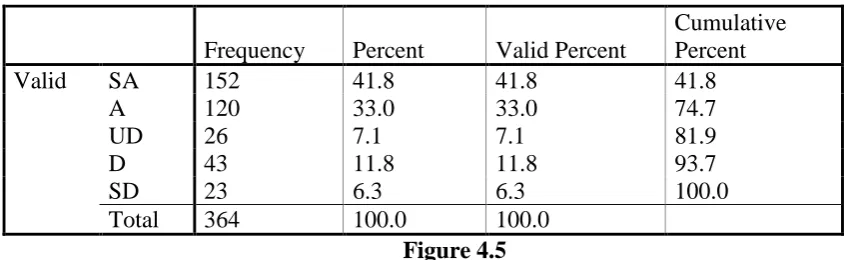
Table 4.5: Enugu resident's view on the effect of foreign television programmes on Igbo culture
Frequency Percent Valid Percent
Cumulative Percent
Valid SA 152 41.8 41.8 41.8
A 120 33.0 33.0 74.7
UD 26 7.1 7.1 81.9
D 43 11.8 11.8 93.7
SD 23 6.3 6.3 100.0
Total 364 100.0 100.0
Table 4.5 and Figure 4.5 show that 152 or 41.8% of the respondents strongly agree that
foreign television programmes has significant effect on Igbo culture, 120 or 33.0% Agreed,
while 26 or 7.1.3% were undecided, 43 or 11.8% disagreed while 23 or 6.3% respondents
strongly agree. It shows that the number of respondent that strongly agreed and strongly
agreed has the highest number i.e. 155 and 120 respectively indicating that foreign television
[image:19.595.66.485.150.454.2]programmes has significant effect on Igbo culture.
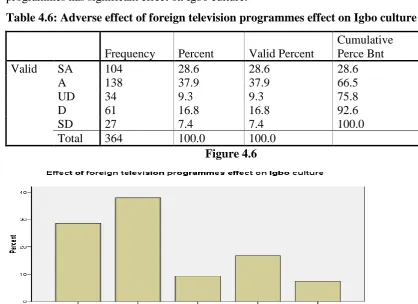
Table 4.6: Adverse effect of foreign television programmes effect on Igbo culture
Frequency Percent Valid Percent
Cumulative Perce Bnt
Valid SA 104 28.6 28.6 28.6
A 138 37.9 37.9 66.5
UD 34 9.3 9.3 75.8
D 61 16.8 16.8 92.6
SD 27 7.4 7.4 100.0
Total 364 100.0 100.0
Figure 4.6
The result in table 4.6 and figure 4.6 shows that 104 or 28.6% respondents strongly agree that
foreign television programmes has adverse effect on Igbo culture, 138 or 37.9 agreed, 34 or
9.3 respondents were undecided while 61 or 16.8% respondents disagreed and 27 or 7.4
respondents strongly disagreed. This indicated that those that strongly agreed and agreed
have the highest response rate showing that foreign television programmes has adverse effect
[image:19.595.77.433.326.460.2]on Igbo culture.
Table: 4.7: Effect foreign television programmes on the wellbeing of Igbo people
Frequency Percent Valid Percent
Cumulative Percent
Valid SA 99 27.2 27.2 27.2
A 131 36.0 36.0 63.2
UD 34 9.3 9.3 72.5
D 51 14.0 14.0 86.5
SD 49 13.5 13.5 100.0
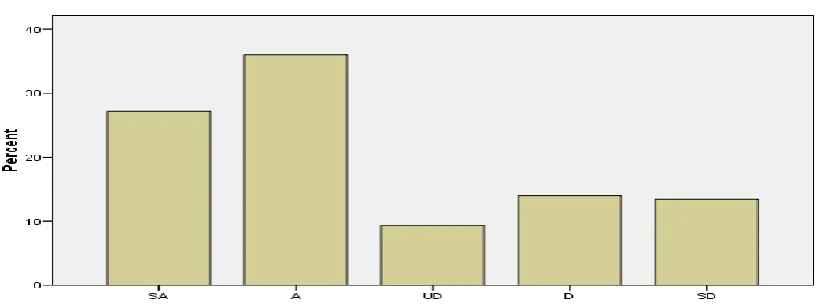
Figure 4.7
Table 4.7 and figure 4.7 shows that 99 or 27.2 respondents strongly agreed that foreign
television programmes affect the wellbeing of Igbo people, 131 or 36.0 respondents agreed,
34 or 9.3 respondents were undecided while 51 or 14.0 respondent disagreed and 49 or 13.5
respondents strongly disagreed. Those that agreed and strongly agreed have the highest
responds rate implying that foreign television programmes affect the wellbeing of Igbo
people.
4.3: Test of Hypotheses
In this section, the hypotheses raised were tested using Pearson correlations. The essence of
the test was to establish relationship between two variables.
Hypothesis One
Ho: Enugu residents have negative perception about the influence of foreign television
programmes on Igbo culture.
Chi-Square Tests
Value Df
Asymp. Sig. (2-sided)
Pearson Chi-Square 48.000(a) 42 .243
Likelihood Ratio 30.498 42 .906
Linear-by-Linear
Association .896 1 .344
N of Valid Cases 8
a 56 cells (100.0%) have expected count less than 5. The minimum expected count is .13. The "Pearson Chi-Square" row. The χ(1) = 48.000, p = .243.
Decision Rule: If F-calculated > F-tabulated, accept H1 and reject H0 and if F-cal< F-tab,
accept H0 and reject H1.
From Table, the F-calculated gives a value greater than the F- tabulated. Hence, H1 is
accepted and H0 rejected. It is therefore affirmed that Enugu residents have negative
[image:20.595.74.429.470.593.2]Hypothesis Two
Ho: Foreign television does not have significant effect on the development of Igbo culture Chi-Square Tests
Value Df
Asymp. Sig. (2-sided)
Pearson Chi-Square 56.000(a) 49 .229
Likelihood Ratio 33.271 49 .958
Linear-by-Linear
Association 4.730 1 .030
N of Valid Cases
8
a 64 cells (100.0%) have expected count less than 5. The minimum expected count is .13.
The "Pearson Chi-Square" row. The χ(1) = 56.000, p = .229.
Decision Rule: If F-calculated > F-tabulated, accept H1 and reject H0 and if F-cal< F-tab,
accept H0 and reject H1.
From Table, the F-calculated gives a value greater than the F- tabulated. Hence, H1 is
accepted and H0 rejected. The study therefore concludes that foreign television does not have
significant effect on the development of Igbo culture.
Hypothesis Three
Ho: Foreign television programmes has adverse effect on the use of Igbo language among Igbos.
Chi-Square Tests
Value Df
Asymp. Sig. (2-sided)
Pearson Chi-Square 36.178(a) 31 .387
Likelihood Ratio 30.498 31 .806
Linear-by-Linear
Association 4.102 1 .043
N of Valid Cases 8
a 56 cells (100.0%) have expected count less than 5. The minimum expected count is .13. The "Pearson Chi-Square" row. The χ(1) = 36.178, p = .387.
Decision Rule: If F-calculated > F-tabulated, accept H1 and reject H0 and if F-cal< F-tab,
accept H0 and reject H1.
From Table, the F-calculated gives a value greater than the F- tabulated. Hence, H1 is
accepted and H0 rejected. The study therefore concludes that foreign television programmes
has significant effect on the use of Igbo language among Igbos.
5.1. Summary of Findings
Enugu residents have negative perception about the influence of foreign television
programmes on Igbo culture. Foreign television programmes do not have significant effect on
the development of Igbo culture. Igbo cultural heritage does not affect the economic growth
of our society. And also there are no factors militating against the development of Igbo
culture.
The result of the tests using Pearson Correlation tool showed that:
i. Enugu residents have positive perception about the influence of foreign television
programmes on Igbo culture. Therefore, the alternate hypothesis is accepted
ii. Foreign television programmes have significant effect on the development of Igbo
culture
iii. Foreign television programmes have significant effect on the use of Igbo language
among Igbos. This implies that extent of projection of Igbo cultural heritage on
foreign television programmes contributes to the economic growth of our society.
Therefore, the alternate hypothesis is accepted.
5.2 Conclusion
In a fast technological growing world with the inevitability of globalization, cultural growth
and change inadvertently ensues and characterizes the system. This entails, change being
lucid in a greater part of the lifestyles of a people, with its culture and values bearing the
brunt of the said change. It should be noted that one does not see cultural growth as evil but
as contradicting to the tenets of idealism. Therefore, in an ideal situation, the culture and
values of a people must be respected, preserved and sustained from one generation to another.
It, consequently, becomes problematic when this is not achieved. It is in the light of this that
this research work has sought for a truce in making young persons and the society as a whole
to realize that there is an undue influence, Western Television Programmes has exerted on
Igbo culture and cultural value of the Igbos. Hence, attention must be drawn to this change
for a legacy to be preserved and meet the standards of sustainability.
Therefore, Nigeria as a nation must look for a common ground to reconcile trends of
globalization (Western Television Programmes) with its indigenous culture, taking special
cognizance of the youth population as the vehicle to be used.
5.3 Recommendations
Following the analyses made, the literature reviewed and the results of the survey, we
recommend that:
cannot be hindered from drinking but the breweries as part of their social responsibility
can emphasize in their adverts that people who drink should do it responsibly. In the same
vein, young people cannot be hindered from watching Western TV programmes, because
not all the programmes have negative contents, but the local TV stations as part of their
social responsibility must ensure that entertainment programmes with demoralising
contents are not shown at prime times. This is vital in a situation whereby the stations feel
that such programmes must go on air for a certain age or social group and will not be
suitable for some other age or social groups.
2.That Nigerian local TV stations can also bombard the airwaves with programmes depicting African cultural heritage. Programmes with high positive social values should
be emphasized, while the negative social values should be de-emphasized. It has been
noted that most of the programmes that the teenagers are exposed to, contain the negative
values, while the positive values are relegated.
3.The regulatory bodies, such as the National Broadcasting Commission (NBC) and Nigerian Film Censors Board should ensure that braod casting standards are not
compromised. The NBC should henceforth enforce the policy regulating and controlling
the broadcast industry; promoting Nigerian indigenous cultures, moral and communal life
through broadcasting; regulating ethical standards and technical excellence in public,
private and commercial broadcast stations; and applying sanctions including revocation of
licenses of defaulting stations which do not operate in accordance with the broadcast code
and in the public interest. Also, the Censors Board has the responsibility to sanction and
ban any home videos and films that tend to portray sexual promiscuity which can easily
negatively influence the youths.
4.Government through concerned bodies should utilize the instrument of legislations and checks and balances in ensuring that the undue influence exercised over our cultural
values is checkmated and constantly monitored. This is to ensure an acceptable blend of
References
Achebe, C. (2015). Chi in Igbo Cosmology, in Morning Yet on Creation Day. Doubleday, New York.
Afigbo, A.E. (2012). The Warrant Chiefs: Indirect Rule in South-eastern Nigerian (1891-1929). University press. Oxford .
Allen, J.V.C. (2016). Ideology, Stratification and the Invisibility of Women, in Hafkin NJ, Bay EG (eds). Women in Africa : Studies in Social and Economic Change. Stanford University Press, Stanford CA.
Aniakor, C. (2018). The State of Igbo Architectural Studies. J. Igbo life Cult., Uwandi Igbo, 2(2): 48-59.
Animalu, A.O.E. (2010). A Way of Life in the Modern Scientific Age. Ahiajioku Lecture. Culture Division Ministry of Information, Owerri.p. 43.
Anyanwu, C.N. (2018). Ofo and Ogu in the Culture of the Igbo in J. Igbo Life Culture, UwaNdi Igbo, 2(11-20) : 104.
Arazu, R. (2015). Our Religion- Past and Present Spiritan Centre for Self Realisation. Black Tower publishers, Awka.
Belson, W. A. (2018). Television violence and the adolescent boy. London: Saxon House. Cartoon violence. Retrieved 2013, November 10 from http://www.dailymail.co.uk/ news/article
Brown, N. J., & Duke, V. B. (2014). Hollywood imperialism on Calabar south teenagers: The score sheet. British Journal of Psychology Research, 2(2), 11-25.
Chukwu, B. (2008). The Relationship between Human Destiny and the Cosmic Forces - A Study of the IGBO Worldview, J. Astrophys. Space Sci., Proceed., pp. 209-215.
Dike, K.O. (2016).Trade and Politics in the Niger Delta: An introduction to the Economics and Political History of Nigeria. Oxford Clarendon Press, London, p. 44.
Ejizu, C.I. (2017). Endurance of Conviction: The Persistence of the traditional Worlds-View in Igbo Christian Convert in NeueZeitschrift fur Mission swissenschaft, 45(2): 132. Ezeanya, S.N. (2016). God, Spirits and the Spirit-World in Dickson K, Elingworth P (eds).
Biblical Revelation and African Beliefs. Lutterworth, London, p. 20.
Horton, R. (2015). Patterns of Thought in Africa and the West: Essays on Magic, Religion and Science. University Press, Cambridge.
Isizoh, C.D. (2017). The Catholic Church in Dialogue with the African Traditional Religion in the Sub-Saharan Africa. A Reflection presented at a Workshop Session organized by the Pontifical Council for Interreligious Dialogue held at Demesse Sisters conference Center Nairobi, July 24-31.
James, W. (2014).Pragmatism and Four Essays From: The Meaning of Truth. New American Library, New York, p. 84.
Jean, T. (2012).The hidden dimension of globalization: What is at stake geoculturally? Global Policy Forum, New York.
Kalu, O.U. (2012). Gods, Oracles and Divination: Folkways in Chinua Achebe's Novels. Africa World Press, Trenton New York, p. 42.
Kraft, C.H. (2013).Christianity in Culture: A Study of Dynamic Biblical Theologising in Cross-Cultural Perspective. Orbis Books, New York. Longman Press, London.
Manus, C.U. (2013).Christ, the African King. New Testament Christology. Studies in the Inter-cultural History of Christianity. Peter L, Frankfurt A. p. 82.
Myerhoff, B. (2016). Life Not Death in Venice in Turner V, & Bruner E, (eds). The Anthropology of Experience. University of Illinois Press, Chicago.
Nwabueze, R. (2013). Research methods: An integrated approach ABIC book press Enugu. Nwoye, M.A.C. (2015). Transitional Ceremonies in Igbo Religion: The Case of Nri and