AUDIENCE FEEDBACK AND PROGRAMMING IN THREE
SELECTED TELEVISION STATIONS
Nwanejuafor Uchechi,
Department of Mass Communication College of Management Sciences
Redeemer’s University (RUN)
ABSTRACT
The place of feedback in communication is not in doubt. But whether or not it is attended to,
and the level of attention given to it has always been a source of concern. This study
examined the influence of audience feedback on television programming in three selected
television stations in Lagos: Lagos Television (LTV), Television Continental (TVC), and
Nigerian Television Authority 2 Channel 5(NTA2 Channel 5). The purpose of the study was
to find out whether or not television stations in Nigeria consider audience feedback in
planning, scheduling, executing and evaluating their programmes. The following research
questions were raised: Do LTV, NTA 2 channel 5 and TVC have operational feedback
channels? Does audience feedback influence programming of LTV, NTA 2 channel 5 and
TVC? What other Factors influence programming of LTV, NTA 2 channel 5 and TVC apart
from audience feedback?
The programme managers of the stations were interviewed to find out the role which
audience feedback plays in the programming of the selected stations. Also, to verify the
interview data, the programme schedule the three stations for two quarters were observed
along with two social media feedback channels (Facebook and Twitter).
The findings of study show that all the three selected television stations consider audience
feedback in implementing their programmes except NTA2 Channel 5, with evidence that
programming is also influenced by other factors, especially government activities, in
government owned stations.
INTRODUCTION
The importance of feedback in the communication process cannot be overemphasized.
It is an essential element of the communication process that enables the source of the
message to know whether he/she has communicated effectively with the audience.
Dominick (1994) defines feedback as those responses of the receiver that shape and
alter the subsequent messages of the source. To underscore feedback as an essential
component of communication, Idemili (1990) cited in Daramola (2003), posits that feedback
helps us to modify and tailor our future messages to suit our audiences and helps us to correct
our mistakes. Daramola (2003) writes that the more feedback-oriented we are in
communicating, the greater our potential for communicating effectively.
Just like in other forms of communication, and in fact other media types, the concept
of feedback in broadcasting is instituted to obtain audience reaction. In broadcasting, the
possible feedback channels available include: letters to the station concerning its
programming and programme content, telephone recording devices attached to a special
phone number in which listeners or viewers, as the case may be, are encouraged to dial and
present their opinions or point of view and so on. Others are: E-mail, Twitter, Facebook,
You-tube, and perhaps other social media platforms through which members of the audience
can air their views about a programme or set of programmes.
Apart from the aforementioned feedback channels, scholars have identified the use of
audience research as a means by which broadcast stations obtain information about the
composition of their audience and measure the impact of their programmes on their
audiences. It can also be used to obtain the views of the audience regarding programme
selection, scheduling and content.
Feedback regarding programme content or scheduling ought to influence the
programming of stations. This is because the station is in business to satisfy the audience and
as such needs feedback from them to know whether programmes aired actually satisfy their
communication needs or not. And because the broadcast environment has become highly
manager with adequate knowledge and understanding of his station’s audience preference can
survive by selecting and airing programmes that are compatible with their interests and needs.
Therefore, considering the enormous growth in the Nigerian broadcast industry since
its liberalization, it is necessary to know whether or not the audience component of the
communication chain is given its deserved consideration in the programming of stations,
especially television, with focus on three selected TV stations: Lagos Television (LTV),
Nigerian Television Authority 2 Channel 5 (NTA2), and Television Continental (TVC).
RESEARCH QUESTIONS
The following research questions are pertinent to this study and serve as a guide to the
research:
RQ1: Do LTV, NTA2 channel5, and TV continental have operational feedback channels?
RQ2: Does audience feedback influence programming of LTV, NTA2 channel5, and TV
continental?
RQ3: What other factors affect programming of LTV, NTA2 channel5, and TV continental
apart from audience feedback?
METHODOLOGY
The survey method was adopted to find out from the selected television stations if
they consider their audiences in programme conceptualization and implementation. The
researcher made use of the personal interview method of gathering information to find out
from the three (3) selected television stations whether the responses gotten from their
audience are considered in their programming.
The population of this study was all television stations in Lagos state. The reason was
that Lagos state has the highest number of TV stations in the country (12 television stations
currently in operation). They include: Nigerian Television Authority (NTA)2 channel 5,
Nigeria Television Authority NTA channel 10, Africa Independent Television (AIT),
(LTV), Murhi International Television (MITV), Channels Television, Super-Screen
television, Galaxy TV and DBN.
The three selected TV stations were purposively sampled especially on the basis of
ownership to enable the researcher generalize the findings of the research more reliably.
Television Continental (TVC), Nigerian Television Authority (NTA5) and Lagos Television
(LTV) were sampled as private, federal government and state government owned stations,
respectively.
In addition, the programme schedules of the three stations were observed. Out of the
four quarters of their annual programme schedules, two quarters were selected for
observation by the researcher in order to ascertain whether there were modifications and
adjustments in the schedule, and if these adjustments were attributable to audience feedback
or other factor that might influence programming.
Also, out of the 12 programme managers of the TV stations in Lagos, three were
selected and interviewed. The programme managers were selected because they are the main
gate-keepers of programmes that are broadcast. Before any programme goes on air, it is
approved by the programme manager who ensures that all programmes aired are in
consonance with the NBC code and other ethical standards. To this extent, the programme
managers of the three sampled television stations were considered most appropriate to
provide the data pertinent to this study.
REVIEW OF LITERATURE
The importance of audience feedback in programming cannot be over-emphasized.
McQuail (2007) opines that the media need their audience more than the audience needs the
media. Hence, proper feedback channels should be put in place to ensure that audience
members air their views, opinions and dissatisfactions about a particular programme or set of
programmes as they are the main-stay of a television station. A broadcast station would not
be acting wisely if it ignores complaints or reactions from its audience. Members of the
Dominick (1994) commenting on this fact states that broadcasters should pay very
close attention to the feedback they receive and treat it seriously. Onabajo (2001) explains
that for broadcasting to be meaningful, it must be identified with the yearnings and
aspirations of its audiences. As such much consideration should be given to audience
feedback in programme conceptualization and implementation.
Bitner (1989), corroborating this fact states “you should never discount the impact of
reader/viewer feedback. Your own letter to the editor or head of a broadcasting station can be
a key indicator to personnel about what the public is thinking and why. One letter indicates to
management that there are many other people who undoubtedly feel the same way but did not
just take time to write.”
According to Jannarone (2012) a US research firm, Bluefin labs’ 2012 report, claims
that comments posted on twitter and other social-media websites about television
shows/programmes increased from 8.8 million in 2011 to 75.5 million in 2012. He further
posits that producers say they pay close attention to comments on social-media sites to gauge
audience response in real time. And that some of these producers also state that the comments
posted on the social-media are not always totally representative of the people who view that
particular programme. Some people can tweet more than ten times about a particular
programme or comment more than 10 times on the face-book page of that programme.
In addition, qualitative analysis of key themes and topics of discussion over the course
of the show provides important feedback about the strengths and weaknesses of a program,
well beyond what may be identified through the inherently artificial device of audience
interviews and focus groups. Such analysis may also be usefully combined with conventional
audience ratings and feedback tools, and in combination, these techniques enable researchers
to understand audiences in an increasingly converged media environment (Simons, 2011).
In Nigeria, the concept of feedback has been instituted in many television stations
across the country. However, differences in programming across these various stations
depend on the use and implementation of the feedback gotten from members of the audience.
Onabajo (2003) noted that many programme producers in Nigeria do not care as to the
initiate programmes for the audience and at the end do not care to evaluate how effective
their programmes are by finding out audience reaction.
[image:6.595.67.531.199.499.2]DATA PRESENTATION AND DISCUSSION OF FINDINGS
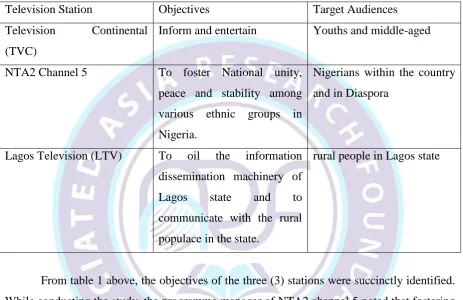
TABLE 1: Objectives and Target Audiences of the Television Stations
Television Station Objectives Target Audiences
Television Continental
(TVC)
Inform and entertain Youths and middle-aged
NTA2 Channel 5 To foster National unity,
peace and stability among
various ethnic groups in
Nigeria.
Nigerians within the country
and in Diaspora
Lagos Television (LTV) To oil the information
dissemination machinery of
Lagos state and to
communicate with the rural
populace in the state.
rural people in Lagos state
From table 1 above, the objectives of the three (3) stations were succinctly identified.
While conducting the study, the programme manager of NTA2 channel 5 noted that fostering
national unity, peace and stability among the various ethnic groups in Nigeria is the general
objective of the station. However, he noted that NTA2 channel 5 has a secondary objective of
satisfying the entertainment needs of the people.
Lagos Television initially was set up to oil the information dissemination machinery
of the state as the Lagos state government under General Mobolaji Johnson was not sure of
adequate media coverage by NTA. But, with successive governments running the state, the
objective of the station has gone beyond disseminating government information and has
extended to serving as a communication link between the Lagos state government and the
rural populace in the state. While Television Continental, a privately owned television
CONCLUSION
In conclusion, the need for and the use of audience feedback in the three TV stations
studied is dependent on the objectives for the establishment of the station. Television
Continental’s objective is primarily entertainment and information; NTA2 is a government
owned station and has as its objectives the promotion of government policies and to foster
national unity, identity and peace while Lagos Television’s objective is to oil the information
dissemination machinery of the state and to reach out to the rural populace. All these stations
agree to the need for audience feedback in programming, hence the establishment of the
various feedback channels.
However, from the study carried out, the use of feedback in programming is also
dependent on the objectives for setting up the station. Television Continental as a commercial
station thrives on advertisements and sponsorships and depends on a large audience to attract
this, thus agreeing to the use of audience feedback in structuring its programmes.
NTA2 as a government-owned station does not make use of the feedback gotten from
the audience but rather base their programmes on commercial gains and government
intervention while Lagos Television makes use of audience feedback to an extent but, as a
state government owned station, its programming policies are still subject to influence from
the government.
The findings of this study also revealed that there are other factors that influence
television programming apart from audience feedback. These include competition,
commercialization (advertisers & sponsors), government activities, National Broadcasting
Commission (NBC), Advertising Practitioner Council (APCON), current trends in the
society, nature of the target market, prime time belt and timing of the programmes i.e the
REFERENCES
Bitner, J.R. (1989) Mass Communication: An Introduction (5th ed). New
Jersey: Prentice-Hall Inc.Daramola, I. (2003) Introduction to Mass
Communication. Lagos: Rothan Press Limited Dominick, J.R. (1994) The
Dynamics of Mass Communication. Dubuque: Von Hoffman Press Inc.
Dominick, J.R. (2009) The Dynamics of Mass Communication: Media in the
Digital Age (10th ed) New York: McGraw Hill
Harrington, S. (2012) “More Than a Backchannel: Twitter and Television”
http://eprints.qut.edu.au/51326/ Retrieved May 3, 2013
Jannarone, J. (2012) “When Twitter Fans Steer TV: Viewer Feedback is
Louder, Faster than
Ever Influencing Scripts of Some Shows”. Http://online.wsj.com. Retrieved
April 12, 2013.
Mcquail, D. (2007) Mass Communication theory (5th ed). London: Sage
Publications ltd
McGarry, M. (2008) “Norbert Weiner’s Cybernetic Theory and Parental Control”.
Http://www.colorado.edu/communication/meta-discourses/papers/App_Papers/McGArry.htm. Retrieved on April 12, 2013.
Onabajo, O. (2001) Broadcast Management and Programming. Lagos: Gabi
concept limited.
Onabajo, O. (2003) “The Nigerian Audience and the Power of Feedback in
Broadcast
Programming”. Ibom Journal of Social Issues: An Interdisciplinary
International Journal Vol 7 No 1. Pp 96-103.
Simons, N. (2011) Television audience research in the age of convergence: