Attitudes towards Dementia Scale (A-ADS). International Journal of Geriatric Psychiatry, 33 (8). pp. 1139-1145. ISSN 1099-1166 DOI: https://doi.org/10.1002/gps.4907
Link to Leeds Beckett Repository record: http://eprints.leedsbeckett.ac.uk/4867/
Document Version: Article
Creative Commons: Attribution-Noncommercial 4.0
This is the peer reviewed version of the following article: Griffiths AW, Parveen S, Shafiq S,Oyebode JR. Development of the Adolescent Attitudes towards Dementia Scale (AADS). Int J Geriatric Psychiatry.2018;17, which has been published in final form at 10.1002/gps.4907. This article may be used for non-commercial purposes in accordance with Wiley Terms and Conditions for Use of Self-Archived Versions
The aim of the Leeds Beckett Repository is to provide open access to our research, as required by funder policies and permitted by publishers and copyright law.
The Leeds Beckett repository holds a wide range of publications, each of which has been checked for copyright and the relevant embargo period has been applied by the Research Services team.
We operate on a standard take-down policy. If you are the author or publisher of an output and you would like it removed from the repository, please contact us and we will investigate on a case-by-case basis.
RUNNING HEAD: DEVELOPING AN ADOLESCENT ATTITUDES SCALE
Development of the Adolescent Attitudes towards Dementia Scale (A-ADS).
Alys Wyn Griffiths12, Sahdia Parveen2, Saba Shafiq2, and Jan R. Oyebode2
1Centre for Dementia Research, Leeds Beckett University, City Campus, Leeds, LS1 3HE
2Centre for Applied Dementia Studies, University of Bradford, Richmond Road, Bradford,
BD7 1DP
Word Count (exc. figures/tables): 3,474 words
Correspondence concerning this article should be sent to: Alys Griffiths, School of Health and Community Studies, Faculty of Health and Social Sciences Leeds Beckett University, City Campus, Leeds, LS1 3HE. Tel: +44 (0)113 812 9238. Email:
Abstract
Objective: There has been an increasing interest in establishing dementia friendly communities
leading to the development and delivery of various dementia awareness initiatives. These
initiatives have generally been aimed at adults, however to sustain dementia friendly
communities, the involvement of young people is imperative. Very few dementia awareness
initiatives exist for young people and none have been independently evaluated to establish
their impact. This research aimed to design and develop a scale to measure adolescents’
attitudes towards dementia to allow such initiatives to be evaluated.
Methods: The Adolescent Attitudes toward Dementia Scale (A-ADS) was developed in two
stages. Firstly, cognitive interviews were conducted with 15 young people and secondly, a new
scale (based on items from two existing scales) was piloted with 262 young people, recruited
through schools.
Results: A scale consisting of 23 items was developed. Exploratory factor analysis
demonstrated that this captured three factors; perceptions of dementia, personal sacrifice and
empathy with people living with dementia. The three sub-scales showed adequate internal
consistency (>.60), correlated with the original scales (r = .79-.91, p <.001) and correlated with
an existing measure of attitudes towards older people at a similar level to the original scales (r
= .47, p < .001).
Discussion: The scale will allow the evaluation of educational initiatives for young people and
provide a validated and standardised measure to establish adolescents’ attitudes towards
dementia.
Introduction
The importance of ensuring that people with dementia retain opportunities to
participate in meaningful social interaction in everyday life is widely recognised (Alzheimer's
Disease International, 2016).To enable this there is a need to increase understanding and
awareness of dementia, and foster dementia friendly communities. Such initiatives are at the
forefront of UK policy, such as the Prime Minister’s Challenge on Dementia (Department of
Health, 2015). One of the core aspects of these policies is the development of initiatives to
improve public understanding, awareness and attitudes towards dementia (Alzheimer’s Disease
International, 2012). The National Dementia Strategy (Department of Health, 2009)
specifically mentioned the importance of challenging the stigma associated with dementia and
improving understanding of dementia.
However, in order to sustain dementia friendly communities, the involvement of
young people is imperative. This has been supported by the desire to create a ‘dementia
friendly generation’, of those aged between 5 and 25, ensuring that young people are educated
and aware of dementia (Department of Health, 2015; Alzheimer’s Society, 2017), as the
likelihood of them knowing someone with dementia increases. One strategy for achieving
these aims is through education to reduce unfounded beliefs and stigma, since these often lead
to stereotypes and prejudice towards people living with the condition (Mukadam & Livingston,
2012). The importance of education for children and young people was highlighted by an
Alzheimer’s Society survey in which two thirds of the young people who responded stated that
that they would like to help people with dementia but that a lack of understanding prevented
them from doing so (Alzheimer's Society, 2015). However, despite this, very little is currently
taught about dementia in schools, with one survey demonstrating that only 15% of 60 schools
Several dementia educational initiatives for children and young people have been
developed. These have been mainly delivered through schools (Di Bona, Kennedy &
Mountain, 2017; Atkinson & Bray, 2013; Nazir & Bangash, 2015; Parveen, Robins, Griffiths,
& Oyebode, 2015; Rylance & Pendleton, 2015) and focused on improving dementia
awareness. Novel approaches, such as the initiative being partly delivered by a person living
with dementia (Atkinson & Bray, 2013; Rylance & Pendleton, 2015), received positive
feedback from students. An initiative that allowed teachers to design their own bespoke
dementia education package resulted in projects of different lengths, all of which were reported
to show improvements in dementia awareness (Atkinson & Bray, 2013). Qualitative evaluation
methods have revealed positive impact on awareness, and in some cases on attitude towards
dementia, in relation to all these educational initiatives. However, to date none of the
initiatives have been independently evaluated and there has also been no follow-up, meaning
that impact, and whether this was maintained over time, cannot be established.
There are mixed messages about existing knowledge and attitudes of young people
towards dementia. A recent study identified that over a third of children aged 10 to 12 had not
heard of either dementia or Alzheimer’s Disease (Baker et al., 2017). However, a UK
government poll indicated that over half of the 8-17 year olds surveyed stated that if people
understood more about dementia, life would improve for those affected and an Alzheimer’s
Society survey found that 65 per cent of the children surveyed said they believed people living
with dementia should be supported and included in everyday life (Alzheimer’s Society, 2015).
A further study demonstrated that in schools without dementia on the curriculum, students may
have negative attitudes and poor knowledge about the condition (Isaac, Isaac, Farina, & Tabet,
2016). Out of fifteen questions testing knowledge about dementia, participants were able to
answer just over six correctly on average. Overall, these studies suggest that children and
attitudes towards people with dementia. Although, contrasting these findings, a recent study in
Israel found that 460 high school students showed generally low levels of stigma towards
people with Alzheimer’s disease (Werner et al., 2017).
However, the above studies used non-validated measures, which limits the usefulness
and applicability of their findings. To effectively establish the attitudes of children and young
people towards dementia, a validated measure needs to be developed. Whilst two measures of
attitudes towards people living with dementia have been developed and validated for adults
(O’Connor & McFadden, 2010; Lundquist & Ready, 2008), and more recently for children
aged 10 to 12 (Baker et al., 2017), there is no measure specifically for adolescents. A validated
measure designed to capture the attitudes of young people towards dementia would facilitate
the development of research in this area and also strengthen the effectiveness of evaluations of
dementia education initiatives (Baker et al., 2017).
In the present study, a measure was designed to capture attitudes of young people
towards dementia was developed in conjunction with a group of young people (stage 1) and
initial validation of the measure completed with students recruited from several secondary
schools across Northern England (stage 2).
Stage 1: Content development
Aim
In stage 1, the aim was to assess the understandability of items within two existing
scales of adult attitudes to dementia in order to ensure that the items and the language used
were suitable for the population that the scale would be used with.
As two existing scales of attitudes towards dementia exist, the A-ADS was developed
based on items from these. As these scales were both developed with populations of
university students, it was not known whether the language was appropriate for adolescents.
In view of this, cognitive walkthrough interviews (Wharton et al., 1994), which aim to
examine whether participants understand the task they are completing, by asking them to
‘think aloud’ the meaning of each question and their response to it, were conducted with 15
young people aged 14-17 years. Participants completed two existing adult attitude measures
whilst thinking aloud what they perceived each question meant. This was done to allow
researchers to identify if there were any problematic items and to inform the most suitable
rewording of items, if necessary, to make them culturally and age appropriate.
The Dementia Attitudes Scale (O’Connor & McFadden, 2010) contains 20 items
measuring attitudes on a 7-point Likert scale (strongly disagree = 1 to strongly agree = 7).
Ten items specifically measure social comfort and 10 items assess dementia knowledge. The
Dementia Attitudes Scale has been used with college students aged 18 to 41 years (mean =
23.5 years, SD = 5.7 years) and found to demonstrate very good reliability and validity. The
second dementia attitudes scale was developed by Lundquist and Ready (2008), and contains
10 items measured on a 5-point Likert scale (strongly disagree = 1 to strongly agree = 5).
This scale contains two subscales: personal sacrifice (6 items) and sympathy for people living
with dementia (4 items). This scale was also developed with undergraduate students and has
demonstrated good validity and reliability. Higher scores on both of these scales indicate
more positive attitudes towards people with dementia.
Results
A total of 15 cognitive interviews were conducted with young people aged 14 to 17
years with a range of academic abilities (recruited from high and low performing schools
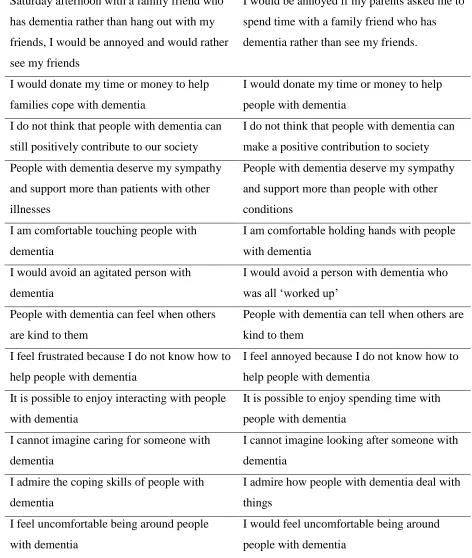
revealed how easily participants understood each item. Based on feedback obtained from the
interviews, the wording of some items was substantially amended to be more simple and
straightforward for young people to complete (see Table 1). This also follows Baker and
colleagues (2017) who adapted wording to be more ‘child-friendly’ in their scale for children.
INSERT TABLE 1 HERE
The items within O’Connor and colleagues’ (2010) scale were generally found to be
simpler and easier to understand. Examples of amendments made to wording included
replacing the term ‘difficult behaviours’ with ‘aggressive behaviours’, since the young people
did not understand what was meant by ‘difficult behaviours’; and the term ‘touching people’
was replaced with ‘holding hands with people with dementia’ to avoid sexual connotations.
The scale developed by Lundquist and Ready (2008), despite being shorter in length, proved
more challenging for young people. The sentences were perceived to be complex and
required the reader to retain and process different ideas and terms. Substantial amendments
were made to simplify the items, and terms were replaced with words more familiar to
adolescents; for example, ‘caretaker’ was replaced with ‘carer’, ‘chronic disease’ was
replaced with ‘condition’ and ‘feeble’ was replaced with ‘weak’. Also, the reference to
helping families cope with dementia was replaced with people with dementia, to maintain a
focus on the person with the condition. Other wording changes clarifying terms that were not
familiar to all adolescents and ensuring items did not assume that individuals already spend
time with someone with dementia (e.g. “I feel uncomfortable” became “I would feel
uncomfortable”). Finally, the items were further amended to reflect more person-centred
language based on the Dementia Engagement and Empowerment Project guidelines (DEEP,
2014), for example, the term ‘patient’ was replaced with ‘person with dementia’.
The combination of reworded items from the two existing scales led to a draft
For the next stage, the 7-point and 5-point Likert scales were retained from the original
questionnaires (i.e. the Lundquist and Ready (2008) scale was responded to on a 5-point
Likert scale and the Dementia Attitudes Scale (O’Connor et al., 2010) was responded to on a
7-point Likert scale).
Stage 2: initial validation of the measure
Aim
The aim of stage 2 was to assess the psychometric properties of the (A-ADS),
including establishing whether all items were suitable for inclusion in the scale, the factor
structure of the scale and its convergent validity. This was done by testing the 30 items with a
sample of young people aged 13-18 years.
Method
Prior to data collection, the University ethical approval was sought and granted. Four
schools from across Northern England were approached via emails to the head teacher and all
agreed to take part. All students in the final two years of high school (aged 14 – 16 years) or
sixth form (aged 16 – 18 years) were eligible to participate. Teachers of pupils aged 14-18
were given information sheets describing the study and their involvement. These teachers
distributed student and parental information sheets, with parents being given one week to ask
for their child to be opted out of the research by completing a response slip on the
information sheet. For all students whose parents did not opt out, a questionnaire was
distributed at the beginning of the day, to be returned in a sealed envelope to their teacher.
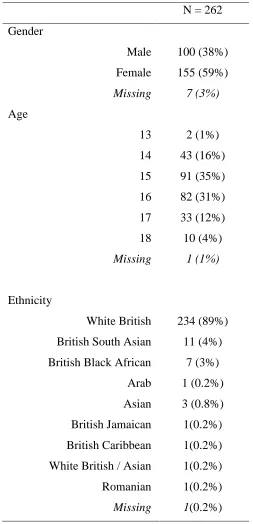
Two hundred and sixty two participants were recruited, this being 68% of the total
number of eligible pupils in the participating schools. Participants were aged 13 to 18 (M =
of other ethnic backgrounds including South Asian and Black British. There were more
female participants than male (female = 59%). Two hundred and forty four participants
(93%) reported knowing what dementia was and 87 (32%) reported knowing someone living
with dementia. See Table 2 for a summary of participant demographics.
Participants completed the draft A-ADS. This consisted of all 30 items that were
being considered for inclusion in the A-ADS, after rewording from Study 1. Participants also
completed the Attitudes Towards Older People measure (Kogan, 1961). This scale consists of
34 statements (17 positive and 17 negative) about older people, e.g. “most old people are
very relaxing to be with”. Participants responded to items using a Likert scale ranging from 1
(strongly disagree) to 6 (strongly agree).
INSERT TABLE 2 HERE
Results
Data analysis of the factor structure was conducted using SPSS 24. Prior to data
analysis, the Likert scaling was standardised so that all responses were considered on a
5-point scale. To achieve this, items from the Dementia Attitudes Scale by O’Connor et al
(2010) was reduced from a 7-point Likert scale to 5-point scale (7/6 = 5; 5 = 4; 4 = 3; 3= 2
and 2/1 = 1), following the guidance of Snell’s (1964) scaling procedure.
To establish the structure of the measure, a maximum-likelihood exploratory factor
analysis (EFA) was conducted on all 30 items. This method is robust enough to moderate any
deviation from normality within the data and as there was no previous EFA conducted for the
attitudes of adolescents towards dementia, we had no a-priori reason to believe a particular
factor structure would emerge. Bartlett’s test of sphericity confirmed that correlations
between items were large enough for an EFA (χ2 [435] = 1784.15, p < .001). A
adequate number of participants for EFA (KMO = .842).
The first ten initial eigenvalues (and % of variance accounted for) resulting from the
factor analysis were 7.08 (23.60%), 2.24 (7.45%), 1.97 (6.56%), 1.54 (5.12%), 1.33 (4.44%),
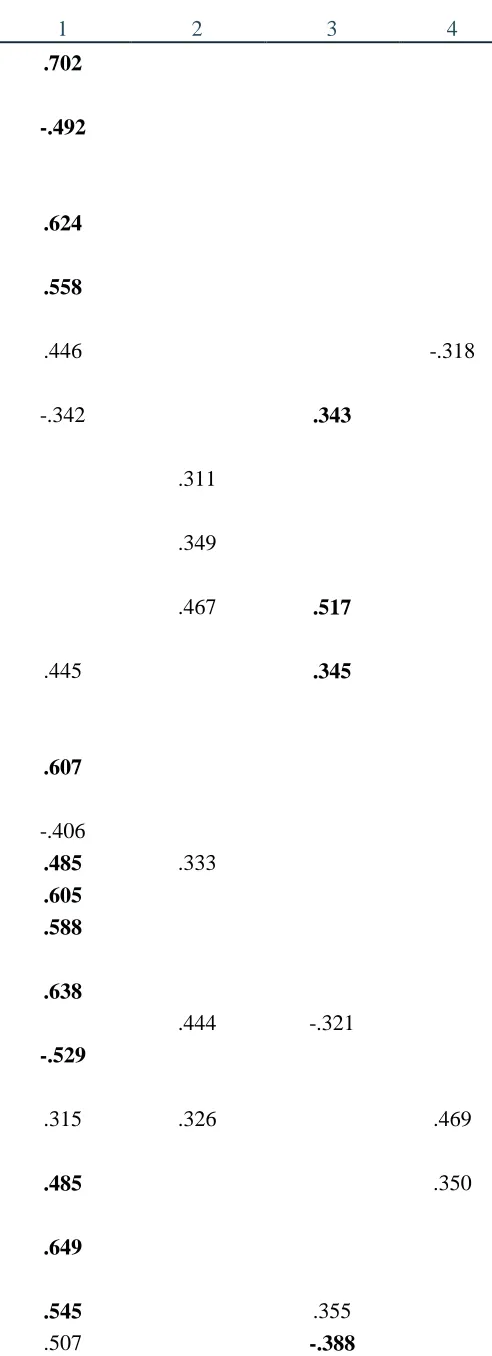
1.28 (4.26%), 1.18 (3.93%), 1.04 (3.46%), .95 (3.16%), and .92 (3.07%). Of the 30 items, 27
items loaded above the .40 cut off considered a reasonable factor loading (Velicer, Peacock,
& Jackson, 1982) and 7 loaded above .60. Twenty-one items loaded on the first factor, five
items loaded on the second factor and two items loaded on the third factor, at .40 or above.
Only two of these items loaded on more than one factor. The fourth factor was poorly
defined, with only one item loading above .40 (see Table 3).
To confirm the structure of the A-ADS, a parallel analysis of 1,000 data sets using a
95% cutoff (O’Connor, 2000) was conducted. The first five eigenvalues extracted from the
simulated data sets were equal to or less than 1.69, 1.59, 1.52, 1.45 and 1.40 respectively. In
the actual data set, only the first three eigenvalues of 7.08, 2.24 and 1.97 exceeded chance
values, suggesting that a three-factor structure underlies the data. Based on these analyses,
three factors were extracted: perceptions of dementia, personal sacrifice, and empathy with
people living with dementia.
INSERT TABLE 3 HERE
Items that loaded on to more than one factor were further inspected and placed into
one domain based on the theoretical underpinning of item and strength of factor loading. Five
of the six items that loaded below .40 on all factors were removed. One item was included
that loaded at -.342 on the first factor (perceptions of dementia) and .343 on the third factor
(empathy with people living with dementia). This item, “I do not think that people with
dementia can make a positive contribution to society”, was retained as there were few items
measuring empathy with people with dementia and this item was thought to clearly measure
parents if they were diagnosed with dementia” was removed as it was too similar to “I cannot
imagine looking after someone with dementia”, which was statistically stronger. A further
item, “I don’t know much about dementia” was removed as it did not load highly on any
factor and also did not theoretically fit well with any factor. Based on the above analyses,
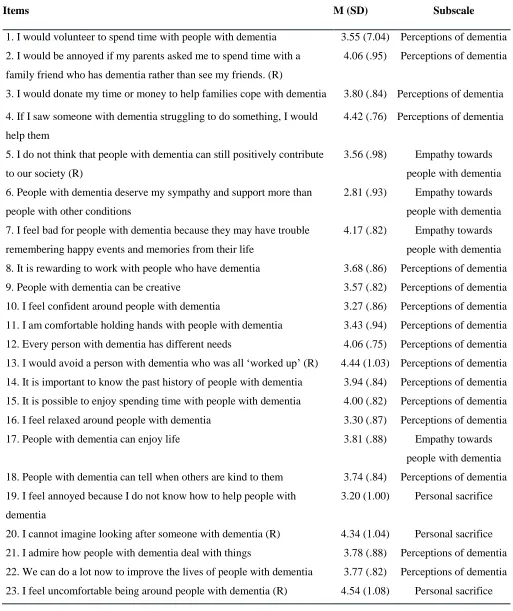
twenty-three items were selected to form the Adolescent Attitudes Towards Dementia Scale
(A-ADS). The final items selected loaded on three factors, perceptions of dementia, personal
sacrifice and empathy with people living with dementia. The fourth factor extracted initially,
was poorly defined and therefore no items representing this construct were included. The
final items, along with mean scores and standard deviation can be seen in Table 4. The
majority of items (nineteen) focused on perceptions of dementia, with four loading on
personal sacrifice and two loading on empathy with people living with dementia. Several
items loaded onto two factors. “I cannot imagine caring for someone with dementia” loaded
on both perceptions of dementia and personal sacrifice, whilst “people with dementia deserve
my sympathy and support more than patients with other illnesses” loaded on both personal
sacrifice and empathy with people living with dementia. As the scale is designed to yield a
single score reflecting one underlying construct of ‘attitudes towards dementia’, rather than to
comprise sub-scales, items that loaded on more than one factor were deemed suitable for
inclusion.
INSERT TABLE 4 HERE
To confirm whether each of the three subscales each measured an underlying
construct, the internal consistency of the scale was conducted. This confirmed that personal
sacrifice sub-scale (α =.79), empathy with people with dementia (α =.69), and perceptions of
dementia (α =.61), all exceeded the standard value for adequate levels of internal consistency
(>.60; Loewenthal, 2004).
correlated with other constructs as would be theoretically expected (Wood & Boyce, 2017).
Scores on the new scale and the two original scales were correlated with the Attitudes
Towards Older People scale (ATOP; Kogan, 1961). This demonstrated that the Adolescent
Attitudes Towards Dementia Scale correlated with the ATOP scale at r = .47, p <.001. The
scores on the Dementia Attitudes Scale (O’Connor & McFadden, 2010) correlated with the
ATOP scale at r = .48, p <.001 and scores on the Lundquist and Ready (2008) scale
correlated with the ATOP scale at r = .29, p < .001. These analyses demonstrate that the
newly developed scale (A-ADS) correlates with another existing measure of attitudes towards
older people at a comparable level to the original scales measuring attitudes towards people
with dementia.
Analyses were also conducted to establish whether any correlations existed between
scores on the A-ADS, and scores on the Dementia Attitudes Scale (O’Connor & McFadden,
2010), the Lundquist and Ready (2008) scale, and the Attitudes Towards Older People
measure (Kogan, 1961; see Table 5). As these scales were designed to measure similar
constructs, correlations were expected to exist between scores on these scales. As the data
were normally distributed (Shapiro Wilk = .985-.987, p >.05 for all scales), Pearson’s
correlations were conducted. To correct for multiple comparisons, boostrapping was used to
generate 95% confidence intervals (CI) for correlation coefficients. This technique generates
CI by randomly resampling the original dataset 2,000 times (Mooney and Duval (1993). This
analysis demonstrated that these scales all correlated significantly, suggesting that they were
measuring the same construct (see Table 5).
INSERT TABLE 5 HERE
The present study reports the development of the Adolescent Attitudes towards
Dementia Scale (A-ADS). It is hoped that the development of this scale encourages research
into the attitudes of adolescents, a research area that until now has focused mainly on adults
(Baker et al., 2017; Werner et al., 2017). This is particularly important as interventions to
tackle stigma towards dementia at an early age are thought to be key to developing positive
attitudes (Werner et al., 2017). More effort is required to ensure that dementia is embedded
into school curriculums (Isaac et al., 2016), to improve education around dementia. However,
to evaluate the impact of educational initiatives, validated measures are required. This newly
developed scale will allow such research to be conducted.
The (A-ADS) has been developed in collaboration with young people, ensuring that
the language is appropriate and easily understood. Psychometric analyses demonstrated that
the scale comprised three well-defined factors: perceptions of dementia, personal sacrifice,
and empathy with people living with dementia, however scores on the overall scale reflect a
cohesive underlying construct. These factors incorporate the main aims of The National
Dementia Strategy (Department of Health, 2009), which focuses on challenging the stigma
associated with dementia and improving understanding.
However, there are limitations associated with the development of the A-ADS. While
the correlation between the A-ADS and the Lundquist and Ready scale was so high that this
might lead to the need for the new scale to be questioned, it is noted that the significantly
adapted language in the A-ADS should make it more acceptable to the intended target group,
and this might be expected to lead to less fatigue, and less missing data. Furthermore,
although young people were consulted about wording and understanding of items, this small
sample may not represent young people more widely as it excluded those aged under 14 years
and all participants were recruited from a single region of the UK. Almost two thirds of
differences between genders on attitudes towards older people (Kite et al., 2005), several
studies have demonstrated that females have a more positive attitude towards older people
(McConatha et al., 2003). Therefore, the scale needs further validation, including
confirmation of the structure of the scale using Confirmatory Factor Analysis, with
individuals across the UK and other countries.
Conclusion
In conclusion, improving education around dementia for young people is key to
ensuring a dementia friendly generation. It is hoped that the initial development of the
A-ADS will allow the evaluation of educational initiatives for young people and provide a
validated and standardised measure to establish the attitudes towards dementia.
References
Alzheimer's Disease International. (2012). World Alzheimer report 2012: Overcoming the
stigma of dementia. London: Author.
Alzheimer's Disease International. (2016). Dementia friendly communities: Global
developments. London: Author.
Alzheimer’s Society. (2017). Creating a dementia-friendly generation.
https://www.alzheimers.org.uk/info/20117/creating_a_dementia-friendly_generation
Atkinson, T., & Bray, J. (2013). Dementia Awareness & Intergenerational Exchange in
Schools: A Pioneer Project supporting Dementia Friendly Communities. University of
Worcester. Retrieved from
http://www.alzheimers.org.uk/site/scripts/download_info.php?fileID=2306
Baker, J. R., Low, L., Goodenough, B., Jeon, Y., Tsang, R. S. M., Bryden, C., & Hutchinson,
K. (2017). The Kids Insight into Dementia Survey (KIDS): development and
preliminary psychometric properties. Aging & Mental Health. doi:
10.1080/13607863.2017.1320703
DEEP. (2014). Dementia words matter: Guidelines on language about dementia. London:
Innovations in Dementia.
Department of Health. (2009). Living well with dementia: A National Dementia Strategy.
London: Department of Health.
Department of Health. (2015). Prime Minister’s challenge on dementia 2020. London:
Di Bona, L., Kennedy, S. and Mountain, G., 2017. Adopt a Care Home: An intergenerational
initiative bringing children into care homes. Dementia, p.1471301217725420.
Isaac, M. G. E. K. N., Isaac, M. M., Farina, N., & Tabet, N. (2016). Knowledge and attitudes
towards dementia in adolescent students. Journal of Mental Health, 1–7. doi:
10.1080/09638237.2016.1207234
Kite, M. E., Stockdale, G. D., Whitley, B. E., & Johnson, B. T. (2005). Attitudes toward
younger and older adults: An updated meta-analytic review. Journal of Social Issues,
61: 241-266.
Kogan, N. (1961). Attitudes toward old people: The development of a scale and an
examination of correlates. The Journal of Abnormal and Social Psychology, 62, 44-54.
doi: 10.1037/h0048053
Loewenthal, K. M. (2004). An introduction to psychological tests and scales (2 ed.).
Routledge; London, UK.
Lundquist, T. S., & Ready, R. E. (2008). Young Adult Attitudes About Alzheimer’s Disease.
American Journal of Alzheimer’s Disease and Other Dementias, 23(3), 267–273. doi:
10.1177/1533317508317818
McConatha, J. T., Schnell, R., Volkwein, K., Riley, L., & Leach, E. (2003). Attitudes toward
aging: A comparative analysis of young adults from the United States and Germany.
International Journal of Aging and Human Development, 57, 203– 215.
Mooney, C. Z., & Duval, R. D. (1993). Bootstrapping: A non-parametric approach to
Mukadam, N., & Livingston, G. (2012). Reducing the stigma associated with dementia:
approaches and goals. Aging Health, 8(4), 377–386. doi: 10.2217/ahe.12.42
Nazir, E., & Bangash, A. (2015). Awareness raising in schools. The Journal of Dementia
Care, 23(2), 14–15.
O’Connor, B. P. (2000). SPSS and SAS programs for determining the number of components using parallel analysis and Velicer’s MAP test. Behavior Research Methods,
Instrumentation, and Computers, 32, 396 – 402.
http://dx.doi.org/10.3758/BF03200807
O’Connor, M. L., & McFadden, S. H. (2010). Development and Psychometric Validation of the Dementia Attitudes Scale. International Journal of Alzheimer’s Disease, 2010,
e454218. doi: 10.4061/2010/454218
Parveen, S., Robins, J., Griffiths, A. W., & Oyebode, J. R. (2015). Dementia Detectives:
Busting the myths. The Journal of Dementia Care, 23(4), 12–13.
Rylance, R., & Pendleton, J. (2015). Creating a dementia friendly generation. Journal of
Dementia Care, 23(2), 15.
Shapiro, S. S., & Wilk, M.B. (1965). An analysis of variance test for normality (complete
samples). Biometrika, 52, 591-611.
Snell, E. (1964). A Scaling Procedure for Ordered Categorical Data. Biometrics, 20, 592-607.
Velicer, W. F., Peacock, A. C., & Jackson, D. N. (1982). A comparison of component and
factor patterns: A Monte Carlo approach. Multivariate Behavioral Research, 17,
371-388. doi: 10.1207/s15327906mbr1703_5
Werner, P., Jabel, H. A., Reuveni, Y., & Prilutzki, D. (2017). Stigmatic beliefs toward a
person with Alzheimer’s disease among high-school students: Does majority-minority
Wharton, C., Rieman, J., Lewis, C., Polson, P. (1994). The cognitive walkthrough method: a
practitioner’s guide. In: Nielsen, J., Mack, R.L. (Eds.), Usability Inspection Methods
(pp. 105–140). New York, NY: Wiley
Wood, A. M. & Boyce, C. (2017). Developing, Evaluating, and Using Subjective Scales of
Personality, Preferences, and Well-Being: A Guide to Psychometrics for Psychologists
and Economists. In Ranyard, R. (Ed), Economic Psychology (pp. 88-103). New Jersey,
Table 1. Wording changes to items after interviews
Original wording New wording
If my mum or dad asked me to spend
Saturday afternoon with a family friend who
has dementia rather than hang out with my
friends, I would be annoyed and would rather
see my friends
I would be annoyed if my parents asked me to
spend time with a family friend who has
dementia rather than see my friends.
I would donate my time or money to help
families cope with dementia
I would donate my time or money to help
people with dementia
I do not think that people with dementia can
still positively contribute to our society
I do not think that people with dementia can
make a positive contribution to society
People with dementia deserve my sympathy
and support more than patients with other
illnesses
People with dementia deserve my sympathy
and support more than people with other
conditions
I am comfortable touching people with
dementia
I am comfortable holding hands with people
with dementia
I would avoid an agitated person with
dementia
I would avoid a person with dementia who
was all ‘worked up’
People with dementia can feel when others
are kind to them
People with dementia can tell when others are
kind to them
I feel frustrated because I do not know how to
help people with dementia
I feel annoyed because I do not know how to
help people with dementia
It is possible to enjoy interacting with people
with dementia
It is possible to enjoy spending time with
people with dementia
I cannot imagine caring for someone with
dementia
I cannot imagine looking after someone with
dementia
I admire the coping skills of people with
dementia
I admire how people with dementia deal with
things
I feel uncomfortable being around people
with dementia
I would feel uncomfortable being around
Table 2. Stage 2 participant demographic characteristics
N = 262
Gender
Male 100 (38%)
Female Missing 155 (59%) 7 (3%) Age 13 14 15 16 17 18 Missing 2 (1%) 43 (16%) 91 (35%) 82 (31%) 33 (12%) 10 (4%) 1 (1%) Ethnicity White British
British South Asian
234 (89%)
11 (4%)
British Black African
Arab
Asian
British Jamaican
British Caribbean
White British / Asian
Table 3. Standardized item loadings of .3 and above for a scale incorporating four factors.
1 2 3 4
1. I would volunteer to spend time with people with dementia
.702
2. I would be annoyed if my parents asked me to spend time with a family friend who has dementia rather than see my friends. (R)
-.492
3. I would donate my time or money to help families cope with dementia
.624
4. If I saw someone with dementia struggling to do something, I would help them
.558
5. In the future, I can imagine willingly becoming a carer for one of my parents if they were diagnosed with dementia
.446 -.318
6. I do not think that people with dementia can still positively contribute to our society (R)
-.342 .343
7. I feel bad for people with dementia because it is one of the worst conditions to have
.311
8. People with dementia are weak and cannot maintain a regular and productive lifestyle once diagnosed (R)
.349
9. People with dementia deserve my sympathy and support more than people with other conditions
.467 .517
10. I feel bad for people with dementia because they may have trouble remembering happy events and memories from their life
.445 .345
11. It is rewarding to work with people who have dementia
.607
12. I am afraid of people with dementia (R) -.406
13. People with dementia can be creative .485 .333
14. I feel confident around people with dementia .605
15. I am comfortable holding hands with people with dementia
.588
16. Every person with dementia has different needs .638
17. I don’t know much about dementia (R) .444 -.321
18. I would avoid a person with dementia who was all ‘worked up’ (R)
-.529
19. People with dementia like having familiar things nearby
.315 .326 .469
20. It is important to know the past history of people with dementia
.485 .350
21. It is possible to enjoy spending time with people with dementia
.649
22. I feel relaxed around people with dementia .545 .355
24. People with dementia can tell when others are kind to them
.514
25. I feel frustrated because I do not know how to help people with dementia (R)
.562
26. I cannot imagine looking after someone with dementia (R)
-.571 .448
27. I admire how people with dementia deal with things .556
28. We can do a lot now to improve the lives of people with dementia
.556
29. I feel uncomfortable being around people with dementia (R)
-.381 .466
30. Aggressive behaviours may be a form of communication for people with dementia
.392 -.396
Table 4. Final items for the scale with mean and standard deviations.
Items M (SD) Subscale
1. I would volunteer to spend time with people with dementia 3.55 (7.04) Perceptions of dementia
2. I would be annoyed if my parents asked me to spend time with a
family friend who has dementia rather than see my friends. (R)
4.06 (.95) Perceptions of dementia
3. I would donate my time or money to help families cope with dementia 3.80 (.84) Perceptions of dementia
4. If I saw someone with dementia struggling to do something, I would
help them
4.42 (.76) Perceptions of dementia
5. I do not think that people with dementia can still positively contribute
to our society (R)
3.56 (.98) Empathy towards
people with dementia
6. People with dementia deserve my sympathy and support more than
people with other conditions
2.81 (.93) Empathy towards
people with dementia
7. I feel bad for people with dementia because they may have trouble
remembering happy events and memories from their life
4.17 (.82) Empathy towards
people with dementia
8. It is rewarding to work with people who have dementia 3.68 (.86) Perceptions of dementia
9. People with dementia can be creative 3.57 (.82) Perceptions of dementia
10. I feel confident around people with dementia 3.27 (.86) Perceptions of dementia
11. I am comfortable holding hands with people with dementia 3.43 (.94) Perceptions of dementia
12. Every person with dementia has different needs 4.06 (.75) Perceptions of dementia
13. I would avoid a person with dementia who was all ‘worked up’ (R) 4.44 (1.03) Perceptions of dementia
14. It is important to know the past history of people with dementia 3.94 (.84) Perceptions of dementia
15. It is possible to enjoy spending time with people with dementia 4.00 (.82) Perceptions of dementia
16. I feel relaxed around people with dementia 3.30 (.87) Perceptions of dementia
17. People with dementia can enjoy life 3.81 (.88) Empathy towards
people with dementia
18. People with dementia can tell when others are kind to them 3.74 (.84) Perceptions of dementia
19. I feel annoyed because I do not know how to help people with
dementia
3.20 (1.00) Personal sacrifice
20. I cannot imagine looking after someone with dementia (R) 4.34 (1.04) Personal sacrifice
21. I admire how people with dementia deal with things 3.78 (.88) Perceptions of dementia
22. We can do a lot now to improve the lives of people with dementia 3.77 (.82) Perceptions of dementia
Table 5. Correlations between scales
A-ADS ATOP DAS LRS
A-ADS - .49* .75* .94*
ATOP .49* - .32* .50*
DAS .75* .32* - .57*
LRS .94* .50* .57* -