International Journal of Operations & Production Management
Emerald Article: Exploring the six sigma phenomenon using multiple case
study evidence
Preeprem Nonthaleerak, Linda Hendry
Article information:
To cite this document: Preeprem Nonthaleerak, Linda Hendry, (2008),"Exploring the six sigma phenomenon using multiple case study evidence", International Journal of Operations & Production Management, Vol. 28 Iss: 3 pp. 279 - 303
Permanent link to this document:
http://dx.doi.org/10.1108/01443570810856198
Downloaded on: 29-01-2013
References: This document contains references to 34 other documents Citations: This document has been cited by 24 other documents To copy this document: [email protected] This document has been downloaded 4774 times since 2008. *
Users who downloaded this Article also downloaded: *
Preeprem Nonthaleerak, Linda Hendry, (2008),"Exploring the six sigma phenomenon using multiple case study evidence", International Journal of Operations & Production Management, Vol. 28 Iss: 3 pp. 279 - 303
http://dx.doi.org/10.1108/01443570810856198
Preeprem Nonthaleerak, Linda Hendry, (2008),"Exploring the six sigma phenomenon using multiple case study evidence", International Journal of Operations & Production Management, Vol. 28 Iss: 3 pp. 279 - 303
http://dx.doi.org/10.1108/01443570810856198
Preeprem Nonthaleerak, Linda Hendry, (2008),"Exploring the six sigma phenomenon using multiple case study evidence", International Journal of Operations & Production Management, Vol. 28 Iss: 3 pp. 279 - 303
http://dx.doi.org/10.1108/01443570810856198
Access to this document was granted through an Emerald subscription provided by LANCASTER UNIVERSITY
For Authors:
If you would like to write for this, or any other Emerald publication, then please use our Emerald for Authors service. Information about how to choose which publication to write for and submission guidelines are available for all. Please visit www.emeraldinsight.com/authors for more information.
About Emerald www.emeraldinsight.com
With over forty years' experience, Emerald Group Publishing is a leading independent publisher of global research with impact in business, society, public policy and education. In total, Emerald publishes over 275 journals and more than 130 book series, as
well as an extensive range of online products and services. Emerald is both COUNTER 3 and TRANSFER compliant. The organization is a partner of the Committee on Publication Ethics (COPE) and also works with Portico and the LOCKSS initiative for digital archive preservation.
Exploring the six sigma
phenomenon using multiple
case study evidence
Preeprem Nonthaleerak
Dhurakij Pundit University, Bangkok, Thailand, and
Linda Hendry
Lancaster University Management School, Lancaster, UK
Abstract
Purpose– This research paper aims to: explore areas of weakness in six sigma implementations that may require enhancements in the methodology; to investigate implementation differences between manufacturing and services; and to investigate critical success factors.
Design/methodology/approach– Exploratory empirical evidence is presented from nine case study companies in Thailand, including manufacturers, sales and service companies and a national airline.
Findings– Key findings include: six sigma is more appropriate for high risk, complicated, large-scale and cross functional projects; the six sigma methodology could be enhanced to ensure that projects are aligned to company goals; the evidence questions standard text book advice that a “Black Belt” (BB) should have a full time role, as a part-time BB role can be more realistic particularly in a small company and the training materials available need to be improved to be more appropriate for service operations. Research limitations/implications– The main research limitation is in the number of companies studied and the restriction to companies located in Thailand. In addition, the research is exploratory and future research is needed to look at the issues raised in depth.
Practical implications– All of the findings have practical implications. For example, the conclusion on the nature of the BB role is seen as a key issue for successful use of six sigma in small businesses.
Originality/value– Six sigma has been widely used in industry, but there has been limited rigorous academic research. This paper seeks to identify a series of issues worthy of further attention from the academic community using a rigorous research approach.
KeywordsSix sigma, Production improvement Paper typeResearch paper
Introduction
Six sigma is one of the more recent quality improvement initiatives to gain popularity and acceptance in many industries across the globe. Its use is increasingly widespread in many industries, including both service and manufacturing companies, with many proponents of the approach claiming that it has developed beyond a quality control approach into a broader process improvement concept. While the basic concept has its origins in industry, its popularity has led to an increasing level of interest from the academic community, with a substantial rise in the number of academic papers published in recent years (Nonthaleerak and Hendry, 2006; Schroederet al., 2007). Many of these academic articles are more skeptical; for example, McManus (1999), through a comparison with TQM, concludes that six sigma is just an add-on project management tool. Despite such skepticism, it is argued here that it is important for
The current issue and full text archive of this journal is available at www.emeraldinsight.com/0144-3577.htm
Six sigma
phenomenon
279
International Journal of Operations & Production Management Vol. 28 No. 3, 2008 pp. 279-303
the academic community to continue to study the six sigma phenomenon given its acceptance in industry. Such study should focus on enhancing the underlining principles, methodology and deployment processes to assist companies in ensuring that it is used appropriately as an effective means of process improvement.
To achieve such enhancements, it is first necessary to gain a deeper understanding of the six sigma phenomenon in practice and in particular any areas of weakness in the approach. The results of an extensive literature review on six sigma revealed that much of the written evidence on issues such as implementation concentrates on positive attributes and is not well founded using a rigorous research approach (Nonthaleerak and Hendry, 2006). Hence, there is a lack of conclusive empirical evidence and it is not yet possible to draw clear conclusions from the literature on issues such as the strengths and weaknesses of this approach. Therefore, there is a need for comparative empirical research to explore potential areas of enhancement and areas of best practice in six sigma implementation.
Hence, the aim of this paper is to explore empirically the phenomenon of six sigma implementation in the organization, using a rigorous multiple case study approach. By using a semi-structured interview method, practitioners’ viewpoints were obtained regarding the methodological and practical issues of six sigma and how the implementation varies in different settings, such as type of business and size of company. On the six sigma methodology side, the study investigated the application of the five-phase define, measure, analyze, improve and control (DMAIC) for improving a current process, or improving an existing product/service performance which does not meet customer expectation. The issues explored include the practitioners’ difficulties and concerns when undertaking the six sigma projects through the methodology as well as the tools that were used in each phase.
The interviews also explored the deployment process of each company, focusing on the critical success factors (CSFs). Some of these have been previously identified in the literature; such as management involvement, the effectiveness of the six sigma training program, the six sigma organization (Project Champion, master black belt (MBB), black belt (BB), etc.) and the motivation program. Other important issues are newly identified, such as the impact of assigning a BB to either a full-time or part-time post; the type of reporting structure and the nature of the technical support available. For further details regarding the six sigma methodologies, the deployment process including the role of the belts, tools description and other key characteristics of six sigma, readers are referred to authors such as Eckes (2001), Tennant (2001) and Breyfogle III (2003).
The rest of this paper is organized in a further five sections. It begins with a literature review of academic research into six sigma to further explain why this exploratory empirical study is needed. The following section proposes key exploratory research questions and describes the research methodology and data collection methods. The next section presents the characteristics of the case study companies and proposes indicators of six sigma progress and success based on the empirical evidence. Then the key findings of the empirical study are discussed based on the research questions and finally the paper draws conclusions and discusses future research.
Literature review
This literature review is grouped into three main categories: research into the underlying theory of the six sigma approach and potential enhancements; research into
IJOPM
28,3
the implementation process, concentrating on problems identified and discussion on applicability to manufacturing and non-manufacturing contexts; and the comprehensive study of associated CSFs.
Six sigma theory development and enhancements
The most significant literature that seeks to develop theory for the six sigma approach is presented in a series of three papers: Lindermanet al.(2003), Chooet al.(2004) and Schroederet al.(2007). In the first of these papers, the authors suggest that the success of six sigma can be explained by linking it to goal theory and organization theory, such as meso theory. For example, one proposition put forth by Linderman et al.(2003) states that six sigma projects that employ specific challenging goals lead to better improvements than projects that do not have appropriate goals. In addition, other propositions link goals to commitment, to team member effort and level of training. They conclude that these propositions need to be further verified by empirical evidence. Choo et al. (2004) present an empirical study of social and method mechanisms (psychological safety and structured method) of knowledge creation to build up a better understanding of both the quality and knowledge management literatures. The study proposed that there are knowledge-creation processes in six sigma projects and concluded that learning behaviors and knowledge created have direct and indirect roles in predicting performance in six sigma projects. The third paper, by Schroeder et al. (2007), uses a grounded theory approach to propose a definition of six sigma. They also study the differences between six sigma and TQM and conclude that six sigma has distinctive features in terms of its deployment approach and emergent structure, though they acknowledge that other aspects are not new. Collectively, these three papers provide plausible explanations for the apparent success of six sigma in practice.
In terms of literature that seeks to enhance the six sigma approach, Knowleset al.
(2005) look at how six sigma can be used in a supply chain setting rather than in an individual organization. They suggest that a two level framework in which the six sigma DMAIC approach is integrated with the Balanced Scorecard SCOR model (supply chain reference model) is appropriate in this setting. This is a theoretical paper and concludes that the framework needs to be tested in practice.
The limited number of papers in this category of the literature illustrate the infancy of academic study into the six sigma phenomenon. In addition, the propositions within the papers indicate the extent of further research needed. The focus of the papers so far has tended to be to determine whether six sigma is an approach worthy of further study. Given conclusions that this is the case, it is argued here that there is also a need to research any weaknesses in the use of the approach that may require other enhancements to the six sigma methodology.
Six sigma implementation process
A previous literature review found that many papers described the implementation process in a variety of business types; however, very few of these papers report empirical research and all of these are single case studies (Nonthaleerak and Hendry, 2006). An example of an empirical single case study is presented by Tylutki and Fox (2002), who discuss the use of the DMAIC methodology to improve the feeding system of a dairy farm. They concluded that the implementation process is very slow in this
Six sigma
phenomenon
small business environment due to problems such as limited resources and lack of data accuracy. Examples of non-manufacturing contexts discussed in the literature include healthcare and financial services, as well as in non-production internal functions within a manufacturing organization. For example, Wyper and Harrison (2000) described a case study on using the DMAIC methodology to improve processes within a human resources (HR) function. They confirmed that six sigma is applicable in non-manufacturing contexts but difficulties arise specific to this context such as defining the project scope and working with less tangible measurements. They also stressed that the mismanagement of data analysis can be a major cause of ineffective improvement results when implementing six sigma.
Only three papers have been identified that present comparative studies of the implementation process, though all look at different projects within a single case study company, to identify the differences in six sigma implementation (Does et al., 2002; McAdam and Evans, 2004; McAdam and Lafferty, 2004). McAdam and Evans (2004) present an analysis of two manufacturing operations in a single high-tech manufacturing company. Data were collected through an e-mail survey questionnaire to employees at a number of levels, followed by semi-structured interviews with some of these personnel. Three issues were studied: the role of management; empowerment, reward and cooperation; and process issues. They found that more positive responses were received from the management level regarding the process of implementing six sigma into the organization. They also found differences between the two sites in the progress of their six sigma programs, concluding that the operation with lower progress suffered from a lack of management buy-in. Other findings addressed some problematic issues of six sigma organization, for example the BB status can be seen as an elite status, which is separate from functional areas; and the process owner has no involvement with the project selection or ownership of on-going projects. These are all important insights that need to be further verified in future cross-organizational comparative studies.
Does et al. (2002) present a comparison of eight six sigma projects in non-manufacturing processes with a theoretical manufacturing application in a case study company in The Netherlands. They used the five phases of DMAIC to discuss the differences and similarities between the two contexts. This paper addressed various problems, typical of non-manufacturing, such as the process being not well defined and the difficulty of applying quantitative data analysis. In addition, this paper identified difficulties in applying traditional tools; for example, they suggested that non-manufacturing projects should use measures of the mean and variation for the current performance or baseline rather than perform capability and performance studies (Cpk) given the lack of hard specification limits in this area. They conclude that six sigma can be applicable in non-manufacturing contexts with minor adaptations. However, the extent of the adaptations is not described in detail. In addition, given that the research is based in a single case study setting, there are limits on the degree to which the conclusions can be generalized.
In contrast to the conclusion of Does et al. (2002), McAdam and Lafferty (2004) conducted a survey in a single company on six sigma implementation issues from process and people perspectives and found low success in six sigma applications in non-manufacturing areas. Key issues identified included a lack of empowerment for the team when undertaking six sigma projects and the need for the organization to
IJOPM
28,3
evaluate the existing culture before adopting six sigma. Hence, the literature has conflicting evidence regarding the applicability of six sigma to non-manufacturing settings and therefore there is a need to investigate further this issue.
Six sigma critical success factors
While much of the research described above looks at issues that affect the success of six sigma implementation, none of them attempt to determine a comprehensive set of CSFs. To fill this gap, Coronado and Antony (2002) identified 12 typical CSFs from their review of six sigma textbooks and related literature. Further papers have been published that confirm these CSFs (Kendall and Fulenwider, 2000; Caulcutt, 2001; Byrne, 2003; Knowles et al., 2004). In addition, some authors suggest specific CSFs other than those previously defined (Lynchet al., 2003; Brewer and Bagranoff, 2004; Voehl, 2004). Table I summarises the CSFs identified by these authors. It could be argued that this list of CSFs is comprehensive and that many of the issues are in common with those found for any implementation process, and are thus not specific to six sigma. However, all of the papers that identify these issues are descriptive papers and there is a need to verify them through rigorous empirical research. Once the set of CSFs is identified, it is then essential to also consider the priority of importance of the factors, given that budget constraints may not allow the immediate adoption of all factors. Antony and Banuelas (2002) have attempted to address this research issue using a pilot postal survey. The survey was sent to large UK manufacturing and service companies, with over 1,000 employees, and considers the CSFs previously identified in Coronado and Antony (2002). According to the survey results, management commitment and involvement is the most important factor but there is no conclusion on the differences between manufacturing and service. In addition, there is a need to determine the specific issues in this context. For example, if management involvement is key, it is necessary to question the nature and frequency of this involvement through in-depth case study research.
12 CSF (Coronado and Antony, 2002) Other CSF
Management involvement and commitment (Byrne, 2003; Caulcutt, 2001)
Cultural change Organization culture (Brewer and Bagranoff, 2004) Communication
Organization infrastructure IT infrastructure (Kendall and Fulenwider, 2000) Training
Linking six sigma to business strategy Measurement and accountability for finance (Brewer and Bagranoff, 2004)
Linking six sigma to customer Linking six sigma to HR Linking six sigma to suppliers
Understanding tools and techniques within six sigma
Project management skills Cross-functional team (Knowleset al., 2004) Project prioritization and selection Identify scope of project (Lynchet al., 2003)
Governance factors for public work (Voehl, 2004)
Table I. A summary of CSFs for six sigma implementation
Six sigma
phenomenon
A summary of the research gaps identified
Thus, in conclusion, there are a number of key research gaps in the literature, which this paper aims to address:
. the existing weaknesses in six sigma implementation are not well understood;
. implementation differences between manufacturing and service settings need to be better understood, in particular to consider whether the approach may need to be adapted to be contingent upon application type; and
. there is insufficient empirical evidence to verify and further explain the six sigma CSFs identified.
All of these issues need to be addressed using multiple case study comparative studies.
Research methodology
The following key exploratory research questions are derived from the research gaps and issues identified in the literature review:
RQ1.What are the areas of weakness in six sigma implementations, if any, which could be addressed by research into potential enhancements to the methodology?
RQ2.What are the difficulties and issues in the six sigma implementation process and how do they differ between manufacturing and non-manufacturing operations?
RQ3.What are the CSFs for six sigma implementation? And how do they impact six sigma?
Research design
Case study research was chosen given the need to gather in-depth, rich data on the phenomenon of six sigma implementation (Hussey and Hussey, 1997; Yin, 2003). Yin (2003) describes three types of case study: exploratory, explanatory and descriptive indicating that all three are valid approaches. The exploratory stage comes before the theory building stage, and seeks to “uncover areas for research and theory development” (Voss et al., 2002). The advantages of the case study approach at this stage of research include the “exploratory depth” of understanding that can be achieved as described in Meredith (1998). Exploratory research is appropriate here as very little is known in the academic literature about the six sigma phenomenon.
A multi-case study approach is needed to overcome the shortcomings of much of the previous research reported in the literature, which has concentrated on a single organization. As discussed above, the multi-case study approach allows a more direct comparison between the similarities and differences of the implementation practices in the different contexts considered (Silverman, 2000). It also enables more generic conclusions to be reached (Eisenhardt and Graebner, 2007).
The research was undertaken in the summer of 2003 in Thailand using nine different companies that have adopted six sigma. These companies are involved in both manufacturing and non-manufacturing operations, thereby using both the replication and the contrary replication logic in the selection of cases (Yin, 2003; Eisenhardt and Graebner, 2007). The diversification of business type enabled the research to consider any differences in implementation issues when using six sigma in manufacturing or service operations, where service operations can exist in a number of
IJOPM
28,3
organizational contexts. For example, office-based transactional work required in a manufacturing organization is considered to be a service process.
Data collection method
The key data collection method employed was semi-structured interviews using an open-ended interview protocol, as described by authors such as Easterby-Smithet al.
(2002). This allowed the interviewees to express their comments freely; thus, in-depth data and insights were collected from practitioners who are involved with six sigma implementation projects. Three types of open-ended interview protocols were employed: (1) a factual protocol aiming to obtain general company data and information
regarding six sigma activities in the organization;
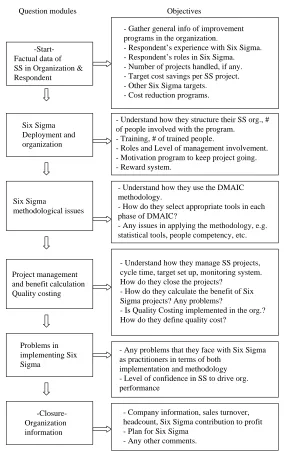
(2) a protocol for management with seven modules covering various topics including the six sigma deployment process, the methodology and the cultural issues (Figure 1); and
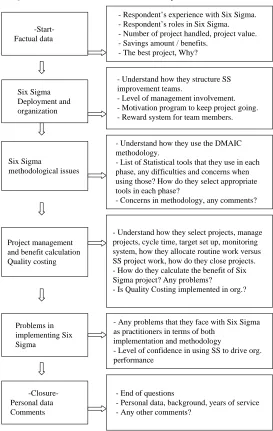
(3) a protocol for belt professionals with a similar structure to that used for management but the questions were focused more on the areas of difficulties and problems that they faced while undertaking the six sigma projects (Figure 2).
A full copy of each of the interview protocols is available from the authors on request. They were piloted by asking three people to answer the questions: a green belt (GB), a BB and a financial director. Their comments were very helpful and led to several revisions to the protocols.
In addition, company archival data were reviewed where possible, including organization charts, six sigma training materials and six sigma project status reports. In total, 43 people in various positions were interviewed by one researcher. The interviews were carried out individually on a face-to-face basis using mainly note taking and a tape-recorder where appropriate. Interview data were transcribed and coded using the three-step coding process suggested by Strauss and Corbin (1990) and cited as a rigorous approach to case study research by Vosset al.(2002). This data reduction approach led to the identification of core categories within the interview data and the build up of a logical chain of evidence, an important precursor to the data analysis described in the next section. Data triangulation was used in the analysis by interviewing at least two levels of management and belt professionals in each company. This data triangulation overcame the problems of anecdotalism and increased the validity of the analysis when relying on a single data collection method (Hussey and Hussey, 1997; Silverman, 2000; Easterby-Smith et al., 2002). A list of interviewees by position for senior management and by roles for belt professionals is in Table II.
Data analysis
Before discussing the research findings, it is important to consider the case study company characteristics and assess their level of progress and success of six sigma implementation. This is considered a necessary first step if the empirical evidence is to be used to explore issues of comparative best practice between the companies. For example, issues of company size may affect implementation issues and the CSFs cannot be discussed without first assessing whether or not the case study companies have achieved a level of success in their six sigma implementation programs.
Six sigma
phenomenon
Company characteristics
[image:9.612.147.433.190.641.2]Table III presents a summary of key characteristics of the nine case study companies, which are classified by company size according to the number of employees (Sadler-Smith et al., 1998); and by main business type of manufacturing and non-manufacturing. Each company was labeled using a reference code to retain anonymity. Table III also indicates type of industry and the nationality of the major Figure 1.
Interview protocol for management
Question modules Objectives
-Start-Factual data of SS in Organization & Respondent
- Gather general info of improvement programs in the organization.
- Respondent’s experience with Six Sigma. - Respondent’s roles in Six Sigma. - Number of projects handled, if any. - Target cost savings per SS project. - Other Six Sigma targets. - Cost reduction programs.
Six Sigma Deployment and organization
Six Sigma
methodological issues
Project management and benefit calculation Quality costing
Problems in implementing Six Sigma
- Understand how they structure their SS org., # of people involved with the program.
- Training, # of trained people.
- Roles and Level of management involvement. - Motivation program to keep project going. - Reward system.
- Understand how they use the DMAIC methodology.
- How do they select appropriate tools in each phase of DMAIC?
- Any issues in applying the methodology, e.g. statistical tools, people competency, etc.
- Understand how they manage SS projects, cycle time, target set up, monitoring system. How do they close the projects?
- How do they calculate the benefit of Six Sigma projects? Any problems?
- Is Quality Costing implemented in the org.? How do they define quality cost?
- Any problems that they face with Six Sigma as practitioners in terms of both
implementation and methodology - Level of confidence in SS to drive org. performance
-Closure-Organization information
- Company information, sales turnover, headcount, Six Sigma contribution to profit - Plan for Six Sigma
- Any other comments.
IJOPM
28,3
shareholders of these companies. It can be seen that the USA is the most common major shareholder, but others include Thai, Japanese, and European.
[image:10.612.87.360.205.636.2]In addition, six sigma practitioners from two six sigma regional support offices participated in the research, as listed as RG10 and RG11 in Table III. These practitioners had each been involved in providing technical support to one of the case study companies (LM3 and LM5, respectively) and have distinctive roles to
Figure 2. Interview protocol for belt professional
Question modules Objectives
-Start-Factual data
- Respondent’s experience with Six Sigma. - Respondent’s roles in Six Sigma. - Number of project handled, project value. - Savings amount / benefits.
- The best project, Why?
Six Sigma Deployment and organization
Six Sigma
methodological issues
Project management and benefit calculation Quality costing
Problems in implementing Six Sigma
- Understand how they structure SS improvement teams.
- Level of management involvement. - Motivation program to keep project going. - Reward system for team members.
- Understand how they use the DMAIC methodology.
- List of Statistical tools that they use in each phase, any difficulties and concerns when using those? How do they select appropriate tools in each phase?
- Concerns in methodology, any comments?
- Understand how they select projects, manage projects, cycle time, target set up, monitoring system, how they allocate routine work versus SS project work, how do they close projects. - How do they calculate the benefit of Six Sigma project? Any problems?
- Is Quality Costing implemented in org.?
- Any problems that they face with Six Sigma as practitioners in terms of both
implementation and methodology
- Level of confidence in using SS to drive org. performance
-Closure-Personal data Comments
- End of questions
- Personal data, background, years of service - Any other comments?
Six sigma
phenomenon
provide six sigma technical support for groups of companies throughout the Asia region. Hence, their perspective on the six sigma phenomenon is considered valuable given their breadth of experience.
Some key company six sigma information is also presented in Table III, such as the continuity of undertaking six sigma projects; a pattern of BB – full-time or part-time; the reporting structure of the deployment team to the Project Champion – either a direct or indirect structure; the inclusion of a dedicated team of technical support within the organization and the degree of training in the organization. These are included here as part of the factual information, but are explained in detail in discussing the key findings from the study.
Determining six sigma success and progress
It could be argued that the area that makes six sigma stand out from previous quality management initiatives is its focus on improving business performance in terms of increasing profits (McAdam and Evans, 2004; Snee, 2004). Many success stories have been published indicating that six sigma helps to generate profits in many reputable companies, such as Motorola and GE (Caulcutt, 2001). However, using only financial evidence as an indicator of success is debatable since the improvement in business profits can be due to factors other than the outcomes of six sigma, such as market changes and effective asset management. In this empirical case study, financial evidence of six sigma success has been collected, though it is acknowledged that verification of the accuracy of this data has not been possible. Thus, it is essential to also consider other factors to determine the levels of progress and success achieved by the case study companies. The factors chosen are described and justified below.
Level of progress. The progress indicators represent the level of commitment of a company to its six sigma program and reflect effort in terms of time spent on training, projects and the belts certification process. Six sigma training requires a certain period of time, such as four months to complete the required BB training sessions and two months for the GB, while the duration of each six sigma project can range from 4 to 6 months. The belts certification process requires each belt to complete at least two to three projects, depending on the savings attained, and thus it often takes almost two years to complete the process. Given the need to train several employees, it is implied that a company may take up to two to three years to realize the benefits of embracing six sigma. Therefore, the number of years of experience of six sigma; continuity of undertaking six sigma projects and
By position Total
Senior manager 11
Financial controller 4
Six sigma leader 3
Master black belt (MBB) 4
Black belt 11
Green belt 8
Finance team 2
Total 43
Table II.
Number of interviewees
IJOPM
28,3
Compa ny label and nat ionality of maj or shareho lders Bu siness Num ber of emplo yees Num ber of years in six sigm a 2003 Forecast six sigma savings (in £ mil) A dedicated tec hnical support tea m Full time BB or pa rt time BB Repo rting to project cham pion On-going six sigm a project Six sigma
training throughout the
orga nization Large LM1 – USA Ha rd disk dri ve 14,000 5.0 69.23 Yes Full tim e Direc t Yes Yes LM2 – JAP Car audio 2,0 00 5.5 No t provided Yes Part time Direc t Yes Yes LM3 – USA Bath and Kitchen 1,4 00 3.0 0.6 9 N o Part time Direc t Yes Yes LM4 – USA In dustrial supplies 525 2.0 No t provided Yes Full tim e In direct Yes Yes LM5 – USA Ai r condi tioning 380 3.0 0.4 6 N o Part time Direc t Yes Yes LN6 – THA Na tional airlin e 4,2 00 3.5 No t provided N o Part time In direct Yes No LN7 – USA Ai r condi tioning 280 1.5 0.0 7 N o N o B B In direct Yes No Medium MM8 – E U R Powe r tra nsforme r 125 5.0 No t provided N o Part time In direct No No Smal l SN9 – USA M edical equipment 18 4.0 No t provided N o N o B B Direc t Yes Yes Regio nal RG10 – USA Six sigma tec hnical support team – reg ional office RG11 – USA Six sigma tec hnical support team – reg ional office Key Compa ny size (head) S – Small (10-49), M – Medium (50-250) and L – Large (more than 250) Business type M – Manuf acturing, N – No n-manufacturing (sa les, service ), RG – Regiona l office Nat ionality THA – Thai, JAP – Jap anese, EU R – European and USA – T he USA Table III. Company factual data, classified by company size
Six sigma
phenomenon
[image:12.612.110.335.198.717.2]the degree of six sigma employee training are suggested as indicators. Three levels of progress are defined as follows:
(1) low progress is defined as having no on-going project(s) or no new project openings in the company, regardless of the years of experience in six sigma implementation, and with six sigma training limited to a certain level of employee;
(2) moderate progress is defined as having on-going project(s) with between one and three years of experience in six sigma implementation and with six sigma training limited to a certain level of employee; and
(3) good progress is defined as having on-going project(s) with more than three years of experience in six sigma implementation and six sigma training completed throughout the organization.
The number of years of experience in practicing six sigma and the presence of on-going projects are considered as good progress indicators showing that a company has committed to six sigma. A six sigma training program for all employee levels is another indicator as this enables better communication within the organization with everyone “speaking the same language” which in turn will ease project execution (Antony and Banuelas, 2002).
Level of success. The proposed indicators of success include financial evidence obtained from the companies together with perceived success of six sigma implementation. Three levels of success are defined as follows:
(1) low success is defined as having no financial evidence or insignificant financial savings from six sigma project(s) and no perceived success;
(2) moderate success is defined as having no financial evidence or a moderate amount of financial savings from six sigma project(s) and some perceived success; and
(3) high success is defined as having a significant amount of financial savings from six sigma project(s) and with high-perceived success.
Clearly, the perception of success is very subjective, but is justified in each case using evidence related to key performance indicators, such as improving customer satisfaction or productivity. Justification of the perceived success for the companies is given below:
. Companies with no perceived success: MM8, LN6 and LN7.MM8 only used six sigma tools to monitor defects from the production line with no evidence of using six sigma to improve business performance. For company LN6, the BB interviewed explained that he did not know how the company quantifies the benefits of his project or other six sigma projects. The only targets were in terms of the number of six sigma projects completed, but no specific business improvement targets were assigned to each project due to the political situation with labor unions in the organization. For example, the union objected to targets such as improvements in productivity. Consequently, there is no evidence of perceived success of six sigma in this company. Company LN7 has no perceived success even though a small financial saving has been attributed to six sigma. A review of company documents indicated that these savings are due to a few
IJOPM
28,3
cost cutting programs in administrative areas, such as reduced telephone bills. In addition, all projects had been open for more than eight months with no project closed at the interview time. Hence, there is no evidence of performance improvements from six sigma.
. Companies with some perceived success: LM2, LM3, LM4, LM5, SN9.Company SN9 is considered to have some perceived success, as all of their six sigma projects in the sales function entail working with customers to improve customer processes. A senior manager of SN9 explained that this type of project has increased customer satisfaction and their loyalty to company products, thereby increasing sales turnover and profit margins. In the case of company LN2, the BB explained how six sigma improved company performance, giving the examples of the creation of a new culture of using data for solving problems; the use of six sigma in every function with employees empowered to set up their own cost savings targets; and their success in winning the first prize in a six sigma projects competition among other companies within the region. Similarly, the remaining companies: LM3, LM4 and LM5 have also established explicit goals for their six sigma projects which are aligned to company objectives and this has led to significant improvements in these goals. In addition, LM5 has also won a prize.
. Company with high-perceived success.Company LM1 is considered to have a high level of perceived success as all functions are working on six sigma projects with clear guidelines on the types of improvement expected. All of their BB projects are expected to generate financial savings while GB projects and others (i.e. white belts, orange belts) focus on productivity improvements, which has led to either quantifiable or non-quantifiable savings.
A matrix of six sigma progress and success
Using the criteria described above, a matrix to indicate the level of progress and success achieved by the companies was developed and is presented in Table IV. For example, it shows that company MM8 is categorized as having low progress and low success. This company has had no new six sigma project openings and no six sigma training since 2001, thereby having no evidence of progress. In terms of the success criteria, there was no evidence of any financial savings as well as no perceived success for the reasons discussed above. In contrast, LM1 is categorized as
Six sigma progress
Management evaluation of six sigma success Low progress Moderate progress Good progress
Low perceived success MM8 LN6
LN7
Moderate perceived success LM4 SN9
LM2 LM3 LM5
High perceived success LM1
Table IV. The matrix of six sigma progress and success
Six sigma
phenomenon
having high levels of progress and success. High progress is indicated by the high number of live projects throughout the organization and the regular training of new belts for all levels of employees, including the shop floor workers who have been given the title of “White Belt – WB”. The success of LM1 is indicated by the significant financial savings attributed to six sigma projects (Table III), and high-perceived success as justified above. Similarly, the remaining companies are categorized into different levels of progress and success in the matrix based on the evidence of each individual company. Interestingly, the matrix suggests a link between the progress and success indicators, with higher progress leading to higher success.
Although it is acknowledged that this categorization is subjective in part, it is felt that it is sufficient to enable the research to determine which aspects of implementation experienced by the companies are most likely to lead to success, and which aspects have been problematic and warrant further research. Thus, the conclusions presented in Table IV will be used as a reference point to explain key findings arising from the analysis of the empirical evidence.
Key findings from the empirical study
Key findings from the empirical study are summarized below by taking each research question in turn and discussing the empirical evidence along with future research issues where appropriate:
RQ1.What are the areas of weakness in six sigma implementations, if any, which could be addressed by research into potential enhancements to the methodology?
The interview results suggest that most practitioners viewed the define and control phases as areas of weakness in the DMAIC methodology and that appropriate execution of these phases are critical to the success of the six sigma projects.
Define phase
From the review of practitioner’s six sigma textbooks, some suggest that project selection should be separated from the define phase in order to ensure careful selection using appropriate criteria and management involvement (Eckes, 2001; Tennant, 2001; Ehrlich, 2002). These authors suggest that these projects should have measurable outcomes and be linked to company goals, and should address existing company problems such as current processes that fail to meet customers’ needs. However, all the case study companies included the project selection process in the define phase and this raised two major issues. The first relates to project selection criteria, while the second relates to the applicability of six sigma.
The main issue regarding the project selection criteria is the over-emphasis on financial savings criteria. Companies LN7, LM3 and LM5 set financial savings as their first priority in project selection. Some of their managers suggested that this criterion sometimes limits the selection to cost reduction projects thereby losing the opportunity to select higher impact projects, such as product quality improvement projects. In addition, this focus gives six sigma a poor image as simply a cost-cutting program. For example, the sales manager of LN7 expressed his concern in relation to their manufacturing suppliers: “manufacturing operation employees often appear to select cost reduction projects for the existing products instead of selecting new product development projects to serve customers or new markets for sales operation”.
IJOPM
28,3
LN7 also provided evidence that belts spend an overly long time on the define phase to identify projects that have financial savings, which has a negative impact on the overall project finish time. In addition, a six sigma leader of RG11 commented that the selection criteria should be based on opportunities, not based on problems and should not over-emphasize financial savings. Some interviewees suggested that project selection criteria should carefully combine financial and non-financial criteria. For example, a six sigma leader from LM1 stated that though non-financial criteria are difficult to quantify in financial terms, they often create future benefits and focus on customers: “This kind of project focuses on potential improvements in reliability, quality and customer relationships, which are hard to measure”. The financial controller of LM1 described the advantages of their policy for BB projects to focus on financial savings while GB projects focus on non-financial criteria, such as cycle time reduction. The key advantage claimed is that leveraging the two criteria enables the company to select appropriate six sigma projects and increase the effectiveness of the project selection process.
In terms of the applicability of six sigma, the main issue raised is the selection of inappropriate or insignificant projects, such as simple or small-scale projects. The empirical study suggests that more successful companies (LM1, LM2) only select six sigma projects for particular types of problem, especially problems that are complicated, high risk, large-scale, and cross-functional as six sigma consumes more resources from all functions. For example, LM2 chose Kaizen to improve a small-scale and simple project, while LM1 chose not to apply six sigma to a small yet highly urgent project. Other companies (LM3, LM5 and LN7) had attempted to apply six sigma DMAIC to small-scale improvement projects using a few simple tools, such as Pareto and fishbone diagrams, but with unsatisfactory results. The interviewees indicated that these projects had not been cost effective and there had been resource allocation problems when attempting to handle a large number of small-scale six sigma projects. Thus, it is concluded that, although six sigma is thought to reduce risk and provide more reliable results, it is inappropriate for solving more day-to-day problems, which are simple or constitute a small project, and can only be cost justified for larger problems. Hence, it is suggested that the project selection process should include a means of identifying this issue, thereby enabling appropriate six sigma projects to be selected.
Control phase
The control phase aims to institutionalize the improvement results from six sigma through documentation and standardization of the new procedures. It includes the setting up of monitoring and process control systems. A variety of process control tools can be used for this purpose, such as a control plan and statistical process control charts. The initial aim is to determine whether the expected improvements actually occur and hence this phase is vital to the effectiveness and sustainability of six sigma results. However, the study found some interviewees expressed concerns regarding this phase, explaining that it is difficult to set up effective means to sustain improvement results after a project is completed. For example, the BB of company LN6 explained that this is particularly problematic when the project was cross-functional and that often project ownership was not properly transferred to a process owner.
LM1, LM4 and LM5, which have been judged to have good or moderate progress and either high or moderate success, all have a good foundation in a quality system.
Six sigma
phenomenon
All have at least ISO9000 in place and use its features, such as documentation control and the internal quality audit committee to handle the control phase. For instance, the control plan is registered in the document control system and used as a work instruction to be followed by all relevant employees. The advantage is that ISO requires a quality audit to be undertaken by internal staff and an external party on a regular basis. This ensures that the control plan is still in use and is effective. Another advantage of a good quality foundation is the build up of a good database thereby increasing data availability, which is critical to the length of six sigma project finish times. One of the six sigma Leaders of RG11 explains, “The basic quality system ISO9000 helps to establish a database of quality data; without a good quality foundation, it would take a longer time to do six sigma projects”. Thus, it is concluded that having a good foundation in a quality system in the organization gives an advantage to companies when adopting six sigma.
Another approach to ensure success is to ensure management is accountable for the project success. For example, companies LM1 and LM4 with moderate or high-success appoint the process owner as the Project Champion, so the process owner also has project ownership for the entire length of the project. In addition, companies LM1, LM3 and LM5 have a post-project monitoring system to track the project outcomes after completion over a given period of time, such as a 12-month period. Thus, the case study evidence suggests that process control tools alone are insufficient to sustain the improvement results, and that the role of management along with a good quality control system can also be important.
In conclusion, strengthening the define and control phases is suggested to be an important area of further research for six sigma. The scope of future study in the define phase should include an explicit project selection process, as this is critical to the success of six sigma projects. This should be closely aligned to the setting of company goals and further study is needed to explore whether this process should constitute a phase in its own right, thereby separated from the other tasks undertaken at this stage, as suggested by Ehrlich (2002). The control phase should be enhanced by identifying key elements that enable improvements to be sustained and provide an explicit guideline on how management should be involved to increase the effectiveness of six sigma projects. In addition, further research could investigate what companies who have successfully implemented six sigma have done regarding their “define” and “control” phases:
RQ2.What are the difficulties and issues in the six sigma implementation process and how do they differ between manufacturing and non-manufacturing operations?
The interviews revealed two main issues; firstly the applicability of six sigma in non-manufacturing contexts and secondly, differences in attitudes to the ease with which six sigma tools can be used and selected.
Applicability of six sigma in non-manufacturing operations. The implementation of the six sigma methodology has been undertaken in a variety of business types within the participating companies. Opinions varied amongst the interviewees regarding the universal application of six sigma for both manufacturing and non-manufacturing processes. Companies with good progress and either moderate or high success have confirmed that six sigma is applicable to both manufacturing and non-manufacturing
IJOPM
28,3
operations (companies LM1, LM2, LM5, SN9). The interviews of their belts revealed evidence of the successful application of six sigma to a variety of different contexts. For instance, belts in company LM5 are employed in the design, manufacturing and accounting functions, while belts in company SN9 are from sales and service. However, some companies comment that the application of six sigma in non-manufacturing is only feasible if used with caution (company LM3, RG11). These interviewees viewed six sigma as suitable for manufacturing but also applicable to non-manufacturing with some modifications, such as in the areas of training, measurements and statistical tools. For instance, the six sigma leader of RG11 suggests that only a few statistical tools can be employed by a GB within Sales operations, though there are also some non-statistical tools that are appropriate. Appropriate tools were suggested to include process mapping, cause and effect diagrams, failure mode and effect analysis, Pareto charts and control plans as defined in Breyfogle III (2003).
Most of the remaining companies gave evidence of the inapplicability of six sigma in non-manufacturing contexts (LM4, LN7, MM8). Belts in the sales operations of company LN7 and LM4 expressed concerns on the difficulties of undertaking six sigma projects caused by a lack of data availability and the nature of sales transactions. This confirms the findings of other authors who have suggested that the nature of transactions creates more difficulties in non-manufacturing contexts in terms of data collection for measurement and analysis (Doeset al., 2002; Breyfogle III, 2003). These sales transactions deal with frontline problems, customer contact and other less visible activities, all of which tend to generate only a small amount of data given that they arise from a non-continuous process (Ehrlich, 2002). Most of the interviewees from LN7 pointed out that six sigma tools are more suitable to a manufacturing environment that generates large amounts of data from continuous processes, given that the tools are traditional manufacturing quality tools, such as control charts and design of experiments (DOE). The sales supervisor of LM4 added:
. . .Six Sigma does not work well in a Sales context. It is more suitable in manufacturing contexts because there are too many external and internal factors that have an impact upon sales and it is very difficult to track data for use in the “analyze” phase.
A senior manager of MM8 added his comment that he does not see a need to apply six sigma in the non-manufacturing functions of his company. He viewed six sigma as a quality tool, thus it is only implemented in the production area and run by the quality department with no involvement from other departments.
Despite these conflicting opinions, it is argued that the application of six sigma in non-manufacturing or service settings is feasible. This is clear given that those who claim its applicability are the most successful companies studied (LM1, LN2, LM4, LM5, SN9) and also as it confirms other evidence in the literature (Wyper and Harrison, 2000). However, the key challenge is to overcome the typical problems experienced in a service setting, such as lack of data availability, difficulties of data collection and hence data analysis. Hence, in-depth study is necessary to explore further the reasons for these problems and investigate ways to overcome them.
Complexity of six sigma tools. The analysis of the interview evidence indicated that the perception of tools’ complexity very much depends upon the interviewees’ educational background. The interviewees from manufacturing areas, who are engineers, have fewer concerns than those from non-manufacturing. The case study
Six sigma
phenomenon
evidence suggests that belts who have an engineering background have no difficulty in understanding the application of the tools and feel comfortable using statistical tools in their projects. In contrast, a concern and fear of using statistical tools in six sigma projects was expressed by several non-engineer belts, who stated that they had a fear of the six sigma phenomenon in the organization. For example, a GB in the accounting function of LM5 admitted trying to avoid undertaking six sigma projects. Some senior managers felt that this difficulty will be overcome as employees become more familiar with the tools and hence move up the learning curve (Company LM5, LM1). The senior manager of LM5 added “ineffective training” as a reason for this fear:
Training courses aim to describe the tools in six sigma rather than how to apply appropriate tools in each stage. Applying the appropriate statistical tools in the project is the hardest part that Belts have faced.
Hence, seeking tools or techniques that could facilitate belts in applying six sigma tools appropriately would be another future area of six sigma study which should seek to reduce the fear surrounding six sigma in non-manufacturing contexts in particular:
RQ3.What are the CSFs for six sigma implementation? And how do they impact six sigma?
Three implementation issues have been identified that influence the success of six sigma implementation:
(1) A pattern of full-time or part-time BB. (2) Belts reporting structure to Project Champion.
(3) The inclusion of a dedicated team of technical support.
These three issues are in addition to those already identified in the literature as summarized in Table I. The case study evidence also confirmed and gave further details on some of the CSFs previously identified by other authors – two of these are also discussed here: these are:
(4) The effectiveness of six sigma training programs. (5) The nature of management involvement.
A pattern of full-time and part-time BB. The study found that using a part-time BB appears to be a more realistic option for small firms, despite the usual recommendation that the BB should be full-time (Breyfogle III, 2003). In fact, company SN9 has been judged to obtain a moderate level of success while having no BB and relying on the GB instead. Other companies that have chosen a part time BB pattern are companies LM2, LM3 and LM5 and these have also been placed in the moderate success category. The major reasons given for choosing a part-time pattern rather than a full-time pattern relate to economic issues of resource allocation and the avoidance of problems of lack of cooperation. The latter can be avoided as the part-time nature of the role allows the BB to also have another more direct part-time role within the organization so that he/she is then a direct colleague to others involved in the six sigma project. However, evidence from companies such as LM5 suggests that the part-time BB struggled to allocate time appropriately between the six sigma project and other work commitments; had low motivation to complete the six sigma project and the scope of
IJOPM
28,3
the projects was limited due to time constraints. A limited project scope may lead to insufficient return on the high investment of the six sigma program, as is suggested by the low-financial savings of LM5 at less than 0.5 percent of sales.
The only company that has been judged to have high success, LM1, is also one of only two companies that have employed a full time BB pattern; the other company is LM4, which has achieved moderate success. Given that some of the other companies with moderate success have employed a part-time BB, the evidence is insufficient to draw a strong conclusion regarding which pattern is more likely to lead to success, if either. However, if the organizational disadvantages of having a full time BB can be overcome, such as the issue of co-operation, then the case study evidence of LM1 and LM4 suggests that there are benefits in having a full time person. A full time BB has the capability to handle a cross-functional, large-scale and complicated project with a high potential to have a significant impact on company performance. There may however still be a cost disadvantage as clearly it is more costly in terms of salary to employ a full time BB. There is insufficient evidence in this study to consider whether this additional cost is justified by the scale of the additional benefits. The advantages and disadvantages of these two BB patterns are summarized from the interviews and presented in Table V.
In conclusion, it is suggested that the most appropriate choice of BB pattern may vary according to the size of the company and hence the resources available. There are clearly advantages and disadvantages of each pattern, which should be considered when choosing the structure that will bring most benefits to the whole organization. This issue needs further investigation, and a survey of a larger number of organizations would be an appropriate methodology to explore this issue to draw more definite conclusions.
Belts reporting structure. The empirical evidence suggests that the more successful companies (such as LM1, LM2, LM3, LM5 and SN9) have a similar style of reporting structure and accountability within their organization. Their belts report directly to the Project Champion, who is the process owner or manager-in-charge of the area targeted for improvement. A director of company LM1 explained that the MBB and BB should report directly to a Project Champion, who can provide guidelines for project selection and give full support to the BB as the project progresses.
BB pattern Advantages Disadvantages
Full-time BB Highly motivated No authority in the improved area Dedicated to six sigma project – fast
progress
Gain less cooperation if the BB status is mismanaged
Can handle cross-functional, large-scale and complicated projects
Higher cost
Part-time BB Project is integrated into day-to-day work High workload Belts have authority as projects are
undertaken in their area of responsibility
Belts have less motivation and less satisfaction in doing six sigma project Gain co-operation as working in the area Projects can be delayed
Lower costs Limited scope of project due to time constraints
Table V. Advantages and disadvantages of two BB patterns
Six sigma
phenomenon
The director of company LM3 also commented on the need to have a good accountability structure:
The Six Sigma reporting structure should be the same as a functional reporting structure. The appropriate Division Manager should be the Six Sigma Project Champion for the BB, who is the subordinate. The Project Champion is then responsible for selecting projects and prioritizing problems for the BB.
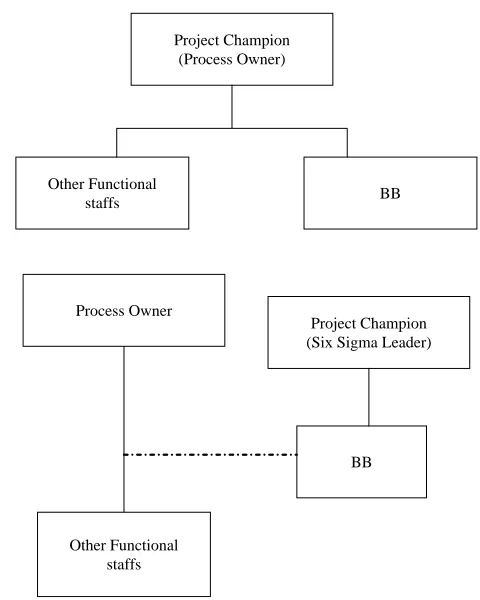
[image:21.612.166.406.416.716.2]Other less successful companies chose to set up more complex and less effective accountability structures. For example, the senior manager of LN7 decided to be the Project Champion for all GBs and assigned one senior manager to be the Project Champion for all Yellow Belts. His reasoning was to ensure that the Project Champion was in a senior position with full authority to support the belts’ actions. However, the study found that this kind of champion did not spend much time supporting belts with the senior manager spending only 5 percent of his time on six sigma projects. Company LN6 adopted another approach to this issue, by setting up a committee of directors from various departments to act as a champion to support belts. However, the senior manager of LN6 expressed his concerns that this approach often delayed the progress of six sigma projects due to a lack of availability of committee members. Figures 3 and 4 show samples of the two reporting channels found in the participating companies.
Figure 3.
Direct reporting structure
Project Champion (Process Owner)
BB Other Functional
staffs
Figure 4. Indirect reporting structure
Process Owner
Other Functional staffs
BB Project Champion (Six Sigma Leader)
IJOPM
28,3
Hence, it is concluded that an indirect and complex type of reporting structure creates a risk that there will be inadequate management involvement and a lack of accountability on project success. A champion who has no direct responsibility over a particular area might not provide enough support to belts, such as by not allocating enough time to six sigma and perhaps by having less understanding of the unfamiliar areas. This reporting style could also have an impact on the effectiveness of the control phase as previously discussed.
Inclusion of a dedicated team of technical support. The technical support team is normally led by the MBB who is an expert and competent in using the six sigma methodology and tools (Breyfogle III, 2003). The team or MBB provides technical support and coaches belts while undertaking six sigma projects. Most case companies (e.g. LM1, LM2, LM5, LN6) admit that less experienced belts need more support from a MBB to guide them in executing the project and choosing appropriate tools. For instance, company LM2 set up a six sigma knowledge center to provide technical support, training and guidance for teams undertaking six sigma projects. Company LM1 trained an MBB for each operation, such as an MBB for the finance department, in order to ensure appropriate support to the team. Among the case companies, it was found that different structures had been instigated for the technical support team, from having a dedicated team supporting belts in the organization to sharing support provided by regional teams within and outside the country. For instance, MM8 shared technical support provided by their Head Office in Europe. The study found that the availability of the technical support team can be a crucial factor in determining the length of projects. In those companies without a dedicated team in place, belts struggled to carry out projects as they had limited access to appropriate coaching, such as is evidenced by LN7. Clearly, a dedicated team is a more expensive option and so these findings also question the effectiveness of six sigma training if it is not sufficient to enable belts to work on projects independently. The impact of ineffective training materials and/or methods was evident in the case companies and will be discussed further in the next sub-section.
Six sigma training. It is interesting to learn that almost half of the interviewees felt dissatisfied with their training program and wanted to improve six sigma training materials and/or methods. It was suggested that it is necessary to improve training materials to be more user-friendly and suitable for each belt level. One belt from company SN9 commented that the company’s six sigma self-training course, as developed by their US corporate team, is very complicated, not motivating and delivered in the English language; hence, this discourages Thai belts from using it for self-learning.
In addition to the self-learning materials, there were concerns in the area of the effectiveness of six sigma direct training as some of the interviewees explained that they had insufficient confidence in undertaking projects after attending the training course and still needed full support from the coach/MBB (LM5, LN7). This problem also affected the length of their project finish times and it became worse when the support (coach) was not available in the organization. Most of the complaints were from lower belt levels (other than BB); for example, a GB from company LN7 complained about the training materials and the availability of the coach as they shared coaching services with other companies.
However, there was some evidence, from LM1, LM2 and LM3, of companies being successful in adapting their training program to suit their circumstances.
Six sigma
phenomenon
For example, a senior manager of company LM2 claimed that the company has been successful in six sigma training because the training materials had been modified to be suitable for Thai employees with case samples based on their industry. In addition, company LM3 employs different kinds of media and communication channels to educate operators on the shop floor, including posters, songs and online sound, all in the local language. Company LM4 uses e-mail to issue six sigma articles to all staff on a regular basis to increase employee’s awareness. Finally, several companies (LM3, LM5, LN7 and SN9) have corporate six sigma training web sites accessible to every employee to enable self-learning. Thus, it can be concluded that while it is possible to improve the training materials, the standard fare recommended by many corporate programs has not been overly well received.
The nature of management involvement. The importance of management involvement and support for six sigma projects has been identified as a CSF in the literature, as discussed earlier in the literature review. The case study evidence presented here confirms this, and goes beyond this statement to explore the nature of effective involvement within the six sigma framework. In several companies, such as LM1, LM3, LM4, LM5 and LN7, it was found that managers were involved through the setting of targets in both financial and non-financial terms. The MBB of company LM4 suggested that it is easier to involve management if targets are set in financial terms “If the Six Sigma Project is not based on financial benefits; it would be hard to drive the Leadership team (management) to get involved with Six Sigma”. However, there is evidence from other companies that management can also be successfully involved when a variety of non-financial targets are used, such as training by headcount; improving project closure rate (speeding up project finish time); and the number of belts certified in each year. Some companies, such as LM1 and LM5, linked these targets to individual performance and thus manager performance is tied to the success of six sigma projects. This confirms a theoretical proposition in the literature that linking six sigma goals to management performance could be seen as a good indicator of the level of management involvement and lead to successful projects in the organization (Linderman et al., 2003). However, the evidence has neither explicitly identified “when” management can effectively be involved or how they can continue their commitment beyond the initial target setting stage. Hence, further study is needed to clarify these issues further specifying the nature of involvement required.
Thus, it is concluded that the CSFs already identified in the literature can be supplemented by the further issues identified in this study, namely the pattern of a part-time or full-time BB; the belt reporting structure and the presence of a dedicated technical support team. While large survey work to verify issues and identify issues of priority of importance would clearly be valuable research, this evidence also clearly shows the importance of case study research to identify more clearly how the factors can be successfully addressed to have a positive impact on six sigma project outcomes.
Conclusions and future research
This paper has explored key aspects of the six sigma phenomenon, including those regarding the associated methodology and implementation process. By interviewing 43 practitioners in nine case study companies and two regional support companies, a multi-level, multi-case study analysis has led to the identification
IJOPM
28,3
of a number of valuable insights. Key findings from this exploratory study are summarized as follows:
. Two areas of weakness in six sigma implementations relate to the use of the DMAIC methodology in the define and control phases. For example, it is concluded that the methodology needs to ensure that the project selection criteria are carefully aligned to company goals rather than being merely based on shortsighted financial targets and that appropriate larger scale projects are selected. The latter is important as the empirical evidence suggests that six sigma is more appropriate for high risk, complicated, large-scale and cross functional projects for which the resources required can be justified. In addition, the process control tools employed in the control phase are insufficient to sustain the improvement results. Thus, the role of management and a good quality control system would be considered important. The methodology needs to be enhanced to address these identified areas of weakness.
. Even though six sigma has been accepted positively among the practitioners as a useful tool to improve business performance, the use of rigorous statistical tools and quality tools creates a fear of six sigma. This is especially pertinent in non-manufacturing areas where employees do not have an engineering background and lack mathematics skills. The study also found that the application of six sigma in non-manufacturing contexts can be problematic for other reasons; in particular, a lack of data availability is a major concern for the practitioners and creates doubts regarding the quality of six sigma outcomes. Consequently, some tools are less used for non-manufacturing processes, such as DOE and some tools need to be adapted or modified to be suitable for this context. Hence, there is scope to contribute to six sigma knowledge by enhancing the methodology to provide better advice to those attempting to implement six sigma in a service process.
. Some CSFs have arisen that supplement those previously identified in the literature. Firstly, it is concluded that using a part-time BB can be a more realistic option for small firms and can still lead to successful six sigma implementation, despite the usual recommendation that the BB should be full-time. Secondly, the nature of the reporting structure is seen to be key, with best practice involving direct reporting to the Project Champion who should also be the process owner and hence have direct responsibility for the project. Thirdly, it is concluded that issues regarding the complexity of tools leads to a need for easy access to coaching advice if projects are not to be unnecessarily delayed.
It is concluded that many of the above findings constitute an important contribution to our knowledge of six sigma in their own right, while others would benefit from further research. For example, the issue of the appropriateness of a part-time or full-time BB could be further investigated using survey research. However, it is perhaps more interesting to work at addressing the issues that need to be enhanced and then to carry out research to implement the changes, monitoring the effect. To this end, it is proposed that a future research project to enhance the six sigma phenomenon should concentrate on improving the training material available, be particularly aimed at those involved in service process improvement, and should address the areas of weakness identified in the use of the DMAIC methodology. Such a project is the basis of the future research plans of the authors.