Munich Personal RePEc Archive
Ordered Search in Differentiated Markets
Zhou, Jidong
Department of Economics, University College London
13 February 2009
Online at
https://mpra.ub.uni-muenchen.de/13397/
Ordered Search in Di
ff
erentiated Markets
∗
Jidong Zhou
Department of Economics, University College London
January 2009
Abstract
This paper presents an ordered search model in which consumers search
both for price and product fitness. We show that there is price dispersion in equilibrium and prices rise in the order of search. The top firms in consumer
search order, though charge lower prices, earn higher profits due to their larger market shares.
Keywords: non-random search, price dispersion, product differentiation
JEL classification: D43, D83, L13
1
Introduction
In a variety of circumstances, consumers need to search tofind a satisfactory product. However, not as most of the search literature assumes, the order in which consumers search through alternatives is often not random. For example, when facing options in a list such as links on a search engine webpage, dishes on a menu, or candidates on a ballot paper, people often consider them from the top down; when shopping in a high street, a bazaar, or a supermarket, consumers’ search order is restricted by the spatial locations of sellers or products; when we go to a travel agent to buy airline tickets or afinancial advisor to buy a savings product, the advisor may tell us the options one by one in a predetermined order.
In a costly search environment, the order in which consumers sample products is an important determinant of their choices, and conceivablyfirms can increase their sales by occupying top positions in consumer search process. In effect it is a common practice forfirms to pay for their products to be displayed in favorable positions. For example, manufacturers pay supermarkets for access to prominent positions; firms bid for sponsored links on search engines; sellers pay more for salient advert slots in yellow page directories. What is less clear is how non-random consumer search (which may be itself a consequence of marketing competition) affectsfirms’ pricing behavior in the market.
Arbatskaya (2007) has studied an ordered search model where firms supply a homogeneous product and all consumers search sequentially in a predetermined order. Since consumers only care about price, in equilibrium the price should decline with the rank of products, otherwise no rational consumer would have an incentive to sample products in unfavorable positions.1 We will consider an ordered search
model with horizontally differentiated products where consumers search both for price and productfitness. Our model is not only more realistic, especially for markets where consumers have diverse tastes, but also provides new insights into firms’ pricing incentive in an ordered-search environment. In particular, we will show that, with product differentiation, the price will rise with the rank of products. This is essentially because afirm positioned earlier in consumer search process has a more price sensitive demand. Therefore, introducing product differentiation may significantly change the price prediction in an ordered search model. Our prediction is consistent with the observation that a product displayed in a favorable position– such as a book at the entrance to a bookshop–is often sold at a discount. The top
firms in consumer search order, though charge lower prices, still earn higher profits due to their larger market shares, which also supports the fact thatfirms are willing to pay for top positions.
The search model with differentiated products is initiated by Wolinsky (1986) and further developed by Anderson and Renault (1999). Both papers consider ran-dom consumer search. More recently, Armstrong, Vickers, and Zhou (2007) (AVZ thereafter) use that framework to model prominence by assuming that all consumers
1An earlier paper on ordered consumer search is Perry and Wigderson (1986). There is two-sided
will sample a prominent productfirst and, if it is not satisfactory, they will continue to search randomly among other products.2 One result in AVZ is that in equilibrium
the prominent product is cheaper than others.3 This paper considers a completely
ordered search model and generalizes the price result in AVZ. Another important difference emerged in our ordered search model is, when there are more than two
firms, the form of consumers’ optimal stopping rule crucially depends on whether they expect a rising or declining price sequence. Hence, we need to deal with the issue of multiple equilibria, which is absent is AVZ.
The remainder of this paper is organized as follows. Section 2 presents the model, and it is analyzed in section 3. Section 4 concludes and discusses possible extensions. Technical proofs are included in the Appendix.
2
A Model of Ordered Search
Our underlying model of consumer choice is based on the framework developed by Wolinsky (1986). There aren ≥2 firms indexed by1,2,· · · , n, each of which sup-plies a single product at a constant unit cost which we normalize to zero. There are a large number of consumers with measure of one, and each consumer has a unit demand for one product. The value of a firm’s product is idiosyncratic to consumers. Specifically, (u1, u2,· · ·, un) are the values attached by a consumer to
different products, and uk is assumed to be independently drawn from a common
distributionF(u)on[umin, umax]which has a positive and differentiable density
func-tion f(u). Therefore, there are no systematic quality differences among products. We also assume that all match utilities are realized independently across consumers. The surplus from buying one unit of firm k’s product at price pk is uk−pk. If all
match utilities and prices are known, a consumer will choose the product providing the highest surplus. Ifuk−pk <0for allk, she will leave the market without buying
anything.
Initially, however, we assume consumers have imperfect information about prices
2Hortaçsu and Syverson (2004) construct a related empirical non-random search model, where
investors sample differentiated mutual funds with unequal probabilities. But they did not ex-plore theoretical predictions of their model, and there is also no empirical conclusion about the relationship between sampling probability and price.
3AVZ also examine the welfare impact of introducing a prominent product. They show that
and match values. They must gather information through a sequential search pro-cess. By incurring a search costs >0, a consumer can find out any product’s price and match utility. We assume that the search process is without replacement and there is costless recall (i.e., a consumer can return to any product she has sampled without extra cost). Departing from the traditional search literature, we suppose that all consumers sample firms in an exogenously specified order. Without loss of generality,firmk will be sampled before firm k+ 1.
Firms know their own positions in consumers’ search process, and they simulta-neously set pricespk (k = 1,2,· · · , n) to maximize profit.
3
Analysis
3.1
Demand
Wefirst analyze consumers’ search behavior. Leta solve
Z umax
a
(u−a)dF(u) =s. (1)
Thus, if there is no price difference among products and if a consumer has found a product with match value a, she is indifferent between buying this product and sampling one more product. As long as the search cost is not too high, a exists uniquely and decreases with s. Throughout this paper, we assume the search cost is relatively small such that in equilibriumpk < a for all k and so each firm has a
chance to be sampled by consumers.4
The form of consumers’ optimal stopping rule depends on whether they expect a rising or declining price sequence. Since we aim to show that p1 < p2 < · · · < pn < a is an equilibrium, we first assume that consumers hold such an expectation
of increasing prices. We will discuss the issue of multiple equilibria in Section 3.3,
4When a consumer expectsp
1 < a, her expected surplus from sampling product 1 is
Rumax p1 (u− p1)dF(u)−s >0and so she is willing to participate in the market. Similarly, when a consumer
expectspk+1 < a, there is a positive probability that she will further sample product k+ 1after
sampling thefirstk products. Therefore,pk < a for allkensures that every firm is active in the
and there we will exclude the possibility of an equilibrium with declining prices.5
The Optimal Stopping Rule Suppose consumers expect an increasing price se-quence pe
1 < pe2 < · · · < pen < a. Then the optimal stopping rule is
charac-terized by a sequence of decreasing cutoff reservation surplus levels z1 > z2 > · · · > zn−1, where zk ≡ a −pek+1. That is, if a consumer has already
sam-pled k firms (with k ≤ n−1), she will search on if the maximum surplus so far vk ≡ max{0, u1−p1,· · · , uk−pk} is less than zk; otherwise she will stop
searching and buy the best product so far. After sampling all products, she will either buy the best one if it provides positive surplus, or leave the market without buying anything.
With such a stopping rule, consumers seem to be making “myopic” search deci-sions because at eachfirmk≤n−1they behave as if there were only one firm left. But it proves to be optimal by means of backward induction. When a consumer has already sampled productn−1, it is clear that she should sample productnfurther if and only if the maximum surplus so far is less thanzn=a−pen according to the
definition ofain (1). Now make the inductive assumption and consider the situation when she has already sampled productk ≤ n−2. Ifvk is less than zk =a−pek+1,
then sampling productk+ 1is always worthwhile. Ifvkis greater thanzk, expecting
that she will stop searching whatever surplus she discovers at the nextfirm (because of vk+1 ≥ vk > zk > zk+1 and the inductive assumption), she should actually cease
her search now.
We now derive demand functions. We claim thatfirmk’s demand when it charges
pk is
qk(pk) =hk[1−F(zk−1+pk)] +rk, (2)
where
hk= Q j≤k−1
F(zk−1 +pj)
is the number of consumers who visitfirmk, and
rk= n X
i=k Z zi−1
zi
f(u+pk) Q j≤i,6=k
F(u+pj)du.
For this expression to be valid for everyk, we use z0 =a−pe1,zn = 0, and Q
j≤0 = 1.
5There is no such an issue when n= 2 or when consumers sample randomly among all other
This demand function can be understood as follows. A consumer will come to
firm k if she does not stop at any of the first k −1 firms (i.e., if vi < zi for all
i ≤ k −1). This condition is equivalent to vk−1 < zk−1, since vi increases weakly
while the cutoffreservation surplus levelzidecreases. So the probability of this event
isPr (vk−1 < zk−1) =hk. (In particular, h1 = 1since all consumers sample product
1 first.) This consumer will immediately buy at firm k if she finds out uk−pk is
greater than zk−1. This is because now vk > zk−1 > zk and so she will not search
on, and at the same time all previous products have surplus lower than zk−1. The
probability of that is 1−F(zk−1 +pk). This explains the first term in (2), and we
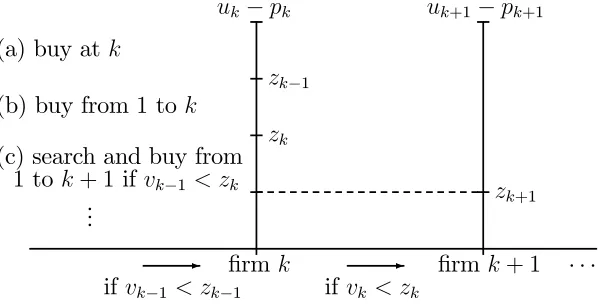
illustrate it as (a) in Figure 1 below.
If this consumer finds outuk−pk is less thanzk−1 but greater than zk, she will
not search on either, but she will buy at firm k only if product k is better than each previous product. (That is,firm k is now competing with all firms positioned before it but none of those positioned after it.) The (unconditional) probability of this whole event is
Pr(max{zk, vk−1}< uk−pk < zk−1)
=
Z zk−1+pk
zk+pk
Q
j≤k−1
F(uk−pk+pj)dF(uk)
=
Z zk−1
zk
f(u+pk) Q j≤k−1
F(u+pj)du,
where the second equality is from changing the integral variable from uk to u =
uk−pk. This explains the first term in rk, and we illustrate it as (b) in Figure 1.
If this consumerfinds outuk−pk is less thanzk but greater than zk+1, then the
only possibility that she will patronize firm k eventually is when vk−1 is also less
than zk (which means that she will continue to sample product k+ 1 but none of
further ones), and product k is the best one among the firstk+ 1 products. (Now
firm k is competing not only with all firms positioned before it but also with one positioned after it). The (unconditional) probability of this whole event is
Pr (max{zk+1, vk−1, uk+1−pk+1}< uk−pk< zk)
=
Z zk+pk
zk+1+pk
Q j≤k+1,6=k
F (uk−pk+pj)dF(uk)
= Z zk
zk+1
f(u+pk) Q j≤k+1,6=k
F(u+pj)du,
indexed byi inrk isfirmk’s demand when uk−pk ∈(zi, zi−1).
uk−pk uk+1−pk+1
-if vk−1 < zk−1
-if vk< zk
firm k firmk+ 1 · · ·
zk−1
zk
zk+1
(a) buy at k
(b) buy from 1to k
(c) search and buy from
1 tok+ 1 if vk−1 < zk
[image:8.595.141.440.138.291.2]...
Figure 1: Consumer Decision at firm k
Using the terminology in AVZ, we call thefirst portion of demand in (2) the “fresh demand” and the second portion of demand (i.e., rk) the “returning demand”.6
Notice that hk is independent of firm k’s actual price. This is because whether a
consumer will come tofirmkis not affected by its actual price but by this consumer’s expectation of pk. Also notice that how a firm’s returning demand varies with its
actual price only depends on the density function f. In particular, for the uniform distribution, a firm’s returning demand is independent of its actual price. When a
firm increases its price, more consumes will search on (which implies a larger number of potential returning consumers), but they will be less likely to return to thisfirm. In the uniform setting, these two effects just cancel out each other. As a result, in the uniform setting, returning demand is less price responsive than fresh demand.7
3.2
Equilibrium prices and pro
fi
ts
The above analysis of demand is predicated on that consumers hold an expectation of increasing prices, and now we want to verify that p1 < p2 < · · · < pn < a
6Notice that the first term inr
k is derived when the consumer does not search on, so the name
of “returning demand” is not appropriate for it. We include it inrk simply because it shares the
similar price elasticity with all other terms inrk.
7More generally, when afirm raises its price, its fresh demand will decrease for sure since more
consumers will then search on. But part of these consumers will become returning consumers, which is a positive effect of raising afirm’s price on its returning demand. Therefore, we expect that returning demand is less price sensitive than fresh demand even for more general distributions. From the expression forrk in (2), we can see that this happens at least when the density function
is indeed an equilibrium. For simplicity, from now on we focus on the case with uniform distribution on[0,1](i.e.,F (u) =u). Thena defined in (1) equals1−√2s. We keep the following condition to ensurepk < ain equilibrium:
s∈(0,1/8), ora∈(1/2,1). (3)
Since in the uniform case bothhk andrk are independent offirmk’sactual price
pk, profit maximization yields the first-order condition:8
hk(1−zk−1−2pk) +rk = 0, (4)
where
hk= Q j≤k−1
(zk−1 +pj); rk = n X
i=k Z zi−1
zi
Q
j≤i,6=k
(u+pj)du.
Using the fact that consumers’ expectation is fulfilled in equilibrium (i.e., zk−1 = a−pk), we have
pk = 1−a+
rk
hk
. (5)
Sincehk(1−a)isfirmk’s fresh demand in equilibrium,rk/hkis proportional to the
ratio of returning demand to fresh demand. Then the economic meaning of (5) is that a firm whose demand consists of more returning demand proportionally will charge a higher price.
Although it is infeasible to solve equilibrium prices analytically, they exist and have the following property (all omitted proofs are included in the Appendix):9
Proposition 1 Under condition (3), our ordered search model has an equilibrium with
1−a < p1 < p2 <· · ·< pn<1/2.
The intuition of this result is as follows: the restricted consumer search order tends to makefirmk have more fresh demand proportionally thanfirmk+ 1, while
8In the uniform-distribution setting, the first-order condition is sufficient for no local profitable
deviation. However, if firm k deviates to a too high price (pk > 1−zk), its fresh demand will
become zero and its returning demand will become price dependent. This may make the profit function no longer globally concave. However, as in AVZ, we can show that, given otherfirms are charging their equilibrium prices,firmk’s profit function is decreasing at anypk >1−zk. Thus,
the equilibrium price we derived below is still valid.
9We have not developed a proof for uniqueness, but numerical simulations suggest that, under
condition (3), within the region of [0,1]n the system of first-order conditions (5) has a unique
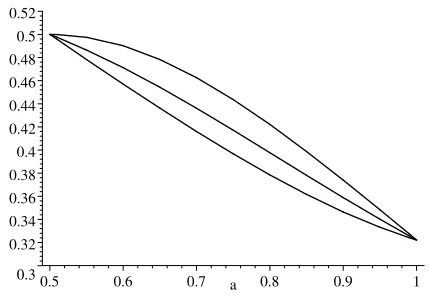
fresh demand is more price sensitive than returning demand. Therefore,firmk has an incentive to charge a lower price thanfirmk+ 1. (We also expect our result to hold even for more general distributions so long as fresh demand is more price sen-sitive than returning demand (see the discussion in footnote 7).) The graph below depicts equilibrium prices when there are three firms, where the three curves from the bottom up representp1,p2 andp3, respectively.
0.3 0.32 0.34 0.36 0.38 0.4 0.42 0.44 0.46 0.48 0.5 0.52
[image:10.595.181.396.213.365.2]0.5 0.6 0.7 a 0.8 0.9 1
Figure 2: Equilibrium Prices With a Whenn= 3
Two polar cases deserve mention: First, when the search cost is sufficiently small (a ≈ 1), consumers tend to sample all firms before they purchase, and so non-random search order has no impact and all prices will converge to the full-information equilibrium pricep¯, say, which satisfiesn¯p= 1−p¯n. (This formula forp¯
is obtained from (5) by lettinga →1.) Second, when the search cost is sufficiently large (a ≈1/2), all prices will converge to the monopoly price 1/2. Here, the high search cost makes a consumer willing to stop searching whenever shefinds a product which yields her positive surplus, and so eachfirm acts as a monopolist. Therefore, the price dispersion caused by non-random consumer search is most pronounced when the search cost is at an intermediate level.10
In equilibriumfirmk has a larger demand than firmk+ 1 (since bothhk > hk+1
and rk > rk+1 hold), but it charges a lower price. Hence, it is a priori unclear
whetherfirm k earns more or less than firm k+ 1. Let πk be firm k’s equilibrium
profit. The following result indicates that the demand effect dominates.
10Another polar case is when there are a large number offirms in the market (n→ ∞). In that
case, all prices will converge to1−a. This is because rn
hn <
Ra pn
¡u
a
¢n−1
Proposition 2 Firm 1 earns more than firm 2. Fork ≥2,firmk earns more than
firm k+ 1 at least when a < n/(n+ 1).
Though we only derive a sufficient condition forπk > πk+1 withk ≥2, numerical
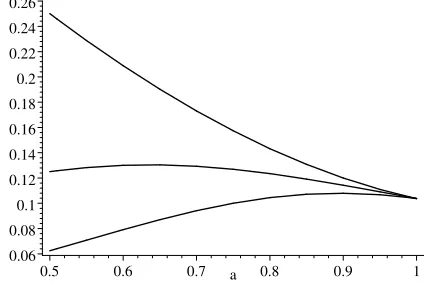
simulations suggest that it is true for any a ∈ (1/2,1). The following graph is an example with threefirms, where the curves from the top down represent π1, π2 and π3, respectively.11
0.06 0.08 0.1 0.12 0.14 0.16 0.18 0.2 0.22 0.24 0.26
[image:11.595.181.393.230.372.2]0.5 0.6 0.7 a 0.8 0.9 1
Figure 3: Equilibrium Profits With a Whenn= 3
3.3
Are there other equilibria?
Our analysis so far has shown that a rising price sequence is an equilibrium outcome. Nevertheless, we have not yet discussed other possible equilibria. Particularly, we want to know whether a decreasing price sequence (as in Arbatskaya (2007)) could also be an equilibrium outcome.12
Suppose consumers hold an expectation of a > pe
1 ≥ pe2 ≥ · · · ≥ pen (but their
search order is still restricted). According to Kohn and Shavell (1974), their optimal stopping rule is well defined and is characterized by a sequence of cutoffreservation surplus levels(z1,· · ·, zn−1). That is, a consumer atfirmk≤n−1will continue to
search if and only if the maximum surplus so far is less than zk. One can further
11This example also shows that in an ordered search market firms positioned relatively down
in consumer search process can benefit from the reduction of search cost. When the search cost becomes smaller (i.e., whenaincreases), the market share redistribution effect due to the restricted search order is weakened, which tends to harmfirm 1 but benefitfirms 2 and 3. At the same time, a smaller search cost implies more intense price competition, which harms allfirms. The combination of these two effects explains why π1decreases whileπ2 andπ3 vary non-monotonically witha.
12It is still an open question whether our ordered search model has equilibria with non-monotonic
show thatz1 ≤· · ·≤zn−1 =a−pen andzk ≥a−pek+1 for allk ≤n−1.13 (To have a
unified expression for demand functions, we use zn=a−pen though at firmnthere
is no need to set a cutoffreservation surplus level at all.)
Now we derive demand functions. For firm k, a consumer will come to it if
ui−pi < zi for alli≤k−1. If she finds out uk−pk≥zk, she will buy immediately
since she will not search on and productk is better than all previous ones (because of increasingzi); if shefinds outuk−pk< zk, then she will continue to search. Once
she leaves, she will eventually return and buy atfirmk only when she has sampled
all products (again because of increasingzi) and product k has the highest positive
surplus. Hence,firmk’s demand is
qk(pk) = Pr (ui−pi < zi for i≤k−1 anduk−pk ≥zk)
+ Pr (ui−pi < zi for i≤k−1 and max{vk−1, uj−pj}j≥k+1 < uk−pk < zk)
= hk[1−(pk+zk)] +rk,
wherehk=Qi≤k−1(zi+pi)is the number of consumers who come tofirmk, andrk
represents the number of returning consumers. In our uniform setting, rk is again
independent of firm k’s actual price pk. Moreover, we have rk ≤ rk+1. This is
because, if a consumer has left both firm k and firm k+ 1, the former’s product must on average have a lower net surplus given zk ≤ zk+1, and so it can win this
consumer back less likely.
Due to the restricted search order,firmk tends to have more fresh demand than
firmk+ 1. At the same time,firmk has less returning demand thanfirmk+ 1as we have pointed out. Since fresh demand is again more price sensitive than returning demand, firm k will actually have an incentive to charge a lower price. This leads to a contradiction. We formalize this argument in the Appendix.
Proposition 3 Our ordered search model has no equilibrium with a > p1 ≥ p2 ≥ · · ·≥pn.
13Keep the notationv
k≡max{0, u1−p1,· · · , uk−pk}. First of all, atfirmn−1,zn−1=a−pen
is simply from the definition ofa. Now consider a consumer atfirmn−2. Ifvn−2< a−pen−1, then
sampling productn−1is always worthwhile. Ifvn−2≥zn−1, this consumer will never samplefirm nno matter what surplus she discovers atfirmn−1, and so she has no incentive to just visitfirm
n−1givenvn−2≥zn−1=a−pen≥a−pen−1. Thus, we havea−pen−1≤zn−2≤zn−1. The same
4
Conclusion
This paper has presented an ordered search model with differentiated products in which consumers search both for price and product fitness. We have shown that in equilibrium there is price dispersion and prices rise in the order of search. The top
firms in consumer search process, though charge lower prices, earn higher profits due to their larger market shares.
We have focused on the case where all consumers have the same search cost. When consumers have heterogenous search costs, those with higher search costs are more likely to buy at the top firms, which provides the top firms an incentive to charge higher prices. The final price prediction will then depend on the relative importance of the effect from product differentiation as this paper has identified and the effect from heterogeneous search costs.
We have also restricted our attention to the case with exogenous search order.14 It would be interesting to endogenize consumer search order through, for example, advertising competition or bidding for online paid placements. Hann and Moraga-Gonzalez (2007) consider a similar search model with differentiated products in which a consumer’s likelihood of sampling afirm is proportional to that firm’s ad-vertising intensity. But in symmetric equilibrium, all firms set the same price and advertise with the same intensity, and consumers end up searching randomly. Chen and He (2006), and Athey and Ellison (2007) present two auction models in which advertisers bid for sponsor-link positions on a search engine. Distinct from other papers on position auctions, they have a formal search model in the consumer side. In equilibrium, consumers search through the sponsor links in the order presented since they anticipate that high-quality links will be placed higher up the listing, and higher-qualityfirms do have a greater incentive to buy top positions given con-sumers’ search order. But there is no effective price competition between sellers in both papers, and so no role for non-random consumer search to affect market prices.15
14Given our equilibrium price result, consumers’ search order is actually rational since the top
firms are charging lower prices. But if we allow consumers to choose their search order freely, then random search with a uniform price in the market will also be an equilibrium outcome.
15Chen and He (2006) do have prices charged by advertisers, but the structure of consumer
A
Appendix
A.1
Proof of Proposition 1
We willfirst show that, in the uniform setting, under the condition a∈(1/2,1)our ordered search model has an equilibrium with1−a ≤p1 ≤· · ·≤pn ≤1/2. We will
then exclude the possibility of equalities.
Suppose consumers hold an expectation of pe = (pe
1,· · · , pen) with 1−a ≤pe1 ≤ · · ·≤pe
n ≤1/2. Given otherfirms’ prices p−k, the demand function of firmk is
qk(pk) =hk(1−zk−1 −pk) +rk,
where
hk= Q j≤k−1
(zk−1 +pj); rk = n X
i=k Z zi−1
zi
Q j≤i,6=k
(u+pj)du.
More precisely, since we are using uniform distribution on[0,1], every term(x+pj)
inhk and rk should be replaced by min{1, x+pj}. Notice that both hk andrk are
independent offirmk’s actual pricepk, and so we can write thefirst-order condition
as
2pk = 1−zk−1+ rk
hk
. (6)
Step 1: Given pe, the system of (6) fork = 1,· · · , n has a solution with
pk =γk(pe)∈[1−a,1/2].
Equation (6) defines the best response ofpk to other pricesp−k, which we denote
pk = bk(p−k;pe). First, from 2pk ≥ 1−zk−1 = 1−a+pek ≥ 2 (1−a), we have pk ≥1−a. Second, since zi decreases andzn= 0, we have
rk ≤hk n X
i=k
(zi−1−zi) =hkzk−1,
and so (6) implies pk ≤ 1/2. Hence, given pe we can now construct a continuous
mapping
b(p;pe) = [b1(p−1;pe),· · · , bn(p−n;pe)]
from[1−a,1/2]n to itself. A fixed-point argument yields our result.
Step 2: Given pe, we have γk+1(pe)≥γk(pe).
From (6), we have
2 (pk+1−pk) =zk−1−zk+
rk+1 hk+1 −
rk
hk ≥
zk−1−zk+
1 hk
where the inequality is becausehk ≥hk+1. (The equality holds if both of them equal
to one.) On the other hand, if we let
A=
n X
i=k+1 Z zi−1
zi
Q
j≤i,6=k,k+1
(u+pj)du,
then
rk+1−rk = (pk−pk+1)A− Z zk−1
zk
Q
j≤k−1
(u+pj)du
≥ (pk−pk+1)A−(zk−1−zk)hk.
Therefore,
2 (pk+1−pk)≥
A hk
(pk−pk+1),
which impliespk+1−pk≥0.
Step 3: The above analysis implies that, for any consumer expectationpe in the domain of Ω= {p ∈[1−a,1/2]n : p1 ≤· · · ≤ pn} (which is compact and convex),
the price competition has an equilibrium γ(pe) = [γ1(pe),· · · , γn(pe)] which also
lies inΩ. Thus, a fixed-point argument implies that our ordered search model has an equilibrium in Ω.
Step 4: We now exclude the equality possibility. First, given pk ≤ 1/2, in
equilibriumzk−1 =a−pk>0 under the conditiona∈(1/2,1). Also recall that we
usezn = 0. Thus, rk >0 and so equation (5) in the main text implies pk >1−a.
Second, notice that in equilibrium
rn=
Z a−pn
0
Q j≤n−1
(u+pj)du < hn(a−pn).
So equation (5) for k = n implies pn < 1/2. Finally, given the equilibrium price p ∈ Ω and the condition a ∈ (1/2,1), hk is strictly greater than hk+1. Then, a
similar argument as in Step 2 impliespk+1 > pk.
A.2
Proof of Proposition 2
Notice thatπk > pk+1qk(pk+1)sincefirmk can at least charge the same price asfirm k+ 1. Thus, it suffices to showqk(pk+1)> qk+1(pk+1), or
hk(1−a+pk−pk+1) +rk> hk+1(1−a) +rk+1. (7)
(Due to the higher cutoffreservation surplus level at firm k, it may now have less fresh demand thanfirmk+ 1.) Decompose rk into two parts: rk =Ak+Bk, where
Ak =
Z a−pk
a−pk+1
Q
j≤k−1
is the first term inrk andBk includes all other terms. It is ready to see Bk > rk+1
since pk < pk+1.
Fork= 1, we further haveAk=hk(pk+1−pk), and so (7) holds sincehk > hk+1.
That is,firm 1 must earn more thanfirm 2. Fork ≥2, we have
Ak >(pk+1−pk) Q j≤k−1
(a−pk+1+pj)>(pk+1−pk)hk+1,
and so (7) holds if(hk−hk+1) [1−a−(pk+1−pk)]>0, or equivalentlypk+1−pk <
1−a. A looser sufficient condition is rk+1/hk+1 <1−a by using (5). Moreover, we
know thatrk/hk increases with k, and so it suffices to showrn/hn <1−a. From
rn
hn
< Z a
pn
³u a
´n−1
du= a
n−pn n
nan−1 < a
n, (8)
we obtain the sufficient conditiona < n/(n+ 1).
A.3
Proof of Proposition 3
We continue our argument in Section 3.3. Given the demand functions derived under consumers’ expectation of a declining price sequence, profit maximization yields the
first-order conditions:
hk(1−zk−2pk) +rk = 0
for allk. In particular, for firmnwe have
hn(1−a−pn) +rn= 0 (9)
by using zn =a−pn in equilibrium, and so 1−a−pn <0. If p1 ≥ · · ·≥ pn, then
thefirst-order condition for anyfirmk ≤n−1 implies
0 =hk(1−zk−2pk) +rk ≤hk(1−a−pk) +rk < hn(1−a−pn) +rn,
where thefirst inequality is becausezk ≥a−pk+1 ≥a−pk, and the second one is
because pk ≥pn, hk > hn andrk≤rn. This, however, contradicts to (9).
References
Arbatskaya, M. (2007): “Ordered Search,” RAND Journal of Economics, 38(1), 119—126.
Armstrong, M., J. Vickers,and J. Zhou(2007): “Prominence and Consumer Search,” RAND Journal of Economics, forthcoming.
Athey, S., and G. Ellison (2007): “Position Auctions with Consumer Search,” mimeo.
Chen, Y., and C. He (2006): “Paid Placement: Advertising and Search on the Internet,” mimeo.
Hann, M., and J. Moraga-Gonzalez (2007): “Advertising for Attention,” mimeo.
Hortaçsu, A.,and C. Syverson(2004): “Product Differentiation, Search Costs, and Competition in the Mutual Fund Industry: A Case Study of S&P 500 Index Funds,” Quarterly Journal of Economics, 119(2), 403—456.
Kohn, M.,and S. Shavell(1974): “The Theory of Search,”Journal of Economic Theory, 9(2), 93—123.
Perry, M., and A. Wigderson (1986): “Search in a Known Pattern,” Journal of Political Economy, 94(1), 225—230.