Munich Personal RePEc Archive
Centre Rules the Markets
Alves, Paulo and Ferreira, Miguel
2008
Online at
https://mpra.ub.uni-muenchen.de/52779/
Centre Rules the Markets
Paulo Alves
CMVM
Comissão do Mercado de Valores Mobiliários Rua Dr. Alfredo Magalhães, 8, 5º
4000-061 Porto [email protected]
and
Miguel Ferreira
ISCTE Escola de Gestão Av. Prof. Aníbal de Bettencourt
1600-189 Lisboa
Abstract
1. Introduction
With the creation of the Economic and Monetary Union (EMU), European monetary
policy has converged, and consequently a similar price for similar stocks in all EMU
stock markets was an expected outcome. Since there exist a series of doubts regarding
such evidence, it is important to identify and to analyse which markets are benefiting
the most from the EMU. The suspicion that the larger markets in the EMU, such as
Germany and France, are becoming centralised, since they are prime receptors of
capital, whilst the others, particularly the smaller markets - such as Austria, Belgium
and Portugal - are becoming peripheral, is the primary concern of this research paper.
Consequently, firms of smaller markets will have an incentive to quote their stocks in
large markets, since the cost of capital will be lower, benefiting from market integration
(see for example, Karolyi (1998) and Errunza and Miller (2000)).
In order to test the hypothesis we compare the capital asset pricing model
(CAPM) of Sharpe (1964) and Lintner (1965) with the Fama and French (1993) model
(FFM) results, following the procedures of Griffin (2002), in order to evaluate the EMU
financial integration, as well as to assess which model is more advisable for
practitioners.
Despite there being many reasons for local capital markets from the EMU to be
integrated, among them – macroeconomic convergence, fiscal policy rules, regulation
and the emergence of the single currency – there also exist many impediments to
financial integration. For example, the existence in Europe of many stock exchanges, as
well as different central securities depositaries, which duplicate instructions and require
a continuing development in banking financial services, makes the cost of cross border
of investment in domestic assets in comparison to the value of the local market - is also
arguably a source of market segmentation.1
CAPM has been the main model to evaluate financial assets since the 1960s (see
for example, Brunner et al (1998), and Graham and Harvey (2001)), although with
different approaches. Despite it having been created to calculate the cost of equity in a
segmented market context, at the end of the 1980s, portfolio managers not only looked
to the US capital market, but also to other capital markets. During a short period,
specifically at the end of 1980s, the market capitalisation of the Tokyo Stock Exchange
overtook the NYSE. Henceforth, excess stock return could be explained not only by the
covariance of its return with the local market return, but also by the covariance of its
return with the return of world market portfolio. In the last three decades asset pricing
took into consideration those changes. Thus, emerged the debate between segmented,
partially segmented, and integrated markets (see for example, Solnik (1974), Stehle
(1977), Errunza and Losq (1985), and Jorion and Schwartz (1986)) and the econometric
developments, arising from the discussion between the CAPM based on conditional or
unconditional information (see for example, Harvey (1991, 1995), and Bekaert and
Harvey (1995)).
During the 1970s and especially in the 1980s a meaningful number of papers
enumerated many misspecifications of CAPM. Basu (1977) finds a positive relationship
1
between expected stock returns and earnings to price ratio. Banz (1981) concludes that
small firms have, on average, higher risk adjusted return than large firms. Bhandari
(1988) shows a positive relationship between debt to equity and expected stock returns,
even controlling some variables like the systematic risk, the firm size and the January
effect. Also Chan et al (1991) analysing the relationship between expected stock returns
and different fundamental variables, find a significantly positive impact on expected
returns by market-to-book and cash flow yield. In this context, Fama and French (1993),
developed an asset pricing model (FFM), where the stock excess return is not only
explained by market excess return, but also by two other two variables, size (measured
by market capitalisation) and book-to-market ratio. Thus, we have two portfolios: Small
minus Big (SMB) portfolio and a High minus Low (HML) portfolio, depending
respectively on market capitalisation and book-to-market. While book-to-market is
related to financial distress problems, size is associated to profitability. Smaller stocks
lead to lower earnings than larger stocks, and consequently to a higher expected return,
after controlling for book-to-market. On the other hand, book-to-market is related to
financial distress problems. Firms with high book-to-market systematically present
lower earnings on book equity, demonstrating signals of some financial distress
problems. Nonetheless, the two factors have been criticised since the mid 1990s. For
example, Berk (1995) concludes that size is not a problem of misspecification of
CAPM, but is only a consequence of economic risk. If two firms have the same size at
time t and consequently the same expected cash-flows at time t+1, the firm at most risk
will have lower market value in that period; Lakonishok et al (1994) explain that high
book-to-market stocks (or value stocks) do not present higher average returns than
mispricing of naive investors, that tend to extrapolate past earnings growth into the
future, leads to an under-pricing of value stocks and over-pricing of growth stocks.
Fama and French (1998) extend the debate between growth and value stocks to
thirteen major capital markets around the world. They find that for twelve markets -
Italy is the exception - there exists a value premium; moreover, they confirm that value
stocks present higher returns than growth stocks and conclude that the world CAPM
does not capture the referred premium, reasserting the CAPM misspecification. Still in
the international field, Griffin (2002), resorting to the three factor model of Fama and
French (1993), compares that model using country factors and global factors, and
concludes that the former explains with more accuracy excess stock returns.
The impact of EMU on local capital markets has been abundantly studied by
academics, and the results are not completely conclusive. Rouwenhorst (1999), using
correlation coefficients shows that the differences on stock returns between European
stock markets remain, after the Maastricht Treaty of 1992. Fratzcher (2001) and
Hardouvelis et al (2001) study the impact of EMU on European stock market
integration. Both conclude that the probability of each currency joining EMU, during
the 1990s, had a decisive importance on European stock market integration. Adjouté
and Danthine (2003) also analyse the European financial integration, and they point out
that the current stock exchange fragmentation is one possible source of market
segmentation; that is, firms with similar characteristics, but listed in a different stock
exchange, are not uniformly priced. Hardouvelis et al (2004) conclude that there exists
evidence of convergence in the cost of equity of industries across EMU countries,
Moerman (2005) using a similar approach to the one adopted in this research,
but using monthly returns, concludes that the Local FFM outperforms the EMU FFM. It
must be highlighted however that there exist many differences between both research
papers. Whilst we debate the use of CAPM and FFM, he focuses solely on FFM.
Although he compares industry with country FFM, we put more emphasis on the
applications, namely in matter of forecasting errors.
Results of this research can be summarised as follows. First, regressions based
on national and international factors are better than those determined by EMU factors.
These results are in line with Griffin (2002) and Moerman (2005). Second, there are
signs of different levels of market integration among EMU capital markets: the largest
are integrating amongst themselves and the smallest are becoming segmented. In fact,
after the single currency the role of international factors began to play a more decisive
role in the biggest stock markets. Our results are in line with Griffin (2002), who
concludes that the choice of a local or international FFM has a significant impact on the
cost-of-equity estimates, and with Fama and French (1997), who find meaningful
differences in the cost-of-equity of many firms, whether the local CAPM or FFM is
used. Finally, we show that the use of local FFM seems to be more advisable for
portfolio analysis, particularly for portfolios of small and high book-to-market firms,
than for individual stocks. International FFM, on the other hand, does not produce better
forecasts than the local FFM, namely for individual stocks.
This paper proceeds as follows. Section 2 describes the methodology and the
data. Section 3 presents the results, that is to say, the regressions of portfolio and firm
excess returns. Section 4 extends the analysis to two applications: we estimate and
forecast firm and portfolio excess returns, compared to the effective excess return.
Section 5 concludes.
2. Methodology and Data
2.1. Methodology
In this paper the three-factor model of Fama and French (1993) is used, with the
adjustments adopted by Griffin (2002). The main objective is to clarify whether the
local or the global factors are the forces that might best explain the stock returns. In
other words, some tests are implemented in order to show how the dichotomy between
market integration and market segmentation has been developing across the single
currency members since the beginning of nineties.
Basically, FFM is built using the following procedure: i) The market excess
return (MER) is obtained through the difference between the stock market return and
the risk free asset. Datastream (DS) stock market indices, German Deutschmarks
denominated, are used as a proxy of local market return. DS indices were chosen
because they represent, in general, more than 99% of local market value. Germany Euro
one-month interest rate is used as risk free asset; ii) Stocks were classified by market
capitalisation in June of year t, using the sample median value, dividing them across Big
(B) and Small (S) portfolios;2 iii) Independently of 2, the sample is divided into three
groups of stocks (using the 30% and 70% percentiles), according to their book-to
market, using the preceding values of December (year t-1) for that ratio, creating the
high (H), medium (M), and low (L) book-to-market portfolios; iv) Portfolios are
value-weighted and we have 6 portfolios, SL, SM, SH, BL, BM, and BH; v) Size premium is
obtained, controlling the firm’s book-to-market, from the difference between S
((SL+SM+SH)/3) and B ((BL+BM+BH)/3), resulting in portfolio SMB (small minus
big); vi) Distress premium is obtained, controlling the firm’s size, through the
difference between H ((SH+BH)/2) and L ((SL+BL)/2), resulting in portfolio HML
(high minus low).
Next, following Griffin (2002), different functional forms of FFM, using either
global or local factors or both, are reported. First, a model based on EMU factors is
presented in German Deutschmarks:
ri,t = i+ bi (EMERt) + s i(ESMBt) + hi(EHMLt) + εi,t (1)
where ri,t is the weekly excess stock return, bi, si, and hi are the unconditional
sensitivities of asset i to the factors, and EMERt, ESMBt, and EHMLt represent the
EMU factors. They are calculated considering the countries’ weight in the EMU
portfolio, where EMERt = wDt-1DMERt+ wFt-1FMERt. wDt-1and wFt-1are respectively
the weight of local and foreign portfolios in the EMU portfolio in the week t-1. The
same procedures for the size and distress premium are used.
This research also considers an international model, based on local and
international sensitivities:
ri,t = i+ b Di(wDt-1DMERt) + sD i(wDt-1DSMBt) + h Di(wDt-1DHMLt)
+ b Fi(wFt-1FMERt) + sF i(wFt-1FSMBt) + h Fi(wFt-1FHMLt) + εi,t (2)
where DMER, DSMB, DHML, FMER, FSMB, and FHML are respectively local and
Finally, a local model is exhibited, where the international factors do not play
any role:
ri,t = i + b Di(wDt-1DMERt) + sD i(wDt-1DSMBt) + h Di(wDt-1DHMLt) + εi,t (3)
Thus, if model (2) does not add any explanatory power to model (3), there are signs that
suggest the excess return is fundamentally explained by local factors and that financial
segmentation continues to exist after the introduction of single currency.
2.2. Data
Data was downloaded from Datastream (DS) and includes a significant number of firms
from the following EMU members: Austria, Belgium, Finland, France, Germany,
Ireland, Italy, the Netherlands, Portugal, and Spain. Luxembourg, a founding member,
is excluded as result of its small capital market. Greece was also not included because it
only adopted the Euro currency at the beginning of 2001. Additionally, the following
were also excluded (1) firms from the financial sector, since they have some capital
requirements which offer them special features, and (2) firms whose book-to-market is
negative, pointing out some financial distress problems.
This analysis focuses on the period from 1990 to 2003, divided into three
sub-periods: 1990-1995; 1996-1998; and 1999-2003. The first period was characterised by a
preliminary discussion of single currency. After 1996, there were a series of economic
policies implemented by local countries in order to assimilate a position on the single
currency. There is a suspicion that this was the higher cycle of integration across
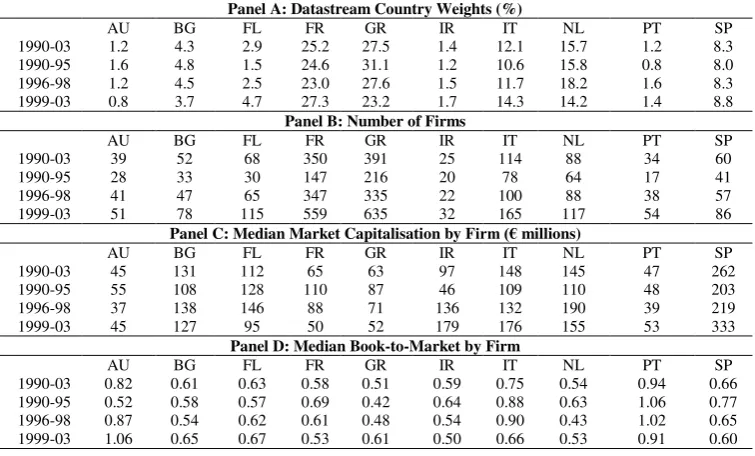
Panel A of Table 1 reveals a stable market share among countries during
1990-2003. France and Germany are the biggest markets with more than a half of the EMU
market capitalisation, regardless of the period. Italy, the Netherlands, and Spain are
median size markets. Their market shares vary from 8% to 18%, depending on the
period being considered. Austria, Belgium, Finland, Ireland, and Portugal are the
smallest markets. All of them present less than 5% of weight in the EMU portfolio at
any point in time. Austria, Ireland, and Portugal with less than 2% are particularly
small.
The number of sample firms used to calculate the size and book-to-market
premiums increases from 1990 to 2003 (see Panel B). The average number of firms
increases from 674 in the first period to 1,892 at the end. This movement has German
and French capital markets as its main representatives. The number of firms from the
biggest markets, contrary to the remaining markets, increase their weight in our sample
- 54% in the first period (363/674) and 63% (1,194/1,892) in the last one. It seems that
this can be explained by the reaction to the development of some new markets,
particularly the Neuer Market and the Nouveau Marché, the German and French
regulated platforms, created respectively in 1997 and in 1996, whose target focuses on
young, small, and high growth stocks (e.g., technology, biotechnology, media and
financial services stocks). The remaining countries also created secondary markets with
the same objective, although without the same success. However, in absolute terms, as it
can be seen in Panel B, the number of firms of each market has been increasing since
the mid 1990s. For example, the number of Portuguese firms increased from 17 to 54.
The reduced interest rates, the development of European capital markets, the economic
growth in the second half of 1990s and the bullish trend, created the ideal atmosphere to
Panel C shows the median market capitalisation by firm during each sub-period.
The large number of new firms in French and German stock markets caused a decrease
in the median size of firms. On the contrary, Spanish firms experienced an increase in
their market capitalisation, as a result of a comparatively lower increase in the number
of firms. Austrian and Portuguese stock markets, more than the others, are characterised
by a large number of small firms.
Book-to-market by firm is exhibited in Panel D. Austrian and Portuguese stocks
present the highest median value for the book-to-market ratio. As a matter of fact, the
median book-to-market ratio of Austrian stocks shows a tendency to increase - from
0.52 to 1.06. There is also a small decrease in market-to-book of French, Irish, Italian,
and Spanish firms. All other countries manifest no tendency in terms of book-to-market.
3. Empirical Results
The analysis debates the results of CAPM versus FFM, using either the portfolios
(High, Low, Small, and Big) or stocks. The absolute value of the intercept or Jensen’s
alpha, meaning the pricing error, and the adjusted R², which represents the explanatory
power of a model, are used to evaluate the robustness of each model. Sample data is
divided into three sub-periods: 1990-1995, 1996-1998, and 1999-2003. The discussion
is carried out based on the following procedures: First, market excess return, size, and
distress risk premiums, which are used in the local FFM application, are presented;
Second, the results obtained for local, international, and EMU CAPM models, using
High, Low, Small, and Big portfolios, ranked by quintiles, are confronted; Third,
previous results are compared to those obtained with the FFM, in order to: assess how
accurate models based on EMU factors are; evaluate how local size and distress
and finally, to evaluate international factors, comparing international to local FFM.
Finally, this research compares the robustness of different asset pricing models - local
CAPM, local FFM and international FFM. Models based on EMU factors are excluded
since they reveal poor explanatory power. These results are similar to those found by
Griffin (2002) and Moerman (2005), who concluded that global factors explain to a
lesser extent time-series variation in return and generally have higher pricing errors than
local model.
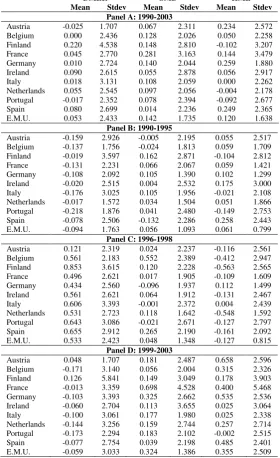
3.1. EMU Local Premiums
Table 2 shows the weekly local market risk premium or domestic market excess return
(DMER), size (DSMB), and distress risk premium (DHML) by country from 1990 to
2003, considering also the following three sub-periods: 1990-95, 1996-98, and
1999-2003.
During 1990-2003 all local market risk premiums followed the same trend.
While market risk premium in the first and the third period were characterised by a
negative return in the majority of European markets, the opposite occurred in the second
period. In the first period, particularly at the beggining, the future Eurozone experienced
a period characterised by high interest rates, as a result of tight monetary policies, and
economic uncertainty about world economic growth and the uncertain result of the
Maastricht Treaty. The last period denotes a correction, after the high-tech bubble in all
stock markets around the world. In contrast, the period from 1996 to 1998 is
economic perspectives and the investor overreaction, explain the stock market
behaviour.
Analysing the DMER by country, with exception to Finland with 12.08% of
annual risk premium in the whole sample period, the remaining countries present weak
results. Some of the smallest stock markets present the poorest performance. Austria,
Belgium, and Portugal, present an annual DMER of -1.31%, 0.01%, and -0.90%
respectively. However, their performance has been different throughout time. Although
Austria presents, comparatively with the two other countries, a weaker performance in
the first two sub-periods, the poorest results for the two other small markets were in the
first and the third sub-period. Concerning the biggest and median stock markets, the
equity risk premium varies from 0.52% (Germany) to 4.22% (Spain), on an annual
basis. These figures are abnormally low, when compared to the traditional results for
equity risk premium, however, the facts previously reffered to, offer a valuable
explanation for this.3
Size premium (DSMB) reveals, in line with DMER, a uniform behaviour across
European countries. In fact, it is possible to observe signs regarding the existence of that
type of premium whatever the sub-period might be. There are only two countries in the
first and in the second period where the size premium is negative (Belgium and Spain in
the first and Germany and Portugal in the second period). Thus, there are some signs of
size premium on the majority of European markets. Size premium is particulalrly high
in Finland, France and Germany. For example, in the French case, the difference
between Small and Big portfolios excess return is 15.73%, on an annual basis, for all
the sample.
Concerning book-to-market premium (DHML), our results are less
homogeneous than those obtained by Fama and French (1998). They find a
book-to-market premium in 11 of 12 stock book-to-markets of its own sample, while we only find the
book-to-market premium in 6 - Austria, Belgium, France, Germany, Ireland, and Spain -
of 10 stock markets analysed. However, we can also observe a similar performance
around the sample. For all the sample, there are only two stock markets where the
distress premium is notoriously negative (Finland and Portugal). These results must be
attributed to the second sub-period. From 1996 to 1998 the book-to-market premium is
negative for the majority of countries - Austria, Belgium, France, Germany, Ireland, and
Spain. However, in the remaining sub-periods, particularly in the last one, signs of
financial distress premium are more homogeneous. In fact, with the exception of
Portugal, all stock markets present a financial distress premium in such period.
Previous findings are a result of institutional and economic changes that
European capital markets witness after the single currency. In fact, the single currency
and consequently the lower interest rates, as well as the high-tech euphoria during the
second half of 1990s, could explain the stock price behaviour of growth firms.
Probably, asset managers did not use the more advisable figures for the cost of equity of
growth firms. They estimated a lower cost of equity for growth stocks, substantially
increasing their market prices; that is, asset managers used a lower estimate for
cost-of-equity, creating the ideal conditions for stock prices to overreact. That should explain
what happened after 1999, a sustainable correction of stock market throughout this
3.2. Local, International, and EMU CAPM: Country Analysis
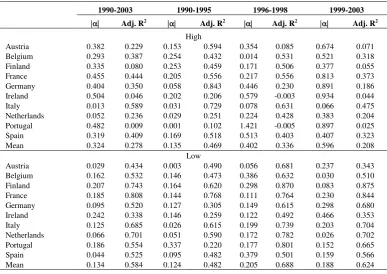
Table 3, Panels A-C, show the results of regressions for excess return of High and Low
portfolios. Top and bottom quintiles are used as the dependent variable. Local CAPM,
represented by a local factor, international CAPM, defined by a local and international
factor, and EMU CAPM, by an EMU factor, are the three specifications considered in
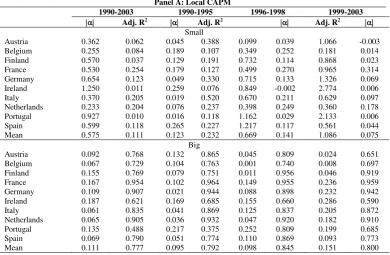
Table 3. Table 4 presents an identical analysis, although it considers the excess return of
Small and Big portfolios, as the dependent variable.
Analysing the whole period, the primary result regards to the lower performance
of the EMU CAPM. Indeed, we observe in both Table 3 and 4 a higher absolute
Jensen’s alpha and lower adjusted R² in comparison with Local and International
CAPM. For example, for Low portfolios (see Table 3, Panels A, B, and C) the Jensen’s
alpha is, on average, 0.134%, 0.132%, and 0.153%, respectively for local, international,
and EMU CAPM, and the adjusted R² is 58.4%, 59.4%, and 40.4%. For Big portfolios
(see Table 4, Panels A, B, and C), the Jensen’s alpha is, on average 0.111%, 0.111%,
and 0.130%, and the adjusted R² is 77.7%, 78.0%, and 48.7%. These results are, in
general, similar in the sub-periods. Comparing either EMU CAPM to local FFM or
EMU CAPM with international FFM it is possible to show that the former is less
accurate than local and international CAPM. On average, considering 120 portfolios (10
countries; 3 periods; 4 categories of portfolios), the following Jensen’s alpha were
obtained: 0.344% for EMU model, 0.322% for international model, and 0.323% for
local model (see Table 7, Panel A). The difference between Jensen’s alpha of EMU
model and international model (0.022% (1.15% on an annual basis)) presented in Panel
Jensen’s alpha of EMU model and local model also shows that the difference between
both means (0.021%) is also statistically insignificant (p-value = 0.69).
Panels A-C of Tables 3 and 4 show the absolute intercept for a variety of models
and portfolios. The tendency reaches a steep decrease in the realm of pricing accuracy
during the sample. In fact, there are signs that the intercept increased since the
beginning of 1990s. For example, Jensen’s alpha for High portfolios, considering the
local CAPM, increased from 0.135% in the first period, to 0.596% after 1999 (see Table
3, Panel A); for Big portfolios, the intercept of local CAPM increased from 0.095% to
0.151% (see Table 4, Panel A). The specific risk, measured by the absolute intercept,
has had a more decisive role in matter of pricing in comparison with systematic risk.
The singularity, the small size and the financial structure of new firms can be plausible
explanations for such result. Results are more evident for High and Small portfolios (see
Tabels 3 and 4). For example, considering the international CAPM, whilst the intercept
of Low portfolios changes, on average, from 0.126% to 0.186%, the High portfolio
changes from 0.114% to 0.601% (see Table 3, Panel B). The results for adjusted R² are
in line with Jensen’s alpha. Inversely, for example, the average adjusted R² for High
portfolios, taking into consideration the international CAPM, decreases from 47.5% to
21.9%, the Low portfolios increases from 48.4% to 62.6% (see Panel B, Table 3).
Comparing the local and the international CAPM (see Tables 3 and 4) a slight
difference is observed in the explanatory power between both models. The adjusted R²
of the International CAPM is higher, on average, than that obtained for local CAPM
(0.45%).4 The use of foreign factor produces an increase in adjusted R², which varies,
on average, from 0.1% (80.1%-80.0%), in the case of Big portfolio in the third period,
to 1.5% (24.7%-23.2%), in the case of Small portfolio and in the first period.
Additionally, a country comparison does not show supremacy of international CAPM.
For example, Panel A, shows adjusted R² of Austrian High portfolio being reduced in
the first period, after foreign factor had been introduced - 59.4% in comparison to
59.3% (see Table 3, Panels A and B).
3.3. Local, International and EMU FFM: Country Analysis
Panels A-C of Tables 5 and 6 show the regressions of High, Low, Small and Big
portfolios excess returns using local, international and EMU FFM.
The first result that must be highlighted for the EMU FFM, as for the EMU
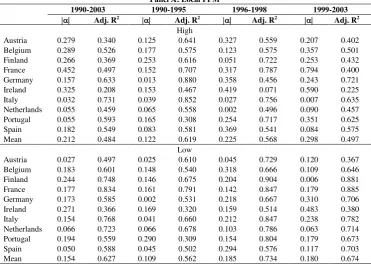
CAPM, concerns its poor results. In fact, the mean alpha of Jensen for 120 portfolios
(10 countries; 3 periods; 4 categories of portfolios) is 0.276%, 0.208%, and 0.225%
respectively for EMU FFM, international FFM, and local FFM (see Panel A, Table 7).
According to Panel B, Table 7 the difference between the mean alpha of Jensen using
EMU and international FFM (0.068%) is statistically significant (p-value = 0.07).
However, the same can not be witnessed when comparing the mean difference of
Jensen’s alphas of EMU FFM and local FFM (0.051%, but p-value = 0.19), as well as
when the results of international and local FFM are confronted (0.018% and p-value =
0.57). Although results not always present statistical significance there are signs that
regressions of local and international FFM present higher explanatory power (higher
adjusted R²) and accuracy (lower absolute intercept) than those obtained using EMU
intercept (adjusted R²) of 0.212% (48.4%), 0.190% (50.0%), and 0.239% (25.8%),
respectively for local, international, and EMU FFM (see Table 5).
As for the CAPM, the debate seems to be concerned to the local and
international FFM. Therefore, the question is whether the introduction of foreign factors
produces better portfolio excess return estimates. If Jensen’s alpha of international FFM
experienced a recent decrease, then we should conclude that there are some signs of
market integration in EMU stock markets. In order to evaluate the impact of different
factors, (i) local FFM results are compared to those obtained for local CAPM, as a
means of assessing local factors (DSMB and SHML), and (ii) international FFM
compares with local FFM, showing how valuable international factors (FMER, FSMB,
and FSMB) are.
The results of local FFM and local CAPM show that there exist some benefits in
employing the first model. In fact, if all country portfolios and sub-periods exhibited in
Tables 3-6, Panels A and B are considered - 120 portfolios (10 countries; 4 portfolios; 3
periods) –the mean Jensen’s alpha for the local CAPM is higher than that obtained for
the local FFM (0.323% and 0.225% respectively). In fact, the difference between both
means (0.097%) is statistically significant (p-value = 0.03), that is, the introduction of
local factors increases model’s accuracy (see panel B, Table 7). This result can also be
extended to explanatory power. The mean adjusted R2 of the local CAPM and FFM for
different portfolios and periods is 47.44% and 61.21% respectively. Thus, the
introduction of size and financial distress premiums seem to be important to produce
more accurate results, or in other words, as a means of reducing the asset pricing errors.
However, the benefit of using both premiums is not similar for all portfolios. While for
errors, the opposite occurs when analyses refer to H and S. Hence, the difference on
mean’s asset pricing error of portfolios H, L, S, and B – estimates are based on periods
and countries, that is 30 observations by category of portfolio – of using local FFM
instead of local FFM is -0.163% (p-value = 0.02), -0.014% (p-value = 0.62), -0.250%
(p-value = 0.07), and 0.038% (p-value = 0.12) respectively (see Panel B, Table 7). Thus,
there are signs to indicate that local FFM is more useful when someone is evaluating a
portfolio of small and high book-to-market firms.
Concerning local and international FFM, the results show that there is a slight
increase in terms of explanatory power and accuracy. The average adjusted R² of the
120 portfolios is 62.17% and 61.21%, respectively for international and local FFM. The
adjusted R² difference between the international and local FFM is 0.96%
(62.17%-61.21%), on average, as a result of the inclusion of the three international factors, while
the difference between the local FFM and local CAPM is 13.77% (61.21%-47.44%).
However, the difference between the mean Jensen’s alpha of both models (-0.018%) is
statistically insignificant (p-value = 0.57). Contrarily to the comparison between local
FFM and local CAPM there is no difference between the mean Jensen’s alpha for
different categories of portfolios. The difference on mean of Jensen’s alpha for
portfolios H, L, S, and B is -0.035%, -0.008%, -0.021%, and -0.006% respectively (see
Panel D, Table 7).
Summing up, whilst the role of International FFM seems to be less relevant than
would be expected, local FFM produces better expected portfolio excess returns
estimates than local CAPM.
Although the impact of foreign factors in portfolio excess return is reduced, it is
each stock market. For that purpose we use the difference between the mean Jensen’s
alpha of international and local FFM as dependent variable, and the average market
capitalisation share of each market relative to each sub-period, as the independent
variable.
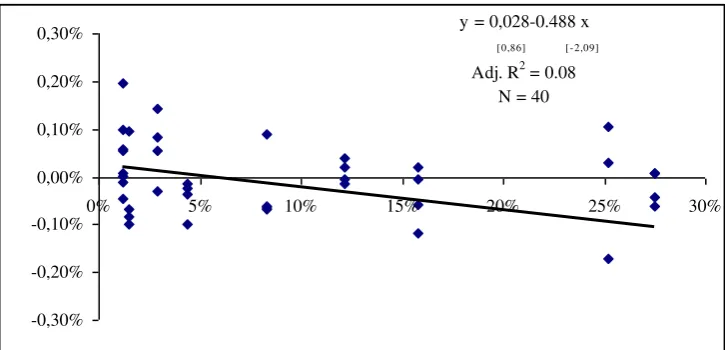
Figure 1 shows that the difference between mean of Jensen’s alpha of
international and local FFM increases with the stock market capitalisation share,
regardless of the period being considered. That is, the larger the stock market is the
higher difference on mean Jensen’s alpha of international and local FFM is. The market
share coefficient is statistical significant at the 10% level (t-statistic = -1.73). However,
the impact of size is higher in the last sub-period (see Figure 2). That is, the use of
international FFM produces lower asset pricing errors in last sub-period for large capital
markets. In fact, the market share coefficient, on one hand, is statistically significant in
the last sub-period (t-statistic = -2.09), and on the other hand, size has more impact on
changing in asset pricing errors (-0.157 in all period compared to -0.488). Thus, there
are some signs of financial integration in large capital markets from EMU, in
comparison to small capital markets, particularly after the introduction of single
currency. In fact, results from using foreign factors in large capital markets outperform
the smallest ones.
3.4. Individual Stock Analysis: Local CAPM and Local and International FFM
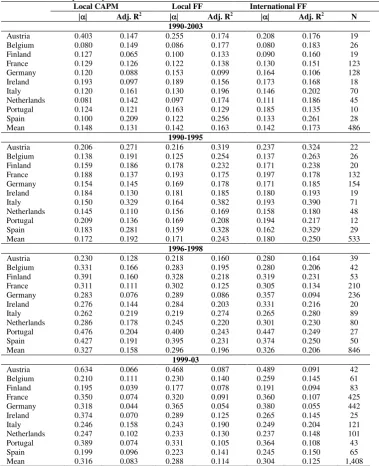
Table 8 displays the results for individual stock excess returns using the local CAPM,
local FFM, and international FFM. The main objective of comparing local CAPM and
comparison between local and international FFM claims to evaluate the level of
integration in firms with different characteristics. For a firm to be included in the
sample it is necessary to have significant data, at least, during one sub-period. Hence,
there are data for 486 stocks during the sample period and 533, 846, and 1,408 for each
sub-period.
Table 8 demonstrates how size and book-to-market premium are valuable in
order to explain excess stock return, comparing local FFM to local CAPM. Regressions
for the 1990-2003 period show a 3.2% (16.3%-13.1%) increase on adjusted R², on
average, and a 0.006% (0.142%-0.148%) decreases in the absolute intercept.5
Comparing the local and international FFM results we can observe a slight increase in
explanatory power (1% = 17.3%-16.3%), and a similar absolute intercept (0.142%).
Thus, either for portfolio, or for stocks, particularly to the former, the introduction of
local premiums improves the modelling accuracy and explanatory power, contrarily to
foreign premiums, whose value is ambiguous.
In the first sub-period, local FFM regressions present an explanatory power on
average 5.1% (24.3%-19.2%) higher than local CAPM regressions, as well as a lower
absolute intercept (-0.001% = 0.171%-0.172%). In the second sub-period, the adjusted
R² increases 3.8% (19.6%-15.8%) and an intercept decrease of 0.031%
(0.296%-0.327%) if local factors were included. Finally from 1999 to 2003, explanatory power
changes 3.1% (11.4%-8.3%) increase in explanatory power and accuracy 0.028%
(0.288%-0.316%).
The inclusion of international factors, on average, and in comparison with local
FFM, produces a reduced impact on the regression explanatory power, 0.7%
5
24.3%), 1% (20.6%-19.6%) and 1.1% (12.5%-11.4%), respectively in the first, second
and the third sub-periods. In regard to intercept, the introduction of international factors
produces the average following variation, 0.009% (0.180%-0.171%), 0.030%
(0.326%-0.296%) and 0.016% (0.304%-0.288%). Thus, the use of international FFM to estimate
stock excess return seems inappropriate since asset pricing errors increase with the
inclusion of foreign factors. The inclusion of new firms in our sample, some of them
with non-synchronous trading, explains why intercept increases, on average, throughout
the sample.
4. Out-of-Sample Analysis: Firm and Portfolio Analysis
In this section, the results obtained through local CAPM and local and international
FFM are used to evaluate if there are differences when portfolio and firm expected
returns are being forecasted.
EMU FFM is not considered in this section because prior results, in the line of
those obtained by Griffin (2002) and Moerman (2005), show that EMU FFM
underperform all specifications in terms of pricing error and explanatory power.
1.4.1. Expected Cost of Capital
Table 9 presents estimates for the cost of equity by firm. Annual estimates for a firm’s
cost of equity are obtained using weekly average returns from 1990 to 2003. Following
assumptions are applied: (1) only firms whose systematic risk is statistically significant
local annual risk premium is on the interval {E[RPannual] 1.5 annualRP}; (3) intercept
terms are excluded because estimates of cost of equity are more accurate under such
circumstance (see Fama and French (1997)). Thus, on average, the sample considers
estimates for cost of equity in 578 firms. France and Ireland are the countries most and
least represented in the sample with 156 and 11 firms respectively.
Table 9 shows that the expected stock excess return in some small stock markets
underperforms those obtained for large stock markets, namely in Austria, Belgium and
Portugal. The results vary from 4.55% to 6.55%, on average. In the opposite extreme of
our sample are Finland, Ireland, and Netherlands whose estimates are always higher
than 9.25%, whatever the specification used. Contrarily to expected, the cost-of capital
is smaller for firms of small countries because the sample of those countries include
comparatively a large percentage of big firms.
The difference obtained for local CAPM and FFM estimates are relatively
comparable with Fama and French (1997). In their research, comparing local CAPM
and FFM, they find a 2% difference in the cost of equity for seventeen industries. In our
research, estimates for both models are different in 1.03% (9.30%-8.27%), in average.
Although there are countries where such difference is higher than 2.5%, on average,
such as is the case in Finland and Netherlands, there are also countries where there is no
difference in the estimates for cost of equity, namely for Italy. However, those results
must be analysed with caution, because they are dependent of the sample of firms. For
example, if a large firm is selected, a lower cost of equity using FFM is expected since
it will have a size discount.
The comparison between estimates for cost of equity, using local and
((10.07%-9.30%)/9.30%). However, the results are not similar around the sample.
While in Germany a 0.22% difference ((9.20%-9.22%)/9.22%) between estimates for
both models is identified, in Italy a 27.87% difference is observed.
Summing up, our results are in line with the conclusion of Griffin (2002), who
concludes that the choice of a local or international FFM has a significant impact on the
cost of equity estimates.
1.4.2. Out-of-Sample Analysis: Firm and Portfolio Analysis
In this section the sample of firms and assumptions presented in 1.4.1 is used. Its main
objective is to forecast errors of stock and portfolio excess returns. That is, the
difference between weekly average return and the weekly expected return of a stock (or
a portfolio), during a year. Errors are forecasted based on weekly mean estimates of a
year, during 1991 to 2004. Expected average return of a stock or a portfolio, during a
year, is calculated based on estimates obtained for different specifications (local CAPM,
local FFM, and international FFM) in the year before forecasting a error. For example,
to forecast an error of stock excess return in 1991 it is necessary to estimate different
specifications during 1990.
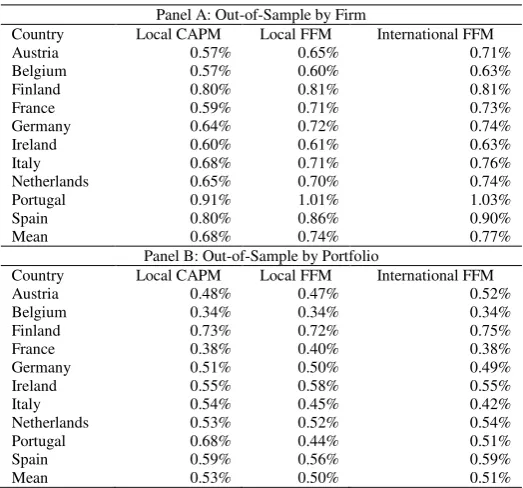
Panel A of Table 10 presents forecasted errors of stock excess returns. For that
purpose the following expression is used:
T
t n
i
it it E r
r N
T 1 1
) ( 1
1
where ritis the weekly average return of a stock i in year t and E(rit) is the expected
stock return for the same period, using the previous models, as well as prior
assumptions. N is the number of stocks.
On the other hand, in Panel B are presented forecasted errors of portfolio excess
return, in value weighted-basis, considering the stocks used in Panel A:
T
i n
i
it it
it T
t n
i it
r E r MV
MV 1 1
1 1
) ( (
1
(1.5)
where MVi is the average market capitalisation of a firm i in year t.
Analysing the forecasted errors, size and distress risk premium seem to be more
advisable factors to evaluate portfolio than stock excess returns. In fact, the introduction
of those two factors produces more accurate estimates for portfolios, because while the
use of local FFM in comparison with local CAPM produces, on average, a decrease of
8.82% for stocks - ((0.74%-0.68%)/0.68%) - in terms of accuracy, for portfolios we
observe an increase of 5.66% - ((0.50%-0.53%)/0.53%).
On the other hand, comparing local and the international FFM there is a small
difference in terms of forecasting power, although international FFM presents poorer
results. In fact, the introduction of the three new factors increases the amplitude of
forecasted errors. Forecasted errors change, on average, from 0.74% to 0.77% and from
0.50% to 0.51%, respectively in case of excess stock returns and excess portfolio
1.5. Conclusion
The main objective of this research is to evaluate whether the biggest stock markets of
EMU are becoming centralised and the smallest peripheral. For that purpose, different
alternative CAPM and FFM specifications are compared, which consider different local
and foreign factors.
In line with Griffin (2002) and Moerman (2005), this research shows that models
based on global factors are less accurate than models based on local and foreign factors.
There are also important signs to illustrate that international factors produce
more accurate estimates in larger capital markets, particularly after the introduction of
single currency. Thus, it seems that the largest firms are becoming integrated between
themselves, and the smallest are becoming segmented.
This paper also shows that the choice of model’s specification has a significant
impact on the cost-of-equity estimates, as Fama and French (1997) and Griffin (2002)
conclude.
Finally, results reveal that the use of domestic size and book-to-market risk seem
to be more advisable factors to consider for portfolio than for firm. International factors,
on the other hand, seem to be inadequate to estimate either portfolio or stock excess
References
Adjaouté, K., and J. Danthine, 2003, European financial integration and equity returns: A theory-based assessment, Working Paper, International Center for Financial Asset Management and Engineering.
Bhandari, L., 1988, Debt/Equity Ratio and Expected Common Stock Returns: Empirical Evidence, Journal of Finance, 1988, 43, 507-528
Banz, R., 1981, The relation between return and market value of common stocks, Journal of Financial Economics 9, 3-18.
Basu, S., 1977, Investment performance of common stocks in relation to their price-earnings: A test of the efficient market hypothesis, Journal of Finance 32, 663-682.
Bekaert, G., and C. Harvey, 1995, Time-varying world market integration, Journal of Finance 32, 663-682.
Berk, J., 1995, A critique of size-related anomalies, Review of Financial Studies 8, 275-286.
Brunner, R., K. Eades, R. Harris, and R. Higgins, 1998, Best practices in estimating the cost of capital: Survey and synthesis, Financial Practice and Education 8, 13-28.
Carvalho, C., 2004, Cross-border securities clearing and settlement infrastructure in the European Union as a prerequisite to financial markets integration: Challenges and perspectives, Working Paper, Hamburg Institute of International Economics.
Chan, L., Y. Hamao, and J. Lakonishok, 1991, Fundamentals and stock returns in Japan, Journal of Finance 46, 1739-1764.
Dahlquist, M., L. Pinkowitz, R. Stulz, and R. Wlliamson, 2003, Corporate governance and the home bias, Journal of Financial and Quantitative Analysis 38, 87-110.
Damodaran, A., 1992, Investment valuation (John Wiley).
Errunza, V., and D. Miller, 2000, Market segmentation and the cost of capital in international equity markets, Journal of Financial and Quantitative Analysis 35, 577-600.
Errunza, V., and E. Losq, 1985, International asset pricing under mild segmentation: Theory and test, Journal of Finance 40, 105-124.
Fama, E., and K. French, 1993, Common risk factors in the returns on stocks and bonds, Journal of Financial Economics 33, 3-56.
Fama, E., and K. French, 1998, Value versus growth: The international evidence, Journal of Finance 53, 1975-1999.
Fratzscher. M., 2001, Financial market integration in Europe: On the effects of EMU on stock markets, Working Paper, European Central Bank.
Graham, J., and C. Harvey, 2001, The theory and practice of corporate finance: Evidence from the field, Journal of Financial Economics 60, 187-243.
Griffin, J., 2002, Are the Fama and French factors global or country specific?, Review of Financial Studies 15, 187-243.
Grinblatt, M., and M. Keloharju, 2001, How distance, language, and culture influence stock-holdings and trades, Journal of Finance 56, 1053-1073.
Hardouvelis, G., D. Malliaropulos, and R. Priestley, 2001, EMU and European stock market integration, http://ssrn.com/abstract=280775.
Hardouvelis, G., D. Malliaropulos, and R. Priestley, 2004, The impact of globalization on the equity cost of capital, Working Paper, Center for Economic and Policy Research.
Harvey, C., 1991, The world price of covariance risk, Journal of Finance 46, 111-157.
Harvey, C., 1995, Predictable risk and returns in emerging markets, Review of Financial Studies 8, 773-816.
Jorion, P., and E. Schwartz, 1986, Integration vs segmentation in the Canadian stock market, Journal of Finance 41, 603-614.
Kang, J., and R. Stulz, 1997, Why there is a home bias? An analysis of foreign portfolio equity ownership in Japan, Journal of Financial Economics 46, 3-28.
Karolyi, G., 1998, Why do companies list shares abroad?: A survey of the evidence and its managerial implications, Financial Markets, Institutions & Instruments 7, Number 1.
Lakonishok, J., A. Shleifer, and R. Vishny, 1994, Contrarian investment, extrapolation, and Risk, Journal of Finance 49, 1541-1578.
Lintner, J., 1965, The valuation of risk assets and the selection of risky investments in stock portfolios and capital budgets, Review of Economics and Statistics 47, 13-37.
Moerman, G., 2005, How domestic is the Fama and French three-factor model? An application to the Euro area, Working Paper, Erasmus Research Institute of Management.
Newey, W., and K. West, 1987, A simple, positive semi-definite, heteroskedasticity and autocorrelation consistent covariance matrix, Econometrica 55, 703-708.
Sharpe, W., 1964, Capital asset prices: A theory of capital market equilibrium under conditions of risk, Journal of Finance 19, 425-442.
Solnik, B., 1974, The international pricing of risk: An empirical investigation of the world capital market structure, Journal of Finance 29, 365-378.
Stehle, R., 1977, An empirical test of the alternative hypothesis of national and international pricing of risky assets, Journal of Finance 32, 365-378.
Table 1: Sample Description by Countries
AU, BG, FL, FR, GR, IR, IT, NL, PT, and SP are respectively Austria, Belgium, Finland, France, Germany, Ireland, Italy, the Netherlands, Portugal, and Spain. Panel A shows Datastream country weights in the EMU portfolio. Panel B indicates annual average number of firms by period used to build the size and the distress risk premiums. Panel C indicates the median size of firms in Panel B. Panels D indicates the median book-to-market of firms in Panel B.
Panel A: Datastream Country Weights (%)
AU BG FL FR GR IR IT NL PT SP
1990-03 1.2 4.3 2.9 25.2 27.5 1.4 12.1 15.7 1.2 8.3 1990-95 1.6 4.8 1.5 24.6 31.1 1.2 10.6 15.8 0.8 8.0 1996-98 1.2 4.5 2.5 23.0 27.6 1.5 11.7 18.2 1.6 8.3 1999-03 0.8 3.7 4.7 27.3 23.2 1.7 14.3 14.2 1.4 8.8
Panel B: Number of Firms
AU BG FL FR GR IR IT NL PT SP
1990-03 39 52 68 350 391 25 114 88 34 60
1990-95 28 33 30 147 216 20 78 64 17 41
1996-98 41 47 65 347 335 22 100 88 38 57 1999-03 51 78 115 559 635 32 165 117 54 86
Panel C: Median Market Capitalisation by Firm (€ millions)
AU BG FL FR GR IR IT NL PT SP
1990-03 45 131 112 65 63 97 148 145 47 262 1990-95 55 108 128 110 87 46 109 110 48 203 1996-98 37 138 146 88 71 136 132 190 39 219 1999-03 45 127 95 50 52 179 176 155 53 333
Panel D: Median Book-to-Market by Firm
AU BG FL FR GR IR IT NL PT SP
Table 2: Descriptive Statistics of Variables
Domestic market excess return (DMER) is obtained, considering a DS country indices and Germany Euro-mark one month, as proxies for market return and risk-free-asset. Small minus big (DSMB) is the return difference between S (small firms) and B (big firms) domestic portfolios. High minus low (DHML) is the return difference between H (high book-to-market firms) and L (low book-to-market firms) domestic portfolios. EMU results are value-weighted. Variables are weekly means, calculated on a value-weighted basis, for the following four periods: 1990-1995; 1996-1998; 1999-2003; and 1990-2003. Results are a weekly percentage.
DMER SMB HML
Mean Stdev Mean Stdev Mean Stdev Panel A: 1990-2003
Austria -0.025 1.707 0.067 2.311 0.234 2.572 Belgium 0.000 2.436 0.128 2.026 0.050 2.258 Finland 0.220 4.538 0.148 2.810 -0.102 3.207 France 0.045 2.770 0.281 3.163 0.144 3.479 Germany 0.010 2.724 0.140 2.044 0.259 1.880 Ireland 0.090 2.615 0.055 2.878 0.056 2.917 Italy 0.018 3.131 0.108 2.059 0.000 2.262 Netherlands 0.055 2.545 0.097 2.056 -0.004 2.178 Portugal -0.017 2.352 0.078 2.394 -0.092 2.677 Spain 0.080 2.699 0.014 2.236 0.249 2.365 E.M.U. 0.053 2.433 0.142 1.735 0.120 1.638
Panel B: 1990-1995
Austria -0.159 2.926 -0.005 2.195 0.055 2.517 Belgium -0.137 1.756 -0.024 1.813 0.059 1.709 Finland -0.019 3.597 0.162 2.871 -0.104 2.812 France -0.131 2.231 0.066 2.067 0.059 1.421 Germany -0.108 2.092 0.105 1.390 0.102 1.299 Ireland -0.020 2.515 0.004 2.532 0.175 3.000 Italy -0.176 3.025 0.105 1.956 -0.021 2.108 Netherlands -0.017 1.572 0.034 1.504 0.051 1.866 Portugal -0.218 1.876 0.041 2.480 -0.149 2.753 Spain -0.078 2.506 -0.132 2.286 0.258 2.443 E.M.U. -0.094 1.763 0.056 1.093 0.061 0.799
Panel C: 1996-1998
Austria 0.121 2.319 0.024 2.237 -0.116 2.561 Belgium 0.561 2.183 0.552 2.389 -0.412 2.947 Finland 0.853 3.615 0.120 2.228 -0.563 2.565 France 0.496 2.621 0.017 1.905 -0.109 1.609 Germany 0.434 2.560 -0.096 1.937 0.112 1.499 Ireland 0.561 2.621 0.064 1.912 -0.131 2.467 Italy 0.606 3.393 -0.001 2.372 0.004 2.439 Netherlands 0.531 2.723 0.118 1.642 -0.548 1.592 Portugal 0.643 3.086 -0.021 2.671 -0.127 2.797 Spain 0.655 2.912 0.265 2.190 -0.161 2.092 E.M.U. 0.533 2.423 0.048 1.348 -0.127 0.815
Panel D: 1999-2003
Table 3: Excess Returns of High and Low Portfolios using CAPM
High and Low portfolios excess returns are dependent variables. They represent the top and bottom quintile. Variables are value-weighted, calculated on a weekly basis for the following periods: 1990-1995; 1996-1998; 1999-2003, and 1990-2003. DS country indices are used as local market proxy. Germany Euro-Mark one-month is the risk-free asset proxy. The method of estimation is ordinary least squares, using the Newey and West (1987) covariance estimator that is consistent in the presence of both heteroskedasticity and autocorrelation of unknown form. Domestic Model is a result of regression ri,t= i + b Di(wDt-1DMERt) + εi,t,
where ri,t is the portfolio (High or Low) excess return in period t, DMER is the domestic excess return, and
is a constant. wDt-1is the weight of a local portfolio in EMU. b Diis the unconditional sensitivity of asset i to
the factor. EMU Model is a result of regression: ri,t = i+ bi(EMERt) + εi,t, where EMERt represents the EMU
factor. It is also calculated using a value-weighted basis. EMERt= wDt-1DMERt+ wFt-1FMERt, where wDt-1 and
wFt-1are respectively the weight of local and foreign portfolios in the EMU portfolio in the week t-1.
International Model is the result of regression: ri,t= i+ b Di(wDt-1 DMERt) + b Fi (wFt-1FMERt) + εi,t.
Panel A: Local CAPM
1990-2003 1990-1995 1996-1998 1999-2003 Adj. R2 Adj. R2 Adj. R2 Adj. R2
High
Austria 0.382 0.229 0.153 0.594 0.354 0.085 0.674 0.071 Belgium 0.293 0.387 0.254 0.432 0.014 0.531 0.521 0.318 Finland 0.335 0.080 0.253 0.459 0.171 0.506 0.377 0.055 France 0.455 0.444 0.205 0.556 0.217 0.556 0.813 0.373 Germany 0.404 0.350 0.058 0.843 0.446 0.230 0.891 0.186 Ireland 0.504 0.046 0.202 0.206 0.579 -0.003 0.934 0.044 Italy 0.013 0.589 0.031 0.729 0.078 0.631 0.066 0.475 Netherlands 0.052 0.236 0.029 0.251 0.224 0.428 0.383 0.204 Portugal 0.482 0.009 0.001 0.102 1.421 -0.005 0.897 0.025 Spain 0.319 0.409 0.169 0.518 0.513 0.403 0.407 0.323 Mean 0.324 0.278 0.135 0.469 0.402 0.336 0.596 0.208
Low
Panel B: International CAPM
1990-2003 1990-1995 1996-1998 1999-2003 Adj. R2 Adj. R2 Adj. R2 Adj. R2
High
Austria 0.371 0.235 0.151 0.593 0.329 0.082 0.710 0.085 Belgium 0.288 0.389 0.003 0.443 0.012 0.529 0.515 0.317 Finland 0.352 0.165 0.290 0.473 0.194 0.513 0.429 0.129 France 0.453 0.444 0.203 0.557 0.237 0.556 0.840 0.387 Germany 0.409 0.351 0.060 0.845 0.418 0.230 0.891 0.183 Ireland 0.504 0.045 0.210 0.205 0.624 -0.003 0.934 0.041 Italy 0.008 0.591 0.030 0.728 0.091 0.630 0.067 0.473 Netherlands 0.068 0.268 0.017 0.286 0.275 0.469 0.329 0.227 Portugal 0.476 0.012 0.003 0.101 1.321 -0.004 0.889 0.023 Spain 0.319 0.408 0.175 0.517 0.493 0.414 0.407 0.322 Mean 0.325 0.291 0.114 0.475 0.399 0.341 0.601 0.219
Low
Austria 0.034 0.436 0.000 0.489 0.061 0.679 0.247 0.347 Belgium 0.163 0.532 0.145 0.474 0.382 0.632 0.022 0.513 Finland 0.215 0.750 0.158 0.619 0.321 0.876 0.057 0.877 France 0.185 0.808 0.145 0.769 0.141 0.770 0.226 0.844 Germany 0.073 0.548 0.125 0.309 0.110 0.621 0.297 0.679 Ireland 0.245 0.382 0.157 0.260 0.103 0.495 0.469 0.354 Italy 0.120 0.688 0.030 0.618 0.163 0.744 0.206 0.703 Netherlands 0.067 0.701 0.067 0.601 0.164 0.782 0.033 0.702 Portugal 0.182 0.564 0.341 0.224 0.148 0.803 0.144 0.672 Spain 0.040 0.530 0.095 0.481 0.375 0.499 0.158 0.572 Mean 0.132 0.594 0.126 0.484 0.197 0.690 0.186 0.626
Panel C: EMU CAPM High
Austria 0.333 0.084 0.109 0.225 0.286 0.059 0.788 0.051 Belgium 0.259 0.269 0.191 0.323 0.121 0.391 0.441 0.214 Finland 0.363 0.163 0.420 0.155 0.044 0.379 0.428 0.132 France 0.440 0.397 0.191 0.385 0.198 0.448 0.843 0.389 Germany 0.380 0.277 0.047 0.696 0.396 0.223 0.882 0.169 Ireland 0.534 0.016 0.254 0.079 0.669 -0.006 0.913 0.017 Italy 0.038 0.370 0.077 0.340 0.097 0.429 0.023 0.397 Netherlands 0.076 0.265 0.044 0.263 0.271 0.466 0.324 0.230 Portugal 0.481 0.012 0.099 0.026 1.290 -0.005 0.787 0.011 Spain 0.360 0.282 0.221 0.316 0.573 0.352 0.402 0.265 Mean 0.326 0.213 0.165 0.281 0.394 0.274 0.583 0.187
Low
Table 4: Excess Returns of Small and Big Portfolios using CAPM
Small and Big portfolios excess returns are dependent variables. They represent the top and bottom quintile. Variables are value-weighted, calculated on a weekly basis for the following periods: 1990-1995; 1996-1998; 1999-2003, and 1990-2003. DS country indices are used as local market proxy. Germany Euro-Mark one-month is the risk-free asset proxy. The method of estimation is ordinary least squares, using the Newey and West (1987) covariance estimator that is consistent in the presence of both heteroskedasticity and autocorrelation of unknown form. Domestic Model is a result of regression ri,t = i+ b Di(wDt-1DMERt) + εi,t, where ri,t is the portfolio (High or Low) excess
return in period t, DMER is the domestic excess return, and is a constant. wDt-1is the weight of a local portfolio in
EMU. b Diis the unconditional sensitivity of asset i to the factor. EMU Model is a result of regression: ri,t = i+ bi
(EMERt) + εi,t, where EMERt represents the EMU factor. It is also calculated using a value-weighted basis. EMERt=
wDt-1DMERt+ wFt-1FMERt, where wDt-1and wFt-1are respectively the weight of local and foreign portfolios in the
EMU portfolio in the week t-1. International Model is the result of regression: ri,t = i + b Di(wDt-1DMERt) + b Fi(wFt-1
FMERt) + εi,t.
Panel A: Local CAPM
1990-2003 1990-1995 1996-1998 1999-2003 Adj. R2 Adj. R2 Adj. R2
Small
Austria 0.362 0.062 0.045 0.388 0.099 0.039 1.066 -0.003 Belgium 0.255 0.084 0.189 0.107 0.349 0.252 0.181 0.014 Finland 0.570 0.037 0.129 0.191 0.732 0.114 0.868 0.023 France 0.530 0.254 0.179 0.127 0.499 0.270 0.965 0.314 Germany 0.654 0.123 0.049 0.330 0.715 0.133 1.326 0.069 Ireland 1.250 0.011 0.259 0.076 0.849 -0.002 2.774 0.006 Italy 0.370 0.205 0.019 0.520 0.670 0.211 0.629 0.097 Netherlands 0.233 0.204 0.076 0.237 0.398 0.249 0.360 0.178 Portugal 0.927 0.010 0.016 0.118 1.162 0.029 2.133 0.006 Spain 0.599 0.118 0.265 0.227 1.217 0.117 0.561 0.044 Mean 0.575 0.111 0.123 0.232 0.669 0.141 1.086 0.075
Big
Panel B: International CAPM
1990-2003 1990-1995 1996-1998 1999-2003 Adj. R2 Adj. R2 a Adj. R2 a Adj. R2
Small
Austria 0.363 0.061 0.042 0.387 0.108 0.033 1.073 -0.007 Belgium 0.252 0.085 0.187 0.112 0.347 0.248 0.178 0.011 Finland 0.581 0.062 0.143 0.191 0.696 0.139 0.919 0.037 France 0.522 0.271 0.187 0.193 0.472 0.284 0.974 0.315 Germany 0.653 0.122 0.052 0.350 0.693 0.130 1.328 0.068 Ireland 1.252 0.011 0.269 0.074 0.905 0.002 2.776 0.007 Italy 0.368 0.204 0.027 0.530 0.669 0.206 0.624 0.095 Netherlands 0.240 0.218 0.081 0.236 0.385 0.249 0.319 0.211 Portugal 0.919 0.013 0.031 0.160 1.139 0.024 2.117 0.004 Spain 0.603 0.119 0.292 0.236 1.175 0.129 0.561 0.041 Mean 0.575 0.116 0.131 0.247 0.659 0.144 1.087 0.078
Big
Austria 0.085 0.774 0.137 0.867 0.040 0.808 0.026 0.650 Belgium 0.071 0.732 0.104 0.763 0.131 0.740 0.005 0.703 Finland 0.165 0.783 0.086 0.751 0.019 0.957 0.073 0.923 France 0.168 0.954 0.100 0.966 0.165 0.958 0.236 0.959 Germany 0.098 0.917 0.021 0.945 0.075 0.899 0.231 0.942 Ireland 0.188 0.624 0.181 0.688 0.138 0.662 0.286 0.593 Italy 0.065 0.836 0.041 0.868 0.094 0.841 0.209 0.874 Netherlands 0.064 0.905 0.020 0.944 0.059 0.923 0.184 0.910 Portugal 0.135 0.487 0.218 0.373 0.271 0.809 0.201 0.685 Spain 0.068 0.790 0.056 0.775 0.121 0.874 0.093 0.773 Mean 0.111 0.780 0.096 0.794 0.111 0.847 0.155 0.801
Panel C: EMU CAPM Small
Austria 0.335 0.010 0.072 0.173 0.067 0.015 1.081 -0.003 Belgium 0.243 0.064 0.170 0.092 0.407 0.193 0.170 0.011 Finland 0.596 0.060 0.218 0.051 0.726 0.138 0.933 0.040 France 0.520 0.269 0.188 0.194 0.468 0.283 0.986 0.311 Germany 0.642 0.106 0.049 0.333 0.673 0.127 1.321 0.055 Ireland 1.270 0.009 0.308 0.030 0.959 -0.006 2.768 0.010 Italy 0.353 0.146 0.002 0.325 0.665 0.136 0.605 0.090 Netherlands 0.249 0.210 0.111 0.163 0.391 0.232 0.326 0.213 Portugal 0.930 0.011 0.045 0.106 1.171 0.016 2.028 0.003 Spain 0.631 0.095 0.321 0.184 1.229 0.127 0.558 0.036 Mean 0.577 0.098 0.148 0.165 0.676 0.126 1.078 0.077
Big
Table 5: Excess Returns of High and Low Portfolios using FFM
High and Low portfolios excess returns are dependent variables. They represent the top and bottom quintile. Variables are value-weighted, calculated on a weekly basis for the following periods: 1990-1995; 1996-1998; 1999-2003, and 1990-2003. DS country indices are used as local market proxy. Germany Euro-Mark one-month is the risk-free asset proxy. The method of estimation is ordinary least squares, using the Newey and West (1987) covariance estimator that is consistent in the presence of both heteroskedasticity and autocorrelation of unknown form. Domestic Model is a result of regression ri,t = i+ b Di(wDt-1DMERt) + sD i(wDt-1DSMBt) + h Di(wD t-1DHMLt) + εi,t, where ri,t is the portfolio (High or Low) excess return in period t, DMER is the domestic excess
return, DSMB is the return difference between S (local small firms) and B (logal big firms), DHML is the return difference between H (high book-to-market firms) and L (low book-to-market firms), and is a constant. wDt-1is
the weight of a local portfolio in EMU. b Di, sDi,, and h Di are the unconditional sensitivities of asset i to the factors. EMU Model is a result of regression: ri,t = i+ bi(EMERt) + si(ESMBt) + hi(EHMLt) + εi,t, where
EMERt ESMB, and EHML represent EMU factors. They are calculated considering the countries weight in the EMU portfolio. Thus, we have, for example, EMERt= wDt-1DMERt+ wFt-1FMERt, where wDt-1and wFt-1are
respectively the weight of local and foreign portfolios in the EMU portfolio in the week t-1. International Model is the result of regression: ri,t = i+ b Di(wDt-1DMERt) + sD i(wDt-1DSMBt) + h Di(wDt-1DHMLt) + b Fi(wFt-1
FMERt) + sF i(wFt-1FSMBt) + h Fi(wFt-1FHMLt) + εi,t.
Panel A: Local FFM
1990-2003 1990-1995 1996-1998 1999-2003 Adj. R2 Adj. R2 Adj. R2 Adj. R2
High
Austria 0.279 0.340 0.125 0.641 0.327 0.559 0.207 0.402 Belgium 0.289 0.526 0.177 0.575 0.123 0.575 0.357 0.501 Finland 0.266 0.369 0.253 0.616 0.051 0.722 0.253 0.432 France 0.452 0.497 0.152 0.707 0.317 0.787 0.794 0.400 Germany 0.157 0.633 0.013 0.880 0.358 0.456 0.243 0.721 Ireland 0.325 0.208 0.153 0.467 0.419 0.071 0.590 0.225 Italy 0.032 0.731 0.039 0.852 0.027 0.756 0.007 0.635 Netherlands 0.055 0.459 0.065 0.558 0.002 0.496 0.090 0.457 Portugal 0.055 0.593 0.165 0.308 0.254 0.717 0.351 0.625 Spain 0.182 0.549 0.083 0.581 0.369 0.541 0.084 0.575 Mean 0.212 0.484 0.122 0.619 0.225 0.568 0.298 0.497
Low