Running with the PAC
C
C
C
Abstract
The mobile phone games market is currently dominated by the single player titles that merely use the phone as a computing platform and ignore the possibilities for innovation provided by the phone’s inherent mobility and connectivity. One new game genre that does utilize these features are the so-called ‘location based games’ which allow players to interact in a game space which is a mixture of real and virtual worlds. The emergence of mobile phones that incorporate an RFID reader offer the new possibility of interacting with real physical objects, in addition to real locations, within a game world providing enhanced game play and experience. In this paper we present details of our mobile location based game which is a novel version of the Namco arcade classic Pacman. This game highlights the possibilities that combining the pervasive technologies of mobile phones and RFID will yield for new
entertainment experiences.
Keywords
mobile, location based game, RFID, Pacman, mixed reality, user experience
ACM Classification Keywords
J. Computer Applications, J.7 Computers in Other Systems-Consumer.
Copyright is held by the author/owner(s). FNG2006, June 26–28, 2006, Preston, England. ACM 1-xxxxxxxxxxxxxxxxxx.
Paul Coulton
Informatics Infolab21
Lancaster University Lancaster, LA1 4WA, UK [email protected]
Omer Rashid
Informatics Infolab21
Lancaster University Lancaster, LA1 4WA, UK [email protected]
Will Bamford
Informatics Infolab21
Lancaster University Lancaster, LA1 4WA, UK [email protected]
Reuben Edwards
Informatics Infolab21
Introduction
Although we often consider the requirement for providing the location of a mobile user as a new problem, in fact all mobile phone systems effectively track a user’s whereabouts at the cellular level. Each cell site has a unique Cell-ID which enables the system to locate a mobile user so that it can route calls to the correct cell. To enable higher degrees of accuracy, other techniques treat location finding as a relative exercise, in other words the location of the mobile user must be estimated against some known framework. This framework could be elements such as the locations of the base stations of a mobile phone network or the satellites of the Global Positioning System (GPS). An alternative approach is to ascertain location from the user’s interaction with objects of known location where their position can then be implied. The interaction could be proximity within a physical area using
communication technologies such as WiFi or Bluetooth [6] or down to object level using one of the various forms of two dimensional (2D) bar codes, such as QR codes [3], or Radio Frequency Identification (RFID). The advantage of 2D barcodes and RFID is that they can be passive solutions in that they do not require a power source in the object itself. All of the 2D barcode systems use a phone with an on-board camera to either decode the 2D barcode on the phone or through interaction with an online database. With the
appearance of RFID readers onto phones [8] and the advent of Near Field Communications (NFC) [2], RFID tags offer superior performance to these two
dimensional barcodes in that they provide
faster read time as the tags can be accessed at rates between 106, 212, or 424 kbits/s, whereas the 2D barcodes require a picture to be taken then the
image processed which we found can often take a few seconds
RFID tags can be written to as well as read from
simpler reading method as the phone and the tag have merely to be placed in close proximity (less than 3cm) whereas the barcodes require the user to take a picture. In fact the phone and RFID tags used in this project come with round target icons to simplify positioning
greater robustness as errors are more likely from the picture due to irregular camera orientation.
As it has been predicted that as many as 50% of all phones will incorporate RFID by 2009 [9] this is a practical long term solution and one that will cover both high and low end phone models.
All of the location techniques highlighted in this section have varying degrees of accuracy [7] although only 2D bar codes and RFID tags could reasonably be used to identify not only position but particular types of object.
However, in comparison to all games produced thus far it is fair to say that none have utilized mobile RFID and few have incorporated interaction with physical game objects. To test the applicability of RFID in this area the objectives of this project where to create a readily deployable game platform on which
we can ascertain whether physical objects enhance the user experience
whether RFID produces effective user interaction with those objects
the effectiveness of RFID as a location positioning scheme when the game players are moving quickly; how tactics occur during game play.
In the following sections we highlight the design of the game and quantative analysis of the feedback
experiences of the users who have played the game.
Why Pacman?
Pacman was chosen for a number of reasons
it is widely recognized with simple but compelling game play which means that the concept behind the game can be quickly ascertained by potential players without a complex explanation
the virtual game maze premise transfers readily to a physical location
and, the Pacman character interacts with game elements (the game pills) that can be considered as physical objects at specific locations which is one of the principle advantages that RFID tags can provide.
This is not the first time Pacman has inspired the development of a location based games and the most famous is probably Pac-Manhattan
(www.pacmanhattan.com). However, Pac-Manhattan differs significantly from PAC-LAN in that
it does not incorporate actual physical objects
it uses mobile phones simply to provide a voice link (effectively a walkie talkie arrangement)
the developers chose not to implement a means of location estimation as it was played around the streets of Manhattan which would have acted as urban canyons for systems such as GPS
and the game play of each player was controlled by a human central operator.
We have specifically chosen to avoid incorporating voice calls or SMS, and hence human game controllers, as we wanted to keep the game play as fast as possible and more akin the arcade classic. Although human controllers introduce interesting aspects of trust and acceptance, as explored by games such as Uncle Roy All Around You [4], we felt that their would be a greater possibility of the emergence of spontaneous tactics without a controller.
The other significant implementation has been Human Pacman [1] which uses an innovative combination of virtual reality goggles, GPS receivers, and portable computers with Bluetooth and WiFi access to recreate the game. In terms of differences from PAC-LAN it
only uses one real object used for interaction
is played at a much slower pace due to large amounts of equipment being carried
uses human central operators to control the game play of each player.
Obviously this is highly specialized and expensive technology and in and interview with CNN in November 2004 its creator Dr Adrian Cheok predicted that:
‘Within two years we'll be able to see full commercial Pacman-type games on the mobile phones.’
With the commercial technology presented in this paper this has became a reality in less than a year and an equipment outlay of less than 1500 euros. This will mean that the system can be tested on large numbers of people without concern over equipment costs or the practicalities of running wearing virtual reality goggles.
How Does PAC-LAN work?
PAC-LAN is a version of the video game PACMAN in which human players play the game on a maze based around the Alexandra Park accommodation complex at Lancaster University [5]. One player who takes the role of the main PAC-LAN character collects game pills (using a Nokia 5140 mobile phone equipped with a Nokia Xpress-on™ RFID reader shell), which are in the form of yellow plastic discs fitted with stick-on RFID tags placed around the maze as shown in Figure 1.
Four other players take the role of the ‘Ghosts’ who attempt to hunt down the PAC-LAN player. The game uses a Java 2 Platform Micro Edition (J2ME) application,
[image:4.595.497.730.255.410.2]running on the mobile phone is connected to a central server using a General Packet Radio Service (GPRS) connection. The server relays to the PAC-LAN character his/her current position along with position of all ghosts based on the pills collected. The game pills are used by the Ghosts, not to gain points, but to obtain the PAC-LAN characters last known position and to reset their kill timer which must be enabled to allow them to kill PAC-LAN. In this way the ghosts must regularly interact with the server which is then able to relay their position to the PAC-LAN.
figure 1. PAC-LAN player tagging a game pill with his phone
and Mr. Pink in full flow.
PAC-LAN sees a display with his own position
The Ghosts can ‘kill’ the PAC-LAN character by detecting him/her via an RFID tag fitted on their costume, assuming their kill timer has not run-out. Once PAC-LAN is killed the game is over and the points for the game are calculated in the form of game pills collected and time taken to do so. When PAC-LAN eats one of the red power pills, indicated by all ghost icons turning white on the screen, he/she is then able to kill the Ghosts, and thus gain extra points, using the same RFID detection process. ‘Dead’ ghosts must return to the central point of the game maze where they can be reactivated into the game. Figure 2 shows a number of typical screens the PAC-LAN character will experience throughout the game.
figure 2. PAC-LAN Phone UI
[image:5.595.494.729.195.412.2]The following Figure 3 highlights a simple game scenario for a Ghost player where he/she enters the game after a controlled delay. The Ghost player then attempts to kill PAC-LAN but his kill timer has expired and he/she then falls victim to PAC-LAN who has subsequently obtained a power pill.
figure 3. Ghost Phone UI
The scoring in the game is simple where the PAC-LAN character gets, 50 points for a normal pill, 150 points for a power pill, 1000 points for collecting all the pills, and 500 points for a Ghost kill. The Ghosts get 30 points per pill (this is linked to the length of the kill timer) and 1000 points for killing PAC-LAN. All players lose 1 point per second to ensure they keep tagging. Game maze as shown on phone
screen which indicates the PAC-LAN character is top right
(highlighted by red square) and the positions of the four ghosts
User Experience
In this section we will present a quantative analysis the feedback collected from the eight games of PAC-LAN played at the time of writing. The majority of players were students from Lancaster University and care was taken to select groups from the various faculties across the campus to ensure which did not have a technophile biased sample. In fact 93% of the players expressed no knowledge of RFID prior to playing the game although at the end the same proportion expressed a willingness to use and RFID enabled mobile phone to access other services which is encouraging for the proponents of this technology. One of the surprising results of our
feedback was the related to mobile games playing habits of the players.
0 5 10 15 20 25 30 35 40 45 50
Nev
e
r
Ra
re
ly
M
o
nt
hly
W
eek
ly
Da
ily
% o
f P
A
C-LA
N
p
la
y
e
[image:6.595.496.734.241.354.2]rs
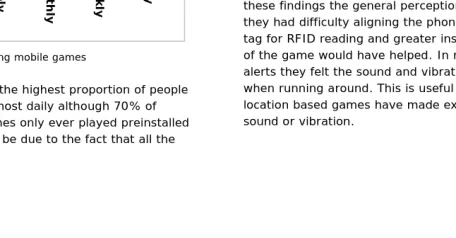
figure 4. Frequency playing mobile games
Figure 4 indicates that the highest proportion of people play a mobile game almost daily although 70% of people who played games only ever played preinstalled games. This is likely to be due to the fact that all the
players were students in predominantly 18-24 age group which would possibly account for the bias.
In the following table we provide the feedback received concerning the User Interface (UI) of the application is relation to the reading RFID tags, sounds, vibrations, visual alerts, and overall usability. A scale of 1 to 5 was used with 1 being difficult and 5 being easy for tag reading and overall usability and with 1 being not useful and 5 being very useful for the rest.
UI Feature Average Score Standard Deviation
Reading RFID tags 3.71 1.14
Sounds 4.07 1.14
Vibrations 4.29 0.83
Visual Alerts 3.64 0.93
Overall Usability 4.21 0.80
table 1. User feedback on interface design
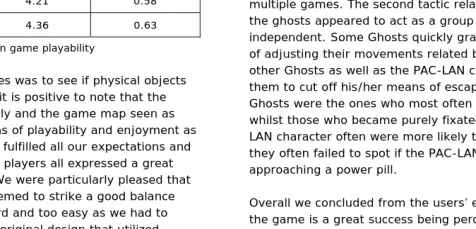
[image:6.595.230.458.302.456.2]We also obtained feedback relating to the playability of the game in terms of the phone map compared to the actual physical layout, visibility of the game pills, ease of killing an opposing player, overall playability and enjoyment. Once again players were asked to rate each of these elements on a scale of 1 to 5 with 1 being poor and 5 being excellent.
Game Feature Average Score Standard Deviation
Maze Layout 4.29 0.73
Pill Visibility 4.14 0.53
Ease of Kill 3.71 0.91
Overall Playability 4.21 0.58
[image:7.595.227.465.207.321.2]Overall Enjoyment 4.36 0.63
table 2. User feedback on game playability
As one of our objectives was to see if physical objects enhanced game play, it is positive to note that the game pills scored highly and the game map seen as very effective. In terms of playability and enjoyment as can be seen the game fulfilled all our expectations and indeed the majority of players all expressed a great desire to play again. We were particularly pleased that the kill mechanism seemed to strike a good balance between being too hard and too easy as we had to compromise from our original design that utilized Bluetooth due to the capabilities of the phone model used.
By analyzing the logged timestamps at the server we were able to identify tactics that were apparent in the game play. The first was concerning PAC-LAN players
who deliberately went long periods without tagging a pill despite losing a point for every second they went without tagging a pill. This occurred on a couple of occasions which did not seem to prolong the game much above the average and in both cases the PAC-LAN character failed to get close to the two highest scores achieved by players who in fact tagged most regularly. This phenomenon was not as noticeable in the Ghost players who generally tagged regularly as they had to keep their kill timer charged and those who didn’t invariably ended up with a negative score and back at the spawn point. We have considered making the points deduction for the PAC-LAN player
exponential based the time between tags but have delayed this until we have exposed more players to multiple games. The second tactic related to whether the ghosts appeared to act as a group or were purely independent. Some Ghosts quickly grasped the concept of adjusting their movements related both to other the other Ghosts as well as the PAC-LAN character enabling them to cut off his/her means of escape. This type of Ghosts were the ones who most often achieved a kill whilst those who became purely fixated with the PAC-LAN character often were more likely to be killed as they often failed to spot if the PAC-LAN character was approaching a power pill.
Overall we concluded from the users’ experiences that the game is a great success being perceived as fun to play and easy to use. The following are quotes taken from the feedback questionnaires at the end of each game.
‘A unique experience! Great Fun!’
‘Very good idea & very good fun (but exhausting!)’
figure 5. A very tired PAC-LAN!
Conclusions
In ascertaining whether PAC-LAN meets our four design objectives we have indeed seen from the user feedback that physical objects do aid in playing an mixed reality game and that RFID is a very effective means of interaction. The use of RFID undoubtedly meant the game could be played at high speed as attested to by the comments from the players. In terms of tactics we have already seen the emergence of such but we will continue this analysis over the coming months when we intend to run weekly trials of the game and develop a maze map to allow similar trials in Helsinki.
Acknowledgements
The authors wish to acknowledge the support of Nokia for the provision of RFID phones and access to the LI server for the development of this project.
References
[1] Cheok,A. D., GOH, K. H., Liu, W., Farbiz, F., Fong,
S. W., Teo, S. L., Li, Y., and Yang, X. B. “Human pacman: A mobile, wide-area entertainment system based on physical, social, and ubiquitous computing”, Personal Ubiquitous Computing 8, 71-81, 2004.
[2] ECMA, Near Field Communication: White Paper,
Ecma/TC32-TG19/2004/1, 2004.
[3] International Organization for Standardization,
“Information Technology – Automatic Identification and Data Capture Techniques – Bar Code Symbology – QR code”, ISO/IEC 18004, 2000.
[4] Magerkurth, C., Cheok, A.D., Mandryk, R.L., and
Nilsen, T., Pervasive games: bringing computer entertainment back to the real world, ACM Computers in Entertainment, Vol 3, Issue 3, July, 2005.
[5] Rashid, 0., Bamford, W., Coulton, P., Edwards, R.,
and Scheibel, J. PAC-LAN: Mixed reality gaming with RFID enabled mobile phones Submitted to the ACM CIE magazine march 2006.
[6] Rashid, O., Coulton, P., and Edwards, R.,
Implementing Location Based Information/Advertising for Existing Mobile Phone Users in Indoor/Urban Environments, IEEE 4th International Conference on Mobile Business, Sydney Australia, , pp 377-383, 2005.
[7] Rashid, O., Mullins, I., Coulton, P., and Edwards,
R., Extending Cyberspace: Location Based Games Using Cellular Phones, ACM Computers in Entertainment, Vol 4, Issue 1, 2006.
[8] RFID Journal, Nokia Unveils RFID Phone Reader,
RFID Journal, 2004.
http://www.rfidjournal.com/article/articleview/834/1/1 3/.
[9] RFID Journal, Developing RFID-Enabled Phones,
RFID Journal, July 2004.