Improving Performance of MANETs using Multi-Criteria
Multipath Routing Protocol
Navjot Kaur
Student, Dept. of CSEAmritsar College of Engineering and Technology, PTU, Jalandhar, Punjab.
Tanupreet Singh,
Ph.D. Professor and HOD, Dept. of ECE Amritsar College of Engineering and Technology,PTU, Jalandhar, Punjab.
ABSTRACT
In recent years many efforts have been made on routing the data in mobile ad hoc networks efficiently. Subsequently, several specialists have provided distinct routing protocol for ad hoc networks, especially routing protocols using the concept of multiple paths such as AOMDV. This is on the account of the utilization of multipath routing protocols that has various benefits like load balancing, better energy consumption etc. Various multi path routing protocols are proposed by analysts with aim to minimize the energy utilization in mobile ad hoc networks such as E-AOMDV. The focus of the paper is to throw light on the critical issue of lowering the routing overhead while preserving the energy consumption in mobile ad hoc networks. The paper presents routing scheme where ratio of residual energy of the nodes and distance is taken into account while making multiple paths between source and destination.
Keywords
Mobile ad hoc network, AOMDV, E-AOMDV, multi path routing.
1.
INTRODUCTION
In recent years, huge improvements have taken place in the technology used to build digital electronics, Micro-Electro-Mechanical Systems (MEMS) and wireless communications. Hence there is an immediate need for the development of minimal effort, low-force, multi-purpose little sensor nodes that can convey crosswise over short distances. There has been an immense measure of investigation into routing in wireless sensor networks. As communication between nodes is fundamental to most provisions, routing in wireless sensor networks is considered very critical. The basic architecture of MANET consists of nodes that are dynamically self-organized into arbitrary and temporary network topology without any infrastructure support. The advantage of employing MANET is to offer a large degree of freedom at a minimal cost in comparison to other networking solutions. Routing is characterized as the act of moving information from source to destination in a network. The primary objective of routing protocols is to minimize delay, amplify the network throughput, maximize network lifetime and maximize energy efficiency. Determining optimal routing path and internetwork packet transfer are the two basic activities involved in routing. Mobile Ad-Hoc Network is the fast developing engineering from the previous 20 years. The increase in their prevalence is as a result of the ease of deployment, infrastructure less and their dynamic nature. MANETs made another set of requests to be actualized and to give proficient better end-to-end communication.
The basic principle of an multipath routing protocol is to provide for load balancing in the network. The source node broadcasts the route request packets to the destination node in search of optimal path. Upon receiving the route reply the
source node selects more than path possible path to the destination. This provides the network with the load balancing. While in single path routing protocol, the nodes in the path tend to get over-utilized over a period of time. Whereas in multiple path scenario that work to route the data to the destination gets distributed on more than path. This also tends to conserve the energy of the nodes. The basic routing protocol in mobile ad hoc network which provides for multiple paths is AOMDV. With an effort to conserve more energy of the network and hence increase its lifetime, energy efficient AOMDV, (E-AOMDV) [5] has also been proposed. This routing protocol takes energy of the nodes into account while forming the multiple paths between the source to destination node.
2.
RELATED
WORK
Deepti Singh, et al. [9] discussed various challenges are faced in routing in MANETs. Different routing protocols based on flat topology and hierarchical topologies, have been evaluated for better performance of mobile ad-hoc networks, in terms of delay, throughput, load balancing and congestion control. This paper focuses multipath transmission capability and load balancing, to get efficient routing for heavy load traffic. Different issues of multipath routing, like route discovery, energy consumption, load balancing and security issues are discussed in this paper and performance of different multipath routing protocols is compared on the basis of these issues and, Quality of Service parameter is also taken into account.
Bhavna Sharma, et al. [5] proposed a new protocol E-AOMDV. Existing Multipath routing protocol has provided the concept of load balancing but had not considered the energy. The proposed E-AOMDV i.e. Energy Efficient AOMDV have taken both parameters energy and load balancing into consideration. The selection of next hop is depended upon its energy level and load balancing among its neighbors. The load from each node i.e. data sent through selected node is calculated. The performance of proposed E-AOMDV is compared with AOMDV on the basis of different performance metrics like Packet delivery ratio, Average end-to-end latency, Routing packet overhead, and Throughput, using NS-2.31 as simulation environment. The proposed scheme has shown better performance over existing protocol. E- AOMDV helped in distributing the load properly and in reducing energy consumption.
AOMDV. It has been found that reason for the better performance of IAOMDV over AOMDV is the implementation of security and load balancing.
Archana Shukla, Sanjay Sharma [3], proposed AOMDV with queue length estimation technique. The proposed technique has helped in reducing congestion by choosing non congested routes to send RREQ and data packets and if the route has turn out congested then it helped in choosing alternate path with the higher hop count. AOMDV routing protocol for the identification of possibly multiple node-disjoint path between the given source and the destination, has been presented. It has found that the performance of the proposed AOMDV is better than AOMDV in terms of different performance metrics like throughput, packet delivery ratio, end-to-end delay etc.
Deeptanoy Ghosh, Poonam Thakur, [8] discussed different on-demand routing techniques with their advantages and disadvantages. This paper discusses the need and specialty of routing protocols and the routing challenges in MANET. The different on-demand (reactive) protocols like DSR, AODV, TORA, ABR, DYMO, LMR, LAR, SSA, CBRP, RDMAR, MSR, AOMDV, ARA are studied and compared with their pros and cons, in this paper. And it has found that all these reactive protocols have their own advantages and disadvantages depending upon the situation of the network.
Hassanali Nasehi, et al. [13] proposed algorithm for improving energy efficiency for AODV protocol and then a comparison between AOMDV, AODVM and IZM-DSR multipath routing algorithms has been made, based on AODV and DSR. Multipath routing algorithms in MANET, send information to destination through different directions simultaneously to reduce end to end delay but the traffic sent in these cases affect the adjacent paths and which increases delay. The proposed algorithm in this paper tries to discover distinct paths, using Omni-directional antennas, to send information simultaneously from source to destination. The algorithm proposed is based on AODV routing algorithm, which is presented as ZD- AOMDV and then it is compared with AOMDV, AODVM and IZM-DSR using the GLOMOSIM as simulator. These routing algorithms are compared on the basis of different parameters such as Packet delivery Ratio, End-to-End delay, Routing Overhead, Number of Dead Nodes and Energy Consumption in different scenarios. In the results it has been found that proposed algorithm shows improvement in energy consumption, end-to-end delay and in packet delivery ratio but it has higher routing overheads than AOMDV and AODVM routing algorithms.
K.Syed Ali Fathima, et al. [16] proposed a protocol that is achieved by using ACO algorithm to optimize routing paths, providing an effective multi-path data transmission to obtain reliable communications in the case of node faults. The aim of the paper is to maintain network life time in maximum, while data transmission is achieved efficiently. The paper evaluates the performance of ant base algorithm and AODV routing protocol in terms of Packet Delivery Ratio, Average end-to end delay and Normalized Routing Load and concludes that overall performance of ant based algorithm is better than AODV in terms of throughput.
Mina Vajed Khiavi, Shahram Jamali, [21] evaluated the performances of AODV and AOMDV using ns2 simulator. In the randomly changing network topology, the design of the robust routing algorithm can adapt the dynamic topology, is one of the main challenge in mobile ad hoc network. This paper has compared AODV and AOMDV protocols for MANETs. AODV is the unipath routing protocol and AOMDV
is the multipath extension of AODV. These two protocols have been compared using ns2 simulator by varying the number of nodes, pause time and traffic rate. The different parameters on the basis of which AODV and AOMDV had been evaluated are: packet delivery ratio, network life time, system life time and end-to-end delay.
Alpesh Chauhan, Prof. B.V. Buddhdev [2], proposed different techniques for improved energy function in case of AOMDV. In mobile communication networks, the wireless devices are portable and battery powered, so they have to work in extreme energy constrains. So energy efficiency is the one of the major issues in the mobile networks. This paper has proposed various techniques to help in improving the energy function, such as Minimum Battery Cost Routing (MBCR), Min-Max Battery Cost Routing (MMBCR), Minimum Total Transmission Power Routing (MTPR), Conditional Min-Max Battery Cost Routing (CMMBCR), Min-Max Residual Energy in AOMDV (MMRE-AOMDV).
3.
ROUTING IN MANETS
Routing protocols facilitate distinguished mechanisms to create and maintain the routing tables of the nodes of the network and discover a route between all nodes of the network. There should be enough versatility in routing protocols to adapt to any type of topology to permit arriving at any remote host in any network.
A vast research account exists for the development of routing protocols in MANETs. The development and improvement of the protocols is dependent on the particular application demands and the architecture of the network. However, there are a few elements that ought to be contemplated when creating routing protocols for MANETs. The protocol should take care of self-configuration, energy efficiency, delay and so forth.
4.
MULTIPATH ROUTING PROTOCOL
Ad-hoc On-demand Multipath Distance Vector Routing (AOMDV) protocol [17] is a denotation to the AODV protocol for computing multiple loop-free and link disjoint paths. There can be multiple next hops for the same destination with same sequence number. This helps in keeping track of a route. An advertised hop count is maintained for each destination by node. Advertised hop count is the maximum hop count for particular destination. Each duplicate route advertisement received by a node defines an alternate path to the destination. Loop freedom is assured for a node by advertised hop counts. Alternative paths are only considered if they have less hop count than advertised hop count. Because the maximum hop count is used, the advertised hop count therefore does not change for the same sequence number. When a route advertisement is received for a destination with a greater sequence number, the next-hop list and the advertised hop count are reinitialized.
may intersect at an intermediate node, but each takes a different reverse path to the source to ensure link disjointness.
The advantage of using AOMDV is that it allows intermediate nodes to reply to RREQs, while still selecting disjoint paths. But, AOMDV has more message overheads during route discovery due to increased flooding and since it is a multipath routing protocol, the destination replies to the multiple RREQs those results are in longer overhead.
5.
ENERGY EFFICIENT AOMDV
E-AOMDV [5] routing protocol is an improved version of AOMDV protocol. AOMDV protocol works on multipath but do not take into consideration the energy of the nodes and the amount of traffic sent through the different paths. E-AOMDV includes energy conservation, shortest path and load balancing. In AOMDV, due to imbalanced distribution of load, the nodes with less energy may die soon because they are heavily used in forwarding packets. This leads to imbalanced energy consumption. In E-AOMDV, while selecting one route from multiple routes, energy left at neighbor node is considered and for this each node in the network reports its energy level to its neighbor. In multipath selection, all the next hops from available path are taken in account along with their normalized energy levels and the hop with maximum energy is chosen. Depending upon the energy level of the nodes the load is being distributed. E-AOMDV helps in reducing energy consumption and increase in energy utilization.
6.
MOTIVATION
Energy efficient routing protocols have been becoming the focus of research because they achieve the complex task of routing which preserving the batteries of the nodes. In mobile ad hoc networks the on demand multi-path routing protocols addresses certain issues such as message overheads, link failures and node’s high mobility. More message overheads occur due to increased flooding. Packets are dropped by intermediate nodes due to frequent link failures. Moreover the overall throughput and the packet delivery ratio are reduced in high mobility scenarios. Energy consumption while maintaining the routing overhead to lower levels is the most challenging issue in routing protocol design.
In ad hoc networks mobile devices are battery operated and the battery technology has not been enhancing that well. Therefore power consumption is likely to remain an issue in mobile wireless network routing. The overall lifetime of the entire ad hoc network can be increased by improving the power consumption balance among nodes and the network connection. In most of the existing protocols, a mobile node may consume all its energy to participate in the operation without considering the remaining energy.
It is utmost crucial to consider the energy efficiency of the underlying algorithm while designing a MANET protocol. While multipath routing protocol such as AOMDV provides for load balancing in the network, the improved version of this, EAOMDV, strives to preserve the energy of the network by considering the nodes having highest residual energy levels while forming the multiple route from source to destination node. However, this energy efficiency is being achieved at the cost of routing overhead which tends to increase while informing the nodes about energy levels of the nodes. There arises a need to design a protocol in such a way that routing overhead becomes lower while the energy efficiency of the network is being preserved.
7.
PROPOSED SCHEME
In AOMDV the source sends the data to the destination using multiple paths. This provides load balancing in the network as the nodes in the single path are not used over and over again instead multi path approach allows the load to be distributed among the other nodes. However, to make it more energy efficient the nodes in the path which have more residual energy are chosen so that the network works for longer duration of time. This method required the each node to know about the remaining energy levels of the neighbors, for which the protocol began with the initial steps of broadcasting the messages informing the nodes about residual energy. However, this tends to increase the overhead in the network. In our proposed work, we tend to increase this routing overhead while keeping the multipath routing energy efficient.
7.1
Proposed Method
In the proposed protocol, we aim at reducing the broadcasting. The whole network needs to be divided into the various grids. The information about the grids will be kept at randomly chosen initiator for each grid. The division of network into grids and the concept of initiator avoids the initial broadcasting required in the energy efficient AOMDV as all the information required by the nodes to make optimal path is stored with initiator which will provide the source with required knowledge about the neighbors. The path from the source to destination should be shorter in length as well as the nodes must have higher amount of residual energy. So the ratio of remaining residual energy to the Euclidean distance with the destination tends to be higher for any node to be chosen in the paths.
7.2
Methodology
The proposed scheme works on the basis of following steps:
Step 1. First the nodes are deployed in the network.
Step 2. All the network is divided into the grids.
Step 3. Choose one initiator for each grid on the basis of the energy level.
Step 4. Each node of the grid forwards its remaining residual energy level to the initiator along with its location information.
Step 5. The initiator calculates the required ratio of remaining residual energy to the Euclidean distance to the destination for each node.
Step 6. The source node asks the initiator for the nodes with higher ratio so that it can have route to destination.
Step 7. The initiator provides with all the relevant information to form multiple paths.
Step 8. Data is sent using the best optimal paths.
The proposed methodology is needed to be implemented in a tool. The tool opted for simulation of the proposed work is NS2.35.
8.
SIMULATION ENVIRONMENT
Table 1: Simulation Parameters
Parameter Value
Simulator NS2.35 Channel Wireless Channel Propagation Model Two Ray Ground
No. of nodes 50 Dimensions of Simulated Area 1000m X 1000m
Queue Drop Tail Antenna Omni-Directional Routing Protocol AOMDV
Energy Model Radio Energy Model Initial Energy 100J
8.1
Performance Metrics
We use four metric to evaluate the performance of proposed scheme and these are:
1) Energy Consumption: shows the average amount of energy that is being consumed in the network.
2) Average end-to-end delay: the average time taken by the data packet to reach the destination i.e. time taken to travel between source and destination.
3) Routing packet overhead: the ratio of the number of control packets to the number of data packets.
4) Throughput: number of packets sent or received per unit of time in network.
9.
SIMULATION RESULTS
Following are the simulation results of proposed scheme based upon above stated performance metrics.
9.1
Average Energy Consumption
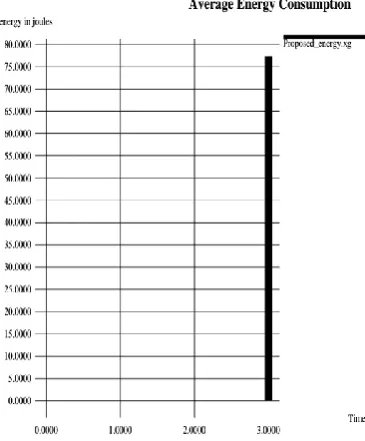
Average Energy consumption is defined as the average amount of energy consumed in the network.In the proposed scheme, initially 100 Joules of energy was provided and the at tend energy was 77 Joules.
Fig1: Average Energy Consumption
9.2
Average End-to-End Delay
Average end-to-end delay or latency is defined as the average time taken by the data packets to reach from source to destination. The value of delay in the network was found 6 seconds.
Fig2: Average End-to-End Delay
9.3
Routing Packet Overhead
The ratio of number of control packets (route request/reply/update/error packets) to the number of data packets is temed as routing packet overhead.
i.e. Routing Overhead =No .of control packets
No .of data packets
In the proposed scheme, it was found 1.27 (approx.).
9.4
Throughput
The ratio of number of data packets sent or received per unit time of the network defines throughput of the network. For the proposed scheme the througput was found 130 kb/s (nearly).
Fig4: Throughput
10.
CONCLUSIONS
The exceedingly rapid topology of Ad Hoc systems and their restricted bandwidth makes the routing task more troublesome. The proposed scheme is being simulated using NS2.35 simulator and different performance metrics i.e. Average energy consumption, Average end-to-end delay, Routing overhead and Throughput are evaluated. This section focuses on promising future research directions based on our current research. However, we would further like to expand our research and apply proposed scheme in combination with genetic algorithms to enhance the performance of the network.
11. REFERENCES
[1] Aarti, Dr. S.S. Tyagi ,“Study of MANET: Characteristics, Challenges, Application and Security Attacks”, International Journal of Advanced Research in Computer Science and Software Engineering, Volume 3, Issue 5, May 2013.
[2] Alpesh Chauhan, Prof. B.V. Buddhdev, “AOMDV with improved Energy Function”, International Journal of Advanced Research in Computer Engineering & Technology, Vol. 2, No. 2, February 2013.
[3] Archana Shukla, Sanjay Sharma, “Queue Length based Load Balancing Technique using with AOMDV Protocol in MAMET”, International Journal of Scientific & Engineering Research (2229-5518), Vol. 4, No. 10, October 2013.
[4] Bhabani Sankar Gouda, Ashish Kumar Dass, K.Lakshmi Narayana “A Comprehensive Performance Analysis of Energy Efficient Routing Protocols in different traffic based Mobile Ad-hoc Networks”, 2013.
[5] Bhavna Sharma, Shaila Chugh, Vismay Jain, “Energy Efficient Load Balancing Approach to Improve AOMDV Routing in MANET”, 2014 Fourth International Conference on Communication Systems and Network Technologies”,IEEE 2014.
[6] Chintan Bhavsar, Mayur M. Vegad, Sunil. A Bakhru, “Performance Comparison of Stability Enhanced AODV and AOMDV Protocols for MAMETs”, International Journal of Emerging Technology and Advanced Engineering (2250-2459), Volume 2, No. 5, May 2012.
[7] D. Maheshwari, R. Nedunchezhian, “Balanced Reliable Shortest for AOMDV (BRSR-AOMDV) using TF Mechanism in MANET”, International Journal of Computer Technology & Applications (2229-6093), Vol. 4, No. 6, Nov-Dec 2013.
[8] Deeptanoy Ghosh, Poonam Thakur, “A Survey on On-Demand Routing Techniques in MANET”, Elixir Comp. Sci. & Engg. (16219-16224), 2013
[9] Deepti Singh, Birendra Kumar Sharma, Arvind Kumar, “A Survey on challenges in Multipath Routing for Adhoc Netwrorks”, International Journal of Emerging Technology and Advanced Engineering, ICADET-14, India (2250-2459), Volume 4, No. 1, February 2014.
[10]http://en.wikipedia.org/wiki/Ad_hoc_OnDemand_Distanc e_Vector_Routing.
[11]Fan Zi Fu, Zhang Ling, Wan Xiao Yu, “An Optimized AOMDV Routing Algorithm Based on Self-Adaptive Node Speed in Wireless Sensor Network”, 2012 International Workshop on Information and Electronics Engineering (IWIEE 2012).
[12]Fubao Yang, et al., “Network Coding-based AOMDV Routing in MANET”, 2012 IEEE International Conference on Information Science and Technology, Wuhan, Hubei, China, March 23-25, 2012.
[13]Hassanali Nasehi, et. al, “Improving Energy Efficiency in MANETs by Multipath Routing”, International journal of Wireless & Mobile Networks (IJWMN), Vol. 5, No. 1, February 2013.
[14]Hesham A. Ali, et. al, “Manet Load Balancing Parallel Routing Protocol”, IJCSI, Vol. 9, No. 1, July 2012.
[15]K. Latif, A. Ahmad, et. al, “Divide-and-Rule for Energy Efficient Routing in Wireless Sensor Networks”, The 4th
International Conference on Ambient Systems, Networks and Technologies (ANT 2013).
[16]K. Syed Ali Fatima et al., “Ant Colony Optimization Based Routing in Wireless Sensor Network”, Int. J. Advanced Networking and Applications, 2013.
[17]Mahesh K. Marina, Samir R. Das, “Ad hoc on-demand multipath distance vector routing”, WIRELESS COMMUNICATIONS AND MOBILE COMPUTING, 2006.
[18]Mahima Chitkara, 2Mohd. Waseem Ahmad, “Review on MANET: Characteristics, Challenges, Imperatives and Routing Protocols”, International Journal of Computer Science and Mobile Computing, Vol. 3, Issue. 2, February 2014.
[19]Manveen Singh Chadha, Rambir Joon, Sandeep, “Simulation and Comparison of AODV, DSR and AOMDV Routing Protocols in MANETs”, International Journal of Soft Computing and Engineering (IJSCE) (2231-2307), Vol. 2, No. 3, July 2012.
Conference on Computer Engineering and Applications, 2010.
[21]Mina Vajed Khiavi, Shahram Jamali, “Performance Comparison of AODV and AOMDV Routing Protocols in Mobile Ad Hoc Networks”, International Research Journal of Applied and Basic Sciences (3277-3285), Vol. 4, No. 11, 2013.
[22]Mohamed Tekaya, Nabil Tabbane, Sami Tabbane, “Multipath Routing with Load Balancing and QoS in Adhoc Network”, IJCSNS, Vol. 10 No. 8, August 2010.
[23]N. Sumathi, Antony Selvasdoss Thanamani, “ENERGY EFFICIENT BANDWIDTH CONSTRAINED QOS ENABLED MULTIPATH ROUTING FOR MANETs”, International Journal of Computing (1727-6209), Vol. 10, No. 3, 2011.
[24]Onkar Singh Bawa, Mr. Supratik Banerjee, “Congestion based Route Discovery AOMDV Protocol”, International Journal of Computer Trends and Technology, Vol. 4, No. 1, 2013.
[25]P. Periyasamy, Dr. E. Karthikeyan, “Performance Evaluation of AOMDV Protocol Based on Various Scenario and Traffic Patterns”, International Journal of Computer Science, Engineering and Applications (IJCSEA), Vol. 1, No. 6, December 2011.
[26]Pinesh A Darji, Mrs. Sumitra Menaria, “An Improvement in AOMDV with Randomization”, IJCTA, Vol. 3, No.3, May-June 2012.
[27]Priyanaka Bansal, Prof. Anuj K. Gupta, “PERFORMANCE EVALUATION OF AOMDV AND IAOMDV UNDER PRETTY GOOD PRIVACY MODEL”, Global Journal of Advanced Engineering Technologies, Vol. 3, Issue 2, 2014.
[28]R. Vinod Kumar, Dr. R.S.D. Wahida Banu, “Load-balancing Approach for AOMDV in Ad-hoc Networks”, IJCA, 2010.
[29]Ruchi Gupta, et al, “A Research Paper on Comparison between Energy Efficient Routing Protocol with Energy and Location in MANET”, IOSR Journal of Computer Engineering, Vol. 9, No. 4, Mar-Apr 2013.
[30]S. Malini et al., “Traffic based Energy Consumption Analysis of AOMDV Protocol in Mobile Ad Hoc Netwrork”, International Journal of Computer Applications (0975-8887), Volume 14- No. 6, February 2011.
[31]S. R. Biradar, et. al., “Performance Evaluation and Comparison of AODV and AOMDV”, International Journal on Computer Science and Engineering (373-377), Vol. 2, No. 2, 2010.
[32]Sanghitra Bhattacharjee, Subhansu Bandyopadhyay, “Lifetime maximizing dynamic energy efficient routing protocol for multi hop wireless networks”, Simulation Modelling Practice and Theory, 2013.
[33]Sasan Adibi, Shervin Erfani, “A Multipath Routing Survey for Mobile Ad-Hoc Networks”, IEEE 2005.
[34]Sujatha P Terdal, Dr. V.D.Mytri, Dr. A.Damodaram, “A Load Aware Routing Mechanism for Improving Energy Efficiency in Mobile Ad Hoc Networks”, International Journal of Computer Applications (0975-8887), Vol. 10- No. 3, November 2010.
[35]Wesam AlMobaideen,” SPDA: Stability Based Partially Disjoint AOMDV”, European Journal of Scientific Research, Vol. 27, No.3, 2009.