N A N O E X P R E S S
Open Access
Optical Modulation of the Diffraction
Efficiency in an Indoline Azobenzene/
Amorphous Polycarbonate Film
G. V. M. Williams
1*, My T. T. Do
2, A. Middleton
1,2, S. G. Raymond
2, M. D. H. Bhuiyan
2and A. J. Kay
2Abstract
We have made a diffraction grating in an indoline azobenzene/amorphous polycarbonate film by two-beam interference at 532 nm that periodically photodegrades the indoline azobenzene dye. Subsequent illumination of the film with 532-nm light into thetrans-isomer band leads totrans-cisisomerization in the indoline azobenzene dye and results in a decrease in thetrans-isomer band absorption coefficient. This causes the diffraction efficiency to decrease when probed at 655 nm. The diffraction efficiency returns to its original value when the 532-nm light is blocked by thermal relaxation from the indoline azobenzenecis-isomer to thetrans-isomer. Thus, we have been able to optically modulate the diffraction efficiency in a thin film diffraction grating.
Keywords:Diffraction grating, Photochromic, Indoline azobenzene, Thin film
Background
Optical filters based on diffraction gratings have a large range of applications that include optical storage [1, 2], optical communication [3–5], strain and chemical sensing [6–9], and spectroscopy [10–12]. They have been made and researched using different methods and materials. For example, doped photorefractive LiNbO3 single crystals
have been used to make optical filters where they are made permanent by thermal fixing [3, 13]. Optical filters have also been produced using liquid crystals [14–16], porous silicon [9, 12], anodic aluminina [17], polymers [4, 18], photochromic films [19, 20], nonlinear optical chromophore thin films [21], and RbCdF3:Mn2+ single
crystals [22]. Optically switchable diffraction gratings would be particularly useful for all-optical switching and multiplexing [5] and could be used, for example, in add/ drop [4] modules in optical communication systems that are needed for dense wavelength division multiplexing.
We have recently shown that an optically switchable diffraction grating can be made using a photochromic dye/amorphous polycarbonate (APC) composite film. In that case, the dye used was
5-chloro-1,3-dihydro-1,3,3-trimethylspiro[2H-indole-2,3′-(3H)naphth[2,1-b](1,4)oxa zine] where UV light is required to break a band that results in a visible absorption band [23]. It was shown that a diffraction grating could be made by two-beam interference, the grating could subsequently be turned on by UV irradiation, and it could disappear after the UV light is turned off. This method does require the use of UV light to turn the diffraction grating on, and it would be advantageous if another dye is used that only requires more easily accessible visible or infrared light.
In this paper, we report the results from optical mea-surements on a film containing an indoline azobenzene dye in an APC matrix where a two-beam interference method was used to create a diffraction grating. We show that a diffraction grating can be made and the diffraction efficiency can be reduced by exposure to visible light and the recovery of the grating occurs by thermal relaxation.
Methods
A photochromic dye/polymer thin film was made using APC and an indoline azobenzene (IAB) dye. The APC used was APEC 9389, and it was obtained from Bayer Materials Science. IAB was synthesized via coupling of the diazonium salt of 4-aminobenzonitrile to 1,3,3-trimethyl-2-methylene indoline using standard conditions. The product was obtained as a red solid, and it was purified by
* Correspondence:[email protected]
1MacDairmid Institute, School of Chemical and Physical Sciences, Victoria
University of Wellington, PO Box 600, Wellington 6012, New Zealand Full list of author information is available at the end of the article
recrystallization in ethanol. An IAB/APC thin film was prepared that contained 5 % of IAB by weight. This was done by dissolving 50 mg of the dye and 950 mg of APC in 10 mL of 1,1,2-trichloroethane (TCE) and stirring the solution for 30 min at ~40 °C. The solution was then passed through 0.45- and then 0.22-μm syringe filters. The solution was spin-coated onto 25 × 25 mm2glass sub-strates to create the thin film that was dried in a vacuum in the dark at 80 °C for several days. To minimize the risk of any unintended photo-switching, the dried films were kept in the dark until required.
An Ocean Optics spectrometer or a PerkinElmer Lambda 1050 spectrophotometer was used to make the optical measurements. The film was 2.6-μm thick as esti-mated from the resultant thin film interference. The optic-ally induced changes in the IAB absorbance were measured by placing a cuvette containing a IAB/TCE so-lution in the Ocean Optics spectrometer. An initial ab-sorbance measurement was made, and then the solution was exposed to an expanded 532-nm laser beam from a 5-W diode-pumped solid-state frequency-doubled Nd:YVO4
laser. This was immediately followed by an absorbance measurement. The photo-induced changes in the absorp-tion coefficient from the IAB/APC film at 488 nm were measured using the 488-nm line from an Ar ion laser. The beam was split into two beams, and the probe beam went through a 1 % neutral density filter.
A diffraction grating was made in the IAB/APC film by using a cube beam splitter to split the 532-nm laser beam into two beams that overlapped on the film surface. The first-order diffracted beam from one of the beams was used to monitor the resultant diffraction efficiency. The angle between the beams was 3.2°. The diffraction efficiency was also probed at 655 nm where there is no absorption from the IAB dye using a 10-mW diode laser where the incident intensity was 5 mW. Silicon photodiodes were used to measure the transmit-ted and diffractransmit-ted beam intensities.
Results and Discussion
Photo-switching of IAB occurs by atrans-cis isomeriza-tion process as can be seen in Fig. 1 where the trans -and cis-isomer structures are shown. Exposure of the
trans-isomer (left structure) to visible light results in
trans- to cis-isomerization (right structure). Thecis -iso-mer can thermally relax back to thetrans-isomer or this process can occur via optical excitation. This trans-cis isomerization process is well-known in a number of photo-chromic dyes including the azobenzene dyes [24, 25].
The absorbance of a TCE solution containing IAB is shown in Fig. 2. There is an absorption maximum at ~470 nm (solid curve) from the trans-isomer. Exposure to laser light at 532 nm led to a reduction in the ~470 nm trans-isomer absorption band and the appear-ance of a second peak at ~370 nm (dashed curve) from thecis-isomer.
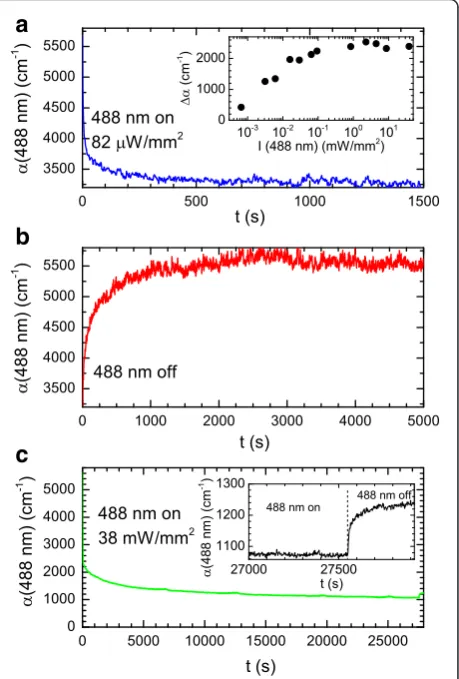
An IAB/APC film containing 5 % IAB by weight was exposed to 488-nm light, and the resulting change in the absorption coefficient,α, at 488 nm can be seen in Fig. 3a for a 488-nm switching intensity of 82 μW/mm2 and when probed with a weak intensity 488-nm probe beam. This wavelength was chosen because it is close to the
trans-isomer peak absorption coefficient; hence, photo-induced changes in α from trans-cis isomerization are expected to be faster than that which could occur if a longer wavelength was used. The time for the absorption coefficient to decay by 1/e was ~11 s. We show in the inset of Fig. 3a that the change in α increases with in-creasing intensity and it saturates at high 488-nm inten-sities. The saturation is likely to be due to equilibrium between optically inducedtrans- tocis-isomerization by exciting into the trans-isomer band peaked at ~470 nm and thermal relaxation from thecis- to thetrans-isomer. Thermal relaxation can be seen in Fig. 3b when the 488-nm switching laser light was blocked. The 1/ethermal re-laxation time was ~116 s. Photodegradation occurs for high intensities, as can be seen in Fig. 3c for a 488-nm switching beam intensity of 38 mW/mm2. The film con-taining IAB initially switches, and then there is a gradual decrease in the absorption coefficient. The switching beam was blocked after 27,550 s, and it can be seen that the ab-sorption coefficient increased by only 170 cm−1after this time and it does not increase back to the initial value. This shows that there is photodegradation of IAB.
The photodegradation process during high-intensity 488-nm illumination is likely to be oxygen-mediated and
Fig. 1The indoline azobenzenetrans-isomer (left) andcis-isomer (right).Trans-cisisomerization can occur by optical excitation into the
[image:2.595.61.540.620.703.2]similar to that seen in other organic compounds [26–28]. Optical excitation leads to an excited singlet state, and relaxation occurs via a transition to the singlet ground state as well as intersystem crossing to the triplet ground state that leads to the generation of singlet oxygen [26–28]. The transition from the ground state triplet to the lower energy ground singlet state is spin-forbidden, but it can occur in the presence of triplet oxygen and results in the generation of singlet oxygen. It is the singlet oxygen that chemically interacts with dye and leads to the loss of the visible absorption band. This is a well-known problem in organic dyes, and it can be significantly reduced by encapsulation as well as by using singlet oxygen quenchers [28–31].
We have shown above that photo-induced changes inα can be made in a film containing IAB. For low intensities and times, these changes are nearly reversible and there is minimal photodegradation of IAB. However, there is sig-nificant photodegradation for high intensities, which can be exploited to create diffraction gratings as shown below.
Diffraction gratings were made by two-beam interfer-ence that leads to a sinusoidal optical intensity in the film with the modulation direction being parallel to the film surface. This results in a periodic modulation of the absorption coefficient via trans- to cis-isomerization as well as gradual photodegradation of IAB. A modulation of the absorption coefficient also means that there will be a periodic modulation of the refractive index. In the thin film limit and for small photo-induced changes in the absorption coefficient, the complex refractive index modulation can be written as Δñ= [Δn/2 +i(λprobe/
(2πn))(Δα/2)]sin(Λx), whereΔnis the maximum change in the refractive index, Δα is the maximum change in the absorption coefficient,λprobeis the probe wavelength,
n is the average refractive index, Λ is the diffraction grating period, and x is the modulation direction that is parallel to the film surface. For small angle and weak
diffraction of a probe beam at normal incidence, the first-order diffraction efficiency in the thin limit is [32],
η1¼ expð−2α0zÞ πΔnz 2λprobe
2
þ Δαz
4
2
" #
ð1Þ
whereη1is the first-order beam intensity divided by the zeroth-order beam intensity, α0is the absorption coeffi-cient, andzis the film thickness.
We show in Fig. 4a the first-order diffraction efficiency at 532 nm for the IAB/APC film during two-beam grat-ing creation at 532 nm and with an intensity of 3.2 mW/ mm2from each beam. This wavelength was used to cre-ate the grating because the 1/eabsorption depth into the film (19 μm) is much greater than the film thickness
Fig. 2Plot of the absorbance from an indoline azobenzene solution in 1,1,2-trichloroethane (solid curve). Also shown is the absorbance during illumination with 532-nm laser light (dashed curve)
a
b
c
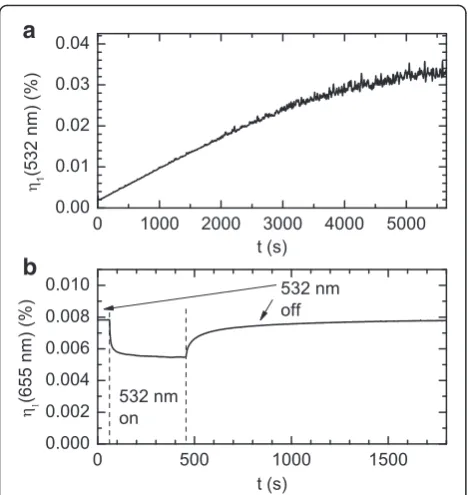
[image:3.595.58.292.87.252.2] [image:3.595.309.539.89.429.2](2.6μm). Thus, the grating will be more uniform through the film when compared with another wavelength that has a higher absorption coefficient. For example, the 1/e absorption depth is 1.8μm at 488 nm, and hence, the peak photo-induced change in the absorption coefficient will vary significantly as a function of thickness into the film. The diffraction efficiency was measured using the diffracted beam from one of the beams used to create the grating, it reached a maximum value of 0.033 %, and after which both beams were blocked.
The diffraction grating was probed using a 655-nm laser beam at normal incidence after an hour which is much longer than the IAB thermal relaxation time. A diffracted beam was observed that arises from periodic photobleaching of IAB that occurred when the film when exposed to the two 532-nm laser beams used to create the grating. Six hundred fifty-five nanometers was chosen as the probe wavelength because at this wave-length, the IAB absorption coefficient is zero and hence
Δα in Eq. 1 is zero. It is therefore possible to estimate
Δnfrom Eq. 1 using the measured first-order diffraction efficiency. We show in Fig. 4b that η1= 0.0078 %, and
from Eq. 1, we estimate thatΔn= 0.0014.
The IAB/APC film was exposed to a single 532-nm laser beam in thetrans-isomer absorption band at a small angle from normal incidence with an intensity of 111μW/mm2
at 61 s and continually probed using the 655-nm laser beam. This caused the diffraction efficiency to decrease to 0.0055 % as can be seen in Fig. 4b. This decrease is due to sometrans- tocis-isomerization that leads to a reduction in the trans-isomer absorption coefficient and hence the refractive index at 655 nm. We estimate the resultantΔn from Eq. 1 to beΔn= 0.0012 where we find that it has re-duced by 0.0002. The 532-nm laser was blocked after 455 s, and the diffraction efficiency increased back to 0.0078 % by thermal relaxation from the cisto thetrans -isomer. Thus, the diffraction efficiency was reduced by ~30 % by illumination at 532 nm. This shows that the
trans-cis isomerization process can be used to modulate the diffraction efficiency. Higher 532-nm intensities or lower switching wavelengths are required to further decrease the diffraction efficiency.
Conclusions
In conclusion, we have shown that a diffraction grating can be made in an IAB/APC thin film by two-beam interference and periodic photodegradation of the IAB dye. Illumination at a later time with a single beam at 532 nm into the trans-isomer band that is centered ~470 nm leads to a structural transition to the cis -iso-mer and a concomitant reduction in the trans-isomer band absorption coefficient. This results in a decrease in the diffraction efficiency when probed at 655 nm. The diffraction grating thermally relaxes back to the original diffraction efficiency when the 532-nm laser beam is blocked. Thus, we have shown that it is possible to optically modulate the diffraction efficiency in a thin film containing a dye that displaystrans-cisisomerization.
Competing Interests
The authors declare that they have no competing interests.
Authors’Contributions
GW directed the research, analyzed the data, and wrote the paper. AM made the films and undertook some of the optical measurements. MD and SG did the diffraction grating measurements. MB and AK made the chromophores. All authors read and approved the final manuscript.
Acknowledgements
We acknowledge funding from the New Zealand Ministry of Business, Innovation and Employment (Contracts CO8X0704, CO8X0807, and RTVU1405) and the MacDiarmid Institute for Advanced Materials and Nanotechnology.
Author details 1
MacDairmid Institute, School of Chemical and Physical Sciences, Victoria University of Wellington, PO Box 600, Wellington 6012, New Zealand.
2
Callaghan Innovation, PO Box 31310, Lower Hutt 5040, New Zealand.
Received: 16 February 2016 Accepted: 5 July 2016
References
1. Coufal HJ, Psaltis D, Sincerbox GT (2000) Holographic data storage. Springer, Berlin 2. Stronski A, Axhimova E, Paiuk O, Meshalkin A, Abashkin V, Lytvyn O, Sergeev
SS, Prisacar A, Triduh G (2016) Holographic and e-Beam image recording in Ge5As37S58–Se nanomultilayer structures. Nanoscale Res Lett 11:39
a
b
[image:4.595.57.292.86.334.2]3. Nee I, Beyer O, Müller M, Buse K (2003) Multichannel wavelength-division multiplexing with thermally fixed Bragg gratings in photorefractive lithium niobate crystals. J Opt Soc Am B 20:1593
4. Alavijeh HK, Baghban MA, Parsanasab GM, Sarailou E, Gharavi A, Javadpour S (2008) Add/drop filter using in-plane slanted gratings in azo polymers. Opt Lett 33:2152
5. Telbiz G, Bugaychuk S, Leonenko E, Derzhypolska L, Gnatovskyy V, Pryafko I (2015) Ability of dynamic holography in self-assembled hybrid
nanostructured silica films for all-optical switching and multiplexing. Nanoscale Res Lett 10:196
6. O’Dwyer MJ, Ye CC, James SW, Tatam RP (2004) Thermal dependence of the strain response of optical fibre Bragg gratings. Meas Sci Technol 15:1607 7. Rao YJ (1999) Recent progress in applications of in-fibre Bragg grating
sensors. Optics and Lasers in Engineering 31:297
8. Stephens KJ, Williams GVM, Monfils I, Hirst D, Wagner P, Raymond SG, Quilty JW (2011) Optics-based strain sensing system. Materials Science Forum 700:178 9. Lai M, Sridharan GM, Parish G, Bhattacharya S, Keating A (2012) Multilayer
porous silicon diffraction gratings operating in the infrared. Nanoscale Res Lett 7:645
10. Barbastathis G, Balberg M, Brady DJ (1999) Confocal microscopy with a volume holographic filter. Opt Lett 24:811
11. Psaltis D (2002) Coherent optical information systems. Science 298:1359 12. Mescheder U, Khazi I, Kovacs A, Ivanov A (2014) Tunable optical filters with
wide wavelength range based on porous multilayers. Nanoscale Res Lett 9:427 13. Jerez VA, de Oliveira I, Frejlich J (2009) Fixed photorefractive holograms with
maximum index-of-refraction modulation in LiNbO3:Fe. J Appl Phys 106:063116 14. Bunning TJ, Natarajan LV, Tondiglia VP, Sutherland RL (2000) Holographic
polymere-dispersed liquid crystals (H-PDLCs). Annu Rev Mater Sci 30:83 15. Ono H, Takahashi F, Emoto A, Kawatsuki N (2005) Polarization holograms in azo
dye-doped polymer dissolved liquid crystal composites. J Appl Phys 97:053508 16. Baldycheva A, Tolmachev VA, Berwick K, Perova TS (2012) Multi-channel
Si-liquid crystal filter with fine tuning capability of individual channels for compensation of fabrication tolerances. Nanoscale Res Lett 7:387 17. Zheng WJ, Fei GT, Wang B, Zhang LD (2009) Modulation of transmission
spectra of anodized alumina membrane distributed Bragg reflector by controlling anodization temperature. Nanoscale Res Lett 4:665
18. Kalachyova V, Lyutakov O, Slepicka P, Elashnikov R, Svorcik V (2014) Preparation of periodic surface structures ondoped poly(methyl metacrylate) films by irradiation with KrF excimer laser. Nanoscale Res Lett 9:951
19. Ishiguro M, Sato D, Shishido A, Ikeda T (2007) Bragg-type polarization gratings formed in thick polymer films containing azobenzene and tolane moieties. Langmuir 23:332
20. Luo S, Chen K, Cao L, Liu G, He Q, Jin G, Zeng D, Chen Y (2005) Photochromic diarylethene for rewritable holographic data storage. Optics Express 13:3123
21. Kutuvantavida Y, Williams GVM, Bhuiyan MDH (2014) Electrically modulated diffraction gratings in organic chromophore thin films. Applied Optics 53:268 22. Williams GVM, Dotzler C, Edgar A, Raymond SG (2007) Ultraviolet induced
absorption and Bragg grating inscription in RbCdF3:Mn2+. J Appl Phys 102:113106 23. Williams GVM, Do MTT, Raymond SG, Ashraf M, Bhuiyan MDH, Kay AJ (2015)
Optically switchable diffraction grating in a photochromic/polymer thin film. Applied Optics 54:6882
24. Natansohn A, Xie S, Richon P (1992) Azo polymers for reversible optical storage. 2. Poly[4′ -[[2-(acryloyloxy)ethyl]ethylamino]-2-chloro-4-nitroazobenzene]. Macromolecules 25:5531
25. Cembran A, Bernardi F, Garavelli M, Gagliardi L, Orlandi G (2004) On the mechanism of the cis−trans isomerization in the lowest electronic states of azobenzene: S0, S1, and T1. J Am Chem Soc 126:3234
26. Wu KC, Trozzio AM (1979) Production of singlet molecular oxygen from the oxygen quenching of the lowest excited singlet state of aromatic molecules in n-hexane solution. J Phys Chem 83:3180
27. Gupta G, Steier WH, Liao Y, Luo J, Dalton LR, Jen AKY (2008) Modeling photobleaching of optical chromophores: light-intensity effects in precise trimming of integrated polymer devices. J Phys Chem C 112:8051 28. Williams GVM, Kutuvantavida Y, Janssens S, Raymond SG, Do MTT, Bhuiyan
MDH, Quilty JW, Denton N, Kay AJ (2011) The effects of excited state lifetime, optical intensity, and excited state quenchers on the photostability of zwitterionic chromophores. J Appl Phys 110:083524
29. Raymond SG, Williams GVM, Do MTT, Janssens S, Lochocki B, Bhuiyan MDH, Kay AJ (2009) Photoluminescence and optical studies of photodegradation in nonlinear optical organic chromophores. Proc SPIE 7354:735408
30. Dalton LR (2003) Rational design of organic electro-optic materials. J Phys: Condens Matter 15:R897
31. DeRosa ME, He M, Cites JS, Garner SM, Tang YR (2004) Photostability of high
μβelectro-optic chromophores at 1550 nm. J Phys Chem B 108:8725 32. Magnusson R, Gaylord TK (1978) Diffraction regimes of transmission
gratings. J Opt Soc Am 68:809
Submit your manuscript to a
journal and benefi t from:
7 Convenient online submission
7Rigorous peer review
7 Immediate publication on acceptance 7Open access: articles freely available online 7 High visibility within the fi eld
7Retaining the copyright to your article