Sungho Woo
, Jae Hoon Jeong
, Hong Kun Lyu
, Yoon Soo Han
and Youngkyoo Kim
Abstract
We report an enhancement in the efficiency of organic solar cells via the incorporation of gold (Au) or silver (Ag) nanoparticles (NPs) in the hole-transporting buffer layer of poly(3,4-ethylenedioxythiophene):poly(styrenesulfonate) (PEDOT:PSS), which was formed on an indium tin oxide (ITO) surface by the spin-coating of PEDOT:PSS-Au or Ag
NPs composite solution. The composite solution was synthesized by a simplein situpreparation method which
involved the reduction of chloroauric acid (HAuCl4) or silver nitrate (AgNO3) with sodium borohydride (NaBH4) solution in the presence of aqueous PEDOT:PSS media. The NPs were well dispersed in the PEDOT:PSS media and showed a characteristic absorption peak due to the surface plasmon resonance effect. Organic solar cells with the structure of ITO/PEDOT:PSS-Au, Ag NPs/poly(3-hexylthiophene):[6,6]-phenyl-C61-butyric acid methyl ester (P3HT: PCBM)/LiF/Al exhibited an 8% improvement in their power conversion efficiency mainly due to the enlarged surface roughness of the PEDOT:PSS, which lead to an improvement in the charge collection and ultimately improvements in the short-circuit current density and fill factor.
Keywords:In situpreparation, PEDOT:PSS-metal NPs, Enhanced light absorption, Organic solar cells
Background
Organic solar cells (OSCs) have recently been studied in-tensively for use in the next-generation photovoltaic devices due to their lower material cost, large area, flexibil-ity, and simple solution processability [1,2]. Although their power conversion efficiency (PCE) levels have been improved to 5% based on the bulk heterojunction of poly (3-hexylthiophene) (P3HT) and [6,6]-phenyl-C61-butyric acid methyl ester (PCBM), further improvement of up to 10% is required for successful commercialization [3,4]. The main drawback of OPV is the limitation of the exciton diffusion length to about 10 to approximately 20 nm and the poor charge transport property. Moreover, the diffi-culty of increasing the active layer thickness leads to insuf-ficient absorption of incident light [5,6]. To improve light absorption in the organic photoactive layer, several
methods, including the introduction of new low-band-gap polymers [7], the use of an inorganic optical spacer be-tween active layer and the metal electrode [8], and the ap-plication of surface plasmons (SPs) based on metal nanoparticles (NPs) incorporated in the active layer or deposited onto an indium tin oxide (ITO) electrode [9,10] have been reported. Among these methods, plasmonic en-hancement is considered to be one of the best approaches due to its simple process, effectiveness, and controllability of the plasmon absorption wavelength by adjusting the particle size, shape, and compositions. SPs are collective surface oscillations of conduction electrons within metal nanostructures that tend to trap optical waves near their interface between the metal and a dielectric medium under electromagnetic field excitation. They can create strong near-field electromagnetic fields and far-field propagating waves, which can be used for the enhancement of the light absorption and photocurrent of OSCs [11]. Three methods using the SP phenomena of metal NPs in OSCs have been reported, but they all have some drawbacks. The first involves the use of metal NPs incorporated into the photo-active layer, but in this case the PCE can be restricted by
* Correspondence:[email protected];[email protected]
1
Green Energy Research Division, Daegu Gyeongbuk Institute of Science and Technology (DGIST), Daegu 711-873, South Korea
2
Organic Nanoelectronics Laboratory, Department of Chemical Engineering, Kyungpook National University, Daegu 702-701, South Korea
Full list of author information is available at the end of the article
exciton quenching with nonradiative energy transfer and the differences between the electronic properties of the metal NPs and the conjugated photoactive molecules [12,13]. Recently, however, several reports on the success-ful application of Au or Ag NPs into a photoactive layer have been published, demonstrating the enhancement of optical and electrical properties based on SPs as well as other additional effects (e.g., increased surface roughness and balanced charge mobilities) [14-17]. The second method involves the formation of a metal NP layer be-tween the ITO electrode and the poly 3,4-ethylenedioxy-thiophene:polystyrene sulfonate (PEDOT:PSS) buffer layer, which typically requires an extra deposition process such as the vacuum deposition of a metal nanolayer with a se-quential thermal treatment or the spin-coating of a metal NP precursor solutions [18,19]. The third method relies on a metal-NP-incorporated PEDOT:PSS layer [20-22]. Both the first and third methods require a two-step experi-mental process, including the aqueous synthesis of metal NPs using organic capping agents such as poly(ethylene glycol) (PEG) or poly(vinyl pyrrolidone) (PVP) and the mixing/dispersion of synthesized metal NPs with a photo-active or PEDOT:PSS solution.
Here, we suggest a simpler method to introduce metal NPs into PEDOT:PSS without the need for organic cap-ping agents or an additional mixing process via in situ -prepared composite materials of PEDOT:PSS-metal NPs in which Au or Ag NPs are stably incorporated. We also investigate the effects of metal NPs on the device proper-ties as to whether they act as SPs or another mechanism.
Methods
Synthesis of PEDOT:PSS-Au or Ag NPs composite materials
We developed a novel in situmeans of preparing stabi-lized Au or Ag NPs by the reduction of chloroauric acid (HAuCl4) or silver nitrate (AgNO3) with a sodium
boro-hydride (NaBH4) solution in the presence of aqueous
PEDOT:PSS media. Briefly, an aqueous solution of 5
mM HAuCl4or AgNO3 was added to 5 ml of PEDOT:
PSS solution (Clevios PH500, Heraeus Clevios GmbH,
Leverkusen, Germany) under vigorous stirring. A 10 mM of NaBH4was then injected into the stirred mixture very
slowly (see Figure 1). The AgNO3 (≥99.5%), HAuCl4
(≥99.9%), and NaBH4 (≥ 99%) used here were all
pur-chased from Sigma-Aldrich Co., Ltd., St. Louis, MO, USA.
Device fabrication
[image:2.595.57.540.89.222.2]In order to investigate the effects of Au or Ag NPs in PEDOT:PSS buffer layer, we prepared three types of OSC devices with pristine PEDOT:PSS, with PEDOT: PSS-Au NPs, and with PEDOT:PSS-Ag NPs as a hole-conducting buffer layer. The device configuration was glass/ITO (10 Ω/sq)/buffer layer (40 nm)/P3HT:PCBM (100 nm)/LiF (0.5 nm)/Al (150 nm), as shown in Figure 2. To fabricate the OSC devices, a patterned ITO glass was cleaned by sequential treatments with de-ionized water, acetone, and isopropanol in an ultrasonic bath for ap-proximately 10 min. The buffer layer, PEDOT:PSS, was spin-coated on the ITO/glass substrate and thermally dried at 140°C for 30 min. The photoactive layer was a mixed solution of P3HT (Rieke Metals Inc., Lincoln, NE, USA)/PCBM (Nano-C, Westwood, MA, USA) blend (1:0.9) dissolved in 1,2-dichlorobenzene. The active layer was spin-coated on top of a buffer layer and dried on a hot plate for 40 min at 50°C to achieve a thickness of 100 nm. Finally, a cathode layer of LiF/Al was deposited by thermal evaporation under a vacuum of 1.0 × 10⁻⁷Torr. A post-annealing process was done at 140°C for 20 min in
Figure 1In situpreparation of PEDOT:PSS-metal NP composite solutions.
[image:2.595.305.539.606.713.2]a N2-filled glove box system. The active area of the devices
was defined as 9 mm2by a shadow mask.
Results and discussion
Au and Ag NPs are among the most widely used nano-materials in biological and electronic applications. Such applications, however, require these particles mostly to be water-dispersible and/or suspended in water without a loss of their physical or chemical properties over long periods of time. To obtain stable NPs in media with a high ionic strength (water), organic capping stabilizers such as PEG, PVP, cetyltrimethylammonium bromide, or sodium dodecylsulfate, which cannot easily be removed during processing for further applications, are required. While synthetic methods of NPs in organic media were reported by several groups with a well-defined size and shape, they are water-immiscible and have limited appli-cation range [23]. Recently, research on combining these NPs with PEDOT:PSS has been conducted in an effort to prepare hybrid materials for use as a surface plasmon source [20-22].
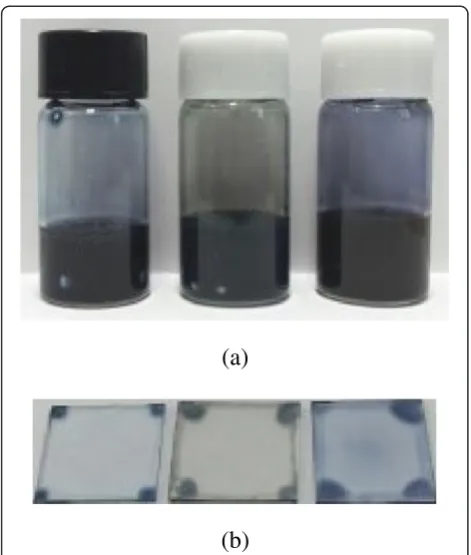
In our new method, we synthesize metal NPs via PEDOT:PSS media. Therefore, there is no need to use a stabilizer or an additional mixing step to prepare metal NPs with a PEDOT:PSS solution. After in situ pre-paration, the color of the mixed solution became pale
nm. From the cross-sectional view of the glass/ITO/ PEDOT:PSS-Ag NPs shown in Figure 4b, most NPs are fully embedded into the PEDOT:PSS; therefore, the sur-face of the PEDOT:PSS appears to have some degree of roughness. Ag NPs generally produce an absorption peak between 400 and 450 nm, and Au NPs have a sur-face plasmon resonance (SPR) peak between 500 and
(a)
[image:3.595.56.292.87.365.2](b)
Figure 3In situ-prepared PEDOT:PSS-metal NP solutions (a) and their corresponding spin-coated films on glass substrates.(b) (Pristine PEDOT:PSS, PEDOT:PSS-Ag NPs, and PEDOT:PSS-Au NPs from left to right).
(a)
[image:3.595.304.538.312.687.2](b)
600 nm depending on the thickness, shape, and distance of the nanostructures [24]. Because the main absorption range of P3HT is from 400 to 650 nm, Ag and Au NPs are both appropriate materials for improving the per-formance of OSCs by the SPR effect.
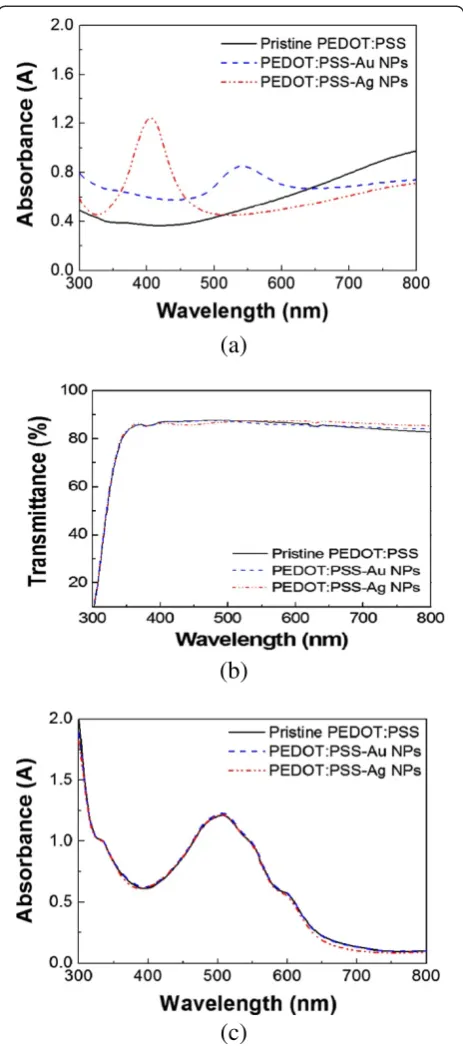
Figure 5a shows the absorption spectra of diluted pris-tine as well as Ag- and Au NP-incorporated PEDOT:PSS solutions as measured by a PerkinElmer Lambda 750 UV–vis spectrometer (PerkinElmer Inc., Waltham, MA, USA). PEDOT:PSS with Ag NPs shows a SPR peak at about 405 nm, and PEDOT:PSS with Au NPs has a SPR peak at 550 nm. The transmission spectra of the glass/ PEDOT:PSS-metal NPs show a slightly decreased region between 400 and 500 nm (Ag NPs) and 500 and 600 nm (Au NPs), which is indicative of SP absorption by metal NPs. However, the contribution of SP absorption in the PEDOT:PSS-metal NPs to the light absorption proper-ties of the photoactive layer is negligible, as shown in Figure 5c, in the wavelength between 400 and 600 nm. In theoretical and experimental analyses found in previ-ous reports, the strong near-field effect around metal NPs by SPR has a certain directionality which is mainly distributed along the lateral direction of the PEDOT:PSS layer and not in a direction vertical to the photoactive layer when the incidence of light is normal to the ITO [20,22]. Because metal NPs are entirely embedded in PEDOT:PSS in our system, the lateral SPR effect by NPs is too weak to affect the light-harvesting activity in the photoactive layer, leading to no obvious enhancement of the absorption spectra in Figure 5c.
Prior to checking the device performance, we mea-sured the sheet resistance of the PEDOT:PSS film and the effect of residual impurities remaining in PEDOT:
(a)
(b)
[image:4.595.58.290.87.611.2](c)
[image:4.595.306.539.89.265.2]Figure 5Optical properties of PEDOT:PSS-metal NPs.(a) UV–vis absorption spectra of the PEDOT:PSS-metal NPs in solutions, (b) transmittance spectra of the glass/PEDOT:PSS-metal NPs, and (c) absorption spectra of glass/PEDOT:PSS-metal NPs/active layer.
[image:4.595.305.539.668.734.2]Figure 6J-Vcharacteristics of the three devices.
Table 1 Summary of device performances
Voc(V) Jsc(mA/cm2) FF (%) PCE (%) Rs(Ωcm2)
Pristine PEDOT:PSS
likely to be important factors in our device system. Figure 6 and Table 1 show the photocurrent density voltages (J-V) of three different OSC devices measured at 100 mW/cm2(AM 1.5 G) with a Keithley model 2400 source meter (Keithley Instruments Inc., Cleveland, OH, USA) and a Newport 91192 solar simulator system (equipped with a 1 kW xenon arc lamp, by Oriel Instru-ments, London, UK). The reference device with a pris-tine PEDOT:PSS buffer layer exhibited an open-circuit voltage (Voc) of 0.62 V, a short-circuit current density
(Jsc) of 9.78 mA/cm2, and a fill factor (FF) of 48.7%; thus,
the calculated PCE was 2.95%. Considering the enhance-ment of theJscand FF values, the PCE was improved by
3.2% by applying thein situ-prepared PEDOT:PSS-metal NPs buffer layer. From the darkJ-Vcharacteristics in the inset of Figure 6, there is no significant change in the leakage current in both the Au NPs and the Ag NPs, which is an additional evidence of the full coverage of metal NPs with the PEDOT:PSS media. The incorpor-ation of metal NPs into PEDOT:PSS increased both the surface roughness of the PEDOT:PSS layer and the PEDOT:PSS/P3HT:PCBM interface area. It has been reported that an increased surface roughness of the buf-fer layer as well as an enlarged interface area of PEDOT: PSS/P3HT:PCBM lead to shortening of the hole-extraction route and enhancement of the hole-collection efficiency by the anode [15,22,25]. The reduced series re-sistance (Rs) from 1.8 to 1.5Ωcm2in Table 1 is another
indicator of the improved hole collection and ultimately, the enhancement ofJscand FF.
Conclusions
In conclusion, we successfully synthesized composites materials of PEDOT:PSS-Au or Ag NPs by a simple in
situ preparation method. The synthesized NPs with a size of 20 to approximately 40 nm were well dispersed in PEDOT:PSS media and showed a characteristic ab-sorption peak due to the SPR effect. According to our
J-V and UV–vis findings, the 8% improvement of the PCE is mainly caused by the increased hole collection to the anode due to the increased surface roughness and increased interface area of the buffer layer. Moreover, the optical effects of metal NPs are a minor factor when the metal NPs are embedded fully into the PEDOT:PSS layer.
The authors declare that they have no competing interests.
Authors' contributions
SW and JHJ synthesized, characterized, and fabricated the OSC device. HKL and YSH participated in the scientific flow and discussions. SW and YK conceived of the study and participated in its design and coordination. All authors read and approved the final manuscript.
Acknowledgments
This work was supported by the DGIST R&D Program of the Ministry of Education, Science and Technology of Korea (12-EN-02). It was also supported by Korean government grant (Priority Research Center-2009-0093819).
Author details
1Green Energy Research Division, Daegu Gyeongbuk Institute of Science and
Technology (DGIST), Daegu 711-873, South Korea.2Organic Nanoelectronics Laboratory, Department of Chemical Engineering, Kyungpook National University, Daegu 702-701, South Korea.3Department of Advanced Energy Material Science and Engineering, Catholic University of Daegu, Gyeongbuk 712-702, South Korea.
Received: 20 July 2012 Accepted: 15 October 2012 Published: 23 November 2012
References
1. Dennler G, Scharber MC, Brabec CJ:Polymer-fullerene bulk-heterojunction solar cells.Adv Mater2009,21:1323–1338.
2. Thompson BC, Frechet JMJ:Polymer-fullerene composite solar cells.
Angew Chem Int Ed2007,47:58–77.
3. Kim Y, Cook S, Tuladhar SM, Choulis SA, Nelson J, Durrant JR, Bradley DDC, Giles M, McCulloch I, Ha CS, Ree M:A strong regioregularity effect in self-organizing conjugated polymer films and high-efficiency polythiophene: fullerene solar cells.Nat Mater2006,5:197–203.
4. Scharber MC, Muhlbacher D, Koppe M, Denk P, Waldauf C, Heeger AJ, Brabec CJ:Design rules for donors in bulkheterojunction solar cells -towards 10% energy-conversion efficiency.Adv Mater2006,18:789–794. 5. Clarke TM, Durrant JR:Charge photo-generation in organic solar cells.
Chem Rev2010,110:6736–6767.
6. Coakley KM, McGehee MD:Conjugated polymer photovoltaic cells.
Chem Mater2004,16:4533–4542.
7. Park SH, Roy A, Beaupre S, Cho S, Coates N, Moon JS, Moses D, Leclerc M, Lee K, Heeger AJ:Bulk heterojunction solar cells with internal quantum efficiency approaching 100%.Nat Photonics2009,3:297–302.
8. Kim JY, Kim SH, Lee HH, Lee K, Ma W, Gong X, Heeger AJ:New architecture for high-efficiency polymer photovoltaic cells using solution-based titanium oxide as an optical spacer.Adv Mater2006,18:572–576. 9. Shen H, Bienstman P, Maes B:Plasmonic absorption enhancement in
organic solar cells with thin active layers.J Appl Phys2009,106:073109. 10. Lee JH, Park JH, Kim JS, Lee DY, Cho K:High efficiency polymer solar cells
with wet deposited plasmonic gold nanodots.Org Electron2009, 10:416–420.
11. Pillai S, Green MA:Plasmonics for photovoltaic applications.Sol Energy
Mater Sol Cells2010,94:1481–1486.
12. Rand BP, Peumans P, Forrest SR:Long-range absorption enhancement in organic tandem thin-film solar cells containing silver nanoclusters.
13. Kim K, Carroll DL:Roles of Au and Ag nanoparticles in efficiency enhancement of poly(3-octylthiophene)/C60bulk heterojunction
photovoltaic devices.Appl Phys Lett2005,87:203113.
14. Wang CCD, Choy WCH, Duan C, Fung DDS, Sha WEI, Xie FX, Huang F, Cao Y:Optical and electrical effects of gold nanoparticles in the active layer of polymer solar cells.J Mater Chem2012,22:1206–1211.
15. Xie FX, Choy WCH, Wang CCD, Sha WEI, Fung DDS:Improving the efficiency of polymer solar cells by incorporating gold nanoparticles into all polymer layers.Appl Phys Lett2011,99:153304.
16. Wang DH, Kim DY, Choi KW, Seo JH, Im SH, Park JH, Park OO, Heeger AJ: Enhancement of donor-acceptor polymer bulk heterojunction solar cell power conversion efficiencies by addition of Au nanoparticles.Angew
Chem Int Ed2011,50:5519–5523.
17. Wang DH, Kim JK, Lim GH, Park KH, Park OO, Lim B, Park JH:Enhanced light harvesting in bulk heterojunction photovoltaic devices with shape-controlled Ag nanomaterials: Ag nanoparticlesversusAg nanoplates.
RSC Adv2012,2:7268–7272.
18. Morfa AJ, Rowlwn KL, Reilly TH III, Romero MJ, Lagemaat JVD: Plasmon-enhanced solar energy conversion in organic bulk heterojunction photovoltaics.Appl Phys Lett2008,92:013504.
19. Yoon WJ, Jung KY, Liu J, Duraisamy T, Revur R, Teixeira FL, Sengupta S, Berger PR:Plasmon-enhanced optical absorption and photocurrent in organic bulk heterojunction photovoltaic devices using self-assembled layer of silver nanoparticles.Sol Energy Mater Sol Cells2010,94:128–132. 20. Qiao L, Wang D, Zuo L, Ye Y, Qian J, Chen H, He S:Localized surface
plasmon resonance enhanced organic solar cell with gold nanospheres.
Appl Energy2011,88:848–852.
21. Chen FC, Wu JL, Lee CL, Hong Y, Kuo CH, Huang MH:Plasmonic-enhanced polymer photovoltaic devices incorporating solution-processable metal nanoparticles.Appl Phys Lett2009,95:013305.
22. Fung DDS, Qiao L, Choy WCH, Wang C, Sha WEI, Xie F, He S:Optical and electrical properties of efficiency enhanced polymer solar cells with Au nanoparticles in a PEDOT:PSS layer.J Mater Chem2011,21:16349–16356. 23. Wiley B, Sun Y, Chen J, Cang H, Li ZY, Li X, Xia Y:Shape-controlled
synthesis of silver and gold nanostructures.MRS Bull2005,30:356–361. 24. Rycenga M, Cobley CM, Zeng J, Li W, Moran CH, Zhang Q, Qin D, Xia Y:
Controlling the synthesis and assembly of silver nanostructures for plasmonic applications.Chem Rev2011,111:3669–3712.
25. Hsu MH, Yu P, Huang JH, Chang CH, Wu CW, Cheng YC, Chu CW:Balanced carrier transport in organic solar cells employing embedded indium-tin-oxide nanoelectrodes.Appl Phys Lett2011,98:073308.
doi:10.1186/1556-276X-7-641
Cite this article as:Wooet al.:In situ-prepared composite materials of PEDOT: PSS buffer layer-metal nanoparticles and their application to organic solar cells.Nanoscale Research Letters20127:641.
Submit your manuscript to a
journal and benefi t from:
7 Convenient online submission
7 Rigorous peer review
7 Immediate publication on acceptance
7 Open access: articles freely available online
7 High visibility within the fi eld
7 Retaining the copyright to your article