N A N O E X P R E S S
Open Access
Pb(core)/ZnO(shell) nanowires obtained by
microwave-assisted method
F Solis-Pomar
1,2, MF Meléndrez
3, R Esparza
4and E Pérez-Tijerina
1,2*Abstract
In this study, Pb-filled ZnO nanowires [Pb(core)/ZnO(shell)] were synthesized by a simple and novel one-step vapor transport and condensation method by microwave-assisted decomposition of zinc ferrite. The synthesis was performed using a conventional oven at 1000 W and 5 min of treatment. After synthesis, a spongy white cotton-like material was obtained in the condensation zone of the reaction system. HRTEM analysis revealed that product consists of a Pb-(core) with (fcc) cubic structure that preferentially grows in the [111] direction and a hexagonal wurtzite ZnO-(Shell) that grows in the [001] direction. Nanowire length was more than 5μm and a statistical analysis determined that the shell and core diameters were 21.00 ± 3.00 and 4.00 ± 1.00 nm, respectively. Experimental, structural details, and synthesis mechanism are discussed in this study.
Introduction
One-dimensional (1D) nanostructures as wires, rods, belts, and tubes have attracted the attention of research-ers because of their intrinsic properties and novel appli-cations in various fields [1]. There are several nanostructured materials that are nowadays being widely used, these are based on those of zinc oxide which has excellent properties such as a wide energy band gap (3.37 eV) [2], a large exciton binding energy (60 meV) at room temperature [3], high optical gain (300 cm-1) [4], high mechanical and thermal stabilities [5], and radiation hardness [6]. Because of these properties, ZnO nanostructures have been applied as activated material in the electronic devices manufacture, e.g., gas sensors, nanoresonators, solar cells, waveguide, field emitters, nanocantilevers, nanolasers, transistors, and optoelectro-nic devices [7-14]. Furthermore, this material is very versatile to obtain several kinds of nanostructures, such as wires, rods, particles, belts, plates, tubes, and flowers, that have been synthesized through various methods. Among these are the chemical and physical methods, whose choice often depends on the type of application being sought. A recent interest in scientific research is the application of nanostructures as superconducting
nanowires with diameters comparable to the
superconducting coherence length that has served as a model system to study thermal and quantum phase slips [15]. In addition, these kinds of materials have a rela-tively high critical temperatures and stability at ambient atmosphere make them potential candidates for applica-tions in other superconducting devices, for example, sin-gle photon detectors [16] and hot-electron bolometric mixers [17]. A nanostructured system with the applica-tion menapplica-tioned may be a core/shell nanostructure based on nanowires filled by a metal. If the core-metal has a suitable thermal expansion coefficient, then these mate-rials [metal(core)/oxide(shell)]-type can also be used as nanosensors and nanothermometers. This is the reason why Ga/MgO, In/CNT, Ga/CNT, Au(Si)/Ga2O3, and Pb/CNT have been used as (core/shell)-NWs systems for the development of nanothermometers and super-conducting nanosensors, being thus far the most sensi-tive nanothermometers those based on the thermal expansion of indium-filled carbon nanotubes (CNT). In summary, one can say that“the integration of supercon-ducting and semiconductors nanostructures would be quite important for technological applications”. Other-wise, among metal nanowires that have been obtained so far, Pb is a particularly attractive, important, and challenging target owing to its superconductivity and high reactivity. The synthesis process to obtain (core/ shell)-NWs using Pb as core is not easy and usually a small portion of this nanostructure is obtained. For this reason, one-step CVD method and two-step template
* Correspondence: [email protected]
1
Laboratorio de Nanociencias y Nanotecnología CICFiM (FCFM), Universidad Autónoma de Nuevo León, Monterrey, Nuevo León 66450, México Full list of author information is available at the end of the article
synthesis method have been developed to obtain those [18]. In this study, a novel, fast, and simple one-step method for the preparation of Pb(core)/ZnO(shell)-NWs based on the ZnFe2O4 decomposition assisted by micro-wave is detailed. As the starting material the mining industry process residue of the ZnO production was used and furthermore did not utilize any reagent or ferential growth precursor molecules. The synthesis pre-sented in this study was reproducible and can be versatile to prepare several kinds of nanostructured materials using microwave-assisted decomposition of precursor salts or other industrial residue.
Experiment
Synthesis
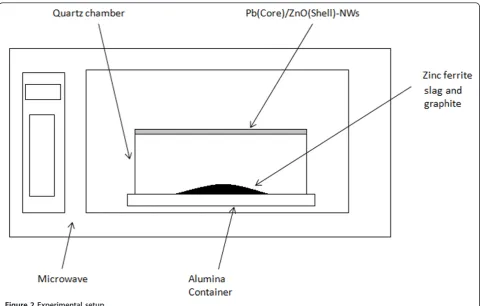
The starting material used for the synthesis was zinc fer-rite slag contaminated with 3.35% of Pb (see Figure 1), purchased from Peñoles SA industrial service (México). A typical synthesis was carried out with zinc ferrite (1.0 g) mixed homogeneously with graphite (1.00 g). Eva-poration procedure was performed using a conventional microwave oven (Sharp R658L (S)-Model) that was amended to do the experiments (see Figure 2). The reaction was carried out at 1000 W for 5 min. The pro-duct was condensed into a quartz chamber which extends from the material decomposition center to the upper surface of the microwave oven. The synthesized material was then collected at the top of condensation chamber.
Characterization
High-resolution transmission electron microscopy was performed in a JEM-ARM200F probe aberration cor-rected analytical microscope with a resolution of 0.08 nm. Selected area electron diffraction was performed in a JEOL 2010F operating at 200 kV (point resolution of 0.19 nm). Scanning electron microscopy (SEM) was car-ried out using a FEG Hitachi S-5500 ultra high-resolu-tion electron microscope (0.4 nm at 30 kV) with a BF/
DF Duo-STEM detector and in a FEI-Nanonova 100 FE-SEM.
Results and discussion
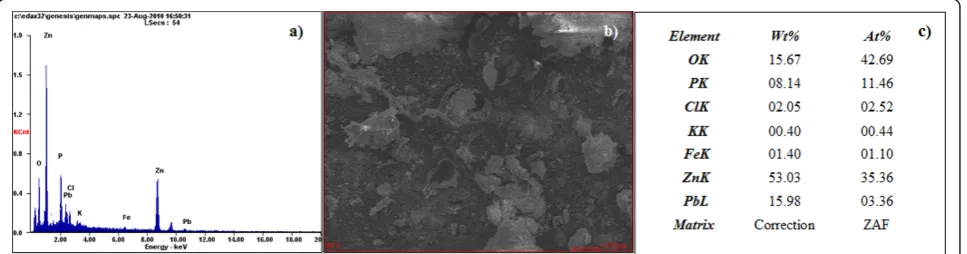
The synthesis process used in this study for the Pb (core)/ZnO(shell)-NWs preparation is simple, inexpen-sive, and was performed in solid state in the absence of chemical reagents and without preferential growth pre-cursor molecule. After the synthesis, a spongy white material was obtained as cotton-like on the upper cham-ber condensate and the evaporation power always remained about 1000 W since below this value it was not possible to obtain the NWs. In addition, reaction time did not exceed more than 5 min since this was suf-ficient to complete reaction of the material and the gra-phite added to the reaction system which was to perform a reductive decomposition of the starting mate-rial and to facilitate the evaporation of the products. The SEM micrographs and EDX of the starting material used in this synthesis are shown in Figure 1; the EDX analysis shows that the slag also has other pollutants in lesser amount than the Pb such as K and Cl. The mor-phology analysis of the white powder obtained is shown in Figure 3, where the low-resolution FE-SEM micro-graphs of the NWs are shown. The technique effective-ness used to obtain the Pb(core)/ZnO(shell)-NWs is evidenced by the large percentage of the nanowires that are observed in the image. Furthermore, the conversion rate was over 90% and the material loss is only due to collection and cleaning processes of the material in the condensation chamber.
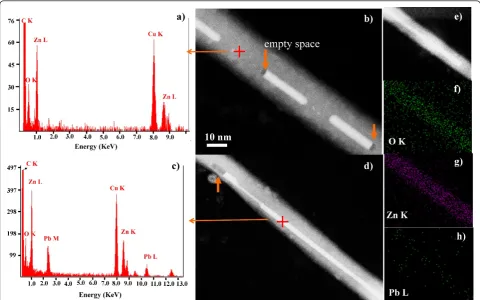
[image:2.595.58.542.575.702.2]Figure 3a shows that the white powder obtained is composed mainly of ZnO nanowires whose length is up to 5 μm as can be seen in Figure 3b. The composition was determined by EDX point/line analysis and map-ping, these results are shown in Figure 4. The EDX ana-lysis and the dark field HRTEM micrographs of Pb/ZnO nanowires revealed the presence of Pb in the ZnO nano-wires and also empty spaces within them as is shown in
Figure 1SEM micrographs and EDX of the starting material.(a)EDX and(b)SEM micrograph analysis of material used in the synthesis of Pb(core)/ZnO(shell) nanowires.(c)Composition analysis.
Solis-Pomaret al.Nanoscale Research Letters2011,6:553 http://www.nanoscalereslett.com/content/6/1/553
Figure 4b,d. These results are similar to those obtained by Wang et al. [19] who say that because of electron beam temperature the Pb-core expands moving from one extreme to another within ZnO-shell. Thermal expansion effect of partially Pb-filled nanotubes has also been studied by Lee et al. [20] who tested the electron beam effect on the Pb inner core of the nanotubes. Only a few studies have reported obtaining of Pb(core)/
ZnO(shell) nanowires using wet chemical synthesis based on their respective nitrates [19]; however, the technique employed in this study consists of a one-step vapor transport, decomposition, and condensation reac-tion assisted by microwave to prepare these nanostruc-tures is reported for the first time. On the other hand, it can be seen in the EDX spectra in Figure 4 that the Pb-core is within of the NWs owing to the signals Figure 2Experimental setup.
[image:3.595.57.539.528.693.2]appearing at 2.4 and 10.5 keV characteristics of Pb (M) and Pb (L), respectively. EDX analysis was performed on the brightest part of the NWs core and also in areas where there is no Pb (see Figure 4a,c); in these zones, the characteristics peaks of zinc [Zn (L); Zn (K)] and oxygen [O (K)] appear. The absence of Fe signals dis-cards that the peaks of the spectra correspond to zinc ferrite. The maps of Zn (K), Pb (L) O (K) signals are shown in Figure 4e-h; these analyses confirmed that the NWs shell and core are formed of ZnO and Pb, respectively.
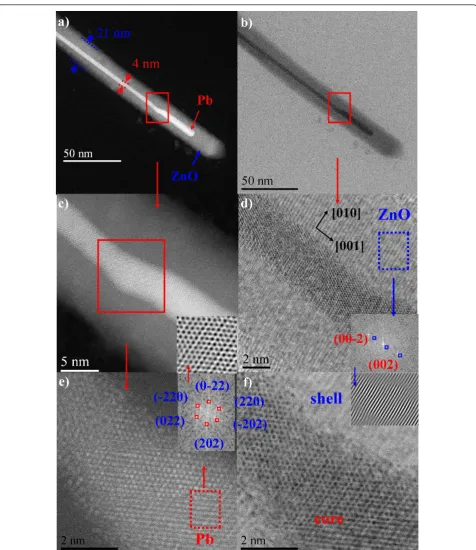
A more detailed structural analysis of the Pb-filled ZnO NWs is shown in the HRTEM micrographs in Fig-ure 5c-f. From dark field micrographs in FigFig-ure 5a,c,e, one can clearly distinguish the Pb-core and ZnO-shell because of the differences in their atomic weights. It was determined through of the fast Fourier transform (FFTs) of the HRTEM image an interplanar distance (dhkl) of 1.75 Å characteristic of the {220} crystallo-graphic planes of Pb with a cubic (fcc) structure. These results are in accordance with those reported by Wang et al. [19]. As mentioned, the Pb-core was highly sus-ceptible to beam damage (especially for the relatively thinner region like the edge of a wire) when it was
exposed to a flux of high-energy electrons. As a result, it is not unusual to observe that the right edge of this wire appears to have stacking defects, an artifact that might be caused by electron-beam-induced damage [18]. ZnO-shell analysis was performed from Figure 5d and it was determined that an interplanar distance (dhkl) of 2.60 Å corresponds to the (002) planes of the ZnO hex-agonal wurtzite-type. In addition, from the HRTEM ana-lysis it is determined that the zone axis crystal orientation is [100] and [001] which is the preferential growth direction characteristic of the ZnO nanostruc-tures [21]. The NWs core and shell diameter were determined by random measurements and the obtained data were represented by a histogram; the average thick-ness was fitted to both normal and Gaussian curves. It was found that ZnO-shell and Pb-core thickness is around 21.00 ± 3.00 and 4.00 ± 1.00 nm, respectively, and the nanowires’ length was ~5.00 μm. ZnO-shell thickness and length were independent of the micro-wave power used in the synthesis which ranged from 800 at 1000 W.
[image:4.595.57.538.89.389.2]The proposed formation mechanism in this study is based on the ZnFe2O4decomposition owing to tempera-ture rise assisted by the microwave and also by Pb the Figure 4EDX analysis and dark field HRTEM micrographs of Pb(core)/ZnO(shell) nanowires.(a, c)EDX analysis of different NWs sections with and without Pb.(b, d)Dark field HRTEM micrographs where the analyzed sections in(a, c)are shown.(e-h)Mapping section of the Pb (core)/ZnO(shell)-NWs.
Solis-Pomaret al.Nanoscale Research Letters2011,6:553 http://www.nanoscalereslett.com/content/6/1/553
evaporation process. Pb has a low melting point (327°C) and a boiling point of 1749°C so this just changes the state, melts, and evaporates. In the past, thermal decom-position of lead acetate in solid state has been studied by several groups and they conclude that depending on the temperature (up to 450°C) and environment (under N2 or in air), both Pb and PbO had been identified as the final products together with several types of basic lead acetate as the intermediates [22,23]. According to these studies, the minimum temperature required for the metallic lead production was around 325°C and it was found that lead could be formed as the major pro-duct (together with the formation of acetic acid as a byproduct). By contrast, in this study, the decomposition of zinc ferrite could be greatly facilitated because of the presence of hot spots, these spots are produced by the graphite in the mixture because it absorbs most of the incident radiation and acts as an evaporation source. Then there are two species in the vapor, the Pb evapo-rated from the slag and the ZnO produced of the ZnFe2O4 decomposition. The possible reactions are
ZnFe2O4(s)+ 1/2CO2(s)→1/2CO2
g+ Zng+ Fe2O3(s) (1)
Zng+ O2
g→ZnogH= 348.3kJ mol−1 (2)
ZnOg →ZnO (s) (3)
Pb(s)→Pbg H= 195.2kJ mol−1 (4)
Pb g→ Pb (s) (5)
In the initial stages, Pb(g) (Equations 4 and 5) will predominate and much less ZnO(g) and Fe2O3 (s) will be produced by virtue of their different heats of forma-tion ZnO (348.3 kJ/mol) and Fe2O3 (824.2 kJ/mol). Thus, the formation of the Pb(core)/ZnO(shell)-NWs could be divided into two parts: (i) the microwave-assisted evaporation of Pb and (ii) the ZnFe2O4 decom-position. Therefore, Pb is in the vapor phase with some Zn and ZnO species and in the condensation process they interact stronger with the {100} facets of Pb that with the {111}. This selectivity can be attributed to the differences in the atoms configuration on these surfaces that may enhance or hinder their coordination to the molecules of ZnO and as a result, the side surface of a Pb nanowires (core) enclosed by {100} could be prefer-entially stabilized; while the ends, the {111} planes could be kept active and continues to grow (see Figure 6). Zinc oxide is produced in greater amounts than Pb, so once the Pb nanowires growth process is finished, ZnO continues to grow in the [001] direction until they coat completely the Pb and get the Pb(core)/ZnO(shell)-NWs as illustrated in the HRTEM micrographs.
Conclusions
[image:6.595.58.539.521.679.2]In this study, it was possible to obtain Pb(core)/ZnO (shell)-NWs using a slag of ZnFe2O4 with a Pb percen-tage of about 3% in the starting material, through a sim-ple synthesis method which consisted of zinc ferrite decomposition assisted by microwave. This method proved to be versatile, economical, and reproducible to obtain this type of nanostructures. The nanowires core and shell had an inner and outer diameters of about 4 and 21 nm, respectively; with lengths greater than 5μm. Length and thickness of both core and shell were inde-pendent of the radiation power used in the synthesis
Figure 6Nucleation and growth mechanism of Pb(core)/ZnO(shell)-NWs obtained from the zinc ferrite slag contaminated with Pb through a decomposition reaction assisted by microwave radiation. The reduction products are Fe (s), Fe2O3(s), and CO2(g). In the early
stages of the reaction, the vapor is rich in Pb and has a ZnO lesser proportion. Some ZnO and Zn species react with the [100] Pb surface thereby facilitating its growth in the [111] direction.
Solis-Pomaret al.Nanoscale Research Letters2011,6:553 http://www.nanoscalereslett.com/content/6/1/553
(800-1000 W). The nanowires core consisted of cubic Pb (fcc) with preferential growth in the [111] direction and the shell structure was ZnO hexagonal wurtzite-type. ZnO and Zn species interact more strongly with {100} facets of Pb facilitating its growth in the [111] direction.
Acknowledgements
The authors wish to thank the“Servicios Industriales Peñoles, SA de C.V (México)”for supporting this research, the International Center for Nanotechnology and Advanced Materials (ICNAM) from the University of Texas at San Antonio-USA for the advice and input on the microscope in particular Mr. David Olmos and for the help in the experiments to the staff of the Laboratory of Nanoscience and Nanotechnology from the Universidad Autonoma de Nuevo Leon.
Author details
1Laboratorio de Nanociencias y Nanotecnología CICFiM (FCFM), Universidad
Autónoma de Nuevo León, Monterrey, Nuevo León 66450, México2Centro de Innovación, Investigación y Desarrollo en Ingeniería y Tecnología (CIIDIT) de la UANL-PIIT, Apodaca, Nuevo León 66600, México3Department of Materials Engineering (DIMAT), Faculty of Engineering, 270 Edmundo Larenas, Casilla 160-C, University of Concepcion, Concepcion, Chile
4International Center for Nanotechnology and Advanced Materials,
Department of Physics & Astronomy, University of Texas at San Antonio, One UTSA Circle, San Antonio, TX 78249, USA
Authors’contributions
FSP carried out the experiment. MFM performed the results interpretation and drafted the manuscript. RE performed the characterization. EPT conceived of the study, design, and coordination. All the authors read and approved the final manuscript.
Competing interests
The authors declare that they have no competing interests.
Received: 4 April 2011 Accepted: 10 October 2011 Published: 10 October 2011
References
1. Wang X, Li G, Wang Y:Synthesis and characterization of well-aligned Cd-Al codoped ZnO nanorod arrays.Chem Phys Lett2009,469:308-312. 2. Thomas DG:The exciton spectrum of zinc oxide.J Phys Chem1960,
15:86-96.
3. Al-Hajry A, Umar A, Hahn YB, Kim DH:Growth, properties and dye-sensitized solar cells-applications of ZnO nanorods grown by low-temperature solution process.Superlattice Microst2009,45:529-534. 4. Chen Y, Bagnall DM, Koh H, Park K, Zhu Z, Yao T:Plasma assisted
molecular beam epitaxy of ZnO onc-plane sapphire: growth and characterization.J Appl Phys1998,84:3912-3918.
5. Wang RC, Liu CP, Huang JL, Chen SJ, Tseng YK:ZnO nanopencils: efficient field emitters.Appl Phys Lett2005,87:013110.
6. Auret FD, Goodman SA, Hayes M, Legodi MJ, Van Laarhoven HA, Look DC:
Electrical characterization of 1.8 MeV proton-bombarded ZnO.Appl Phys Lett2001,79:3074-3076.
7. Foreman JV, Li J, Peng H, Choi S, Everitt HO, Liu J:Time-resolved investigation of bright visible wavelength luminescence from sulfur-doped ZnO nanowires and micropowders.Nano Lett2006,6:1126-1130. 8. Umar A, Rahman MM, Kim SH, Hahn YB:Zinc oxide nanonail based
chemical sensor for hydrazine detection.Chem Commun2008, 166-168. 9. Bai XD, Gao PX, Wang ZL, Wang EG:Dual-mode mechanical resonance of
individual ZnO nanobelts.Appl Phys Lett2003,82:4806-4808. 10. Leschkies KS, Divakar R, Basu J, Enache-Pommer E, Boercker JE, Carter CB,
Kortshagen UR, Norris DJ, Aydil ES:Photosensitization of ZnO nanowires with CdSe quantum dots for photovoltaic devices.Nano Lett2007,
7:1793-1798.
11. Voss T, Svacha GT, Mazur E:High-order waveguide modes in ZnO nanowires.Nano Lett2007,7:3675-3680.
12. Lee J-H, Chung Y-W, Siung Hon M-H, Leu I-C:Density-controlled growth and field emission property of aligned ZnO nanorod arrays.Appl Phys A
2009,97:403-408.
13. Arnold MS, Avouris P, Pan ZW, Wang ZL:Field-effect transistors based on single semiconducting oxide nanobelts.Phys Chem B2003,107:659-663. 14. Hughes WL, Wang ZL:Nanobelts as nanocantilevers.Appl Phys Lett2003,
82:2886-2888.
15. Korneev A, Kouminov P, Matvienko V, Chulkoka G, Smirnov K, Voronov B, Gol’tsman GN, Currie M, Lo W, Wilsher K, Zhang J, Slysz W, Pearlman A, Verevkin A, Sobolewski R:Sensitivity and gigahertz counting performance of NbN superconducting single-photon detectors.Appl Phys Lett2004,
84:5338-5340.
16. Kerman AJ, Dauler EA, Keicher WE, Yang JKW, Berggren KK, Voronov GG:
Kinetic-inductance-limited reset time of superconducting nanowire photon counters.Appl Phys Lett2006,88:111116.
17. Kawamura J, Blundell R, Tong CE, Goltsman G, Gershenzon E, Voronov B:
Performance of NbN lattice-cooled hot-electron bolometric mixers.J
Appl Phys1996,80:4232-4234.
18. Wang C-Y, Lu M-Y, Chen H-C, Chen L-J:Single-crystalline Pb nanowires grown by galvanic displacement reactions of Pb ions on zinc foils and their superconducting properties.J Phys Chem C2007,111:6215-6219. 19. Wang C-Y, Gong N-W, L-J Chen:High-sensitivity solid-state Pb(core)/ZnO
(shell) nanothermometers fabricated by a facile galvanic displacement method.Chem Adv Mater2008,20:4789-4792.
20. Jong-Soo Lee, Sung-Kyu Sim, Kyung-Hwan Kim, Kyoungah Cho, Sangsig Kim:Amorphous lead oxide nanotubes filled partially with single-crystalline lead.Mat Sci Eng B2005,122:85-89.
21. Pan ZW, Mahurin SM, Dai S, Lowndes DH:Nanowire array gratings with ZnO comb.Nano Lett2005,5:723-727.
22. Patel U, Avci S, Xiao ZL, Hua J, Yu SH, Ito Y, Divan R, Ocola LE, Zheng C, Clous H, Hiller J, Welp U, Miller DJ, Kwok WK:Synthesis and
superconducting properties of niobium nitride nanowires and nanoribbons.Appl Phys Lett2007,91:162508.
23. Mohamed MA, Halawy SA, Ehenbrahim MM:Non-isothermal kinetic and thermodynamic study of the decomposition of lead acetate trihydrate.
Thermochim Acta1994,236:249-262.
doi:10.1186/1556-276X-6-553
Cite this article as:Solis-Pomaret al.:Pb(core)/ZnO(shell) nanowires obtained by microwave-assisted method.Nanoscale Research Letters2011 6:553.
Submit your manuscript to a
journal and benefi t from:
7 Convenient online submission
7 Rigorous peer review
7 Immediate publication on acceptance
7 Open access: articles freely available online
7 High visibility within the fi eld
7 Retaining the copyright to your article