Number 6105
Konkoly Observatory Budapest
16 May 2014
HU ISSN 0374 – 0676
TYC3556-299-1 AND TYC3556-130-1: A BINARY MEMBER
AND A SINGLE δ Sct STAR
SEREBRYANSKIY, A.V. ; GAYNULLINA, E.R.; KHALIKOVA, A.V.
Ulugh Beg Astronomical Institute, Astronomicheskaya str., 33, 100072 Tashkent, Uzbekistan email: [email protected], [email protected]
TYC3556-299-1 (RA2000=19h35m36s.798; DEC2000=+46◦05′56′′.34) is a star with V≈ 12 mags and TYC3556-130-1 (RA2000=19h38m08s.115; DEC2000=+46◦34′55′′.64) is a rela-tively bright star with V≈ 10.7 mags. TYC3556-299-1 is also designated by Kepler ID 9470054 and classified as eclipsing binary system. The premise for designating the star as binary is its light curve variability with period of 1d.4732271.
We observed the field of the open cluster NGC 6811 on Maidanak observatory (Uzbek-istan) during several nights in 2010 with Taiwan Automated Telescope (TAT, Chou et al., 2010). The TAT uses a 9-cm Maksutov-type telescope with f=25, manufactured by “Questar”. The CCD camera is Apogee Alta U6 16-bit 1024×1024, the CCD chip is a Kodak KAF-1101E, scale is 2′′.18 per pixel which gives field of view of 0◦.62×0◦.62. Because
the telescope was not originally equipped with standard color filters, observations were made in integrated light, exposure times were either 280 or 320 sec. The main goal of the observations was a search for new variables as well as asteroseismic analysis of known
δ Sct stars. Among all nights of observations we had four nights (Aug 26 and Sep 7, 9, 10) when the star TYC3556-299-1 was found in the field of view and two nights (Sep 9, 10) when the star TYC3556-130-1 was found in the field of view. Basic reduction of the frames was done using standard IRAF2 software.
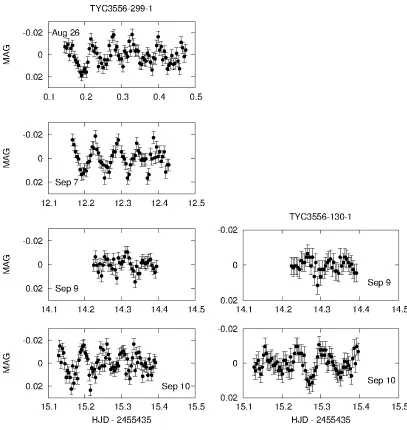
To obtain light curve of TYC3556-299-1 and TYC3556-130-1 we used method of dif-ferential photometry. For this goal we extract photometry of a set of stars across the field of NGC 6811. During the photometric analyses we encountered two main problems: (i) strong coma distortions of the stellar profiles due to a quite wide field of view of the telescope, and (ii) moderate star crowding on the field. To avoid these problems we performed only aperture photometry with aperture radius is being approximately equal to FWHM. Having had the instrumental magnitudes we used method of ensemble pho-tometry (Honeycutt, 1992) realized in “Ensemble-0.7” software by Michael Richmond (http://spiff.rit.edu/ensemble). Then we subtracted low-frequency trends (due to possible effects of differential absorption) from all light curves by fitting low-order polyno-mial. This effectively removes any periodic signal with period longer than several hours. The final light curves contain 119 data points for TYC3556-130-1 and 226 data points for TYC3556-299-1 and are shown in Figure 1.
1
http://archive.stsci.edu/kepler
2
Figure 1. Light curves of the stars TYC3556-299-1 (left column) and TYC3556-130-1 (right column) observed in Maidanak observatory in 2010.
Table 1: Mode parameters for TYC3556-299-1 and TYC3556-130-1
Star Frequency (c/d)) Amplitude (mmag) Phase SNR
TYC3556-299-1 17.233 ±0.002 6.00 ±0.53 0.03 ± 0.02 8.60
15.489 ± 0.003 4.68 ± 0.54 0.35 ± 0.03 7.91
21.371 ± 0.004 3.07 ± 0.49 0.90 ± 0.05 5.70
12.432 ± 0.005 2.50 ± 0.51 0.77 ± 0.06 4.57
TYC3556-130-1 13.364 3.75 ± 0.41 0.11 ± 0.017 9.53
20.409 2.78 ± 0.41 0.50 ± 0.023 9.07
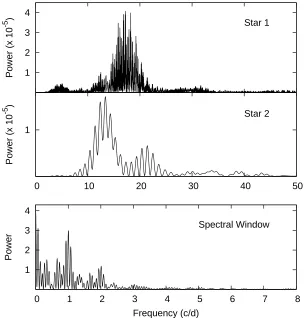
[image:2.595.86.507.621.766.2]For the power spectra analysis of the light curves the FAMIAS software package (Zima, 2008) was used. The parameters of the FAMIAS are identical to those used in (Serebryan-skiy et al., 2013). The parameters of the modes are listed in Table 1. The errors of the frequency estimation for TYC3556-130-1 are not presented due to low resolution of power spectra used in our analyses. This causes instability of frequencies during pre-whitening in FAMIAS. We fixed the frequency value determined in the previous run to estimate frequency and other parameters of the mode in the subsequent run.
1 2 3 4
0 1 2 3 4 5 6 7 8
Power
Frequency (c/d)
Spectral Window 1
0 10 20 30 40 50
Power (x 10
-5 ) Star 2
1 2 3 4
Power (x 10
[image:3.595.161.465.210.528.2]-5 ) Star 1
Figure 2. Upper panel (Star 1): power spectrum of TYC3556-299-1. Middle panel (Star 2): power spectrum of TYC3556-130-1. Lower panel: window function of TYC3556-299-1 power spectrum.
Using the available information for these stars, i.e. their magnitudes in different wave-lengths from SIMBAD astronomical database and CSOCA catalog (Kharchenko et al., 2004) we found that (B−V) color index for TYC3556-299-1 is in the range of 0.02-0.04 and (B−V) color index for TYC3556-130-1 is in the range of 0.4-0.43. According to Dias et al. (2002) the star TYC3556-299-1 has a high probability due to its proper motion to be a member of NGC 6811 open cluster. From Janes et al. (2013) the color excess EB−V
TYC3556-130-1 belongs to the NGC6811 is smaller, but it is high considering photometry and position criteria (Kharchenko et al., 2004). If we assume that this star belongs to the open cluster then the true (B−V)0 color index will be ∼ 0.35 which make this star closer to spectral class F0. We assumed that both stars belong to the main sequence.
0 1
10 12 14 16 18 20 22 24
Power (x 10
-5 )
Frequency (c/d) 0
40 41 42 43 44
Flux
[image:4.595.122.480.170.442.2]BJD - 2455400 TYC 3556-299-1
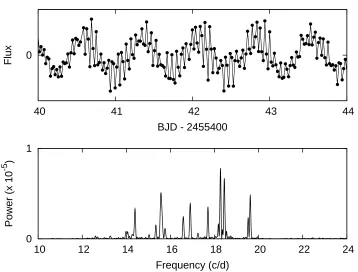
Figure 3. Upper panel: an example of a segment of Kepler light curve. Lower panel: power spectrum for TYC3556-299-1 computed using “Kepler” light curve of the same period of observation (see the
text).
We tried to compare our results with results obtained by analyzing part of the Kepler light curve for TYC3556-299-13 for the observing period similar to our observations. It should be noted that sampling rate of the Kepler light curve for this star did not allow us to make precise frequency determination. Median value of sampling rate for Kepler observations is∼1765 sec, comparing to the sampling rate of the TAT of∼300 sec. As a result the possible aliasing did not allow us to select unique modes from power spectrum of Kepler light curve. But we were able to confirm the presence of modes in the range from 12 to 22 c/d with amplitudes higher than 4σ above the noise level; see Fig. 3. On the top panel of Fig. 3 we show only part of Kepler light curve to see clearly oscillation with period of 1d.473227 and superimposed on it the oscillations with shorter periods. The lower panel shows the power spectrum computed using Kepler light curve for the same observing period to our observations.
Considering the amplitudes and periods of oscillations, as well as the spectral type of the stars (A-F) we conclude that TYC3556-299-1 and TYC3556-130-1 could be variables of δ Sct type although the classification of TYC3556-299-1 might be biased by the fact that this system is a binary star.
3
Taking into account their brightness and that one of the stars is in a close binary system they will be convenient and interesting targets for a future asteroseismic campaign using small-aperture telescopes.
Acknowledgements: The authors are supported by Fundamental Research Grant FA-F02-F028 of the Uzbek Academy of Sciences. We thanks the anonymous referee for important suggestions and comments.
References:
Chou, D.-Y., Sun, M.-T., Fernandez, F.J. et al., 2010, Advances in Astronomy, 2010, 125340
Dias, W. S., Alessi, B. S., Moitinho, A., L´epine, J. R. D., 2002, A&A, 389, 871 Honeycutt, R.K., 1992, PASP, 104, 435
Janes, K., Barnes, S.A., Meibom, S., Hoq, S., 2013,Astronomical Journal, 145, 7
Kharchenko, N.V., Piskunov, A.E., R¨oser, S., Schilbach, E., Scholz, R.-D., 2004, Astr. Nachr., 325, 740
Serebryanskiy, A. V., Gaynullina, E. R., Strel’nikov, D. V., Khalikova, A. V., 2013,IBVS, 6047