Volume 63 Number 6265 DOI: 10.22444/IBVS.6265
Konkoly Observatory Budapest
8 May 2019
HU ISSN 0374 – 0676
THE RS CVn CANDIDATE DG Ari:
ORBITAL AND LONG CYCLES REVEALED
ROJAS, G.; ROSALES, J. A.; CELED ´ON, I.; GARC´ES, J.; MENNICKENT, R. E.; VILLEGAS, F.
Astronomy Department, University of Concepci´on, Concepci´on, Chile. e-mail: [email protected]
Abstract
DG Ari (ASAS J025521+1539.4) is a variable star that was found in the search of binary stars with periods longer than 30 days in ASAS catalogue . The source shows two periodic component in its light curve. We estimate both, the orbital period, and the long-term cycle using PDM. Additionally, we present a match with the soft X-ray source 1RXSJ025521.3+153951 located at similar position. According with these results, we discuss about its nature as a RS CVn candidate.
DG Ari is a periodic variable star located in the Aries constellation. There is a discrep-ancy in the determined period of the source, one being half of the other, which suggests two different explanations for its properties. Here we present some evidence that support the election of one of the possible periods. We present a general overview of the RS CVn class, following by observational data analysis that support the selected period, and finally, a brief discussion on the nature of the source.
RS Canum Venaticorum is an eclipsing binary star, the first time that the variability of this source was noticed was by Ceraski (1914). Later, the variability was well studied, and the object gave the name to a subcategory of binary systems with the same behaviour. The principal characteristics are presented in the following paragraph.
Hall (1976) have defined some binaries with orbital periods between 1 and 14 days, which present strong H and K emission in the spectrum outside the eclipse and have been defined as RS CVn stars, wherein the systems with periods longer than 14 days were classified as part of the long period group. Some of these objects are eclipsing variable systems, and show additional photometric variations, probably caused by chromospheric activity cycles lasting some years (Buccini & Mauas, 2009). These systems are composed of F-K type dwarf/giant stars. The systems with smaller orbital periods exhibit strong magnetic activity, which is thought to be related to rapid rotation of one of the compo-nents. A remarkable characteristic of these objects is the presence of soft X-ray emissions from the source, first studied by Walter et al. (1978, 1980). The X-ray emissions from those sources are considered as a tracer of coronal activity in stars. They offer laboratories to study stellar activity in post-main-sequence stars influenced by tidal effects (Strass-meier, 2009). The presence of cool spots on eclipsing RS CVn-type systems is responsible for significant variability in their light curves outside eclipses (Berdyugina, 2005).
2 IBVS6265
in the ROSAT All-Sky Survey Faint Source Catalog1 (Voges et al., 2000), was matched later to an ASAS object (ASAS J025521+1539.4) by Szczygiel et al. (2008), as a part of a larger project to search stars displaying coronal activity in the ASAS catalogue. This object shows X-ray and bolometric luminosities of log(Lx)= 29.207 (log(ergs s−1)) and log(Lbol)=32.769 (log(ergs s−1)) respectively, which we consider as evidence that could indicate that it is a RS CVn system.
From the ASAS catalogue2we get for the systemα
2000= 02h:55m:21s,δ2000= 15◦:39′:24′′,
V = 11.2 mag and B −V = 0.53 mag. We determined a orbital period of 34.0241856 d
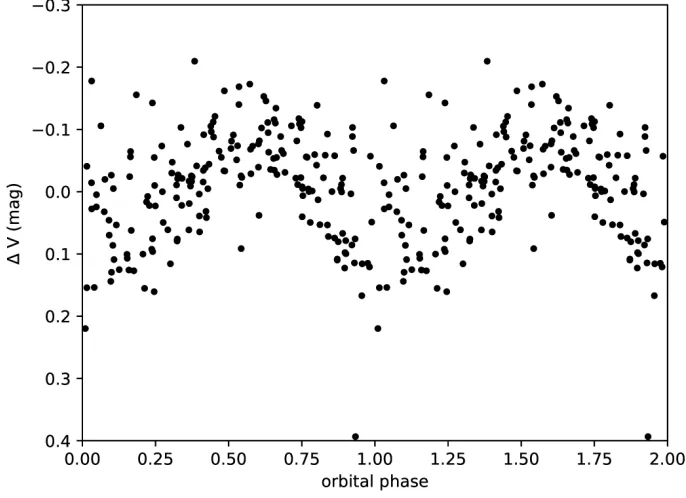
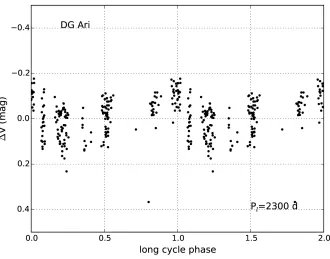
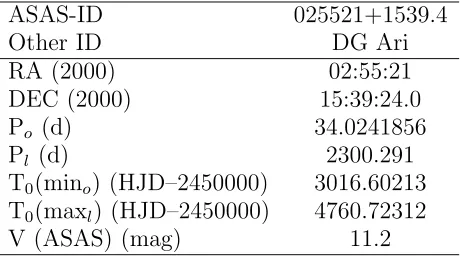
[image:2.595.116.459.371.620.2]using the PDM IRAF3 software (Stellingwerf, 1978). We determined the errors for the orbital period and long cycle by visual inspection of the phased light curves with trial periods near the minimum of the periodogram given by PDM. The parameters obtained from the light curve of DG Ari were summarised in Table 1. Two main frequencies of the system were disentangled using the code written by Zbigniew Kolaczkowski, described by Mennickent et al. (2012), wich is a multi-harmonic Fourier decomposition, and obtained both isolated light curves (Figures 1 and 2). We suspect that the long variability is related with the movement of a starspot over the surface of a magnetically active star present in the system. This variability is shown in Fig. 2.
Figure 1. Disentangled light curve of DG Ari showing the short-term orbital variation.
Additional to the ASAS data, we present here observations from the Northern Sky Variability Survey (NSVS). Those data were obtained from the first generation Robotic Optical Transient Search Experiment (ROTSE-I). For the source, we found a total of 126
1
http://www.xray.mpe.mpg.de/rosat/survey/rass-fsc/ 2
http://www.astrouw.edu.pl/asas/ 3
Figure 2. Disentangled light curve of DG Ari showing the long-cycle variation.
points that are qualified as good points by SKYDOT. The median ROTSE magnitude presented for the object is 11.166 ± 0.012 mag. The light curve is shown in Fig. 3. The reason we are not showing the long period phase light curve is that the time series covers only 157 days, too short compared to the long cycle, therefore, is impossible to cover the total phase of the long variation.
These results are consistent with Lloyd et al. (2011), who identified this object as a chromospherically active star in the ROTSE-1 database. They identified the object as GSC 01224–00894, with a period of 33.998 days, roughly similar to the period reported here. They also identified the object as a possible RS CVn variable.
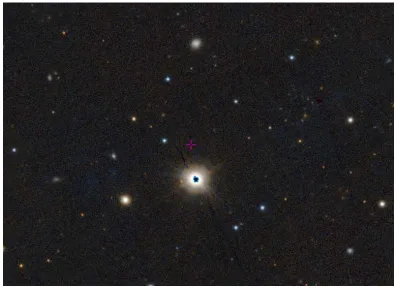
In Figure 4 we show, the position of the faint X-ray source 1RXSJ025521.3+153951 (marked with a cross) and the ASAS object J025521+1539.4 (the brightest nearest star) separated a distance of 27.356′′ (Szczygiel et al., 2008). Image taken from Aladin Lite4.
The possibility to fit two different periods, one being half of the other, is related to the nature of the source. For the first case, when the period is 34.024 days, the possible source could be a magnetically active star, and the periodicity would be related to the presence of a spot on its surface, which means that the associated period is the rotational period of the object.
The other possibility is when the period is twice the mentioned period, as ASAS catalogue suggest. It is possible to see both eclipses on the light curve, and the nature of the source could correspond to a binary system were one of the stellar component shows
4
4 IBVS6265
Figure 3. Phased light curve of DG Ari, the period we used was 34.024 d. Data from the NSVS database.
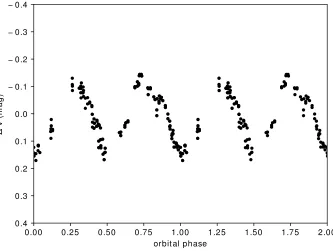
[image:4.595.100.499.438.726.2]Figure 5. Phased light curve for DG Ari with period of 68.205 days, from the NSVS database.
0.00 0.25 0.50 0.75 1.00 1.25 1.50 1.75 2.00
orbit al phase
−0.4
−0.3
−0.2
−0.1
0.0
0.1
0.2
0.3
0.4
∆
V
(
m
a
g
)
[image:5.595.123.456.477.728.2]6 IBVS6265
Table 1: Parameters of DG Ari including its orbital (Po) and long period (Pl). Epoch for both the
minimum brightness of the orbital light curve and the maximum brightness of the long-cycle light curve are given.
ASAS-ID 025521+1539.4
Other ID DG Ari
RA (2000) 02:55:21 DEC (2000) 15:39:24.0 Po (d) 34.0241856
Pl (d) 2300.291
T0(mino) (HJD–2450000) 3016.60213
T0(maxl) (HJD–2450000) 4760.72312
V (ASAS) (mag) 11.2
magnetic activity. In Figures 5 and 6 we show the possibility of a different period of 68.8 days. From the shape of the light curve in this case, we assume that the system should have very close components, but the period is too long, so the stellar components must be very massive, which is a doubtful scenario. The explanation we assume for the long term variability, is the presence of a cyclic activity on the source, related to the number of star spots on the star with period similar to 6.5 years. We expect to study the spectral characteristics of this object in the future, in order to understand the possible nature of DG Ari.
References:
Berdyugina, S. V., 2005, Living Reviews in Solar Physics, 2, 8 DOI
Buccino, A. P., Mauas, P. J. D., 2009, A&A, 495, 287 DOI
Ceraski, W., 1914,AN, 197, 256
Hall, D. S., 1976, IAU Colloq. 29: Multiple Periodic Variable Stars,60, 287 DOI
Lloyd, C.; Schirmer, J.; Bernhard, K.; Frank, P., 2011, OEJV, 136, 1
Mennickent, R. E., Djuraˇsevi´c, G., Ko laczkowski, Z., & Michalska, G. 2012, MNRAS,
421, 862 DOI
Percy, J. R., Soondarsingh, D., Velocci, V. 2001, JAAVSO, 29, 82 DOI
Pojmanski, G. 1997, AcA, 47, 467
Stellingwerf, R. F. 1978, ApJ, 224, 953 DOI
Strassmeier, K. G. 2009, Astr. Astron. Reviews, 17, 251 DOI
Szczygiel, D. M., Socrates, A., Paczynski, B., Pojmanski, G., Pilecki, B., 2008, AcA, 58,
405
Voges, W., Aschenbach, B., Boller, T. et al., 2000,IAU Circular, 7432, 1 Walter, F., Charles, P., Bowyer, S., 1978, ApJ, 225, L119 DOI