N A N O E X P R E S S
Open Access
Sintering Behavior of Spark Plasma Sintered
SiC with Si-SiC Composite Nanoparticles
Prepared by Thermal DC Plasma Process
Yeon-Tae Yu
*, Gautam Kumar Naik, Young-Bin Lim and Jeong-Mo Yoon
Abstract
The Si-coated SiC (Si-SiC) composite nanoparticle was prepared by non-transferred arc thermal plasma processing of solid-state synthesized SiC powder and was used as a sintering additive for SiC ceramic formation. Sintered SiC pellet was prepared by spark plasma sintering (SPS) process, and the effect of nano-sized Si-SiC composite particles on the sintering behavior of micron-sized SiC powder was investigated. The mixing ratio of Si-SiC composite nanoparticle to micron-sized SiC was optimized to 10 wt%. Vicker’s hardness and relative density was increased with increasing sintering temperature and holding time. The relative density and Vicker’s hardness was further increased by reaction bonding using additional activated carbon to the mixture of micron-sized SiC and nano-sized Si-SiC. The maximum relative density (97.1%) and Vicker’s hardness (31.4 GPa) were recorded at 1800 °C sintering temperature for 1 min holding time, when 0.2 wt% additional activated carbon was added to the mixture of SiC/Si-SiC.
Keywords:Si-SiC nanoparticles, Additive, Plasma processing, Spark plasma sintering
Background
Silicon carbide (SiC) ceramics have been attracting great attention due to its phenomenal properties, such as high-temperature hardness, wear resistance, low thermal expansion coefficient, high thermal conductivity, strong corrosion resistance, and high stability in aggressive en-vironment, and have been applied for various fields such as turbine blades, diesel engine parts, and aerospace and nuclear reactor materials [1–6]. However, it is difficult to densify the SiC without additives because of the covalent nature of Si–C bonding and low self-diffusion coefficient [7, 8]. The bulk SiC materials are usually prepared either by the solid state sintered silicon carbide (SSS-SiC) or by the liquid phase sintered silicon carbide (LPS-SiC) from the starting SiC crystalline powders [7, 8]. In the case of SSS-SiC, no liquid forming additives, such as boron, aluminum, carbon, or their compounds, have been used for densification of SiC by the reduction of the surface energy of grains and the reaction between silica present on surface and carbon. However, this process requires
over 2000 °C temperature for sintering [7, 9, 10]. LPS-SiC is governed by liquid phase formation of metal oxide ad-ditive at sintering temperature and this liquid phase act as a mass transport media during SiC sintering [8, 11, 12]. Except magnesia and alumina, yttria and other rare earth oxides are mostly used as sintering additives, and sintering temperature can be decreased down to 1850 °C, depen-ding upon the used combination of sintering additives [11, 12]. However, presence of the amorphous silicate compound at grain boundaries and the triple points cause decrease of hardness and high-temperature creep resistance as compared with the SSS-SiC [12]. But the additives used to enhance processing invariably become a“weak”secondary phase in the final ceramic, which usu-ally lower its mechanical properties at high temperature [13]. This detrimental effect infers that the smallest frac-tion of additives is desirable. In addifrac-tion, the effectiveness of the additives greatly depends on the homogeneity of their distribution [13]. There is also another approach for fabrication of bulk SiC, which is called as reaction bonded silicon carbide (RB-SiC). In RB-SiC, the reaction of molten silicon with carbon powder results in a formation of SiC [13–16]. Although this approach requires lower sintering temperature and there is no limitation of product shape
* Correspondence:[email protected]
Division of Advanced Materials Engineering and Research Centre for Advanced Materials Development, Chonbuk National University, Jeonju 54896, South Korea
and size, low density of the bodies is a disadvantage [17, 18]. However, lowering of sintering temperature is essential to save the energy. In recent time, energy sav-ing becomes the drivsav-ing force to find other methods suitable for the preparation of bulk SiC ceramics at low temperature.
Recently, nano-sized SiC has been widely investigated to examine their mechanical, physical, and chemical proper-ties that are different from those in bulk forms and often useful [19–21]. For example, nanopowders primarily due to the higher specific surface areas and surface activities can provide the low-temperature sinterability of nano-sized SiC in the consolidation processing and the im-provement of mechanical properties by making it possible to reach high densities [22]. Therefore, in present, we have developed a new method to prepare Si-coated SiC (Si-SiC) nanoparticle to apply as a sintering additive by using non-transferred thermal DC plasma processing of solid-state synthesized SiC powder [23].
In this study, the nano-sized Si-SiC composite particle as a sintering additive was applied for preparing bulk SiC ceramic by spark plasma sintering (SPS) process, and the effect of addition of the nano-sized Si-SiC com-posite particle on sintering temperature, relative density, and Vicker’s hardness of sintered SiC ceramic was inves-tigated. In addition, to further increase the relative dens-ity and hardness of sintered SiC, reaction bonding between free silicon of nano-sized Si-SiC particle and ac-tivated carbon which was additionally added was newly introduced to SiC sintering process. The sintering mech-anism of the SiC ceramic produced with nano-sized Si-SiC composite additive through SPS process was also discussed on the basis of nano-size effect and reaction bonding effect. This study provides a new promising strategy to be able to prepare the SiC ceramic with high
density and hardness at a relatively low sintering temperature.
Experimental
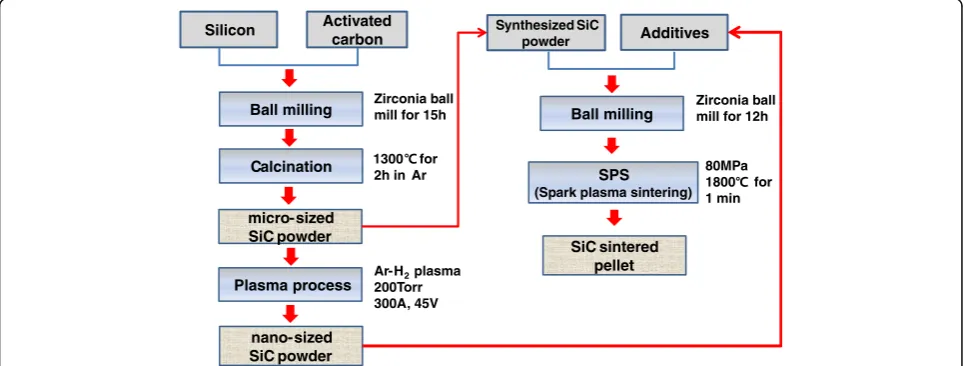
Figure 1 shows the preparation procedures of micron-sized SiC powder by solid-solid reaction (calcination), nano-sized SiC powder by non-transferred arc thermal plasma process, and sintered SiC pellet by SPS process. In this work, SiC powders with two different sizes, micron-sized SiC powder (as a main sintering material) and nano-sized Si-SiC composite nanopowder (as a sin-tering additive), were prepared by calcination and plasma processes respectively.
Micron-sized SiC Powder Preparation
The micron-sized SiC was synthesized by using Si pow-ders with an average particle size of 25μm (99.9%; Neo-plant Co. LTD.) and activated carbon with an average particle size of 32μm (Sigma-Aldrich). In a typical pro-cedure, 1:1.5 mol ratio of Si and carbon were mixed to-gether by using ball mill for 15 h. The mixed powder was placed in a vertical tube furnace and heated at 1300 °C for 2 h with 10 °C/min heating rate in the pres-ence of argon gas (1 L/min). After completion of the re-action, the obtained powder was grinded in agate mortar for further characterization.
Plasma Processing of Synthesized SiC Powders
Plasma processing was carried out by non-transferred arc thermal plasma reactor as reported in our previous work [21, 23]. The milled SiC powder was fed into the plasma arc through the internal feeding pipeline of 2-mm inner diameter in the plasma torch using a specially designed powder feeder. The powder feeding system consisted of a sample container, a vibrator, and a carrier
Silicon Activated carbon
Ball milling
Calcination
micro-sized SiC powder
Synthesized SiC powder
Plasma process
nano-sized SiC powder
Additives
SPS
(Spark plasma sintering)
SiC sintered pellet Ball milling
Zirconia ball mill for 15h
1300 for 2h in Ar
Ar-H2plasma
200Torr 300A, 45V
Zirconia ball mill for 12h
80MPa 1800 for 1 min
[image:2.595.57.540.520.703.2]gas line. Powders were fed by vibrating feeder at 70 V with 1 g/min feeding rate. Typical synthesis experiments were operated at system pressures of 200 Torr, with Ar plasma gas flow rates of 30 L/min, H2gas flow rates of about 3 L/min, and DC current of 300 A (at 45 V). After plasma ignition, a micron-sized SiC powder was supplied by feeder. The synthesized nanopowders were collected from the reactor wall and bottom of the plasma reactor system. The yield was about 80–85%.
Preparation of Sintered SiC Pellet
Sintered SiC pellet was prepared by SPS process (as shown in Fig. 1). Both SiC materials, i.e., the micron-sized SiC powder synthemicron-sized by calcination process and the nano-sized Si-SiC powder obtained from plasma process, were used without additional additives. The mixing content of Si-SiC nanoparticles in micron-sized SiC powder was changed from 5 to 15 wt%.
The mixed powders were put into a graphite die (20 mm in diameter) and sintered with SPS system in vacuum atmosphere (10−2 Torr). The heating rate was fixed at 600 °C/min, and the applied pressure was
80 MPa. The sintering temperature was changed from 1600 to 1800 °C. The holding time at target temperature was varied from 0 to 1 min at 1800 °C. After sintering, the sample surfaces were grounded to remove the graphite layer and then polished by a diamond paste. The density of the sintered specimens was measured by the Archimedes method in deionized water as an immersion medium.
20 30 40 50 60 70 80
yti
s
ne
t
nI
/ a.u.
2
degree
β-SiC
α-SiC
(a)
(b)
5 µm
Fig. 2XRD profile (a) and FESEM image (b) of micron-sized SiC synthesized by solid-state method
[image:3.595.306.538.200.705.2] [image:3.595.56.293.390.704.2]Sample Characterization
The crystallographic structures of the solid samples were determined using a XRD (D/Max 2005 Rigaku) equipped with graphite monochromatized high-intensity Cu-Kα1 radiation (λ= 1.5405 Å). The XRD patterns were re-corded from 20° to 80° (2θ) with a scanning speed of 0.04°/s. Particle size and morphology were investigated by a scanning electron microscope (SEM; JSM-5900, JEOL) and transmission electron microscope (TEM; JEM-2010, JEOL).
Results and Discussion
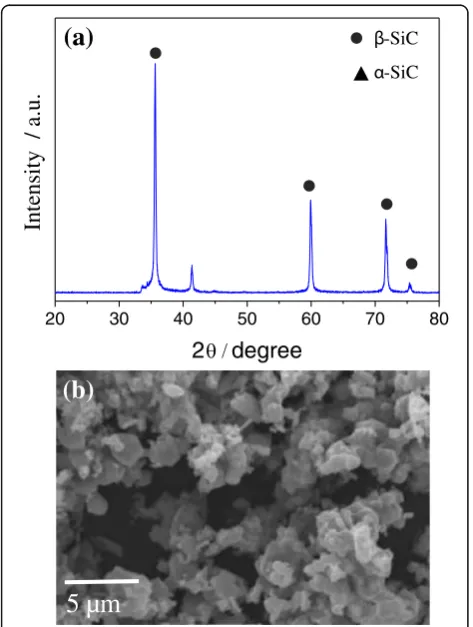
Figure 2 shows the XRD pattern and FESEM image of SiC synthesized by a solid-state method using mixture of Si and C in 1:1.5 mol ratios. XRD pattern confirms the formation ofβ-SiC with small amount ofα-SiC as shown in Fig. 2a. There were no other impurity phases, such as free silicon and SiO2. FESEM image showed the forma-tion of micron-sized SiC particles and the particle size varied from 2 to 5μm as displayed in Fig. 2b.
Nano-sized SiC powder was prepared from this micron-sized SiC powder using thermal plasma processing as ex-hibited in Fig. 3. Figure 3a, b was a FESEM image and a TEM image, respectively. These photographs confirm the formation of nano-sized Si-SiC particles, and particle size
varied from 20 to 70 nm. Figure 3c is a HRTEM image of Si nano-sized SiC particles, which confirms the formation of nano-sized Si-SiC composite particles as clear lattice fringes of both materials (Si and SiC) are presented. The surface area of nano-sized SiC powder was 69 m2/g.
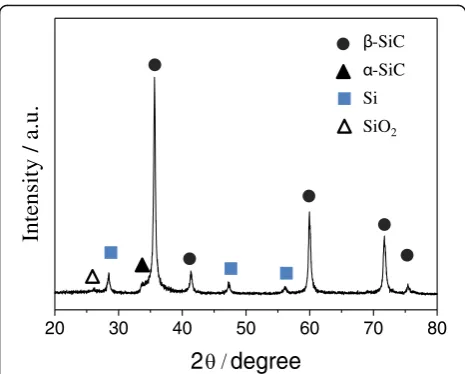
The phase and structure of nano-sized SiC particles were analyzed by XRD and shown in Fig. 4. Similar to micron-sized SiC, it also shows the formation of β-SiC with small amount of α-SiC. However, nano-sized SiC exhibited free Si and SiO2peaks. The appearance of sili-con peak was related to the partial decomposition of SiC during thermal plasma processing. The origin of SiO2 peak was possibly related to the partial oxidation of SiC surface during the exposure to air after plasma pro-cessing. Sintered SiC ceramic pellet was prepared from these two kinds of SiCs, i.e., the micron-sized SiC and the nano-sized Si-SiC composites. The mixture was sin-tered by SPS process using various compositions of micron-sized SiC and nano-sized Si-SiC, and sintering temperature, holding time at sintering temperature, and compressed pressure were varied as shown in Table 1.
The changes of relative density and Vicker’s hardness of the sintered SiC according to sintering temperature and holding time at target sintering temperature are also given in Table 1. Relative density and hardness increases with increasing sintering temperature, and highest rela-tive density (87.4%) and hardness (18.6 GPa) were re-corded at 1800 °C. The relative density and hardness was further increased to 88.2% and 21.2 GPa, respect-ively, with increasing holding time from 0 to 1 min at 1800 °C sintering temperature. It suggest that relative density and hardness increases with increasing hold-ing time; unfortunately, the holdhold-ing time at 1800 °C could not be increased further due to limitation of the SPS system.
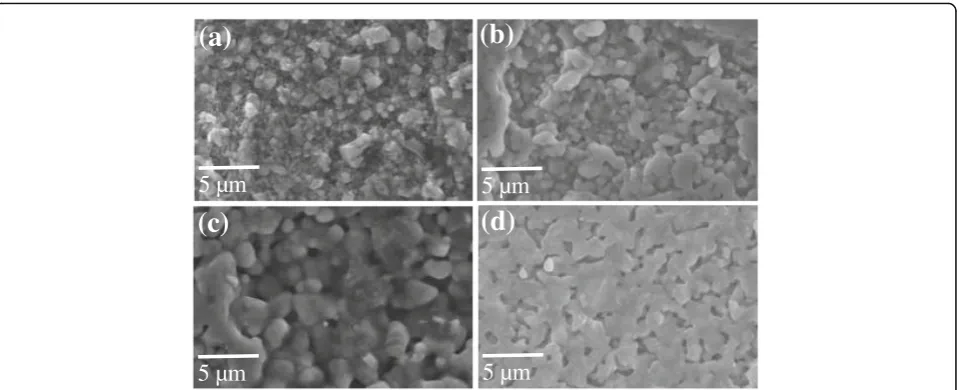
Figure 5 shows the FESEM images of sintered SiC sur-face with varying sintering temperature and holding time. The grain size of SiC was increased with increasing sintering temperature as shown in Fig. 5a–c. The shape and size of micron-sized SiC particles were almost main-tained up to 1600 °C (Fig. 5a), and the grain growth of SiC was started from 1700 °C which resulted in an in-crease in relative density and hardness of up to 86.1% and 14.8 GPa, respectively (Fig. 5b). At 1800 °C of
20 30 40 50 60 70 80
yti
s
n
et
nI
/ a.u.
2
degree
β-SiC
α-SiC Si SiO2
[image:4.595.57.290.86.273.2]Fig. 4XRD profile of Si-SiC composite nanoparticles prepared by non-transferred arc thermal plasma process
Table 1Composition of micron-sized SiC and nano-sized Si-SiC composite particle, temperature, and pressure for preparing sintered SiC pellets and their relative densities and Vicker’s hardness
Sample Composition (wt%) Temp.
(°C)
Holding time (min)
Pressure (MPa)
Relative density (%)
Vicker’s hardness (GPa) Micron-sized SiC Nano-sized Si-SiC
a 90 10 1600 0 80 78.7 9.8
b 90 10 1700 0 80 86.1 14.8
c 90 10 1800 0 80 87.4 18.6
[image:4.595.56.539.650.732.2]sintering temperature, the grain size of SiC was 2–4 μm and the crystal texture was more densified (Fig. 4c). The relative density and hardness at 1800 °C was 87.4% and 18.6 GPa, respectively. Grain growth was further re-corded when sample was held for 1 min at 1800 °C sin-tering temperature, which is evident from the increase in relative density and hardness to 88.2% and 21.2 GPa, respectively (Fig. 5d).
In order to increase the relative density, the adding amount of nano-sized Si-SiC in micron-sized SiC powder was changed from 5 to 15 wt%. In addition, extra activated carbon was also added to this mixture to increase the re-lative density through reaction bonding (RB) with free silicon of nano-sized Si-SiC. The relative density and Vicker’s hardness of sintered SiC depending on different compositions of micron-sized SiC, nano-sized Si-SiC, and activated carbon is summarized in Table 2.
Sintering temperature (1800 °C), holding time (1 min), and pressure (80 MPa) were kept constant throughout the experiment. In the absence of added carbon, the relative density and hardness increases with increasing nano-sized SiC content up to 10 wt% and then de-creases. For example, the relative density and hardness
was 85.9% and 21.1 GPa, when the content of nano-sized Si-SiC was 5 wt%. The relative density and hard-ness increased to 88.2% and 21.2 GPa, respective at 10 wt% of the nano-sized Si-SiC. Whereas when the content was 15 wt%, the hardness decreased remarkably down to 16.6 GPa though the relative density showed still 85.6%. This is mainly because the excessively added nano-sized Si-SiC particles can provide large amount of pore in the sintered SiC. For further increase of relative density and hardness, activated carbon was added add-itionally. The addition of 0.1 wt% of activated carbon re-sulted in remarkable increase in the relative density (93.1%) and hardness (25.2 GPa). The relative density and hardness was further increased to 97.1% and 31.4 GPa, respectively, with increasing activated carbon content up to 0.2 wt%. XRD analysis of these sintered SiC pellets with different compositions was carried out and shown in Fig. 6. There was no change in crystal structure even after sintering, except for a weak silicon peak recorded at 29°, which is possibly originated from the addition of nano-sized Si-SiC composite particles.
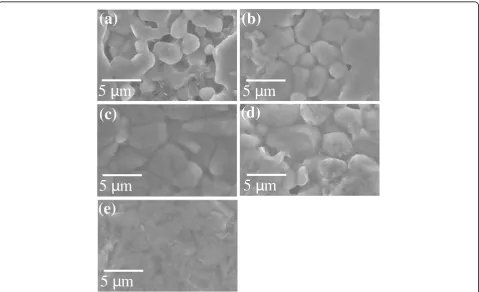
Figure 7 shows FESEM images of the surface of the sintered SiC pellets with different micron-sized SiC and
(a)
(b)
(c)
(d)
5 µm
5 µm
5 µm
5 µm
[image:5.595.60.540.87.282.2]Fig. 5FESEM images of the sintered SiC with nano-sized Si-SiC composite particles by SPS process ata1600 °C,b1700 °C,c1800 °C sintering temperature with 0 min holding time, andd1800 °C sintering temperature at 1 min holding time at target temperature
Table 2Composition of micron-sized SiC, nano-sized Si-SiC composite particle, and activated carbon for preparing sintered SiC pellets, and their relative densities and Vicker’s hardness (sintering temp. 1800 °C, holding time 1 min, pressure 80 MPa)
Sample Composition (wt%) Relative
density (%)
Vicker’s hardness (GPa) Micron-sized SiC Nano-sized SiC Activated carbon
a 95 5 85.9 21.1
b 90 10 88.2 21.2
c 85 15 85.6 16.6
d 89.9 10 0.1 93.1 25.2
[image:5.595.57.537.636.731.2]nano-sized Si-SiC compositions. The grain size of SiC was 2–3 μm with bigger pores, when nano-sized Si-SiC content was 5 wt% (Fig. 7a). The grain size was in-creased with increasing the content of nano-sized Si-SiC as displayed in Fig. 7b, c. The grain size of SiC pellets
with 10 and 15 wt% of Si-SiC was about 3–5 and 4– 6μm, respectively. Figure 7d, e presents the FESEM im-ages of sintered SiC pellet after addition of activated carbon. When 0.1 wt% of activated carbon was added, giant grains start to appear, which suggest that densifica-tion of SiC texture was progressed by reacdensifica-tion bonding between silicon and activated carbon. Further increase in activated carbon up to 0.2 wt% resulted in complete densification of SiC texture as shown in Fig. 7e.
Figure 8 presents the shrinkage displacements of sin-tered SiC samples with different compositions at differ-ent sintering temperature. There was an expansion recorded for all specimens up to 1500 °C, which is mainly because of expansion of gases present in SiC mixture (Fig. 8a–e). It can also be observed by 1.0– 1.28 mm increase in height of graphite mold having SiC mixture powder after sintering as compared to initial sintering step. Further increase in sintering temperature resulted in shrinkage of all specimens due to sintering effect of nano-sized Si-SiC nanoparticles. The increase in holding time of specimen at sintering temperature from 0 to 1 min also resulted in increase in shrinkage of specimens. The addition of extra activated carbon to the mixture of SiC and Si-SiC showed higher shrinkage displacement after 1500 °C as compared to SiC/Si-SiC
20 30 40 50 60 70 80
(e) (d) (c) (b)
yti
s
ne
t
nI
/ a.u.
2
degree
(a)
Si -SiC
Fig. 6XRD profiles of SiC pellets sintered with nano-sized Si-SiC composite particles and activated carbon by SPS process (details of a, b, c, d, and e are given in Table 2)
(a)
(d)
(e)
(c)
(b)
5
μ
m
5
μ
m
5
μ
m
5
μ
m
5
μ
m
[image:6.595.57.290.86.259.2] [image:6.595.59.539.409.701.2]mixtures without activated carbon (Fig. 8d, e). Further-more, the shrinkage displacement increases with in-creasing added amount of additional activated carbon. For example, shrinkage displacement was increased from 1.11 to 1.61 mm, when added activated carbon amount was increased from 0.1 to 0.2 wt%, respectively, as displayed in Fig. 8d, e. This is due to the reaction bonding effect of free silicon of Si-SiC composite nano-particle and activated carbon. The exothermic nature of this reaction results in increase in real temperature in-side SiC pellet during sintering. Thus, these results clearly confirm that reaction bonding effect of silicon and activated carbon can increase the relative density and hardness of SiC ceramics.
From the above experimental results, we can
summarize a sintering mechanism of micron-sized SiC powder with nano-sized Si-SiC composite powder and activated carbon as follows. It was determined in Table 1 that the sintering of micron-sized SiC powder with 10 wt% of nano-sized Si-SiC composite powder was started at 1600 °C, and the sintering reaction was accel-erated with increasing the sintering temperature and holding time. From this result, we confirmed the nano-size effect of Si-SiC composite nanoparticles on the
sintering of the micron-sized SiC powder. Herein, if acti-vated carbon is added to the mixture of micron-sized SiC and nano-sized Si-SiC composite powder, the reac-tion bonding, which originated from the exothermic re-action between the free silicon of Si-SiC composite nanoparticles, can be induced into the sintering process as shown schematically in Fig. 9. Consequently, it could be found that the sintering mechanism of micron-sized SiC powder with nano-sized Si-SiC composite powder and activated carbon as sintering additives lies on both effects, the nano-size effect and the reaction bonding ef-fect, which were introduced from the nano-sized Si-SiC composite powder.
Conclusions
Micron-sized SiC (2–5μm) powder was synthesized by a solid-state method using Si powder and activated carbon sources. Nano-sized Si-SiC composite powder, having 20–70 nm particle size, was prepared by non-transferred arc thermal plasma process. Sintered SiC pellets were prepared by SPS process using the mixture with different ratio of micron-sized SiC powder and nano-sized Si-SiC composite particle as a sintering additive. At a fixed ratio of micron-sized SiC and nano-sized Si-SiC (90:10), the relative density and Vicker’s hardness increased with in-creasing sintering temperature and holding time. The maximum relative density (88.2%) and Vicker’s hardness (21.2) were recorded at 1800 °C sintering temperature for 1 min holding time. The relative density and Vicker’s hardness was further increased by addition of extra acti-vated carbon to the mixture of micron-sized SiC and nano-sized Si-SiC. The relative density and Vicker’s hardness were increased to 97.1% and 31.4 GPa, respect-ively, with the addition of 0.2 wt% of extra activated car-bon to the SiC/Si-SiC mixture. It was found that the nano-size effect of Si-SiC composite particle and the exothermic nature of silicon–carbon reaction bonding were responsible for the increase in relative density and hardness. Therefore, it was suggested that the nano-sized Si-SiC composite particle could be a promising additive for sintering of SiC ceramics.
0 50 100 150 200 250
500 1000 1500 2000
Shrinka
g
e dis
p
lacement / mm
Temperature (a) (b) (c) (d) (e)
Time / sec
/
er
ut
ar
e
p
me
T
o C
-1.0 -0.5 0.0 0.5 1.0 1.5 2.0 2.5
Fig. 8Shrinkage displacement change of SiC pellets sintered with nanosized Si-SiC composite nanoparticles during SPS process (details of a, b, c, d, and e are given in Table 2)
[image:7.595.56.290.88.236.2] [image:7.595.57.540.612.703.2]Acknowledgements
This paper was supported by the (1) BK21 plus program from the Ministry of Education and Human-Resource Development, (2) National Research Foun-dation grant funded by the Korean Government (MSIP) (BRL No. 2015042417, 2016R1A2B4014090), and (3) Research Base Construction Fund Support Pro-gram funded by Chonbuk National University in 2016.
Funding
This research work was supported by the funding of National Research Foundation grant funded by the Korean Government (MSIP) and Research Base Construction Fund Support Program of Chonbuk National University in 2016.
Authors’Contributions
Y-TY designed the research work. He has carried out the interpretation of all the data such as the XRD patterns, SEM images, and hardness and density changes of sintered SiC pellets. He also proposed the sintering mechanism from shrinkage displacement change of SiC pellets sintered with nano-sized Si-SiC composite nanoparticles during SPS process. GKN has contributed in observing the morphology and crystal structure of Si-SiC composite nanoparticles and studied on the formation of metallic Si-loaded SiC nanoparticles in DC thermal plasma reactor. Y-BL has prepared the micron-sized SiC and nano-micron-sized Si-SiC composite powders by using calcination furnace and DC plasma reactor. He has also sintered the mixture of those powders by using the SPS (spark plasma sintering) processing and analyzed the surface morphology, relative density, and Vicker’s hardness of the SiC sintered pellets. J-MY has designed the non-transferred DC arc thermal plasma reactor and tuned the operating condition for preparing the nano-sized Si-SiC composite powders. All authors read and approved the final manuscript.
Competing Interests
The authors declare that they have no competing interests.
Publisher’s Note
Springer Nature remains neutral with regard to jurisdictional claims in published maps and institutional affiliations.
Received: 16 July 2017 Accepted: 10 November 2017
References
1. Morko H, Strite S, Gao GB, Lin ME, Sverdlov B, Burns M (1994) Large-band-gap SiC, III-V nitride, and II-VI ZnSe-based semiconductor device technologies. J Appl Phys 76:1363–1398
2. Pensl G, Morkoc H, Monemar B, Janzen E (1998) Silicon carbide, III-nitrides, and related materials. Trans Tech Publication, Zürich, pp 2678–2682 3. Raffray AR, Jones R, Aiello G, Billone M, Giancarli L, Golfier H, Hasegawa A,
Katoh Y, Kohyama A, Nishio S, Riccardi B, Tillack MS (2001) Design and material issues for high performance SiCf/SiC-based fusion power cores.
Fusion Eng Des 55:55–59
4. Katoh Y, Kohyama A, Nozawa T, Sato M (2004) SiC/SiC composites through transient eutectic-phase route for fusion applications. J Nucl Mater 329–333:587–591
5. Zinkle SJ (2005) Advanced materials for fusion technology. Fusion Eng Des 74:31–40
6. Hirata Y, Suzue N, Matsunaga N, Sameshima S (2010) Particle size effect of starting SiC on processing, microstructures and mechanical properties of liquid phase-sintered SiC. J Eur Ceram Soc 30:1945–1954
7. Jian C, Zhengren H, Zhongming C, Ming Y, Yan L, Yunzhou Z (2014) The effect of carbon on surface quality of solid-state-sintered silicon carbide as optical materials. Mater Charact 89:7–12
8. She J, Ueno K (1999) Effect of additive content on liquid-phase sintering on silicon carbide ceramics. Mater Res Bull 34:1629–1636
9. Stobierski L, Gubernat A (2003) Sintering of silicon carbide I. Effect of carbon. Ceram Int 29:287–292
10. Stobierski L, Gubernat A (2003) Sintering of silicon carbide II. Effect of boron. Ceram Int 29:355–361
11. Sciti D, Bellosi A (2000) Effects of additives on densification, microstructure and properties of liquid-phase sintered silicon carbide. J Mater Sci 35:3849–3855
12. Sánchez GE, Miranda P, Guiberteau F, Pajares A (2011) Effect of microstructure on the mechanical properties of liquid-phase-sintered silicon carbide at pre-creep temperatures. J Eur Ceram Soc 31:1131–1139
13. Paik U, Park HC, Choi SC, Ha CG, Kim JW, Jung YG (2002) Effect of particle dispersion on microstructure and strength of reaction-bonded silicon carbide. Mater Sci Eng A 334:267–274
14. Chakrabarti R, Ghosh S, Mukerji J (1994) Influence of grain size, free silicon content and temperature on the strength and toughness of reaction-bonded silicon carbide. Ceram Int 20:283–286
15. Zhang Y, Zhang J, Han J, He X, Yao W (2004) Large-scale fabrication of light weight Si/SiC ceramic composite optical mirror. Mater Lett 58:1204–1208 16. Suyama S, Kameda T, Itoh Y (2003) Development of high-strength
reaction-sintered silicon carbide. Diam Relat Mater 12:1201–1204
17. Jung YI, Park DJ, Park JH, Park JY, Kim HG, Koo YH (2016) Effect of TiSi2/
Ti3SiC2matrix phases in a reaction-bonded SiC on mechanical and
high-temperature oxidation properties. J Eur Ceram Soc 36:1343–1348 18. Aroati S, Cafri M, Dilman H, Dariel MP, Frage N (2011) Preparation of reaction
bonded silicon carbide (RBSC) using boron carbide as an alternative source of carbon. J Eur Ceram Soc 31:841–845
19. Leonhardt A, Liepack H, Biedermann K, Thomas J (2005) Synthesis of SiC nanorods by chemical vapor deposition. Fullerenes, Nanotubes Carbon Nanostruct 13:91–97
20. Vassen R, Kaiser A, Stöver D (1999) Processing and properties of nanograin silicon carbide. J Am Ceram Soc 82:2585–2593
21. Rai P, Kim YS, Kang SK, Yu YT (2012) Synthesis of nanosized silicon carbide through non-transferred arc thermal plasma. Plasma Chem Plasma Process 32:211–218
22. Mashhadi M, Khaksari H, Safi S (2015) Pressureless sintering behavior and mechanical properties of ZrB2–SiC composites: effect of SiC content and
particle size. J Mater Res Technol 4:416–422