BIROn - Birkbeck Institutional Research Online
Fenner, Trevor and Levene, Mark and Loizou, George (2016) A stochastic
evolutionary model generating a mixture of exponential distributions. The
European Physical Journal B (EPJ B) 89 (2), ISSN 1434-6036.
Downloaded from:
Usage Guidelines:
Please refer to usage guidelines at or alternatively
arXiv:1511.08712v2 [physics.soc-ph] 14 Jan 2016
A stochastic evolutionary model generating a mixture of
exponential distributions
Trevor Fenner, Mark Levene, and George Loizou Department of Computer Science and Information Systems
Birkbeck, University of London London WC1E 7HX, U.K.
{mark,trevor,george}@dcs.bbk.ac.uk
Abstract
Recent interest in human dynamics has stimulated the investigation of the stochastic processes that explain human behaviour in various contexts, such as mobile phone net-works and social media. In this paper, we extend the stochastic urn-based model proposed in [FLL15] so that it can generate mixture models, in particular, a mixture of exponential distributions. The model is designed to capture the dynamics of survival analysis, tradi-tionally employed in clinical trials, reliability analysis in engineering, and more recently in the analysis of large data sets recording human dynamics. The mixture modelling approach, which is relatively simple and well understood, is very effective in capturing heterogeneity in data. We provide empirical evidence for the validity of the model, using a data set of popular search engine queries collected over a period of 114 months. We show that the survival function of these queries is closely matched by the exponential mixture solution for our model.
Keywords: human dynamics, stochastic model, survival analysis, mortality rate, mixture
model, exponential mixture
1
Introduction
Recent interest in complex systems, such as social networks, the world-wide-web, email net-works and mobile phone netnet-works [Bar07], has led researchers to investigate the processes that could explain the dynamics of human behaviour within these networks. Barab´asi [Bar05] has suggested that the bursty nature of human behaviour, for example, when measuring the inter-event response time of email communication, is a result of a decision-based queuing process. In particular, humans tend to prioritise actions, for example, when deciding which email to respond to, and therefore a priority queue model was proposed in [Bar05], leading to a heavy-tailed power-law distribution of inter-event times. The availability of large data sets, such as mobile phone records, has widened the applicability of human dynamics investigation, for example, in an attempt by Schneider et al. [SBCG13] to uncover the characteristics of daily mobility patterns. Human dynamics is not limited to the study of behaviour within communication networks, as can be seen, for example, by a recent proposal of Mitnitski et al. [MSR13], who apply a simple stochastic queueing model to the complex phenomenon of ageing, in order to illustrate how health deficits accumulate with age. Moreover,sociophysics
statistical physics to investigate social phenomena and political behaviour. This methodol-ogy often involves the empirical investigation of collective choice dynamics, resulting in the formation of statistical laws governing, for example, how the popularity of movies emerges from social behaviour. In this context, we have recently modelled the survival of search en-gine queries in the top-10 list of the most popular queries that users have submitted, as an application of human dynamics [FLL15]; see [TdFA14] for attempts to predict the future popularity of online content.
Survival analysis [Law03, KK12] provides statistical methods to estimate the time until an event occurs, known as thesurvivalor failuretime. Typically, an event in a survival model is referred to as a failure, since it often has negative connotations, such as mortality or the contraction of a disease, although it could, in principle, also be positive, such as the time to return to work or to recover from a disease. In the context of email communication mentioned above, an event might be a reply to an email; in the context of popular queries, an event might be dropping out of the top-10 most popular queries. Traditional applications of survival analysis are in clinical trials [FL00], and in understanding the mechanisms in biological ageing [GG01]. The methods used in survival analysis overlap with those used in engineering for reliability life data analysis [Fin08, OK12]. Reliability analysis in engineering has many applications, for example, in manufacturing processes, and in software design and testing. However, one can envisage that survival analysis would find application in newer human dynamics scenarios in complex systems, such as those arising in social and communication networks [Bar05, CGW+08, MAAJ13].
We have been particularly interested in formulating generative models in the form of stochastic processes by which complex systems evolve and give rise to power laws or other distributions [FLL07, FLL12, FLL15]. This type of research builds on the early work of Simon [Sim55], and the more recent work of Barab´asi’s group [AB02] and other researchers [BSV07]. In the context of human dynamics, the priority queue model mentioned above [Bar05] is a generative model characterised by a heavy-tailed distribution.
In the bigger picture, one can view the goal of such research as being similar to that of
social mechanisms [HS98], which looks into the processes, or mechanisms, that can explain
observed social phenomena. Using an example given in [Sch98], the growth in the sales of a book can be explained by the well-known logistic growth model [TW02], and more recently we have shown that the process of conference registration with an early bird deadline can be modelled by bi-logistic growth [FLL13]. Such research can also be grounded within the field of sociophysics, mentioned above, where critical phenomena are important in demonstrating how the transition to global behaviour can emerge from the interactions of many individuals. The individuals may be neurons, as in [LAE+12], where criticality emerges as neuron cooperation,
or people’s decisions, as in [PS10], where the popularity of movies emerges as collective choice behaviour.
according to some specifiedmortality function, which may take a general form. It is evident that, at any given timet, we may have at most one ball in urni, for alli≤t.
The probability that, after t steps of the stochastic process outlined above, there is a surviving ball inurni is known as thesurvival function [KK12]. In the context of a medical
study, this could represent the probability that a patient survives for longer than a specified time. In [FLL15] we have shown how the survival function depends on the mortality function. Two important cases are: (1) when the mortality function is constant then the survival function follows an exponential distribution, and (2) when the mortality function follows a power-law distribution then the survival function follows a Weibull distribution [Rin09]; the latter is often applied to the modelling oflife data(also known as survival data, time to event data, or time to failure data) [KK12, OK12].
It is interesting to observe that the distribution of the survival function has two param-eters, i and t, cf. [FLL12], whereas most previously studied generative stochastic models [AB02], including those in our previous work, for example [FLL07], result in steady state distributions that are asymptotic int to a distribution with a single parameteri.
Exponential mixture models [MP00] have been exploited in survival analysis in a variety of applications, as mentioned in Section 2 below. Moreover, it has been shown that the survival function of an exponential mixture model has a decreasing failure rate [BJ97, Fin09], which was first observed in [Pro63] in the context of air-conditioning systems for a fleet of airplanes. To generate exponential mixtures, in Section 3, we extend the urn-based stochastic process of [FLL15] by adding a first step of tossing a biased coin to decide which of two processes becomes active; although the extension is defined for a mixture of two exponentials, it extends naturally to a mixture of several exponentials. We provide empirical evidence for the validity of the model by analysing the longitudinal data set of popular search engine queries over 114 months that we used in [FLL15]. We show that the survival function of these queries closely follows the distribution generated by our model.
The rest of the paper is organised as follows. In Section 2, we review mixture models in the context of survival data analysis. In Section 3, we present our stochastic urn-based model that provides us with a mechanism to model the mixture of exponential distributions. In Section 4, we apply the model to the survival of popular search engine queries posted on Google Trends (www.google.com/trends/hottrends). Finally, in Section 5, we give our concluding remarks.
2
Mixture models for Failure Time Analysis
Lifetime analysis, also referred to as survival time analysis or failure time analysis [Law03], has a long history of exploiting mixture models [MP00], in particular exponential mixture models, in a variety of applications. Examples of areas where exponential mixtures have been employed for lifetime analysis modelling are: the reliability of system components [Pro63], network performance [FW98], actuarial losses [Kea99], reliability engineering [Fin09], and the likelihood of volcanic eruption [MD09].
capturing heterogeneity. In particular, when considering the popularity of queries, a mixture model can differentiate between two types of queries: ones that are very popular for a short period of time and others whose popularity lasts much longer; such an observation has already been made in the context of the popularity of movies [PS10].
The survival function S(θ) represents the probability that an actor survives for longer
than a specified time θ. Here we restrict ourselves to a mixture of two exponential survival functions, noting that this can readily be extended to a mixture of more than two such functions. The mixture rates of the distribution, p1 and p2, sum to one, and the mortality
rates,λ1 and λ2, of the mixture model (also known as thefailure rates) are constants. These
define adiscrete hazard function[BG03], i.e. the conditional probability that a failure occurs at a specified time instant given that no failure occurred previously. We therefore define the mixture survival function S(θ) as
S(θ) =p1exp(−λ1θ) +p2exp(−λ2θ), (1)
where p1+p2 = 1.
The mortality rate of the mixture model [Fin09] is now given by
λ(θ) =π1(θ)λ1+π2(θ)λ2, (2)
where the time-dependent probabilities πk are defined as
πk(θ) = pkexp(−λkθ)
p1exp(−λ1θ) +p2exp(−λ2θ). (3)
In [BJ97, Fin09] it was shown that the mortality rate λ(θ) of the mixture model is de-creasing inθ. Moreover, if we assume that λ1 ≤λ2, then λ(θ)/λ1 converges to 1 as θ tends to infinity; this is referred to in the literature as a decreasing failure rate.
For comparison purposes, we will also make use of the Weibull survival function considered in [FLL15], with shape parameter ρ and scale parameterγ, which is given by
exp −γ θ1+ρ
. (4)
It is important to note that, when the shape parameter satisfies −1 < ρ < 0, then it can be expressed as a mixture of exponentials, since it is a completely monotone function
[Jew82, FW98]; see [Fel71] for the underlying theory.
3
An Evolutionary Urn Transfer Model
We next formalise a stochastic urn model based on the survival model for human dynamics introduced in [FLL15], in order to generate the mixture of two exponential distributions. This is done by first generating a mixture distribution by tossing a coin with mixture probabilities
p1andp2, wherep1+p2= 1, to decide which process is active, and then employing a constant mortality rate parameter λk in order to generate an exponential distribution, as in [FLL15].
We note that this mechanism extends naturally to a mixture of more than two exponentials by deploying a multi-sided “coin”.
We assume a countable number of urns,urn0, urn1, . . ., where aball(oractor) inurni is
toss the coin, as described above, to decide which of two processes will be active. From then on, at any time t, t≥0, a new ball may beborn, with probability b, and any such new ball is inserted into urn0; in addition, an existing ball of age i can die by being discarded from
urni, for alli >0.
For a given age iand time t, we let the mortality rate µk(i, t) be the probability that a
ball inurnidies at timet, wherek= 1 or 2 depending on which process is active. We always
require that µk(0, t) = 0 for all t, and that µk(i, t) = λk for i > 0, where λk is a constant, satisfying 0< λk<1.
At timet, the stochastic process then proceeds as follows in order to obtain the configu-ration at time t+ 1, wheret≥0.
(i) For each i, 1 ≤ i ≤ t, if urni is non-empty then, with probability µk(i, t) = λk, a mortality event occurs, i.e. the ball in urni is discarded.
(ii) Next, the ages of all balls remaining in the system are incremented by 1, i.e. a ball in
urni is moved to urni+1, for each i.
(iii) Finally, with probabilityb, where 0< b <1, a birth event occurs, i.e. a ball is inserted into urn0.
We observe that, at any time t,urni is empty fori > t. Note that we are assuming that the mortality rate is constant, i.e. µk(i, t) = λk, which leads to the survival function of an
exponential distribution, as was shown in [FLL15]. However, in principle, the mortality rate could be an arbitrary function, for example, power-law mortality leads to the survival function of a Weibull distribution. Note also that we are using a single birth probabilityb, rather than one for each process, since, as can be seen from (7) below, b is merely a scaling factor. It follows that having different values for b for the two processes is equivalent to adjusting the mixture probabilities.
We now let Fk(i, t) ≥0, with k= 1 or 2, be a discrete function denoting the probability
that there is a ball inurniat timet, given that processkis active. Initially, we setFk(0,0) =b
and Fk(i,0) = 0 for all i >0.
The dynamics of the model are captured by the following two equations, where we assume that k= 1 or 2 according to the outcome of the coin toss:
Fk(0, t) =b for t≥0, (5)
and
Fk(i+ 1, t+ 1) =Fk(i, t)−µk(i, t)Fk(i, t) for 0≤i≤t. (6)
We can expand (6) to obtain
Fk(i+ 1, t+ 1) =b i Y
j=1
(1−µk(j, t−i+j)) =b(1−λk)i. (7)
Using the approximation ln(1−x)≈ −x, which holds for small x, we see that the distri-bution is approximately exponential:
We note that, in (8), we could use the more accurate second order approximation ln(1− x)≈ −x−x2
/2.
We now defineF(i, t) analogously toFk(i, t) to take into account which of the two processes is active, i.e.
F(i, t) =p1F1(i, t) +p2F2(i, t).
This yields the initial conditionsF(0,0) =b,F(i,0) = 0 for all i >0, and alsoF(0, t) =b
for t≥0. Similarly, from (7) and (8) for 0≤i≤t, we obtain the exponential mixture:
F(i+ 1, t+ 1) =p1b(1−λ1)i+p2b(1−λ2)i (9) ≈p1bexp(−λ1i) +p2bexp(−λ2i).
We note that, as mentioned in the beginning of this section, the model can be extended to more than two components; in this case the sums in (9) would have the appropriate number of terms.
4
Application of the Mixture Model
In the context of human dynamics, survival analysis has recently been applied to large data sets. These include the analysis of phone call durations [VAFL10], the investigation of how long Wikipedia editors remain active [ZPL12], and for predicting the likelihood of online content to become popular [LMS12].
The survival functionS(θ) introduced in Section 2 is usually estimated via a step function by computing the probability that an actor survives until timeθ, forθ= 1,2, . . . , t; this step function is known as theKaplan-Meier estimator[KM58, KK12]. By comparing (7) with the Kaplan-Meier estimators for the survival functions [KM58, equation (2b)] of the components of the mixture model, these are seen to be analogous to Fk(i, t) for k = 1,2, and an actor that was born at timet−i. We thus obtain
S(i)≈ p1F1(i, t) +p2F2(i, t)
b =
F(i, t)
b . (10)
In theory, the survival functionS(θ) does not depend on the lengthtof the trial. However, in practice, the Kaplan-Meier estimate will be more accurate for longer trials. Nevertheless, this estimate is more accurate when most of the actors are still present in the study, since the estimate may be inaccurate when there are only a few actors remaining [RNP+10].
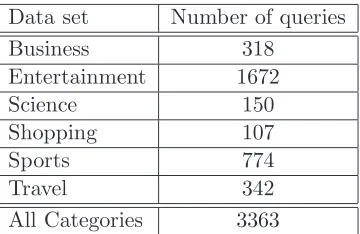
As as a proof of concept for the exponential mixture model, we analysed the survival of queries in the top-10 Google Trends “hot searches” (www.google.com/trends/hottrends), that we used in [FLL15]. Data was collected monthly for the top-10 “hot searches” over 114 months, from January 2004 until June 2013, for six categories (together with their subcat-egories in each case): Business & Politics (or simply Business), Entertainment, Nature & Science (or simply Science), Shopping & Fashion (or simply Shopping), Sports, and Travel & Leisure (or simply Travel). The number of distinct queries per category over the period is shown in Table 1. It is apparent from this statistic that the top-10 queries from Shopping change the least, while those from Entertainment change the most.
Data set Number of queries
Business 318
Entertainment 1672
Science 150
Shopping 107
Sports 774
Travel 342
[image:8.595.213.393.107.224.2]All Categories 3363
Table 1: Number of top-10 queries collected from Google Trends.
a given month (note that time is discrete and is measured in months). As we are considering an exponential mixture model with constant mortality for each component, queries leave the top-10 according to (2).
We next outline the methodology we have used to validate and evaluate the stochastic urn model presented in Section 3. We then give further details, before discussing and analysing the results.
(I) First, to obtain estimates of p1, λ1 and λ2, we performed nonlinear regression to the right-hand side of (9) using the Kaplan-Meier estimates computed from the raw data, fori= 1,2, . . . ,114.
(II) We used the estimates of p1,λ1 and λ2 from (I) to compute, for each i, the right-hand side of (9); we call this the mixture data. We then repeated the nonlinear regression using the mixture data as a quick “sanity check” that the new values of p1, λ1 and λ2
obtained were consistent with those from (I).
(III) Next we ran simulations using the parametersp1,λ1andλ2 from (I), andb= 0.9. Using the averaged values of F(i, t) from the simulations, we again repeated the nonlinear regression to obtain new values for p1,λ1 andλ2; these were compared with those from (I) for consistency.
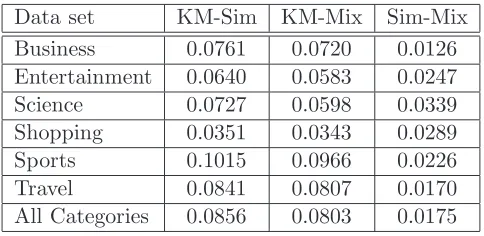
(IV) We computed the D values for Kolmogorov-Smirnov tests to ascertain whether the Kaplan-Meier estimates, the mixture data and the averaged simulation data are likely to have all come from the same distribution.
We first obtained the Kaplan-Meier estimates from the raw data sets for the six individual categories and for their aggregation (All Categories). Recalling that the survival function is approximated as in (10), following (I), we used Matlab to obtain estimates for p1, λ1 and
λ2 by nonlinear least-squares regression ofS(i) on ifor fitting the right-hand side of (9), for
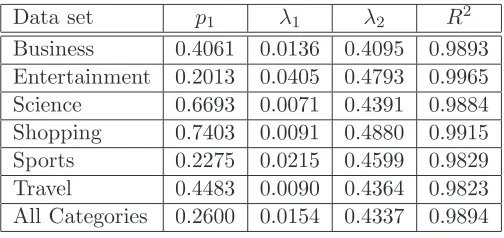
i= 1,2, . . . ,114. The estimated parametersp1,λ1 and λ2 are shown in the rows of Table 2, together with the coefficient of determination R2
[Mot95]; theR2
values show a very good fit for all of the categories. Nonlinear regression using the mixture data values computed from the right-hand side of (9), as in (II), yielded almost perfect fits, as expected.
Data set p1 λ1 λ2 R2
Business 0.4061 0.0136 0.4095 0.9893
Entertainment 0.2013 0.0405 0.4793 0.9965
Science 0.6693 0.0071 0.4391 0.9884
Shopping 0.7403 0.0091 0.4880 0.9915
Sports 0.2275 0.0215 0.4599 0.9829
Travel 0.4483 0.0090 0.4364 0.9823
[image:9.595.176.428.107.226.2]All Categories 0.2600 0.0154 0.4337 0.9894
Table 2: Nonlinear least-squares regression to a mixture of exponentials using the Kaplan-Meier estimates.
the valueb= 0.9 for all simulations, after running some sample simulations with other values ofb. The value ofb is not critical since, as can be seen from (9), bis merely a scaling factor. The simulations were run for 114 steps, one for each month, for each of the categories, and this was repeated 106 times. For each category, we then calculated the average value ofF(i, t)
fori= 1,2, . . . , t, over the 106
runs. Repeating the nonlinear regression using these average values gave the results shown in Table 3. Comparing Table 3 with Table 2 shows that all the values ofp1,λ1 and λ2 are very close. Moreover, the very high values forR2 confirm the
validity of (9) as the solution to our model.
Data set p1 λ1 λ2 R2
Business 0.4052 0.0135 0.4037 0.9999
Entertainment 0.1991 0.0402 0.4683 0.9996
Science 0.6686 0.0071 0.4289 0.9994
Shopping 0.7394 0.0091 0.4760 0.9996
Sports 0.2269 0.0214 0.4504 0.9997
Travel 0.4472 0.0089 0.4286 0.9997
All Categories 0.2598 0.0153 0.4260 0.9998
Table 3: Nonlinear least-squares regression to a mixture of exponentials using the simulated data withp,λ1 and λ2 taken from Table 2.
Data set KM-Sim KM-Mix Sim-Mix
Business 0.0761 0.0720 0.0126
Entertainment 0.0640 0.0583 0.0247
Science 0.0727 0.0598 0.0339
Shopping 0.0351 0.0343 0.0289
Sports 0.1015 0.0966 0.0226
Travel 0.0841 0.0807 0.0170
[image:10.595.181.423.107.225.2]All Categories 0.0856 0.0803 0.0175
Table 4: TheD values for the 2-sample 2-tailed Kolmogorov-Smirnov tests.
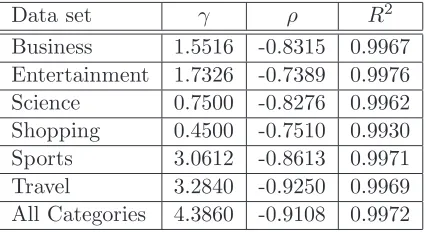
In [FLL15], we used nonlinear least-squares regression to fit Weibull survival functions to the Kaplan-Meier estimates. The estimates obtained for the parameters γ and ρ are shown in Table 5, taken from [FLL15]. We note that the shape parameters ρ satisfy −1 < ρ <0, which, as mentioned at the end of Section 2, implies that the Weibull survival functions can be expressed as mixtures of exponentials. In order to compare our approximation by exponential mixtures with the Weibull survival functions obtained in [FLL15], we used least-squares curve fitting to fit Weibulls (4) to the exponential mixtures obtained from (9) and (10), using the parameters from Table 2, in a similar manner to [JG10]. The estimated parameters γ and ρ
are shown in Table 6, together withR2. It can be seen that these estimates are very close to
those in Table 5.
Data set γ ρ R2
Business 1.5576 -0.8321 0.9818
Entertainment 1.7877 -0.7453 0.9957
Science 0.7575 -0.8318 0.9303
Shopping 0.4736 -0.7608 0.9240
Sports 3.1986 -0.8666 0.9967
Travel 3.5141 -0.9291 0.9760
[image:10.595.194.409.416.533.2]All Categories 4.5262 -0.9134 0.9955
Table 5: Nonlinear least-squares regression to Weibull survival functions using the Kaplan-Meier estimates.
Finally, we note from Table 2 thatλ1 is significantly smaller thanλ2. It therefore follows, from the comment made after (3) regarding the decreasing failure rate, that a substantial number of queries are popular for a short duration, becauseλ2 is large, while the popularity of others lasts for much longer, because λ1 is small. We note that a similar observation, in the context of the popularity of movies, was made in [PS10]. In particular, for the Google Trends data set, about 40% of the queries survive for only a single month.
5
Concluding Remarks
Data set γ ρ R2
Business 1.5516 -0.8315 0.9967
Entertainment 1.7326 -0.7389 0.9976
Science 0.7500 -0.8276 0.9962
Shopping 0.4500 -0.7510 0.9930
Sports 3.0612 -0.8613 0.9971
Travel 3.2840 -0.9250 0.9969
[image:11.595.196.409.108.224.2]All Categories 4.3860 -0.9108 0.9972
Table 6: Least-squares curve fitting of Weibulls to the exponential mixture survival functions.
in the system until they die and leave the system according to a constant mortality rate. A solution to the equations describing the model was obtained in (9), and it was seen that this solution is approximately an exponential mixture. We then successfully applied our model to data on the survival of popular search engine queries. It is also potentially applicable to other data sets relating to human behaviour.
One important problem to be addressed is how to choose the number of components in the mixture model. As discussed in [MP00, Chapter 6], several methods have been suggested to obtain a parsimonious model. Among these, a number of prominent methods are based on maximising a penalised log-likelihood function.
Generative models, like the one presented here, have the potential to explain observed social phenomena and, more specifically, social mechanisms and the emergence of collective behaviour, as discussed in the introduction. They allow us to gain insight into the underlying processes; in addition, they may be useful for more accurate prediction of, for example, online content, as discussed in [TdFA14]. With regards to our theme of human dynamics [CFL09], our stochastic mixture urn model contributes to a better understanding of collective phenomena, such as popularity, and how such global behaviour emerges from the decisions of individuals from whom the statistics have been collected. Another possible avenue for investigation is to consider other distribution mixtures, such as finite Weibull mixture models (see [BNF04], where it is argued that the reliability of a system can be suitably modelled by a Weibull mixture model).
Acknowledgements
We would like to thank Suneel Kingrani, who collected the Google Trends data and computed the Kaplan-Meier estimates for the data set.
References
[AB02] R. Albert and A.-L. Barab´asi. Statistical mechanics of complex networks.Reviews
of Modern Physics, 74:47–97, 2002.
[Bar07] A.-L. Barab´asi. The architecture of complexity: From network strucutre to hu-man dynamics. IEEE Control Systems Magazine, 27:33–42, 2007.
[BG03] C. Bracquemond and O. Gaudoin. A survey on discrete lifetime distributions.
International Journal of Reliability, Quality and Safety Engineering, 10:69–98,
2003.
[BJ97] H. Block and H. Joe. Tail behavior of the failure rate functions of mixtures.
Lifetime Data Analysis, 3:269–288, 1997.
[BNF04] T. B˘ucar, M. Nagode, and M. Fajdiga. Reliability approximation using finite Weibull mixture distributions.Reliability Engineering and System Safety, 84:241– 251, 2004.
[BSV07] S. B¨orner, S. Sanyal, and A. Vespignani. Network science. Annual Review of
Information Science & Technology (ARIST), 41:537–607, 2007.
[CFL09] C. Castellano, S. Fortunato, and V. Loreto. Statistical physics of social dynamics.
Reviews of Modern Physics, 81:591–646, 2009.
[CGW+
08] J. Candia, M.C. Gonz´alez, P. Wang, T. Schoenhar, G. Madey, and A.-L. Barab´asi. Uncovering individual and collective human dynamics from mobile phone records.
Journal of Physics A: Mathematical and Theoretical, 41:224015, 11pp, 2008.
[Fel71] W. Feller. An Introduction to Probability Theory and its Applications, volume II. John Wiley & Sons, New York, NY, 2nd edition, 1971.
[Fin08] M. Finkelstein. Failure Rate Modelling for Reliability and Risk. Springer Series in Reliability Engineering. Springer-Verlag, London, 2008.
[Fin09] M. Finkelstein. Understanding the shape of the mixture failure rate (with engi-neering and demographic applications). Applied Stochastic Models In Business
And Industry, 25:643–663, 2009.
[FL00] T.R. Fleming and D.Y. Lin. Survival analysis in clinical trials: Past developments and future directions. Biometrics, 56:971–983, 2000.
[FLL07] T. Fenner, M. Levene, and G. Loizou. A model for collaboration networks giving rise to a power-law distribution with an exponential cutoff. Social Networks, 29:70–80, 2007.
[FLL12] T. Fenner, M. Levene, and G. Loizou. A discrete evolutionary model for chess players ratings. IEEE Transactions on Computational Intelligence and AI in
Games, 4:84–93, 2012.
[FLL13] T. Fenner, M. Levene, and G. Loizou. A bi-logistic growth model for conference registration with an early bird deadline. Central European Journal of Physics, 11:904–909, 2013.
[FW98] A. Feldman and W. Whitt. Fitting mixtures of exponentials to long-tail distribu-tions to analyze network performance models. Performance Evaluation, 31:245– 279, 1998.
[Gal08] S. Galam. Sociophysics: A review of Galam models. Journal of Modern Physics C, 19:409–440, 2008.
[GG01] L.A. Gavrilov and N.S. Gavrilova. The reliability theory of aging and longevity.
Journal of Theoretical Biology, 213:527–545, 2001.
[HS98] P. Hedstr¨om and R. Swedberg. Social mechanisms: An introductory essay. In P. Hedstr¨om and R. Swedberg, editors, Social Mechanisms: An Analytical
Ap-proach to Social Theory, pages 1–31. Cambridge University Press, Cambridge,
U.K., 1998.
[Jew82] N.P. Jewell. Mixture of exponential distributions. Annals of Statistics, 10:479– 484, 1982.
[JG10] T. Jin and L.K. Gonigunta. Exponential approximation of Weibull renewal with decreasing failure rate. Journal of Statistical Computation and Simulation, 80:273–285, 2010.
[Kea99] C. Keatinge. Modeling losses with the mixed exponential distribution.Proceedings
of the Casualty Actuarial Society, LXXXVI:654–698, 1999.
[KK12] D.G. Kleinbaum and M. Klein. Survival Analysis, A Self-Learning Text. Springer Science+Business Media, LLC, New York, NY, 3rd edition, 2012.
[KM58] E.L. Kaplan and P. Meier. Nonparametric estimation from incomplete observa-tions. Journal of the American Statistical Association, 53:457–481, 1958.
[LAE+
12] E. Lovecchio, P. Allegrini, E.Geneston, B.J. West, and P. Grigolini. From self-organized to extended criticality. Frontiers in Physiology, 3:Article 98, 9pp, 2012. [Law03] J.F. Lawless. Statistical Models and Methods for Lifetime Data. Wiley Series in
Probability and Statistics. John Wiley & Sons, 2nd edition, 2003.
[LMS12] J.G. Lee, S. Moon, and K. Salamatian. Modeling and predicting the popularity of online contents with Cox proportional hazard regression model. Neurocomputing, 76:134–145, 2012.
[MAAJ13] J. Mathiesen, L. Angheluta, P.T.H. Ahlgren, and M.H. Jensen. Excitable human dynamics driven by extrinsic events in massive communities. Proceedings of the
National Academy of Sciences of the United States of America, 110:17259–17262,
October 2013.
[MD09] A.T. Mendoza-Rosas and S. De la Cruz-Reyna. A mixture of exponentials dis-tribution for a simple and precise assessment of the volcanic hazard. Natural
Hazards and Earth System Sciences, 9:425–431, 2009.
[MP00] G. McLachlan and D. Peel. Finite Mixture Models. John Wiley & Sons, New York, NY, 2nd edition, 2000.
[MSR13] A. Mitnitski, X. Song, and K. Rockwood. Assessing biological aging: the origin of deficit accumulation. Biogerontology, 14:709–717, 2013.
[OK12] P.D.T. O’Connor and A. Kleyner. Practical Reliability Engineering. Wiley Series in Telecommunications. John Wiley & Sons, Chichester, 5th edition, 2012.
[Pro63] F. Proschan. Theoretical explanation of observed decreasing failure rate.
Tech-nometrics, 5:375–383, 1963.
[PS10] R.K. Pan and S. Sinha. The statistical laws of popularity: universal properties of the box-office dynamics of motion pictures. New Journal of Physics, 12:115004 (23pp), 2010.
[Rin09] H. Rinne. The Weibull Distribution: A Handbook. CRC Press, Boca Raton, FL, 2009.
[RNP+
10] J.T. Rich, J.G. Neely, R.C. Paniello, C.C.J. Voelker, B. Nussenbaum, and E.W. Wang. A practical guide to understanding Kaplan-Meier curves.
Otolaryngology-Head and Neck Surgery, 143:331–336, 2010.
[SBCG13] C.M. Schneider, V. Belik, T. Couronn´e, and M.C. Gonz´alez. Unravelling daily human mobility motifs.Journal of the Royal Society Interface, 10:20130246, 2013. [SC88] S. Siegel and N.J. Castellan Jr. Nonparametric Statistics for the Behavioral
Sci-ences. McGraw-Hill, New York, NY, 2nd edition, 1988.
[SC14] P. Sen and B.K. Chakrabarti. Sociophysics: An Introduction. Oxford University Press, Oxford, 2014.
[Sch98] T.C. Schelling. Social mechanisms and social dynamics. In P. Hedstr¨om and R. Swedberg, editors,Social Mechanisms: An Analytical Approach to Social The-ory, pages 32–44. Cambridge University Press, Cambridge, U.K., 1998.
[Sim55] H.A. Simon. On a class of skew distribution functions. Biometrika, 42:425–440, 1955.
[TdFA14] A. Tatar, M.D. de Amorim, S. Fdida, and P. Antoniadis. A survey on predicting the popularity of web content. Journal of Internet Services and Applications, 5:20 pages, 2014.
[TW02] A. Tsoularis and J. Wallace. Analysis of logistic growth models. Mathematical
Biosciences, 179:21–55, 2002.
[VAFL10] P.O.S. Vaz De Melo, L. Akoglu, C. Faloutsos, and A.A.P. Loureiro. Surprising patterns for the call duration distribution of mobile phone users. InProceedings of European Conference on Machine Learning and Principles and Practice of
Knowledge Discovery in Databases (ECML PKDD), pages 354–369, Barcelona,
[ZPL12] D. Zhang, K. Prior, and M. Levene. How long do wikipedia editors keep active? In
Proceedings of the 8th International Symposium on Wikis and Open Collaboration