0022-538X/87/051478-10$02.00/0
CopyrightX 1987, American SocietyforMicrobiology
Construction
of Viable Deletion and Insertion
Strain of Type 1 Poliovirus: Function of the 5'
in Viral
Replication
Mutants
of the
Sabin
Noncoding Sequence
SHUSUKE KUGEtANDAKIO NOMOTO*
Department ofMicrobiology, Faculty of Medicine, University of Tokyo,
Hongo,
Bunkyo-ku, Tokyo 113, JapanReceived 20August 1986/Accepted6January1987
A number of deletion and insertion sequences were introduced into the 5' noncoding sequence (742 nucleotides long)ofthegenomeoftheSabin strain of type 1 poliovirus by usinganinfectious cDNA clone of the virus strain. The genomes of all three poliovirus serotypes contained highly homologous sequences (nucleotide positions 509to639)aswellashighlyvariable sequences(positions640 to742)in the 5'noncoding region. Theviability ofmutant viruses was tested by
transfecting
mutant cDNA clones into African green monkeykidney cells andthenestimatingtheplaquesizesdisplayed
onthe cells. The resultssuggestedthat the highlyvariable sequencenext tothe VP4coding regiondidnotplayanimportant role, atleast in the in vitro culture systemused, that the loci ofhighlyconserved nucleotide sequenceswerenotalways expectedto be the genomeregionsessential for viralreplication, that the sequence betweenpositions564 and 599 carriedgenetic information to maintain the efficiency of certain steps in viral replication, and that the sequence between positions 551to563might playanessential roleinviralreplication.
Four-base deletionorinsertion mutations wereintroduced intorelatively variable sequences in the genomeregion
upstream ofposition
509. The results suggest that variable sequences do not always indicate that the corresponding genome regions are less important. Apparentrevertants(large-plaque variants)wereeasily generatedfromoneof the viablemutants withthesmall-plaque phenotype. The determination of nucleotide sequences of therevertantgenomesrevealed the second mutation site. Theresults suggested that thedifferent loci ataroundpositions200and500might specifically interact with each other. This interaction mayresult in theformation ofafunctionalstructurethat influencestheefficiency of certain steps in the viralreplication.Poliovirus, a member of the Picornaviridae, contains a
single-stranded RNA genome with positive polarity. The genomic RNAis composed of approximately 7,500 nucleo-tides towhich a genome-linkedprotein (VPg) is covalently attachedatthe 5'terminus (27)andpoly(A) isattachedatthe 3'terminus (28). ThisRNAisinfectious in mammalian cells regardless ofwhetherVPg is attachedatthe5'terminus(9). Inthe hostcell cytoplasm, the viral RNA is translatedinto a single continuous polyprotein with a molecular weight of 247,000, and the polyprotein is subsequently cleaved by proteases toform viralstructural and nonstructuralproteins (4, 5, 25). Studies on the sequences of RNA and of amino acids in viral polypeptides have provided a precise viral protein map. The studies have also revealed a fairly long untranslated region (approximately 750 nucleotides long) at the 5' terminus ofthe genome(5).
Todate,the totalnucleotide sequences of the genomes of both the virulent and attenuated strains of all three poliovirus serotypes havebeen elucidated (5, 8, 10, 13, 20, 22, 24). A comparative sequence study on the genomes of polioviruses ofall three serotypes has been performed by Toyoda et al. (24). The study revealed that the nucleotide sequenceinthe 5' noncoding region carried a highly variable sequence at nucleotide positions 640 to 742 and a highly conserved sequence at nucleotide positions 509 to 639 (see Fig. 1, 2, and 5). Although the sequence upstream of
* Correspondingauthor.
tPresentaddress: Department of Molecular Biology, School of Medicine, Kitasato University, Kitasato, Sagamihara, Kanagawa 228, Japan.
nucleotide position 509 showed high homology among vi-rusesof different serotypes, severalportions ofthis genome regionwerefoundtoberelatively variable.The reasonsfor the sequence homology and variation are unknown. It is possible that homologous sequences in the untranslated region, which have been conserved through a long evolu-tionaryprocess,playessentialrolesinviralreplicationsuch as in virus-specific RNA synthesis, virus-specific protein synthesis,andpackaging, and thatalong variable sequence discovered in the 5'noncoding regionnexttothe VP4coding region (nucleotide positions 640 to 742) serves just as a spacer in the genome because of the conservation ofthe approximate length of the sequence inthis locus. Thus,the biological significance ofthese genome structures in the 5' noncoding region remains tobe elucidated.
Racaniello and Baltimore (14) have shown that a com-plete, cloned cDNA copy of the genome of the virulent Mahoney strain oftype1poliovirus isinfectiousin mamma-liancells. A similar cloneof high specific infectivity was also constructedby Semleretal. (17). Omata et al. (12) isolated an infectious cDNA clone of the genome of the attenuated Sabin strain of type 1poliovirus [Sabin 1 strain;PV1(Sab)]. Furthermore, highly infectious cDNA clone of the Sabin 1 strainwasreported by Kohara et al. (6), who used a plasmid vectorconstructed by Semler and Johnson (manuscript in preparation) containingthesimian virus 40 origin of replica-tionaswellasthe promoter and coding region for the simian virus 40largeTantigen. The availability of infectious cDNA clones of polioviruses provided a molecular genetic ap-proach for investigating the relationship between structure and function of the viral genome by using a recombinant
1478
on November 10, 2019 by guest
http://jvi.asm.org/
VIABLE MUTANTS OF SABIN STRAIN OF TYPE 1 POLIOVIRUS
5' non-coding
region
e' m'i: .-.-. ~ u. .a,II
m m m m -~m a
VP Rso I (702)
t
"IVP2
Sabin 1 cDNA
pVS(1)IC-SaL CGACC
pVS(1)IC-PL47a
GGTCGACCAATTCGAGCTCGGTACCCGGGGATCCTCTAGAGTCGACCpVS(1)IC-PL47b GGTCGACTCTAGAGGATCCCCGGGTACCGAGCTCGAATTGGTCGACC
FIG. 1. Sequences of insertion mutant genomes. Sequences of theSalllinkernucleotide and polylinker nucleotide were inserted into the RsaIsite at nucleotide position 702 as described in Materials and Methods. Nucleotide sequences inserted are shown with thecorresponding plasmids. The insertion sequence of plasmidpVS(1)IC-47b is in the opposite orientation to that of plasmid pVS(1)IC-47a. Nucleotide sequence homology among genomes of various poliovirus serotypes is indicated as black bands at the top of the figure. The bands indicate homologous regions as follows: row 1 (top), more than 1 nucleotide; row 2, more than 3 nucleotides; row 3, 6nucleotides;row 4, 12nucleotides;row5,
18nucleotides (24).
DNA technology. Thus, it is now possible to modulate nucleotidesequences ofpoliovirus genomes in vitro. Indeed, intratypic recombinant polioviruses (7, 11) and intertypic recombinant polioviruses (8, 23) have been constructed. Furthermore, Semler et al. (18) reported the in vitro con-struction of a recombinant virus between poliovirus and coxsackievirus. Viable insertion mutants of the Mahoney strain oftype 1poliovirus inregard to theviral nonstructural protein coding region (2) and the 3' noncoding region (16) have also been constructed. These in vitro-modifiedviruses were successfully used for molecular genetic analyses of poliovirus replication.
Weintroducedanumberof deletionorinsertionmutations into the5' noncodingsequenceof the Sabin 1straingenome
by using
ahighly infectiouscDNA clone of the virusstrain,and we tested the mutant viruses for their efficiency of replication. Thegenetic analysis, including identification of the secondmutation sites in thegenomesof variants derived from one ofthe invitromutants, providedimportant infor-mation about the function of the 5'
noncoding
sequence in poliovirus replication.MATERIALS AND METHODS
DNA procedure. An infectious cDNA
clone,
pVS(1)IC-O(T), was constructed from a series of cDNA clones of
PV1(Sab)
(6, 12). Restrictionendonucleases,
T4DNApoly-merase, and Sall linker nucleotide
(GGTCGACC)
werepurchasedfrom Takara Shuzo Co. (Kyoto, Japan),
Toyobo
Co.
(Osaka,
Japan), orNippongene
Co.(Toyama,
Japan).
Avian
myeloblastosis
virusreversetranscriptase
and human placenta RNase inhibtor were fromSeikagaku
Kogyo Co. (Osaka, Japan). Calf intestine alkalinephosphatase
wasfrom Boehringer(Mannheim,
FederalRepublic
ofGermany).
La-beled compounds werepurchased
from AmershamCorp.,
ArlingtonHeights, Ill. Theseenzymes and
compounds
were usedaccordingtothemanufacturers' instructions.Themod-ified calcium phosphate method of transfection was per-formed asdescribedpreviously (6).
Subcloning of the 5'-proximal sequence of PV1(Sab) genome. To modulate the 5' noncoding sequence of the PV1(Sab) genome, the corresponding sequence of nucleotide positions 1 to 1813 was subcloned into plasmid pML2 as follows. Plasmid pVS(1)IC-O(T) was digested with PstI, treatedwith T4 DNA polymerase to produce blunt ends at the cleavage sites, and digested with EcoRI. The cDNA fragment approximately 1,800 nucleotideslong was isolated after the separation of DNA fragments by agarose gel electrophoresis. PlasmidpML2 wasdigestedwithSalI, and theprotrudingends were filled inbytreatmentwithT4DNA polymerase. The linearized DNA was digestedwithEcoRI, and thelongerDNAfragmentwasisolatedby electrophore-sisonagarosegel. Both of the isolatedDNAfragmentswere ligated together to form a plasmid called pEP(Sab), which had aPV1(Sab)genome sequence of nucleotidepositions 1 to 1809.
Construction of cDNAmutantwithlonginsertionsequence. ASall linker nucleotide 8 baseslong was inserted intothe RsaIcleavagesite at thecorrespondingnucleotide(position 702) as follows. Plasmid
pEP(Sab)
wasdigested with RsaI and separated by 5%polyacrylamide
gel electrophoresis. The cDNAfragments
approximately
450 and 290 nucleotides longwereeluted from thegelandligatedwiththeeight-base Sall linker. The formerfragments weredigestedwith NcoI and SalI, and the latter wasdigested
with BanII and SalI. The larger DNA fragments (approximately 315 and 210 nucleotideslong,respectively)
of bothdigests
wereisolated by gel electrophoresis as described above. These isolated fragments were ligated with thelonger
DNAfragment
of pEP(Sab)that had beendigested
withNcoI andBanII. The modifiedpEP(Sab),
designated
aspEP(Sab)Sal,
was di-gestedwithAatII,and the shorter DNAfragment
wasligated with thelongerAatIIfragment
ofpVS(1)IC-O(T).
Thus,
the eight-base Sall linkernucleotide wasinserted into anRsaIa II a oidllif - - Mkm M l we
VOL.61, 1987 1479
I :
on November 10, 2019 by guest
http://jvi.asm.org/
[image:2.612.119.497.75.284.2]5'
non-coding
region
N_inin,.inmmminmin_.il__ o _ _m _ - il~M- u a m mu m-!'
-mrn-m ~~~~~~~~~~~~~~~V4VP2
1 cDNA 480 534 54727r743
p
163b deletion
DB DF DH DA23 DA21 DA25 DA53 DAva
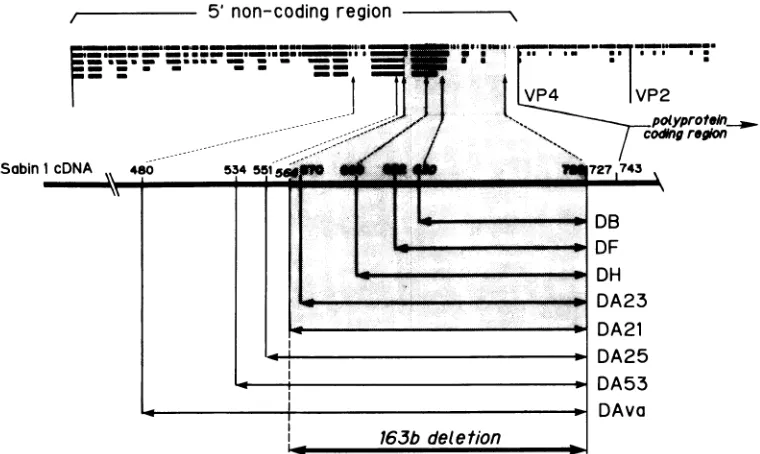
FIG. 2. Viabilityof deletionmutants.The nucleotidesequencehomologyamonggenomes of variouspoliovirusserotypesis shownasin Fig. 1.Deletion cDNA cloneswereconstructedasdescribed in Materials and Methods. Thenomenclatureof cDNA clones is shownonthe right side of thefigure. pVS(1)IC- is omitted fromthe nomenclature. Deletedsequences of the cDNA clones areindicatedby lineswith arrowheads onboth ends. Viable deletionmutants lackinggenome sequencesareindicatedas shadowedregions. Nucleotidepositionsare
shownbynumbers above the Sabin1cDNAline.
cleavage siteatthecorrespondingnucleotideposition702of the PV1(Sab) genome. This plasmid was designated as
pVS(1)IC-Sal (Fig. 1).
Alonger insertion sequence for the Sall cleavage site of plasmid pVS(1)IC-Sal was prepared from the polylinker region of a cloning vector, pUC18. Plasmid pUC18 was
digested with EcoRI, the protruding ends were filled in by treatment with T4 DNA polymerase, and the DNA was
ligated with Sall linker nucleotides. The modified pUC18 DNA was then digested with Sall, and the 39-base SalI
fragmentwaspurifiedby electrophoresis on a5%
polyacryl-amidegel. TheSallDNAfragmentelutedfrom thegelwas
inserted intotheSall cleavage site of plasmid pVS(1)IC-Sal. The plasmids thus obtained have a total 47-base insertion
sequenceatthecorrespondingnucleotideposition702onthe PV1(Sab)genome andwere designated aspVS(1)IC-PL47a
andpVS(1)IC-PL47b (Fig. 1).
Constructionof cDNAmutantwithlongdeletedsequences.
PlasmidpEP(Sab)Sal that had been linearized by the diges-tion with SalI was treated with exonuclease Bal3l and
ligatedwith Salllinker nucleotides. The DNAs, after treat-mentwithSall, werecircularized with T4 DNA ligase. One
of the plasmid clones thus obtained carried the deleted
sequence ofnucleotide positions 697to 726 andwas
desig-nated as pEP(Sab)D56. On the other hand, plasmid
pEP(Sab)wasdigested with Bal 1atpositions 629and1227, ligated with Sall linker nucleotides, andthen digested with PstI. The DNA fragment approximately 1,400 nucleotides longwasisolated byagarosegelelectrophoresis. This DNA
fragment was used to replace the corresponding PstI-SalI fragment of pEP(Sab)D56, and the resulting plasmid was
designated as pEP(Sab)DB. The shorter AatII fragment of pVS(1)IC-O(T) wasreplaced by the shorter AatII fragment
ofpEP(Sab)DB; this plasmid, called pVS(1)IC-DB, lacked thegenomeregion of the correspondingnucleotide positions
630to726(Fig. 2).
Similarly, the Salllinker nucleotide was introduced into the FokI cleavage site at the corresponding nucleotide position 617 or the HphI site at position 599. PV1(Sab)
sequences upstream of these newly introduced
SalI
siteswere ligated with PV1(Sab) sequence downstream of the SalI site of pEP(Sab)D56 as described above. Plasmids obtainedweredesignatedaspEP(Sab)DF andpEP(Sab)DH, respectively. The shorter AatII fragment ofpVS(1)IC-O(T)
wasthenreplacedby the corresponding DNA fragment with
deletion ofpEP(Sab)DForpEP(Sab)DHasdescribed above. These deletion cDNAmutantswerecalledpVS(1)IC-DF and pVS(1)IC-DH, respectively (Fig. 2). The deletedsequences
of pVS(1)IC-DF and pVS(1)IC-DH are the corresponding nucleotide positions 622 to726 and600to726, respectively (Fig. 2).
After digestion with Sall, plasmid pEP(Sab)DH was
treated withBal 31. The Bal 31-treated pEP(Sab)DH DNAs
wereligated withSail linker nucleotides and circularized by
usingthe cohesivecleavagesiteofSall. PV1(Sab)sequences
upstreamof the SalI cleavagesitesof thedeletionplasmids constructed from pEP(Sab)DH were ligated withPV1(Sab) sequence downstream of the Sall cleavage site of pEP(Sab)D56. The deletion plasmids thus obtained were
designated as pEP(Sab)DA23, pEP(Sab)DA21, pEP(Sab)
DA25, and pEP(Sab)DA53. Similarly, plasmid pEP(Sab) DAvawas constructed by using the AvaI cleavage site at nucleotide position 476. Replacements ofAatII fragments between these deleted subclones and pVS(1)IC-O(T) were
carried outasdescribed aboveto construct pVS(1)IC-O(T)
werecarriedoutasdescribed aboveto construct pVS(1)IC-DA23, pVS(1)IC-DA21, pVS(1)IC-DA25, pVS(1)IC-DA53, and pVS(1)IC-DAva, whose deleted sequences were the
corresponding nucleotide positions 570to 726, 564 to 726, 551to726, 534to726, and 480to726, respectively (Fig. 2). Construction of cDNA with four-base deletionorinsertion
sequences. Plasmid pEP(Sab) was linearized by using the
Sabin
on November 10, 2019 by guest
http://jvi.asm.org/
[image:3.612.125.505.71.298.2]VIABLE MUTANTS OF SABIN STRAIN OF TYPE 1 POLIOVIRUS 1481
unique cleavage site of KpnI, BamHI, NcoI, or
AvaI,
treated with T4 DNA polymerase to modify the terminal structure of DNAs, and circularized with T4 DNA ligase. The plasmid with a modified sequence at the corresponding restriction cleavage site was digested with AatII. The shorter AatII fragment was ligated with the longer AatII fragment of plasmid pVS(1)IC-O(T). Thus, we constructed plasmids pVS(1)IC-AK,pVS(1)IC-AB, pVS(1)IC-AN,
andpVS(1)IC-AA,
which carried a four-base deletion at the KpnI site at position 70, a four-base insertion at the BamHI site at position 220, a four-base insertion at the NcoI site at position 388, and a four-base insertion at theAvaI site at position 475, respectively (see Fig. 5).Cells and virus stocks. AGMK cells (African green monkey kidney cells) were maintained in Dulbecco modified Eagle medium supplemented with 5%newborn calf serum. AGMK cells were transfected with 10
pug
of closed circular forms of plasmidpVS(1)IC-O(T)
or mutant cDNA clones per 60-mm plastic dish, and viruses were recovered from the cells by the modified calcium phosphate method described above. The recovered viruses were used as virus stocks. Usually, titers of the virus stocks were 1 x 10⁸ to 3 x 10⁸ PFU/ml.Large-plaque variants were prepared by isolating a single large plaque and expanding it on AGMK cells by conven-tional methods.
Virus infection and growth. To measure virus titers, AGMK monolayer cells in 60-mm plastic dishes were washed with Eagle minimum essential medium twice, cov-ered with 0.5 ml of virus solution diluted fromhigh-titer virus stocks, and kept at room temperature for 1 h. After incuba-tion at
36.5°C
for 30 min, the cells were washed with minimum essential medium twice and covered with mini-mum essential medium containing 1% agarose and 5%new-born
calf serum. After 3 to 5 days of incubation at 35.5°C, plaques were visualized by staining cells withcrystal violet. To determine the extent of virus production in AGMK cells, approximatelyS x 106 AGMKcells in a60-mm plastic dish were infected with viruses atSto 10 PFUpercell. After the infection, thecells were washed with ice-cold minimum essential medium five times to remove freeviruses, covered with the same mediumcontaining
5% newborn calf serum, and incubated at 35.5°C. The infected cells were frozen at appropriate times, and the virus solution was prepared by freeze-thawing three times followed by centrifugation to remove cell debris. The titers of viruses produced in the infected cells were measured as described above.Nucleotide sequence analysis. Approximately 4 x
107
AGMK cells were infected with virusesat 10 to 20PFU per cell and incubated at 33.5°C for 7 to12 h, whenalmostall of the cells showed cytopathic effects (CPE). Cytoplasmic RNAs containing poliovirus RNA were prepared from the infected cells by the method of Berket al. (1). Briefly, the infected cells were harvested with a rubber policeman, washed with ice-coldphosphate-buffered saline three times, and suspended in2 ml of buffercontaining0.14 MNaCl, 1.5 mM MgCl2, 10 mM Tris hydrochloride (pH 7.4), and 0.5% Nonidet P-40. After incubation at0°C for 5min followedby centrifugation to remove the nuclear fraction, the superna-tant was mixed with an equal volume ofurea solution (0.35 M NaCl, 10 mM Trishydrochloride [pH 7.4], 10 mMEDTA, 7 M urea, 1% sodium dodecyl sulfate). The mixture was extracted with phenol-chloroform three times, and RNAs were precipitated in ethanol. Withthis procedure, approxi-mately 100,ug of cytoplasmic RNA containing poliovirus RNA was obtained.
A modifieddideoxymethod wasemployed forsequencing
RNAs. Synthetic DNA primer (2 pmol) was mixed with
cytoplasmic
RNAs(5
to10pug)
in 10.5pI of buffer containing75 mMTris hydrochloride (pH 8.3), 12
mM
MgCl2, and 25mM
dithiothreitol
andincubated at60°C
for5min. For DNAsynthesis, theprimer-RNA solution was added with 2 1.l of
[a-32P]dCTP
(400Ci/mmol), 0.5pul
of human placenta RNase inhibitor (72U/,ul),
and 1.0 pI of avian myeloblastosis virus reverse transcriptase (20U/,u).
A3.5-,u
portion of this mixture was mixed with 2 pd of each dideoxynucleoside mixture containing 0.1 mM each of dGTP, dATP, and dTTP and the appropriate concentrations of dideoxynucleoside triphosphates (0.014 mM ddGTP, 0.01 mM ddATP, 0.006 mM ddTTP, and 0.0005 mM ddCTP for G, A, T, and C reactions, respectively). The reaction for cDNA synthesis was carried out at42°C
for 15 min, and then 1 pl of chase mixturecontaining
1 mM each of fourdeoxynucleoside
triphosphates
was added. The reaction was continued at42°C
for 15min
and stopped by the addition of 6 p1 of stop solutioncontaining
95%formamide,
20 mMTrisborate (pH 8.3), 0.03% bromophenol blue, and 0.03% xylene cyanol. The final mixturewas heatedto95°C
for3 min, and samplesof1 to 2
pul
wereapplied
to sequencing gels(15).
The dideoxy method (15) was also employed to confirm nucleotide sequences of all modified DNAs by using syn-thetic DNA primers.
RESULTS
Variable sequence at nucleotide positions 640 to 742. A highly variable sequence in the untranslated genome
region
next tothe VP4 coding region has been considered to be apossible
spacer ofthegenome, since theapproximatelength
is conserved among genomes ofvarious
poliovirus
serotypes (24).As afirst step to investigate the function of this genome region in viral replication, we constructed mutant cDNAs with insertion sequences at the corresponding nucleotide position 702 as described in Materials andMethods, that is, pVS(1)IC-Sal, pVS(1)IC-PL47a, and pVS(1)IC-PL47b (Fig. 1). AGMKcells weretransfected with closed circular forms of these plasmids. All of these plasmids were infectious in AGMK cells, and infectious virus particles wereproducedin the transfected cells. Therecoveredviruses were
designated
as Sal, PL47a, and PV1(Sab)IC-PL47b,respectively (Fig. 1).RNAsequencesofthemodified genome region were determined as described in Materials and Methods. The RNA in the genome region had the nucleotide sequence which correctly reflected those of the modified cDNAs(data notshown; Fig. 1).
We tested biological characteristics of the recovered vi-ruses with regard to plaque size, the rate by which CPE progressed, and finalyields of infectious virusparticlesfrom AGMK cells. These phenotypes of the insertion mutants were indistinguishable from those of the parent virus PV1(Sab)IC-O, which was produced in AGMK cells transfected with plasmid pVS(1)IC-O(T) (6, 7). Similar ob-servations were obtained in experiments with in vitro mu-tants, with a 72-base insertion sequence at nucleotide posi-tion 702ofPV1(Sab) genome
(S.
Kuge, N. Kawamura, and A. Nomoto, manuscript in preparation). These results indi-catedthat theinsertionofmutationsup to 72 baseslong into the highly variable sequence in the 5' noncoding region of poliovirus genomehad noeffectontheviability of thisvirus, suggesting that theconservationof theapproximate
length
of the sequence ofthisgenome region isnot important for viral replication, at least in the in vitro culture system used. ToVOL.61, 1987
on November 10, 2019 by guest
http://jvi.asm.org/
1482 KUGE AND NOMOTO
DAva
SObin 1 429 GAC.TACATAAGAATCCGGCCCCTIGAATGCGGCTAATcCcAA.CCT cAmGGrGGTGCACAAACCAGTGATTGGCT....GTCGTAACCAA 523
I 111
11IIIIIlIIIIIIIIIIIIII1
111111 1111111111111 1111 1111 Rhino 14 438 GrcTTGGTTGTIAGA CrCCCEcCTGAATGCmGCrAACCWTAACCCTAGAGCTAT.GCCACGATCCAGTGGTTIG...TAAGGTCGrAATGAGCAA 533DA25
rDA21
rDD
A
*3
DI
E
524 cGCrGGC7GAACCGACTACTTGcrrGTCCarG'rTC. MI I III!
534 1rCCWGACOGACCGACrAC=PrGT3CTCGTGN'TC'
619
624
T richregion 8bconsensus
620
624
:+
~~~~~~~~~~~~~~~~~~~~~~~~~~~~~~~~~~..
;719V...f
624.. ...624~~~~~~~~~~~~~~~~~~~~~~~~~~~~~~~~~~~~~~~~~~~~~...
_poyprotein
coding region
720 GACAATTIGTATCATPA'ATGGGCTCAaGTlrMATCACAGAAAGTfGCGCACATGAAAACTCAAATAGAGCGrATGGTIGGTTIC
625 .GA,.
'rGOCrCAOmTT'TCTACACAGAAAAG71rGATCTCCACGAAAATCAAAACATTTTGACCAATGGATC
FIG. 3. Nucleotide sequence homology between genomes of PV1(Sab) and human rhinovirus type 14. The nucleotide sequences of PV1(Sab)(10)and human rhinovirustype14(3, 21)arealignedtoshowmaximumhomology.Lines above thePV1(Sab)sequenceorbelow
the humanrhinovirus type14sequenceindicate sequenceswheremorethan 7 bases arecommonamongpoliovirus serotypegenomes or
between human rhinovirustype14andtype2(19),respectively. Viable deletionmutantslackinggenome sequencesareindicatedasshadowed
regions.PV1(Sab)IC-isomittedasinFig. 2. Nucleotide positionsareindicatedbynumbersontherightandleft sides of thefigure. confirm this assumption, we constructed a mutant cDNA
with deletion in this variable genome region, that is, pVS(1)IC-DB (Fig.2).
AGMK cells were transfected with
pVS(1)IC-DB.
pVS(1)IC-DBwas infectious, andthevirus
PV1(Sab)IC-DB
recovered from the transfected cells also had
biological
properties in regardtophenotypesdescribed above indistin-guishable from those of theparentvirusPV1(Sab)IC-O (data not shown). The RNA sequence of the modified genome region of PV1(Sab)IC-DBwasdeterminedandfoundtohave the nucleotide sequence expected from cDNA (data not
shown).
Thus, neither insertion mutations nordeletion mutations introduced into the highly variable sequence of the 5' noncoding region appeared to have any effect on the viral replication inthein vitro culturesystemused. Theseresults suggested that the genome region did not serve even as a spacer of the genome under the experimental conditions used. It may not besurprisingthat this genomeregion has no biological function in replication of picornviruses in vitro, sincethe genomesof rhinovirus belonging to other genera of the Picornaviridae lack the 5' noncoding sequence of the corresponding nucleotide positions 616 to 739 of the
PV1(Sab)
genome(Fig. 3) (3, 19, 21).Highly conserved sequence at nucleotide positions 509 to 639. We constructed a number of cDNA mutants with deletions of various sizes as described in Materials and Methods (Fig. 2). AGMK cells were transfected with these deletion cDNA clones to determine whether viable viruses could be generated in the transfected cells. The cells transfected with plasmids pVS(1)IC-DF,
pVS(1)IC-DH,
pVS(1)IC-23,
andpVS(1)IC-DA21
producedinfectious virusparticles
(Fig. 2). The recovered viruses were designated asPV1(Sab)IC-DF,
PV1(Sab)IC-DH, PV1(Sab)IC-DA23, andPV1(Sab)IC-DA21,
respectively. The results suggested thatthehighlyconserved sequencebetween nucleotide positions 580 and639did notplay an essential role in viral replication under theexperimental conditions used. Thus, we concluded
that high conservation of a nucleotide sequence in the
poliovirus
genome does notalways
indicate an essentialbiological function encoded by the genome locus. On the other hand, AGMK cells transfected with
plasmids
pVS(1)IC-DA25,
pVS(1)IC-DA53,
and pVS(1)IC-DAva did not show CPE underliquid
mediumoverlays
orplaques
underagaroverlays. Thus,infectivitywas notdetectable for these plasmids (Fig. 2). Since approximately 100 plaques were displayed on monolayers of AGMK cells transfected with 10 ,ug of
plasmid
pVS(1)IC-O(T)
(6), thespecific
infectivities oftheseplasmidsmustbe lowerthan
1%
of thatof
pVS(1)IC-O(T).
To excludethepossibility
that verylowor no infectivity ofthese plasmids was due to the shorter length ofthegenome, apolylinker sequence 64 baseslong
prepared
fromplasmid
vectorpUC18
wasinsertedinto theSallcleavage site ofplasmid pVS(1)IC-DA25.This modified plasmid clone didnotshowanyinfectivity (datanotshown). Theseresultssuggestedthat thehighly conserved sequence between nucleotide positions 509 and 563 includes se-quences essential for viralreplication.
Plaques formedby virus infections with PV1(Sab)IC-DF,
PV1(Sab)IC-DH, PV1(Sab)IC-DA23,
PV1(Sab)IC-DA21,and the parent virus
PV1(Sab)IC-O
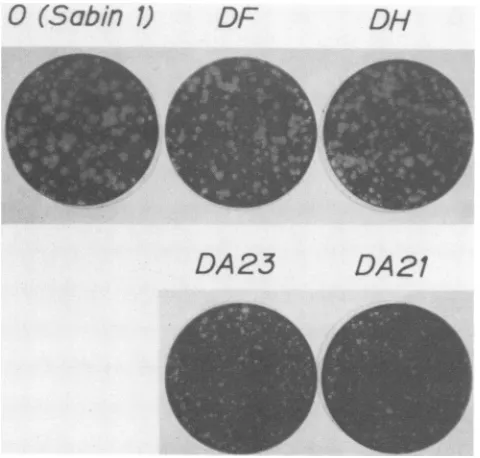
on monolayers of AGMK cellsareshown inFig. 4. VirusesPV1(Sab)IC-DA23and
PV1(Sab)IC-DA21
formed plaquesthatwereapparentlysmaller than those of the parent virus
PV1(Sab)IC-O,
whereas plaques produced by PV1(Sab)IC-DF andPV1(Sab)IC-DH
were similar in size to those of virusPV1(Sab)IC-O.
Thelarge-plaque phenotype of the latter twoviruses indicates that the highly homologous sequence of positions 600 to639 may notplayan importantrolein viral replication in the cell culture system. It should be noted againthat thegenomeofhumanrhinoviruslacks the corre-spondinggenomeregion of positions616 to 739 ofPV1(Sab) genome (Fig. 3).The small-plaquephenotype of the former two deletion mutants could be attributed to lowered effi-cienciesin certain viralreplicationsteps. Indeed, the gener-ation times ofthesevirusesappearedto belongerthan that J. VIROL.
on November 10, 2019 by guest
http://jvi.asm.org/
VIABLE MUTANTS OF SABIN STRAIN OF TYPE 1 POLIOVIRUS 1483
0
(Sabin 1)
DF
DH
I
[image:6.612.57.297.71.300.2]DA23
DA21
FIG. 4. Plaques of deletion mutantsdisplayedonAGMKcells. After the virus infection, AGMKcells were cultured at 35.5°C for 3 days underagarose overlays and stainedasdescribed inMaterials and Methods.PV1(Sab)IC- is omittedasinFig. 2.
of the parent virus (N. lizuka, S. Kuge, and A. Nomoto, unpublishedresult). Itistherefore of interest to identify the
specific
sequences contributing totheefficiency oftheviralreplication.
The nucleotide sequences of positions 429 to 810 of the PV1(Sab) genome (10) and ofpositions 438 to 696 of the humanrhinovirus 14genome(3, 21) are shown in Fig. 3. In the nucleotide sequence of positions 564 to 599 in the genome ofPV1(Sab)IC-DH but missing in the genome of
PV1(Sab)IC-DA21,
twointeresting nucleotide sequences areobserved. One is the nucleotidesequenceofpositions564 to 577,which is richinuridine residues andisindicated as the T-rich region in Fig. 3. Many uridine residues are also observed in this region ofthe genomes ofother poliovirus strains (5, 8, 13, 20, 22, 24), rhinoviruses (3, 19, 21), and coxsackieviruses (26;N. lizuka, S. Kuge, and A. Nomoto,
Virology,
inpress; A. M. Lindberg, P. 0. K.Stalhandske,
and U.
Pettersson, Virology,
in press). Theinteresting
nucleotide sequence is atpositions 583 to 590,indicated as
the 8b consensus in Fig. 3. This sequence is perfectly conserved in this
region
ofthe genomeofpicornaviruses(see
above). The biological significances of these nucleotide sequencesareunknown.It is
possible,
however,thatatleast one of two sequences serves as asignal
to enhance theefficiency
in certain viralreplication
steps such as theinitiation ofviral RNA synthesis or viral protein
synthesis
andfunctions associated withassembly.
A
fairly long
conservedsequenceisobservedupstreamofthe T-rich
region
(Fig. 3).
Since no viable virus was recov-ered from cells transfected withpVS(1)IC-DA25, this con-served sequence may have anessential roleinviral replica-tion. Thebiological
function of this genome region also remains obscure.Relatively variable sequences upstream of nucleotide posi-tion 509. The nucleotide sequence upstream of nucleotide position 509 includes several genome regions of
relatively
variable sequences. To test the biological significances of these genomeregionswithregard to viral replication, four-base deletion or insertion sequences were introduced into these
regions
by making
useoftherestrictioncleavage
sitesof
KpnI (nucleotide
position70),
BamHI (position220),
NcoI (position 388),and AvaI(position
475).
Transfectionexperiments of these modifiedcDNAclones into AGMK cells were performed as described above. In-fectious virus particles were recovered from the cells transfected with pVS(1)IC-AB or pVS(1)IC-AN, but not from the cells transfected with pVS(1)IC-AK or
pVS(1)IC-AA.Theseobservations indicate thatthe genomeregions of relativelyvariable sequences donotalwayssuggestthat the loci are less important for viral replication. The viruses recovered from cells transfected with pVS(1)IC-AB and pVS(1)IC-AN were designated as PV1(Sab)IC-AB and PV1(Sab)IC-AN, respectively(Fig.5).
The plaques produced by viruses PV1(Sab)IC-AB and PV1(Sab)IC-AN on AGMK monolayer cells are shown in Fig. 6; bothinsertionmutants showed smallerplaques than those of the parentPV1(Sab)IC-O, especially in the case of PV1(Sab)IC-AB. These observations suggest that the inser-tion of four bases at the BamHI or the NcoI site in the 5' noncoding sequence of thePV1(Sab)genome results inviral replicationwith lowerefficiencybyanunknown mechanism.
5'
non-coding
region
Sabin
1
cDNA
Insertion
ordeletion
i- -n
- mm
F
-
m100 A
Kpn
I
(70)
A
GTAC
_ a - u in....MN I - __
~Mm uu m mm
- m m m -mm
-200 2300 400 500 600
1 . . .
A
BomHI
(220)
A
GATC
A
Nco I
(388)
aof I on
*a
VP4
760
1%-A
A
vaI
(475)
A
A
CATG TCGG
FIG. 5. Nucleotidesequencesof the genomesof site-directedmutants. Thenucleotide sequence
homology
among genomes ofvarious poliovirus serotype is shownasin Fig. 1. The numbers inparentheses represent nucleotidepositions
of thecleavage
sites of restriction endonucleases. Open and closed triangles indicate positions where four bases are deleted and inserted,respectively.
The nucleotide sequencesdeletedorinsertedareshown under thetriangles.k I A 0
VOL.61, 1987
on November 10, 2019 by guest
http://jvi.asm.org/
[image:6.612.99.511.536.689.2]Interestingly, large-plaque variants ofPV1(Sab)IC-AB rap-idlyaroseduring passagingofPV1(Sab)IC-AB(Fig. 6 and 7). Itispossible that these variants regain replication efficiency tosome extent by some additional mutations.
Large-plaque variants derived fromPV1(Sab)IC-AB. Four differentlarge-plaque variants were isolated by plaque puri-fication from the viruspreparation obtained by one passage ofPV1(Sab)IC-AB on AGMK cells atmultiplicity of infec-tion of
10-3
and designated as PV1(Sab)IC-ABL1, PV1(Sab)IC-ABL2, PV1(Sab)IC-ABL3, and PV1(Sab)IC-ABL4. One small-plaque virus thatseemedtobe the parent virus PV1(Sab)IC-AB was also isolated and designated as PV1(Sab)IC-ABS. These purified viruses were expanded once on AGMK cells by infection at a multiplicity of10-3
and testedfor their plaquesizes on thesamecells(Fig. 7);asmall numberof large-plaque variantsarealreadyobserved in the preparation of virus PV1(Sab)IC-ABS. The plaque sizesof isolated large-plaque variantsarelargerthan thoseof PV1(Sab)IC-AB, although the sizesareslightlysmaller than thoseofPV1(Sab)IC-O. VirusPV1(Sab)IC-ABL2 displayed relatively small plaques among those large-plaque variants whenincubationwas continued (Fig. 7B).
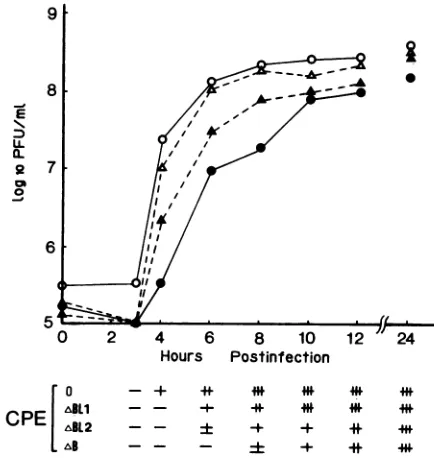
Thesmall-plaque phenotypemaybe attributedtolowered efficiency of certain viral replication steps, resulting in reduction ofthe rateofviralproductionin the infectedcells. To test this possibility, we measured titers of viruses pro-duced in the infected AGMK cells in a single cycle of infection at 35.5°C (Fig. 8). In cells infected with virus PV1(Sab)IC-O, virion assembly starts at about 3 h postin-fection and lasts until 6 to 8 h postinfection. The cells infected with PV1(Sab)IC-AB produced 100-fold fewer plaque-forming particles at 4hpostinfection and more than 10-fold fewer at 6 h postinfection as compared with virus
.s~~~~~~~~~~~~~~~~~~~~~~~~~~~~~~~~~~~~.
r /. " I'i
I..Ii,- 1; ., Ais:
" "
[image:7.612.327.560.71.369.2]-... -.1
.7b
.4... VFIG. 6. Plaques of site-directed mutants displayed on AGMK
cells. Plaques of PV1(Sab)IC-AB (A) and PV1(Sab)IC-AN (B)on
AGMK cells are shown. The plaque formation procedure was
similar to the conditions described in the legend to Fig. 4.
PV1(Sab)IC-is omittedasin Fig. 2.
A
At.9 ;ib X L.i S
.C- I
.ABLf
ABL3 ABL4B
B,I./I, Al I/L 12J AL~I ABl?"
FIG. 7. Plaques of large-plaque variants derived from
PV1(Sab)IC-AB. One small-plaque virus (ABS) and four large-plaque viruses(ABL1,ABL2,ABL3,andABL4)wereisolated from apreparation of virusPV1(Sab)IC-ABasdescribed in Materials and Methods.PlaquesdisplayedonAGMK cells afterincubation for3 days (A) and 5days (B)areshown.PV1(Sab)IC-is omittedasinFig. 2.
productionin cellsinfectedwith
PV1(Sab)IC-O
(Fig. 8).The CPE inducedby viruseswas also examined(Fig.
8). At 8 h postinfection, almost all cells infected with PV1(Sab)IC-O were rounded and detached. At the same time, however, only10 to30% of cells infected withPV1(Sab)IC-AB
showed apparent CPE. The cells infected with two large-plaque variants,PV1(Sab)IC-ABL1
and PV1(Sab)IC-ABL2, pro-duced an intermediate numberofplaque-formingvirus par-ticles and showed an intermediate extent of CPE until 8 h postinfection(Fig.
8). The virus infection cycle of PV1(Sab)IC-ABL2 appearedtoprogress slower than that of PV1(Sab)IC-ABL1 (Fig. 8). The number ofinfectious parti-clesproduced in theseinfectedcellsreachedessentiallythe same level at 24 h postinfection (Fig. 8). Thus, the small-plaque phenotype of mutant virus PV1(Sab)IC-AB can be explained by the prolongation of each cycle of infection, probablybecauseof areduction ofefficiency incertain steps oftheviral replication. Thelarge-plaque variantstherefore seemed to regain to some extent the efficiency by the second-sitemutations that might suppress the small-plaque phenotypeofPV1(Sab)IC-A&B.
Second-site suppressor mutations. To identify the second mutationsites, the nucleotide sequences of the 5' noncoding sequences of thegenomes of the large-plaque variants were determined asdescribedin Materials andMethods
iFig.
9). Everygenome of large-plaque variant was foundtosetaina four-base insertion sequence at the BamHIcleavYagesiteofon November 10, 2019 by guest
http://jvi.asm.org/
[image:7.612.67.307.419.678.2]VIABLE MUTANTS OF SABIN STRAIN OF TYPE 1 POLIOVIRUS 1485
residues (Fig. 9). In the genome of variant
PV1(Sab)IC-ABL2,
the U atposition186and the Gatposition480 werechanged to C and A, respectively (Fig. 9). No other alter-* ationofnucleotide sequence wasdetected in the 5'
noncod-ing
sequence. The results indicated that two nucleotide substitutions in each genome that occurred at nucleotide positions 186 and around 500gaverisetothe recovery ofthe normal generation time ofPV1(Sab)IC-O to some extent,which wasprolonged by the introduction of the four-base insertionsequence at nucleotide position 220. These obser-vations suggest that the specific interaction between these
two genome loci at positions around 200 and around 500 influences theformation ofsomefunctional structures that maintain the
efficiency
ofcertain stepsinviralreplication.0 2 4 6 8 10 Hours Postinfection
CPE
"L
+ *
*f *s
-i- +
±4
12 24
*
*
*
*;
4*+
4*+
FIG. 8. Virus production and appearance of CPE in infected
AGMK cells. AGMK cells were infected with PV1(Sab)IC-O(T)
(0), PV1(Sab)IC-AB (*), PV1(Sab)IC-ABL1 (A), or
PV1(Sab)IC-ABL2 (A) as described in Materials and Methods'. The titers of
viruses produced in the infectedcells were measuredatindicated times after the infection. CPEwasscoredasfollows: -,cells with nodetectabledifference from uninfected cells; ±,less than 10% of
cellsrounded;+,10to30%of cellsroundedordetached; *,30to
70o of cells rounded or detached; * , most cells rounded,
de-tached,orlysed. PV1(Sab)IC- is omittedas inFig. 2.
nucleotide position 220. In thesequenceof threegenomesof large-plaque variants PV1(Sab)IC-ABL1, PV1(Sab)IC-ABL3, and PV1(Sab)IC-ABL4, two point mutations were
observed at nucleotide positions 186 and 525, at which U residues in PV1(Sab)IC-AB genome were changed to C
DISCUSSION
We modulated the 5' noncoding sequences of the
PV1(Sab)
genome, which included highly homologousse-quences as well as
highly
variable sequences among genomes ofpoliovirus
serotypes, toinvestigate
thebiologi-cal
significance
ofthegenomeregionsinviralreplication.Anumber ofmutant cDNA clones constructed in vitro were
tested for their infectivity in AGMK cells. The mutant viruses recovered from the transfected cells were further
characterized in terms of their plaque
size,
which was amarker of viral
proliferation
rate. From theseexperiments,it could be concluded that the genome regions ofhighly
homologous sequences do not always have essential
roles,
although such regions appear to harbor very
important
signals incertain viralreplication steps.
The mutant viruses that lacked the genome region at nucleotidepositions600to726appearedtobefullyviableas
compared with
PV1(Sab).
The genome region contains thehighlyvariablesequence(positions640to726)and the
highly
homologous sequence (positions 600 to639).
Interestingly,
thecorrespondinggenomeregion [positions616to739 ofthe PV1(Sab) genome] is missing in the genomes of human rhinoviruses (3, 19, 21), which are members of the Picornaviridae (Fig. 3). The genome region may therefore1
5'
non-coding region= =_n_.in, m.m _---um--!" ''a~'ilaeau
'---'-_--"-'--su
1220
AB ! 100 186 300 480525 600
ABL
GucG
GAUC
ABL 1
f,i
f
ABL2
ci
A-ABL3 C+
aBL4
Cs
c-VP4 VP2
700
-a
- N '.
-I
FIG. 9. Second-sitesuppressormutations detected in the5'noncodingsequenceoflarge-plaquevariantgenomes.Nucleotidesequence
homologyamong genomesofvariouspoliovirus serotypesisshownasinFig.1. The results ofsequenceanalysesof thegenomesofvirus
PV1(iM)C-AB and itslarge-plaquevariantsareshown. The four bases(GAUC)inserted at nucleotideposition220remained intact inall
vr.iam*genomes asindicatedbyclosedtriangles.Nucleotidenumbers ofPV1(Sab)genome(10)areshown abovePV1(Sab)IC-ABgenome.
PVI$Sab)IC- isomittedasinFig.2.
9
8
7
N
D LL
cm
_o
6
0 :
VOL.61, 1987
on November 10, 2019 by guest
http://jvi.asm.org/
[image:8.612.73.290.70.299.2] [image:8.612.120.504.486.676.2]notplayanessential rolein thereplicationofpicornaviruses incell culture systems. The lackof thisgenome regionmay
cause the distortion of virion particles; this may result in instability of the particles in acidic conditions since rhinovirusesarenot stablein acidic conditionsascompared withpolioviruses. We therefore tested the stabilityofviruses PV1(Sab)IC-DH and PV1(Sab)IC-DA21 at pH 2.0. The stability in acid was similar to that of PV1(Sab) particles (data not shown). Thus, the biological function of this
genome region is unclear. It is possible, however, that the regionmayhaveanimportantfunction inpoliovirus
replica-tion innaturebutnotin the cell culturesystemused in this
study.
Viruses PV1(Sab)IC-DA21 and PV1(Sab)IC-DA23 showed small-plaque phenotypes, whereas virus PV1(Sab)IC-DH showed plaques almost similar in size to those of PV1(Sab). The small-plaque phenotypes of the formertwo viruses may be dueto the lowered rateof viral proliferation as described above. Therefore, two specific nucleotidesequences(T-rich regionand 8bconsensusinFig. 3) might act as important signals to maintain the viral proliferation rate. The functions of these two sequences,
however, remain to be elucidated. It might be possible to constructnewpolio vaccine strains by introducingthis kind of deletion into the viralgenome, because viral attenuation
may be attributed to lowered efficiency of certain steps essential for viral multiplication (11). The attenuation phe-notype must be very stable upon repeated passages if the efficiency of viral replication is reduced by the introduction of deletion. Indeed, the small-plaque phenotype of virus PV1(Sab)IC-DA21 was found to be very stable during
pas-saging. Monkey neurovirulence tests ofthe virus are
cur-rently under investigation.
The second mutation sites were identified by analyzing
nucleotide sequences of the 5' noncoding region of the genomes of large-plaque variants derived from virus PV1(Sab)IC-AB, although additional mutations mightreside in other portions of the genome. Every variant genome
harbors two point mutations at positions around 200 and around 500. Theefficiency insomereplicationstepslowered
by the four-base insertion at position 220 appeared to be restored to some extent by these second-site mutations. These results suggest that the mutation sites in different
genome loci may interact to function in some replication
steps. The formation of certain functionalstructures suchas
initiation signals of virus-specific replication eventsmay be
influenced by the specific interactions between different
genome loci. This phenomenon might be observed in the
case of every single-stranded RNA genome. Additional
moleculargenetic experiments of thetypereported heremay
elucidate the specific interactions in the 5' noncoding
se-quence that have important functions during poliovirus
replication.
ACKNOWLEDGMENTS
We thank Hiroshi Yoshikura and Michinori Kohara for helpful suggestions and discussions during thecourseof this work.Wealso thankJunOshima for help in the modification ofthedideoxymethod forRNAsequencing.
This work was supported by research grants awarded by the
Ministry of Education, Science and Culture ofJapantoA.N.
LITERATURECITED
1. Berk, A. J., F. Lee, T. Harrison, J. Williams, and P. Sharp.
1979.Pre-early adenovirus 5geneproduct regulates synthesis of
early viralmessengerRNAs. Cell 17:935-944.
2. Bernstein, H. D., N. Sonenberg, and D. Baltimore. 1985. Poliovirus mutant that does not
selectively
inhibit host cell proteinsynthesis.Mol. Cell. Biol. 5:2913-2923.3. Callahan,P.L.,S.Mizutani,and R.J.Colonno.1985. Molecular cloningandcompletesequencedetermination of RNA genome of humanrhinovirus type 14. Proc. Natl. Acad. Sci. USA 82:732-736. 4. Hanecak, R.,B. L. Semler,C. W. Anderson,and E. Wimmer. 1982. Proteolytic processing of poliovirus
polypeptides:
anti-bodies to polypeptide P3-7c inhibit cleavage atglutamine-glycine pairs. Proc.Natl. Acad. Sci. USA 79:3973-3977. 5. Kitamura, N.,B. L.Semler,P.G.Rothberg,G.R.Larsen,C.J.
Adler,A.J. Dorner,E.A.Emini,R.Hanecak,J.J.Lee,S.van
der Werf, C. W. Anderson, and E. Wimmer. 1981.
Primary
structure, gene organization and polypeptideexpression
of poliovirusRNA. Nature(London)291:547-553.6. Kohara, M., S. Abe, S. Kuge, B. L. Semler, T. Komatsu, M. Arita,H.Itoh,and A. Nomoto.1986. Aninfectious cDNA clone of thepoliovirus Sabin strain could be usedas astable
reposi-tory and inoculum for the oral polio live vaccine. Virology 151:21-30.7. Kohara,M., T.Omata, A. Kameda, B.L. Semler, H.Itoh,E. Wimmer,and A.Nomoto.1985.Invitrophenotypicmarkersof
a poliovirus recombinant constructed from infectious cDNA clones of the neurovirulentMahoneystrain and the attenuated Sabin1 strain. J. Virol.53:786-792.
8. LaMonica, N.,C.Meriam,and V. R. Racaniello.1986.
Mapping
and sequencesrequiredformouseneurovirulence ofpoliovirus
type 2Lansing.J. Virol. 57:515-525.9. Nomoto,A.,N.Kitamura,F.Golini,andE. Wimmer.1977. The 5'-terminalstructuresofpoliovirionRNAandpoliovirusmRNA differonlyin thegenome-linkedproteinVPg.Proc.Natl. Acad. Sci. USA 74:5345-5349.
10. Nomoto, A., T. Omata, H. Toyoda, S. Kuge, H. Horie, Y. Kataoka,Y. Genba,Y.Nakano,and N. Imura.1982.Complete
nucleotide sequence of the attenuatedpoliovirusSabin1 strain genome.Proc. Natl. Acad. Sci. USA 79:5793-5797.
11. Omata, T., M. Kohara, S. Kuge, T. Komatsu, S. Abe, B. L. Semler, A. Kameda, H. Itoh, M. Arita, E. Wimmer, and A. Nomoto.1986.Geneticanalysisof theattenuationphenotypeof poliovirustype1.J. Virol.58:348-358.
12. Omata,T.,M.Kohara,Y.Sakai,A.Kameda,N.Imura,and A. Nomoto. 1984. Cloned infectious complementary DNAof the
poliovirus Sabin1 genome:biochemical andbiological proper-ties of the recovered virus. Gene32:1-10.
13. Racaniello,V.R.,andD.Baltimore. 1981. Molecularcloningof
polioviruscDNA anddeterminationof thecompletenucleotide sequence of the viral genome. Proc. Natl. Acad. Sci. USA 78:4887-4891.
14. Racaniello, V. R., and D. Baltimore. 1981. Cloned poliovirus complementaryDNAis infectious inmammalian cells. Science 214:916-919.
15. Sanger, F.,S.Nicklen,and A. R.Coulson. 1977.DNA
sequenc-ing with chain-terminating inhibitors. Proc. Natl. Acad. Sci. USA 74:5463-5467.
16. Sarnow, P., H. D. Bernstein, and D. Baltimore. 1986. A poliovirus temperature-sensitiveRNAsynthesismutantlocated in a noncoding region ofthe genome. Proc. Natl. Acad. Sci. USA 83:571-575.
17. Semler,B.L.,A.J. Dorner,and E. Wimmer. 1984. Production of infectious poliovirus from cloned cDNA is dramatically increasedbySV40transcriptionandreplication signals.Nucleic Acids. Res. 12:5123-5141.
18. Semler, B.L., V. H.Johnson,andS. Tracy. 1986. Achimeric plasmid from cDNA clones ofpoliovirus and coxsackievirus produces a recombinant virus that is temperature-sensitive. Proc. Natl. Acad. Sci. USA83:1777-1781.
19. Skern, T., W. Sommergruber, D. Blaas, P. Gruendler, F. Fraundorfer,C. Pieler,I. Fogy,and E.Kuechler. 1985. Human rhinovirus 2: complete nucleotide sequence and proteolytic processing signals inthe capsid protein region. Nucleic Acids Res. 13:2111-2126.
20. Stanway, G., A. J. Cann, R. Hauptmann, P. Hughes, L. D. Clarke,R.C.Mountford, P. D.Minor,G. C.Schild,andJ.W.
on November 10, 2019 by guest
http://jvi.asm.org/
VIABLE MUTANTS OF SABIN STRAIN OF TYPE 1 POLIOVIRUS 1487
Almond. 1983. The nucleotide sequence ofpoliovirus type 3 Leon 12alb:comparison with poliovirus type1. Nucleic Acids Res. 11:5629-5643.
21. Stanway,G., P. J. Hughes, R. C. Mountford, P. D. Minor, and
J. W. Almond. 1984. The complete nucleotide sequence ofa
common cold virus: human rhinovirus 14. Nucleic Acids Res.
12:7859-7875.
22. Stanway, G., P. J. Hughes, R. C. Mountford, P. Reeve, P. D. Minor, G. C. Schild,andJ. W. Almond. 1984. Comparison of the complete nucleotide sequences of the genomes of the
neurovirulent poliovirus P3/Leon 37 and its attenuated Sabin vaccinederivative P3/Leon12alb. Proc.Natl. Acad.Sci. USA 81:1539-1543.
23. Stanway,G., P. J. Hughes, G. D. Westrop, D. M. A. Evans,G. Dunn, P. D. Minor, G. C. Schild, and J. W. Almond. 1986. Construction of poliovirus intertypic recombinants by use of cDNA. J.Virol. 57:1187-1190.
24. Toyoda, H., M. Kohara, Y. Kataoka, T. Suganuma, T. Omata, N. Imura, and A. Nomoto.1984.Complete nucleotidesequences
ofall threepoliovirus serotypegenomes:implication for genetic
relationship,genefunction andantigenic determinants.J.Mol. Biol. 174:561-585.
25. Toyoda, H., M. J. H.Nicklin,M.G.Murray, C. W. Anderson, J. J. Dunn, F. W. Studier, and E. Wimmer. 1986. A second virus-encoded proteinase involved in proteolytic processing of polioviruspolyprotein.Cell45:761-770.
26. Tracy,S.,H.-L.Liu,and N. M.Chapman.1985.Coxsackievirus B3: primarystructureof the 5'non-codingandcapsid protein-coding regionsof thegenome.VirusRes. 3:263-270.
27. Wimmer, E. 1982. Genome-linked proteins of viruses. Cell
28:199-201.
28. Yogo, Y., and E. Wimmer. 1972. Polyadenylic acid at the
3'-terminus ofpoliovirus RNA. Proc. Natl. Acad. Sci. USA 69:1877-1882.
VOL. 61, 1987