getting a new knowledge is possible for everyone through communication or with the help of commu-nication face to face (from someone else) or with an artificial system, which contains knowledge (Mentzas et al. 2001).
The article deals with the communication process between a user and a knowledge base that is a part of a knowledge system. The user needs knowledge for his work that can be provided by the knowledge base. The user needs a knowledge or communication
User-oriented methodology of communication
with expert systems
Uživatelsky orientovaná metodologie komunikace s expertním
systémem
M. Beránková, L. Dömeová, M. Houška
Faculty of Economics and Management, Czech University of Life Sciences,
Prague, Czech Republic
Abstract: The article deals with communication between a user and an expert system, especially from the viewpoint of psy-chology aspects of the communication process. Psychological factor of the communication between the user and the expert system seems to be marginal, although it is a necessary part of a final methodology of the expert system development. Domain expert, knowledge engineer as well as iT expert, who takes part in the expert system creation, usually sets up a unified and static communication interface that is identical for all users. The communication process form highly influences user’s satisfaction of working with the expert system and his willingness to reuse that system. User’s satisfaction expressed by some metrics is one of the key indicators of both efficiency and effectiveness of the expert system. if the system is not used because of the user’s discontent, the money spent for its creation cannot be understood as an investment (asset), but as an expense. in the article, there are classified the users from the point of view of their personality type and some recom-mendations for a communication project development in the frame of the methodology of the expert system creation are suggested.
Key words: interface, communication, user, expert system, Jung’s typology of personality, communication project, sce-narios
Abstrakt: Článek se zabývá komunikací uživatele expertního systému s uživatelem s důrazem na psychologickou složku komunikačního procesu. Psychologické faktory komunikace mezi uživatelem a expertním systémem jsou obvykle nedosta-tečně zohledněny při tvorbě komunikačních scénářů. Doménový expert, znalostní inženýr a informatik, kteří se na tvorbě expertních systémů podílejí, obvykle nastaví jednotné a statické komunikační rozhraní, které je pro všechny uživatele identické. Forma komunikačního procesu výrazně ovlivňuje spokojenost uživatele s prací se systémem a jeho ochotu tento systém opakovaně využívat. Spokojenost uživatele vyjádřená vhodnými měřítky je jedním z klíčových ukazatelů efektivnosti expertního systému. Pokud nebude využíván z důvodu uživatelské nespokojenosti, prostředky vložené do jeho vybudování nebudou investicí, ale nákladem. cílem článku je popsat vzorový komunikační proces, při kterém dochází k obohacení aktuální znalostní báze uživatele o novou znalost, která je uložena nebo generována expertním systémem, a na základě klasické Jungovy typologie osobnosti navrhnout doporučení, která by měla být v komunikačním projektu pro různé typy uživatelů zohledněna.
Klíčová slova: rozhraní, komunikace, uživatel, expertní systém, Jungova typologie osobnosti, komunikační projekt, scénáře
expert’s assistance to understand well and to get the knowledge needed in the right time and the right form. The expert’s assistance means that he prepares a scheme of the communication with respect to all aspects of the communication on both sides.
The knowledge can be put into the knowledge base by anyone (user, expert, group of experts, etc.), the knowledge/communication expert’s role is to present it to the user in a suitable form (Probst 2002). There is no goal to teach the user to work with the knowledge system, but to provide the assistance to him.
The technical solution is not understood as the limiting factor of the communication (Veltman 2005). The information and communication technologies (icT) are developing very fast and it is possible to prepare many different tailor made solutions for each knowledge system. Most important is the methodo-logical part of knowledge communication.
The important aspect of the methodology is the identification and respecting of the fact that there is the user on one side of the communication – a person who has different personal characteristics, work-ing habits, different kind of knowledge perception, esthetical, ethic and other norms, etc. The second side is represented by the system, which contains the knowledge base.
The knowledge base should be also enriched by the individual experience of the user. A feedback in knowl-edge form can be loaded into the system. The loading process should also respect the user’s personality.
MATERIAL AND METHODS
The main objective of the paper is to classify the users from the viewpoint of their personality and to describe its influences to communication between the
user and the expert system. Finally, some recommen-dations for the improvement of the communication process efficiency will be suggested and demonstrated on the illustrative case study.
The final scheme and project of communication between the user and the knowledge base in the expert system has to respect existing methodologies and methods. in the presented scheme, general sys-tems theory and syssys-tems approaches principles are used. it is necessary to apply systems approaches in the final suggestions, because it is the only way how to include all relevant aspect of the problem solved. Soft systems methodologies are included, because of human roles and activities description in the com-munication process.
Scheme of communication between the expert system and the user
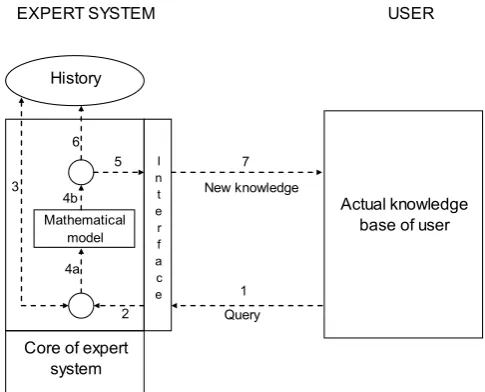
The communication scheme between the expert system and the user has a standard form (Beránková, Dömeová 2007). Some kind of interface that trans-lates user’s query from natural language to the digital one is necessarily required. if there is some kind of a knowledge base (e. g. mathematical model) in the expert system, the communication process can be represented by Figure 1.
The communication process can be divided into the following phases:
(1) The user asks a query to the expert system. (2) The expert system codes the query with help of
a chosen syntax and according to given rules. it means that the system is formulating a problem, which it can solve.
(3) The expert system scans the history of communi-cation with all previous users. it searches a
solu-Query
USER EXPERT SYSTEM
7
1 2
3
5 6
4a
Core of expert system
Actual knowledge base of user
I n t e r f a c e
History
Mathematical model
[image:2.595.76.319.567.763.2]4b New knowledge
tion of analogical queries and balances schemes of previous users’ behaviour with actual one to offer an answer in a suitable form. The informa-tion found is then entered into the communica-tion process.
(4) The expert system solves the given problem with the help of a mathematical model (4a – inputs, 4b – outputs of the model).
(5) The expert system formulates the answer for the user; the information is decoded into a common language.
(6) The expert system saves the information about the user’s query/problem and its solution into the communication history.
(7) Answer of the query to the user.
Mathematical model in the expert system holds knowledge, but it can also, according to concept Ba, create a new knowledge with the use of different data. The initial knowledge can be put into the knowledge model or the communication history by anybody (user, expert, group of experts, etc.).
Typology of personality
The communicated messages consist of cognitive, emotive and content factors. They are transmitted (communicated) by any process that allows using characters or other symbols that are used as a medium for a structure with information quality (Brožová, Šubrt 2006).
The communication could be direct or indirect (Brožová, Klimešová 2006). The direct communi-cation is realized by a direct social contact (inter-personal interaction), the indirect communication is a mediated by information and communication technologies. (havlíček, Vaněk 2005). A special kind of communication is the communication between a person and some technical system (computer) or even communication between two artificial systems (Vostrovský 2006).
McQuail (2002) mentioned some specific kinds of the communications as for example art performances. Paintwork is a very difficult kind of communication because an artistic artefact is communicated. its interpretation is a result of both inter- and intra-individual way of perceiving and reading of hidden reasons.
When the communication process flows directly (there is an interpersonal contact), it is realized by the verbal and/or non-verbal form. The non-verbal form is characterized by using specific methods for expression the message as gestures, mimics,
paralin-guistic signals etc. non-linparalin-guistic symbols are used for indirect social contacts. For example, some standard symbols are used as some alert marks, traffic marks, etc. Widely, the communication is realized on the social level and as a whole makes a part of workflow processes (rybka, Malý 2002).
A mental factor of the communication seems to be a marginal part of the communication process, although it is an unavoidable part of the final com-munication project methodology. The domain expert has to prepare several different ways of communica-tion; he has to anticipate the communication flow for different personality kinds of users. That is why some psychic characteristics of the users such as his personality, perceiving, motivation, ethic norms, etc., cannot be ignored, when some artificial system with communication functionality is being developed.
To fulfil the goal of the article from the user’s point of view, it is necessary to start with definitions of each type of personality. A suitable classification was made by carl gustav Jung (1968). he identified four types of personality according to people’s habits in organizing and decision making:
Extrovert
These people are mainly oriented to object and objectively given facts rather than the perceived real-ity. The decisions and behaviour are determined by objective factors. The extrovert is acting in an objective reality and in correspondence with it. his interest and attention are focused on objective things, especially on events from the closest surroundings.
The extrovert is motivated externally and his be-haviour is managed by external, objective factors and relations. he behaves towards the object positively.
Introvert
he is not oriented to object and objectively given facts, but to subjective factors. he is managed by understanding and recognition, which is subjective; he understands the sense of inputs. Example: Two introvert type personalities see the same object, but its recognition in the minds of both of them can be totally different.
Rationalist
This type is characterized by thoughts, feelings and actions, which are in correspondence with reasons. The attitude of rational person is leaned on the objec-tive values got from practical experience.
its layout with the same urgency as living organisms react to the average, constant and static conditions of their environment, with never-ending confrontation to functional complexes. E. g. eye reacts perfectly to light. Everything what is in concordance with such kind of laws is “rational”, everything what is not in concordance is “irrational”.
in the Jung’s model of typology there are as rational psychological functions determined thinking and feeling. The thinking and feeling are rational, because they are valued by experience.
Irrational
irrational is everything what is not based on reason-ing. Jung shows that to this category belong also basic facts about human existence – e.g., that the Moon cir-culates around the Earth, that the chlorine is chemical element, that water would freeze in certain temperature and that water has the biggest concentration in certain temperature. By Jung such things are irrational, because despite the fact they are logical, they are too far away from our ability to understand them.
in the Jung’s model of typology, the perception and the intuition are determined as rational psychological functions. Both perception and intuition are func-tions, which are fulfilled by the absolute perception of flow of actions. in its characteristics, that they miss any rational steering, they react to absolutely all inputs and these inputs are mostly completely accidental actions. That is why they are irrational
functions, opposite to thinking and feeling functions, which are used only in complete concordance with reasoning rules.
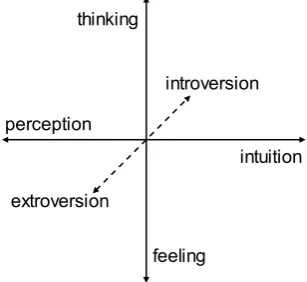
The typology of personality basic scheme is given in Figure 2.
The four basic psychological functions thinking, perception, feeling and intuition are not developed on the same level at everybody. one of them controls the psyche, other two are in background and the fourth is usually suppressed and starts to drive the personality in the “noon” of life (Table 1).
RESULTS AND DISCUSSION
The Jung’s typology model is based on the seg-mentation of psychological functions in the typol-ogy of personality and contains eight partial types of personality. Each type of personality is described also by the typical professions for the concrete type of personality. Principles which should be used in communication between the expert system and the user with such personality are also suggested.
Extroverted thinking type
This personality prefers empirical understanding, utility; people of this type manage their manners on the base of intellectual reasoning influenced by external criteria. These persons can solve problems, reorganize enterprises, clarify questions and separate essential and non-essential things. They nearly always deal with external conditions, but not with theories or ideas. They prefer pure practical rules and prin-ciples, which they try to use in all situations which may occur. They organize themselves and others under fixed rules and principles. They are interested in reality, orders and concrete facts.
Examples of professions: lawyers, state officers, business advisor, researchers, technicians
Suggestions for communication with expert sys-tem:
– well structured information,
– give one-way understandable questions, clear and comprehensible answers,
– go to the core of a problem,
– form of the communication should be easy, goal-oriented and without changes (still the same).
Extroverted feeling type
This type keeps society conventions, takes ready schemes of evaluation. it is very well adapted to its time period and environment; it is interested in personal and society success. it is changeable but trustful in critical situations.
thinking
feeling
intuition perception
extroversion
[image:4.595.100.254.480.621.2]introversion
Figure 2. Typology of personality
Table 1. Psychological functions in typology of personality Extroversion introversion
rationality thinking thinking
feeling feeling irrationality perception perception
[image:4.595.64.289.680.766.2]Example of profession: actors
Suggestions for communication with expert sys-tem:
– it is important to sustain his attention,
– communication should not be too schematic, for enlivening something unexpected can be used, – motivation elements should be used when the user
works with system,
– form of the communication should support informa-tion receiving process by more senses, multimedia can be used.
Extroverted perception type
This type looks like the extreme realist, interested only in science, focused mostly at external events, practical and pragmatic and takes the world as it is. Such people are above all interested in the objective reality; their objective sense for reality is extremely developed. Mostly they are realistic and practical; they are focused on details and have no time for abstract thoughts, consideration about values and sense. Their lasting goal is to have a sense percep-tions and a pleasure from them.
Examples of professions: engineers, entrepreneurs, builders, racers, jockeys.
Suggestions for communication with expert sys-tem:
– give to user a lot of facts, user cannot be over-feed,
– give him enough capacity to save given information or own data by user,
– form of the communication is not important, user is oriented mostly to information and knowledge.
Extroverted intuitive type
he is a planner of his own goals. Such people are used to use intuition for communication with outside world. intuition is not only the perception or view, but an active creative process, which is not only taking something from the object, but also inputs something. Extroverted intuitive types clearly see the possibilities in every given situation and they can predict the future. in case the thinking is not their supporting psychical function, they cannot hold on running projects to finish them. They have perfect innovative abilities, routine bores them. They never conform in stabile, long-running and well-known situations, which have a generally accepted but limited value.
Examples of professions: journalists, brokers, in-vestors, salesmen, politicians
Suggestions for communication with expert sys-tem:
– offer him many possibilities, wide choice of eve-rything, new and new possibilities,
– support of wide progress of user’s abilities, – user is not interested in information or knowledge
itself, he can use it only with instructions how to use it.
Introverted thinking type
The user is oriented to thoughts, ideas or abstract things more than to facts. he formulates questions and tries to understand his own being, he is inter-ested in his own thoughts. This type of personality aims to extend his knowledge, but not enlargement. his style of behaviour and phrasing is more difficult for him because of his own reservations, vigilances, misdoubts, which all are going from his broodiness and confusion. Manners of this person are based on intellectual thinking, but it is influenced by the internal criteria. These people are not very interested about the outside world and mostly they are interested in theories and thoughts.
Examples of professions: philosophers, mathemati-cians, theoreticians of science
Suggestions for communication with expert sys-tem:
– non-aggressive style of communication, let him ask questions,
– do not limit the user by time, let him work at his own speed,
– well-prepared, balanced information based on clear opposites,
– user wants to understand the given topic deeply, – form of the communication can be very strict, user
is expert in his area, he knows perfectly symbols of his profession, formulas, relations, theorems, proofs etc.
Introverted feeling type
Such personality is oriented mostly to ideas, sub-jective feelings, perceiving obsub-jective reality, but it is not in the centre of the interest. he is non-receptive, but seems to be well-balances and self-sufficient. People of such type of personality have a highly differentiated system of values, but they keep the system for themselves. They can, by living, using their standards, secretly influence their neighbour-hood. They can give an ethic base to the group of other people, not by speeches and lectures, but only by their own existence. Mostly they are quiet, non-receptive, hardly understandable, harmonic, and unobtrusive, they affect a nice inside serenity, and they do not want to change the others, influ-ence them, they do not try too much to react to someone’s real feelings.
Suggestions for communication with expert sys-tem:
– ethically correct communication, e. g. do not user familiar greetings,
– give him information in standardized form.
Introverted perception type
The typical features are sensitivity, perceptiveness and empathy. The person prefers sense feelings and is interested in his own internal perception. it is an irrational type, because in actual situation he is not learning with reasoning, but only with current per-ception. it is extremely difficult to make this type to understand the objective reality; mostly he is not able to understand himself. The introverted type is lead by the intensity of subjective perceptions evoked by objective inputs. Every detail is noticed and can be knowingly evoked from memory. These people have a vivid memory of places, colours, parts in books, noises, interviews, aroma, taste, haptic percept, etc.
Example of profession: painters
Suggestions for communication with expert sys-tem:
– form of the given information or knowledge should be on the same level as its quality, it should be esthetically impressive,
– multimedia are welcomed.
Introverted intuitive type
The person is a mystic, who is organized by the inside sight. he is a daily dreamer, often with clairvoyance. he takes himself as an un-comprehended genius, who is fighting with the esoteric experience. A deep intuition often makes him out off the real world. he does not sometimes even reflect the obvious reality event, so he is mysterious for his environment.
These people do not deal with external opportu-nities, but work with ideas, pictures and their own imaginations as with reality. They cannot express their ideas simply and clearly, they go both by pictures and ideas but randomly rather than logically.
Examples of professions: visionaries, illusionists, poets, psychologists (but not experimental or aca-demics), artists.
Suggestions for communication with expert sys-tem:
– user prefers the way of giving pre-prepared ques-tions as well as choosing from the closed range of answers,
– graphs and pictures should follow the message, – the system gets information from the users step by
step; the user requires the exact navigation.
AppLICATION IN AgRObUSINESS
it seems to be very useful to use the above mentioned approach in agriculture. it could be applied e. g. on regional level, where is a regional agrarian chamber managing administrator (or owner) of knowledge system and a farmer (from this region) or a salesman in agribusiness as a final user. According to the real character of agriculture, it could not be expected, that the farmer would go with every larger problem to his regional agrarian chamber or that it could be possible to solve such problem via phone.
[image:6.595.70.531.577.762.2]The goal of the user is not to learn how to use a new environment, what is mostly an expert system, but to get the information and knowledge needed for his work. operations with the expert system should be easy, understandable, with one-meaning results. Personal characteristics of each user can be stored
Table 2. illustrative example i. – machinery selection problem
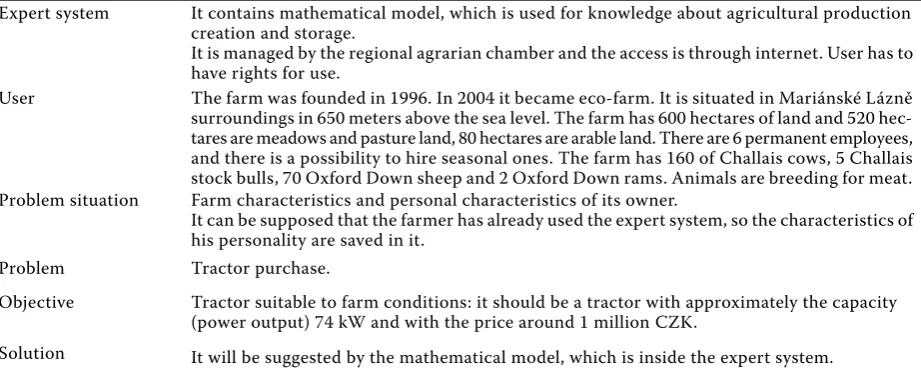
Expert system it contains mathematical model, which is used for knowledge about agricultural production creation and storage.
it is managed by the regional agrarian chamber and the access is through internet. User has to have rights for use.
User The farm was founded in 1996. in 2004 it became eco-farm. it is situated in Mariánské Lázně surroundings in 650 meters above the sea level. The farm has 600 hectares of land and 520 hec- tares are meadows and pasture land, 80 hectares are arable land. There are 6 permanent employees, and there is a possibility to hire seasonal ones. The farm has 160 of challais cows, 5 challais stock bulls, 70 oxford Down sheep and 2 oxford Down rams. Animals are breeding for meat. Problem situation Farm characteristics and personal characteristics of its owner.
it can be supposed that the farmer has already used the expert system, so the characteristics of his personality are saved in it.
Problem Tractor purchase.
objective Tractor suitable to farm conditions: it should be a tractor with approximately the capacity (power output) 74 kW and with the price around 1 million czK.
in the expert system and the communication with him can be tailor-made.
To demonstrate above mentioned approach was chosen the example in Table 2.
Communication scenario I. – introverted thinking type
The communication between the user – introverted thinking type – farmer and expert system can be realized by following way:
1. User enters the expert system (after validation of entering data is user uniquely identified).
2. There is pre-prepared menu in the expert system, where the user can choose what he needs, there can be offered e. g. the following possibilities: (a) Problem solving – this possibility will be chosen
by the above mentioned user.
(b) go back to solved problem by this user – the user needs to verify that the solution from expert system he is implementing is correct.
(c) Save experiences with the solved problem im-plementation – problem was solved successfully and user gives feed-back to the system. Already this phase of communication is influenced by the user’s type of personality. The user is not appealed to communicate, to answer, it is not suit-able with this type, there is more suitsuit-able to offer possibilities and let the user more time for decision making. generally, communication with such type of personality should not be aggressive, he should not be pressured (mainly by time) to make decision. 3. The expert system offers the database of other
user’s problems, which were solved with its help. Again, it has to be offered by the expert system, but not calling for the user’s activity, quick answer etc. E.g. it can happen, that the user does not choose anything from the offer and it would be necessary to solve the problem step by step.
4. The expert system offers different types of models, which can be used to solve the problem. clear and detailed description of models with examples should
be given to the user. According to the analogy of example and problem, the user should choose the multiple-criteria model (Table 2).
5. Model setting – in this phase the user will insert data from his problem situation into the expert system with the help of similar questions, which were used for choosing of the model. criteria and variants have to be named by the user:
(a) Variants - Deutz-Fahr Agrotron K100, claas Ares 567, claas nectis 207, Belarus 1025.3, Deutz-Fahr Agrotron K110, new holland LT 100A
(b) Decision criteria – price in czK (min), capac-ity (power output) in kW (max), number of transmission grades (max), curb weight in kg (min), rPM per min (max), up-stroke capacity in cm3 (max).
6. Step-by-step model solution.
(a) Aspiration levels – price 1 000 000 czK, 24 × 24 transmission grades, rPM 2 200/min, curi weight 4 250 kg, power output 74 kW and up-stroke capacity 4 500 cm3
(b) Methods for decision criteria evaluation – Saaty’s method
(c) Methods for choice of the best variant – the weighted sum approach, the AhP method After this, the user should get one well-arranged output – the list of variants and their evaluation by different methods in the table. it should be on him if he wants some other type of output, e. g. polygonal graph.
7. Allow the user to experiment with the values in the model.
8. Storage of the problem solution and all experi-ments to the expert system base and the end of the ES activity.
Communication scenario II. – extroverted feeling type
[image:7.595.63.529.641.769.2]This type of personality was chosen because it is opposite to previous one and differences could be
Table 3. illustrative example ii. – computer selection problem
Example Questions for the user (to choose right model)
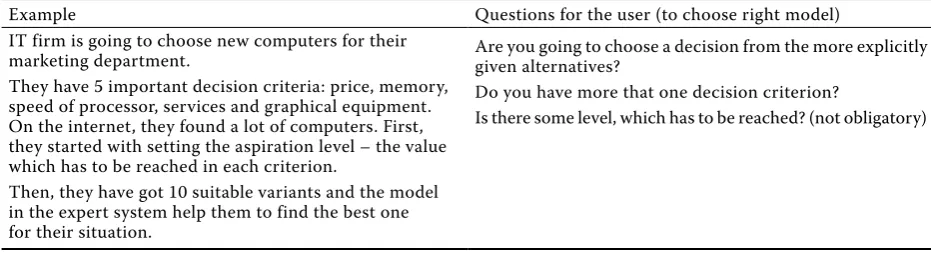
iT firm is going to choose new computers for their marketing department.
They have 5 important decision criteria: price, memory, speed of processor, services and graphical equipment. on the internet, they found a lot of computers. First, they started with setting the aspiration level – the value which has to be reached in each criterion.
Then, they have got 10 suitable variants and the model in the expert system help them to find the best one for their situation.
Are you going to choose a decision from the more explicitly given alternatives?
Do you have more that one decision criterion?
more visible. The communication scenario can be realized by the following way:
1. The user enters the expert system (after the valida-tion of entering data user is uniquely identified); this phase is the same as in the previous case. 2. The expert system welcomes the user and starts
to offer him possibilities what to do:
(a) Problem solving – this possibility will be chosen by the user in this case.
(b) go back to the solved problem from this user – the user inserts the feedback to the expert system.
(c) Save experiences with the solved problem imple-mentation – the problem was solved successfully and the user gives feed-back to the system. This phase is also running the following the general procedure (Figure 1). This is the first opportunity for the increase of the user’s motivation. For smooth continuation, the expert system has to explain the user, what the objective of his effort is and espe-cially what his benefit is after finishing the work with it. Finally, at least simple animation should be performed in both cases, during the user’s decision making about his next step.
3. The expert system offers the database of other user’s problems which were solved with its help. it has to be offer by the expert system and the expert system should call for the user’s activity, quick answer etc. Multimedia presentations are suitable for this phase. E.g. it can happen, that the user does not choose anything from the offer and it would be necessary to solve the problem step by step – by one of the mathematical models. 4. The expert system offers different types of models,
which can be used to solve the problem. The clear and detailed description of models with examples should be given to the user. According to the analogy of example and problem, the user should choose the multiple-criteria model. The expert system has to keep the user’s attention in this phase.
5. Model setting – in this phase the user will insert data from his problem situation into the expert system with the help of similar questions which were used for choosing of the model in previ-ous scenario. criteria and alternatives have to be named by the user.
6. Step-by-step model solution. After this, the user should get more kinds of outputs, e. g. table, text description, pictures, and graphs. Especially, if the Saaty’s method is used, the graphical form for preference evaluation should be very rich; not pure Saaty’s matrixes for pairwise comparison, but graphical models of weight-ing machines, evaluation buttons, connection rods and other visual tools are suitable to use.
7. Allow the user to experiment with values in the model. The expert system should ask him for it. 8. Storage of the problem solution and all
experi-ments to the expert system base and the end of the ES activity.
CONCLUSION
The personal characteristics of an expert system user may radically influence the quality of work with the system as well as the required knowledge ac-ceptance by the user. The Jung’s typology seemed to be suitable for the analysis of the relationships between the personality of user and rules of the com-munication with the expert system. it is possible to formulate and assign exact recommendations to the individual sub-types of user’s personality. Violation of these recommendations and/or omission of their ethical and esthetical norms are one of basic com-munication barriers.
other important psychical aspect of communication is motivation. Motivation is an intrapersonal proc-ess of creation personal goals. Motivation integrates psychical and physical activities of people leading towards reaching their goals. non-adequate motiva-tion is useless the same as an excessive motivamotiva-tion. The base of motivation process is a need which has not been satisfied. not satisfied need causes a tension (physical or psychical), which leads to the steps which satisfy the need and lower the tension. This activity is usually goal-oriented. The motivation process is completed when the goal is reached and the need is satisfied. Motivation can be understood as a specific process of related reactions. The motivation process can be described as: need → wish (or goal-oriented behaviour) → satisfied need.
Motivation is influenced by internal criteria – they are given by an individual person: way of self-evalua-tion, experiences, personal goals; and external criteria – they are given by an environment – society, rules, moral codex, law norms. it is necessary to differenti-ate the stimulation from the motivation. Motivation is the internal spur to go to the given goals; stimula-tion is the set of external impulsions that manage the behaviour of workers. A stimulus is an external stimulant, which should support or moderate some motive. A stimulus is an effective/efficient only when it is in concordance with the motivation profile of a man and the actual situation.
using by the same user or for a new user. The feedback can be spontaneous, not-requested – users present their opinions, attitudes to the ES and communication with it. This feedback is important for the expert, who is preparing communication scenarios. other type of feedback can be requested – is it a unique experience of the user with finding solution to his/ her problem and this experience should be saved in the ES. This feedback is important for other users. Both kinds of feedback have to be regarded in the communication project.
communication between the user and the ES can be limited or even completely destroyed by different kinds of barriers.
The first group of them is physical – access to the expert system, acceptation of the system. Various disturbing elements as noise in an office shared by several people, phone ring, visitors, etc., can be very harmful. Any kind of personal inconvenience (feeling cold, hungry, tired from sitting in one position) can represent a cause of not sufficient concentration. The lack of concentration as well as not understanding of some special expressions can lead to a lower ac-ceptance of the system.
The second type of barrier is psychical – distress, problems at workplace, problems in family. if the employee feels afraid of being unsuccessful, he/she is very careful in any new activities. Low motiva-tion together with preference of personal needs can cause important imperfections in the communication. other problems lie in cultural differences, habits and stereotypes.
The third group of communication barriers consists of virtual ones – interruptions during work with the ES, technical problems. Main representatives of this group are technical imperfections of the expert system itself. other virtual barriers are interruptions during the work with computer like incoming messages, and all other types of unrequested communication.
REFERENCES
Beránková M., Dömeová L. (2007): Knowledge points in communication interface. international Journal of Knowledge and System Science, 3 (3): 29–34; iSSn 1349-7030.
Brožová h., Klimešová D. (2006): A Space for com-munication of Knowledge. in: Proceedings of the 4th
conference EriE, Prague; iSBn 80-213-1509-1. Brožová h., Šubrt T. (2006): Knowledge creation in
or/MS modelling process. Scientia Agriculturae Bohemica, 37 (Special issue): 16–23; iSSn 1211-3174.
havlíček z., Vaněk J. (2005): icT and cooperative work. Agricultural Economics – czech, 51 (10): 469–474.
Jung c.g. (1968): Analytical Psychology: its Theory and Practice (Tavistock Lectures). routledge and Kegan, London.
Mentzas g., Apostolou D., Abecker A. (2001): Man-aging Knowledge as a Strategic resource for Electronic government. in: Workshop Electronic government and Knowledge Management, Siena. McQuail D. (2002): Mass communication Theory
an introduction (in czech). Portal, Prague; iSBn: 978-80-7367-338-3.
Probst g. (2002): Managing Knowledge, Building Blocks for Success. Wiley, West Sussex, England; iSBn 0-471-99768-4.
rybka M., Malý o. (2002): how to communicate by icT (in czech). grada, Prague; iSBn 80-247-0208-8.
Veltman K. h. (2005): Access, claims and quality on the internet – Future challenges. Progress in informatics, 4 (2): 17–40; iSSn 1349-8606. Vostrovský V. (2006): Expert systems utilization in
knowledge management. Agricultural Economics – czech, 52 (10): 451–455.
Arrived on 14th March 2008
Contact address:
Martina houšková Beránková, Ludmila Dömeová, Milan houška, czech University of Life Sciences Prague, Faculty of Economics and Management, Department of operational and Systems Analysis, Kamýcká 129,
165 21 Prague 6-Suchdol, czech republic