International Journal of Emerging Technology and Advanced Engineering
Website: www.ijetae.com (ISSN 2250-2459,ISO 9001:2008 Certified Journal, Volume 5, Issue 8, August 2015)
429
Efficient and Secure Retrieval of Query in Personalize Web
Search
J. K. Shimpi
1,
Prof. S. R. Durugkar
21ME Student, 2Head, Dept. of Computer Engg., JES’S SND College of Engineering & Research Center, Yeola, Nasik, India.
Abstract— Personalized web searching is a capable to improve searching excellence by modifying searching results for people with data. Users are always uncomfortable with revealing private data to search engines. Privacy is not compromised if there is an improvement in service to the user. Personalized web search is an effective way of search technique that aiming to provide customizing search results and also it improves the search quality. Personalized web search (PWS) is ability that identifies different users needs who issue the same query for web searching for carry out data retrieval as a part of his/her interests. User profiles summarize a user’s specific interests into a hierarchical
organisation according to particular interests. Two
parameters used here minDetail and expRatio for specifying the privacy requirements to help the user to choose the content and degree of detail of profile information exposed to search engine. The UPS called PWS system framework that can adaptively generalize profiles by queries while respecting user specified privacy requirements. This UPS framework analysis the given query understands the exact intension of the user and displays only the relevant data to the user. Analysed certain parameters such as Recall, Precision, Frequency Measure, Distortion and Computational Delay using the PWS System.
Keywords— Privacy protection, Personalized web search, User Profile, Immediate and Accurate Result, User search behaviour, User query logs.
I. INTRODUCTION
As the amount of information on the Web increases rapidly, it creates many new challenges for Web search. When the same query is submitted by different users, a typical search engine returns the same result, regardless of who submitted the query. This may not be suitable for users with different information needs. For example, for the query “apple” some users may be interested in documents dealing with “apple” as “fruit”, while some other users may want documents related to Apple computers. One way to disambiguate the words in a query is to associate a small set of categories with the query. For example, if the category “cooking” or the category “fruit” is associated with the query “apple”, then the user's intention becomes clear.
For a given query, a personalized web search can provide different search results, organize search results differently for each user and different users or, based upon their interests, favorites, and data needs. Personalized web search changes from general web search, which returns equal research results to all users for identical queries, regardless of varied user interests and data needs. Despite the attractiveness of personalized search, we have not yet seen large scale uses of personalized search services; such services are not available, but likely because users are not comfortable with the lack of protection of user privacy.
The mean of personalization is search engine can help users to filter the useful information for them by using user's interest. Search engine will pick the users' interest at the top of results, so it is very convenient for users to pick useful information.
II. RELATED WORK
Lidan Shou, He Bai, Ke Chen, and Gang Chen Supporting privacy protection in personalized web search[1].To know that profile based methods can be potentially effective for almost all sorts of queries. PWS has demonstrated more effectiveness in improving the quality of web search.
Z. Dou, R. Song, and J.-R.Wen, A Large-Scale
Evaluation and Analysis of Personalized Search
Strategies[2].The Personalized search has been anticipated for a lot of years and lots of personalization strategy has been examine, it is still in distinct whether personalization is constantly efficient on dissimilar uncertainty for
dissimilar users, and under dissimilar investigate
background. In this paper, we learn this difficulty and get a few beginning end. By examine the consequences, we expose that personalized search has important development over general web search on a number of query but it also has tiny out come on additional question. It still troubles search accurateness under a few situation.
International Journal of Emerging Technology and Advanced Engineering
Website: www.ijetae.com (ISSN 2250-2459,ISO 9001:2008 Certified Journal, Volume 5, Issue 8, August 2015)
430
However, users are uncomfortable with exposing private preference information to search engines. On the other hand, privacy is not absolute, and often can be compromised if there is a gain in service or profitability to the user. Thus, a balance must be struck between search quality and privacy protection.From this approach[4]they requires users to contribution the server full access to personal information on Internet, which break users’ privacy. In this paper, author inspects the possibility of accomplish a balance between users’ privacy and search quality. First, an algorithm is provided to the user for collecting, abbreviation, and organizing their personal information into a hierarchical user profile, where general terms are ranked to higher levels than explicit terms.
Through this profile, users control what section of their private information is uncovered to the server by adjusting the minDetail threshold. An additional privacy measure, expRatio, is proposed to approximation the amount of privacy is exposed with the specified minDetail value. Yet, this paper is an exploratory work on the two features: First, author deal with unstructured data such as personal documents, for which it is still an open problem on how to define privacy. Secondly, author try to bridge the conflict needs of personalization and privacy protection by breaking the premise on privacy as an absolute standard.
M.Speretta,S.Gauch, Personalizing Search Based on User Search Histories[5].User profiles, descriptions of user interests, can be used by search engines to provide personalized search results.Build user profiles based on activity at the search site itself and study the use of these profiles to provide personalized search results.
Google Personalize Search;
http://www.google.com/psearch [6], they analysis the user search history on the Google.
K.Sugiyama,K.Hatano, Adaptive Web Search Based on User Profile Constructed without Any Effort from Users[7], Web search help to user query find the useful information on the web. However, when the same query is submitted by different users, typical web search return the same result of who submitted the query. Each user has different data needs for his/her query.
F. Qiu,J. Cho, Automatic Identification of User Interest for Personalized Search[9],One hundred users, one hundred plus needs. As more and more topics are being discussed on the www and our vocabulary remains relatively stable, it is increasingly difficult to let the search engine know what want.
Personalized search has recently got significant attention to address this challenge in the web search community, based on the premise that a user’s general preference may help the search engine disambiguate the true meaning of a query.
F.Liu ,C.Yu, Personalized Web Search For Improving Retrieval Effectiveness[15].Web Search Retrieve the information for each user incorporating his/her interests. The user enter the query to improve retrieval effectiveness in personalize web search. A user profile and a general profile are learned from the user’s search history and a category hierarchy. The two profiles are combined to map a user query into a set of categories, which represent the user’s search intention and serve as words in the user’s query.
III. PROBLEM STATEMENT
Most of the existing works concentrate on server-side personalized search services in preserving privacy, it provide a less security to the user. To provide a security to the user from the profile-based PWS from the client side, many researchers have to deem two challenging effects during the search process of the user, (i) To increase the search quality by user profile and (ii) hide the privacy content to place the privacy risk under control.
In many studies tells that user suggestions and their click based method is the helpful way to provide a personalized search and at the same time they have trouble with the loss of their privacy under their providing contents. Profile based method is an ideal case for providing the relevant search. Under this they were many drawbacks, it does not support on the runtime profiling, it can be based on the online and offline generalization, insufficiently protection of the data and require more iteration for obtaining relevant search.
IV. IMPLMENTATION DETAILS
International Journal of Emerging Technology and Advanced Engineering
Website: www.ijetae.com (ISSN 2250-2459,ISO 9001:2008 Certified Journal, Volume 5, Issue 8, August 2015)
431
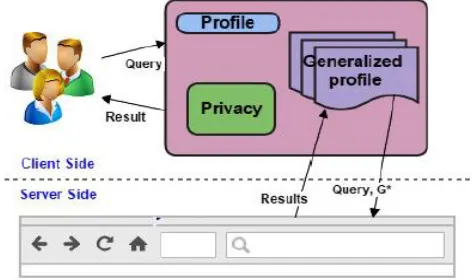
A. System Overview [image:3.612.65.301.201.341.2]It is a simple system architecture that can be used to represent a system in terms of the input data to the system, how to perform the various processing carry out the data, and the output data is generated by the system.
Figure 1. Privacy-Preserving Personalized Web Search Framework
Profile based personalization
A personalize the query such as images, text and any multimedia content based on user profile information. For the two mechanism were develop a profile generator that creates the user profile representing the user preferences, the content based recommendation algorithm that estimates the users interest in unknown content by matching the user profile to dataset description of the content. Both are the incorporated into personalize web search system.
Privacy protection in PWS system
Personalize web search framework called as UPS that can be generalize profiles in for each query according to user specified privacy requirements. Query utility for the hierarchical user profile and the privacy risk they are proposed the two predictive metric.
To develop two effective generalizations algorithm for user profile allow to query level customization using our metrics. To decide whether query personalize in UPS, they provide an online prediction mechanism based on query. The demonstrate the efficiency and effectiveness of our framework.
Generating user profile
The generalization process has to meet handle the requisite user profile. They also were preprocessing the user profile. Then after that loads the data for frontend and backend of the map according to describe the selected user profile. Additionally, the references enable caching them needful and help to implement in the production environment.
The user profile reference can used an identifier for already process the user profile. They allow customization process one and using the result multiple times. However update of the user profile is also propagated to generalization process. The user profile has not change, this require a specific event and specific strategies which check after specific time out.
Online decision
The profile-based personalization they contributes the small and reduce the quality of search, the profile expose to a server system would for user privacy risk.
To decide whether the query is personalize or not to develop the online mechanism. The basic idea is query is identified by the generalization process, the query sent to server without user profile because the run time profiling is aborted.
B. Algorithms for System
Algorithm: Split (n,S(t),minsup, δ )
Input: a node n labeled term t, supporting document S(t),thresholds minsup and δ
1.generate the frequent term list{ ti } with D(ti) ≥ minsup sorted by the descending order of frequency.
2.for each term ti
3.if Sim (ti, tk)> δ ,where k < i,
4.set the node label as ti / tk, and S(ti / tk )=S(tk)ᴜ D(ti) 5.else if P(a tk/ ti, ) > δ ,where K< i,
6.keep the node label as tk and S(tk) ᴜ D(ti) 7.else
8.create a new node with label ti, and (ti)=D(ti)
9.calculate Sup(ti) for each node with label ti, and sorted them in a descending order.
Algorithm: BuildUP(n,D,minsup, δ)
Input: a node n, supporting documents D, thresholds minsup and δ
Output: a user profile U
1. Spilt (n,D,minsup, δ)
2. for each child ci , labeled ti, of node n: 3. Build Up(ci, S(ti),minsup, δ)
The advantages Enhanced Privacy Protection
Framework is as follows:
It enhances the stability of the search quality
Improves the privacy protection against different type of attacks
It has less computational time and communicational time.
International Journal of Emerging Technology and Advanced Engineering
Website: www.ijetae.com (ISSN 2250-2459,ISO 9001:2008 Certified Journal, Volume 5, Issue 8, August 2015)
432
V. RESULT AND DISCUSSION
A. Dataset
Here we perform the experiments on a user defined contains dataset; It contains more than 1000 set of data with unique tag.
According to that the following Five different datasets were used, it is worth noting that the Finance, Sports, Health, Society, and Local News.
The Category of Data Set Finance
Sports Health Society Local News
B. Performance Evaluation
The following performance parameters are commonly used in privacy protection technique evaluation. The existing approach is compared with proposed approach using these evaluation parameters. The system is evaluated in terms of Precision, Recall, F-measure, Computational Delay and Distortion.
Precision
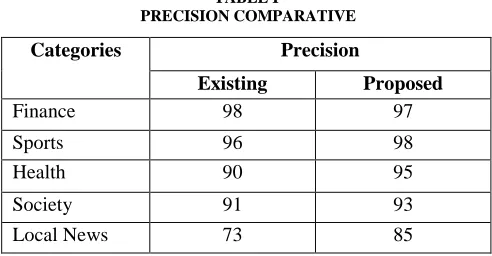
It is a measure of correctly predicted documents by the system among all the predicted documents. It is defined as the number of relevant documents retrieved by a search divided by the total number of documents retrieved by that search.
[image:4.612.325.570.125.299.2]Precision= number of correct results/number of all return results
TABLE I
PRECISION COMPARATIVE
Categories Precision
Existing Proposed
Finance 98 97
Sports 96 98
Health 90 95
Society 91 93
[image:4.612.45.291.515.643.2]Local News 73 85
Figure 2.Evaluation of Precision
The proposed approach accuracy level is high when compared with the existing one.
Recall
Recall is a measure of correctly predicted documents by the system among the positive documents.
Recall is defined as the number of relevant documents retrieved by a search divided by the total number of existing relevant documents.
Recall= number of correct results/total number of actual results
TABLE II RECALL COMPARATIVE
Categories Recall
Existing Proposed
Finance 50 48
Sports 70 69
Health 81 79
Society 83 82
International Journal of Emerging Technology and Advanced Engineering
Website: www.ijetae.com (ISSN 2250-2459,ISO 9001:2008 Certified Journal, Volume 5, Issue 8, August 2015)
[image:5.612.54.284.118.293.2]433
Figure 3.Evaluation of RecallThe proposed approach takes less time when compared with existing design.
Frequency-Measure
F-measure combines precision and recall and is the harmonic mean of precision and recall.
[image:5.612.321.563.250.579.2]F-measure=2*(precision*recall/precision+recall)
TABLE III
F-MEASURE COMPARATIVE
Categories F-Measure
Existing Proposed
Finance 66.21 64.65
Sports 80.96 81.32
Health 85.26 87.07
Society 86.81 88.44
Local News 80.20 81.89
Figure 4. Evaluation of F-Measure
Frequency measures are very helpful in evaluating the performance of both frequent and rare categories.
Computational Delay
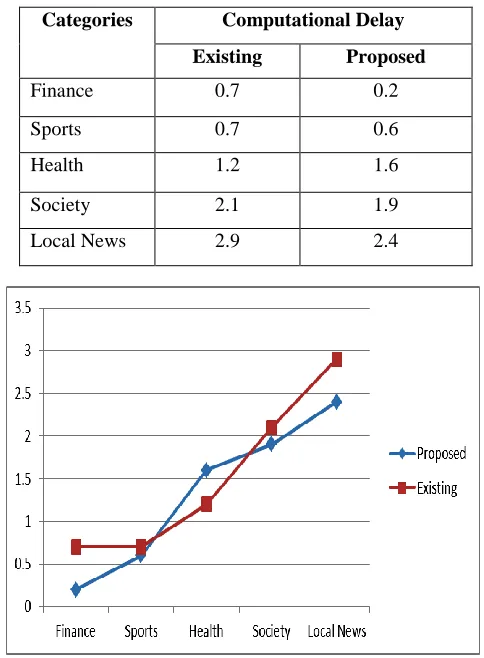
It represents the accessing time or speed of user profiles in the database.
The approach takes less computational time for accessing the queries when compared with existing design.
TABLE IV
COMPUTATIONAL DELAY COMPARATIVE
Categories Computational Delay
Existing Proposed
Finance 0.7 0.2
Sports 0.7 0.6
Health 1.2 1.6
Society 2.1 1.9
Local News 2.9 2.4
Figure 5. Evaluation of Computational Delay
VI. CONCLUSION AND FUTURE SCOPE
To improve the quality of search services on the Internet with the help of personalized web search (PWS) is used. Privacy preserved PWS methods are used to protect the disclosure of personal information in search process.
[image:5.612.47.290.393.676.2]International Journal of Emerging Technology and Advanced Engineering
Website: www.ijetae.com (ISSN 2250-2459,ISO 9001:2008 Certified Journal, Volume 5, Issue 8, August 2015)
434
For this system to prevent the user data and provide the relevant search result to the user, in future As our application the construction of topic space provides a possible solution to handle the complex multiple word-based queries.To provide privacy in location-based services, worked on multiple keyword based queries; it will be future work to track the user location using GPS system and according to that location return the data to user. Try to find more appropriate solution to predict the performance and find better method to construct user profile.
Acknowledgment
I express true sense of gratitude towards my Dissertation Stage-II guide Prof. S. R. Durugkar, for their co-operation and guidance that he gave me overall my dissertation work.
REFERENCES
[1] Lidan Shou, He Bai, Ke Chen, and Gang Chen, “Supporting Privacy Protection in Personalized Web Search,” vol . 26, no. 2, Feb 2014. [2] Z. Dou, R. Song, and J.-R.Wen, “A Large-ScaleEvaluation and
Analysis of Personalized Search Strategies,” Proc. Int’l Conf. World Wide Web (WWW), pp. 581-590,2007.
[3] Xu, Yabo, et al. “Privacy-enhancing personalized web search” Proceedings of the 16th international conference on World Wide Web. ACM, 2007.
[4] K. Ramanathan, J. Giraudi, and A. Gupta, “Creating Hierarchical User Profiles Using Wikipedia,” HP Labs, 2008.
[5] M. Spertta and S. Gach, “Personalizing Search Based on User Search Histories”, Proc. IEEE/WIC/ACM Intl Conf. Web Intelligence (WI), 2005.
[6] Google personalized search: http://www.google.com/psearch. [7] K. Sugiyama, K. Hatano, and M. Yoshikawa, “Adaptive Web Search
Based on User Profile Constructed without any Effort from Users, ”Proc. 13th Intl Conf. World Wide Web (WWW), 2004.
[8] M.M.Ghonge,Dr. M. V. Sarode,“User customizable Privacy preserving Search Framework-UPS for Personalized Web Search, ”International Journal of Research in Advent Technology, Vol.2, No.4,E-ISSN: 2420-14141,2014.
[9] F. Qiu and J. Cho, “Automatic Identification of User Interest for Personalized Search, ”Proc. 15th Intl Conf. World Wide Web (WWW), pp. 727-736, 2006.
[10] J.Sang,C.Xu, “Learn to Personalized Image Search from the Photo Sharing Websites, ”IEEE Transaction on Multimedia, vol. X, pp.Issue:99, 2012.
[11] Y. Xu, K.Wang, G. Yang, and A.W.-C. Fu, “Online Anonymity for Personalized Web Services, ”Proc. 18th ACM Conf. Information and Knowledge Management (CIKM), pp. 1497-1500, 2009.
[12] J. Castelly-Roca, A. Viejo, and J. Herrera-Joancomart, “Preserving Users Privacy in Web Search Engines, ”Computer Comm., vol. 32, no. 13/14, pp. 1541-1551, 2009.
[13] Y. Zhu, L. Xiong, and C. Verdery, “Anonymizing User Profiles for Personalized Web Search ”,Proc. 19th Intl Conf. World Wide Web (WWW), pp. 1225-1226,2010.
[14] V.S.Kumar,P.Kumar , “A Ups Framework for Providing Privacy Protection in Personalized Web Search, ’IJIRSET, vol-4,Issue-7,2015
[15] F. Liu and Clement Yu, “Personalized Web Search for Improving Retrieval Effectiveness”, IEEE Transactions On Knowledge And Data Engineering, 2004.
[16] J. Teevan, M.R. Morris, and S. Bush, “Discovering and Using Groups to Improve Personalized Search, ”Proc. ACM Intl Conf. Web Search and Data Mining (WSDM), 2009.
[17] Sumitra,“Comparative Analyasis of AES and DES Security Algorithm ,”IJSRP,Vol 3,Issue 1,ISSN 2250-3153,pp1-5,2013. [18] Google Images Web site. [Online]. Available:
http://images.google.com
[19] Wikipedia Web site. [Online]. Available: http://www.wikipedia.org [20] A. Turpin and F. Scholer. “User performance versus precision