Full Length Research Paper
Correlation between total water absorption and wet
compressive strength of compressed stabilised peat
bricks
Sadek Deboucha* and Roslan Hashim
Department of Civil Engineering, University of Malaya, Lembah Pantai 50603, Kuala Lumpur, Malaysia.
Accepted 20 April, 2011
Housing is a great problem in today and future world, the most basic building material for infrastructure construction and houses is the usual bricks or blocks. Although there are approximately 2,500 000 hectares of peat soils in Malaysia, only a small portion of this as being utilised. In this study, peat soil was investigated in tandem with the production of lightweight bricks. Peat soil, sand, cement and hydrated lime mixtures were steam autoclaved under different test conditions to produce brick samples. The purpose for this study was undertaken on the production of compressed peat – siliceous sand, PFA, OPC cement and lime as solid bricks to solving the problems of housing and builds the construction economically and environmentally by utilising local materials. The compressive strength and water absorption of stabilised peat bricks obtained under 6 and 10 Mpa pressure are 5.48 and 7.10 Mpa; 4.75 and 2.6%, respectively. Tests were also conducted to study correlation between wet compressive strength and water absorption; it was found negative values, increase in strength decreased water absorption and hardening of the bricks with time.
Key words: Stabilised peat bricks, strength, water absorption, correlation.
INTRODUCTION
Earth as a building material is available everywhere and exists in many different compositions. It is most efficiently used in developing and developed countries to house the greatest number of people with the least demand. Masonry is one of the most popular materials in many countries for construction of houses due to its useful properties such as durability, relatively low cost, wider availability, good sound and heat insulation, acceptable fire resistance, adequate resistance to weathering and attractive appearance (Jayasinghe and Mallawarachchi, 2009). Historically, earth has been the most widely known and used building material in construction and probably has been the most important of all building materials. According to Middendorf (2001) recorded cases of the use of earth bricks dates back to Mesopotamia around 8000 BC. Of all urban housing units worldwide there are about 25% that does not conform to building regulations while 18% are considered non-permanent structures
*Corresponding author. E-mail: [email protected].
(Habitat, 2001). There are many benefits of earth buildings. For example, earth structures are completely recyclable, so sun-dried bricks return to the earth without polluting the soil (Rigassi, 1995). Many benefits that are offered by earth construction are often underutilised in the developed world where the use of earth as a low-embodied material is often the case (Middendorf, 2001). Hall and Allinson (2009) reported that stabilised compressed earth materials are made using graded soils with the addition on hydraulic binder (for example Portland cement) either statically or dynamically compacted into moulds to form compressed earth bricks, or monolithically inside formwork to create rammed earth walls.
Figure 1. Compressed stabilised peat bricks.
long and illustrious record of providing durable and attractive buildings. Recently, the technology of traditional earth construction has undergone considerable developments that have enhanced earth’s durability and quality as a construction material for low-cost buildings (Adam and Agib, 2001). Buildings made from earth materials can be a way towards sustainable management of the earth’s resources. They can be put in place using simple machinery and human energy. Earth buildings avoid high-energy costs in the initial manufacturing and construction period, in their use as homes, and eventually in their recycling process (AL-Temeemi and Harris, 2004). Several researches in Malaysia and in the world (Huat et al., 2006; Wong 2010; Habib and Ferral, 2003) were carried out on the subject of improvement engineering properties of peat soils using “ordinary Portland cement” as main binder and other binders. Stabilised peats researches did not show significant improvement to construction materials like bricks or blocks. Peat soil usually contains organic material with normal depth of 0.5 m. Peat is known for its high organic content which could exceed 75%. The organic contents classified as peat are basically of plant whose rate of accumulation is faster than the rate of decay. The content of peat soil differs in terms of locations due to factors such as temperature and degree of humification. Decomposition or humification involves the loss of organic matter either in gas or in solution, the disappearance of physical structure and change in chemical state (Huat, 2004).
The objective of this study is to evaluate the possibility of improving the physical and mechanical properties of compressed peat soil and sand as bricks and blocks by incorporating a binder (PFA cement or OPC and lime). The aim of the work reported in this paper is to determine the correlation between wet compressive strength and total water absorption of compressed stabilised peat bricks.
Fabrications of compressed stabilised peat bricks
The compressed cemented peat brick was fabricated in steel mould with internal dimension of 220 x 100 x 70 mm typically used in the laboratory test. As shown in Figure 1. There are electric hydraulic machine connected with load cell and data-logger to control the pressure. Dry peat soil sieved through a 2.00 mm were dried under natural temperature of sun in the laboratory, the moisture content of peat soil after drying was 13 to 14%. The purpose of saving the dry peat soil was to remove the coarse materials such as roots, stones and large fibres greater than 2 mm size. Peat soil was then mixed with chemical binder, sand and distilled water using the electric mixer for 5 to 10 min. The amount of water added to each admixture was 24% by the total weight of admixture which was obtained from the plasticity test. To cast bricks used hydraulic compression machine. After 3 min under pressure, the sample removed from the moulds were covered with plastic bags for 1 day, when the specimens had attained sufficient strength for handling; these specimens were transferred to the water filled tanks at 23 ± 2°C.
MATERIALS AND METHODS
Property Value
Physical properties
Bulk density (
γ
b) (mg/m3) 1.098Degree of humification H4
Dry density (
γ
d) (mg/m3) 0.196Void ratio (e) 7.050
Fibre content (%) 80.36
Specific gravity (Gs) 1.494
Linear shrinkage (%) 5.780
Organic content (%) 92.00
BET specific surface area (m2/g) 76.34
pH 4.650
Liquid limit, (%) 173.7
Plastic limit (%) 115.8
Plastic index (%) 57.95
Chemical properties
93.40 0.045
MgO 0.150
Al2O3 0.850
SiO2 3.150
0.033 0.790 0.040
CaO 0.375
0.025
MnO -
0.690 0.003
Binders
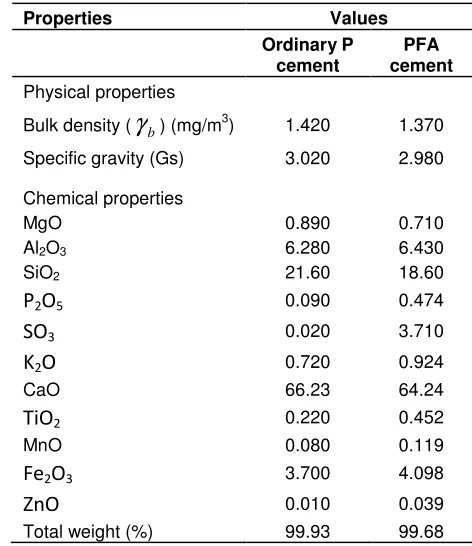
Two types of binder were used to fabricate peat bricks, namely: ordinary Portland cement and Portland pluverised fuel ash cement, the later is rapid setting pulverized fuel ash cement with high fineness and manufacturing by adding a superplasticiser as a cement-dispersing agent. The properties of OPC and PFA cement is presented in Table 2.
Sand
Sand material was used in this study. Fine sand with a maximum diameter of 2.00 mm was used to increase solid matrix to the peat. Use of sand for this study has specified grain size distribution to give uniformity of standard material in the mix design. The physical and mechanical properties of siliceous sand are given in Table 3.
RESULTS
Figures 2 to 5 presented compressive wet compressive
Properties Values Ordinary P
cement cement PFA
Physical properties
Bulk density (
γ
b) (mg/m3) 1.420 1.370 Specific gravity (Gs) 3.020 2.980Chemical properties
MgO 0.890 0.710
Al2O3 6.280 6.430
SiO2 21.60 18.60
0.090 0.474 0.020 3.710 0.720 0.924
CaO 66.23 64.24
0.220 0.452
MnO 0.080 0.119
3.700 4.098 0.010 0.039
[image:3.612.327.563.93.366.2]Total weight (%) 99.93 99.68
Table 3. Properties of siliceous sand.
Properties Values
Physical properties
Bulk density (
γ
b) (mg/m3) 1.600Specific gravity (Gs) 2.550
Chemical properties
MgO 0.390
Al2O3 19.20
SiO2 70.04
0.731 0.160 3.750
CaO 2.150
0.045
MnO 2.125
0.033 0.041
strength and water absorption of compressed stabilised peat bricks relationship.
DISCUSSION
[image:3.612.52.290.96.498.2] [image:3.612.327.569.407.641.2]3 days total water absorption (%)
3
da
ys
w
et
c
om
pr
es
si
ve
s
tr
en
gt
h
(M
pa
)
20% peat + 0% lime (10 Mpa)20% peat + 4% lime (10 Mpa) 20% peat + 2% lime (6 Mpa)
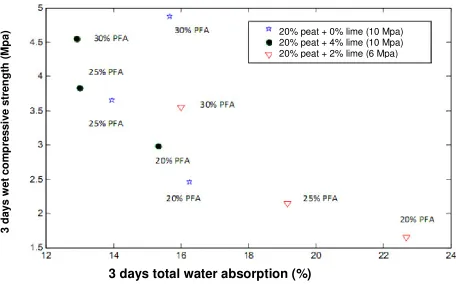
Figure 2. Correlation between total water absorption and wet compressive strength of CSPB at 3 days (PFA).
28 days total water absorption (%)
28
d
ay
s
w
et
c
om
pr
es
si
ve
s
tr
en
gt
h
(M
pa
)
20% peat + 0% lime (10 Mpa) [image:4.612.81.537.78.362.2]20% peat + 2% lime (10 Mpa) 20% peat + 0% lime (6 Mpa)
3 days total water absorption (%)
3
da
ys
w
et
c
om
pr
es
si
ve
s
tr
en
gt
h
(M
pa
)
Figure 4. Correlation between total water absorption and wet compressive strength of CSPB at 3 days (OPC).
28 days total water absorption (%)
28
d
ay
s
w
et
c
om
pr
es
si
ve
s
tr
en
gt
h
(M
pa
)
2 3 4 5 6 7 8 9 10 3.5 4 4.5 5 5.5 6 6.5 7 7.5
28 Days Total Water Absorption (%)
28 D ay s W et C om pr es si ve S tr en gt h (M pa
) 20 % Peat + 0 % Lime (10 Mpa)20 % Peat + 2 % Lime (10 Mpa)
20 % Peat + 0 % Lime (6 Mpa)
28 days total water absorption (%)
28 d ay s w et c om pr es si ve s tr en gt h (M pa )
Figure 6. Correlation between total water absorption and wet compressive strength of CSPB at 28 days (PFA).
compressive strength is discussed. The experimental results obtained for total water absorption are plotted against those for 3 and 28 days. Wet compressive strength shown in Figures 2, 3, 4 and 5. This figures shows that a general negative correlation between total water absorption and wet compressive strength. A decrease in water absorption is accompanied by a corresponding increase in strength; clearly from Figure 6 the relationship between total water absorption and wet compressive strength was very strong, water absorption decreasing when the wet compressive strength increased means the material durable. Negative coefficient of correlation found, varied between -1.29 to -0.705 at 3 days with OPC as stabiliser and -0.999 to -0.612 at 28 days. However, it varied between -0.956 to -0.269 at 3 days with PFA cement and -0.994 to -0.891 at 28 days. The water absorption at 3 days was higher with lower strength, as less curing period means less hydration of cement and lime with soil and sand particles, however less strength means more voids and more water absorption for compressed stabilised peat bricks. As mentioned previously the total water absorption capacity of a block and brick can usually be measured by determining the amount of water it can take in (ILO, 1987). A compressed stabilised peat brick has good engineering properties compared to other materials, concrete blocks has high strength and high water absorption. Better bricks or blocks using for construction should be less water absorption.
According to Meukam et al. (2004) compressive strength of stabilised laterite soil bricks ranged between 2 to 10 Mpa with 3 to 10% cement content, and investigations revealed that the compressive strength increased with increase in cement content and curing period. Ajam et al. (2009) found the water absorption of PG fired bricks ranged between 15.84 and 19.67%. Kumar (2000); IS: 3952, (1988) reported that the water absorption of ordinary burnt clay bricks or blocks should not be more than 20% by weight. BS: 3921, (1985) defined the limits of water absorption in order to categorise engineering bricks.
The standard specifies low water absorption for category A 4.5% and 7% for category B. Compressed stabilised peat bricks to be replace brunt clay bricks has environments problems during burning processing and concrete blocks has high water absorption, new material has suffusion strength and lower water absorption. For this reason investigate this type to replace traditional bricks and blocks.
Conclusion
curing periods have adverse effects.
Therefore, from investigation into the effects of varying the stabiliser type and content on the compressed stabilised peat bricks total water absorption, it was found the increasing the cement content and lime decreasing the water absorption of brick. For increasing cement from 20 to 30%, it was found reducing the water absorption from 5.4 to 16.4%. However, increasing curing periods improve compressive strength and decreasing water absorption. It was found the negative correlation total water absorption and compressive strength. The compressed stabilised peat bricks produced in this study seem to be suitable and environment friendly for use as construction material.
ACKNOWLEDGEMENTS
Source of finance for the research came from Postgraduate Research Fund PS115-2008C under University of Malaya Research University Grant. Acknowledgement is also not complete without thanking Lafarge Malayan Cement Berhad for providing binders for the purpose of the research.
REFERENCES
Adam EA, Agib A (2001). Compressed Stabilised Earth Block Manufacture in Sudan. Printed by Graphoprint for the United Nations Educational, Scientific and Cultural Organization. France, Paris, UNESCO.
Ajam L, Mongi O, Hayet SF, Rashid M (2009). Characterisation of the Tunisian Phosphogypsum and its Valorisation in clay bricks. J. Constr. Build. Mater., 23(1): 3240-3247.
Al-Temeemi AA, Harris DJ (2004). A guideline for assessing the suitability of earth-sheltered mass-housing in hot-arid climates. J. Energy Build., 63(3): 251-260.
British Standards Institution (1985). Clay Bricks: BS 3921. London, England.
Habib S, Ferral ER (2003). Some experiences on the stabilisation of Irish peats. J. Can. Geotechnol., 40(1): 107-120.
Habitat: Strengthening Human Settlement (2001). United Nation Human Settlement: State of world's city. Urban settlements: housing. http://www.unchs.org/documents. November 28.
Hall MR, Allinson D (2009). Evaporative Drying in Stabilised Compressed Earth Materials Using Unsaturated Flow Theory. J. Build. Environ., 45(3): 509-518.
Huat BK, Ali FH, Low TH (2006).Water infiltration characteristics of unsaturated soil slope and its effect on suction and stability, Geotechn. Geol. Eng., 24(5): 1293-1306.
Indian Standard (1988): IS: 3952. Specification for Burnt Clay Hollow Bricks for Walls and Partitions.
International Labour Office (1987). Small-Scale Manufacture of Stabilised Soil Blocks, International Labour Office, Geneva.
Jayasinghe CR, Mallawaarachchi S (2009). Flexural of Compressed Stabilized Earth Masonry Materials. J. Mater. Des., 30: 3859-3868. Kumar S (2000). Fly Ash-Lime-Phosphogypsum Cementitious Binder a
New Trend in Bricks. J. Mater. Struct., 33(1): 59-64.
Meukam P, Jannot Y, Noumowe A, Kofane TC (2004). Thermo Physical Characteristics of Economical Building Materials. J. Constr. Build. Mater., 18: 437-443.
Middendrof J (2001). Properties and Methodology of Earth Structures. Energy and Environment. Michell Addington. Harvard Graduate School of Design.
Rigassi V (1995). Compressed Earth Blocks. Manual of Production. Gate, Vol. 1.