A TQM based Assessment Framework for Blended Learning
Environment in Higher Education Sector
Vandana Savara
PhD
2015
University of Salford
School of the Built Environment
Submitted in Partial fulfillment of the requirements of the Degree of
Doctor of Philosophy
Table of Contents
Chapter 1: Introduction
1.1 Research Background………..………1
1.2 Research Problem………..………..2
1.2.1 Higher Education Sector………..……….5
1.2.2 Learning Environment………..………5
1.2.3 Blended Learning………..………6
1.2.4 Total Quality Management……….………..6
1.3 Research Aim……….………..7
1.4 Research Objectives……….………7
1.5 Research Questions……….……….7
1.6 Contribution of the Study……….………9
1.7 Thesis Structure……….. 9
Chapter 2: Literature Review 2.1 Introduction………11
2.2 Higher Education Sector………13
2.2.1 Learner Perspective………..14
2.2.2 Industry Perspective……….14
2.2.3 Government Perspective………..14
2.3 Learning Environment………...15
2.3.1 Environment……….15
2.3.1.1 Physical Environment……….16
2.3.1.2 Virtual Learning Environment………17
2.3.2 Learning………...17
2.3.2.1 Learning Theories………..19
2.3.2.1.1 Theory of Behaviorism……….19
2.3.2.1.2 Cognitive Theory………..19
2.3.2.1.3 Constructivism Theory………..20
2.3.2.2 Learning Styles ………...23
2.3.2.3 Mode of Learning………28
2.3.2.3.1 Traditional Learning……….……….29
2.3.2.3.2 Distance Learning……….……….29
2.3.2.3.3 E-Learning………….………29
2.4 Blended Learning………...36
2.4.1 Success Factors in Adoption of Blended Learning ………40
2.4.2 Barriers in Adoption of Blended Learning……….….41
2.4.3 Pedagogical Aspect of Blended learning……….…42
2.4.4 Technical Aspect of Blended learning……….…45
2.4.5 Social Aspect of Blended Learning……….……46
2.4.6 Organizational Aspect of Blended Learning……….…..47
2.4.7 Assessment and Evaluation Aspect of Blended Learning……….……..48
2.4.8 Framework for blended learning communities……….……...49
2.5 Blended Learning Environment……….51
2.5.1 Design of Blended Learning Environment……….……….54
2.5.2 Success factors of Blended learning environment………....57
2.6 Total Quality Management………60
2.6.1 Assessment methods in TQM ………..………67
2.7 Quality in Higher Education………..69
2.7.1 Quality in Traditional Learning……….………..71
2.7.2 Quality in E-Learning……….……….71
2.7.3 Assuring Quality in Education……….………72
2.8 Summary………73
Chapter 3: Research methodology 3.1 Introduction to Research Methodology……….74
3.2 Philosophy of Research……….……….74
3.2.1 Positivism………..75
3.2.2 Social Constructivism………...76
3.3 Research Approach………77
3.4 Pilot Study……….……….79
3.5 Data Collection ……….80
3.5.1 Sampling………..81
3.5.2 Sample Size……….82
3.5.3 Primary Data………83
3.5.4 Secondary Data………84
3.6 Quantitative Data Techniques………84
3.6.1 Questionnaires………..84
3.7 Qualitative Data Technique………...86
3.7.1 Interview………..86
3.8 Ethical Issues……….88
3.9 Research Phases……….88
3.10 List of Adopted Quantitative Analytical Techniques………90
3.10.1 Exploratory Factor Analysis………..91
3.10.1.1 Identifying Factor Structure……….94
3.10.1.2 Factor Extraction: Eigen values, Scree plot and KMO (Kaiser –Meyer-Olkin) ….95 3.10.2 Why DEMATEL………98
3.10.2.1 DEMATEL Method……….98
3.10.2.1.1 Procedure of Applying DEMATEL………..99
3.10.3 Why MOORA……….102
3.10.3.1 MOORA Method……..………102
3.10.3.1 Standard deviation Method………..…………..106
3.10.3.2 Entropy Method...…...108
3.11 Sensitivity Analysis……….110
3.12 Why EFQM Model………111
3.12.1 EFQM Assessment Model………...113
3.13 Summary………114
Chapter 4: Analysis
4.1 Introduction……….………….115
4.2 Basic Analysis……….………….115
4.2.1 Results of Basic Analysis……….…………115
4.3 Results of Exploratory Factor Analysis………...119
4.3.1 Interpretation of Results of Factor Analysis………129
4.4 Results of Application of DEMATEL Technique………...130
4.4.1 Implication of DEMATEL Technique……….136
4.4.2 Results of DEMATEL on Criteria………...137
4.4.2.1 Practical Implication of DEMATEL on Criteria………...174
4.4.2.1.2 Impact relation under factor F2 and its implication………176
4.4.2.1.3 Impact relation under factor F3 and its implication………177
4.4.2.1.4 Impact relation under factor F4 and its implication………178
4.4.2.1.5 Impact relation under factor F5 and its implication………179
4.4.2.1.6 Impact relation under factor F6 and its implication………180
4.5 Application of MOORA Method……….180
4.5.1 Results of Standard deviation Method………...191
4.5.1.1 Implication of Final Composite Score……….197
4.5.2 Results of Entropy Method………198
4.5.2.1 Implication of Ranking………207
4.6 Results of Sensitivity Analysis………208
4.7 Brief on Development of Framework………..215
4.8 Summary………..215
Chapter 5: Framework 5.1 Introduction ……….216
5.2 Development of Framework ………...216
5.2.1 Combining the Results of DEMATEL and MOORA in Framework ………...222
5.3 Application of EFQM model on the combined result of DEMATEL and MOORA ……..224
5.4 Application of EFQM model ………..227
5.4.1 Validation by expert’s opinion ………..243
5.4.2 Implication of RADAR Approach ………243
5.4.3 Benefits of Application of EFQM Model ……….243
5.5 Summary ……….248
Chapter 6: Conclusions and Suggestions 6.1 Introduction ……….249
6.2 Reflection ………251
6.3 Conclusions ………...255
6.4 Results of This Research ………...261
6.5 Limitation ……….. .261
6.6 Future Area of Research ……….261
References………...266
Appendix ………283
Participant Information Sheet ……….284
Participant Consent Form ………286
Participant Recruitement Letter ……….287
Questionnaire ………288
Table of Figures
Figure 2.1: Flowchart of various topics in literature review ………...12
Figure 2.2: Source: Johari Window, adapted after Lengel et al. (2004)………22
Figure 2.3: Kolb's Learning Styles………....25
Figure 2.4: Taxonomy of Learning Approaches ………...28
Figure 2.5:5 Stage Model Adapted from Salmon (2004)………..35
Figure 2.6: Blended Approach in Open Malaysian University (Lim et al., 2011) ………..39
Figure 2.7: Continuum of blended learning is explained by (Jones, 2006)………...47
Figure 2.8: Indications for Blended Learning Continuum (Allen et al., 2007)……….48
Figure 2.9: A Metaphor of Learning Community (Varlamis & Apostolakis, 2010)……….50
Figure 2.10: The Handbook of Blended Learning by (Bonk & Graham, 2005)………52
Figure 2.11: Five Key Elements in the Blended Learning Design………55
Figure 2.12: Critical Issues in the Blended Learning Design………56
Figure 3.1: Epistemology……….. 76
Figure 3.2: Ontology ……….77
Figure 3.3: Research Approach………. 79
Figure 3.4: Research Phases and Activities………...89
Figure 3.5: Flowchart of adopted techniques……….………92
Figure 3.6: Representation of Fuzzy Conversion 11 Point Scale (Chen & Hwang, 1992)……..105
Figure 3.7: The EFQM Model by Schreurs (2006)……….………...112
Figure 4.1: Pie chart of Age of Learners ……….116
Figure 4.2: Pie chart of Gender of Learners………....117
Figure 4.3: Pie chart of Qualification of Learners……….. 118
Figure 4.4: Pie Chart of Numbers of Years Studied in BLE………...119
Figure 4.5: Scree Plot ………..125
Figure 4.6: The Cause and Effect Diagram……….136
Figure 4.7: Cause and Effect Diagram………...175
Figure 4.8: Digraph of all Criteria of Factor1………..176
Figure 4.9: Digraph of all Criteria of Factor 2 ……….177
Figure 4.10: Digraph of all Criteria of Factor3………....178
Figure 4.11: Digraph of all Criteria of Factor 4 ………..179
Figure 4.12: Digraph of all Criteria of Factor 5 ………..179
Figure 4.13: Digraph of all Criteria of Factor 6 ………..180
Figure 5.1: Framework……….221
Table of Tables
Table 2.1 Dale’s cone of experience……….……….18
Table 2.2 Success factors of BLE………..57
Table 2.3 TQM perspective of Deming, Juran, and Crosby………..62
Table 2.4 Importance of TQM……….………..69
Table 2.5 Definition of Quality in Business and Higher Education…..………70
Table 3.1 Probability and Non-probability Sampling……….……….. 81
Table 3.2 Adopted Analytical Methods..………90
Table 3.3 Assignment of Fuzzy Conversion 11 Point Scale ………...105
Table 4.1 Frequency Distribution of Age………116
Table 4.2 Frequency Distribution of Gender……….………..117
Table 4.3 Frequency distribution qualification………....117
Table 4.4 Frequency Distribution of No of years Studied in the BLE………….………...118
Table 4.5 Descriptive Statistics………... 120
Table 4.6 Communalities……….122
Table 4.7 Total Variance……….124
Table 4.8 Component Matrix ………..126
Table 4.9 Rotated Component Matrix ………128
Table 4.10 Opinion of (DM1)………..131
Table 4.11 Opinion of (DM2)………..131
Table 4.12 Average decision Matrix Z6x6………131
Table 4.13 Average Matrix with R (Sum) and C (sum) ……….…………132
Table 4.14: Matrix after Division with 17 ……….………….…………132
Table 4.15 Results of Matrix (I-X) ...……132
Table 4.16 Inverse Matrix of (I-X)………...133
Table 4.17 Matrix of T= X* (I – X )(-1) ……….……….…….…133
Table 4.18 Matrix representing more than Threshold Value ………..………….... ….133
Table 4.19 Resultant Matrix with D+ R and D-R ………..……….134
Table 4.20 Results of the DEMATEL on Factors ………..………135
Table 4.21 Opinions of DM1………..……….139
Table 4.22 Opinions of DM1………..……….140
Table 4.23 Opinions of DM1………...141
Table 4.24 Opinions of DM1………...142
Table 4.25 Decision Matrix by DM2 ………..143
Table 4.26 Decision Matrix by DM2 ………..144
Table 4.27 Decision Matrix by DM2 ………..145
Table 4.28 Decision Matrix by DM2 ………..146
Table 4.29 Average Values of opinions of DM1, DM2 (Decision maker 1 and 2)……….148
Table 4.30 Average Values of opinions of DM1, DM2 (Decision maker 1 and 2)……….149
Table 4.31 Average Values of opinions of DM1, DM2 (Decision maker 1 and 2)……….150
Table 4.32 Average Values of opinions of DM1, DM2 (Decision maker 1 and 2)……….151
Table 4.33 Matrix X (result of multiplication by 0.0117)………...153
Table 4.34 Matrix X (result of multiplication by 0.0117)………154
Table 4.35 Matrix X (result of multiplication by 0.0117)………155
Table 4.36 Matrix X (result of multiplication by 0.0117)………156
Table 4.37 Matrix (I – X)……….158
Table 4.38 Matrix (I – X)……….159
Table 4.39 Matrix (I – X)……….160
Table 4.40 Matrix (I – X)………..….. 161
Table 4.41 Output of inverse of matrix (I-X) ……….…..…... 162
Table 4.42 Output of inverse of matrix (I-X) ……….….…...163
Table 4.43 Output of inverse of matrix (I-X) ...…....164
Table 4.44 Output of inverse of matrix (I-X) ……….……….…...165
Table 4.45 Outcome of T= X* (I – X) (-1)...……….………..….. 167
Table 4.47 Outcome of T= X* (I – X) (-1)...…... 169
Table 4.48 Outcome of T= X* (I – X) (-1) ……….……...170
Table 4.49 Outcome of T= X* (I – X) (-1) ……….….……..171
Table 4.50 Calculation of (D + R) and (D – R) ……….……….172
Table 4.51 Cause group………...173
Table 4.52 Effect Group ……… 174
Table 4.53 Opinions of DM1 in the MOORA Method………... 181
Table 4.54 Opinions of DM2 in the MOORA Method………..…. 181
Table 4.55 Opinions of DM3 in the MOORA Method………182
Table 4.56 Crisp Values of opinions of DM3………..184
Table 4.57 Crisp Values of opinions of DM3………..185
Table 4.58 Crisp Values of opinions of DM3 ……….186
Table 4.59 (Xij) Average value of opinions of Average of DM1, DM2, and DM3………….…187
Table 4.60 Sum of all square values of Xij ……….188
Table 4.61 Square Root of all Xij2 ………..………188
Table 4.62 Normalized Matrix ……….………...190
Table 4.63 Standardized Matrix ……….………...193
Table 4.64 Standard Deviations……….………..…194
Table 4.65 Weights of Criteria ……….………..….194
Table 4.66 List of Benefit and Cost Criteria………..…..195
Table 4.67 Weights multiplied by xij*………..…196
Table 4.68a Final Ranking………...……197
Table 4.68b Final Ranking (Cause group Criteria)……….….198
Table 4.69 Matrix 1+ Xij …………... 200
Table 4.70 Values of ∑𝒊𝒊=𝒎𝒎𝒊𝒊=𝟏𝟏(𝟏𝟏 + 𝒙𝒙𝒊𝒊𝒊𝒊∗ )………..………201
Table 4.71 Value of fij ...….. 202
Table 4.72 Values in ln fij ……….…..…203
Table 4.73 Value of Sum of fij*lnfij ……… 203
Table 4.74 Value of Hj ……….………..….204
Table 4.75 Value of 1-Hj = Gj ……….……..…….204
Table 4.76 Weights ……….206
Table 4.77 Weights multiplied by Xij………..207
Table 4.78a Net Results of Ranking of Alternatives for all criteria..………..208
Table 4.78b Net Results of Ranking of Alternatives for cause criteria………...208
Table 4.79 Original Weights ……….… 209
Table 4.80 New weights ……… 209
Table 4.81 Final Matrix Multiplied with Normalized Parameters ……… 210
Table 4.82 Final Output ………..211
Table 4.83 Original Weights Table ………212
Table 4.84 New Weights by Reducing Weight of C64 by (0.02)……….……212
Table 4.85 Resultant of Weights Multiplied with Normalized Parameters……….213
Table 4.86 Final Output……….………..214
Table 5.1 Level of Influence from highest to lowest value ………218
Table 5.2 Negative values of (D-R) from the effect group ……….219
Table 5.3 Combining the Results of the DEMATEL and MOORA Method ……….223
Table 5.4 Division of Cause Criteria under EFQM Enablers………..225
Table 5.5 RADAR Approach………...227
Table 5.6 Assigning Weights ………..245
Table 6.1 Meeting the objectives……….250
Table 6.2 Indicators of Maturity level ………263
Table 6.3 Competence Context: Stage 0 ……….264
Acknowledgements
This thesis is the essence of a challenging journey which started about three years ago. Along the
journey I have experienced many hurdles, dead ends, and challenging situations. A number of
people have helped by providing guidance, support and motivation along this journey. I am
particularly grateful to my supervisor Prof. Mohammed Arif who was the key guide on this journey
and provided prompt, frequent, constructive, and detailed feedback. I am equally thankful to my
local supervisor Dr. Aftab Haider Rizvi.
I would like to thank my husband Rohit and my children Dhruv and Mallika who have constantly
provided encouragement and support. I am also very grateful to my parents and relatives. I would
also like to thank Dr. Seth, Prof. Soltani, and Dr. Madrecha for providing their opinions for
applying decision making techniques.
Last but not least, I would like to thank all the participants of this research study and staff members
of School of Built Environment, University of Salford, UK, who have made this research possible.
Abbreviations
The following abbreviations are used in this thesis.
BLE –Blended Learning Environment
DM – Decision Maker
DEMATEL – Decision making Trial and Evaluation Laboratory
EFQM – European Foundation for Quality Management
Eq – Equation
f2f – face-to-face
HEI – Higher Education Institution
HES – Higher Education Sector
ICT – Information Communication Technology
MOORA – Multi Objective Optimization by Ratio Analysis
QDI – Quality Development Initiative
SDV – Standard Deviation
TQM – Total Quality Management
Abstract
The purpose of this research is to develop an assessment framework in the TQM perspective for a
blended learning environment in the higher education sector. Blended learning is a specialized
field in learning, i.e., combination of face to face learning and e-learning. This research is an
attempt to bring a logical approach in assessing the quality feature of the blended learning
environment.
The quality of the BLE can be easily enhanced if the implementation of important parameters of
quality in the blended learning environment is undertaken at all levels of the institution: individual
level, organizational level, and at external stakeholders (employers, government, parents, etc.)
level. The six major factors are deduced that affect the quality of the blended learning environment
in the HES through exploratory factor analysis. To check the intertwining effects of the derived
factors/underlying criteria, the DEMATEL technique is applied. This technique has resulted in the
formation of the cause group and effect group out of the derived factors/underlying criteria. This
group formation has led to high quality in the BLE.
The criterion, Qualification and experience of the tutor of the cause group, influences the other
criteria in the most significant way and is the master influencer. The criterion, appropriate use of
delivery methods, is identified as the most related criterion. Furthermore, the ranking of
alternatives (by applying the MOORA method) to improve the quality of the cause criteria has
resulted in the formation of effective quality implementation strategy in the higher education
sector. The use of the EFQM model on cause criteria is once again a step to bring effectiveness in
assessment related activities of the BLE and eventually leading to high quality in the HES.
This research involves a mixed method approach to deal with quantitative and qualitative data.
The human perceptions and expectations are dealt with by the use of mathematical techniques. A
combination of subjectivism and objectivism is seen in the development of this framework. The
result of this study has offered a framework to attain superior quality learning environment in the
HES.
Chapter 1: Introduction
This research on Blended Learning Environment (BLE) is focused on the quality of BLE. The
learning environment is the learning environment which promotes the use of blended learning (a
combination of face-to-face and on-line learning). A relationship is tried to be established on the
quality based perceptions of BLE by main stakeholders of the learning environment: learner,
faculty and employer to enhance the quality of the students' learning experiences and learning
outcomes holistically. In particular, this research needs to generate usable evidence about the use
of Total Quality Management (TQM) philosophy and tools. In turn, this demands the use of
appropriate powerful methodologies. This research is limited to the use of blended learning in
higher education sector. Hence the results of this research may or may not be applicable to other
BLE. For example: providing training in industrial or government sector.
1.1
Research Background
The Higher Education Sector (HES) has the ability to shape the citizens of tomorrow. In the last
two decades technology has influenced all aspects of human life. The way we approached a
particular situation or problem in the past is no longer the same approach due to the embracement
of technology. One of the biggest influences of technology in our lives is the knowledge industry.
In today’s world, with the help of technology we have an access to knowledge which is in
abundance, and moreover, it is just a “click” away. This has influenced the education field to an
extent that courses are designed by keeping technology in mind.
The use of blended learning is increasing in the whole of UK. The use of Virtual Learning
Environment (VLE) in Higher Education Institutions (HEIs) have increased exponentially from 7
% in 1997 to 95% in 2005 (Browne and Jenkins, 2003; Joint Information Systems Committee
(JISC), 2005).There was a report published in USA named "Going the Distance - Online Education
in the United States, 2011" published by the College Board and the Babson Survey Research
Group, that stated that there are over 6 million students of which almost one third of the total
number of students in USA are taking at least one class online. The important point is that this
number is 560,000 students more than the number of students enrolled in 2010. The same report
suggested that in 2011, 67 percent of academic professionals were of the opinion that online classes
could be equally as effective as face-to-face classes. However, in 2003 only 50 percent had
responded this way. This proves that more and more students and educators are comfortable with
this kind of reliance on technology and mode of teaching and learning. Exceptions are some
courses like sciences, mathematics, humanities, and business studies which are too difficult to be
taught effectively in the e-learning environment. Therefore, people from academia have shown a
greater interest in blended learning than in the e-learning mode in higher education sector.
Blended learning has overcome the limitations of e-learning or pure online learning. However, the
challenges faced by most education institutes in implementing blended learning courses are
numerous. The cost of the infrastructure required for the e-learning component of blended learning
is quite high initially. At the same time, there are numerous efforts required to redesign the course
content to make it electronically suitable and quality wise sustainable for the students and
stakeholders respectively. The ICT (information and communication technologies) skills are
required to implement and manage e-learning. It is imperative for all stakeholders in the
educational institution to understand the existing ICT infrastructure, its services and usefulness in
the execution of specific tasks. Moreover, the awareness and adoption of quality development
parameters are required. The assessment of quality parameters of this technological advanced
environment in total quality management perspective will help in bringing desirable quality
learning experiences for learners. Furthermore, the related stakeholders of this environment will
also benefit by this development.
1.2 Research Problem
A study in 2006 has mentioned the low status of pedagogic research in higher education (Sharpe
et al., 2006).The report has highlighted that all seven institutions under study in UK were finding
the establishment of institutional level practices very hard to ensure and enhance the quality of
blended learning design in the institutions. It is found that different institutions are using different
possible strategic ways to ensure quality at the institutional level. There is no defined way. The
absence of a defined way can lead to dissatisfaction, inefficiency, ineffectiveness and
non-competitiveness of the learning environment as a whole. This gap is tried to be filled with the help
of the adopted approach in this research. According to the report on the impact of networked
learning in HEIs
‘the evaluation of staff and student experiences appears to be an area that institutions are just beginning to address and one that would benefit from further investigation’(Bricheno et al., 2004, p.7)
Hence the evaluation of staff and student experiences in BLE to improve quality is the strong
rationale of introducing this area in this research. Moreover, the extended use of BLE in schools,
for primary and secondary education also highlights the importance of superior quality BLE at the
level of higher education. This is important to meet the high expectations of learners who are
exposed to BLE in schools and are well experienced of learning in such an environment.
The higher education sector, which is no longer strategically confined to the age limit of 17 to 30
years, has openly started accepting an educational paradigm which can provide education to the
learners of any age. This sector has opened its doors to a convenient access of high quality
education in a more flexible, actively engaged, and reflective way. Learners can fulfill their dreams
of a quality learning experience in spite the constraints and commitments of family, money, health,
job, etc. there is no doubt that the traditional learning system cannot support this shift. Therefore,
the adoption of new learning modes of education in a learning environment has become a necessity
for all educational institutions. Blended learning has become a buzz word in today’s learning
environment since it promotes not only engagement, access, flexibility in student learning, but it
also helps in establishing organizational and institutional imperatives in higher education (Bonk
& Graham, 2006).
An interactive, engaging, and flexible learning environment is of the utmost need today. In order
to bring excellence to the learning environment, all aspects of the learning environment which
means pedagogical, social, technical, organizational, and evaluation and assessment need
excellence. There are various success factors and barriers which need to be optimized in order to
bring high quality, accountability, and excellence in all these aspects of the learning environment.
In today’s world, all learning organizations must make an effort in keeping their environment
efficient, effective, and competitive while aspiring for high standards of quality in their outcomes.
The success is connected with the outcomes which are further associated with each individual
learner’s outcome, professional development of faculty and staff, active involvement in research
and innovation, lower drop rate, and high marks in satisfaction in the experience for all
stakeholders from the learning environment.
Blended learning is a thoughtful integration of face to face and online learning. The online learning
can have asynchronous and synchronous components. The asynchronous mode of online
communication allows the participant to think for more time and with an equal right to share their
thoughts. The synchronous mode of online learning is comparable with face to face learning in a
traditional learning environment. This blended approach is gaining a lot of importance as it
provides the best of both worlds. A study by Allen, Seaman, and Garrett revealed that 55 percent
of all institutions offer at least one blended course .It seems that in the future the percentage of this
kind of college courses will increase, and therefore, the quality of these blended courses and
learning environment should be of absolute importance.
The prominence of quality is further manifested by the growing interest in the delivery of high
quality services which can often lead to a sustainable competitive advantage (Suresh et al., 2002).
Quality management in education has taken varying forms all over the world in terms of
stakeholder accountability, customer satisfaction, and issues of assessment, accreditation, ratings,
and rankings. The focal point is essentially on the understanding of the stakeholder’s requirements
with the resultant objective of delighting them. The educational system comprises various classes
of internal stakeholders (faculty and administrative staff) and external stakeholders (students,
society, industry and employers).Therefore; it needs to be responsive to the varying and competing
interests of all. It is expected that in the future, optimum quality of the BLE will be expected from
almost all the HEIs.
The assessment of the quality of a BLE in the TQM perspective for HES will be an important step
in the direction of attaining optimality. However, how to do this assessment is a problem? A proper
strategy needs to be carefully designed to implement the four necessary elements of quality
assessment. The four elements are required to be addressed which are: cost of poor quality,
standing in the market place, quality culture in the organization, and operation of a company
quality system.
A solution to this problem is proposed in one way by developing an assessment framework in the
TQM perspective. The framework takes learners, faculty, and industry representatives and experts
to a holistic picture of quality. Hence, the word “Total” of TQM has an utmost importance. This
framework addresses all four elements of quality assessment to some extent. The use of decision
making techniques and application of sensitivity analysis on the most critical criterion of the
blended learning environment has helped in proving the robustness of this framework. A brief of
the four major elements of this research, higher education sector, learning environment, blended
learning, and total quality management, is given in the next sub section.
1.2.1 Higher Education Sector
The introduction of this research has highlighted the importance of quality in the HES. Higher
education means getting a minimum qualification of a bachelor’s degree, higher national diploma,
or foundation degrees. Higher education prepares learners to continue their education for the next
level towards realizing their dreams, hopes, and aspirations. Attaining of specific knowledge
(curricula), attaining of degrees or credentials (careers) and leading responsible lives (civics) are
the entities which reflect the beliefs and thoughts of a variety of philosopher/scholars ranging from
Plato’s concept of reality to Dewey’s concept of experiential learning. The different existing
learning and teaching perspectives, learning styles, learning theories, and learning methods need
to be combined together for the formation of a learning environment in the higher education field.
The future aim of the HES should be to provide quality education to masses with efficiency so that
everyone has the access to a world class quality education.
1.2.2 Learning Environment
In addressing this issue in the higher education field, a detailed study of learning environment
would be of great interest. A new mode of learning like blended learning can transform the learning
environment in to a desirable quality learning environment. The blended learning environment is
studied under different aspects like pedagogical, technical, social, organizational, and evaluation
and assessment, in order to get the in depth knowledge of quality parameters. The next step will
be to apply the TQM philosophy and quality development tools to create a sustainable quality
culture in the learning environment.
1.2.3 Blended Learning
Blended learning is the integration of face to face and online learning. Blended learning has a
critical role to play in the global market to prepare the learners to become leaders in their respective
areas in the future. Gutierrez (2005) outlines in her research that blended learning is the
combination of multiple approaches to learning, combining several delivery methods such as
collaboration software, web-based courses, and computer communication practices. Blended
learning can successfully make the learning environment more engaging, authentic, meaningful,
motivational and reflective. Some studies have underlined that technology and interaction should
be taken in consideration in order to design effective, attractive, and efficient learning
environments (Karadeniz 2009; Bliuc et al., 2007; Ginns and Ellis 2007). The portable traits like
confidence, patience, judgment, and synthetic ability will be a part of the future learner’s
personality which can be developed with the introduction of problem based learning and
generating workplace like simulations. A blended learning environment can help bringing these
changes in the HES by creating a student centered environment with improved learning outcomes.
The assessment of quality parameters of blended learning environments will be of great
importance. The right implementation of the TQM philosophy will develop a sustainable excellent
quality learning environment.
1.2.4 Total Quality Management
The TQM philosophy became a part of the higher education institutions by 1980’s. It has advocated
more than a mere change in the management practice. It promotes quality culture, focus on learner,
teamwork, and avid improvement. To make a learning environment driven by this philosophy, all
aspects of it (pedagogical, technical, organizational, evaluation and assessment) must be taken into
account. The tools, techniques and methods of TQM can contribute in bringing quality,
effectiveness, and efficiency in the learning environment. The study’s conclusion will present the
assessment framework with the objective that all significant factors and criteria are taken into
account optimally in establishing and maintaining quality of the learning environment. A detailed
study of these factors, criteria, frameworks and assessment methods will be presented in the next
few sections of this research.
1.3 Research Aim
To develop a TQM based assessment framework for blended learning environment in higher
education sector.
1.4 Research Objectives
The following objectives have been identified to achieve this
aim:-• To identify the relevant literature around higher education sector, learning theories,
learning styles, learning methods, blended learning, TQM, and use of TQM assessment
tools in higher education sector.
• To determine the important factors and criteria for the quality of BLE in learner’s
perspective and document them.
• To determine the relationships among factors / criteria in the faculty’s perspective and
document them.
• To assess the priority of quality development management strategies in the perspective of
employer and quality experts.
• To develop a TQM based framework by integrating all the above mentioned perspectives
and by applying European Foundation for Quality Management (EFQM) model.
• To refine and validate the framework.
1.5 Research Questions
1. How is the quality of the BLE in HES important for its learners and its associated
community?
2. How to develop a TQM based assessment framework in BLE which can help in the
improving of the quality of higher education sector?
1.6 Contribution of the Study
This undertaken study will mainly generate the following academic and practical
contributions:
1. It provides a comprehensible understanding of the whole situation in the assessment of a
BLE in the TQM perspective in the higher education field.
2. This study could be considered a beginning or a background for further studies in the
future by other researchers in the field of a BLE.
3. According to the literature review, originally this study might be the first one to deal
mathematically with the factors and criteria of a BLE‘s quality in accordance to the
different perspectives of learner, faculty, employer and quality experts.
4. This is an attempt to bring a logical approach in the subjective nature of quality related
activities which helps in an easy adoption of this approach by HEIs.
5. It helps higher education institutions to analyze the impact of various factors and criteria
in maintaining and evaluating the quality standard.
6. It provides a self -assessment framework for higher educational organizations to be able
to assess their current quality standards, to identify opportunities for improvement, and to
enhance their quality in the future.
7. It recommends steps for quality assessment and enhancement by adopting the suggested
framework.
1.7 Thesis Structure
This chapter has briefly explained the rationale for this research by highlighting the importance of
the learning environment in the higher education field. The advances in information
communication technology have facilitated learning to happen in a tailored made way by taking
care of student’s learning preferences in accordance with the learning styles and learning methods.
This area of assessment of the BLE in the TQM perspective is identified as being under-researched.
The assessment framework will help in developing and maintaining the quality aspect which will
help in bringing more accountability, transparency, standardization, and satisfaction in the learning
experience. Since this area is being identified as under-researched through the literature review, it
is being adopted as a research topic to extend the knowledge in this field. The development of this
assessment framework of the BLE in the TQM perspective will follow in the next few chapters.
1.7.1 Chapter 2: Literature Review: This chapter’s aim will be to identify and analyze the relevant
literature surrounding the higher education sector; learning environment, e-learning environment,
and traditional environment. There will be an extensive explanation of various sub topics; i.e.,
learning theories, learning modes, learning styles, learning methods, learning tools, and assessment
frameworks. Moreover, the TQM philosophy and its various tools and techniques will also be
reviewed in detail to develop a framework.
1.7.2 Chapter 3: Research Methodology: This chapter will talk about the main philosophical
assumptions, the research methods, and the data collection techniques. The exploratory factor
analysis and decision making mathematical techniques such as the Decision Making Trial and
Evaluation Laboratory (DEMATEL) and the Multi Objective Optimization on the basis of Ratio
Analysis (MOORA) are explained in detail in this research. On the basis of the given research
setting and the research questions, the appropriate research design, activities, and processes will
be decided upon and justified.
1.7.3 Chapter 4: Analysis: This chapter will describe the implementation of the philosophical
assumptions, the research methods, and the research tools. A detailed description of data analysis
(basic as well as exploratory factor analysis) is given. The results of mathematical decision making
techniques the DEMATEL, the MOORA, and the Sensitivity Analysis will be explained in detail
with the help of appropriate charts and tables.
1.7.4 Chapter 5: Framework: This chapter will describe the development of framework, and its
robustness will be checked through the use of a mathematical technique called: Sensitivity
analysis. The application of the EFQM method will help in the development of assessment
framework in the TQM perspective.
1.7.5 Chapter 6: Conclusions and Suggestions: This chapter will describe the conclusions and
suggestions. These are influenced by the adopted research methods and research questions. This
section will also highlight the limitations of the research. The inferences from the findings will be
discussed, and future study directions will also be proposed.
Chapter 2: Literature Review
2.1 Introduction
The previous chapter has outlined the problem area and research aim. In this chapter, the related
literature will be reviewed. The ubiquitous use of information communication technologies in the
HES has brought incredible changes. The main research question, “How to develop a TQM based
assessment framework in BLE which can help in the improving of the quality of HES?” is
addressed by offering a detailed insight through literature review. This section will review some
of the existing literature in the same field. The focus will be specifically on the concept of blended
learning, the factors which are important for quality assessment, the concept of TQM, and different
existing assessment models related to the learning environment.
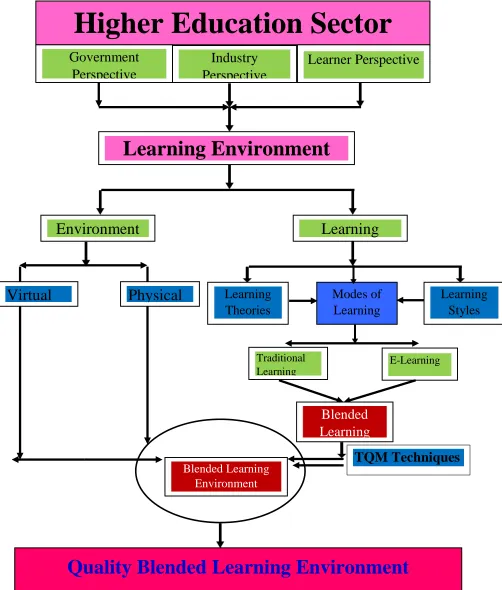
The flow chart in Figure 2.1 highlights the flow of the reviewed topics taken as per the research
requirement. The first part of this section deals with the importance of the HES in different
perspectives: Learner Perspective, Industry Perspective and Government Perspective. The
importance of HES is highlighted in this section. Then I reviewed the next main element of HES:
learning environment. The HES is explained by dividing it into two main parts. The two main parts
are: Learning and Environment. The Learning Theories, Learning Styles and Mode of Learning
are reviewed in detail to understand the important elements of quality learning. Next topic which
is reviewed is Environment. The blended learning, BLE and TQM are the main topics which are
studied in detail in order to get the deep understanding of the aspect of quality in BLE. The
application of quality assessment models of TQM will provide a quality learning experience to
learners.
TQM Techniques
Figure 2.1: Flowchart of various topics in literature review
Higher Education Sector
Learner Perspective
Government
Perspective
Learning Environment
Environment
Learning
Industry
Perspective
Learning Theories
Modes of Learning
Learning Styles
Traditional Learning
E-Learning
Virtual
Physical
Blended
Learning
Blended Learning Environment
Quality Blended Learning Environment
2.2 Higher Education Sector
The dictionary meaning of education is the act or process of educating or being educated in which
the knowledge or skill is obtained or developed by a learning process. The word higher education
was first used in 1834, and the meaning of this is referred as the education beyond the level of
secondary education. This field is of significant importance because the higher education
institutions are not only responsible for the development of skills and abilities of their learners
(Ginsberg, 1991),but they also provide learners with quality learning experience for the survival
in the global market. In this whole process of development, attainment, maintenance, assessment,
and evaluation, a lot of challenges are faced by higher education institutions. The reasons behind
these challenges are: the speedy growth of science and technology, the increasing expectation to
personalize the learning experiences, the growing demand to reach to more students, the limited
financial resources of universities, the rising demand of quality higher education systems, and
necessity of more qualitative labor, lifelong learning, and the emergence of the knowledge
community.
The higher education institutions are in a continuous search of those delivery methods which will
help in achieving the learning outcomes with the best possible outcomes. There is limited access
to higher education. The reasons are: High cost, Lack of resources, Lack of tertiary institutions
and, Commute problems. The aim of the higher education is to meet the demand of learners for
high quality learning so that they can be a part of a qualified workforce. To achieve this,
universities and colleges must examine what is happening in their classrooms (Whittington, 2003).
The higher education institutions should be ready to produce the kind of environment that
promotes critical thinking and problem solving for entry-level employment and beyond. Piaget
research has explored cognitive development as a continuum. This continuum has the involvement
of four influences: maturation, active experience, social interaction, and general progression.
In today’s world, we are in search of quality of HES that can provide a world class quality
education. The importance of HES is reviewed from different perspectives, i.e., learner, industry
and government (stakeholder).
2.2.1 Learner Perspective
The various drivers for acquiring higher education from a learner perspective are; acquiring more
knowledge, looking for better jobs, acquiring renowned degrees and diplomas, being trained for
multinational and multicultural work environments, earning more money, enhancing skills for
effective communication , developing leadership skills , and preparing for lifelong learning. Most
of the higher education institutions are focusing and adopting learner centric educational
paradigms so that the future workforce can be trained in their respective areas of interest to lead
and take entrepreneur like challenges in all walks of life.
2.2.2 Industry Perspective
In today’s competitive environment, industry wants to hire people with strong academic
backgrounds, who are trained in their specialized areas of interest and exhibit leadership qualities.
From the industry perspective, job seekers should be able to work within limited resources.
Organizations have realized the importance of an efficient workforce to work in the challenging
multicultural work environment. The HES aims to set high standards for the future workforce and
focuses on training to meet employer high expectations. Skills acquired and nurtured in a learning
environment result in bringing more confidence, satisfaction, motivation, enthusiasm for lifelong
learning, application of high order problem solving techniques, successful teamwork, competitive
work environment, and the initiation of innovative and challenging tasks which lead to the high
retention and satisfaction rate of employees in any organization.
2.2.3 Government Perspective
Globalization and providing education to masses are the major areas of focus and concern for the
governments all over the world. Globalization is a phenomenon of interconnectedness worldwide
which has resulted in bringing changes in the economic, cultural, environmental, and social sectors
of society. These changes bring more awareness, competition, and drive to excel in meeting the
requirements of established parameters of worldwide standards of work. The internationalization
of higher education means either going across borders for education or being admitted to branches
of foreign institutions. Providing higher education to maximum number of people can change the
outlook of any society. A well-informed and competent workforce helps the nation to overcome
social and economic challenges. The high employment rate is a good indicator of economic
strength of the government.
In summary, it can be said that the complexities of globalization, educational, and socio-cultural
issues have put pressure on the modern HES to make necessary changes in the way teaching and
learning takes place. In today’s world the role of the HES has become much more demanding in
order to cope with these pressures. It is often recommended to revise the roles and educational
aims of the higher education institutions in a continuous manner so that these pressures can be
dealt with much more efficiency and effectively.
The next section is the most valuable component of the higher education field: the learning
environment. This learning environment needs to be developed in such a way so that learners can
enhance and polish their existing skills under the expert guidance.
2.3 Learning Environment
A learning environment is an important element of the higher education sector. The learning
environment is defined in diverse manners but most precisely, a learning environment facilitates
all kinds of learning activities. The learning activities can take place in a more efficient and
effective manner when the necessary conditions like proper class arrangement, learning tools, and
teaching and learning resources are in place. The learning environment is considered to be made
of two parts: environment and learning. The environment is defined in more detail in the next
subsection.
2.3.1 Environment
The environment is an integral part of any learning environment. The concept of environment is
stated as:
‘The concept of environment, as applied to educational settings, refers to the atmosphere, ambience, tone, or climate that pervades the particular setting’. (Aldridge et al., 2004, p. 110)
This kind of explanation by Aldridge is so apt for describing the learning environment. The
environment is a kind of setting which encourages a welcoming, friendly, and secure atmosphere
for achieving the best possible results. No doubt an efficient learning environment is one which
facilitates a quality learning experience in higher education institutions. The organizations are
emphasizing the importance of continuously improving the learning environment to meet the
prevailing global competition from a diverse community of students in higher education
institutions.
Moreover, the global competition has helped in establishing the importance of creating a quality
learning environment .Therefore, its continuous improvement is the only feasible way to respond
to the growing requirements of this sector against the pressures of globalization and
internationalization. The European Commission (2009) has also stressed the need for higher
education institutions to be challenged to adopt a creative and entrepreneurial approach in
acquiring and utilizing knowledge. This kind of attempt can promote innovations in the
environment which will enhance the quality of environment. The environment for learning can be
of two types: physical environment, i.e., the traditional environment of brick and mortar, or the IT
enhanced-virtual environment.
2.3.1.1 Physical Environment
The physical environment has its own vital role in encouraging learning to happen within its
premises. Some well-known educational institutions are popular for their architecture, student
amenities, campus residential housing, and beautiful surrounding landscape.
The importance of shaping the physical environment is being addressed by (Rothblatt, 2006). The
physical environment plays an essential role in the learning experience of a learner since liberal,
safe, and healthy environment supports the development of a strong character. Some elite
universities are undoubtedly popular for their physical surroundings.
2.3.1.2 Virtual Learning Environment
The virtual learning environment is the one which allows students and teachers to interact in
technologically advanced environment in order to facilitate learning. The learning environment
can be identified as a learning management system (LMS), a course management system (CMS),
a virtual learning environment (VLE), or even a knowledge management system (KMS). Most of
the time, these terms are used synonymously, but a few see each term differently. The functionality
has increased in the last few years, and recently some virtual learning environments (VLEs) allow
integration with other institutional information systems. The examples of VLEs include
Blackboard, a commercial development originating in the United States of America, and Moodle,
an open source development originating in Australia.
The virtual learning environment is a kind of online environment in which synchronous
conversation, asynchronous forum discussions, e-mails, weekly online evaluations, and
examinations take place according to learner preference. The virtual environment provides a
platform to facilitate all technological advanced learning activities under a variety of aspects. The
other vital part of the learning environment focuses on learning. The next section explains the other
integral part of the learning environment which focuses only on learning. The higher educational
institutions are trying to optimize the learning outcomes by the optimum use of traditional and
advanced technological methods. An extensive explanation of it is available in the next section.
2.3.2 Learning
In 1780, Abigail Adams wife of USA President John Adam stated,
"Learning is not attained by chance; it must be sought for with ardor and attended to with diligence"(quotationspage.com http://www.quotationspage.com/quote/3072.html, 2005)
Effective , deep, and reflective learning implies that the learner is not only getting answers to their
queries but is also involved in cognitive and constructive problem solving activities in accordance
to available knowledge on learning styles, learning theories, and learning methods. Student
questions are of utmost importance in the learning process since “questioning lies at the heart of
scientific inquiry and meaningful learning” (Chin et al., 2002, p.521).The questioning from
learners is also an indication that deep and constructive learning is taking place. Learning can be
active or passive in nature. In active learning, a learner is able to retain the knowledge for longer
periods as compared to passive learning. The following Table 2.1 by Dale shows it clearly.
Table 2.1 Dale’s cone of experience
Rate of Retention % Nature of involvement
10 Reading textbook – passive
20 Listening audio files – passive
30 Watching video, still images – passive
50 Participating in interactive animations/simulations – active
70 Collaborative practicing by doing – active
90 Teaching others – active
Table 2.1 shows that reading textbooks, listening audio files, and watching video, all come under
the passive learning. In passive learning, the learner can retain a maximum 30% of the content.
The other mode of learning is an active mode of learning in which the learner can retain maximum
90% of the new concept. The kind of activities which are a part of active learning are: participating
in interactive animations, collaborative practicing by doing, and teaching others. If the concept of
teaching others is promoted in the learning environment, then the learner can learn not only
actively involved but can help other learners also learn effectively.
So it can be concluded that higher education institutions should build a learning environment
where all students, regardless of their backgrounds: 1) are engaged and valued in the classroom
learning environment (Macias & Dolan, 2009); 2) should have the access to the learning facilities,
resources and students services provided by the learning organizations (Jamieson et al., 2000); 3)
are able to participate to build new social networks and join learning communities.
Undoubtedly, the introduction of the right kind of learning theories, learning styles, and learning
modes has the potential to optimize the outcomes of learning in the higher education sector. In
fact, all these learning theories, learning styles, learning methods, and learning modes constitute
the pedagogical aspect of learning environment. The effective adoption of all these elements will
be advantageous in bringing the effectiveness and satisfaction to the learning environment. A brief
on learning theories, learning styles, and mode of learning is given in the next subsection obtain a
more in depth knowledge of these topics.
2.3.2.1 Learning Theories
The evolution of different learning theories in teaching and learning has paved the way to
continuously be looking for better quality options. Johann Friedrich Herbart (1776-1841)
introduced the first major pedagogic theory, Associations. From Herbart’s point of view, there are
five steps in the teaching process: preparation (getting ready), presentation, and association
(connection of already known with newly learned), generalization (understanding in big
perspective) and application (use in practice). Herbart’s views were criticized by John Dewey
(1859-1952) who was of the opinion that students should learn problem solving skills. In this study,
three kinds of learning theories will be explained in brief: Theory of Behaviorism, Cognitive
Theory, and Theory of Social Constructivism.
2.3.2.1.1 Theory of Behaviorism
According to behaviorists, knowledge is not an outcome of a mental process. It is an observable
outcome and a result of responses to observable stimuli. In behaviorism the stress is given to the
hierarchal and sequential way of framing the learning materials. An assessment is considered the
only way to evaluate the understanding and ability of learners, and, hence, an extensive use of
evaluation and assessment is recommended. The results and feedback are used by the students to
assess their performances.
Behaviorism emphasizes teaching and repetition rather than learning. It originated from the Greek
word ‘didaskein’ meaning ‘teach’. Behaviorism is often linked to didactic pedagogic beliefs
concerned with the instruction of students.
2.3.2.1.2 Cognitive Theory
This is another pedagogical approach which is connected to the mind and related activities. The
occurrence of certain behavior is connected with the process of the mind.Under this approach
concepts and procedures are analyzed in terms of information structures. In this theory certain
influential sub-areas are highlighted, e.g., schema theory, information processing, and theories of
problem-solving and reasoning. The basis for such learning is to model the involved processes and
then interpret and construct meaning on the basis of previous knowledge and experience.
Increasingly, the cognitive approaches to learning and teaching have emphasized the assumptions
of constructivism in building new forms of understanding through activity (Biggs & Tang,
2011).Cognitive theory is based on the thought process .Cognitivists consider learning as a mental
process including activities that involve memorizing, thinking, analyzing, abstraction and
enthusiasm etc.
2.3.2.1.3 Constructivism Theory
The Constructivism Theory is based on the idea that people construct their own knowledge through
their personal experience. Constructivism prepares students for problem solving skills in a
complex environment. In Constructivism Theory, the students are more actively engaged in
building and creating their knowledge based on their individual and social experiences. As a result,
there are differences between the taught knowledge and the learned knowledge based on individual
experiences. The teacher is a facilitator who tries to understand how the students interpret
knowledge and tries to guide and help them. The guidance is provided to refine the understanding
and interpretation, correct any mistaken understandings, and improve learner knowledge quality.
In social constructivism learners construct their own understanding and knowledge during the
process of social interactions with others. Vygotsky, the main architect of social constructivism,
stated that interaction and help from more knowledgeable peers results in developing more
profound comprehension than only the one individual’s capacity of learning. The principle of
social constructivism promotes the student’s deep understanding and creativity (Wink, 2001).
Although social constructivism has typically been thought of as a face to face (F2F) mechanism in
the traditional learning setting, there is no reason why it cannot take place in other learning
environments (Sthapornnanon et al., 2009).
In constructivism, terms like discussion, analysis, investigation, and creation are used extensively
in teaching and learning. Learners are motivated in the learning environment to share their
interpretations, understandings, and experiences about a topic before it is taught. Communication
and interaction are strongly emphasized in this theory. The focus is to create a challenging learning
environment for learners. Moreover, the student responses and suggestions are considered to be
important in making decisions about teaching methods, instructional tools, activities, teacher
assessment, and course materials. The students are given enough time to reflect and construct their
own knowledge. Jean Piaget (1896-1980), John Dewey (1859-1952) and Lev Semenovich
Vygotsky (1896-1934) are the believers of Constructivism (Shepard, 2000).
In any learning environment the emphasis is on two kinds of interactions: teacher-student and
student – student .The teacher-student interactions are examined in the context of conversational
methods, and the student-student interactions are examined in the context of the social theories of
learning.
Teacher - student interactions: The core of any learning process is comprised of learners and their
learning. The teacher’s role is to facilitate their learning. The constructivist paradigm was
advanced in the 1970’s through Conversation Theory. An effective conversation is the base of
Conversation Theory.
Few assumptions of the Conversation Theory are:
1) All human beings are learning systems which are continuously engaged in learning
activities;
2) Motivation should focus on what is learned and why it is learned.
3) The ability to ‘Teach back something’, is considered as remembered.
Student – student interaction: In this section student-student communication and the related peer
learning elements are discussed. The benefits of group learning are emphasized by the Johari
Window, see Figure 2.2
Johari Windows
[image:37.612.67.467.153.401.2]
Figure 2.2: Johari Window, adapted after Thurlow (Lengel et al., 2004)
Johari Window in Figure 2.2 is perceived in multiple dimensions. It is ‘Public’ when self and
others are aware of it. It is ‘Unconscious’ when it is unknown to self and others. It is ‘Blind’ when
only the others can observe it, and it is ‘Hidden’ when it is only known to us. It is believed that
collaborative learning helps to achieve a shift of learning to the ‘Public’ quadrant of the window
(see arrow in the Figure 2.2 above) by (Heinze, 2008). This model also facilitates enrichment in
interpersonal relationships but also self-development .However, some negative effects (unsuitable
or dysfunctional outcome) of open communication are also possible.
The other important and relevant social theories are: Zone of Proximal Development and
Communities of Practice (CoP).Vygotsky produced the concept of the Zone of Proximal
Development and it is defined as:
Public/Open
Hidden
(Closed)
Blind
Unconscious
(Dark/Unknown)
Shift Through
Group
Known to self Unknown to
self
Known
to
Others
Unknown to
others
“…the distance between the actual developmental level as determined by independent problem solving and the level of potential development as determined through problem solving under adult guidance or in collaboration with more capable peers.”(Vygotsky, 1935, p.86)
In this concept of ZPD, the emphasis is on enhancing the problem solving skills of individuals,
and this is done through interaction with more competent peers. The zone of learning can be treated
as the difference between the knowledge of a competent peer and the existing knowledge of the
learner.
The concept of Communities of Practice (CoP) was recognized by (Wenger, 1998). It provides an
opportunity to establish e-learning communities in educational settings. There are three
fundamental elements in CoP. These are:
a) A ‘domain’ of knowledge (focus for the community outlining a set of issues)
b) A ‘community’ of people (who are interested in this domain)
c) The shared ‘practice’ (that they are constructing to be effective in their domain)
The right use of social constructivism and cognitivism in designing the learning activities and
processes help in the development of excellent quality learning environment.
2.3.2.2 Learning Styles
A learning style is the method preferred by an individual during the recognition and processing of
a specific piece of information (Kolb, 1984). Therefore, a learning style has both an emotional and
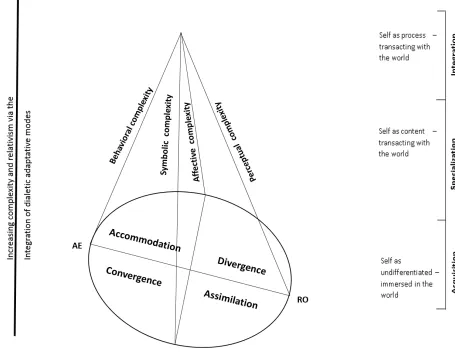
a mental dimension. Kolb’s learning style model states that learning is a combination of
experience, cognition, perception, and behavior. In all learning styles, learners use both a process
and content approach. The Kolb Model is defined and explained by a four-stage learning cycle.
The four stages of this learning cycle are: concrete experience (CE) reflective observation (RO),
abstract conceptualization (AC), and active experimentation (AE). The concrete experience is
followed by reflection on that experience (RO). Reflection on this experience is followed by the
development of general rules describing the experience which is called abstract conceptualization
(AC). AC may lead to the formation of ways of changing the occurrence of this experience which
is called active experimentation (AE).
According to Kolb, the developments of skills in all the four areas are required. The activities were
planned to improve the movement along with the cycle. A range of activities related with Kolb’s
learning styles are written in the following way:
CE – group work, seminars, wiki web-site;
RO – learning log, bulletin board;
AC – presentation, individual assignment, bulletin board; and
AE – bulletin board, seminars, wiki web-site
Learners with different learning styles in Kolb’s Model can be categorized as; assimilator,
accommodator, divergent, and convergent. All kinds of learners use any two of the learning stages
only out of four available stages (concrete experience (CE), reflective observation (RO), abstract
conceptualization (AC) and active experimentation (AE)). The Figure 2.3 displays all these
activities.
Figure 2.3: Kolb's Learning Styles
According to Kolb, “Learning through experiencing” is suitable for “concrete experience”;
“learning through observation” is suitable for “reflective observation”; “learning through thinking”
is suitable for “abstract conceptualization” and “learning by doing” is suitable for "active
experimentation”. The accommodator learning style includes concrete experience and active
experimentation. The individuals preferring this learning style learn by doing and feeling. They
like new experiences and planned work. The divergent learners are for individuals with high scores
in the areas of concrete experience and reflective observation. These individuals are capable of
assessing concrete events from different angles. The assimilator learners use abstract
conceptualization and reflective observation. The individuals bearing the characteristics of this