
International Journal of Emerging Technology and Advanced Engineering
Website: www.ijetae.com (ISSN 2250-2459, ISO 9001:2008 Certified Journal, Volume 9, Issue 10, October 2019)
A Survey on Secure and Energy Efficient Optimization
Methods in WSN
Sadhna K. Mishra
1, Vikram Rajpoot
2, Priya
31
Prof. & Head, 2Assistant Professor, 3Research Scholar, Department of CSE, LNCT Bhopal (M.P.), India Abstract—A wireless sensor networks (WSN) consists of
spatially distributed autonomous sensors nodes called motes. WSN are information-driven, various levelled, are put together and with respect to request directing conventions. The WSN application requires a gathering of explicit sensors, and compelling powerful utilization of vitality requires successful steering conventions. The cluster based protocols are most suitable in terms of energy efficiency This work defines the difficult problem in WSN & also offers optimization methods applicable to solving these problems. Details of how to apply technology in WSN are also given. Comparative analysis also given on optimization methods
Keywords—Wireless sensor network, Optimization techniques, Energy-efficient proptocol, Security.
I. INTRODUCTION
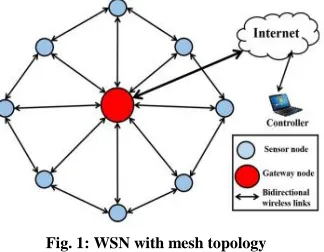
[image:1.612.90.252.540.666.2](WSN) Wireless sensor networks have at least one gateway hubs (focal controllers) and a few sensor hubs that are in different places. Every sensor hub has sensor by capacity for screen a particular type of circumstances for example: - temperature, pressure, noise levels, and so forth [1]. A remote sensor area system is unique. It collects natural information and continues to be the gateway to transmitted data to the next location. For example, many facts that can be used to create WSNs - a star or mesh [Picture 1] Topology and multi-hop wireless mesh topology [3].
Fig. 1: WSN with mesh topology
Cluster head & BS data collection requires the optimization of WSNs for secure data transmission. Data forwarding is done when forwarding data to each router. Due to employing energy-efficient nodes for data
Therefore, the integration process in WSN should be optimized in an energy efficient manner. Cluster head and base station have some computational techniques to implement aggregation. Sensors can be compromised in various places, and compromise can be taken by opponents. During the data collection process the incorrect data entry in the sock by the wrong, it takes the wrong decision at the base station (BS). The simplest average data collection process is fitting in an unmanned environment. So, filter the wrong data during attack-insistent data collection. For each round of data, the behaviour of aggregation nodes should be monitored. Thus, the consequences of the contribution of the attack will be easy to reduce. Trust secured data aggregation saved Algorithm (TESDA) [4] to secure data collection process with reliable estimates. The data collection process is optimized by the combination of energy efficiently through clustering.
In this paper Portion II present the associated effort; portion III defines main requirements of energy efficient routing. Section IV gives detailed analysis on optimization techniques, Section V Comparison of optimization Section VI describes conclusion.
II. LITERATURE SURVEY
A. Alarifi and A. Tolba [2019] In this examination, CIoT was involved in a specific process to strengthen the sensor network interaction quality. Clustering-based CIoT-aided WSN better network execution after some another non-clustering strategy which bargains with few network factors like residual energy and overhead. AQL is a learning methodology that sees the hubs like the header inside the groups for selection of forwarder outside the cluster. This strategy works in two unique steps, which reduce the difference among overhead and energy efficiency. For lessen the difficulty of the calculation, the choice of the header depended on preference as opposed to the selection,
which required extra transmission. So as to offset
International Journal of Emerging Technology and Advanced Engineering
Website: www.ijetae.com (ISSN 2250-2459, ISO 9001:2008 Certified Journal, Volume 9, Issue 10, October 2019) Pratik Goswami et al. [2019] a vitality productive and
dynamic bunch advancement technique is arranged. Group development is the first and the standard requirement for any WSN the proposed strategy in our work is mix of Firefly calculation and Hierarchical Maximum Likelihood (HML) for an Optical Wireless Sensor Network (OWSN). It utilizes the one of kind resource of Firefly calculation and kills its issue by showing HML. As a result, the parameters of the system change in connection to the
prerequisite of appropriate position of hubs. Power
distribution is additionally done effectively in the nodes because HML works on the property of the most extreme possibility. This implies the nodes are activated when they are chosen dependent on the nearest price of the source node from a cluster. Cost function also became minimal [6].
S. Kaur and R. Mahajan [2018] Present a crossover convention that utilizes grouping, ACOPSO built bunching convention for WSN. This sensor parcels the system into a few portions, along these lines bunch and group heads are chosen in each bunch. By then, tree-based data amassing comes in the activity and accumulates affectability data clearly from the group heads utilizing short-separate correspondence. ACOPSO evaluates the littlest course between customization sinks and bunch heads. The utilization of compressive detecting lessens the degree of the bundle which will be communicated in the sensor organize. The MATLAB reproduction apparatus is utilized for recreation purposes. It evaluates the execution of the proposed strategy, in which the present method for example GSTEB is on the going with lattice for instance, throughput with time of dependability, organize life, lingering vitality (normal equalization vitality), and 100 sensor hubs. Distinctive parameters for reproduction have been improved with GSTEB. Sensors passed on discretionarily in a 100 zone with base station at (50 meters, 50 meters). Exhaustive examination exhibit that the crossover convention updates the system life by sensor systems, right now protecting vitality more effectively than different conventions. [7].
Amanjot Singh Toora and A.K. Jain [2018] Propose the idea of a novel about versatile sensor hubs has been proposed, which has been chosen for the various levelled heterogeneous WSNs dependent on the Mobile Energy Aware Cluster-based Multi-Hop (MEACBM) steering convention which chooses CHS dependent on the recently proposed likelihood condition Is: just chooses that sensor hub as a group head (CH), in which the new sensor S (I) in the condition will begin with the most astounding sensor hubs Energy happens.
This sensor thinks about the three dimensions of hubs as progressive odd groups; Inter-bunch correspondence and availability sensor hubs inside the whole system zone are very anticipated. In MEACBM, after the making of sensor hubs and the arrangement of groups, the whole system region is partitioned into divisions and a portable sensor hub is set inside every area, which will be gathered from the versatile information authority (MDC) fills in as information from CHs. This system is helpful in diminishing the vitality utilization of sensor hubs to trade information to the BS. Re-enactment execution based outcomes demonstrates the feasibility of the MEACBM directing convention contrasted with the system's lifetime, strength, stream, number of CHS and other contemporary group based steering conventions regarding number of dead hubs [8].
Ziwei Yan et al. [2018] examine an optical remote sensor arrange that joins remote sensor systems with optical correspondence innovation. We use vector quantization to locate the dynamic hubs in helpful correspondence and concentrate the execution parameters of the general system. The scientific examination is at first completed for computing the hub positions relying upon their detecting yields with vitality recognition. The re-enactment results are given an examination of hypothetical and reproduced approach of our proposed technique. The proposed plan can adequately take care of the issue of examining the power effectiveness of customary remote sensor organizes, and decrease vitality utilization, while giving rapid information transmission and secure correspondence joins for optical correspondence [9].
Kabakulak [2018] WSN proposes a mixed integer linear
programming (MILP) model to boost the quantity of time-periods to achieve the ideal tasks with constrained energy & budget. Our sink & sensor arrangement is the first in routing writing with the Scheduling, Connected Coverage (SPSRC) demonstrate, which consolidates the choice of sync and sensor areas, action calendars of stationed sensors & information flow routes from every active sensor. Allocated Sync for Network-Related Coverage on Finite Planning Horizon. The issue is NP-hard and it is difficult to illuminate notwithstanding for little occasions. Excepting that sink areas are known, we create succession that makes an answer for the issue, which can step by step fulfil the obstacles. At that point, we offer search related statistics to decide the areas of the sink to boost the life of the
network. Computational tests demonstrate that our
International Journal of Emerging Technology and Advanced Engineering
Website: www.ijetae.com (ISSN 2250-2459, ISO 9001:2008 Certified Journal, Volume 9, Issue 10, October 2019) Arcangelo Castiglione et al. [2015] present an expository
vitality display for secure correspondence among multimode terminals. This model portrays the vitality utilization of versatile terminals working inside a dynamic system situation, considering both their interconnection and secure information trade issues, so as to create versatile
methodologies for vitality effective secure
correspondences. At long last, the model has been approved through recreation [11].
Yifan Lu et al. [2012] Propose a novel Trust Assessment Model to upgrade Information Security in WSNs. Under our structure, each hub processes the assessment of the confidence of its 1-bounce neighbours, which depends on their different conduct evaluation, which is not prerequisite when learning about the typical / traded sensor practices. And trusts the authorities. Apart from this, our plan application is cordial, which can be used to organize many parts of the sensor and build safe steering. In our protected steering, in addition to security, high life force productivity is considered. The reassessment results show that in order to provide information, it can circumvent most bargaining centres in the broadcast route [12].
Bo Sun et al. [2006] We recommend you propose another square figure, in light of Linear Conservative Generator (LCG), which is sensible to make a basic secure convention for the asset struck WSN. With the end goal of the content, our development square is viewed as sheltered if the assailant cannot get the phony irregular numbers delivered by LCC. LCD plasma figuring 17with obscure ideas proposes that it is hard to build security in its system by building up the estimation of modules. Along these lines, we were inspired to duplicate messages utilizing security information with security information messages. In particular, the security of our endorsed safe range, including unregistered voice and uncontrolled requests, brings unique information messages. We help the body and twofold to choose authentic parameters used to LCC. Our figure inquiry demonstrates that this remote sensor can arrange security prerequisites. We likewise demonstrate that the security conventions we rely upon our proposed figure meet the essential security prerequisites: information protection, validness, and a little cerebral pain. The execution examination exhibits that the particular square figure is excessively slim than the RC5, the estimation of the base capacity, the normally utilized figure in the remote sensor arrange [13].
III. MAIN REQUIREMENTS OF ENERGY EFFICIENT
ROUTING IN WSN
A routing protocol(RP) is a calculation that show how to
It uses no less than one measurements, for instance: - geographic area, number of bounces, conveyance delay and so forth. The crucial WSN steering convention prerequisites are [14]:
Energy efficiency: A RP is required to adapt to hub rest and limit the likelihood of overhead identified with conceivable inquiry and course the executives. Flexibility: A protocol ought to have the capacity to
withstand entering or leaving hubs (eg, dead hubs or new hubs) in the system and adapt to the terms of the connection (Forster, 2016).
Master & amp; Routing is very high through link layer protocols. Quality connectivity is incredibly weak - more stringent connections; Steering convention is good. Albeit numerous conventions proposed in the writing lessen vitality utilization on sending ways to expand vitality proficiency, they don't really stretch out system lifetime due to the nonstop many-to-one traffic design [15].
IV. OPTIMIZATION IN WSN
A.Need of Optimization
Optimization is process of creating a perfect design, suitable for functional as required. Optimum means maximum or minimum for certain factors which related with various applications. Network optimization is needed for achieving desired goals as minimize energy consumption & maximize network lifetime. In WSN network lifetime, security, energy consumption and node deployment are some challenges for routing [16].
B.Significant Study of the Optimization Methods
In WSNs various optimization methods are used for increase the network lifetime and enhance the security. The methods are defined as following [17]:
1)Genetic Algorithm (GA) for Clustering
International Journal of Emerging Technology and Advanced Engineering
Website: www.ijetae.com (ISSN 2250-2459, ISO 9001:2008 Certified Journal, Volume 9, Issue 10, October 2019) The Authority CH will be the leader of the get together
with the most unmistakable survival power, and it is seen at the gathering of CHs. [18]
2)Clustering Using Bacterial Foraging Optimization (BFO)
In [19], the initial phase is to present microorganisms arbitrarily. There are some pairs of CHCs in the bacteria. In chemotaxis, the CH position appears as hub ID and the system of 2D is refreshed. The next herd depends on the situation. At that point microscopic animals are requested to depend on wellness. The best 50% of microscopic organisms are transported to the lower half of the population so that they can be promoted. The most vulnerable micro-organisms can be erased and again new bacteria are produced with new hubs. Here, in the welfare work, the outstanding life force of CH, separation of inter-bunch and separation from CH to BS is included.
3)Routing Using Bacterial Foraging Optimization (BFO)
Right part of bat produces bacteria. For directing, each bacterial estimate is similar to the amount of CHS and for BS, one condition is additionally included. After this, the mapping limit is associated with choosing the following bounce for BS. The following jump in the welfare work for the wireless sensor for directing include the Euclidean separation between the remaining life force and the CUL and the following jump from BS. [19]
4)Artificial Bee Colony (ABC) Optimization for Clustering In [20], ABC count is utilized to make the perfect CH list. As a matter of first importance, the sensor offers a "Howdy" group. Because of accepting the reasonable message, every sensor centre point(CP) has a neighbour’s table with the ID of the sensor from which the message is sent and the RSSI regard. Legitimately, centre points send their IDs, neighbouring table data, & holding up necessities of BS. BS presently makes the CH list utilizing the circumstance. Centre with more required dimension than Limit Esteem is only qualified as CH. After the advancement of the CH list, the gathering is trusted based on RSS gauges. Up to that point, welfare is settled. Presently, in a remote, ABC Count is hurried to locate the best CH between Randan. That is the right number of CHS looks on them in the store. TDMA spaces are utilized to send information from the CP to the CHS. Information is facilitated with BS utilizing the CDMA Mac custom. Here, the welfare work expects the youthfulness proportion of CH which ought to could easily compare to the limit. To expend less impulse, the measure of CH ought to be limited.
5)Routing Using PSO and V-LEACH
LEACH is the upgrade of the conference. In the V-LEACH, a bad habit CH is grouped up. In a group that has a head, one obstruction from it, by then, the expansion of the bad habits CH system and another bunch changes into the head. In [6], the head of a group is given the shape of each bunch whose control is more than the edge. One of the improvements in the bunch system is in a target less form, by then a group can have a large number of hubs, while the other may have new hubs. To keep an important separation from this issue, the molecule flock increase (PSO) technique is used to execute the same grouping. After the actions of the groups, the life force dimension of CHS hub is trusted. Since CH is eating more vitality to broadcast information to the BS, the hub can be passed sooner or later. By then, when CH hits the bucket, at that point the bad habit accepts accountability for the major CH and continues with the broadcast through special hub.
6)Firefly Algorithm (FA) for Routing
In [21], the zunjun count can be used to select courses from CH to BS in each group. Above all, the fireworks have been presented. Here, every Firefly(F) displays courses from CH to BS. The component of the F is comparable to the amount of BS & CH, it is a condition that for every repeat, with less glow, the firefly moves towards the magnificent firefly & the condition of every F is fresh. The procedure is restarted for most extreme ages. Use of welfare work is the sluggish life force of the following boom, the following jump hub ratio for Euclidean separation, & BS for the following jump from CH, is the quantity of individuals from CH-Next-bounce.
7)Ant Colony Optimization Attack Detection (ACO-AD)
International Journal of Emerging Technology and Advanced Engineering
Website: www.ijetae.com (ISSN 2250-2459, ISO 9001:2008 Certified Journal, Volume 9, Issue 10, October 2019) ACO calculations should be sorted for the hub ID of the
fresh course bundle with standard accumulation. The hub contains a summary of the suspicious hub. To see the gate cases, keep the acknowledgment motor alert in order to hub each other. In the end, the strike has been recognized, at that point every caution holds a set for the hub clock that the amount of attack of the period appears in the suspicious list.
8)Firefly Algorithm (FA) for Node Localization
[23] FA are understanding true location of the SN, which has been surveyed through DV-jump figurines. In any case, present the fireplace meeting. By then, find out the wellness of a person and update the fluorescent expense. Each person determines a person for the area whose fluorescence relationship is not as much as the broom of his choice. By then, a moving possibility of a person is resolved in the field set. Individuals have to move forward for the most extreme advance prospects. By then the area of fireflies and decisions are extended, the method is followed until you get a good welfare relationship. Wellness work is a division between an unknown hub or a perfect hub.
[image:5.612.315.574.135.531.2] [image:5.612.39.302.437.732.2]V. VARIOUS OPTIMIZATION TECHNIQUES Table 1:
Different optimization methods on various parameters [24]
Parame ters
ACO PSO GA FFO
Represe ntation
Undirect ed Graph
Dimensions for vector position and speed
In binary form as 0’s and 1’s, random variables
Attractio n on basis of distance r Operat ors Pherom one updates and trial evaporat ion
Initial values updates and evaluation.
Selection, crossover , mutation Light Intensity, attraction Control Parame ters
number of ants, iteration s, pherom one evaporat ion rate Particles position, number of particles, Range, weight, number of iterations
Populatio n size, selection procedure , crossover and mutation probabilit y, chromoso mes, Attractio n of fireflies, light intensity Node Deploy ment Nodes deploye d in
Centralized nodes deployment
Random as well as determini
Nodes deployed in
ed nature, used in dynamic applicati ons
determine local best and global best position.
deployme nt
manner
Clusteri ng and routing
Find shortest path from source to destinati on and data transmis sion better
Select higher energy nodes as CHs in every round and find optimal path Reduce communi cation distance with formation of number of predefine d clusters
Select nodes in Cluster on basis of distance
Advant ages
1.Can be used in dynamic applicati ons 2.Better for travellin g salesma n problem
1. It
determines lbest and gbest position. 2. Inherently continuous, no
overlapping and mutation calculation
1. Handle complex problems and parallelis m 2. discrete
1. Effective in multi objective optimizat ion
Disadva ntages
1. Local search is not sufficien t 2. Consum e large amount of energy if more number of paths.
1.It cannot work well for scattering and optimizing 2. Not work well for noncoordinate system
1. Dynamic data sets difficult to operate
1. It works only for randomly deployed nodes.
VI. CONCLUSION
WSN has turnout to be the key advancements in the decade. Energy conservation and safety in the elderly of the WSN is a foremost challenge. In WSN, here few difficult issues which does not be explained into appropriate period. difficult issues should be explained with the help of optimization methods. This paper noticeably portrays the utilization of various optimization methods into area of WSNS.
REFERENCES
[1] Sulieman, N. I., & Gitlin, R. D. (2018). Ultra-reliable and energy efficient wireless sensor networks. 2018 IEEE 19th Wireless and Microwave Technology Conference (WAMICON), pp. 1-4. [2] A. Nayak and I. Stojmenovic, Wireless Sensor and Actuator
International Journal of Emerging Technology and Advanced Engineering
Website: www.ijetae.com (ISSN 2250-2459, ISO 9001:2008 Certified Journal, Volume 9, Issue 10, October 2019)
[3] I. F. Akyildiz, W. Su, Y. Sankarasubramaniam, and E. Cayirci, “Wireless sensor networks: a survey,” Computer Networks journal (Elsevier), 38:393–422, 2002.
[4] Padmaja, P., & Marutheswar, G. V. (2018). Energy efficient data aggregation in wireless sensor networks. Materials Today: Proceedings, 5(1), 388–396.
[5] Alarifi, A., & Tolba, A. (2019). Optimizing the network energy of cloud assisted internet of things by using the adaptive neural learning approach in wireless sensor networks. Computers in Industry, 106, 133–141.
[6] Goswami, P., Yan, Z., Mukherjee, A., Yang, L., Routray, S., & Palai, G. (2019). An Energy Efficient Clustering using Firefly and HML for Optical Wireless Sensor Network. Optik, pp. 1-9. [7] Kaur, S., & Mahajan, R. (2018). Hybrid meta-heuristic optimization
based energy efficient protocol for wireless sensor networks. Egyptian Informatics Journal, pp. 1-6.
[8] Toor, A. S., & Jain, A. K. (2019). Energy Aware Cluster Based Multi-hop Energy Efficient Routing Protocol using Multiple Mobile Nodes (MEACBM) in Wireless Sensor Networks. AEU - International Journal of Electronics and Communications, pp. 1-37. [9] Ziwei, Y., Amrit, M., Lixia, Y., Sidheswar, R., & G, P. (2018).
Energy-efficient node positioning in optical wireless sensor networks. Optik, pp. 1-11.
[10] Kabakulak, B. (2018). Sensor and Sink Placement, Scheduling and Routing Algorithms for Connected Coverage of Wireless Sensor Networks. Ad Hoc Networks, pp. 83-102.
[11] Castiglione, A., Palmieri, F., Fiore, U., Castiglione, A., & De Santis, A. (2015). Modeling energy-efficient secure communications in multi-mode wireless mobile devices. Journal of Computer and System Sciences, 81(8), 1464–1478.
[12] Lu, Y., Lin, K., & Li, K. (2012). Trust Evaluation Model against Insider Attack in Wireless Sensor Networks. 2012 Second International Conference on Cloud and Green Computing, pp. 319-326.
[13] Sun, B., Li, C.-C., Wu, K., & Xiao, Y. (2006). A lightweight secure protocol for wireless sensor networks. Computer Communications, 29(13-14), 2556–2568.
[14] Banđur, Đ., Jakšić, B., Banđur, M., & Jović, S. (2019). An analysis of energy efficiency in Wireless Sensor Networks (WSNs) applied in smart agriculture. Computers and Electronics in Agriculture, 156, 500–507.
[15] Gupta, I., & Daniel, A. K. (2013). An Energy-Efficient Position Based Clustering Protocol for Wireless Sensor Network Using Round Robin Scheduling Technique. 2013 Third International Conference on Advanced Computing and Communication Technologies (ACCT), pp. 231-235.
[16] [11]. Dinesh Kumar, Prabhjot singh sandhu “Wireless Sensor Network Optimization” International Journal of Engineering and Computer Science Sep 2015.
[17] Parwekar, P., Rodda, S., & Kalla, N. (2018). A Study of the Optimization Techniques for Wireless Sensor Networks (WSNs). Information Systems Design and Intelligent Applications, 909–915. [18] 5. L. Aziz, S. Raghay, H. Aznaoui, A. Jamali. “A new approach
based on a genetic algorithm and an agent cluster head to optimize energy in Wireless Sensor Networks.” 2016 International Conference on Information Technology for Organizations Development (IT4OD), Fez, 2016: pp. 1–5.
[19] P. Lalwani, S. Das. “Bacterial Foraging Optimization Algorithm for CH selection and routing in wireless sensor networks.” 2016 3rd International Conference on Recent Advances in Information Technology (RAIT), Dhanbad, 2016: pp. 95–100.
[20] A.A.Abba Ari, A. Gueroui, B. O. Yenke, N. Labraoui. “Energy efficient clustering algorithm for Wireless Sensor Networks using the ABC metaheuristic.” 2016 International Conference on Computer Communication and Informatics (ICCCI), Coimbatore, 2016: pp. 1–6.
[21] P. Lalwani, I. Ganguli, H. Banka. “FARW: Firefly algorithm for Routing in wireless sensor networks.” 2016 3rd International Conference on Recent Advances in Information Technology (RAIT), Dhanbad, 2016: pp. 248–252.
[22] 8. Rakesh Kumar Yadav, Akshita Kapila, Deepa Arora. “Analysis Geographic Routing Protocol using Ant Colony Optimization Technique for WSNs.” International Journal of Innovations & Advancement in Computer Science (IJIACS), 2016: pp. 34–37. [23] 9. Bingnan Pei, Hao Zhang, Tengda Pei, H. Wang. “Firefly
algorithm optimization based WSN localization algorithm.” 2015 International Conference on Information and Communications Technologies (ICT 2015), Xi’an, 2015: pp. 1–5.
![Table 1: Different optimization methods on various parameters [24]](https://thumb-us.123doks.com/thumbv2/123dok_us/8676589.873614/5.612.39.302.437.732/table-different-optimization-methods-various-parameters.webp)
