Analysis
of Ergonomics
Workstation Layout Design Using
Analytical Hierarchy Process
Hartomo" Iand Zahari Taha2 Center for Product Design and Manufacturing Department of Engineering Design and Manufacture
Faculty of Engineering, University of Malaya 50603 Kuala Lumpur Malaysia
Email: hartomo({Vfiiuii.ac.id.hartomo(iVperdana.um.edu.nnl
zahari tahaimum.edu.m,l Phone: 603 79675369 Emy Dwi Hastutiningsih Industrial Engineering Department
Faculty of Industrial Technology
Islamic University of Indonesia Yogyakarta Indonesia
Abstract. Ergonomic workstation isan important component in a production line. Poor layout design of a workstation can have an adverse effect on a worker's performance. This paper presents a method for analyzing the layout design of a workstation using the Analytical Hierarchy Process (A HP). Three criterias and several sub criteria were identified. The criterions are the easiness of motion which consists of three sub criterions-working areas, position of tools, position of material; the comfort of work which consists of four sub criterions-temperature, light, working position, noise; and safety which consists of three sub criterions-safety, dust, smell. A case study was conducted on an assembly workstation of a furniture manufacturer with three alternative layout designs. The result shows that the best layout for assembly is
where the worker feels comfortable in completing the task.
Key word: Workstation, Layout design, Ergonomics, AHP, Performance, Comfort.
1.
INTRODUCTION
An ergonomic workstation is an important component in a production line. Poor layout designs of a workstation can have an adverse effect on a worker's performance. Thus there is a need for a proper layout design of workstation that can reduce these effects.
Alternatives of the layout design can be developed based on ergonomics principles. The determination of the best design at the early design stage is a crucial decision. The selection of the most appropriate design is important because an improper design can never be compensated for by a good detailed design and will incur great expense of redesign cost (Hsu and Woon, 1998) and (Zhang et aI., 2006). Therefore, selecting the best design is not an easy task and is the most critical stage in layout design development due to the many factors influencing the selection that need to be considered (Hambali et ai, 2009).
There are many different methods to evaluate and select the layout of an ergonomics workstation. Each method has its strength and weakness. This study is going to focus on one method, called analytical hierarchy process (AHP).
The use of AHP for evaluating and selection has been studied by many authors. Yang and Kuo (2003) and Ertay et al. (2006) proposed a combined AHP-DEA approach to solve the facility layout design problem.
Rajhans and Ahuja (2005) suggested the use of Analytic Hierarchy Process for analyzing the parameters involved in
layout and relayout decisions. The multiple criteria selected for each of the major factors, flexibility, batch size, cost and accessibility for maintenance are chosen based on the case study undertaken. Unfortunately, there are only few studies that have been done to investigate the layout design of workstation involving ergonomics aspect. They only focused on plant layout.
The objective of this study is to analyze the layout design of an ergonomic workstation using the Analytical Hierarchy Process (AHP).
2.
ANALITICAL HIERACHY PROCESS
The Analytical Hierarchy Process (AHP) is a decision-aiding method developed by Saaty (1980; 1985; 1990; 1991). It aims at quantifying relative priorities for a given set of alternatives on a ratio scale, based on the judgment of the decision maker, and stresses the importance of the intuitive judgments of a decision-maker as well as the consistency of the comparison of alternatives in the decision-making process (Saaty. 1980).
Saaty (1980; 1985; 1990; 1991) developed the following steps for applying the AHP:
I. Define the problem and determine its goal.
the lowest level which usually contains the list of alternatives.
3. Construct a set of pair-wise comparison matrices (size
n x n) for each of the lower levels with one matrix for each element in the level immediately above by using the relative scale measurement shown in Table l. The pair-wise comparisons are done in terms of which element dominates the other.
4. There aren(n - l);judgments required to develop the set of matrices in step 3. Reciprocals are automatically as' igned in each pair-wise comparison.
5. H ....rarchical synthesis is now used to weight the eigenvectors by the weights of the criteria and the sum is taken over all weighted eigenvector entries corresponding to those in the next lower level of the hi' archy.
6. H - ing made all the pair-wise comparisons. the consistency is determined by using the eigenvalue, A.m axe to calculate the consistency index, CI as follows: CI =
(!..max- n)/(n - I), where n is the matrix size. Judgment consistency can be checked by taking the consistency ratio (CR) of CI with the appropriate value in Table 2. The CR is acceptable, if it does not exceed 0.10. If it is
mon ,the judgment matrix is inconsistent. To obtain a con istent matrix, judgments should be reviewed and improved.
7. Step 3 - 6 are performed for all levels in the hierarchy. Table I. Pair-wise comparison scale for AHP preferences
(Saaty, 1980; 1985; 1990; 1991)
N umerica1 rating Verbal judgments of preferences 9
8 7 6
5
4 3 2 I
Extremely preferred Very strongly to extremely Very strongly preferred Strongly to very strongly Strongly preferred Moderately to strongly Moderately preferred Equally to moderately Equally preferred
Table 2. Average random consistency (RI) (Saaty, 1980; 1985; 1990; 1991)
Size of matrix . 1 2 3 4 6 7 8 9 10
Random consistency 0 0 0.580.9 1.12 1.24 1.32 1.41 lAS 1.49
3. METHOD OF RESEARCH
The study was conducted at Furniture Manufacturing Company on an assembly workstation. A survey was conducted to identify factors that affect comfort during work at the assembly workstation. Then a hierarchical structure was developed based on questionnaire distributed to the worker consisting of criteria and sub criteria. Twelve assembling male worker participated in survey. They were
between 23 to 30 years old. Three alternatives for an ergonomics workstation were developed. The data was processed using AHP to determine the weight of each criterion and sub criteria.
4. RESULT
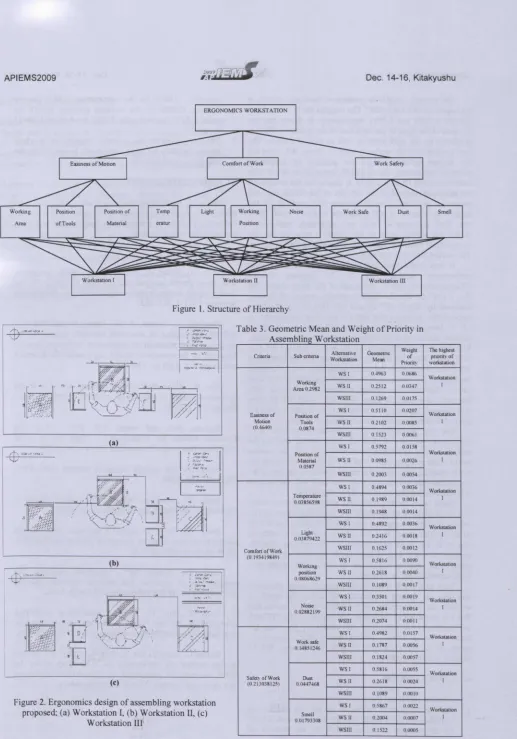
Figure I describes the hierarchical structure comprising of four levels. The levels are as follows:
Level 0: Objective. This level presents the target achieved that an ergonomics workstation.
Level I: Criteria. This level describes some factors that affect achieving the target or objective. The three factors identified are easiness of motion, comfort of work, and work safety.
Level 2: Sub criteria. Level 2 presents factors affecting the criteria. These comprises of position of tools. position of materials, temperature, light, working position, noise, work safe, dust, and smell. Level 3: Decision Alternatives. This level contain of three
alternatives of the ergonomics workstation design proposed. These are workstation I, workstation II and workstation III each aving different layout characteristic.
Figure 2 shows the different layout of each workstation. They contain five components which are the main materials (A), assembling area (B), bin (C)"supporting material (D), and tools/equipments (E). Layout or workstation I (Figure2 (a» is such that the main material and supporting material are located on the left of the worker. While the bin and equipments/tools are located on the right of the worker. The worker completes the task in a squat and bends position. The temperature at the workstation is 24 degrees Celsius.
Figure 2 (b) shows the layout of workstation II where the main material is located on the left of the worker. The bin, supporting material and tools/equipments are located on the right of the worker. The worker completes the task in a squatting position. The temperature at the workstation is 25 degrees Celsius. Figure 2 (c) describes the layout of workstation III. The main material, supporting material, and tools/equipment are located on the left of the worker. The bin is located on the right of the worker. The worker completes the task in bending position. The temperature at the workstation is 26 degrees Celsius. For all the workstation design, the assembly area is located in front of the worker.
Table 3 shows the final results of AHP which are the priority weights of each proposed ergonomics workstation. The weights are the results of multiplying the geometric means of the criteria, sub criteria and alternative workstation. The workstation that has the highest priority weight is the best workstation from an ergonomically point of view.
5. DISCUSSION
ERGONOMICS WORKSTATION
Figure I. Structure of Hierarchy
~ .;>OII'!:.).~
.'_;'u.(>..' { ;;~.": •• ' """f0l><'
,; .",4'« •
• ~~'A'«:~
-,l./
(a)
I
l__
~~~,l ",,...,'
.;;~:,J .... 'Jo.'., '"
,~.~
(b)
" ~Y'~.:;,>¥
c :..<\'~q:'
I .:.'~.'...._,
,!~':;::.~
--_._---_.."
... ,",
r,..·
'1\~
'''''''''''''=,''',~,-?'"
\.\)., r-O\ !/
'\ ..' '(,j-'ft-!
(c)
Figure 2. Ergonomics design of assembling workstation proposed; (a) Workstation I, (b) Workstation II, (c)
Workstation III
Table 3. Geometric Mean and Weight of Priority in
AssemblimgWor stationk
Alternative Geometric Weight The highest Criteria Sub criteria
Workstation Meon of priority of Priority workstation
WSI 0,4%3 0.0686
Workstation Working
WSll 0.2512 0.0347 I Area 0.2982
WSlll 0.1269 0.0175
WSI 0.5110 0.0207
Workstation Easiness of Position of
Motion Tools WSll 0.2102 0.0085 I (04640) 0.OS74
WSlll 0.1523 O,DOGI
WSI 0.5792 0.0158
Position of Workstation
Material WSll 0.0985 0.0026 I 0.0587
WSlll 0.2003 0.0054
WSI 0.4894 0.0036
Workstation Temperature
WSll O,I9R9 0.0014 I
0.03856598
WSlll O.I94R 0.0014
WSI O.4S92 0.0036
Workstation Light
WSll 0.2416 0.0018 I 0.OJR79422
Comfort ofWark WSlll 0.1625 O.OOI~ (0.193419849) WSI
0.5816 0.0090
Working Workstation
position WSIl O.261S O.(X)40 I 0.OKOGK629
WSlll 0.1089 O.O(H7
WSI f).3501 0.0019
Workstation Noise
WSll 0.2684 0.0014 I 0.02882199
WSIlI 0.2074 0.0011
WSI 0.49R2 0.0157
Workstation Work safe
WSll 0.1787 0.0056 I
o.M851~46
WSlll 0.IS2~ 0.0057
WSI 0.5816 0.0055
Workstation Safctv of Work Dust
WSII 0.2618 0.0024 I (0.213038125) O.0447~68
WSIlI 0.IOS9 O.(KJlO
WSI 0.5867 O.()O22
Workstation Smell WSII
0.2004 0.0007 I 0.01793308
The priority weight for position of tools sub criteria is the higest for WS I at 0.0207. The weights for WS II and WS lITI are 0.0085 and 0.0061 respectively. It shows that the location of the tools in the right side of the worker in WS I is reachable by the right hand as well as ease of motion. The tool position is in the worker's reach of 30 em, WS I also has the highest priority weight for position of supporting materilal sub criteria, that is 0.0158, followed by WS II with 0.0026 and WS III with 0.0054. It shows that the location of the suporting material on the left side of the worker does not presen a problem. This is because the position of the suppor ing material is still within the worker's reach of 30 em. BNh positions of tools and supporting materials is within the normal reach of the worker's hand so that the worker. feels more comfortable when reaching for the object. The w _rker also does not need to twist the body.
It was found that worker poductivity increases with temperature between 24 to 27 degrees Celsius (Wignjosoebroto, 1995). The result of the study shows that WS I (240 C) has the highest priority weight of 0.0036,
followed by WS II (250 C) and WS III (260 C) of 0.0014
respectively. It means that WS I is the most comfortable at 240 C. Increasing the temperature will make the condition
become armer causing discomfort. On the light sub criteria, WS I has the highest priority weight of 0.0036 while WS II is 0.0018 and WS III is 0.0012. This means that the lighting of WS I was identified as the most comfortable. This is beacuse the lighting did not come from the artificial sources but from natural lighting. The worker recieved the artificial light indirectly thus reducing glare. With WS II and WS III there is no natural lighting. The artificial light produces a higher glare. A higher glare can cause eye fatigue or strain.
The work position also affects the comfort at work. WS I has priori weigth of 0.0090 which the worker perform the task in a 'stoop and squat position. For WS II, the worker works while stooping only. And in WS III, the worker works while squating only. Both will cause increasing fatigue of the musculoskeletal system especially the back and legs because it is monotonous and repetitive for a long period.
Noise is an another factor that affects comfort at work. The result of the AHP identified WS I with the higest priority weight of 0.0019 compared with WS II (0.0014) and WS III (0.0011). This shows that WS I has a low level of noise so that it is the most comfortable for the worker. Besides comfort at work, high dosage noise for long periods will result with negative impact on the safety and health of a work espesially on the hearing.
Dust and smell come from materials being processed and also the outside component will affect the health of workers due to incresing air pollution. Table 3 shows that WS I is identified as the safest. The priority weight of each sub criteria (work safe, dust, and smell) for WS I are the highest that, is 0.0157, 0.0055 and 0.0022 respectivelly compared to WS II (0.0056, 0.0024, 0.0007) and WS III (0.0057, 0.0010.0.0005).
6. CONCLUSSION
It can be concluded that:
1. The highest priority weight for all the sub criterions is workstation I with 0.0686 for the working area, 0.0207 for the position of tools, 0.0158 for the position of
material, 0.0036 for the temperature, 0.0036 for the lighting, 0.0090 for the working position, 0.0019 for noise, 0.0157 for work safe, 0.0055 for dust, and 0.0022 for smell.
2. The best layout for the assembly workstation is where the worker feels the most comfortable in completing the task that is workstation 1.
ACKNOWLEDGEMENT
We wish to acknowledge all of our participants who made this possible. Thanks to Islamic University of Indonesia Yogyakarta Indonesia for funding this project as well as University of Malaya.
REFERENCES
Ertay, T., Ruan, D., Tuzkaya, U.R., 2006. Integrating data envelopment analysis and analytic hierarchy for the facility layout design in manufacturing systems. Information Sciences 176 (3), 237-262.
Hambali, A., Sapuan, S. M., Ismail, N. and Nukman, Y.2009. Application of analytical htharchy process in the design concept selection of automotive composite bumper beam during the conceptual design stage. Scientific Research and Essay Vol. 4 (4) pp. 198-211
Hsu W, Woon IMY (1998). Current research in the conceptual design of mechanical products. Computer-Aided Design. 30: 377-389.
Rajhans, N.R. and Ahuja, B.B. 2005. Analyzing Decision Factors for Redesigning a Plant Layout using Analytical Hierarchical Processing. IE (I) Journal (86).
Saaty TL. The analytic hierarchy process. New York: McGraw- Hill, 1980.
Saaty TL. Decision making for leaders. Belmont, California: Life Time Leaning Publications, 1985.
Saaty TL. How to make a decision: the analytic hierarchy process. Europea Journal of Operational Research, North-Holland 1990;48:9±26.
Saaty TL, Kearns KP . Analytical planning: the organization of systems. The analytic hierarchy process series 1991 ;vol. 4R WS PublicationsPittsburgh, USA.
Yang, T., Kuo, C., 2003. A hierarchical AHPIDEA methodology for the facilities layout design problem. European Journal of Operational Research 147 (1), 128-136.
AUTHOR BIOGRAPHIES
Zahari Taha is a Professor in Department of Engineering Design and Manufacture, Faculty of Engineering, University of Malaya, Malaysia. His research interests are in ergonomics, robotics, engineer design and manufacturing automation. His email addressiszaharitahaiii1um.<!du.my
Hartomo is a lecturer of Industrial Engineering Department, Faculty of Industrial Technology, Islamic University of Indonesia, Yogyakarta-Indonesia. Currently he is a PhD student in Department of Engineering Design and Manufacture, Faculty of Engineering, University of Malaya, Malaysia. His teaching and research interest are Industrial
Ergonomic Design. His email address is
hartomo((vJti.uii.ac.id; [email protected]