Video Based Reconstruction
and validating it within a
Telepresence context
Tobias William Duckworth
U
NIVERSITY OF
S
ALFORD
SCHOOL OFCOMPUTING, SCIENCE ANDENGINEERING
2013
This thesis is submitted in partial fulfilment of the requirements
Contents
0.1 Abstract . . . xii
1 Introduction 1 1.1 Communication and technology . . . 2
1.2 Capturing 3D models . . . 4
1.3 Motivation and setting . . . 6
1.4 Scope of this thesis . . . 9
1.4.1 Contributions . . . 10
1.4.2 Collaboration and this research . . . 11
1.4.3 Thesis overview . . . 12
2 Methodology 14 2.1 Setting . . . 15
2.2 Aim and Objectives . . . 15
2.2.1 Aim . . . 15
2.2.2 Objectives . . . 15
2.2.3 Research questions . . . 16
2.2.4 Hypotheses . . . 16
2.3 Research process . . . 17
2.3.1 Summary of research process . . . 17
2.3.2 Common practise . . . 18
2.3.3 Derivation of research process . . . 19
2.3.4 Literature review . . . 20
2.3.5 Prototyping and evaluation . . . 21
2.3.6 Interpretation . . . 25
2.3.7 Comparison to literature . . . 26
2.3.8 Conclusions and future research . . . 26
2.4 Experiments . . . 27
2.5 Evolution of the research . . . 29
2.5.1 Selecting an approach to 3D reconstruction . . . 29
2.5.2 Working with real data . . . 31
2.5.3 Focus on temporal quality . . . 33
CONTENTS iii
2.5.5 Evaluation for telepresence applications . . . 35
3 Background and Related work 37 3.1 Introduction . . . 38
3.2 Telepresence . . . 39
3.2.1 Telepresence and eye gaze . . . 39
3.2.2 Remote collaboration . . . 41
3.2.3 Remote collaboration and human modelling . . . 41
3.3 3D reconstruction approaches . . . 42
3.3.1 Active 3D reconstruction methods . . . 43
3.3.2 Passive 3D reconstruction methods (Image based modelling) 43 3.3.3 Single camera image based modelling . . . 44
3.3.4 Two camera (stereo) image based modelling . . . 45
3.3.5 Multiple camera image based modelling . . . 46
3.3.6 Volumetric modelling from multiple camera images . . . . 47
3.3.7 Surface reconstruction from multiple camera images . . . 49
3.3.8 Image based rendering . . . 53
3.3.9 Camera calibration . . . 53
3.4.1 Initial literature survey . . . 54
3.4.2 Pilot experiments . . . 56
3.4.3 EPVH implementation and development . . . 59
3.5 Conclusion . . . 60
4 Quality of 3D reconstruction 62 4.1 Research questions and hypotheses . . . 63
4.1.1 Hypotheses . . . 63
4.2 Qualities . . . 63
4.2.1 Spatial quality . . . 64
4.2.2 Visual quality . . . 66
4.2.3 Temporal quality . . . 67
4.2.4 Relationship between spatial, visual and temporal quality . 68 4.2.5 EPVH algorithm and quality . . . 69
4.2.6 Quality requirements for telepresence . . . 70
4.3 3D reconstruction system components impacting upon quality . . 71
4.3.1 Camera choice . . . 71
4.3.2 Camera placement . . . 73
CONTENTS v
4.3.4 Background segmentation . . . 76
4.3.5 Camera exposure and colour balance . . . 79
4.3.6 Reconstructed model transmission . . . 80
4.3.7 Experiment E1- Comparing the latency of an ICVE and video conference . . . 80
4.4 Temporal consistency of inputs and quality . . . 82
4.4.1 Experiment E2- Synchronization of images from multi-ple cameras to reconstruct a moving human . . . 83
4.4.2 Experiment E4 - Investigating the suitability of a soft-ware capture trigger in a 3D reconstruction system for telepresence . . . 87
4.5 Experiment E5- Whole frame period temporal inconsistency . . 90
4.5.1 Method . . . 91
4.5.2 Results . . . 92
4.5.3 Discussion . . . 103
4.6 Conclusion . . . 106
4.6.1 Quality measures and their relationship . . . 106
4.6.2 Impact of 3D reconstruction system components on quality 107 4.6.3 Temporal consistency of inputs . . . 108
5.1 Objectives and research questions . . . 111
5.2 Introduction . . . 111
5.2.1 Context . . . 112
5.3 Related Work . . . 113
5.4 Motivation and Scope of work . . . 115
5.5 EPVH Algorithm and primitives . . . 116
5.5.1 Camera Images and 2D primitives . . . 116
5.5.2 Silhouette cones and 3D primitives . . . 117
5.6 Implementation . . . 118
5.6.1 Methodology . . . 119
5.6.2 Inputs, outputs and data preparation . . . 119
5.6.3 Parallelisation . . . 120
5.7 Evaluation . . . 131
5.7.1 Methodology . . . 131
5.7.2 OpenCL vs OpenMP for parallel CPU execution . . . 133
5.8 Results . . . 134
5.8.1 Comparison with sequential EPVH . . . 134
5.8.2 Comparison with distributed EPVH . . . 134
CONTENTS vii
5.8.4 Comparison of OpenCL vs OpenMP performance . . . 142
5.8.5 R+-Tree optimisation results . . . 143
5.8.6 Evaluation using humans . . . 143
5.9 Discussion . . . 148
5.9.1 Comparison with sequential EPVH . . . 148
5.9.2 Comparison with distributed EPVH . . . 148
5.9.3 Evaluation of parallelisation . . . 148
5.9.4 OpenCL vs OpenMP for parallel CPU execution . . . 150
5.9.5 R+-Tree intersection . . . 151
5.9.6 Evaluation using humans . . . 151
5.10 Conclusion . . . 151
6 Evaluation 153 6.1 Objectives and research questions . . . 154
6.2 3DRecon, a utility for investigating quality in 3D reconstruction . 154 6.2.1 Related work . . . 155
6.2.2 Overview of 3DRecon’s features . . . 156
6.2.3 Camera interface . . . 156
6.2.5 Simulator . . . 160
6.3 Case study 1: Camera Placement . . . 161
6.3.1 Spatial quality: overall constraint of the visual hull . . . . 161
6.3.2 Reconstruction of the face . . . 164
6.3.3 Discussion . . . 172
6.4 Case study 2: Investigating Eye Gaze . . . 173
6.4.1 Introduction . . . 173
6.4.2 Method . . . 174
6.4.3 Results and analysis . . . 179
6.4.4 Discussion . . . 186
6.5 Conclusions . . . 186
7 Discussion and Conclusions 188 7.1 Discussion . . . 189
7.1.1 Aim and point of departure . . . 189
7.1.2 Review of objectives and research questions . . . 189
7.1.3 Review of methodology . . . 191
7.1.4 How literature guided the research . . . 191
CONTENTS ix
7.1.6 Prototyping and evaluation . . . 193
7.2 Review of hypotheses . . . 195
7.2.1 Shortcomings of the research . . . 196
7.3 Conclusion . . . 198
7.3.1 Future research directions . . . 200
A Equations 220 A.0.2 Pinhole camera model . . . 220
A.0.3 Formation of a unit vector from an image point . . . 221
A.0.4 Projection at infinity of a unit vector on a camera image plane . . . 221
A.0.5 Projection of the minimum epipolar extent . . . 222
In loving memory of Heather Moffett,
Companion, soul-mate, lover, best friend and partner for a decade.
With your encouragement I embarked upon this journey,
Your daily loving support helped me to continue with it,
Through the memory of you I found the strength to complete it.
CONTENTS xi
Acknowledgements
With special thanks to: David Roberts, for his supervision and friendship. John
O’Hare, for his long term friendship, suggestion of doing the PhD in the first place,
and indispensable technical support in the Octave laboratory. Carl Moore for
being my PhD brother, and our collaboration throughout, culminating in creating
the final end-to-end system.
Thanks to Neil Robertson and Ian Drumm, for examining this thesis, and
provid-ing useful comments and suggestions for improvprovid-ing the delivery of its content.
Many thanks to EPSRC and OMG Vicon for sponsoring this research.
Thankyou to all of my family and close friends. Each of you helped me through
2012, the worst year of my life so far. Without your understanding, support and
belief in my ability to pick myself up again, I may never have completed this
0.1
Abstract
This thesis investigates visual, spatial and temporal qualities of video based
recon-struction with respect to telepresence. State of the art was improved and validated
through a new parallelisation of an established algorithm; a tool that allows
visio-spatial impact of algorithm and camera arrangement to be visualised; and a set
of experiments to derive requirements and investigate outcomes. The motivation
is to support the exchange of appearance and attention between moving humans
through video based reconstruction. A previous research project showed moving
humans could faithfully convey attention in virtual environments and appearance
through video-conferencing, suggesting that it may be possible to combine the
two. Video based 3D reconstruction of humans appeared to be able to achieve both, but it was uncertain whether this could be achieved at sufficient quality.
Research began by justifying the approach and setting the requirements. A
lit-erature survey and initial experiments indicated that the visual hull provided a
form suitable for modeling humans. However, evidence of visual and temporal
qualities necessary to support gaze was not found. A state of the art visual hull
reconstruction algorithm was parallelised to run on a modern multi-core
proces-sor, enabling human reconstruction on a single computer, thus providing stable
visual and temporal qualities. A parallelisation scheme theoretically better suited
for execution on a single multi-core processor than distributed over a network is proposed. Importantly, the way in which the problem is parallelised has been
op-timised to reflect the various stages of the process rather than the need to minimise
data communication across a network. A utility application has been developed
providing a framework for rapidly testing algorithms, validating requirements,
and as a platform for conducting experiments. This underpinned a collaborative
experiment that showed for the first time that eye gaze could be conveyed to
accu-racies sufficient for human social interaction. To facilitate the analysis, the utility
allowed the impact of camera placement on spatial and visual quality to be
Chapter 1
Introduction
The ability to capture the human form in three dimensions has many applications
and remains the focus of much research. One such application is telepresence, the
ability to convey the feeling of presence across a distance, so that participants may
feel or appear as though they are present at another location. Video conferencing
(VC) and immersive collaborative virtual environments (ICVE) are both
exam-ples of telepresence systems. VC faithfully conveys what participants look like,
whilst ICVEs can faithfully convey what participants are looking at, but neither
can achieve both. In VC, careful alignment of camera and screen can create the
illusion of eye contact, but gaze direction and focus of attention are not evident.
In ICVEs participants are represented by an avatar that may not resemble them
and does not convey facial expressions or meaningful gestures, both of which are
important parts of human communication.
The research described by this thesis aims to capture the human form in three
dimensions, quickly enough, and with sufficient detail to be useful for future
telep-resence systems such as ICVEs. By doing so the future collaboration of remotely
situated humans can surely be improved.
1.1
Communication and technology
The telephone, and two way radio have enabled voice communication over a
dis-tance for well over one hundred years, and they have become indispensable to
modern society. Teleconferencing allows multiple parties from multiple locations
to take part in a telephone conversation, but this technology gives rise to turn
tak-ing problems, such as interruption and extended silences, since the participants
are not sure who should be talking next.
Video conferencing
Video conferencing has its conceptual roots as far back as the development of the television, but has only become technically feasible for the general population
since the implementation of global high bandwidth digital infrastructure. In the
early days of the internet the infrastructure was such that even short text based
communications such as emails could only be achieved in pseudo real-time. It
is well known that human communication extends beyond voice alone, and that
visual cues are used to convey additional information not present in the words
spoken or voice tone used. Video conferencing adds some of these visual cues to
a conversation by enabling participants to see each other. This works very well
for conferences involving two participants, but begins to break down where more people are involved. This is largely because it is not possible to determine where
each participant is looking, and eye-gaze is an important cue for turn taking in a
conversation.
Immersive collaborative virtual environments
ICVEs extend the concept of remote collaboration into three dimensions, enabling
participants to interact in a shared virtual environment, and work on a shared data
CHAPTER 1. INTRODUCTION 3
someone looks like, or any of the visual cues available in a video conference;
smil-ing, frownsmil-ing, etc. Recently, researchers have extended ICVEs to address some
of these shortcomings by capturing important information such as eye gaze direc-tion, eye pupil dilation and whether the user is currently talking. This information
can be used to animate the avatar’s eyes and mouth in order to make its
appear-ance more convincing, and importantly to convey the direction of participants’ eye
gaze.
Existing telepresence systems
Telepresence is the ability for a human to feel, or appear as if they are present
at a place other than their true location. Modern telepresence systems are
typi-cally high-end 2D video conferencing systems. A number of carefully positioned cameras, screens and seats are employed to allow a group of people in one
loca-tion to meet with another group in a different localoca-tion and have the impression of
being able to judge approximately where participants in the meeting are looking.
This leads to a number of shortcomings, primarily that participants cannot look
directly at each other due to the offset between cameras and screens, but also that
they are unable to move around freely as the illusion of eye gaze is created by the
alignment of cameras, seats and screens.
3D telepresence
Bringing together the advantages of both VC and ICVEs into a 3D telepresence
system requires the ability to capture the true form and look of the participants
in real-time. This replaces the avatar with a model that looks like the participant
and conveys their facial expressions, bodily movements and eye gaze. ICVEs
enable participants to move around one another and their shared virtual
environ-ment, viewing the virtual scene from the point of view of their avatar. Therefore,
participants would need to be captured and modelled in their entirety, in three
3D telepresence is the application forming the main motivation for this research,
although there are other applications the research lends itself to such as free
view-point 3D video for television or film. Technology has always been, and remains key to advances in telepresence, whether by simply increasing quality through
in-put component improvements, or by adding further senses or dimensions to the
telepresence experience.
1.2
Capturing 3D models
A number of approaches to 3D model capture exist, falling largely into two
cat-egories, active and passive. Active methods ([124], [115]) direct signals towards
the object and analyse their reflection to form a 3D representation. Passive
meth-ods use natural images, such as those from a conventional camera, of an object
from more than one viewpoint to reconstruct a 3D model. These are known as
image based reconstruction (IBR) techniques [30]. Video based 3D
reconstruc-tion (VBR) is a technique that can be used to create dynamic three dimensional models of objects from video streams. The process may be regarded as an
exten-sion into four dimenexten-sions of IBR. In its simplest form, VBR can be implemented
as a series of discreet IBR instances, each instance reconstructing a single frame
from a video sequence. Such an implementation results in a static 3D model for
each input video frame, the impression of movement in the model or scene being
created by repeating the process at high frequency.
Over the past decade there has been significant research into IBR, and since there
are diverse applications for 3D models, a multitude of approaches to creating them
exist. Some attempt only the animal binocular (stereo) 3D modelling of an object
[7], which yields at most half of the object. Others attempt full 3D
reconstruc-tion of the object: by taking simultaneous images from several viewpoints [9], or
by progressively modifying the reconstructed 3D model as the object is moved
around a single viewpoint [125]. Each technique has its advantages and
CHAPTER 1. INTRODUCTION 5
result in spatially faithful and detailed reconstructions of an object, which can be
a computationally expensive, and therefore a time consuming operation; others
form less faithful reconstructions, but are suitable for real-time applications.
Quality of 3D reconstruction
Specific 3D reconstruction applications determine the requirements, which can be defined in terms of three quality measures:
• Spatial quality defines the faithfulness of the form, how accurately the
re-construction models the original object.
• Visual quality provides a measure of how well the reconstruction resembles
the original.
• Temporal quality measures how quickly the reconstruction is achieved.
In general, as spatial and visual quality increase temporal quality decreases, and
therefore for real-time applications such as telepresence these qualities must be
balanced to achieve the desired quality of representation and frame rate.
Spatial and visual quality are largely determined by the complexity of inputs
to a reconstruction system, namely the number of cameras and their resolution.
Adding cameras will increase spatial quality by providing more constraints to the reconstruction algorithm. Increasing camera resolution will improve both spatial
and visual quality by capturing more detail that can be used for reconstruction
and texturing respectively. Increased input complexity will result in a decrease in
temporal quality as more data will take longer to process. However, a careless
ap-proach to increasing input complexity may significantly reduce temporal quality,
whilst having a negligible effect on spatial or visual quality. For example, when
adding cameras to a reconstruction system careless placement may result in an
increased processing burden without an appreciable improvement in faithfulness
requirements (usually constrained by network bandwidth) of a reconstruction
sys-tem, resulting in a maximum possible number of cameras for a particular system
infrastructure.
The focus of this thesis is to determine how 3D reconstruction can be used to
capture in 3D the dynamic human form in real-time, as faithfully as is necessary for use in a telepresence system.
1.3
Motivation and setting
Human communication between individuals in different locations could be enor-mously improved if people were able to see each other, and move around each
other, as if they were in the same room. By capturing images of humans with
a number of cameras, and creating 3D models from these images, it should be
possible to recreate human interactions in a virtual setting, across a distance.
Video conferencing (VC) is able to convey what someone looks like, including
non-verbal cues such as facial expressions, that form an important part of human
communication. In VC, however, cameras and screens need to be closely aligned
to give the viewer the impression that the person being captured is looking
to-wards them. Not only does this illusion begin to break down when several parties
are involved, but it forces participants to remain in one fixed location.
Previ-ous research [102] has shown that immersive collaborative virtual environments
(ICVEs), in combination with eye-tracking equipment to convey eye gaze, and
body tracking to allow participants to freely move around each other, can be used
to enhance communication at a distance.
Real-time 3D Reconstruction from video streams has the potential to capture both
what someone looks like and what they are looking at, combining the benefits of
VC and ICVEs whilst solving some of their shortcomings. If the avatars used
in ICVEs could be replaced with real-time generated models of the participants
vir-CHAPTER 1. INTRODUCTION 7
tual setting and use body language, facial expressions, gestures and eye gaze to
communicate in a manner more closely resembling real-world human interaction.
Participants would be captured from a number of cameras whose position and
ori-entation have no special alignment requirements, allowing free movement within
the capture area. The resulting camera images can be used to reconstruct the 3D form of each participant for display at a remote location. Since each person is
no longer tied to a particular camera, and their entire form is captured by
cam-eras surrounding them, participants should be able to look directly at one another,
or better judge the direction of each other’s eye gaze. Furthermore, participants
can now meet in a 3D virtual setting, enabling collaboration with dynamic virtual
objects.
The literature provides a wealth of approaches suitable for 3D reconstruction of
the entire human. Many of these, such as multi-view stereo [43] are capable of
producing very high quality, spatially accurate and visually faithful models, but
take minutes to achieve this result. For real-time applications such as
telepres-ence, models must be calculated quickly enough to achieve interactive frame rates.
Techniques based on the shape-from-silhouette principle [9] form an
approxima-tion to the 3D shape known as the visual hull [67] and can be achieved at a much
lower processing cost. These techniques provide a good point of departure for
balancing temporal, spatial and visual quality in the context of a real-time 3D
reconstruction system. This is because the faithfulness of the visual hull to the
object being modelled improves as more cameras are used to form it, whilst the
time taken to achieve it increases.
Many researchers have investigated volumetric 3D reconstruction [77] as a means
for reconstructing the visual hull, and a number of optimisations can be used to
increase performance [22], some suitable for real-time applications [117]. More
recently, parallel processing has been used to achieve better performance either
through network distributed processing [123], or local processing on multi-core
CPUs or GPUs [65]. Whilst volumetric reconstruction is a good fit for the
are discussed in more depth in Chapter 3. Primarily, volumetric reconstruction
re-sults in a voxel set which must be post processed to generate a polygonal surface
model, which increases processing overhead and gives rise to surface artefacts. The preference for a polygonal model in the context of this research is twofold:
A polygonal model occupies less memory than a voxel set and can be further
compressed, reducing latency in transmission. Polygonal models can be rendered
using general purpose primitives such as those provided by OpenGL, and
hard-ware acceleration of this rendering is commonplace in graphics chips.
Therefore, the ability to form the visual hull directly from camera images,
out an intermediate volumetric step could directly form a polygonal model
with-out surface artefacts and remove the burden on memory of the voxel set. Recent
research has introduced such direct surface recovery techniques [68] but fails to
make topological guarantees. The Exact Polyhedral Visual Hulls (EPVH)
algo-rithm forms a guaranteed watertight and manifold polyhedral surface model [39],
making it the state-of-the-art approach. Whilst the original description of the al-gorithm is presented for sequential processing and does not achieve real-time 3D
reconstruction, a network distributed parallelisation is presented in [41] enabling
interactive frame rates with 8 cameras. This appears to be the only research into
parallelising direct surface 3D reconstruction for real-time applications.
Recently CPUs and GPUs have become available that have increasing numbers
of processing cores, potentially making it possible to achieve real-time 3D
recon-struction on a single computer. Adapting the EPVH algorithm for processing in
a shared memory context on local multi-core compute resources could therefore
eliminate the requirement for network distributed processing. Such an
achieve-ment would be of benefit for a real-time telepresence system for two reasons:
Latency incurred by network distributed processing would be eliminated, improv-ing human communication through the medium. The system cost and complexity
would be enormously reduced by replacing a network of computers with a single
CHAPTER 1. INTRODUCTION 9
[image:22.595.203.393.167.394.2]1.4
Scope of this thesis
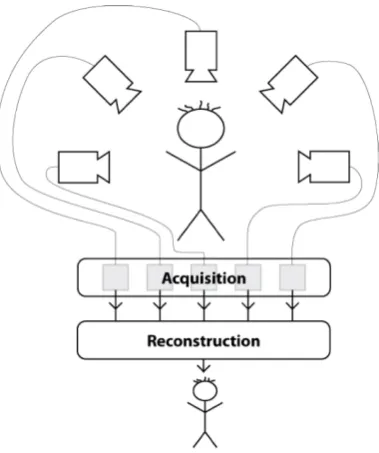
Figure 1.1: Overview of a 3D reconstruction system.
Figure 1.1 depicts a 3D reconstruction system, from cameras to reconstructed
out-put model. The scope of this thesis is confined to the ”Reconstruction” region of
the system. The camera acquisition stage forms the basis of a concurrent research
project.
There are a number of existing approaches to 3D reconstruction from camera
im-ages, ranging significantly in performance and quality output. The scope of this
research is to investigate 3D reconstruction approaches and algorithms for the
purposes of reconstructing humans at sufficient speed and quality to combine the
strengths of VC and ICVEs.
Within this scope, and in the context of a 3D telepresence system, the thesis will:
• Define the requirements in terms of visual, spatial and temporal quality.
– The relationships between these qualities, and impact of wider 3D
becomes temporal quality.
• Support the requirements through 3D reconstruction algorithm
implemen-tation.
– 3D reconstruction algorithms are implemented and their ability to meet
the requirements is determined. A particular algorithm, and improving
the performance of its implementation becomes the focus.
• Validate the requirements.
– A research platform is developed that allows investigation of the
im-pact of camera placement on spatial and visual qualities required. Two
case studies validate it for this purpose.
1.4.1
Contributions
The primary contributions of this thesis are:
• Provides the first investigations into the effect removing camera image
syn-chronisation has on the reconstruction of moving humans, validating the
requirement for hardware synchronised cameras.
• Presents a parallelisation of a state of the art 3D reconstruction algorithm
for execution on a single multi-core processor and tests the performance
over a range of camera numbers and resolutions. The performance of the
implementation on multi-core CPUs and GPUs is also compared.
• A research platform is developed that can be used to study 3D
reconstruc-tion of humans in the context of telepresence. The platform provides the
basis for a collaborative experiment that showed for the first time that eye
CHAPTER 1. INTRODUCTION 11
1.4.2
Collaboration and this research
Ca
m
era
imag
e acq
uisition 3D reconstr
uction
Te lep
rese
nce and human interac tion
Carl Moore Tobias Duckworth
David Roberts & John Rae
[image:24.595.180.409.165.378.2]E0 E3 E5 E6 E1 E2 E4 E7
Figure 1.2: Placement of the project within the wider research group. The shaded region denotes the scope of this thesis, overlapping regions denote collaborative research undertaken with other members of the research group.
The scope of this thesis has been described and is confined to the 3D
reconstruc-tion algorithm. However, some outputs from this research have been
collabora-tive where there is overlap with the agendas of other projects or interests within
the wider research group. Figure 1.2 illustrates this overlap with the primary
re-searchers with whom collaborative outputs were achieved. The collaborations
shown in the overlapping circles of the diagram are presented in terms of
experi-ments that were conducted, the details of each can be found in Chapter 2. Where
experiments led to publications the relationship is shown in Table 1.1.
Camera image acquisition
The camera image acquisition part of the collaborative research diagram in Figure
1.2 depicts the work of a concurrent research project that investigated the
re-E1 Comparing the latency of VC and ICVE [103]
E2 Synchronization of images for reconstruction [82]
E3 Investigating the effects of ”free-running” camera synchronisation [32]
E4 Investigating the suitability of ”Pull” camera synchronisation [83]
E5 Accelerated polyhedral visual hulls using OpenCL [33]
E6 Parallel processing for real-time reconstruction from video streams [34]
E7 Investigating the gaze of a virtuality human [104]
Table 1.1: De-referencing specific experiments and their publication output
construction algorithm. This part of the system was researched and implemented
by Carl Moore. The challenges faced by the camera acquisition stage included
the synchronised capture of images from cameras, compression of resulting video
streams to enable high frame-rate throughput to the reconstruction algorithm, and
background segmentation of the video streams to provide silhouettes to the shape-from-silhouette based algorithm. The main overlap between the the research
de-scribed within this thesis and that undertaken by the camera acquisition stage is
where decisions made within the scope of camera acquisition affect output quality
of the 3D reconstruction. Many of these dependencies are discussed in Chapter 4.
1.4.3
Thesis overview
The rest of this thesis is organised as follows:
• Chapter 2 - The aim, approach, objectives, research questions and
hypothe-ses are presented, followed by a description of the research methods
em-ployed in this thesis. Experiments aimed at answering research questions or meeting objectives are presented.
• Chapter 3 - A review of the literature and background to the research,
fol-lowed by some outcomes of the early research undertaken to narrow down
choice of 3D reconstruction approaches.
CHAPTER 1. INTRODUCTION 13
are defined. The relationship between these qualities is explored, and the
necessity to balance them discussed. Factors affecting quality in the context
of a 3D telepresence system are studied, leading to experiments designed to validate requirements and better understand their impact on quality.
• Chapter 5 - Leading on from the definition of three quality measures, we
focus on temporal quality. A parallelisation of a state-of-the-art 3D
recon-struction algorithm is presented, along with a number of optimisations that
enable more cameras at a higher resolution in real-time, and hence provide
the mechanism by which better spatial and visual qualities may be achieved.
• Chapter 6 - A research platform used to evaluate 3D reconstruction is
pre-sented. The various aspects of this utility are described in relation to vali-dating the research as a whole. Two case studies are presented as a means
to demonstrate the efficacy of the research platform in analysing the impact
of camera placement on spatial and visual quality.
• Chapter 7 - Discussion of the thesis, reflecting on the methods and
ap-proaches taken, culminating in conclusions and identifying directions for
Methodology
This chapter presents the methodology used in conducting this research. The
over-all aim of the research is described, key objectives and research questions
iden-tified, and hypotheses formulated. Following this, the methods comprising the
iterative research process are described, along with how each has contributed
to the overall research, and how one has fed into another. The experiments and
evolution of the research are then summarised, providing the framework for the
remaining chapters in the thesis.
CHAPTER 2. METHODOLOGY 15
2.1
Setting
This research examines the use of 3D reconstruction from video streams to model
humans at sufficient quality levels to enable a 3D telepresence system to convey
the subtleties of human non-verbal communication.
2.2
Aim and Objectives
2.2.1
Aim
To study and improve the balance of temporal, spatial and visual quality of virtual
humans, reconstructed from multiple video streams, to support most kinds of
non-verbal communication in telepresence.
The approach used was to understand the requirements placed on reconstruction
algorithms, improve temporal qualities of an algorithm or its implementation, and
study what visual and spatial qualities could be achieved within the real time
con-straints of telepresence.
2.2.2
Objectives
• O1: Determine the requirements and approaches to 3D reconstruction
suit-able for a real-time telepresence system.
• O2:Determine whether algorithms can be improved upon to achieve higher
temporal or spatial/visual quality.
• O3: Develop a platform through which the impact of camera placement on
2.2.3
Research questions
• Q1: Which approaches to 3D reconstruction can provide the best balance
between performance and model quality for representing the dynamic
hu-man form in the context of a telepresence system?
• Q2: How can algorithms or their implementation be improved upon to
achieve higher qualities in real-time?
• Q3:What are the requirements of a system with which the impact of camera
placement on spatial and visual quality can be studied?
2.2.4
Hypotheses
Where an objective is to answer a research question, the questions are refined to
hypotheses:
• H1: Approaches to 3D modelling from images can be used to model
mov-ing humans at sufficient qualities for telepresence applications.
• H2: Relaxing constraints on temporal consistency of inputs will result in
a degradation of spatial and visual quality in the case where the subject is
moving.
• H3: Temporal quality can be improved upon through parallel processing
CHAPTER 2. METHODOLOGY 17
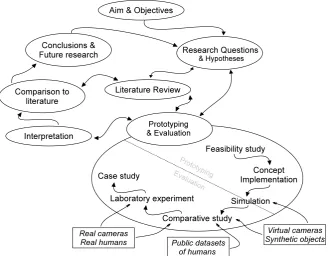
Figure 2.1: The research process employed, how elements influence one another.
2.3
Research process
2.3.1
Summary of research process
The process employed was devised for its suitability to research where there are
many open questions. The key aspects of it are that an iterative research cycle
was employed to answer research questions and meet objectives through the use of rapid prototyping and simulation. Initially there were many short iterations
through the cycle, reducing to fewer longer iterations as the research path
2.3.2
Common practise
This thesis is the overlap of two key fields in the research community: 3D
re-construction, and virtual reality/telepresence. Common practice within these
dis-ciplines is drawn upon in the research methodology employed. 3D
reconstruc-tion researchers implement algorithms, often only testing them in a simulated
setting, and report their performance through timing measurements and present visio-spatial quality through pictures in research papers. Telepresence researchers
build prototype systems and examine human factors, such as conversations,
im-pact of embodiment and timings. We implement a combination of these practices
to enable algorithm prototyping and initial evaluation in a simulated setting,
fol-lowed by the building of a prototype system which can be evaluated using real
humans.
Quality evaluation
Evaluation of quality of 3D reconstruction can be a non-trivial process. Whilst temporal quality is simple to evaluate in quantitative terms by measuring latency,
spatial and visual qualities are much more difficult to define quantitavely. These
qualities will be defined in more depth in Chapter 4, but here we describe the
rationale for the methods used to evaluate them.
Spatial quality encompasses the accuracy and completeness of the representation
compared with the object being modelled. One method for measuring this
quan-titatively would be to obtain ground truth data of the object being reconstructed,
for example by using a laser scanner. The reconstructed form could then be
com-pared to the ground truth model in terms of the differences between them, which
could be quantified as two distinct measures: volumes present in the reconstructed
model but missing in the ground truth data, i.e. errors in the reconstruction
giv-ing rise to superfluous volume. Or volumes present in the ground truth data but missing in the reconstructed model, i.e. errors in the reconstruction in the form of
ge-CHAPTER 2. METHODOLOGY 19
ometry (CSG) techniques, which are able to evaluate boolean operations on three
dimensional data. Given that the visual hull is only an approximation to the form
in the first place, and is unable to model surface concavities, the value of quantify-ing differences between model and ground truth data becomes questionable. The
importance of spatial quality in the context of telepresence applications is that
hu-man behaviour and non-verbal communication can be conveyed, and therefore it is
more important that the waving of a hand or shaking of a fist can be differentiated
than that the width of the arm used to convey that action is accurate.
Visual quality can be regarded as a subjective quality measure. Whilst quantitative
differences between pixel colours in camera images compared to the
reconstruc-tion could be compared, the meaningful value of these differences is dubious.
The cameras themselves may have colour or exposure settings that affect
appear-ance of the whole image, and these would first need to be quantified in terms of
differences compared to the camera used to obtain the ground truth reference
im-age. Secondly, the importance in terms of a telepresence system is that human communication can be conveyed effectively, and in this sense it is more
impor-tant that facial expressions can be accurately perceived than whether a person’s
reconstructed face is slightly more red in the reconstruction than in real life.
Given the complications and possibly dubious value of quantitative measures for
spatial and visual qualities in the context of this research, this thesis presents
quan-titative results for temporal quality and adopts the common practise used in the 3D
reconstruction community of presenting spatial and visual quality pictorally.
2.3.3
Derivation of research process
The individual research methods employed are adopted from those widely used
in computer science. [99] gives an analysis of the popularity and frequency of
different methods used in computer science research papers and provided
guid-ance for methods suitable for this thesis. The specifics of how each method was
this research. Research methods employed included: literature review, feasibility
study, concept implementation, simulation, comparative study, laboratory
exper-iment and case study. Each of these methods contributed to answering research questions, meeting objectives and proving or disproving hypotheses. Figure 2.1
illustrates the relationships between aim and objectives, research questions and
selected research methods. The overall aim is the starting point for research, it
forms the objectives which in turn lead to research questions. The aim and
objec-tives are considered to be more or less fixed for the duration of the research, but
research questions can be influenced by the research process and revised at any
point.
2.3.4
Literature review
Literature reviews form an important element of the research method employed,
as depicted in Figure 2.1. Reviews and evaluation of the literature fed into the
research continuously: when searching for answers to research questions, looking
for solutions to implement and test, and when comparing obtained results with the outcome of other research.
Whilst the limits of human perception set the fundamental requirements of this
research and need to be accurately determined, the initial set of constraints were derived from the technology widely in use today. For example, the frame rate
of a television guides the approximate frequency for temporal quality, and the
resolution of digital cameras provided the starting point in terms of visual
qual-ity. Therefore the approach to the literature survey was to begin by building up
a body of literature on the subject of 3D reconstruction techniques, video
confer-encing, telepresence, and human modelling. This in turn led to an understanding
of commonly accepted measures in human perception, for example frame rates
being described as ”interactive”. Of particular interest were articles where these
disciplines overlapped, for example human modelling through 3D reconstruction. There is a wealth of material published on the aforementioned subjects,
CHAPTER 2. METHODOLOGY 21
articles and book chapters were located. The scope of this material encompasses
many disciplines including geometry, algorithms, computer graphics, maths, and
photography. The initial body of knowledge shaped research questions and con-tained certain publications that included sufficient detail to form the first ideas
for concept implementation. The wider literature survey also covered material
re-lating to existing telepresence and ICVE implementations in order to understand
the background against which future improvements will be made, this includes the
technical implementation of telepresence systems as well as psychological studies
relating to collaboration through such systems.
During numerous phases of literature review, key authors, conferences and
jour-nals were identified, and further material discovered through forward and
back-ward referencing. Backback-ward referencing helped to build a picture of the genesis of
a particular research area up to the point of publication, whilst forward
referenc-ing highlighted the direction research had taken since publication. Key outlets for
literature searches included IEEExplore, ACM, Google Scholar, Web of Science, Science Direct, PubGet and Research Gate.
2.3.5
Prototyping and evaluation
A major aspect of the methodology of this thesis is the prototyping and evaluation of ideas resulting from literature review or novel concept. Figure 2.1 shows how
other elements of research feed into prototyping and evaluation. It also shows the
methods that are used at successive stages of prototyping and evaluation. As the
arrows in the diagram suggest, the process of prototyping and evaluation is
pro-gressive. Concepts first undergo a feasibility study before they are implemented,
and then may progress through to later stages of evaluation. A particular 3D
re-construction approach will not necessarily proceed through all the listed steps,
in fact it is unlikely that it will; concepts can be dropped at any of stages listed
Feasibility study
A feasibility study precedes the implementation of a concept. Where the
liter-ature review, or a novel idea has yielded a method or concept that seems to fit
the requirements and meet some or all of the objectives, the feasibility is studied
in more detail in the context of a final 3D telepresence system. The
feasibil-ity of implementing a concept is considered in terms of the requirements of the concept that can be deduced from the literature and how well they fit with the
available resources. Concepts evidently failing to meet the overall aim or
objec-tives would generally be ruled out during the literature review, but this may not
become clear until feasibility is considered in more detail. Available resources
were an important consideration as this guided the direction of research based
on what was achievable without significant outlay on new equipment. For
exam-ple, a 3D reconstruction method that appears to fulfil the aim and meet some of
the objectives, but requires 100 cameras might be ruled out during the feasibility
study. Other resources analysed during the feasibility assessment were: estimated
processing overhead, memory requirements and network bandwidth where appli-cable. Another means by which the feasibility study can rule a concept out before
implementation is where the literature survey does not provide sufficient
imple-mentation details. The feasibility study relies heavily on figures quoted in the
literature and implementation overhead is only estimated. Therefore the outcome
of the feasibility study cannot considered to be totally reliable.
Concept implementation
Concept implementation takes place when a method or concept has been deemed
feasible by the feasibility study. The concept is implemented based on details
derived from the literature or in some cases from novel thought and deduction.
Apart from at the earliest stages in the research there is often a framework in
place that can be reused for parts of the concept implementation. For example, all
of the 3D reconstruction approaches that were implemented required the basics
re-CHAPTER 2. METHODOLOGY 23
usable components of a research platform that matured during the course of the
overall project. Correct implementation of a concept requires an adequate degree
of detail derived from the literature survey or deduced by logical thought. In some cases it does not become apparent until attempting concept implementation
that there are insufficient details to complete the implementation. Often further
literature searches using disparate sources to that from which the concept was
derived were required to bridge these gaps and implement the complete concept.
[image:36.595.123.474.315.584.2]Simulation
Figure 2.2: An early screen shot of the simulated setting through which many approaches to 3D reconstruction were evaluated. Shown here performing a volu-metric reconstruction of a synthetic dog model from 6 virtual cameras.
Given the nature of the research problem being investigated, and the time taken
to set up and calibrate real cameras, simulation became an invaluable part of the
research methodology. A simulator was implemented as an integral part of the
around a synthetic object and for implemented algorithms to be tested using
im-ages derived from these virtual cameras, as shown in Figure 2.2. Many real-world
problems are not present in the simulated setting: virtual cameras do not exhibit lens distortion, camera image noise is non-existent, and they are trivial to
cali-brate compared with real cameras. Therefore, incorporation of a simulator into
the research platform enabled rapid prototyping of both algorithms and camera
placement that would be much more time consuming in a real-world setting. The
first point of testing for algorithms progressing from the concept implementation
stage was in simulation.
Comparative study
Comparative study results from the simulated testing of implemented algorithms. Algorithms can be evaluated and compared based on implementation details such
as memory or processor overhead, or their ability to meet the spatial, visual or
temporal qualities of the end system. Most algorithms could be effectively
eval-uated during simulation or comparative study, only progressing to the next stages
of evaluation if simulated testing and comparison did not rule them out.
Laboratory experiment
Laboratory experiment denotes the stage at which algorithms begin to be tested
in a real-world setting. Real cameras replace the virtual cameras used in the sim-ulation setting, and consequently real-world problems become apparent; camera
lens choice can lead to image distortion which needs to be corrected before
recon-struction is attempted. Camera image noise can make background subtraction less
reliable and predictable. Lighting and shadows add to the background subtraction
problems. Differences in camera image exposure or colour balance become
ap-parent. Real cameras are much more difficult to calibrate than virtual cameras,
and calibration of them can take some time to get right. The simulated setting
CHAPTER 2. METHODOLOGY 25
acquisition stage of a 3D reconstruction system. It could be argued that this
re-search could be conducted in an entirely simulated setting, focussing on algorithm
performance and therefore temporal quality, and theoretically enabling improved spatial and visual quality. It would, however, be impossible to test with anything
but synthetic human subjects, and consequently real human phenomena such as
eye gaze could not be investigated.
Within the scope of this thesis, only one algorithm, EPVH was tested under
labo-ratory experiment conditions. A number of variants of the algorithm were tested
(sequential, parallel execution on CPU, parallel execution on GPU), but aside from
differences in performance their output was identical.
Case study
A case study was used where an algorithm had been validated in real-world
set-tings using laboratory experiment conditions, and progressed to being used as part of a true experiment. In this research, an experiment was conducted into the
abil-ity of people to estimate the eye gaze of a 3D reconstruction of a real person. A
number of participants manipulated the 3D reconstructed person until they felt it
was looking directly at them. The angle of presentation to the viewer of the body,
the head, and the direction of gaze of the eyes in the head, were varied over a
number of gaze poses to determine which of these had an impact on gaze
estima-tion. The impact of camera placement on form reconstruction and texturing was
also investigated. Further details of this study are presented in Chapter 6.
2.3.6
Interpretation
Results obtained from prototyping and evaluation are (where relevant) subject
to interpretation before they can be compared to the literature. Even those
ap-proaches which did not progress through all the stages of prototyping and
from the findings. For example, early experimentation with volumetric
recon-struction techniques proved exceptionally slow, and it was not until interpretation
of the results and subsequent revisiting of the literature had taken place that the
concept of octrees [57] was discovered and implemented.
2.3.7
Comparison to literature
Comparing findings of the research to the literature provides a mean by which conclusions can be formed in the wider context of the research area. Comparison
can take the form of any of the measured or observed qualities or characteristics.
For example, performance of the implemented EPVH algorithm was
quantita-tively compared with performance published in the literature. Visual and spatial
qualities of the algorithm were qualitatively compared against pictures of
recon-structions in the literature. Such qualitative comparisons, however, were only
re-ally meaningful where reconstructions had been performed on the same publicly
available datasets.
2.3.8
Conclusions and future research
Findings from the whole cycle of the research methodology employed lead to
conclusions that can identify gaps in the research undertaken and provide
direc-tions for future research. Even if the entire cycle of the research methodology has not taken place, valid conclusions can still be drawn, which may provide new
directions for research. These new research directions provide an input for new
research questions and hypotheses and therefore bring us back to the start of the
CHAPTER 2. METHODOLOGY 27
2.4
Experiments
The experiments undertaken fall into two categories: independent research and
collaborative research. Figure 1.2 shows how collaborative experiments fit into
the structure of the wider research group within which the work in this thesis was
carried out. The experiments performed can be broadly categorised by research
question:
• Q1: Which approaches to 3D reconstruction can provide the best balance
between performance and model quality for representing the dynamic hu-man form in the context of a telepresence system?
– E0- Pilot experiments to investigate the suitability of various 3D
reconstruction approaches to realtime 3D rereconstruction of humans.
-Various approaches found in the literature were implemented and their
suitability tested in a simulated setting, or using real datasets from
disk. These approaches were successively narrowed down until only
one remained; the EPVH algorithm, which was efficient, scalable, and
resulted in high quality visual and spatial reconstructions.
– E1collaborative. - Comparing the latency of an ICVE and video con-ference - The latency of both video conferencing, and a typical ICVE
setting, where two CAVEs were connected together, was measured.
The intention of the experiment was to derive results for guiding the
latency expectation of a final end to end 3D reconstruction system [103].
– E2 collaborative. - Synchronisation of images from multiple cam-eras to reconstruct a moving human - A simulated setting was used to
conduct this experiment aimed at determining what the camera frame synchronisation requirements of a 3D reconstruction might be. The
experiment studied the effects of relaxing camera frame
– E4collaborative. - Investigating the suitability of a software capture trigger in a 3D reconstruction system for telepresence - The
experi-ment investigated using a software trigger (”Pull” approach) compared with a hardware trigger (”Push” approach) for obtaining images from
cameras in a 3D reconstruction system. The resulting sub-frame
pe-riod desynchronisation was measured, and its effect on resulting 3D
reconstruction studied [83].
– E5- Camera image synchronisation in multiple camera real-time 3D
reconstruction of moving humans. - Using pre-captured datasets from
disk, an increasing number of camera images up to half of the
cam-era set were delayed by a whole frame period for a variety of
hu-man movement sequences. The effect this ”Free-running” approach to camera synchronisation had on the reconstruction was presented.
The motivation for the experiment was to determine what the effects
might be of using commodity cameras such as webcams that do not
have a hardware synchronisation capability [33].
• Q2: How can algorithms or their implementation be improved upon to
achieve higher qualities in real-time?
– E3- Accelerating polyhedral visual hull reconstruction using OpenCL.
- The acceleration achieved by accelerating various discreet sub-processes
of the EPVH algorithm, by executing them in parallel on a GPU, was
measured [32].
– E6 - Parallel processing for real-time 3D reconstruction from video
streams. - An end-to-end parallelisation of the EPVH algorithm
tai-lored for local processing was tested. Its performance was compared
with published figures for the network distributed parallel approach,
and also between multi-core CPU and GPU execution [34].
• Q3:What are the requirements of a system with which the impact of camera
placement on spatial and visual quality can be studied?
CHAPTER 2. METHODOLOGY 29
was measured to determine whether 3D reconstruction can effectively
convey eye gaze. The impact of camera placement on spatial and
vi-sual quality of the output, and how this affected eye gaze judgement,
was analysed [104].
2.5
Evolution of the research
During the course of the research the direction taken was influenced by the process employed, as described in Section 2.3. Here follows a synopsis of the path taken
and the reasons why.
[image:42.595.201.396.408.632.2]2.5.1
Selecting an approach to 3D reconstruction
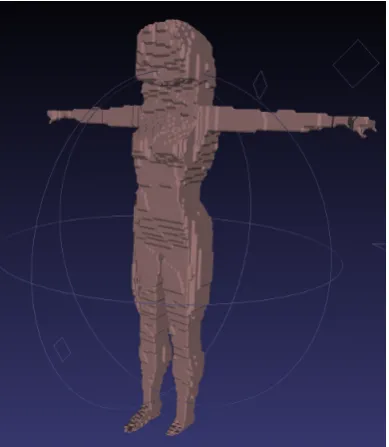
Figure 2.3: Early volumetric reconstruction performed in simulation from syn-thetic model and virtual cameras.
Research began by surveying literature for approaches to 3D reconstruction from
details are given in Section 3.4. The earliest working prototypes were achieved
entirely in simulation from virtual camera images of synthetic objects, such as the
simplistic voxel reconstruction of a human in Figure 2.3.
Through exploring shape-from-silhouette reconstruction techniques, the concept
of direct surface reconstruction algorithms became appealing. A surface based model seemed like the best choice for a telepresence system as it could be
repre-sented by a polygonal mesh, for which many display, compression and
transmis-sion schemes already exist. Given this, any volumetric method would require a
post-process to extract a surface based polygonal model, so if direct surface
meth-ods could be achieved sufficiently quickly, the intermediate surface extraction step
would become redundant. The Exact Polyhedral Visual Hulls (EPVH) algorithm
appeared to meet these requirements, but the ability of it to achieve real-time
[image:43.595.215.384.393.622.2]per-formance at the desired quality was unknown.
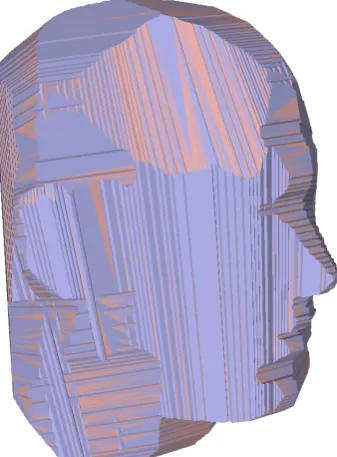
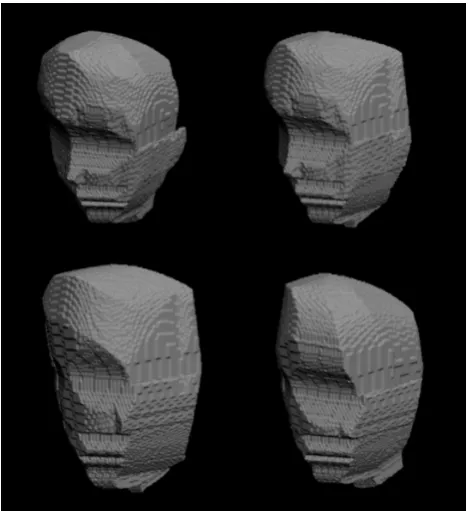
Figure 2.4: Early EPVH reconstruction performed in simulation from a synthetic model and virtual cameras.
Through the description in the literature the EPVH algorithm was implemented,
CHAPTER 2. METHODOLOGY 31
cameras and a synthetic human head. However, performance of the sequential
implementation was not sufficient for real-time applications at the desired output
qualities.
2.5.2
Working with real data
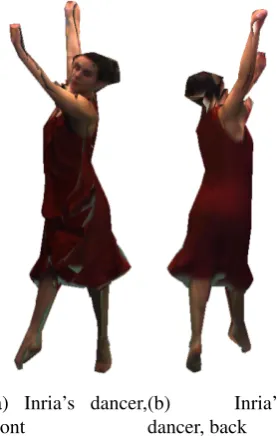
(a) Inria’s dancer, front
(b) Inria’s
[image:44.595.229.368.264.485.2]dancer, back
Figure 2.5: Reconstruction of Inria’s dancer from publicly available dataset using the EPVH algorithm.
Whilst simulation was an invaluable tool for rapidly prototyping and beginning the process of evaluating algorithms, many real-world human phenomena are not
eas-ily tested through this medium. Most notably movement. Whilst synthetic models
can be crudely animated, they are unable to emulate the way in which a human
moves without significant modelling effort. Publicly available datasets comprising
camera images of moving humans provided essential material enabling algorithm
testing with real-world data, prior to deploying and calibrating a set of cameras in
the laboratory. Figure 2.5 shows two novel viewpoints reconstructed from Inria’s
Dancer dataset1.
Calibrating cameras
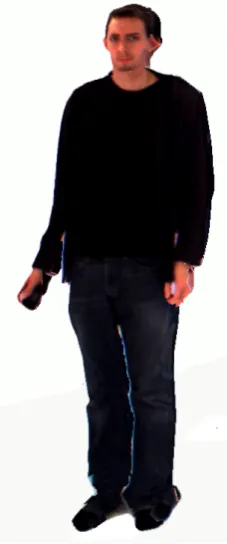
Figure 2.6: A reconstruction from real camera images from our own calibrated camera set.
Deploying and calibrating a set of real cameras can be a time consuming task, and
the journey to achieving it in this research was no exception. A number of methods
for calibrating cameras are identified in 3.3.9, ultimately the method described in
[80] was settled upon.
In this method, cameras forming a set may be calibrated in groups, which is a
sig-nificant advantage over methods such as [120] that require painstaking calibration
of each individual camera. A wand is used with two clearly visible and easily
dif-ferentiatable markers placed a known distance apart, we used two coloured foam
balls on a stick. The wand is waved in front of all the cameras simulataneously
whilst they capture images. The positions of the centres of the markers in each
CHAPTER 2. METHODOLOGY 33
important to maintain consistency in frame numbering between cameras in the
process. For cameras where one or both of the markers is not visible, this is
de-noted. It is extremely important to only record the positions of markers whose visibility and centre position are known with absolute certainty because the
cali-bration algorithm can be recalcitrant in the presence of false positives. Conversely
the presence of false negatives does not affect the calibration results providing
there are sufficient marker occurances detected. The algorithm requires only the
image centre in pixels and estimated focal length of each camera to begin. The
calibration algorithm uses descent methods (bundle adjustment) to iteratively
ad-just a working model of the complete camera set until pixel reprojection errors are
minimised across all of the cameras. A second advantage of this technique over
other camera calibration methods is that marker correspondences only need to be present between pairs of cameras in the set, rather than present in the entire set.
This means that, providing sufficient pairs of markers exist between all cameras
in the set, camera sets comprising cameras pointing in diverse directions can more
easily be calibrated.
Given a set of real calibrated cameras we were able to start capturing our own data
and begin to conduct laboratory experiments. Figure 2.6 shows an example of an
early reconstruction from our own camera set.
2.5.3
Focus on temporal quality
Through literature survey, algorithm prototyping and evaluation, the impact of camera resolution and the number of cameras on the visual, spatial and temporal
quality of the visual hull was determined as:
• spatial quality increases as camera count and resolution are increased;
• visual quality increases as spatial quality and camera resolution increase;
• temporal quality increases as input complexity decreases (in general input
Therefore the relationship between visual, spatial and temporal quality is that
tem-poral quality decreases as spatial and visual quality increase. Hence, if by some
means the performance of an algorithm could be increased, it should be possible to increase the spatial and visual qualities possible per unit time. In other words,
by increasing temporal quality through enhancing performance, spatial and
vi-sual qualities can be improved. An aspect of temporal quality that was explored,
aside from the performance of the algorithm itself, was temporal consistency of
the inputs and how this impacts on spatial and visual quality of the output. In this
context temporal consistency can be regarded as the level of synchronisation of
camera images. The motivation for this study came from a concurrent research
project studying the camera acquisition stage, in which the question of frame
syn-chronisation had arisen. Not all cameras offer hardware frame synsyn-chronisation inputs, and therefore signalling such cameras to provide a frame must be achieved
in software, which is unlikely to be temporally consistent across all cameras.
Ex-periment E4 (2.4, E4) was performed as part of the concurrent research project
and investigated sub-frame camera desynchronisation. Experiment E5 (2.4, E5)
was conducted as part of this research and investigated the effect of whole frame
desynchronisation of part of the camera set on the reconstruction of moving
hu-mans. Together these experiments provided results supporting hypothesis H2.
2.5.4
Parallelisation of EPVH
Parallel processing was employed to improve the performance of the EPVH al-gorithm. The authors of the algorithm had described a network distributed
im-plementation [41], which they claimed enabled real-time performance at
approxi-mately the qualities required by our application. The initial approach to
paralleli-sation was to identify parts of the algorithm that performed a simple step
numer-ous times with different input data (i.e. SIMD), and implement a discreet parallel
processing block for them. Literature review had revealed recent research using
multi-core GPUs for general purpose number crunching, and it seemed likely that
GPUs could accelerate some parts of the EPVH algorithm. My initial EPVH
CHAPTER 2. METHODOLOGY 35
in parallel on a GPU. The overall reconstruction time for a range of camera counts
and resolution was compared to sequential execution on the CPU in experiment
E3 (2.4, E3). The experiment found that the partially parallelised algorithm exe-cuted on the GPU offered improved performance compared with sequential CPU
execution.
Parallelisation of the EPVH algorithm continued with the end goal of achieving
an end to end parallelisation. The approach to parallelisation was completely
revisited; the data entities over which the parallel processing was performed were
rethought compared to that used in E3, and the parallel partitioning re-analysed. A
new end-to-end parallelisation was conceived and implemented in both OpenCL
and OpenMP. The new scheme improved performance over that used in E3 and
also provided a means of comparison to figures published in the literature for the
network distributed approach. Experiment E6 (2.4, E6) tested the new parallel
partitioning, and was able to compare its execution on GPUs with that on
multi-core CPUs. It was found that the implemented scheme achieved much better performance on multi-core CPUs than GPUs. The parallelisation of EPVH, and
the experiments which were performed, proved hypothesis H3 - that temporal
quality could be improved through parallel processing - in turn allowing for higher
spatial and visual qualities.
2.5.5
Evaluation for telepresence applications
The parallelised EPVH was able to achieve real-time 3D reconstruction of
hu-mans at appropriate spatial and visual qualities, in simulation, using pre-recorded
datasets from disk, and with our calibrated camera set. The evaluation for
telepres-ence applications comprised of two parts: a one directional live end-to-end system
demonstration, and an experiment to determine whether test subjects could
accu-rately judge the direction of eye gaze of a 3D reconstructed person.
The end-to-end demonstration brought together two research projects, one
cap-Figure 2.7: The research platform through which human interaction through 3D reconstruction can be investigated.
ture live images of a person in our laboratory, whilst the 3D reconstruction
algo-rithm received these images and performed the reconstruction at another building
in the university in front of a number of conference delegates. Skype was used
for audio so that the conference delegates could instruct the person being
recon-structed to perform a particular action, in order to prove that the demonstration was live. We used wi-fi for connecting the 3D reconstruction computer to the
camera acquisition stage, and the receiving computer also had the burden of
de-compressing all the texture streams. Consequently only about 7 frames per second
were achieved, but the concept was proven and latency seemed acceptable.
The collaborative eye gaze experiment was conducted using a research platform
that was implemented as part of this thesis. The platform allows human
interac-tion through 3D reconstrucinterac-tion to be tested and provides a means to evaluate the
applicability of the implemented algorithms for telepresence applications. The
eye gaze experiment showed for the first time that eye gaze could be conveyed to
accuracies sufficient for human social interaction. The experiment also provided
Chapter 3
Background and Related work
In this chapter we review the background and literature related to specific areas of
this thesis: Eye gaze and remote interaction, virtual collaboration and 3D
recon-struction techniques. Finally, details of early research not described elsewhere
in the thesis are provided, serving as a critical analysis of 3D reconstruction
ap-proaches presented in the literature.