g a n g m e m b e r s hi p : v ali d a ti o n
is s u e s f r o m L a ti n Am e ri c a
Ro d ri g u e z, JA, P e r e z S a n t i a g o , N, Bi r k b e c k , C H , C r e s p o , F a n d
M o rillo, S
h t t p :// dx. d oi.o r g / 1 0 . 1 0 9 3 / bj c/ a z w 0 5 8 )
T i t l e
I n t e r n a ti o n alizi n g t h e s t u d y of g a n g m e m b e r s h i p :
v ali d a tio n is s u e s f r o m L a ti n Am e r i c a
A u t h o r s
Ro d r i g u e z, JA, P e r e z S a n ti a g o , N, Bi r k b e c k , C H , C r e s p o , F
a n d M o rillo, S
Typ e
Ar ticl e
U RL
T hi s v e r si o n is a v ail a bl e a t :
h t t p :// u sir. s alfo r d . a c . u k /i d/ e p ri n t/ 3 9 3 6 3 /
P u b l i s h e d D a t e
2 0 1 7
U S IR is a d i gi t al c oll e c ti o n of t h e r e s e a r c h o u t p u t of t h e U n iv e r si ty of S alfo r d .
W h e r e c o p y ri g h t p e r m i t s , f ull t e x t m a t e r i al h el d i n t h e r e p o si t o r y is m a d e
f r e ely a v ail a bl e o nli n e a n d c a n b e r e a d , d o w nl o a d e d a n d c o pi e d fo r n o
n-c o m m e r n-ci al p r iv a t e s t u d y o r r e s e a r n-c h p u r p o s e s . Pl e a s e n-c h e n-c k t h e m a n u s n-c ri p t
fo r a n y f u r t h e r c o p y ri g h t r e s t r i c ti o n s .
1 INTERNATIONALISING THE STUDY OF GANG MEMBERSHIP: VALIDATION ISSUES FROM LATIN AMERICA
Juan Antonio Rodríguez, Universidad de Los Andes, Venezuela Neelie Pérez Santiago, Universidad Central de Venezuela Christopher Birkbeck, University of Salford, UK
Freddy Crespo, Universidad de Los Andes, Venezuela Solbey Morillo, Universidad de Medellín, Colombia
Word count: 10,000
ABSTRACT
Developing valid measures of gang membership for self-report surveys is a challenging task in comparative cross-national research. In this article we use the Venezuelan case to assess the validity of the Eurogang indicators of gang membership. Based on focus groups with adolescents and the results from two sweeps of the International Self-Report Survey of Juvenile Delinquency we identify problems in the content and construct validities of the Eurogang items. We propose an alternative set of measures for cross-national studies of gang membership, focusing on a group’s reputation for violence (or broader criminal behaviour).
2 Introduction
Asking adolescents to report on their involvement in gang activity is a very common
component of contemporary surveys on juvenile delinquency. Indeed, measuring ‘gang membership’
now appears to surpass – in quantity, if not in depth – observational studies of gangs. The
theoretical importance of this exercise is based on the opportunity to include measures of individual
gang participation as an independent or dependent variable in quantitative explanatory frameworks.
For example, a consistently reported finding is that rates of individual delinquent behaviour are
significantly higher when respondents also report belonging to a gang (e.g., Thornberry et al. 2003;
Decker, et al. 2013), although the interpretation of this finding is subject to some debate.1 The same
finding also lends weight to the pragmatic interest in estimating the prevalence of gang activity, and
the risk factors associated with it, as a prelude to developing gang intervention programmes (e.g.,
Gilman et al. 2014).
However, the fact that criminologists have been unable to agree on the definition of a gang
indicates some challenges for measuring gang membership in surveys. After all, a cardinal requisite
for seeking validity is that measurement ‘be guided by a clear conception of the construct to be
measured’ (Guion 2011: 182). Absent this clear conception, it is difficult to defend survey items in
terms of their operational value.2 In the U.S. – the birthplace and for long the near-exclusive domain
of gang studies (Weerman and Esbensen, 2005) - researchers have usually asked respondents one or
more explicit questions about ‘belonging to a gang’. They have defended this strategy partly on the
grounds of construct validity, by showing that gang membership, thus measured, is significantly
1 Most researchers interpret gang membership as the cause, and higher delinquency rates as the effect;
however, Katz and Jackson-Jacobs (2004) argue for the inverse interpretation.
2 The literature on measurement is replete with varied classifications of the dimensions of validity (Newton
3 associated with other variables of theoretical significance (e.g., Thornberry et al. 2003; Boxer et al.
2015). They have also made arguments for criterion validity, pointing to the overlap between
self-reports of gang membership and the police’s identification of gang members (Curry 2000). Similarly,
Decker et al. (2014) reported that self-nomination as a current or former gang member is a strong
predictor of ‘embeddedness’ in gangs, as measured by other survey items. In general, these findings
support Thornberry et al.’s (2003: 22) claim that ‘[US] Adolescents appear to know what gangs are
and whether they are a member of a gang’ (Esbensen et al. 2001; Gibson et al. 2009).
Yet if concerns about measurement arise in relation to survey research on gangs in
English-speaking countries, they are augmented when the empirical gaze is broadened to include other
linguistic and cultural regions. Is there an equivalent word for criminology’s ‘gangs’3 or are there
merely several possible approximations? Is group criminality organised in ways that include
criminology’s ‘gangs’, or are those ‘gangs’ nowhere to be found? These are fundamental questions
for the international comparative study of gangs. They became immediately evident when U.S. gang
researcher Malcolm Klein met with researchers from Western Europe to design and carry forward a
project for studying gangs in Europe (Klein et al. 2001). Members of the resulting ‘Eurogang Project’
were quick to point out that self-report items referring to gangs (in whatever language) might well
evoke, in the minds of respondents, phenomena that were far removed from the sort of delinquent
youth group that international criminologists had in mind when using the term. Indeed, much of the
early discussion between Klein and European researchers revealed that the word ‘gang’ evoked
stereotypical images of an American gang that was assumed to exist in the U.S. and to be absent in
Europe. Klein (2001) noted that there was a paradox here: many gangs of interest to U.S.
criminology did not match this stereotypical image, such that denials of a European gang problem
could well have overlooked local delinquent youth groups that were similar to at least some of the
various types of U.S. gang identified by U.S. researchers (Maxson and Klein 1995).
3 Katz and Jackson-Jacobs (2004) refer to ‘the criminologists’ gang’ – an important recognition that academic
4 This debate reflected a potential problem with the content validity of self-nomination as a
‘gang’ member. The Eurogang solution to this problem (reviewed in detail below) was to clarify their
conception of the gang and develop six indicators of gang membership that, without mentioning the
word ‘gang,’ could be put to respondents. Those who responded to all the indicators in terms that
were congruent with the researchers’ definition of the gang would be classed as gang members. This
indicator-based approach to identifying gang members has some significant advantages. One of its
strengths lies in the attempt to develop survey items that are easily understood by adolescents, and
easily answered (e.g., ‘Which of the following best describes the ages of people in your group?’).
Hopefully, this will increase the criterion validity of self-reported information. Secondly, these
indicators are less linguistically complex than the word ‘gang,’ thereby facilitating measurement and
comparison of gang membership across different countries and cultures. Indeed, the Eurogang
indicators were a natural candidate for inclusion in the largest comparative study of juvenile
delinquency to date, the International Self-Report Survey of Juvenile Delinquency (ISRD). Thus, the
Eurogang items were included in the second (2006-7) and third (2013-15) sweeps of the ISRD.
In those sweeps, the ISRD went beyond Europe and the USA to include countries from the
Caribbean and South America. Venezuela, the country that occupies our attention in this article,
participated in both. Its social, cultural and criminological characteristics are sufficiently different
from those found in Europe and the USA to prompt continued attention to the task of achieving
cross-national equivalence in measures of juvenile delinquency, including membership in gangs.
Thus, in this paper, we continue the vein of critical comparative inquiry piloted by the Eurogang
project, but now we apply it to the Eurogang indicators themselves.
Our study proceeds in several stages. First, we outline the Eurogang definition of a gang, the
indicators used to measure gang membership, and some problems with those indicators. Some of
the problems have been raised by participants in the Eurogang project, but one concerns the
ambiguous role of a seventh Eurogang item which includes the word ‘gang’. Second, we use the
5 overview of what is known about delinquent youth groups in Venezuela, among other things seeking
to emphasize the dissimilarities with several other Latin American countries (such as El Salvador,
Honduras or Colombia) where, for one reason or another, the ‘gang’ has a more visible presence.
This serves as important contextual information for an assessment of the Eurogang indicators of
gang membership. Drawing mainly on focus groups conducted with Venezuelan adolescents, we
identify several problems with the content validity of the Eurogang indicators - problems derived
from Eurocentric conceptions of the adolescent experience. Third, using Venezuelan survey data we
examine the construct validity of the Eurogang indicators from three different perspectives: the
overlap between different configurations of the indicators themselves, the overlap between the
Eurogang measures and other measures of group delinquency, and the associations between the
Eurogang measures and commonly cited risk factors for gang membership. On all three counts, we
find construct validity to be relatively low.
In sum, while Eurogang researchers sought to remove the ethnocentrism inherent in survey
items that include the word ‘gang’, they only managed to dilute it. Using the Venezuelan experience
not as a special case but as representative of a different cultural region,4 we propose that indicators
of gang membership be designed in even more generic terms in order to improve cross-cultural
equivalence in measurement. To illustrate this approach we focus on group identity, which is a key
concern (and problem) for the Eurogang project. We develop a set of items which, we argue, will
increase the validity and comparability of adolescents’ reports about their group experiences and
facilitate the cross-cultural study of gangs.
The Eurogang Framework: Concept and Indicators
4 That culture varies within and between countries is a truism. Characterising those differences, particularly at
6 Prior to the Eurogang project, European research on gangs had been sparse, partly because
gangs did not figure strongly in the public mind. From the start of the project, however, European
researchers worked actively to shape the study of gangs according to their own experiences. Most
importantly, they noted that the term ‘gang’ does not translate easily into many European
languages. For example, bande (French) or jeugdbende (Dutch) look similar to the word gang but
might not refer to exactly the phenomenon that North American researchers have in mind when
talking about gangs (Esbensen and Maxson 2012: 7; van Gemert 2012). Yet project members
eschewed cultural relativism: they did not equate linguistic variation with incommensurability.
Instead, they devoted considerable effort to the development of a definition of the gang that would
be fit for comparative purposes. This reflected the project’s commitment to systematic comparative
research that would facilitate the integration of results from many international sites (Weerman et
al., 2009).
In defining the gang, Eurogang members identified specific dimensions of group delinquency
that in their view would merit the academic, if not social, label of gang: ‘A street gang (or
troublesome youth group corresponding to a street gang elsewhere) is any durable, street-oriented
youth group whose involvement in illegal activity is part of its group identity’ (Esbensen and Maxson
2012: 6). These dimensions – group, durability, street orientation, illegal activity and identity – were
further specified in a youth survey questionnaire that was developed for comparative cross-national
research on gang membership. Six items were designed to distinguish gangs and gang membership
from other patterns of delinquent association (see Table 1).
TABLE 1 ABOUT HERE
Respondents are considered to be gang members if they have a group of friends aged
between twelve and 25 which spends a lot of time in public places, has existed for at least three
months and accepts and participates in illegal activity. Table 1 also shows a seventh item asking
respondents if they consider their group of friends to be a gang. In the words of the project
7 consensus definition, but can be seen as a contrast to the six preceding questions’ (Weerman at el.
2009: 30). While measuring gang membership with the first six items is a strategy designed to avoid
mention of the word ‘gang’ and has been used by some researchers to assess gang membership
(e.g., Matsuda et al. 2012), these items do not explicitly address the group’s identity, which is also
part of the Eurogang definition. Thus, other researchers have included the seventh item as a core
indicator of gang membership (e.g., Blaya and Gatti 2010; Haymoz and Gatti 2010; Gatti et al. 2011;
Moravcová 2012).5 ‘Gangs’ have returned, as it were, by the back door.
While the effort expended to define and measure gang membership has produced a tangible
product which has been incorporated into international research agendas, the Eurogang framework
has also garnered some critical observations from project members, most notably from the
University of Manchester research group. Based on extended ethnographic work in a northern
English city, Aldridge et al. (2012) found that what otherwise looked to be a gang did not have the
‘street orientation’ envisaged by the Eurogang project, its members meeting mainly at different
homes and apartments. What kept them off the street was partly the weather, partly a very active
police presence, and partly an increasing engagement in online activity. A strict application of the
Eurogang definition would have excluded this group from consideration. Aldridge et al. also noted
that the Eurogang definition would include some groups that ‘(arguably) we would not wish to
consider as gangs’ (2012:40) because of the nature of their illegal activity: pot smokers who meet in
public parks, illegal ravers, and clubbers who consume illegal drugs. The authors questioned whether
the reference to ‘illegal things’ is sufficiently precise to capture the criminality that researchers
envision when speaking of ‘gangs’ and whether cross-national variations in the il/legality of some
deviant behaviours confound comparisons.
These comments represented a rather negative assessment of the criterion validity of the
Eurogang measurement framework. But they also revealed ongoing questions about the appropriate
5 In fact, use of the Eurogang indicators has been rather idiosyncratic. For example, Gatti et al. did not include
8 definition of a gang, specifically in relation to the role of identity. The authors argued that Eurogang
item 5 (doing illegal things is accepted by the group) had at least two different and conflicting
interpretations of its meaning.6 Additionally, they proposed that the identity of the gang is founded
on a reputation for violence or for a willingness to resort to it, even if rarely used. Their primary
justification was ostensive rather than analytical: ‘this “reputation for violence” criterion actually
distinguished what we would want to consider the “gang” from the “non-gang” groups we observed’
(49). The authors did not develop a discussion of the theoretical significance of a reputation for
violence (e.g., in terms of labelling theory) or consider alternatives to this definition (such as a
reputation for serious criminal behaviour, rather than only for violence). They also commented that,
because reputations are partly constructed from without, a self-report survey could only capture
respondents’ assessments of whether or not their group had a reputation. And they recognised that
further thought needed to be given to additional specifications, such as how to distinguish between
youth groups and organised crime groups.
Despite these observations, no modifications have so far been proposed to the Eurogang
framework. Instead, methodological attention has focused on the extent to which different
strategies for measuring gang membership produce dis/similar results. Using survey data from a
multi-site, multi-wave, project in the United States, Matsuda et al. (2012) compared the prevalence
of gang membership as estimated by the first six Eurogang indicators on the one hand, and the
seventh indicator on the other. In their comparisons, they also included a version of the standard
‘self-nomination’ question used in US research (e.g., ‘Are you now in a gang?’). As is to be expected
(Weerman and Esbensen 2005), different measurement strategies produced different results: only
9% of all respondents classified as gang members by any method (‘any gang’) were identified by all
three forms of measurement; conversely, 68% of ‘any gang’ respondents were identified by only one
6 Interpretation 1: illegal activity is acceptable for the group. Interpretation 2: the group knows the difference
9 method.7 As Matsuda et al. point out (2012:25), ‘From a policy perspective, these varying prevalence
rates suggest that definition is important. The magnitude of the “gang problem” varies substantially
by definition’.8
One might also add that these varying prevalence rates are of methodological significance:
what phenomenon external to the survey is being measured in each case? This query about the
criterion-related validity of the different measures of gang membership is hard to answer when the
only empirical referents available are the survey results. Instead, Matsuda et al. assessed the
construct validity of those measures by exploring their relationships with other variables in the
survey. They did not explicate a theoretical framework for their analysis, but focused on commonly
accepted correlates of gang membership (delinquency, substance use, victimization, parental
monitoring, etc.) for which they reported significant results. Although they reported some
non-significant results – for example, gang membership was not associated with family structure – they
did not discuss these in terms of construct validity. For their part, studies using ISRD-2 data have also
found a higher prevalence of drug use, delinquency and victimization among those defined as gang
members, but they have not discussed the findings in terms of the construct validity of the Eurogang
items (e.g., Blaya and Gatti 2010; Gatti et al. 2011).
Looking for the Criterion: Gangs in Latin America and Venezuela
As a recent review of research in the region indicates (Rodgers and Baird 2015), a longstanding and
growing body of studies can be assembled under the heading of ‘gang research’ in Latin America.
These reveal a number of interesting things. First, across the region gangs have acquired varied
salience as a social problem and, consequently, as a research topic. Concern is strongest in Central
7 See Esbensen et al. (2001) for a similar analysis focusing on different strategies for measuring self-nominated
gang membership. Weerman and Esbensen (2005) provide an extended discussion of the impact of different definitions of gang and different sources of data and methods of observation on the measurement of gang membership and the description of gangs’ characteristics.
8 A natural corollary to this kind of comment would be a discussion of the consequential validity of the
10 America and generally declines as one moves south from there, with intermediate attention in
countries like Colombia and Brazil but relatively low levels of preoccupation in the Southern Cone
(Argentina, Chile, Uruguay). Second, there is a marked abundance of terms referring to delinquent
and organized crime groups, e.g., maras in El Salvador, bandas and parches in Colombia, and
comandos in Brazil. This poses challenges for establishing semantic equivalence between these
terms, or with the English word gang. Third, observational studies of gangs dominate in empirical
research; only the Central American studies by Rubio (e.g., 2003; 2006; 2007) use self-report surveys
to examine perceptions of, pathways to, and consequences of gang involvement. Working in
countries where gangs are a significant social problem, Rubio employed widely used terms (mara in
El Salvador; pandilla in Panamá) in the surveys and did not consider issues relating to the validity of
the measurement. However, his findings show significant associations between gang affiliation, risk
factors and rates of delinquency, which could be taken as evidence in favour of construct validity.
As Rodgers and Baird (2015) observe, there is a paucity of research on gangs in Venezuela,
and this in a country that has some of the highest rates of violence in the region. While crime is
nowadays recognised by Venezuelans as a leading social problem (Latinobarómetro, 2015), youth
gangs occupy a vague and minor role in popular thinking about the characteristics and causes of
delinquency. There has been very little extended observation of delinquent youth groups and most
research relies on interviews and testimonial accounts. While an early study, based on interviews
with young males and females, purported to identify the classic characteristics of gangs as described
by Thrasher for the U.S., a close reading of the evidence suggests that informants were talking about
groups of delinquents, but not necessarily gangs (Mateo and González, 1998).
Subsequent research has similarly reported the experiences narrated by young offenders,
but their focus is really on that archetype of Venezuelan culture known as the malandro. This is a
label for the individual, not the group, which is used as a moralistic epithet by most and embraced as
a delinquent identity by a very few (Zubillaga, 2007). The term most widely used for group
11 assortments of suspects arrested for specific crimes. More recently, the word pandilla has also
gained some currency, arguably as a result of public attention to the maras in Central America and
of a continuing focus on gangs in internationally sourced news and entertainment media. Reflecting
on extensive testimonials from three current or former offenders, Moreno et al. (2008: 255)
observed that the banda (their term, not that of their informants) represented ‘a small group linked
by a feeling that is momentary, short-term, fleeting and changeable but very strong….There is never
a commitment to someone.’ Their conclusion resonates with the individualism and instability which
is apparent in other testimony and also underlines the absence, in Venezuela, of types of gangs
described in other Latin American countries (Rodgers and Baird 2015). While the Venezuelan studies
leave no doubt that much delinquent behaviour is not carried out by lone offenders, very little is
known about the group dimension of that behaviour.
The Eurogang Indicators: Content Validity for Venezuela
In order to explore the content validity of the Eurogang indicators, some months after the
ISRD-3 survey had been completed three of the authors organised six focus groups to explore
adolescents’ understandings of some of the key terms in these indicators.9 Attention focused
particularly on the meanings attached to ‘friends’, bandas, and pandillas, and indirectly on
conceptions of illegal behaviour.
When asked what groups of friends they might have, participants described a number of
characteristics. They spoke of friends as peers with whom they spent time in shared activities:
They are people who are always together. They get out of school and they are
together; they go out somewhere. That’s a group of friends. (C2:3)10
9 The focus groups were conducted by Rodríguez, Pérez Santiago and Crespo in November 2014. The six groups
were distributed to match the sampling strategy employed in ISRD-3, involving three school years (7th, 8th and
9th grade), two cities (Caracas, Mérida) and two school types (public, private). None of these groups had
participated in the ISRD-3 survey in 2013. The average number of participants per group was ten, and the average length of each session was 35 minutes. The focus group discussions were recorded and subsequently transcribed for analysis.
12 Importantly, these groups of friends could form wherever young people spent a significant
period of time:
It’s mainly where you are, because at school, for example, you have your school
friend. If you’re at home, it’s a neighbour. (C1:5)
The groups could be large:
1: For example, I hang out with 25.
5: There’s about six of us.
3: The whole school. (C2)
But not all of the members necessarily came together at the same time:
……we’re a large group, you see, but it’s not that everyone always goes
everywhere…. because some can and some can’t. (M2:7)
Additionally, new friends could be made quite casually:
And in any place, because if you go out you get new friends and you get to know
more people, and so on. (C1:5)
But within these groups of varying sizes and locations, some important distinctions were made in
terms of intimacy:
For me there are two types of groups of friends. There’s a group of friends that
you have grown up with, with whom you can speak of long friendships. And the
other group of friends I’d call casuals, who are like those you go to school with or
for other reasons. (M3:1)
For me, a group of friends is like a brother in the good times and the bad,
whatever happens. We fall out, the next day we’ll talk, we’ll love each
other…and, well, that…[chuckles] (C1:2)
13 If you don’t want to do something, friends can’t make you do it, because they’re
supposed to be your friends, and they’re not going to make you do something
you don’t want to do. (C1:9)
Acquaintances, by contrast, were not always to be trusted:
Because friends can betray you. (M1:9)
Because there’s a lot of people, at least, who are friends today but might they not
be friends tomorrow. (M2:6)
Amid the clichés and generalizations that these young people put forward, there might be
little that looks different to the sorts of thing that would be said by adolescents in many other
societies. Yet the small but growing interest in the anthropology of friendship suggests that the
definitions and dynamics of friendship vary across cultures, entwined as they are with the relative
un/importance of kin, mobility, instrumental relationships, personal autonomy and so on (Bell and
Coleman 1999; Smart 1999; Keller 2004; French et al. 2005). What interests us here is the variety of
meanings that seem to come to mind for Venezuelan adolescents when they talk about friends (cfr.
Barcellos Rezende, 1999). When asked - via Eurogang Item 1 - whether they have a group of friends,
which group(s) might they be thinking of when responding affirmatively?
Additionally, participants described some members of their peer groups engaging in
unacceptable or wrongful behaviour: fights, bullying, smoking, drinking, doing drugs, minor theft
(usually in the classroom) and even talking in street slang. These activities range from legal (street
slang, smoking, drinking) through the problematic but not criminal (drug use, bullying, fights) to
criminal (theft), and underline Aldridge et al.’s (2012) point that conceptions of illegal behaviour (the
focus of the Eurogang indicators) vary from country to country and may include transgressions that
do not fit with researchers’ images of gangs. Participants often mentioned that these activities
occurred within their group, but also stated that they did not get involved and did not feel group
14 In exploring the meanings of the two terms that in Venezuela come closest to the word gang
(banda and pandilla), it became apparent that the focus groups ranged them along a moral scale, in
counter-position to the notion of friends. Whereas friendship groups were seen as non-hierarchical,
often fairly casually organised, fun-seeking, and mainly law abiding although tolerant of diverse
behaviour patterns, bandas and pandillas were described as having leaders, operating in an
organised manner, intolerant of deviations from group norms, and engaged in criminal behaviour:
A banda and a group of friends is not the same thing, because with your group
you get up to mischief, pranks, you play, you jump about, something that doesn’t
happen in the banda because, for example crudely, you’ve got to go and steal
because he said so, or she said so, or things like that. (C1:2)
There were, however, some doubts about whether bandas always involved criminal activity:
A good banda could be one that does good things, like giving money to charity,
and a pandilla focuses on doing bad things. (C3:4)
…the bad bandas spend their time smoking, doing drugs, bothering others. In
contrast, the good bandas spend their time having fun. (M1:2)
But no such doubts arose concerning the pandilla: these were the worst of the worst, groups of
malandros dedicated to the most serious crimes:
Pandillas are more dangerous [than bandas]. They like danger more. (C2:2)
Most of the pandillas are bad because they rob, kill… (M1:9)
A banda of youths is a bad thing, but not as bad as the pandilla, because you’re
going to see the pandilla on a [street] corner, all made up, aha! with something
like a uniform, all tattooed with a pistol in their belt…and they can even rob you
in the neighbourhood you live in..’ (C1:2)
However, what is striking about these descriptions of pandillas is that they were all made from a
distance: no one in these focus groups said that they belonged to a gang. ‘I read an article on the
15 a gang he belonged to’; ‘where I live there are a lot of pandillas in a manner of speaking, or
malandros, so when I go by there I know them all’ (C1:2). Ironically, these young respondents’
perceptions resonated more with mediated images of gangs than with the characteristics of group
delinquency uncovered by Venezuelan researchers.
The findings from these focus groups thus pose a number of questions regarding the
validity of the Eurogang indicators. First, the ‘group of friends’ may be very elastic in Venezuela,
including casual short-term acquaintances and comrades with whom the adolescent has maintained
a lengthy and more intimate relationship. This potential variety could introduce measurement error
in the corresponding survey items. While the initial remedy for that problem might focus on a better
specification of the group of friends that the adolescent is asked to think about, it is also worth
noting that the Eurogang definition of a gang makes no mention of friends – something that also
resonates with the testimonial accounts from Venezuelan delinquents, who do not speak so much of
friends as of partners in crime. Given that the Eurogang definition refers to a ‘youth group’, focusing
the Eurogang indicators on the adolescent’s group of friends complicates matters unnecessarily in
Venezuela.
Second, as Aldridge et al. (2012) observed in relation to European countries, the range of
behaviours understood as illegal by Venezuelan adolescents may be much wider than that typically
thought of by researchers as characterising gangs. A better measurement strategy would specify key
forms of behaviour rather than using the abstract category of illegal behaviour. Third, Eurogang item
7 (‘Do you consider your group of friends to be a gang?) is semantically problematic. Venezuelan
adolescents recognise both positive and negative variants of groups termed bandas, meaning that
this word is not necessarily equivalent to the idea of the gang. Paradoxically, they talk about
pandillas in ways that are congruent with the notion of the gang in metropolitan countries, even
though Venezuelan research has not unearthed examples of youth groups that would fit with the
international conception of gang. Given that pandilla was the word used in the Venezuelan version
16 gang-like groups that researchers have yet to find? Survey results presented in the next section of
this paper suggest that this is not necessarily the case and point to the need to develop alternative
measures of delinquent group identity.
Finally, the focus groups reveal a potential problem with the Eurogang’s focus on
street-oriented youth groups. This problem is the inverse of Aldridge et al.’s (2012) observation about the
effect of climate in Northern England: in Venezuela the hot climate means that spending a lot of
time in public places is a common activity among people of all ages. Thus, this indicator may have
less power to discriminate gang-like groups from other groups of adolescents in tropical countries.
The Eurogang Indicators: Construct Validity for Venezuela
The Eurogang indicators were used with Venezuelan samples in ISRD-2 (2006) and ISRD-3
(2013). Both samples comprised seventh (12-13 years old), eighth (13-14 years old) and ninth (14-15
years old) grade students in the capital city of Caracas (population 2.7 million) and the mid-sized city
of Mérida (population 250,000). The sample included 1,503 adolescents in 2006 and 2,433
adolescents in 2013. Apart from the Eurogang indicators, both surveys also asked respondents if
they had friends who engaged in selected illegal behaviours (drugs, shoplifting, burglary, robbery
and assault); and the ISRD-2 survey additionally asked respondents about things they did with
friends (drinking/drug use, vandalism, shoplifting, annoying others).
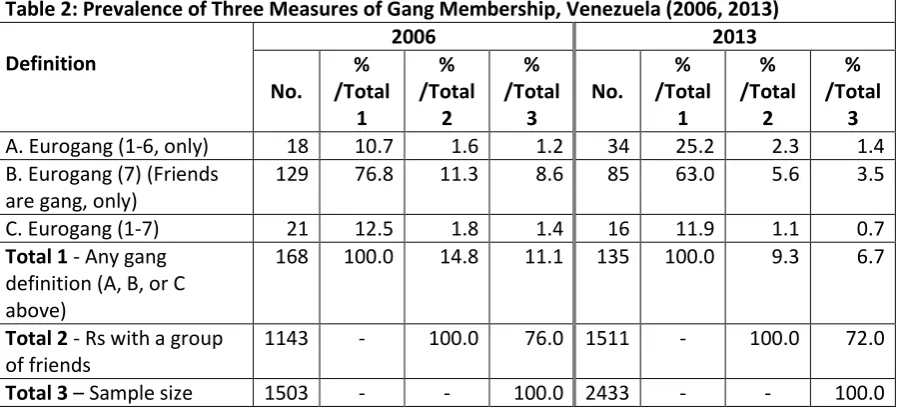
Table 2 shows the prevalence of three measures of gang membership:
Eurogang (1-6): responses to the first six Eurogang items.
Eurogang (7): responses to the seventh Eurogang item (‘Do you consider your group of
friends to be a gang?’)
Eurogang (1-7)11
11 A potential challenge to the reliability of these indicators is posed by inconsistent responses to the Eurogang
17 Table 2 about here
Table 2 shows that there is not much overlap between Eurogang (1-6) and Eurogang (7): only
12.5% of respondents identified by either of these gang definitions in 2006 and 11.9% in 2013 were
jointly defined by Eurogang items 1-6 and Eurogang item 7 (Eurogang 1-7). In both samples,
Eurogang’s item 7 on its own accounted for by far the largest group of ‘gang membership’: 76.8% of
‘any gang’ respondents in 2006 and 63.0% in 2013. While the lack of overlap between different
definitions is not dissimilar to the findings reported by Matsuda et al. (2012), the relative
prominence of Eurogang’s item 7 contrasts with the results of the U.S. surveys where this latter
indicator was less frequent than Eurogang items 1-6.
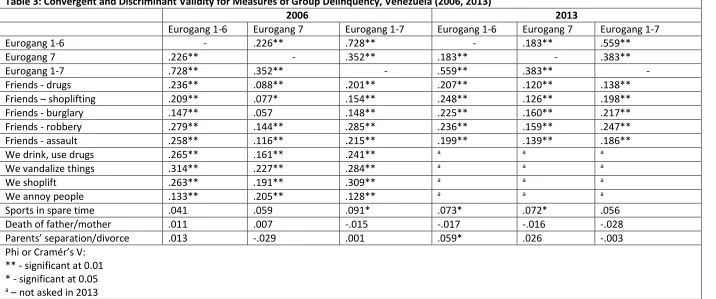
Table 3 examines construct validity, comparing the correlations between each measure of
gang membership and with other measures of group delinquency in one or both of the surveys.
Looking at the three measures of gang membership, Eurogang (1-6) and Eurogang (1-7) are highly
correlated, as is to be expected since they are similar in all but one indicator. However, Eurogang (7)
does not show a high correlation with either Eurogang (1-6) or Eurogang (1-7), even though the
latter includes the same item. This is further evidence that there is only a weak semantic association
between the word for gang (pandilla) and the presence of illegal behaviour. In terms of convergent
validity, none of the three measures of gang membership shows high correlations with respondents’
reports about friends’ illegal behaviour or their own illegal behaviour when with friends – both of
which would be expected to capture gang-like behaviour. If correlations should be large (i.e., > 0.5)
in order to be considered as the threshold for convergent validity, these measures are clearly well
below that value.
Table 3 about here
18 In terms of discriminant validity, there are only a few variables which are comparable
between the two surveys and which could not be speculatively associated with a greater probability
of belonging to a gang. Of these, three are included: free time spent in sports activities, the death of
either parent, and parents’ separation or divorce. There is no prima facie reason why these variables
should be significantly associated with belonging to a gang, and Table 3 shows that only four of the
18 correlations are significant (and at the .05 rather than .01 level). Thus, the different Eurogang
measures show some discriminant validity. In general, the results in Table 3 could be used to argue
that the Eurogang measures are weaker in their convergent validity than their discriminant validity.
A further test of construct validity is to explore the ‘risk factors’ associated with gang
membership. Significant associations with expected variables (and in the expected direction) are
taken as evidence of the validity of the measure of gang membership (e.g., Thornberry et al., 2003;
Matsuda et al. 2012; Boxer et al., 2015). Cronbach and Meehl (1955) designated this strategy as the
construction of ‘nomological networks’, with Cronbach (1988) subsequently distinguishing between
‘strong’ (theoretically articulated) and ‘weak’ (empirically sought) networks. Like most nomological
networks in the social sciences, exploration of risk factors for gang membership falls into the weak
programme for validation because theory is relatively underdeveloped (Katz and Jackson-Jacobs,
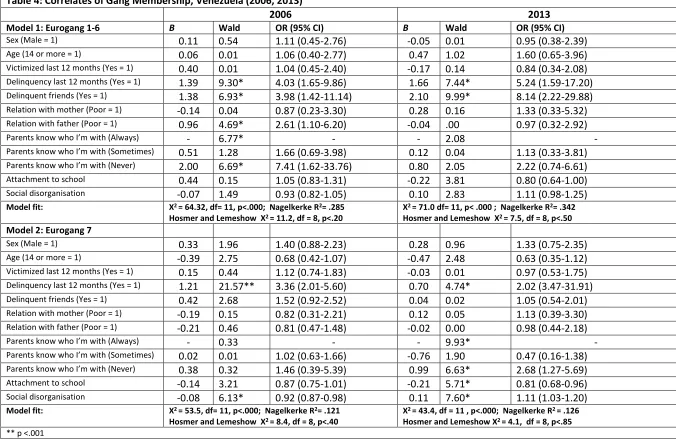
2004). With that in mind, we prepared logistic regression models for correlates of gang membership,
including variables that have been often identified as risk factors. Table 4 shows the results for the
Eurogang 1-6 and Eurogang 7 measures of gang membership.12 The only consistent correlate of gang
membership was the respondent’s own delinquent behaviour during the previous twelve months.
Having delinquent friends was significantly associated with a higher probability of gang membership
(Eurogang 1-6) in both samples, but not with the single item measure (Eurogang 7). Other variables,
12 The Eurogang 1-7 measure generated a very small number of cases in the gang membership category,
19 such as parental relations/supervision and social disorganisation, showed significant associations in
some models but not in others. Surprisingly, neither sex nor age were significant correlates in any of
the models and samples. Overall, the results point to a relatively low level of construct validity when
these measures of gang membership are compared with risk factors identified in the international
literature.13
Table 4 about here
Alternative Indicators of Gang Membership
An increase in construct validity can only be achieved by attention to content validity. Our
previous findings indicate that, if the validity of cross-national measurement of gang membership is
to be improved, a number of changes need to be made to the Eurogang indicators. Specifically,
references to friends, public places, ‘illegal things’ and gangs need to be replaced by less
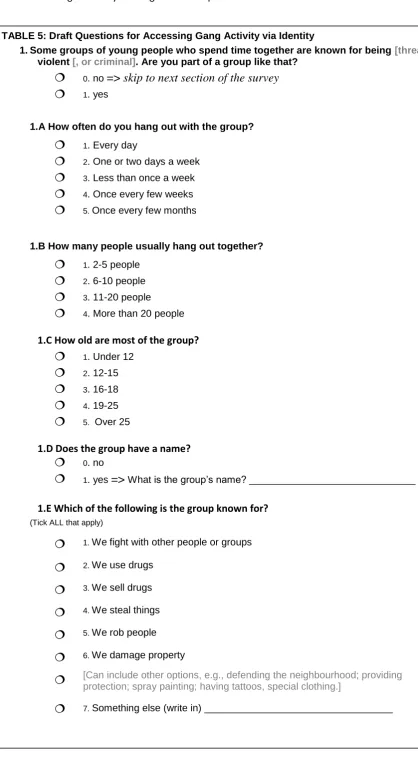
ethnocentric measures of youth groups, criminal activity and identity. Table 5 provides an
alternative and illustrative proposal for measuring gang membership using six indicators expressed
in terms that are more generic. It develops Aldridge et al.’s (2012:48-49) proposal to reformulate the
current Eurogang measures by focusing on gang identity defined as the reputation for a willingness
to use violence. The initial screening question uses this definition to make a basic distinction
between gang-like activity and everything else. It is expressed in simple terms, asking respondents if
they are ‘part of’ a ‘group of young people who spend time together’ that is ‘known for being
violent.’ Its improved validity compared to alternative formulations is premised on the hypothesis
that this phrasing will generate higher levels of shared understanding between survey respondents
and researchers. The generality of the terms also facilitate translation into other languages. The
basic distinction could be refined, if considered appropriate, by including references to ‘threatening’
and ‘criminal’ behaviour, although the latter term might encounter some of the problems already
raised in relation to ‘illegal things.’
13 The lower values of R2 for Model 2 also confirm that the single item asking adolescents if they consider their
20 Table 5 about here
Groups with a reputation for a willingness to use violence could be very varied, including
adults and young people, organised crime networks, neighbourhood toughs, some sports fans, and
so on. This is certainly the case for Latin America, where such groups could include everything from
the Comandos in Brazil, ‘loose network[s] of local armed groups, each…dominating a small
community’ (Cano and Ribeiro 2016:364), through the maras in Central America, who engage in
drugs sales, crime and extortion (Bruneau 2014), to Colombia’s parches, which construct themselves
around a territorially-based and openly deviant identity (Perea 2004). Criminologists usually reserve
the term gang for only some of these groups. Following the Eurogang project’s interest in youth
gangs, Question 1 includes a reference to ‘young people,’ thereby orienting respondents’ thinking
towards their interactions with peers. Items 1.A to 1.E represent five probes for those who respond
affirmatively to the first question, which are designed to capture more information about groups
with a reputation for violence and provide a set of indicators that could help make finer-grained
distinctions between youth gangs and other gang-like groups. Item 1.A is a measure of respondents’
involvement with the group (how often they spend time with it), which can help inform decisions
about who to treat as ‘members’. Items 1.B to 1.E measure characteristics of the group itself and can
be used to distinguish groups by size, typical age composition and types of illicit activity. Item 1.D
further explores identity by asking if the group has a name. Not only are names a relatively strong
expression of group identity, but inspection of any names could help to distinguish between gangs
and other gang-like groups. Item 1.E probes for different types of illicit activity and the list could be
expanded if so desired.
Our proposal aligns with the Eurogang definition of a gang in all but a focus on the street.14
However, the measurement strategy is markedly different. Whereas the Eurogang items seek to
distinguish gangs from other youth groups by moving from broad (‘Do you have a group of friends?’)
14 The proposal does not include a measure of the length of time that the group has existed because for a
21 to narrow criteria (‘Do you consider your group of friends to be a gang?’), our proposal seeks to
identify gang-like groups and then collect additional information about them. In doing this, we
would also recommend against pre-defining the operational indicators of the gang and allow
empirical research to inform classificatory decisions. Thus, Items 1.A to 1.E in Table 5 can be used to
explore the varied characteristics of these groups (for example, with nonlinear principal components
analysis), and it is for researchers to decide which, if any, merit the ‘gang’ label. Given the varied
forms of group delinquency within and between countries, this inductive approach can refresh the
comparative study of the ‘criminologists’ gang’ through survey research.
Conclusion
As the volume of criminological research (including international surveys) continues to increase so
will the study of gangs and gang membership, in part because news and entertainment media are
globalising their presence in the collective conscience. The process can be described as one of
diffusion, from the United States to Western Europe and then to other cultural contexts such as
Latin America.15 In this paper, we have tapped into the expanding survey research on gang
membership at the point where it spread from relatively wealthy research-intensive countries to a
different cultural setting (Latin America). If European researchers found it necessary to go beyond
US researchers’ reliance on a self-nomination question and develop a more comprehensive
approach for the valid measurement of gang membership, their own solution (which was not
without problems in its originating context) meets with some similar measurement problems when
employed in Latin America. The qualitative data in this paper identify challenges to the content
validity of some of the Eurogang items and the quantitative data indicate relatively low construct
validity for them.
15 For example, ISRD-1 included twelve Western European countries and the USA; ISRD-2 included 25 European
22 We have proposed an alternative set of items for measuring membership in groups with a
reputation for violence, and for describing and classifying those groups in ways that are central to
the continued discussion about what the ‘criminologists’ gang’ is. We argue that the terms used
should lead to improved content validity (and through that construct validity), a claim that can be
tested by further research.
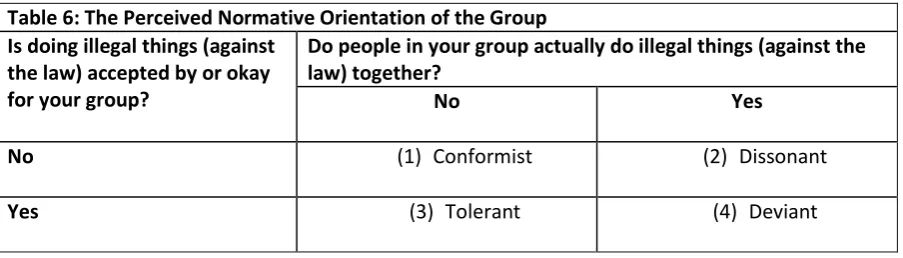
Table 6 about here
Finally, as recent discussions on validity indicate, ‘It is the interpretation…that is validated,
not the test or the test score’ (Kane, 2001:328). Our results do not provide strong support for
interpreting prior combinations/selections of the Eurogang items as indicators of gang membership,
at least in Venezuela. But this does not mean that other interpretations of the Eurogang indicators
should be discounted. For example, Aldridge et al. (2012:46) commented that items 5 and 6
(accepting/doing illegal things) measure the normative orientation of the group rather than group
identity. We combined responses to these two items to create an ordinal variable ranging from
conformist to deviant, as shown in Table 6. Compared to any of the Eurogang definitions of gang
membership, the ‘Perceived Normative Orientation of the Group’ (PNOG)16 was a stronger correlate
of group delinquency and a stronger predictor of individual delinquency.17 This variable, of particular
significance for social learning theory, merits exploration in future research.
16 In order to avoid potential contradiction with our previous arguments about the problematic measurement
of the ‘group of friends’ in Venezuela, the perceived normative orientation of the group should be more strictly interpreted as the perceived normative environment among the peers with whom the adolescent interacts.
17 For example, for the ISRD-2 results, correlation coefficients for the PNOG and group delinquency ranged
from 0.215 to 0.416 (mean = 0.329), while coefficients for the Eurogang indicators ranged from 0.077 to 0.314 (mean = 0.198). A logistic regression model for individual delinquency had a goodness-of-fit (Nagelkerke R2) of
23 Funding
This work was supported by the Consejo de Desarrollo Científico, Humanístico Tecnológico y
Artístico, Universidad de Los Andes, Venezuela (Project D-298-05-09-A [to CB, SM]); and the Fondo
Nacional de Ciencia, Tecnología e Innovación, Venezuela (Project C201200930 [to JAR]).
References
Aldridge, J., Medina-Ariza, J., and Ralphs, R. (2012), ‘Counting Gangs: Conceptual and Validity
Problems with the Eurogang Definition’, in F. –A. Esbensen and C. Maxson, eds., Youth
Gangs in International Perspective: Results from the Eurogang Program of Research, 35-51.
Springer.
Barcellos Rezende, C. (1999), ‘Building Affinity Through Friendship’, in S. Bell and S. Coleman, eds.,
The Anthropology of Friendship, 79--97. Berg.
Bell, S., and Coleman, S. (1999), The Anthropology of Friendship. Berg.
Blaya, C., and Gatti, U. (2010), ‘Deviant Youth Groups in Italy and France: Prevalence and
Characteristics’, European Journal on Criminal Policy and Research, 16: 127-144.
Boxer, P., Veysey, B., Ostermann, M., and Kubik, J. (2015), ‘Measuring Gang Involvement in a
Justice-Referred Sample of Youth in Treatment’, Youth Violence and Juvenile Justice, 13/1:41-59.
Bruneau, T. (2014), ‘Pandillas and Security in Central America’, Latin American Research Review,
49/2:152-172.
Cano, I., and Ribeiro, T. (2016), ‘Old Strategies and New Approaches towards Policing Drug Markets
in Rio de Janeiro’, Police Practice and Research 17/4:364-375.
Cronbach, L. (1988), ‘Five Perspectives on Validity Argument’, in H. Wainer and H. Braun, eds., Test
24 Cronbach, L., and Meehl, P. (1955), ‘Construct Validity in Psychological Tests’. Psychological Bulletin,
52: 281-302.
Curry, D. (2000), ‘Self-Reported Gang Involvement and Officially Recorded Delinquency’,
Criminology, 38/4: 1253-1274.
Decker, S., Melde, C., and Pyrooz, D. (2013), ‘What Do We Know About Gangs and Gang Members
and Where Do We Go from Here?’, Justice Quarterly, 30/3: 369-402.
Decker, S., Pyrooz, D., Sweeten, G., and Moule, R. (2014), ‘Validating Self-Nomination in Gang
Research: Assessing Differences in Gang Embeddedness Across Non-, Current, and Former
Gang Members’, Journal of Quantitative Criminology 30: 577-598.
Esbensen, F-A., Winfree, L., He, N., and Taylor, T. (2001), ‘Youth Gangs and Definitional Issues: When
is a Gang a Gang, and Why Does it Matter?’, Crime and Delinquency, 47/1: 105-130.
Esbensen, F. –A., and Maxson, C. (eds.) (2012), Youth Gangs in International Perspective: Results
from the Eurogang Program of Research. Springer.
French, D.; Pidada, S., and Victor, A. (2005), ‘Friendships of Indonesian and United States Youth’,
International Journal of Behavioral Development 29/4: 304--313.
Gatti, U., Haymoz, S., and Schadee, H. (2011), ‘Deviant Youth Groups in 30 Countries: Results From
the Second International Self-Report Delinquency Study’, International Criminal Justice
Review, 21/3: 208-224.
Gibson, C., Miller, M., Jennings, W., Swatt, M., and Gover, A. (2009), ‘Using Propensity Score
Matching to Understand the Relationship Between Gang Membership and Violent
Victimization: A Research Note’, Justice Quarterly, 26/4: 625-643.
Gilman, A., Hill, K., Hawkins, D., Howell, J., and Kosterman, R. (2014), ‘The Developmental Dynamics
of Joining a Gang in Adolescence: Patterns and Predictors of Gang Membership’, Journal of
Research on Adolescence, 24/2: 204–219.
Guion, R. (2011), Assessment, Measurement, and Prediction for Personnel Decisions. Taylor and
25 Haymoz, S., and Gatti, U. (2010), ‘Girl Members of Deviant Youth Groups, Offending Behaviour and
Victimisation: Results from the ISRD2 in Italy and Switzerland’, European Journal on Criminal
Policy and Research 16/3: 167-182.
Hofstede, G. ([1980]2001) Culture’s Consequences. Sage.
Inglehart R., and Carballo, M. (1997), ‘Does Latin America exist? (And is there a Confucian culture?):
A Global Analysis of Cross-Cultural Differences’, PS: Political Science and Politics, 30/1: 34-47.
Kane, M. (2001), ‘Current Concerns in Validity Theory’, Journal of Educational Measurement, 38/4:
319-342.
Katz, J., and Jackson-Jacobs, C. (2004), ‘The Criminologists’ Gang’, in C. Sumner, ed., The Blackwell
Companion to Criminology, 91-124. Blackwell Publishing.
Keller, M. (2004), ‘A Cross-Cultural Perspective on Friendship Research’, ISBBD Newsletter 46/2:
10-11, 14.
Klein, M. (2001), ‘Resolving the Eurogang Paradox’, in M. Klein, H.-J. Kerner, C. Maxson, and E.
Weitekamp, eds., The Eurogang Paradox: Street Gangs and Youth Groups in the U.S. and
Europe, 7-19. Kluwer Academic Publications.
Klein, M., Kerner, H.-J., Maxson, C., and Weitekamp, E. (2001), The Eurogang Paradox: Street Gangs
and Youth Groups in the U.S. and Europe. Kluwer Academic Publications.
Latinobarómetro (2015), ‘Problema Más Importante en el País – Venezuela, 2015’, Latinobarómetro,
available online at http://www.latinobarometro.org/latOnline.jsp (last accessed 15
December 2015).
Mateo, C., and González, C. (1998), ‘Bandas Juveniles: Violencia y Moda’, Revista Venezolana de
Análisis de Coyuntura IV/1: 229-247.
Matsuda, K., Esbensen, F.-A., and Carson, D. (2012), ‘Putting the “Gang” in “Eurogang”:
Characteristics of Delinquent Youth Groups by Different Definitional Approaches’, in F. –A.
Esbensen and C. Maxson, eds., Youth Gangs in International Perspective: Results from the
26 Maxson, C. and Klein, M. (1995), ‘Investigating Gang Structures’, Journal of Gang Research, 3/1:
33-40.
Messick, S. (1989), ‘Meaning and Values in Test Validation: The Science and Ethics of Assessment’,
Educational Researcher, 18/2: 5-11.
Moravcová, E. (2012), ‘Methodological Aspects of Gang Membership: The Case of the Czech
Republic’, Acta Universitatis Carolinae Philosophica et Historica (Acta Universitatis Carolinae
Philosophica et Historica), 2: 69-83.
Moreno, A., Campos, A., Pérez, M., and Rodríguez, W. (2008), Tiros en la Cara: El Delincuente
Violento de Origen Popular. Ediciones IESA.
Newton, P., and Shaw, S. (2014), Validity in Educational and Psychological Assessment. Sage.
Perea, C., (2004) ‘Pandillas y Conflicto Urbano en Colombia’, Desacatos 14:15-35.
Rodgers, D., and Baird, A. (2015), ‘Understanding Gangs in Contemporary Latin America’, in S. Decker
and D. Pyrooz, eds., Handbook of Gangs and Gang Responses, 478—502. Wiley.
Rubio, M. (2003), ‘Maras y Delincuencia Juvenil en Centroamérica’, in M. Llorente and M. Rubio,
eds., Elementos para una Criminología Local: Políticas de Prevención del Crimen y la
Violencia en Ámbitos Urbanos, 327-353. Alcaldía Mayor de Bogotá.
Rubio, M. (2006), La Faceta Ignorada de la Violencia Juvenil: El Caso de Panamá. Banco
Interamericano de Desarrollo.
Rubio, M. (2007), El Sendero Hacia las Maras: El Caso de Honduras. Banco Interamericano de
Desarrollo.
Smart, A. (1999), ‘Expressions of Interest: Friendship and Guanxi in Chinese Societies’, 119-136 in S.
Bell and S. Coleman, eds., The Anthropology of Friendship, 119-136. Berg.
Thornberry, T., Krohn, M., Lizotte, A., Smith, C., and Tobin, K. (2003), Gangs and Delinquency in
27 van Gemert, F. (2012), ‘Five Decades of Defining Gangs in The Netherlands: The Eurogang Paradox in
Practice’, in F.-A. Esbensen and C. Maxson, eds., Youth Gangs in International Perspective:
Results from the Eurogang Program of Research, 69-84. Springer.
Weerman, F., and Esbensen, F.-A. (2005), ‘A Cross-National Comparison of Gangs: The Netherlands
and the United States’, in S. Decker and F. Weerman, eds., European Street Gangs and
Troublesome Youth Groups, 291—255. Altamira Press.
Weerman, F., Maxson, C., Esbensen, F.-A., Aldridge, J., Medina, J., and van Gemert, F. (2009),
Eurogang Program Manual: Background, Development, and Use of the Eurogang
Instruments in Multi-Site, Multi-Method, Comparative Research, Eurogang project, available
online at http://www.umsl.edu/ccj/Eurogang/EurogangManual.pdf. (last accessed 12 May
2015).
Zubillaga, V. (2007), ‘Los Varones y sus Clamores: Los Sentidos de la Demanda de Respeto y las
Lógicas de la Violencia entre Jóvenes de Vida Violenta de Barrios en Caracas’, Espacio
28 TABLES
Table 1: Eurogang Youth Survey Items and Indicators of Gang Membership
Item Response Options (Eurogang indicators in bold)
1. Do you have a group of friends that you spend time with?
No
=>
skip to next section of the survey Yes
2. Which of the following best describes the ages of people in your group?
under twelve twelve to fifteen sixteen to eighteen nineteen to twenty-five over twenty-five
3. Does this group spend a lot of time together in public places like the park, the street, shopping areas, or the neighbourhood?
No
Yes
4. How long has this group existed? less than three months
three months to less than one year one to four years
five to ten years eleven to twenty years more than twenty years 5. Is doing illegal things (against the
law) accepted by or okay for your group?
No
Yes
6. Do people in your group actually do illegal things (against the law) together?
No
Yes
7. Do you consider your group of friends to be a gang?
No
29 Table 2: Prevalence of Three Measures of Gang Membership, Venezuela (2006, 2013)
Definition
2006 2013
No.
% /Total
1
% /Total
2
% /Total
3
No.
% /Total
1
% /Total
2
% /Total
3
A. Eurogang (1-6, only) 18 10.7 1.6 1.2 34 25.2 2.3 1.4
B. Eurogang (7) (Friends are gang, only)
129 76.8 11.3 8.6 85 63.0 5.6 3.5
C. Eurogang (1-7) 21 12.5 1.8 1.4 16 11.9 1.1 0.7
Total 1 - Any gang definition (A, B, or C above)
168 100.0 14.8 11.1 135 100.0 9.3 6.7
Total 2 - Rs with a group of friends
1143 - 100.0 76.0 1511 - 100.0 72.0
30 Table 3: Convergent and Discriminant Validity for Measures of Group Delinquency, Venezuela (2006, 2013)
2006 2013
Eurogang 1-6 Eurogang 7 Eurogang 1-7 Eurogang 1-6 Eurogang 7 Eurogang 1-7
Eurogang 1-6 - .226** .728** - .183** .559**
Eurogang 7 .226** - .352** .183** - .383**
Eurogang 1-7 .728** .352** - .559** .383** -
Friends - drugs .236** .088** .201** .207** .120** .138**
Friends – shoplifting .209** .077* .154** .248** .126** .198**
Friends - burglary .147** .057 .148** .225** .160** .217**
Friends - robbery .279** .144** .285** .236** .159** .247**
Friends - assault .258** .116** .215** .199** .139** .186**
We drink, use drugs .265** .161** .241** a a a
We vandalize things .314** .227** .284** a a a
We shoplift .263** .191** .309** a a a
We annoy people .133** .205** .128** a a a
Sports in spare time .041 .059 .091* .073* .072* .056
Death of father/mother .011 .007 -.015 -.017 -.016 -.028
Parents’ separation/divorce .013 -.029 .001 .059* .026 -.003
31 Table 4: Correlates of Gang Membership, Venezuela (2006, 2013)
2006 2013
Model 1: Eurogang 1-6 B Wald OR (95% CI) B Wald OR (95% CI)
Sex (Male = 1) 0.11 0.54 1.11 (0.45-2.76) -0.05 0.01 0.95 (0.38-2.39)
Age (14 or more = 1) 0.06 0.01 1.06 (0.40-2.77) 0.47 1.02 1.60 (0.65-3.96)
Victimized last 12 months (Yes = 1) 0.40 0.01 1.04 (0.45-2.40) -0.17 0.14 0.84 (0.34-2.08) Delinquency last 12 months (Yes = 1) 1.39 9.30* 4.03 (1.65-9.86) 1.66 7.44* 5.24 (1.59-17.20) Delinquent friends (Yes = 1) 1.38 6.93* 3.98 (1.42-11.14) 2.10 9.99* 8.14 (2.22-29.88) Relation with mother (Poor = 1) -0.14 0.04 0.87 (0.23-3.30) 0.28 0.16 1.33 (0.33-5.32) Relation with father (Poor = 1) 0.96 4.69* 2.61 (1.10-6.20) -0.04 .00 0.97 (0.32-2.92)
Parents know who I’m with (Always) - 6.77* - - 2.08 -
Parents know who I’m with (Sometimes) 0.51 1.28 1.66 (0.69-3.98) 0.12 0.04 1.13 (0.33-3.81) Parents know who I’m with (Never) 2.00 6.69* 7.41 (1.62-33.76) 0.80 2.05 2.22 (0.74-6.61)
Attachment to school 0.44 0.15 1.05 (0.83-1.31) -0.22 3.81 0.80 (0.64-1.00)
Social disorganisation -0.07 1.49 0.93 (0.82-1.05) 0.10 2.83 1.11 (0.98-1.25)
Model fit: X2 = 64.32, df= 11, p<.000; Nagelkerke R2= .285
Hosmer and Lemeshow X2 = 11.2, df = 8, p<.20
X2 = 71.0 df= 11, p< .000 ; Nagelkerke R2= .342
Hosmer and Lemeshow X2 = 7.5, df = 8, p<.50
Model 2: Eurogang 7
Sex (Male = 1) 0.33 1.96 1.40 (0.88-2.23) 0.28 0.96 1.33 (0.75-2.35)
Age (14 or more = 1) -0.39 2.75 0.68 (0.42-1.07) -0.47 2.48 0.63 (0.35-1.12) Victimized last 12 months (Yes = 1) 0.15 0.44 1.12 (0.74-1.83) -0.03 0.01 0.97 (0.53-1.75) Delinquency last 12 months (Yes = 1) 1.21 21.57** 3.36 (2.01-5.60) 0.70 4.74* 2.02 (3.47-31.91) Delinquent friends (Yes = 1) 0.42 2.68 1.52 (0.92-2.52) 0.04 0.02 1.05 (0.54-2.01) Relation with mother (Poor = 1) -0.19 0.15 0.82 (0.31-2.21) 0.12 0.05 1.13 (0.39-3.30) Relation with father (Poor = 1) -0.21 0.46 0.81 (0.47-1.48) -0.02 0.00 0.98 (0.44-2.18)
Parents know who I’m with (Always) - 0.33 - - 9.93* -
Parents know who I’m with (Sometimes) 0.02 0.01 1.02 (0.63-1.66) -0.76 1.90 0.47 (0.16-1.38) Parents know who I’m with (Never) 0.38 0.32 1.46 (0.39-5.39) 0.99 6.63* 2.68 (1.27-5.69) Attachment to school -0.14 3.21 0.87 (0.75-1.01) -0.21 5.71* 0.81 (0.68-0.96) Social disorganisation -0.08 6.13* 0.92 (0.87-0.98) 0.11 7.60* 1.11 (1.03-1.20)
Model fit: X2 = 53.5, df= 11, p<.000; Nagelkerke R2= .121
Hosmer and Lemeshow X2 = 8.4, df = 8, p<.40
X2 = 43.4, df = 11 , p<.000; Nagelkerke R2 = .126
32
33 TABLE 5: Draft Questions for Accessing Gang Activity via Identity
1. Some groups of young people who spend time together are known for being [threatening,]
violent [, or criminal]. Are you part of a group like that?
0. no=>
skip to next section of the survey
1. yes1.A How often do you hang out with the group?
1. Every day
2. One or two days a week
3. Less than once a week
4. Once every few weeks
5. Once every few months1.B How many people usually hang out together?
1. 2-5 people
2. 6-10 people
3. 11-20 people
4. More than 20 people1.C How old are most of the group?
1. Under 12
2. 12-15
3. 16-18
4. 19-25
5. Over 251.D Does the group have a name?
0. no
1. yes=>
What is the group’s name? ______________________________1.E Which of the following is the group known for?
(Tick ALL that apply)
1. We fight with other people or groups
2. We use drugs
3. We sell drugs
4. We steal things
5. We rob people
6. We damage property
[Can include other options, e.g., defending the neighbourhood; providingprotection; spray painting; having tattoos, special clothing.]
34 Table 6: The Perceived Normative Orientation of the Group
Is doing illegal things (against the law) accepted by or okay for your group?
Do people in your group actually do illegal things (against the law) together?
No Yes
No (1) Conformist (2) Dissonant