End to End Support System for E-Commerce
Prof. S. B. Jadhav1, Vrushali Thombare2, Aarti Rathod3, Ashwini Kuchekar4, Kajal Sonawane5
1, 2,3,4,5
Department of computer engineering, Bharati Vidyapeeth’s College of Engineering for Women, Dhankawadi, Pune, India.
Abstract: Now-a-days E-commerce is important because most of the businesses are done online. Examples of E-commerce are Magento, Prestashop, Opencart, etc. This paper introduces the important concepts, features, basic function and applications of E-commerce using CMS (Content Management System). Content Management Content Management Systems are getting used in building number of websites now a day. This document discusses the difference between building a website using a CMS than to building a web application using the existing web technologies like J2ee, dot net, php etc.
Keywords: AWS, CMS, E-Commerce, Theme Creation.
I. INTRODUCTION
A. E-commerce
E-commerce is fast gaining ground as an accepted and used business paradigm.
(Electronic commerce or EC) is the buying and selling of goods and services ,or transmitting of funds or data.
More and more business houses are implementing web. Sites providing functionality for performing commercial transaction over
the web. It reasonable to say that the process of shoppingon the web is becoming commonplace.
The objective of this project is to develop a general purpose e-commerce store. Where any product (such as books, CDs, computers,
mobile phones, electronic items andhome appliances) can be bought from the comfort of home through the Internet.
1) Types of E-commerce
There are 6 basic types of e-commerce Business-to-Business (B2B)
Business-to-Consumer (B2C) Consumer-to-Consumer (C2C) Business-to-Administration (B2A) Consumer-to-Administration (C2A)
B. Content Management System (CMS)
is a computer program that allows publishing, editing and modifying content as well as maintenance from a central interface .Such
system of content management provide procedure to manage workflow in a collaborative environment. This procedure can be
manual steps or an automated cascade. Content Management System Joomla(CMS Joomla ) - is a software which can be used for
creation of different type electronic commercesystem (the Internet shops, corporate, portals, blogs, forums and another).A CMS is
used to store information to present on web site.Creation and modification of digital content.
1) Advantages of content management system
While a website the digital image of your business. Relevant information and engaging websites help you to ideally reach out the
potential client. Content encompasses broad spectrum of written documentation such as business documents user manuals,
articles, blogs. The benefits are not confined to website which has dynamic content changes and design.
a) Keep control intact : CMS tools provide total control over the website content and design written in the site. The changes can be at any time without the need of a developer coding.
b) Modular Development: CMS allows flexibility, which can add features and modules as per the needs which makes the website highly scalable
c) SEO Friday: CMS tools are SEO friendly and changes done reflect on the Search engines quickly. Real time updates is not a challenging task.
C. End to end system
D. AWS help to create website
AWS can help you boost your online presence. Use AWS Elastic Beanstalk to create your own web app by selecting a name and platform for your environment. You can also host your website on AWS itself with the option of running it with or without a web server. AWS also allows you to name and register your own domain for your website. McCormick is just one example of how a company used AWS to expand their web presence. Using AWS, McCormock was able to support web traffic and launch their Flav or Print platform.
II. LITERATURESURVEY
A. Title- Comparing E-Commerce Content Management Systems
Author- Amal A. Alrasheed, M.Sc., Samir D. El-Masri, Ph.D Year- 2013Abstract- Content Management Systems ( CMS) are popular ways for e-commerce to set up websites as they provide easy editing of website content. Popular generic CMSs are of a race to provide the provide the best solution for e-commerce. At the same time, some customize CMSs solution for e-commerce: Virtual from Joomla! Ubercart from Drupal, and Magento. We compare these products according to many aspects: hosting and installation, performance, support/community, content management, add-on modules, and functional features. The aim of the paper is to find the best CMS solution for e-commerce which encompasses the best of both CMS and store management.
B. Title- Designing Systems For E-Commerce
Author- Shona Leitch, Matthew Warren Abstract- This paper will discuss how ethical matters can affect the design E-commerce systems and how a framework designed for E-commerce can be used to create and deliver effective, ethical E-commerce systems.
C. Title- Comparative Analysis Of Open Source Content Management Systems
Author- Akanksha Mirdha, Apurva Jain, Kunall Shah Year- 2014 Abstract- This paper compares seven CMSs namely Alfresco, Typo3, Dotnetnuke, Drupal, Joomla, Word press and Plone on the dimensions namely, system requirements, performance, security, built-in features, support and management.
III.PROPOSEDSYSTEM
In Existing system, we have to follow these four steps.
A. CMS installation
CMS is an application used to create and manage digital content of web pages. CMS development includes CMS Installation, Theme Development, Configuration, Plug-ins, Data Migration, Template Design, and Theme Customization.
It keeps the content relevant and fresh always. This can help to improve your search engine ranking. When you are running a
business, you may need to give permissions for different users to add images, products, and many more. Using a content
management system can make it easy to manage roles and permissions for your website.Anyone can use the CMS without training.
CMS have all the functionalities that are easily accessible and you don’t need to spend much time and cost on training. if you want
to add or modify something to your website you don’t need to break the functionality of the website. With CMS you can easily make changes.Browse, monitor, and control your website easily. Add or modify the pages of your website directly.Content
Management System includes forums, blogs, calendars, e-commerce and many more.he main purpose of a Content Management
System is to provide the capability for multiple users with different permission levels tomanage a website or a section of the content.
B. Theme Creation
A theme changes the design of your website, often including its layout. Changing your theme changes how your site looks on the front-end, i.e. what a visitor sees when they browse to your site on the web.
Every site require atleast one theme to be present & every theme should be designed using wordpress standards with structured php,html & css. Themes take the content and data stored by WordPress and display it in the browser.
Themes are of two types:Free PremiumIn free themes ,themes are available in wordpress theme directory.and In premium theme,themes purchase from market place and we can also create.
C. Theme Modification
you can launch theme.All themes come with build-in settings that can be easily adjusted on the Customize theme page. The built-in settings include the ability to change make changes to the font, the colors, the layout, and the content of your online store.
To make more in-depth changes to your theme, or to make changes that aren't available on the Customizetheme page, you will have
to make edits to your theme code from the Edit HTML/CSS page.
D. Product Creation
Products are naturally created when there is a need or demand in a particular market for that product. Product development may involve modification of an existing product or its presentation, or formulation of an entirely new product that satisfies a newly defined customer want or market.
Product Management can be described as an organizational function that involves the process of conceiving, planning, developing, testing, launching, and delivering products in the market. It also is in charge of retiring a product due to low customer satisfaction or increasing costs. A product manager often analyses market and competitive conditions and lays out a product vision that is differentiated and delivers unique value based on customer demands.
Product management in e-commerce has to discover a system that is usable, feasible and valuable in order to achieve the company objectives.In our proposed system,we do not have to follow these Four steps.To overcome this problems and complexity we are providing one click installation to User.User can directly install our system online as well as offline.this is new feature in our system.It is hassle free development.
IV.SYSTEMARCHITECTURE
P H P / S T A N D A R E D F R A M E W O R K Service contracts Layouts Template Block
Controllers CSS LESS
UI lab
JQUERY
REQUIERE.JS
Service
Interface Data interface
Models
Resource models
Web Users Service Consumers
[image:4.612.96.523.330.567.2]Web API endpoints MYSQL Presentation layer Service layer Domain layer Persistence layer
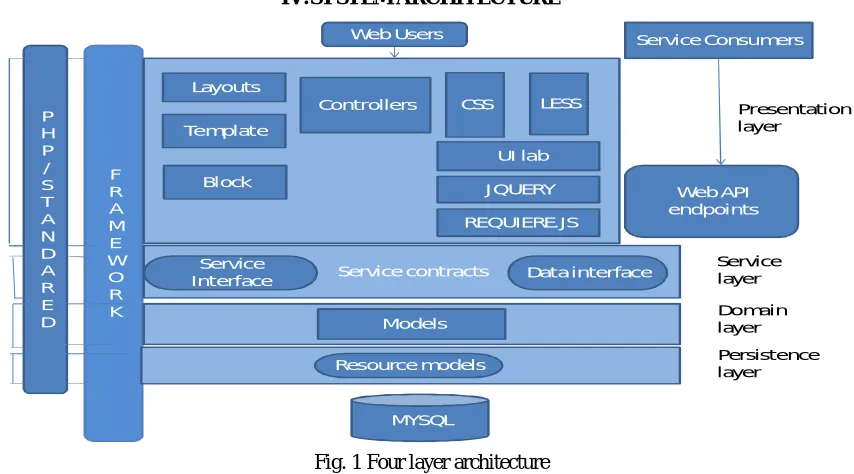
Fig. 1 Four layer architecture
There are several different ways to view the proposed system architecture. for example a developer wants to create new modules or perhaps customize an existing module will want to understand the architecture of a module itself & how it fits into the larger view with the proposed system framework & other components.
This architecture shows the "layers" or tiers for all components as well as the framework, 3rd party libraries, the supported database & other technologies.
E. Css
Cascading style sheets (CSS) is a style sheet language used for the describing the presentation of a document written in a markup language .Jquary is concise & fast JavaScript library that can be used to simplify event handling html document traversing. Jquery simplifies the html client side scripting, Thus simplifying web 2.0 application device.
a) System administrator: Customizing a storefront can indirectly manipulate the presentation layer by for example adding themes or widgets to the front end.
b) Web A PIcalls: can be made through HTTP just like browser requests & can be made via AJAX calls from the user interface. Proposed systems themes organize both the visual aspect of your storefront & certain aspects of product behavior. Each themes resides in a unique directory & contains custom page layouts, template skins & language files that work together to create a district user interface.
c) Blocks: Can generate dynamic content & can contain named child view elements that are similar to argument. Containers collect an ordered group of children view elements.
2)Service layer:: The service layer provides a bridge between the presentation layer & the model layer of domain logic & resource specific area. Which are defined using PHP interface. Provides a stable API for other modules to calls into.
3)Domain layer: The domain layer holds the business logic layer of a proposed system module. It typically does not contain resource. Specific or database specific information. Defining the generic proposed system data objects or modules that contain business logic. These models contain generic information.
4)Presentation layer: Proposed system uses an active record pattern strategy for persistence. In this system the models object contains a resource model that maps an object to one or more database rows. a resource models is responsible for performing functions such as. Executing all CRUD (create, read, update, delete) requests. the resource model contains the SQL code for completing these requests. Performing additional business logic. for example a resource model could perform data validation.
V. CONCLUSIONS
The E-commerce is widely considered the buying and selling of products over the internet but any transactions that is completely solely through electronic measures can be considered as E-commerce. CMS can be used when web application is specially going to be used for management if contents instead of any complex business logic. It is hassle free development. It creates a large number of opportunities for the manufacturers to perform their own e-commerce business and compete worldwide.
VI.ACKNOWLEDGMENT
We would like to take this opportunity to express sincere thanks to the department and the University for this Course where we have such an opportunity to express our ideas and put our learning all the way into practice.
REFERENCES
[1] Miss Nikita A. Rathi, Prof. S.R. Gupta, Optimizing security in E-Commerce Transaction: An Overview, International Journal of Advanced Research in Computer Engineering & Technology (IJARCET) Volume 3 Issue 12, December 2014
[2] The IEEE website. [Online]. Available: http://www.ieee.org/ [3] http://docs.joomla.org/
[4] http://www.magentocommerce.com/