‘Rational Choice’ PPP Procurement Selection
Decision Tool for Delivering Project Specific VfM
Objectives
Muhammad M. Gambo
Christy P. Gomez
Department of Construction and Property Management Department of Construction and Property Management Faculty of Technology Management and Business Faculty of Technology Management and Business Universiti Tun Hussein Onn Malaysia Universiti Tun Hussein Onn Malaysia Johor, Malaysia Johor, Malaysia
[email protected] [email protected]
Abstract — The adoption of the Value for Money (VfM) concept in Public Private Partnership (PPP) for the delivery of infrastructure projects is facing immense criticisms, with issues relating to the VfM concept in PPP being often blurred in terms of clearly outlining its inherent advantages as to the adoption of PPP over traditional infrastructure procurement approaches. This research paper attempts to address the lack of a clear evaluative rationale to aid decision making for the adoption of the most appropriate PPP option for achieving established VfM objectives of a particular project. A comprehensive evaluative matrix is designed based on extensive literature review with respect to the relevant VfM measures embedded within particular PPP infrastructure projects that is most aligned with the established specific infrastructure project objectives. This evaluation phase can be framed within the early stages of current established conceptual frameworks of PPP infrastructure projects for the successful delivery of PPP projects. The significance of this PPP option pathfinder approach is aimed at getting it right the first time and to avoid the scenario of having to rework PPP contractual requirements to fit with unstructured decision making leading to mismatched choices on PPP options.
Keywords — Infrastructure Projects, Public Private Partnership, Value for Money
INTRODUCTION
Public Private Partnerships (PPP’s) are contractual relationships between the public and private sectors in infrastructure development. PPP is defined as ‘a cooperative venture between the public and private sectors, built on the expertise of each partner that best meets clearly defined public needs through the appropriate allocation of resources, risks and rewards’ [1]. The whole concept behind the PPP collaborative form of partnership in the delivery of infrastructure projects is primarily based on the government sectors desire to resolve financial constraints in the provision of public facilities and services by leveraging on the private
sector management skills, expertise and innovation in order to increase the efficiency, effectiveness and quality of facilities and services delivery [2].
PPP can be described as a form of procuring public infrastructure which has evolved to solve infrastructural deficits. It is a system which is primarily aimed at achieving the best output possible by pulling together and mobilizing of funds, technologies, managerial skills, operational efficiencies and facilitating innovations that exists in the private sector [3, 4]. Basically, this is achieved by the transfer of the risks and responsibilities that are being associated with the provision of such infrastructure to the private sector. PPP provides a means of collaboration between the public and private sector in order to pursue common goals of providing infrastructural facilities, while taking advantage of the resources, strengths, competencies and capabilities that do exist in the public and private sectors [5].
PPP offers several advantages as a means of procuring public infrastructure [6], which includes:
a) The achievement and maintenance of a balanced risk return structure as a result of the private sector participation in the provision of such public infrastructure, thereby utilizing the private sector capability of providing effective services.
b) As the private sector is known to possess better mobility than the public sector, it offers cost savings in projects in such aspects as planning, design, construction and eventually the operation. Furthermore, the private sector offers additional advantages of mitigating and relieving all the bureaucracies and administrative burden that is associated with public’s provision of infrastructural facilities and services.
infrastructure projects, as the government is known to be lacking in providing such huge resources that are required in the provision of such projects.
In the PPP form of delivering infrastructure, value for money (VfM) is considered a pivotal requirement in adopting the innovative partnership collaboration to deliver the needed infrastructure [7, 8]. VfM in a procurement context is defined as “using resources effectively, economically, and without waste, with due regard for the total costs and benefits of an arrangement, and its contribution to the outcomes the entity is trying to achieve’’ [9].
VfM has been previously described as the optimum combination of whole-of-life costs and quality (or fitness for purpose) of the good or service to meet the user’s requirement [2]. The term whole-of-life is used to refer to the lifecycle of the good or service. VfM is not the choice of goods and services based on the lowest cost bid, but rather the best possible outcome for the total cost of ownership (or whole-of-life cost).
The PPP as a procurement option offers greater advantage in the premise of delivering better VfM , [10] considered ‘’better value for money’’ as the greatest positive factor for adopting the PPP for delivering infrastructure projects. PPP projects enable public services to be delivered in a more ‘’value for money way’’ by making optimal use of the expertise of both the public and private sectors, resources and innovation to meet public needs effectively and efficiently to the ultimate benefit of the end users [11].
But however, the use of the VfM with respect to the PPP in the delivery of infrastructure projects is facing lots of criticisms. Even though VfM is considered to be the overriding criteria in the choice between using a PPP or traditional procurement, the use of the VfM in making such choice is very often non explicit in practice. More specifically, the choice of using a PPP option is often influenced by factors other than VfM [12]. Moreover, in most PPP markets, it is not sufficiently clear how the VfM concept is incorporated in the assessment framework for adopting the PPP option to deliver their infrastructure projects [13]. The implementation of PPP in both the developed and emerging practice, as an infrastructure delivery option, has been an issue with respect to the achievement of the VfM objective, as the required VfM objectives for achieving the end user’s expectation in the procurement approach have often not been adequately met [14,15].
Various studies have been conducted with respect to the VfM implementation and evaluation for PPP infrastructure projects. A comprehensive study has been conducted on how the achievement of VfM objectives in PPP projects can be assessed, through the identification of the Key Performance Indicators (KPI) required for the evaluation of VfM objectives in PPP projects [16]. Whilst, a survey research has been undertaken to identify the measures that enhance VfM in PPP
projects in Hong Kong, where eighteen VfM measures in PPP projects were identified [16]. One other significant study was carried out to investigate VfM drivers in PPP schemes [18]. However, [12] in their survey research explored the VfM requirements with respect to the PPP form of project delivery and the conventional project delivery option, that is the traditional procurement approach.
One other study proposed a framework for the assessment of the cost and value relationships of the delivery of a project using the PPP approach as compared to the traditional procurement delivery [13],that is by the adoption of the public sector comparator evaluation criteria for delivering VfM objectives.
Given the fact there exists various PPP options that can be adopted to deliver PPP projects, this study which is based on a review of previous literature, was initiated as a result of the paucity of any prior studies which looked into valid criteria used to determine the adoption of the most appropriate PPP option to deliver the required VfM objectives.
Currently, PPP stakeholders, most prominently, the private sector body in the form of the Special Purpose Vehicle (SPV) does not place emphasis on the criteria necessary to determine which PPP option are best suited to deliver the required project specific VfM objectives. Hence, there is a lack of clarity and a definitive structured method of selecting the most appropriate PPP option in order to deliver the project specific VfM objectives; Based on evaluative analysis of the varying types of PPP options to deliver projects, it is evident that each of them possess differing features in terms of the key aspect that characterizes the PPP form of project delivery. This study suggests that certain factors need to be considered in order to determine the most appropriate PPP option that can deliver the project specific VfM objectives most effectively. Therefore an attempt is made here to structure a decision tool based on rational choice that can serve to support decision making based on clear identification and evaluation of such criteria. This tool is expected to serve as clear guideline for the SPV‘s and also the PPP project stakeholders in general towards adopting the most viable ‘VfM objective’- oriented PPP option , thereby providing the basis to structure the SPV that is consistently aligned to effectively deliver PPP projects to meet stakeholder needs.
VALUE FOR MONEY (VfM) OBJECTIVE IN PPP INFRASTRUCTURE PROJECTS
The main driving force behind the adoption of the PPP to deliver infrastructure projects is the need to achieve VfM. Thus, PPP as a procurement option allows risks to be transferred from the public to the private sector on the premise that such risk apportionment is to result in enhancing the achievement of VfM with respect to the project [21,22] . From these, it is apparent that currently the drive to use PPP’s to deliver infrastructure projects is increasingly premised on the pursuit of the VfM objectives associated with the project which thereby makes the VfM concept extremely important in determining whether a project is to be delivered using the PPP approach; and moreover which of the various PPP options is best suited to deliver the required VfM objective with respect to the proposed infrastructure project.
FORMS OF PPP FOR DELIVERING INFRASTRUCTURE PROJECTS
PPP refers to a contractual agreement between a government agency which is reffered to as the host and the private sector entity in the form of Special Purpose Vehicle (SPV) to provide the basis which allows for a greater and all inclusive private sector participation in the execution and subsequent management of public infrastructure projects and services in the form of a concessioning contract [23].
PPP in the delivery of infrastructure projects is known to characterize itself in different forms and types, but with an underlying basic feature as a form of collaboration between the public and private sectors where they join forces together by potentializing the strenghts that does exist in the two sectors to deliver the required infrastructure projects and services. Many forms of PPP are being practiced globally, and in some situations the name the practice carries differs from one country to another and also in some cases having some major differences in the approach. This all depends on the country’s specific set of laws and regulations governing the practice and procedure of the innovative form of partnership [17]. It has been identified that within the various forms of PPP that are implemented, the differing models of the partnership between the public and private sectors do mainly vary with respect to the following features [24]:
• Ownership of capital assets;
• Financial responsibility for investment; • Operation and maintenance responsibility; and,
• Duration of contract.
With regards to the above description of the factors that differentiate the various PPP models, the colloborative form of partnership between the public and private sectors can be generally classified into six broad categories. This is done basically with reference to the general sense of the private sector’s increased involvement; and also the level of risk apportionmant and responsibility. These six broad categories are discussed below:
a) Build – Own – Operate – Transfer (BOOT): This form of the private sector participation in the delivery of infrastructure facilities and services involves the public sector i.e the government going into a form of franchise agreement with the private sector through the SPV in order to finance, design, build and subsequently own and operate the built facility for an agreed duration after which then the transfer aspect of the collaboration comes into effect by having the facility in operation being transfered back to the government [25].
b) Build – Own – Operate (BOO) : This category of PPP involves the private sector being responsible for the financing, designing, constructing and the eventual operation of the infrastructure project, but then the private sector goes on to retain the ownership of the completed facility in perpetuity [26, 27].
c) Design-Build-Finance-Operate/Maintain
(DBFO/DBFM or DBFOM): This is an all-encompassing means of private participation of the provision of infrastructural projects where theprivate sector is responsible for the finance, design, construction, operation, and maintenance of the infrastructural project [28].
d) Build –Transfer (BT): This PPP form involves the public sector entering into a contract with the private sector to design and then build the required project in accordance to the set requirements and objectives agreed by the procuring body i.e the government and also the end users [23]. This PPP model has a direct semblance to the Design and Build (D&B) form of project procurement, where one entity or consortium is contractually responsible for both the design and construction of a project [29, 30].
e) Build – Operate – Transfer (BOT): This involves the private sector being responsible for the finance, design, construction, operation and maintenance of a project for a concession period, by which then at the end of the period, the asset is transferred to the government, often at no cost [26].
TABLE 1: PORTFOLIO OF THE CORE RESPONSIBILITIES FOR THE VARIOUS PPP OPTIONS
[image:4.595.47.287.309.516.2]
Adopted from [References 31, 32, 33, 34]
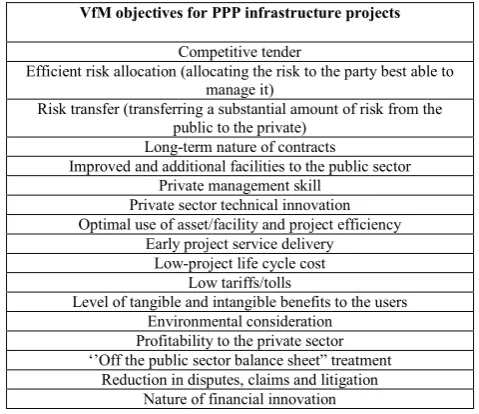
TABLE 2: VfM OBJECTIVES FOR PPP INFRASTRUCTURE PROJECTS
VfM objectives for PPP infrastructure projects
Competitive tender
Efficient risk allocation (allocating the risk to the party best able to manage it)
Risk transfer (transferring a substantial amount of risk from the public to the private)
Long-term nature of contracts
Improved and additional facilities to the public sector Private management skill
Private sector technical innovation Optimal use of asset/facility and project efficiency
Early project service delivery Low-project life cycle cost
Low tariffs/tolls
Level of tangible and intangible benefits to the users Environmental consideration
Profitability to the private sector ‘’Off the public sector balance sheet” treatment
Reduction in disputes, claims and litigation Nature of financial innovation
Source: Reference [35]
The table 2 above identifies the VfM objectives for PPP infrastructure projects based on the studies conducted by [35]. The table describes the VfM objectives in PPP in an all-encompassing context, as it tends to cover key aspects that the PPP form of infrastructure projects entails, from project inception to implementation, and ultimately describing what the stakeholders in PPP seek to achieve in relation to their VfM needs in the project.
Figure 1. Methodological flow of the study
The above figure describes the methodological approach adopted in the study to achieve the intended objectives. Firstly, the portfolio of the core responsibilities for the PPP options are to be determined where each of the PPP options are described with respect to their core features that distiguishes their operations in terms of ownership, conceivement, operation and mantainance and financial responsibility. Then, the VfM objectives for the PPP projects are identified, where the underlying VfM advantages that the PPP form of project delivery seeks to achieve are clearly enumerated.
[image:4.595.310.576.414.689.2]The PPP option selection criteria evaluation for delivering project specific VfM objectives for PPP infrastructure projects has been developed based on a logical mapping procedure. The established generic VfM objectives of PPP projects identified through extensive literature review are matched with the various PPP forms in terms of the project specific VfM objectives.
TABLE 3: PPP RATIONALITY DOMAIN IN TERMS OF VfM
VfM objectives for PPP infrastructure projects
PPP options
Competitive tender All
Efficient risk allocation and transfer All
Long-term nature of contracts Boot, Boo, Dbfo/Dbfm/Dbfom,Bot, Blt
Improved and additional facilities to the
public sector All
Private management skill Boot, Boo, Dbfo/Dbfm/Dbfom,Bot, Blt
Private sector technical innovation All
Optimal use of asset/facility and project efficiency
Boot, Boo, Dbfo/Dbfm/Dbfom,Bot, Blt
Early project service delivery All
Low-project life cycle cost Boot, Boo, Dbfo/Dbfm/Dbfom,Bot, Blt
Low tariffs/tolls Boot, Boo, Dbfo/Dbfm/Dbfom,Bot,
Blt Tangible and intangible benefits to the
users
All
Environmental consideration All
Profitability to the private sector All
‘’Off the public sector balance sheet” treatment
Boot, Boo, Dbfo/Dbfm/Dbfom,Bot, Blt
Reduction in disputes, claims and litigation
All
Financial innovation Boot, Boo, Dbfo/Dbfm/Dbfom,Bot,
Blt PPP options Own Conceive Operation &
Maintenance
Financial Responsibility Build – Own –
Operate – Transfer (BOOT)
Public Public or
Private
Private by concession
Private
Build – Own – Operate (BOO)
Private Public or Private
Private by fee contract
Private
Design-Build- Finance-Operate/Maintain
(DBFO/DBFM or DBFOM):
Private Public or Private
Private by fee contract
Private
Build –Transfer (BT):
Public Public or
Private
No operation required
Public
Build – Operate – Transfer (BOT)
Public Public or
Private
Private by concession
Private
Build – Lease – Transfer (BLT)
Public Public or
Private
Private by fee contract
Private
Portfolio of core responsibilities
for PPP options
VfM objectives
for PPP
PPP rationality domain in terms of VfM
Effective adoption of PPP options
to deliver Project specific VfM
Note: In table 3, the term ‘’all’’ refers to the six PPP options being referred to in this study.
RESEARCH ANALYSIS AND DISCUSSION
The individual VfM objectives as described in table 2 were matched to the characteristics of all the six major existing PPP procurement options, and the final mapping is displayed in
Table 3.
The Table 3 above shows the PPP options categorization according to the VfM objectives for effective PPP infrastructure project delivery. The table describes in detail which each of the VfM objectives matches up with the appropriate PPP option for the effective delivery of PPP
infrastructure projects.
The criteria which was adopted in the categorization were the main aspects which constitute the PPP form of infrastructure delivery and which also distinguishes it from the other convential forms of delivering infrastructure projects.
These criteria include:
• Project ownership;
• Project conceivement;
• Project operation & mantainance;
And lastly,
• Project financial responsibility.
From the table, it is clear that the majority of the VfM objectives are embedded in most of the PPP options, except for the generic VfM measures of : (i) Long-term nature of contracts (ii) Private management skill (iii) Optimal use of asset/facility and project efficiency (iv) Low-project life cycle cost (v) Low tariffs/tolls (vi) ‘’Off the public sector balance sheet” treatment, and (vii) Financial innovation.
From the categorization table, it can be noted that such VfM objectives as Competitive tender, Profitability to the private sector , Efficient risk allocation and transfer, Improved and additional facilities to the public sector, Private sector technical innovation, Early project service delivery, Tangible and intangible benefits to the users, Environmental consideration and Reduction in disputes, claims and litigation matches up with all the PPP options for the delivery of infrastructure projects. The reason for this is that these are underlying basic features of the PPP which are embedded in all the forms of the infrastructure delivery approach. Whereas the VfM objectives as Long-term nature of contracts, Optimal use of asset/facility and project efficiency, Low tariffs/tolls, and Financial innovation , Off the public sector balance sheet treatment, long term contractual obligation, Low-project life cycle cost and Private management skill are possessed in
certain PPP options which includes B-O-T, B-O-O, D-B-F-O/D-B-F-M/D-B-F-O-M, B-O-T and B-L-T. The
reason why these VfM objectives are related to such PPP
options is that they do possess the operation aspect of the procurement approach, where the project operation responsibilities in the infrastructure delivery lies with the private sector organizations through the SPV during the concession period as agreed by the project parties, i.e the public and private sectors.
In this latter form of the PPP options categorization, it is the B - T form of PPP that is excluded, this is due to the fact that the B - T does not involve the operation aspect, as it is just considered like a form of a project delivery approach, similar to the D&B procurement approach, where it is described as a procurement method where one entity or consortium is contractually responsible for both the design and construction of a project thereby primariliy excluding the aspect of operation in the project delivery approach [29,30].
The above categorization provides an insight into which of the VfM objectives matches with the appropriate PPP option in the adoption of the PPP collaborative approach in the delivery of infrastructure facilities and services aiming towards the effective delivery of such infrastructure projects and services.
CONCLUSIONS
Achieving VfM is a pivotal requirement towards ensuring the effective delivery of PPP infrastructure projects which are aimed towards achieving the set objectives of the PPP project stakeholders in terms of the private sector parties in the form of the SPV, end-users and regulators.
Based on an extensive literature review, this study formalizes a mapping of the VfM objectives for PPP projects with the various PPP options towards enabling the delivery of PPP projects that are tailored at delivering the VfM objective specific PPP projects. This simple ‘rational choice’ tool can be an enabler for aligning project specific VfM objectives with the most appropriate choice of PPP option.
With the information from this research, it is expected to enable PPP stakeholders towards selecting the most appropriate PPP option that will serve to address a fundamental need of VfM alignment with PPP option choice to start with in the effort of ensuring the structure of an SPV capable of delivering PPP projects effectively. Furthermore, this study could provide valuable guideline, especially to the procuring parties as to which of the PPP options is most suited to deliver their VfM requirements and ultimately their expectations and needs with respect to achieving their infrastructure project needs.
ACKNOWLEDGMENT
REFERENCES
[1] CCPPP, ‘’100 Projects: Selected Public – Private Partnerships’’. Ottawa: Canadian Council for PPP, 2001.
[2] Treasury, H. ‘’Value for Money Assesment Guidance’’ . London : Treasury Department, 2006.
[3] Njikamp, P., Van Der Buch, M., & Vidigni, G. ‘’A Comparative Institutional Evaluation of Public Private Partnership in Dutch Urban Land Use and Revitalization Projects’’ . Urban Studies , 1865-80, 2002.
[4] Zhang, X. ‘’Public Client's Public Clients Best Value Perspectives of Public Private Partnerships in Infrastructure Development’’ . Journal of Construction Engineering and Management,107-114, 2006.
[5] Pongsiri, N. ‘’Regulation and public-private partnerships’’. International Journal of Public Sector Management, 487-495, 2002.
[6] Walker, C. T. ‘’Privatized infrastructure: The build operate transfer approach’’. London : Thomas Telford, 1995.
[7] Shaoul, J. ‘’A Financial Appraisal of the London Underground Public Private Partnership’’. Public Money & Management, 53-60, 2002.
[8] Ismail, S., & Pendlebury, M. ‘’The Private Finance Initiative (PFI) in Schools: The Experiences’’ . Financial Accountability & Management, 381-404, 2006.
[9] Office of the Auditor-General. ‘’Good Practice Guide for Public Sector Procurement Guidance’’. Wellington, 2008.
[10] Hwang, B. G., Zhao, X., & Gay, M. J. S. ‘’Public private partnership projects in Singapore: Factors, critical risks and preferred risk allocation from the perspective of
contractors’’. International Journal of Project Management, 31(3),
424-433, 2013.
[11] MOF. ‘’Public Private Partnership Handbook’’. Ministry of
Finance, Singapore. 2004
[12] Burger, P., & Hawkesworth, I. ‘’How to attain value for money: comparing PPP and traditional infrastructure public procurement’’. OECD Journal on Budgeting, 1-56, 2011.
[13] Lubis, H., & Majid, N. ‘’Standardized Assesment Method Of PPP’’ . Jakarta: Economic Research Insttute for Asean and East Asia , 2010.
[14] Ismail, K., Takim, R., Nawawi, A. H., & Jaapar, A. ‘’The Malaysian Private Finance Initiative and Value for Money’’. Asian Social Sciences , 103-111. 2009
[15] Ismail, K., Takim, R., & Nawawi, A. H. ‘’The Evaluation Criteria of Value for Money (VfM) of Public Private Partnership (PPP) Bids’’. International Conference on Intelligent Building and Management. Singapore.2011.
[16] Yuan, J., Zeng, A. Y., Skibniewski, M. J., & Li, Q. ‘’Selection of Performance Objectives and Key Performance Indicators in Public–Private Partnership Projects to achieve Value for Money’’. Construction Management and Economics, 253-270, 2009. [17] Cheung, E.’’ Developing a Best Practice Framework for
Implementing Public Private Partnerships (PPP) in Hong Kong’’. Brisbane : Unpublished Doctoral Theses, 2009.
[18] Nisar, T. M. ‘’Value for Money Drivers in Public Private Partnership Schemes’’. International Journal of Public Sector Management, 147-156,2007.
[19] Jackson, P. ‘’Value for Money and International Development: Deconstructing Myths to Promote’’. Paris : OECD Development Co-operation Directorate
,
2012.[20] Rosenau, P. ‘’Public-Private Policy Partnerships’’. Massachusetts:
Scotsman, 2000.
[21] Grout, P. ‘’The Economics of the Private Finance Initiative’’. Oxford Review of Economic Policy, 53 – 66 ,1997
[22] Grimsey, D., & Lewis, D. ‘’Public Private Partnerships: The Worldwide Revolution in Infrastructure Provision and Project Finance’’. Cheltenham: Edward Elga, 2004.
[23] Deloitte Research. ‘’Closing the Infrastructure Gap: The Role of Public–Private Partneirshps’’. New York: Deloitte LLC, 2006. [24] UNESCAP. ‘’A Guidebook on Public - Private Partnership In
Infrastructure’’ . Bangkok: United Nations, 2011.
[25] World Bank . PPIAF. Retrieved August 20th , 2013, from PPP In Infrastructure Resource Center : World Bank.org, 2013.
[26] National Council of PPP. Types of Partnerships . Retrieved September 15, 2013, from PPP Resources: Ncppp.org [27] Credo Group. Build-Own-Operate . Retrieved November 8th,
2013, from Resources Portal : Credo Group.com, 2013. [28] Brink Groep. PPP Services. Retrieved July 23rd, 2013, from
Corporate Resources: Brink Groep.com, 2013.
[29] Akintoye, A. ‘’Design and build: A Survey of Construction Contractors’ Views’’. Construction Management and Economics, 155-163, 1994.
[30] Knight, A.’’ Best Practice Tendering for Design and Build Projects’’. London: Thomas Telford,2003.
[31] Kumaraswamy, M. M., & Zhang, X. ‘’Governmental Role in BOT- led Infrastructure Development’’. International Journal of Project Management , 195-205, 2001.
[32] Chege, L. W., & Rwelamila, P. D. ‘’Private Financing of Construction Projects and Procurement Systems: An Integrated Approach’’. CIB World Building Congress. CIB, 2001
[33] Sanghi, A., Hankinson, D., & Sundakov, A. ‘’Designing and Using Public-Private Partnership Units in Infrastructure: Lessons from Case Studies around the World’’. Washington D.C: World Bank, 2007.
[34] Kelly, E. S., Haskins, S., & Reiter, P. D. ‘’Implementing a DBO Project’’. Journal-American Water Works Association, 34-46, 1998
[35] Li, B.‘’Risk management of construction public-private