A COMPARATIVE STUDY OF THE AHP AND TOPSIS METHODS FOR IMPLEMENTING LOAD SHEDDING SCHEME IN A PULP MILL SYSTEM
ZARINA BT HAJI IBRAHIM
A project report submitted in partial fulfilment of the requirement for the award of the
Degree of Master of Electrical Engineering
Faculty of Electrical and Electronics Engineering Universiti Tun Hussein Onn Malaysia
ABSTRACT
vi
ABSTRAK
CONTENTS
THESIS STATUS APPROVAL
EXAMINER’S DECLARATION
TITLE i
DECLARATION ii
DEDICATION iii
ACKNOWLEDGEMENTS iv
ABSTRACT v
ABSTRAK vi
CONTENTS vii
LIST OF TABLES ix
LIST OF FIGURES x
LIST OF SYMBOLS AND ABBREVIATIONS xii
LIST OF APPENDICES xiii
CHAPTER 1 INTRODUCTION
1.1 Project Background
1.2 Problem Statement 1.3 Project Objective
1.4 Project Scope
1
1 2-5
5 5
CHAPTER 2 LITERATURE REVIEW
2.1 Load Shedding 2.2 Analytical Hierarchy Process (AHP) 2.3 Technique for Order Preference by Similarity to Ideal
Solution (TOPSIS)
2.4 Pulp Mill Electrical System General Information 2.4.1 Island Mode
2.4.2 Parallel Mode
viii
CHAPTER 3 METHODOLOGY
3.1 Analytic Hierarchy Process (AHP) 3.2 Technique For Order Preference By Similarity to Ideal Situation (TOPSIS)
3.3 Load Shedding Scheme in Pulp Mill System
18
18-26 27-30
31-35
CHAPTER 4 RESULT AND ANALYSIS
4.1 Data Analysis
4.2 AHP Analysis Method 4.3 TOPSIS Analysis Method
4.4 Discussion
36
36-37 37-58 59-74 75-80
CHAPTER 5 CONCLUSION AND RECOMMENDATION
5.1 Conclusion 5.2 Recommendation
81
81-82 82-83
REFERENCES 84-87
LIST OF TABLES
Table 1.1 Statistics of transmission system tripping with a load loss of 50MW and above for the first half year of 2010
3
Table 2.1 The fundamental scale of absolute numbers 10 Table 2.2 Summarised information for research projects related to AHP 12 Table 2.3 Summarised information for research projects related to
TOPSIS
13
Table 3.1 Table of random index (Saaty, 1980) 19
Table 3.2 The pulp mill loading estimation 34
Table 4.1 Pair-wise comparison table matrix 38
Table 4.2 Product of pair-wise comparison matrix 38
Table 4.3 Root of the product for criteria 39
Table 4.4 Pair-wise comparison matrix (alternatives) for operating load 43 Table 4.5 Pair-wise comparison matrix (alternatives) for area power 44 Table 4.6 The 15th root of product for alternatives in operating load 45 Table 4.7 The 15th root of product for alternatives in area power 46 Table 4.8 Matrix multiplication between criteria and alternatives 54 Table 4.9 Overall performance of AHP for pulp mill system 55
Table 4.10 Criteria data 63
Table 4.11 Relative closeness calculation 69
Table 4.12 Relative closeness 70
Table 4.13 Load ranking using TOPSIS 71
Table 4.14 The order of load shedding for pulp mill system 76 Table 4.15 The percentage effectiveness of load shedding for pulp mill
system
x
LIST OF FIGURES
Figure 1.1 Number of Transmission System Tripping in Peninsular Malaysia with a Load Loss of 50MW and above for first half year of 2008 – 2010 and in the year 2007-2009
3
Figure 1.2 Causes of unscheduled electricity supply interruptions in Peninsular Malaysia [3]
4
Figure 1.3 Maximum demand and installed generation capacity in Peninsular Malaysia for the first half year of 2010
4
Figure 2.1 The Analytic Hierarchy Process (AHP) scheme 8
Figure 3.1 Flowchart for AHP Method 23
Figure 3.2 Step 1 in AHP method 24
Figure 3.3 Step 2 in AHP method 25
Figure 3.4 Step 3 in AHP method 26
Figure 3.5 Flowchart for TOPSIS method 30
Figure 3.6 The part of the electrical system in a pulp mill 32 Figure 3.7 The pulp mill electrical system analysis by using ETAP 33
Figure 4.1 Relationship between the parameter 37
Figure 4.2 Weight of Criteria 41
Figure 4.3 Percentage of weight of criteria 41
Figure 4.4 Graph for weight of alternatives in operating load 48 Figure 4.5 Graph for percentage of alternatives in operating load 49 Figure 4.6 Graph for weight of alternatives in area power 51 Figure 4.7 Graph for percentage of weight of alternatives in area
power
51
Figure 4.8 Relationship between criteria and alternatives for load shedding analysis
53
Figure 4.10 Graph for percentage of overall performance of AHP for pulp mill system
57
Figure 4.11 Flowchart for load shedding using AHP method in pulp mill system
58
Figure 4.12 Relative closeness to ideal solution for pulp mill system 70 Figure 4.14 Graph for overall ranking for feeder in pulp mill system 72 Figure 4.15 Flowchart for load shedding using TOPSIS method in
pulp mill system
73
Figure 4.19 Flow chart of TOPSIS solution procedure 74 Figure 4.20 The percentage effectiveness of load shedding for pulp
mill system
xii
LIST OS SYMBOLS AND ABBREVIATIONS
∑ - Summation
CR - Consistency Ratio
RC - Relative Closeness
RI - Random Index
CI - Consistency Index
et al. - And others
AHP - Analytic Hierarchy Process
AP - Area Power
ETAP - Power system software
HV - High voltage
Hz - Hertz
L - Load
LP - Load power
LS - Load shedding
LV - Low voltage
AHP - Analytic Hierarchy Process
TG - Turbo Generator
TNB - Tenaga Nasional Berhad
ETAP - Power system software
SCADA - Supervisory Control and Data Acquisition
TOPSIS - Technique for Order Preference by Similarity to Ideal Solution
Parea - Area Power
Pload - Operating Load
Wc - weight matrix for criteria
PIS - positive ideal solution
NIS - negative ideal solution
LIST OF APPENDICES
APPENDIX TITLE PAGE
A Fuzzy Multi-criteria Decision-making TOPSIS for 88 Distribution Center Location Selection
CHAPTER 1
INTRODUCTION
1.1 Project background
Power systems are designed and operated so that for any normal system condition, including a defined set of contingency conditions, there is adequate generating and transmission capacities to meet load requirements. However, there are economic limits on the excess capacity designed into a system and the contingency outages under which a system may be designed to operate satisfactorily. For those rare conditions where the system’s capability is exceeded, there are usually processes in place to automatically monitor a power system’s loading levels and reduce loading when required.
The load shed processes automatically sense overload conditions, then shed enough load to relieve the overloaded equipment before there is loss of generation, line tripping, equipment damage, or a chaotic random shutdown of the system.
achieving an ideal load shedding module. The process of differentiating can be done by ranking them in hierarchy.
Therefore in this study, the analysis outcome in interest is to remove loads by ranking them according to their priority. By earning the first rank means that the priority is less as the load shedding module aims is to ensure power continuity to only vital and most critical loads in the system. The module begins with non-vital loads shedding and follows by semi-vital loads removal. The vital loads can only be removed if the system is disturbed by large disturbances such as major generation outages.
Foremost, the analysis is begins by setting a goal and identifies the criteria. These two will frame out the shedding process. And to aid or to simplify the selecting process comprising multiple criteria condition can be chosen from the variety multi-attribute or multi-criteria decision making (MADM/MCDM) technique.
In this study, the Analytic Hierarchy Process(AHP) and Technique for Order Preference by Similarity to Ideal Solution (TOPSIS) are used to as an agent searching for the best set of load to be shed in recovering the shortage of the electrical power availability. They have been known to solve problems in areas such as engineering, government, industry, management, manufacturing, personal, political, social and sports [2].
1.2 Problem statement
3
Figure 1.1: Number of Transmission System Tripping in Peninsular Malaysia with a Load Loss of 50MW and above for first half year of 2008 – 2010 and in the year
2007-2009 [3]
[image:13.596.138.507.481.745.2]By referring to Table 1.1, in the first half of 2010 Peninsular Malaysia experienced tripping events only twice without load shedding action compared to none when with load shedding. A 56MW and 61.5MW loads were shed in February and June, respectively which caused a discontinuity of 112.1 MW/h and 57.3 MW/h supplied energy to the customers as seen in Table 1.1. The causes were numerous; with process and quality of works hold the majority of 56.7% in contrast to the least cause natural disaster with only 0.1% (refer to Figure 1.2). But still, they only caused two tripping events in the first six months of 2010.
Figure 1.2: Causes of unscheduled electricity supply interruptions in Peninsular Malaysia [3]
[image:14.596.142.499.514.716.2]5
Thus, by analyzing the data from Figure 1.3 can clearly explains that customers demand continues to grow with each year despite the unscheduled interruptions event. Therefore, it is the duty of Tenaga Nasional Berhad (TNB) to ensure the continuity in load feeding as the progress of the industrial and technological relies in the reliability and credibility of such companies. Any contingency that could bring catastrophic impact to the power system Peninsular Malaysia power network has to be prudently mitigated. There are many ways for the companies to mitigate the problem and among them is the famed load shedding. By far load shedding is a last-resort measure taken by the company if and only if prior precaution steps fail to balance back the supply (power generated) and demand (loads/customers).
1.3 Project Objectives
There are three objectives for this project:
a) To implement multi-criteria decision-making methods such as AHP and TOPSIS in the load shedding scheme.
b) To evaluate AHP and TOPSIS performances for pulp mill electrical system c) To compare the effectiveness of multi-criteria decision making methods in
load shedding scheme.
1.4 Project Scope
The system study was carried out using the Microsoft Excel software application. The following salient points are taken into consideration:
a) The system study is carried out to rank load priority for load shedding scheme as one of the defense scheme/protection system in pulp mill electrical system b) Only power generated and load demand were considered in this analysis c) The type of disturbance considered in this analysis was large contingency
CHAPTER 2
LITERATURE REVIEW
2.1 Load shedding
Load shedding is defined as an amount of load that must almost instantly be removed from a power system to keep the remaining portion of the system operational [3]. This protection action is in response to the system that was disturbed by either major generation outages or important power transmission line outages, faults, switching errors or lightning strikes which cause a generation deficiency condition and if not properly executed can lead to a total system collapse [3-4].
Thereupon, through tremendous studies it has been proven that by removing a substances amount of load can ensure a portion of the system operational. That remaining portion should be only the vital and most critical loads in the system. And the supposed loads that were shed or switched off should be from any non-vital loads available in the same disturbed system [5]. This fast mitigation helps in bringing back the balance between the power generated and load demand.
7
investment is scheduled and networks are well managed; such events are considered an unacceptable failure of planning and can cause significant political damage to responsible governments.
2.2 Analytic Hierarchy Process (AHP)
Analytical Hierarchy Process (AHP) is a method for ranking decision alternatives and selecting the best one when the decision maker has multiple criteria. It answers the question, “Which one?”. With AHP, the decision maker selects the alternative that best meets his or her decision criteria and develops a numerical score to rank each alternative decision based on how well each alternative meets them [6].
In AHP, preferences between alternatives are determined by making pairwise comparisons. In a pairwise comparison, the decision maker examines two alternatives by considering one criterion and indicates a preference. These comparisons are made using a preference scale, which assigns numerical values to different levels of preference. The standard preferred scale used for the AHP is 1-9 scale which lies between “equal importances” to “extreme importance” where sometimes different evaluation scales can be used such as 1 to 5 [7].
In the pairwise comparison matrix, the value 9 indicates that one factor is extremely more important than the other, and the value 1/9 indicates that one factor is extremely less important than the other, and the value 1 indicates equal importance. Therefore, if the importance of one factor with respect to the second factor is given, then the importance of the second factor with respect to the first is the reciprocal. The ratio scale and the use of verbal comparisons are used for weighting of quantifiable and non-quantifiable elements [7].
hierarchy and to evaluate a large number of quantitative and qualitative factors in a systematic manner under multiple criteria environment in the conflation [8].
The application of the AHP to the complex problem usually involves four major steps [8].
(a) Break down the complex problem into a number of small constituent elements and then structure the elements in a hierarchical form.
(b) Make a series of pairwise comparisons between the elements according to a ratio scale.
(c) Use the eigenvalue method to estimate the relative weights of the elements. (d) Aggregate the relative weights and synthesis them for the final measurement
of given decision alternatives [8].
The AHP is a powerful and flexible multi-criteria decision-making tool for dealing with complex problems where both qualitative and quantitative aspects need to be considered. The AHP helps analysts to organise the critical aspects of a problem into a hierarchy rather like a family tree [8].
The essence of the process is decomposition of a complex problem into a hierarchy with a goal at the top of the hierarchy, criteria and sub-criteria at levels and sub-levels of the hierarchy, and decision alternatives at the bottom of the hierarchy [8]. Figure 2.1 illustrates the scheme of the Analytic Hierarchy Process (AHP).
9
Elements at the given hierarchy levels are compared in pairs to assess their relative preference with respect to each of the elements at the next higher level. The method computes and aggregates their eigenvectors until the composite final vector of weight coefficients for alternatives are obtained. The entries of the final weight coefficient vector reflect the relative importance (value) of each alternative with respect to the goal stated at the top of the hierarchy [8].
A decision maker may use this vector according to his particular needs and interests. To elicit pairwise comparisons performed at a given level, a matrix A is created in turn by putting the result of pairwise comparisons of element i with element j into the position aji as given in Equation (2.1) [8].
(2.1) where
n = criteria number to be evaluated Ci = ith criteria, (i=1,2,3,….,n)
Aij = importance of ith criteria according to jth criteria (j=1,2,3,….,n) After obtaining the weight vector, it is then multiplied by the weight coefficient of the element at a higher level (that was used as the criterion for pairwise comparisons). The procedure is repeated upward for each level, until the top of the hierarchy is reached.
Table 2.1 shows the fundamental scale of values to represent the intensities of judgments. There are several intensities of importance. Each of the intensities of the importance is attached with the definition and explanation. Table 2.1 can be used as the reference when proceed to do the AHP analysis [9].
Table 2.1 : The fundamental scale of absolute numbers [9]
Intensity of
Importance
Definition Explaination
1 2 3 4 5 6 7 8 9 Equal importance Weak Moderate importance Moderate plus Strong importance Strong Plus Very Strong
Very, very strong
Extreme importance
Two activities contribute equally to the objective
Experience and judgment slightly favour one activity
over another
Experience and judgment strongly favour one
activity over another
An activity is favoured very strongly over another;its
dominance demonstrated in practice
The evidence favouring one activity over another is
of the highest possible order to affirmation
Reciprocals of above
If activity i has one of the
above nonzero numbers
assigned to it when
compared with activity j,
then j has the reciprocal
value when compared with i
A reasonable assumption
11
influencing factors, which cover the knowledge of kinds of subjects, such as management, security, scheming and so on.
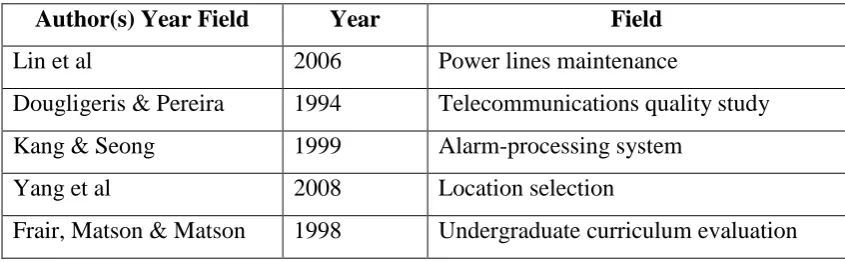
Dougligeris & Pereira [10] applied the analytical hierarchy process in a telecommunications quality study to solve the specific problem that the customer faced in choosing a telecommunication company that best specifies the consumers’ needs. The evolution of technology has enabled the simultaneous cost reduction and quality improvement in the services offered. Customers have the opportunities to determine and purchase the quality of communication services that they need, by balancing their cost and value.
Kang & Seong [11] proposed a procedure for evaluating alarm-processing system regard to integrating a series of deviations in a nuclear power plant control room. Yang et al. [16] applied the analytic hierarchy process in location selection for a company. The location decision often depends on the type of business. For industrial location decision, the strategy is minimising the costs while for service organization, the strategy focuses on maximising revenue.
Frair, Matson & Matson [12] proposed an undergraduate curriculum evaluation with the analytic hierarchy process. A model of the problem for undergraduate curriculum designed is developed based on the responses from the affected parties (students, faculties, employers, etc.), curriculum components (design, science, math, etc.) and curriculum alternatives.
Table 2.2: Summarised information for research projects related to AHP
Author(s) Year Field Year Field
Lin et al 2006 Power lines maintenance
Dougligeris & Pereira 1994 Telecommunications quality study Kang & Seong 1999 Alarm-processing system
Yang et al 2008 Location selection
Frair, Matson & Matson 1998 Undergraduate curriculum evaluation
2.3 TOPSIS (Technique For Order Preference By Similarity to Ideal Solution)
TOPSIS is known as the “Technique for Order Preference by Similarity to Ideal Solution”. This method is a unique technique to identify the ranking of all alternatives considered. In the TOPSIS method, the decision making matrix and weight vector are determined as crisp values and a positive ideal solution (PIS) and a negative ideal solution (NIS) are obtained from the decision matrix [18].
In other words, PIS is a set of the best value of criteria while NIS is a set of worst values achievable of criteria. This method is applied to make wide-ranging evaluation of samples where it measured the distances between the index value vector of each sample and ideal solution along with the negative ideal solution of the comprehensive evaluation [18].
Hwang and Yon [19] are the first who introduces the TOPSIS method. Hwang and Yon describe multiple decisions making as follows: multiple decisions making is applied to the preferable decision (such as assessment making priorities and choices) between available classified alternatives over the multiple attributes or criteria. It assumes that each criterion requires to be maximised or minimised. Therefore, the ideal positive and negative values of each criterion are identified, and each alternative judge against this information.
13
process. Each evaluation of criteria entails diverse opinions and meanings. Hence, the assumption that each evaluation criterion is equally important is prohibited [20].
TOPSIS method consists of two artificial alternatives hypothesis, which are ‘Ideal Alternative’ and ‘Negative Ideal Alternative’. ‘Ideal Alternative’ represents the best level of all attributes considered while the ‘Negative Ideal Alternative’ represented the worst attributes values. With these two hypotheses, sets of calculations using eigenvector, square rooting and summations to obtain a relative closeness value of the criteria tested. These values of relative closeness, TOPSIS ranked the whole system by selecting the highest value of the relative closeness as the best attributes in the system.
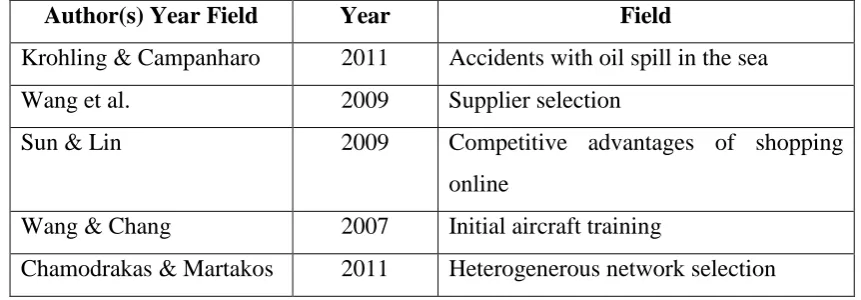
[image:23.596.103.534.535.685.2]Krohling & Campanharo [21] did a case study of accidents with oil spill in the sea by using TOPSIS approach. Wang et al. [21] applied TOPSIS to supplier selection. Sun & Lin [22] used TOPSIS for evaluating the competitive advantages of shopping websites. Wang & Chang [23] developed an approach in evaluating initial training aircraft under a fuzzy environment for the Taiwan Air Force Academy. Chamodrakas & Martakos [24] applied TOPSIS method for energy efficient network selection in heterogeneous wireless networks. Table 2.4 shows the summarized information for the research projects related to the TOPSIS.
Table 2.3: Summarised information for research projects related to TOPSIS
Author(s) Year Field Year Field
Krohling & Campanharo 2011 Accidents with oil spill in the sea
Wang et al. 2009 Supplier selection
Sun & Lin 2009 Competitive advantages of shopping online
Wang & Chang 2007 Initial aircraft training
2.4 Pulp Mill Electrical System General Information [25]
Pulp mill is one of the heavy industries that consumes large amount of electricity in its production. In particular, the breakdown of generator would cause others generators to be overloaded. Thus load shedding scheme is the best way in handling such condition. Selected load will be shed under this scheme in order to protect the generators from being damaged. In the meantime, the subsequence loads will be shed until the generators are sufficient to provide the power to other loads. In other to determine the sequences of load shedding scheme, Analytic Hierarchy Process (AHP) and Technique For Order Preference By Similarity to Ideal Situation (TOPSIS) are used. AHP and TOPSIS are the multi-criteria decision making methods.
In pulp mill, there are quite a number of areas of land being used to allocate the equipment and device. The electrical system must be well managed in order to ensure that the operation in the mill is fully utilized. However, there might be breakdown in the electrical system due to the longer working period of the machines. The malfunction of the equipment or devices might cause huge losses to the company. Due to this, the load shedding scheme is needed in the pulp mill to prevent damage of the power generator.
The mill electrical voltage levels are divided into several categories such as: (i) 3-phase, 50Hz voltage level is divided to:
High voltage : 110kVac
Medium voltage : 35kVac and 6kVac Low voltage : 690Vac and 400Vac
(ii) 3×Turbine generator: 2×120MW+90MW=330MW connected to the public grid with 80MVA transformer but limited import to 60MVA due to shortage power in the grid.
15
operating load is 130MW at 3,000 air-dried tons per day (adt/d) of production capacity.
The electrical load shedding coverage is focused on 35kV incoming feeders to each plant which excludes 35kV feeder to boiler and water treatment plant and 6kV motor feeders in each mill and arranged the priority table with manual and automatic options (excluded 690Vac incoming feeder due to huge cost additional). Notes: 6kV include in the load shedding system only for monitoring and the 6kV Smart Motor Control Center (MCC) is a conventional type. This is the purpose to gather the most information.
In order to design the pulp mill’s electrical load shedding Supervisory Control and Data Acquisition (SCADA) system, the person in charge must have basic knowledge and process concept of a pulp mill and is required to work closely with process department. In addition, he/she must be capable to plan for an integrated system to fulfill the plant process and electrical distribution stability needs, and possesses the knowledge of the behaviour of a Steam Turbo Generator (TG) or electrical system and mill wide control system.
For example, the Load Shedding System should consist of a pulp storage tank with level indication. This is to decide when part of the mill should start the load shedding as it depends on the load and priority if TG trips, boiler trips or if some fault disturbing the stability of system frequency. The purpose of electrical load shedding SCADA system is to provide mill wide load shedding to stabilize the power distribution system during any abnormal circumstances, collect information for maintenance, diagnostic and historical purposes, ON-OFF control for the switcher, metering purposes and etc.
This is an important part of mill wide electrical system because the technology, which combines the electrical system, communication system with fully digitalised information of protection relay is for maintenance convenience. Two operation modes of load shedding are:
2.4.1 Island mode [25]
The load shedding on island mode with 2 circumstances is designed:
(a) 110kV bus bar frequency, as the frequency is directly related to a turbine generator turning speed. If the frequency drops, the turbine is overloaded and the steam will be insufficient or internal fault occurred and causes frequency dip.
(b) Tripping of the turbine generators, the electrical system will immediately lose electricity not less than 40MW (During this condition, the other turbine running the generator is not able to coverthe load in a short duration but will manage to take 10~15MW and another 20MW from the public grid). At such condition, the load shedder cannot depend on the busbar frequency due to slow responses but can depend on the setting made in the column of the TG trip. All settings will be done by the process engineer according to the mill production conditions or the automotive cyclic calculation and trip loads as per TG’s power loses. This concept is convenient for the engineers during emergency cases.
2.4.2 Parallel mode [25]
The overall function of load shedding is similar to the island mode but the only deviation is that the frequency-based load shedding function will be deactivated (the reason is the public grid system is too huge compared to the electrical mill system which is only 330MW. Therefore, any disturbance from the external system will affect the mill system tremendously. So the decoupling protection relay setting at Gas Insulated Substation (GIS) – 140-ES is the critical point that protects the mill system from external factors.)
17
This is to avoid the mill wide electrical system from interruption due to heavy external fault occurred in public overhead transmission line. The load shedding will be activated and the load will be isolated according to the supply lost from the public grid.
Most cases that caused the load shedding function to activate were due to the tripping of recovery boilers. Recovery boiler is the main steam generator to produce about 60% of the electricity. If the recovery boiler trips, the steam will reduce rapidly.
The operators need to act fast to start the load shedding function manually (as it has not tripped the turbine generator yet) in order to keep the turbine generator to continue running.
Initially, the operation of the mill was unable to be saved due to lack of knowledge and experience of the load factor. However, after training is provided, the operator in charge can act wisely and promptly.
CHAPTER 3
METHODOLOGY
3.1 Analytical Hierarchy Process (AHP)
Analytical Hierarchy Process (AHP) was developed by Professor Thomas L. Saaty in the 1970s and has been extensively studied and refined since then [26]. It is a method for solving complex decision making based on the alternatives and multiple criteria, as it names stated. It is also a process for developing a numerical score to rank each decision alternative based on how well each alternative meets the decision maker‟s criteria.
Nowadays, there are many versions of AHP existed. Originally, AHP was designed to calculate the nth root of the product of the pair-wise comparison values in each row of the matrices and then normalizes the aforementioned nth root of products to get the corresponding weights [26]. Meanwhile the modified AHP version normalizes the pair-wise comparison values within each of the matrices and then averages the values in each row to get the corresponding weights and ratings [26].
19
Step 1: Develop the weights for the criteria:
a) First, develop a single pair-wise comparison matrix for the criteria as shown in the equation below:
(3.1) where, C1, C2,….,Cn representing the criteria,
aij represents the rating Ci with respect to C1
b) Then, multiply the values in each row together and calculates the nth root of the said product as shown in the equation below:
√ (3.2)
Where n = positive integer number
c) After that, normalizing the aforementioned nth root of products to get the appropriate weights by using the formula given in equation 3.3:
∑ (3.3)
d) Lastly, perform the Consistency Ratio (CR) by using the formula as shown below:
e)
CR =
(3.4)
Table 3.1: Table of Random index (Saaty, 1980)
n 1 2 3 4 5 6 7 8 9
RI 0 0 0.58 0.90 1.12 1.24 1.32 1.41 1.45
*Note: Value of C.R must be less than the allowable value of 0.10. Therefore, the consistency of the judgment matrix should be within an acceptable tolerance. But if the consistency ratio is greater than 0.10 then the subjective judgment needs to be revised.
While the value for Consistency Index (CI) can be found by using this equation:
(3.5)
And for Lambda_Max,
∑ ∑ (3.6)
where: Σcolumn is the summation of pair-wise values of each alternative vertically and n is a positive integer number.
Step 2: Develop the ratings for each decision alternative for each criterion
a) First, develop a pair-wise comparison matrix for each criterion, with each matrix containing the pair-wise comparisons of the performance of decision alternatives on each criterion as shown in equation 3.7 below:
(3.7)
21
b) Secondly, multiply the values in each row together and calculates the nth root of the said product by using equation 3.8 below:
√ (3.8)
Where n = positive integer number
c) Then, normalizing the aforementioned nth root of product values to get the corresponding ratings by using equation 3.9 below:
∑
d) Lastly, perform the Consistency Ratio (CR) using equation 3.10 below:
[image:31.596.108.533.477.524.2]
The value of Random index (RI) can be found using Table 3.1 below where Random Index (RI) is a constant and it is a standard for AHP analysis.
Table 3.1: Table of Random index (Saaty, 1980)
n 1 2 3 4 5 6 7 8 9
RI 0 0 0.58 0.90 1.12 1.24 1.32 1.41 1.45
*Note: Value of C.R must be less than the allowable value of 0.10. Therefore, the consistency of the judgment matrix should be within an acceptable tolerance. But if the consistency ratio is greater than 0.10 then the subjective judgment needs to be revised.
While the value for Consistency Index (CI) can be found by using this equation:
(3.11)
And for Lambda_Max,
where: Σcolumn is the summation of pair-wise values of each alternative vertically and n is a positive integer number.
Step 3: Calculate the weighted average rating for each decision
alternative. Choose the one with the highest score
a) First, find the final score for each of the alternative. The final score for each
alternative is the summation of the product of criteria to alternative. b) Generally, there will be n number of overall weight and n must be an
integer that does not exceed 9. Therefore by using the formula given by equation 3.13 below the value for each decision alternative can be found:
Final_scorealternativeX = (Criterion A x Alternative X) + (Criterion B x Alternative X) + (Criterion C x Alternative X )+……+ (Criterion I x Alternative X ) (3.13)
where Criterion A = 1st criterion, Criterion B = 2nd criterion, …, Criterion I = 9th criterion and 1 ≤ X ≤ 9
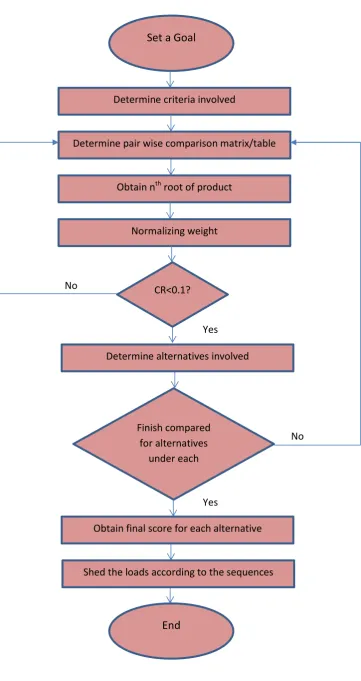
23
Figure 3.1: Flowchart for AHP Method Set a Goal
Determine criteria involved
Determine pair wise comparison matrix/table
Normalizing weight Obtain nth root of product
CR<0.1?
Determine alternatives involved
Finish compared for alternatives
under each criterion
Obtain final score for each alternative
Shed the loads according to the sequences
End
No
Figure 3.2: Step 1 in AHP method Start
Develop a single pair-wise comparison matrix for the criteria
Normalizing the aformentioned nth products to the appropriate weights
Multiplying the value in each row together, and calculating the nth root of said product
Calculating and checking the Consistency Ratio
Consistency ratio < 0.1?
Finalized weight for criteria?
End
Yes No
84
REFERENCE
[1] Jethwa, U.K., Bansal, R.K., Date, N., Vaishnav, R.. Comprehensive Load-Shedding System. IEEE Transactions on Industry Applications. 2010. 46(2): 740-749.
[2] Li, C., Sun, Y., Jia, Y., Li, H.. An Improved Ranking Approach to AHP Alternatives Based on Variable Weights. 7th World Congress on Intelligent Control and Automation. June 25-27th 2008. Chongqing:China. 2008. pp.8255-8260.
[3] Suruhanjaya Tenaga. Interim Report on the Performance of the Electricity Supply Services in Malaysia for the first half year of 2010. Malaysia: An Interim Report.
[4] Shokooh, F., Dai, J. J., Shokkoh, S., Tastet, J., Castro, H., Khandelwal, T. & Donner, G.. An Intelligent Load Shedding (ILS) System Application in a Large Industrial Facility. Industry Applications Conf, 2005. Fourtieth IAS Annual Meeting Conf. Record of the 2005, 1. 2005. pp. 417 - 425.
[6] Ozdagoglu, A. & Ozdagoglu, G. (2007). Comparison of AHP and Fuzzy AHP for the Multi-criteria Decision Making Process with Linguistic Evaluations. Retrieved on March 26, 2010 from
http://www.iticu.edu.tr/Kutuphane/dergi/f11/M00178.pdf
[7] Goh, H. H. & Kok, B. C.. Application of Analytic Hierarchy Process (AHP) in Load Shedding Scheme for Electrical Power System. 2010 9th International Conference on Environment and Electrical Engineering (EEEIC). 2010. pp. 365 - 368.
[8] Saaty, T. L. The Analytical Hierarchy Process. Mc Graw Hill, New York. 1980
[9] Ling, C.U.. Analytical Hierarchy Approach for Load Shedding Scheme of an Islanded Power System. Master Thesis. Universiti Tun Hussein Onn Malaysia:2012.
[10] Triantaphyllou, E. and Mann, S.H.. Using the Analytic Hierarchy Process For Decision Making in Engineering Applications: Some Challenges. International Journal of Industrial Engineering: Applications and Practice. 1995. 2(1): 35-44.
[11] Goh HH, Kok BC. A unique load shedding application in a large pulp mill elctrical system. Int Conf Environ Electri Eng 2010.
[12] Palaniswany KA, Sharma J, Misra KB. Optimum Load Shedding taking into account of Voltage and Frequency Characteristic of Load. IEEE Trans Vol Power Apparatus Syst 1985;PAS-104:1342–8.
86
[14] Worawat N, Istvan E. Optimal load shedding for voltage stability enhancement by ant colony optimization. International conference on intelligent system application to power systems. World Academy of Science, Engineering and Technology; 2009. p. 1003–8.
[15] Cai GL, Zhang YJ, Cai ZX, Yu, T. A corrective load shedding control scheme to prevent voltage collapse. In: International Power Engineering Conference (IPEC 2007), IEEE Explore; 2007. p. 817–21.
[16] Arya LD, Singh P, Titare LS. Differential evolution applied for anticipatory load shedding with voltage stability considerations. International Journal of Electrical Power & Energy Systems 2012;42:644–52.
[17] Hooshmand R, Moazzami M. Optimal design of adaptive under frequency load shedding using artificial neural networks in isolated power system. Int J ElectroPower Energy Syst 2012;42:220–8.
[18] Karimi M, Mohamad H, Mokhlis H, Bakar AHA. Under-Frequency Load Shedding scheme for islanded distribution network connected with mini hydro. Int J Electr Power Energy Syst 2012;42:127–38.
[19] Giroletti M, Farina M, Scattolini R. A hybrid frequency/power based method for industrial load shedding. Int J Electr Power Energy Syst 2011;35:194–200.
[20] Yu TB, Zhou JZ, Zhao K, Wang W, Wang WS. Study on project experts’ evaluation based on analytic hierarchy process and fuzzy comprehensive evaluation. In: International conference on intelligent computation technology and automation, IEEE explore; 2008. p. 941–5.
method applied to power systems KTH, Stockholm, Sweden, IEEE Explore; 2006.
[22] Cheng E, Li H, Ho D. Analytic hierarchy process (AHP). Measuring business excellence bradford 2002;6:33–8.
[23] Dashti Z, Pedram MM, Shanbehzadeh J. A multi-criteria decision making based method for ranking sequential patterns. In: International multi conference of engineers and computer, scientist; 2010.
[24] Dan Xue, Zhao QL, Guo XY. TOPSIS method for evaluation customer service satisfaction to fast food industry, IEEE Explore; 2008. p. 920–5.
[25] L. S. T. Alpo, “Mega-sized pulp mill sets new standard for economies of scale,” Results pulp & paper 2009/2 ed. vol. 2010, 2009.
[26] Hwang CL, Yoon K. Multiple attribute decision making methods and applications. New York: Springer-Verlag; 1981.

![Figure 1.2: Causes of unscheduled electricity supply interruptions in Peninsular Malaysia [3]](https://thumb-us.123doks.com/thumbv2/123dok_us/8767935.897429/14.596.142.499.514.716/figure-causes-unscheduled-electricity-supply-interruptions-peninsular-malaysia.webp)
![Table 2.1 : The fundamental scale of absolute numbers [9]](https://thumb-us.123doks.com/thumbv2/123dok_us/8767935.897429/20.596.107.525.220.623/table-fundamental-scale-absolute-numbers.webp)