ii
SIMULATION OF PALM OIL AND METHANOL MIXING IN
STIRRED TANK BY IMPLEMENT A NORMAL AND FRACTAL
BAFFLES
ALI.H.ASMAYOU
This project report presented in partial fulfillment of the requirements for the award of
the Degree of Master of Mechanical and Manufacturing Engineering
Faculty of Mechanical and Manufacturing Engineering Universiti Tun Hussein Onn Malaysia
vi
ABSTRACT
vii
CONTENTS
TITLE ii
DECLARATION iii
DEDICATION iv
ACKNOWLEDGEMENT v
ABSTRACT vi
CONTENTS vii
LIST OF TABLES xi
LIST OF FIGURES xiii
LIST OF SYMBOLS xvi
LIST OF APPENDICES xvii
CHAPTER 1 INTRODUCTION 1
1.1 Definition 1
1.2 Biodiesel 1
1.3 Problem statement 2
1.4 1.5
Objectives Scope of research
3 3
CHAPTER 2 LITERATURE REVIEWS 5
2.1 2.2
Biodiesel
Mixing process in tank
5 6 2.3 Multiple phase system of the mixing 7
2.3.1 Gas-liquid dispersion 7
2.3.2 Solid-liquid suspension 8
2.3.3 Liquid-liquid emulsions 9
2.4 Flows in the tank 10
2.4.1 Radial Flow 11
viii
2.5 Impeller clearance 13
2.6 mixing time 13
2.7 Reynolds number 14
2.7.1 Laminar region 14
2.7.2 Transition regime 15
2.7.3 Turbulent regime 15
2.8 Baffle 15
2.8.1 Effects on baffling 16
2.9 Fractal square grid 17
2.10 Coefficient of variance (COV) 18
2.11 Palm kernel oil 20
2.12 Methanol and ethanol 21
2.13 Computational Fluid Dynamics (CFD) 22
CHAPTER 3 METHODOLOGY 23
3.1 3.2
Introduction
Methodology flow chart
23 23
3.3 Pre processor 26
3.3.1 Model geometry 27
3.3.2 Models 3D of normal impeller 27
3.3.3 3.3.4 3.3.5
Models 3D of normal and fractal baffle Configuration of normal baffle tank Configuration of fractal baffle tank
29 31 32 3.4 3.5 3.6 3.7 3.8 3.9 ANSYS Fluent
Grid of normal and fractal baffle tank Domain and boundary condition Solver setup
Post processing
Coefficient of variation (COV)
33 33 36 36 37 37
CHAPTER 4 RSULTS AND DISCUSSION 37
4.1 Introduction 37
4.2 Post processing (Simulation Result) 38
4.3 Turbulent Flow Simulations of normal baffles in mixing tank, (Time =1000 s) by ANSYS fluent Software.
ix 4.4 4.5 4.6 4.7 4.8 4.9 4.10 4.11 4.12 4.13 4.14
Turbulent Flow Simulations of normal baffles in mixing tank, (Time =1200 s) by ANSYS fluent Software for. Re = 4965.
Turbulent Flow Simulations of normal baffles in mixing tank, (Time =1400 s) by ANSYS fluent Software for Re = 4965.
Turbulent Flow Simulations of normal baffles in mixing tank, (Time =3600 s) by ANSYS fluent Software for Re = 4965.
The COV with homogeneous for normal baffle tank at time (1000, 1200, 1400 and 3600) s and Re of 4965. Turbulent Flow Simulations of fractal baffles in mixing tank, (Time =1000 s) by ANSYS fluent Software for Re = 4965.
Turbulent Flow Simulations of fractal baffles in mixing tank, (Time =1200 s) by ANSYS fluent Software for Re = 4965.
Turbulent Flow Simulations of fractal baffles in mixing tank, (Time =1400 s) by ANSYS fluent Software for Re = 4965.
Turbulent Flow Simulations of fractal baffles in mixing tank, (Time =3600 s) by ANSYS fluent Software for Re = 4965.
The COV with homogeneous of fractal baffled tank at (1000, 1200, 1400 and 3600) s and Re of 4965. Comparison between the COV with homogeneous of normal and fractal baffle at only plan1 ZX= [0.01] m, (Time =1000, 1200, 1400 and 3600 s) , 20 iteration, Re = 4965.
Turbulent flow confirmation
x CHAPTER 5 CONCLUSIONS AND RECOMMENDATIONS 60
5.1 Conclusion 60
5.2 Recommendation 62
REFERENCES 63
Appendices A Appendices B
xi
LIST OF TABLES
3.1 Specifications dimensions tank 27
3.2 Specifications dimensions of impeller 28
3.3 Specifications dimensions of normal and fractal baffle 30 3.4 3.5 4.1 4.2 4.3 4.4 4.5 4.6 4.7
Element and nodes in normal baffle tank Element and nodes in fractal baffle tank
Total nodes and element for grid independent test. Homogeneity level of the local volume fraction for the dispersed phase, methanol in palm oil, the normal baffles in mixing tank, Re = 4965.
Homogeneity level of the local volume fraction for the dispersed phase, methanol in palm oil, the normal baffles in mixing tank, at ,(Time =1200 s).
Homogeneity level of the local volume fraction for the dispersed phase, methanol in palm oil, the normal baffles in mixing tank, at ,(Time =1400 s), Re =4965
Homogeneity level of the local volume fraction for the dispersed phase, methanol in palm oil, the normal baffles in mixing tank, at ,(Time =3600 s), Re =4965
Homogeneity level of the local volume fraction for the dispersed phase, methanol in palm oil, the fractal baffles in mixing tank, at (Time =1000 s) Re =4965
Homogeneity level of the local volume fraction for the dispersed phase, methanol in palm oil, the fractal baffles in mixing tank, at (Time =1200 s)Re =4965.
xii 4.8
4.9
4.10
Homogeneity level of the local volume fraction for the dispersed phase, methanol in palm oil, the fractal baffles in mixing tank, at (Time =1400 s) Re =4965
Homogeneity level of the local volume fraction for the dispersed phase, methanol in palm oil, the normal baffles in mixing tank, at ,(Time =3600 s), Re =4965
Parameter values of Reynolds Numbers
53
55
xiii
LIST OF FIGURES
2.1 2.2 2.3 2.4 2.5 2.6 2.7 2.8 2.9 2.10 2.11 3.1 3.2 3.3 3.4 3.5 3.6 3.7 3.8 3.9 3.10 4.1
process mixing tank
Typical arrangement of Rushton radial-flow R100 flat-blade turbine for gas-liquid mass transfer
Solid-liquid reaction.
Method to obtained light phase and dense phase Radial Redial Flat-blade turbine.
Marine-type mixing impeller and Pitched-blade turbine Turbulent flow pattern for an axial impeller type Increased baffling increases the power draw of an agitator
Baffling also reduces blend time
Construction of a plane fractal square grid based on three
fractal iterations.
Global consumption and major users of oil palm 1995-2010.
Methodology flowchart (1) Methodology flowchart (2) Dimensional of tank (mm)
Dimensional of impeller (mm) (mm) Dimensional normal baffle (mm) Dimensional fractal baffle (mm) Geometry of normal baffles tank (mm) Geometry of fractal baffles tank (mm) Mesh for normal baffle tank
Mesh for fractal baffle tank
Graph of velocity versus distance for three type of mesh
xiv 4.2 4.3 4.4 4.5 4.6 4.7 4.8 4.9 4.10 4.11
Distribution of the local volume fraction for the
dispersed phase, methanol in palm oil, of normal baffles in mixing tank, plan 1 at XY= [0.0] m.
Distribution of the local volume fraction for the
dispersed phase, methanol in palm oil, of normal baffles in mixing tank, at ZX= [0.01,0.1,0.2 and 0.3] m .
Distribution of the local volume fraction for the
dispersed phase, methanol in palm oil, of normal baffles in mixing tank at (Time =1200 s)
Distribution of the local volume fraction for the
dispersed phase, methanol in palm oil, of normal baffles in mixing tank at (Time =1200 s)
Distribution of the local volume fraction for the
dispersed phase, methanol in palm oil, of normal baffles in mixing tank at (Time =1400 s) and20 iteration, Re = 4965
Distribution of the local volume fraction for the
dispersed phase, methanol in palm oil, of normal baffles in mixing tank at (Time =1400 s)
Distribution of the local volume fraction for the
dispersed phase, methanol in palm oil, of normal baffles in mixing tank at (Time =3600 s) and20 iteration, Re = 4965
Distribution of the local volume fraction for the
dispersed phase, methanol in palm oil, of normal baffles in mixing tank at (Time =3600 s)
Graph of COV with four types of distance plans and three deference times for normal baffle tank
Distribution of the local volume fraction for the
dispersed phase, methanol in palm oil, of fractal baffles in mixing tank, plan 1 at XY= [0.0] m .
xv 4.12 4.13 4.14 4.15 4.16 4.17 4.18 4.19 4.20
Distribution of the local volume fraction for the
dispersed phase, methanol in Mixing fractal baffle tank, (Time =1.0000e+03).
Distribution of the local volume fraction for the
dispersed phase, methanol in palm oil, of fractal baffles in mixing tank at (Time =1200 s) and20 iteration, Re = 4965.
Distribution of the local volume fraction for the
dispersed phase, methanol in Mixing fractal baffle tank, (Time =1200 s).
Distribution of the local volume fraction for the
dispersed phase, methanol in palm oil, of normal baffles in mixing tank at (Time =1400 s) and20 iteration, Re = 4965
Distribution of the local volume fraction for the
dispersed phase, methanol in Mixing fractal baffle tank, (Time =1400 s).
Distribution of the local volume fraction for the
dispersed phase, methanol in palm oil, of fractal baffles in mixing tank at (Time =3600 s) and20 iteration, Re = 4965
Distribution of the local volume fraction for the
dispersed phase, methanol in palm oil, of fractal baffles in mixing tank at (Time =3600 s)
Graph of COV with four types of distance plans and three deference times for fractal baffle tank.
Graph the result compare between normal and fractal baffle of COV
xvi
LIST OF SYMBOLS
Mixing time cycling time
, dimensionless blending time
N D
N X COV
Reynolds number Fluid viscosity Fluid density Rotational speed Impeller diameter Standard deviation
The number of data points The mean of the xi
xvii
LIST OF APPENDICES
APPENDIX TITLE PAGE
A Overall result for volume fraction of Methanol in normal baffle mixing tank
66
B Overall result for volume fraction of Methanol in fractal baffle mixing tank
1
CHAPTER 1
INTRODUCTION
1.1 Definition
Stirring, mixing, blending, homogenization, and emulsification are necessary unit operations in the manufacture of many pharmaceutical, fuels products and are in most cases carried out in agitated tanks made of steel and sometimes equipped with a glass liner. Another significant operation is the dissolution of solids in a liquid phase.1 A large number of studies have therefore focused on analyzing the (multiphase) flow in agitated vessels, as well as numerical and experimental studies. Different flow regimes have been recognized, depending on the range of the Reynolds (Re) number, and also different systems including various impeller types and fractal baffle type system and with normal baffle type system at all. According to, (Thomas Heormann, et al., 2011)
1.2 Biodiesel
2
vegetable oils and animal fats. The cost of biodiesel, is the primary obstacle to commercialization of the item .The utilized cooking oils are utilized as crude material, adaption of uninterrupted transesterification procedure and recovery of high quality glycerol from biodiesel by-item (glycerol) are primary cucumber to be considered to minimize the expense of biodiesel. (Fangrui Ma et. al, 1999). Malaysia has left on an exhaustive palm bio fuel customized since 1982 and has effectively settled the utilization of palm methyl esters and the mix of transformed palm oil (5%) with petroleum diesel (95%) as a suitable fuel for the transport and industrial parts. At present, the real sympathy toward biodiesel handling is financial achievability. Biodiesel creation will not be supported without tax exemption and subsidy from government; as the generation expense is higher than fossil inferred diesel (Demirbas & Balat, 2006).
1.3 Problem Statement
A mixing tank is one of gadgets in designing commercial ventures that is utilized for the persistent blending of liquid materials. By and large, mixing tank is utilized to blend fluid; however it can additionally be utilized to blend gas streams, scatter gas into fluid or mix immiscible fluids.
3
ideal blender geometries, proper devices and techniques are required to describe the stream conditions and their impact on the blending procedure.
In this study, COV will be connected keeping in mind the end goal to measure for showing the consistency of fixation at a cross area of blending tank. The recreation of blending liquid could be reproduced by utilizing computational liquid element (CFD) programming. The reenactment will anticipate the conduct of liquid course and blending inside the tank. This study will concentrate on recreation of liquid flow and blending inside the Tank at particular separation of investment.
1.4 Objective
This research study embarks on the following objectives:
i. To propose a new approach of fractal concept (square grid fractal) for baffle in mixing tank.
ii. To assess a capability of fractal pattern in mixing process by determining the coefficient of variation (COV).
iii. To make a recommendation for new concept of mixing in tank by using a fractal concept based on square grids fractal.
1.5 Scopes of Study
To conduct this research study, several scopes have been outlined:
4
ii. This study will be implemented by fully numerical simulations.
iii. Three different time steps of 1000, 1200, 1400 and 3600 second will be use in this simulation.
iv. Use the 3 dimension model.
v. The Methanol (C𝐻!O) will be used in the inlet feed.
vi. The propeller rotation speed is 150 RPM.
vii. The flow will be turbulent with a Reynolds numbers, Re of 4965.
5
CHAPTER 2
LITERATURE REVIEW
2.1 Biodiesel
Bio diesel is a renewable asset serving to decrease the reliance of the economy on constrained assets and imports, make a business sector for ranchers and lessen the measure of waste oil, fat and oil being dumped into landfills and sewers. Moreover, Biodiesel is a light to dull yellow fluid immiscible with water, with high ebullition point and low vapor pressure. It additionally alludes to a diesel – proportionate handled fuel determined from biodiesel sources, (for example, vegetable oils), which could be utilized as a part of unmodified diesel – motors vehicles. It is additionally biodegradable, non-dangerous and regularly transforms something like 60% less net carbon dioxide (Co2) emanations than petroleum – based diesel. Ecological Researchers have reported that global warming change by humanly induced. Its head reason incorporates blazing of fossil powers, for example, coal, oil and characteristic gas via cars which ceaselessly discharges carbon dioxide into the atmosphere (Idusuyi, N. et al 2012).
6
2.2 Mixing process in tank
Liquid blenders cut crosswise over very nearly every preparing industry including the concoction process industry; minerals, mash, and paper; waste and water treating and very nearly every individual methodology area. The specialist working with the requisition and configuration of blenders for a given procedure has three essential hotspots for data. One is distributed writing, comprising of a few thousand distributed articles and a few as of now accessible books, and pamphlets from supplies sellers. Figure :(2:1) shows process mixing tank ( James Y. Oldshue, 1983). They have a considerable measure assortment of employments because of the operation adaptability. It could be worked in laminar and turbulent blending administrations. Stirred tank might be utilized for a fluid and gas, a fluid stage mixture, a three stage mixture or fluid with suspended solids mixture.
[image:19.612.236.457.383.629.2]7
It likewise accompanies part of size and utilized focused around the creation and interest. In biodiesel production mixing process is an essential process considered in biodiesel generation. This production is exceptionally intricate and it generates from convection and turbulent trades in a mixing tank (G.r. Kasat et. al, 2008).
For blending process, a couple of challengers must to think about on the grounds that this methodology obliged long living arrangement time, high working expense, high vitality utilization and low of preparation proficiency. To comprehend all the challengers, thinks about on biodiesel blend are creating focused around the strengthening innovations. From the research, the analyst found that to attained the best reactor plans, there have a couple of imperative components must to think about including the measure of reactor, tumult framework, hydrodynamic, physical properties of reactants, development material, sharpened steel model, impeller sort, size and speed and confound plan and the systems for hotness expelling and supplying from reactor (M. Hosseini, et al, 2012).
2.3 Multiple phase system of the mixing
Multiphase systems are habitually encountered in an assortment of modern methods including a.o. covering, granulation, drying and blend of powers (Fischer Tropsch) and base chemicals. The hydrodynamics of multiphase systems are managed by the movement towards the individual stages and the complex shared collaborations and as a direct an immediate thereof CFD-based modeling of these frameworks has demonstrated so difficult (Niels G. DEEN ,et al 2006).
2.3.1 Gas-liquid dispersion
8
someplace else nears the impeller to give the diffusion of gas. Figure (2.2) shows how gas dispersed in the liquid state. (James Y. Oldshue, 1983).
Figure (2.2): Typical arrangement of Rushton radial-flow R100 flat-blade turbine for gas-liquid mass transfer. (James Y. Oldshue. 1983)
2.3.2 Solid-liquid suspension
[image:21.612.240.436.143.376.2]9
comprehended by utilizing a pitched cutting edge turbine impeller and full baffled. The affect ability of response rate to both molecule size and impeller velocity was promptly settled. Figure (2.3) shows the example of a solid- liquid reaction inside an instigator in tank. (J. Derksen, 2010)
Figure (2.3): Solid-liquid reaction,(J. Derksen, 2010)
2.3.3 Liquid-liquid emulsions
The prediction of drop sizes in liquid-liquid systems is difficult. Most of the studies have used very pure fluids as two of the immiscible liquids, and in industrial practice there almost always are other chemicals that are surface-active to some degree and make the prediction of absolute drop sizes very difficult. In addition, techniques to measure drop sizes in experimental studies have all types of experimental and interpretation variations and difficulties so that many of the equations and correlations in the literature give contradictory results under similar conditions.
[image:22.612.261.426.173.387.2]10
the tank you can make these observations, and the difficulty of using probes that measure bubble size or bubble area by light or other sample transmission techniques which are very sensitive to the concentration of the dispersed phase and often are used in very dilute solutions. (James Y. Oldshue, 1983). The impeller should be placed in the phase which is going to be the continuous phase to create a table emulsion between a light and also a dense liquid phase such as Figure (2.4).
Figure (2.4): Method to obtained light phase and dense phase dispersed (James Y. Oldshue, 1983)
2.4 Flows in the tank
[image:23.612.212.458.233.395.2]11
whatsoever, while in the meantime abstaining from harming the different species scattered in it. (Hinze and J.o, 1975).
2.4.1 Radial Flow
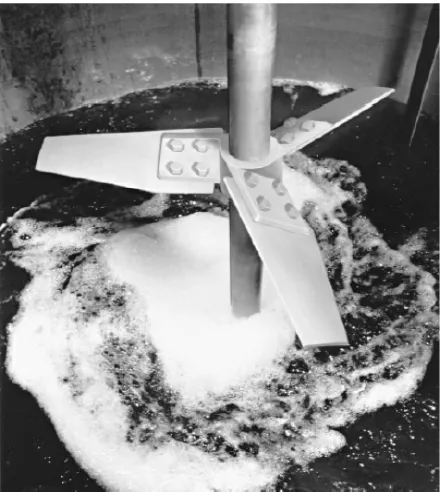
Radial-flow impellers have sharpened pieces of steels which are parallel to the pivot of the drive shaft. The littler multi bladed ones are known as turbines; bigger, slower-speed impellers, with two or four edges, are frequently called oars. The width of a turbine is ordinarily between 0.3 and 0.6 of the tank breadth. Turbine impellers arrive in a mixture of sorts, for example, bended cutting edge and even sharpened steel, as delineated in Figure (2.5). (James Y. Oldshue, 1983).
Figure (2.5): Radial Flat-blade turbine. (James Y. Oldshue, 1983)
2.4.2 Axial flow
[image:24.612.261.387.364.491.2]12
Figure (2.6): Marine-type mixing impeller and Pitched-blade turbine (James Y. Oldshue, 1983)
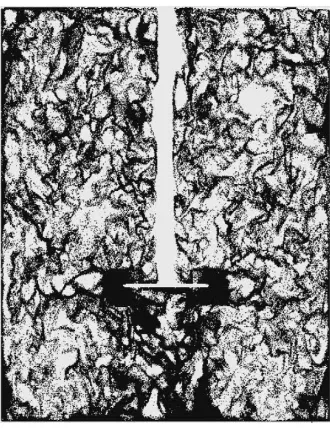
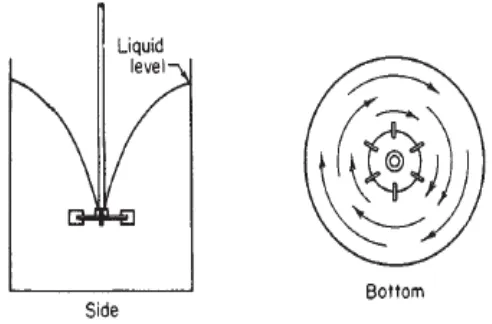
Versatile blenders may be braced as an afterthought of an open vessel in the precise, off-center position or darted to a rib or plate on the highest point of a shut vessel with the pole in the same rakish, unbalanced position. This mounting brings about a solid start to finish dissemination. (James Y. Oldshue, 1983) .The fan create parallels stream to the impellers. In addition that, if impeller set close to the lowest part of the vessel, radial drainage may happen. when utilized the propeller of axially kind , liquids stream moves upward and downward in the tank .axial stream propeller distribute material chiefly axially .In standard case of reactor without baffles, the rotational time to be lower than in a baffles time. (Tatterson and J.b, 1991). Figure (2.7) show the diverse of the stream design for axial impeller.
[image:25.612.237.462.92.194.2] [image:25.612.286.409.491.684.2]13
2.5 Impeller clearance
Most studies have been completed at the standard impeller leeway (one-third of the tank diameter). Furthermore, it has been demonstrated that the impeller clearance does influence the liquid stream modality. In any case, it has been accounted for that the stream example created by the Ruston turbine transformed from the average two circles at a standard clearance to a solitary circle design at a low clearance. For a multiple impeller system, the most favorable clearance at which there is minimal intrusion among the flow generated by the top and lower impellers is the same to the tank diameter. Well-spaced impellers generate smooth and high fluid flows, which are characterize by mean velocity of the fluid and turbulence concentration. (A. Ochieng ,et al ,.2009)
2.6 Mixing Time
Mixing time, 𝑡! , is the time needed to accomplish a given deviation from the
completely blended state from the occasion of a tracer data. Mixing time is a global indicator of blending and it is influenced by pivotal and outspread blending and the impacts of bulk stream. Mixing in airlift reactors is in some cases depict regarding a dimensionless blending time 𝜃!, describe as follows:
𝜃
!=
!!!! 2.1
14
2.7 Reynolds number
The definition of Reynolds number for a mixing impeller differs from a pipe or particle Reynolds number in that the product of N D is used to represent velocity. Reynolds is:
N!" = !²!!
! 2.2
Where is the fluid viscosity, ρis the fluid density, N is the rotational speed and D is
the impeller diameter .Again, coherent units or appropriate conversion factors will make the Reynolds number dimensionless .Value for the impeller Reynolds number are also different from other forms of Re, in that turbulent conditions usually exist for Re > 20,000 and laminar conditions occur for Re < 10. The large transition range between turbulent and laminar condition represents a gradual transition from turbulent conditions near the impeller to laminar conditions near the tank wall. In the transition range, the turbulent regions, especially in the impeller discharge, gradually diminish in size as the Reynolds number becomes smaller (D. S. Dickey et al., 2004).
2.7.1 Laminar region
The laminar regime corresponds to (Re) i < 10 for many impellers; for stirrers with very small wall-clearance such as the anchor and helical-ribbon mixer, laminar flow persists until (Re) i = 100 or greater. In the laminar regime:
15
2.7.2 Transition regime
Between laminar and turbulent stream lies the move administration. There is normally a progressive move from laminar to completely created turbulent stream in mixed tanks; the stream example and Reynolds-number range for move rely on upon framework geometry (Mohan, p et al., 1992).
2.7.3 Turbulent regime
The marvel of turbulent mixing is an immediate aftereffect of turbulent liquid stream, which is portrayed by an arbitrary variance of the liquid speed at any given point within the framework. The liquid speed at a given moment may be communicated as the vector aggregate of its segments in the x, y, and z directions. With turbulence, these directional segments vary arbitrarily about their individual mean values, as does the speed itself. As a rule, with turbulence, the liquid has distinctive immediate speeds at diverse areas in the meantime (Dr. Bhawna Bhatt, Prof. S.S. Agrawal 2007).
2.8 Baffle
16
as suppressing vortex formation, increasing the power input and improving mechanical stability (Kevin J. Myers,et al., 2002).
2.8.1 Effects on baffling
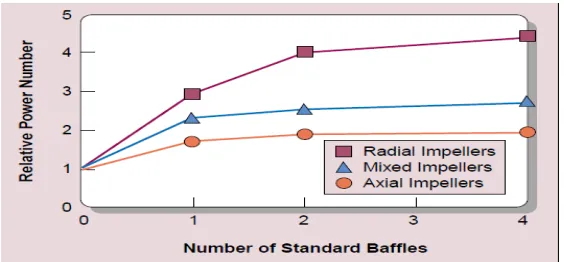
During agitation of a low-viscosity liquid, the rotating impeller imparts tangential motion to the liquid. Without baffling, this swirling motion approximates solid-body rotation in which little mixing actually occurs. The primary purpose of baffling is to convert swirling motion into a preferred flow pattern to accomplish process objectives. The most common flow patterns are axial flow, typically used for blending and solids suspension, and radial flow, used for dispersion. However, baffling also has some other effects, such as suppressing vortex formation, increasing the power input and improving mechanical stability, Figure (2.8) shows that the impeller power number increases as the number of standard width baffles (T/12) is increased. (Kevin J. Myers,et al., 2002).
Fig (2.8): Increased baffling increases the power draw of an agitator (Kevin J. Myers,et al., 2002).
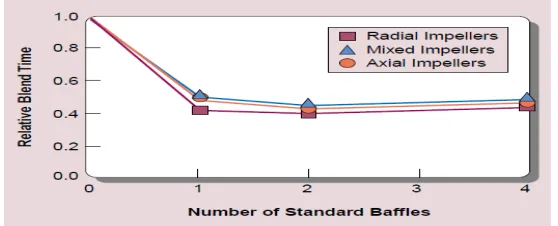
[image:29.612.188.470.422.553.2]17
with respect to the unbaffled condition, with each impeller style being normalized individually, rather than with respect to a common reference (Kevin J. Myers,et al., 2002).
Fig (2.9): Baffling also reduces blend time (Kevin J. Myers, et al., 2002).
“Normalized” means that, if the unbaffled radial-flow power number is 2.5 and the unbaffled high-efficiency impeller number is 0.2, then all of the radial-flow impeller data are divided by (normalized) 2.5 and all of the high-efficiency impeller data are divided by 0.2 (Kevin J. Myers ,et al., 2002).
2.9 Fractal square grid
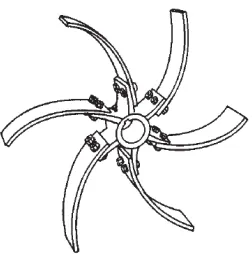
Homogeneous isotropic turbulence has been widely studied both experimentally in wind or water tunnels and numerically by Direct Numerical Simulations (DNS).Recently, used various multi scale (fractal) grids to generate turbulence in wind tunnels and found that complex multi scale boundary/initial conditions can drastically influence the behavior of a turbulent flow, especially when a fractal square grid (see Figs.2.10) is placed at the entry of a wind tunnel test section. According to, (Sylvain Laizet • John Christos, 2011).
[image:30.612.189.468.182.295.2]18
recover some of the experimental results of, such as the higher turbulent intensities that fractal square grids generate by comparison to regular grids of same or even larger blockage ratio.
Fig (2.10): Construction of a panel fractal square grid based on three fractal iterations. According to, (Sylvain Laizet · John Christos, 2011)
In these simulations the fractal stirrers were mainly based on a square pattern with three multi scale iterations and with a relatively small computational domain in the stream wise direction. There were also successfully performed DNS of turbulence generated by strategy. According to, (Sylvain Laizet • John Christos, 2011).
2.10 Coefficient of variance (COV)
[image:31.612.154.475.199.346.2]19
coefficient, COV. Usually a COV value between 0.01 and 0.05 is a reasonable target of completely homogeneous mixing fluid for most applications. The lower value of COV represents better quality of the homogenous mixture. The standard COV value equal to 0 represents a complete distributive mixing, while COV value more than or equal to 1 represents total segregation. According to (R.V., 2004). The COV is defined as the standard deviation of concentration, σ over the mean concentration, 𝑥 for a given set of data points.
The standard deviation of concentration is:
σ
=
!!!! ! !!!!
!!!
(2.4)
Where;
σ = Standard deviation n = the number of data points
𝑥 = the mean of the 𝑥!
𝑥!= Each of the values of the data
An alternative measure of homogeneity is provided by the coefficient of variation:
COV
=
!! (2.5)Where:-
COV = Coefficient of variation σ = Standard deviation
𝑥 =Mean concentration
dd
20
2.11 Palm kernel oil
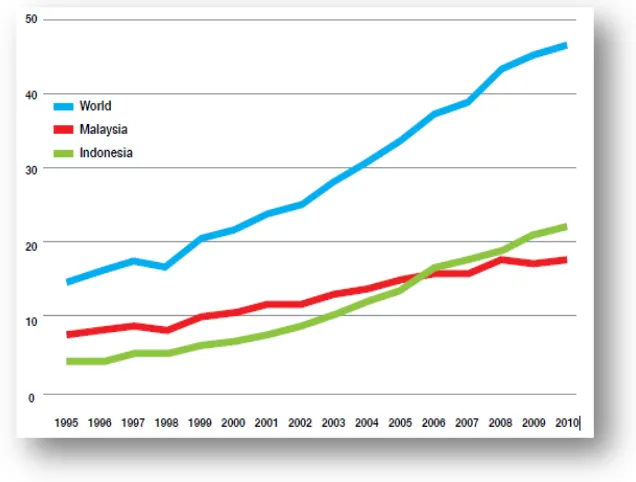
Palm oil is the world’s cheapest edible oil, and increasingly one of the most popular. As global demand continues to grow so has the vigorous search for land for new plantations by investors and industry. When it is done well and is properly managed, palm oil production can be of potential benefit to the populations of developing countries by providing sustainable livelihoods. Oil palm cultivation also has a greater oil yield per hectare than any other oil crop, which in theory means it should require less land.
Fig (2.11): Global consumption and major users of oil palm 1995-2010 (Basiron, Y., 2010)
[image:33.612.167.485.306.547.2]21
the livelihood of the people depending on the land, global consumption and major users of oil palm 1995-2010 as in fig 2.11 (Basiron, Y., 2010).
Palm oil, produced within well-managed and diverse agro forestry systems, would not only help ensure food security for millions of Africans, provide people with a living grow local economies; it can also help protect the region’s last remaining rainforests. In turn, food production will become more diverse and more resilient, helping to offset the impact of climate change, (Basiron, Y., 2010).
2.12 Methanol and ethanol
22
2.13 COMPUTATIONAL FLUID DYNAMICS (CFD)
The CFD simulation procedure embodies mesh creating, comparison solving and result handling modules. A lot of exertion has been committed to the simulation and modeling of an impeller. The absolute most normal methodologies to modeling an impeller will be impeller limit condition, preview, sliding network, various casings of reference and inner–outer. In an extraordinary number of these studies, impellers with basic geometries, for example, the Rushton turbine, have been modeled. Modeling of curved blade impellers poses a great challenge with regards to grid generation (A. Ochienga et al., 2009).
23
CHAPTER 3
METHODOLOGY
3.1 Introduction
Methodology is a method or process, or facts that involve an array of measures of work that should be in a scientific study. For the method the main essential aspect that should have to concern is on the modeling of the baffled stirred reactor and kinetics model for biodiesel reactor which will be a way to reach our goals and the results accepted by using commercial CFD code ANSYS Workbench 14.5 is employed as it is the most effective way to determine such geometrical parameters.
3.2 Methodology flow chart
24
Determine title
Objective/scope
Literature review
Discuss the literature review content
Collecting data
Simulation using ANSYS Fluent
Data analysis No
Yes
No
Results
Validation and discussion
Conclusion
[image:37.612.169.476.95.702.2]End Yes
Figure 3.1: Methodology flowchart
63
REFERENCES
A. Egedy, T. Varga, T. Chovan (2011). Application of Models with the different complexity for a stirred tank Reactor.
A. Ochienga, M. Onyangob and K. Kiriamitic, Experimental measurement and computational fluid dynamics simulation of mixing in a stirred tank , South African Journal of Science 105, November/December 2009
A.Sa Nchez Miro N, M.-C. Cero N Garcia, F. Garcia Camacho, E. Molina Grima And Y. Chisti.( 2004) mixing in bubble column and airlift reactors, Trans IChemE, Part A, October 2004 , Chemical Engineering Research and Design, 82
Basiron, Y. (2010). Palm oil. Bailey's Industrial Oil and Fat Products.
D. S. Dickey, K. J. Bittorf, C. J. Ramsey and K. E. Johnson(2004). Understand Flow Patterns in Glass-Lined Reactor. www.cepmagazine.org.
Demirbas, A. (2005). Biodiesel production from vegetable oils via catalytic and non-catalytic supercritical methanol transesterification methods. Progress in energy and combustion scienc.
64
Dr. Bhawna Bhatt, Prof. S.S. Agrawal (2007), Mixing, Pharmaceutical engineering, www.spxprocessequipment.com
Fan, C. a. (1990). Recent Developments in Solids Mixing, Powder Technology. 255– 287.
Fangrui Ma, Milford A. Hanna., Biodiesel production: a review1a Department of Food Science and Technology, University of Nebraska, Lincoln,NE,USA, Bioresource Technology 70 (1999) 1-15
G.R.Kasat, A.R.khopar, V.V.Ranade, A.B.Pandit., CFD Simulation of Liquid, Phase mixing and Liquid stirred reactor. Mumbai : Elsevier Ltd, 2008, Vol. 63. 3877 -- 3885.
Hinze and J.O, Turbulent, Second Edition, McGraw-Hill Book Company, 1975.
Idusuyi, N, Ajide. O.O., Abu, R.(2012) .Biodiesel as an Alternative Energy Resource in Southwest Nigeria Mechanical Engineering Department, University of Ibadan, Nigeria. ISSN 2224-3577,http://www.ejournalofsciences.org 323
J. Derksen, Solid-liquid suspension in a stirred tank retrieved April 22, 2010 from the University of Alberta Chemical Engineering instructor website, http://www.ualberta.ca/~jos/mv.html
James Y. Oldshue, Ph.D., McGraw-Hill, New York, 1983. Liquid-Solid Operations and Equipment, ria.servinit.cl/grabiel/libros/Perry/CHAP18.pdf
Kevin J , Myers,., Mark F. Reeder, and Julian B. Fasano. "Optimize mixing by using the proper baffles." Chem. Eng.FEB 2002
65
Mohan, P., Nicholas Emery, A., & Al-Hassan, T. (1992). Review heat transfer to Newtonian fluids in mechanically agitated vessels. Experimental thermal and fluid science.
Niels G. DEEN, Martin VAN SINT ANNALAND And J.A.M. KUIPERS. Direct numerical simulation of particle mixing in dispersed gas-liquid-solid flows using a combined volume of fluid and discrete particle approach, University of Twente, Fac. of Science and Technology, PO Box 217, 7500 AE. 13-15 December 2006
R.V., L. D. (2004). Immiscible liquid-liquid systems. In V. A.-O. E.L. Paul, Handbook of Industrial Mixing (pp. 689-753). Hoboken, New Jersey: John Wiley & Sons Inc.
R.Zadghaffari, J.S. Moghaddas and J.Revstedt. A Study of Liquid-liquid Mixing in a Stirred Tank with 6- Blade Rushton Turbine. 2008.
Sylvain Laizet • John Christos Vassilicos,(2011) , DNS of Fractal-Generated Turbulence. Flow Turbulence Combust (2011) 87:673–705
Tatterson, G.B, Fluid Mixing and Gas Dispersion in Agitated Tanks, McGraw-Hill, 1991