International Journal of Emerging Technology and Advanced Engineering
Website: www.ijetae.com (ISSN 2250-2459, Volume 2, Issue 4, April 2012)333
Green Computing
1Vijay A Tathe, 2Deepavali P PatilAbstract: Global warming and the increase of toxic waste generated by electronic devices are some of the issues that are being currently addressed through the use of the so- called “Green Technologies”. or “Green Computing” Green computing is the study and practice of using computing resources efficiently. The goals are similar to green chemistry; that is reduce the use of hazardous materials, maximize energy efficiency during the product's lifetime, and promote recyclability or biodegradability of defunct products and factory waste.
Keywords: E-Waste, Virtualization, Carbon, Green
Data Center (GDC), IAAS, PAAS, SAAS .
I. INTRODUCTION:-THE 21ST CENTURY VISION OF
GREEN COMPUTING “SAVE THE PLANET,SAVE YOUR
EQUIPMENT,SAVE MONEY”
As 21st century belongs to computers, and electronic items, energy issues will get a serious ring in the coming days, as the public debate on carbon emissions, global warming and climate change gets hotter. Faster processors historically use more power. Inefficient CPU's are a double hit because they both use too much power themselves and their waste heat increases air conditioning needs.
Industrial revolution followed by the advances in information technology during the last century has radically changed people's lifestyle. Although this development has helped the human race, mismanagement has led to new problems of contamination and pollution.
The technical process acquired during the last century has posed a new challenge in the management of wastes. Green computing is the practice of using computing resources efficiently. Modern IT Systems rely upon a complicated mix of people, networks, and hardware, as such, a Green computing initiative must be systemic in nature, and address increasingly sophisticated problems. Green computing is the utmost requirement to protect environment and save energy along with operational expenses in today's increasingly competitive world. Currently are working on implementation of the green computing practices.
But before implementing, it's also important to study about what kind of energy gains and operational gains can be achieved. Hence, analysis of the gap between what we have today and what we'll have to do is essential in order to achieve the benefits of green computing. Currently we are in that stage. Also, every big change begins from small initiatives. For instance, we started some of the simple but effective initiatives like setting the power options on your computer or in phones to switch to sleep mode when it's not active. When you're going to be away from your PC for more than a few minutes, setting it to stand-by mode and turning off the monitor will save a huge amount of energy. “Green Computing” is the name attached to this movement, which represents an environmentally responsible way to reduce power and environmental e- waste.
The 5 core green computing technologies advocated by GCI are Green Data Center, Virtualization, Cloud Computing, Power Optimization and Grid Computing.
International Journal of Emerging Technology and Advanced Engineering
Website: www.ijetae.com (ISSN 2250-2459, Volume 2, Issue 4, April 2012)334
The goals are to reduce the use of hazardous materials, maximize energy efficiency during the product's lifetime, and promote recyclability or biodegradability of defunct products and factory waste. Such practices include the implementation of energy-efficient central processing units (CPUs), servers and peripherals as well as reduced resource consumption and proper disposal of electronic waste (E-Waste).
II. NEED FOR GREEN COMPUTING
The technology is a highly fascinating thing to ponder and think about. In every small thing that we see and every big leap that we experience in our lifetime, technology is a pivotal instrument that bridge gap b/w being remote industrialized.
One of the prime movers in the technology that we have these days is the use of the grid computing. This technology allows for the distribution of the PC efficiency where there is an extraordinary computing device with resources comparable to a super computer that acts as a “server” for a group of computers that then act as workstations that systematically work as a group in order to achieve a common goal.
Green computing is a new approach which aims at designing computer systems that achieves better processing and performance with least amount of power consumption. Numerous studies and surveys have already shown that the power costs put together form the lion’s share of total costs of management of a data center.
The extensive use of computers and IT has made our life easier and as such the use of IT is ever on the increase resulting in greater power consumption. Greater power consumption means greater emission of greenhouse gases like carbon dioxide. It is observed that most of the computer energy is often wasteful. This is because we leave the computer ON even when it is not in use.
The CPU and fan consume power. Screen savers consume power even when the system is not in use. Insufficient power and cooling capacities can also results in loss of energy. It is observed that most of the datacenters do not have sufficient cooling capacities. This results in environment pollution. This could be because of defects in Manufacturing techniques, packaging, disposal of computers and components. Another effect is because of toxicity. There are toxic chemicals used in the manufacturing of new computers as well as disposal of old computers.
Green information technology (IT) is associated with concepts like reduced energy consumption, recycling obsolete products and waste, eliminating hazardous substances and reducing carbon footprint. But green IT can also entail practices that leverage technology to reduce business travel, use of shared resources like cloud computing and resource optimization like virtualization. Methods for Green Computing:-
There are a number of more fundamental steps that can be taken to significantly decrease the environmental impact of computing. These mainly involve measures for reducing energy consumption.
Lower Power Hardware:- PCs can be made to use less electricity by using a lower power processor, opting for onboard graphics (rather than a separate graphics card), using passive cooling (rather than energy consuming fans), and either a solid-state disk (SSD) in place of a spinning hard drive system disk.
Virtualization:- Virtualization is the use of computer software to simulate hardware. Within data centers, server consolidation applies virtualization in its replacement of many stand-alone physical servers with virtual servers that run as software on a small number of larger computers. via a virtualized server consolidation a company can obtain a far more optimal use of computing resources by removing the idle server capacity that is usually spread across of physical servers.
Cloud Computing:- Cloud computing is where software applications, processing power, data and potentially even artificial intelligence are accessed over the Internet. Cloud Computing has many benefits, one of which is enabling anybody to obtain the environmental benefits of virtualization. potentially reduce their carbon footprint. As well as allowing server capacity to run at a more optimal energy efficiency, cloud computing can also remove the need for most users to run high-power PCs and laptops. Less Pollutant Manufacture:-A great many hazardous chemicals - including lead, mercury, cadmium, beryllium, bromine flame retardants (BFRs) and polyvinyl chloride (PVC) are used to make computers. By reducing the use of such substances, hardware manufacturers could prevent people being exposed to them, as well as enabling more electronics waste to be safely recycled.
International Journal of Emerging Technology and Advanced Engineering
Website: www.ijetae.com (ISSN 2250-2459, Volume 2, Issue 4, April 2012)335
Recycle:- Discard used or unwanted electronic equipment in a convenient and environmentally responsible manner. Computers have toxin metals and pollutants that can emit harmful emissions into the environment.
III. APPROACHES TO GREEN COMPUTING
Green Data Centre:-
A data centre or computer centre is a facility used to house computer systems and associated components, such as telecommunications and storage systems. It generally includes redundant or backup power supplies, redundant data communications connections, environmental controls (e.g., air conditioning, fire suppression) and security devices. A green data centre is a repository for the storage, management, and dissemination of data in which the mechanical, lighting, electrical and computer systems are designed for maximum energy efficiency and minimum environmental impact. The construction and operation of a green data centre includes advanced technologies and strategies.
The world of data and communications is swiftly moving in the direction of eco-friendly and greener data centers. Eco awareness along with corporate being held accountable has made it more than need pay attention to such initiatives.
As the hub of the information technology department, data centers are an integral part of daily functioning for most organizations. Protecting data keeps a company operating, and downtime is simply lost money to any company. What challenges does today's enterprise need to understand when it comes to their data, and in the design of environmentally friendly Green data centers.
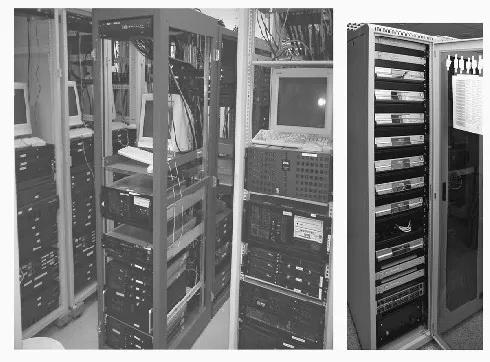
The practical requirements of a data center are as follows: Provide a physically secure location for servers,
storage, and network equipment.
Provide 24 *7*365 days network connectivity for equipment within the data center to devices outside the data center.
Provide necessary power to operate all equipment. Provide an environment where the temperature
and humidity are controlled
[image:3.612.325.570.160.341.2]within a narrow range and air is exchanged at an adequate rate.
Figure -2 Cabinet and racks in a data center.
Characteristics of Design Center
Design must be simple :-
Simplicity makes it difficult to err. To make the work simpler for those using the facility, all cables, circuit breakers, servers, storage devices, network ports, and power outlets must be labeled. Design must be scalable:-
The design, once finalized, must work for any size of data center 50,000, 5,000, or even 500 square feet.
Design must be modular:-
built large complex structures using small, manageable units that could be designed and manufactured easily.
Design must be flexible:-
It is impossible to predict the technical requirements for the data center 10 (or even more) years out. To build a successful data center for long-term use, it must be easy to upgrade and to change layout or component.
Server Virtualization:-
International Journal of Emerging Technology and Advanced Engineering
Website: www.ijetae.com (ISSN 2250-2459, Volume 2, Issue 4, April 2012)336
[image:4.612.332.554.163.343.2]A virtual organization is a collection of people and resources that work in a coordinated way to achieve a common goal. To use grid facilities, any user must subscribe to a virtual organization as a member. Each people or resource can be a member of more virtual organizations at the same time and each virtual organization can contain people or resources belonging to different administration domains.
Fig 2 Server Virtualization
Cloud Computing:-
[image:4.612.62.277.272.447.2]Cloud computing is a technology that uses the internet and central remote servers to maintain data and applications. Cloud computing allows consumers and businesses to use applications without installation and access their personal files at any computer with internet access. This technology allows for much more efficient computing by centralizing storage, memory, processing and bandwidth. Cloud computing is broken down into three segments: "Application" "Storage" and "Connectivity." Each segment serves a different Cloud computing is a general term for anything that involves delivering hosted services over the Internet. These services are broadly divided into three categories: Infrastructure-as-a-Service (IAAS), Platform-as-a-Service (PAAS) and Software-Platform-as-a-Service (SAAS). The name cloud computing was inspired by the cloud symbol purpose and offers different products for businesses and individuals around the world.
Fig 3 Cloud Computing
Grid Computing:-
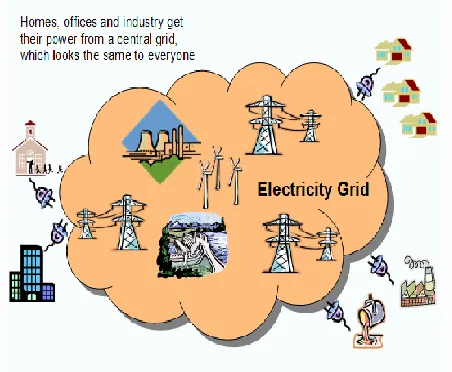
Grid computing is increasingly being viewed as the next phase of distributed computing. Built on pervasive Internet standards, grid computing enables organizations to share computing and information resources across department and organizational boundaries in a secure, highly efficient manner. The next generation Grid will be virtualized the notion of distribution in computation, storage and communication over unlimited resources.
Fig 4 Grid Architecture
[image:4.612.335.561.501.687.2]International Journal of Emerging Technology and Advanced Engineering
Website: www.ijetae.com (ISSN 2250-2459, Volume 2, Issue 4, April 2012)337
A Grid provides an abstraction for resource sharing and collaboration across multiple administrative domains. The term resource covers a wide range of concepts including physical resources (computation, communication, storage), informational resources (databases, archives, instruments), individuals (people and the expertise represent) capabilities (software packages, brokering and scheduling services) and frameworks for access and control of these resources The virtualization of the resources is one of the most important aspects of the Next Generation Grid (NGG). It is necessary to raise the level of abstraction of the resources available in the Grid by virtualization them at a different level of abstraction.
Fig 4 Grid Vision
TYPES OF GRID:
The three primary types of grids and are summarized below:
Computational Grid
A computational grid is focused on setting aside resources specifically for computing power. In this type of grid, most of the machines are high-performance servers.
Scavenging grid
A scavenging grid is most commonly used with large numbers of desktop machines. Machines are scavenged for available CPU cycles and other resources. Owners of the desktop machines are usually given control over when their resources are available to participate in the grid.
Data Grid
A data grid is responsible for housing and providing access to data across multiple organizations. Users are not concerned with where this data is located as long as they have access to the data.
IV.GREENCOMPUTINGTECHNIQUES
Understanding the ways in which power consumption impacts the “greenness” of any technology, and specifically computing technology, is an essential step toward reducing this consumption. the various specific techniques that can be used to reduce power consumption.
Turn Off Equipment When Not In Use.
Computer Power Savings Modes.
Use Screen Savers.
Monitor Sleep Mode.
Hard Disk Sleep Mode.
System Standby Mode.
Hibernate Mode.
International Journal of Emerging Technology and Advanced Engineering
Website: www.ijetae.com (ISSN 2250-2459, Volume 2, Issue 4, April 2012)338
Green Technologies of the Future
NanoSolar
Solar energy has always been one of the best renewable energy sources as it doesn't release noxious gasses into the atmosphere, and once installed requires little maintenance. However the manufacturing and operational costs have historically been quite high, especially in comparison with more traditional but carbon-intensive means of producing energy.
Concentrated Solar Energy
Another alternative solar energy technology is Concentrated Solar Power (CSP). Similar in concept to the ancient 'burning mirrors' used by the Chinese back in 700BC, this modern version takes the form of solar farms
in which multiple rows of mirrors concentrate the sun's rays onto a fluid-filled vessel, which in turn powers generators or steam turbines. Once these plants are up and running, it would be possible to import the energy. Concentrated Solar Power definitely seems the most likely way forward in producing cost effective and clean renewable energy.
Nuclear Fusion Power
Nuclear fusion is a clean, safe technology which has the potential to create much larger volumes of energy than traditional or alternative renewable energy sources. It is quite possibly the best long term energy solution currently being explored.
V. CONCLUSION
International Journal of Emerging Technology and Advanced Engineering
Website: www.ijetae.com (ISSN 2250-2459, Volume 2, Issue 4, April 2012)339
Green IT practices including exciting new efforts in the major area of data center power utilization are earning a place on the corporate agenda, and implementation of these programs is clearly within the reach of most enterprises today. Because Green IT programs are demonstrating fundamental economic as well as environmental sense, it is understandable why organizations are exploring green computing options with such intense interest across the IT industry. needs to be developed.
References
:-
[1] Shobhit Tiwari “Need of Green Computing Measures for Indian IT Industry” ISSN 2224-3232, Vol.1, No.4, 2011. [2] Vijay A Tathe , Deepavali P Patil “Next Generation
Computing on the Internet (GRID)”, published at,"
International Journal of Scientific and Research
Publications,”ISSN 2250-3153 ,Volume 2, Issue 2, February 2012 Edition.
[3] Priya Rana”Green Computing Saves Green” published at International Journal of Advanced Computer and Mathematical Sciences.Vol 1, Issue 1, Dec, 2010, pp 45-51. [4]ParichayChakraborty,Debnath,Bhattacharyya,"Green