Research Article
CODEN(USA) : JCPRC5
ISSN : 0975-7384
Identification and characterization of unknown impurity in zolmitriptan
tablets by a sensitive HPLC method
A. S. Reddy*, R. C. Reddy and P. Venkateswarlu
Physico-Chemical Laboratory, Department of Chemistry, S.V. University, Tirupathi, A.P., India
_____________________________________________________________________________________________
ABSTRACT
A sensitive and accurate high performance liquid chromatographic (HPLC) method was developed and validated to identify and characterize the unknown impurity found in zolmitriptan tablets during investigation of stability samples. The successful separation was achieved by using Inertsil ODS-3V, 150x4.6 mm, 5µm HPLC column with phosphate buffer (pH 3.0) as a mobile phase-A and methanol as mobile phase-B and detector wavelength at 225 nm. The gradient flow as delivered at a flow rate of 1.5 ml/min. The method was established by determining limit of detection and limit of quantification. The linearity and accuracy has been demonstrated at a range of LOQ to 400% and 50 to 200% of specification level respectively. The drug product was subjected to various stress conditions and proved the method stability indicating nature.
Keywords: Zolmitriptan, Zolmitriptan-Impurity, HPLC.
_____________________________________________________________________________________________
INTRODUCTION
Identification and characterization of unknown impurity in pharmaceutical dosage forms is one of the most critical and challenging task during drug product stability samples analysis [1]. The presence of unknown impurity in drug product may influence not only the therapeutic efficacy but also the safety of the pharmaceutical drug products. The regulatory guidelines such as ICH established maximum allowed limits for impurities in formulated drug products. Our ongoing research is focused on determining the impurities in pharmaceutical dosage forms [2].
Zolmitriptan is a synthetic triptamine derivative and is used for the treatment of acute migraine attacks [3-5]. Zolmitriptan is one of the fast dissolving and commercially available tablets with trade name Zoming-ZMT, manufactured by AstraZeneca, USA [6]. Zolmitriptan is available in two forms such as film coated and orally disintegrated tablets which is a selective 5-hydroxytryptamine 1B/1D (5-HT1B/1D) receptor agonist. Zolmitriptan is
O
N
H
O
N
H
N
Fig.-1: Chemical structure of the zolmitriptan molecule
Zolmitriptan has the empirical formula C16H21N3O2 with a molecular weight of 287.36. Zolmitriptan is a white to
almost white powder that is readily soluble in water. Zolmitriptan tablets are available as 2.5 mg (yellow) and 5 mg (pink) film coated tablets for oral administration. The film coated tablets contain anhydrous lactose NF, microcrystalline cellulose NF, sodium starch glycolate NF, magnesium stearate NF, hydroxypropyl methylcellulose USP, titanium dioxide USP, polyethylene glycol 400 NF, yellow iron oxide NF (2.5 mg tablet), red iron oxide NF (5 mg tablet), and polyethylene glycol 8000 NF.
Literature search revealed that, several analytical HPLC methods were reported for the quantitative determination of zolmitriptan and very few achiral and chiral HPLC methods were reported for the detection and quantification of related impurities in the drug substance zolmitriptan [7-10]. It’s validated analytical performance in terms of major parameters such as selectivity, accuracy, precision and sensitivity is adequate for the routine quality control of the purity of zolmitriptan containing pharmaceutical formulations. The most important part of method is with help of single injection, quantification of zolmitriptan and its degradable impurities and identified unknown impurity.
The intension of this study is to identify and characterize the unknown impurity in zolmitriptan tablets and confirm the structure by chemical independent organic synthesis of this compound. NMR, IR, MS and LC–UV (DAD) techniques were employed for characterization. After that, a HPLC method was developed and validated for a rapid quantification of both zolmitriptan and the impurity in the tablets. System suitability, limit of detection (LOD), limit of quantification (LOQ) and linearity were established as per ICH guidelines [11, 12].
EXPERIMENTAL SECTION
Materials and reagents
All experiment work was performed using HPLC grade monobasic potassium phosphate, methanol and orthophosphoric acid were procured from Merck Chemicals Ltd., India. Acetonitrile and triethylamine were procured from Sigma Aldrich Chemicals Pvt. Ltd., India. HPLC grade milli-Q water was generated in-house from Millipore water purification system. The samples, standards, identified unknown impurity and excipients used in this study were obtained from “Creative Organics Limited”, Bangalore, India. Analytical samples are charged in climatic chambers at room temperature and accelerated conditions.
Chromatographic system and conditions
The high performance liquid chromatograph (HPLC) consisted of Waters alliance system, equipped with automatic sample injector and PDA detector. For chromatographic analytical data collection and calculation water’s empower software was used. Mobile phase-A was prepared by dissolving 2.72 g of monobasic potassium phosphate in 2000 ml milli-Q water, sonicated for dissolved and filtered through nylon membrane filters under vacuum. To this solution, added 6 ml of triethylamine and adjusted the pH to 3.00±0.05 with 25% diluted orthophosphoric acid solution. Methanol was used as mobile phase-B. Both mobile phases were prepared freshly before each experiment conducted and degassed prior to use. Diluent was prepared by mixed mobile phase-A and mobile phase-B in the ratio of 850 ml and 150 ml respectively.
Table-1: Gradient program for HPLC system
Time (Min) Mobile phase (A%) Mobile phase (B%)
0.01 90 10
15.0 90 10
20.0 50 50
20.5 90 10
25.0 90 10
Analysis was carried by using optimized chromatographic conditions on stability samples and various stressed samples as well as to identify the unknown impurity at RRT. The unknown impurity clearly identified in accelerated stability samples of 6 months station and observed maximum detection at 225 nm.
Standard and sample preparation
Standard: Accurately weighed and transferred about 25.0 mg of zolmitriptan working standard in to 200 ml
volumetric flask. To this, added about 140 ml of diluent, sonicated to dissolve and diluted to the volume with diluent.
Sample: Tablets were crushed in to a fine powder and transferred in to a 50 ml volumetric flask, added about 10 ml
of diluent and shaken mechanically for 10 minutes. To this, added about 20 ml of diluent, sonicated for 20 minutes with intermittent shaking of 5 minutes interval, cooled to room temperature, diluted to the volume with diluent. The sample solutions were filtered through Millipore Nylon, 0.45 µm, 33 mm membrane filters.
RESULTS AND DISCUSSION
Method development and optimization
The main objective of the HPLC method development and optimization was to achieve the separation of unknown impurity from all the associated nearest peaks. Initial trail was carried out using monobasic potassium phosphate buffer with pH 4.00±0.05 as mobile phase-A and acetonitrile as mobile phase-B on a C18 stationary phase with a 25 cm length, 4.6 mm ID and 5 µm particle size. Column and sample temperatures were fixed at 25°C, mobile phase flow rate was 1.0 ml/min and injection volume was 10 µl when zolmitriptan sample was spiked with all impurities. For this trail, the resolution between all impurities was observed >2.0 and retention time for zolmitriptan was very high (about 30 minutes). By performed many trails with mobile phase gradient program change, column length and column temperatures, we achieved the less retention time for zolmitriptan and unknown peaks. Peak shapes of impurities are also improved. Based on several trails, another trail was carried out by using C18 stationary phase with a 15 cm length, 4.6 mm ID and 5 µm particle size with column temperature 35°C. The retention time of unknown impurity was observed about 10 minutes but peak shape was not satisfactory. To further improve the method gradient steps optimized with methanol in mobile phase-B, pH of mobile phase-A was reduced to 3.00±0.05, flow rate increased to 1.5 ml/min and injection volume fixed as 5 µl. Observed all impurities well resolved and unknown impurity peak shape found symmetrical and satisfactory.
Forced degradation studies
Zolmitriptan drug product was exposed to 1N HCl, 3% H2O2 and 1N NaOH at 60°C with continuous constant
stirring. Zolmitriptan has shown significant sensitivity towards treatment of 1N HCl, 3% H2O2 and 1N NaOH. The
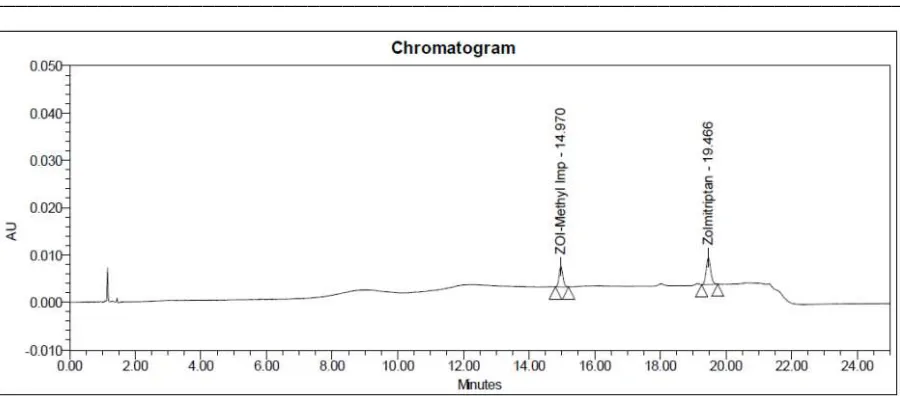
Fig.-2: Representative chromatogram of zolmitriptan and zolmitriptan methyl impurity
Method validation
Sample solutions were prepared and analyzed using optimized chromatographic conditions with UV detection of 225 nm and quantified the all responses using empower software. The interference of excipients mixture and identified unknown impurity was also checked by injecting sample solutions of excipients mixture and identified unknown impurity. There was no interference observed due to excipients with impurity and zolmitriptan.
Linearity of the unknown impurity was established from LOQ to 400% of specification level. In the proposed method, zolmitriptan methyl impurity obeys Beer-Lambert’s law over the concentration range of 0.309-10.301
[image:4.595.74.524.93.291.2]µg/ml (Table 2) and the representative chromatogram was shown in Fig. 2. The regression equation was found to be y = 21404x – 2118.8 with correlation coefficient 0.9994 (Fig. 3).
Table 2: The experimental results of impurity concentration and its chromatographic area
Sample Condition Concentration (µg/mL) Area
LOQ 0.309 7197
60 1.545 31319
80 2.06 41595
100 2.575 53189
120 3.09 63321
160 4.12 84704
200% 5.15 105195
300% 7.726 163187
400% 10.301 220507
Accuracy of a method is defined as the closeness of the measured value to the true value for the sample. The recovery method was studied at concentration levels 50%, 100% and 200% of the specification level for unknown impurity in presence of placebo. The % recovery was calculated with respect to the standard and was achieved as 99.4, 100.2 and 99.9 for the above three level solutions respectively.
The detection limit of individual analytical procedure is the lowest amount of analyte in a sample which can be detected but not necessarily quantified as an exact value and quantification limit is the lowest amount of analyte in a sample which can be quantitatively determined with suitable precision and accuracy.
Limit of Detection = (3.3 X σ) / S
Limit of Quantification = (10 X σ) / S
Where, σ = Residual standard deviation of regression line. S = Slope of calibration curve.
Injected six replicate injections of these LOD and LOQ concentrations and ensured the peak is detected and responses were measured.
Fig.-3: Plotted graph between zolmitriptan methyl impurity concentration and area response
Specificity and selectivity of the analytical method has been proved by analyzing the various stressed samples under optimized chromatographic conditions. No interferences with the analyte peaks due to placebo, blank, impurities and force degradation sample have been observed. On the basis of that, the method results specific for the qualitative analysis of zolmitriptan and its unknown impurity at RRT 0.77.
The peak purity angle should be less than peak purity threshold. It’s indicating that all peaks are pure. According to the areas obtained and peak purity results, it can be concluded that all peaks are homogeneous under various forced degradation conditions. The purity factor for the drug product assures that there is no co elution of other peaks. Therefore, the method is specific and suitable for routine work.
CONCLUSION
The proposed HPLC method developed for determination of zolmitriptan unknown impurities in pharmaceutical dosage forms were precise, accurate and specific. The method was completely validated showing satisfactory data for all the method validation parameters tested. The developed method is stability indicating and can be used for the routine analysis of production samples and also to check the stability of zolmitriptan samples.
Acknowledgements
Authors are highly grateful to the Creative Organics Limited, Bangalore, India for providing research facilities and gift samples.
REFERENCES
[2] AS Reddy; RC Reddy; P Venkateswarlu. J. Chem. Pharm. Res. 2012, 4(7), 3659-3664. [3] AD Oldman; LA Smith; HJ McQuay; RA Moore. Pain. 2002, 97, 247-257.
[4] R Yates; K Nairn; R Dixon; E Seaber. J. Clin. Pharmacol. 2002, 42(11), 1237-1243.
[5] KP Sampath kumar; D Bhowmik; B Chiranjib; P Tripathi; RM Chandira. J. Chem. Pharm. Res. 2009, 1(1), 72-87.
[6] D Bhowmik; B Chiranjib; Krishnakanth, Pankaj, RM Chandira. J. Chem. Pharm. Res. 2009, 1(1), 163-177. [7] Y Hu; T Yao; X Wang. J. Zhejiang Univ. Med. Sci. 2004, 33, 37-40.
[8] MK Srinivasu; B Mallikarjuna Rao; G Sridhar; P Rajender Kumar; KB Chandra Sekhar; I Aminul. J. Pharm.
Biomed. Anal. 2005, 37, 453-460.
[9] T Srinivasu; MM Annapurna; TG Chandrasekhar. Drug Inven. Today, 2012, 4(9), 450-454.
[10] B Mallikarjuna Rao; MK Srinivasu; G Sridhar; P Rajender Kumar; KB Chandra Sekhar; I Aminul, J. Pharm.
Biomed. Anal. 2005, 39, 503-509.