Tribological Evaluation on Various Formulation of Modified RBD Palm
Olein as Sustainable Metalworking Fluids for Machining Process
E. A. Rahim
1,a, N. Talib
1,b,
A. S. Amiril S.
1,c, S. Syahrullail
2,dand Z. Mohid
1,e 1Precision Machining Research Center (PREMACH), Faculty of Mechanical and Manufacturing Engineering, Universiti Tun Hussein Onn Malaysia, 86400 Parit Raja, Johor, Malaysia
2
Faculty of Mechanical Engineering, Universiti Teknologi Malaysia, 81310 Skudai, Johor, Malaysia
a
[email protected], [email protected], [email protected],
d
[email protected], [email protected]
Keywords: Bio-based lubricant, metalworking fluids, RBD palm olein, tribology
Abstract. Sustainable manufacturing has become popular among manufacturers and industrialists due to the increase in environmental issues, health impacts and stringent law enforcement. The use of vegetable oils as metalworking fluids is one way to implement manufacturing sustainability. Palm oils are commonly used as cooking oils. Further, palm oil is also the main oil sources in Southeast Asia besides petroleum. Therefore, the potential use of palm oil as functional lubricant for future replacement of petroleum-based oil is indeed important. In this study, the refined, bleached and deodorized (RBD) palm olein has been formulated into various properties of modified RBD palm oil (MRPO) by transesterification process at different molar ratio of RBD methyl ester (FAME) with trimethylolpropane (TMP). Next, the MRPOs are compared with synthetic ester on lubrication and tribology tests according to standard based on American Society for Testing and Materials (ASTM). The results observed that MRPO have outstanding performance in lubrication and tribological behavior. MRPO2 recorded the highest viscosity index and the lowest coefficient of friction which are 496 and 0.06, respectively. MRPO2 showed to be an alternative biodegradable cutting fluid in promoting sustainable manufacturing activities by reducing the bad impact on environment and health.
Introduction
Metalworking fluids (MWFs) are applied in various machining processes to ensure workpiece quality by reducing the tool wear and thus increase the productivity. The primary functions of MWF in machining are as heat removal, lubrication and also chip evacuation. Globally, manufactures consume over 600 million of the worldwide consumption of MWFs that were used for the machining purposes and Asia is the second leading costumer with an estimated of 30% of the worldwide total of MWFs [1]. It is estimated that only 0.1% lubricants in the market are made from vegetable oils [2]. The conventional MWFs, which are the petroleum-based feedstock, are heavily toxic and can negatively affect the environment and health. As a consequence, the biodegradable oils from vegetable oils are seen to be an alternative to reduce or even replace the high dependency on petroleum-based oil in manufacturing and engineering applications. Biodegradable oils offer significant environmental benefits, renewability, and biodegradability as well as excellent lubricating properties which provide satisfactory performance in machining operation. MWFs provide a protective layer that reduces the friction force during the contacts between tools and workpieces, thus cooling the machining processes and avoid damaging the tools. Furthermore, scientific researches have shown that 0.4% of gross domestic product could be saved in terms of energy in industrialized countries if current knowledge in tribology is applied into lubricated applications [3].
oil-based lubricants for engine oil, hydraulic fluids and MWFs [4–6]. However, bio-lubricant in its crude form has a lot of limitations in terms of their physical and chemical properties. Kheang et al. [7] indicated that palm olein-based lubricant has high lubricity properties such as high flash point temperature and viscosity index. Interestingly, they also indicated that palm olein-based lubricant has a high pour point and cloud point resulting in poor cold flow characteristics, thus limiting their use in multi seasonal countries. In addition, palm olein shows low coefficient of friction and friction torque compared to the other mineral-based oils. However, in terms of wear properties, it shows larger wear scar diameter compared to mineral oil [8, 9]. Therefore, in order to explore the wide range of palm olein products especially MWFs, the chemical modification process is essential to enhance lubrication properties of bio-based oil. This study focuses on the evaluation of various formulation of refined, bleached and deodorized (RBD) palm oleins on the tribological behavior in order to discover their potential as a sustainable bio-based MWF.
Methodology
Samples preparation
RBD palm olein (RPO) was chemically modified and converted into a bio-based lubricant of trimethylolpropane (TMP) ester. TMP ester, which is a polyol group, has a complex structure with branches of alkyl groups that significantly improved the thermal and oxidative stability of the bio-based oil. RBD palm oil was first converted into RBD palm oil methyl ester (FAME) via transesterification process at variable methanol to RPO molar ratios of 3:1, 6:1 and 9:1. The oil reaction was conducted in a three neck flask which was fitted with a condenser. Water bath on a hot plate with magnetic stirrer was used to provide and maintain the suitable reaction temperature and stirring facility.
[image:2.596.71.527.536.726.2]The reaction condition was as follows; reaction temperature was set at 60 °C, reaction time was set to one hour, sodium methoxide was used as the reaction catalyst and was weight in by 1% weight to weight ratio (w/w) with the RPO oil. After the reaction, the mixture was separated using separating funnel for 1 hour. Two layers were formed: the upper layer consisted of FAME, whereas the lower layer consisted of glycerol and other impurities. After separation from the glycerol layer, the FAME layer was purified by washing with hot water at 60 °C together with 2-3 drops of ortho-phosphoric acid. Next, the FAME was dried in the drying oven until all remaining water was removed (overnight).
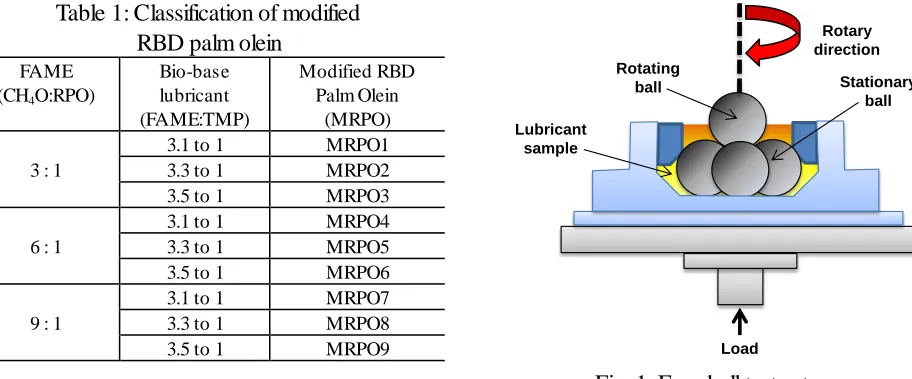
Table 1: Classification of modified RBD palm olein
FAME
(CH4O:RPO)
Bio-base lubricant (FAME:TMP)
Modified RBD Palm Olein
(MRPO)
3 : 1
3.1 to 1 MRPO1
3.3 to 1 MRPO2
3.5 to 1 MRPO3
6 : 1
3.1 to 1 MRPO4
3.3 to 1 MRPO5
3.5 to 1 MRPO6
9 : 1
3.1 to 1 MRPO7
3.3 to 1 MRPO8
3.5 to 1 MRPO9
Rotary direction Rotating
ball
Lubricant sample
Load
Stationary ball
Fig. 1: Four ball test set up
with oil bath condition. The condenser was connected to a vacuum line equipped with a relief valve, accumulator and a vacuum trap to remove the excessive FAME. The reaction time was set for 5 hours at 120°C reaction temperature. The FAME to TMP molar ratios were varied from 3.1:1, 3.3:1 and 3.5:1. After the reaction process, the final product of modified RBD palm oil (MRPO) was filtered to remove any undissolved substances or impurities. Finally, it was leaved overnight in the drying oven to discard the moisture. Table 1 shows the classification details of the weight to weight ratio of every reaction mixtures used in this experiment. All samples of MRPO were compared with the existing synthetic ester (SE) as the reference oil and the unmodified RPO as the base stock.
Viscosity test
The kinematic viscosities of lubricant were measured by using viscometer. The viscometer was immersed in the heated lubricant at 40 °C and 100 °C based on ASTM D445. After that, the viscosity index (VI) value was calculated according to ASTM D2270 by using the measured data of kinematic viscosity at 40 °C and 100 °C.
Wear scar diameter and friction coefficient test
The samples were tested via four balls wear test method (ASTM D4172) using a four ball tester machine DUCOM TR-30 L to evaluate the tribology behaviours of MWFs. The experiment was conducted by using four chrome steel balls, AISI 52100 with a diameter of 12.7 mm, a hardness value of 62 HRC, extra polished (EP Grade 25) and with an initial surface roughness of 0.015 µm. Three stationary balls were clamped together in a pot and then were covered with approximately 10 ml of MWFs. The fourth ball, which is referred as the rotating ball was pressed against the three stationary balls with a load of 392 N as shown in Fig. 1. The lubricant temperature was controlled at 75 °C and the rotating ball was rotated at 1200 rpm for an hour (1 hr). During the experiment, the friction torque was recorded in situ and presented by using Winducom 2010 software in order to determine the coefficient of friction. The mean wear scar diameter (MWSD) of the stationary balls was measured directly through an optical microscope.
Results and discussion
Viscosity
Viscosity is an important property in determining the lubrication quality of an MWF. It serves as an internal friction within the lubricant against applied shear stress during sliding process, which influences the wear and friction behavior of the two contacting surfaces. Fig. 2 displayed the kinematic viscosity of samples at 40°C and 100 °C. The viscosity of a lubricant is known to increase with the increasing temperature. It can be observed from both linear graphs that a lower viscous lubricant (SE) at 40 °C has the lowest viscosity value at 100 °C. In fact, the highest viscosity of MRPO2 at 40 °C does not imply the highest viscosity value at 100 °C compared to MRPO1. The kinematic viscosity of SE at both temperatures recorded the lowest compared to RPO and MRPOs. This is reflected to the number of carbon in the oil molecules. The number of carbon in SE is 8 to 14 whilst, 12 to 20 for the number of carbon in RPO. The higher the number of carbon positively affects the oil’s viscosity. Moreover, the kinematic viscosity at both temperatures for all samples of MRPOs has exceeded the kinematic viscosity of SE and RPO. The reason behind it is that, after the chemical modification process of RPO, the large molecular chain and branches of TMP ester is broken and combined with the monoester (FAME) to form a MRPO which has good low-temperature properties [4].
MRPO1 displayed the highest VI value of 496. VI is a measure for the change of viscosity with variations in temperature. High VI indicates the ability of the lubricant to perform within broad temperature range especially during the machining operation. From the same figure, MRPO3 until MRPO9 recorded lower viscosity and viscosity index value when compared to MRPO1 and MRPO2. This is due to the unreacted FAME contained in the MRPO which decreases the viscosity value [10].
SE RPO MRPO1 MRPO2 MRPO3 MRPO4 MRPO5 MRPO6 MRPO7 MRPO8 MRPO9 0 100 200 300 400 500 600
Metalworking fluid samples
VI
Kinematic viscosity at 40°C Kinematic viscosity at 100°C
Vi scosi ty In d e x, VI 0 10 20 30 40 50 60 Ki n e ma tic vi scosi ty, in mm 2 /s
Fig. 2: Viscosity index and kinematic viscosity at 40 °C and 100 °C for all lubricant samples
Wear Scar Diameter and Coefficient of Friction
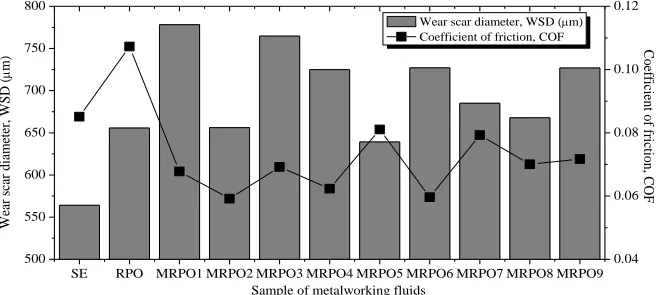
[image:4.596.132.480.164.333.2]The four balls wear test presents a discussion on tribological characteristics of the steel/steel sliding pairs with the presence of the tested lubricants in terms of wear scar diameter (WSD) and coefficient of friction (COF). Fig. 3 shows the result of average WSD and COF for all lubricant samples. Both results show a correlation with the oil’s viscosity. It can be seen that SE recorded the smallest WSD at 564 µm compared to all samples, while the COF is 0.09. This shows that SE reduced the WSD but recorded a high COF. Moreover, the highest COF is observed on RPO at 0.11, whilst the WSD is at 655 µm. At high temperature, the carbon chains with double bond in the unsaturated fatty acids are easily broken which then leads to direct contact between the metal asperities and thus, increase the wear rate. During the sliding process, the high load and temperature applied on the steel surfaces damage the lubricant layer formed by the fatty acids on the metal surface and thus leave the lubricated surfaces vulnerable to the attacks by the chemical reactions between metal debris, contacting surfaces and the fatty acids of the lubricant. These chemical reactions however, reduces the COF although wear increase is inevitable [9].
SE RPO MRPO1 MRPO2 MRPO3 MRPO4 MRPO5 MRPO6 MRPO7 MRPO8 MRPO9
500 550 600 650 700 750 800
Wear scar diameter, WSD (m)
Coefficient of friction, COF
Sample of metalworking fluids
Wea r s ca r di am eter, WSD ( m) 0.04 0.06 0.08 0.10 0.12 Co efficie n t o f fric tio n , COF
Fig. 3: Wear scar diameter (WSD) and coefficient of friction (COF) for all samples
[image:4.596.135.464.589.737.2]with RPO in WSD. However, MRPO2 had 45% of decrement in COF which is at 0.06 compared to RPO (0.11). This indicates that the VI of MRPO2, which is higher than SE, significantly reflected on the reduction of COF value. The high VI value indicates the nature of the lubricant that is able to withstand broad range of machining temperature and forces thus formed an excellent lubrication film. The COF of MRPO2 had 33% decrement when compared to SE. Furthermore, it can be observed that all MRPO samples have low COF values compared to the unmodified RPO. This proves that the presence of complex branched of TMP polyol ester in MRPO tends to improve the tribological behaviour of the biodegradabale lubricants [10].
Conclusion
Based on the analysis results, the evaluation of MWFs on the lubrication properties and tribological behaviour was determined. The following conclusions can be drawn from this study;
i. The oil’s viscosity is one of the important properties that affects the tribological behavior on metal sliding pairs in terms of wear and friction. The lubricant with high VI provided an excellent lubrication film which reflected on the tribological performance of the mating pairs. The highest VI was observed on MRPO1 at 496.
ii. MRPO2 shows excellent tribological behavior with the lowest COF value at 0.06. Besides, it shows comparable result with SE in terms of WSD. MRPO2 showed to be an alternative feedstock for biodegradable cutting fluid in promoting sustainable manufacturing activities by improving the environmental and health quality.
Acknowledgement
The authors are grateful for the support by the Ministry of Education Malaysia, Universiti Tun Hussein Onn Malaysia for the financial support via Fundamental Research Grant Scheme (Vot 1467) and Universiti Teknologi Malaysia for the technical supports in performing the four ball wear test.
References
[1] T. F. Glenn and F. Vanantwerpen, Lubr. Eng., Vol. 54, (1998), pp. 31–34.
[2] S. Z. Erhan, B. K. Sharma, and J. M. Perez, Ind. Crops Prod., Vol. 24, (2006), pp. 292–299. [3] T. Mang, in: Lubricant and Lubrication, Wiley, United States of America, (2007), pp. 1–6. [4] N. H. Alias, R. Yunus, and A. Idris, Int. Symp. Exhib. Sustain. Energy Environ., (2011), pp.
89–93.
[5] N. W. M. Zulkifli, M. A. Kalam, H. H. Masjuki, M. Shahabuddin, and R. Yunus, Energy, Vol. 54, (2013), pp. 167–173.
[6] E. A. Rahim and H. Sasahara, Tribol. Int., Vol. 44, (2011), pp. 309–317.
[7] L. S. Kheang and C. Y. May, J. Palm Oil Res., Vol. 24, (2012), pp. 1388–1396.
[8] T. C. Ing, M. Rafiq, and A. Kadir, Tribology - Lubricants and Lubrication, (2011), pp. 175–185. [9] S. Syahrullail, M. I. Izhan, and A. K. M. Rafiq, Sci. Iran., Vol. 21, (2014), pp. 162–170.