Public Health Theses School of Public Health
5-15-2015
Early Sexual Debut and Human Immunodeficiency
Virus Infection in Central Africa
Emerencienne Kibangou
Follow this and additional works at:https://scholarworks.gsu.edu/iph_theses
This Thesis is brought to you for free and open access by the School of Public Health at ScholarWorks @ Georgia State University. It has been accepted for inclusion in Public Health Theses by an authorized administrator of ScholarWorks @ Georgia State University. For more information, please contact
Recommended Citation
Kibangou, Emerencienne, "Early Sexual Debut and Human Immunodeficiency Virus Infection in Central Africa." Thesis, Georgia State University, 2015.
ABSTRACT
Background: A variety of studies identified early sexual debut as a significant risk factor for HIV infection, particularly among young African women. However, little is known about this
relationship in Central Africa.
Methods: This study was based on a cross-sectional analysis of Demographic and Health Surveys data drawn from four central African countries, Cameroon and Gabon with high HIV prevalence levels, Democratic Republic of Congo and Congo with low HIV prevalence levels. Relationship between sexual activity initiated before age 15 and HIV sero-status was examined in men and women aged 15-24 years, to determine potential differences in this relationship across countries. Logistic regression was used to build a standard multivariate analysis model allowing for comparison between countries while controlling for sociodemographic, economic, behavioral, most recent partner characteristics, and HIV prevention knowledge.
Results: HIV prevalences were significantly higher among women from high HIV prevalence countries compared to women living in lower HIV prevalence countries (p<.0001), and among women compared to men: 3.7%, 2.7%, 0.9%, and 2% for women and 0.8%, 0.7%, 0.2%, 0.7% for men from Cameroon, Gabon, Democratic Republic of Congo, and Congo respectively. The median age at first intercourse varied between 15 and 16 years in all four countries. Significant associations were found between early sexual debut and HIV-positive status among females in Cameroon (OR, 2.52; 95% CI, 1.57-4.01; p=.0001) and Democratic Republic of Congo (OR, 3.92; 95%CI, 1.71-9.48; p=.002) after controlling for age, marital status, education, religion, economic status, lifetime number of sexual partners, condom use, relationship with most recent sex partner, and knowledge of condom and fidelity as HIV prevention methods. Multivariate analyses also showed that being older (OR, 1.88; 95% CI, 1.13-3.22; p=.02), and having more than one lifetime sexual partners (OR, 3.05; 95%CI, 1.77-5.61; p=.0001) remained significantly associated with a positive HIV test among female Cameroonians whereas in Democratic Republic of Congo, women having a low economic status were significantly less likely to be seropositive (OR, 0.16; 95%CI, 0.04-0.5; p=.004) compared to those from wealthier families.
Conclusion: Decline in heterosexual transmission of HIV in Central Africa will necessitate that behavioral interventions targeting young African women encourage delaying sexual debut and not engaging in other risky sexual behaviors.
EARLY SEXUAL DEBUT AND HUMAN IMMUNODEFICIENCY VIRUS INFECTION IN CENTRAL AFRICA
By
Emerencienne KIBANGOU GEORGIA STATE UNIVERSITY
A Thesis Submitted to the Graduate Faculty of Georgia State University in Partial Fulfillment of the Requirements for the Degree
MASTER OF PUBLIC HEALTH
APPROVAL PAGE
EARLY SEXUAL DEBUT AND HUMAN IMMUNODEFICIENCY VIRUS INFECTION IN CENTRAL AFRICA
By
Emerencienne KIBANGOU
Approved:
Dr. Richard B. Rothenberg
Committee Chair
Dr. Ike S. Okosun
Committee Member
Date
April 22, 2015
AUTHOR’S STATEMENT
NOTICE TO BORROWERS PAGE
All these deposited in the Georgia State University Library must be used in accordance With the stipulations prescribed by the author in the preceding statement.
The author of this thesis is: Emerencienne Kibangou 2006 Brockett Way Clarkston, GA 30021
The Chair of the committee for this thesis is: Richard B. Rothenberg, MD, MPH
Regents’ Professor School of Public Health Georgia State University P.O. Box 3995
Atlanta, GA 30302-3995
Users of this thesis who not regularly enrolled as students at Georgia State University are required to attest acceptance of the preceding stipulation by signing below. Libraries borrowing this thesis for the use of their patrons are required to see that each user records here the information requested.
NAME OF USER ADDRESS DATE TYPE OF USE
Emerencienne Kibangou
2006 Brockett Way, Clarkston, GA 30021 Cell: 404-446-7173
EDUCATION
Fulbright Student Scholarship
Master of Public Health, Epidemiology
Georgia State University, School of Public Health, Atlanta, GA
2013-2015
Expected May 2015
Doctorate of Medicine
Marien N’gouabi University, Faculty of Medicine,Brazzaville, Congo November 2009
SKILLS
Fluent in English and French
Microsoft Office (Word, Excel, PowerPoint, Outlook); EndNote; SPSS; SAS
WORK EXPERIENCE Student Intern
Field Epidemiology and Training Program Branch, Center for Global Health Centers for Disease Control and Prevention, Atlanta, GA
Physician
National Center of Blood Transfusion, Brazzaville, Congo
Managed clinical selection of blood donors; contacted and counseled blood donors with HIV/AIDS, syphilis, viral hepatitis; compiled data on sexually transmitted infections in Congolese blood donors in order to provide the health department with statistical annual reports on the trends of these infections in blood donors.
December 2014-Present
March 2010-March 2012
RESEARCH EXPERIENCE
CORUS 2 Project on Dementia in Central Africa, Brazzaville, Congo
Conducted interviews and clinical examination during the door-to-door survey on the epidemiology of dementia in Brazzaville. This investigation was funded by Institut d’Epidemiologie Neurologique et de Neurologie Tropicale (Limoges, France) and was a part of a multicenter study on the epidemiology of dementia in central Africa.
Faculty of Medicine of Brazzaville Training, Brazzaville, Congo
Participated in a community-based intervention on the prevention of communicable diseases in Congolese rural settings. This training was funded by the World Health Organization.
January 2009-February 2009
ACKNOWLEDGEMENTS
This work is dedicated to my God, Jesus-Christ, who gave me strength, health and love during my stay in the United States.
I would like to express my deepest appreciation to my thesis committee chair and academic adviser, Dr Richard B. Rothenberg, for his invaluable support throughout the program: I consider it an honor to have written this thesis under your guidance.
I am so grateful to my thesis committee member, Dr Ike S. Okosun, who is the most patient person I have ever met: you always had the time to respond to my questions despite your busy schedule.
I am thankful to my family for encouraging me to pursue my dreams and for never complaining about my absence from many family occasions...
TABLE OF CONTENTS
Pages
ACKNOWLEDGMENTS………...iii
LIST OF FIGURES AND TABLES………...v
CHAPTER I INTRODUCTION 1.1 Background………...1
1.2 Purpose of the Study………...3
1.3 Research Questions………...3
CHAPTER II REVIEW OF THE LITERATURE 2.1 HIV Infection in Central Africa………...4
2.1.1. Republic of Cameroon (Cameroon)………...7
2.1.2. Gabonese Republic (Gabon)...9
2.1.3. Republic of Congo (Congo)...10
2.1.4. Democratic Republic of Congo (DRC)...11
2.2. Early Sexual Debut...12
2.2.1. Definition...12
2.2.2. Determinants of Early Sexual Debut...13
2.2.2.1. Individual Factors...13
2.2.2.2. Family Factors...14
2.2.2.3. Cultural Factors...15
2.2.2.4. Environmental Factors...15
2.3 Mechanisms of Influence of Early Sexual Debut on HIV Infection Risk among Women in Sub-Saharan Africa………...16
2.3.1. Biological Factors...17
2.3.2. Behavioral Factors...18
2.3.3. Factors Related to the Sexual Partner...18
2.3.4. Duration of Sexual Activity...18
References...19
CHAPTER III MANUSCRIPT 1. Introduction 2. Methods 2.2. Data Source...25
2.3. Variables and Measures...26
2.4. Statistical Analysis...26
3. Results 3.1. Descriptive Analysis...27
3.2. Bivariate Analysis...33
3.3. Univariate and Multivariate Logistic Regression Analyses...39
LIST OF FIGURES AND TABLES
Figure A Central African countries...……..6
Figure B Potential causal pathways influencing early sexual debut and its relationship to women’s increased risk of HIV infection in sub-Saharan Africa...……17
Table A Central African Countries by HIV/AIDS Prevalence in 2005 and 2013 ...……...7
Table 1 Countries included in the Study and respective samples size...……...28
Table 2a Descriptive characteristics of women by country...…………....30
Table 2b Descriptive characteristics of men by country...…...32
Table 3a Distribution of selected characteristics by HIV sero-status and country for women...35
Table 3b Distribution of selected characteristics by HIV sero-status and country for men...38
Table 4a Unadjusted odds ratios (OR) and 95% confidence intervals (CI) of HIV sero-status association with selected characteristics among women, by country...…...41
Table 4b Unadjusted odds ratios and 95% confidence intervals (CI) of HIV sero-status association with selected characteristics among men, by country...……….……...43
Table 5 Results of the multivariate logistic regression analysis examining the relationship between early age at coital debut and HIV sero-status among women and men, by country 45
CHAPTER I
INTRODUCTION
1.1. Background
Human Immunodeficiency Virus (HIV) is one of the rare viruses that the human immune system
is unable to eliminate [1]. Once the virus enters the human body, it attacks the CD4 cells and
destroys them [1]. Over time, a massive destruction of these immune cells (CD4) leads to the
inability of the immune system to control infections, and the subject infected by the virus is
considered to be at the final stage of HIV infection, namely, Acquired Immunodeficiency
Syndrome (AIDS) [1]. However, even though HIV infection cannot be cured, the virus can be
controlled by an antiretroviral therapy (ART) delaying the natural evolution of the infection to
AIDS [1]. Moreover, HIV infection can be prevented by numerous methods among which HIV
testing, antiretroviral prophylaxis and behavioral interventions promoting safer sexual practices
[1]. These methods are undoubtedly effective in curbing the spread of the infection. Indeed,
global estimates suggest that, in 2012, there was a reduction of new cases by 33% (2.3 million
of new cases in 2012 compared to 3.4 million in 2001) [2]. In addition, compared to the 2.3
million of deaths due to HIV in 2005, only 1.6 million of people died from HIV in 2012 [2].
Nevertheless, HIV/AIDS remains an important health challenge since 35.3 million of children
and adults are still living with HIV globally [2]. Furthermore, HIV/AIDS was considered, in 2010,
the first cause of disability-adjusted life years (DALYs) among men and women aged 30-44 in
There are significant variations in geographic and demographic trends of HIV/AIDS worldwide
[4]. Even though the percentage of people infected annually in Africa has decreased by 25%
from 2001 to 2011 [5], Africa remains the continent most vulnerable to the HIV pandemic with
72% of new infections in 2011 [5], and the highest rates of adolescents and adults new cases
[6]. The prevalence of the disease in this region is also the highest, 4.7% in the age group 15-49,
compared to 0.7% and 0.5% respectively in Eastern Europe/central Asia and North America,
representing the second and third most affected regions in the world [7]. The burden of the
disease in sub-Saharan Africa lies on women who represent approximately 60% of infected
people in this region [5]. Prostitution, concurrent sex partners, Herpes simplex virus type 2
(HSV-2) infection (more prevalent in women), and lack of circumcision in men constitute the
main risk factors of HIV transmission between men and women in this part of the globe [8]. In
many societies around the world, early age at first sex is considered a risky sexual behavior
increasing the risk of being infected by HIV [9]. Besides being a risk factor for HIV/AIDS, early
sexual debut in adolescents, particularly girls, also increases their risk of experiencing sexual
abuse, unintended pregnancies, psychological disorders and even suicide [10-13]. Given that
high-risk sexual behaviors, such as multiple sexual partnership and condom nonuse, increase
the likelihood of acquiring HIV [8], and given that the first sexual experience, especially at
earlier ages, could have an impact on a person’s future sexual behaviors [13], it is necessary to
evaluate the role of age at coital debut in HIV infection occurrence in sub-Saharan Africa, in
order to develop targeted interventions against the disease. Many studies have been
conducted on the relationship between sexual debut and HIV infection in the region, but few
1.2. Purpose of the Study
This study aimed to determine the relationship between early sexual debut and HIV infection in
four central African countries, namely, Cameroon, Gabon, Democratic Republic of Congo, and
Congo.
Given that these countries have different levels of HIV prevalence, we were also interested to
explore whether potential variations in age at first sex could account for differences in levels of
the infection in higher HIV prevalence countries (Cameroon and Gabon), compared to lower
HIV prevalence countries (Democratic Republic of Congo, and Congo).
1.3. Research Questions
Based on the Demographic and Health Surveys (DHS) data, the analyses conducted addressed
the following questions:
1. What percentages of males and females aged 15-24 years living in Cameroon, Gabon,
Republic of the Congo, and Democratic Republic of the Congo, had their first sexual
intercourse before age 15?
2. What is the distribution of age at first intercourse of males compared to females?
3. What is the association of age at first intercourse with HIV status among males and
females in high HIV prevalence countries compared to low HIV prevalence countries?
CHAPTER II
REVIEW OF THE LITERATURE
2.1. HIV infection in Central Africa
Central Africa is one of the five sub-Saharan African regions, home to 134 million people [15]
and which comprises eight countries [16]: Republic of Cameroon, Central African Republic,
Gabonese Republic, Republic of Chad, Republic of the Congo, Democratic Republic of the Congo
(formerly Zaire), Equatorial Guinea, and Sa͂o Tome e Principe (figure1). Besides being border
countries, these countries also have many common cultural ties, inter alia, the same ethnic
groups and languages. The Pygmies, for instance, are an ethnic group found not only in
Cameroon but also in the Republic of the Congo; the Fang in Cameroon and Equatorial Guinea
and the Teke in Gabon, Republic of the Congo and Democratic Republic of the Congo [17]. Most
of the languages spoken in central Africa are similar and constitute the Bantu languages such as
Lingala and Swahili which are lingua franca spoken in both Congos for the former, and in
Burundi, Rwanda and Democratic Republic of the Congo for the latter [17].
Moreover, these countries are grouped in socioeconomic and political institutions among which
the Economic and Monetary Community of Central Africa (CEMAC) and the Economic Community of CentralAfrican States (ECCAS). CEMAC includes all the central African countries,
Central Africa is considered to have played a great part in the origin and human transmission of
the Human Immunodeficiency Virus [20]. The Democratic Republic of the Congo (DRC) was
considered as the epicenter of the first epidemic in Africa in the 1970’s [21]. It has also been
hypothesized that the virus strain M, responsible for the spread of the disease all over the
world, could have been carried by an individual contaminated by wild Chimpanzees in
Cameroon, who then travelled from Cameroon to DRC [20, 21]. Despite this critical role in the
history of the HIV infection, central Africa has not remained the region the most affected by the
AIDS pandemic. There is an alarming spread of the disease in Southern and East Africa which
now represent the most affected areas in sub-Saharan Africa [22]. Prevalences in central Africa
Figure A Central African countries
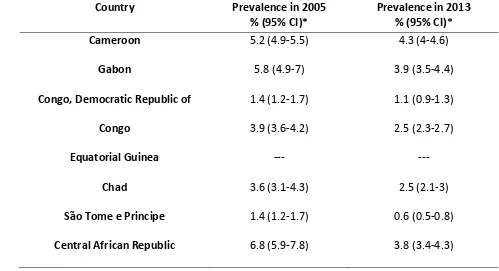
Table A Central African countries by HIV/AIDS prevalence in 2005 and 2013
Country Prevalence in 2005
% (95% CI)* Prevalence in 2013 % (95% CI)*
Cameroon 5.2 (4.9-5.5) 4.3 (4-4.6)
Gabon 5.8 (4.9-7) 3.9 (3.5-4.4)
Congo, Democratic Republic of 1.4 (1.2-1.7) 1.1 (0.9-1.3)
Congo 3.9 (3.6-4.2) 2.5 (2.3-2.7)
Equatorial Guinea --- ---
Chad 3.6 (3.1-4.3) 2.5 (2.1-3)
Sa͂o Tome e Principe 1.4 (1.2-1.7) 0.6 (0.5-0.8)
Central African Republic 6.8 (5.9-7.8) 3.8 (3.4-4.3)
Source of data: [23]
*HIV/AIDS Prevalence among adults aged 15 to 49 ---No available data
2.1.1. Republic of Cameroon (Cameroon)
The Republic of Cameroon is a central African country with a size of 475,000 square kilometers
[15]. Yaounde and Douala are respectively the capital and commercial city and represent the
most crowded areas of the country [15]. Cameroon is a lower middle income country and has
the most diverse and productive agriculture in central Africa, yet 40% of the population live
under the poverty level and starvation is periodically rife in the northern part of the country
[24, 25]. Cameroon is characterized by a socio-cultural diversity. Indeed, there are six ethnic
groups, with about 230 sub-ethnic groups, and three main religions: Christianity, Islam and
percent of the population belongs to indigenous African religions. Muslims (22%) are the less
numerous and are likely to be found in the northern part of the country [25]. Moreover, unlike
most of other central African countries which have one official language, Cameroon has two
official languages, French and English.
The population which is estimated to 22.25 million people [24] is young, with 49% aged
between 15 and 49 [25]. Life expectancy in Cameroon is low (55 years) and the country faces
many health-related issues among which a high infant mortality rate (74‰ in 2004), the lack of
medical personnel with only one physician for 13468 inhabitants, and the HIV epidemic [25].
Furthermore, women literacy rate remains relatively low (64.8%) compared with men (78.3%)
[26].
Based on the Cameroon 2011 Demographic Health Survey [25], women remain the most
vulnerable population and are approximately two times more infected than men, with 5.6% of
HIV positive women compared with 2.9% HIV positive men. Moreover, the infection is more
frequently observed in women aged 35-39 and men aged 45-49. The geographical distribution
of the epidemic across the country is not homogeneous. Indeed, people living in urban areas
are more affected (4.8%) than those living in rural areas (3.8%). In addition, the capital city
(Yaounde), the southern, north-western, eastern, and central regions of the country present
the highest prevalence rates respectively of 6.3, 7.2, 6.3, 6.3, and 6.9%, compared to the
2.1.2. Gabonese Republic (Gabon)
Gabon is a central African country, home to 1.672 million dwellers mostly located in Libreville,
the capital city [24]. The official language of this country, extending over 267,667 square
kilometers, is French [15]. Gabon is divided in nine provinces and comprises more than 40
ethnic groups among which the Bapounou and the Teke [15] also found in one of its border
countries, the republic of Congo. Christianity, Islam, animism constitute the major religions in
the country. Despite being an upper middle income country and the most prosperous
producing oil country in sub-Saharan Africa [15, 27], approximately 40% of the population live
under the poverty level [28]. Infant mortality (around 60‰) and HIV infection are the country’s
most important health-related challenges [28]. Moreover, despite the high literacy rate in the
general population (89%), women generally drop out of school at the secondary level [28].
According to the Gabon 2012 Demographic Health Survey (The World Bank, 2014c), Fifty
percent of the population is less than 20 years old, and women are slightly more numerous
than men (94 men for 100 women). Moreover, 85% of the population lives in urban areas [29].
Gabon HIV trends are very similar to those of Cameroon. Indeed, the prevalence of HIV in
Gabon is very close to that of Cameroon, with more than 4% of people infected [29]. In
addition, as in Cameroon, the prevalence of infected women is about twice the prevalence of
infected men (respectively 5.8% and 2.2%), and the most affected age groups are women aged
35-39 and men aged 45-49 [29]. Moreover, the disease is not evenly distributed across the
respectively 7.2 and 5.8% of HIV positive people, while Ogooué-Ivindo has the lowest
prevalences (3.3% of women and 1.3% of men) [29].
2.1.3. Republic of the Congo (Congo)
Housing the World Health Organization’s regional office for Africa, Republic of the Congo is a
central African country with a population of 4.448 million people [24] and a size of 342,000
square kilometers [15]. Based on the Congo 2011 Demographic and Health Survey [30], the
Congolese population is young with 62% of the population aged less than 25. Sixty four percent
of the population lives in urban areas, especially in Brazzaville and Pointe-Noire which are
respectively the capital and commercial cities [30]. These data are consistent with those of the
Congo 2007 census [30] reporting that 61.8% of the general population were living in urban
areas, 39% were aged less than 15 and 57% aged between 15 and 59. The Congo is composed
of 15 Bantu ethnic groups, and French is the official language of the country [15]. Christianity is
the second religion of the country (45%) and only 2% of the population is Muslim. Fifty percent
of the population is part of traditional religions [15].
Despite consistent economic growth observed during the ten last years, 54% of Congolese
children live under the poverty threshold [31]. Moreover, maternal and infant mortality, lack of
access to social services and HIV/AIDS constitute important challenges to the development of
the country [30, 31].
Congo 2009 AIDS Indicator Survey (AIS) has reported a HIV prevalence of 3.2% in the
population aged 15 to 49 [32]. This prevalence has decreased overtime and has been estimated
with 2.1% of men. The highest seroprevalences were found in the group ages of 25-49 and
40-44 for men and women respectively [32]. The disease was not evenly distributed across the
country. Lekoumou, Niari, and Pointe-Noire the commercial city, located in the southern part of
the country, were the most affected with prevalences of respectively 4.8, 4.6, and 4.4%.
Prevalence in the capital city, estimated at 2.4%, was approximately half the prevalence of the
disease in the commercial city Pointe-Noire. The northern, central and western parts of the
country generally had the lower rates of the disease (1.9% in Likouala, 1.7 in Cuvette, 1.5% in
Cuvette-Ouest).
2.1.4. Democratic Republic of Congo (DRC)
Democratic Republic of the Congo constitutes along with Burundi, Kenya, Rwanda, Tanzania,
and Uganda, the Great Lakes region [33]. DRC has a population of 67.51 million people and a
size of 2,344,000 square kilometers [15, 24]. There are approximately 200 ethnic groups in the
country, and 70% of the population is Christian, 10% are Muslim, and 20% belong to traditional
religious groups and sects [15]. The population is young with 64.5% aged less than 25, and
French is the official language [34]. The multiple conflicts the country has faced since its
independence have set the stage to important economic difficulties (DRC is a low income
country) and poor health [34, 35]. According to the DRC 2007 Demographic and Health Survey
[35], the prevalence of the disease among those aged 15 to 49 is 1.2%, with only 0.5% of
pregnant women infected [35], which seems to show a better control of the epidemic
compared with other countries of the central African region. However, it is important to know
a generalized epidemic in DRC, with more than 1% of pregnant women infected (4.1% in 2006)
[35, 36]. Moreover, HIV/AIDS is the first cause of mortality in the workforce [36], which is a
proof that despite this apparent low prevalence rate, the HIV epidemic remains an important
issue in DRC. As in other countries described earlier, women are the most affected by the
disease [35, 36] and their literacy rate, estimated at 57%, is the lowest when compared to
Cameroon (64.85%), Congo (78.4%) and Gabon (85.6%) [34].
2.2. Early Sexual Debut
2.2.1. Definition
According to WHO [37], a first sexual intercourse, with vaginal or anal penetration, taking place
before age 15 is considered early sexual debut.
Trends in early sexual debut vary across different regions of the world, and gender differences
in age at first sex are more noticeable in developing countries [38]. Indeed, sub-Saharan Africa
and Asia, where early marriage is prevailing, are the regions where women first have sex earlier
than men [38]. Nevertheless, some African countries have seen an increase in age at first sex
[9]. In the United States, about 50% of adolescents already engaged in sexual activity by the
end of high school, and age at first sex is constantly decreasing since the 1990s [39]. Moreover,
African American youths tend to begin sexual activity earlier than white and Hispanic youths
[40]. In Europe, early sexual debut vary between 11.5% and 36.9% for girls and between 18%
2.2.2. Determinants of Early Sexual Debut
Available evidence showed that a first sexual intercourse occurring precociously, during
adolescence, is more likely to be impromptu, unprotected and non-consensual [10, 38, 42].
Most consider sexual intercourse to be a normal moment of the adolescent sexual
development [43]. However, in many societies, sexual debut at earlier ages is viewed as an
issue, and is considered to be driven by multiple individual, familial, cultural and environmental
factors [42] Moreover, individual factors seem to induce early sexual activity more importantly
compared to other factors [42].
2.2.2.1. Individual Factors
• Physiological factors are related to pubertal development. An association between early
pubertal development and early sexual activity has been observed in some studies. A
cross-sectional study conducted in Malawi on the relationship between age at
menarche, sexual initiation and education showed that girls having had their menarche
before 14 were more likely to have their first sexual intercourse before 16 [44]. On the
other side, a relationship between advanced pubertal development and early sexual
debut has also been described. Indeed, Price and Hyde [45] found that advanced
pubertal development was associated with early sexual debut in boys after following
American adolescents from age 13 to 15.
• Behaviors also play a great role in the onset of sexual activity. Aggressive behaviors in
childhood have been correlated to early sexual activity in adolescence; school
[46]. In addition, practicing risky behaviors during adolescence, such as drugs and
alcohol use, can lead to early sexual initiation, through disinhibition and relationship
with peers already engaged in sexual activity [10, 12, 41, 42].
• Factors related to education have been found to be important predictors of early sexual
debut among girls. Indeed, little determination for school achievement and low
academic performances have been found to be related to early sexual debut among girls
[42, 45]. A cross-sectional study using Demographic and Health surveys data of eight
sub-Saharan African countries (Mali, Zimbabwe, Burkina Faso, Tanziana, Cote d’Ivoire,
Ghana, Kenya, and Senegal) showed that the higher educational level, the less the
probability that girls experience first coitus before 18. This result was found in all eight
countries [6].
2.2.2.2. Family Factors
Family structure and socioeconomic status are factors that could have consequences on the
adolescent sexual activity. Adolescents growing in a one-parent family or a family with a low
socioeconomic status are more likely to engage in early sexual activity than their peers [40, 42].
Palermo and Peterman [47] found a relationship between orphanhood and early sexual debut
among girls aged between 15 and 17 in seven sub-Saharan African countries [47]. These factors
are mediated by economic and lifestyle instability [42].
Similarly, level of family cohesion and communication also play a role in teenagers’ early sexual
initiation [42, 45].
2.2.2.3. Cultural Factors
• Although a growing number of adolescents in developed countries engage in premarital
sexual activity [41], adolescent marriage is customary in many developing countries,
and is generally viewed as a way to put an end to individual or family economic
difficulties [47]. In developing countries, one in seven adolescent girls gets married
before the age of 15, and 42% of African girls are already married before turning 18
[47]. In this case, early sexual initiation represents a normal consequence of early
marriage.
• Religion is considered a protective factor against early sexual debut. In a qualitative
study on determinants of early sexual debut among Nigerian adolescents aged 14-19
years old, religious beliefs were one of the main reasons for delaying the first sexual
intercourse [48]. In the United States, a study was conducted on the environmental
factors that shape female adolescents sexual initiation and subsequent sexual
behaviors. This study showed that belonging to a conservative religious community
reduced the likelihood of engaging in premarital sexual activity in white and African
American adolescent girls [49].
2.2.2.4. Environmental Factors
• Living environment, especially low socioeconomic neighborhoods, has been found
associated with early sexual initiation in the United States [42]. Living in the rural area is
also considered a risk factor for early sexual commencement in some developing
• Peer pressure and watching pornography on television have also been implicated in the
early onset of sexual activity, mostly in young boys [42, 48].
2.3. Mechanisms of Influence of Early Sexual Debut on HIV infection Risk among Women in sub-Saharan Africa
Four pathways of influence of early sexual initiation on risk of acquiring HIV infection,
particularly among women, have been described by Stöckl, Kalra, Jacobi and Watts (figure 2)
[14]. Biological and behavioral risk factors, as well as factors related to the sexual partner and
duration of sexual activity, are considered to be the main potential mechanisms that could
explain why early sexual debut is a risk factor for HIV infection among women in sub-Saharan
Africa. Although these factors can individually lead to HIV/AIDS in young females engaging in
Figure B Potential causal pathways influencing early sexual debut and its relationship to women’s increased risk of HIV infection in sub-Saharan Africa
Source: [14]
2.3.1. Biological Factors
Women have a heightened risk of being infected with HIV during heterosexual intercourse,
compared to men. Indeed, genital secretions are more easily transferred from men to women
during sexual intercourse, which increases their exposure to infection compared to men [50]. In
addition to this risk, female adolescents present a higher susceptibility to sexually transmitted
infections, including HIV/AIDS, compared to older women [51]. The physiologic and
immunologic immaturity of these adolescents’ genital organs constitutes one of the main
2.3.2. Behavioral Factors
Due to the frequency of condom nonuse, and subsequently, the risk of HIV transmission, a first
sexual intercourse at earlier age is generally not safe for young girls [54]. Moreover, girls who
have had an earlier sexual debut, voluntarily or following rape, generally engage in sexual
behaviors increasing their risk of being infected by HIV/AIDS such as having multiple lifetime sex
partners, concurrent partners, older partners, and not using condom during sex[14, 54, 55].
2.3.3. Factors Related to the Sexual Partner
While adolescent boys have their first sexual experience with girls that are approximately the
same age, their female counterparts generally first have sex with older partners [54]. In Africa,
adolescent girls are more likely to date older partners [14, 55]. This age difference puts girls at
risk of being infected with HIV because their older partners are more likely to have multiple sex
partners [14]. In addition, they are less likely to oblige their partner to use condom because in
most African societies, men are the ones who decide of the use of condom [14, 54].
2.3.4. Duration of Sexual Activity
It has been hypothesized that young girls who start sexual activity earlier are at greater risk of
being infected with HIV because the period of potential exposure to HIV/AIDS is longer
References
[1] CDC. About HIV/AIDS. [Updated2014]. Accessed April 2015 at http://www.cdc.gov/hiv/basics/whatishiv.html
[2] UNAIDS. UNAIDS report on the global AIDS epidemic 2013. Global Report. UNAIDS/jc2502/1/E; 2013.
[3] Ortblad KF, Lozano R, Murray CJL. The burden of HIV: insights from the global burden of disease study 2010. AIDS 2013; 27: 2003-2017.
[4] Onsumu EO, Kimani JK, Abuya BA, Arif AA, Moore D, Duren-Winfield V, Harwell G. Delaying sexual debut as a strategy for reducing HIV epidemic in Kenya. African Journal of Reproductive Health, 2013; 17(2), 46-57.
[5] African Union Commission. Delivering results towards ending AIDS, tuberculosis and malaria in Africa: African Union accountability report on Africa-G8 partnership commitments. UNAIDS; 2013.
[6] Gupta N, Mahy M. (2003). Sexual initiation among adolescent girls and boys: trends and differentials in sub-Saharan Africa. Archives of Sexual Behavior 2003; 32(1): 41-53.
[7] UNAIDS & WHO. Core Epidemiology Slides. UNAIDS/WHO; September 2013.
[8] Chen L, Jha P, Stirling B, Sgaier SK, Daid T, Kaul R, Nagelkerke N. Sexual risk factors for HIV infection in early and advanced HIV epidemics in sub-saharan Africa: systematic overview of 68 epidemiological studies. PLoS ONE 2007; 10: e1001.
[9] Zaba B, Pisani E, Slaymaker E, Ties Boerma J. Age at first sex: understanding recent trends in African demographic surveys. Sexually Transmitted Infections 2004; 80(Suppl II): ii28-ii35. [10] Coker AL, Richter DL, Valois RF, McKeown RE, Garrison CZ, Vincent ML. Correlates and consequences of early initiation of sexual intercourse. Journal of School Health 1994; 64(9): 372-377.
[11] O’Donnell L, O’Donnell CR, Stueve A. Early sexual initiation and subsequent sex-related risks among urban minority youth: the reach for health study. Family Planning Perspectives 2001; 33(6): 268-275.
[14] Stöckl H, Kalra N, Jacobi J, Watts C. Is early sexual debut a risk factor for HIV infection among women in sub-Saharan Africa? A systematic review. American Journal of Reproductive Immunology 2013; 69 (suppl 1): 27-40.
[15] Nationsonline. Africa. Accessed April 2015 at http://www.nationsonline.org/oneworld/index.html.
[16] European commission (Eurostat). Central Africa. [Updated 2010]. Accessed April 2015 at http://epp.eurostat.ec.europa.eu/portal/page/portal/international_statistical_cooperation/afri ca_caribbean_pacific/africa_sub_saharan/central_africa.
[17] Encyclopaedia Britannica. Central Africa. [Updated 2014]. Accessed April 2015 at Retrieved from http://www.britannica.com/EBchecked/topic/102127/Central-Africa.
[18] The World Bank. Central Africa: CEMAC-economic and monetary community of Central Africa. [Updated 2013]. Accessed April 2015 at
http://web.worldbank.org/WBSITE/EXTERNAL/COUNTRIES/AFRICAEXT/EXTREGINI/EXTAFRREGI NICOO/0,,contentMDK:20626584~menuPK:1592430~pagePK:64168445~piPK:64168309~theSit ePK:1587585,00.html.
[19] CEEAC-ECCAS. Communauté économique des états de l’Afrique centrale: états membres. [Updated 2014]. Accessed April 2015 at
http://www.ceeac-eccas.org/index.php?option=com_content&view=article&id=41&Itemid=4.
[20] Vidal N, Peeters M, Mulanga-Kabeya C, Nzilambi N, Robertson D, Ilunga W, Sema H, Tschimanga K, Bongo B, Delaporte, E. Unprecedented degree of Human Immunodeficiency Virus type 1 (HIV-1) group M genetic diversity in the Demographic Republic of the Congo suggests that the HIV-1 pandemic originated in Central Africa. Journal of Virology 2000; 74 (22): 10498-10507.
[21] Avert. History of HIV & AIDS in Africa. Accessed April 2015 at http://www.avert.org/history-hiv-aids-africa.htm.
[22] Avert. HIV and AIDS in sub-Saharan Africa. Accessed April 2015 at http://www.avert.org/hiv-aids-sub-saharan-africa.htm.
[23] WHO. Global Health Observatory Data Repository. Updated 2014. Accessed April 2015 at http://apps.who.int/gho/data/node.country.
[24] The World Bank. Countries and economies. [Updated 2014]. Accessed April 2015 at http://data.worldbank.org/country.
[25] The World Bank. Cameroon-enquête démographique et de santé ὰ indicateurs multiples 2011. [Updated 2014]. Accessed April 2015 at
http://microdata.worldbank.org/index.php/catalog/1564. [26] The World Factbook. Cameroon. Accessed April 2015 at
[27] Emerging policy: a general overview of Gabon. Accessed April 2015 at http://www.en.legabon.org/emerging-gabon/emerging-policy
[28] UNICEF. Gabon. [Updated 2003]. Accessed April 2015 at http://www.unicef.org/infobycountry/gabon_1746.html
[29] The World Bank. Gabon-enquête démographique et de santé 2012. [Updated 2014]. Accessed April 2015 at http://microdata.worldbank.org/index.php/catalog/1560
[30] The World Bank. République du Congo-enquête démographique et de santé 2011-2012. [Updated 2014] Accessed April 2015 at
http://microdata.worldbank.org/index.php/catalog/1767
[31] UNICEF. At a glance: Congo. [Updated 2003]. Accessed April 2015 at http://www.unicef.org/infobycountry/congo_2686.html
[32] DHS program. Congo (Brazzaville): standard AIS 2009. Accessed April 2015 at http://dhsprogram.com/what-we-do/survey/survey-display-370.cfm
[33] The World Bank. Rapid analysis of HIV epidemiological and response data on vulnerable populations in the great lakes region of Africa. [Updated 2008]. Accessed April 2015 at http://hivinsite.ucsf.edu/global?page=cr09-cg-00
[34] The World Factbook. Democratic Republic of the Congo. Accessed April 2015 at https://www.cia.gov/library/publications/the-world-factbook/geos/cg.html
[35] Democratic Republic of the Congo Demographic and Health Survey 2007. Accessed April 2015 at http://hivinsite.ucsf.edu/global?page=cr09-cg-00
[36] UNGASS 2008 country progress report. Accessed April 2015 at http://hivinsite.ucsf.edu/global?page=cr09-cg-00
[37] WHO. National AIDS programmes: a guide to indicators for monitoring and evaluating national HIV/AIDS prevention programmes for young people. WHO; 2004.
[38] Wellings K, Collumbien M, Slaymaker E, Singh S, Hodges Z, Patel D, Bajos N. Sexual behavior in context: a global perspective. Lancet 2006; 368: 1706-1728.
[39] Meier A. Adolescent first sex and subsequent mental health. American Journal of Sociology 2007; 112(6): 1811-1847.
[40] Browning CR, Leventhal T, Brooks-Gunn J. Neighborhood context and racial differences in early adolescent sexual activity. Demography 2004; 41(4): 697-720.
[42] Smith C. Factors associated with early sexual activity among urban adolescents. Social Work 1997; 42(4): 334-346.
[43] Dacey J, Kenny M. Sexuality. 2nd ed. Massachusetts, MA: McGraw-Hill Companies, Inc; 1997. Adolescent Development; p. 276-313.
[44] Glynn JR, Kayuni N, Floyd S, Banda E, Francis-Chizororo M, Tanton C. Molesworth A, Hemmings J, Crampin A, French N. Age at menarche, schooling, and sexual debut in northern Malawi. PLoS ONE 2010; 5(12): e15334.
[45] Price MN, Hyde JS. When two isn’t better than one: predictors of early sexual activity in adolescence using a cumulative risk model. Journal of Youth and Adolescence 2009; 38: 1059-1071.
[46] Schofield HLT, Bierman KL, Heinrichs B, Nix RL, Conduct Problems Prevention Research Group. Predicting early sexual activity with behavior problems exhibited at school entry and in early adolescence. Journal of Abnormal Child Psychology 2008; 36: 1175-1188.
[47] Palermo T, Peterman A. Are female orphans at risk for early marriage, early sexual debut, and teen pregnancy? Evidence from sub-Saharan Africa. Studies in Family Planning 2009; 40(2): 101-112.
[48] Ankomah A, Mamman-Daura F, Omoregie G, Anyanti J. Reasons for delaying or engaging in early sexual initiation among adolescents in Nigeria. Adolescent Health, Medicine and Therapeutics 2011; 2: 75-84.
[49] Billy JOG, Brewster KL, Grady WR. Effects on the sexual behavior of adolescent women. Journal of Marriage and Family 1994; 56(2): 387-404.
[50] Pettifor AE, Van Der Straten A, Dunbar MS, Shiboski SC, Padian NS. Early age of first sex: a risk factor for HIV infection among women in Zimbabwe. AIDS 2004; 18, 1435-1442.
[51] Upchurch DM, Kusunoki Y. Associations between forced sex, sexual and protective practices, and sexually transmitted diseases among a national sample of adolescent girls. Women’s Health Issues 2004; 14: 75-84.
[52] Kahn JA, Huang B, Rosenthal SL, Tissot AM, Burk RD. Coercive sexual experiences and subsequent human papillomavirus infection and squamous intraepithelial lesions in adolescent and young adult women. Journal of Adolescent Health 2005; 36: 363-371.
CHAPTER III MANUSCRIPT
Early sexual debut and Human Immunodeficiency Virus infection in Central Africa
Abstract: Early sexual debut has been recognized to play a seminal role in the heterosexual HIV
transmission among adolescents and young adults in sub-Saharan Africa. A cross-sectional
analysis of the relationship between initiation of sexual activity before age 15 and HIV sero-status, among men and women aged 15-24 years, was conducted using Demographic and Health Surveys data of four central African countries with different levels of HIV seroprevalence, namely Cameroon, Gabon, Democratic Republic of Congo, and Congo. The median age at sexual debut varied between 15 and 16 years in all countries. Afteradjusting for sociodemographic, economic, behavioral, and most recent partner’s characteristics, as well as HIV prevention knowledge, early sexual debut was significantly associated with a positive HIV test among women in Cameroon (OR, 2.52; 95% CI, 1.57-4.01; p=.0001) and Democratic Republic of Congo (OR, 3.92; 95%CI, 1.71-9.48; p=.002). No association was found statistically significant among men. Among female Cameroonians, an age between 20-24 years (OR, 1.88; 95% CI, 1.13-3.22; p=.02) and a lifetime number of sexual partners greater than one (OR, 3.05; 95%CI, 1.77-5.61; p=.0001) remained significantly associated with HIV, whereas a negative association was found between a low economic status and HIV infection among women in Democratic Republic of Congo (OR, 0.16; 95%CI, 0.04-0.5; p=.004), in the multivariate analyses. Early sexual debut is associated with HIV infection among young women in some central African countries, independently of the level of HIV seroprevalence of the country. Sex-education strategies for the youth in central Africa, particularly for women, should emphasize the necessity of delaying first sexual intercourse and avoiding other risky sexual behaviors.
Keywords: HIV, first intercourse, sexual behavior, women, central Africa
1. Introduction
The HIV/AIDS pandemic represents one of the major world challenges with 35.3 million of people living with HIV worldwide, of which 25 million are located in sub-Saharan Africa, which also accounts for 1.2 million deaths and 1.6 million of new infections [1]. As HIV transmission
early sexual debut. Early sexual debut is often used as an indicator of high-risk sexual behaviors and a predictor of sexually transmitted infections, particularly among adolescents [7, 8]. Research conducted on the relationship between early sexual debut and HIV infection has shown that African women engaging in early first sex are more vulnerable to HIV than their male counterparts [5]. The decrease in the prevalence of the HIV infection among young pregnant women in Uganda, possibly associated with an increase in age at first sex between 1990 and 1995, exemplifies the critical role of this factor in the transmission of the disease [9]. Proposed mechanisms [5] to explain the role played by early sexual debut in HIV acquisition among women are, inter alia, the immaturity of the genital tract and its trauma caused by the coercive nature of the first intercourse; the tendency of young women who have sex early to engage in subsequent risky sexual behaviors such as multiple lifetime number of sex partners, concurrency, and unprotected sex; the power imbalance between men and women regarding the sexual act, with most African women’s fear to refuse sex or ask their partner to use condom, and poverty driving them to early sex with older partners inclined to have concurrent sex partners. In Central Africa, Cameroon is the country where the relationship between early sexual debut and HIV has been studied extensively [3, 10, 11], and little is known about this relationship in other central African countries. This study was therefore intended to examine the relationship between early sexual debut and HIV infection among young men and women aged 15-24 in four central African countries with different levels of HIV prevalence. Two central African countries with relatively high
HIV prevalence, Cameroon 4.3% (4-4.6) and Gabon 3.9% (3.5-4.4), were compared to two central African countries with lower HIV prevalences, Congo 2.5% (2.3-2.7), and Democratic Republic of Congo 1.1% (0.9-1.3) [12]. It was hypothesized that young people aged 15-24, particularly women, living in higher HIV prevalence countries would be more likely to be infected with HIV compared to those living in lower HIV prevalence countries because they had their first sexual intercourse before age 15.
2. Methods 2.1. Data Source
for all women aged 49 and men aged 15-59 eligible in the household in Cameroon, Gabon, and Democratic Republic of the Congo, and all men and women aged 15-49 in Congo. For the purpose of this study, analyses were limited to respondents aged 15-24 who ever had sex, for whom data on HIV sero-status and age at first sex were reported.
2.2. Variables and Measures
The outcome measured for this study, HIV sero-status, was defined as a binary outcome: HIV seropositive and HIV seronegative respectively based on the respondent positive or negative results to HIV testing. The main predictor for which we intended to study the association with HIV sero-status was age at sexual debut,
defined as a dichotomous variable: ˂15
versus 15 and above. A respondent was
considered as having had an early sexual debut when the first sexual intercourse took place before age 15. Other factors explored as potential determinants of HIV infection in the study population were grouped into 4 areas of interest: (1) Sociodemographic and economic factors: respondent current age at the time of the survey (ages 15-19 years and 20-24 years); residence (living in urban or rural area), marital status (currently married/living with partner, or not); highest educational level (‘no education’ for those who never attended school, ‘primary level’ for those who did not attain high-school level, and ‘secondary/higher level’ for those who attained high-school or university level at the time of the survey); religion (‘Christians’ including catholic and protestants, ‘Muslims’, ‘Other religions’ including country-specific religions, and ‘none’); wealth index (based on household assets
and utility services reflecting economic status; agricultural land ownership, and presence of domestic servant in the household) [14]. (2) High-risk sexual behaviors including lifetime number of sexual partners (one or more than one partner); condom use every time the respondent had sex with the most recent partner in the 12 months preceding the survey; cumulative concurrency (overlapping sexual relationships in the 12 months preceding the survey). (3) Most recent partner characteristics, comprising the type of relationship with the most recent sexual partner (spouse, boyfriend/girlfriend not cohabiting, casual sex partner, commercial sex worker or live-in partner) and the most recent partner age (a partner was considered older when age difference with the respondent’s current age was equal or greater than 3). (4) Knowledge of the respondent regarding HIV/AIDS prevention, measured by asking the respondent whether or not HIV/AIDS could be prevented by ‘always using a condom during sex’, and ‘having one sex partner only, who had no other partners’. Age at sexual debut, respondent current age, most recent partner age, and lifetime number of sexual partners were described both as continuous and categorical variables.
2.3. Statistical Analysis
bivariate analyses, Chi-square test of homogeneity was used to determine the significance of the differences between levels/values of the independent variables according to HIV sero-status, by sex and country. Fisher’s exact test was used when one or more of the expected cell frequencies were less than 5 (chi-square test of homogeneity not valid). Univariate association between HIV sero-status and each predictor was examined in logistic regression analysis, and unadjusted odds ratios (ORs) and 95% confidence intervals (CI) were computed. Finally, multivariate logistic regression analysis was performed to determine the association between age at coital debut and HIV sero-status, controlling for sociodemographic and economic factors, other high-risk sexual
behaviors, most recent partner
characteristics and HIV prevention knowledge. A standard model was developed to allow for comparison between countries, after performing a manual selection of variables coupled to a stepwise elimination (with alpha level at entry P ≤
.10). Variables that were found to be significantly associated with HIV at the level
P≤.05 in the univariate analysis, in at least one country, were the first ones to be manually included into the model. Age at coital debut was kept in the adjusted model regardless of the level of significance of its association with the outcome. Data on cumulative concurrency and last partner age were not available for Congo; therefore, these variables were not included into the standard model. Statistical significance was set at an alpha level of 0.05. All analyses were conducting using SAS version 9.3 (SAS Institute, Cary, NC, USA).
3. Results
3.1. Descriptive Analysis
Table1 Countries included in the study and respective samples size
Country (survey period) % aged 15-24 Study Sample size Men n (%) Women n (%)
Higher HIV Prevalence
Cameroon (January-August 2011) 9,511 3,760 1,628 (43.3) 2,132 (56.7) Gabon (January-May 2012) 5,369 3,264 1,521 (46.6) 1,743 (53.4)
Lower HIV Prevalence
DRC (November 2013-February 2014) 10,730 4,568 1,941 (42.5) 2,627 (57.5) Congo (March-June 2009) 4,558 3,485 1,496 (42.9) 1,989 (57.1) DRC: Democratic Republic of Congo
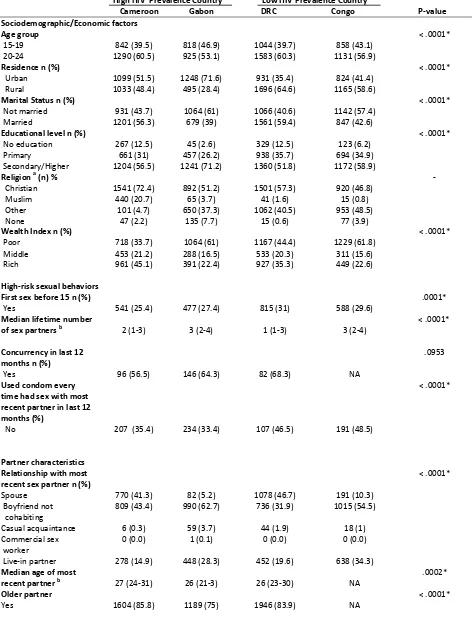
The proportions of HIV-positive females were significantly higher in the higher HIV prevalence countries than the lower HIV prevalence countries (p˂.0001). Indeed,
3.7% and 2.7% of females respectively in Cameroon and Gabon were HIV-positive, whereas 0.9%, and 2% of females in Democratic Republic of Congo and Congo had HIV infection. The respective prevalences among males were 0.8%, 0.7%, 0.2%, and 0.7% (p˂.0001). Overall, the proportions of males and females having engaged in early sexual debut were lower compared to those who had sex at age 15 or later. The median ages at sexual debut (with 25th and 75th percentiles) among females were respectively 16 (14-17), 16 (14-17), 15 (14-17), and 15 (14-16) in Cameroon, Gabon, Democratic Republic of
Congo, and Congo (p ˂.0001). The
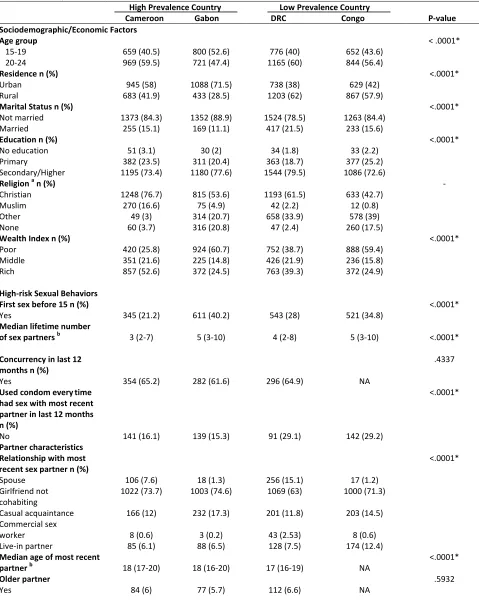
proportions of females respondents having experienced early sexual debut were significantly lower in the higher HIV prevalence countries than in the lower HIV prevalence countries (p=.0001). Indeed, 25.4% and 27.4% of females respectively in Cameroon and Gabon reported having had their first sexual intercourse before age 15 compared to 31%, and 29.6% in Democratic Republic of Congo and Congo respectively (Table2a). Among those females who experienced early sexual debut, 50.3%, 57%, 50.5%, and 52.9% in Cameroon, Gabon, Democratic Republic of Congo, and
Congo were aged between 15 and 19 years at the time of the survey. The median ages at sexual debut among males from Cameroon, Gabon, Democratic Republic of Congo, and Congo were 16 (15-18), 15 (14-16), 15 (14-17), and 15 (14-17) respectively
(p ˂.0001). Gabon and Congo were the
countries with the highest proportions of early sexual debut among males, respectively 40.2% and 34.8% (Table 2b). Males in the age group 15-19 engaged in sexual activity earlier than those in the age group 20-24, and represented respectively 59.4%, 62.5%, 58%, and 52.2% of males engaging in early sexual debut in Cameroon, Gabon, Democratic Republic of Congo, and Congo.
Gabon, Democratic Republic of Congo, and Congo had a low economic status (Table 2a). The median age of male respondents included in the study was 20 years (18-22) in Cameroon, Democratic Republic of Congo, Congo, and 19 years (17-22) in Gabon. As Cameroonian and Gabonese females, most Cameroonian and Gabonese males were living in urban areas whereas males from low HIV prevalence countries were mostly living in rural areas (Table 2b). Most males in the four countries were Christians, not married or living with their partner and already attained the high-school or university level at the time of the survey (Table 2b). Most males in Gabon and Congo had a low economic status whereas those in Cameroon and Democratic Republic of Congo had a higher economic status (Table 2b).
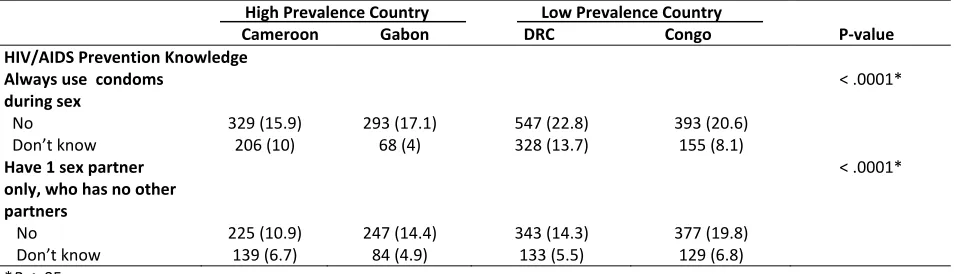
Regarding the behavioral profile of females and males in the four countries, although males had more lifetime number of sex partners than females, the median lifetime number of sex partners was higher in males and females from Gabon and Congo compared to other countries. Most females and males in Cameroon, Gabon and Democratic Republic of Congo engaged in concurrency during the 12 months preceding the survey; females and males in the four countries who did not use condom every time they had sex with their most recent partner in the 12 months preceding the survey were less numerous than those who used condom regularly (Tables 2a and 2b).
Regarding the female respondents most recent sex partner’s characteristics, most of these partners were the spouses or boyfriends of the respondents; only few
females’ most recent sex partner was a casual acquaintance, and only one female (from Gabon) most recent sex partner was a commercial sex worker (Table 2a); Compared to females, more males’ most recent sex partner was a casual acquaintance or a commercial sex worker (Table 2b). Females’ most recent partners were older in the four countries, whereas males’ most recent partners were younger. Most female and male respondents in the four countries were aware that HIV could be prevented by using condom and being faithful to one’s partner.
Table 2a Descriptive characteristics of women by country High HIV Prevalence Country
Cameroon Gabon DRC Congo Low HIV Prevalence Country P-value Sociodemographic/Economic factors
Age group
15-19
20-24 1290 (60.5) 842 (39.5) 818 (46.9) 925 (53.1) 1044 (39.7) 1583 (60.3) 1131 (56.9) 858 (43.1)
˂ .0001*
Residence n (%)
Urban
Rural 1099 (51.5) 1033 (48.4) 1248 (71.6) 495 (28.4) 1696 (64.6) 931 (35.4) 1165 (58.6) 824 (41.4)
˂ .0001*
Marital Status n (%)
Not married
Married 1201 (56.3) 931 (43.7) 1064 (61) 679 (39) 1066 (40.6) 1561 (59.4) 1142 (57.4) 847 (42.6)
˂ .0001*
Educational level n (%)
No education Primary Secondary/Higher 267 (12.5) 661 (31) 1204 (56.5) 45 (2.6) 457 (26.2) 1241 (71.2) 329 (12.5) 938 (35.7) 1360 (51.8) 123 (6.2) 694 (34.9) 1172 (58.9)
˂ .0001*
Religion a (n) % -
Christian Muslim Other None 1541 (72.4) 440 (20.7) 101 (4.7) 47 (2.2) 892 (51.2) 65 (3.7) 650 (37.3) 135 (7.7) 1501 (57.3) 41 (1.6) 1062 (40.5) 15 (0.6) 920 (46.8) 15 (0.8) 953 (48.5) 77 (3.9)
Wealth Index n (%)
Poor Middle Rich 718 (33.7) 453 (21.2) 961 (45.1) 1064 (61) 288 (16.5) 391 (22.4) 1167 (44.4) 533 (20.3) 927 (35.3) 1229 (61.8) 311 (15.6) 449 (22.6)
˂ .0001*
High-risk sexual behaviors First sex before 15 n (%)
Yes 541 (25.4) 477 (27.4) 815 (31) 588 (29.6) .0001*
Median lifetime number
of sex partners b 2 (1-3) 3 (2-4) 1 (1-3) 3 (2-4) ˂ .0001*
Concurrency in last 12 months n (%)
Yes 96 (56.5) 146 (64.3) 82 (68.3) NA
.0953
Used condom every time had sex with most recent partner in last 12 months (%)
No 207 (35.4) 234 (33.4) 107 (46.5) 191 (48.5)
˂ .0001*
Partner characteristics Relationship with most recent sex partner n (%)
Spouse Boyfriend not cohabiting Casual acquaintance Commercial sex worker Live-in partner 770 (41.3) 809 (43.4) 6 (0.3) 0 (0.0) 278 (14.9) 82 (5.2) 990 (62.7) 59 (3.7) 1 (0.1) 448 (28.3) 1078 (46.7) 736 (31.9) 44 (1.9) 0 (0.0) 452 (19.6) 191 (10.3) 1015 (54.5) 18 (1) 0 (0.0) 638 (34.3)
˂ .0001*
Median age of most
recent partner b 27 (24-31) 26 (21-3) 26 (23-30) NA .0002*
Older partner
Table 2a Descriptive characteristics of women by country (Continued)
*P≤ .05.
a. Religion is a country-specific variable-‘other religions’ differ between countries. b. The 25th and 75th percentiles are displayed in the parentheses.
Percentages may not total 100% because of rounding. DRC= Democratic Republic of Congo.
NA= data not available.
High Prevalence Country
Cameroon Gabon DRC Congo Low Prevalence Country P-value HIV/AIDS Prevention Knowledge
Always use condoms during sex
No
Don’t know 329 (15.9) 206 (10) 293 (17.1) 68 (4) 547 (22.8) 328 (13.7) 393 (20.6) 155 (8.1)
˂ .0001*
Have 1 sex partner only, who has no other partners
No
Don’t know 225 (10.9) 139 (6.7) 247 (14.4) 84 (4.9) 343 (14.3) 133 (5.5) 377 (19.8) 129 (6.8)
Table 2b Descriptive characteristics of men by country
High Prevalence Country
Cameroon Gabon DRC Congo Low Prevalence Country P-value Sociodemographic/Economic Factors
Age group
15-19
20-24 659 (40.5) 969 (59.5) 800 (52.6) 721 (47.4) 1165 (60) 776 (40) 652 (43.6) 844 (56.4)
˂ .0001*
Residence n (%)
Urban
Rural 683 (41.9) 945 (58) 1088 (71.5) 433 (28.5) 1203 (62) 738 (38) 867 (57.9) 629 (42)
˂.0001*
Marital Status n (%)
Not married
Married 1373 (84.3) 255 (15.1) 1352 (88.9) 169 (11.1) 1524 (78.5) 417 (21.5) 1263 (84.4) 233 (15.6)
˂.0001*
Education n (%)
No education Primary Secondary/Higher 51 (3.1) 382 (23.5) 1195 (73.4) 30 (2) 311 (20.4) 1180 (77.6) 34 (1.8) 363 (18.7) 1544 (79.5) 33 (2.2) 377 (25.2) 1086 (72.6) ˂.0001*
Religion a n (%) -
Christian Muslim Other None 1248 (76.7) 270 (16.6) 49 (3) 60 (3.7) 815 (53.6) 75 (4.9) 314 (20.7) 316 (20.8) 1193 (61.5) 42 (2.2) 658 (33.9) 47 (2.4) 633 (42.7) 12 (0.8) 578 (39) 260 (17.5)
Wealth Index n (%)
Poor Middle Rich 420 (25.8) 351 (21.6) 857 (52.6) 924 (60.7) 225 (14.8) 372 (24.5) 752 (38.7) 426 (21.9) 763 (39.3) 888 (59.4) 236 (15.8) 372 (24.9) ˂.0001*
High-risk Sexual Behaviors First sex before 15 n (%)
Yes 345 (21.2) 611 (40.2) 543 (28) 521 (34.8) ˂.0001*
Median lifetime number
of sex partners b 3 (2-7) 5 (3-10) 4 (2-8) 5 (3-10) ˂.0001*
Concurrency in last 12 months n (%)
Yes 354 (65.2) 282 (61.6) 296 (64.9) NA
.4337
Used condom everytime had sex with most recent partner in last 12 months n (%)
No 141 (16.1) 139 (15.3) 91 (29.1) 142 (29.2)
˂.0001*
Partner characteristics Relationship with most recent sex partner n (%)
Spouse Girlfriend not cohabiting Casual acquaintance Commercial sex worker Live-in partner 106 (7.6) 1022 (73.7) 166 (12) 8 (0.6) 85 (6.1) 18 (1.3) 1003 (74.6) 232 (17.3) 3 (0.2) 88 (6.5) 256 (15.1) 1069 (63) 201 (11.8) 43 (2.53) 128 (7.5) 17 (1.2) 1000 (71.3) 203 (14.5) 8 (0.6) 174 (12.4) ˂.0001*
Median age of most recent
partner b 18 (17-20) 18 (16-20) 17 (16-19) NA ˂.0001*
Older partner
Table 2b Descriptive characteristics of men by country (Continued)
High Prevalence Country
Cameroon Gabon Low Prevalence Country DRC Congo P-value HIV/AIDS Prevention Knowledge
Always use condoms during sex
No
Don’t know 214 (13.3) 48 (3) 146 (9.7) 21 (1.4) 321 (17) 90 (4.7) 173 (11.75) 37 (2.51)
˂ .0001*
Have 1 sex partner only, who has no other partners
No
Don’t know 187 (11.6) 28 (1.7) 154 (10.2) 29 (1.9) 240 (12.7) 66 (3.5) 196 (13.31) 42 (2.85)
.0008
*P≤ .05.
a. Religion is a country-specific variable-‘other religions’ differ between countries. b. The 25th and 75th percentiles are displayed in the parentheses.
Percentages may not total 100% because of rounding. DRC= Democratic Republic of Congo.
NA= data not available.
3.2. Bivariate Analysis
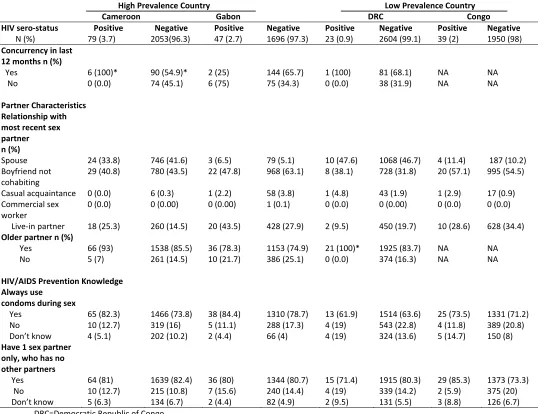
The sociodemographic, economic, and behavioral characteristics of the respondents, as well as their last partner characteristics and HIV prevention knowledge, according to their HIV sero-status, were displayed in Tables 3a and 3b. The majority of females who tested positive for HIV in the four countries were aged between 20 and 24 years, and, except for females in Democratic Republic of Congo, they had had their sexual debut at age 15 or later (Table 3a). Most HIV-positive females in Gabon and Democratic Republic of Congo were living in urban areas (78.7% and 52.2% respectively), whereas it was the opposite in Cameroon and Congo (50.6% and 56.4%, respectively, were living in rural areas). HIV-positive females in high HIV prevalence countries were, in majority, married or living with a partner (respectively 59.5% and 53.2%); contrariwise, most of their counterparts in low HIV prevalence countries were not married or living with a partner (52.2% and 69.2%). Most HIV-positive females already attained at least
infected females in Cameroon, Gabon, and Democratic Republic of Congo. The majority of HIV-positive females in the four countries
Table 3a Distribution of selected characteristics by HIV sero-status and country for women
High Prevalence Country
Cameroon Gabon Low Prevalence Country DRC Congo HIV
Sero-status N (%) Positive 79 (3.7) 2053(96.3) Negative Positive 47 (2.7) 1696 (97.3) Negative Positive 23 (0.9) 2604 (99.1) Negative Positive 39 (2) 1950 (98) Negative
Sociodemographic/Economic Factors Age n (%)
15-19
20-24 58 (73.4)* 21 (26.6) 1232 (60) 821 (40) 12 (25.5) 35(74.5)** 890 (52.5) 806 (47.5) 16 (69.6) 7 (30.4) 1037 (39.8) 1567 (60.2) 30 (76.9)* 9 (23.1) 1101 (56.5) 849 (43.5)
Residence n (%)
Urban
Rural 39 (49.4) 40 (50.6) 1060 (51.6) 993 (48.4) 37 (78.7) 10 (21.3) 1211 (71.4) 485 (28.6) 12 (52.2) 11 (47.8) 1685 (64.7) 919 (35.3) 17 (43.6) 22 (56.4) 1143 (58.6) 807 (41.4)
Marital Status n (%)
Not married
Married 32 (40.5) 47 (59.5) 1154 (56.2) 899 (43.8) 25 (53.2)* 22 (46.8) 1042 (61.4) 654 (38.6) 12 (52.2) 11 (47.8) 1054 (40.5) 1550 (59.5) 27 (69.2) 12 (30.8) 1115 (57.2) 835 (42.8)
Educational level n (%)
No education Primary Secondary/ Higher 5 (6.3) 27 (34.2) 47 (59.5) 262 (12.8) 634 (30.9) 1157 (56.4) 1 (2.1) 12 (25.5) 34 (72.3) 44 (2.6) 445 (26.) 1207(71.2) 1 (4.3) 11 (47.8) 11 (47.8) 328 (12.6) 927 (35.6) 1349 (51.8) 5 (12.8) 16 (41) 18 (46.1) 118 (6) 678 (34.8) 1154 (59.2)
Religion n (%)
Christian Muslim Other None 60 (75.9) 15 (19) 3 (3.8) 1 (1.3) 1481 (72.2) 425 (20.7) 98 (4.8) 46 (2.2) 28 (59.6) 1 (2.1) 16 (34) 2 (4.3) 864 (50.9) 64 (3.8) 634 (37.4) 133 (7.8) 15 (68.2) 1 (4.5) 6 (27.3) 0 (0.00) 1486 (57.2) 40 (1.5) 1056 (40.7) 15 (0.6) 14 (35.9) 0 (0.00) 22 (56.4) 3 (7.7) 906 (47) 15 (0.8) 931 (48.3) 74 (3.8) Wealth Index n (%) Poor Middle Rich 22 (27.8) 20 (25.3) 37 (46.8) 696 (33.9) 433 (21.1) 924 (45) 26 (55.3) 11 (23.4) 10 (21.3) 1038 (61.2) 277 (16.3) 381 (22.5) 3 (13) 7 (30.4) 13(56.5)** 1164 (44.7) 526 (20.2) 914 (35.1) 23 (59) 6 (15.4) 10 (25.6) 1206 (61.8) 305 (15.6) 439 (22.5)
High-risk Sexual Behaviors First sex before
15 n (%)
Yes
No 45(57)*** 34 (43) 1546 (75.3) 507 (24.7) 10 (21.3) 37 (78.7) 1229 (72.5) 467 (27.5) 14 (60.9)** 9 (39.1) 1803 (69.2) 801 (30.8) 13 (33.3) 26 (66.7) 1375 (70.5) 575 (29.5)
Lifetime number of sexual partners n (%)
1
˃1 64 (81)*** 15 (19) 1157 (56.5) 891 (43.5) 44 (93.6)** 3 (6.4) 1281(75.5) 415 (24.5) 17(73.9)* 6 (26.1) 1314 (50.5) 1289 (49.5) 33 (84.6) 6 (15.4) 1528 (78.4) 421 (21.6)
Used condom every time had sex with most recent partner in last 12 months n (%) Yes